
Towards a collective localisation of memory and intimacy
Home as a non-physical place.
Aimilia Antoniou
Thesis supervisors: Erik Hagoort, Mariska van den Berg
Submitted to
Master Fine Art & Design, St.Joost School of Art & Design, Avans University of Applied Sciences, s’Hertogenbosch The Netherlands
In partial fulfilment of the requirements for the degree of Master of Art in Fine Art & Design
s’ Hertogenbosch, The Netherland
Abstract
In this thesis I am redefining home and looking from another perspective on what makes a place or space home. Using a phenomenological approach, my personal experience, as well as art practices, I use memory, imagination and somatic ways of knowing to approach home as an unstable and non-physical environment.
Through workshops we create collectively an environment of remembrance and bring forward our intimacies and thus we habitate spaces that were not meant to feel like home. This is what speaks to its non-physical state. The charcoal as a material offers the fluidity of the notion of home and the stopmotion technique proves to be the way to “map” an unstable environment. My research offers ways of carrying home with us and sheds light on the fact that it is within us, and we can find it and localize it in the spaces we habitate.
Acknowledgements
To my mum and sister that helped me feel home in more than one places and spaces.
To my supporting environment that always was impelling me to search deeper and keep moving forward.
To my lovely professors Erik Hagoort, Martine Stig and Mariska van den Berg who helped me throughout the writing of the thesis and evolution of my art practice.
There is this Greek word that keeps coming in my mind whenever I need to write down my thoughts.
Νοσταλγία (nostalgia), which is a compound word, deriving from the ancient νόστος (nostos) which means return and ἄλγος (algos) which means pain. It has come to have a negative meaning although I strongly believe otherwise. You see the etymology of algos is the negation -a and the verb λέγω (lego) which means to tell. So, by etymology the word is about what is not being said. We’ve all have had these silent moments of thinking back, delving in our memory casket, reliving what was lived, or maybe daydreaming of what could have been… These moments of having an internal conversation with ourselves and our past. These moments don’t necessarily come with pain or sadness. They can also come with joy, laughter or hope. They can also take the shape of daydreaming our past and imagining different outcomes by slightly changing our decision making. It really can be a playful process.
As a child I used to fantasize my environment had life of its own. I loved to personify things or places, and I still do, although not as often anymore. There is something special in these private quiet moments while having dialogues with my surroundings, listening to or making up their stories. To put some narrative in the environment that encompasses me and, in that way, help myself feel grounded, at place. As a child I built an intimacy I very much needed. "The ability to fantasize is the ability to survive, and the ability to fantasize is the ability to grow".
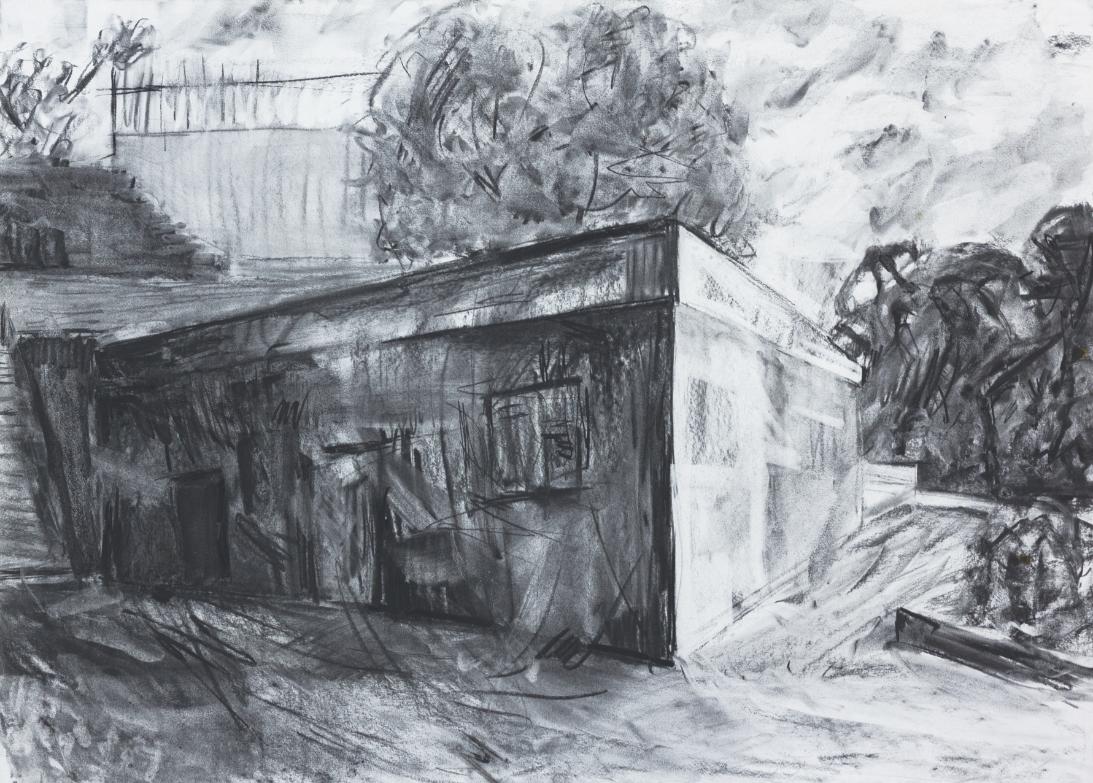
(Bradburry, 1991)
Localizing emotions of belonging, of being heard and seen by trying to hear and see the space I was within. That space was special in the way that being high up the mountain around large pine tree forests is. We had the constant threat of fire, either due to ecological reasons or foul play. There were many deserted houses around, which were burned at some point in time and remained as reminders, standing there slowly caving in. My grandma then, without being conscious about it, led me in some way in the path I am on today, as she used to take me and my sister for walks and explorations in abandoned burned houses in our neighborhood and tell us the stories of the houses (not the actual ones of course but her own made up narratives of them). I used to be amazed at how much information, memory and sentimentalism can live in a house even without its residents - and all of it lives in all its extensibility.
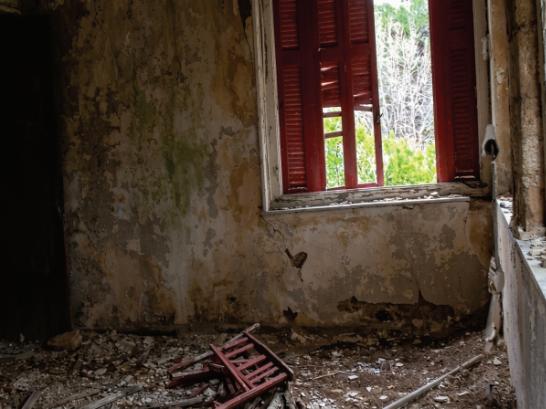
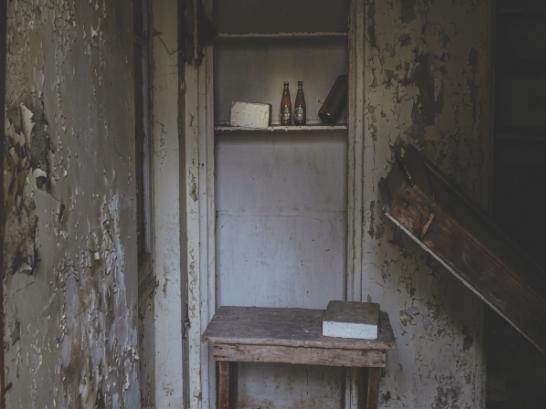
Bachelard has been a great influence as well. As a French philosopher his stand was that scientific inquiry is not enough to build knowledge and find answers but in fact human experience is equally important and should be taken into account. He argued that scientific understanding is fundamentally shaped by the subjective nature of human observation and cognitive processes. In these thoughts I have been finding myself as well when thinking about artistic research and how I could reveal knowledge that mostly we have within us.
“ It is a non-house in the same way metaphysicians speak of a non-I, and between the house and the nonhouse it is easy to establish all sorts of contradictions. Inside the house, everything may be differentiated and multiplied. The house derives reserves and refinements of intimacy from winter; while in the outside world, snow covers all tracks, blurs the road, muffles every sound, conceals all colors.” (Bachelard, 1964, p. 61)
In this first passage Bachelard compares the nonhouse aka the “outside world”, which he believes is also a home, to the non-I of the metaphysics philosophy. In philosophy the “I” speaks about the
By revisiting a place, we get back our memories of it. We reclaim or redefine it because all our new experiences change the way we interpret this space now. It may be that Bachelard is romanticizing this act, although in terms of today’s world, to slow down, to not forget and carry our intimacies can be a political act itself. In the capitalistic reality we live in, with cold materials around us, such as concrete, plastic, metal, to use organic materials and remembrance as an active practice goes against the quick rhythms we are obliged to operate in. We can reclaim our internal world by paying attention to it and be in contact with ourselves our emotions and experiences, and ultimately show ourselves empathy.
Finding this fascinating, I started my practice by exploring all these houses I moved around throughout my life and the abandoned ones in every neighborhood I happened to be in. Photograph themmentally or literally, observe every inch of them and create narratives and imaginations. I was sketching and painting them trying to capture their unique atmosphere. Charcoal as a tool concluded to be very important in this practice because of it’s fluidity as a material. I was drawing what remained unsaid about
self not just as a human body but as clear consciousness. The “non-I” cannot exist without the “I”, it needs it so that it gains depth and content. The “non-I” therefore is a construct of the “I” and the consciousness. In that regard, when Bachelard is making this analogy he speaks of the home as a person with its own mind and consciousness, which is interacting and creating the non-house aka the “outside” world. To see another example of personifying the house:
“And faced with pack, which gradually breaks loose, the house becomes the real being of a pure humanity which defends itself without ever being responsible for an attack.” (Bachelard, 1964, p. 65)
In this excerpt we can read the house as a selfdefendant against the elements “attacking” it. It is the core value of humanity, the instinct of selfpreservation against a threat. He also speaks of the psychology of the house and its cosmicity. Isn’t this another way of personifying as well?
those spaces. It felt I was searching for a home long gone, or one that never existed to begin with.
It must have been years later that I read for the first time Bachelard’s Poetics of Space and realized that, maybe, I was carrying that home in me everywhere by daydreaming. And funnily enough, I observed how Bachelard is using a vocabulary that we use to describe human condition whereas he is not talking about humans.
Memory, Intimacy and localization.
I would like to point out that the definition itself links intimacy to space. In my understanding this space can be defined as a physical space but also as nonphysical. It also demands closeness and time to grow the knowledge around and to be able to understand each other. In order for this to happen there needs to be some shared memory between the subjects, which allows them to build this type of an understanding relationship.
To begin this chapter I would like to speak on the definition of intimacy as we find it in the American Psychology Association’s Dictionary of Psychology(American Psychological Association, 2018)1 .
With this quote in mind I understand that when nostalgia comes forward is our way of protecting our intimacy. I would like to take this thought further and link it not just with a significant other but everything we linked our intimacy to. An object, a moment, a friend or family member, even a moment of solitude or a conflict. I believe solitude, anger and sadness are also part of our intimate moments, they are part of life and in order to release these feelings - we mostly
“Remembering past events experienced with significant others may serve to keep those persons close— not only in mind but also in one’s heart— implying that autobiographical memories, and positive memories in particular, serve an intimacy function in social relationships.” 2
1 Intimacy: n.an interpersonal state of extreme emotional closeness such that each party’s personal space can be entered by any of the other parties without causing discomfort to that person. Intimacy characterizes close, familiar, and usually affectionate or loving personal relationships and requires the parties to have a detailed knowledge or deep understanding of each other.
2 Alea, N., & Bluck, S. (2003). Why are you telling me that? A conceptual model of the social function of autobiographical memory. Memory (Hove, England), 11(2), 165–178. https://doi.org/10.1080/741938207
label them as negative - we have to be vulnerable. If intimacy is missing, there is no space for vulnerability.
In my personal experience we need to be open to live and allow ourselves the space for intimacy. The past two years I lived in three different apartments in the Netherlands. That meant I didn't have much time in each space to make it feel like home. On the other hand, however, I did manage to find intimacy in each one because of the moments I carried with me and the representatives of those moments. My sketches, my printed photographs, a little pillow I got as a gift... All those objects, even if small, they are reminders of my past intimacies and reminders of the intimacy I aspire to "build" in this new space. Even if I just allow myself to daydream inside the new space, laugh at the memory of an old moment, become emotional remembering or even have fun imagining all the new experiences I would live in the particular space I am situated in the moment, that as an activity itself "builds" the intimacy I am reffering to.
Looking at Tracey Emin’s work I can clearly see how vulnerable her images are and how openly she communicates - either visually in her paintings or orally in her interviews - intimate moments and memories and what she takes from them. It is mainly in those “negative” feelings her work resides, but isn’t this a way to reconcile with life itself and realize that intimacy is where we are free to feel the full spectrum of emotions? Her work may not be about home or explicitly of belonging but I can see, in embracing these moments and memories that she makes a space for her to belong to.
Maurice Halbwachs was a French sociologist inspired by Durkheim and who interpreted sociology as collective portrayals. He has been a great influence on my views of memory because he presents memory not only as biological process, but he understands it as sociological process which has a collective aspect to it. He says in his book “Collective Memory” that even though we have what is called individual memory, we never build them just by ourselves. Even if others are not physically present in a moment, we are actually never alone. We carry within us a multiplicity of unique people with whom we experience our lives. At
the same time as Bachelard positions his ideas, if we delve inside our memory casket we will see that we carry with us all the spaces we once felt at home or intimate in, thus we also never experience a moment in one place but in a multitude of all the spaces we hold on to dearly. We see here a link between internal and collective memory that is also build by depositing our memories and whereupon our intimacy into the spaces where our experiences take place. It is like some type of projection that creates these palimpsests of experiential occurrences. Like memory is taking the shape of bricks and creates the spaces where our intimacy dwells.
Narration as a tool.
Narration has been important for me since I was very young. As I mentioned earlier, it has been a companion for me, and I’ve grown up in a family that loved to share stories. They were either personal or fictional, but they were always present.
I used to ask every family member I would come across to, to tell me their stories, moments of their past – in a way I was forcing them down the memory lane just by giving them this childish begging eyes, and of course they didn’t want to disappoint the child. There have been many stories which were shared verbally and I keep dearly, however the books are not just in my heart but also in a big collection I cannot free myself from. They are part of my home- an idea I will expand on later.
It is the same way someone would speak about one’s home. The emotions involved and the warmth these places carry. The words we use for describing an intimate space always hit differently when spoken out loud. They are not just words but, simoultaneously, carriers of emotions. When I speak about my bedroom with it's many books on the shelves all around and the smell of the warmed up expanding wood, my words are not dry. They are charged with way more than just their literal meaning.
So one of my favorite books of the recent times is called “The Physics of Sorrow”, and the way its writer Georgi Gospodinov is writing about memory is very important. He is creating an experience almost lived through his narration. The way his writing invites me or any other reader to just exist in the moment of the story that is being shared is impeccable. For giving an example of his writing:
“I was born two hours before dawn like a fruit fly. I’ll die this evening after sundown.
I was born on January 1, 1968, as a human being of the male sex. I remember all of 1968 in detail from beginning to end. I don’t remember anything of the year we’re in now. I don’t even know its number.
I have always been born. I still remember the beginning of the Ice Age and the end of the Cold War. The sight of the dying dinosaurs (in both epochs) is one of the most unbearable things I have seen.” (Gospodinov, 2024, p. 1)
He is addressing questions, writing almost as though you are having a conversation with him. He is linking the claim of foreign memories to the act of coming back to a space. To be able to familiarize someone
Let’s allow myself to be inspired by his writing:
I grew up in a single-family house. Life was peaceful and the garden was big. The house was welcoming, always alive, always warm.
I grew up in a two-bedroom apartment. The windows on the one side were big, and you could see the mountain, however on the other side they were small and you could see a concrete sea spreading in front of you. The apartment was left in chance, with mold spreading in all rooms. Although my mom did her best to make it a home, somehow the place still felt cold.
I was so alone in that studio apartment. It was tiny, on a loud street and people’s voices passing through that street would only intensify my loneliness. I was trying to keep my heart warm with blankets, but I guess I had to do more to resolve those feelings.
My home used to be a basement. Cold, moldy and noisy from the pipes. The echo was strong. I didn’t own that much furniture so the sound would be intensified. Some would not be comfortable here but for me it is my little cave, my shelter from the chaos outside and around me.
else’s memories through storytelling and localizing yourself mentally rather than physically in the space where the particular memory takes place. At the same time, he speaks mostly about memories that include others, very often in public spaces (familiar to the hero of the memory), although these memories are so intimate and the way he speaks about his hometown as well.
I can say in this context that I have walked in the gloomy atmosphere of St. Petersburg, agonizing and overanalyzing our every movement while cold sweat ran down my temples through Dostoevsky’s Crime and Punishment or in the outskirts of the city, I closed myself in a basement with the Underground Man while listening to him critically judging the outside world under the dim light of the oil lamp. I have lived in Afghanistan’s mud houses with the sewing machine and its sound, with the sand around under a soft light through Narges Mohammadi’s installations; I’ve laid down on an endless - at times golden and warm, at times cold and snowy- sunflower field with a small breeze almost imagining the sound of the plants dancing, in post-war Germany through Kiefer’s paintings, I kept coming back with a feeling of despair but never giving up, to a shed outside of Kafka’s Tower village. I have also lived high up on a mountain, with the possibility of fire, with owls hooting in the dark sky and the light summer breeze caressing my hair, in my own life, in my childhood home. I have lived all these short lives, all these experiences just by the power of oral or visual narration. Because narration is also a spatial practice not just a literary one, and it is maybe in the visual aspect of it that we can find the space to project our own experiences or juxtapose them to those of the narration.
It is the way he is localizing the memories but leaving enough space for the reader to create an image, a moment himself in his mind. It is inspiring how someone can use narrative methods to immerse someone else in a world that might be undiscovered yet or even hidden. To be able to share something so personal yet so relatable and to do so in a way that leaves space without imposing one’s own emotions or thoughts.
Towards defining home and situating it in space
If we see home1 as space and not just a place, we could be talking about a vaster area, like a neighborhood or a park or even an entire city. That although, speaks of the notion of home in a less private aspect than our individual spaces. How could we approach this broader idea?
With this question in mind and probably my personal feelings around the words “home” and “house”, I decided to try and connect with the people of my environment and understand their thoughts and point of view on the subject. I thought the form of interview might not create the proper environment for the participants to open up. I needed them to feel comfortable, gain trust towards me and not feel pressure to respond. With those values in mind I decided to move forward with a correspondence project. Mostly because by receiving a letter from me and reading my thoughts would create space for them to decide if they wanted to proceed with a response or not. At the same time the form of written communication comes to me easier and allows me to be more vulnerable which I believe, for me to get in a vulnerable state creates an equal dynamic with the correspondent in case they also decide to open up. So, moving on with the idea I let my thoughts and feelings around home to bloom and expand on the
1 Here we could read into the word ‘home’ all these places through our lives in which we built a sense of intimacy and thus we make this big network of houses in our mind and their materiality, where our memories find shelter. The memories can both live in us as well as keep living in all these homes. At the end of the day we are part of their lives and not vice versa.
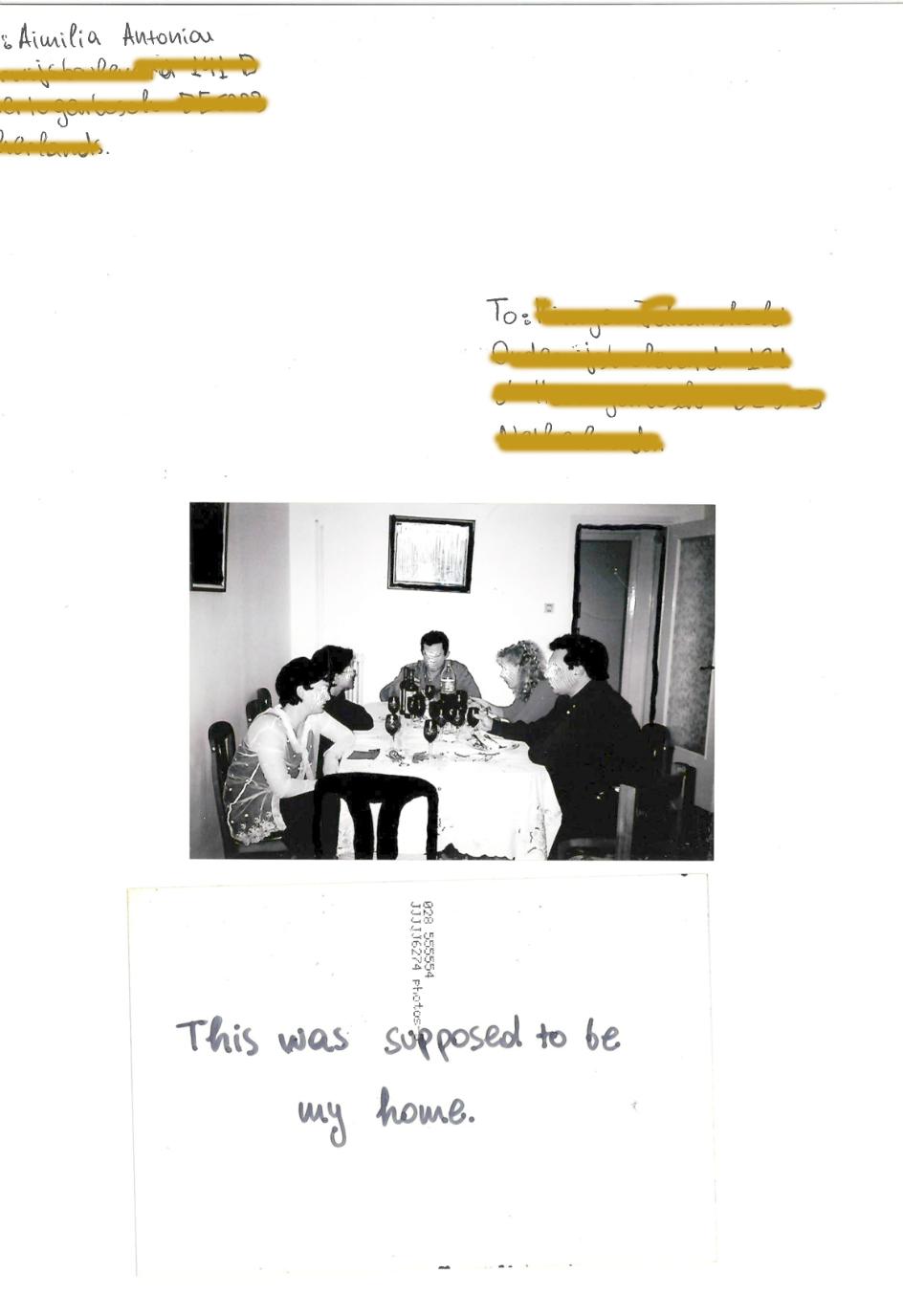
paper and asked for the letter receiver to help me find what home is.
The responses I received were genuine and thoughtful. The overall outcome after reading all the letters was that probably that I wasn’t the only one who didn’t link the word home with the specific structure of a house. Someone wrote to me about a space that is till today their anchor where they experienced a lot of beloved or not memories. Someone else said that their chosen family, the people around them were what made them feel like home. They were also advising me to look around me to find my own, in the small precious moments of life and to make sure it won’t be temporary.

“Even so, these buildings are in the domain of our dwelling. That domain extends over these buildings and yet is not limited to the dwelling place. The truck driver is at home on the highway, but he does not have his shelter there;” (Martin Heideger, 1971, p. 145)
It is what Bachelard means when saying: “The normal unconscious knows how to make itself at home everywhere, […].” (Bachelard, 1964, p. 32)
In this line of thinking we can remove from the notion of home the idea of a shelter (since home doesn’t always operate as a shelter), and then we can also remove its four walls, remove the specific rooms and corridors. By stripping away the four walls, we reveal the essential architecture of home: the people, the co-habitants, the friends, the neighbors. The memories, the experiences lived, the laughter, the tears, the anger, the conflicts and the making-up moments. The materials or objects that represent a feeling. What does this space look like now? For me this deduction creates a nonphysical space. It is as though I can take this home with me wherever I go.
As a result of this thinking, I started planning a workshop whereby through revisiting a playful child practice we would get the chance with people who participated to also revisit memories of intimacy and comfort. Clublokaal was the best place to propose this workshop because of the way they wanted to change the space’s operation. They took it over after it was more closed off towards the visitors and they are trying to take another path in how they handle the space. Through realizing this project, the goal was to gain insight in my research of what home can be in an
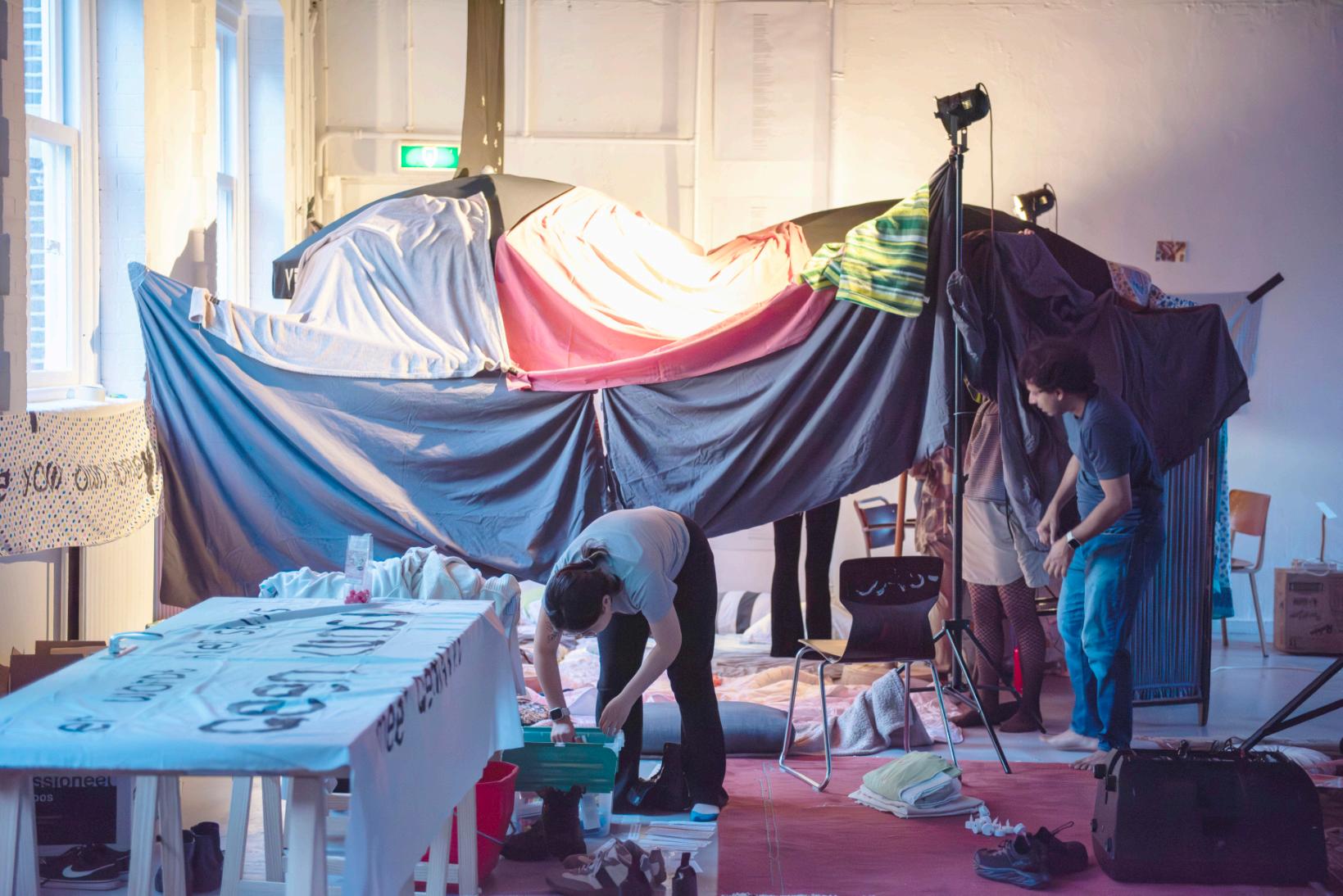
unorthodox way, how people of different backgrounds experience the notion of home and its intimacy and set another root that is more open-ended. My questioning was what makes us call a space home, is it the sole act of dwelling it? Is it a combination of habitating and creating memories? And what happens if we must abandon this home? Does it stop feeling intimate? When we go back to that space what feelings do we carry?
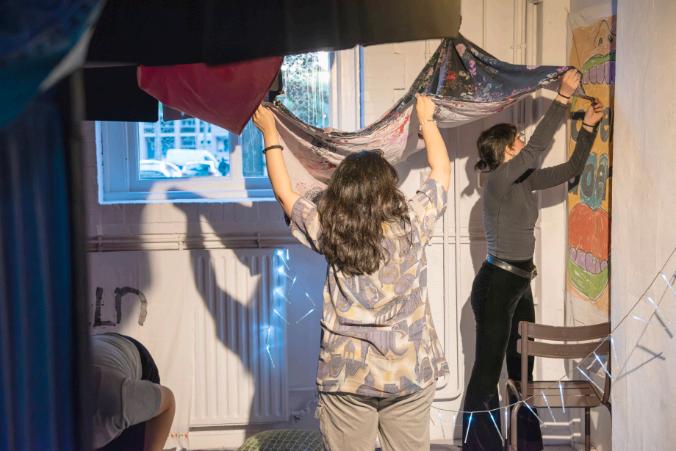
The aim was to create collectively an infrastructure in the existing space. Create a blanket fort that will house us for the night. Choosing the structure of a blanket fort was intentional because it is as valuable for adults as it is for children.
This can be seen in the exhibition of Narges Mohammadi in Brutus titled: “Er kraait geen haan naar”. Her work was about her childhood home although there were no walls or images of structures we usually expect. She presented domestic sounds of her own experience, cooking materials and representations of intimate or not moments. She was revisiting her home and we were invited to take a look into her world.
Indeed, by collectively practicing the blanket fort building, I could observe that the participants were working together but also individually one next to another. That was a mini manifestation of control and privacy interchanging in time. Imagination was manifested when participants went overboard taking materials which weren’t firstly introduced to be used in the workshop. The idea was to make a home for society and not just for oneself. That was achieved by the act of building collaboratively and not based on one’s interests. The outcome intended was to create a home archive with the creative results of the workshop as well as the space of Club Solo to become
Researches show that one gains 3 important values from this act. Control (in setting up a space reflecting one’s needs), Privacy by the boundaries and definition of the space, and Imagination by creating our own world.1
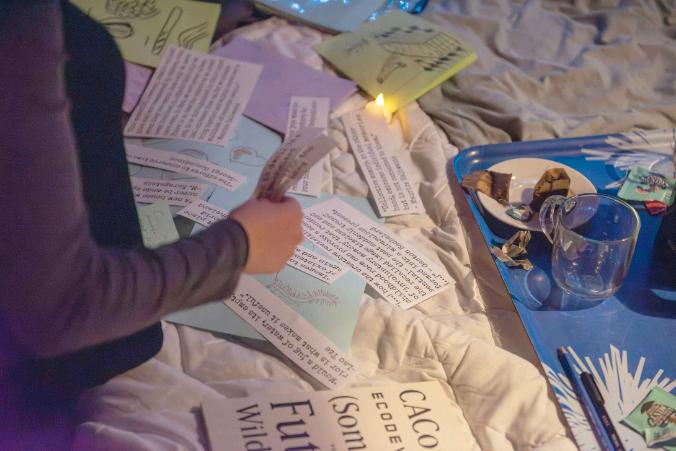
6 Documenta�on of the process of making the blanket fort.
1 Sobel, D. (2001). Children's special places: Exploring the role of forts, dens, and bush houses in middle childhood. Wayne State University Press.
more intimate for the group than it used to be before. At the same time, it was important to pay attention to the structure that was created after that night and if it resonated, the next few days, with people who were not participants. The structure, as in the blanket fort itself.
It was interesting to see how at the beginning of the workshop sharing felt a little shy, cautious. When the act of building started participants opened up, felt more comfortable and inside the structure through writing and sketching we could realize together that home as a feeling is way more than a structure. It is also sharing moments, emotions, dreams and longings.
Through activities like this, I can gain more insight into the people’s views on the subject because they are freer and more playful and that puts the mind as well in the same space. It is helpful for my research to dive deeper into the emotional part, because intimacy and memory are linked to emotions, and if we house those somewhere we house our emotions with them. Through workshops like this it can be revealed as well that in some way we carry within us all the homes we’ve dwelled in and we experience the world through the lenses of all our intimacies.
Topoanalysing home through contingent memory.
What can I learn from a place by looking at its emotional world?
To analyze the “topos”1 means to investigate the psychology of the space, in its little corners and nooks, in the imprints that have been saved by time.
Topoanalysis is, first of all, about space -where space is intimate and operates as a container of memory. The type of space that has been lived and experienced and has “housed” us for an amount of time. It is about a reciprocal relationship with the space in the way that we shape it, but also how the space itself shapes us – at least partially. To give the space a specific use by adding objects, furniture, appliances. Or by habitating it and leave marks, imprints of our presence until we come back. At the same time for the space to contain us, restrain us or give us opportunities to freely be. This is why topoanalysing comes with the acceptance of the fact that every space has a different meaning for every person.
The word "place" in greek is "topos". Topos in ancient greek had many meanings - literal like a piece of land that is not precisely defined or demarcated - but also metaphorical. Aristotle believed1 that our understanding of the world comes by associating places with ideas. In his writings he would speak of the notion of place literally as in a particular or more general area of land but also, he would refer to mental space - as in, the place of a particular idea that is recognizable from a group of people.
1 Ariadne Gnafaki, 2015-2016, IN - BETWEEN Place and memory in the Work of Enric Miralles Bachelor’s thesis, CRETE UNIVERSITY OF TECHNOLOGY SCHOOL OF ARCHITECTURAL ENGINEERING. Arch.tuc. https://www.arch.tuc.gr/fileadmin/users_data/arch_tmpl/ ereynitikes/year15_16/gnafaki.pdf
The first to introduce the term topoanalysis was Gaston Bachelard in his book Poetics of Space.2 He himself said that “Topoanalysis, then, would be the systematic psychological study of the sites of our intimate lives.” ( (Bachelard, 1964, p. 30)
1 Editors, Litencyc. "Topos".The Literary Encyclopedia. First published 01 November 2001[https://www.litencyc.com/php/stopics.php? rec=true&UID=1126, accessed 03 May 2026.]
2 Seamon, D. Gaston Bachelard’s Topoanalysis in the 21st Century: The Lived Reciprocity between Houses and Inhabitants as Portrayed by American Writer Louis Bromfield (2010). https://doi.org/ 10.7761/9789731997766.12
This of course doesn’t mean that a space which is intimate, cannot be experienced by more than one individual. More persons can inhabit or dwell in a space and even though experiencing it distinctively, still collectively hou se part of their intimacy and share the act of topoanalysis. Every space does not have just one identity nor does it house just one experience. And even if we have been there in solitude, we never experience a space on our own.
“In reality we are never alone. Others don’t have necessarily to be present, […] because we bring with us a multitude of distinct people.” (Halbwachs, 2013)
I strongly believe that we can collectively topoanalyse and create a type of experiential-psychological “surveyor’s map”. One that maps the memories and feelings of a space, rather than one measuring its cold surfaces and levels. What indeed will that have to offer in our way of experiencing space? With the idea of “surveyor’s map” I am thinking not necessarily the visual of a map, but more so components juxtaposed to create a bigger picture of a space. By components I mean the rooms and the objects of a house which change its levels, its looks and its atmosphere. It is about what stands there frozen in time but then again if that component were missing, we would notice – we would feel like something’s changed. Having this thought in mind, is where the methodology of Contingent Agencies (Alex Arteaga, 2025) fit in.
Contingent Agencies is a long research which concluded into a big publication. The official title of the publication is: “Contingent Agencies, Inquiring into the Emergence of Atmospheres.” The initiators of the project and editors of the publication are Alex Arteaga and Nicolaus Gansterer.
In Contingent Agencies what they propose as agencies is anything that can change or affect the atmosphere of where we are situated in the moment. For example, light, sound, temperature etc. For the notations they propose the format of sketches, photographs, video and audio recordings and the notation process can last as long as the researcher wants. When it comes to the reflection it can take the form of a text and any form proposed for the notations but this time the focus is on the notations made and not the agency.
The way I want to approach this is by keeping the psychoanalytical idea of Bachelard as a possible outcome, which the person using this methodology might have. Stability is something I am speaking of in my text earlier and I don’t believe myself in it. Since I want my agencies to be recollections of atmospheres, or rather recollections of agencies that created the atmosphere of home I can agree with Halbwachs on the fact that "If what we see today is placed in the context of our older memories, the reverse also happens: memories are adapted to our current perceptions as a whole". That means that there is no stable memory we can count on, it is altered by the passage of time. It is changed by the moment, how the agency speaks to us, and of course it is affected by
The goal is to research and investigate atmospheres rather than objects or frames of reality detached by their environment. The general idea is that everything around us is co-related and influences its surroundings. So the methodology proposes each time to choose an agency that we feel has an influence and keep notations. After the notation process is concluded, then the researcher reflects on the notation. It is in our own competence to choose each time the agency, the notation and reflection tools.
our past and our present state. I can see in myself this fluidity and the admission that research coming from our sensory perceptions is valid research!
I chose these methodologies to work with because, as I wrote earlier, topoanalysing is something that apparently I was doing from a young age without having the words for it. The Contingent Agencies is a methodology I was introduced to by my professor Martine Stig in class and I was instantly attracted to the freedom it gives and the openness of the possible results. Both these methodologies interest me in many of their aspects, however I feel none of them is exactly what speaks to my practice. So, my idea is to merge them in ways that would be beneficial to my research, since I focus on the specific area of home’s definition.
“[…] we propose starting with a “place”—a concept close to, even synonymous with atmosphere but with a stronger geographic component—and to then become aware of the “situation” unfolding in the chosen place. The shift from place to situation implies a change of intentionality that enables an object-oriented perception of the practitioner’s surroundings.” 1
I was always interested in the atmosphere of a space, and had the idea that we are part of a space’s life and not vice versa, although we do affect each other. Remembering myself as a teenager, living almost in two different houses at the same period of time, how I could feel them charged with different emotions. I wasn’t feeling myself necessarily as part of any of these houses but one of them felt a bit more like home. I could be freer in expressing myself without being judged, whilst in the other house felt like my every move was monitored and critically judged.
I can see connections and differences, although in my understanding both methodologies share foundations. Bachelard is speaking of an analysis of space itself and anything we impose on that space. Memories, daydreams, incidents and emotions. On the other hand the Contingent Agencies authors are taking this a bit further and instead of concentrating on the space, they concentrate on the agencies that create the atmosphere of the space. Bachelard is talking about a kind of stability in the instability, while the authors in Contingent Agencies are accepting the fact that all the agencies they deal with, are as much victims of time as we ourselves are (or our concentration span).
1 Alex Arteaga, N. G. (2025). Contingent Agencies – Inquiring Into the Emergence of Atmospheres. Berlin: Hatje Cantz. p.33
That on its own can have an effect on a person, and of course there cannot be intimacy under a controlled “regime.” If vulnerability is seen as a threat to prosperity, then in my experience, the feeling of home is almost impossible.
Since this methodology I am imagining is still evolving, I could speak on the goals I would like to achieve by putting it into practice. The focus of the research would be based on memories of objects that hold a personal intimacy from a space that housed the person researching. The goal of the objectoriented research is to see where we localize our intimacy in a space.
Which objects are those that witnessed our intimate moments and imprinted them on their “skin”?
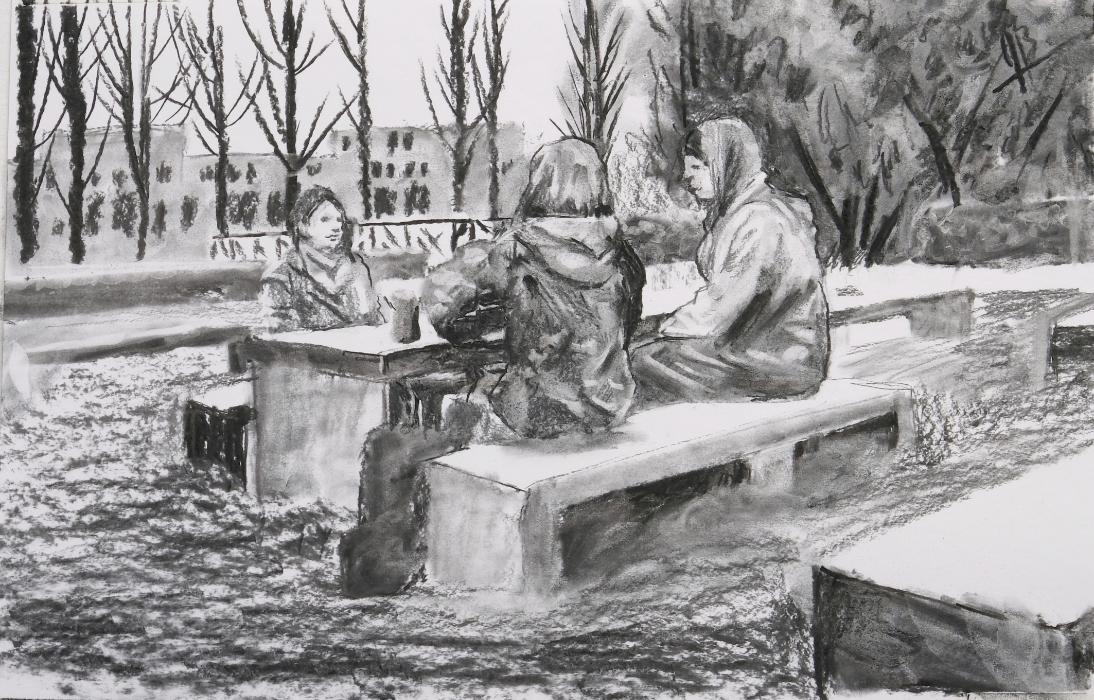
It might be that the researchers in Contingent Agencies are interested in atmospheres in general, although in my research I am interested in the particular atmosphere of a home and using their methodology without any alterations wouldn’t be fruitful. To investigate what could be the atmosphere of home, agencies such as light wouldn’t offer what I need. The object can serve as a vessel of memory and emotions, so object-oriented research is the path I chose for my methodology. The object was the witness of all those moments that made the space feel like home. By intuition I believe that there will be objects, or types of objects that will keep occurring by the people using the methodology. That remains to be tested of course. The reason charcoal is the tool, is because it translates the fluidity of memory. By
Barbara Bloom would be a great influence on this approach since she herself is doing visual objectoriented research and links the object itself with intimacies it carries. She creates visual narrations which as I mentioned earlier are great in their way of leaving space for the spectator to fill in and project their own meanings and intimacies.
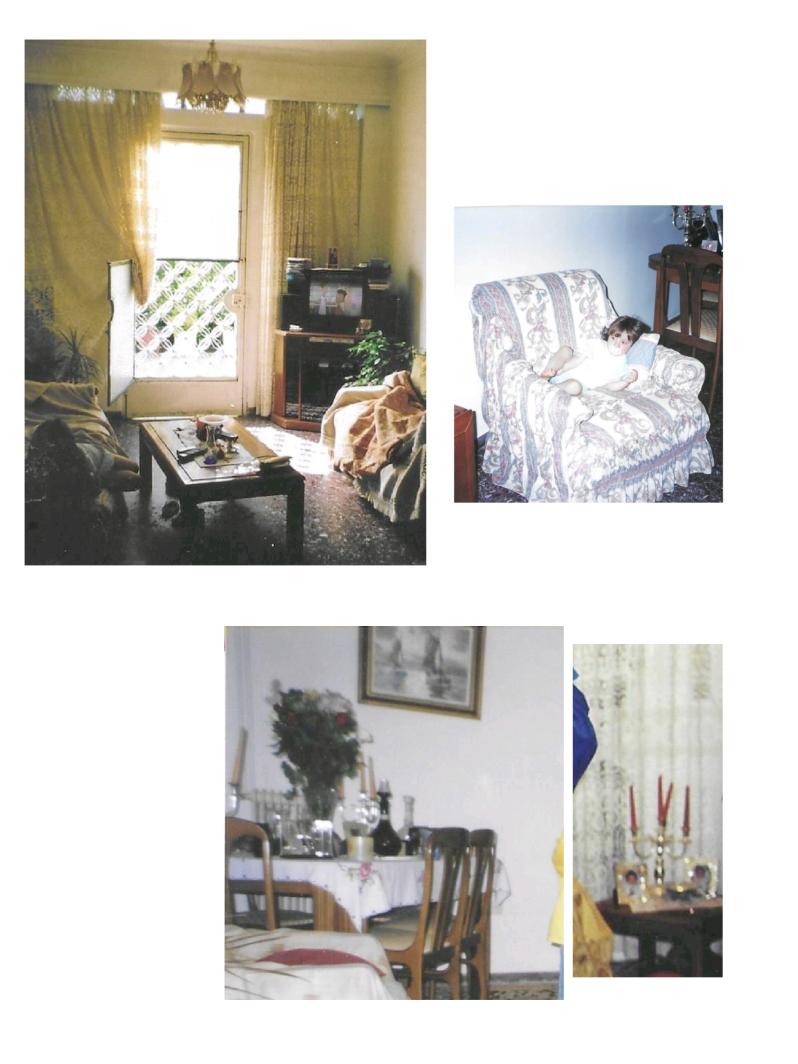
Figure 8 Photographs of objects of my childhood home, which don't exist anymore.
drawing, erasing and re-drawing is being put into practice the fact that memory is ever-changing and it speaks symbolically on the instability of home itself.
Putting the methodology in practice myself, creating stop-motion drawings of intimate moments shared with others but also animations of researching an intimate object of home, makes me feel that this fluidity almost works as meditation. It is a way to hold-on to the unstable home, and as we as people are ever-changing, we keep our ever-changing home with us. Reflecting on the drawings, since every frame is sketched on the same paper, the marks of previous writing remains. Like the palimpsests of memory imprinted in a space, the drawing serves the purpose of actively seeing those marks ourselves. It is what I mentioned of carrying all our intimate spaces within us, they leave a mark which we always carry.
By making these collections of notations we can collectively reflect on the outcomes. Whether they will be reoccurring forms or a big variety, it has a lot to indicate about our surroundings and where we feel, individually, that our intimacy dwells. This can create a collective surveyor’s map of our intimacies. In that manner I am hoping to gain insight into how we house our feelings, and maybe be able to carry not only our memories that make home, but also some object-representatives of it. Ultimately the participants in the methodology workshop can take with them a way of observing, of housing their feelings wherever they are.
I believe home as a concept is important to be researched both physically, and psychologically although as I am supporting, it is our memory and psychology that localize themselves upon the place, the objects and materials, so that we are able to call and feel them home. It is through these workshops that remembrance brings intimacy forward and collectively through the act of creative sharing we can hold on to the feeling. After all, home is a collectively shared experience, we cannot build it on our own and so, my memory of being home is not individual, but a collectively shared social structure that each and every individual experiences. There is a need for collectively practicing remembrance in order to see how these feelings are indeed part of our social experience. To see that it is unstable is not a melancholic realization rather than freedom to carry it with us and not be limited by our locality.
• Alea, N. &. (2003). Why are you telling me that? A conceptual model of the social function of autobiographical memory.
• Alex Arteaga, N. G. (2025). Contingent Agencies – Inquiring Into the Emergence of Atmospheres. Berlin: Hatje Cantz.
• American Psychological Association. (2018, 19 04). Ανάκτηση από dictionary.apa.org: https://dictionary.apa. org/intimacy
• Bachelard, G. (1964). The Poetics of Space. New York: Penguin Group LLC.
• Benjamin R. Meagher *, S. K.-G. (2024). Predicting home attachment through its psychological costs and benefits:. Journal of Environmental Psychology, 9.
• Bradburry, R. (1991, n.d. n.d.). The Art of Fiction No. 122, The Paris Review. (Interview by Steven Aggelis)
• Gnafaki, A. (2016). arch.tuc.gr. Ανάκτηση από https://www.arch.tuc.gr/fileadmin/users_data/arch_tmpl/ ereynitikes/year15_16/gnafaki.pdf
• Gospodinov, G. (2024). The Physics Of Sorrow. London: Weidenfeld & Nicolson.
• Halbwachs, M. (2013). Collective Memory. Athens: Editions Papazisi.
• Heidegger, M. (1971). Poetry, Language, Thought. New York: Harper & Row, PUblishers.
• Higgins, C. (2026, February 14). The Guardian. Ανάκτηση από theguardian.com: https://www.theguardian. com/artanddesign/2026/feb/14/tracey-emin-interview-tate-modern-regrets-smoking
• Ludion. (n.d.). Barbara Bloom. Ανάκτηση από https://ludion.be/nl/artists/bloom
• MOORE, J. (2000). PLACING HOME IN CONTEXT1. Journal of Environmental Psychology, 11.
• Saverio Bellizzi, S. E. (2025, May 14). The future patterns of displacement and its escalating global health needs. Ανάκτηση από Public Health: https://www.sciencedirect.com/science/article/abs/pii