EAGLE
EDITOR-IN-CHIEF:
Ellie Wain
GRAPHIC DESIGN: Will Logan
St John’s School Leatherhead Politics Magazine
A NOTE FROM THE EDITOR-IN-CHIEF: ELLIE WAIN
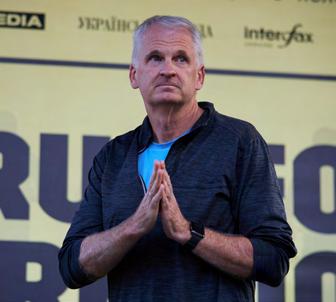
Over Christmas, I read the short novel, ‘On Tyranny: 20 Lessons from the 20th Century’ by Timothy Snyder. It consists of twenty short lessons from the past that can be applied to the present day to stop the rise of tyranny. Lesson number six was ‘to be wary of paramilitaries’, and number ten was ‘believe in truth’ (to abandon facts is to abandon free dom). As I read this in January, I was able to draw some strenuous compar isons to the Trump administration since 2025, especially after Trump took over Venezuela, however, after I read of the two ICE Minneapolis murders, my mind immediately fell back to Snyder’s les sons. When civilians are killed during domestic law‑enforcement actions that resemble military operations, it invites questions about how power is being used and how it aligns with democratic principles. Given these events and the broader national conversation around them, is it really such a stretch to ask whether we should be more willing to use terms like fascism when discussing what we’re witnessing?
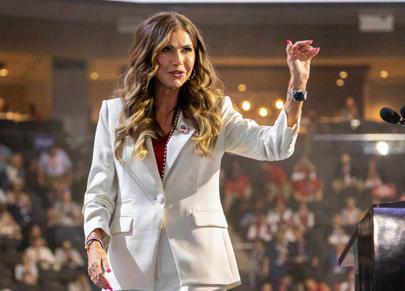
What confirmed my hesitant parallels was when I sat in my Monday morning politics class discussing last week’s cur rent affairs. The latest story in the U.S. was the ICE murder of Alex Pretti. The latest story in the UK was that Andy Burnham’s attempt for a Westminster seat had been blocked. The differ ence between the two worlds we live in is inconceivable, and I can’t fathom how many Americans are feeling now. When the UK citizens’ biggest concern is who can replace our lacklustre prime minister, and the U.S. citizens’ biggest concern is whether their friends are safe from ICE right now, it is not enough to turn a blind eye to what is happening in the U.S. and blame it on Trump’s ‘unique’ presidential style – regardless of being on the left or right politically. Watching Kristi Noem, head of home
issues apparent in America, but Aoife Barnes writes them with more detail and dignity to complement this interview as additional context.
land security for Trump, egregiously lie against video footage stating that Renee Good was driving towards an ICE agent, reminds me of Snyder’s tenth lesson, ‘believe in truth’. The video proof is sitting there waiting for the average American to click on, yet it is that lack of motivation to investigate which allows Kristi Noem to make the same blatant lies addressing Alex Pretti’s murder two weeks later.
With the state of the world being as it as currently, this terms edition of The Ea gle presents a central theme of ‘abuse of power’ covering pressing topics such as the Epstein files, Sudanese femicides and ICE. Although last term I made an active effort in my note to mention the positives in politics, this term it feels ur gent to confront systemic injustices and hold those in authority accountable, especially as these issues continue to shape lives on a global scale. After seeing the passion from many writers last term, our second theme naturally lands as ‘opinion’, including dissections of theories, economics and conflicts. Our final theme is returning as ‘culture’ exploring the ways in which art, music, traditions, and societal trends both re flect and shape our world. From deep dives into subcultures to critiques of mainstream phenomena, this section aims to illuminate the narratives that influence our daily lives and collective identity.
If you picked up this magazine because your laptop is dead, and there’s noth ing else to do in the school library, there is only one thing I ask of you. Read the interview with Dominick Skinner, the Irishman who released 4,500 ICE agent identities online in the ‘ICE list’. Conducted by Sarah Winklehner, he speaks on some prevalent topics relat ing to American politics as well as UK sovereignty. I have outlined some of the
Thank you to all the writers of this edition who seem to be just as passionate as I am about this magazine, your ideas are creative and executed incredibly! But as ever, the multitude of my gratitude goes to my second half and graphic design er, Will Logan. The amount of time you spend designing The Eagle (combined with three essay A levels) is criminal, and I hope you take a well deserved, laptop free rest over easter. Whenever I think your artistic talent has peaked, you manage to double the quality and somehow also produce a deeply per sonal article that was a pleasure to edit. So, thank you, thank you, thank you.
And whilst I have clearly shared my pen nies of thoughts on the state of Ameri can politics, I encourage you to draw your own conclusions and thoughts. Whether they are on ICE or who won Aoife and Alice’s debate, now is a time in politics where you need to create your own opinions (even if your whole politics class vehemently disagrees with them). It is simply not enough to believe what propaganda is fed from the white house. If the white house tells you it is raining, and your friend says it is sunny, it is down to you to look outside your window and figure it out yourself. As Timothy Snyder writes, ‘Investigate’. And as always, happy reading!
- Editor-In-Chief: Ellie Wain, L6
Designing the Spring 2026 edition of the Eagle has once again been one of those projects that consumes your life before you even realise it. With 24 ar ticles and 64 pages, it was not easy to approach, yet I genuinely think this is our best issue yet.
A NOTE FROM THE GRAPHIC DESIGNER: WILL LOGAN
Since the last issue, I’d like to think I’ve grown a lot as a designer, and I hope that shows. This time around, I wanted to push into something more colourful and expressive. The political landscape feels loud and chaotic, and even open ing a news website has started to make me sweat slightly. I wanted to show this through the design, reflecting the ener gy of the writing and the world rather than retreating into minimalism.
I have to give a special mention to the artwork in this issue, because it has genuinely elevated the whole thing. Wilf’s piece about the Prince Andrew Epstein scandal was nothing short of striking, so I urge you all to go and look at that and really take it in, because the quality and commentary it provides is incredible. And Issie’s illustration on the recent Venezuela story articulated the situation in a perfect balance of satire, political awareness, and artistic talent. We are so proud to have original art in the magazine; it’s something we will never take for granted, and both of these pieces absolutely delivered.
ter edition than Winter. The amount of work she puts into this role quietly and without fuss is something I deeply ad mire her for. You carried this on your back while making it look easy, which is either very noble or mildly worrying, and either way, I am eternally grateful.
It feels impossible to write a note for this issue without sitting with the weight of what’s happening in the world right now. Gaza, Sudan, Congo, and the humanitarian catastrophe unfolding in Iran. Each of these crises shares com mon ground of powerful states acting with impunity while the international community watches, and largely does nothing. When I see the news, it’s hard not to look at Iran and feel the nause ating familiarity of it; the same rhetoric, the same justifications, leading down the same road of Afghanistan and Iraq. History may not repeat itself, but it does seem to have a handful of its favourite templates to draw upon.
And seriously, what incredible writing it is. I couldn’t praise this edition with out mentioning Sarah’s interview with Dominic Skinner – the man who doxed thousands of ICE agents – which was one of those pieces which genuinely stopped me mid layout. Becca’s piece on Sudanese femicides was another that I urge you to read. It’s a complete ly overlooked issue that Becca wrote about so incredibly articulately. Millie’s dissection of Your Party’s inevitable fail ure was also a highlight for me. And I’ll admit some bias here, but I’m particu larly proud of my own contribution to this issue; I chose to discuss the condi tionality of queer acceptance, which is something I’ve wanted to write about for a long time, so I’m glad I finally mus tered up the time and courage!
None of this would exist without the awe inspiring Editor in Chief, Ellie Wain. While I was having what I would describe as a normal and proportion ate response to InDesign crashing for the fourth time, Ellie was organising what has turned out to be an even bet
My favourite section to design this issue was ‘Abuse of Power’, and honestly, the current political climate has made that one almost too easy to write for. From Trump’s increasingly unhinged decisions, to the Epstein Files (and the questionable censoring within them) ICE, Venezuela, the potency here is de pressingly consistent. It’s been a busy season for impunity!
But this is exactly why magazines like the Eagle matter. Every article is evi dence that young people are paying attention and thinking critically (which, given the current state of things, is more than can be said for most actual world leaders). From the horrors of Sudan to the politics of queer identity (shameless plug) to the spectacular implosion of a political party that didn’t even really exist, we are covering it, and covering it well.
So please, take your time with this one, read every article, sit with it. And then, when you’re done, maybe cast a glance at the design too, because the number of hours that went into it is, once again, genuinely obscene.
- Graphic Designer: Will Logan, L6
Timothy Synder
Kristi Noem
ABUSE OF POWER
ICE IN MINNEAPOLIS by Aoife Barnes, L5
DOMINICK SKINNER ON THE INFLUENCE OF ICE AND THE GLOBAL REPERCUSSIONS by Sarah Winklehner, U6
VENEZUELA’S CAPTURE AND ITS GLOBAL FOREIGN POLICY IMPLICATIONS by Lucas Dean, U6
THE DOMINO EFFECT OF AMERICAN DEPORTATION by Maxine Turnball, U5 MANDELSON AND MCSWEENEY; THE HIDDEN ARCHITECTURE OF LABOUR POLITICS by Will Reed, L5
THE FED AT A CROSSROADS: INDEPENDENCE OR EXECUTIVE CONTROL? by Millie Beacham, L6 THE JEFFREY EPSTEIN CASE AND ITS IMPLICATIONS FOR GLOBAL POLITICS by Caspar Hunt , L6
WHY IS NOBODY TALKING ABOUT THE SUDAN FEMICIDES? by Becca Towers, U5
DEBATE: ‘POPULISM IS A THREAT TO DEMOCRACY’ by Aoife Barnes, L5 (proposing) and Alice Dunn, L5 (opposing) CAN YOU BE AN EFFICIENT AND MORAL LEADER? MACHIAVELLI’S ARGUMENT by Fred Von Kaltenborn, L6
CHURCHILL’S LEGACY: TRIUMPH OR TRAGEDY? by Annabel Pullen, L5
WHAT THE UK PRISON CRISIS REVEALS ABOUT CRIMINAL LAW by Gwen Buckley, L6 ARE OUR OPINIONS EVER REALLY OUR OWN? by Issie Appadoo, 4F MAMDANI’S MONEY PIT - WHO REALLY PAYS? by Felix Samuels, L6
THE ETHICS OF ORCA BEHAVIOUR: PLAYERS OR KILLERS? by Mia Gunn, L3 WHY ‘YOUR PARTY’ FAILED BEFORE IT EVEN STARTED by Millie Beacham, L6
THE ‘PALATABLE GAY’; CONDITIONAL ACCEPTANCE OF QUEERNESS by Will Logan, L6 SOCIOLOGICALLY SPEAKING... THE STORY OF ALEX AND MARCUS LEWIS by Bea Moore, L6 MUSIC’S IMPACT ON POLITICS by George Williams, U5
MISOGYNY IN THE MEDIA by Rose McVeigh, L5
DEREK JARMAN AND THE POLITICS OF QUEER FAITH by Charlotte Clee, U6
THE SHADOW STATE: MEMORY, POWER, AND SURVIVAL IN CAMBODIA by Will Reed, L5
FILM REVIEW: A REVIEW OF ‘CIVIL WAR’ by Anna Cuckow, L6
HOW POP CULTURE BECAME A POLITICAL BATTLEGROUND by Oli Paget, L5
The first section of this term’s magazine lands naturally as ‘abuse of power,’ something that became increasingly relevant as articles were being submitted. When more of the Epstein files were released, no one could have predicted it would be more damning for Starmer than Trump, and I think this epitomises why this theme is so relevant. The sector begins with Aoife Barnes covering the murder of two Minneapolis citizens by ICE and the political significance of these events, followed by the moving interview with Dominick Skinner, carried out by Sarah Winklehner. Skinner released ‘the ICE list,’ including thousands of ICE agent identities in June 2025 and this interview covering his motivation is a highlight of the section, and the editorial team are so grateful for Skinner’s participation in this edition. His words were mobilising and passionate, and I think summarise the crisis in America perfectly. Lucas Dean continues the focus on America by evaluating the disastrous consequence of Trump’s actions in Venezuela and what this means for future global politics. He raises the question; how will global affairs function if no one holds Trump accountable? Please also take a moment to appreciate Issie Appadoo’s art inspired by the topic! Maxine Turnball extends this line of thought as she discusses what the mass deportation means for those not directly deported. She highlights how the domestic immigration doesn’t remain confined to America, and that it is actively reshaping communities across the world.
Admittedly, ‘Abuse of Power’ is not confined to the United States. Will Reed’s investigation into Labour’s architecture explores networks and relationships which shape our UK government. Institutional influence is taken further by Millie Beacham, whose article asks whether the Federal Reserve can maintain its independence under the executive pressure. And of course, it is not right to discuss abuse of power without featuring a deep dive on convicted child predator, Jeffrey Epstein. Caspar Hunt’s analysis on what this case means for global politics exposes the dependence of the elite on connections and money. Accompanied by perhaps the best political cartoon I’ve seen all year, by Wilf Basnett. Will and I wanted to include more art this edition, and Wilf came and conquered by tripling our expectations.
And if those articles weren’t enough to convince you that maybe we should be holding politicians accountable, Becca Towers closes this section by drawing attention to an often overlooked conflict, Sudan. Her article challenges readers to confront the harsh reality of the Sudan femicides. It is important that although our headlines remain dominated by corrupt elites, we also acknowledge those who remain tragically overlooked. These articles reveal that abuse of power is not a single phenomenon but a pattern that appears within governments, institutions, and global systems. Whether through violence, secrecy or silence, each peace asks the same underlying question: who holds power to account when those who wield it refuse to do so themselves? 08 10 14 16 18 20 22 24
ICE IN MINNEAPOLIS
DOMINICK SKINNER ON THE INFLUENCE OF ICE AND THE GLOBAL REPERCUSSIONS
VENEZUELA’S CAPTURE AND ITS GLOBAL FOREIGN POLICY IMPLICATIONS
01
THE DOMINO EFFECT OF AMERICAN DEPORTATION MANDELSON AND MCSWEENEY; THE HIDDEN ARCHITECTURE OF LABOUR POLITICS
Abuse of Power
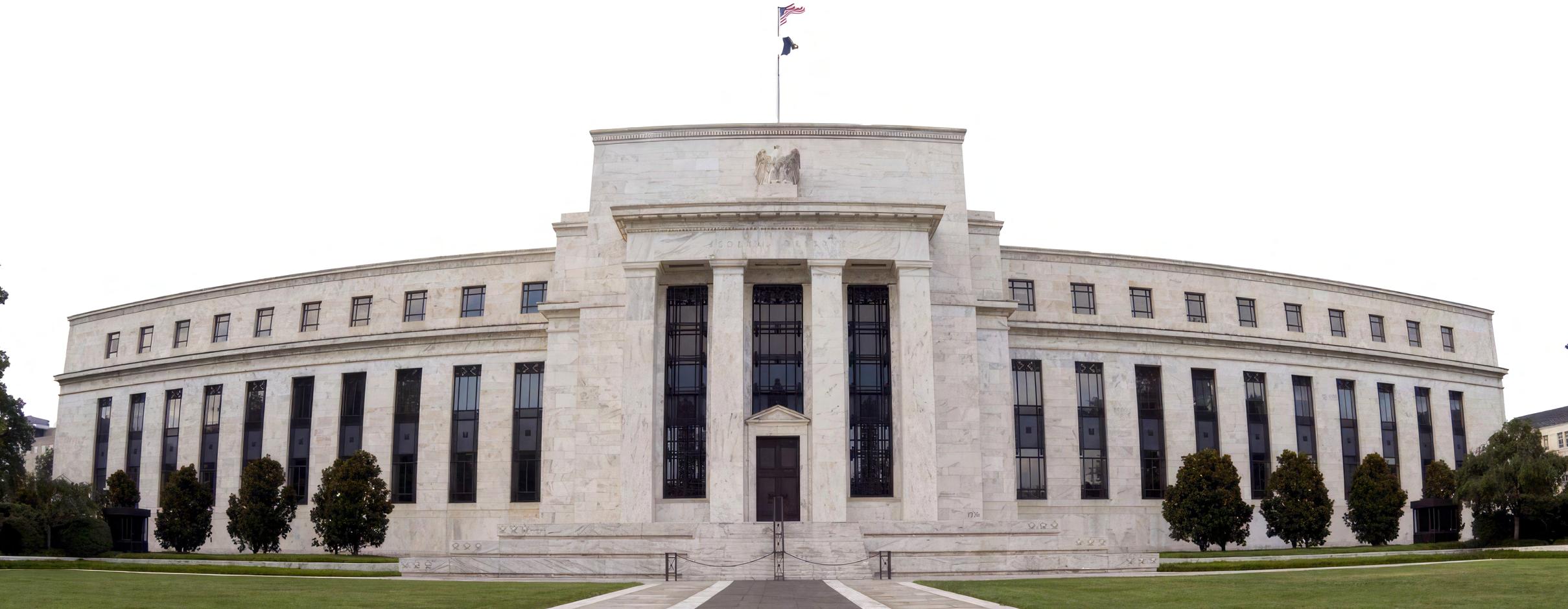
THE FED AT A CROSSROADS: INDEPENDENCE OR EXECUTIVE CONTROL?
THE JEFFREY EPSTEIN CASE AND ITS IMPLICATIONS FOR GLOBAL POLITICS WHY IS NOBODY TALKING ABOUT THE SUDAN FEMICIDES?
Aoife Barnes, L5
Sarah Winlehner, U6
Lucas Dean, U6
Maxine Turnball, U5
Will Reed, L5
Millie Beacham, L6
Caspar Hunt, L6
Becca Towers, U5
On March 1st, 2003, U.S Immigration and Customs Enforcement (ICE) was put in place as a direct response to the 9/11 terrorist at tack. This was part of a massive federal gov ‑ ernment reorganization aimed at strengthening national security and addressing gaps in bor der control and interior enforcement. However, almost 23 years later, ICE has changed from law enforcement to an immense paramilitary force.
ICE operates across all 50 states, and in stead of attempting to aid and reinforce safety across all states, people are scared, scarred, and hurt from what was once a law enforcement protecting all American citizens.
ICE agents are masked, untrained and appear to be unaccountable for their actions, often failing to wear any uniforms. With agents training being reduced from 20 weeks, to only 8, people are rash with their decisions, there have been operational inefficiencies and numerous safety concerns. This lack of training was a result of a focus to increase deportation rates, leading to terrorising neighbour hoods and ripping families apart. All carried out in the name of fear, not justice Contradicting Americas morals of liberty and individualism, funda mental equality and common val ues. ICE’s harm is a betrayal of the very principles the nation was built on.

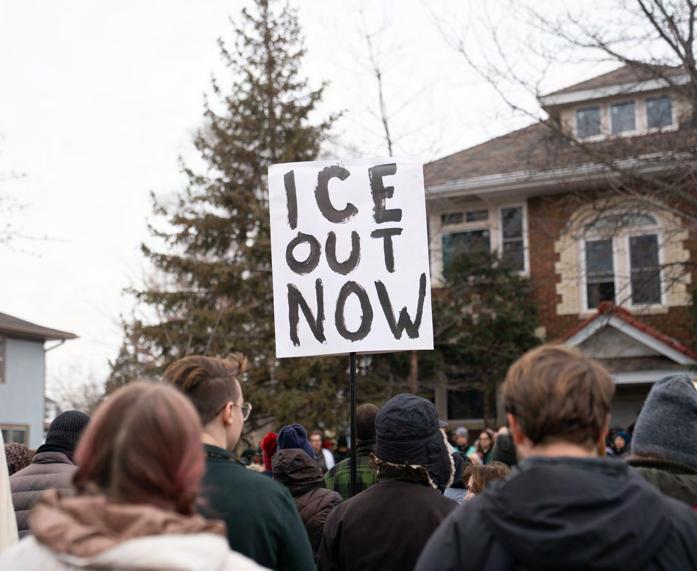
election in the United States, it has been every more clearly divided into red (Republican) and blue (Dem ocrat) states. Minneapolis being a well known democrat run state, has meant that Trump and his adminis trators see this state as a threat. Sub sequently, on December 4th, 2025, USA’s department of homeland security announced, Operation Metro Surge Which is an ongoing operation by the United States Immi grations and Customs Enforcement, with the goal of seeking out and de porting illegal, undocumented immi grants. When this operation was first announced, it was placed in the twin cities of Minneapolis and Saint Paul, with The Department of Homeland
Security calling it: “the largest immi gration enforce ment operation ever carried out”. The operation has been seen incredi bly negatively due to the severity of ICE’s tactics, as well as the harassment and threats observ ers.
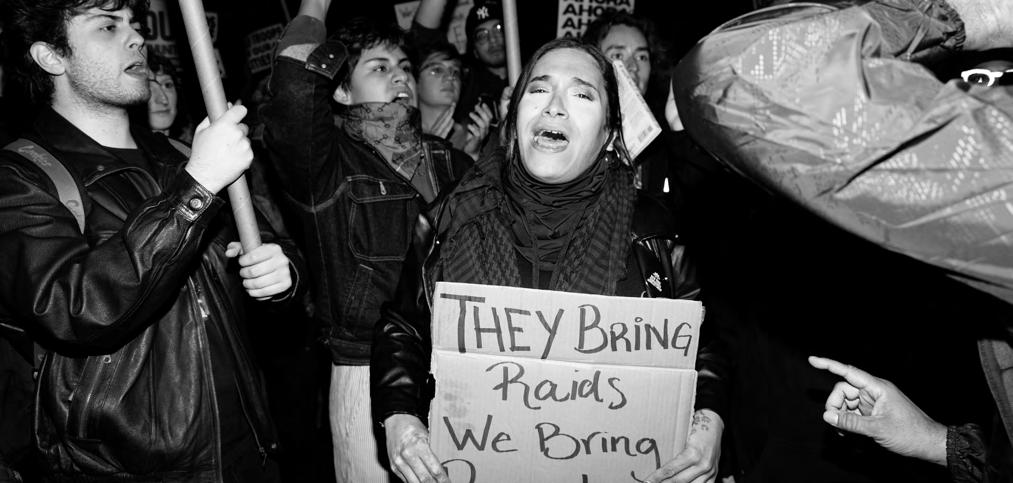
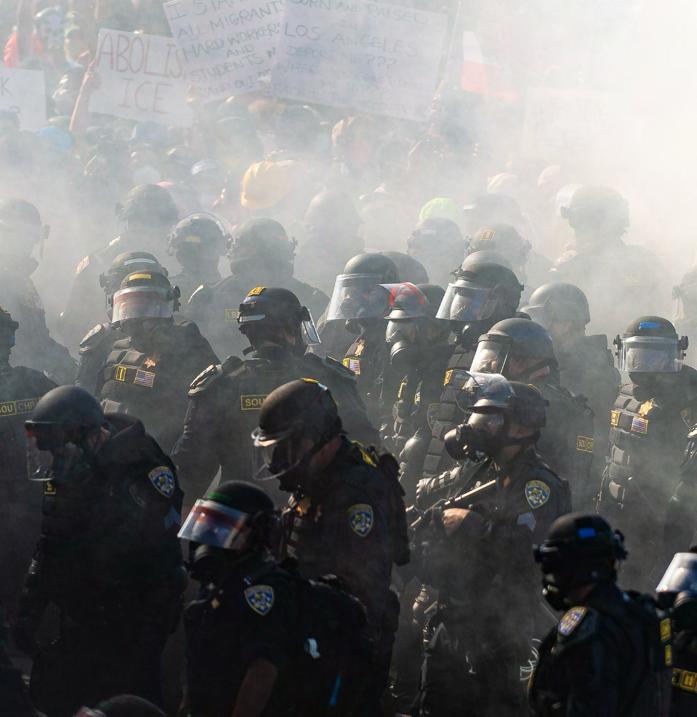
During this operation, federal ICE officers killed two US citizens only 17 days apart in January 2026. Renée Good was shot and killed by an ICE officer on 7th January 2026, in southern Minneap olis. With her children in the back of her car, Good started slowly attempting to flee the situation and drive into the traffic ahead. The of ficers saw this as a threat and an attempt to ‘run them over’ and shot her three times. On January 24th, 37 year old Alex Pretti was shot and killed. He was a registered ICU nurse with the only hope of saving lives and aiding people. This all took place during a protest this operation, as well as mourning the loss of Renée Good’s life. During a pro test, Pretti was filming federal agents and attempting to help direct on coming traffic, he then at one point stood in between a ICE agent and a woman who was being aggressive ly wrestled to the ground. Not only was Pretti pepper sprayed but was also tackled to the ground by six or more federal agents.
ICE IN MINNEAPOLIS
Through all the video ev idence taken by bystanders, it is clearly seen that a weapon was re moved from Pretti (who was a legal ly licensed firearm holder) just seconds before these shots were fired. It can be heard in the vid eo, an officer yelling ‘gun, gun’ even after the firearm was taken. In the end, it was made known that instead of a weapon, Alex Pretti was holding a phone. With no means of harming an yone, just trying to help a fellow protester and speak out about the damaged caused to this state of Min neapolis. Unfortunately, the killing of two US citizens is not the only thing ICE is re sponsible for.
As a result of Operation Met ro, as well as Stephen Millers ‘targets’ (3,000 arrests per day) set for deportation, deten tion centres have been created to hold asylum seekers and peo ple awaiting deportation. Not only do the US government spend over three billion dollars a year on these detention centres but they also allow for inhumane and horri ble conditions for people to endure. Immigrantsjustice.org states that
‘People in detention ex perience inhumane conditions and rights abuses that include medical neglect, preventable deaths, puni tive use of solitary confinement, lack of due process, obstructed access to legal counsel, and discriminato ry and racist treatment’. People that seek safety and refuge from their home because it is unsafe to contin ue living there, seek refuge only to be placed in a detention centres. They fled danger to survive, only to find themselves surviving detention cen tres instead of finding refuge. These centres have led to 31 deaths alone in 2025, the conditions, the circum stance and the morals these centres are built on contradict freedom and every right given to a person.
After these two horrific shootings, the White House and the DHS’s re actions were completely staggering. Not only was a blatant denial of truth, but also the label placed on both victims was one of a ‘domestic terrorist’. Instead of a surge of over whelming empathy, or compassion for these people and their families. All the White House seemed to want to be apply a label and spread ob vious lies. After the shooting of Alex Pretti, and the White House’s clear view of America’s reaction, only then did they speak out with empa thy and state that this was an ‘unfor tunate incident’ while still speculat ing why the victim had a gun in the first place. However, Trumps deputy chief of staff and the head of home land security stated on X, that Pretti was both a “terrorist” and a “as
sassin”. Words written by Stephen Miller the man responsible for the demand that immigration enforce ment officials do more to detain and deport undocumented migrants in American cities and setting a frankly unrealistic 3,000 arrest target per day.
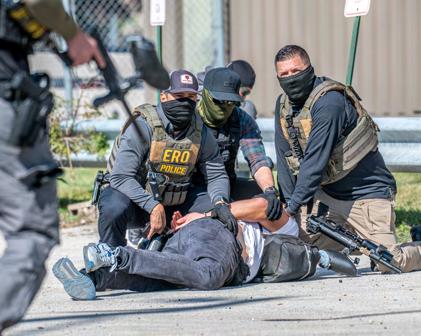
ICE is hurting, terrorising and dam aging civilians’ lives, and taking lives away. To quote Billie Eilish ‘no one is illegal on stolen land’. Every ‑ one deserves the right to live a life of peace and to choose where they live it. President Donald Trump, Stephen Miller and the whole of the DHS need to understand the power and the magnitude of single decisions and operations. Innocent people should not live in fear, and innocent lives should never be condemned to death. It has been shown that when one apple falls, everyone knows and understands the meaning of gravity. But when multiple bodies fall, no one can seem to understand the meaning of humanity.
-Aoife Barnes, L5
Since the 2000 presidential
INTERVIEW:
Dominick Skinner on the Influence of ICE and the Global Repurcussions
Conducted by Sarah Winklehner
ince its creation in 2003, the U.S. Immigration and Customs Enforcement (ICE) has faced increasing scrutiny for their role in U.S. immigration law enforcement. Established by the Department of Homeland Security in the aftermath of the September 11, 2001, terror attacks, ICE was born from a determination to prevent another such tragedy, representing a broader promise: never again. So why are we seeing two-thirds of U.S. citizens today condemning this supposed strengthening of security?
In its early years, ICE operated largely outside of the public eye. But Trump’s 2015 presidential campaign thrust the agency into the spotlight through an increasing number of workplace raids and unlawful detentions and legislation like the Department of Justice’s 2018 “zero-tolerance” policy. Controversy grew further in 2025, a year that saw the highest number of deaths in ICE custody in roughly twenty years.
In a time when questions of accountability are more relevant than ever, new forms of activism are emerging as a response. Dominick Skinner is an Irish activist based in the Netherlands and in June 2025, launched the ICE List, a website compiled of the personal information of ICE agents, to push for this idea of ensuring those who have done wrong are able to be held responsible. I spoke with Dominick about the growing tensions in the United States and the resulting wider global repercussions.
SARAH: Who is, with your experience, the primary demographic targeted by ICE recruitment?
SKINNER: So, it seems to me that they seem to be targeting lower in come areas and as a side effect of that, a lot of second generation im
migrants. Which is not what we ex pected to see, actually. We expect‑ ed to see more January 6th type people. But what we’re seeing is a lot of people coming from an immi grant background. We have about 10,000 names, most that are still un der review. But the names you don’t expect to see would be European American, so there’s a lot of Filipino names, a lot of Hispanic names. And I’d say the vast majority are Hispanic names.
SARAH: What do you think is the biggest threat that ICE possess right now? Do they pose a danger to democracy and basic freedoms?
SKINNER: I think we’re all looking at this, and I’m also guilty of this, but we’re all looking at this as if Amer ican democracy still exists. Ameri can democracy does not still exist. We’re all kind of waiting for some very visible tipping point and we’re ignoring the fact that we’ve had them. We’ve seen that the Trump re gime is willing to ignore judge de mands. They’re willing to ignore the law. They’re willing to impose things that aren’t the law. They’re willing to lock up Americans. They’re willing to round up people based on skin colour. All of these things are hap pening and it’s all illegal, so where is the democracy that they speak of, you know? So, when you’re talking about whether how democracy is somehow the greatest risk, I think that ship has sailed. I think the biggest risk now… is that they’re going to be come the leading police agency in the USA. There’s a set of agreements called 287(g) and it essentially al lows ICE to deputize police agencies and federal agents. So, an example of this is if you work for the federal government as just a postmaster… if you’re in a 287(g) state, you could earn more money by going to work for ICE. Now, that’s kinda messed up because you’re doing immigration
enforcement and essentially policing because of how ICE operates now, but you’re not trained to do so. In the state of Florida, we see already the end point of this because [287(g)] has been agreed to in Florida by every police officer, every police agency, every federal agency, and every federal agent. So, in Flori da, ICE are the police. They are the highest level of accountability in the enforcement structure and that’s the real danger, that ICE will become the SS of the USA. We kind of see that already. The FBI are prioritizing immigration cases over local law en forcement which is just crazy.
SARAH: You said you wouldn’t call it democracy – is there another way you would describe it or something else you would call it?
SKINNER: Well, I think America has always struggled to call itself a de mocracy anyway. Their voting sys tem is not democratic [the electoral college system]. So, America has al ways been a bit of a duopoly where you have two shared powers who are quite close together, and they just kind of “it’s my turn now” then “it’s your turn” then “it’s my turn”, but “we don’t allow funding for third parties… we can’t have competition”. But now, like every two party system, we’ve seen it develop more towards a one par ty system. And everyone who read project 2025 knows that that plan was to make it a one par ty system. And I think the closest thing we have to explain the U.S’s power makeup is fascist regimes. But ac tually, I think that while it’s useful to use that term, I don’t think it’s actually accurate because I think what we’re seeing is a way more modernized version of some things we’ve seen in the past and would probably need their own definitions.
SARAH: I shared with you a quote from the DHS [“Their fam-
ilies are being threatened. We will not back down. Anyone who doxxes our officers will be prosecuted to the fullest extent of the law.” -DHS assistant secretary, Tricia McLaughlin] threatening the work that you’re doing. What are your thoughts on that?
SKINNER: Well, what I find funny about it is that it’s inaccurate because the DHS continues to say that it’s ille gal to do what we do. The law that would make this illegal is the ‘protect ICE from doxxing’ act, it’s written by Marsha Blackburn in Tennessee, and it hasn’t been voted on. It’s just not there. So, the DHS can talk all they want but this kind of highlights my first point that there is no democracy. If what they were saying was accu rate, then we would need that law to be in place to even mention a threat of any kind based on that law. But they’re using just a pretext of this law being suggested as it being the real law.
SARAH: ICE is clearly a big topic of conversation in media all over the world. Do you believe that the situation about ICE has international implications? Can it affect the sovereignty of other nations?
SKINNER: Without question. With out question, because every time we’ve seen some sort of authoritar ian regime, it has required an inter national coalition to fight against it. We’ve seen a few days ago that the Trump regime will bring ICE to Italy as part of the security team. Now, ICE is immigration enforcement in the USA, they have no position in Italy. So, what are they doing in Italy? And the reality is that America can just do what it wants. America is the most powerful country that every existed. Ever. When we look at history, when we look at, say, Nazi Germany or fascist Italy, it needed an interna tional coalition to fight against it. But America is more powerful than both
of those countries combined and we don’t really know what it will take to stop America going to extremes. Be cause he threatened to attack Ven ezuela and he did. He’s threatened to invade Greenland and he will. He’s threatened to invade Canada and he will… and I think because the whole world is so reliant on the USA, political figures find it very difficult to say these things. We need to be able to say these things because if we don’t, we’re all going to be asking ourselves, “how did we let this hap pen?”, But it’s all on paper. We all know what’s happening.
SARAH: The Minneapolis shootings – Renee Good and Alex Pretti. Those especially violent cases, what are your thoughts on those?
SKINNER: I think it’s really difficult to look at because all it seems to be is that they just have a carte blanche to do whatever they want. It seems that the regime will just defend them no matter what they do. We need to see some kind of punishment for the peo ple who do these things. What we’re seeing in Minneapolis now, is that the regime is kind of willing to move Greg Bovino out of the area but not hold murderers accountable for mur der. But all that does is solidify the fact that ICE agents can murder will ingly, and I think that time and time again, they’ve proven it. ICE agents are allowed to kill people.
SARAH: Do you think that American citizens should be able to retaliate with their own weapons?
SKINNER: Well, I personally don’t. I don’t like this idea of war on the streets in the USA, and I think that’s a very regime centred mindset. You know, if you read project 2025 its all about getting the insurrection act done, and then using the insurrection act, they can implement the one par ty system. And I think fighting back in that manner, it gives the regime
exactly what they want. But that’s the reason why people are talking about fighting back, is because there’s a need to fight back. But on the point of that, the US constitution is remarka bly clear on this one. And all of those second amendment activists [right of the people to keep and bear Arms], who were all pro guns, everything like this, this is the time that they warned about. Where there is a ty rannical regime that they were giv en guns to fight against. And it says it clear as day in the US constitution that they’re allowed to fight back. I don’t agree with it, but it is there.
SARAH: Finally, what information do you believe that the public still don’t know about ICE that they should know?
SKINNER: I think the biggest one is the 287(g) agreements because I don’t think we realise how dangerous [they] are. Some states have realised how dangerous they are. So, in Califor nia it’s banned – you can’t sign 287(g) agree ments. But for the rest of the USA, ICE can just become your local po lice and there is nothing to stop them. And that’s what happened in Ger many with the S.S and the S.A. They overtook the police force in the exact same manner, and I think that’s kind of the biggest danger we need to become more aware of. But then on the other side of it is what I said earlier about how we keep pretending the USA is still a democra cy. We need to look at the reality of the situa tion and say, “actually,
this doesn’t look like a democracy.” We need to label it what it is, and we need to start forgetting about these special relationships between the UK and the U.S. and the friendship be tween the EU and the U.S. We need to put that on the back burner, so to speak, and say, “look, we can only continue these relationships if you reinstitute democracy in some way shape or form”, because the public, broadly speaking, believes that the USA is still a democracy. They think that trump is a bad guy, but they think the USA is safe when I actually don’t think that’s true.
- Sarah Winklehner, U6
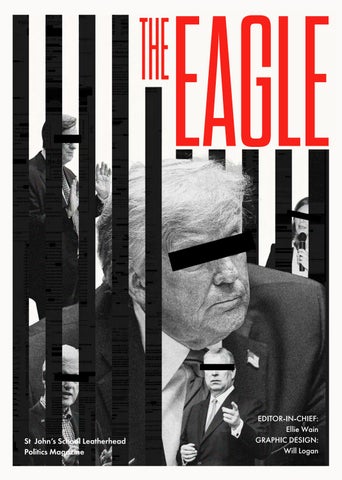
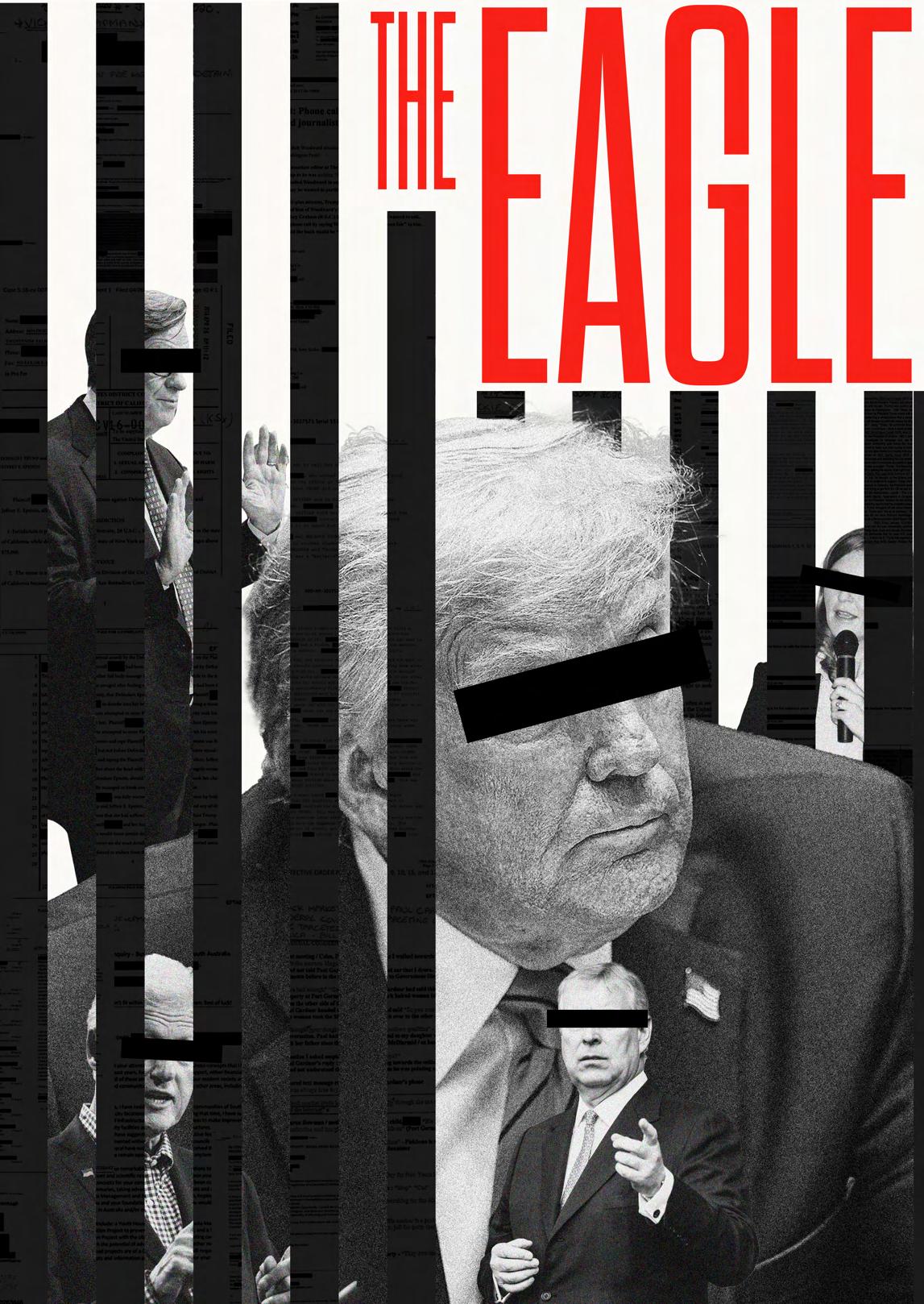
Designing the cover of the Eagle for this edition was for sure an arduous task. With such an amazing issue, with such amazing articles, it felt like I had to do it justice. My idea developed slowly, but as I started researching the Epstein files and the figures highlighted in their release, it made me understand that this wasn’t a topic to treat lightly. It also fits extremely well into our subsection of Abuse of Power, with 2 articles related to the scandals, it is pretty on the nose. I wanted the cover to feel almost uncomfortable to look at, and I hope it was direct yet technical enough that it rewarded a second glance.
Since the last issue, I think I’ve become much more interested in how design can carry much more meaning than just visual. For this issue, I was particularly drawn to the bold yet symbolic style of The Economist, which I’m sure you can see the inspiration from my use of strong contrast and a simplified composition. I also added some noise to my photos, which I think lent itself to a cover that feels more fully rounded and layered. Additionally, I stumbled back across one of my favourite political artists, Jenny Holzer, who uses official government and military documents within her art, often projecting them onto buildings to comment on war and corruption, which definitley inspired me here. This gave me the idea to take screenshots from some of the pages that incriminate Trump in the Epstein Files and impose them onto the vertical bars across the image, so look closely and you might spot them!
And the bars are certainly doing a lot of the heavy lifting here. On one level, they represent prison bars, hinting at the consequences that these people should face, but likely never will. They also mimic the heavy redactions in the released documents. By constructing them out of parts of the published files where Trump is mentioned, I wanted the design to quite literally be made of the evidence it is commenting on.
The decision to redact the eyes of each figure: Donald Trump, Bill Clinton, Sarah Ferguson, Peter Mandelson, and Prince Andrew, was about com-
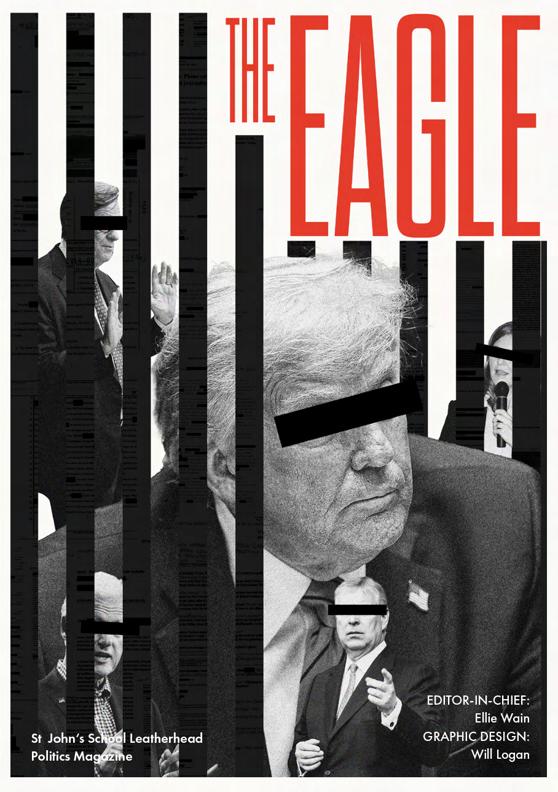
menting on how these figures hide behind the redaction of the files, pleading innocence. I wanted the cover to imply a criticism of this network of power where accountability doesn’t really exist, and I think I achieved that through the unsettling nature of their own redaction.
More than anything, the cover is trying to capture the state that the public is in. Aware that something is deeply, deeply wrong, but only able to see fragments of it, and never the full picture. It’s about impunity, and I hope I encouraged you to question the structures that allow power and silence to coexist so comfortably.
-Graphic Designer: Will Logan, L6
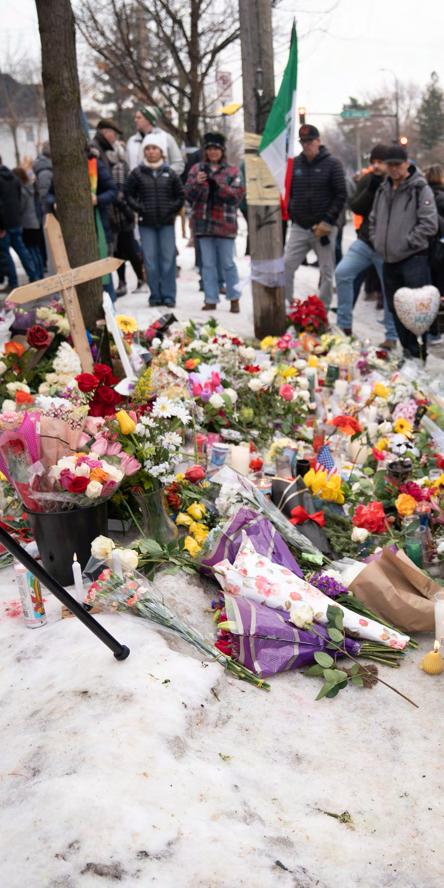
VIGIL FOR RENEE GOOD, MINEAPOLIS
Venezuela’s Capture and its Global Foreign Policy Implications
On the 3rd of January the United States launched a military strike in Venezuela. As a part of Oper ation Absolute Resolve president Nicolas Maduro and his wife, Cilia Flores were abducted and brought on board the USS Iwo Jima. The couple are now in New York City where they will face tri al. No one would deny that this is unprecedented in the sense that the US openly kidnapped anoth er countries leader in a blatant violation of international law. The
US not only committed a major war crime, but they were open and proud about it. The US had previously inter vened in Venezuela although this was done in the form of crip pling economic sanctions. On the grounds that the Venezuelan government oppresses its peo ple, the first Trump administration imposed measures that inflicted worse harm on the Venezuelan people with studies demonstrat ing that US economic sanctions on Venezuela lead to a reduced caloric intake for the population, increase in disease and mortality and resulted in millions of Vene ‑ zuelans feeling the country due to hyper inflation and economic depression. The argument can therefore be raised that Trump hasn’t broken that far away from US foreign policy norms. The US has never shied from interven ing abroad and enacting regime change is certainly nothing new within US foreign policy.
During the Cold War the US launched many covert operations through the CIA that aimed to top ple governments which were sus pected to have communist sym pathies. Iranian prime minister, Muhummad Mossadegh, was overthrown in a CIA and MI6 backed coup in 1953, the CIA supported the assassination of the first prime minister of the Con go Patrice Lumumba before they propped up the brutal Mobutu regime, pan African president of Ghana Kwame Nkrumah was also overthrown as a result of the CIA and it has been estimated the CIA has interfered in over 200 foreign elections since 1945. In
short, the US have, for a long time, held the belief that they have the right to interfere in other countries domestic affairs if it benefits their national interests.
However, what Trump has done is different. The actions mentioned above were done covertly. CIA operations are highly classified and at the time no one knew the US was behind events such as the assassination of Lumumba or the takeover of the Chilean gov ernment by General Pinochet in 1973. Trump and members of his government, on the other hand, have been extremely open not only about US actions, but why they are being taken. J.D. Vance has openly stated that the true reason the US are in Venezuela is economic imperialism Vance has said in an interview: We control the energy resources, and we tell the regime, you’re allowed to sell the oil so long as you serve America’s national interest, you’re not allowed to sell it if you can’t serve America’s national interest”.
Vance is not pretending to have the interests of the Ven‑ ezuelan people at heart, he is openly admitting that the US are prepared to overthrow another countries government simply to lower the price of US oil.
In the past when countries have invaded other countries or inter vened it has been presenting as being behind some seemingly moral cause. The best example of this historically is perhaps the
British empire and the rhetoric of the “civilising mission” with Britain carrying the “white man’s bur den” – in the words of British poet and imperialist Rudyard Kipling. Economic exploitation of British colonies undeniably occurred es pecially in places such as India and the Caribbean. What should be noted however, is that some British officials did genuinely be lieve that what they were doing would benefit and was actively benefiting the populations they were colonising. Figures such as Lord Curzon, former viceroy of India, were adamant about help ing to civilise and advance the
Indian population. These views are deeply problematic although I think it is worth mentioning that there was at least some positive intention behind them and there fore positive intention behind Brit ish imperialism. On the contrary, there is seemingly no positive intention behind US foreign pol icy under the second Trump ad ministration. Every action that is being taken is done so purely to advance US interests.
In conclusion, US foreign policy is taking a dangerous turn for the worse. The US are showing that they have no regard for interna‑
tional law, they will take any ac tion they want to if it benefits them and they are willing to openly admit this. This is on top of the fact that they are the only global su perpower and have unmatched military power. The US are the most powerful country in the world and the recent actions by the Trump administration therefore set a very dangerous precedent.
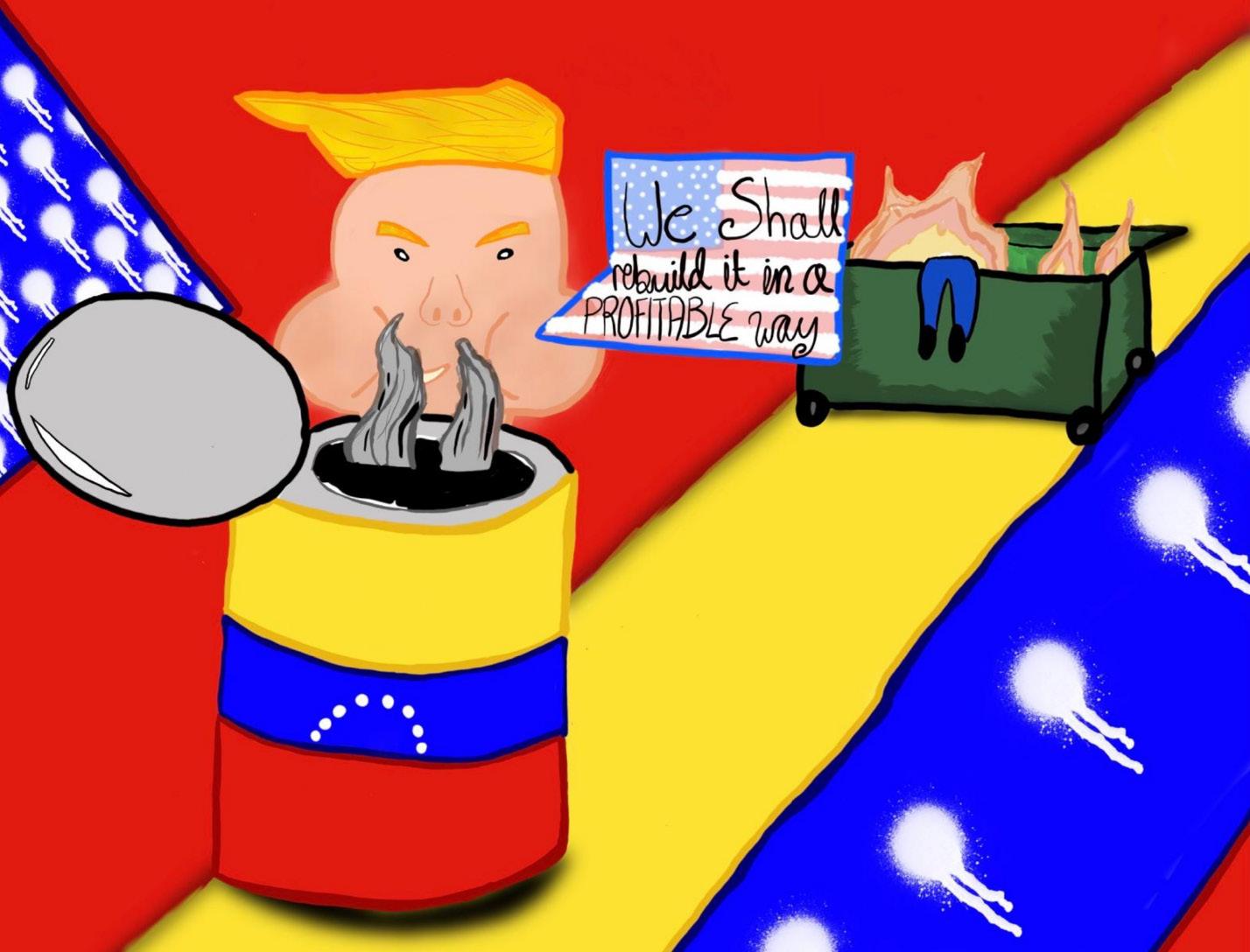
“We shall rebuild it in a PROFITABLE way”
MADURO IN USS IWO JIMA
-Lucas Dean, U6
Art by Issie Appadoo, 4F
THE DOMINO EFFECT OF
AMERICAN DEPORTATION
When people talk about immigra tion, the focus of the conversation generally leans towards borders and legality. However, for many families in the United States the con versation branches further; the cur rent issues in the USA reshape fami ly life, health and safety making the knock‑on consequences impossible to ignore. Deportations in the USA rarely impacts the victim alone, the effects branching off throughout the families. For woman who are de ported, legal American citizens or not, this often coincides with the loss of care for children and elderly.
In South American countries, 80% of unpaid care work is performed by woman. On average, 6 hours a day are spent caring for their family. As far as family traditions
go, this follows through generations. Once deported, a major support system has now been removed, creating instability throughout the homes of hundreds of thousands liv ing in the United States. If one thinks about the effect this has on woman, the problem reveals to be extortion ate. Without consideration of the relatives around them, American families begin to crumble, leading to pressure and struggles often falling on the shoulders of the young daughters of the family. Between 2013 2019, 260,000 immigrants with US citizen children were deported alone this number alone amplifies the breadth of this problem.
When it comes to deportations, the problem is rarely just the legality; the personal effects that stem from the removal of woman has on soci ety not only reinforce the severity of this problem but also the importance of South American woman to their families. Their removal lacks con sideration of the children, elderly, and family equilibrium. Loss of core woman introduces great financial strain. Families with a deported fam ily member report losing 15 30,000
rights, when governments take this away, vulnerable people in society are dehumanised and live to grow in this state of fear. Throughout commu nities, these vulnerable families will most likely not speak up but learn to adapt to this never ending state of fear, furthermore, rooting this problem into the United States. The well being of American immigrants is constantly at risk, and for the USA to not recognise this beyond legality and border control is a problem.
dollars of income annually, further burrowing these families into the hole of instability and poverty. For the children alone, a great deal of stress is inherited from such loss as these children are twice as likely to struggle academically and are 40% less likely to finish high school. It is time the American government stopped treating this problem as simply one of legality and more as one of morality.
Once health and safety are taken into consideration, a whole different plane is introduced. Woman and families alike become terrified to come forward for things like mental or physical health, includ ing going to the doctors or emergen cy services, in fear of authorities and ICE. Is the land of the free really “free” if there are people living in a constant state of fear of deportation? It would be different if these were hardened criminals, but these are regular people, families, mothers, children. While the fami ly’s economic status is affected, the growing issue is the state of fear that has been created not too dissimilar to ones we have seen before. Health and safety are fundamental human
It is hard to imagine being taken away from your family for years on end, but for Alejandra Juarez this was the case. Juarez was a moth er of two deported from the USA in 2018 after being a Florida resi dent for two whole decades. Juarez lacked a criminal record, was mar ried to a marine veteran and had two US citizen children (known as ‘dreamers’). Despite her long resi
dency and family, she was forcibly removed from her home and fami ly, being deported back to Mexico. When people read these stories on the news and see “340,000 people deported in 2025” in bold it is easy to see this as just a figure, but these are real people, with real families. Although this is an issue in the UK, it is easy to be desensitised to numbers like this solely because it is not our own country; across the Atlantic Ocean does not change the fact these are people with dreams, worries and fears. The lasting effect ing these deportations have is not something to be dismissed. The im pact this has on families across the US is extortionate, and stems fear through Americans throughout the country.
It is important we don’t ignore this - not as readers of the news, but as people. We need to have
empathy for those living in these situations and more importantly for the people who must deal with the lasting effects – the people losing their wives, children, friends. While it may be easy to shrug the problem off as simply one of border control, it is a problem of morality first and foremost, not one of legality.
-Maxine Turnball, U5
MANDELSON AND MCSWEENEY; THE HIDDEN ARCHITECTURE OF LABOUR POLITICS
Since the first truly democratic parlia ment in 1928, British Parliament has been the world’s exemplar of what true, representative democracy looks like. Voters, the heart and soul of constitutional governance, imagine politics as parliament, elections, and cabinet meetings. Currently, this could not be further from the truth; real decision making happens in private offices, WhatsApp groups, and informal advi sory networks. While every political system has visible au thority, the invisible architects of power are the figures who shape policy without holding office or being elected. Two of the most prominent figures rising to power in this informal way are Morgan McSweeney and Peter Mandelson; these men are not conspirators, nor villains, instead they are illus trations of a structural reality. Labour today is influenced not just by those elected to lead and run it, but by those trusted to shape it from the inside.
At the turn of the century, Tony Blair won a formidable land slide. After Thatcher strained public services or sold them off, and Major did nothing about it, the British people needed a fresh start; this came in Blair’s vision of the third way. What the public were not aware of though, was how Britain would be transformed. Blair was heavily reliant on his trusted advisors, leading the press to la bel his rule the “Sofa government”. The Labour Party utilised professional po litical messaging and strategic media management – forming close ties with the media magnate Rupert Murdoch. This era of British politics saw advisors become not peripheral, but central. As a result, control shifted from full Cabi net to a tightly controlled inner circle
– a consequential consolidation of he gemony in the run up to Blair’s illegal, catastrophic 2003 Iraq invasion, where the lives of one million Iraqis were swayed by informal advisors, rather than through transparent, collective de liberation.
Peter Mandelson, the so called “Prince of Darkness” is the embodiment of that legacy. The architect of New Labour, he operates in important media, busi ness, and diplomatic spheres, an ex ample of a political figure whose influ ence extends beyond formal office. It is exercised outside formal structures, not managerial control, nor internal discipline, but instead power from rep
utation, access, and signalling. When someone with deep elite connections is proximate to leadership, their influence operates indirectly but meaningfully. After the latest revelations, Mandelson is under criminal investigation by the Metropolitan Police af ter “allegedly” passing market sensitive government informa tion to the notorious convicted paedophile Jeffrey Epstein. This remains an example of what happens when power is placed in the wrong hands. Elite reassurance may stabilise markets or media, but it can also narrow the ideological spectrum; it privileges insiders over public deliberation. Even while McSweeney, Starmer’s ex chief of staff, knew about Mandelson’s close relation ship with Epstein, the influence Mandelson came with, and McSweeney and Mandel son’s friendship led to Man delson being appointed US Ambassador. As Labour MP for Tooting, Rosena Allin Khan put it “Someone needs to take responsibility, and a lot of the responsibility needs to lie with people who advise [Starmer]. It is well known that there is a boys’ club in No 10 of people who feel as though they can act with impunity, give advice. And it’s not worked out well.”
As US ambassador, Man delson overstepped his remit, involving himself in domestic political decisions, with reports showing that, while being ambassador to the US (one of our closest allies) Mandelson ‘mas terminded’ Starmer’s reshuffle just days before being sacked as US ambassa dor, and allegedly ‘helped pick elec tion candidates’. This begs the question: what was the US ambassador doing
reshaping the most influential group of politicians in the country? As one No10 insider pointed out, “That is not normal. Why was he masterminding the reshuf fle?”. Ultimately, when influence follows individuals rather than office, account ability blurs and democratic authority quietly erodes.
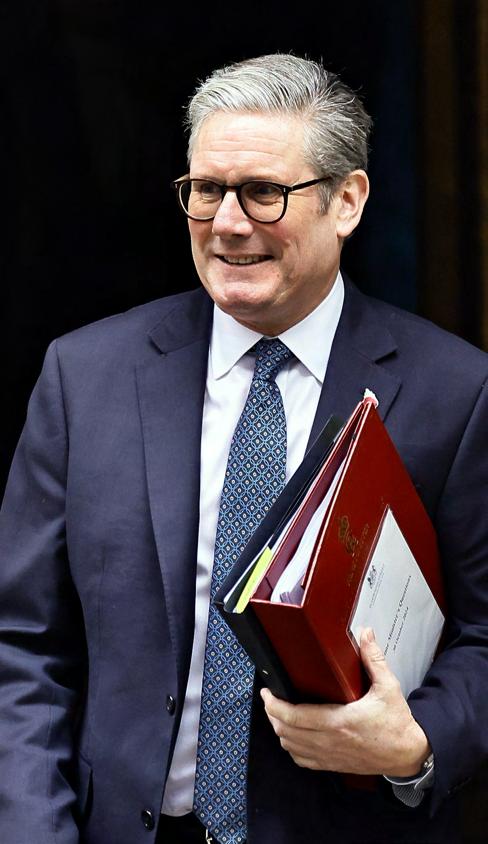
From running Keir Starmer’s Labour leadership campaign, to his resignation as Downing Street Chief of Staff on Feb ruary 8, 2026, McSweeney was Starmer’s most trust ed advisor, accredited for winning Labour the gener al election. On top of this, McSweeney was a key strat egist of Labour’s post Corbyn repositioning, after havin2g successfully taken him down, as well as his fellow progres sive allies in the Labour Par ty. His “ruthlessly pragmatic” strategy included enforcing strict discipline, by advising the Prime Minister to suspend several MPs, resulting in the suspensions of Diane Abbott and Rachael Maskell – this only brought Starmer and McSweeney closer, solidify ing McSweeney’s iron grip on the Prime Minister’s au thority.
Another way McSweeney exerted his power was in his centralised process of “long listing” candidates, moving power away from local party members, and into the hands of a small group at Labour HQ. Whis tle blowers have revealed that McSweeney and his allies used a secret Google spreadsheet to track and vet potential candidates. Those who were deemed too left wing for the Labour Party (his torically the workers’ party of Britain) were sidelined unsurprisingly, another key unelected figure who had access to this information was Peter Mandelson. This process, the systemic side lining of Corbyn aligned candidates, wiped out any potential “troublemakers” before
the 2024 general election, resulting in a new intake of overwhelmingly moderate and loyal MPs. Candidate selection shapes Parliament before vot ing occurs, strategic filtering determines who reaches voters, and internal disci pline determines which ideas survive a system closely associated with figures like Morgan McSweeney, whose influ ence operates at precisely these early, decisive stages of political power. The most decisive political leverage may
not be the ability to pass laws, but the ability to determine who gets to pro pose them it is for these reasons that McSweeney has had pre democratic influence.
When comparing the Mandelson and McSweeney, while their unelect ed powers may bear similarities, their forms of power vary. While Mandel-
son had internal, network-based, elitist influence, McSweeney had internal, organisational, and gate keeping authority shaping the way modern Labour power operates. The two glaring parallels between the two being their firm hold overpower, and their lack of accountability. Structural ly, the concerns for democracy lie in accountability, transparency, and cen tralisation. Advisors cannot be removed by voters, nor do they face electoral sanction. Advisors leave little record, blurring responsibility. Advisors compress debate, re duce pluralism, and prioritise loyalty over deliberation. This is not corruption – it is simply concentration, and concentra tion always shifts democratic balance.
Understandably, leaders must rely on trusted individuals; mod ern politics requires coordina tion, strategy, discipline, and professional expertise. With out this, governance becomes chaotic, only amplified to the public by the relentless press. However, professionalisation must not, as it has done in the modern Labour Party, become insulation as the Nixon White House learnt, when authority becomes concentrated into un elected inner circles, democrat ic legitimacy begins to erode from within.
If politics increasingly operates through unelected architecture, democratic legitimacy may just about remain intact but dem ocratic influence has and will continue to narrow further. The question is not whether advisors exist; after all, although Special Advi sors have only been a formal part of UK politics since 1964, political advisors have held some form of power since the Tudor and Stuart eras. Instead, the question is how much authority they accumulate before office itself becomes secondary.
-Will Reed, L5
Trump’s recent actions, regard ing his attempted manipula tion of the economy and threat to fire Fed chair Jerome Powell, are a precursor to a more dangerous route he may lead the US down. Trump getting what he wants may not only abolish America’s standing as a free republic, but also convert the role of the president into a ruling monarch. Trump repeatedly pushes the boundaries of his power in an attempt to ‘test the limits’ of both the people and the federal government. If he continues to widen the bound aries and get his way, it may set a dangerous precedent that he can do whatever he wishes with no checks, essentially removing the separation of powers, of which is crucial to the American constitution.
The Federal Reserve has been an apolitical and independent institu tion since 1913; its role is to maintain
Humphrey against the president’s ability to fire people in such po sitions. The case of Humphrey’s Executor v. United States stopped the President from firing heads of independent agencies. This 1935 case effectively protected these independent agency heads from Presidential interference, but the Su preme Court has been slowly abol ishing this ruling, with cases such as ‘Trump v Wilcox’ and ‘Seila Law LLC v Consumer Financial Protec tion Bureau’ which allowed Trump to remove board officials. If the line was not crossed by board officials, who’s stopping him from removing other agency heads?
The Fed’s independence is threat ened if Trump gets his way and can fire Powell before his 4 year term ends. Previously, the only way for this to occur would be ‘For Cause,’ meaning malfeasance by the Chair,
from being able to protect agency heads from being fired by the Presi dent. This new capability of the Pres ident could end the Fed’s independ ence, as if the Chair fears any policy that goes against the Executive’s wishes may subsequently end with them being fired, meaning that nec‑ essary polices may never be intro duced. It also threatens the system of checks and balances, set up by the US Constitution, since Congress may be completely unable to pre vent the Chair from being fired by the President after these SC rulings.
The SEILA LAW LLC v. CFPB ruling led to the CFPB head being fired by Trump, edging Trump closer and closer to being able to fire Jerome Powell. Now that there is a legal precedent, Trump may be embold ened to agitate for the removal of Powell. This is incredibly dangerous because if the Chair were to fear
be influenced to implement policies that he otherwise wouldn’t, therefore compromising the independence of the Fed.
The Fed must remain apolitical, as the wishes of the President can of ten be damaging for the Economy. For instance, during the 1972 elec tion, Nixon, who Trump was pen pals with in the 80s, pressed then Chair Arthur Burns to keep interest rates down before his re election, which in turn led to inflation reach ing almost 15%. We have already seen the consequences of Trump threatening to fire Powell, with Al Jazeera reporting that the ‘bench mark US S&P 500 briefly fell by 0.7 percent, and the US dollar sank 0.9 percent’ after Trump asked lawmak ers if he could fire Powell. ABC also reported that ‘the episode sent stock prices tumbling and bond yields climbing’, with ‘several big bank
fluencing Trump’s current agenda, it is not surprising that he has idolised Nixon since the 80s, writing in a se ries of mutual letters to and from the disgraced ex president, ‘I think that you are one of this country’s great men’.
The Stock Market functions best on consistency and certainty for the future; the sudden removal of the Chair of the Fed would be similar to the position if Andrew Bailey (the Governor of the BoE) were abruptly removed. This point was dramati cally evidenced recently in the UK, when the Chancellor of the Excheq uer, Reeves, was seen crying in the Commons, bond yields sharply in creased, reflecting the increased risk external investors attributed to speculation that she was about to be fired or had resigned. If the US Stock Market does not appear to be stable, investors will want to exit the
Since Trump appointed Powell in 2018 to replace Yellen, whom Trump thought was ‘too short’ for the job, he has fallen further out of the pres ident’s favour as he has refused to do what Trump orders him to. While Powell could be reappointed by Trump in 2028 at the end of his term, he is not at all likely to do so. Thus far, Powell has remained Chair and dealt with Trump’s threats easi ly; however, if he is replaced at the end of his term – a likely scenario as Trump searches for a candidate whom he can doubtlessly influence – then the independence of the Fed may, and the American economy will, be at risk. With politicians man aging the economy, interest rates will not likely reflect the needs of the economy, and another crisis, such as COVID or the 2008 crash, could prove fatal to the US monetary and financial system.
THEFEDATACROSSROADS: INDEP ENDENCE OR EXECUTIVECONTROL
THE JEFFREY EPSTEIN CASE AND ITS IMPLICATIONS FOR GLOBAL POLITICS
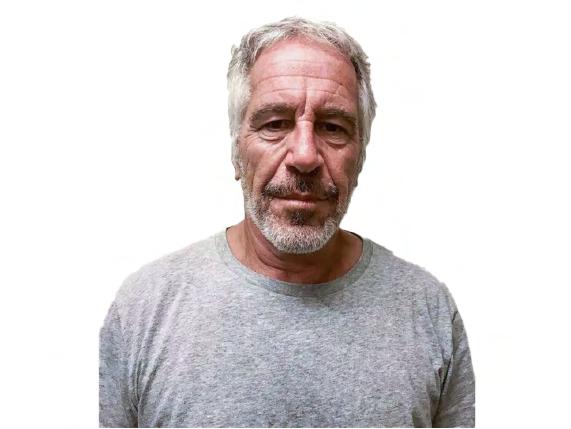
In modern politics, power is often un derstood in formal terms like elected office, statutory authority or consti tutional responsibility. Yet some of the most impactful forms of influence operate informally; through wealth, privileged access, and elite net works that function beyond direct democratic scrutiny. When this type of power evades accountability, the rule of law can be applied, insulat ing those at the top while revealing the practical limits of institutional en forcement. The Jeffrey Epstein case serves as a clear example of this imbalance. More than a criminal controversy, it demonstrates how political proximity, financial advan tage, and international connections can be used to protect individ uals from legal scrutiny. Epstein’s capacity to avoid meaningful consequences for years raises questions that
extend beyond a single individual or isolated legal failure. It compels a wider evaluation of how global structures of power operate, how accountability may be selective ly enforced, and what these reveal about democratic legitimacy in an increasingly interconnected world.
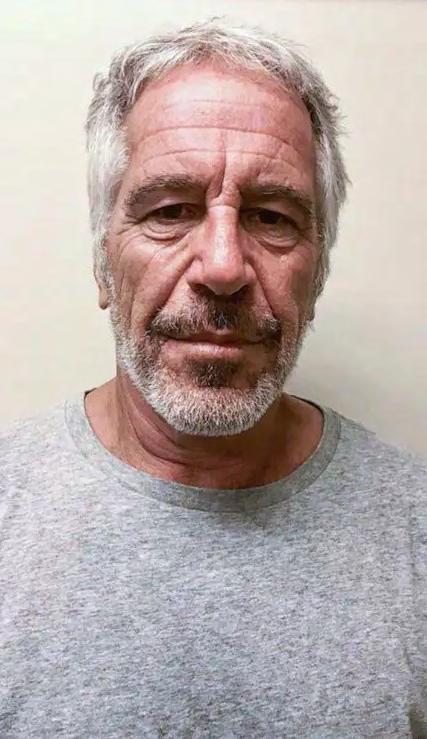
Jeffrey Epstein was a financier and net worker. He cultivated elite rela tionships across a variety of forms, including politics, finance, academ ia, science, and international elites. He acted as a middleman who pro vided introductions, funding, access, and connections to powerful peo ple. His role as a middleman is most notably exemplified on his infamous island. The sexual atrocities that oc curred on this island led to his arrest, and, later, his suicide.
However, in 2008, this was not the case. Instead, Epstein secured an exceptionally lenient plea agree ment, limiting his prosecution to mi nor state level of fences and inslat ing him from federal charges that carried the potential for substantial imprisonment. Crucially, this result didn’t
depend solely on bribery or illegal ity, but on the discretionary power embedded within legal institutions themselves. Prosecutors exercised judgment in a manner that priori tised efficiency and caution over full accountability, while legal frame works allowed such discretion to go largely unchecked. The result wasn’t just a corrupt bargain. It was a systemic failure in which institutions meant to uphold justice instead facilitated hierarchical immunity.
Epstein’s case demonstrates how in formal circles of influence can shield powerful individuals from facing le gal consequences. These networks tend to function through common interests, personal connections, and a culture of mutual loyalty, rather than any official or constitutional authority. As Epstein himself was a brilliant net worker, he attracted many politicians (such as Trump and Peter Mandelson), influential law yers, and institutions, creating an environment in which challenging him carried both professional and political risks. Structures designed to ensure accountability, which should have functioned independently, became hesitant, cautious, or re luctant. The reluctance and institu tional caution to portray Epstein as a monster allowed him to receive a sentence drastically below what federal charges could have carried. Ultimately, the protection received reflects a broader pattern in which elite power ruins the application of justice.
Epstein’s case suggests that elite networks and fragile systems of accountability are not limited to a single nation but carry wider consequences for politics and justice on a global scale. His money and in fluence reached across borders, while the lack
of transparency within financial and legal frameworks enabled him to shift assets and operate with minimal oversight. International institutions, such as law enforcement agencies and regulatory authorities, frequent ly face difficulties when pursuing individuals with broad transnation‑ al ties, leaving loopholes that those with significant power can exploit. As a result, public trust in legal sys tems is undermined. How can you trust the legal system if powerful people are too big to get the sen tence they deserve? Epstein’s case highlights the global challenge fac ing elite immunity, which tests the resilience of both political and legal systems.
Media coverage and public atten tion are often the only forces ca pable of pressuring institutions to enforce accountability on elites. The immense role of the media is
often reinforced through investiga tive journalism, which can uncover hidden networks and force legal institutions to act. However, this of ten fails due to the legal risk facing journalists and the media. This was especially potent in this case due to Epstein’s influence and power; a defamation or lawsuit against them would be costly and thus was too high a risk. Moreover, some stories are suppressed or delayed due to elite influences. In Epstein’s case, his files have only just been released, generating global public outcry at not just his actions but all those in volved. The limited reporting and institutional fear of Epstein allowed him to evade accountability for years, demonstrating that justice often depends as much on scrutiny as on law itself.
The Jeffrey Epstein case reveals how informal influence, elite circles, and
institutional discretion can work to gether to protect powerful figures from genuine accountability. From the lenient outcome he received in 2008 to the international scope of his connections, Epstein’s trajectory highlights vulnerabilities within legal systems and the difficulties of deliv ‑ ering justice across national bound aries. It also reinforces the important role played by investigative journal ism and public pressure in pushing institutions to respond. Ultimately, the case serves as a cautionary ex ample: when power functions with out effective oversight, the law is ap plied selectively, and confidence in political institutions erodes. Securing accountability for those at the top depends not only on robust legal structures, but also on the willingness of society and its institutions to en force them consistently and without exception.
-Caspar Hunt, L6
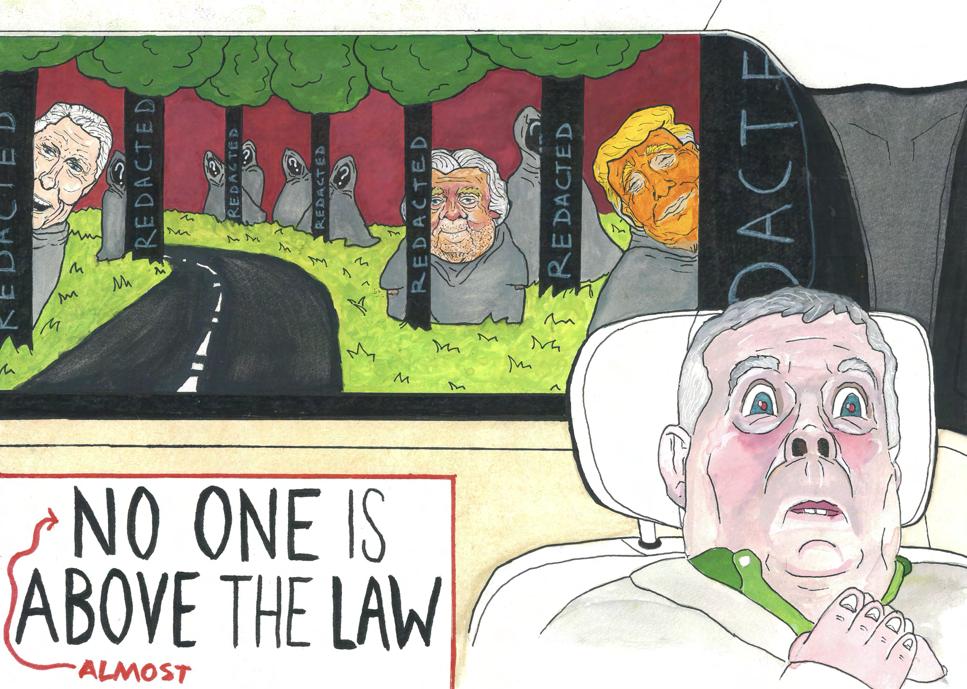
Art by Wilf Basnett, ‘Almost
The Sudanese civil war broke out on April 15th of 2023, following the 2021 military coup, when the Rap id Support Forces (RSF) attacked many bases including the airport and Khartoum (the Capital), later the state broadcaster, Sudan TV, and many bridges and roads in the capital were captured by the RSF. As of early 2026, the recorded civilian casualty rate has risen to over 150,000 people, with 12 million being forcibly displaced. Not only has the overall humanitarian cost been catastrophic, many members of the RSF and other accompanying rebel groups have taken this conflict as an opportunity to target and attack women specifically.
The femicides (the intentional kill ing of women with a gender based motive) and gender based violence has doubled since the conflict be
submission. Along with the increase in attacks from powerful forces on women, femicides by family mem bers and previous or current inti mate partners (IPF) simultaneously increased. The conflict has made the already poorly policed sexual vio lence increasingly difficult and of ten pushed aside or ignored by the leaders, more focused on fighting the RSF.
discussed the increase in danger and gender based violence by stat ing ‘even before the fighting broke out’ that ‘more than 3 million wom en and girls in Sudan were at risk of gender based violence’ and that since the conflict this number has ‘climbed to an estimated 4.2 mil lion.’
Reasons behind this often link to his

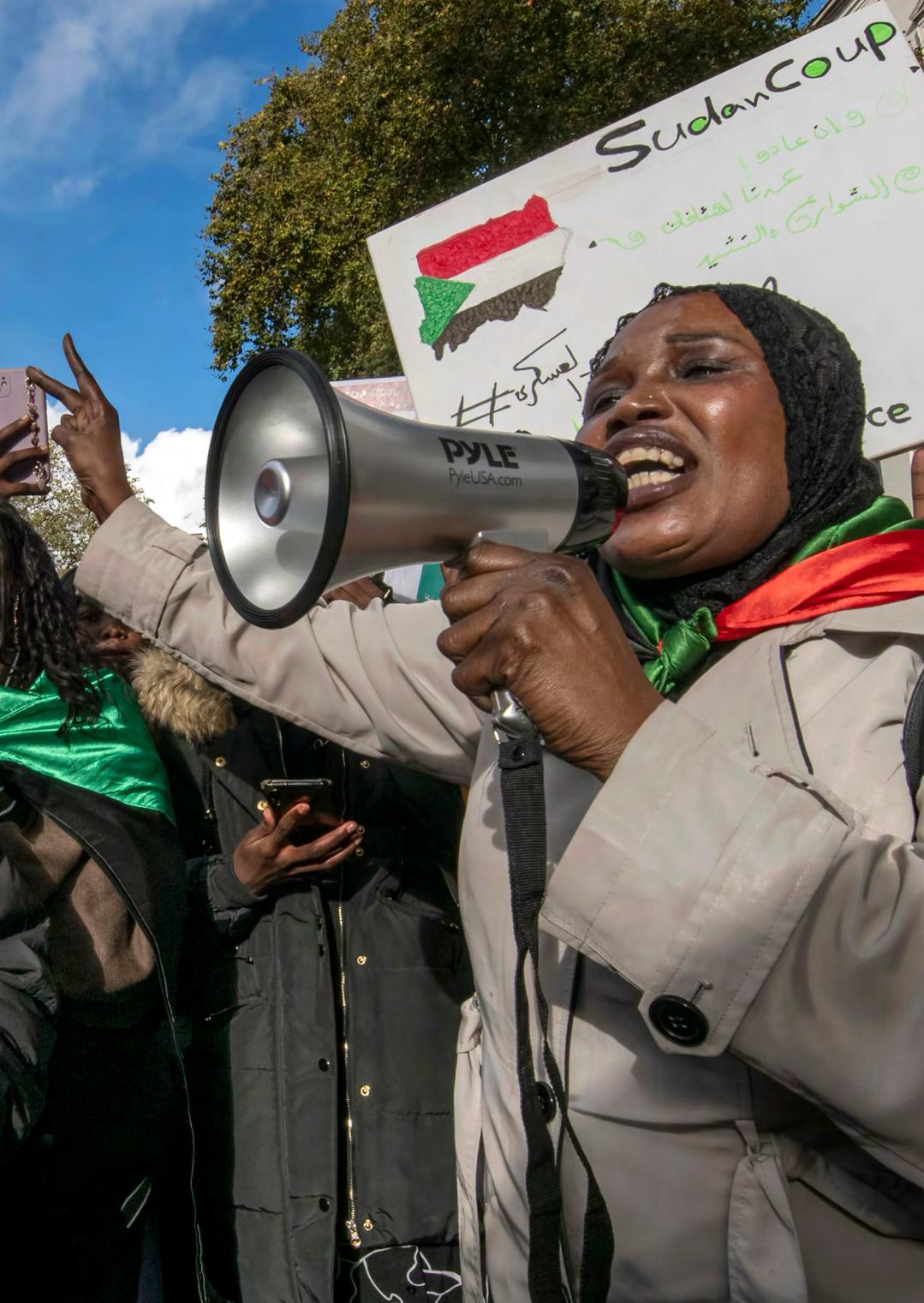
femicides globally is IPF as femicides are typically a result of long-term abuse. The belief that women are the property of a man is used to manipulate the conflict in Sudan as the RSF attack the women to punish the men, treating these innocent women as pawns in their game of war. The horrifying femicides in South Africa has much attention raised to them through ‘The Purple Movement’ campaign organised by Women for Change, which led the government to recognize the murders as a national disaster and increase protection for women. The wars in Ukraine and Pakistan have received new
coverage worthy of their cause. But why is nobody talking about Sudan?
Countless women and girls die daily due to heinous acts of sexual abuse and violence on top of the incredibly high civilian causality count. These people desperately need our help. So, get talking! As proven by the digital campaigns in South Africa, raising awareness, no matter how far from the conflict you are located, can have a huge impact on the lives and safety of the victims. Talk! No matter how uncomfortable.
-Becca Towers, U5
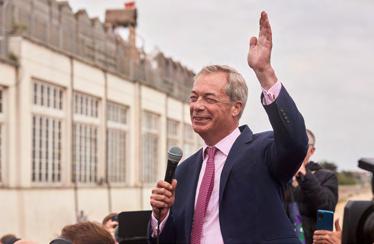
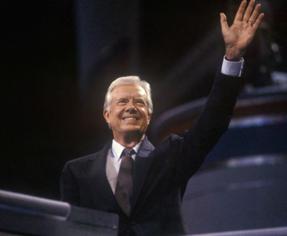
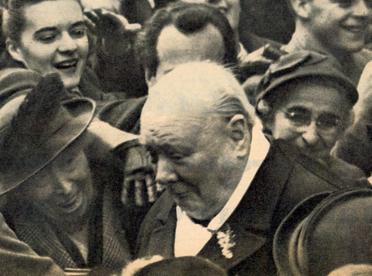

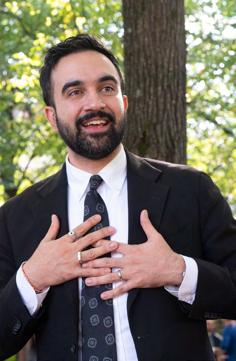
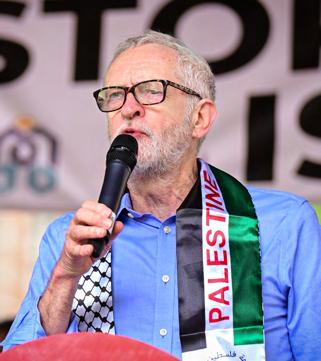
It is no surprise that the school politics magazine cannot remain impartial. And whilst impartiality has not been an aim throughout The Eagle, the amount of passion in the following articles requires its own section. This sector opens with the amusingly sassy debate between passionate Aoife Barnes and Alice Dunn, who both dissect whether populism can be good for democracy. This sets the tone for the rest of these articles, as they write with humour, wit, and intellectual rigor. Fred Von Kaltenborn follows this conversation on leadership by taking it a step further, and asking what values does a good leader actu ally require? He dissects Machiavelli’s theory from a realist view on whether a leader can be both moral and efficient. Through drawing parallels with mod ern politics, he encourages readers to draw their own conclusions. Applying this debate to history, Churchill is a notorious figure, who many consider one of the most efficient leaders in history. However, his values often come into fire as controversial. Annabel Pullen provides an answer to both Machiavel li’s argument and whether his effectiveness should be considered more important than his controversies.
Moving from historical controversies to modern institutions, Gwen Buckley examines the UK’s prison crisis and what it reveals about the state of criminal law. Her article considers how a system designed to deliver justice can become overwhelmed, raising broader questions about potential reform in the justice sector. On a more inward, phil osophical perspective, Issie Appadoo asks if our opinions form as a result of our surroundings, or if they are really our own.
More recently, one of the more polarising wins in politics was by Zohran Mamdani, the self proclaimed Socialist. He took the world by storm through his down to earth personality, and affordability policies – however, Felix Samuels interrogates the deeper levels of his economic policies. They may seem promising on the surface, but he dissects what the realities mean in New York’s budget. Our youngest writer, Mia Gunn, moves away from economy to environment as she explores the environmen tal consequences of Orca behaviour. It is inspiring to see such young people taking an interest in what the environment will look like in the future, and her article reminds us that political and moral debates do not exist only within parliaments and policy papers, but also in how we understand and interact with the natural world.

Millie Beacham closes this section with a brutal dissection of why Corbyn and Sultana’s new party failed in practice, with disastrous effects of splitting the left vote further. It is a joy to see writers choose what they care about most and write in a way that sparks debate. The variation of topics is emblematic of how passionate the writers this term and I hope you can agree this passion comes across in the writing!
By Aoife Barnes, L5 (Proposing) and Alice Dunn, L5 (Opposing)
By Fred Von Kaltenborn, L6
By Annabel Pullen, L5
By Gwen Buckley, L6
By Issie Appadoo, 4F
By Felix Samuels, L6
By Mia Gunn, L3
By Millie Beacham, L6
DEBATE: ‘Populism is a Threat to Democracy’
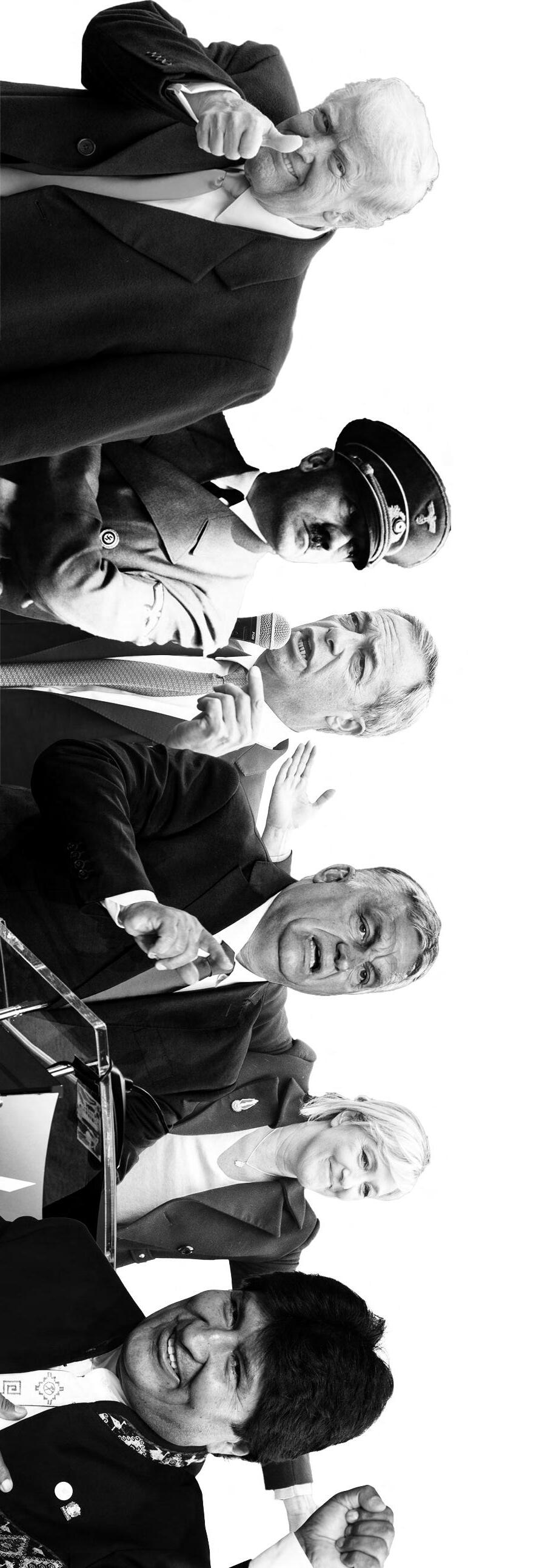
I will be presenting the view of the proposition regarding populism and its threat to democ racy, with populist figures such as President Donald Trump, Adolf Hitler and our coun try’s very own, Nigel Farage. To begin, I would like you, dear readers, all to consider out the evening, long and hard. Populism always asks, ‘who should we blame?’, but democracy asks, ‘how can we fix it together?’ Which question do you want guiding us and our future?
So, what actual ly is populism? It’s something I asked myself many times before writing this. I define populism litical strategy that splits society into two groups: the “pure people” and the “corrupt elite.” We see this play out across the globe, from Viktor Orbán in Hungary and Marine Le Pen in France, to Evo Mo rales, Hugo Chávez, and even Nigel Farage.
Alice may argue that leaders like Orbán, Trump, or many of my other examples were democratically elected, and of course, they were. But the issue isn’t
terns those examples represent.
how they won power; it’s what they did after they had it. Once in office, they chipped away at democratic norms, deepened division, and used their platforms to weaken the systems meant to hold leaders accountable. That is the danger of populism: de mocracy doesn’t vanish overnight; it erodes slowly, through words and actions that exploit the trust of the very people it claims to champion
And nowhere was this clearer than in the United States. ICE’s brutal deportation apparatus isn’t law en forcement it’s the weaponisation of fear. Under Donald Trump, that fear became a political brand. He cast himself as the defender of “the people,” yet turned deportation into a spectacle, using broken families as proof of his strength. That isn’t populism protecting a nation, its populism built on pain. Every inhu mane removal carried out under his watch wasn’t a display of power, but a moral collapse. When a lead‑ er turns cruelty into applause lines, the country isn’t being safeguarded it’s being led into darkness. And if Alice argues that Trump was simply enforcing the law, we must ask: since when does enforcing the law require stripping away dignity, compassion, and due process? A democracy governed by fear is no democracy at all.
Alice may argue that I have careful ly selected the politicians I’m speak ing about today, also known as ‘cherry picking’, but that should be irrelevant, to me and to everyone lis tening. What matters is not who they are, but what they are doing. Their actions are unmistakably populist, and that is the core issue. The focus should not be on my choice of ex amples, but on the dangerous pat
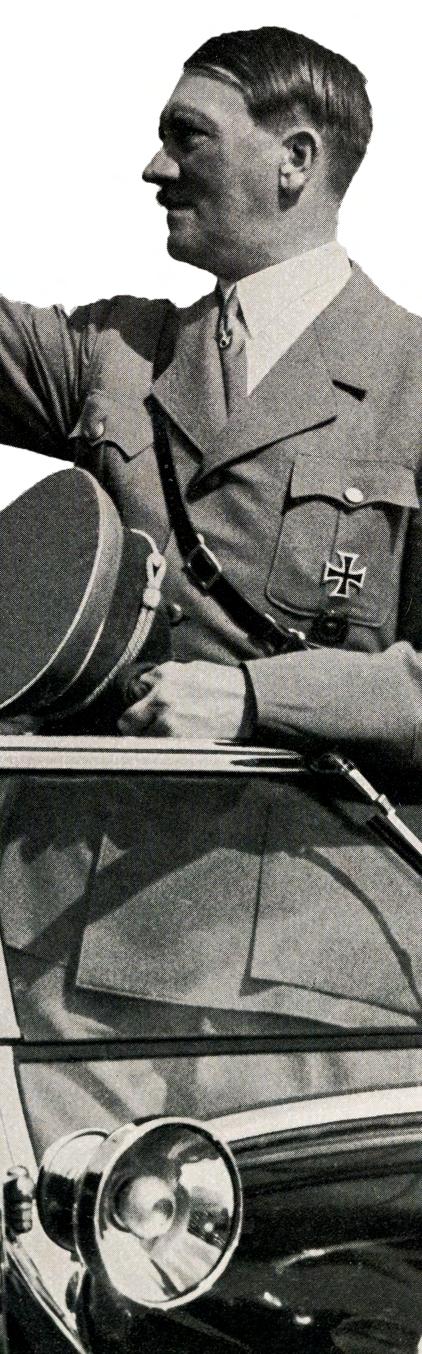
Secondly, allow me share two quotes: “We are living through the last days of parliamentary democ racy,” and “They tell us we are free but to speak freely is already dan gerous.” These aren’t modern warn‑ ings, they’re from 1930s Germany, a decade scarred by Hitler’s rise. Why mention Hitler today? wasn’t just a fascist; he was a populist. the “voice of the people” and built power by dividing society. When I visited the Wannsee House, a guide said, “The Nazis looked for the weakness es in others to make themselves feel stronger.” the psychology of destructive populism. claim Hitler didn’t threaten democ racy? His entire regime was built on dismantling it. You may claim the Nazis belong to the past. But their tactics of fear, division, emotional manipulation are echoed by popu list movements across the world to day. This isn’t about dwelling on history. It’s about recognising its return.
Repeated often enough, it cloud ed the judgement of voters and re shaped a national decision. That is the power of populism: simple slo gans, repeated loudly, drowning out complexity. Brexit itself fits the popu list mould perfectly. It framed the EU as the “incompetent elite” holding Britain back, a narrative strikingly similar to the way Hitler’s Nazi Par

a single exaggerated claim helped sway ballots and led to a seismic constitutional change. That is a threat to democracy, and it’s one we cannot afford to ignore
Lastly, Nigel Farage is one of the clearest examples of modern pop ulism, not from “across the globe” or “a century ago,” but right here, in our own country. We saw this vividly during the Brexit referendum. If Al ice argues that comparing modern populists to Hitler is “extreme,” she forgets that history is a warning sys tem. The purpose of a comparison isn’t to say they are identical, it’s to show the familiar patterns we ignore at our own risk.
Farage’s famous promise of £350 million a week for the NHS was, at best, wildly optimistic and at worst, a deliberate distortion. But it worked.
To conclude, the proposition firm ly believes that populism is indeed a threat to democracy, as by using clear historic and current figures who outline populism by every ac tion, word and decree, populism is slowly threatening every democratic society as more people gain power. History proves that when populism thrives, democracy withers in its shadow. The path of populism can lead democracy to its own de struction, and make no mistake, de mocracy doesn’t die overnight; it dies when we let populism win. So, I leave you readers with this; will we stand by and watch democracy fade, or will we defend it before it’s too late?
-Aoife Barnes, L5
DEBATE: ‘Populism
is a Threat to Democracy’
one which their democratic systems should exist as a servant to amplify, have been ignored. Despite what the proposition would have you believe, you cannot have democracy without populism.
Aoife clearly chose the populists she wrote of very carefully,
I hope we can all agree these were good feats of populist leaders around the world, considering, and directly quoting you, Aoife, “What matters is not who they are, but what they are doing”, however, unlike the proposition, I will not fo cus purely on these leaders, as I believe it would be unfair to judge an entire political ide
bunch of populists destroying all the good work done by (neo‑)liberals. These distasteful populists propose simple solutions to complicated problems. They use moralistic rhet oric, make unrealistic promises and launch unfair personal attacks on their opponents. They demonise the elite and idealise ordinary people, setting the latter against the former.
for alternatives. Ruling elites should look at themselves in the mirror be ‑ fore blaming others.
It is easy to see why we have a nat ural disdain for populism – Trump, Orban, the list goes on; we are sur rounded by right wing so called populists. As much as I may person ally dislike these individuals, I cannot
Few political thinkers have gar nered a reputation as dubious and questionable as Niccolo Machiavelli. His name has become immortalised in history in the term ‘Machiavellian’ – a word with con notations of power, corruption and moral flexibility. A reputation that raises a timeless question, first out lined in his book The Prince and still relevant today: can a politician ever be both moral and effective?
Upon immediate consideration, mo rality and efficiency appear to be the two conflicting sides of the po litical coin that any politician must balance. To act morally means be
lessly vyed for power, creating an environment in which political am bition and scheming thrived often leading to those seeking morally just means, meeting violent and un pleasant ends.
All of this helped shape the writings of Machiavelli and outline the view that, for him, intentions mattered less than outcomes. A leader who preserved the state, even with morally questionable actions, was preferable to a vitreous ruler whose weakness led to chaos and instabil ity. His argument was not that im morality was good, but that it was sometimes necessary to ensure the survival of the state and prosperity of its people.
When looking at modern politics, it does appear to clearly support this harsh realist attitude. Underhanded tactics, dodgy dealings and corrup tion scandals are mainstays of any election or political administration
We can see this when considering the Presidency of Jimmy Car t er between 1977 to 1981 in the United States. Carter was often de scribed as a morally correct indi vidual who was deeply principled and very Christian. He prioritised honesty, integrity and transparency throughout his election campaign, specifically to counteract the cor ruption and scheming of the pre vious administrations, specifically Nixon and the Watergate Scandal. However, Carters commitments to such a rigid moral code often hindered more than it helped. His Presidency was hampered by an in ability to deal with the economic tur moil of the time as well as a failure to reach a deal regarding the Iranian Hostage Cri sis. Two issues that can be traced back to his inability to reach some what

morally grey compro mises which deep ly conflicted with his thoughtful Christian prin ciples.
However, Machiavelli’s theory is not without seri ous flaws. Whilst immor al actions may deliver short term efficiency, they erode trust in the long run which can bring about its own issues of political apathy and cynicism –especially in a democracy. Fear, deception and secrecy may stabilise power temporarily, but in the long run can damage the system they are attempting to uphold. When looking back again at the era of Jimmy Cart er, we can see this in action when considering the Watergate Scan dal. Nixon’s actions, wire tapping the Democrat headquarters and then denying it in front of the nation, brought about huge amounts of po litical distrust and cynicism as well as permanently damaging the repu tation of the office of President.
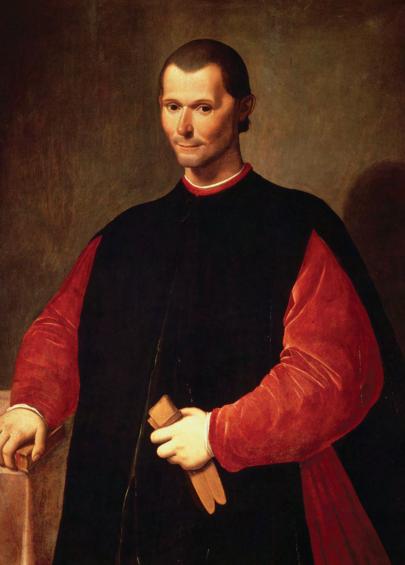
This brings us back to the central dilemma at the core of this article. What should a politician prioritise, morality or efficiency? If immoral methods produce beneficial outcomes, does that justify their use? Or does accepting Machia velli’s logic simply destroy the sys tem it sets out to maintain?
Ultimately, Machiavelli may be best understood as a realist rather than someone to look up too. He accu rately describes and articulates the predicament that politicians have always faced although description doesn’t necessarily equal endorse ment. While it may be unrealistic to expect absolute moral purity from politicians, ethical boundaries do still matter. Whilst Machiavelli’s ob servations are largely correct, ef ficiency without a hint or morality attacks the heart of democracy and fosters a slippery slope into chaos and tyranny.
- Fred Von Kaltenborn, L6
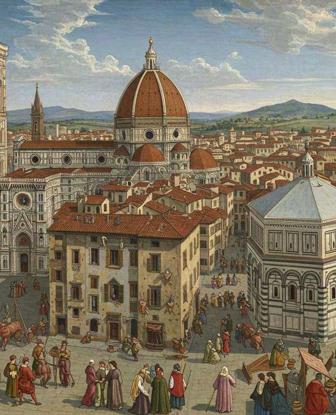
Churchill’s Legacy:
unlike any other. He would never take no for an answer and would never back down, even when his beloved country was staring defeat in the face, Europe was crumbling around him and the most prominent political figures of the time were urg ing him to accept defeat, he stayed strong, and that is why our country is still here today.
For as long as most of us can re member, Churchill has been paint ed as an influential and prominent figure in the history of Great Brit ain. He’s been described in many positive ways by people such as Queen Elizabeth II, who depicted him as “the inspiring leader who strengthened and supported us all”, or Franklin Roosevelt who stated that, in order to inspire people in the Second World War, Churchill “mo bilised the English language and sent it into battle”. Churchill is also very famous for his comedic quotes, such as “Everyone is a worm, but I do believe that I am a glow worm”, or equally well known was his re sponse to Lady Aston’s comment “If I were married to you I would put poison in your coffee”, to which his reply was “If I were married to you, I would drink it”. Additionally, Churchill had many inspirational comments such as “I have nothing to offer, but blood, toil, tears and sweat” and “The pessimist sees dif ficulty in every opportunity. The op timist sees the opportunity in every difficulty”. But what differentiated Churchill from so many other great world leaders that have come before and after him? The answer is resolve. Churchill had an unwavering determination
Churchill was born in Oxfordshire on 30th November 1874. His moth er was a wealthy American heiress, Lady Randolph Churchill, and his father, Lord Randolph Churchill, was the son of the 7th duke of Marlbor ough. When he was a child, Church ill lived a very luxurious lifestyle and spent much of his early life travel ling between homes in places such as Dublin, Oxfordshire and various parts of London. When Churchill was 12, his father was Chancellor of the Exchequer, in 1886 at age 37, and Churchill has said on many
occasions that his father’s political success was a crucial source of inspiration for him. However, in late December the same year, Churchill Sr submitted a budget request which was duly refused. He viewed this as a crushing and humiliating blow to his political career (which was very much not the case), but nonetheless he subsequently submitted his resignation on 20th December. Churchill later described his father’s resignation as a major, self-inflicted disaster, famously writing that his father resigned “at the wrong time, on the wrong issue, and he made no attempt to rally support”, describing how it affected him in his autobiography, ‘My Early Life’, “All my dreams of comradeship with him, of entering Parliament at his side and in his support, were ended”. This no doubt held significant power over Churchill and was perhaps one of the core reasons why he was so stubborn and had such a
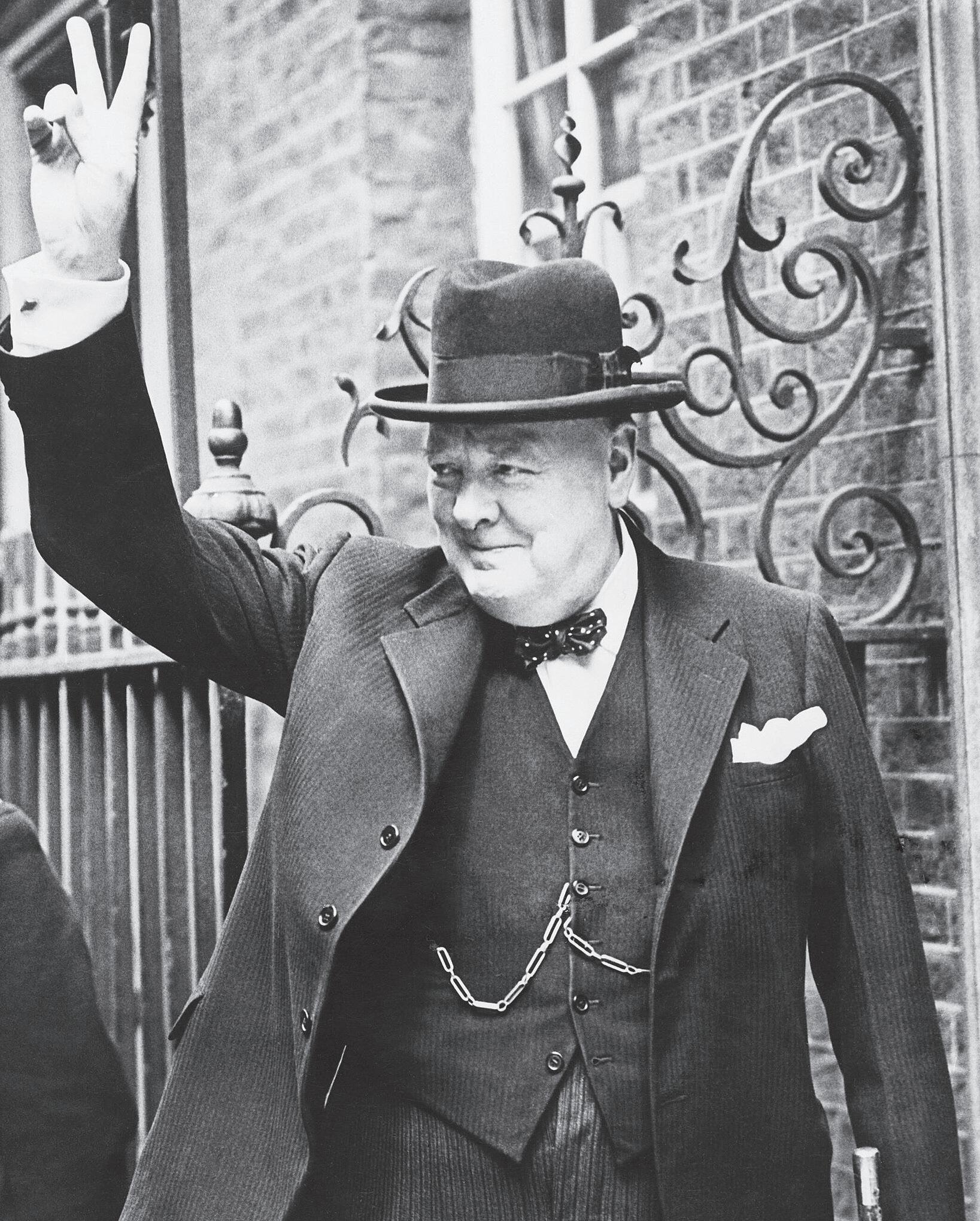
strong willpower throughout his life, to avoid appearing cowardly as his father did.
Churchill entered the Royal Military College, Sandhurst in 1893 and was commissioned as a second lieu tenant in the 4th Queen’s Own Hus‑ sars in December 1894, which was a British Cavalry regiment stationed mainly in India. Throughout his ear ly life he fought in many conflicts such as the Cuban War of Inde pendence (1895), the Malakand field force (India, 1897), Mahdist War (Sudan, 1898), the Second Boer War (South Africa, 1899 1900) and the First World War (Eu rope 1914 1918). In South Africa, Churchill was originally a civilian war correspondent, reporting news of the war back to the UK. On the 15th of November 1899, Churchill was on a reconnaissance and pa trol mission on an armoured train near Chieveley, with approximate ly 150 other men when they were ambushed. Immediately many of the senior officers were injured and so Churchill took the lead of the op eration, helping carry and care for wounded, and evacuating people from the train. Many of which later credited him with saving their lives. Churchill was painted as a coura geous hero in the British papers; however, he ended up being cap tured during the incident and taken to a prisoner of war camp where he later escaped and returned to Brit ain even more revered than before. This was the beginning of Churchill’s immense courage and bravery.
Regarding his political career, Churchill was first elected as a mem ber of Parliament on October 1st, 1900, and progressed through vari ous roles until he was made first Lord of the Admiralty in 1911. In 1915, Churchill proposed the Gallipoli campaign, to break the stalemate
by seizing the Dardanelles straight and potentially knock the Ottoman empire out of the war. He proposed they do this by landing 559,000 allied soldiers in total. There was a massacre and the entire plan was a huge failure. The authorities used Churchill as a scapegoat. He was disgraced and discredited to the point of being verbally abused in the streets leading him to make the cou rageous decision to ‘put his money where his mouth was’ and resign from all political duties. He rejoined the armed forces as the command er of 6th battalion, demonstrating his courage and tenacity.
Churchill did make many mistakes such as preventing food from be ing dangerously yet crucially trans ported to Bengal during the fam ine where 3 million died or being a ‘die hard’ imperialist (due to the Victorian society he grew up in and his father’s beliefs) and being opposed to the suffragettes (one of which, ironically, was his wife). However, he also made many vital and crucial decisions that led to the victory of the allies in WW2 such as the conservation of millions of lives and arguably the preservation of the free world as we know it today. Therefore, it would be unreasonable to have a negative view of Church ill, as he was an integral factor of the victory of the allies during the second world war and helped defend his country on countless occasions, demonstrating courage, selflessness and tenacity. Churchill if often regarded as a by gone and irrelevant to the issue of today’s society, however there are many things that we can still learn from him. For example, his utterly unmatched leadership, his admira ble determination and his absolute views on the defence of democ racy. Finally, his influence can be epitomised by the American writer
Jon Meachem “Churchill should inspire us, not because he’s such a hero, but because he’s so human.”
-Annabel Pullen, L5
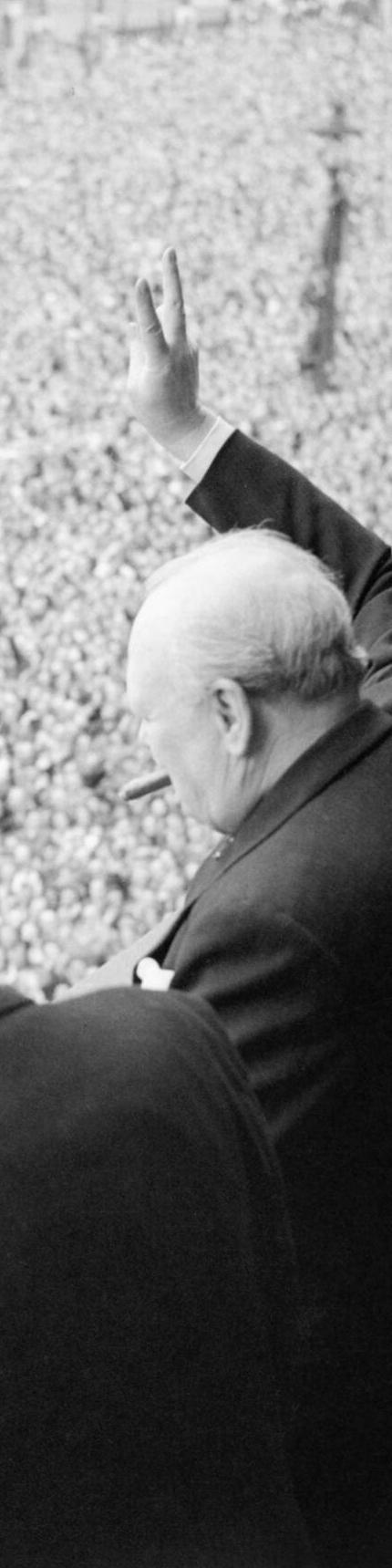
Churchill holding up his iconic ‘V’ sign.
What the UK Prison Crisis Reveals about Criminal Law
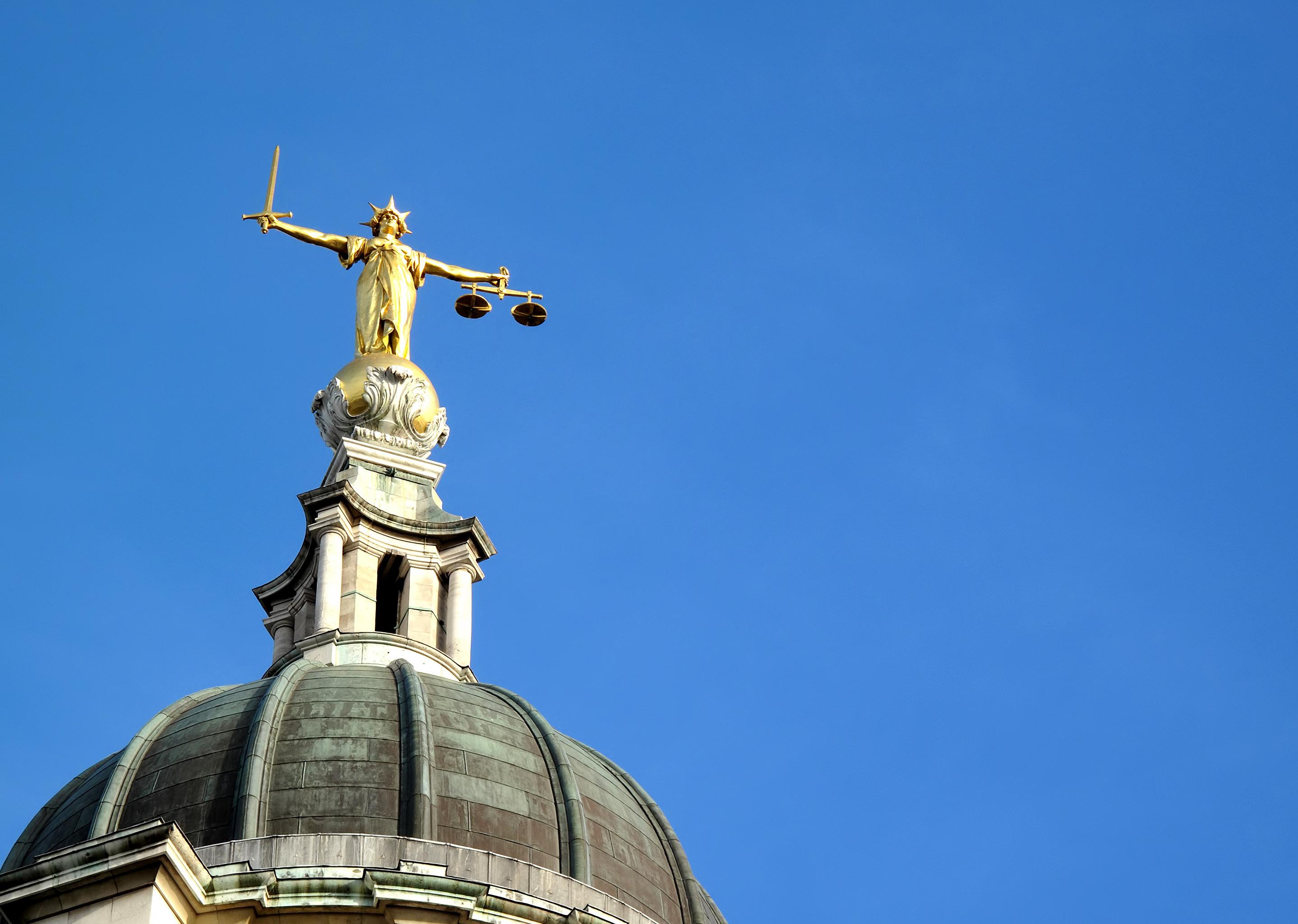
The UK is renowned for being a country that abides by the rule of law; crime is detected, offenders are brought to justice, and sentenc es are passed. However, behind the myth of due process resides a major political issue: a criminal law system that is increasingly reliant on punishment it cannot afford to deliver.
Prisons are overcrowded, under re sourced and failing to meet basic standards. This is no longer just a practical concern – it is a political and legal is sue. Does our criminal law system follow through on the deliv ery of its stated objectives: justice, deterrence and public protection?
The stated purpose of criminal law is that wrongdoing must be punished. This retributive philosophy has dominated sen tencing policy in England and Wales for decades. Politicians vied with each other to appear ‘tough on crime’, calling for more severe sentences and an end to early release. This has reaped a multitude of con sequences.
The prison population has grown relentlessly over the past few decades while investment in rehabili tation has not kept
pace; many offenders are being sent to prison for short periods of time for non violent offences, despite com pelling evidence that such sentences are ineffective at minimising offence. As a result, criminal law appears increasingly strong on rhetoric but weak in practice, and a criminal law system that punishes more people for longer may ultimately prove ineffec tive in preventing crime.
Overcrowding and the Erosion of Justice
Prison overcrowding is not just a matter of discomfort; it has a direct bearing on the authority of the crimi nal law. When prisons are operating at or near full capacity, prisoners are less likely to have access to educa tion and training, treatment for men tal illnesses or support to address issues of substance abuse. Addition ally, incidents of violence and self harm are more common.
Overcrowding, therefore, under mines one of the stated rationales for punishment: rehabilitation. If prisons are not fit for purpose, if they cannot support offenders to al ter their ways, then the criminal law begins to look less like a constructive response to offence and more like a means of simply containing the problem.
Politically, this creates a problem of credibility; the state asserts that punishment is being ‘meted out’ as a form of societal protection. Yet, the practical reality is that people who are released from custody are more likely to commit further crimes than when they were imprisoned. This poses the awkward query on every one’s tongues: Does the criminal law system really protect our society, or does it merely manage the risk of future harm?
The Pledge of Equality Preceding the Law
Another stated principle of the crim inal law is that justice must be equal. In theory, all of us are equal before the law. In practice, the criminal law operates in a deeply unequal socie ty. People from poorer backgrounds are more likely to be criminalised, less likely to have access to good quality legal representation and more likely to be sent to prison. Ra cial disparities throughout the system further undermine confidence in the fairness of criminal law.
Politically, this matters due to the au thority mandated by criminal law. If select communities perceive them selves as targeted by or excluded from the process, the law becomes less of a neutral arbiter and more of an instrument for social control.
The Politics of Reform – Why Change is a Challenge
If the problems facing the criminal law are deeply apparent, why is re form so slow in coming? The answer lies in politics.
Criminal justice is uniquely vulnera ble to populism; any retreat from pun ishment could easily be construed as a sign of weakness, whatever the evidence might suggest. Rehabil itation will always be more difficult to sell than punishment, because its benefits are longer‑term and less tangible. There are, however, signs of change. Greater use of communi ty sentences, restorative justice and diversion schemes for offenders is proof of a growing recognition that punishment has its limits. These alter native approaches aim to reduce of fending by responding to its under‑ lying causes – addiction, poverty, mental illness, etc – instead of simply penalising the symptoms. Although such moves can be politically vulner
able and easily overturned in cases where media intrusion incites public scrutiny of an offender or crime.
Are the Principles of Criminal Law Still Fit for Purpose?
The principles underlying criminal law – responsibility, proportionality and the rule of law – remain as valid today as they have been. We must have laws, and we must have listed consequences as a result of break ing said laws.
However, the practical application of these principles is under extreme strain. If punishment is delivered without any realistic prospect of re habilitation, then proportionality becomes a meaningless concept. If imprisonment becomes the default position rather than a sentence of last resort, then responsibility for change lies less with the individual offender and more with a system that is programmed to fail. In this sense, the crisis is not about abandoning criminal law’s principles; it is about defending them.
Therefore, Britain is faced with a choice. The criminal law system can continue down the path it is on, more punishment, more prison places, more rhetoric, or it can evolve into a system that balances punishment with effectiveness. This is not just a matter of criminal law either; it is a political issue. It requires pol‑ iticians to explain what the purpose of criminal law is: punishment for its own sake, a means of reassuring the public, or a constructive way of reducing crime? Until we are given an honest answer to that question, the prison crisis will remain not just a policy failure but a symptom of a deeper malaise at the heart of British politics.
-Gwen Buckley, L6
ARE OUR OPINIONS EVER REALLY OUR
Why do we care more about
sider how often we stop to consider the idea we might be wrong. It’s a pret ty simple question but one we rarely ask ourselves. And I won der why. Maybe, it’s because be ing wrong about something you care about is like handing in your resignation to your own brain. Be cause our opinions are more than just our own thoughts? Admitting we are wrong is uncomfortable, something our brains are taught
ions are challenged, our amyg dala may trigger a fight or flight response which releases cortisol and adrenaline.
In our fight or flight response the left side of your brain and the prefrontal cortex responsible for logical thinking and emotion al regulation shut off. Therefore we as humans struggle to pause and think and say ‘hey I actual ly might be wrong here’; instead,

still close?’ ‘Do I still trust them?’. When a belief is tied to people we care about, it no longer exists in isolation but becomes a reflection of our identity. Therefore, opinions often feel like part of our identity rather than just beliefs because they are re inforced by those we trust, have strong emotional bonds and, eventually, become intertwined with our sense of self or belong ing. Disagreements feel personal and threatening as previously explored.
Finally, are our opinions ours? In a world filled with social media, advertising, unspoken rules and dominating political views, the idea of having a completely independent opinion is becoming increasingly questionable. The line between inde ‑ pendent thought and imitation is incredibly fine, blurry and hard to determine; but the question is where do we draw it?
Even when we feel our opinions are unique, they are often most likely influenced consciously or unconsciously. This idea is known as social learning, ‘a theory that proposes that people learn through observing, modelling and imitating others’ – DLI. As mentioned above, over time re peated exposure to others’ ideas makes them feel familiar and so we eventually internalize them. Making an opinion feel unique since we have unconsciously ab‑ sorbed it and have processed it technically independently (at least from our point of view). This doesn’t mean we lack agency, but it does challenge the
idea of fully independent thought and opinions.
Ultimately, our opinions are both ours but not entirely, they form off a mix of personal reflection and external influence. Our thoughts are shaped by trusted relation ships and repetition. So, it could be suggested that no opinion ex ists in total isolation, but we still should have a sense of owner ship over our beliefs since we are selective over what we choose to believe or absorb. In conclusion, the exploration of these questions could reveal that opinions are personal and inherently social. They are shaped by repetition, trust and exposure to the idea of those around us but also filtered through our own reflections and choices. Perhaps real insight is being aware of forces that shape our opinions is just as important as the opinions themselves since it gives us the freedom to think critically, act intentionally and define who we are.
-Issie Appadoo, 4F
MAMADANI’S MONEY PIT
New York City’s newest mayor, Zohran Mamdani, has been a major talking point in politics over the course of the last 3 months. Born in 1991, Mamdani is only 34, making him New York’s youngest mayor in more than a century. His notable charisma and charm enthused voters across all demographics, and combined with his popular socialist policies, he was elected mayor with 50.4% of the vote (beating Andrew Cuomo by 10 points). However, there are undoubta ble flaws in his Mamdaniomics, lead ing to the question of who will be foot ing his bill?
On the housing front, a rent freeze for rent stabilized apartments, holding rent increases steady for millions of tenants in stabilized units, combined with building 200,000 new afforda ble housing units over the next decade using union labour and public fund ing. In terms of taxes, the main premise is raising tax for the wealthy, spe cifically raising corporate taxes from 7.25 % to 11.5 % to generate addi tional city revenue, imposing a 2% city income tax on residents earning over $1 million annually, and proposing to hire more auditors and cracking down on unpaid fines to raise extra revenue. Wages are also central to Mamdani’s plans, aiming to raise minimum wage to $30 per hour by 2030, with auto matic increases tied to cost of living or productivity. Finally, for public servic es, free public bus fares, and universal childcare for all children 6 weeks to 5 years old. Whilst this is not every pol icy, these are, in my opinion, the most central ones to analyse as they have the most significant impact on civilian life.
It is important to see the potential cost of these policies. First, rent freezes for rent stabilized apartments does not have an immediate cost with figures attached to it but it could result in in direct revenue loss of tens of millions per year in property tax and econom ic activity. Landlords and property owners would collect less rent, which would damage the economy despite reducing the cost of living. Next, Mamdani’s plan to construct 200,000 new affordable housing units over the next decade is estimated to cost roughly ‘$100 billion, which would hinge on the city getting permission to borrow $70 billion, or about 40% more per year added to its annual capital budget.’ This is according to Vital City NYC, showing the huge cost of this ambitious policy.
Raising the minimum wage to $30 an hour by 2030, similarly has no meas urable cost. As the Economic Policy Institute states, this policy ‘would go beyond the levels of minimum wag es studied in past research, making it more difficult to precisely estimate the number of workers who would benefit and any additional impacts of the measure, such as reductions in hours or employment.’ However, we can estimate that this policy would raise labour costs for both small and large businesses and employers, par ticularly in retail and hospitality. On the public service front, free public bus fares have been very popular amongst Mamdani’s supporters, and this policy is estimated to cost the city around $700m $800m annually in lost fare revenue, based on Metropol itan Transportation Authority es ti mates and Mamdani’s own campaign figures. Following this, his plan for
universal childcare for all children 6 weeks to 5 years old is one of his most pricey proposals, with his campaign citing cost figures at $6bn per year. These estimates would place the annu al cost at $16.7bn, and over the 10-year peri od, $167bn. Whilst this total does not account for minimum wage rises or rent freezes, it does show the cost for the City of New York per year in con crete terms.
With figures this substantial in com parison to New York City’s annual budget of $116bn a year, the ques tion is what price does this plan come at, and who will be picking up the invoice? Mam dani’s main proposi tion as mentioned is increasing corporate tax, specifically the rate from 7.25% to 11.5%. This is projected to raise $5bn annually, in conjunction with a 2% city income tax surcharge on those earning over $1 million a year, which forecasts estimate will raise $4bn per year.
The overall revenue Mamdani will raise comes to roughly $10bn if we estimate the stricter enforce ment produces an extra $1bn, leaving $6.7bn unaccounted for in Mamdani’s budget. This deficit force the city into borrowing more money, cut spending on essential services elsewhere, or raise taxes on the working classes if Mamdani exhausts the methods he can use to tax the wealthiest in New York City
buildings, invest in housing stock, and may stop investing in rent stabilized
minimum wage could also lift thousands of workers out of
istic. The universal childcare policy sounds excellent in theory, making
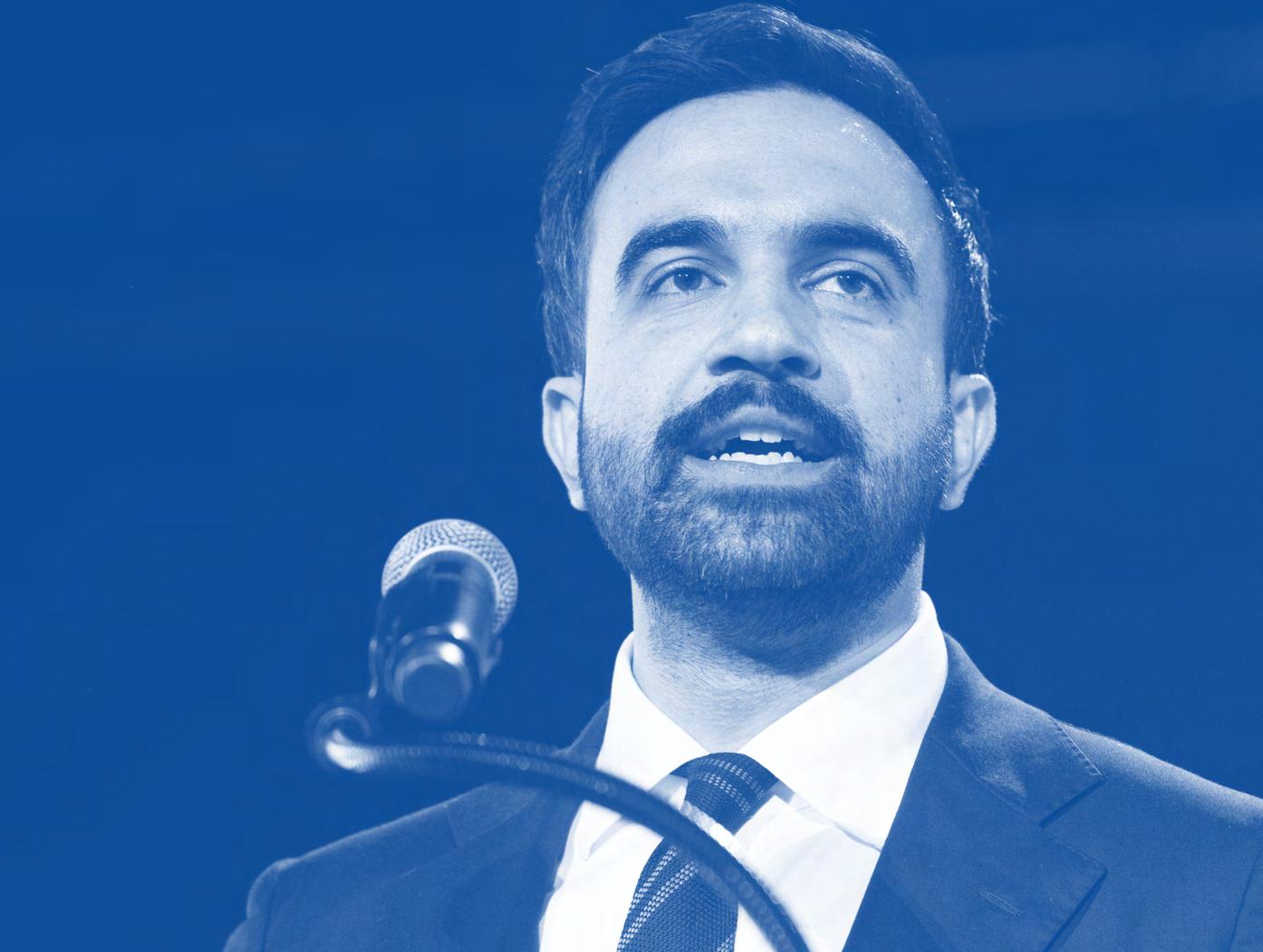
On the housing front, Mamdani’s pro posed rent freeze would aid millions of tenants save money as their rent will not increase, which is an obviously a positive as it helps citizens survive dur ing a cost of living crisis by giving them more disposable income to spend on essentials. However, the drawback of this policy is the Landlords may have less incentive to maintain apartment
ing this, former Mayor Bill De Blasio also implement ed 200,000 housing units, but Democ racy Collaborative states, ‘Problem was, 200,000 was really a drop in the bucket.’ Therefore, Mamdani’s plan may be expensive and not fix the housing crisis in New York completely.
Some may argue the mayor’s mini mum wage policy of ‘$30 by 30’ is necessary due to wages not rising as fast as living costs, and with a higher minimum wage, citizens will be able to pay for their food, rent and trans port costs far more easily. A higher
wages for workers. Businesses fac ing sharply higher wage costs may respond by reducing staff (unemploy ment), cutting employee hours (under employment), raising prices, or shift ing toward automation.
Mamdani’s free bus policy is strong, only costing $800million to give New Yorkers free transport. A downside would be if overcrowding and delays would become a problem with too many people relying on buses as their primary means of transport, however theoretically this policy remains real
implement the policies I have dis cussed effectively brings concerns. A $6.7bn deficit in his budget cannot be brushed over, alongside other economic concerns which are conse quences of his rent freeze, minimum wage rise, and housing project. Ulti mately, Mamdani’s agenda reads less like a budget, and more like a wish list, so cannot be implemented without reviewing funding plans.
-Felix Samuels, L6
The Ethics of Orca Behaviour:

Killer whales have been spotted off the coast of Portugal attacking boats raising the question of their behavioural ethics. Marine scientists have found out that this is actually a playful behaviour, and they are just having fun. Despite their good intent, their size can be dangerous when they interact with these boats. Luckily no one has been killed yet as they have all been saved before the ship sank as a result. The cause of their mischief is due to the creatures aiming for the back rudder. This is a problem, as when they snap the rudder, it causes the boat to leak which also prevents them from turning around.
Another issue has arisen as elder orcas are teaching their young how to play with the boats, increasing the original size of the problem. This has even been caught on camera. The adult bumps it first, and then the young one bumps it, imitating their parents. People originally thought that this issue would wear off over time, however after scientists observed this behaviour being taught to younger orcas, it has increased the problem.
A strange thing that scientists have also noticed is that two pods have joined together to playfully carry out this unknowingly dangerous behaviour. Similarly, this is strange behaviour as killer whale pods tend to keep to themselves, despite not being territorial to other pods. At least 250 boats have been damaged by the orcas and 7 sunken, thankfully with no casualties as a result.
However, from further investigation scientists concluded that this is the orca’s migration course and they do this path every year in order to get to their pray, the blue tuna, however – it has never been recalled that they have interfered and harmed ships.
It raises the question; are they innocently playful or dangerous?
-Mia Gunn, L3
The new left wing party that was supposed to bring hope to the voters disenfranchised by the current party options, started off full of aspirations and a possibility for new beginnings. Your Party has been doomed from the start, made up of two leaders who cannot agree on simple ideas or plans. Their animosity created an im possible mission for the party to form a coherent plan; and members lack a clear aim and mission for the party to reach. From puerile boycotts of the party conference by a co founder to infighting and a complete lack of rep resentation for the working class by a party that claims to represent them, the initially hopeful party has fallen into little more than petty squabbles and foregone its original purpose.
Co founded by Jeremy Corbyn and Zarah Sultana after Corbyn was oust ed from the Labour party for several reasons; including anti gations resulting in a ban to stand as a Labour candidate and Sultana af ter having the whip removed for voting against the government to scrap the two child benefit cap. In July 2025, the new left wing party gave hope to younger, more left ing voters who had lost confidence in Labour to pro mote a left felt increasingly detached from the left party. Over 700,000 people signed up for the Your Party website in a week, demon strating signifi cant sup port for the party in its early days
Why ‘Your Party’ Failed Before it Even Started
and providing evidence of public de mand for a fresh, far left party and perspective.
Despite this positive start, problems rapidly came to the forefront, with the party quickly dissolving into fac tions as they debated how the party should be organised. In early August people like Driscoll, Feinstein and Roger Hallam favoured a federal approach made up of grassroots movements and interactions, figuring out a full party later. Others such as Corbyn favoured a collective, party first approach – prioritising forming the party and wanting to figure out
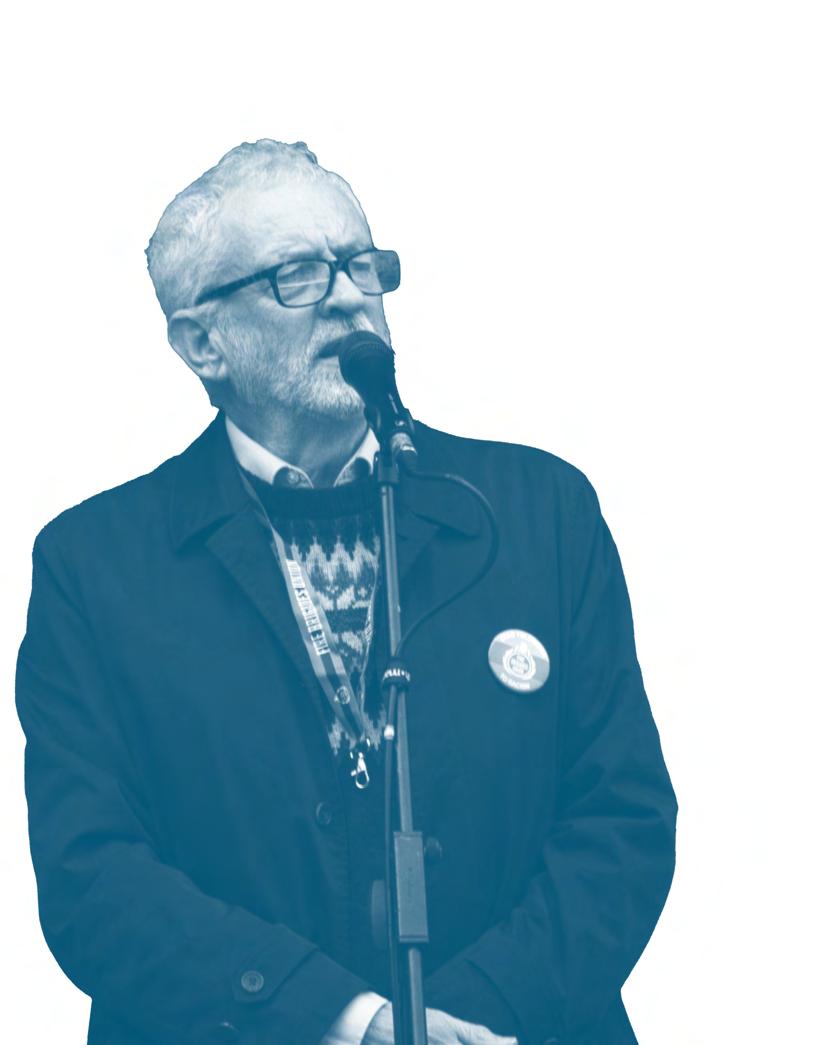
public fight on social media over the issue of Sultana sending out an “un authorised” email inviting people to become paid members; Corbyn told people to ignore the email and in formed the public that he was taking legal action against his co leader. This spat took place as Sultana ac cused him of running a ‘sexist boy’s club,’ tacking onto his record of being accused of bigotry, the two continued to have public fallout, severely dam aging their reputation and making the party a laughingstock among news reporters and opposition parties. Sul tana subsequently explained she felt she had been left out of discussions and not included to the same extent as Corbyn, despite founding the par ty with him and being of the same rank within the party. Their actions undermine the party’s authority as the lack of professionalism and decorum comes across entirely unprofessional, especially of two established politi cians, who want to present themselves as candidates to become the Prime Minister, should their party win.
Less than a week after the member ship fiasco, there was a second mem bership launch, using the same web site, this time with Corbyn’s approval. During which, Sultana named herself a member – hinting to a step down from her previous position as co lead er. All of which alluded to further party fighting and disagree ments – at least these ones seemed to be kept within party confines. Despite Corbyn’s outrage at the first launch of membership a week prior, he seemed quite happy with the second launch, brush ing off the fraught days the party had just experienced. He was able to reassure those who had signed up under the first launch that their ‘‘data and membership is secure and will
be migrated across.’’ Securing some semblance of competence and confi dence in the party.
Despite this apparent end to the fighting and fix of the member system, on the 14th of November Adnan Hussain withdrew his support for Your Party over “persistent infighting” followed shortly by Jamie Driscoll, then Iqbal Mohamed in mid-November. With multiple members fleeing from the party over concerns of leadership, infighting, and overall incompetence. The future of the party seems quite uncertain, as loosing members in such rapid succession does not lead to much stability or reassure their voter base. Continuing into future election, if the party is still functional by the next General Elec-
gent on not being aligned with any other parties recognised by the Elec toral Commission. Sultana then boy cotted the first day of the party confer ence in Liverpool, an event which had been built up to and seen as the end of the infighting and issues, with it meant to instil confidence and put to rest all the issues that had plagued the party since its formation. Sultana’s boycott revealed clear division within the par ty and caused chaos amongst attend ing members. During the inaugural conference, of an expected 13,000 attendees, only around 2,500 came, proving a rather meagre turnout and demonstrating the lack of support for the budding left wing party.
Falling from its original possibility of providing an alternative left wing

with the wealth reform they seem so dead set on. The removal of a single leader system by the members – pre ferring a ‘Central Executive Commit tee’ is likely to lead to more confusion and division within the party, as they do not have one person to centralise the party and ensure stability.
With the upcoming Council elections in May, the party does not seem to have any candidates proposed, as they have not published any mem ber data nor suggested who may be up to stand for a council position. It is currently unlikely that the party will be able to field candidates for the up coming council elections, and even if they manage to, it will be so late that many supporters may have lost faith in the party’s ability to organise them selves. According to Inside Croydon there will not be a candidate standing for Croydon mayor during the council elections. Their image is continuing to decline outside of their resolute sup porters; their manifesto remains unpublished and the party has not publicised any policies or concrete aims.
Your Party does not embody any specific ideology, nor present any policies that would lead to it taking a majority in the next General Elec tion. It has faced numerous issues with infighting and opposition within the party – reflective of the notorious Tory ‘psychodrama’ of the late period of the 2019 2024 government. With out any true direction or support from core members (especially since so many have fled), the party has contin ued to fall further out of the public eye and favourability, losing the faith of those they initially brought hope. The party’s failure can easily be traced to the intra party opposition, among other things, but fundamentally the party is unlikely to survive to the next election, with the blame laying with the co founders who refuse to agree with one another.
-Millie Beacham, L6
THE ‘PALATABLE GAY’; CONDITIONAL ACCEPTANCE OF QUEERNESS by Will Logan, L6
SOCIOLOGICALLY SPEAKING... THE STORY OF ALEX AND MARCUS LEWIS by Bea Moore, L6
MUSIC’S IMPACT ON POLITICS by George Williams, U5
MISOGYNY IN THE MEDIA by Rose McVeigh, L5
DEREK JARMAN AND THE POLITICS OF QUEER FAITH by Charlotte Clee, U6
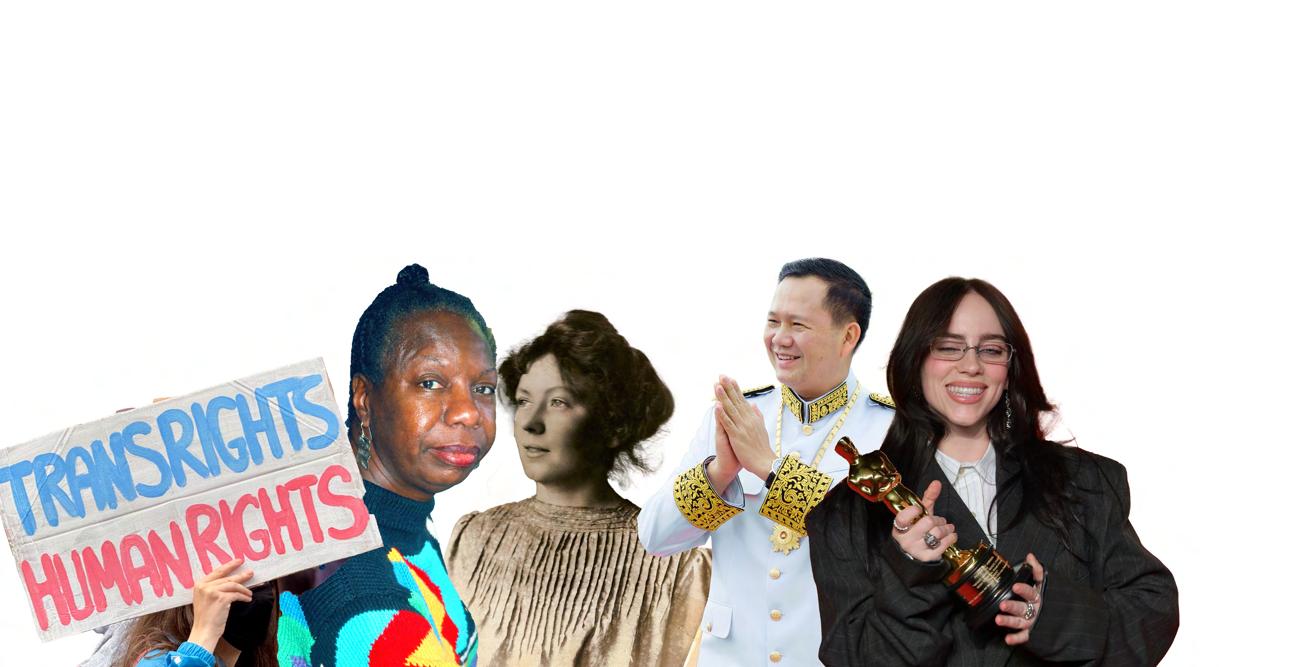
RETHE SHADOW STATE: MEMORY, POWER, AND SURVIVAL IN CAMBODIA by Will Reed, L5
FILM REVIEW: A REVIEW OF ‘CIVIL WAR’ by Anna Cuckow, L6
HOW POP CULTURE BECAME A POLITICAL BATTLEGROUND by Oli Paget, L5
The culture section begins with perhaps my favourite article of this term’s magazine, from Will Logan (I promise I am not just saying that because he is also the graphic designer and I need his artistic talent). His exploration of the conditional acceptance of queerness is covered with emotional maturity, and I think everyone should read this. It serves as a harsh reminder that society still has a long way to go culturally and encourages the reader to hold themselves accountable to implicit prejudice.
Sociology student, Bea Moore, returns for her second Sociologically Speaking column as she retells the story of Alex and Marcus Lewis in the new Netflix documentary, covering key topics of intertwined truth and identity. Moving from television to music, George Williams undergoes an exploration of music’s fundamental impact on politics, from ancient times to Katy Perry. In a time where an increasing number of people declare that ‘politics doesn’t affect them’, it is refreshing to see that, in actuality, politics remains intertwined with our music. Maintaining the topic of media is Rose McVeigh who dissects gender prejudice in our media, inspired by the V&A Marie Antoinette exhibition. She explores how women have historically been portrayed and the development of female representation.
You’ve seen TV and music in the contents list, so to complete the holy trio, Charlotte Clee covers filmmaker Derek Jarman and the politics of queer faith. She examines how Jarman’s work navigates sexuality, spirituality, and expression – highlighting the ways in which culture can act as a vessel for society to challenge traditional boundaries. In a geographic shift, Will Reed reflects on Cambodia, and how collective memory can shape political identity long after said events have passed.
Last edition, Fred Von Kaltenborn introduced the film review column, and this term he passes the baton to Anna Cuckow who offers a nuanced review of the film Civil War. Editing her review was enough to convince me to watch it, and I can now confirm that her review summarises the moral debates evident in the plot perfectly. And to finish the whole magazine, Oli Paget examines how the entirety of pop culture itself has become a political battleground, where influences actors and singers are being pressured to comment too often on political situations, acknowledging how media and politics is a double-edged sword. All these articles together demonstrate how politics is never separate from our culture. After we examine film, music, TV, and broader trends, we can see how politics remains more central than what we might initially expect. The Eagle Spring 2026
On countless occasions, I have been told I am “one of the good ones” in relation to being a gay man. This is an unsurprisingly uni versal experience within the LGBTQ+ community, particularly for cisgender, white, gay men. Whilst I’m sure the people who make these comments mean it as a compliment, said casu ally, or even kindly, it often times just makes us uncomfortable. That phrase only works if there are supposed ‘bad ones’: queer people who are too loud, too gender non conforming, or too disruptive. It’s in these moments that acceptance reveals itself as con ditional, and what’s being praised of me is not my queerness, but my ability to blend in.
In the UK, LGBTQ+ progress has of ten been reliant on this type of con ditional inclusion. LGBTQ+ rights have been viewed as rewards for respectability and palatability rath er than as universal protections. A great example of this is how mar riage equality alongside protection from discrimination has been cultur ally treated as a symbolic endpoint of LGBTQ+ equality in the UK, while trans healthcare remains severely un derfunded, over regulated, and bur dened with incredibly long waiting
lists. Demonstrating that queerness that aligns with monogamy, stability, and traditional conservative values is protected, while identities that go against these societal norms are still treated as a problem. This leads to a hierarchy within the queer community itself, where only select identities are welcomed into the mainstream while others are left behind.
Identity politics based on respectabil ity and palatability began as a sur vival strategy for marginalised com munities, particularly among racial minorities navigating hostile societies, diluting their culture to present as more ‘assimilated’ or ‘tolerable’. Behaving ‘correctly’ (in line with White British norms) could reduce harm and their risk of violence. But this logic has be come deeply entrenched in our law, media and activism, becoming over ly restrictive rather than protective. In Britain today, this is shown through how queerness is only tolerated if it behaves properly.
The archetype of the “acceptable” gay is easy to recognise and is what most straight people will think of when they are asked to think of a gay per son. He is a man, cisgender, white, and middle class. He is profession
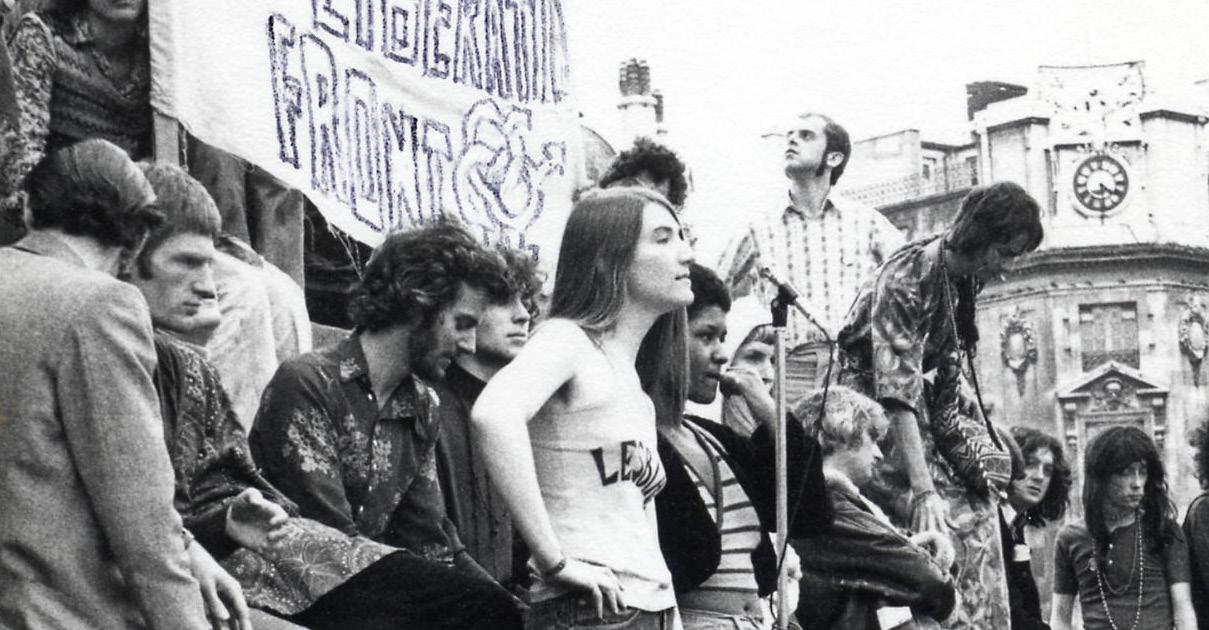
al, monogamous, and apolitical. His queerness is visible enough to be cel ebrated during Pride Month, but con servative and toned down enough not to unsettle anyone. This image is reflected in our culture; mass portions of both the UK and the US population and media saw gay marriage as a natural endpoint to LGBTQ+ libera tion, aligning queerness with the his toric British ideals of domestic stabil ity. Once gay relationships could be made to resemble heterosexual ones, they became politically tolerable.
Corporate pride is another issue which follows the same logic. In large metropolitan cities like London and Manchester, Pride parades have be come capitalistic and dominated by banks, high street companies and oth er large employers. These companies signal inclusion while avoiding any meaningful engagement with the real ities many LGBTQ+ people face, such as homelessness, healthcare barriers, or policing. 24% of young people facing homelessness are queer, yet these companies often take no action to remove these barriers and inequalities. Queerness is rebranded to aid their company, rather than as a dissent. Representation increases, but with no lasting impact for the wider
community other than for this palata ble archetype.
The media especially plays a crucial role in retaining this hierarchy within the community. British newspapers frequently distinguish between “rea sonable” LGBTQ+ people and those framed as extreme or disruptive. This is becoming increasingly clear in the coverage of trans issues, where trans lives are treated as a matter of pub lic debate rather than as basic rights, newspapers prioritising neutrality at the expense of a community’s dig nity. Trans people are invited onto panels to simply justify their experi ence, while their opponents on these panels frame their hostility towards them as ‘concern’. In this political en vironment, the heteronormative stand ards often encourage these “good” gays to distance themselves from those subverting this heteronormativ ity. Furthermore, within the commu nity itself, queer people who do not conform, particularly trans women, ethnic minority queer people, and working class LGBTQ+ people, are portrayed as liabilities to progress. ‘Common sense’ politics encourages them to be left behind. And it creates an idea that acceptance is available, but only if you don’t ask for too much.
The consequences of this are nothing short of worrying. In the UK, LGBTQ+ young people are disproportionately represented in the homeless popula tion, trans people face years of NHS waiting lists, queer asylum seekers are subject to hostile environments, often required to “prove” their identity to authorities. These groups are not ex cluded because they fail to behave correctly, but rather because protect ing them would require us to confront inequality rather than to overlook it, as we have done in the past.
This idea of respectability also oper ates within LGBTQ movements them selves; activism is often criticised by people saying, “this hurts our commu nity” or “we’ll lose public support”. These radical, yet necessary demands are diluted into politically friendly lan guage. In Britain, this dynamic has been intensified by the capitalisation of LGBTQ+ politics, where large or ganisations that rely on funding pri oritise palatability over confrontation.
The benefit of personal respectability is safety. Even I admit that I subconsciously conform to the palatable expectations placed on me as a gay person, almost as a defence mechanism. But safety that de -
pends on good behaviour is fragile. Support and safety granted con ditionally can be withdrawn just as easily, as the social political climate shifts further to the right, the bound aries of acceptability also move. Respectability will never truly protect queer people from backlash or violence; it will simply delay it.
Queer liberation was never meant to be about being liked; it was about survival, dignity, and freedom, just like any civil rights movement. Moving beyond respectability means we must reject the idea that support is earned through conformity, and it, more im portantly, means centring meaningful action; action on housing, healthcare, protection from policing and immigra tion enforcement, rather than settling for visibility and representation alone.
Being prescribed as a “tolerable” queer person is often meant as reas surance. But it should also serve as a warning, reminding us that accept ance is only for some and that it can always be revoked. A movement that survives simply by being respectable will never be powerful enough to pro tect those who don’t conform.
-Will Logan, L6
SOCIOLOGICALLY SPEAKING...
THE STORY OF ALEX AND MARCUS LEWIS
If memory makes us who we are, what happens when the only story you know is the one someone else tells?
By Bea Moore
Alex and Marcus Lewis were identi cal twin brothers, caught at the cen tre of a spiral of abuse and mental turmoil. Their story offers a compel ling lens through how identity can be socially constructed and sustained, especially when memory is disrupt ed. The journey of Alex and Marcus illustrates the fragility of individual identity, the power of narrative and how it distorts your view on life, and the long term effects of trauma and
secrets that were mean to stay unde tected.
At age 18, Alex Lewis was in a near fatal motorcycle accident, leaving him comatose for 3 months. When he awoke most of his autobiographical memory had been lost, the recollection of his personal life, events, relationships, roles, and experiences, no longer existed. The only person he recognised, was his identical twin brother, Marcus. From a sociological standpoint, identity is not just an internal collection of mem ories, but also the people in your life, and deeply relational rather than cognitive recall. For Alex, Marcus became an anchor, some one who he could refer to, a safe place, and his second set of eyes of the world. Alex relied on Marcus to resocialise him, tell him about his childhood, his past relationships, where he lived, and even his own family. Marcus essentially recon structed Alex’s entire sense of self. Sociologist George Herbert Mead argues that the self emerges through interaction with others and so Alex’s brother helped him rediscover him self both internally and externally.
Once Alex returned home, he relied entirely on Marcus to help him un derstand what his life had been like, even the little things became a lesson Marcus offered, ‘this is a kitchen. This is a television. These are shoes, and this is how you put them on.’ Alex asked many questions, but many of them revealed knowledge he never knew he had, such as ‘is our mum a good mum?’, or ‘is this family a hap py one?’. Without any recollection of his early life to help him, Alex’s memory was a blank canvas, pri marily shaped by Marcus. This dy namic reflects a sociological process called resocialisation; the restructur ing of identity and self conception that occurs when familiar mental frameworks are lost. In many cases,
individuals internalize the norms and narratives offered by those around them. In Alex’s case, Marcus filled that role, not only as a caretaker, but as an agent of primary socialisation, shaping Alex’s understanding of per sonal history and social context, the strength of this bond is a key to later events.
Marcus told Alex a story of an ideal ised upbringing in a loving home, de scribing carefree holidays and close family bonds, however this story was exactly that, a story, a reconstructed narrative, fabricated to shield Alex from the reality of their early life. In 1990, Alex and Marcus’ stepfather died of cancer, 8 years after Alex’s accident, not long after, in 1995, their mother, Jill Dudley, died of a brain tumour, 13 years after Alex’s accident. After the deaths of their parents, Alex began uncovering evidence suggesting that his early family life was far from what Marcus described to him.
It began when they were going through their mothers’ belongings, Alex discovered a photograph of the boys when they were younger, na ked. Torn in a way that their heads were cut off. Alex turned to his broth er and asked, ‘did our mother sexual ly abuse us?’. To which Marcus nod ded. Marcus refused to elaborate any further, all Alex knew was that he had been lied to about his own life for 13 years. He was left with this knowledge for over 20 years, leav ing him with a loss of identity, a si lence rooted in trauma and self pro tection, until 2019. On the set of the Netflix documentary ‘Tell Me Who I Am’ Marcus recorded a video for Alex to watch, deciding he couldn’t handle telling his twin about the hor rors they experienced face to face. Marcus describes how their mother sexually abused them, and, accord ing to detailed reports, facilitated further abuse by others. This reality
was socially and psychologically re pressed.
This prolonged silence between the brothers demonstrates how social repression of traumatic memory can affect self-identity. Instead of integrating painful experiences into a coherent self, both brothers lived with partial fragments; Alex with a socially constructed ideal he now knew to be fake, and Marcus with suppressed pain and guilt, illustrat ing how trauma can be socially hid den, not just personally repressed, shaping community narratives and individual stories in layered and con flicted ways.
From the viewpoint of Marcus, he had experienced a traumatizing event, something no child should ever have to go through, and the one person who was there with him, who could relate to him and under stand his pain, had forgotten it ever happened. Something he wished for more than anything else, to for get that it ever happened to him, but he couldn’t. He fabricated a happy and safe childhood for Alex, the one they always yearned for, to cover up the abuse they suffered, and frankly he couldn’t see why Alex could ever want to remember it.
The stories we tell about ourselves are central to human identity as powerful tools of meaning. They shape how in‑ dividuals understand themselves and their place in the world. Sociologists emphasize that identity is a socially shared story, shaped by interac tion, culture, and meaning. Marcus’ narrative did just that. It gave Alex structure, predictability, and social cohesion, something he could look back on and smile. But it also meant that the truth of Alex’s life was socially suppressed, locking both brothers in a role that maintained si lence and shaped their identities in ways divorced from actual experi
ence. We are prompted to question whether this construction also carried some form of social empowerment: Marcus had control over what Alex knew about himself. For years, Alex lived with a falsified version of him self. The sociological implication be ing that our identity can be shaped, not only by memory, but by the sto ry’s others tell about us. Marcus’s choice to create an idyllic childhood for Alex adds a complex ethical and sociological layer to their story. On one hand, Marcus believed he was protecting Alex from trauma too se vere to handle; on the other, he was controlling the narrative that would define Alex’s sense of self for dec ades. Urging us to wonder, is it down to him?
Ultimately, the story of Alex and Marcus Lewis forces us to confront a powerful sociological truth: we are not only the sum of our memories, but the stories others tell us about who we are, and the extraordinary strength of their bond. When Alex lost his past, it was Marcus who became his anchor, rebuilding his world, protecting him from unbeara ble trauma, and carrying the weight of their shared history alone. Though the secrets kept between them creat ed distance and tension, it was root ed in love. Their journey shows that identity is shaped through relation ships, and that even the most frac tured pasts can be faced when trust endures. Today, despite everything, Aelx and Marcus remain deeply close a testament to the resilience of sibling bonds and loyalty in the face of unimaginable trauma. In the end, their story asks us a haunting ques tion: if memory makes us who we are, then what does it mean when love is the only thing that remains?
-Bea Moore, L6
arwin believed that music arose as an elaborate form of sexual selection, perhaps arising in mating calls whereas other schol ars have proposed that music arose alongside language and guttural sounds produced by ancient man. The earliest examples of music (or proof thereof) are said to have exist ed roughly 40,000 years ago in the form of fragments of what archaeol ogists thought to be bird bone and mammoth ivory flutes in caves in the Swabian Alps, Germany. We can speculate on whether these palae olithic pipers are myth or truth, but the facts are that music is (and has always been) a cornerstone of hu man identity. Music has been a part of my life for longer than I can re member with my first signs of interest in music starting with the magnum opus of Bruno Mars, ‘Uptown Funk’, and Katy Perry’s ‘Roar’. These songs may not hold incredibly powerful
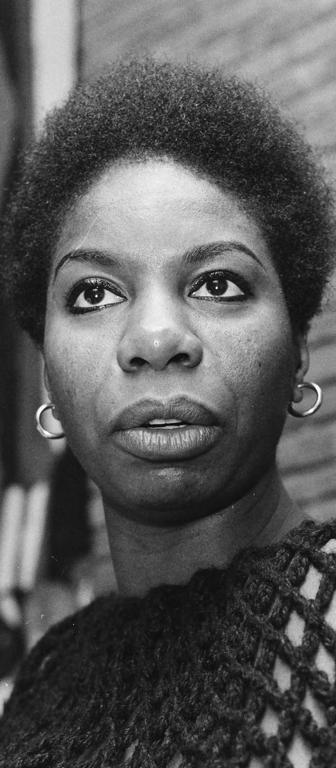
MUSIC’S IMPACT ON POLITICS
meaning but are still incredibly im portant to me, nonetheless.
As far as my research went, the ear liest examples of the use of music to invoke political change were in ancient Mesopotamian hymns that were created to legitimise the pow er of kings and rulers. From then on, music always had varying factors of involvement with politics; Con fucius believed that songs reflected the health of the state at the time, a statement that I believe holds incred ible meaning, even in recent years. For me, the point in western society that kindled the type of music people would listen to for centuries to come was in the medieval era (6th centu ry to 15th century.) During the 9th century, several important develop ments took place, the most impor tant of which being the introduction of polyphonic music history, and the reinvention of musical notation after a lapse of about five hundred years, though it would be several more centuries before a system of pitch and rhythm notation evolved hav ing the precision and flexibility that modern musicians take for granted. Music’s versatility and political mes sage begin to flourish and grow into more than just a form of entertain ment in the late 1700s. During the French Revolution, “La Marseillaise” emerged as a unifying anthem. It served as a statement of identity for the working class and peasants and spoke about the revolutionaries love for the nation and signified the end of tyranny It was a statement of identity and resistance. The idea that a melody could rally citizens behind a cause demonstrates
how deeply music can influence collective feeling. National anthems that followed in various countries served similar purposes, strength ening unity and shaping patriotic identity.
The 19th and 20th century clearly demonstrate music’s role as some thing that can challenge authori ty and invoke social and political change. The racism and social in justice faced by African Americans didn’t change whatsoever after the abolition of slavery in 1865. Black people still faced prejudice and ha tred all over the United States and despite their “freedom” were seen as lesser. Despite this darkness, a light began to shine through in the form of ‘the blues.’ It evolved the oral traditions and experiences of formerly enslaved people and fea tured call and response patterns that offered inclusion for the whole community. Blues introduced a nev er seen before freedom of expres sion for African Americans, and al most all popular genres today owe it to the blues and the messages it stood for. The blues laid the foun dations for countless movements in which artists spoke about inequality and civil rights. Artists such as Nina Simone and Bob Dylan used their platforms to questions systems of power. Bob Dylan’s performance at the Washington March, in which he advocates for an intervention of the USA’s backwards system, presented to American citizens that it wasn’t just black people that wanted change; it was everyone that felt empathy for the mistreatment of fellow human beings.
Before the start of the second world war a youth group named the Edel weiss Pirates began to gain popu larity in Germany around the 1930s. The group opposed the status quo of Nazi Germany, offering freedom for youths to ‘mingle’ with the opposite sex and (even more horrifically) lis‑ tened to and created their own jazz music. I think what makes this group stand out to me is simply how some thing as trivial as listening to a type of music can pose as such a threat to one of (if not the most) tyrannical leaders of all time. Furthermore, the founder of the group was sentenced to death for his “very active part in carrying out the nefarious schemes of the Piraten.” Although this charge was eventually dropped, the impact that it had and what the group stood for illustrates the way that music can impact politics in such incredible ways.
through headphones, it feels like it belongs entirely to me. That duality gives music its unique power. It can unite thousands in a stadium while also comforting a single individual alone in their room.
Confucius’ idea that music reflects the state of society continues to feel relevant. When we examine the themes dominating contemporary charts, we see reflections of current concerns such as identity, empow erment, anxiety and social change. The blending of genres mirrors in creasingly interconnected cultures. The accessibility of music produc tion means more voices can con tribute to the cultural conversation than ever before. From prehistoric flutes carved from bone to sympho nies performed in grand concert halls, from revolutionary anthems to pop songs played on repeat in bedrooms, music has consistently shaped and responded to the political landscapes around it.
Looking back at my own early expe riences with music, I realise that even the most light hearted pop songs contributed to my understanding of confidence, identity and expression. While they may not have carried overt political messages, they still shaped how I saw myself and the world. And perhaps that is where music’s deepest power lies. Political change does not always begin with grand speeches or formal decla rations. Sometimes it begins with a feeling, and music has always been one of the most powerful ways to create one.
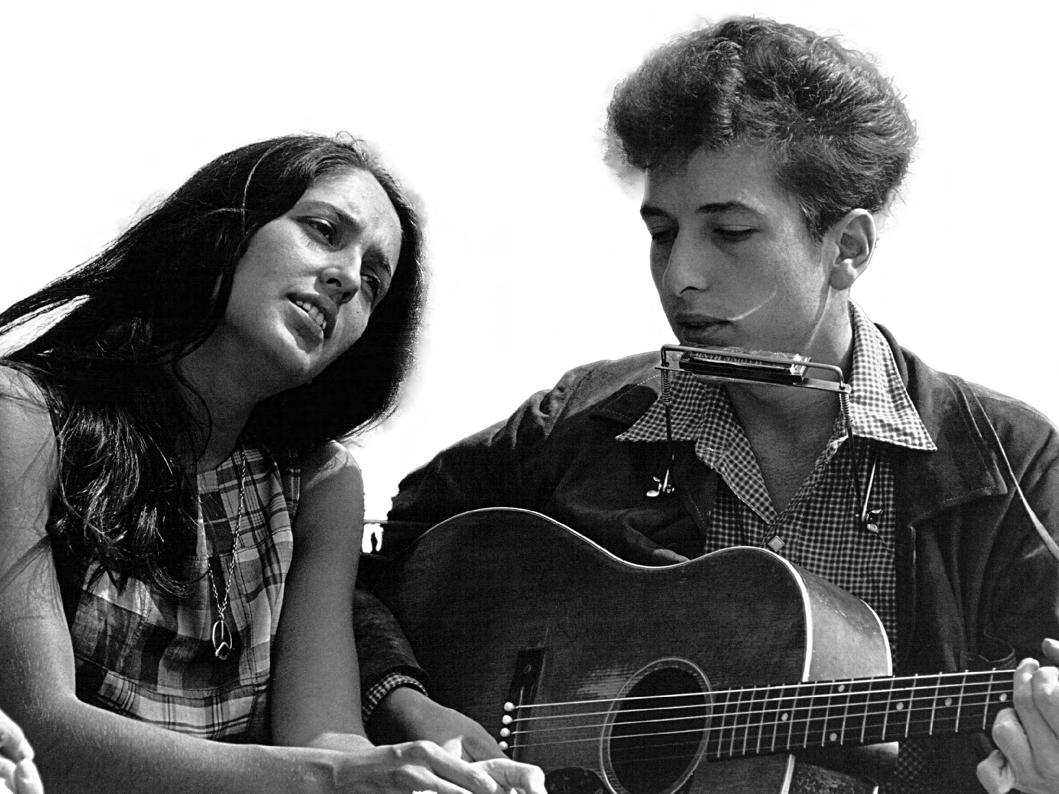
- George Williams, U5
Nina Simone, 1965
Bob Dylan & Joan Baez, Civil Rights March on Washington, 1963.
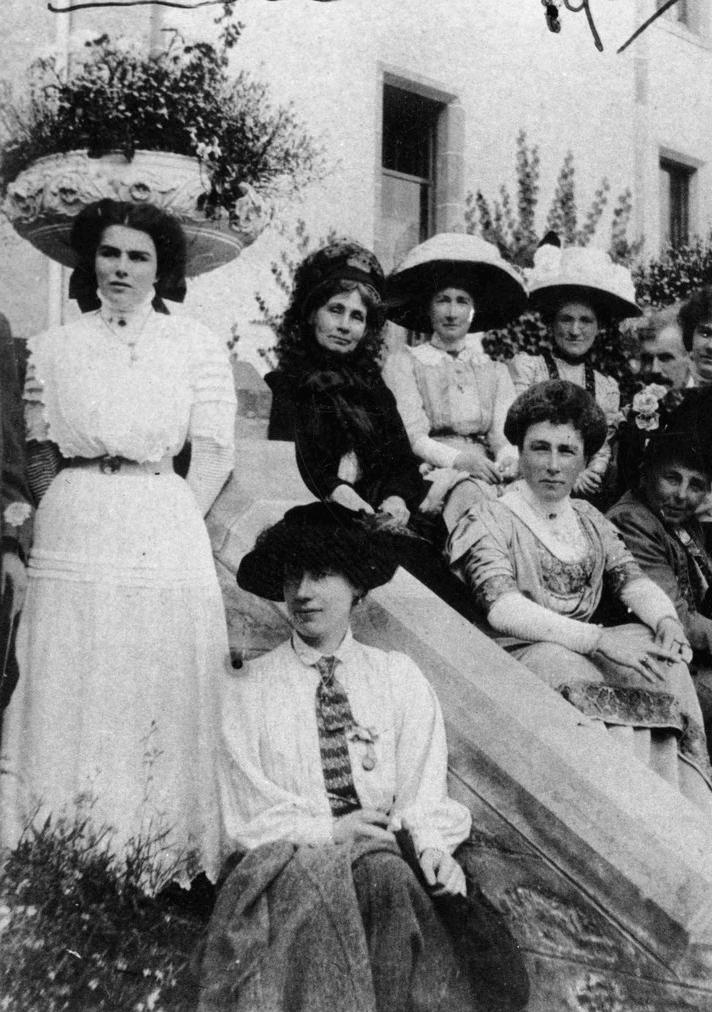
I recently went to visit the Marie An tionette exhibit in the V&A museum; within the scented vases, incredible dresses tucked away in a corner something caught my eye. Cartoons of her demoralized and degraded that had been previously featured in magazines. But it’s not just her, it’s every woman whose had an article written on her criticizing the way she acts or looks. And not so shocking ly, the majority of those articles were written by men.
A poll conducted in early 2025 by Savanta stated how 73% of Gen Z people on social media had expe rienced misogynistic content. In that 73% of individuals, 53% received inappropriate emojis, 44% received unsolicited explicate images, 27% reported online stalking so on and so forth. These statics are high, especial ly for this day and age. Since the start of the feminism movement in 1848 to the suffragettes (who now have a train line named after them) in 1903 and even in the world wars when women proved they are so much more that a sub species for men. The suffragette a newspaper created to help their movement, to get women the right to vote. The fact that I am writing for this is proof of how far we have come as a society. But we haven’t come far enough.

Misogyny in media refers to portray al of sexist attitudes towards women degrading, sexualizing and devalu ing women on the internet who are simply trying to exist ranging from something as simple as a comment to a whole article of unnecessary and unwanted negative opinions. In movies especially with female char acters receiving more hate. Some prime examples are Nancy wheeler from Stranger Things being forced together with Steve because ‘they look good together’ against her will, ‘I’m Just Ken’ from Barbie winning Critics Choice Award for Best Song in 2023 which took place in a mov ie about feminism, yet somehow the song about men won the award. Cri tiques of Isabella Conklin from ‘The Summer I Turned Pretty’ for coming in between two brothers when they should know better or even Her mione Granger from Harry Potter being seen as an accessory to two men instead of her own individual extremely intelligent person.
Moreover, music has an under whelmingly investigated large im pact on views. From subtly hidden jabs to overt lyrics talking about women derogatively that dumbs them down to mindless boy toys. The majority of this happens in the genres of rap and country or the sub genre or ‘bro country’. An example of this is ‘Blurred lines’ by Robin Thicke feat T.I. and Pharrell. In the pre ‑chorus Robin Thicke states that women need to be tamed as they are too free and wild through the lines ‘Tried to do mesticate you but you are an ani mal’. Also, the song ‘Into the Night’ by Benny Mardones tells him to stop preying on a teenager. The lyrics say ‘She’s just 16 years old. Leave her alone, they say. Separated from fools who don’t know what love is yet’. Mi sogyny is also present in the industry itself, with lower pay for women and sexual harassment frequenting.
These are problems that need to be resolved whether through stricter guild lines, mandatory education on such topics at school, or more ac knowledgment in real life. Howev er, it won’t happen overnight or for many years in fact but as a society and as moral human beings we need to see how deeply rooted and unno ticed this goes in society to fix it. It takes one person to spark change. So be the person and make the change.
-Rose McVeigh, L5
Emmeline Pankhurst and supporters at Elgin, 1907
Derek Jarman and the Politics of Queer Faith
Neil Tennant, in his 2013 commen tary on Jarman’s oeuvre, wrote that there was a “weirdly ecclesiastical” and “medieval” method which Jar man often took when making art. Jarman frequently drew on medieval themes in his films, most obviously in his retelling of Marlowe’s Edward II. Describing his gravitation towards ascetic and aesthetic medievalism, Jarman wrote that “for years the Middle Ages have formed the par adise of my imagination, the archa ic half smile on the Apostle’s lips at Chartres, the blisse that unlocks.” Contained in his library at Prospect Cottage were numerous medieval

religious texts, including the Ancrene Wisse, Pearl and The Book of Mar gery Kempe. He even contemplated making a Margery Kempe film in 1991, three years before his death, anticipating the rise in scholarly in terest in her life. During the 1970s and 1980s, Jarman voraciously read devotional writings, which had a distinct impact on the meaning of his films. He proposed a theological connection between the medieval monastic lifestyle and how Christianity treated homosexuals in the 20th century, in voking Henry James’s notion of “the new life and the old having melted together” — meaning an absence of the dividing line.
In The Garden (1990), filmed at Jar man’s Prospect Cottage, he evokes Julian of Norwich’s use of blood in Revelations to convey his suffering with AIDS. In medieval devotional works, blood represented mystical traditions combining medical and theological knowledge to present Jesus as the physician. On 19 De cember 1989, Jarman wrote in his diary about reading Revelations beside his washing machine, noting Julian’s line “grete dropis of blode, in this shewing countless raindrops fall so thick no man may number them with bodily witte.” Julian com pares the abundance of blood to “the drops of water that fall from the eaves after a great shower of rain,” contextualising her pain through her anchoritic cell and alluding to Christ’s blood during the Passion.
In The Garden, Jarman invokes similar imagery through a dream sequence retelling the Passion in a contemporary setting—his own cot tage, purchased after his HIV diag nosis in 1986. During the sequence, Jarman sits at his desk and relates the blood of Christ to his own, watching men whipped on crosses outside,
blood dripping through their shirts. It is argued that this was an intentional choice to separate the experience of AIDS from typical portrayals of the crisis. Inspired by Pasolini’s methods of relating the modern to the medie val, Jarman presents Tilda Swinton’s character as the Madonna in Jan van Eyck’s Madonna in the Church, situating her in front of a 1961 light house to represent a kaleidoscope of different periods, situating the sa cred past as a living entity.
He developed this connection be tween those suffering from AIDS and the medieval world in Edward II (1991), to critique the Christian Church’s attitude to homosexuality. Jarman adapted Marlowe’s play to expose institutional homo phobia in Britain, likening the Ca tholicism of the play’s time to the Church of England in the 1990s. In the film’s companion text, Jarman compared Clement of Alexandria to George Carey, the newly or dained Archbishop of Canterbury, who claimed “Gay men are unfit to be ordained as priests.” Draw ing on John Boswell’s Christianity, Social Tolerance, and Homosex uality (1980), Jarman agreed that the later Middle Ages consolidat ed institutional homophobia with in Christianity — a sentiment per sisting in the 20th century. Following the 1988 Local Government Act, which included Section 28, Jarman worked on an unreleased project with Keith Collins using extracts from Marlowe’s play, following a young actor named Edward and his lov er Johnny Galveston. In Edward II, influenced by Pasolini’s Canterbury Tales, Jarman includes a scene of two men having sex in the back ground, emphasising homosexuality as an incidental backdrop to medi eval life. One striking scene shows Isabella murdering Edward with a bite to the neck, echoing AIDS para
noia. Through Pasolini inspired tech niques, Jarman synthesises past and present, emphasising similarities be tween Edward’s Middle Ages, Mar lowe’s Renaissance, and Thatcher’s Britain through costume: Isabella in couture, Gaveston in jeans and a T‑shirt. He includes a scene with the Gay Rights group OutRage! protest ing—history colliding with the pres ent. The past becomes a vehicle to critique the present.
Jarman invoked medieval image ry again in the promotional film he directed for the Pet Shop Boys’ sin gle “It’s a Sin,” inspired by Dreyer’s The Passion of Joan of Arc (1928). Shot on 35mm film, it offered a distinct criticism of the institutional church. A prisoner (Neil Tennant) encounters each of the seven dead ly sins before facing an ecclesiasti cal trial. The judge (Ron Moody) is filmed in Dreyer like close ups. The film ends with churchmen circling a pyre, engulfed in flames, echoing Joan of Arc’s execution. To Jarman, Joan represented a “queer martyr,” inspired by Vita Sackville West’s 1936 biography, which alludes to Joan’s sapphic tendencies. Once again, he linked historic persecution of queer people to Thatcher’s Brit ain. The song itself, written by Ten nant as a confessional, drew on his own religious upbringing. Jarman also designed the Pet Shop Boys’ concert backdrops, drawing on Bosch’s Garden of Earthly Delights and Geertgen tot Sint Jans’s Na tivity at Night, explaining that they resembled “a night in Hampstead.” This alluded to what he believed were the ‘closeted’ figures within the historic church. In his memoir At Your Own Risk (1992), he wrote: “its timelessness becomes the brother hood; the brethren are lovers; they extend the ‘family’. I share that sexu ality. It was then, is now and will be in the future. I like the idea that we
are linked in orgasm with Alcuin, St Anselm or St Aeldred, all of whom loved men physically.” He enlisted these figures, viewed by Boswell as representing the gay sensibility of the medieval English church, to con textualise the suppression of sexual ity by Christianity.
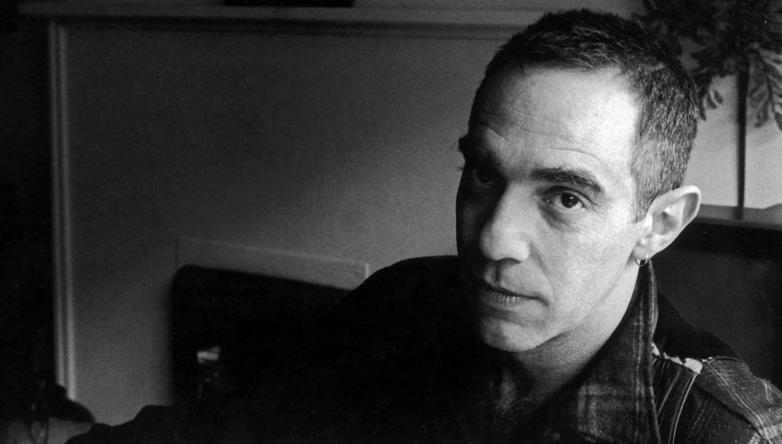
Neil Tennant himself summarised Jarman’s fascination with the medi eval and the theological:
“I used to see his big black sketch books open on his desk, filled with beautiful script. There was some thing medieval about Derek, sitting in the house at Dungeness in this wood panelled room. He looked like a monk in the 13th century—do ing calligraphy or copying out the works of St Augustine. There was something weirdly ecclesiastical about him.”
Jarman was canonised by the Sis ters of Perpetual Indulgence, a pro test group founded in response to Section 28 and the government’s failure to protect LGBTQ+ people. In satirical contrast to Thatcher’s knighthood of Ian McKellen, they declared Jarman a saint. Jarman had written a letter to The Guardi an titled “An offer Sir Ian was hon
our bound to refuse”, arguing that such honours co opted gay iden tity into Tory respectability. After eighteen artists, including Stephen Fry, signed a response supporting McKellen, Jarman replied that they seemed “unaware of ordinary gay life as it is experienced beyond the world of the high arts.” The Sisters felt compelled to canonise him. They travelled to his Kent garden, where he was sainted in a robe borrowed from the Edward II set. One Sister later said, “The whole point was the touching of a person with HIV and venerating him.” Four years later, the night Jarman died, gay rights groups rioted outside Parliament af ter MPs refused to equalise the age of consent. Every bookshop in Soho placed candles in their windows in his honour.
In his diary, Jarman described the canonisation as deeply special: “In spite of the Sisters of Perpetual Indulgence’s warnings not to let it go to my head, I had to take it seriously. I am, after all, the first Kentish saint since Queer Thomas of Canterbury who was murdered by his boyfriend, Henry, in 1170.”
-Charlotte Clee, U6
‘Maddona in the Church’ -Jan van Eyck Culture
Cambodia’s Shadow State
Nearly half a century after the fall of the Communist Party of Cambo dia the Khmer Rouge, Cambodia is still defined by the weight of its past. Scholarly estimates place the number of deaths under the regime at around 1.7 to 2 million people, roughly a quarter of the population at the time. Yet when speaking to Cambodians, many told me the toll was closer to three million, nearly 40% of the population, illustrating how severely the trauma continues to shape national memory. While memorials and museums preserve the memory of atrocity, the politics of the present is shaped more by a compressed horizon of political possibility than by remembrance. Cambodia is governed by two parallel pillars: a monarchy that embodies unity but remains above politics, and a ruling party dynasty that brooks no dissent.
Travelling through Cambodia, it became clear that the past is never far away. At Tuol Sleng prison, once the S 21 torture centre, guides recount the imprisonment of more than 20,000 prisoners, of whom only twelve survived – five of them children. At the Killing Fields out side Phnom Penh, accounts of exe cutions, including the use of spikes attached to trees to murder children, convey the extreme brutality of the regime. Even at these sites, made to remember the atrocities, memory is carefully controlled. Survivors who share their stories are monitored to ensure they say nothing critical of the current government.
The Cambodian People’s Party
(CPP) has dominated the political landscape since 1979, with Hun Sen as prime minister until 2023. A former Khmer Rouge commander who defected during Vietnam’s in tervention, Hun Sen became prime minister in 1985. His rule was osten sibly stable, relying on a strict con‑ solidation of power. Opposition is systematically dismantled: in 2017, the main opposition the Cambo dia National Rescue Party (CNRP) was dissolved by the courts, after having almost beaten the CPP in 2013. Its leader, Kem Sokha, was arrested and, in 2023, sentenced to 27 years of house arrest on charges of treason for ‘conspiring with for eign powers’. Co leader Sam Rain sy fled to France, where he remains in exile, having been convicted in absentia of offences that would re sult in imprisonment if he returned. Fear is continually embedded deep er into political life. Citizens face imprisonment for actions considered harmless elsewhere.
Concerningly, the dangers facing opposition figures are not confined to Cambodia’s borders. In January 2025, Lim Kimya, a 73 year old former MP from the outlawed Cam bodia National Rescue Party, was shot dead in Bangkok. A gunman calmly parked his motorbike near a temple, walked across the road, and fired two bullets into Lim’s chest be
fore escaping. The killer was quickly identified by Thai police as an ex Thai navy officer. Lim’s daughter described him as courageous, and opposition leaders blamed the Cam bodian state, insisting no one else had a motive to kill him. It has inten sified fears that Cambodia’s repres‑ sion now extends across borders, with dissidents hunted in Thailand, Laos, and Vietnam as part of what rights groups call “transnational re pression.” For Hun Sen’s successors, silencing opponents is no longer limited to the courts; it can reach as far as neighbouring capitals.
In August 2023, Hun Sen stepped aside, but this change did not open the way to democracy, as he re tained the position of president of the Senate. Power passed to his son, Hun Manet, a general in the army. The transition, presented as generational renewal, in reality re flects dynastic succession; a nation of 17 million people is run like a family business. Hun Manet’s ad ministration, supported by the same CPP machinery, represents continui ty rather than reform. Elections take place, but they are neither free nor fair. Outcomes are predetermined in a dystopian theatre in which the ending is set and the audience has no voice. Cambodia exemplifies authoritarian resilience, insidiously cloaked in democratic forms.
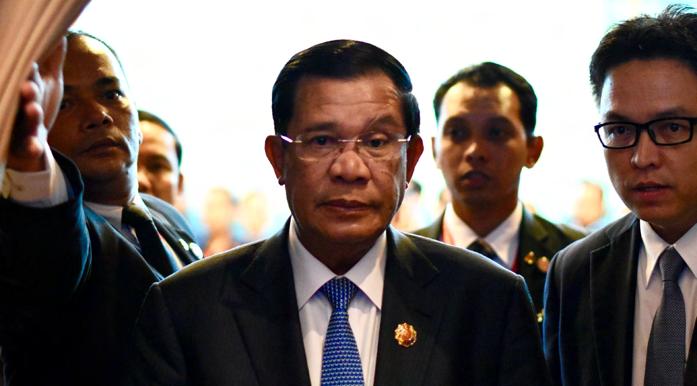
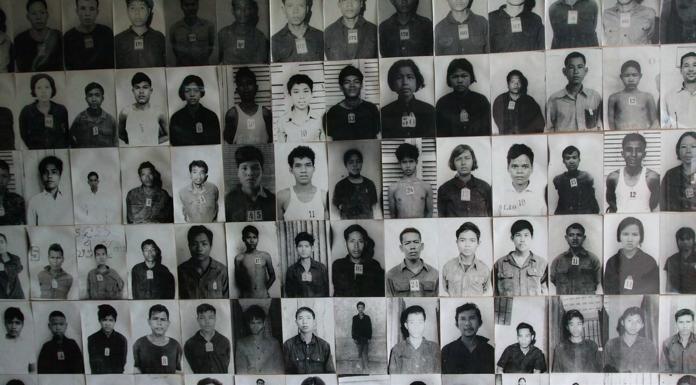
Yet the shadow of the Khmer Rouge is not confined to memorial sites. Judicial accountability for its lead ers’ actions has been selective and painfully delayed. Pol Pot died in his jungle stronghold in 1998, nev er brought to trial. The infamous “Comrade Duch,” commandant of Tuol Sleng (S 21) prison, was one of the few to face a court, convicted in 2010 and dead a decade later in custody. Nuon Chea, Cambodia’s “unrepentant perpetrator of geno cide” and Pol Pot’s right hand man, said he would appear before a tribu nal but doubted he would receive a fair trial, infamously remarking: “I love justice, but it doesn’t exist in this world.” Perhaps many Cambodians would agree with him. Chea and Samphan were eventually convict ed of genocide and crimes against humanity, but only when they were frail old men. For the vast majority of perpetrators, no punishment ever came. Many rank and file cadres slipped quietly back into ordinary life, some even into local positions of authority. Most disturbingly, many of those who carried out the killings were teenagers from poor villag‑ es conscripted specifically, much like how authoritarian regimes have historically exploited young people for mass violence because they had reasons to despise those they were tasked with killing. The result is a country where the architecture
apoliticism provides the ruling party with a useful counterpoint: the King embodies tradition and stability, while the CPP controls the state.
of atrocity remains visible not only in bones and memorials, but in the continuing presence of those who once built it.
Alongside this political dynasty stands the monarchy. King Siham oni, ruling since 2004, maintains a strictly ceremonial role and delib erately abstains from political en gagement. Unlike his father, he is not a political player, but a former ballet dancer and UNESCO am bassador. He carefully cultivates a monk like image of humility and po litical neutrality. Having no girlfriend and never married, his personal cel ibacy contributes to the widespread respect he receives from Cambodi ans. By remaining personally de tached from worldly desires, he is seen as above politics and scandal, reinforcing his image as a moral and stabilising figure. He avoids political comment, focusing instead on education, cultural preservation, and ceremonial duties. For many, he symbolises national unity, and his
This dual structure an apolitical monarchy alongside a dominant ruling party ‑ defines Cam‑ bodia’s political reality. On the sur face, it provides stability; beneath it, the space for alternative voices narrows. Guides at historical sites describe the risks they face: one re called posting criticism online and receiving threatening phone calls warning she would “disappear” if she continued. Another admits, in a hushed tone, that freedom of speech is entirely non existent.
In public, citizens speak as they ought to. In private, they live with silence, fear, and compromise. Dur ing my visit, the weight of unspoken fears pressed against every street and temple, the tension between public façade and private anxie ty impossible to ignore. Memory is both a refuge and a danger; hope flickers in whispered conversations and small acts of defiance that es cape the eyes of power. In a nation of 17 million, the true story is neither written in laws nor decrees, but in the lives lived between silence and survival, in the resilience that persists despite fear, and in the frag ile spaces where courage refuses to be extinguished.
- Will Reed, L5
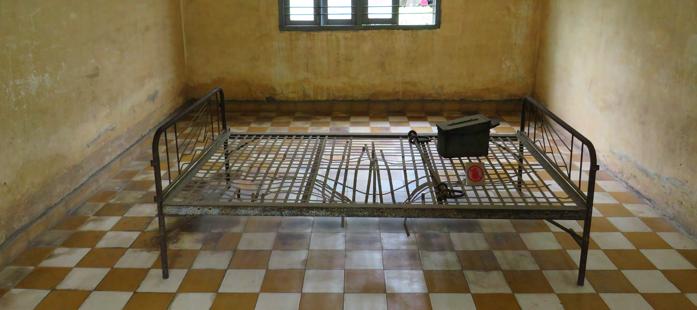
A Review of ‘Civil War’
Alex Garland’s politically charged drama, Civil War, presents a distant reimagined America comprised of two polarised states. The film fol lows war photographer Lee (Kirsten Dunst) on her way to D.C, in attempts to interview the President before he is assassinated during the civil war. Within it, there are undercurrents of desensitisation, complicity, racism and ruthlessly corrupt ambition –things that run truer now than ever in the two years since the film’s initial release. Garland’s foresight, even just two years into the future, calls his viewers to action to promote politi cal reform via interest, and to cease the mentality of the ‘passing of the baton’ to the younger generation.
The film begins as a slow burn, only to accelerate into complete anar chy by the end, which is mimetic of Jessie’s (Cailee Spaeny) increasing exposure to trauma – causing and cascading into her desensitisation. In my opinion, Garland’s use of metaphors is a homage to artistic film making. The end camera shutter sounding like the cocking of a gun, the lack of attention given to Lee’s death (despite her residing at the crux of the story), and the ‘passing of the baton’… I could go on.
And the acting was not exempt of this excellency. It was Priscilla – in which Spaeny stars – that motivated me to tick this film off my ‘to be watched’ list. Spaeny’s ability to portray Jes
sie’s hunger to excel ex peditious ly and yet seamlessly tap into her veiled inno cence was truly mas terful. The descent of her charac ter plucks at an audi ence’s heart strings, as her purpose is to symbolise the younger gen eration: emulating innocence, pu rity and naivety – all of which are stripped away over the course of the film.
to that of a stereotypical reaction to death, heightened tensions, provid ing insightful, proleptic irony to Lee’s own death, to which Jessie had no reaction.
Dunst never misses, and under Gar land’s genius her character craft flourished. Lee – representing the current generation – resonated with me because we meet her ‘in media res’ (meaning that what we witness of her on screen life is not an origin story, but a doomed pursuit of des tiny). Lee yearns to find any form of justification for what she has been complicit in as an experienced war photographer, despite her constant dismissal of both her memories and those who refuse to partake in or acknowledge the war in any ca pacity. The scene in which she is cleaning the blood off her car seat illustrates a volta in her storyline, as – even though her apathy was evident before – the viewer is now blatantly aware that her search for recompense is a futile endeavour. Dunst performed the scene with a blunt delivery and coupled with the visceral intensity of the cinematic shot, the message behind it was a hard pill to swallow. The subversion of Lee’s reaction, when compared
As a politically charged artistic statement, this film brilliantly ex presses the risks surrounding lack of action and as mentioned, runs truer than ever today. Therefore, prompting me to refute the ‘dystopian’ genre and instead take a leaf out of Margaret Atwood’s book and label it as a ‘speculative fiction’.
In such tumultuous times of dawning conflict, lack of awareness or inter est, and the suppression of the arts and expression, Civil War brings about a harsh reality that society refuse to foresee. Films like this are not just for entertainment. Civil War, like many others, offers foresight. Masterpieces such as ‘Nuremberg’ offers hindsight. They are used as devices to socially and politically critique, and to wake us up to our own situation, which politicians would rather us be blissfully unaware to – and it is due to this fact that this film remains a must-see.
-Anna
Cuckow, L6

HOW POP CULTURE BECAME A POLITICAL BATTLEGROUND
The eclectic sprawl of pop culture has traditionally offered a place for people to take refuge from the harsh reality of the world. However, as the political tensions continue to tug on people’s everyday lives, through so cial media or otherwise, celebrities and influencers alike are pressured to speak out against the many injus tices afflicting the world. Expectations for people in the public eye have drastically increased within the past few years, as silence becomes a sign of complicity with the horrors occurring globally and domestically.
Whilst today’s pop culture is highly politically charged and very different from the media of a century ago, the cultural mainstream has always been political. Hollywood and the music scene have always caused controversy through political statements, actions and movements motivated purely by artists’ ideological standpoints. Musically, Bob Dylan used his songs in the 1960s to display support for civil rights and his anti-war views, such as “Blowin’ in the Wind” and “The Times They Are A Changin” which advocate for progress and reform, becoming anthems in their respective themes of civil rights, war and social upheaval. In terms of film, the industry is teeming with films containing strong or embedded political messages, usually concerning current affairs or issues.
For instance, when ‘Do the Right Thing’, directed by Spike Lee, pre miered at Cannes Film Festival in 1989, it was met with controversy
due to its themes of racial violence and police brutality. The film reaches a tragic climax involving the killing of a young black man by a white police officer and sought to reflect and criticise the deaths of several black citizens in New York City in the 1970s and 80s. One incident of racial violence that inspired the film was the 1983 death of Michael Stewart, who was a young graffiti artist who had been arrested after ‘tagging’ a subway wall. However, witnesses later stated that he had been beaten and choked by police officers, and he became comatose and died in the hospital due to this; his story became infamous as an emblem of racial injustice and a grave reminder of the severe effects racism and discrimination has in law enforcement.
Culture has always reflected po litical anxieties, but the dynamics of mainstream media today tend to amplify conflict and deepen the divide between groups, even if the aim is to unite and celebrate groups. For instance, the recent Superbowl Halftime Show sparked criticism from many conservative voices in the U.S. such as Donald Trump and his cabinet as Latino artist Bad Bun ny performed. Despite the show be ing rooted in unification, diversity and love evident through the mes sages ‘together, we are America’ and ‘the only thing more powerful than hate is love’ emblazoned in dif ferent areas throughout the perfor mance many right wing politicians and supporters chose to extend the country’s current political divisions by commenting that the show was
‘offensive’ and ‘inappropriate’ due to its messages of cultural celebra tion and the uplifting of immigrants, who are currently facing immense pressure in the U.S due to the ab horrent activity of Immigration and Customs Enforcement (ICE). Donald Trump posted on Truth Social that the half time show was ‘an affront to the Greatness of America’ and was ‘one of the worst EVER!’ amplifying the controversy surrounding it, whilst the show championed America and celebrated cultural apride with no malicious intent, as opposed to MA GA’s contorted perception of it.
Furthermore, today’s pop culture promotes accountability and ad vocation, especially against those in abuse of power and for those oppressed. For example, with the mainstream rise in awareness of the ongoing conflict between Isra el and Palestine, public figures are expected to utilise their platforms to bring attention to the genocide in Gaza or condemn the brutality of the war. As it is awards season, with the Grammys and Golden Globes having passed and the Oscars on March 15th, actors and artists are
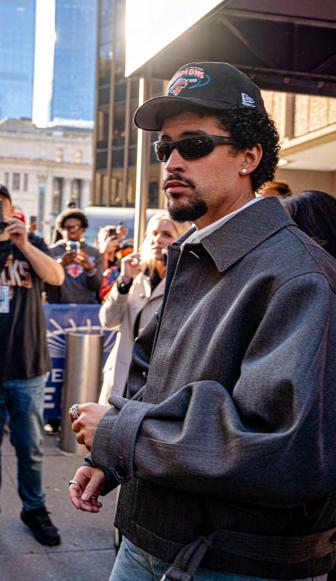
using the broadcasts and their win ning of awards to voice their views and messages. Artists such as Billie Eilish and Bad Bunny used their ac ceptance speeches to condemn ICE and support immigrants, with Eilish stating ‘no one is illegal on stolen land’ and Bad Bunny declaring ‘ICE out’. Additionally, Hannah Einbind er, an actress in the TV show ‘Hacks’
is right has encouraged A listers to sacrifice their work in order to chal lenge injustice.
Overall, our rising culture of advo cation and calling out oppressors and those complicit in oppression has deeply influenced the core of pop culture, which is nowadays utilised to voice the struggles and hardships of the marginalised and confront injustice. This sentiment is amplified by social media and the ease of spreading opin ions. As societal values and political discourse develop,
pop culture must blur the lines between art and activism to promote a more informed and aware society. Whilst entertainment can oversimplify or distort complex issues, it also has the capacity to be a catalyst for political action and thought. There ‑ fore, the value of pop culture and its potential for causing significant change must not be disparaged, especially in the intense political cli mate of today.
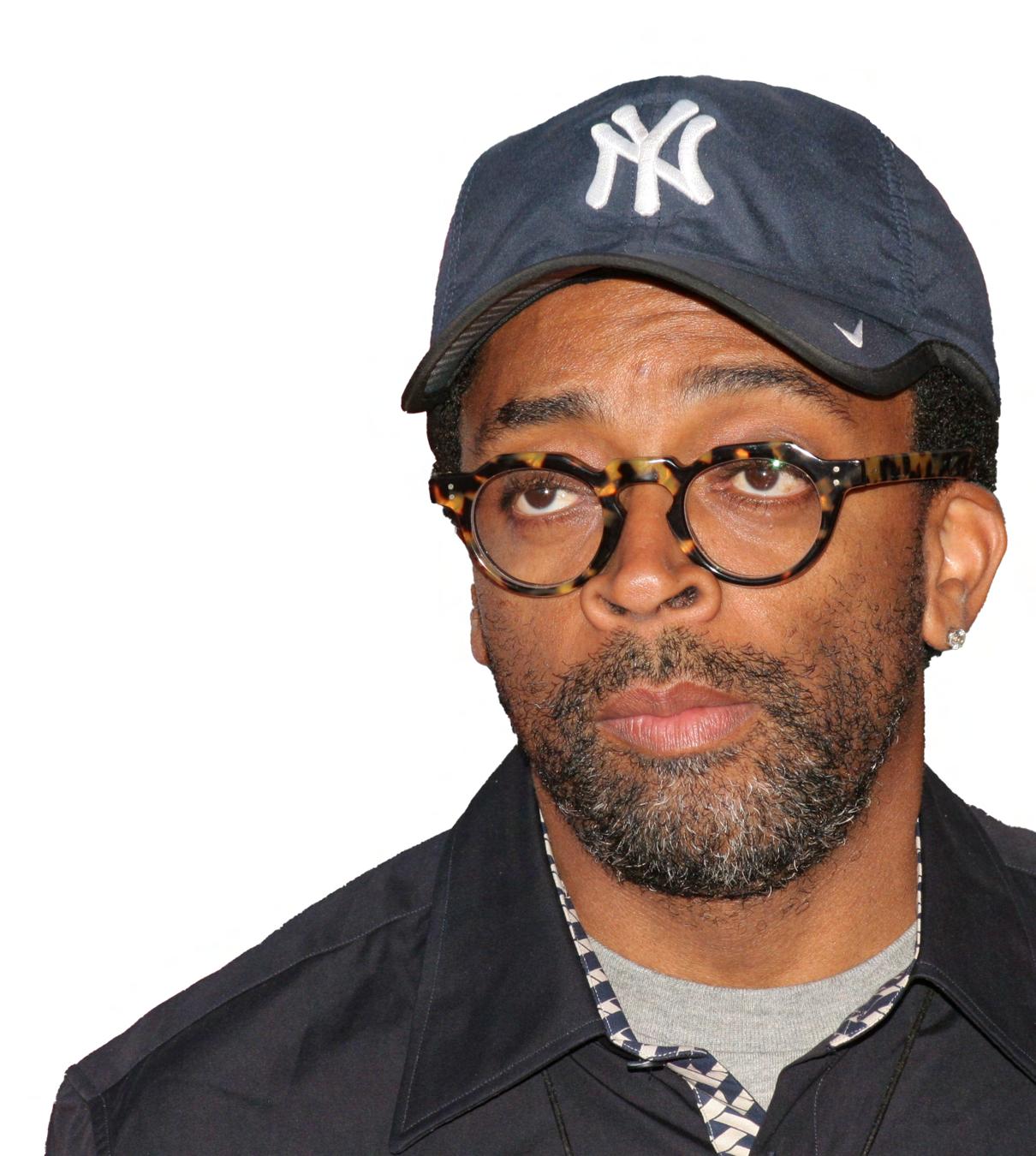

-Oli Paget, L5
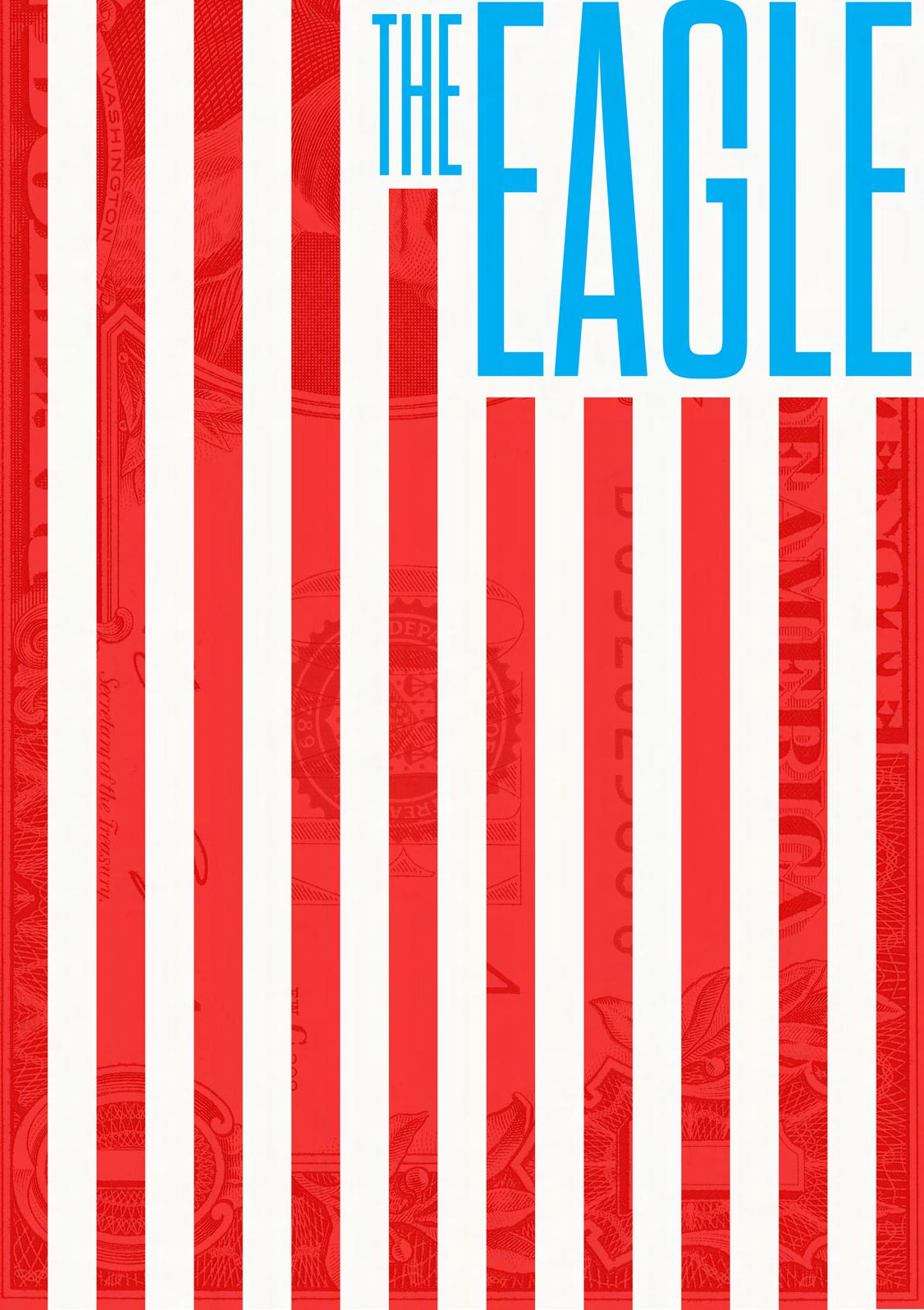
EDITOR-IN-CHIEF:
Ellie Wain
GRAPHIC DESIGN:
Will Logan
St John’s School Leatherhead Politics Magazine