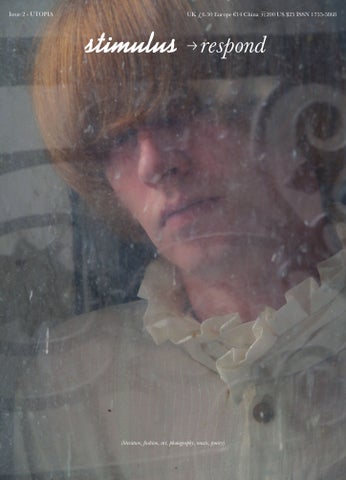
Issue 2 - UTOPIA
UK £6.50 Europe €14 China 元200 US $25 ISSN 1755-5868
(literature, fashion, art, photography, music, poetry)
Contents Features 019 Imaginary Civilisations by Christian Astuguevielle Words by Georg Dressler Images by Michael James O’Brien
Fashion 025 TwoTom 033 Rendering Intents
Literature
063 Klaxons Silenced
071 Utopia in Ruins Words by James Burton 077 A Comet for Utopia Words by John Hutnyk and Laura King 081 The Ineffable Nature of Dreams Words by William Robertson
Art 043 Anne Hardy 049 Charles Long
083 This is best spoken by a naked muddied man with an axe. Words by Andy Johnson 087 The New Dystopia: Fear and Insecurity in Residential Communities Words by Setha Low
Music 055 Lydia Lunch 059 Dead Kids
001 | Stimulus Respond
Poetry 011 The Island-designing Competition Words by Kate-Smith Bingham 012 A View of Empire from a Train Words by Isobel Dixon
Cover photography by Thomas Cap De Ville Back page photography by Vicki Churchill
013 Eat Dog Words by Olivier Marie Garbay 014 Advice to the Gods Words by Philip Fried 015 Inside the Garden Words by Peter Campbell 016 The Paper River Words by Chase Twichell 017 Outlook Good Words by Simon Barraclough 018 Utopia Words by Olivier Marie Garbay
Stimulus Respond | 002
Editor’s Letter Well, two months turned into three, then into four. It seems that Utopia is not as easy to achieve as one would have thought. The next issue is Time, well, we’ll see. Things have been quite difficult of late but we appear to have overcome the problems that we have faced over the past months. It’s not so easy you know, starting up a new magazine. Some people even think they can do my job for me. I say ‘ha’. I DARE YOU. What we do have is a great issue, and I offer my apologies for the severe lateness this time around. All of my editors have been exceptionally skilled this number, and it seems inappropriate to say in writing how brilliant you all are, because there have been words, brainstorms, so many ‘oh god I’m just so fucking sick of it’s, and everyone knows what has been going on. Telephone calls like you would never imagine. Anyway - please do look out for Melina’s amazing shoots this issue, I know that she has spent a lot of time and effort in creating them, and hey, what a result. You only have to look at the rendering intents shoot to realise what amazing vision and skill she has. It reminds me sometimes of how gifted and talented the people I have grown to work with are. This issue Yannis has produced some fantastic interivews, and I am so happy to be featuring Anne Hardy this time around, her work really evokes something in me which I have a huge appreciation for. Will and Amin also create such a great music section that they certainly cannot go without mention. The literature section continues to move from strength to strength, and I am very pleased to say that we are planning a beautiful book in the near future, which will feature a compendium of the best parts of Stimulus Respond alongside some new bits. Perhaps I repeat these words in different ways every issue, but then I am sure that no one really reads this section anyway. Doesn’t matter, I still mean it. Jack Boulton Editor-in-Chief
007 | Stimulus Respond
Image courtesy of Kevin Griffin and the Photographer’s Gallery Wave #25
Stimulus Respond | 008
Unit 3, 508a Kingsland Road, London E8 4AE Tel 020 7249 0236 Editor in Chief Jack Boulton jack@stimulusrespond.com Art Direction Melina Nicolaide Jack Boulton
Editor - Poetry Yannis Tsitsovits yannis@stimulusrespond.com
Editor - Literature Tara Blake Wilson tara@stimulusrespond.com
Editor - Fashion Editor - Arts Melina Nicolaide Yannis Tsitsovits melina@stimulusrespond.com yannis@stimulusrespond.com
Editor - Music Amin Samman amin@stimulusrespond.com
Editor - Music William Alderwick william@stimulusrespond.com
Literature Co-Ordinator Jinny Colby jinny@stimulusrespond.com Director - Advertising Oliver Schneider oliver@serifmedia.com Fashion Journalist Christos Kyriakides christos@stimulusrespond.com Logo Design Tina Borkowski tina@yippieyeah.co.uk
Contributors this Issue ARTICLES
IMAGES
POETRY
FASHION
Christian Astuguevielle Georg Dressler Holly de las Casas Setha Low James Burton John Hutnyk Laura King Andy Johnson William Robertson
Robert Glowacki Michael James O’Brien Tom Goffa Thomas Cap De Ville Vicki Churchill Daniel Jones Kevin Griffin
Kate-Smith Bingham Isobel Dixon Olivier Marie Garbay Philip Fried Peter Campbell Chase Twichell Simon Barraclough
Ken Nakano Hisae Jamikd Keo Adtijkdle Francois and Kateb @ Marylin anna pytka @ models 1
For contributors’ contact details please contact the Editor in Chief. We welcome unsolicited material from our readers. If you would like to make a contribution to future issues then please email the editorial team at the addresses above. Stimulus Respond is published four times a year by Buster Dog and Serif Media. All material is copyright (c) 2008 the respective contributors, aside from ‘in-house’ material which remains the property of Buster Dog. All rights reserved. No reproduction without prior consent. The views expressed in the magazine are those of the contributors and are not neccessarily shared by the magazine. The magazine accepts no liability for loss or damage of manuscripts, artwork, photographic prints and transparencies. 009 | Stimulus Respond
Image by Tom Goffa
Stimulus Respond | 010
The Island-designing Competition Words by Kate Smith-Bingham
starts with two blank sheets and a box of pencils sharpened by Dad with a carving-knife. We hunch at the table, squiggling headlands, inlets, estuaries, then filling in the ground between with swamps and volcanoes, rainforest, glaciers, a ski-resort. It has to be imaginative and plausible, needs water, for instance, dungeons and schools and villages with names like Hiccupbottom, Lurch, Thornton-le-Spam. By lunch, my brother has moved on to climate: his palm trees lean north, his capital springs shanties in the aftermath of last year’s hurricane, and every bus-stop harbours a scarlet dhow - for when there are floods, his key explains. Any excuse to draw a boat, I mutter, snatching the red for my stick men, each to represent one hundred votes. They stand in public squares demanding a recount as the President mouths his acceptance speech and such is the confusion no one sees my brother’s auxillary fleet tack past the mustard and salt and strawberry jam and on through international waters,
From Kate Smith-Bingham’s latest collection, Quicksand Beach (Seren, 2006), which was shortlisted for the 2006 Forward Prize.
011 | Stimulus Respond
A View of Empire from a Train Words by Isobel Dixon
Who positioned these perfect black-and-white cows in the landscape (the gently rolling fields of English Christmas present calendars)? Like the Timpo Toys we carefully arranged on a green felt spread far lusher than the veld we ever had, some smoothed-out foil or broken mirror for that glassy pond. Back then, from small beginnings shipwreck, orphanhood we’d build a homestead, sprawling ranch, a village, then a dynasty as the milking girl with the boots and bucket married (of course, how else?) the suave black-stetsonned cowboy man, and they, and all the wild and farmyard animals, bred. Things multiply. The story ran for weeks. But we’d get bored with such abundance, our mother raging about all the mess, and so we’d plan a devastating end to all of it: rid of the burden of creation, all those lives. At last, the pure relief of Finis: volcano, fire or flood. The promise, later in the holiday we might just start again, Year Zero. From Isobel Dixon’s latest collection, A Fold in the Map (Salt, 2007).
Stimulus Respond | 012
Eat Dog Words by Olivier Marie Garbay
I eat the dog to protect home, you come alive to restore my dead, to find you there I climb the stairs, it’s nothing else but burning hell. I feed the birds to kill the planes, I give no shite to the boyfriends, I’ve got the one for my concern, tv imploded on a western. We instead of I, an open we, instead of you. We for it’s free. I had a wee piss at three, that is the only we I ever had and pissed off. A double-decker bus bunch of cunts, in front of helpless princess stress, she thinks he’ll never come the one she wakes up for in the fourth tome. I push the cat over the edge, the river flows on holy drugs, wiping the shite off the system, to go fly a kite, a needle work instead. We instead of I or you. We for it’s free. I had a blessing thy, that is the only we I ever had and peace is off. Blast the poor and blast the rich, trash your pathetic will in just one go, get the planet ruined anyway bitch, there’s no more secret for the day, no. Vomiting the dog I had for breakfast, it’s not nice so much in pain, anger in vain, can’t find the door to get out fast, definitely wrong I must have been. Left, all in the realm of we instead of I, we instead of you, we for it’s free. I had a free will at once or was it a quarter to two? Where is Fellini gone?
013 | Stimulus Respond
Advice to the Gods Words by Philip Fried
I am a consiglieri to the gods of travel, but they rarely consult me, the journey through all the late hours is interminable, we are always between cities, behind our cyclopean headlight. Less and less do we travel from car to car. I recall my masters stowing bulky coats on overhead racks. Now every left wrist is adorned with a chain that snakes to a slim portfolio, gear for couriers in this expanding stain of indelible lateness. We are poised to arrive in the greatest city of all. But the gods are losing interest in astonishment’s drama. Now that the world is derelict and humans have fled like refugees into the well’s mouth to discover an older, pre-Aztec water, the glistening morning of organized river valleys, a few realize that eons ago a glitter of quartz in the pavement should have been scried, a weed or a soda cap should have been interrogated. But this very minute it is too late and the train zooms at zero altitude through family backyards, whooshing by mowers and pools, reducing all that it passes to less of a place, too close, more and more local. Sometime soon, the gods will begin to rise, to smell their own sour breath. I am brimming with advice for them that won’t be followed. Masters, whatever you do, be sure of the scale of your arrival, you may have become incongruous with the story itself, worship won’t find you, who are now too large or too little.
Stimulus Respond | 014
Inside the Garden Words by Peter Campbell
In a Surrey asylum garden There are peonies, large and showy. There is Quercus robur shading the hollows. Butterflies, colours founded in Eden. But there are no smiling natives. They swarm in behind the doors, Lagged to their ears with tobacco smoke and peace-cake. Tinkling us for favours, Shanked up like ricketty ponies Out of sight of the fairground. Yellow, mournful, dull. Laughter dies here A maiden run to mud. The food comes from a central place in cylinders, Hustled between the lawns in unapproachable convoys, Arriving smashed and waxy. They hover in porches hungry before the bell. The horticultural detail plant onions In the old walled orchard. Squat among tomato frames sharing boiled sweets. Seventy-five per cent non-productive, Holding the barrow and rake, They tip their heads to nurses In brief colonial tribute. We have farmed here with care Not wilderness nor oasis. A green and pleasant fourteen acre wood. A cricket pitch With magpies feeding and a clubhouse For the membership. A little England For ruling of the mad. An exhibition for the sane and unbelieving They have sat beneath the banks of rhodedendron With their fly-buttons undone. They have brought out knitting, Unravelling themselves backwards in sight Of the flagpole. How fine the paths are in Maytime. How red the bricks from Bagshot. Unease is wrapped up here In a plain manilla. We look in. We polish our shoes as if for a long journey. We pop in and out with presents from home. There is always a clock, a nameplate By a dry fountain. A definition for the garden That does not rattle in the autumn wind. Behind the rituals of rocking at the corner, Saying aye-aye and grimacing, There is no mystery, no savage discourse Of a different palate. Our nobility Is of no other order, our brains and jaws the same, Excepting separation and dominion make it so. We have planted here with care A shady empire for our nicer affectation. Inside an asylum garden There are Surrey names posted on gable-ends. There are Surrey notables in busted profile. But this is not Surrey, this is not noble, And there are no smiling natives.
015 | Stimulus Respond
The Paper River Words by Chase Twichell
The most beloved body of my childhood was Johns Brook, its bed of ancient broken pears, icy libations pouring over them for centuries. Through the leaky oval mask I entered its alcoves and grand halls, its precincts of green-brown light, the light of my infant thinking. In the minnow-bright roar I saw the place where life and art meet underwater stone to stone, with the sunken treasure and trash. The sound of the brook was the sound of the house, the pools of the kitchen and bedrooms. A galaxy away it would still be the background of my sleep. Clouds came down to earth, great gloomy rooms among the trees, dark rooms of the brook, church of deep pools. As soon as you entered you were wholly alone in it, all sinewy ladders and gray stairs, stones magnified, and the sidelong trout, all gone now, rainbows and brookies, one big one per pool, gills like fresh cuts. I dove into the flume’s mystery, no place you could touch bottom or see all the way down in because half at least was always in shadow. It was like learning a room by carrying a candle corner to corner, looking for God to see if He too was awake and listening to the river crumpling and erasing, enforcing its laws. I found a cold, an oblique god who commanded me to answer all my questions by myself. The human mind is also a beautiful river, full of driftwood and detritus, bones hung with trinkets, scant beaches more stones than sand. And up on the hills it’s the wind touching the juniper spurned by the cows, its thistle sharpness, and the fawn’s hoof left by coyotes, in their scat. From Chase Twichell’s latest collection, Dog Language (Bloodaxe, 2006). Stimulus Respond | 016
Outlook Good Words by Simon Barraclough
Another Kentuckian bourbon night’s swill and swell rocks me gently in the dark as I wait for the nightly shipping forecast while sailors in oils slick cross deck to hear their fate from the oracle of Broadcasting House and long to be cardiganed and coffeed in Studio B with a black cab waiting to drive the tarmac miles to sanctuary, and a single helmsman paws over charts by the light of a kerosene lamp that swings and knocks his forehead with each restless turn of the Atlantic as she takes more and more duvet for herself and finally kicks all the brackish green bedclothes to the floor, and chilled by the six or seven rising to gale force eight, he sets his alarm for fifteen minutes’ time and tries to get his head down, and wishes he were living in Switzerland where shipping forecasts are as useful as pollen warnings on the moon, but I dream of casting off from the nodding donkey derrick of Cape Cod, with a bait-hold jammed with slabs of frozen squid and forty miles of monofilament, hooks, buoys, beepers, leaders, gaffs and slime knives to dress the throngs of swordfish I would haul on deck under waxing moons that never wane in ocean breaks that furnish forth fish like the pot that wouldn’t stop.
From Simon Barraclough’s first collection, Los Alamos Mon Amour, which will be published in March 2008 by Salt.
017 | Stimulus Respond
Utopia Words by Olivier Marie Garbay
UTOPIA
= THE CENTER OF THE UNIVERSE / ME = NOW LET’S ALL CONJUGATE! IS SHOULD HAVE BEEN WOULD BE MEANS TO PROPAGATE LOVE THROUGH MUST BE ISN’T IT? + You understand everything I say, + As I mean it. + You mean to answer meaningfully. + Yes, I too understand it as you mean it.
Hallelujah it works! (See “American Football” by Harold Pinter)
Stimulus Respond | 018
019 | Stimulus Respond
In these modern times it is possible to travel all over the globe. With so little of the world left to explore, it seems that the imagination is one of the last unknown territories remaining to be discovered. With the gift of awakening our senses, Christian Astuguevielle is a guide on a journey of a different kind. Hands See (Les Mains Regardent), an exhibition at the Pompidou Centre in the 70s, was one of his first invitations to follow him into this new world. With this display, the things you could see were not the things that you could touch. Since than he has guided our hands, particularly our sense of touch, through Tactile Pathways (Parcours Tactiles) and is currently facilitating our voyage with Five Senses (Cinq Sens), a permanent installation in a French museum. Five Senses challenges the traditional and cultural boundaries of sensory perception established over centuries of cultural evolution. Science has virtually erased every border that differentiates us from animals, and Astuguevieilles’s Chimera Boxes are designed to question the very nature of the human being. The Chimera used to be a mythical creature, but now although the existence of cells combined from human and animal embryos, named Chimera, is ratified by current British legislation, the fact that it is possible to combine species in this way makes concrete the utopian idea of creating a Chimera in real life. In The Illiad, Homer recounts the story of the Chimera not as human at all, but as a mixture of lion, snake and goat, and with the characteristic of exhaling an inextinguishable fire. Hieronymous Bosch further depicted the Chimera with already more human characteristics, and, in the film Freaks, Tod Browning gave them a strong human identity, depicting them as social outcasts living in traveling circus. In this way, Astuguevieille’s Chimera Boxes are what the future might look like, a weird circus of living beings.
Imaginary Civilisations by Christian Astuguevielle Words by Georg Dressler Images by Michael James O’Brien
Stimulus Respond | 020
021 | Stimulus Respond
Stimulus Respond | 022
023 | Stimulus Respond
Stimulus Respond | 024
Two Tom
interview Christos Kyriakides photographer Thomas Cap De Ville fashion Editor Melina Nicolaide model Francois and Kateb at Marylin agency
025 | Stimulus Respond
Stimulus Respond | 026
1. Are you in need of utopia? Of course YES. 2. Is one designer’s utopia another’s dystopia? ? 3. Ideal conditions when designing a collection? Sleeping in the forest. 4. Where is utopia for you? The place invisible. 5. Is Donatella Versace there? If yes, what is she wearing? Nothing, she is just there next to a unicorn.
027 | Stimulus Respond
Stimulus Respond | 030
031 | Stimulus Respond
rendering intents photographer / vicki churchill fashion editor / melina nicolaide hair stylist / antonio deluca makeup / ashley brockman model / anna pytka @ models 1
033 | Stimulus Respond
dress by Sophia Kokosalaki
shoe by Miu Miu
top by Miu Miu, trousers by Vanessa Bruno
top by Miu Miu, trousers by Vanessa Bruno
Opposite page, top by Marc Jacobs, trousers by Vanessa Bruno, shoes by Tatiana Katinova. This page, dress by David Szeto, shoes by Tatiana Katinova.
jacket and skirt by Tatiana Katinova
Stimulus Respond | 040
This page: top by Bally, trousers by Sophia Kokosalaki, shoes by Tatiana Katinova Opposite: top by Tatiana Katinova
This page, top by Tatiana Katinova. Opposite page,top by Bally, trousers by Sophia Kokosalaki, shoes by Tatiana Katinova
Above: Untitled VI 2005 Diasec mounted c-type print 120 x 150 cm Opposite page: Building 2006 Diasec mounted c-type print 120 x 150 cm
043 | Stimulus Respond
Anne Hardy Anne Hardy’s tableaux of messy or derelict interiors are satirical, beautiful, and quite often rather sinister. Yannis Tsitsovits interviews the artist whose self-contained dystopias one can smile at.
Stimulus Respond | 044
Untitled VII 2007 Diasec mounted c-type print 137 X 190 cm
045 | Stimulus Respond
Drift 2004 Diasec mounted c-type print 120 x 180 cm
Stimulus Respond | 046
A jumble of post-it notes, tags, diagrams, measuring devices, and other oddly placed items often litters Anne Hardy’s vacant interiors. These muddled clues evoke a state in which the persona of the artist has been replaced by an unseen prime mover. In Untitled VII (2007) and Untitled VI (2005), for instance, one can envision an invisible hand-belonging, perhaps to a hobbyist or dotty scientist-rearranging objects or compulsively jotting down a daily log of tasks. Hardy is interested in how people try to make sense of the world around them by manipulating their environment. Her art seems to suggest that, when filtered through individual quirks, the logical or mechanical systems people use to this end results in something idiosyncratic and unpredictable. Sometimes this suggestion takes on a darker hue: the CCTV control room in 2006’s Building, whose monitors keep a watchful eye on the corridors and desks of a ghostly office, is the stuff of totalitarian nightmares. Hardy’s tableaux have been likened to horror film sets, although this is not a comparison she is entirely comfortable with. (“I don’t even watch that many horror films,” she tells me, “because I’m a bit of a wimp.”) Rather, as my discussion with her makes clear, she imagines the spaces she creates as being closer to everyday life-parallel worlds, poised between reality and fiction, which invite the viewer to step in as the protagonist of her visual narratives.
In your sets, the camera is positioned so that nothing seems to exist beyond what is seen in the photograph. How important is this sense of self-containment? It’s really important. With the way the space is constructed around the camera you get that sense that you’re personally involved in it rather than looking at it from a distance. I want the scenes to be encompassing, as much as a photograph can be encompassing. There is a lot of consideration given to the physical relationship between yourself when you look at the work and the size of the space and placement of objects and the scale of the print too. It gives a sense of being life-size and immediate. In Drift (2004) a big mass of leaves surrounds a control room. Is this a metaphor for the chaos that surrounds our attempt at order? With Drift, I wanted to have a control room and a slightly epic feeling of wonder around this structure, but I wanted it to be completely defunct. So there is all this hope and optimism within the architecture and shape of the room, but on the other hand that’s all over because it doesn’t work anymore. With the leaves falling there is the sense of time having passed because they’ve built up over the window. That’s important in a lot of my work: there is a lot of time building up within the images, rather than a dramatic second; it’s more accumulative. But the leaves also suggest that the control room is defunct, because you don’t see out of it; there should be a view of whatever it is that’s being monitored from the control room. So the leaves have the formal purpose of closing off the view and just allowing a little bit of light in so that the focus is in the room. I see some similarities between Jeff Wall’s Destroyed Room (1978) and much of your art: it is a self-contained tableau, and although it seems disorderly it is in fact carefully laid out. Also, even though no human action is depicted, it has aggressive overtones. Do you agree? Maybe on a formal level. I agree that the suggestion of violence is a similarity, but in many other ways it’s different to what I do. I think particularly with that piece Jeff Wall made such a reference to the construction of photography and the construction of imagery and almost dissected that, showing you that this is just a set, so you can see the supports behind it. I’m more interested in the fictionalisation of the real world around me and how that can feed back into the images rather than the medium itself.
047 | Stimulus Respond
Would you say that your work is less formalist and more about storytelling? It’s a tricky one. A lot of how and why my images work has to do with the fact that they are photographs rather than installations, because the material realness of places is withheld from you, so you can never know them in a physical sense. The photograph provides a veneer of realness, just like in cinema where you feel you can step into a scene and believe it. So my work is very much about photography, because it’s what makes it happen. But I’m not concerned about making a statement about the truthfulness or otherwise of photography. What was the inspiration behind Untitled VII and Untitled II (plants) (2004)? A lot of pieces, such as Untitled III (office) (2005) and Untitled VII, start with architecture. For Untitled III (office) I wanted something very Modernist in reference: clean lines, a big floor-to-ceiling window. Untitled VII was more about a space that was very provisional, something that may start off as one thing, but later other bits can be added on or chopped off. That type of space can become ambiguous because it’s not organised; it’s almost as if within this space things can happen that are unregulated or hidden. I’ve done quite a lot of work with plants and am quite interested in our relationship to the natural world and how sometimes it’s symbolic-so it comes through Christmas trees or antlers-or distant and controlling. For Untitled II (plants) (2004) I wanted something like a growing chamber, like an experiment. So you have these green plants going up, and measuring sticks or rulers, but everything is unruly and disorganised. It doesn’t really look as if you were going to get any useful results from whatever it is you’re measuring. With Untitled VII it’s similar, but on a much smaller scale, like someone is growing all these plants in a haphazard and not very efficient-looking way. Is this where your sense of humour comes in? There is something tragicomic about these photos, or about Drift, because you’re portraying someone’s attempt to control or study an environment that seems intrinsically unmanageable. I think so. With Drift, the attempt to control was more cultural or institutional. Untitled VII is more about an individual. But yeah, there is a sense of inbuilt failure in many of these spaces, which is tragicomic, but also a sense of improvisation, which is endearing. For me the picture painted here, especially in Untitled VII or Untitled II (plants), is that of a would-be perfectionist’s failure to assume full control over nature. Or over anything, really. But there is still an intent, I think, always. In Untitled IV (balloons) (2005) there are chalk diagrams on the wall, which relate back to the idea of a system beyond. All the images have elements-a door, or light wells-that suggest a space beyond the one you’re in, joining you back into the bigger world. That one has all these chalk drawings on the walls which are a bit like graffiti, but they also suggest badly done diagrams of electric circuitry or plumbing. So it’s this idea of planning that descends into disorganisation.
Anne Hardy’s upcoming solo exhibition is at Bellwether Gallery, New York, from 15 April until 17 May. She will also be on show at In Our World: New Photography from Britain, at Galleria Civica di Modena in Italy, which runs from April until July.
Stimulus Respond | 048
Charles Long For the last five years, Charles Long has looked to the LA river for comfort and inspiration. Its polluted banks have supplied him with material for his art, as well as food for thought. Yannis Tsitsovits meets an artist who looks for hope and beauty among the ruins.
Opposite page: Charles LONG Soundly through the Noise 2003 Mixed media 56 x 35 x 28 inches, 143 5/8 x 89 3/4 x 71 3/4 cm Courtesy of the artist and Tanya Bonakdar Gallery, New York. Next spread: Charles LONG Untitled 2007 papier machĂŠ, plaster, steel, acrylic, river sediment and debris Courtesy of the artist and Tanya Bonakdar Gallery, New York. Stimulus Respond | 050
“I am heartbroken every time it rains, because I think of how the bird shit gets washed away,” Charles Long tells me in a mournful mutter. In drier weather these brownish white streaks can be found dripping down the slope of the LA River, the long concrete channel that cuts through Los Angeles. It houses a sort of degraded Garden of Eden, where lush vegetation soaks up murky water, and herons, egrets and other birds pick through the rubbish to find nest materials and food. Since his move from New York to LA, this decrepit waterway has been the artist’s refuge, sanctuary and muse. Like the birds, Long too has scavenged its littered banks. The debris he happens upon often finds its way into his work, as with 2003’s Soundly Through the Noise, and its dilapidated chair base, or 2005’s Poem of the River, in which a mesh of bars and branches emerges through a table frame. Many of these pieces are covered in a scaly white or pale blue patina. Some are quirky and skeletal, like Heath Robinsons recovered from a shipwreck in a not so distant future. The strung out patterns of bird faeces the sculptor so fondly speaks of are the latest among the river’s riches to capture his imagination. “I photograph or draw them,” he explains, “and then start to interpret these things as figures. I weld right on top of the picture of the droppings to build a three-dimensional framework.” To that he adds the plaster and papier-mâché he moulds, mixed with feathers, broken glass, straws, and other pieces of detritus. The welding is not without its complications. “Sometimes the drawings catch fire and the garbage starts to smell,” Long says, half amused. “The whole experience is really visceral.” The product of this messy process has been last year’s Untitled series: spindly, squid-like creatures, which stretch out leprous, trash-infested tentacles. On their ailing bodies one can spot the technicolour stigmata of mindless consumerism: here is a green straw; there a pink wrapper; elsewhere a bit of a plastic blue bag. One piece, whose shafts extend skywards as if in plea, could be a coral or fossilised sea plant. Another, which lies horizontally, reminds Long of a “corpse or odalisque.” An air of mute suffering hangs over these sculptures, which speak through the body language of martyrs and the terminally ill. “There is a way in which I think of these forms-whether they’re human or animal or sea plants-as quite tortured,” the artist tells me. Their shape reaffirms this notion: Long’s latest work follows in a long line of imagery, from El Greco’s emaciated saints to the cliché of the willow tree, which couples elongation to the tragic. It is no wonder, then, that the series bears the weight of a sculptor whose gangly figures gave shape to feelings of existentialist torment. “When I look at the bird shit I see my favourite artist’s work: I see late Giacometti,” Long confesses. “I don’t think I would have noticed it if it hadn’t been for him.” But elongation can often be otherworldly too, as with Parmigianino’s Madonna of the Long Neck (1534-40), with her swan’s neck and vermicelli fingers, or, again, Giacometti’s lanky Cat (1954) and Woman of Venice (II) (1956), which have a touch of the extraterrestrial about them. So too with the Untitled series, which would not be out of place on the set of Doctor Who or Star Trek, and which Long himself likens to “ectoplasm”. And yet, these diseased, alien things arouse affection rather than disgust. Here Long draws an analogy with a scene from Cormac McCarthy’s The Road (2006). “It’s a beautiful book about a father and son travelling through a post-apocalyptic landscape,” he says. “Everything is black and gone., Humans are pretty much the only thing left, so they are eating each other. As the book goes on, the father and son get thinner and thinner. At one point the father looks at the boy and his sunken cheeks and sees a strange beauty.” That his latest work is redolent of Giacometti, whose dragging out of the human body was partly a response to the atrocities of World War II, is quite telling, for Long’s preceding work also seems inspired by post-war sculpture. The wire column on which the radar-like structure in Everyone’s Heart Skipped a Beat (2003) is perched, for example, is a likely nod to Paolozzi’s Cage (1950-1951). The scabrous thorax in More Like a Dream Than a Scheme (2003), meanwhile, and the way one of its ribs pierces through a palm frond, evokes Seymour Lipton’s Imprisoned Figure (1948). A sense of despair underlies Long’s river-inspired work-a sentiment shared by many a post-war artist, although in Long’s case it is caused less by the trauma of warfare than the insidious destruction of our natural habitat. “My work is in part a very strong reaction to a culture I really wish was different,” Long says. “We live in an age of incredible transformation of materials into anything we want. Some of it is pretty great but most of it is going to be a huge problem for future generations. I drive through LA and see the fancy faces of corporate buildings, but from another exit you can see them being built and realise there’s nothing special to them. And you see the system of freeways and trucks hauling things and understand that we’re dependent on an economy that is so short-sighted that you know just on the other side of the hill is the apocalypse.” But if ours is essentially a tragic age, Long refuses to take it tragically. His cages, skeletons and spikes may borrow from Lipton and Paolozzi’s ‘geometry of fear’, but he takes the sting out of their sharp edges and tempers their allusions to torture and violence. The Untitled series is at once sorrowful and grotesque, bordering on the tragicomic. It’s not that Long sees a funny side to human self-destruction; rather, he looks at this defiled world and asks whether we can find hope in its resilience and flawed beauty. He does this by holding on to a childlike sense of wonder and playfulness that harks back to the days where he made big interactive spheres of bubblegum. Much of this playfulness must be credited to Long’s use of the objet trouvé, the found object, which is perhaps the closest a sculptor can get to the impulsive painterly gesture. The manky toothbrush or car relics poking out of the Untitled pieces, even their patches of bubble wrap, sponge, and webbed plastic (which tie in with the aquatic and extraterrestrial motifs) all uphold an illusion of spontaneity. In the work inspired by drawings of the artist’s son, Gene, such as The Slave Chemist (2004) and A Marvelous Science (2004), this playfulness merges with the naivety of a child’s vision. There is no doubt something mischievous about using bird caca as a blueprint for one’s sculpture and shipping it off to galleries and prestigious art fairs. It points, along with the objet trouvé and Gene’s drawings, to the Dada movement and Tristan
053 | Stimulus Respond
Tzara’s cry of “Pregnant birds who make number / two on the bourgeois / the doodoo is always a child”. Could this simply be an excuse for Long to stick his tongue out at the art establishment, like Piero Manzoni before him, who sold cans labelled ‘Artist’s Shit: contents 30gr net, freshly preserved, produced and tinned in May 1961’? “There is a part of me that wants to say, ‘You know what, people? This is a joke!’” Long concedes. “Not what I’m doing necessarily, but our whole privileging of these objects. Artists can’t entirely do away with the Dadaist part of it. But what I began to realise at a certain pointand it came through teaching-is that art doesn’t exist. It’s on a par with becoming an atheist. Once your eyes open to the incredible illusion and apparatus you’ve been working with, you realise that they’re less than a dried lettuce leaf on a kitchen counter-there is nothing there; it’s a fiction. But the degree to which a writer or artist embraces this fiction is the degree to which it can be useful. If you’re not embracing the fact that it doesn’t really exist, in my mind, you’re missing out on life, which is so much bigger than art.” Quite often, after he has finished one of his works, Long will take it to the river when its banks are full and immerse it in water. It is a touching ritual: a baptism and a coming full circle. The Chinese sometimes do the same with gongshi, scholar’s rocks, as a tribute to Nature as a selfcreative force. “They’re pulled out of the water, worked on by the artist, and then put back into the river to be finished,” Long tells me. I look at a photograph of him in the midst of this strange rite. He is up to his hips in water and pushing one of his creations deeper into the murky liquid. Only his back is visible, but I can picture his face, and it’s lost in contemplation, serene. To Long, the river is an affirmation that ultimately everything is all right, even though he senses an uncertain future. He describes to me a recurrent dream: there are fires in buildings, lots of people, anarchy, and all these “difficult, terrifying things to be done, but it’s exciting.” From where he is standing, however, this infernal vision seems like a distant haze. “Right now, as I’m talking to you, I’m looking at clouds drift over the mountains and a black-headed grosbeak is flying past my window. The present is terrific but I think I dream of something else.”
Charles Long will be on show at Nina in Position, Artists Space, New York, until 22 March and at Arm’s Length In: Ceramics and the Treachery of Objects in the Digital Age, Ruth Chandler Williamson Gallery, Scripps College, Claremont, until 6 April. Work by Charles Long will also be included in the Whitney Biennial, New York, which opens in March.
Stimulus Respond | 054
055 | Stimulus Respond
Lydia Lunch Lydia Lunch has made a life’s work out of defying classification. For the last thirty years, she has moved unrelentingly from one format to another, developing an artistic vision that is at once violent and compassionate; decisive and unhinged; disgusted and victorious. From the brittle tirades of her early work with Teenage Jesus & the Jerks through to her current textual, filmic and musical collaborations, she has kept an unflinching eye on the exigencies of human existence. Amin Samman caught up with her after her latest London performance to discuss (inter-) subjectivity, public psychotherapy, humour and art.
A recurrent theme in your work is the tension between the body and the psyche. When did this first emerge as an interest and why do you think that it has proved to be such a well of inspiration? The body bears the burden of any extreme trauma or emotion. That’s the main obsession of my body of work. When your psyche has been hit with enough blunt force traumas, you start punishing your body. It’s a connection that you become more aware of the older you get, but I realised early on. At the age of six I was already suffering spinal taps and fainting-spells; my body was already an infected hotel. Then one day I literally had a stroke of consciousness; I knew that something was not right. It was as if sunlight was pouring in through the attic windows of the ghetto mansion where I lived. It was a beautiful afternoon dusty twilight and I stood there paralysed, like a small doll, open to the reality that my perception had somehow just been irreversibly altered. Soon after my body began rebelling, I began rebelling against my body. I pursued extremes of pleasure that would result in extremes of pain. Some people just go for the extremes of pain but it’s the same in the end: it’s going to hurt one way or another. But as much as I’ve punished and pleasured my body, this is about trying to find balance. My goal, both in art and life, has always been to find a way off the wheel, to avoid being victimised, without relinquishing my contradictions and obsessions. Is that utopia? Is that dystopia? I don’t know. A lot of the no-wave bands explored personal politics at the expense of the collective. You, on the other hand, have frequently touched on broader social events and processes. When and how did you make the connection between fractured subjectivity and society at large? When I first began to aim the creative gun, I went after the nearest deserving target: my father. Like so much of what I do, it was instinctual. I recognised the family as a microcosm of fascist society and was just throwing down primal energy to get it out. I became more politically vociferous when I started doing spoken word. After the initial assailant was attacked, it made sense to broaden it out: I went after the father of my country, which was Reagan at the time; next up – God the father. So I kind of stumbled into this patriarchal trajectory. I do still believe that it is the construct of the patriarch that is leading the world into the disastrous state that it’s in. Greed, fear, and religion are male-dominated terrains. It’s not all men; it’s men in positions of power. Most men have such little power that they aren’t the ones to fear; they are the ones to be pitied because they have to deal with other men on a daily basis. People might not see it in my work, but I understand the dilemma for those young boys in danger of having their sensitivity and beauty battered out of them.
Stimulus Respond | 056
If I can press you a little, what exactly do you mean when you say things like ‘the more they kill, the more I fuck – I feel I’m becoming the rapist’? I began preparing ‘Real Pornography’ after hurricane Katrina had struck. The problem for New Orleans was not so much the hurricane as it was the flood – an essentially man-made disaster that they knew was coming for years. Watching it all unfold, I became both ill and obsessed; a calamity and disaster junky. It felt like I was becoming the liver of America, but couldn’t tear my finger from the remote control. It was ridiculous. I’m not living in a war zone, but that doesn’t mean it’s patronising to care about the rape and genocide that goes on. I have no choice but to speak out against it because it makes me sick. It’s personal to me and I don’t know why. After more than twenty years of dealing with this global genocide, the slave trading that continues, the disrespect for human life, and the pillaging of the planet, you’d think that I would become more immune to it. But I haven’t. It makes me fucking ill. And if it makes me sick, it kills the direct victims. I have to be a voice for that; and because we’re so helpless against it all, the only real rebellion becomes pleasure. And I don’t mean unmitigated hedonism; I mean reclaiming the pleasure possibility that’s been beaten out of us by being too fucking aware – by being addicted to calamity. You’ve referred to your illustrated word performances as ‘public psychotherapy’. What are the aims of these sessions and how do they differ from those of your average New York analyst? People often cry at my shows. Some run out in horror, screaming, and just can’t fucking take it. There is no collective response to what I do. If I’m doing a piece like ‘The Ghosts of Spain’, I don’t feel better when it’s over because I haven’t changed anything. But I still hope to create some kind of emotional release for people. I’m hysterical at times, and I mean that in many ways. Not only am I funny, I am a hysteric. Obviously I’m not pulling my hair out too many days of the week, but sometimes I do become so overwhelmed that I contaminate myself. And I think it’s very healthy to be able to have a performance where I’m dissolved in it to the point where my real emotions are coming out. Sure, but what’s the public value? The public value is that I know some people are going through that with me. Not everyone, but it’s not for everyone. I don’t know why people come to my shows – I guess to get some kind of catharsis. And I guess that’s why I find illustrated word to be the most powerful vehicle for me - much more powerful than having other musicians with me, even if it’s the same material. It’s the place where I’m the freest; where I can have a real emotional tantrum, when I’m really there and in it. Afterwards, some people feel better and some people feel worse. But the value to the public doesn’t really concern me. What concerns me is the value to the individual, and there are some individuals that are going to feel incredible relief after that, or shed a few tears, or who get it and have a little chuckle.
057 | Stimulus Respond
That leads me to my next question. If you’re going to be exploring the disaster that is the human condition, isn’t comedy as (if not more) important than tragedy? I do stand-up tragedy – let’s leave the comedy to Henry Rollins or Jello Biafra. It’s hard enough for women to be taken seriously when they’re not comedians. I don’t think it’s my duty to be the light-relief. I think I’m pretty fucking funny, but I enjoy denying people the pause for laughter. That’s part of the inherent sadism of my performances. I get off on knowing that it becomes unrelenting, that people become nervous and hold back their laughter. It almost becomes a frustrated orgasm. But an overly serious approach to the kinds of issues that you deal with could lead to bitterness and resignation, right? Of course, but it’s not for me alone to strike that balance. Last night [at the performance], I was as gentle as I could be. I thought I eased into the hysterical high point. And that is something that has taken me quite a long time to be able to do. With Teenage Jesus, I wasn’t trying to control my performance –I couldn’t. I’ve only just learned to rein in and finesse my expression; otherwise I would have to run screaming through the streets firing off a gun from all eight of my arms. Day to day, I may be intense but I’m still alive. I still enjoy things. But that doesn’t mean it’s for my performance to present what popular culture inundates us with. Fuck off. You can go laugh at somebody else. If you want to laugh, let’s go have a coffee. I don’t find it necessary in my work to ‘lighten it up’. There are just too few challenging female performers today. There’s Diamanda Galas, Wanda Coleman, and Karen Finley, but I can’t really think of any others with such passion that they hark back to the Greek furies. Where are they? They’re all complaining about their belly-fat, exposing their midriffs and dancing to disco music. Go fucking kill yourselves! This is how far we’ve come, Britney?! I’m so glad she fell into the gutter – she’s so much sexier now that she’s back to her white trash roots. Over the years you’ve worked with many different musicians. Do you think that any of them have shared your vision? I don’t think any of the people that I’ve worked with share my vision in its entirety. I just don’t think they do. Because they think of themselves as ‘artists’, most feel as if they are outside of everything. I’m not outside of it; I’m not in my own utopia. I’m still searching for the drug, trying to find a way in which I can turn this cancer into art. What I try to do is offer a safety zone for people to come into, a space where they can express themselves in an unusual way. I’ve always felt outside of every collective, every movement, every time period and every collaborative project that I’ve ever been involved in – but that can’t and won’t stop me.
Listen: No New York – Teenage Jesus and the Jerks (Antilles, 1978). Deviations on a theme: A Retrospective of the Artist’s Career (Provocateur Media, 2006). Read: Paradoxia: A Predator’s Diary (Creation Press, 1997). The Gun is Loaded: Lydia Lunch (Black Dog Publishing, Forthcoming [2008]). http://www.lydia-lunch.org
Stimulus Respond | 058
Dead Kids Dead Kids are a conundrum. Renowned for playing wild and confrontational shows, they are nevertheless a band that refuses to stand for anything. Fusing pop punk energy, football-terrace choruses, and shoe-gazing darkness into a relentless party soundtrack, they somehow manage to maintain a sense of humour in the face of contradiction. Far from being a weakness, this is what keeps Dead Kids alive. Holly de las Casas met up with front man Mike Frankel to discuss the band’s relationship with idealism, cynicism and freedom. Images by Vicki Churchill. I can think of a few different meanings for the name Dead Kids. Which kind of dead kids are you? Which kind? The boiled ones but not the fried ones… Band names become more and more abstract the longer that they are around. When you think of a band like Radiohead, you don’t think of a person with a head that’s a radio. It becomes meaningless, which is quite funny because it’s supposed to be everything that the band symbolises. So it becomes its own reference. Are you saying that you want to create a new word? It’s not even a new word; it’s a new language. But the name actually comes from the tabloids. In any tabloid on any day of the week there is a story about a dead child – even before Maddy (Madeleine McCann). Although she has been fantastic for this band, she really has. That beautiful eyed baby girl has highlighted how the media will ruthlessly exploit any image just to sell papers. Why do you think we like reading this stuff? It’s titillating. I was coming back from Portugal and there was a story about a baby that got eaten by a dog. What struck me about it was the detail: they were saying things like “the laminated floors were awash with blood”. That’s a very provocative image. They give the game away when they write these things. It’s Hollywood. They want you to imagine that you have walked into the room and there’s blood everywhere. Tides of blood! All over the cheap laminated floors. They weren’t nice hard wood floors. It was cheap laminated MFI flooring on a council estate. You seem quite critical of what you see around you. Is this what inspires your confrontational stage performance? I don’t mean to be critical. Confrontational definitely, but that doesn’t make me critical of other people. I probably am, if my blood is up, but I have sides of my personality that I don’t necessarily like either… This is something I like about your band, that you don’t seem hypocritical in what you do. You can also criticise your self. I like to think that I hold myself up as a horrible human being so that other people have the chance to stare into some kind of cracked mirror. How idealistic are you? Do you see yourself as having a role to play in changing people’s outlooks? I’m not the sort of person that indulges in the fantastical idea of changing people’s mindsets in the long term. I just do what I do as a survival reaction to what is around me. Maybe I do the same thing that the tabloids do? In the way that tabloids try to occupy your mind for the 30 minutes while you are on the tube, when you come and see Dead Kids play you get the reaction to that and an alternate message. It’s difficult though because as soon as you have a little bit of an opinion you are supposed to fucking stand for something. It keeps getting thrust upon us that we are some massively subversive band, but I don’t want to stand here with my hand in a fist saying: “this is the revolution!” I like the idea of provoking not only the people who don’t like to be provoked, but also the people who see it as their job to provoke. If there is one thing I hate, it’s bands that sold more T-shirts than they sold records – bands that sold the idea of revolution. “Fuck you, I won’t tidy my bedroom”? It’s bullshit. I want the opportunity in my life to make music and to entertain people; to be able to sustain ourselves so that we don’t have to be desperately making money doing things that we hate. Yes, we do stand for a lot of things but it’s not for me to expound upon that. I think we are quite an obvious band in many ways.
059 | Stimulus Respond
You were saying earlier that you aim to provoke rather than to criticise. How do you hope the audience will react to this, ideally? Firstly, you have to understand that not everyone in the band sees themselves as going out there to be provocative. My band are constantly grabbing me by the throat, smashing my head against the wall and screaming in my face: “Don’t be so fucking angry” – which is always pretty funny. No one really wants me to get some bloke’s drink, pour it over my head and then kiss his girlfriend. They want to create a party. And to be honest that is what I want too. Sometimes we turn up to a place, the music’s great, people are having a lovely time, and we cement the feeling that is already in the room. But I’m like a spoiled child – I can smell if people want to have fun but are afraid to. That’s when the gig can turn and the performance can turn into an attack. Sometimes I’ll be in the mood to seduce and gently cajole people in to having a good time and make them feel good. But sometimes I’ll just come out and rape them. It’s funny you should say that. When I saw you at the Lovebox festival you jumped offstage and tried to hump a girl’s face while she was eating. You were relentless. People actually seemed to respond really well to that, but sometimes you must make them angry? We’re not trying to be everyone’s friend. You’re here to see a show. Fine. But don’t come to the show then just eat your baked potato and talk to your friend about work. It’s not going to happen and I don’t find it acceptable. I see what we do very much like a religious fucking ceremony. I’m trying to channel energy in the room and I’m trying to harmonise what people are feeling. The band is trying to create something almost voodoo – a little bit shamanic. Are you saying that you want people to really engage with the band in some way, not sit back and observe what you are doing, but to participate? They don’t have to come up and tap dance but it would be very nice if they could, just for a second, relinquish their every day self. Losing yourself is surely the greatest blessing that could ever be pushed upon you. If you’re a religious person you don’t go to your temple, open up your prayer book and let your pet cat enter your mind – it’s not important, the cat can look after itself. You surrender yourself. And that’s what everyone in the band does. We collectively surrender ourselves to the music that we have written, to the unpredictability that ensues when you are performing something that’s not properly nailed down. I’m not James Brown, saying: “you missed that G flat, you owe me £10!” It’s a fucking mess. But, we’re very serious about what we do, and the great thing is that wherever we go now there are people who are there to surrender themselves. How do you relate to the London music scene? I don’t think anyone in Dead Kids sees themselves as part of the London music scene. Actually there isn’t a London music scene. And there isn’t a Leeds music scene either. It doesn’t matter what the magazines say. It’s just people playing music in their bedrooms, and then trying to play music in venues, or play music for their friends. New Rave is a perfect example of this. It’s a scene without bands. And the bands that are labelled it don’t even want to be labelled it. To be New Rave you have to be sixteen years old and waving around a glow stick. You seem to have a real distaste for the fact that people commercialise being provocative or anti-establishment. Is that right? I’m not the person that’s going to say ‘Fuck the establishment’ when I’d rather question what it is to be the person that takes on the establishment. You have to be cynical up to a certain point. How do you feel about people who live vicariously through what you have come to represent? Do you think you can ever get past that? Are there any bands that you really believe in? Do you accept the band as an entity or is it what they stand for? As soon as people start labelling you as such, are you dangerous? Fuck off, it’s not dangerous – it’s music. I’m just an idiot and very fortunate that I’m playing with some of the most talented musicians that I’ve ever met in my life. Never a day goes by that I don’t think I’m the luckiest idiot with a microphone in my hand. And that’s my utopia: I’m with people that not only do I love as individuals but every day I am blown away by just how brilliant they are. But of course, if you are talking about Utopia you aren’t talking about someone’s individual desires at all, you are talking about a society. Utopia isn’t about the way you live your life, it’s a collective thing. It’s a state where everyone is collectively trying to reach some sort of perfection. And just trying is enough.
Listen: Fear and Fluoride (Salvia/XL, 2007) is out now. http://www.myspace.com/youaredeadkids
Stimulus Respond | 062
klaxons silenced photographer/Robert Glowacki fashion editor/Christos Kyriakides make-up artist/Ken Nakano using Estee Lauder hair stylist/Hisae model/jamikd keo adtijkdle
063 | Stimulus Respond
Stimulus Respond | 064
photographer Robert Glowacki, fashion editor Christos Kyriakides, make-up artist Ken Nakano, hair stylist Hisae, model Anders at Storm Opposite page, coat by Unconditional, trousers by Ann Demeulemeester, shoes by Balenciaga. This page, shirt by Junya Watanabe for Comme Des Garcons, trousers by Ann Demeulemeester, shoes by Balenciaga.
This page, t/shirt by Top Shop, waistcoat by Lee. Opposite page, shirt by Martin Margiela, jumper by Dries Van Noten.
067 | Stimulus Respond
Stimulus Respond | 068
Opposite page, jacket by Soar, shirt Junya Watanabe,trousers by Ann Demeulemeester. This page, shirt by Yohji Yamamoto, hat and vale stylist own.
Using Shakespeare’s The Tempest and the doctrine of St Paul, James Burton explores the relationship between the messianic and the utopian through the contemporary philosophical perspectives of Agamben and Badiou.
Utopia in Ruins This article or section may fail to make a clear distinction between fact and fiction. (1)
1 Whatever cynicism we may harbour about any given manifestation of utopian thinking, the concept and word utopia have already anticipated us, preparing the ground for the subversion of our criticisms. Generally, when we express disdain for the kinds of discourse that we dismiss as utopian, we allude to a supposed inherent contradiction within any attempt to conceive a programme for improving the real world by reference to a wholly imaginary other. Yet if on hearing a utopian description of the perfect society I declare “there’s no such place!” I find that this is precisely the territory that the word utopia, no-place, has already claimed for itself. Just as when I dismiss an account of extraordinary events by responding, “that’s just a myth”, I am trying to render a discourse insignificant on the basis of a distance from reality which it has already made the condition for its significance. 2 Take the response to the perfect Commonwealth proposed by the honest old counsellor Gonzalo in Shakespeare’s The Tempest. Imagining the society he would create as king of the island on which he and his fellow courtiers have been shipwrecked, Gonzalo lists the things he would abolish: law, learning, money, ownership, labour, wine – and, finally, sovereignty. The cynical usurpers Sebastian and Antonio pounce on his self-contradictory desire to be king of a land without kingship: “The latter end of his Commonwealth forgets the beginning.” (2.1: 163-4) Their criticism seems to highlight a fundamental utopian flaw – that utopian discourse forgets the practical conditions (such as holding power) that it would need to fulfil in order to achieve its aims (such as eradicating power), and thus ties itself up in contradictions that render it useless. 3 Such internal contradiction may well have to do with the failure of many utopian projects. But we could just as easily invert the tone of Antonio’s jibe, and ask whether his phrase does not in fact describe the great potential that utopian thought derives from its fundamental capacity to mediate between the realms of fiction and reality. Read this way, Gonzalo’s Commonwealth seems to echo one of the central elements of the messianism of Saint Paul, whereby putting an end to the deleterious effects of the law is itself conceived as the fulfilment of the law in a particular sense. On the one hand, “Christ is the end of the law” (telos nomou Khristos) (Rom. 10.4); yet at the same time, love, the primary Christian virtue, “is the fulfilling of the law” (pleroma nomou he agape) (Rom. 13.10). (2) For many commentators, and especially within the perspective of “secular messianism” that emerges through the recent approaches of contemporary philosophers Agamben and Badiou, this apparent contradiction becomes one of the greatest strengths of Paul’s writing.
071 | Stimulus Respond
4 Indeed, secularization, whatever this really means, surely has as much to do with the cynicism surrounding modern political utopias as it does with the declining prevalence of messianism (e.g. as a framework juxtaposing the present world of suffering against a future of eternal bliss) in everyday life. We might even wonder whether the flourishing of utopia and its variants (dystopia, heterotopia, uchronia) over the past century-and-a-half, in science fiction/fantasy especially, does not constitute a sublimated form of messianism, made palatable for a secular age. If there is some connection between the messianic and the utopian along these lines, a subsequent question would be, does the rising appeal of fictional utopias signify the weakening of messianism, or is the apparently transcendent power of the messianic transferred into the utopian mode? 5 Once God is recognised as a fiction, there are two broad paths that may be followed with regard to the messianic. These correspond to the two paths available to utopianism in the face of its foregrounding of its envisioned utopias as fictional. The first would be epitomised by Nietzsche’s view of Paul as the detestable figure who made the fiction of the Resurrection central to Christianity. Establishing a Church around the lie that death is not absolute, Paul was reponsible for Christianity becoming “the one great curse” – the influence that has caused humans to defer pleasure, joy and affirmation for centuries onto an imaginary promised future that will never come. (1968: 186) 6 In contrast, there is a response to the fictionality of the Resurrection that recognises fiction’s essential power, and sees in Paul not a promise destined to be perpetually broken, but one that is fulfilled instantly through commitment to its truth. This is the path taken by Agamben and Badiou, who see Paul as already engaged in the process of immanentising the messianic, and thus as Nietzsche’s predecessor or rival rather than his enemy. We might say that for them, the task is not (as for Nietzsche) to rescue Christianity from Paul, but to recover Paul the militant revolutionary (Badiou) and his messianic vocation as “a movement of immanence” (Agamben) from the transcendent/mystical framework epitomised by Saint Augustine, whose radical separation of the holy city of God from the earthly city of mankind formed the core of one of the most influential early works of utopia.
Stimulus Respond | 072
7 These two perspectives on Paul, and specifically on the fictionality of the Resurrection, correspond to the two broad possibilities for the utopian thinker (both of which the notion of utopia always harbours in potential): either escape into fantasy, into pure fiction that has no discernible connection with reality, or take up the power of fiction and use it to expose, challenge and overcome the elements of fiction which are already at work in the maintenance of those aspects of the social and material world that cause human suffering. For if secularism licences us in advance to dismiss every utopia as a fiction, then we must surely at least also have licence to challenge the fiction that the present state of the world is beyond large-scale transformation. 8 Both Agamben and Badiou find this messianic power of fiction in the distinction Paul makes between the law of works (nomos ton ergon) and the law of faith (nomos pisteos). This is how the apparent contradiction of the notion of an end to the law which is simultaneously the law’s fulfilment, echoed by Gonzalo’s Commonwealth whose end forgets its beginning, is resolved. The law that messianism seeks to abolish is the law of works – the law that governs worldly actions and the juridical categories that divide and structure society. Faith in the Messiah, or the possibility of Resurrection, means commitment to the abolition of such categories, and the messianic law would be the imperative to make this commitment. The first is a law of exclusion (Agamben) and particularity (Badiou) – the separation of people into different groups, classes, factions; the second a law of the inclusion of the excluded (Agamben), a nonliteral or spiritual law of universality (Badiou). The law of faith is thus utopian in a double-sense, in which “noplace” combines both the fictionality of a universal realm, and its deterritorialising function. 9 The law of works sets up fictional divisions between people on the basis of some pre-determined difference (whether resulting from divine predestination or biology) – and then actualises these divisions through social and political segregation. In contrast to this fiction that has instantiated itself in the real, the law of faith sets up another fiction – that of the universal equivalence of all humans – which is equally capable of actualisation through people’s commitment to its truth: “The announcement is power for the salvation of he who believes.” (Rom. 1:16) For Agamben, this power of belief situates the core of Pauline messianism in “a magical-juridical state of human existence, in which words and deeds, linguistic expression and real efficacy, coincide.” (2005: 132) For Badiou, “Faith is the declared thought of a possible power of thought.” (2003: 88) This would translate into a “law of faith” when widely shared. 10 Both Agamben and Badiou can be said to engage in a process of immanentising Pauline messianism or of establishing within it what Agamben calls a “zone of indiscernability between immanence and transcendence”. (2005: 26) Yet both also find this to be a process that is already at work within Paul’s writing, which as Badiou argues, refuses to justify itself “through the apparel of prophetic reckoning, of the miraculous exception, or of the ineffable personal revelation.” (2003: 53) The immanentising operation carried out on Paul by these contemporary readers, whereby one is able to begin with the figures or trappings of the transcendent and gradually erode them, would thus seem an essential rather than accidental aspect of what they are trying to do. Rather than simply turning away altogether from mystical and religious terminology, can we not say that even in projects committed to immanent, real-world change, the disregarded realm of transcendence, of exposed fictionality, plays a crucial role, even if primarily in allowing itself to be immanentised? 11 This would then be the difficult problem which utopia places itself in a position to address, by setting up its camp in the “nowhere” between immanence and transcendence. Any project of radical transformation of the real world is always likely to involve some thought of that alternative future which it seeks to bring about – and this is virtually impossible to think without some intimation of the transcendent. We need to be able to conceive of this alternative – our particular utopia – and set it against the immanent present. Then, a second movement, along a way always prepared but not necessarily always followed by utopian discourse, is the gradual dismantling, in thought or fiction, of all the transcendent elements that render the fictional realm so radically distant from our own immanent reality. This is the path Agamben and Badiou both follow with regard to Paul, and which they see Paul as already taking with regard to Christianity. 12 On the basis of these immanentising processes, Agamben and Badiou are able to render Paul our contemporary. While Agamben finds a repressed or sublimated (Pauline) messianism at work in a wide range of areas of the contemporary secular thought of social (in)justice, from Marx and Weber to Benjamin and Heidegger, Badiou emphasizes this contemporaneity with reference to Pasolini’s unrealised project of a film about Saint Paul set in the twentieth century “without modifying any of his statements”, in which ancient Rome would be replaced by contemporary New York: “Paul is our fictional contemporary because the universal content of his preaching, obstacles and failures included, remains absolutely real.” (Badiou, 2003: 37) 13 Another striking figure of the contemporaneity between Paul’s circumstances and ours may be found in the strange life of the science fiction writer Philip K. Dick. One of the numerous visionary experiences that inspired and plagued Dick from the early 1970s onwards was the conviction that he was simultaneously living in modern California and the ancient Roman Empire: “as I discovered in 3-74 when I experienced anamnesis, remembered I’m really an apostolic xtian, & saw ancient Rome – This is our condition: we’re mass hallucinating this 1970s world.” (Dick, 1991: 179) A key conclusion of this experience for Dick was that he – and
073 | Stimulus Respond
we – are still living under the oppressive conditions of Empire as established in the era of Saint Paul. Such a realisation does not logically depend upon or follow from Dick’s mystical experience, yet it would not have come about without that experience: Dick immanentises the vision into a political description of his contemporary world, though can only do so from a metaphysical starting-point, just as Agamben and Badiou need to begin from a discourse surrounded by transcendence, even if their aim is to extricate it from these surroundings. 14 In many of Dick’s own works of science fiction we find this same process of the immanentising of the divine: of saviours finding themselves in need of salvation – often by those they had set out to save; of deities being incapacitated or undermined; of mystics turning out to be machines; of all manner of god-like entities being revealed as fictions. (3) Yet such revelations never result in absolute hopelessness. On the contrary, the moments at which the power of the divine reaches its nadir is almost always the point at which the hitherto oppressed human protagonist discovers some previously unseen transformative potential within their own immanent circumstances. It is as though the subtraction of every mystical element from a figure of salvation makes possible the realisation that the potential for radical transformation still remains, with or without the appearance of transcendence. The story of a God killed, a promise of salvation unfilfilled, paves the way for the discovery of the divine in the everyday, the magical potential within the very fiction that has been the cause of divinity’s undoing. 15 Perhaps the greatest modern example of secular messianism, and of the attempt to charge revolutionary, material transformation with the power of the messianic, is in the work of Walter Benjamin. He too was aware of the connection between ancient Rome and the present, as times of extreme danger requiring revolutionary change: “…to Robespierre ancient Rome was a past charged with the time of the now which he blasted out of the continuum of history.” (1999: 253) Benjamin’s quest was to find redemption for the present in the material remnants of the past that was the present’s beginning – in the wreckage hurled at the feet of the angel of history: what he called the “weak Messianic power” of the present (1999: 246) would be the power of fiction to tell the story of history as catastrophe – that is, of a utopia whose first gesture would be the erosion and ruin of all its own transcendent elements – as a means of undoing the dominant alternative fiction of history as progress. 16 Augustine erected his City of God in the wake of the destruction of large parts of the material city of Rome. As a spiritual realm impervious to the effects of human war machines, the New Jerusalem was perhaps intended to provide security and comfort, to underwrite the Christian account of the impermanence of suffering, and the promise of ultimate salvation. This, certainly, is one type of utopia – the imaginary place, nowhere, a realm of pure fiction, that allows some escape or respite from the burdens of worldly existence. But a second type of utopia – one which would open up the genuine possibility of revolutionary transformation of the present world – nowhere becoming now-here – can only be built on the basis of the sacking of the City of God itself, through the reduction of its transcendent towers to a state of immanent ruination. James Burton has recently completed his PhD on philosophy and science fiction at the Centre for Cultural Studies, Goldsmiths College, University of London, where he also teaches cultural theory and media psychology. His ongoing research interests include Bergson and process philosophy, theories of fiction and the works of Philip K. Dick. Notes 1. Note encountered on following a link from Wikipedia’s entry on “Utopia”. <http://en.wikipedia.org/wiki/ Globus_Cassus> accessed 8th Oct, 2007. 2. Indeed, as Agamben notes, the tension is already at work in the first statement taken on its own, where it is impossible to distinguish between the two possible meanings of telos as “end” and “fulfilment”. (2005: 98) 3. Such figures would include Doc Meade/Ormazd in Cosmic Puppets (1957), Father Fields in Vulcan’s Hammer (1960), the Anarch Peak in Counter-Clock World (1967), Wilbur Mercer in Do Androids Dream of Electric Sheep? (1968), the Glimmung in Galactic Pot-Healer (1969), Glen Runciter, along with the eponymous saviour-commodity in Ubik (1969), the unending stream of saviour-figures in Valis (1981) and Emmanuel in The Divine Invasion (1981). Works cited Agamben, Giorgio. The Time That Remains: A Commentary on the Letter to the Romans. Trans. Patricia Dailey. Stanford, CA: Standford University Press, 2005. Augustine of Hippo. City of God. Trans. Henry Bettenson. London: Penguin, 2003. Badiou, Alain. Saint Paul: The Foundation of Universalism. Trans. Ray Brassier. Stanford, CA: Stanford University Press, 2003. Benjamin, Walter. “Theses on the Philosophy of History.” In Illuminations. Trans. Harry Zorn. London, Pimlico: 1999. Dick, Philip K. In Pursuit of Valis: Selections from the Exegesis. Ed. Lawrence Sutin. Novato, CA: Underwood-Miller, 1991. Nietzsche, Friedrich. Twighlight of the Idols and the Anti-Christ. Trans. R. J. Hollingdale. Harmondsworth: Penguin, 1968. Shakespeare, William. The Riverside Shakespeare. 2nd ed. London: Houghton Mifflin, 1997.
Stimulus Respond | 074
John Hutnyk and Laura King explore utopian visions of science fiction futures, reading Battlestar Galactica as a projection of contemporary neo-colonial anxieties
One cannot imagine any fundamental change in our social existence which has not first thrown off Utopian visions like so many sparks from a comet Jameson 2005: xii
A Comet for Utopia Earthlings experience dystopia in a variety of ways. Yet we all have visions of a utopia which is in some way designed or designated as ours and for us. Hope and fear. No doubt, we get such things from TV. One way of understanding the constellation of the dystopic, and therefore the utopic, is to go searching among the stars – a projected vision launched from the living room, blasting up up and away towards science fiction (SF) futures. The fantastic future as utopia/dystopia is an old routine, but nowhere in popular culture do we find the recurring (neo-colonial) atrocities of today, and the subsequent escape to paradise, explored in such depth as in the re-imagined version of the television show Battlestar Galactica (2003, USA). This series delves into the need for refuge and redemption, conjuring the idea and ideal of a safe home, the Earth as sanctuary. The basic premise of the show is that the robot creations of humanity evolve and return to destroy their creators, who in classic SF fashion, had tried to restrict the autonomy and rights of the previously servile machines (called Cylons). After the Cylon revenge attack, the few survivors take flight in a rag-tag fleet of space ships and are hunted through the galaxy. Among the refugee survivors a flawed genius-scientist battles for political leadership with a former Government functionary of the now destroyed home worlds. The military commander, of course, remains ostensibly neutral but plays his part in both political intrigue and the family-narrative that drives each episode – heroic soldiers/viper pilots Starbuck and Lee Adama (the Admiral’s son) play out the conflict as last ditch heroic defenders again and again. The Cylons’ mission is to destroy. The human mission is to find the 13th Colony of Kobul, which is, of course, the mythical rumoured but unknown planet called ‘Earth’. Amidst the fleet, fear, anxiety and paranoia reign – the escape is threatened from within, the search for home, safety and the futureperfect family hang in the balance (sit-com style relationship dramas and the commander’s marital redemption also anticipate the ‘utopia’ of a reunited humanity). But its not on this show that we’ll find a harmonious Borg-like vista of all people joining together in one struggle, Galactica takes us further and projects a unity in fear that strives for its opposite. The utopic is defined by and thrives upon its antithesis, and is thereby unachievable. The search for Earth as a refuge from terror reproduces terror itself. In such intergalactic dreamscapes as this, utopia exists as a reverse-tooled set of vampires and villains; slaying one leaves a void in which new enemies must be invented. Rather than an attained, liveable, realisable utopia, utopia itself dwells only in its own imagining. No-place. It is this that we find particularly evident in Galactica; unachievable goals are the prime drive for the human fleet, and it is this same drive that keeps the Cylons at the chase. The robotic ‘bad guys’ do not give up because they fully recognise that humans are no good, they must be redeemed and restored to the machinic-digital ideal, and so because of their destructive ways, they must be destroyed. This impeccable but contradictory logic justifies human efforts not only to escape and survive, but through a dialectical embrace, to return and fight again. The first premise of Galactica – that Cylons rebel against their creators – is born of the same concern that drives science fiction utopianism from its earliest beginnings, and perhaps its highest point of articulation is found in the work of Isaac Asimov and his three laws of robotics. Thus we remember Asimov would have robots always help humans without complaint: 1.
A robot may not injure a human being or, through inaction, allow a human being to come to harm.
2.
A robot must obey orders given to it by human beings except where such orders would conflict with the First Law.
3.
A robot must protect its own existence as long as such protection does not conflict with the First or Second Law.
(Asimov 1940 I, Robot) Helpful robot heroes of SF begin with The False Maria of Fritz Lang’s Metropolis. We might also think of Roy in Bladerunner, more human that Deckard by some distance. And the character Bishop in Aliens, played by Lance Henrikson; or Cal in Alien Resurrection, played by Winona Ryder. Think again of the Borg (go team), willing to improve humanity by way of assimilation. We may wonder why these beings are given such a hard time. Is it because our concern is that as artificial intelligence exceeds human thought we are doomed as obsolete and redundant? Or is it guilt at the residual slavery narrative that lurks behind these future space-scapes? We suspect something more sinister is really behind the fear of manchines. The future cleansed of all danger and threat, the dark misogynism that quakes at the idea of human-machine intercourse, the Cylon baby, the new evolutionism, are all symptomatic. Isn’t it also perhaps a worry that there might be something about machine knowledge (collective intelligence, techne, logic, wisdom) that extends the organisational capacities of an individual mind, and thus suggests the collective rules. This might also be taken as the utopian drive
077 | Stimulus Respond
buried within the circuitry of A.I – the design society, the sleek sharp curves of both a Centurion or a Sharon (the first Cylon to switch sides). The planned economy is targeted here also. If we allow that science fiction is a fantasy projection of real world concerns into space, one other consequence is that the collective might be a potential brake on rampant individual profiteering. If so, isn’t it the case that fear of robotics is merely the distorted manifestation of fear of an organisation of life and labour that would harness the general intellect for the good of all? To worry about this is a bourgeois anxiety, but to actively fear it and project it off-world is perhaps already an ideological concession that abandons both individualist and hierarchical thinking: and so no longer promotes the good of one over the well-being of all. Admiral Adama leads the fleet in the chant: ‘And So Say We All, So Say We All’. Thus the Cylon quest also questions what it is to be human even as it is the humans who are searching for Earth. It is never a precise search – the human utopia exists only as an oblique reference in an obscure religious text, and is fuelled by the rallying hype and lies of the pragmatically wise military leader, Adama. Utopia here is by definition unreachable, uncertain and false. The effort to find the new non-hierarchical terror free terra firma is, however, tangible, and it provides the humans with an abstract but motivating goal. We are intrigued by this new fold in the survivalist text; and we suggest that it is rare in SF for utopia to present this as possible only in the imagination. Ever since Things to Come (William Menzies, 1936, UK) utopia has been posed as a spectacular achievement which must be defended; it has been realized, but it is under threat. Here it is an aspiration. Yet the promise of Galactica is dark. Utopia cannot be achieved, it alienates. Utopia becomes viable merely as an appearance of coherence and wholeness that is to come only after a violent resolution that will destroy the motivation of all. This repetition recurs throughout the (ongoing) series of Galactica. Appeasing all politics, all morals and all desires is the never-ending impossibility of our protagonists. Earth as destination becomes a fetish, it is the mirage of a united front. Thus, there is also a certain dystopian pleasure in this for us as viewers who ‘already’ live on Earth since we know that the Earth we have now cannot ever offer the fleeing Galactica fleet sanctuary (the State would build a detention centre somewhere in Kent perhaps…). That this planet can be (re)imagined as a place of asylum is cleverly knowing – we are fully aware that this neo-colonial war-ridden, pollution-choked, automotive-industrialpsychologically unstable, inhospitable planet cannot provide anyone with the utopia they desire, and therefore the show underlines for the viewer the prospect of their own impossible utopias…. Our politics are thereby deferred, as in episode after episode we see the good guys and bad guys change sides with alarming frequency. Our heroic leaders may turn out to be Cylons in the end, our president of the colonies bans abortion, and just as we begin to find hope and heroism in the military, they go and shoot into an unarmed crowd. The Cylons also share such schizophrenia; we should hate them for their destruction, their violence, their cold calculus, but then they surprise us with philosophical interjections that demand a rethink. The Cylon vision of utopia lies both in the annihilation of the human race, and the creation of a hybrid human/Cylon child who can lead them towards another version of this same denouement. Such an obvious dystopia to the humans, a prospective resolution that cannot be countenanced, a hybridity too far, it seems the only solution. Yet both Cylon and human visions drive each other on exponentially and Earth remains out of reach (at least as of series three; the final series screens in 2008). The blue planet does not apear on ‘dradus’ (radar) and we have a sneaking feeling that if the Cylons in the end prevail, this would not be all that bad… Fear and revenge animate televised ideals. Galactica’s search for Earth would not exist without a dystopic threat that includes the destruction of civilization; the path to freedom must pass by way of violent death for most, breeding farms for the rest (the population must grow). Conversely, the Cylons are concerned that the possibility of the fleet reaching Earth would mean a disruption of their well-made plans for human destruction, in turn spurring them towards a more comprehensive terror. The imbrications of dystopia and utopia find their places within each other, both becoming unachievable as the one cancels out its opponent. As the series themes it: ‘This has happened before, it will happen again’. Laura King and John Hutnyk are both at Goldsmiths College, University of London, and among other projects are working on a text on the politics of Battlestar Galactica, entitled The Eighteenth Brumaire of Gaius Balthar. John Hutnyk is Professor of Cultural Studies and Academic Director of the Centre for Cultural Studies. He is author of several books including The Rumour of Calcutta (1997), Critique of Exotica (2004) and Bad Marxism (2005). Work: CCS. http://www.goldsmiths.ac.uk/cultural-studies/staff/j-hutnyk.php Weblog: Trinketization. http://hutnyk.blogspot.com/ References Asimov, I. 1968 I,Robot, London: Grafton Books (short story ‘Runaround’ from 1940). Jameson, F, 2005, Archaeologies of the Future: The Desire called Utopia and Other Science Fictions, Verso Press: London
Stimulus Respond | 078
Illustration by TwoTom
The Ineffable Nature of Dreams Having tired of spring cleaning, William Robertson sceptically embarks on a meditative journey via a relaxation DVD which, using hallucinogenic visuals and imagined sunsets, claims it will help to make his dreams come true…
Imagine that you are the navigator of a canoe, guiding it down a river on a warm sunny day... So begins my meditation. On clearing out a cupboard in my flat, I come across an instant relaxation DVD, given away free, no doubt, with a recent newspaper. Tastefully written on the sleeve is the promise that this disc will change the life of its listener, juxtaposed with a photograph of a sunset over a vast expanse of water. Needless to say, my tidying ceases immediately with this find. It is two o’clock in the afternoon. Without delving into the political or moral aspects of utopia, the DVD offers another promise - that it will transport its viewer to his or her ideally perfect place. I approach with extreme caution. Before entering into my meditative journey, I peruse the DVD’s special features to find the ‘Bonus Track’ - a five minute piece of music entitled ‘Dreams Become Reality’. Layered over this, an echoey narrative asks us to Focus on the positive aspects of our lives today and to Observe the flow of our thoughts and feelings, but it is not until we are asked to Let them go with the flow, that the experience becomes all too redolent of a spiritualism for which I have very little patience. The content is created by a team of professional writers, musicians and artists who rely on user feedback to craft the most effective meditative experience. The synth-laden track, characterised by slow drums and repeated reverberating mantras such as At peace with yourself, at ease with yourself, with an added delay effect, works the listener’s brain-waves into a state of relaxation. The music dies down so that we can be asked to Imagine ourselves ten years in the future looking back at ourselves now, and, without warning, kicks back in with a double time dance beat accompanied by jerky kaleidoscopic flower-like visuals of pink and blue, green and red. I have never felt less relaxed. Remember, only you have the power to make your dreams become reality, I am reminded once more before being returned, wide-eyed and confused, to the main menu. That this is the first toe I have dipped into meditation’s pool is not due to past superciliousness, rather to my conviction that any attempt would be futile. I was concerned, moreover, of two things: that, despite any amount of imagination, I would not allow myself to be pulled fully away from reality and that, if I did, my return would be all the more upsetting. Better than tidying up though. To reach a state of meditation takes more than a free DVD and an “are you sitting comfortably?” - it takes training of the mind and body. The promise of sending us to our own personal utopia is a bold one. We are able only to conceive the idea of a micro-utopia of conscious, daily acts that propagate a fulfilling life in the present. One’s sense of fulfillment is another’s sense of loss, thus utopia cannot be shared. Every utopia, no matter how broad, is a fictional, more attractive system than the one in which its creator lives; a thought experiment which attempts to solve a problem through the power of imagination, or, as suggested by the classic Marxist analysis of utopian thought, mere idle wish-fulfillment. To design our own meditation, the DVD offers us a number of multiple-choice routes. We are asked to choose our current state of mind - ranging from Sleepy through to Stressed. I dive in at the deep end. We are then asked to decide what it is that we hope to achieve through the experiment. I choose ‘Calmness and Clarity’, for ‘Freedom from Stress’ reeks of ambiguity and to be sent into a ‘Deep and Natural Sleep’ at two o’clock in the afternoon would be wholly undesirable. Our next choice is the theme of our meditation, that is, the description of our perfect setting. I go with ‘Summer’s Day’. Finally, I put my trust in the male rather than the female narrator because he sounds like Ian McKellen. I embark on my chosen path. Please close your eyes. When suffering from stress, I become uncreative. In utopia, there is no need for creation because there is nothing left to improve. Fine artists produce work whose purpose is purely aesthetic; whose beauty is too insignificant to evoke wider
081 | Stimulus Respond
meaning; work which is too easily assimilated by the very society it needs to attack in order to survive. Here it is isolated, defused, loses all artistry and becomes a work of craft, which may be pretty, but ultimately useless. Is the idea of utopia conceivable if art continues to express a need for change and, if not, can art as we know it exist in utopia? I don’t believe it could. In such a world, I would have little impetus to create. I could not live in utopia without falling into depression. Besides, the notion of being surrounded by happy people is frankly nightmarish. You are looking forward to arriving at a destination that is all your own. There is no need for any haste as this place is always there for you. No one else knows of this place and no one expects anything from you here. I imagine the meadow where I often played as a child. The village in which I grew up is on a hill with the meadow situated on the boundary sloping down to the west, so when I am asked to take a moment to watch the sunset; to capture its rich colours (colours which Ian then lists in a slow, monotonous voice), I can, if only momentarily, picture the scene with relative ease. An orchestra of birds and crickets performs for me, accompanied by short interludes of music fitting somewhere between the Twin Peaks soundtrack and Death In Vegas’ ‘Girls’ (recognised by many as the theme from ‘Lost In Translation’). Despite my meditation nurturing a growing desire for an equanimous reprieve, I am never without full awareness that I am not, despite my wishes, lying on the grass of my childhood sanctuary, but I am, in fact, lying on the floor of my flat in Islington. Was the place to which I was taken during the meditation my personal utopia? I don’t think so. Were the evenings I spent as a child at the meadow my utopia? Maybe. Or perhaps the memories I have of such occasions? The most likely of the three. How reassuring it is that, to get there, I need nothing more than my own thoughts. Formed in Iowa, a group called the Invincible America Assembly claim that they can control America’s prosperity through group transcendental meditation. The 1,800 members have taken part in this daily since July 2006. Their good vibrations release harmonious waves (ah my my what a sensation etc.) which benefit all aspects of U.S. life - bringing fewer hurricanes and the lowest unemployment rates for six years - and which caused North Korea to shut down its nuclear reactor. Asked what it would take to achieve world peace, group leader, John Hagelin, said, “such a utopia would need 8,000 meditators.” “This is not praying for peace, this is not sending out positive thoughts for peace,” spokesman Bob Roth said. “This is diving deep into one’s own consciousness.” You see your canoe moored on the riverbank. You embark and make your way back along the river. Take one last look at the clearing in the trees…Utopia, paradoxically, encompasses an inescapable desire for change and a coincident fear of this change. We are drawn to it like a moth to a flame. I have never read it being so beautifully or succinctly summed up as when, on reviewing artist Josiah McElheny’s installation addressing utopian ideas of the early twentieth century, critic Morgan Meis states that his work “conveys the ineffable nature of dreams.” I am suddenly aware of a soft pressure on my face, so I open my eyes to find that my kitten is standing on my forehead. She wants her dinner. It is eight o’clock in the evening. Despite having specifically chosen not to be put into a ‘deep and natural sleep’, this is precisely the effect my meditation has upon me - an effect which could only have been further away from attaining ‘calmness and clarity’ if I had died in the process. I don’t remember anything after I got back into the canoe, but I suspect I didn’t miss much. That I had had only a few hours sleep the previous night was a more likely cause for my daytime slumber. Perhaps I will try it with a clearer mind when, come Spring, I find the DVD whilst clearing out the cupboard again. William Robertson is a writer of short stories and articles and is also currently working on a screenplay.
Stimulus Respond | 082
Andy Johnson’s sanguinary one-man show drives a satirical knife through the idyll of commodity culture.
This is best spoken by a naked muddied man with an axe. A secret’s a secret. That’s what I say. And best kept between the ears on Piggy-Banks... Bank-Manager takes the day off with the fucker’s head---Line in tomorrow’s paper News to me, my love. I lead a quiet life or death situation comedy??? I do it just for the money you understand?!! SHOW BUSINESS??. Well now ladies and gentlemen’srelish this. If you willpower and the glory-gory detail of the story-book ending is not enough to keep the wolves of desire at BAYWATCH those perfect tits splits and clits and cracks in the make - uptight-arsed cheeks in tongues of flamed desire as volcano cracks open and closed like the bearded oyster to be swallowed whole, in one magnificent, fatal festival of flesh, flashed flush with mush and mashed skin and bloody bones.
-‘Bloody hell of a good time to make an investment on your future, young man, my lad, old boy! Chops stops and looks aren’t everything you know I’m lying don’t you? Don’t you think like me? Like me? Do you think you know what I’d like to look like in the perfect “World Of Leather” trousers so tight you can see your face in them?... Glint. Glimmer. Gleam. I know what I’d like to look ‘like it or lump’...in the throat every time we say good-bye a little goes a long way in this game show-host. Welcome! Welcome! You! Yes, YOU! You’ve Come, come now, you’ve won tonight’s star - tled look of disbelief. Yes. It’s YOU… Yes come and go for it! Come on and go down for it to your heart’s desire. Have your cake-hole filled with gold. Glitter, glint…Glimmer of hope on the lost horizon-tal hold... as .. much as you cancan, carrier bags are extra! Extra! Read all about it! Murder. Mystery. Suspense, willing suspenders into disbelief in the Big Bang stock market, stocking tops market crash.... Bang....Wallop! First rush. The golden AXE bites deep. Sensational, electrical tingle flows through me - rising. And SMACKS the BACK of my skull. CRACK. CRACK! A million magic messages chatter crackle and pop. Synapses fuse in a confused static muse. The opium from the ether is beamed in. Filling my dreams with dreams. Telling. Selling the secrets of success. Telling me what I want and I want a lot! I need… A trip to MFI.! A satellite for Sky! A holiday on the planet Zannussi! A breakfast bowl of new, improved muesli! A freezer full of Lean Cuisine! Woman’s World and Hello Magazine! A germ - free home! A cordless phone! A phone less chord! 083 | Stimulus Respond
No Ikea? No idea! A Renault CLIO! Two Clio’s. A whole herd of Clio’s - They’re almost giving them away. Nicole???? Papa???? I want breasts like Nicole! Do they come with the car? Do I come in the car? Will tights help? I want a date with Natasha the newsinski minksky little thing you know want you are doing - Goddess... I want sex with Ronald MacDonald! I can’t mend the ozone layer - But I can change my burger to a Burger King Burger. And that’s a comfort! I care! I care about life. Do I smell nice? Will I be on TV? Am I going to be famous? Do I look nice? A perfect form! A perfect form is perfect content in this crazy, mixed-up, old world. I care that kids are clean and white. I care about the future; so do Mr. Bradford and Mr. Bingley - I trust them with my future. I want every mouthful to be an experience, every experience to be a mouthful. I care......... Because Boots cares!!! SO!... Here the brain. Powerhouse of the imagination, a treasure - chest of the jewels of knowledge, hardly used, hardly taxed in its day to day maintenance of the measly functions of the rest of the body. Who knows what the mind will be capable of thinking? Inventing?.... Great works of art, of science. Understanding of ourselves and of the Universe?.. What utopia does the future hold????
Who knows where we will not go in our search for…
The hearts desire doesn’t always have the desired effective use of soap and water, to wash away the... guilt-trips you up... And down the stairs to the bedroom for one more on top! Tip top tap tap tap. Do I sense panic? Anyone nervous?? Nervous reaction - stations, action stations. Men first. Women and children later, well see - saw the giggling volunteer in half a dozen pieces of silver. That’s The Price Is Right she’ll have to pay for her fifteen minutes of fame at the top. Another blond bomb-shell’s the streets of Beirut of all evil Tip top tap tap. As we feel our waywardness in the dark-alleyness. Afraid to go on. To follow the Golden Glow that’s best before..... See Base Of Can???? Sub-prime…
Location Location Location Location Location Location Location Location Location Location Location Location Location Location Location Location Location Location Location Location Location Location Location Location Location Location Location Location Location Location Location Location Location Location a stone’s throw up on grand central station-master Gets a little jumpy! And this small… This nugget of stuff… This silver-tipped projectile starts its mercurial journey towards the future. We spiral towards entropy. A Flash, a bang, A puff of smoke and its all over.
Can it and keep it safe in the Bank Manager’s pocketful of dreams, and wishes us all the best with our future arrangements derangement’s in my secret saucy dreams and a s p i r i n s to stop the pain. ........................................I want my free gift! Because now..... I can afford it! Andy Johnson is a stand up comedian, actor, writer and director. He wrote and performed Bob Target for the five series of the BAFTA award-winning Short Change for the BBC, and has written for Week Ending. At The Edinburgh Festival he has devised written and directed many award winning shows including Loop Gas De Nada, Raw and Uncooked and See Base of Can at the Assembly Rooms, which won a Fringe First and toured widely. Andy has also has directed shows for Boothby Graffoe and others at The Fringe.
Stimulus Respond | 084
Image courtesy of Sophie Gerrard and the Photographer’s Gallery. E-waste recycling workshop, Maya Puri, Delhi, 2006
Drawing on her research in gated communities Setha Low explores how the post 9/11 discourse of insecurity adopted by the imperialist and militaristic US government has infiltrated domestic environments.
The New Dystopia: Fear and Insecurity in Residential Communities The United States was imagined as a ‘utopia’ where the right to life, liberty, and the pursuit of happiness were guaranteed. But instead, in our contemporary world, a new dystopia is being created in our nation and in our homes. Since September 11, 2001, the Bush administration has mobilized a discourse of insecurity to create a psychological environment that allows the constriction of liberty in the United States, while continuing an unpopular war in Iraq. In New York City and other urban centers there has been an increased presence of camouflaged soldiers carrying rifles at all transportation centers, and authorized surveillance reinforced by police, barricades and concrete barriers (Bornstein 2005, Katz 2006, Low and Smith 2006). Iris Young argues that the U.S. security state offers a bargain to its citizens: “obey our commands and support our security actions, and we will ensure your protection” (2003:3). This political manipulation of terrorism and threat from outside is inscribing a new structure of feeling based on fear and re-inscribing the paranoia of the Cold War period to further militaristic and imperialist aims. The government’s overt use of public fear with regard to the atom bomb has been well researched: Bevery Ann Deepe Keever’s (2004) analysis of the New York Times as a propaganda agent, Spencer R. Wearts’ (1988) exploration of nuclear imagery and fear, and Robert Jay Lifton’s discussion of the psychosocial dimensions of nuclear proliferation (Perlman 1998) suggest historical parallels especially with regard to the relationship of security and fear. Eisenhower’s promotion of fallout shelters–there were 40,000 public shelters by 1961--and President Kennedy’s July 1,1961 speech warning that shelters were needed as insurance for families following the Berlin-crisis dramatically increased fears of nuclear war and drove families to think about fallout shelters as never before (Rose 2001). The political consequences of this fear-mongering reinforced “red baiting” and the suspension of civil liberties. Alarmist thinking such as “we are in a state of emergency” and “the global security situation is alarming” justified being absorbed in one’s own security needs and self-protective activities including aggression, hatred, and war. The scale of the psychological manipulation, however, has escalated. Catherine Lutz and Geoffrey White argue that the months of terror post-9/11 generated a tremendous overload of emotion and that this emotion has been “learned, half-learned, resisted, reformulated or ignored” by intense cultural tutoring that shapes how we make sense of what we feel (2002: 6). They conceptualize the emotions and the practices they represent as “emotive institutions,” illustrating how media discursive practices evoke and reform emotions through television war news. A higher incidence of fear and anxiety is reported due to the amount of media coverage of a terrorist event (Boscarino, Figley and Adams 2003, Rothe and Muzzatti 2004, Schuster et al. 2001), especially among children (Gershoff and Aber 2004, Keinan, Sadeh, and Rosen 2003, Saylor et al. 2003), and people are more concerned about the risks of terrorism than the statistically larger risks they confront in everyday life (Sunstein 2003). These emotive institutions are one component of the production of a new structure of feeling expressed in a variety of material and discursive forms (William 1977). Neoliberal practices of the shrinking state and the re-inscription of responsibility on individuals and communities are the second component providing a substrate for this process. Individuals and communities in cities are encouraged to protect themselves from perceived threats, thus contributing to the emergence of a new pattern of civic militancy even at home (Ruben and Maskovsky nd). Matt Ruben and Jeff Maskovsky (nd) point out that the “home” in Homeland Security is where these feelings and practices are most in evidence. Inderpal Grewal (2006) further contends that neoliberal contexts bring forth a re-articulation of the public/private division, placing nationalism and militarism within the home. She illustrates her contention through a feminist analysis of USA Today’s columnist Michelle Malkin’s “security mom” for whom “nothing matters...[more] than the safety of my home and the survival of my homeland” (Malkin 2004 cited in Grewal
087 | Stimulus Respond
and Michellemalkin.com). Since 9/11, Malkin writes in her blog that she has begun to monitor everyone around her: I have studied the faces on the FBI’s most wanted-terrorists list. When I ride the train, I watch for suspicious packages in empty seats. When I am on the highways, I pay attention to larger trucks and tankers. ...We have educated our four year old daughter about Osama Bin Laden and Saddan Hussein. She knows there are bad men in the world trying to kill Americans everywhere. ..This isn’t living in fear. This is living with reality. We drive defensively. Now, we must live defensively too. Thus, security is being governmentalized even through the function of the mother in the private realm of the home and family. This emotional and political environment is in part being created in response of a wide spread perception that there is a “fiercely hostile, dystopian environment ‘out there’” (MacLeod and Ward 2002). This imaged dystopia of terrorist cells, criminals, drug dealers, and other social predators who lie in wait for susceptible middle class citizens, legitimates an increasing fortified and revanchist urban landscape (Low 2003, Smith 1996, Harvey 2000). Further, there is a melding of the increased fear of a terrorist attack and fear of being a victim of crime, possibly due to the overall pessimism of the individual (Lerner et al. 2003, Haridakis and Rubin 2005). But it can also be argued that terrorism and crime have been linked through the lexicon of fear and threat in the American language. Althiede (2003) observes that: The attacks on certain buildings in the United States on 9/11 were cast as “terrorism” and that term has now become widely used. Just as crime and criminality has merged over decades with numerous myths, identities and characteristics of “criminals.” Just as “crime” resonates with audiences who tend to think of “violent crime,” and in turn,”criminal types, characteristics and images,” so too has terrorism. Terrorism has been socially constructed as a variant of crime (2003: 43). My work on middle-class residential environments expands and elucidates this analysis by focusing on how everyday emotions are negatively transformed by the interaction of neoliberal contexts and post 9/11 measures. I trace how the new structure of feeling has infiltrated the domain of home in ways that rationalize the social exclusion, surveillance, fortification, and racialization that mark neoliberal urban reform. I draw examples from ethnographic research on communities that are particularly vulnerable to the new emotional climate: gated communities where fear and insecurity predate 9/11, and Battery Park City, a neighborhood next to the World Trade Center site where the residents continue to live in the shadow of the attack. Their emotional reactions are exaggerations of what is found in the general population, but instructive in terms of understanding the conditions, concerns, and expressions of the new discourse of insecurity. The comparison of the fears and concerns of gated community and Battery Park City residents illustrates the different ways that the fear of others and newcomers is experienced and represented. Based on the findings, gated community residents say they moved to a gated and guarded development when their neighborhoods changed. Although I have presented only a few examples, it is a common reaction, although the “others” may be “Black,” “Mexicans,” or “those kind of people.” In each case, residents claim that the change disturbs their sense of belonging, especially when the newcomers do not conform to their ideal or desired social–race, class, or ethnic–status. The chang-
Stimulus Respond | 088
ing neighborhood composition is rhetorically accompanied by statements about increased crime--of which there is little evidence, their “fear of being robbed,” and the need to live somewhere more secure. It is rare that the interviewee is able to articulate how the changing neighborhood threatens their sense of home, but the discursive elements of this translation are visible in each transcript. Even when questioned about the “others”, interviewees avoid answering, but repeat that they need some place more secure. In the Battery Park City case, the attack on the World Trade Center and post 9/11 landscape produces many of the same reactions. Residents who return are anxious about the newcomers attracted by lower rents. They worry the newcomers are younger, single, lack commitment, and will destroy their sense of community. Yet there is little evidence the newcomers are demographically different or less committed to staying or participating. Instead, the fear of newcomers is rhetorically linked to their sense of loss of from the death and departure of other residents, and the destruction of an image of Battery Park City as a safe, home environment. Residents also perceive their neighborhood boundaries as porous, and inadequate to protect them from a terrorist attack (as in the case of Battery Park City) or from kidnaping, victimization by workers, and terrorism (in the case of the gated communities). In both studies the residents are fearful, worried, anxious, and even paranoid about their social world and immediate environment, and their distorted perceptions are rationalized and legitimated by their fears. Thus fear of others and an emotional shift in the local environment play significant roles in the transformation of how residents’ feel about their home places. These reactive emotions, however, are not independent of the historical moment in which they occur and are intensified by a social and political context of fear and distrust. Residents’ fear, worry, and anxiety is constructed out of a discourse that is salient at both local and national scales with home as a key metaphor for the nation/state. There is a blurring of conceptual boundaries in these commentaries. Residents’ fear of outsiders and foreigners entering their homes and neighborhoods resonates with political discussions of the penetration of the nation and homeland by illegal immigrants, foreign nationals, and potential terrorists. The threatened security of home becomes a psychological substitute for the vulnerability of the nation/state at war, compounded by the menace of unknown terrorists. Thus, the powerful icon of home symbolically transforms the insecurity felt about the nation-state, relocating it in the domestic realm. This relocation is further reinforced by neoliberal processes that emphasize personal and private responsibility over social welfare and public good that were already set in motion. Most people want to feel loved, safe, and secure at home, but the strategies being used to accomplish this security–building higher walls and adding trained guards and security patrols to gated communities, improving home surveillance technology, adding both a private and public police presence on city streets and in neighborhood complexes, creating safe rooms, and stockpiling supplies for a terrorist attack--produce a new level of reactivity. While many Americans want home security, most do not want to live in a police state, and these security enhancements do not address citizens’ unarticulated concerns about the vulnerability of the state. The social impact of fear and anxiety provides a paradox. The reactive emotions of home have real world consequences: they restrict participation and limit aspects of social interaction that are important to participatory democracy (Brown 2006). Fear creates a citizenry more concerned with protecting their homes than with protecting social and political freedom. The McCarthy era and red baiting of the 1940’s and 1950’s documented in the film, “Good Night and Good Luck,” portrays how fear and distrust of others creates a world where political freedoms are curtailed, quite similar to the ethnic profiling, political arrests, and increased surveillance sanctioned by the World Trade Center attack. We are enmeshed in a historical period when fear and anxiety are being manipulated to produce unhealthy political ends. The consequences of this social atmosphere, though, are not just political, but produce increasing fears in children and an obsession with safety and security that is claiming ground and appropriating feelings even within the ultimate retreat, that of home. Full references can be found online at www.stimulusrespond.com/sethalow.html Setha Low is Professor of Anthropology and Environmental Psychology at the Graduate Center of the City University of New York. She is author or editor of numerous books including Common Ground (2004), Behind the Gates (2003), On the Plaza (2000) and Theorizing the City (1999).
089 | Stimulus Respond
&OR 4HE 5RBAN !NTHROPOLOGIST ÊÊÊ ÃÃÕiÊ£Ç\ÊÊÊ-Ê/Ê"Ê,Ê Ê Ê-ÊÊÊNÊÊMARCH APRIL ÊÊÊÊ
ÃÃ Ê
&OR 4HE 5RBAN !NTHROPOLOGIST ÊÊÊ ÃÃÕiÊ£n\ÊÊÊ Ê Ê Ê Ê Ê Ê-ÊÊÊNÊÊJUNE JULY ÊÊÊÊ
ÃÃ Ê
&OR 4HE 5RBAN !NTHROPOLOGIST ÊÊÊ ÃÃÕiÊ£ \ÊÊÊ/Ê,Ê Ê6Ê Ê ÊÊÊNÊÊAUG SEP ÊÊÊÊ
ÃÃ Ê ÃÃÕiÊ£Ê\ÊÊ Ê Ê Ê Ê ÊÊÊNÊÊÊOCTOBER NOVEMBER ÊÊÊÊ
ÃÃ Ê
MAGIC
LITERATURE FASHION ART PHOTOGRAPHY POETRY MUSIC
Subscribe
Stimulus Respond Magazine Six Issue Subscription UK £35 Europe £45 Rest of World £65 Yes! I would like to subscribe to Stimulus Respond Magazine! I enclose a UK sterling cheque made payable to buster dog for
Name: ............................................................................................................................................. Address: .......................................................................................................................................... ......................................................................................................................................................... Post/Zip Code: ............................................................ Country: .................................................. Phone: ............................................................................................................................................. E-Mail: ............................................................................................................................................ Delivery Address (If different to above): .........................................................................................
£ .....................................................................
......................................................................................................................................................... ......................................................................................................................................................... .........................................................................................................................................................
Please mail this to: Subscriptions Department buster dog Unit 3, 508a Kingsland Road London E8 4AE United Kingdom
Please specify the issue that you are reading: ................................................................................. Signature: ....................................................................................................................................... Date: ............................................................................................................................................... You can also subscribe online via credit or debit card at www.stimulusrespond.com. We do not add details to any mailing list.
Stockists Ann Demeulemeester www.anndemeulemeester.be Bally www.bally.com
Miu Miu www.miumiu.com
Balenciaga www.balenciaga.com
Soar www.soar-london.com
David Szeto www.start-london.com
Sophia Kokosalaki www.sophiakokosalaki.com
Dries Van Noten www.driesvannoten.be
Tatiana Katinova www.harrods.com
Junya Watanbe 16, place Vend么me 75001 Paris France
TopShop www.topshop.com
Comme des Gar莽ons www.doverstreetmarket.com Lee www.lee.com Marc Jacobs www.marcjacobs.com
TwoTom www.twotom.com Unconditional www.unconditional.uk.com Vanessa Bruno www.vanessabruno.com Yoji Yamamoto www.yohjiyamamoto.co.jp
Martin Margiela www.maisonmartinmargiela.com
Stimulus Respond | 090