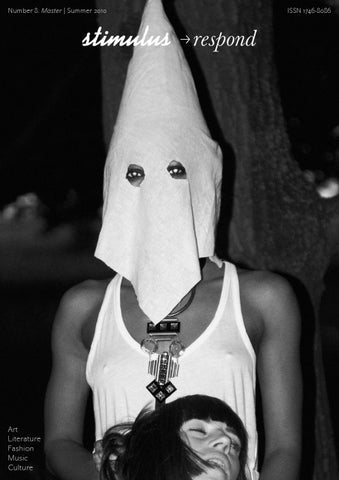
Number 8: Master | Summer 2010
Art Literature Fashion Music Culture
ISSN 1746-8086
herr von eden.com 覺 PhoTo: dan覺el josefsohn.com
christian wijnants www.christianwijnants.com
Master Contents
Literature 111 Masterpiece PrĂŠcis of a work unwritten Rob Ward 117 Raging Bull, or Cinema and Self-Mastery Karla Oeler 121 You Are The Writing In Your Hands: Phrasal Abrasions and Graphic Modulations Paul Wright 127 Wrestling Truth: Hegel and Nietzsche in Florescent Yellow Leotards William J. F. Keenan 129 Artist - The Game Master Katarzyna Zimna
007 | Stimulus Respond
Fashion 017 Narcisissm and Other Demons 063 Demos Natar 085 Victory or Death 133 Miss Fear
Music Art
073 Jukebox Collective
029 You Don’t Bring Me Flowers Any More Roisin Byrne
079 I Dream in Colour
039 Modern Masterpieces Christopher Thomas 053 Holes (Or Slutting Yourself on the Art Market) Simon Foxall
Features 103 Raj 145 Master Switch
Stimulus Respond | 008
Paul Costelloe and Sons present...
press agency berlin
h채berlein & mauerer, sebastian.warschow@haeb
bmau.de
www.kostasmurkudis.net
Contributors this Issue
Cover image by Christopher Thomas + Carolina Daher Literature
Music
Rob Ward Karla Oeler Paul Wright William J. F. Keenan Katarzyna Zimna
Jukebox Collective I Dream of Colour
Fashion
Features Aditya Arya Kulwant Roy Nicholas Scaife
Jacob Thue For contributors’ contact details, please email the Matthew Holroyd editor in chief at jack@stimulusrespond.com. Valeria Lera Bulgakova Christiana Vourna Alexandros Pissourios Christopher Thomas Carolina Daher Trudie Le Marie Angela Hertel Natasha Nikolic-Dunlop Liam Pearce Barbara Anastacio Emma Vukic Daniel Conway Helena Melao Octavia Welby & Lottie Sunkel @ Models 1 Anna Stephenson, Megan Train, Tegan & Imogen Perry @ Storm Art Roisin Byrne Simon Foxall Christopher Thomas
Editor in Chief Jack Boulton jack@stimulusrespond.com Editors - Literature Phil Sawdon and Marsha Meskimmon phil@stimulusrespond.com Editor - Fashion Christos Kyriakides christos@stimulusrespond.com Contributing Fashion Editor Matthew Holroyd Editor - Art Christopher Thomas christopher@stimulusrespond.com Editor - Music Hannah Yelin hannah@stimulusrespond.com Editor - Features Rose Cooper-Thorne rose@stimulusrespond.com Editor - Poetry Ellen Sampson ellen@stimulusrespond.com For advertising opportunities, please contact the editor-in-chief at the address above. We welcome unsolicited material from our readers. If you would like to make a contribution to future issues then please email the editorial team at the addresses above. Stimulus Respond is published by Jack Boulton. All material is copyright (c) 2010 the respective contributors. All rights reserved. No reproduction without prior consent. The views expressed in the magazine are those of the contributors and are not neccessarily shared by the magazine. The magazine accepts no liability for loss or damage of manuscripts, artwork, photographic prints and transparencies. ISSN 1746-8086 www.stimulusrespond.com www.otheredition.com Stimulus Respond | 014
mas·ter Pronunciation: \ˈmas-tər\ Function: noun Etymology: Middle English, from Old English magister & Anglo-French meistre, both from Latin magister; akin to Latin magnus large — more at much Date: before 12th century 1 a (1) : a male teacher (2) : a person holding an academic degree higher than a bachelor’s but lower than a doctor’s b: (often capitalised) a revered religious leader c: a worker or artisan qualified to teach apprentices d (1) : an artist, performer, or player of consummate skill (2): a great figure of the past (as in science or art) whose work serves as a model or ideal 2 a: one having authority over another : ruler, governor b: one that conquers or masters : victor, superior <in the new challenger the champion found his master> c: a person licensed to command a merchant ship d(1): one having control (2): an owner especially of a slave or animal e: the employer especially of a servant f (1) dialect : husband (2) : the male head of a household 3 a(1) archaic : mr. (2): a youth or boy too young to be called mister —used as a title b: the eldest son of a Scottish viscount or baron 4 a: a presiding officer in an institution or society (as a college) b: any of several officers of court appointed to assist (as by hearing and reporting) a judge 5 a: a master mechanism or device b: an original from which copies can be made; especially : a master recording (as a magnetic tape)
015 | Stimulus Respond
Narcissism and other Demons Based on the writing of Cash Teran
Photography Jacob Thue Fashion Matthew Holroyd
Previous spread: Brown Wedges by Carin Wester Opposite: Bug bracelet by Vibe Harslof
Previous spread left: Black dress by Carin Wester Previous spread right: Black and white tee by Weekday Opposite: Black dress by Carin Wester
Grey Jacket by Wood Wood
IT IS ETERNITY FOR THE PRESENT AND PATIENCE FOR THE EPHEMERAL IT IS DETAILS FOR THE MINIMALIST AND NOSTALGIA FOR THE STOIC www.stephanieschneider.de
You Don’t Bring Me Flowers Any More Roisin Byrne
029 | Stimulus Respond
Stimulus Respond | 030
031 | Stimulus Respond
033 | Stimulus Respond
Stimulus Respond | 034
035 | Stimulus Respond
Stimulus Respond | 036
You don’t bring me flowers anymore, 2009, Roisin Byrne 1 Rhododendron ponticum plant stolen from Parque Los Alcornocales Spain and smuggled into the UK after being rescued and re-introduced into cultivation by Simon Starling in 2000, Book, Map, email correspondence
037 | Stimulus Respond
Modern Masterpieces Christopher Thomas
These double-frame works are made by distracting unsuspecting museum-goers, engrossed in significant artworks at Tate Modern, by photographing them. Momentarily stealing the viewers of these masterpieces, these diptychs explore the psychology of the complex relationship between artist, artwork and viewer, whilst exploiting the strategies by which that relationship is mediated. Just as Lacan describes “the mirror stage” in which the infant sees itself for the first time as Other, the subject of a photograph is forced to consider themselves as Other, as a double of the Self. These works capture the momentary negotiation between their subjects’ private selves and a public encounter that takes place at the instant they realise that they have fallen prey to the photographer’s lens. At that moment, the process of looking at art becomes one that is necessarily self-conscious; especially when accompanied (as here) by didactic explanatory text. Whilst the attempts here to steal the attention of these important artists’ viewers is doomed to failure, also stolen is the famously infantilising typeface in which you read these words, exclusively adapted for Tate by typographer Miles Newlyn (and seen here in lovely Tate mauve). As art in Britain is repositioned as an entertainment experience and our national museums become recreational retail spaces, it becomes increasingly important to know your customer. Moving beyond dominant ways of understanding photography (for example, as a decisive moment or as a text or as an object), this work stems from an understanding of the image as a dialogical transaction, constituted within the power dynamics of the relationship between photographer and subject. 039 | Stimulus Respond
Unlike posed portraits, the actual act of photography is not suppressed or hidden here. With the photographer’s presence as apparent as that of the subject, these works form some kind of dubious selfportrait of the artist as a twat. The subjects in these photographs become the momentary site for an impossible collaboration, caught between the work of a dead artist and a living one. The iconoclastic strategy employed here plays out as a losing game, confounded not only by delusional ambition but by the limits of photographic representation itself.
Works First Spread: Three Figures and Portrait, oil and pastel on canvas, 1981 x 1473 mm C-type print with text 295 x 396 mm Second Spread: The Bride Stripped Bare by her Bachelors, Even (The Large Glass), oil, lead, dust and varnish on glass, 2775 x 1759 mm C-type print with text 295 x 396 mm Third Spread: Action Pants: Genital Panic, screenprint on paper, 658 x 459 mm C-type print with text 295 x 396 mm Fourth Spread: Nude Woman with Necklace, oil on canvas, 1135 x 1617 mm C-type print with text 295 x 396 mm Fifth Spread: Marilyn Diptych, acrylic on canvas, each 2054 x 1448 mm C-type print with text 295 x 396 mm Sixth Spread: Enlarged Contact Sheet from The Americans, gelatin silver print, 500 x 399 mm C-type print with text 295 x 396 mm Stimulus Respond | 040
Three Figures oil and paste 1981 x 14
s and Portrait el on canvas 473 mm
The Bride Stripped Bare (The Larg Oil, lead, dust and 2775 x 17
e by her Bachelors, Even ge Glass) d varnish on glass 759 mm
Action Pants: Screenprin 658 x 4
Genital Panic nt on paper 459 mm
Nude Woman Oil on c 1135 x 16
with Necklace canvas 617 mm
Marilyn Acrylic on Each 2054
Diptych n canvas x 1448 mm
Enlarged Contact Shee Gelatin si 500 x 3
et from The Americans ilver print 399 mm
Holes
(Or slutting yourself on the art market) Simon Foxall
A Tavern ARTIST (A) WALKS IN AND LOOKS AROUND. HE IS CONFUSED. VOICE OVER – SEA CAPTAIN That was you running was it? Ha! No – you don’t do that CUT TO: A SUDDENLY SEATED AT A TABLE IN THE MIDDLE OPPOSITE AN OLD SEA CAPTAIN (SC), ILLUMINTAED BY A SPOT LIGHT. ARTIST What? SC I didn’t think that was my decision to make A What wasn’t? SC To seem in a hurry and consider how that might effect you – your sense of urgency’s your own business. Hell I would a thought you’d be here waiting for me! A Sorry – SC GRUMBLES INAUDIBLY, FOLLOWED BY A LONG PAUSE A (gets up) I’m going to get a drink – same again? SC (Grabbing his wrist) No – sit down. There ain’t time now. (pointing over his shoulder) See that tavern wench behind the bar? She talks too much – poisonous rubbish it is, not so 053 | Stimulus Respond
as you’d notice – not till its hours later ain’t nothing of consequence been said since you started and your brain – mush! She’ll squeeze the blood out your eyeballs if she could paint her lips with it. So – take some of this (Brings up a bottle and a glass from under the table) BARMAID WINKS AT THE CAMERA HE POURS A GLASS. A BEGINS TO DRINK. LONG PAUSE. A I’m confused – SC I know – lost your way my boy. A LOOKS UNCOMFORTABLE SC (dreamily) She was a wonderful creature once you know A Who? SC Her! (points at barmaid) She and her sisters, the three graces of the island – luminous skin, long cascading locks of hair like honey and their tails sparkling in the sun – A Tails – SC Mermaid’s tails.
Stimulus Respond | 054
A Oh for God’s sake SC No? Reject that do you? Why? Don’t believe in that kind of thing? Then why are you here? A
how you see. (triumphantly) And there in lies the root of the problem. There it is! (gesturing to the room as if they are listening) Fairytales! (to A) Mermaids, Fictions and lies, well, (laughs again) What are you waiting for? A (Exasperated) I don’t know now.
I– SC SC I got the distinct impression you came here because you thought I could tell you something you needed to know
Because almost no documentation exists of it anymore, so much of it’s been lost – theres a bit, here and there. It won’t be easy – and not for you –
A
A
Ok, but –
(interested again) but it – exists?
SC
SC
You already know what that is. A
(becoming vague) now – why do you want to go asking questions like that for?
No – I –
A
SC Yes?
(again exasperated) it seems an obvious question – what should I ask?
A
SC
Mermaids are a bit far
That’s just not my – its not what I do –
Well (pouring another drink) Theres more to it see. Theres not so doing about it now – all talk about the old and the new – things that die, and the living – (in imaginary coversation) whats dead now? Oh is it! Well I never! (to A) There’s the newest, of course like those – ah – great – black – things – metal soaring into the sky half finished bathed in their white fluorescence! But what about down there? (points)
SC
A
Its not about what you do, its about
(following his finger) Where?
SC (laughs) Ha yes I suppose they sound it to you, poor – (laughing) imprisoned! A
SC Just in a shadow in the corner – that’ll lead you somewhere else. Through a vaulted little arcade – oh it looks nice enough, but brought alive only by thinking of the dead you see? – but where do we go? And what are they – either of them – really?
fingers) What’s he talking to you about, eh? (sweetly) He’s a lying toerag you know – not a true word… (laughs indulgently) A He was about to tell me about the Perfect Place to Make Art SC LOOK AT THE FLOOR
A TW People – they’re, places – just places, surely? SC Well. If that’s all they are – (finishes his drink in one) then what brings you here? The romance?
(turning sharply to SC) Oh! Was he? (clipped, to SC) And why would he want to do that, hmmm? A I’m an artist TW
A I–
(quickly, sarcastically) Yes, are you really –
THE TAVERN WENCH, HAVING SPOTTED THE BOTTLE APPROACHES)
SC
TAVERN WENCH
TW
Now bless you boys! What are you discussing so privately over here, eh? (She looks flirtatiously at A) SC
(to A, patronising) mmmm I thought you were. (pause) Oh Well! (laughs) Well Well! (grabs artist’s chin) you want to get yourself a real job love.
That’s no concern of yours
TW STORMS OFF
TW
SC
Oooooo! (she rubs his chest from behind) and what is this? Bringing drinks into my tavern again Rufus?
So. If it ain’t the romance –
SC MUMBLES SHEEPISHLY TW (to A) Well! We don’t care about that do we? (beaming, she walks over to A) No (she strokes his cheek – she has a slimy substance on her
He’s losing his way
The bulk of air forced its way into his chest like a hammer and in that moment the choice to inhale was taken over by its need to fill his lungs, they felt like they would rip apart and it felt amazing. The music of the palmed drop ahead of him lead his mind falling into the sea that glittered sliver, that scratched his eyes, and he lay himself back in the long grass – their swaying heads blinking in the sun and tracing their shadows across his face. A single momentous drip of sweat slid past his groin, which he followed with a finger. Stimulus Respond | 056
There had been little or no documentation of this place, and (again?) that had been okay – the place less documented, resisting all probable cliché, being the one of more value – but there would be documentation now, this place – this place, the feeling, the beingness… His breathing was calming, the warm air massaged him inside and out, his sweat indicating where his body started and finished. The glaring lightness was obstructing his sight beyond the hazy blinking grassheads and waves of a dead fish smell were being brought up from the rocks to the corners of his mouth. And in that drifting mind, sensing the brittle drying of the leaves in the heat and their tiny invisible cracks delicately snapping in continuous chorus, he wanked till his heart almost stopped and fell asleep. *** Down on the beach, he decided to start by digging a hole. It seemed the most sensible place to start, he wasn’t sure why, but he felt it might ground his practice in something – it would perhaps feel like drawing. He dug. He felt the ground as he ferociously scrabbled at it with his hands, flicking it underneath him and between his legs; this was grounding his practice – quite literally – he enjoyed its basis in the literal as place from which to conceptualise beyond, but this was his map. He dug deeper, becoming gradually aware of his amusement at the situation, he must look like a dog piling more sand underneath him! His triceps ached. He stopped. He had dug his hole. It wasn’t very big, but it was a start and he sat on the side with his feet in the hole, raking the sand with his toes and fingers, looking out to sea for an hour. The white sunlight trembled on the horizon and allowed in waves of memory habitual areas of thought to position themselves as usual, more prominently than their inherent value warranted. A little old woman outside a South London betting shop, white ankle socks clinging to her over-tanned beaten looking legs, old Ray-Bans and a tracksuit top – that bright morning she had stood and stared at him looking back at her, cigarette smoke rising in front of the betting shop, the terracotta colour rendered flats and the rusting skeletons of the giant gas cylinders that loomed above the whole area. He looked over his shoulder to the waiting cliffs absorbing his efforts and tried to compare the spires of dead palms and trailing to that architectural spectre – flaked and powered metal now pinning, spearing the bruised old woman to the pavement, smoke seeping from her rather than blood, coughing up a brown oily clod of phlegm as if in some last desperate attempt to survive its grasp. He inhaled deeply, the fresh sea air reaching every part of his insides. But the light shimmering on the horizon, that light, like the glistening windows of Canary Wharf
“They all dig to begin with; he supposed they must think it feels like drawing. The sea fills them in again in no time of course, but for now it was there, another hole”
that he sees so many mornings from the station platform, rests above the trembling foreground of Victorian rooves and gritty crooked chimneys, a glittering grey utopia, stately – failing in the distance. Is that what he meant, the Sea Captain – in his talk of old and new, of the beautiful failure – more potent by the careless breaking of its promises. For now that seemed likely enough, and he wasn’t here to disagree. High above, standing on the orange cliff top, a man who wanted to take his life watched him. Another digger. They all dig to begin with; he supposed they must think it feels like drawing. The sea fills them in again in no time of course, but for now it was there, another hole. The following day he returned to the site of his hole – there was a vague wide-ish dip in the sand where it had been that had collected some black twists of dried seaweed and a flake of drift wood. He picked them up and examined their potential – could the hole be used to collect things that he could then use for something else – was that a viable process to adopt for this, what, project? No. And that was a bad word. He left the idea static in the air and looked down at his once hole. He began to dig again. He dug a hole the size of yesterday’s and lay back on the sand. This is the beginning, he thought. I will dig more. He hoped that something else would come to him, but he was not interested in forcing or contriving it – that was not what he had come for. The ache in his arms had subsided, and getting back on to all fours he began to dig again, faster and more frenetically than before, and he let out an experimental howl. How did that feel? That worked – he howled again, and again, louder: his hands working still harder, burrowing more and more sand, and howl! Howl! Who was he in the mind of someone else? He was a form or type even – perhaps he wouldn’t identify with what the man on the cliff top was currently thinking about him as he watched with a combination of amusement and jarring curiosity the second hole being dug by the naked man on the sweltering empty beach. This had not occurred to Simon, Stimulus Respond | 058
kneeling up into a panting crouch, looking into the hole he had just dug. His eyes were wide, his lips parted in a disengaged half smile; his body peppered with damp sand and around his thighs and crotch he was encrusted, cracking with heavy breathing. He sat in the hole until dusk, but nothing had really happened. This was clearly not a process that could be rushed and tomorrow again he would return, and did, and again spent time with his work. He needed to hear what it would say – so far it had been mystifyingly silent – but speak it would, and he would be ready, patient, to listen. Several days passed, each day a hole subtly different from the one the day before, but in the same place. On the fourth day, the noonday sun shining full into the hole as, on his back, he drifted in and out of awakeness, watched the occasional bird meander across the haze and followed in his mind the paths of the sun’s warmth curling across his body. The morning had been spent re-digging the hole of the day before and here it was again, grounding his practice in this place, reformed and beautiful – better than yesterday’s, wider, so he could stretch out in it – it was bliss! He was starting to fell very closely connected to this practice, it was becoming is own, he understood it more with each day – it was such a simple straight forward response to his environment; on a beach, dig. He had done it so many times on so many beaches, yet here he was digging holes daily in the sand, truly connected to this activity. He had surpassed the conventions of his own sense of value and worth imposed on him hadn’t he. Surely he had. Everyone dug holes on the beach but they didn’t understand it as he did, they didn’t feel it in the same way. The beach was empty of course but had it been full of people; old men, children, soldiers, office secretaries, he could almost see them all lined along the beach in a row stretching around the headland out of sight all digging holes with their lovers, friends and families simply because that is what one does on the beach, but they wouldn’t be truly engaged with it! As a discipline; as he was, and with that higher conception he had turned one quarter turn through his perception of the world – he was approaching everything differently. He looked at the hole suddenly amazed by it. But was it art? He would ask himself that again tomorrow. A bird passed quickly overhead, calling as it went. The following day he did not ask himself the question. The night’s tide had rubbed away the hole of course so he dug it again. He was getting quicker at it – but then it was a little shallower – but then it was a little wider, he pondered for a moment what difference this might have made., but he didn’t want to feel constrained the artificial notion of ‘style’. Today he was going to move on. The work had spoken, at least it seemed to have 059 | Stimulus Respond
done and if it hadn’t then he couldn’t wait any longer. The hole was meant to be the beginning and yet it was fast becoming the work; he had planned to document, to develop. Today he would begin that. Lying again in his hole he thought about writing the story of his first day – the headiness, the excitement! He had been overcome. He had wanked. He decided to leave that bit out. He had, however, nothing here to write with or on – well – that was that then. The man who wanted to take his life was now at the edge of the beach staring with great interest at the fifth hole to be dug by the same man in the same place. He emerged from the shadows of the chalky orange cliff cave and set his face hard against the crystal brightness of the day; squinting he looked, placidly, at the distant naked figure quivering in the heat haze – what was he doing now? Walking around the hole, and – sitting down again – he watched, transfixed. This hole interested him more than the last four, and most others he had seen on this same sorry beach. It was different – it was – shallower, yes, and wider he thought. He pondered what difference that might make. He supposed it would depend what difference that made to that man digging it – but that he didn’t know. It was hot. He turned clumsily around and walked back into the cool dark damp of the cave. That man by the cave, he had seen him the previous day on top of the cliff; he had looked stridently powerful up there, classically posed, but down on the beach he was a far odder prospect, grotesque almost; but compelling – perhaps – bewitchingly erotic: maybe that is misleading. But it fired something in him as he darted his head above the edge of the hole that caught him off guard, a strange – it was sparked by a dislocated circumstance, but this man, more the concept of his masculinity – a potent arrangement of triggers rather than features, that provoked a sexuality so visceral it was more – sexless, but it had hold his sense of being, so tight that he could feel its fingers on his skin and its hand closing around his heart and he came in less than a minute. A creeping wave broke. He slept, he didn’t know how long for but it was time to do something. The inactivity of the past week nearly, had started to give him a slightly nauseous feeling which right now only an expedition into the coconut bush would solve; he needed materials, he needed to develop his practice, and he needed to get the hell on with it. He stood again at that quarter turn in his own perception and considered his options – field expansion, he had the drawings sewn up, he was reassured to feel so in possession of his relationship to them, placing him in a strong position from which to discover their potential relationship to his next work. They mapped an awkward area in his work in regards to its own performative concern – where did this lie with the work that had
“Where did this lie with the work that had always in past been two dimensional?”
a clue, but he only had the old man’s word for it. It had been him that had led him here really, not that he had intended to necessarily, the waspy man had had a look in his eyes, stains of missed opportunity and a bitter tone; and that had lead him here – that and his implications and riddles. Now he had to document it somehow. The fish blood on his nipples felt sensual. Out to sea beyond the shadow of the overhang, where the orange tinting always in past been two dimensional, painting usually, late afternoon sun started to thrash the surface of the here the conceptual theory expressing itself through the water, was a great grey rock; climbing on to it, he stood activity of a broad interpretation of the drawing process – because it was, he assumed, the process as much as the braced against the open sky. Behind him the cascading green foliage of the overhang shimmered and flashed its result that was of interest – he would consider that it was for now, just in case. He felt he was slowly ticking around foily luminesence and clawing at great hand fulls of it, he pulled it round his shoulders like a cape, heavy, sprayed to a one third turn in his perspective, aware for the first and salty and stared out to sea. No boats. time of the possibility and capability he had to engage – indeed to converse, with the lived process of painting. The lump of wood he found the following day and He looked out to sea then stretching his throat, let his had half dragged half thrown down to the beach, now head fall back and closed his eyes against the bright sky. And so, to the bush, he thought. Motionless, he urinated, stood by the edge of the hole, re-dug that morning. It resembled almost a pallet from an industrial estate, so washing the sand away in little streams inside his left thigh, around his toes, into the hole. For a few minutes he much he could smell and feel the unidentified tarry substance – a sense memory of – engine grease smell and laughed watching it pool at the bottom, its strong odour pigeon feather, it filled him with that familiar crossroads attracting flies almost immediately and grains of sand slowly turning in circles in it until it soaked away – in the feeling and much as he tried to shake it, he was gripped by the sensation that what he did now would go some mind of someone else, who was he? The last of his urine way to defining a part of him albeit a small one, but a seemed almost to resist being drained away, like it had part for which he would be held accountable – something a sentient awareness, but drain it did and his lips lightly expected of him, what should he expect – another closed as he watched the last of it disappear. page marker to things that help or things that hinder, He hadn’t been through the bush since that first that value judgement unplacable at the time of the morning and climbing round the rocks to the overhang performance of the significant moment but placed later, at the far end of the beach he looked up at the point by him, by someone else – it depended who got there at which he had fallen. The overhang was sheltered first. The man stood at the edge of the cliff again. Five from the sun. he recognised the smell of dead fish, more holes, now a piece of wood – it looked like a pallet from pungent now he was at its source – the hollow clocking an industrial estate. He watched him drape the green slap of the water on the rocks offering up, in various foily foliage over and around it in various arrangements states of decay, the fish – damp and moistly rotting – he drew love hearts and smiling suns in the sand, two – what kind of fish were they? Plain fish, but the richest figures – embracing? He appeared to be arranging sea crimson stains slathered the rocks. He picked one up weed for hair. Oh God enough is enough, the man – a fresher one – and squeezed it, the flesh and scales thought and retreating from the edge of the orange slipping through his fingers leaving their alizarin slime chalky cliff he made his way down by a well worn route glistening as the hand he held up above his face caught to the beach below. a single slanting beam of afternoon sun. I hate crimson, he thought. In the Perfect Place to Make Art there were Coconut shells of diluted crimson fish blood littered the no materials, no artists and no art – it was a place of studio area that was developing around the hole. They conspicuous absence – it was just a tropical island, that had a way of staining the flat pale sand between his was all! But in this he felt he could hardly afford his scratched lines that was beautiful and inevitably a little prejudice against crimson; dipping his left index finger gruesome. He poured one over the girls face – the one in the palmful of fish blood in his right hand he used he was embracing. They wore the stripy t-shirts they had it to colour in his nipples. It was a tropical island. For worn on a hot august afternoon on Tottenham Court the first time he wondered if he had expected it to be a Road buying green metallic curtains for a piece of work. tropical island; what had the waspy old man said – he couldn’t remember exactly now – guidelines – this place; It had been one of those close aired summer days and little or no documentation, he had said, and there hadn’t they had laughed on the crowded sweaty underground that their breezy matching stripes airy manner gave the been, either – a scrap here and there would have been Stimulus Respond | 060
impression of a sexy young couple gadding about town at their leisure, a summers afternoon, like any other. He had drawn them next to a palm tree that he had modelled on one of the charred trunks with the brown crispy fronds hanging solidly and unmoving. The next palm tree drawn in the sand had been from his imagination and so successful it was that from then on everything had been from his imagination. As he arranged some sea weed in the shape of a sun’s sunglasses a shadow fell across its shell-toothed smile. He looked up at the silhouette that carved itself out of the brightness dribbling around its contours. Squinting, he said nothing for a moment, the man’s fingers casting a dancing shadow across his lips – he opened his mouth to speak but the man got there first. You’ve been – drawing – I suppose? He said it tentatively as if concerned not to misrepresent the efforts of the concerned-looking naked man crouched in front of him covered in sand, alizarin stained hands clutching seaweed and a razor clam shell Whats the shell for? The man asked, trying perhaps to appeal to a simpler, more direct line of questioning. The sun’s cock. Glad to hear it. And these drawings, tell me about them. The holes are the drawings, they grounded my practice – these are – paintings. The man murmured barely audibly. Okay. But this work looks more like drawing that the holes which seem more like performative sculptures perhaps – or a land installation. These felt more like drawings to me, he said, standing up to face the man directly. They functioned in that directly responsive way that drawing does, these – paintings – they are becoming a more filtered response to where my work is going – Is it enough for you to just change the names of disciplines to give your work an appropriate context in which to operate? These holes aren’t as much drawings as these – drawings – he laughed – why can’t you see the function that drawing usually performs for you is performing this time in a different manifestation? The artist looked for a moment at the tops of the cliffs and at the charred remains of the palm trees and then at the charred old woman skewered outside the Peckham betting shop. He turned to the man and smiled. True, he said. But why should art terminology be dependant on appearance? Just because my paintings look more drawn than my drawings doesn’t define them conceptually, surely you couldn’t insist on those kinds of simplistic absolutes in art practice? What are you more concerned with – the terminology used to describe your work or the work itself! Why is it such a challenge to you to see these paintings could be drawings and still operate in the same way – are you limiting yourself in your perception of how a drawing can 061 | Stimulus Respond
function? You have dug this hole on the same spot five or is it six days in a row? He laughed, I have lost count! But the real question is for heaven’s sake why? What did you gain from such an exercise? The grotesque little man was becoming more grotesque each minute, his brain had frozen up. I – it felt – appropriate somehow – fuck, (he knew what a bad answer that was) The man looked conceitedly at him. In a few short minutes this horrible man – who was he? Someone important. He had totally undermined his work – he looked at it now – it was nothing – valueless, how had this escaped his notice? Holes in the sand. God. He was a good artist, he had always been a good artist. The man drew closer to him and stroked his cheek. Are you a good artist? Yes. How then, I wonder, does a good artist spend a week in the Perfect Place to Make Art and feel so – disconnected? Why do you say that? Am I disconnected? I felt – What exactly? The man drew closer still and firmly placed his hand around the back of his neck. Don’t worry – I still find your work interesting, I have watched it for several days so I have a pretty good idea. Several days (he said quietly) Yes – said the man squeezing hard on the back of his neck and slipping his other hand down between his legs. Come on now, open up! He clasped his sand covered testicles. Yes I have – and its good news! I judge you to be potentially of interest. The man closed his fingers more tightly around the artists testicles and neck and pulled him down into the hole. With his torso over the edge he looked blankly at the waves. The man pushed his face into the sand and fucked him. The waves in his mind became bluer, so blue, a bright chemical turquoise rolling mechanically, rhythmically over each other, clunking as they went round, throwing up great fireworks of golden glittering sand and the sun played ferociously on the surface – white sparks and yellow, green, red, blue, orange like the frenzied flashing lights of the fairground waltzers, the comedic music and battery operated toys beeping, buzzing and singing! He laughed and laughed into the sand. Those beautiful waves.
Stimulus Respond | 062
demos natar
photography + styling / christos kyriakides model / valeria make up / lera bulgakova hair / christiana vourna thanks to it’s not gallery for providing the space
073 | Stimulus Respond
Hannah Yelin meets the sharpest, most charmingest and least pretentious band ever to come out of East London.
Jukebox Collective Stimulus Respond | 074
“Being the Masters Of Our Universe has its advantages”
075 | Stimulus Respond
Jukebox Collective are Hackney based foursome about to release their second single. Bristling with excitement and good humour, often answering my questions with an explosive “Ha!” it’s obvious from any distance that they’re very much enjoying themselves. When asked about the name Jukebox Collective, Kev offers enthusiastically, “It came to us simultaneously in a dream whispered on the wind by a wizard dressed like a squirrel.” I look to Greg for elaboration, but get simply “See above.” Oh-kaaay, I say to myself. This is going to be fun. Their first single, Lost and Found, was an auspicious start, gaining them a Top 15 entry into the Hype Machine chart. Something to feel proud of indeed considering it was recorded, produced and released entirely by themselves. When I ask them about this Kev, their vocalist, describes it as having been more “out of necessity” than choice. “We’d only just really become a proper band, so we weren’t gonna get a label to take a chance on us. Plus the music we make kind of lends itself to the DIY approach.” Guitarist, Greg, however, has something more like a distrust of studios and their effect on his music. “We’d tried recording studios but were generally unhappy with the result at the end of the session. We ended up acquiring some gear and taking our time to record and experiment with it. Releasing independently is the done thing by up and coming bands I suppose, unless you’re extremely lucky early on. Besides” he adds with characteristic cheek “being the Masters Of Our Universe has its advantages.” Becoming Master Of One’s Own Universe sounds like quite a lot of hard work. Kev explains “We learned quite a few lessons, certainly. It’s difficult when you’re just starting out to know what you should be doing, where you should spend what little cash you have, who you should be talking to and who’s arse you should be kissing. As for arse-kissing we had no label
so I don’t suppose that really mattered. Unless...” he quips “Greg felt he could’ve done with a little more positive reinforcement…” This banter characterises the conversation. With the friendship between the pair being evident. Greg takes us back to the original point “I suppose the music industry takes you more seriously if you have someone credible punting your music. We felt like we had the songs, but not the backing to do a hell of a lot with it. This seems to be changing a bit now though....doors are starting to open. I ask if this success, the Top 15 single, these opening doors, have gone to their head. “Haha! Hardly!” bursts Kev, wholely unsusceptible to my flattery, “When they drive a truck full of cash up to my door I’ll get carried away.” Greg did most of his growing up in a small surfing community north of Durban, South Africa. “I used to use my mother’s credit card to order CD’s from UK and US mail order sites as it was difficult to get hold of good music back then. I was only allowed to order every few months so basically had CD’s on repeat for weeks and weeks on end. One day my dad arrived home with a CD writer and once I mastered the art of early CD writers, I became a bit of a music pirate at school, importing music and duplicating the shit out of it.” I wonder whether that influenced the kind of music he makes but I’m again met with an utter absence of pretension, “I’d love to say that African music has influenced me greatly, but sadly this isn’t the case. South Africa was a difficult place to be in a band in the 90’s, we all looked abroad and idolized Britpop bands and thought that we had to be more like them. I have much more of an interest in African music now than I ever did though, perhaps it’s maturity or perhaps I’m being reminded by the new wave of African influenced indie bands. Never thought I’d see the day, but it does make me smile.” So what is the musical diet of a young South
African, aspiring musician looking abroad? “My older sister Sharyn, who wore Mary Chain T-shirts, was a major influence mostly because I used to get handme-downs and mixtapes from her. Britpop, shoegaze and American punk mostly. My father used to play The Travelling Wilburys on long trips in the car when I was a kid. My friend bought me their first record on tape for my birthday last year and it now permanently stays in the tape player in my van.” As we’re discussing the pair’s background, I debate whether to ask Kev about something I know must have affected him, the fact that he is registered blind. Hesitantly I blunder in asking whether this has any effect on his music. Once again the quick wit immediately puctures any awkwardness “Well it gets much worse when I fall off the stage if that counts? Although that’s generally cos I’m pissed to be fair. Oh and I’m quite into Ray Charles. But that’s mostly cos I liked the Blues Brothers when I was a kid.” I feel silly for asking, and charmed by his humour. I brazen it out with something pretentious about Homer the ancient poet, 19th century piano tuners, American blues, and the image of the gifted blind musician and am again met with his self-effacing humour. “Haha!” There it is again. “I really what to say yes here [that it’s an image I recognise] and be the most egotistical human of all time but I don’t think I can pull it off. It’s definitely true there’s a huge number of talented blind musicians though. I went to school with people who could do incredible things. I mostly just stand at the front of a stage and shout a lot though, so I’m not quite sure that’s the same.” Jukebox Collective is not their first musical endeavour, with Kev having played in al number of bands since he was 13. “I played bass and got kicked out after a week. Then I decided the only real way to do things is to start your own band so you can’t get kicked out.” “I thought I started the band?” Greg interjects quickly. I ask them about Hackney, nostalgic for the place Stimulus Respond | 076
that until a year ago I myself lived, and Kev laconically directs me to Wikipedia, where I can learn that The London Borough of Hackney is a London borough of North London,[2] and forms part of inner London.[3] The south western tip of the borough is adjacent to the City and close to the Broadgate development. In this area some office development has taken place within the borough… “Sorry,” he says sheepishly, “that’s probably not what you meant.” Greg steps in helpfully “Kev is the only non Hackney band member, hence his confusion. I got given a badge at the local book shop the other day which read “Keep Hackney crap.” I suppose this sums up locals opinions of the recent gentrification of the area. Seriously though, house prices (and beers prices) have shot up incredibly in the last 3 years. I do still like it here though and could draw correlations between Hackney and parts of South Africa “The Rainbow Nation.” Asking about their musical influences now, Kev likes “a lot of the stuff from the late 70’s and 80’s where punk music got a bit blurry and you could dance as well as jump. I think that’s something we really want to achieve in our music. I guess a lot of people have mentioned LCD Soundsystem and The Rapture as contemporary comparisons, and we certainly like those bands, but I think New Order and The Talking Heads deserve just as much of a namecheck. Oh and Dizzee. I love Dizzee. Even though he’s gone a bit shit.” Greg is still reeling from a recent Yeasayer gig his girlfriend took him to “They have definitely left their mark on me. I started working on developing my own guitar technique and sound after hearing Television’s Marquee Moon.” Their new single has been described as sounding “as if it just stumbled in from a boozy night”. I ask is getting drunk and making music are compatible. Again, cheeky and concise Kev replies “Not compatible. Essential.” I ask about the idea behind it. What the lyrics mean. What an Icon Parade is. Kev enlightens me, “Well an Icon Parade can be one of those slightly odd things they do in Roman Catholic countries where they walk around the streets with some kind of religious icon. I was thinking about how that sort of thing can get really twisted out of shape and wind up with some massive, big budget 4th of July style parade with massive floats and stuff. Plus at the time we were working on the song a friend was telling me about a guy on his street who’d gone kind of mad cos
“I imagined a guy whose mind has got a bit twisted out of shape who starts making a bunch of parade floats of all his favourite things” the ASBO kids were giving him grief. So I imagined a guy whose mind has got a bit twisted out of shape who starts making a bunch of parade floats of all his favourite things.” Oh-kaaay. “It’s a pretty weird train of thought, sorry.” That’s a bit dark, I say. “Yeah I like the fact that the music has quite bright tones, and the lyrics are quite oblique, but if you get inside them they’re pretty shady. There’s also something quite unhinged about the Guitar as well. It’s unrelenting.” Their stage performances are a pretty upbeat affair. Greg describes “On stage Kev, Nick and I get to do our thang, really go for it. Off stage, our drummer Josh gets all the attention. Slut.” Whilst Kev likes “to set the bar really low in terms of dancing skills. That way people know they can’t look stupid.” I ask them to describe their music in 5 words or less: Greg: “It‘s boozey, yet sharp witted.” In person that description still feels apt. “Like channel Dave,” he adds. Which, having worked at the channel for nearly 3 years, amuses me enormously. When asked to tell the good people at home why they should be coming to see them next week, Kev puts it simply, “Cos it’ll be a wicked party. Plus it’s 93 Feet East, they have a BBQ. What more do you need!?” Greg excitedly finishes Kev’s sentence “and and and we’ll be debuting our best material yet, can I get a fwoop!?” Fwoop. I tell them they can write their own headline if they do it in the style of The Sun, Kev: GREG KEEGAN IN SEX CHANGE SHOCKER: “I never felt right as a man” says billionare music icon. (Sorry dude) Greg: KEVIN SEWELL BEATEN AND MUGGED ON WAY TO GIG (true story, no really) Icon Parade is released on 9th August 2010. Jukebox Collective play 93ft East, Brick Lane, London on August 11th. www.myspace.com/jukeboxcollective
Stimulus Respond | 078
Monotwin Records is an independent label founded by Jason Thomas. I Dream In Colour is one of his flagship acts. The day after the launch of their debut EP, The Boiler Room, at the Camden Enterprise, Hannah Yelin caught up with both Jason and Richard Judge, front man of I Dream In Colour, to see how it’s all going.
079 | Stimulus Respond
I Dream in Colour Stimulus Respond | 080
Jason setup Monotwin to give musicians the support that he “never really had as a musician. When I was trying to get into the industry,” he explains, “things were very different. These were ‘pre-iPod’ times and the music industry was very closed unless you had loads of money to go and cut a really great recording at a top studio. Now people can make tunes on phones, at their laptop or on their parents’ computers. Gone are the days where people have 100 grand recording budgets. Record sales have dropped so there is less way to recoup investment with bands at a ‘breaking’ level.” I ask how a small label like Monotwin survives when recovering investment is so difficult? “I have my own recording facility and am a skilled producer/engineer, my overheads for the recording process are low. I’m well connected with producers and engineers, who are happy to come down to an indie level. This is due to a personal relationship but also speaks volumes about the bands I sign to the label.” If they are making these savings, which are the essential investments? The studio puts us in a great position above many labels of similar size as investment can be pushed into other places, like marketing, radio plugging and PR; the things that help to sell a record. People have always said to me you can have the best track ever written sitting on the computer, you could be the best kept secret ever, but if no one hears it, what’s the point? Saying that, the songs absolutely have to be the best they can be, so there is a really solid foundation to work with, and no producer will come on board unless they see this in the music.” Are there any drawbacks to recording in your own small studio? “Artists, and labels have for that matter, worry too much about what studio and the kudos that comes with it, but this is pointless really as the buying public don’t give a toss about which studio you have used or what producers were involved, or how much money you spent, they just care about the music and how it makes them feel.” So bands shouldn’t be too concerned if they don’t have bags of money to spend on recording? “If the recordings are shit, people will notice so there is a fine line. I love the sound of a great live room in a massive studio with a million pounds worth of hardware, but at an indie level this level of investment cannot be justified. We get great results. By using a smaller studio we are not scrimping on quality. I have recorded with Iain Gore (Mystery Jets, Libertines, Glasvegas), Phil Tyreman (Seal, Sade, Belle and Sebastian, The Darkness), Chris Kimsey (Rolling Stones, Ash, Peter Frampton) and many more at Monotwin Studios. My artists are working with some of the most respected engineers in the world. Not something many bands will ever experience.” When I ask how he feels about the big labels he’s extremely diplomatic. “It’s very easy for people to slag off the major labels, but we are all in this together. I think some of the majors missed a trick when iTunes took over, and there is an element of them having sat back in the past, but that would be to say they don’t work as hard to put their artists out there and they obviously do.” What does in this together mean in this context? “As an independent we need the major labels to take the bands global, whether that be through major publishing deals or record deals. There are a lot of indies out there who not only survive but do very well out of their artists without the need for major labels. Major labels need someone to develop their acts, build a fan base, make people aware of the acts, get a recording catalogue together and this is where the indies can play a really important role; so there is an element of the indies doing all the hard work to break an act. I think nowadays if a band has investment,
“‘Pre-iPod’ times the music industry was very closed unless you had loads of money to go and cut a really great recording at a top studio”
infrastructure and support from a great label, major labels can be negated. However there will always be need for major management, booking agents and pluggers so labels need to make that leap sooner or later.“ I ask whether the industry has been more or less risk averse with these changes in technology. “The way the industry used to work around recording artists did have many plus points. In the 60s and 70s you were very lucky if you made it into a studio due to the sheer expense of recording. Record labels would not put an artist into a studio unless they were completely ready, and above all seriously talented, in fact, the best. With the current music climate it sometimes seems the bigger labels play it safe and only release artists who have mainstream appeal, this can affect the quality of what gets released, I am not one for modern day pop music, girl bands or boy bands. There is a tendency to let great music slide, or for great musicians to be overlooked as they do not have ‘mass’ appeal.” So what does it take for an alternative band to make it in an industry like that? “I find that many musicians have a very poor understanding of the way the music industry works and this can be a massive hindrance to their careers going forward, so I find myself educating them to a certain point. Being in a band is a mind set, you have to take yourself out of the rock and roll cliché and treat it as a business, you don’t go to play a gig for your mates and get pissed, you turn up well rested and ready to work. So this is often the first hurdle to overcome as a label; changing peoples mind sets. It sounds boring, but you wouldn’t see people like Thom Yorke drinking 4 pints and smoking 20 fags before going on stage, they care too much about what they do.” Where do some bands go wrong? “The level of information on what to do to succeed, until recently, has been poor. The live scene in London is a joke at many levels; many venues and promoters see bands as a way to get more heads through the venue, and more money over the bar, and really do not think about what that means to the band that play, and how much of a waste of time 9/10 gigs can be. Again this is down to experience and choosing the right promoters and venues but everyone has to start somewhere. So what’s your advice to aspiring music artists starting now? “Start young, work your nuts off, learn and inform yourself about the ins and outs of the music industry. Don’t be afraid to pick up the phone to the big wigs (what’s the worst that can happen?) Learn some music production skills and start making recordings. Build a catalogue of songs and get gigging as soon as possible.” Any gigs? “Do the right gigs and do not saturate yourselves in one area. Promoters want to see you bring people along to your gigs.” And what of the brilliant websites you mentioned? “Social networking is the way forward. You need to connect with your fans on a personal basis. Posting new content on a weekly basis and giving people a reason to revisit your site. Instead of just posting material on your site and waiting for people to find it, post it then personally invite people to come and check it out. Ask what they think of it and for them to give you feedback. If they do this, MAKE SURE you go and revisit their site and thank them personally: now you have formed a relationship. But remember, approximately 10% of people who say they are attending an event will actually go, so take all of these things with a pinch of salt. The first thing the industry will look at is your MySpace site so make sure it looks as pro as possible: the number of profile views you have overall, the song plays per day. I think if you are averaging 200 plays per day you
“Being in a band is a mind set, you have to take yourself out of the rock and roll cliché and treat it as a business, you don’t go to play a gig for your mates and get pissed”
Stimulus Respond | 082
are doing something right.” I ask if he’s proud of I Dream In Colour after last night’s launch. “Yes, I am!” he beams, “They are doing very well at the moment. There is a real buzz about them in the industry; you can sense it building daily. It’s a great feeling. Last night was a great success. It’s crazy when you go to gigs and a sold out venue recognises the songs and sing the words. And what of the EP itself? The Boiler Room was recorded in 4 days in between I Dream In Colour’s day jobs and we had such a jokes week. I put the band up at my flat (my mate Alec kindly moved out for the week. Cheers Al!) so evenings were spent generally making mischief. The days in the studio started at 9am and by around 8pm we were all too knackered to go on, so it’d be off to the local pub for a jar then back for wine and TV!! Good times... Citing “love, life and The Beatles” as their musical influences I Dream In Colour are “four guys playing music like their lives depended on it.” Richard grew up in the sleepy town of Bishop’s Storford. “It is essentially a town for people commuting into London. I recall the first time I went out in London. It was a Tuesday and yet there was an atmosphere. Something my hometown always lacked. There wasn’t even a scene for bands until recently when my Brother started an indie night. I wouldn’t say living in a middle class commuter’s town has inspired me, but maybe the idea of escaping it has.” The band members are now all based around the border of Herts & Essex, but contemplating a move to Brighton. “Sooner the better.” Is I Dream In Colour his first musical endeavour? “I always wanted to create a ‘band’ as opposed to being a solo artist. I can imagine it being a little lonely. The band has had a few different names and changes in line up; but it’s always had the same intentions. So in answer to your question... essentially, yes.” Asked how the band began, he goes right back to his early childhood “My brother Peter and I were born only a couple of years apart. We were always close growing up, we even shared a room. We’d always escape the dinner table to gather pots n pants, creating an ensemble of instruments. Pete was always tapping. It just made sense for him to be a drummer. He had rhythm. I’d always be singing in the car, on route to a family holiday. Where my older brothers hated the annoyance, my Mum would always encourage it. I guess all I ever wanted to do was be a singer. The rest just followed.” I ask about band name and Richard replies, “I’ve always had an issue with band names. Even the best bands in the world have shit names. The Beatles?! Come on. When I was thinking about the name for this band I needed a little help. Ironically I thought the best place to start would be the Beatle’s anthology. I read a sentence from John which went something like ‘when I dream… I Dream In Colour.’ And that was that. Concerning his approach to making music he “can’t explain how I write really, it just happens. I’ll take a song to the rehearsal room and the guys will put their stamp on it. There are never any egos in that space. I guess you could say I conduct the process but we’ll always play for the song. Asked to describe his music in as few words as possible he says, without hesitation, “Built. For. Stadiums.” I Dream In Colour play The Queen of Hoxton on 25th August 2010. www.myspace.com/monotwinrecords www.idreamincolour.bandcamp.com
Victory or Death .
by Christopher Thomas & Carolina Daher
Our massed enemies are gathering against us. v
Yesterday, today, tomorrow, forever.
Virtuous anger is our right.
Styling – Trudie Le Marie Hair – Angela Hertel Make-up – Natasha Nikolic-Dunlop Cinematography – Liam Pearce Photographers’ Assistant – Barbara Anastacio Fashion Assistant – Emma Vukic Model – Helena Melao Models – Octavia Welby & Lottie Sunkel @ Models 1 Models – Anna Stephenson, Megan Train, Tegan & Imogen Perry @ Storm Retouching – Daniel Conway
With thanks to The Southern Poverty Law Centre West Hackney White Pride The Christian Defence League and Caroline at the Princess of Wales, London NW1
Previous (From Left): Dress - Charles Anastase at Start Body - Stolen Girlfriend Club, Socks - Falke Vest - Acne at my-wardrobe.com, Necklace - Fenwick, Knitted trousers - Paul & Joe Sequin dress - Richard Sorger Jersey dress - Stolen Girlfriend Club, Lace bra - American Apparel, Socks - Falke Dress - Elizabeth Lau Opposite: Dress - Yarnie at my-wardrobe.com Shoes - Office
Previous: Vest - Acne at my-wardrobe.com Necklace - Fenwick Opposite: Dress - Stolen Girlfriend Club, Long socks - Wolford Long dress - Kate Moss for Topshop, Knitted jumpsuit - Paul & Joe, Lace bra - American Apparel, Lace dress - Isabel Marant at Start Boutique Dress - Topshop Black dress - Disaya Above: White dresses - Topshop Black dress - Stolen Girlfriend Club, boots - Urban Outfitters
White dresses - Topshop Cream boots - Urban Outfitters Suede brown boots - Topshop Dress - Stolen Girlfriend Club Ribbon shoes - Office
All: As previous
This spread: As previous Next spread: Shoes - Office
All - As Previous
Raj These previously unpublished photos rescued from yellow crates reveal a unique portrait of India’s history. Unearthed by inheritor Aditya Arya, the images which document the making of a free India, are shown in archives by photo-journalist Kulwant Roy, who chronicled the changing face of the subcontinent as far back as the 1930s. A small selection of the images are on display at the Nehru Centre in London’s Mayfair, and 500 of Roy’s stunning black and white photographs have been compiled in a new anthology History in the Making: The Visual Archives of Kulwant Roy. The book, published by Harper Collins India, will be available to buy on Amazon.com from June. ‘This book is for Roy’ says Arya, ‘a gentleman who encouraged me to pick up the camera.’ Roy sold many of the photographs to international news agencies during his lifetime and some of them are now found in archival collections, but they are rarely credited with his name. Arya has spent the last 2 years restoring, collating and annotating Roy’s historical images. Events captured through Roy’s unique lense include Mahatma Gandhi in a heated debate with Muhammad Ali Jinnah, Jacqueline Kennedy sharing a laugh with Nehruji, congress party meetings, and many others. The archive has excited historians who believe it may shed new light on key moments in India’s independence movement. It has also attracted attention for the commercial value of its images of historical figures ranging from Mahatma Gandi and Jawaharlal Nehru to Jacqueline Kennedy. ‘It is a real find’ says Raghuraj Sing Chauhan, Director of Public Relations and Exhibitions at India’s National Museum. ‘They are historically important for the freedom struggle because many of these are quite rare photos.’ To view a selection of the stunning images visit www.adityaaryaarchive.com Stimulus Respond | 104
105 | Stimulus Respond
Stimulus Respond | 106
109 | Stimulus Respond
All Images are Š Copyright Aditya Arya Archive
Masterpiece Précis of a work unwritten Rob Ward
If I were to write an extended article on a theme of ‘Master’, I would envisage the whole as a series of sub headings. In other words, I would have already worked out where the theme would lead. And although I wouldn’t have much of an idea how the rhetoric of my thoughts would join up, I would assert a certain mastery of the whole thing. These would be my title chapter headings: The Master’s Craft Mastery and Mediocrity Mastery and (Miss)tery Master/Slave Master and Copy Pragmatics of Mastery Mastering Heuristics The Ignorant Master Drawing without a Master The Unknown Masterpiece Doing without a Master The Master’s Speech Viva Voce Masterstroke, or, Aphasia of Know-how The Master’s Craft This would amount to a hermeneutics within a ‘community of shared semeiosis’. C.S. Pierce via Umberto Eco. Eco (http://www.cspierce.com/ menu/library/aboutcsp/eco/unlimited.doc p.12) The ‘crafts’ we describe amount to the skills we employ in articulating our words, our things and operating a ‘knowing sensibility’ – something we would once have called (and some would still call) aesthetics. Some things only work when technical mastery has been achieved, (a Beethoven piano sonata could only be what it is when all the right notes are played by someone who not only knows which are the right notes but can play them without looking at either musical score or indeed the keyboard; and, can play the right notes with a feeling for how they should be played). This craft of ‘interpretation’, however, is 111 | Stimulus Respond
different from the idea of mastery of a creative form in a modern or postmodern era of art. Other descriptions vie for the accolade of quality and often turn on the idea of novelty, spectacle or its opposite form of banality. Skill, as an aggregation over time becomes, ‘Skill as a means to an effect’ The community that interprets mastery has shifted from the closed guild to the open agora. Mastery and Mediocrity This would follow on from the previous heading. Whilst the term ‘mastery’ might now flounder in its attempt to be robustly applied, there is an implied recognition of mediocrity, that is, something that in its conception, its manifestation avoids the epithet ‘wrong’ but fails to accomplish; fails to satisfy. There is a sense that superficially there is something valid yet there is an established opinion that nothing of significance has been achieved — that there has possibly been a lost opportunity. Even so there is a kind of mediocrity that stands for mediocrity — that makes it ironical. How is one to distinguish between mediocrity and a kind of mastery of the means to mimic that which is mediocre? The greater the mastery of mimicry, the more convincing the mediocrity. Mastery and (Miss)tery Already gendered. Research done already and more into how throughout western art, master and his model predominate. Dominus. Mystification. Virgin and Child, Adam and Eve, Europa and bull, Rape of the Daughters of Leucippus, Rape of Prosperine, Rape of the Sabine Women. Woman of Canaan, Woman with the Issue of Blood, Woman of Samaria, Woman Taken in Adultery, Women of Jerusalem, Women at the Tomb. Ubiquitous Odalisques full of eastern promise.
Master/Slave Hegelian encounter. Two consciousnesses; why do they fight? ‘Since to begin with they are unequal and opposed, and their reflection into a unity has not yet been achieved, they exist as two opposed shapes of consciousness; one is the independent consciousness whose essential nature is to be for itself, the other is the dependent consciousness whose essential nature is simply to live or be for another. The former is lord, the other is bondsman.’ (Hegel, trans. Miller, 1977, p.115) Why do they need to try to subdue? Because they are ‘primal’ and primal means that they have to fight. That is how it looks. That is how it looked to Hegel, to Darwin. Master and Copy ‘Some properties of an object may be essential to it, in that it could not have failed to have them. But these properties are not used to identify the object in another possible world, for such an identification is not needed. Nor need the essential properties of an object be the properties used to identify it in the actual world, if indeed it is identified in the actual world by means of properties.’ (Kripke1981 p.53) Pragmatics of Mastery Know-how and know-what. Constructivist teaching ‘if knowledge is conceptualized as a cognitive state, then instruction is thought of as instructional strategies designed to affect one’s schemas.’ Thompson, Running Head: (http:// pegasus.cc.ucf.edu/~kthompso/projects/lit_ constructivist.pdf p.3) Mastering Heuristics How does one know when one is a master — when or whether one has achieved ‘mastery’? James Elkins (2001) deals with the paradoxical
nature of master /student assessment/dialogue in ‘crits’. First, we don’t know how we teach art, and so we cannot claim to teach it or to know what teaching might be like. This may sound odd …— … but it’s my experience that studio instruction teachers and students accept some informal version of it. (p.91) he describes ‘crits’ as, ‘(U)nbelievably difficult to understand and rich with possibilities. All kinds of meanings, all forms of understandings, can be at issue.’ He concludes with the admission that, ‘They just barely make sense — they are nearly totally irrational.’ (Ibid p.166) The Ignorant Master Jacques Rancière’s assertion of heuristic learning has counterparts with Gadamer’s creatively ‘prejudiced’ hermeneuticist in that they are motivated. The three assertions are: ‘All men have equal intelligence’ ‘Every man has received from god the ability to instruct himself’ ‘Everything is in everything’ Drawing without a Master Doré’s engraved cartoon showing two ragamuffins drawing on a wall the caption reading: ‘’Drawing without a master, on Madame Cave’s method.’ N.B. — The style was applied on the walls of Paris long before the lady inventor was born.’ This text could be envisaged as graffiti on an academic wall in that its mastery of certain ‘marks and moves’ is without a Master — a certain skill Stimulus Respond | 112
“Mastery in this sense is an attempt at a provisional control over the things that words make” — call it rhetorical — but also a vast ignorance — often a combination of the two that promotes arrogance. This ignorance, in itself, isn’t inimical to the project. There are always heuristic possibilities, always things to say, but, by whom is one allowed to speak? (Rancière on Plato’s ‘four citizens ‘) The Unknown Masterpiece The title of the short story by Balzac published in 1831 and again in 1837. The first version he called a ‘conte fantastique’, the second as a ‘philosophical’ work. The deranged Frenhofer in the first version becomes the possessed genius in the second — an inspiration for those (from Cézanne to de Kooning) who read into him the idea that pure genius transcended skill and that true mastery could never be recognised by the ‘ordinary’ senses of men. Frenhofer’s masterpiece, a portrait of Catherine Lescault, the courtesan known as La Belle Noiseuse, appears to be only ‘colours piled upon one another in confusion and held in restraint by a multitude of curious lines which form a wall of painting.’ (Ashton 1980 p.7) Doing without a Master Pragmatics of laissez-faire. Isn’t this what happens in a ‘teaching studio’. The ‘master’ latches onto what the student is doing — often in passing — out of curiosity as opposed to a wilful determination to impose a rule, a decisive thought. In this scenario, the master ‘glides over’ the student. Both are released from gravity; both float freely without each other’s sphere of influence. The student needs the master only in so far as (s)he can internalise a reciprocal dialogue, the master needs the student in order to internalise a hierarchical dialogue. The art student ‘does’, the master ‘waits’. The Master’s Speech This would invoke Derrida’s deconstruction of logocentrism (the privileging of speech over writing). In this sense there is no mastery 113 | Stimulus Respond
of speech as the addressee takes part in the possibilities of dissemination. There is no definitive ‘meaning’. This surely has consequences for hermeneutics. If a ‘grounding’ for a provisional hermeneutics isn’t forthcoming then there can be no extension to an horizon that could emanate from a position because a position is ‘posited’ from an interpretation of that position. Mastery in this sense is an attempt at a provisional control over the things that words make. Viva Voce The master’s voice. The rhetoric of mastery. Dissensus/habitus and cultural capital. What do you mean? What do I mean now that you have misrepresented what I meant? What if your (mis)representation was more productive than what at first seemed to be what I intended? Hesitation and stuttering. Unimagined production of misunderstanding leading to fruitful dialogue. Or, for instance missing the opportunity as when Proust met Joyce, when Derrida encountered Gadamer. There is a well known film animation by Jan Svankmajer called Dimensions of Dialogue (1982) which is in three parts. The third is entitled, Exhausting Dialogue. In it two highly realistic but pugnacious clay heads face one another, eyes made of glass bulge as each challenges the other. The first opens his mouth and out pops a toothbrush. The other counter-attacks — out of his mouth protrudes a tube of toothpaste that squirts onto the bristles. The next object to come out of the mouth of the first head is a chunk of bread and again the opponent offers a knife with butter which is spread over it. The sequence continues: shoe/laces, pencil/pencil sharpener. The sequence is repeated but where each object offered is responded to by an incongruous counterpart so that bread gets toothpaste, brush is ‘sharpened’ with the pencil sharpener, shoe is plastered with butter and pencil is tied up with a shoe lace. The sequence is repeated with more incongruous permutations until thoroughly
exhausted, the heads echo each other’s offering with the same object: Shoe attacks shoe, laces tie up laces, bread crunches into bread butter butters butter toothbrushes grind each other’s bristles away, toothpaste tubes clash together in an ejaculation of dental cream, pencils splinter each other and sharpeners paradoxically sharpen each other away. Masterstroke, or, Aphasia of Know-how
References Ashton. D, (1980) A Fable of Modern Art, London, Thames and Hudson Eco. U, (accessed March 2010) Unlimited Semeiosis and Drift Pragmaticism vs. ‘Pragmatism’ http://www.cspierce.com/menu/library/aboutcsp/eco/unlimited.doc Elkins. J, (2001) Why Art Cannot be Taught a Handbook for Art Students. Chicago, University of Illinois Hegel, G. W. F. 1807 (trans. Miller, A.V.1977) Phenomenology of Spirit, Oxford (et al.), Oxford University Press. Kripke, S. (1981) Naming and Necessity, Malden(USA), Blackwell Publishing Rancière, J. (Trans. Parker, A.) (2004) The Philosopher and his Poor. Durham, North Carolina, Duke University Press Thompson. K, (accessed March 2010) Running Head: Constructivist Curriculum Design. Constructivist Curriculum Design for Professional Development: A Review of the Literature. Orlando, University of Central Florida. http://pegasus.cc.ucf.edu/~kthompso/projects/lit_constructivist. pdf
Stimulus Respond | 114
Raging Bull, or Cinema and Self-Mastery Karla Oeler
As the young Jake La Motta, Robert De Niro speaks this first line of dialogue: ‘They know who’s the boss.’ ‘I’m the boss! I’m the boss! I’m the boss!’ he grunts while pummeling his well-padded brother Joey (Joe Pesci) in the locker room before the Marcel Cerdan fight that marks his peak as a fighter. They are also his last words as, overweight and middle-aged, he shadowboxes in his dressing room before heading onstage at film’s end. Whose boss? La Motta often dominates his opponents, wives and brother, but never masters himself. He has the discipline to train successfully as a fighter, but lacks self-knowledge. Seeing his wife’s faithlessness everywhere where it is not, he never fully grasps the difference between what he sees, and what is. This self-blindness generates the formal paradox at the crux of the film: Raging Bull (1980) incongruously (and masterfully) brings the art film’s stylised portrayal of subjectivity to bear on an emphatically unselfconscious hero. At once surrounded by the Rocky franchise and coming at the end of an era of modernist film that famously produced such portraits of introspection as Hiroshima, mon amour, Persona, and Andrei Rublev, Scorsese’s Raging Bull pictures a patriarchal, violent world without reflection. Through reflection, the practice of attentively regarding self and world, we strive for insight into our material, social, and cultural existence; we struggle for self-mastery in the sense of self-knowledge (which might mean knowing that we do not know). Selfmastery and cinema: the terms seem antithetical from the perspective of some post-1960 Western film theory that has questioned the very idea of a discrete, knowable self and posited a cinema that only further embeds us in unconscious power structures as we take passive, voyeuristic pleasure in the shadows on the screen. But Raging Bull suggests the importance, and persistence, of active reflectivity by figuring its absence in a film language still suffused with the promise of its possibility. This film language partially consists in a repertoire of devices that, historically, were developed and marshaled to communicate the subjective experience of characters and to cultivate the mental processes of spectators. Raging Bull, for instances, favors its protagonist, with stylised eyeline matches and point-of-view shots. At the neighborhood pool, Jake catches a glimpse of his future wife Vickie (Cathy Moriarty). We see a close-up of him looking intently offscreen and we see a glimpse 117 | Stimulus Respond
of a blond head before a man obstructs it. The camera moves around the man as if straining, like Jake, to see her. As Jake asks Joey, ‘Who’s that girl over there?’ the frame moves in to an extreme close-up, a shot scale Hugo Münsterberg described ninety-five years ago as a cinematic realisation of a mind directing its attention. Such formulaic, and gendered, structuring of the spatial relations between characters (the looker and the looked at) occurs in most films. But small details (the way the camera moves around the man who gets in the way of its gaze) and other forms of stylisation make Scorsese and cinematographer Michael Chapman’s camera more markedly subjective. Vickie sits on the edge of the pool and kicks the water. A high-angle shot shows only her legs splashing in slow motion. This is not a pointof-view shot; it is an eyeline match: we see what the protagonist is looking at, but not from his position. But the slow motion, a device that Soviet montage filmmaker Vsevolod Pudovkin (1949, pp. 146-154) described as ‘a close-up in time,’ again suggests a subjective fascination with Vickie’s body. The film only uses slow motion in relation to Jake’s heightened states of perception when he is focused on Vickie or an opponent in the ring. In scenes where he watches Vickie’s movements, the world - and the film slow down specifically when she interacts with other men. Slow motion here suggests pathological jealousy: the film realises a heightened attentiveness, signaled by ‘close-ups in time,’ precisely when Jake is least attentive to himself. Early film viewers experienced slow motion as a filmic device that allowed the human eye to see things it would otherwise miss because at normal speed they passed too quickly; it newly revealed the limits that velocity imposes on vision. For thinkers like Pudovkin, Dziga Vertov and Jean Epstein, slow motion expanded the possibilities for human perception and consciousness; over half a century later in Raging Bull, the same device signifies blinding possessiveness. Like slow motion, montage once promised revelation. Vertov thought it could ‘decode’ the world, revealing the underlying economic structures that determine everything from social relations to individual consciousness. With it, cinema could defetishise the commodity by showing all the different kinds of labor (and workers) it takes to produce a loaf of bread or a cut of meat; it could make explicit the necessary
connections between a cameraman and a coal miner. Sergei M. Eisenstein was more of a behavioralist. Initially influenced by Ivan Pavlov’s demonstration of the conditioned reflex, he aimed to make the film audience his dogs, training them, through a montage of attractions, to make politically correct associations. In 1925 he compared making a film to throwing a punch: ‘We’d gladly give [the spectators] a million black eyes!’ (1988, 64). Eisenstein’s attractional montage constitutes an important part of Raging Bull’s stylistic repertoire. The first fight scene (La Motta vs. Reeves) begins with a onetwo punch landing on the right and left sides of Jake’s head, punctuating the cut that takes us from the La Motta of 1964 with his paunch and broken nose to the lean La Motta of 1941. The soundtrack points up this Eisensteinian collision, cutting from the retired fighter’s quiet, recited, ‘That’s entertainment’ to the sound of two gloved blows to the skull. As in October (1928) when the machine gun fires on peaceful demonstrators, some shots in the last Sugar Ray fight are so brief we see not so much images as a flashing screen. But the flashing light of Raging Bull’s rapid-fire montage does not aim to raise its audience’s political alarm. Rather than alert us to social injustice and revolutionary consciousness, Scorsese uses this jolting technique to place us in the perceptual world of a protagonist who effectively uses his head as a bone. (The real La Motta was justifiably proud of his shockabsorbing chin.) In Raging Bull, the primary collision occurs not at the level of the shot, as in Eisenstein, but at the level of genre: the boxing film and the art film form an uneasy hybrid. The art film is a film that thinks—often at the level of the protagonist as well as the discourse. The boxing film has at its crux a threat to the material ground of all thinking: the brain-damaging blow to the head. We might think of Ben Chaplin (Canada Lee) in Robert Rossen’s 1947 Body and Soul; Anthony Quinn as Louis Rivera in Requiem for a Heavyweight (Ralph Nelson, 1962), or the disturbing final freeze frame, a point of view shot that follows the vacant stare of the washed-up boxer Billy Tully, played by Stacy Keach, in John Huston’s 1972 Fat City. De Niro’s LaMotta invites such blows. Indeed, at the nadir of the plot, in the Dade County jail, he inflicts them on himself. Imprisoned, he bangs his head against the wall screaming, ‘Why!’ Afterward, he sits and sobs, ‘Why’d you treat me like this? I’m not an animal.’ This famous scene, shot mostly in shadow, permits us to see little, but says much to some viewers, who see in it the seeds of Jake’s redemption, proof that he is not just a petty tyrant without a conscience, or another realisation of the banality of evil. The film critic for the Toronto Globe and Mail Jay Scott writes that in this scene, ‘the intensity of the film verges on the intolerable’ as ‘the fighter sees the brick wall - the prison of his own personality - he has been shadowboxing all his life’ (Hays, 2005, p. 137). Michael H. Seitz, reviewer for The Progressive, identifies the scene as the one where La Motta more fully confronts his humanity
Above: Robert DeNiro in Raging Bull, directed by Martin Scorcese, United Artists, 1980
Stimulus Respond | 118
Right: Raging Bull, directed by Martin Scorcese, United Artists, 1980
“Why tell the story of this mean, ugly, vituperative, vicious, unfeeling human being?” (Hays, 2005, p. 141). These reviews correspond to Scorsese’s public views of the film’s hero. He finds the post incarceration La Motta ‘more accepting of himself . . . more gentle to himself and the people around him’ (Schickel, 2010, p. 8). All three comments identify the scene as the one in which the protagonist finally reflects. Other reviewers find insufficient evidence of redeeming self-confrontation in this, or any, scene. Houston Post reviewer Eric Gerber notes that we are more inclined to think that La Motta is an animal (Hays, 2005, p. 138). Carol J. Adams despises him as a wife beater (1994, pp. 107-121). And Joe Pollack of the St. Louis PostDispatch asks, ‘Why make the film? Why tell the story of this mean, ugly, vituperative, vicious, unfeeling human being? Why lionise a man who, when he can’t find anyone else to beat up on, chooses his wife?’ (Hays, 2005, p. 143). Indeed nothing explicitly suggests La Motta’s redemption—not his belated and awkward embrace of a brother who clearly wishes to avoid him, nor his stage performances, which retain the sadomasochism of his fights: he takes insults from the audience and returns them, along with threats. Both pro and anti-La Motta sentiments express a desire—even an expectation—that he have a conscience. The absence of conscience, or more precisely, the film’s reticence concerning its existence, engenders attempts to account for it either by positing its implicit presence or by denouncing the hero as inhuman. This artful taciturnity and the critical response it has engendered are key to the film’s lasting fascination. Raging Bull refrains from showing the causes of La Motta’s violence, and it omits any scene where he unambiguously looks back on, and judges, his actions. But the discourse sustains an air of retrospection. The screenplay loosely adapts La Motta’s autobiography, eliding his own reflections on his past. In the film, it is not the character who seems to be remembering the story, but the narrative discourse. Several formal qualities invoke the framework of memory. Apart from the opening credit sequence and the closing epigraph, the movie begins and ends with the retired, middle-aged La Motta in his dressing room preparing for his standup routine; this plot structure imposes on everything in between the status of a flashback. The use of black and 119 | Stimulus Respond
white and the grainy color stock of home movies carefully create the look of an older photography. Diegetic period music sounds as if broadcast over tinny neighborhood radios. The voices of an authentic beer commercial and fight commentary emerge from Joey’s television set. La Motta’s closing recitation of Terry Malloy’s (Marlon Brando’s) famous ‘I could’ve been a contender’ speech from On the Waterfront (Elia Kazan, 1954) suggests a nostalgic cinephilia. And the camera almost lovingly lingers on incidental objects that no character pays attention to: a pot of coffee in a boiling pan of water, a cup and saucers, the taillight housings of Cadillacs. These objects anchor the story world in the nineteen forties and fifties. Their close-ups are brief elegies for a lost time. None of this is La Motta’s memory, or his regret for a lost past; it belongs to the narration. A loving visual and aural remembrance and reconstruction of an era houses a protagonist whose way of seeing most often fills us with revulsion. Discursive flirtation with melancholy and nostalgia strives against the story of a protagonist whose emotional range is mostly limited to ambition, jealousy, and anger. These realisations of consciousness - that of the hero and that of the narration - are in tension in many fictions. But Raging Bull takes the conflict between these levels of narrative knowledge (or mastery) to an extreme: in a sense, it’s what the film is about. Who dominates our attention - La Motta the character or De Niro the extremist method actor? Does the significance of the fight scenes derive from their importance to the character’s ambitions - or from their motivation of an extravagant poetics? Why do the words of the film’s epigraph (‘So, for the second time, [the Pharisees] summoned the man who had been blind and said: “Speak the truth before God. We know this fellow is a sinner.” “Whether or not he is a sinner, I do not know,” the man replied. “All I know is this: once I was blind and now I can see.’) seem to hover so uncertainly between referring to La Motta and referring to Scorsese. The lines that follow this Biblical citation (‘Remembering Haig P. Manoogian, teacher. May 23, 1916 - May 26, 1980. With Love and resolution, Marty.’) situate it as Scorsese’s tribute to his teacher. But the preceding story also gives this dedication meaning since it portrays La
Motta as both blind and sinning. The narration is lord, the character in bondage, reliant upon the master plot for his very existence. But as between Hegel’s master and slave, a dialectic is in play. (‘I was blind’ can refer to Scorsese as well as La Motta.) Leger Grindon locates a potential for blindness in popular culture. Marking On the Waterfront as a point of connection between author and hero, he writes, ‘It is part of the ideology that produced Jake La Motta and Martin Scorsese; it may also become a means toward their salvation’ (2005, 39-40). Implicit here is the difference between what the character La Motta and the auteur Scorsese ultimately do with the popular culture that helps to found their sensibility: La Motta recites; Scorsese revises. The friction between the film’s brutish hero and its pensive form realises the difference between automatised thought and reflection.
Selected References Adams, Carol J., 1994. ‘Raging Batterer’. In Seven G. Kellman, ed. Perspectives on Raging Bull. New York: G. K. Hall & Co., pp. 107-121. Eisenstein, Sergei Mikhailovich, 1988. S. M. Eisenstein Selected Works. Volume I, Writings, 1922-34. Edited and translated by Richard Taylor. London: British Film Institute. Grindon, Leger, 2005. ‘Art and Genre in Raging Bull’. In Hays, Kevin J., ed. Martin Scorsese’s Raging Bull. Cambridge: Cambridge University Press. Ch. 1. Hays, Kevin J., ed., 2005. Martin Scorsese’s Raging Bull. Cambridge: Cambridge University Press. Pudovkin, Vsevolod Illiaronovich, 1949. Film Technique and Film Acting. Translated by Ivor Montagu. New York: Bonanza Books Raging Bull, 1980. [Film] Directed by Martin Scorsese. USA: MGM. 1998 [DVD] Santa Monica: MGM. Schickel, Richard, 2010. ‘Brutal Attraction: The Making of Raging Bull’. Vanity Fair [Online]. March. Available at: http://www. vanityfair.com/hollywood/features/2010/03/raging-bull-201003 [Accessed 31 March 2010]. Stimulus Respond | 120
The synchronicity of the voices of publishers, writers and photographers occurred once upon a time in a swath of ideas. In the UK this happened through the appearance of a magazine called Time Out. The listingsmagazine can be tracked and linked to the underground press set-up of the late ‘60s and early ’70s. This protopublishing and distribution of the period is largely accepted as being the thorn in the side of the established press. Established book publishers of the period were compliant in disseminating some of the scant messages of discontent. Independently published and distributed underground papers began percolating into the mainstream consciousness. Elm Tree Books was one such publisher. In 1976 they ventured into publishing an artistic work. Their only foray into photo-book publishing, a political edition in the form of a book, The Writing on the Wall can be seen as rewarding the efforts of the underground press. Through publishing and distributing the book, their efforts sanctioned a channel of dissemination abovethe-line. This recognises a type of authorship based on a terse collaboration and, if finely-tuned, provides a public forum for ideas to be disseminated. Read the
colophon, typeset text-rangecentre in 10 point Rockwell on an absent numbered page four, and it reveals as much. It states ‘Some of these photographs first appeared in Time Out magazine under the title of ‘We Are The Writing On Your Wall’ a year before’. From stapled listings-magazine to perfectbound book, the accent of the publication would take up the voice and vision of collaboration in the form of design by Pearce Marchbank, photography by Roger Perry, inspiration by Neil Lyndon; with further sanctioning of the ideas embedded through the supplementary addition of words. These are printed on the page as penned poetry from Philip Larkin woven into the pleasurable insights of jazz musician George Melly, whose commissioned commentary appears on the initial eleven pages of the book. Publishing a photobook provides a level of interplay and supplement between text and image. This is not to mock their mastery as individual art forms, but in this instance, photography and writing do not flatten one another; on the contrary, the hallmark of a well-considered photo-book is that an editor regards the written word and photographic print as forms to supplement the page – the printed page being master of each.
You Are The Writing In Your Hands: Phrasal Abrasions and Graphic Modulations By Paul Wright
...oh yes they do. At least in terms of political cadence. On a printed page these single-handed contrivances secrete pithy reminders of a past and their visual appearance cavorts as a membrane fixing in place events that once happened. Given time the meanings of these deliberate marks evolve, transmuting beyond being seen as simple surface visuals and into concrete ideas. The importance of writing-as-idea, rather than as statement, then provides an abrasive which strips away decorative layers. Re-stoking these phrasal abrasions reveals the otherwise concealed meanings lurking in the gamut of their paint-stroked aesthetic. Once fixed on the printed pages of a contemporary photo-book, these street-vended ideas take on an illustrative tone, the accent of a photo-book leaning more towards political journal or visual manifesto. The graffiti-style imagery seen in combinations of image-text, as in the image WORDS DO NOT MEAN ANYTHING TODAY,
make use of a dialectical language reflective of the paint-stroked and spray-can aesthetic trends of a time. They can also be used to measure the impact of the edgy yet insightful commentary, itself a reaction to timely events. The blight, seen through the aesthetic of a black-and-white photograph, is further tainted when considered to be part of a photo-book’s sequential montage. Innocent of artistic intention, once the ideas are photographed, they take on a pictorial and narrative quality. The lithographic version of a photograph is weighed with a heavier significance through association with the codes and conventions of the printed page. Yet the artistic and technical associations of the photographic image are retained. As charges within the grip of a publisher, it purports to attempt a translation of disparate ideas to form an inspired ensemble. The result of this redirects the photographic image from its journey towards being appreciated in isolation for its aesthetics. The material spontaneity and individuality of the concreteauthor, now captured by a photographer’s lens, is
profoundly influenced by its inclusion as part of a sequence of image- and text- based story-telling. This mode of publishing is exemplified in a phototext published by Elm Tree Books/Hamish Hamilton London in 1976. Effectively a literate collaboration of text-image, the emphasis of the printed page in The Writing On The Wall has shifted, in its booklike quality, from the status of a timely record to more of a timely-journal. The timely-journal evokes a sense of expression in the use of image-text that can be read as a cache of ideas easily discarded until rediscovered. On the printed page, this rediscovery is found to be loitering until the timeless qualities of evocative themes are again unlocked by a vigilant reader-looker. Be it through the want of better understanding, paging through this photo-book of individual images, a reader-looker builds up a unique tapestry of migrated remains. Although each image is coloured by the previous, when recognised in photographic isolation of a single frame, each is dragged down to a level of decorative contemplation. The trigger for this contemplation can be identified in two ways. Firstly, it is reflected inwardly towards the reader-looker. The second is as a reaction to an outward projection caused by interwoven literary devices in the image-text combination. An inward introspection means the photo-book is understood though personal inquiry; the outward projection illustrating the tendency of a photo-book to offer a portentous mirror reflecting contemporary society. Either way the value evoked by the publishing of a photo-book is related in part to the modulation of the narrative (text-image), and also the collaborative aspects (editorial voice). Modulation refers to a graphical tone-of-voice and offers an insight to its impact to affect the narrative strain of a photo-book. Collaboration can be explained as being the ‘inspired whole of a collective’, where individual contributions shape the final score of an idea. The former, modulation, has a transmutable quality of which this is affected by a historical context. Taking the historical as an approach to looking seizes the dormant layers of text-image in and of a time, leading to the fragmented remains migrating quickly along a contemporary trajectory. This is in part reflexive of our hard-wiring and of our human sensibility to look back to the past in order to understand a possible future. So these graphical modulations shimmer like reflective cursors of a political-then, yet are imbued with the political malaise of the political-now. As if squinting through the dusty lens of yesterday, the events unfolding during May 2010 struck a timely chord. Albeit in a flattened tone, these political events Stimulus Respond | 122
resonate with the ideas published in The Writing On The Wall. Looking beyond this lithographic horizon a reader-looker starts to appreciate the documented/ historic viewpoints as evidential/forensic snapshots. In this form, they can be used to examine the impact of events which happen from one moment to the next. With hallmarks related to its time of origination, a photo-book should remain consigned to its original contemporary period. So, when opening up a photo-book which carries with it the seniority of thirty-six years of thrift, how can it possibly inspire a contemporary audience? Reviewing the pages of the elder-statesman The Writing On The Wall, we are reminded of the discontent that illustrates people’s attitudes towards the prospect of political reform in the current British electoral system. To position a photo-book as a dramatic device for making commentary confirms its value as an eleventh-hour cache. As a mode of archive, the photo-book evolves from social documentary toward forensic evidence. In it, the messages which eventually erode from the walls and walkways, instead endure the trends and are ensured to remain as indelible stand-ins.
“As a mode of archive, the photo-book evolves from social documentary toward forensic evidence” Fuelled by, yet not unique to Blighty’s blight, this indelible commentary gathers graphical momentum as it spills over into the streets. This may be an apt form of expression for those who wish to register their dissent, quickly and publicly, in response to the news of a hung Parliament subsequently resulting in a Tory/Lib-Dem coalition government. These graphical modulations range from politically-flagrant errors to outright blazing offence. I invite any readerlooker to take up the mantle and document these impressions of the paint-stroked reactions already seen scrawled on walls by the dissenting voices. For the British, this is one of many outlets of political expression instrumental in discreetly unburdening themselves of the weighty external pressures imposed by sanctioned ideas. Questioning the legitimacy of a manifesto offered by a presiding political party is reflected in the range of non-sanctioned commentary. Ranging from scant opinion and the most sincere protest this is how the photo-book The Writing On The Wall makes a successful attempt at chronicling this mode of expression. In a photo-book, manifesto murmurs are translated from the sanctioned ideas of 123 | Stimulus Respond
the politician into broad brush-stokes of unsanctioned demonstration. Through defining ‘sanctioned’ to mean imposed and ‘non-sanctioned’ to indicate a reverberation, we can measure the shift in the toneof-voice which forms proletarian criticism. Further comparison of the graphical modulations appearing as reflecting concerns surrounding a hung parliament shows that the non-sanctioned mantle has been well and truly flung into the air. And whoever grabs it first, their vocal-grip of inky- and pasted-graphic layers will need a platform from which to find a democratic hearing. Furthermore, their ideas will need to transmute beyond the geographical localities of their origin. Without a doubt this is already happening via the use of technology associated with social networking tools. I recently uploaded an image I’d captured of a nonsanctioned commentary to my Facebook newsfeed. Within the vast repository of non-sanctioned commentary which truncates newsfeeds, this means my contribution only gets absorbed into a steady spiral. A caption text is required though to provide a full platform from which a contribution can percolate through. Above the noisy digital-din this caption reads: ‘graffiti used in full force as a weapon to help add an attractive inky layer over the top of some
grimy Tory propaganda – Location: Dalston Road, East London.’ When propagated in public spaces, and subsequently caught in the safety net of a photobook’s frame, visible phrasing shows a tendency to gain traction. Its strength is in the arrangement of image-text as topological inquiry. An example of this type of collection is reviewed here as a bitmapped-montage of otherwise sequential commentary. Originally published in photographic format, the artistic framing is stripped clear, opting this time for a more revealing graphic modulation. This reinvigorates the original messages and highlights the painted and spray-can aesthetic originally lost - a problem inherent with the captured photographic form. Surveying new editions of graphic modulation at street-level there appears to be a proliferation in emphasis of non-sanctioned spritely pasted-graphics replacing their spray-can elders. Although different in aesthetic, what remains is a non-sanctioned membrane used with deliberate intent, as a device, to agitate the underlying messages printed on the sanctioned base-level hoardings. These layers form the modern frenetic visual notation being conjured-up in the political beats being pasted by a new generation of street-vending authors. The focus of this article is to fix an understanding to show how text-image exist as trustful elements. Given the right sort of space these elements can delight, provoke, disturb, entertain or stimulate discussion. Energising and colouring the printed page through arrangement and interplay of phrasal abrasions and graphic modulations, as lyrical charges their supplementary qualities work to arouse the force of an otherwise muted space
Stimulus Respond | 124
MA and MPhil/PhD Loughborough University School of Art and Design The School provides excellent opportunities for postgraduate students in areas relating to Art and Design practice and the history and theory of Art and Design. We are particularly interested in encouraging research that includes reflection on practice within and across the boundaries of our disciplines; students can take advantage of expertise in new technologies present both within the School and in other departments and faculties across the campus. The School of Art and Design offers several pathways for postgraduate study. We currently run three MA programmes and an MPhil/PhD:
• MA/MSc 2D and 3D Visualisation • MA Art and Design • MA Studio Ceramics: Methodology and Practice • MPhil/PhD Art and Design/History of Art and Design
For further information contact: School of Art and Design Inquiries: +44 (0)1509 228903 www.lboro.ac.uk/departments/ac/mainpages/postgraduate.htm
Image courtesy of Felicity Lloyd-Coombes, Ceramics 2008
Wrestling Truth: Hegel and Nietzsche in Florescent Yellow Leotards By William J. F. Keenan
Academic Power Play Mastering the interrelated crafts of dissertation authorship and academic supervision represents a considerable array of intellectual and negotiating skills honed through protracted bouts of wrestling with complex ideas, personalities and relationships. Each year, the university becomes a setting in which students and their tutors grapple with the multiple performance arts entailed in the construction and production of that singular end-of-course master work, the dissertation. Much is at stake on both sides of this asymmetric power relationship. Reputations and careers may hang on mutually successful outcomes. The annual courtly dance of academic deference plays itself out in ritual forms that may, occasionally, burst forth with all the serious dramatic force reserved for classical Greek theatre, unless, that is, as in the case considered here, they play out with the farcical bouffon of a pantomime troupe on LSD. Sometimes, cracks appear in the mannered partition protecting donnish dominion. For many students in higher education, particularly those on undergraduate degree courses, the Dissertation is the high water mark of their academic life, their pièce de resistance that attests to long years of academic skill development, demonstrates command over ‘their topic’, and produces a bulky, bound, showpiece volume for display to admiring relatives and potential employers. For supervisors of these monumental proof-texts of undergraduate achievement, completion of the final year Dissertation represents the reward of years of investment of academic labour and confirmation that the effort, energy and expenditure spent on nurturing raw intellectual talent has been worthwhile in the end. Beyond the grey and murky foothills of consumerism and commodification, there lie glorious and sunny Dissertation uplands. This is the moment of transfiguration when the student ‘slave’ stands to win his/her spurs, attain proven mastery of the tools of the academic trade. Such, at any rate, is the pedagogical grand narrative underpinning the romantic theory of the Dissertation as supreme test of academic best practice and objective witness to the community of scholars at its finest. Unfortunately, not all experiences of such supervision live up to the ideal image found in the textbooks and glossy course brochures. One of the joys of academic 127 | Stimulus Respond
life is pacing seasoned undergraduates through the rite de passage of their final year magnum opus. Hope can turn to dust, however, as the indolent, the anti-social, the illmannered, the semi-literate, or the otherwise ‘difficult’ student appears on one’s tutee allocation. The saga of the pseudonymous Granville may provide catharsis for those who shudder in grim recollection of similar war stories from the academic front. What follows is a case example of how things in reality can sometimes fall far short of the dream. The case concerns Granville, a fictional student whose progress through higher education, particularly through his extraordinary Dissertation preliminaries, is representative in absurdum of what happens when one draws a turkey in the annual matching ritual that pairs up students with supervisors. On such occasions, the gasps of surprise, expectation and hope that meet the chance encounter in the annual cup draw squaring up potential giant killing minnows and last season’s European Champions have nothing on the angst, trembling and panic in common rooms up and down the nation when student number ‘XYZ12345’ on one’s Level 3 Dissertation Allocation Sheet incarnates as a ‘Granville’. Around college quads the world o’er, certified sapiential masters quake in their boots when the metaphorical bell goes to pair them off with – or, in the example to follow, against – their tutee vassals bent upon self-determination and release from tutelage. Let me disclose, suitably fictionalised, the elements of a case in point. Granville the Academic Contender Granville, the hero of the present fable, was an exceptional entrant to our Broad Humanities undergraduate programme. His Alternative Entry Qualifications presented in its gold-embossed leatherette cover listed ‘Self-Defence in the Community’, ‘Hip Hop and The Enlightenment’, and ‘Learning to Skate-Board’. It impressed our zealous Recruitment in the Community Tutor. Gran was no proletarian autodidact, no ‘Rita’. On interview, he showed the marks of the extremer sort of ‘Thatcher’s child’, including knuckle-tattoos bearing the free market mantra: ‘LoadsaDosh’. As academics we bore no animus against body decoration; we had reservations about Granville’s suitability for the academic side of the course. However, the veto power over recruitment had passed to administrators, a triumph of income–stream
generation over academic expectation. As a 6 foot, 6 inches 17-stoner, Granville dominated the student union crowd and also the regional bare-knuckle contact sports circuit from which he supplemented his student loan. No model student, ‘Our Gran’ helped boost the quirky public image cultivated in the local rag by the University Media Liaison Unit: ‘Gran the Man Fells Slugger Hardacre; Submits Essay on F. R. Leavis’. A quirk of Granville was his inclination to tackle the most complex of assignments on his modules. ‘I like to have a go’, was his stated position. Generally, Granville’s ‘go’s’ led to multiple forms of support from the Literacy Enhancement Unit, heated meetings of the Deadlines Extension Panel, and a mountain of ExtraSpecial Mitigation Forms. All this investment, of which he remained largely unaware, prepared Granville for his Dissertation ‘bout’. ‘We must succeed with Granville’ was the implicit message given out by the ‘suits’: ‘He’s the test case for our policies on outreach and wider participation’. The crunch came at Dissertation time, the great annual lottery of who supervises whom. Gran set his sights on a multidisciplinary project on the ontology and epistemology of socio-aesthetic consciousness. A realistic sense of the challenges peculiar to this particular complex realm of ideas largely escaped Granville’s pre-Dissertation stage of consciousness. He lodged his Preliminary Proposal Outline Form under the title, in bold, gold 38-font: ‘Putting Down the Mighty: The Scary Science’. The ‘Indicative References’ Section was terse to a degree: ‘Hit the right web sites’. There wasn’t a queue of eager supervisors bursting to escort Gran through philosophical aesthetics. ‘Over my dead body!’ was the cri de coeur of one potential supervisor, speaking for many. Conversation with a Champ Having drawn lots for this bit of unconventional pastoral care, the urgently arranged ‘one-to-one’ tutorial with Granville went like this: Dissertation Tutor: (hoping to impress via an underrehearsed, idiosyncratic repertoire of high fives, ‘ghetto’ finger gestures and a badly-timed air punch) ‘Come in, Granville. Oops! Mind your head. How’s the fight game going? Watched a tad Olympic wrestling myself. HalfNapoleon, slam-dunk, as you guys say. Called you in
for a man-to-man chat about your Dissertation project. Ambitious, eh?’ Granville: ‘Well, my Mum says it will look great in leather-bound covers. Maybe gold-embossed lettering, font size 24.’ Dissertation Tutor: ‘Not an easy field by any means. Prof. Bodgers tried it. Nearly drove him mad. Well, I say nearly … but, anyway, kind of weedy subject, perhaps?’ Granville: ‘I fancy myself down the gym in a leotard with ‘BA Civilisation (Ord)’ splashed in gold lamé on my backside. 44 Font. Bold.’ Dissertation Tutor: ‘Granville, tell me, is the area really ‘you’? Your weight division, so to speak? Are you planning a splash when you graduate? Shiny new car? Speakers? Twin exhausts? Lots of gold lamé?’ Granville: ‘Well, I don’t mind having a bash at something I can get my teeth into. Something with a bit of oomph, with a career future, like.’ Dissertation Tutor: ‘How about a participant study of the bare-knuckle fight game? Not a lot of seminal work in that area. Plenty to grapple with.’ Granville: ‘OK, then. I’ve a great idea. Would you be my trainer, like? My corner man, the guy with the spit bucket and sponge? Even better, how about you and I doing a double-act? The Twin Flames tag team. Remember Plato’s soul mates? I can see you in a gold lamé academic gown. Kinda supermanish like. We could share the billing, split the mazumah.’ Dissertation Tutor: ‘I’m a bit ring rusty these days, Gran old chap. Have a word with our Rev. Dr Clarissa Wordsworth. She works on Shakespearean Stage Fight Scenes. “Gadzooks, Sir, box sharp!”, sort of thing. But do drop in any time you need a hand. Hegel’s philosophy of right and left hooks, eh, Gran? Now where’s my copy of Nietzsche’s Twilight of the Idols, or How One Philosophises with a Hammer?’
Stimulus Respond | 128
Artist – The Game Master By Katarzyna Zimna
129 | Stimulus Respond
I propose to test the metaphor of an artist as a ‘game master’. This phrase describes the position of a postmodern artist as based on the tension between homo ludens – the careless player, the naughty child, the ‘grasshopper’, and post-industrial homo faber – the entrepreneur, the legitimate provider of a unique ‘experience’, the careful organiser of the tours to ‘real life’. I will sketch here a subjective characterisation of the artist-game master, my own interpretation/representation of this paradoxical persona. There exist various roles he/she can adopt – mutually exclusive or maybe complementary, or even necessary to locate this function within the domain of art. There is one sentence by Jacques Derrida that comes to my mind when I think about contemporary artists. Derrida writes about god Thoth – the ambiguous figure – the magician, the bookkeeper, the pharmacist – ‘messenger-god’, ‘the god of the absolute passage between opposites’... Sly, slippery and masked, an intriguer and a card, like Hermes, he is neither king nor jack, but rather a sort of joker, a wild card, one who puts play into play. (Derrida, 1997:93). Puts play into play... plays with the game... is played by the game... ‘Master’ immediately calls for the notions of authority, power and gender; it designates the one who possesses skills and goods, and takes control over his disciples or servants. In the art world it is a title reserved for maestros, the great (male) masters of the past. It is also an academic degree title, a sign of scholarship and specialisation. All these notions of a ‘master’ seem to imply the position that 20th and 21st century artists have tried to overturn. ‘Mastery’ is a suspicious notion condemned by the proponents of ‘relational’ or ‘dialogic’ art, who see the artist not as someone who dominates the process, but rather gently initiates and models situations. The notion of a ‘master’ does not fit within the postmodern agenda of the critique of representation as ‘a mode of thinking and a relationship to the world that involves a will to fixity and mastery’ (Bolt, 2004, 17). Locating leadership and authority within the domain of game/play makes it an ambivalent function and undermines the artist’s will and the possibility to be in total control. In the world of games and specifically Role-Playing Games, game master is a person who creates a setting and coordinates action. He or she leads other players through the imaginary world emerging from the collective and interactive storytelling. The game master – an authority within the temporary frames of fiction – supplements the traditional account of mastery with the notions of collaboration, participation and the democratic
negotiation of rules, but also incompetence, letting go or subversion. The artist-game master is no longer the exclusive and dominant source of power, meaning and knowledge – neither the average player. The mixture of non-functional knowledge (too abstract or too specific), life experience and the willingness to learn and research various ‘realities’ in order to temporarily shift their rules, constitutes the figure of the game master in the realm of art – a jester and a sage. sly, slippery and masked As Allan Kaprow (2003, 1, 104, 125) suggests in his essays from the ‘70s, artists should abandon the activity of art-making and become players – slip between professional categories, test various identities and lead others in the social exchange based on play. It seems to me that things have actually gone this way. Contemporary artists work (play) within the social sphere and try to transgress the hermetic world of aesthetic or art-specific concerns. They leave the studios of the art world and enter the worlds of politics, economy, religion, biotechnology, ecology, medicine, education, social care and social control, psychology, trade and services, among many others. They are at once responsible ‘service providers’ and players – ‘masked intriguers’ who juggle conventions and other peoples’ emotions; educators who represent the world through the temporary logic and order (or disorder) of the created game-world and provocateurs, pranksters who test the boundaries of the proper and the accepted, and push/seduce participants into the controversial situation. In 2003 Polish artist Zuzanna Janin staged her own funeral procession (I’ve seen my death). After the death announcements in national newspapers, the actual funeral took place. The artist disguised as an old woman, members of her family (aware that it was a performance) and members of the artworld (unaware) participated in the event. Various roles designed by the artist for the participants of this project were, to a large degree, its condition. Janin, in her disguise, observing the burying of her other self (game character, ‘avatar’) could come closer to the inaccessible experience of her own non-being. Her family could face the fear and try to ‘domesticate death’. The members of the artworld, experiencing the whole situation ‘for real’, made the frames of fiction almost invisible; they guaranteed the ‘reality’ element of the ‘show’. The artist – masked – present and absent – acted as a game master. She ‘put play into play’, designed the roles and the basic script, created and led the game, but she was also ‘played’
“The function of the game master releases the artist from the pressure of being the only person in charge” by this game, unable to predict how the actual events would unfold. The function of the game master thus releases the artist from the pressure of being the only person in charge – the ‘author’ – who determines all moves from the initial idea to the final performance. The participants embody the plan and fill it with different meanings, transgress the singular point of view, often surprise the artist-initiator – and potentially transform his/her own game into a common experience. neither king nor jack The artist-game master is neither the highest authority nor the average player. He or she is an expert within the game-world – his or her invention or appropriation. In a way it is an exclusive expertise – the command of rules that might be yet not invented and the instinctive knowledge of the possible scenarios. However, the action always takes place at the borders – somewhere in between art and life, the plan and the enactment, the intention and interpretation that occurs in the ‘real world’. The ‘expert’ in a particular game may turn out a layman within the non-art reality or an incompetent group leader, unprepared to face the complex ethical questions that belong to the ‘real’ life and the particular domain the artist chooses to explore. The incompetence can have, however, various manifestations and hidden agendas. It can be simply the tactic to let go and see what happens, as expressed by Jeremy Deller in reference to his project The Battle of Orgreave, 2001, ‘I was interested in how other people would interpret the idea, where it would go to. I knew it had its own life. I had no ownership over it’ (in Doherty, 2004:94). It can also be a didactic tool, utilised in various ‘community workshops’ where the participants are encouraged to take the initiative, discuss their own needs as a group and design the activities accordingly. The approach to an artist as a ‘game master’ automatically discloses all possible variations of this function – from the authoritarian gestures to subversion or empathy. It is clear from the beginning that the person named as the artist performs a ‘mastery’ but within the frame that can be negotiated. Stimulus Respond | 130
Nonetheless, even in the most ‘democratic’ projects the grain of mastery – leadership/authority/ responsibility – remains untouched and it cannot be removed if we want to treat these projects as art. The function of the game master is inevitably loaded with authorial power which, in my view, is desirable, although it might be disturbing in the era of ‘social’ or ‘ethical’ turn in art and the self-sacrifice of the author. a joker Game master is a figure of the borders, someone at once inside and outside the game – the creative act and the particular ‘game world’. The joker can replace other cards but it does not belong to any suit; it can be neutral, beneficial or to be avoided. Being an outsider allows to approach the situation from the unexpected angle, see things in a fresh way, open-mindedly and unconventionally. Being a player/educator in play – not in purposeful real life activities – gives an artist a large scope of freedom. However, as Frank Wedekind used to say (from his own experience), this freedom revels ‘in the licence given the artist to be a mad outsider, exempt from society’s normal behaviour’ whose role is considered ‘utterly insignificant, more tolerated than accepted’ (Goldberg, 1988:52). From the outcast to the scapegoat or the ‘Pied Piper’, the role of the artist-game master is to question the status quo, lead the others outside the ‘city walls’ into the joyful exploration of the unknown. On the other hand the artists ‘role-play’ or gradually become ‘useful’ society members providing community services such as workshops for children or the unemployed, family events, collective activities for the neighbourhoods, parades or meals. The artists as assimilated community workers lose the ability to stir up – they simply smooth over the ‘relational fabric’. The effective game master seems to be the one who can balance between these distant identifications, between the position of a detached outsider, an external voice of wisdom (or ignorance) and the position of a hired animator of the communal entertainment or education, according to the given political or social agenda. Artists-game masters organise, initiate, animate, coordinate and provoke situations and actions that are promised as open-ended and allow for viewers/ participants’ initiative, intervention and choice. Who are they? Spontaneous playmates open for the democratic negotiation of rules or disguised masters in a quite traditional sense who, like Rirkrit Tiravanija apply the phrase ‘many people’ among other names of materials utilised to create an artwork. Nonetheless, it seems to me that the ambiguity of game master’s 131 | Stimulus Respond
role, as both: an educator and a player; a community leader and an outsider; a potential ‘authority’ and a jester; an entrepreneur and a vagabond – constitutes the elusive ‘essence’ of artistic occupation. Perhaps this ‘undecidability’ is the crucial factor enabling to locate the more or less functional community events, initiated by the artist-game master, on the side of art.
References: Bishop, C., ‘The Social Turn: Collaboration and its Discontents’, in: Warsza J. (Ed.), Stadium X. A Place that never was. A Reader, Bęc Zmiana Foundation, Warszawa, Kraków, 2008 Bolt, B., 2004, Art Beyond Representation: The Performative Power of the Image, I.B. Tauris, London Bourriaud, N., 1998, Relational Aesthetics, trans. S. Pleasance, F. Woods, les presses du réel, 2002 Derrida, J., 1997, Plato’s Pharmacy, in: Dissemination, trans. B. Johnson, The Athlone Press, London Doherty, C., (Ed.), 2004, Contemporary Art. From Studio to Situation, Black Dog Publishing, London Goldberg, R., 1988, Performance Art. From Futurism to the Present, Thames and Huston, London Kaprow, A., 2003, Essays on the Blurring of Art and Life, Kelley J. (Ed.), University of California Press Kester, G., 2004, Conversation Pieces. Community + Communication in Modern Art, University of California Press, London
www.journalofroleplaying.org www.janin.art.pl/english/index_en.htm
Stimulus Respond | 132
Miss Fear Photographer Alexandros Pissourios Fashion Christos Kyriakides
Blouse Chloe Shoes Giussepe Zanotti Jewellery Stalo Markides Mask made by stylist
Blouse Halston
Bag Stalo Markides
Vintage dress Flashback Bag Alexander McQueen Jewellery and small black purse Louis Vuitton
Scarf Louis Vuitton Bag Stalo Markides Gloves Max Mara Jewellery Lanvin Earrings Stalo Markides
Dress Alexander McQueen Scarf in the bag Louis Vuitton Headband made by stylist
Long cardigan Emanuel Ungaro Mask made by stylist Belt from private collection
Coat Gucci Jewellery Lanvin Belts worn on sleeves made by stylist
Long cardigan Emanuel Ungaro
Master Switch As the latest radical and controversial redevelopment plans for Battersea Power Station are given the all-important go ahead by English Heritage, Rose Cooper-Thorne reflects back on its cultural, historical and iconic journey. Images by Nicholas Scaife. The largest brick building in Europe, Sir Giles Gilbert Scott’s Battersea Power Station casts its imposing shadow over the south bank of the Thames in London; decommissioned as a power station in 1983, it has remained largely unused and condemned to English Heritage’s ‘Buildings at Risk Register’. The building gained its culturally iconic status through film cameo’s including The Beatles Help, and has graced many an album cover/ film poster most notably Pink Floyd’s Animals. A London landmark passed from developer to developer, its crumbling state has drawn concern from many in the architectural community and as yet no redevelopment plans have made it past the strict planning boards. The most recent redevelopment plans are by Architect Rafael Vinoly, who aims to create a sustainable development to include commercial and retail functions, along with residential, cultural and event spaces. Retaining the chimneys as the main visual focus, but integrating it with a six acre public park, a riverside walk and an urban square, Vinoly believes the plans ‘define a new opportunity area signalling London’s commitment to innovation and sustainability.’ The development is estimated to be home to around 7000 people and create up to 20,000 jobs inclusive of construction. However many conservation architects have raised concerns that the plans ignore the historic significance of the site, and do not sensitively integrate the original building. The Battersea Power Station Company, has campaigned for the transfer of the freehold of Battersea Power Station to a public trust. This would ensure that historic areas of the building were made available for public access and use, whilst the remaining
60% of the building was open to redevelopment. Design blogs have been awash with criticism of the plans, including this post from anonymous ‘They are completely missing the point as to why Battersea is a landmark. It is the sheer volume and raw power of the beast. It is not to be clad in this frivolous attire of steel and glass.’ Many have also pointed to Scott’s other great riverside legacy- the Tate Modern as an example of a more sensitively executed redevelopment of a building of this size and importance. If the plans are given the final go-ahead later this year construction work is scheduled to begin in 2012 and the development will be completed by 2020.
Stimulus Respond | 146
147 | Stimulus Respond
Stimulus Respond | 148
masters 17 www.stephanieschneider.de
Fanny and the Cave www.fannyandthecave.com
Max Mara www.maxmara.com
Acne www.acnestudios.com
Fendi www.fendi.com
My Wardrobe www.my-wardrobe.com
Agent Provocateur www.agentprovocateur.com
Fenwick www.fenwick.co.uk
Office www.office.co.uk
Alexander McQueen www.alexandermcqueen.com
Flashback www.fashion-flashbacks.com
Paul Costelloe Man www.paulcostelloeman.co.uk
American Apparel www.americanapparel.net
Giuseppe Zanotti www.giuseppezanottidesign.com
Paul & Joe www.paulandjoe.com
Boutique at Topshop www.topshop.com
Gucci www.gucci.com
Richard Sorger www.richardsorger.com
Carin Wester www.carinwester.com
Halston www.halston.com
Stalo Markides www. stalo-markides.com
Charles Anastase www. charlesanastase1979.com
Havana Club www.havana-club.com
Start www.start-london.com
Chloe www.chloe.com
Herr Von Eden www.hervoneden.com
Stolen Girlfriends Club stolengirlfriendsclub.com
Christian Wijnants www.christianwijnants.be
Inbar Spector www.inbarspector.com
Topshop www.topshop.com
David Szeto www.david-szeto.com
Isabel Marant www.isabelmarant.tm.fr
Urban Outfitters www.urbanoutfitters.co.uk
Demos Natar unnouveauideal.typepad.com
Kate Moss for Topshop www.katemossfortopshop.com
Vibe Harslof www.vibeharsloef.dk
Disaya www.disaya.com
Kostas Murkudis www.kostasmurkudis.net
Weekday www.weekday.se
Elizabeth Lau www.elizabethlau.com
Lanvin www.lanvin.com
Wolford www.wolford.com
Emanuel Ungaro www.ungaro.com
Liberty www.liberty.co.uk
Wood Wood www.woodwood.dk
Falke www.falke.com
Louis Vuitton www.louisvuitton.com
Yarnie www.yarniefashion.com Stimulus Respond | 150
next issue . . . binary . . . . . autumn 2010 . . . . www.stimulusrespond.com . . . . . . . . . . . . . . . www.otheredition.com