For The Urban Anthropologist
issue 17: S T O R I E S | march - april 07
issn 1746-8086
Contents Literature 063 Everyday Fairytale Words by Alice Pfeiffer Images by Francis L Brookes 069 The Love Affair Between Fantasy and the Ego Words by Tom Minor Images by Camilo Delgado Aguilera 079 Other Ways of Telling Words by Wade Tarzia 087 Tales From the City Words by Jezebelle La Pixi Art 037 Untamed Desires Images by Samantha Sweeting Words by Jack Sargeant 039 Inka Essenhigh 045 Anthony Goicolea
Fashion 025 Maximilian Doerr 031 Tatiana Katinova Features 075 Night Falls Early Words and Images by Carol Mann Music 053 Les Georges Leningrad 057 Do Say Make Think
Poetry
Regulars
015 If You Were To Come Back Words by Mario Petrucci
061 Helen McKenna
016 Fast.Victoria To Warren St Words by Sean Bonney 017 This Woman Words by Tim J Brennan 018 Never Tell Words by Christina Lovin 019 Sweet William: Three Accounts Words by Lana Hechtman Ayers 020 Singing Sand Words by Annmarie O’Connor 021 She Makes Home Smell Like Lemons Words by Ryan Van Winkle 022 Skeleton Wings Words by Victoria Rohac 023 Tarmac Words by Ella Fantry 024 Passing Words by David Blaine
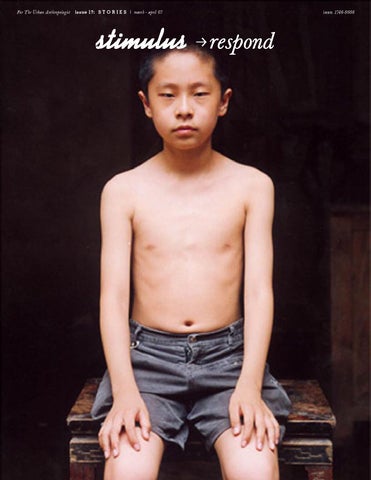
085 Gareth Webb Cover image is by He Chengyao and is courtesy of the Chinese Arts Centre, Manchester UK.
www.korres.com
Korres natural products is a Greek company with roots in the first homeopathic pharmacy of Athens. Set up in 1996 with the aim to utilise its extensive scientific resources for the creation of beneficial and safe products, the company today offers a complete skin and hair care range, sun care products and herbal preparations. download brochure Stimulus Respond and Korres natural products invite you to the Korres flagship store, 124 King’s Road, Chelsea, London SW3 4TR. Present this page to receive a warm welcome and an exclusive 30% off your purchases. Offer valid until 30.04.07. MINERAL OIL FREE SILICONE FREE PROPYLENE GLYCOL FREE ETHANOLAMINE FREE ENRICHED WITH ACTIVE PLANT EXTRACTS
ellen sampson
www.ellensampsonshoes.com
Editor’s Letter Dear Readers, Sadly this issue we must say goodbye to Sharmaine who has decided to stand down as editor of literature. Sharmaine and I have worked together for a few years now but as the magazine grows and expands, Sharmaine felt that she was unable to attend the necessary time needed to complete a proper job. However, we also have a new addition to the Stimulus fold in the form of Amin Samman who has joined us as music editor. With an ear for a sharp sound and an eye for an aesthetic, Amin has bought some great sounds to this issue and I am looking forward to all of the features that he can bring. Although I am saddened at Sharmaine’s departure, what this has meant is that I have looked at my existing team and seen what a great job they all do. Yannis, with his recent job expansion to cover the arts as well as poetry, exceeds at both of these roles. The poetry continues to move from strength to strength, and the newly accommodated arts content proves to be an immediate success, containing some inspirational and controversial artists. Covering exciting developments at London Fashion Week as well as the best graduates from the fashion colleges, as fashion editor, Melina is bringing a new and exciting edge to the magazine. Designer Tatiana Katinova has proven a joy to work with this issue, have a look at pages 031 to see her amazing new collection as photographed by Robert Glowacki, another wonderful person that we are delighted to be associated with. I could mention so many names… Alice, Carol, Aleksi, Francis, Tom… All in all, I am so happy with the direction that Stimulus is taking and I am continually surprised and delighted by both the quality of the material that is solicited by my editorial team, and also the high standards of the material that is contributed to us directly by you. Please please do continue to send in your material, it is a joy to read, see, and work with. With all that and much much more, Jack Editor in Chief Image by Francis L Brookes
Editor in Chief Jack Boulton jack@stimulusrespond.com Art Direction Jack Boulton Melina Nicolaide Editor - Photography Jack Boulton jack@stimulusrespond.com
Editor - Literature Tara Blake Wilson
Editor - Arts Editor - Poetry Yannis Tsitsovits
tara@stimulusrespond.com
Editor - Fashion Melina Nicolaide
melina@stimulusrespond.com
Editor - Music Amin Samman
amin@stimulusrespond.com
yannis@stimulusrespond.com
Fashion Journalist Christos Kyriakides
Logo Design Tina Borkowski tina@yippieyeah.co.uk Proofing Will Aldwick
Contributors this Issue ARTICLES
IMAGES
POETRY
FASHION
Alice Pfeiffer Tom Minor Wade Tarzia Jezebelle La Pixi Jack Sargeant Carol Mann
Francis L Brooks Aleksi Niemela Robert Glowacki Camilo Delgado Aguilera Samantha Sweeting Carol Mann
Mario Petrucci Sean Bonney Tim J Brennan Christina Lovin Lana Hechtman Ayers Annmarie O’Connor Ryan Van Winkle Victoria Rohac Ella Fantry David Blaine
Tina Borkowski Alex at Premier Hannah Flowerday at Premier
For contributor’s contact details or to discuss advertising opportunities within Stimulus, please contact the Editor in Chief. We welcome unsolicited material from our readers. If you would like to make a contribution to future issues then please email the editorial team at the addresses above. Stimulus Respond is published six times a year by Stimulus Respond Limited. All material is copyright (c) 2007 the respective contributors. All rights reserved. No reproduction without prior consent. The views expressed in the magazine are those of the contributors and are not neccessarily shared by the magazine. The magazine accepts no liability for loss or damage of manuscripts, artwork, photographic prints and transparencies.
If You Were To Come Back Words by Mario Petrucci I’d stand at the door like one bereaved: Aghast and breathless, With silence stretched between us For a second Before it snapped And my heart burst its banks In belief. Then I’d draw you in by both hands I’d kiss you on the mouth, on the face Wear out your name with soft saying I’d kiss you more than you would want Until you’d have to draw back, breathless As one wounded To try to speak, to tell me Why it was you came. First published in Shrapnel and Sheets (Headland Publications) Mario Petrucci’s new collection, Flowers of Sulphur, will be available in June 2007 from Enitharmon Press (www.enitharmon.co.uk).
Fast.Victoria To Warren St Words by Sean Bonney got getta back to my flat gotta flat gotta key cos gotta flat gotta TV gotta lovely gotta cat gotta flower got got gotta come got gotta see what mirror what left at the mirror back of my mirror gotta lovely pussy cat & gonna & gonna feed him his whiskers gonna buy him gonna flower gonna go to that whats that the name of that whirlpool the name of that jasmine the name of that shop gonna go to that that whats that name of which is what which is larger the honey or the padlock the honey or the got blood got blue river glue powdered blue got the name of that shop sell paper dust and padlock dust dust and cigarettes it sells cigarettes gonna go to that yeah gonna go to that jasmine that lovely gonna buy gonna cigarettes get my pussy cat gonna take him for walkies First published in Blade Pitch Control Unit (www.saltpublishing.com) For more information on Sean Bonney, visit www.abandonedbuildings.blogspot.com
This Woman Words by Tim J Brennan (i) If this woman be avian, up on thin legs, fanning her tail feathers like the main of a sail, searching for wind the artist’s own tongue a twig in his throat, she a seeker of nest her wings begging, her tongue a sharp thorn, she be a ghost ship by morning, deathly still (ii) If this woman be rain, she would first wash his upturned face, and finally with fluid fingers, she would in tears, caress his pain If this woman be rain, she would fall into his life as small drops, perhaps pool as his wife & fill his years with liquid dreams (iii) If this woman be ashes, she would smolder gray smoke in the morning having shed earrings, hair strands, undergarments in her personal pyre, leaving him with a turned head, sobbing in ecstasy
Never Tell Words by Christina Lovin What’s past is nothing and remembering is not seeing. ~~Fernando Pessoa, as Alberto Ceiro Never tell what might have beendull stories of almost but not quite and never was and who cares anyway but fools babbling on of the heart attack survived, the rabid dog outrun, that turn at the last second-accident that almost was, but wasn’t-love un-snared, so how can it be lost? Move your hand across the bruised limbs and knotted branches of grafted apple trees, thick with spring and mourning of the homeless swarm. Listen to the high keening of the wind, of widows-their voices sound the same in winter-and learn that fruitless melody. Taste the sea and someone else’s tears to understand your own are bland, indistinct. New grass forgets the sharp teeth of frost. Last summer owns no light; it has been spent among the high branches of the pines. Crickets’ cadenced dirges, whirring downward of maple seeds to their own burial, death rattles in the narrow throat of the desiccated gourd: herein lie a hundred million secrets, but only one revelation, one certainty - no matter what might have been, what was. Remember the trap you set as a child just to see what could be caught crushed wing and broken leg of the sparrow there, pale flesh around the surprised round eyeshow the sun shone down on you both and on the winter lawn. First published in What We Burned For Warmth (www.finishinglinepress.com)
Sweet William: Three Accounts Words by Lana Hechtman Ayers I. Wrists In A Time Of War
I wake for no one.
There is someone else on his fingertips.
I don’t care. “The Price is Right” breaks me up with laughter. The coffee’s hot with plenty of cream. No sugar-that’s his thing.
Her name is wind, apple, ink. No matter. Let night roam its sleek black tom while snow drifts in my marrow, crows lift from my eyes.
I have time for books now, so many words funneling like sand.
Sleep is a puzzle solved. There will be days of soup, the moon’s leash straining. So what. I laugh bone china cups. I bite stars, spit caffeine.
III. Love Drops He guzzles her slick elixir. He calls her salt-lick, salvation.
New volumes stock the shelves of my lungs, all their pages
To hell with it. Let him ride like Paul Revere. My lips are cemented, my heart a rubber ball.
refutable
There’s a cure for this disease.
II. Implied Consent
Sharp as the spring-green grassblade, warm trickle like sun.
His mind reeks of another’s perfume. She is plum blossom petal falling, morning prairie sun, his last prayer before sleep. I could care less. Night is for prowlers. I bundle up. Tires squeal out of the driveway. but I can’t hear them. Sleep is my kingdom. I eat for one.
It’s all good. I recline on cool clay, listening to the ravens call my name. I become so light, so massless, even the black hole misses. Lana Hechtman Ayers’s latest collection, Dance From Inside My Bones, is available now from Snake Nation Press (www.snakenationpress.org)
Singing Sand Words by Annmarie O’Connor It all changed when the sand began to sing when parabolic dunes told the story of our soul each grain conspiring high and low to etch a melody, pure as hearse across our sloping brow. Still I poised with elongated arms, ready to embrace the crest of you, lost in this candid refrain, left with sorrow, so shear, I could scarcely recognise.
She Makes Home Smell Like Lemons Words by Ryan Van Winkle Dahlias and Hollyhocks float in great white bowls like knees in a bath. Curved cherry backs dusted, TVs polished, shine. The groceries are away, four bananas cradled in the fruit bowl. If he does come home at one, two, three, four he will turn on the TV, or skulk to their room. Still, the flowers float, the cabinets shine and reek of aerosol lemons.
Skeleton Wings Words by Victoria Rohac Somewhere in between the mice and Tuesday morning It became obvious: Her flesh and feathers had disappeared Into the cold. Organs still intact, Her vision blurs as she Beats her wings From the fourth floor She falls She is full of weight; Marrow bent hoary Churned into chalky dollops Strung together like burlap. And she turns And turns Lapsing into memory Lulled by the gravity That swallows her. Maybe she will sink into the earth Further than the roots The sparrows beak the burrows; Further than her own veins will reach * There was a solstice of sounds That night The cries The bellows The faint swelling of lung against dirt He could hear those wolves Howling at ambulances Just waiting for the moment to pass Just waiting to come home to find out about the accident About the head exploding About the blood draining Somewhere above the doorstep The outlying coo of a pigeon could be heard But he found himself too numb to notice anything Except the twist of grainy hardwood Magnified from this view on the floor
Tarmac Words by Ella Fantry
Silence sometimes indicates the other story churning, the backward reel running. Somewhere over this ribbon’s blue Or under this wide scorched earth, another hidden cartwheel of an indeterminate hue. That way someone spoke when I wasn’t listening, finished sentences, rounded out pauses. Hovered beyond the rims of my eyes, an oculus above a lachrymose lake. Spoke in a manner of speaking, Un-words no sound. Out on the tarmac winds graze grasses, shear fright, the plane’s engine turbos into the night. Guess which list I am on, long waiting. Start the wind machine, We are flung out in figure 8’s.
Passing Words by David Blaine
You ask your wife, “Why must it always be about perceptions?” “Well,” she replies, “they say perception is nine tenths of the law.” “No,” you correct her, “That’s possession. Possession is nine tenths of the law.” “You must be right,” she sighs. “You always have to be right.” Touche’ This week you wrote villanelles so that at tonight’s party you could pass yourself off as a lyricist. “A song writer? That explains the black turtleneck.” chortled your host. “Thank God, I thought you might be a poet.” That’s how others think. But you are lying on your bed now, comparing your life to an obscure French movie, one where the English comes only in subtitles. You resolve to write an epic narrative about the whole sordid thing. Next weekend you will wear a crew neck, and pass yourself off as a film critic. You are always passing; it’s forever about perceptions
Designs that carry well adjusted, almost polite twists, that don’t necessarily force you to look again, but gently define the artistic (2 interests of their designer, 27 year old German charmer Maximilian Doerr. Just graduated from the Central Saint Martins MA in menswear, Maximilian believes in formal casual wear and thinks Luis Wilson is legendary. (1
maximilian doerr
1) Designs that carry well adjusted, almost polite twists, that don’t necessarily force you to look again, but gently define the artistic interests of their designer, 27 year old German charmer Maximilian Doerr. Just graduated from the Central Saint Martins MA in menswear, Maximilian believes in formal casual wear and thinks Luis Wilson is legendary. 2) maximilian doerr
3) text&interview christos kyriakides photography aleksi niemela layout tina borkowski fashion editor melina nicolaide model alex at premier
Greatest achievement? Being a friend, son and brother. Your biggest fear? Not being able to do what I enjoy doing. Main influence so far? The biggest influence was getting to know Sarah&Patrik. Artists like Erwin Wurm, Jenny Holzer, Jeff Koons have influenced me, as well the people I have worked with, such as Kostas Murkudis, Partik Muff and my Mother, who has made studying fashion financially possible. how much of you work reflects yourself and how much is purely commercial is there a balance? It is balanced between being wearable and being me. I come from a jewellery background and therefore I enjoy the crafting part. My collection is something you need to see close up in order to really appreciate. what drives you to continue? I enjoy it. What better can happen, than enjoying what you are doing? How would you dress Anna Wintour for the Oscars ceremony? In a Couture Dress by Gabriele Blachnik. This is the “story” issue. what is your story of fahion? It probably started when I was 4 years old and my mother changed my outfits 2/3 times a day. It wasn’t because they were dirty.
tatiana Katinova
text and interview/ christos kyriakides photography/ robert glowacki fashion editor/ melina nicolaide layout/ tina borkowski model/ hannah owerday at premier )
( Main inuence so far ?) Louise Wilson
( Greatest achievement? Hope it’s still going to happen
)
( Your biggest fear? Being squashed by a london bus )
what drives you to continue? My stupidity ( ) How much of you work reflects yourself and how much is purely commercial - is there a balance? I don’t do pure commercial work. But I believe that fashion is about clothes and is about people. If people don’t want to buy my things then it might be because I am a shit designer.
(How would you dress Anna Wintour for the Oscars ceremony?) Black vintage Chanel
This is the “story” issue. what is your story of fahion? I am a FASHION DESIGNER not a fashion journalist.
)
( Looking back to the 60s rock scene where old tailoring was first applied to the new progress and absorbed some of the turbulence of the times, Tatiana jumps back into the future as one of London’s most promising womenswear designers. The strong shapes and tailoring of her Central Saint Martins MA collection look good in black and white and gave russian born Tatiana this year’s Harrods Award.)
Untamed Desires Images by Samantha Sweeting Words by Jack Sargeant
D
ocumentation becomes evidence. The artist who works in live art can use the inscriptive technologies to disseminate their work via the digital medium. Free of censure, free to examine an idea in a short digital loop. But even this can be stripped back, individual images picked from a video and allowing the artist to present an event in five frames. There appears to be chaos in the gestures, no hands grasp at the fruit, instead the movements appear as feral, the woman uses her mouth to bite the apple, teeth biting and consuming the bitter flesh. In contrast the clean bed and contemplative closing image suggest this was only a brief transgressive moment, a taste of crypto lycanthropy rather than the complete submission of the self to the nihilistic freedom that is promised in the abyss of ego-annihilation. The performance here is rendered as simple gesture and colour. Entry, consumption, completion, contemplation. The creased white sheets, a red apple, and clean pink flesh form a mise-en-scene devoid of extraneous matter. The questions become: what is unseen in this event, what is happening beyond the frame, and what sounds accompany the event? Does the woman grunt, snort, and cough as she chews her food, does her breathing accelerate as she embraces albeit briefly becoming animal? Even while looking at these images, seduced by the untamed desires and animalism, there is an undertow of technology, the images are taken from a video, further removing the viewer from the moment, forcing a moment of contemplation. There is a palpable tension in the need to pay witness and the urge to experience more.
Subway 2005 oil on canvas 78” x 70”
Brush with Death 2004 oil on linen 60” x 48”
Inka Essenhigh Inka Essenhigh’s paintings toe the line between Pop Art immediacy and Surrealist fancy. Stimulus talks to the woman who, for the last ten years, has kept the art world under her spell. Text and interview by Yannis Tsitsovits.
Setting Sun 2005 oil on canvas 75.5” x 70”
Spring 2006 oil on canvas 72” x 62”
“M “I considered Abstract Expressionism to be a truer art form, where something genuine was going to come up from your guts and onto the canvas”
aybe I’m a figurative painter who’s interested in people,” proclaims Inka Essenhigh, in a voice that wavers between hasty mezzo soprano and rich, affable alto. “And where there’s people, there’s usually a story.” I am looking at one of her new paintings, Picnic, and am finding it difficult to disagree with her. It is a landscape of a couple sitting in a hay field, food basket and red wine at arm’s reach. The setting sun brings to the upper third of the picture a deep flush: the man is leaning against a tree whose tinted blossoms look like red corals; the forest in the background is an unbridled orgy of scarlet and vermillion, a colour which Kandinsky compared to “glowing steel which can be cooled by water.” In the centre, amidst the yellow undulations, the smiling couple – tipsy and euphoric – is imbued with hues of orange. Chromatically, the picture is a hide-and-seek between vigour and warmth. A bit like Inka’s voice. The painting is worlds apart from the artist’s pre-2000 work, which borrowed from Bacon’s palette and abstracted anatomies. (“Faces add baggage” and “bring unnecessary information to the image,” she declared in an exhibition catalogue of 1999.) In fact, Essenhigh’s oeuvre might be read as journey from the abstract to the figurative, the impetus for which was a stint, in 1995, in fabric design. “Up to that point I considered Abstract Expressionism to be a truer art form, where something genuine was going to come up from your guts and onto the canvas,” she explains. “Doing the fabric started to free me up. I’d look at it and it was more interesting than the things that were going on in the studio. It had more content, more social content. It just had more meaning.” Another leap in this direction was taken in 2001, when Essenhigh switched from enamel to oil. “The enamel was rather limiting. I had to paint by a certain type of rules,” she says of the shift. “I knew that one day I’d go back to oil. Once I made that decision it was crazy to postpone it.” A year later, she gave her subjects faces. Her compositions lost some of their flatness, a move that owed as much to cartoons and sci-fi as it did to the landscapes of Dali, Ernst and Tanguy. By 2002, curves and movement were the norm rather than the exception. Much of her output in this period, such as Screaming Victim and Green Wave, echoes Hokusai and the Japanese Ukiyo-e prints. As her paintings became increasingly threedimensional – looking less like comic book cells and more like stills from a Dreamworks animation – her figures were endowed with a dough-like plasticity (or, in Essenhigh’s words, “they became gooier”). In no work is this more evident than Subway, in which a group of frantic commuters becomes entangled in a complex of stretched-out, colloidal bodies. Subway toys with the idea of losing one’s identity in the hustle and bustle of a large city. It also hints at the notion, popularised by quantum theory, that there are no such things as separate structures. (“I’ve heard the best explanation of this on The Sopranos,” Essenhigh recalls, “‘We’re all tornadoes, but we’re made of the same air.’”) It is tempting to see in the painting a social critique. Yet in her depiction
Bullies 2005 oil on linen 70” x 76”
“A ‘whoosh’ mark is both an abstract mark and showing an action and it’s comical. I find that so much part of my language that I don’t even think about it.”
of the distorted bodies of busy city dwellers, Essenhigh is the apolitical flipside to Grosz’s brutal caricatures of decadent Berliners and Ensor’s masked or skull-headed burghers. And whereas Grosz was motivated by misanthropy and Ensor by mistrust, Essenhigh’s recent work is informed by a benign, almost child-like curiosity about the human race. How fitting, then, that she expresses this curiosity through a style that draws so heavily from the world of Disney, Tin Tin and the Warner Brothers. “I take it so much for granted that that’s the language I’m using,” she says. “For example, a ‘whoosh’ mark is both an abstract mark and showing an action and it’s comical. I find that so much part of my language that I don’t even think about it.” I ask her if she considers comic books and cartoons to be art. “Yeah. Absolutely,” comes the reply. “If it is meaningful to you and it’s visual, then it’s art. I don’t draw this harsh line between what’s illustrational, or trivial, or too entertaining. I think that’s just something we grew up with - thinking that art has to be difficult. Hopefully this is changing. I assume it is. I am acting like it is.” Her disregard for the distinction between high art and popular culture would have Clement Greenberg’s ashes spinning in their urn. But it seems that this distinction has long ceased to matter; many would argue that it is meaningless. Essenhigh is quick to retort to this type of criticism. “[Art]
“I am not mythologizing, I read that as meaning it is taking it to the heavens. People ask about Pegasus and to me that’s little girl stuff of horses and rainbows.”
can be on TV; it can be in a comic book; it can be anywhere. By the same token, just because something is in a gallery, it doesn’t mean it’s art. But I wouldn’t have a problem with it – I guess it’s just not good art. As a matter of fact, I question whether there is such a thing as good or bad art – just ineffectual sometimes, or boring.” Aristotle saw comedy as “an imitation of action that is ludicrous and imperfect”. Cartoons and caricatures skew the lens on reality and fantasy alike and, hence, loan themselves to hilarity and jest more than any other medium. This is a fact Essenhigh is all too aware of. “I find that when there is humour I can relate to things a lot more easily. For me, it takes it off its pedestal. I can take it for what it’s worth and it makes everything more accessible. And I want my art to be accessible.” She extends this principle to subject matter that, more often than not, is treated in an earnest or selfimportant manner. In Brush with Death, a human figure is painted mid-jump over the Grim Reaper, a chthonian imp with extended claws that may well have sprung out of Bosch’s Temptation of Saint Anthony. The scene is instilled with an ambiguity suggestive of both narrow escape and capture; the hovering quarry’s wide open mouth could be letting loose a scream or a shriek of relief. “It has the feeling of almost getting it, almost biting the dust. It’s perhaps even thrilling as much as anything else,” Essenhigh remarks. The painting is ghoulish and goofy in equal measures. Yet in spite of its lightness, it carries the weight of personal history: “Brush with Death was made while my husband [the combat artist Steve Mumford] was in Iraq and my brain would come up with nasty scenarios. I do think that my real fear of him not escaping is in there and I do think of this all as being genuine.” The painting brings to mind the story of the abduction of Persephone by Hades, the God of the Underworld, who burst up through a cleft while the clueless damsel was picking flowers. Even the leaping figure’s garment and sandals have something of the ancient Greek to them. But Essenhigh objects to the suggestion that her paintings are about myth. “I am not mythologizing,” she maintains. “What I read that as meaning is glorifying it, taking it to the heavens. People ask about Pegasus or Unicorn and, even
though they’re mythological beasts, to me that’s little girl stuff of horses and rainbows.” Perhaps Essenhigh simply takes exception to pomposity. Her allusions to the lore of yesteryear, far from being premeditated grand gestures, are an expression of what’s current and personal. At times this results in work that resonates with contemporary events, such as Brush with Death and Bullies – a nod to Dürer’s Four Horsemen of the Apocalypse that evokes the “fear and drum roll” up to the war in Iraq. At others, it results in private reveries, such as Setting Sun and Spring – both examples of how Essenhigh uses the constraints of form to dictate the paintings’ narrative. “I base what I want on what it looks like and I suppose that makes it more formal,” Essenhigh says. “I don’t have an agenda with the story. If I decide that it would look great with more yellow in it, then I go ahead and change the story.” So what does she make of other people’s take on her work? “I welcome it – the whole way it enters into making meaning for people is always personal, it’s Picnic 2007 always a misinterpretation. Ultimately other people oil on canvas will have to find a meaning of their own for it to be 29.16” x 26.79” a living work of art.” This is a far cry from many an artist with a penchant for precious sibylline statements. Essenhigh’s art, meanwhile, is formal yet fun; it crackles, bounces and squeaks; it is pop that can spell its name backwards. Inka Essenhigh is on show at the Comic Abstraction exhibition at the Museum of Modern Art, New York, until 11 June, and the Imagination Becomes Reality exhibition at ZKM, Karlsruhe, until 1 May. Her paintings are also part of the Tate Modern collection in London. For more information on the artist, please visit: www.inka-essenhigh.com. Images for Brush with Death, Bullies and Picnic courtesy of the Victoria-Miro gallery, London. Images for Subway, Setting Sun and Spring courtesy of 303 Gallery, New York.
The Tin Drum, 2006 30” x 58”
Anthony Goicolea
In Anthony Goicolea’s photographic tableaux, what is left unsaid is often as important as what meets the eye. Stimulus meets the artist with a knack for beautiful yet throught-provoking images. Text and interview by Yannis Tsitsovits.
“M
aurice forgot he had ever been sexless, and only realised in maturity how just and clear the sensation of his earliest days must have been. He sank far below them now, for he was descending the Valley of the Shadow of Life. It lies between the lesser mountains and the greater, and without breathing its fogs no one can come through.” When E.M. Forster painted this young man’s struggle with his own essence, he could have described the story of Anthony Goicolea’s subjects and their troubled path to adulthood. It started with tableaux of adolescent boys – all manipulated images of the artist himself – with amorphous identities and an obsession with spit, snot and jism. The confines of authority – represented by a class room or church – were gradually removed, and the kids were left to their own devices in a fight against nature. In the Shelter series, the boys slowly begin to build a makeshift society of their own. The rite of passage into adulthood finds its culmination in the Septemberists, where the boys have grown up and live an ordered life in a self-sustaining commune. Goicolea describes the Septemberists as a “summary” of his art’s larger narrative. The film is rich with symbolism and allegoric structures. I ask him whether he thinks the film takes his work into full circle. In a way, I view the Septemberists as a closure, because it embodies everything I’ve been dealing with in my work. I feel that it’s allowed me to take a departure from those subjects and do something new. It sort of goes from the Landscape series and the idea of the wilderness and these groups of people working together in nature, but there is still this institutional feel in the way they dress or operate in silence. It’s almost monastic or militaristic – they know the function they’re supposed to fulfil and they’re able to engage in that role in utter silence and without communicating with each other. I’m also interested in ” the idea of tradition, and how, through repetition in tradition, things lose their meaning and movements become robotic and they take on a different type of interpretation. Within that film, I take these rituals and ceremonies – whether it’s a baptism, wedding, funeral or communion – and merge them in a way that makes them take on this hybridised, ritualistic procession.
“In a way, I view the Septemberists as a closure, because it embodies everything I’ve been dealing in my work
Is your new work a break from this larger narrative? It’s a little bit of a departure because the whole show – drawing, video and photo – is in black and white and it’s kind of industrial, urban environments and I’m working with older people. In the new work people seem more isolated. They’re
not really functioning in groups. They’re more akin to the Shelter series, in the sense that the environment is more of a predominant figure. People are dwarfed by their surroundings, but they’re presented in a singular or solitary way. The drawings and paintings look like negatives – they’re black and white or monochromatic. The work is less narrative than the earlier ones. I would say that they’re probably a little bit more formalist, although initially they might seem realist. I think my photos are becoming more painterly in the way I am shooting them and putting them together, because I’m creating these environments that don’t actually exist – it’s like making something from scratch. So I am allowing myself to become looser. In the Kidnap series, there are some images that are a reference to the Wickerman, this ritual of burning an effigy of a real person in a ceremonial sacrifice. It made me think of transgression, this pagan idea of reaching this state that’s almost non-human and committing an act that goes beyond generally accepted boundaries – because after the burning ritual there is a scene where the boys are asleep and the viewer’s left wondering what has happened. Yeah, that’s definitely part of it. The idea of a ceremonial ritual is representational but also leads to the act of change. What both the Kidnap series and the Septemberists have in common is that a lot of these rituals take on a persecution feel to them. I am interested, within the notion of homogenisation and cultures and groups, in the idea of how minorities are persecuted or set out aside of that. The Kidnap video, for example, has a moment that references the KKK. The Septemberists has moments that references fascism and Nazism and the Holocaust – this sort of dystopian society. And they’re also set against a Southern plantation backdrop. I grew up in Georgia, so I don’t know if that filtered in a little bit. Is this type of persecution something you’ve ever felt? Yeah, I think that’s part of it. I grew up gay and Cuban in a very homogenised white Southern society, so I definitely felt the danger of persecution, but not actual persecution. I felt like part of a minority where there was still a possibility of blending in and not being a visual minority. But that to me is what’s interesting, because that’s where the choice comes in as to whether you allow yourself to lose your identity and become part of a larger group or whether you assert yourself and risk becoming persecuted or ‘other’ and different. With some photos from your Shelter series, such as Ice Storm, teenagers are exposed to nature in a way and that renders them vulnerable. Particularly with the Landscapes series I was interested in how fairy tales and mythology take this mystical woodland environment and make it both beautiful and dangerous. I think that’s something a lot of early American landscape painters also
Above Ice Storm, 2005 70” x 80” Left Sleeping, 2006 50.5” x 40”
“I was interested in how fairy tales and mythology take this mystical woodland environment and make it both beautiful and dangerous”
Greenhouse, 2006 28 x 120 in.
dealt with – the issue of the sublime and how landscapes seem beautiful but foreboding at the same time. Also, fairy tales and mythology and biblical stories have all these iconic symbols and allegorical structures set up. I grew up in a Cuban-American household, so I had stories from different cultures, which I somehow ended up fusing together.
“Every culture has their own absurdist little tales to prevent kids from doing what they shouldn’t”
Can you remember any stories from your childhood that have had a particular effect on you? Various things, like idiomatic expressions or songs that were sung before bedtime. I remember my mother telling me that if you swallow chewing gum, you grow a tree out of your nose, ears and belly button. Every culture has their own absurdist little tales to prevent kids from doing what they shouldn’t, so I ended up getting both. Have you heard of the Shockheaded Peter story? Oh, is that Slovenly Peter? Who wouldn’t take a bath and ended up in the river? In the story I know, his hair and nails kept growing and he ends up turning into this vegetable. I heard a version where he wouldn’t bathe and was really disgusting, so the villagers took him to the river to bathe him and he drowned. The stories seem really absurd when you’re older, but when you’re younger somehow they seem really believable. A lot of fairy tales are quite brutal in a way, because they portray uncomfortable, ugly truths, but they do it in a poetic way. I feel your art does that as well with, for example, ideas of mortality in the Septemberists or the idea that kids can be cruel in the earlier work. In my work, I like a level of ambiguity. I like the contrast between an image that’s beautiful in composition or colour and an act that seems grotesque or dangerous. So you’re looking at something and it becomes palatable. In the earlier works, the adolescents seem sweet and innocent, but they’re being portrayed as doing these malign acts. Their youth and looks betray what they’re doing or make it visually palatable.
In Tin Drum, the boys are all asleep and about to be summoned by a drummer. There are also some rats at the bottom of the photo. Is this a nod to the story of the Pied Piper of Hamlin? Maybe a subconscious one. I wasn’t really thinking of that – I wanted to show that even though things seem quite ordered, there is this gritty underbelly to it all. I mention this because, in the tale, the piper drives out all the rats from Hamlin and then, because the town didn’t pay him for doing that, he seeks revenge by driving out all the children. So the tale symbolises the departure of childhood, and in the Septemberists, for the first time, you use young men instead of adolescents. It’s funny because I didn’t know the whole story. It’s often the case with fairy tales I refer to that I only know parts of the story and I mix them with parts of stories from other cultures and that’s why they end up being such a weird hybridisation. I don’t know if that subconsciously seeped in, but it seems really great. I love that you told me that. It’s pretty perfect. The photos where you use clones of yourself have a strange effect on the viewer, because the scenes are immediately recognised as an artifice. So although the images are quite grabbing, they give the viewer something to distance himself intellectually. How does your more recent work explore notions of artificiality? If you look at the Landscape series, or the Shelter series, or even the Septemberists, some things initially seem believable, but then they fall apart. Greenhouse is shot simultaneously from the outside and the inside. In Sleeping, the vanishing point in the rafters is kind of skewed off to the right, whereas the vanishing point of where the boys are sleeping is skewed off to the left. Also, part of it is shot from above and some of it is shot from below. When you look at it for a while it starts to reveal it’s own artificiality in a way that you maybe can’t put your finger on but you still know it’s not quite right. That’s something I’m interested in: putting things together that undermine the way we normally see things. Anthony Goicolea’s new work will be on show at Postmasters gallery, New York, from 28 April until 2 June. Please visit www.anthonygoicolea.com. All works colour photographs (C-prints mounted on aluminium, and laminated, edition of 9) . All images courtesy of Postmasters Gallery, New York
“I wanted to show that even though things seem quite ordered, there is this gritty underbelly to it all.”
“Right now, we are at a point where we don’t know what to do. We are becoming a product and we need to find a way around it”
Les Georges Leningrad L Text and Interview by Amin Samman
es Georges Leningrad are not a band; they are a restless, art-damaged circus troupe. Formed in Montréal in 2000, these self-proclaimed purveyors of ‘petro-chemical rock’ have travelled the world as a bizarre and unstable blend of theatre and clanging analog electronics. This year sees the group follow up their third full-length Sangue Puro (Tomlab: 2006) with a foray into the art-world proper; an off-site collaboration with the Pil and Galia Kollectiv entitled Asparagus: A Horticultural Ballet (The Showroom: 03-4/2007). I caught up with Dominique (a.k.a Poney P. – vocals, synths) in London on the eve of this transition, hoping to shed some light on the group’s obsession with alterity. “Do the classics ever go out of style?” I ask, wearing a sheepish grin. “No. I don’t think they do” she replies: “they are like a well-tailored suit.” Why then, I wonder, do they seem so determined to re-invent themselves? From the stunted, dubinflected no-wave of their debut Deux Hot Dogs Moutarde Chou (Coco Cognac: 2002; Alien8: 2004) to the leaner Dadadisco of Sur les Traces de Black Eskimo (Alien8: 2004), the change was almost a natural one; but Sangue Puro finds Les Georges defying evolution and offering up a murky, primordial soup of drones and garbled monologues. The trademark rhythms remain, but are far sparser on the ground, crowded-out by sheets of tic-inducing synth vomit. I press the issue, and she responds frankly: “Right now, we are at a point where we don’t know what to do. We are becoming a product and we need to find a way around it”. Disillusioned, they have turned to selfsabotage, deliberately distancing themselves from the dancefriendly elements of their early work. In fact, this was the only guideline that they set themselves in writing the new album. So, on a rough reading, Les Georges have much in common
with the utopian Left: their brand-suicide is a strategy against marketecture. But who wants a rough reading? As is often the case, the devil is in the detail. “I am a Fire Marxist”, Dominique tells me. And I believe her, for the group’s live show owes as much to the Situationist International as it does the Second International. In character and costume, Louis (a.k.a Bobo Boutin – drums, synths), Martin (a.k.a Mingo L’Indien – guitars, synths) and Poney P. playfully bounce identity and spectacle off against one-another, enacting absurd scenarios that throw into relief the absurdity of everyday life in the cash-nexus. But they don’t stop here, and frequently launch into alien phonic exchanges between songs. Whilst this began as a reaction to feeling comfortable neither in French or English, it has become a passport to their collective subconscious, allowing them to “go into that cave and see what creatures there are inside”. It is now a key ingredient in both their writing process and their understanding of performance: “When we perform, we really become someone else on stage...and as my character becomes part of me, I discover that I am a super-hero in real-life”. It would seem, then, that they are trying to convince us that intersubjectivity is ours for the making. But does their urgent, shocking cabaret risk becoming a mere playground for audio-visual rape – an acquired taste; another rebel sell? Dominique thinks so. And it is in light of this that we should interpret the shift from the club to the concert hall; it is an attempt to defy the regularities of the music-industry. “I have stopped fighting for my right to party... it’s much more of a political statement to explain an idea... [and] that is why we will be playing more with minds than with dancefloors”. So, when viewed alongside their sonic-experimentation and hands-on approach to classification, these antics reveal another Les Georges; one that is flirting with discourse, attempting to harness its productive power. It is with little surprise, then, that we should find them in the orchestra-pit for Asparagus: A Horticultural Ballet. This offkilter adaptation of Das Kapital is definitely not your average tour date. In fact, Les Georges came to London especially for it. Unfortunately, the Ballet itself was underdeveloped (due in most part to poor choreography). But the evening was not without its merits. On the whole, the asparagus – as a metaphor for the formal and real subsumption of the lifeworld by capital – did succeed in bringing the issue of modernity to the fore. However, it was the contrast between the Kollectiv and Les Georges that I found most interesting. Whilst the former played organisms sucked of life, trapped beneath the yoke of exchange-value, in synchrony and marching on as the vessel for a juggernaut capitalism, the latter provided a score that interrupted the menacing music of the man-making machine with stumbles, creaks and groans – reminding us that machines are man-made too. Whether or not this was intentional, it quite rightly sets Les Georges apart from both the pseudo-scientific historical-materialism of the Old
“When we perform, we really become someone else on stage... and as my character becomes part of me, I discover that I am a super-hero in real-life”
Left and the defeatist tendencies of the soixante-huitards. For Dominique, “the concept of the future appeared, suddenly� and her post-structural sensibilities seem to be pushing her towards taking it into her own hands. Thus, the real story of Les Georges Leningrad is that of a band on the cusp of a critical political economy. They may be lost for words, but they are willing to begin making new ones. Deux Hot Dogs Moutarde Chou (Coco Cognac: 2002; Alien8: 2004) Sur les Traces de Black Eskimo (Alien8: 2004) Sangue Puro (Tomlab: 2006) www.lesgeorgesleningrad.org www.myspace.com/lesgeorgesleningrad Pil and Galia Kollectiv (w/ Les Georges Leningrad) Asparagus: A Horticultural Ballet (The Showroom: March 7 to April 15, 2007) www.theshowroom.org
Do Say Make Think
Text by Amin Samman and Marc Holmes
“From the outset, they have been a band committed to the ideal of pure organic art”
Toronto’s Do Make Say Think have spent the last ten years honing a sound that is at once cerebral and affecting. Loose, wandering rhythms subsumed by orchestral arrangements provide a sonic-metaphor for city life; unsuspected melodies shoot through vignettes of grey with the colour of faith and hope; and precise electronic interjections reveal a deeply personal approach to production. Yet because these planks are only hinted at, the band’s unique statement is often obscured by the post-political connotations of instrumental rock. It is in this context, then, alongside the release of their fifth album You, You’re A History in Rust (CST: 2007), that we have decided to dig-up the untold story of Do Make Say Think. From the outset, they have been a band committed to the ideal of pure organic art. Their self-recorded, eponymous debut was an inventive and improvised affair that fused composition and production into one collaborative act of expression. Despite being limited to 500 copies, its slow-burning psychedelic jazz and dub soon caught the attention of Constellation records; a staunchly independent label taking its cue from the North American hardcore scene of the early 1980s. Views were discussed, the album was rereleased (CST: 1998) and a relationship was forged.
“Plaintive melodies, carried in the most part by cyclical guitar riffs, sew together a ragged patchwork of movements that evoke a decidedly claustrophobic urban existence”
To this day, the band remains with the label, and through it are linked to a tightly-woven group of anarchist artists based in Montréal’s Old Town. But whilst label-mates Godspeed You! Black Emperor and A Silver Mount Zion add spoken and lyrical content to their dystopian soundscapes – making them worthy heirs to British punk-evangelists Crass – Do Make Say Think are decidedly more oblique. In fact, rather than a blanket condemnation of postindustrial society, the permissive approach to tension and release on their debut suggests the casting of a more contemplative eye; drudgery and repetition are hinted at in the taut cadences of Dr. Hooch, but the space-rock haze of pieces like If I Only… offers a disbelieving, dream-like meditation instead. We believe that this ambiguity is of foundational importance to the band; their albums can be read as an ongoing engagement with concept of work through practice itself. For their second album, Goodbye Enemy Airship The Landlord is Dead (CST: 2000), the band found a secluded barn in rural Ontario and turned it into a makeshift recording-studio. It marks a real turning point because The Landlord – as the personification of structural dominance – provides for the first explicit exploration of the themes alluded to in its predecessor. Plaintive melodies, carried in the most part by cyclical guitar riffs, sew together a ragged patchwork of movements that evoke a decidedly claustrophobic urban existence. The newly forceful waves of bass and brass add a menacing swell to the implicit threat of pieces like When the Day Chokes the Night, pitting society and imagination
“Even as a product, it brimmed with the possibility of change.” against each other. But this binary opposition is not presented as immutable, and the tandem rhythm section’s intricately interwoven webs – in providing a sense of unity and common purpose – tentatively point towards a way out of this scenario: the re-appropriation of work through art and community. Consider the physical production of the album: not only was the recording and mixing process itself turned into an escape from lifeless tenements; the circulation of the recordings rested on Constellation’s anomalous contract-free code of conduct. Even as a product, it brimmed with the possibility of change. In their next two albums, one can sense this very idea blooming into an ambient and joyful symphony. & Yet & Yet (CST: 2002) finds bright, shimmering guitars and fat analog synths layered on top each other and pinned in place by crisp, syncopated rhythms – a pronounced departure from the grey Goodbye Enemy Airship. Pieces like Chinatown, along with the jazzy reverberations of opener Classic Noodlanding, are suffused with an uplifting, even pop-like curiosity. And whilst tracks such as End of Music – with its twin-drum and bass hammerings – are still suggestive of monotony, it is this time punctured by an airy and warm production that simultaneously expresses and is the expression of a newfound pleasure and pride in work. Winter Hymn Country Hymn Secret Hymn (CST: 2004) builds on this through its compositional-sophistication, returning to the non-linearity of Goodbye Enemy Airship whilst dividing itself into three rough suites. The warmth of production remains and is combined with emotive, pastoral melodies in pieces like Auberge le Mouton Noir to stunning effect. A certain volatility is on display too, but it is the iridescent triumph of pieces like Hooray! Hooray! Hooray! which constitutes the album’s narrative thrust. It is at this point, then, that You, You’re A History in Rust (CST: 2007) steps forward; an accomplished epic that revels in the act of its own creation. Acoustic guitars, combined with drifting vocal harmonies and casual laughter, create an intensely organic feel - in many ways picking up where Winter Hymn left off. But rather than simply heralding the birth of a new pastoral post-rock, A History in Rust is a genuinely joyful act of defiance; a vaccine for urban quotidian fever. By side-stepping meddling middle-men and producing their art from start to finish, Do Make Say Think energise free-thinking communities - engaging with them as directly as possible. In doing so, they transform work into play.
Helen McKenna There is a person very dear to my heart who has a story she will not share with a soul. Clearly then, I won’t be writing about it here. And the reason for her silence? She thinks to tell her story, to go back over her experiences, would be so emotionally distressing that it would break her. But I disagree. In my opinion the pain is already there and cannot be escaped by burying it away. Furthermore, talking helps; remember the old saying, ‘a problem shared is a problem halved’? Well, that saying can probably be traced back to a group of old biddies in a remote countryside village who had nothing to do but gossip all day. However, it is my belief that the stories of our lives make us who we are, and that far from disappearing, they get repeated over and over again. The past to me can never entirely be ‘water under the bridge’, as the saying goes. This is no more apparent than in John Bowlby’s attachment theory (1969), which proposes that what takes place in our childhood past very much continues to operate in our present. Research shows that the relationships we have with our primary care-givers (normally our parents) have a very strong influence on the way we relate to others throughout our lives. We use these as a model on how to relate to the rest of the world. So, the patterns we establish
in our early years get repeated as we grow older, just with different people. The peak learning time for developing our relationship model is between 6 months and 3 years of age. In other words, when you get to 3 you’re past it in terms of relationship development. Which is great if you grew up in an Enid Blyton book, where everyone related to each other in a constructive manner and hence you developed a positive model of attachment. However, not everyone lived like that. Attachment theory divides attachment models into two types; secure and insecure. It is estimated that around 50% of children experience secure attachments, while the other half end up with the insecure type. Insecure people tend to find it harder to have successful, loving and secure relationships in adulthood because they repeat their insecure attachment model with everyone they meet. By relating to our partners the way we related to our parents, we can actually manipulate them into responding to us in the way that our parents did. It’s frightening really. In the face of an uncertain future, the past feels so safe that we attempt to reconstruct it throughout our lives. It’s rather unfair on our partners, however. In a way, our relationships are less about who they are than to what extent we can make them
“Does that mean we’re forever doomed from age 3? Or is it possible to change the record? That depends on what you want” act out roles from our past. So does that mean we’re forever doomed from age 3? Or is it possible to change the record? That depends on what you want. By entering into intensive therapy or having a relationship with a very responsive partner / saint who can tolerate your insecurities, you can, if you are determined, break the pattern. In other words, you can change the story instead of going back to page one every time you reach the end. Through really thinking about our relationships and through objective observation of how we interact with others, we can start to see the patterns we re-enact time and time again. By discussing these and looking at where they come from – ie. childhood rather than in response to our current partner – we can learn about the attachment models we developed as children and work on forming more positive attachments in the present. In this way we can move on from the age where we got stuck (usually 3) and move on to a happier future. Relationships are the bread and butter of our lives and hence the substance of our stories. I doubt that my friend’s story has nothing to do with relationships. And even if the painful memories she carries occurred in the more recent past, if they are relationship-based they will have their origins way back in the attachment
patterns she learnt in childhood, perhaps even in the patterns her mother and her grandmother learnt when they were small. I hope that one day she is ready to talk and to challenge the thoughts that she has been repeating for years. Of course it will be painful, but there will always be people there ready to hold her hand. I wonder whether it is really the telling of the story that frightens her, or whether it is what telling the story could result in. For in sharing our stories we open ourselves up to hearing different perspectives, to change, to the chance of a different story in the future. Change is new and different and frightening. But in comparison with a future that is identical to yesterday, it could be better. Maybe it’s worth the risk.
Fairy tales play with archetypes that say a great deal about the human psyche. Alice Pfeiffer takes a look at some of the characters behind them, from Goldilocks to contemporary media icons. Images by Francis L Brookes
Everyday Fairytale
S
leeping Beauty’s never-aging allure, Snow White and her seven pocket-sized companions, Cinderella and her billowing dresses, fairy tales still make us dream today. Each of us has grown up to specific tales, stories that constituted a base for our games, our fantasies, discreetly coaching us through childhood. The collective imagination of every society emerges from a set of fairy tales, urban legends, or myths. From Arabian Nights’ agile Aladdin to Andersen’s yearning little mermaid, they serve to entertain us, while warning children about the dangers and realities of growing up. Ingeniously disguised morals designed to prepare us for the Big Bad World. When growing up, it is said that the two major sources of influence, of norm-creating factors are on one hand one’s parents and background, that is, the immediate effect of our surroundings on our minds, and on the other our cultural heritage and imagery. Carl Jung (1876-1961) explains that the human psyche is in great deal conducted by the ‘collective unconscious’: subjective archetypes and shared psychological dispositions, carried in and learned through culturally specific tales that the mind ‘leans’ against in times of anxiety. Fairy tales, essentially a compilation of cultural imagination, are still the most popular form of children literature, never yet beaten by contemporary writing. On a palpable level, they serve as a way of spreading universal truths, an illustrative support to parental authority. Austrian psychiatrist Bruno Bettelheim (19031990), the authority on fairy tales, argues that they also help children find ‘the meaning of life’; give an importance to their existence beyond mundane everyday events. Through what appears to be candid entertainment, they construct an elaborate metaphor around certain issues of life. Goldilocks for example, may appear to be the innocent tale of a nosy little girl, but beyond the obvious moral (‘don’t go into other people’s
“Structure itself plays a key role in conveying a message, cautious not to leave children feeling lectured”
houses’), it deals underhandedly with issues of identity, of growing from childhood to adulthood. She very symbolically tries on the three seats, to see which role suits her best, which place she can occupy. While trying to find herself she also has to deal with the rejection of the bears, who embody the Outside. Cinderella, said to be the most famous of fairy tales, introduces girls to the concept of Oedipus, of sibling rivalry. In each tale intricate allegories can be found, tactfully teaching us about ourselves. Structure itself plays a key role in conveying a message, cautious not to leave children feeling lectured. Fairy tales always start by displacing the action to another unattainable world. ‘Once upon a time, in a land far away’ constructs a ‘somewhere else’, liberating the story from any locale or time period a priori. ‘This deliberate vagueness in the beginnings of fairy tales symbolises that we are leaving the concrete world of ordinary reality’. The story suggests it is not ‘real’, presenting itself as entertainment; in a galaxy far far away… but where our rules still apply. We are then introduced to a likeable character, one who we will want to identify with, to be guided through his/her physical and emotional journey. We follow this metaphorical combat, emblemised anxieties for children to detect, and are ultimately lead to the inevitable happy ending. Fairy tales thus teach us to identify and deal with our emotions, giving us hope: they ‘give full recognitions to his difficulties while at the same time suggesting solutions to the problems that perturb him’. While fairy tales assist us through our emotional blooming, the impact they have on today’s society has been vastly (and justifiably) criticized. These tales, being specific to a culture, prepare as well as format us for that specific society. Metaphors aren’t only built around psychological issues but also serve as an introduction to the norms of the system we belong to. While they stimulate our imagination, they also places clear barriers upon it: as if to say ‘yes you may dream, but this is what you should dream of’. In questioning the extent to which fairy tales influence our everyday lives, one must try to rationalise what we perceive as ‘reality’. Beyond what we see around us, everything we understand, feel, fantasise about has been conditioned by our environment. According to the French Post-Structuralist philosopher Jacques Derrida (1930-2004), what we view as reality is a construction we are taught to accept: our society is, as he believes, built on a fictitious ‘centre’, composed of, in the case of western society, certain Judeo-Christian ideals. These ideals are greatly promoted in fairy tales: the ‘good’ hero will fight the ‘bad’ in whatever shape it arrives- he/she will have to face a journey of struggle and suffering in order to earn a happy ending. From these emerge arbitrary principles forming the basis of any society’s functioning. Set up in oppositions (good vs bad, man vs woman, and so forth), everything is therefore categorized and finds meaning in opposition to its Other. Fairy tales amply promote this creation of morals. This is strongly manifested in the ruthless definition of gender roles, functioning and defining themselves through their mutual opposition: the passivity of the princess is justified by the prince’s combat to ‘earn’ her, his fight and male-ness is sanctified by his docile trophy. This is further enhanced by the tyrannical aesthetics and behavioural
rules that fairy tales enforce, reflecting now out-dated stereotypes from patriarchal societies. Physical attributes are associated with personality traits. The beautiful princess vs. the repugnant witch: looks are a measuring indicator of a person’s value. A character’s transcendence in status is symbolized by a change in looks: the ugly duckling becoming a beautiful swan symbolizes a successful growing up. In the Beauty and the Beast, a tale supposedly teaching children not to be shallow, the prince is punished by being trapped in a frightful body. His ultimate reward is to get his good looks back. The great majority of fairy tales place a great emphasis on the princess’s beauty, associated with purity and virginity: ‘snow-white was growing up, and grew more and more beautiful and when she was seven years old she was as beautiful as the day …’. This suggests that appearance is a rating factor amongst women, presenting good looks as a necessity to fulfill womanhood. The situation is further complicated by Disney’s Hollywood airbrushed princesses setting clear guidelines for ‘beauty’ as thin, fair, long haired. As a child, I used to run around the house with a pair of tights on my head, which I called ‘my long hair’. Displeased with my short bob, I felt the need for the required long locks to feel like a ‘real’ princess. Fairy tales are equally demanding on boys. A representation that used to serve as preparation for a then much more physical life (hunting, horseback riding, and so forth) has today led to an idealisation of the rugged, macho male. Lad culture is a direct effect of this stereotyped expectation of a man with quick fists, big arms and a rare interest in drunken fights, often manifested through team sports, a form of a war simulation. Fairy tales hence set and alter our very perception of life and of ourselves. If tales define what we perceive as ‘reality’, to what extent do they reflect us, our innate fears and desires? Do they condition human beings into desiring, aspiring to certain things, which we will mistake for natural needs? Are we all inadvertently building our lives in relation to what we desired or perceived as an unquestionable norm as children? Do we make stories or do stories make us? To what extend do the ‘rules’ of fairy tales ripple through our dreams as adults? What modern-day fairy tales make us dream today? Fairy tales, and their concepts, are actively recreated by human beings today. The journey (or at least belief in a journey- that struggle leads to a happy end) operates on both a personal and cultural level. All you need to do is switch on the TV: plastic fairytales are artificially created by the media to be served as entertainment in popular culture. We are constantly bombarded with shows such as ‘Fame Academy’ or ‘X-Factor’. The structure of the fairytale is maintained, while content is updated to the flavor of the month. From one program to another, the aim is almost identical: ultimately leading to a certain fame, today’s measuring indicator of having made it to Neverneverland. Yet the rules of the game vary slightly. Through what is considered a glamorous field by popular media (singing/modeling/acting - or sometimes only agreeing to be filmed 24/7), the girl-next-door is transformed before our eyes into a ‘princess’. True to form, she will have to struggle, her journey through the dark forest of media insanity will be strenuous, but she is finally launched into her wonderland filled with paparazzi and couture dresses.
“The great majority of fairy tales place a great emphasis on the princess’s beauty, associated with purity and virginity”
“Plastic fairytales are artificially created by the media to be served as entertainment in popular culture.” Celebrity Big Brother’s Chantelle, famous for not being famous, embodies the ultimate fairy tale. From Essex to the cover of Heat, her journey as a modern-day Cinderella, one complete with hair extensions and a certain taste for pink flannel, is now a telltale, causing the envy of thousands of ladettes. She is long gone, living her own ‘happily-ever-after’ with a chauffeured Preston (that’ll make up for the white horse), her fake tan having been replaced by St Tropez sun. This type of behavior can be observed on a wider cultural level too. Isn’t America, in its founding functioning, the ultimate proof of the impact of fairy tales on our dreams? When building a new country, a search for utopia, one of the grounding principles to trigger a drive amongst people was the concept of the American Dream, of ‘the little man made big’. It is persistently promoted through highly mediatized success stories. Steve Jobs, for example, is famous for his struggle to the top. The media lovingly describe him as an unwanted child gone multi-billionaire, a contemporary version of the toad-gone-prince. To create a drive amongst a population, individuals need to believe that everyone can get a shot at being a prince/princess; that our fairytale fantasy is within reach. These contemporary tales are structured as an allegorical journey expressing a desire. The recurring elements are a symbol translated into today’s currency. Neverneverland is now called the Hamptons, the White Horse has tinted windows and the princess bleached teeth- but certainly hasn’t lost the blond locks. Imagination is necessary to every individual’s mind and life, fantasy is a common trait between every society. While the actual dreams change, evolve, they always reflect our need to know that we have the possibility of ‘writing’ our lives. Perhaps we all need to be reminded that our lives are in our own hands, that they too can be written like fairy-tales. Or perhaps we’re still wait to for the day we will wake up transformed into Peter Pan and will fly out never to come back…
The breath of life, The spirit of life, The word of life, If flies to you and you and you, Always the word. - Maori Proverb
What makes a good story? How do stories affect our personality and view of reality? Is oral tradition, such as Native American storytelling, waning? Tom Minor examines the nature and norms of narrative. Images by Camilo Delgado Aguilera.
The Love Affair Between Fantasy & the Ego
W
e all love a good story (especially a love story) and this story is about love; specifically the human love of fantasy. From a Situationist perspective, everyday life, in its totality, is a fantastical arrangement of spectacular culture and illusion: reality can only be experienced when one is not surrounded by the dominant materialist doctrine. Participants in life can dodge the deadly weight of inertia for mere moments at a time through poetry or art. Actually living nothing short of Revolution. Situationists aside I can see that we all do fall victim to a virulent form of brainwashing. Just by opening our eyes we are forced to consume en masse criminal images on a pathological scale. If you don’t want to…tough luck! Your brain picks up the information like a sponge: the advertising; the blatant sexism; the racism; the stereotypical homophobia; the indoctrination of warfare. In many ways our reality is a fantasy, so much of what we have created and choose to surround ourselves with is unashamedly nothing to do with the harsh reality of the world we have inherited! This leads me to posit that there may be something that human beings have evolved to negotiate this paradox; a process of denial and rejection; a fight and flight response which deals with the toxic levels of self negation that exists within the story of our nihilistic society. In some cases the narratives individuals create to structure their lives bear no relation to the official ‘version’ of reality, as enshrined in and understood by institutions like the mental health services. These people swiftly have their humanity stripped from them and are labelled as ‘abnormal’ in a vain attempt to ‘understand’ their viewpoint from a medical position. We begin to see some boundaries in the polarity between collective and individual fantasy (as ratified by the society we live in). In the West, the story of a man or woman wearing next to nothing would be a tabloid news scandal, whereas in other parts of the world, that is reality. Our stories are contextualised by our culture, and ‘specialists’ decide upon the limits of what is considered healthy (the status quo) and unhealthy (delusional). The plethora of different specialists dealing with our varied forms of delusional behaviour is testament to how many different styles of fantasy are being used. For some people, their narrative is locked up in rigid patterns, as we see with sufferers of Obsessive Compulsive Disorder. These people can only move from frame to frame if they have completed certain ritualistic behaviours, interacting with their environment in anxiety reducing ways (switching lights on and off/shutting doors several times/washing hands incessantly).
“Each step on the ladder has its own unique value-system, which if not physically manifested in life, can be alluded to in the story of your ‘normal’ life”
Having gone through a negative experience of loss in an earlier episode of their story, some people will convincingly deny whatever information they mentally can’t deal with and for long periods of time live in a bubble: ‘so and so didn’t die’; ‘my wife isn’t filing for divorce’! Sometimes, we literally can’t incorporate the truth into our stories: reality is so difficult to take on board that we create our own version. It wasn’t supposed to be like this! There is impermanence within fantasy, and that looks attractive to the average wayfarer. We can assimilate and accommodate information as and when we choose, there is no immediacy, no urgency. Reality on the other hand can often be stark and unforgiving, illogical even (to the ego at least!) All the things you tell yourself that happened, all the assumptions you make, everything you infer from conversation that has not been made explicit- all these conform to the definition of fantasy, i.e. what you want it to be! Fantasy plays a critical role in our survival as a species; it gets us through our hardships, protecting our fragile subconscious psyche, offering us hope where there may have been none, and with it the strength to persevere. To look at the ways stories are constructed to represent ‘normal life’ I’d like to consider some of the nuances and idiosyncrasies I’ve noticed in several families I have lived with. The poor family: ignoring the abusive behaviour that has driven the whole family’s self-esteem down the drain. Or who refuse to let anyone in to see their real struggles, only putting on a show to look ‘worthy’ in the eyes of the educated class and more importantly, their peers! The middle class professionals: experts at the pretence of emotionlessness in order to perform their function in the big machine. Who detach from each other and shy away from any demonstrative expressions, of love and affection or anger and hatred. Achieving only an increase in their frustration and eventually venting it on their loved ones (over inane and quite often petty issues). The appearance of stability is really a mask to hide the neuroticism and histrionicism that exists in the psyches of the socially mobile! Then we have the rich folk, oozing success and fortune yet existing in some of the most isolated, albeit luxurious conditions known to man. The inhumane treatment of other fellow humans as numbers; subservient to themselves, useful only insomuch as they can produce profit. Learning to think of only oneself can only feed the ego for so long before the cracks begin to show in the soul! The appearance of richness and wealth disguises an emotional baroness comparable only to the lifeless desert! Each step on the ladder has its own unique value-system, which if not physically manifested in life, can be alluded to in the story of your ‘normal’ life. The more exciting you make it sound, the more people want to listen, the more off the wall, the bigger the jaw drops! Shock and awe is the best tactic for a good story but ultimately different people respond differently to the many different elements you find in fiction writing. I think fantasy appeals to anyone who has anything they wish to escape thinking about. Stories can consume your mind and attention like nothing else can, as long as you’re able to empathise with what is being written. Personally I can’t understand the crime/thriller or romantic reader, but there must be something in those mediocre
“Plot and characters compliment good narratives and depending who you’re reading to, different aspects will elicit more vehement interaction”
writings that is easy and pleasant to induldge in for the people who want to relax and get into someone else’s dramas for a while. As a teenager I used to enjoy reading biographical stories with no clear point to them, just arduous writing that forced my vocabulary skywards! From about 18 onwards I only read non-fiction, scientific and academic journals but when I did take on the challenge of two famous trilogies I finally understood the value of getting lost in a story. There was something comforting about knowing that it wasn’t true. It took my imagination to so many places reading Tolkein and Pullman. From the top of my head I can think of at least 12 types of stories, can you think of any more? Personal History Stories Participatory Stories Folk Tales and Fairy Tales Myths and Legends Holiday Stories Heritage Stories Author-Created Fiction Courage or Adventure Stories Self-Created Stories Ghost Stories Biography Stories from Religious Texts Plot and characters compliment good narratives and depending who you’re reading to, different aspects will elicit more vehement interaction, when applied sensitively, to differing age groups. Children should be exposed to many different styles, but some hard and fast rules are that repetition works well for 3-6 yr olds, fantasy really appeals to the 6-9 group, Hero worship is effective for 9-12 yr olds and post 12 its all about idealism. The best Stories are those of my Native American ancestors, of my people and their history. From that point of view, the oral traditions of many tribal cultures from across the globe, whether victims of genocide or not, are valuable to us all. Beyond simple fantastical gymnastics and mental play, these stories of how the world began (see appendix) and how human civilisation was created represent symbolic associations that help our subconscious minds access archetypal images and information. Written records may document the information but they lack the qualitative experience of having the story read around the fire by the elders of the tribe, the gestures, the sounds, the ambience! It’s an interested fete that our egos only let their guards down when enveloped in the imagery and mystery of a well-told story. Stories are how we make sense of the world, and our
existence within it; not one day goes by without a story being told. Unfortunately the culture of storytelling and reading, even within the family, has diminished over the years. I fear this is in part due to the inaccuracies of many of our written records. In an era of instant information people are beginning to realise they are lied to, often by their governments and text book manufacturers (see the Disinformation Guides for evidence). But many people are fighting to keep the ancient oral tradition, as an alternative to written records, alive. I include a list of great resources for anyone interested in Storytelling, for my part I am beginning a project to create a mobile children’s library which will include lots of Native American Stories which I will read and share with the young people in deprived areas of our native land (the Big Smoke)! Storytelling is an ancient art. For centuries, it has reinforced the popular paradigms regarding the workings of the universe. The archetypes we have access to through stories keep us responsible; encouraging us to laugh at ourselves and always to examine our motives. Whether you participate in the art of stories for fun, spiritual or cultural needs, they nourish us and act as a constant reminder of who we are, where we have come from and what we have the potential to become. Storytelling Festivals www.weststoryfest.co.uk/index.html www.festivalattheedge.org (England) www.beyondtheborder.com (set in the wonderful St Donats Castle home to the Atlantic College, Wales) indigo.ie/~stories/index.htm (Rep. Ireland) www.sostoryfest.com/festivals.html (US/Canada/International)
“The culture of storytelling and reading, even within the family, has diminished over the years�
Night Falls Early Carol Mann tells the tale of a troubled Bosnian’s life and leads us into a world of stray cats, tobacco and everyday survival.
H
er name is Hanifa, maybe it’s Selima, I’m not sure. I met her last November in Sarajevo, in a tiny Buredniza, the local version of the kind of steamy transport caf’ that used to huddle near Victoria station. Instead of greasy toasted bacon sandwiches, you get delicious cheese and spinach filo pastry pies, baked in front of you and served with coffee that is called here Bosnian (and elsewhere Serbian, Macedonian, AKA Turkish). Hanifa was there, chain smoking, not eating or drinking anything, exchanging a few words and silences with the woman behind the counter, a stout faded blonde in a sequined angora jumper. I was sitting there with my friend Marija who, before the war, had been a star of the Sarajevo stage down the road. Hanifa turned towards us and began to talk with a low voice between a growl and a sigh, staring in mid-air. I’m not quite sure whom she was speaking to, some invisible cynical deity lost in the curling smoke. Hanifa is or rather was from Tuzla in central Bosnia, a refugee from Srebrenica. She still wears her big shawl draped over her head, the way Muslim peasants have for centuries here, with those baggy Ottoman-style trousers, where they stuff crushed packets of Drina. I wonder if she ever saw those cigarette packets made out of sheet music and pages of books that had risen from the bombed Sarajevo library, the air was full of charred paper that blew across the city for a long time. In those days, Hanifa was probably used to sitting cross-legged on the floor of her front room, when she still had a front room that is and her good red carpet. Sitting, smoking with her husband, her sons and grandchildren, when she still had a husband, sons and grand-children, before the massacre of 1995. In this monstrous city, she’s had to get used to chairs, frozen food, noisy loneliness and much else. She probably arrived to the city with others like her, trailing her worldly belongings bundled into a single cardboard suitcase held together by string. Leaving her village, or rather the rubble and charred refuse that used to be low whitewashed houses, wooden gates, apple trees, plum trees. In those days, she owned a couple of goats, a few hens. Three boys, two girls, five grand-children. Brother and sister-in-law, their kids went to work
in a factory in Germany, long time ago. A roaring fire in winter to keep them all warm with the help of swigs of slibovica, plum brandy, her old Faruk used to brew in the back. The sweet fumes already made you tipsy. In the summer, she would turn the other side of the yard into a regular Ajvar factory, red and green and yellow peppers lined up ready to be crushed to make up a spicy sauce and poured into the awaiting glass jars. Hanifa’ s was the best of the village, everybody said so. She’d learnt how to make it from her mother and grand-mother, in the days when they lived in the house with shutters painted green, three fields away from husband’s compound, to which she moved the day she married. Yes, I taught my own daughters as well, not much use to them where they are now, is it. Help yourself to the fags, draga, dear. The boys would come up and spoon the Ajvar piping hot straight out of the steaming pots, even when they were grown men, so we ended up hiding them because there would n’t have been anything left for the winter. I should have let them eat the whole lot, then and there, rather than leave our preserves to those Serbian killers. Better not think about it, I can’t swallow a teaspoon of Ajvar anymore now, I just see red crushed shapes in the jar. My tears have dried up, it’s just when you can’t squeeze anything out anymore for your baby, you know what it’s like, don’t you, your breasts are withered and dead and now my eyes as well. Besides, here in the city who makes the stuff anyway ? Much cheaper in those new fangled supermarkets where everything looks the same and you can’t tell if it’s food or paint. People are in a hurry, don’t want to cook, but what do they do with all that time, that wasted sun ?Also it’s not cheap to get to those cement and neon shacks, you have to go by bus, at least I do nowadays. Everything costs, even breathing the muggy air here. Hanifa ‘s knees hurt, she moves, slowly, imperceptibly. You can’t get the right herbs and plants in this place, we knew how to look after people, not like these clowns in white coats who give out pills without examining the colour of your skin, the smell of your sweat. You won’t believe it, but I used to know how to make creams and potions with “Hajducka trava’, Bandit Grass, yarrow. It was magic, miraculous even. I cured my sister-in-law that way, leaves distilled in honey, three times a day for half a year, and soon we were back to our afternoon coffee and cigarettes, just as if nothing had ever happened. And the doctor in town said she had n’t long to live. In a way he was right, but was n’t because of cancer. Years he studied, that quack, I never even learned to read but I knew more than anything he learnt in his books. Would have been better to let her die from illness. Hanifa stares at the counter without seeing, customers, mainly out-of- work actors come and leave holding their order, packed in grease-stained wrapping paper. The chill evening seeps in through the ill-fitting door. She pulls out another cigarette, lights it from the previous one, inhales deeply. Yes and the birds flew away out of sheer fright, all together after the shooting. Never to return. Same thing happened here in Sarajevo during the siege. It took nearly four years for the pigeons and the sparrows to come back, nothing survived, nearly nothing. One night after I arrived, things were very bad here, no light, no water, no heat anywhere. My cousin invited me to eat with her in Barscarija, three roads away from here. A party, someone’s birthday I think. There was a huge steaming dish, smelled good. We all said how terrific, so right at the end, she got us to guess what she’d cooked. Nobody could make out what is was, it was rather like rabbit with all the bones. Turns out it was a stray cat, probably the last one in town. Her daughter, silly girl, threw up. I just said, well done Azra, you were sprightly enough to pounce on it. I could n’t catch a cat or a rat nowadays, I used to, mind you, faster than my kids, on account of my being so short. Hanifa chuckles. Here have one with me, while there’s tobacco left, life can go on. Somehow. Hanifa, or it Selima, comes up every day to this joint, slowly, painstakingly, sits awhile and then makes her way to the market. Buys a handful of onions, contraband cigarettes, sold by grey women who stand there, forlorn with their carrier bags, in every weather, selling single cigarettes from packets of Drina or Marlboro which tear at your throat, like raw liquor. They don’t make you drunk , just dizzy and nauseous enough to forget that you’re hungry. Night falls early in the Balkans winter, the sky filled with bleeding roses covers the large square bordered by a cathedral and a mosque, heavy traffic at each end. Darkness runs like water, bent silhouettes scuttle noiselessly through the icy fume-filled mist, dreaming of ancient forests and laughter, forever devastated by a unending war.
Other Ways of Telling Wade Tarzia, inspired by his poetry muse and the folklore of of years past, highlights the tension between narrative habit and scientific will.
T
he ethnographer Conrad Arensberg once wrote that the novel was a proper medium for a complete description of a community. I ran across that comment while also reading Elliot’s Middlemarch, an expansive book crosscutting several layers of a British community, and I have been haunted by the thought ever since. Similarly, the relation of narrative to anthropological writing has haunted many scholars. I remember best Landau’s Narratives of Human Evolution: The Hero Story, which analysed descriptions of human evolution as traditionally plotted stories; an archaeologist friend wrote to express bemusement: “Story patterns exist in science, maybe, but science is more than a story!” I agree. I recently gave a public lecture on Beowulf and social archaeology, and as I contemplated the professional eye-candy (PowerPoint slides) and grew properly doubtful, I said to myself, “This is bullshit,” and changed my introduction extemporaneously to, “You are in an Anglo-Saxon feast hall. It is dark despite the fire pit, and the smoke hangs half way down from the rafters, where swallows sometimes perch....” Then I could go on. Narrative is comforting, and it need not tell any serious lies.
“I had the usual years-long training in the field uniting all I loved: archaeology, folklore, and generally dead things from the past - the deader (the more exotic) the better”
As Anthropologists have written about the influence of story on science writing, I have considered how I have processed folklore information collected during scattered fieldwork (not employed at a research institution, academic investigation rests purely on my own shoulders and budget). I had the usual years-long training in the field uniting all I loved: archaeology, folklore, and generally dead things from the past - the deader (the more exotic) the better - that is to say, the anthropology of medieval epics. Even so I branched into modern Irish folklore as a kind of hobby, or through the desperation to talk to someone alive for a change. The “hobby” category at first freed me from being a purely scientific observer of Irish folklore, so it began in the spirit of youthful rite-of-passage travel as well as study - a three-month bike-and-tent journey sampling the folklore of archaeological sites just after finishing my B.A. in 1980. Back then I had the heart of poet, and unabashedly so, one rainy night on a hilltop tenting near a Bronze Age ruin about which the local farmer could relate no legends. As a storm rolled over the hills and drove me into my tent, I wrote the following romantic verse about the tomb: Place my head to rising sun let me look upon the valley. I lived well and I am done/ and Death will take its tally. So place my stones and raise the mound and lay me with my sword for I watched well my people’s ground when I was the valley’s lord “ Three months later the formalised journal looked like this: Item #65 — October 18, 1980 Location — Kilcommon, Co. Tipperary Site — cromlech, (2) on hillside, one aligned northwest, another east/west. Folklore Text: No information — I noted that I never bothered to seek lore about some other monuments in this area because the area seemed too heavily commercialised and tourist infested. Move up another many-year increment, and I am in the word-processor age and entering the sterilised version of the journal to use it as an accruing boilerplate document to aid continuing research;
“Defeated by ranks of ubiquitous nettles protecting the hill as well as any fairytale fence of swords, I did find an abandoned horsedrawn hay rake.”
now in a fit of nostalgia I type in the poem but add a comment after the last two lines of the poem: “One hopes so, anyway – the fellow could have been an ass.” I had evolved into honest embarrassment toward my romanticism, yet thought the poem in all its adolescent fantasy must live on, indeed, live on in the shadow of the “scientific” writing, though I had then no theory behind the decision. Poetry again loomed over clear prose soon after another fieldwork ramble only two years ago. I returned to the community I had settled down to (see Tarzia 1997) to focus on the folklore of the “landlord” days and how the community might frame itself from such history. One afternoon, with a strong urge to savour the foolish but agreeably young and brighteyed self of my first journey, I devoted a few hours to a purely antiquarian search for the ring-fort that my new map pinpointed but one local farmer denied existed. Defeated by ranks of ubiquitous nettles protecting the hill as well as any fairytale fence of swords, I did find an abandoned horse-drawn hay rake. It sat with broken axle in the center of a mown field, romantic in its rust, dripping with poetry, reminding me of one rusting similarly on the New Hampshire farm where my uncle lived all his life. I noted its existence in my field journal, quite done with making bad poetry an overt feature. But narrative habit overpowered scientific will: a month later, I wrote this poem and inserted it into the document being typed from the handwritten journal: Hay Rake on Ardkillmore, Co. Cavan, 2004 It doesn’t talk, nor will I pretend it thinks or feels, rusting there where its axle bent on the slope. I imagine the man who spoke his one bad word that week when the iron wheels lurched once and the horse looked back and the man stepped down. “What else now, when the hay must be won and the rain comin on?” Or perhaps it was no crisis, just event – the contrivance due to fail to the growling tractor and petrol stink. Does the fellow sometimes hear over whining gear and hum the almost-music of the iron claws
grasping, gathering, letting go the rows of cut grass, and the shake of harness and ring of metal snaps? Or was it all appreciation of power and acres worked per day? No – the tool seems god-dropped in field center and no tractor could have dragged it off. This is a sudden monument even if the man simply walked away already planning sale of harness and horse. Really, how could he not have known he was translating accident to ceremony? A nod to a past that fell, his measured tread away marking time to a bell.
“Poetry is the ultimate of entextualised language; it looks odd, it sounds odd, it is generally supposed to be a little difficult to read, it can be extracted from its context like a ‘thing’.”
Students of anthropological narrative now cry out, “Aha! The trope of ‘the traditional past is dying away, and we must lament the fall of good old things.’” And they would be right, and they would cite a recent article on the lament-trope and how it can in turn structure anthropological writing (Wilce). I would also say (folklorists are used to saying it all the time), “‘Trope’ (or ‘folklore’) does not have to mean ‘lie’.” And now what narrative mold shall I use to make sense of it all? First I would borrow a term from ethnopoetics: Bauman and Briggs (73) speak of situated language, which brings attention to itself, or becomes entextualised. Entextualisation marks language out for scrutiny. How could we go for long without that poetic function? Poetry is the ultimate of entextualised language; it looks odd, it sounds odd, it is generally supposed to be a little difficult to read, it can be extracted from its context like a ‘thing’. I cannot say how poets see the process, but for me poetry focuses powerful feeling, it marks out a moment worthy to be dwelt upon. Poetry often has much that is ritualistic about it. Wilce mentions how anthropology is rather a “clumsy form of ritual,” and he defines ritual as a form of symbolic action that deals with moral issues (among other things); publishing is part of the ritual process of anthropology with its symbolic language of emotional distancing (892-893). I am reminded of the terrors of having been a technical writer for aerospace industries, warring (the word is not too strong) with engineers devoted to the passive voice; one fellow
“We must sometimes meditate on the peculiar insistence in science to disavow the human behind the writing.”
triumphantly brought a journal’s guidelines to me: “One will never use the pronouns I and we.” We must sometimes meditate on the peculiar insistence in science to disavow the human behind the writing. My “hay rake” poem brings the human back, albeit a fake human perhaps, which may be bad science, or perhaps an honest adjunct to science; I don’t know, but the idea seems worth working through. The poem does reflect my state of mind in my dialogue with anthropology as both participant and potential object. I grew up semi-rurally and knew what hay rakes were, though I was of the Apollo and Star Trek generation – I am the “urban anthropologist” journeying to the exotic rural locale to gain wisdom from observing a vastly different lifeway. My situated-ness became apparent the night my informant’s brother drove up to have tea with us, he standing legs-wide-braced on a donkey-drawn cart like a Homeric chariot-hero. I saw less of such things in later visits. By 2004 in fact I was seeing a noticeably new Ireland, with its new factories making lasers, and a new industrial middle-class flying radio-controlled airplanes in a field that held some of Vaughan William’s romantic cows 25 years ago. When the hay rake poem popped out after a month of return-homeprocessing, I thought it expressed a reality fairly well – that my future trips to Ireland would move closer to urban anthropology haunted by antiquarianism. I could have seen this potential even back in 1980, but I didn’t, and I have a romantic poem about a 3,000 year old dead (fake) person to remind me where my mind was, and how I was filtering my view of Irish culture – I will return to this idea when we consider “reflexivity” in another minute. Recently as I viewed the classic Japanese film, Rashomon, which describes a killing in a forest from viewpoints of three characters who witnessed it, I thought that creative genres unite with analytical methods to make “thick description” – a Rashomonlike use of different viewpoints about a culture. Wilce concludes that, “A growing group of anthropologists finds the old triad of magic, science, and religion a troubled inheritance, arguing that, even while early moderns apparently police to their boundaries effectively, they actually produced a zoo-full of hybrids by regularly transgressing those boundaries” (904). Pluciennik thought similarly as he showed how literary tropes have structured archaeological writing: “[I]f we accept that no language can adequately and fully represent the world or the past, archaeologists [...]
“One ‘other way of telling’ may fulfill the call for reflexivity in ethnographic writing.”
should at least be more open to exploring alternative forms of (re)presentation [...] [I]n contrast to ethnographers, archaeologists rarely directly explore other genres and media such as poetry, performance, fiction, and film as ways of presenting archaeologies and pasts [...] I suggest that it is worthwhile not only to reflect on our textual outputs to date but also to consider equally valuable but underexplored other ways of telling.” (667-668). One ‘other way of telling’ may fulfill the call for reflexivity in ethnographic writing: reflexivity is the inclusion of details about how the data was collected, where it originated, and other details of the collection context (Aunger 103). So – might the field worker create reflexivity through fieldwork poetry and other creative writing? At the least such genres indicate the state of mind of the researcher – the human behind the ideas, which I think a true science will have to admit, if we are ready for that. But do not discount the chance that a eureka moment will emerge in a line of poetry. Aunger, Robert. “On Ethnography: Storytelling or Science?” Current Anthropology 36/1: 97-13. 1995. Bauman, Richard, and Charles L. Briggs. “Poetics and performance as Critical Perspectives on Language and Social Life.” Annual Review of Anthropology 19:59-88. 1990. Landau, M. Narratives of Human Evolution: The Hero Story. New Haven: Yale University Press. 1991. Pluciennik, Mark. “Archaeological narratives and other ways of telling.” Current Anthropology, 40/5: 653-678. 1999. Tarzia, Wade. “Tower, Ballad, and Conversational Folklore: The Stable Artifact and the Fluid Commentary of Tradition.” Assemblage 2. 1997. (on-line at The University of Sheffield School of Archaeology). Wilce, James M. “Magical laments and anthropological reflections: the production and circulation of anthropological text as ritual activity.” Current Anthropology 47/6: 891-914. 2006.
Gareth Webb What is a story?
Well, imagine a cup of tea. You lift your hand to pick up it up, and as you do so a clever scientist with wires and computers watches as the motor centres of your brain light up with electrical activity. Fine. Then you watch someone else pick up the cup. The scientist notes the activity in the visual centers of your brain, but it seems that your motor centers light up at the same time. You didn’t move your arm, but your brain is acting as though it did. It is a great little trick. One of those brilliant innovations that crop up now and then in evolution. This genius bit of wiring is called a mirror neuron. You watch someone do something and your brain rehearses what it would be like for you to do the same. You see, you learn, you do. It sounds simple I know, but just think how much time and computation it saves. You don’t have to practice everything to get it right. By connecting observation and action the mirror neuron does the ‘practice’ for you. This trick, this process of connection, is the fundamental building block of all higher learning, and was probably developed between 20 and 30 million years ago. By a monkey. Now consider our capacity for imagination. You
start with sequential memory and then you project in your mind a sequence of possible future events. Year after year you see plants die back, re-grow, flower, fruit and seed. You see how the seed falls and how in time a new plant emerges. You start to imagine, to anticipate. You realize that if you take some seeds now you can plant them out later and have your crops grow wherever you want them to. Suddenly you can plan ahead, you can have agriculture. You can consider what went wrong last time, and how you might do better next time. Better still, bring our little friend the mirror neuron back into it and you can learn from what he did wrong last time, and imagine how you can improve it. Now we’re really getting somewhere! So then consider language. What happens when I say, “Imagine a cup of tea”? Maybe you can smell it. Maybe you can feel its warmth in you hands. Maybe you can see the steam rising lazily from its milky surface. Maybe I can use my words to convey my imagination. Maybe those words can cause you to imagine the same (or similar). I no longer need to see someone do something to learn from it. I can be told about what a hash Michael made of the family barbeque last year. I can be told over the phone how to get my befuddled printer back
“The story doesn’t have to have the slightest whiff of fact about it. It just has to be true. I don’t imagine there was ever a “boy who cried wolf”. It doesn’t matter. The truth of the story is eternal.” online. I can be told a story. The story doesn’t have to have the slightest whiff of fact about it. It just has to be true. I don’t imagine there was ever a “boy who cried wolf”. It doesn’t matter. The truth of the story is eternal. It’s not a cold, pedestrian morality tale. What it does is paint a picture of trust and the betrayal of trust. Again, understand how important it was that our ancestors could learn from words, from a story that never really happened. Appreciate just what your mirror neurons do for you every day. Sadly the storytellers, along with the poets, teachers and doctors, have lost their pride of place in our culture. We are left with novelists instead of bards. Entertaining stories entertain, and I like being entertained, but the more simple, the more archetypal stories are the tools that have helped us develop civilisation. Without our storytellers where do we stand? Well, we have... religion. Let’s be clear. I am not implying that people’s holy books are storybooks, far from it. I have a great respect for the books. You may conceivably have strong feelings about the past and present abuses of influence associated with our religions, but on their own the books hold a lot of good, sound sense. The trouble as I see it is that religions will tend
to become prescriptive. “The boy who cried wolf” doesn’t lay down a rule. It doesn’t tell us that lying is bad, or worse still, sinful. The story leads you to identify with someone else’s experience. Just another person. Not a prophet, not a God. Rules are incomplete. Experiece is subtle. Stories offer you an experience that you can relate to directly and learn through directly. Thankfully the storytelling circuit is starting to open up again, much in the way that the poetry circuit has opened up over recent years. Stories are important. My mother is a storyteller.
Tales From the City Words by Jezebelle la Pixi
A
s we run blindly through our city lives, playing our numerous major roles and bit parts, we allow society to write our story, to tell us which role we are to play. Whether we are the industrious club kid, the devil-maycare graduate or the disillusioned highflier, we are all set on a storyline that can too often feel as though it has been prescribed, playing out parts that have been written for us by someone else. As the city’s cyclical routines and dramas swirl on past us, we do our best to just keep up and get through, as characters who are trammelled in the confines of master plans we feel we must be part of, or getting lost in sub-plots that we feel have been unjustly thrown our way, sentencing us to act within the bounds of what is expected and what has been done before. We can too easily forget that each of us is actually the storyteller. We shape the narrative that we live through; we can construct the most enchanting, beautiful worlds of possibility and wonder, just as easily as we create dystopian hells of mediocrity and the banal. And of course we also have omnipotent control over the roles we play ourselves, even when things happen outside of our influence. How we react to situations and how we decide to paint our lives - whether we’re turning good into bad, or bad into good - comes purely from within. We can re-write character sketches in a moment, turning our ne’er-do-wells into gallant heroes, destined to win the prize. Surely it’s just a matter of perspective. As the child believes he can be king and walk on the moon, well, why not? Aren’t there things we can do to make us feel like we’re king of our kingdoms and feel as exhilarating as walking on the moon? It’s all relative. Through indulging in our dreams and fantasies we can create fantastical realities and alternate endings to our grand story, and perhaps this is the simplest way to bring out all of the amazing colours of a city that would otherwise be made up of far too many shades of grey.
Next Issue | Animals
28 May 2007
Image by Samantha Sweeting
www.stimulusrespond.com For the Urban Anthropologist