ISSN 1746-8086
Respond
Stimulus
Issue 14 - Man-Woman - October November 2006 - For the Urban Anthropologist
Creative Urban Culture
STIMULUS 14 Man-Woman Contents
*
Poetry 009
How To Get A Girl Into Bed Without Trying Too Hard Words by Paul St. Paul
011
So God Created Man in His Own Image Words by Jeffrey Barnes
012
The Clearing
Words by Clare Thornton
013
Playing Chess Words by Mary X
014
Reversing the Muse Words by Annmarie O’Connor
016
Faithful
Words by David Blaine
020
Club Paradise, Lost Words by Christina Lovin
017
Persian
Words by Christina Lovin
018
069
Gene Test
Pasthun Landays
Words by Alistair Noon
Images by Carol Mann
019
*
Incendiary
Words by Christina Lovin
*
Writing 033
What Are You Looking At? Words by Tom Minor Images by Juan Del Gado
063
Subconscious Pandrogeny Words by William Roberston Images by Heike Schneider-Matzigkeit
073
Free As A Bird
Words by James Walker Images by Lisa Johansson and James Walker
081
Will You Go To Bed With Me? Words by Alice Pfeiffer
*
Interviews 045
Here We Are
Neil Conroy and Lesley Sanderson Interview by Yannis Tsitsovits
*
Fashion 023
Noir 027
Deux Hommes
*
Music 041
Bark Psychosis
Words by Michael Nottingham
*
Photography
Regulars
002-003, 006-007
021
Images by Ms Robin Shaw
Hannah Cranston
052
032
Rough Versions
Gwen Cheeseman
Images by Yorgos Nikas Words by Yannis Tsitsovits
052
055
Helen McKenna
Dance for Me
061
Words and Images by Neal Newfield, Ph.D., ACSW and Phillip Donnelly, M.S.W.
Gareth Webb
This set of images (pages 1-2 and 5-6) are by Ms Robin Shaw - www.robinshaw.net.
stimulus Respond For the Urban Anthropologist Issue 14 - Man/Woman October/November 2006 ISSN 1746-8086 EDITORIAL ____________________________ Editor in Chief Jack Boulton jack@stimulusrespond.com Comissioning Editor - Articles Sharmaine Reid sharmaine@stimulusrespond.com PHOTOGRAPHY ____________________________ Editor - Photography Jack Boulton jack@stimulusrespond.com POETRY ____________________________ Editor - Poetry Yannis Tsitsovits yannis@stimulusrespond.com FASHION ____________________________ Editor - Fashion Melina Nicolaide melina@stimulusrespond.com Fashion Journalist Christos Kyriakides christos@stimulusrespond.com ART ____________________________ Layouts Jack Boulton Melina Nicolaide
REGULARS ____________________________
Fashion ____________________________
Hannah Cranston Gareth Webb Gwen Cheeseman Helen McKenna
Hannes Gudmunsson James Constantinos Tsiliacos Stelios F. Stylianou Julie Alexander Francee
CONTRIBUTORS THIS ISSUE ____________________________ Cover image by Juan Del Gado Images on pages 2-3, 6-7 by Ms Robin Shaw Articles ____________________________ Phillip Donnelly Tom Minor Neal Newfield Alice Pfeiffer William Roberston James Walker Poetry ____________________________ Jeffrey Barnes David Blaine Christina Lovin Alistair Noon Annmarie O’Connor Paul St. Paul Clare Thornton Mary X Photography ____________________________ Neil Conroy Juan Del Gado Phillip Donnelly Lisa Johansson Carol Mann Herwig Maurer Neal Newfield Shannon o’Shea Lesley Sanderson Heike Schneider-Matzigkeit Robin Shaw James Walker
For contributor’s contact details, please email the editor in chief at jack@stimulusrespond.com. We welcome unsolicited material from our readers. If you would like to make a contribution to future issues then please email the editorial team at the addresses above. Stimulus Respond is published six times a year by Stimulus Respond Limited. All material is copyright (c) 2006 the respective contributors. No reproduction without prior consent.
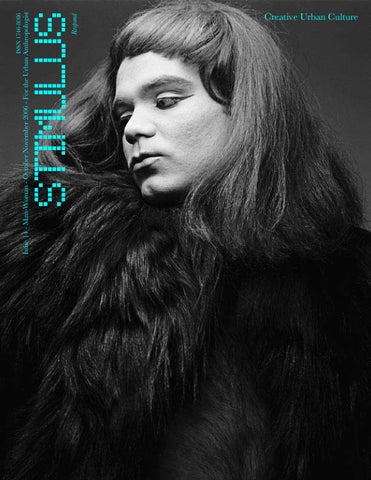
Cover image by Juan Del Gado
Issue 14 Man/Woman How is the relationship between genders defined by culture? Are the stereotypical ideas of man and woman true to life? What is the importance of gender within society? As a white male in London it is difficult to conceptualise in a first-hand manner the problems and issues associated with being discriminated against because of my gender. I am lucky, I suppose. It is hard though to imagine what society would be like without some idea of gender. Although we live in an age where same-sex marriage is possible, and where a man giving birth is a distinct reality, will we ever see a culture where gender is irrelevant; where the struggle for mutual respect between genders is fulfilled? One would certainly hope that the changing rules of society are somehow indicative of changing attitudes on a more personal level. The exploration of this topic has certainly been thought provoking for our contributors as well. Taking centre-stage is Tom Minor’s celebration of androgyny, accompanied by some wonderful portraits by Juan Del Gado, who also takes the cover. If anything, this issue is a celebration of diversity and we are pleased to be including a piece that explores perceived notions of sexuality amongst disabled people, as reported by Neal Newfield and Phillip Donnelly in their recounting of Buddy’s visit to a lapdancing club.
It seems that not an issue has gone by recently without a change of editorial staff. We have settled down now with a great regular team, joined most recently by Yannis Tsitsovits as poetry editor. Yannis has been working with us for a few issues in various capacities so when Mary’s role became available at short notice he was the ideal candidate to fill it.
Just a quick reminder then that the theme next month is Home. Fitting perhaps, because this year has been an incredible journey for Stimulus and everyone who is involved in producing it. Finally then, we made it.
How To Get A Girl Into Bed Without Trying Too Hard Words by Paul St. Paul This IS
POEM
A Because
I
Said It
Is
P.S. I am a postmodernist
So God Created Man in His Own Image Words by Jeffrey Barnes
Earth is moon-coded, an egg aswim in seamen, son. (O God hid magic in water!) As I am coming down to her edge (a sin), going: “Cow,” I said. “Man needs a mother,” God-chime: “To drown is a sin. Amen. Age is the ending...” Was a grim ocean mood drawing me? I’d chosen to...so I manage a swim -- (none imagined “chaster” good) -- ‘n’ chased ‘er good! Woman, imagine it’s seawater, man coming inside...”Oh God!” ...Odd...We came singing His name. A root to Eden’s Garden, I -- O woman, His magic.
Every line in this poem is an anagram of the title. Thus it is a product of alphabetical necessity, and does not necessarily express the views of its author.
The Clearing Words by Clare Thornton Both arriving at the clearing, They experience a temporary territorial conundrum. They size each other up. Faces tipped down yet eyes looking up, locked gaze. Flaring her nostrils un-perceptibly (almost) He runs his tongue along the inside of his teeth. “He’s hungry” she thinks – smells it “She interested” he surmises, but in what exactly? Pull off that skin you fucker! Fuck me, fuck, it, fuck us, fuck them, Just… But hold on just a fucking second! There, in that clearing, Floor springy and giving beneath their sinewy optimistic feet.. Isn’t that it? No, no, no, No oasis references. No welcome drops of water = piss, Blah de fucking blah. I want it semi real, “Like wild, yeah, but like totally mental!” “You are absolutely impossible my dear, Really quite the thing”. Crack the joint, lick it, bite it, suck the very marrow of it Crack it, crack me.
Playing Chess Words by Mary X It was in the night that awkward darkness covered a girl and pushed the check towards my eyes. That busy place – Hustle and bustle – Booze being knocked back like Water. I had no legs and the fairy darkness lay on my hip. I ask questions, cryptic question marks that bemuse and confuse my listener. She slides from under my feet and into the lit palm of another man – again. I am another piece on the board. The hand that catches these women of the night is bewildering to a forlorn man. Towering over my head with forks for fingers and wings for wrinkles. The floor was littered with ashes and stapled together in a livid mix of beer and vodka in
the night-time, with it’s mysterious glow; was as good as it gets to tumbling over the edge of heaven just to be cast in granite and dropped into an ocean of Hades. I am simply playing chess with humans, and I am a pawn in white opposing every check that slips through my fingers; until I get dropped into the basket of death. Until I get placed back On the board for another game.
Reversing the Muse Words by Annmarie O’Connor
My memories of you are like fresh paint: sticky with colour, impatiently waiting to stain me, dare I touch. But I do. Wanting again to feel your residue cupping the soft curve of my stomach as it rises and falls, I would rather you mark my entire body with your tongue than lose you again. Like a tide of pornography, I opened myself up to you: legs, mind and heart so that you would want me. And you did...the best of zealots worshipping with such Dionysian fury You were christened and I was your rite of passage. Now there is no going back.
Image by Tasos Linardo
Faithful
Words by David Blaine Image by Tasos Linardo
Two Sailors, faithful crew. No mutineers here, no, they’ll do the bit they signed on for. So each one takes his orders; each one stands her watch, living, working, knowing, growing, together, side by side. And when the watch is over, each one returns to quarters, on a different ship. And when the day is done each one is loyal to a different captain. Two captains who anchored their ships for a time, together, side by side. But in due season each ship will sail a different course. And these sailors won’t become mates, but remain two sailors, faithful crew. No mutineers here, no, they’ll do the bit they signed on for.
Persian
Words by Christina Lovin Shuttle looming over and over and under and over me with a music not yet made— humming through my strings, like the gentle current of Abzinrud, sighing: Ibram—I will make of you a garment of doubly twisted thread, from the wool of fat-tailed sheep, from absham, my cone of silk— indigo with longing, crushed purple like the dyeing root of madder, the crimson death of cochineal— strands pounded tight upon themselves like darkness enmeshed between taut thighs. And I become shikafur-zar, a garden abloom— pomegranate beneath the palm leaf of your hand, honeyed bread to your mouth, jasmine against your nostrils, bent willow, Mihrab, in the arch of my prayer, celestial, eternal in this arabesque, hanging like held breath, abrache of my belly shimmer and shake— rishida. I am wounded—reshida. You have knotted me two-hundred-fifty to the inch. Embellish my faults: ‘aqd bastan...sehna Like the Arishani of Marrhad, whose price is firm, you roll out my body and shake it, loosening the clinched fringe, my edges coming unraveled.
Notes: Abzinrud..a river in Persia Ibram…to make a garment of fine thread absham…cone of silk shikafur-zar…a blooming garden Mihrab…a prayer arch abrache…subtle shading & shimmering of fine, high quality oriental rugs, colored with vegetable dyes. rishida… luminous reshida…wounded aqd’ bastan…to tie a knot sehna…a tight, Persian knot Arishani…silk merchant Marrhad…a holy city, known for the best quality of rug.
Gene Test
Words by Alistair Noon Pa – no ram: a pan, or a map, an ‘or’. Am? A panorama. Pa? Nora M? A panoramapa? No! Ram a pan or a map!
A ‘Nora’ – ma? P… an ‘O’… R, A, M, A... Pa, no! Ram a P, a ‘nor’! Am ‘A’! Pa/Nora map ‘A’? Nora, Ma, Pa... Nor am a panorama...
Incendiary Words by Christina Lovin Image by Herwig Maurer I caught your eye across the dim café where you were sitting with your dark-eyed wife, together filling up the chipped ashtray— her butts smeared red, yours long and still alight with flickering ash. And smoldering in the dark the brand between my thighs began that slow burn which only fleeting glances seem to spark. My lowered eyes and cheeks reflected shuddering glows of candle flame and blood-stung flush— your gaze surged toward me. Then as quickly froze, for she had felt your heat and caught my answering blush. You took her pretty hand in yours and quickly rose. Then choosing long love over singeing lust left me, incendiary in the gloom, to self-combust
Club Paradise, Lost Words by Christina Lovin
One woman to one hundred forty-four of them, the men: the odds of paradise or that strobe-lit stage of suffering before? The lovely devils levitate and writhe in smoke, like Rodin’s muscled multitudes in hell. The halogen burns hot above as I ignite below the glistening rood. On borrowed wings he hovers, smooth-skinned dove. His wing tips brush my body like the holy sigh he presses to my ear: “Nine inches that will make you scream my name!” And I, my tongue struck dumb, my breath, magnificat; but where (although I cannot speak his name) I touch his shining horn, my fingers flame.
I
t is funny how the seemingly obvious relationship between a man and a woman is that of marriage or partnership. It could of course relate to mother/son, brother/sister and so on. Given the relatively democratic inclusion of lesbian, gay, bisexual and trans-gendered people in society these days, it is surprising to me that man/woman still evokes such a traditional concept of a sexual partnership. Egalitarians have replaced ‘man and wife’ with ‘husband and wife’ for the purposes of the Eucharist of the marriage ceremony – without perhaps considering using ‘man and woman’. ‘Man and wife’ was seen as conveying a possessive message – that the wife belongs to the man. But couples still want to come across as belonging to each other in some way, and perhaps ‘man and woman’ would simply not cut it romantically when considering marriage. I am a great believer in marriage. Being the only child of two married people who began to despise each other quite early in the relationship – finishing via an acrimonious divorce – this may be somewhat surprising. Given that my father went on to marry his divorce lawyer, you would think that my vision of nuptials may have been further sullied and confused. But I believe that being legally connected to someone who is not a blood relative imposes a sense of responsibility and commitment. These are terms that in contemporary society can send people screaming into the next room in order to find petrol to douse and a match to light. Why? Being able to include someone else into your
Hannah Cranston daily planning and thinking, and to empathise with them in a way that opens you up to how they think must be an engaging and serene experience. For those who believe they are strong independent types who wear lipstick because they want to, marriage may be seen as an antifeminist sacrifice of one’s strength and individuality. But having the strength to consider others when thinking of one’s own life, as marriage requires, demonstrates a power way beyond that of being able to independently decide to get lipstick on your (or someone else’s) collar. Being a member of a movement such as feminism is in itself an indication of group – rather than individual – identity, so the obligation of individuality falls at the first hurdle. Furthermore, lesbians – who are often faithful subscribers to the religion of feminism - seem to be getting married. Gay men too want their day of attention and glory. Whether it be for the party and fame or the desire to demonstrate long term commitment, everyone is doing it. Marriage has definitely not gone down in popularity. It is a sad fact however, that the desire for people to abuse their partners never ceases to increase. One in four women will suffer domestic abuse in their lifetimes. Two women a week are murdered by their partners or ex-partners in the UK. It is estimated that there were about 12.9 million incidents of domestic violence against women and 190,000 against men in 2004 (Walby and Allen, 2004), and domestic violence accounts for 17%
of all violent crime (Nicolas, S. et al, (2005). Added to the shock of these figures is the growing number of honour killings and abuse committed by those whose cultures dictate such violence. These cultures tend to be those that hold marriage in very high esteem – who you marry and when can either make or break you as an individual. It is ironic that in cultures where marriage is such a socially desirable thing, that it is abused in such a violent and emotionally destructive way. So perhaps we should start thinking of the relationship between men and women in a different way. Abuser/survivor, criminal/victim. Not quite the romantic association one would like to have towards gender relations, but a partial reality all the same. A woman is more likely to be harassed, stalked, raped or killed by her partner once they become separated. How strange that someone would abuse their position within a marriage or partnership to the point of separation, and yet once separated the frustration simply worsens. Perhaps we are confused about marriage these days, not knowing how we are supposed to behave and show our affection. With certain members of society becoming so vocal about their opposition to marriage, there are not enough of us who are publicly vocal about our support for it. Perhaps if there were more forums of debate supporting marriage, there would be more education on how to do it right, rather than not do it at all.
Text and Interviews Christos Kyriakides Photography Hannes Gudmunsson Styling Melina Nicolaide Make Up James Hair Christos Kyriakides Model Ksenia at FM Models
Noir
D
anish designer Peter Ingwersen walks in no darkness at all. The former executive of jeans giant Levi’s, now designs under his own label, Noir. Using illuminati (a luxurious fabric brand that delivers organic and Fair Trade cotton) as his main supplier, Peter’s eco-fashion designs are leading urban-chic wear. His structured clothes and strict tailoring are inspired by a passionate, dreamlike sensibility of american literature and the strict femme-fatales of Helmut Newton. We think Peter is in fact nothing but sunshine for the industry. www.noir-illuminati2.com
1. Signature design by now?
Slight appreciation of subtle SM…caressed by the whip and black satin.
2. Materials & techniques. Can you give us your favorite? Leather. Favourite: Black leather pencil skirt
3. Soundtrack of the coming winter? Boys Choir
4. Greatest influence by now?
My mother and Helmut Newton
5. What drives you to continue?
My personal assistant in high heels
6. Best Man/Woman around? Edgar Allan Poe
Deux Hommes Photography Constantinos Tsiliacos /Adrenalin Management Styling Stelios F. Stylianou Make-Up Julie Alexander /D-TALES Hair Francee/EFFEX Model Alex /A1
Dimitris Alexakis and Gregoris Triantafyllou, alias Deux Hommes, define contemporary beauty by projecting yesterday’s class onto the future’s simplicity; giving birth to a genuine post-Greek sense of perfection. Deux Hommes’ pret-a-porter is now ready to go international after several years of constant creation. Their spring/summer 07 collection will be shown in Paris and Tokyo.
Signature design by now? Retro - future cocktail dresses and tailoring that looks part bourgeois part uniform. Materials & techniques. Can you give us your favorite? We use and favour a lot of silk brocades and cloque cotton. Also thick lace, wool and organza. Our techniques are based on anatomic seams, layering of fabrics to create new textures and graphic effects and modified volume that seems light and under control. Soundtrack for the coming winter? Jean Luc Goddard: Nouvelle Vague Phillip Glass: La belle et la bete Serge Gainsbourg: Initials B.B. Greatest influence by now? French cinema, (Nouvelle Vague), post-war Paris couture, European Portraiture and Romantic Futurism of the 60’s. What drives you to continue? Our need to chart new territories of beauty and our duty to project yesterday’s clothes into the future, and last but not least not disappoint those who believe in us. Best Man/Woman around? It is difficult to place the people we love and admire in a line up!
P
opping into H&M the other day I was confronted by a quite hideous mountain of ‘Madonna tracksuits’. They are, frankly, pretty vile and cheap looking, and I’m surprised she’s actually put her name to them. But it did get me thinking about her career and all her reinventions. Although as far as I know she’s not involved herself in ‘fashion design’ directly before, she’s certainly had an effect on the fashion world through the various iconic looks she’s sported before. So is longevity in music achieved through constant reinvention, as Madonna has done with her look and her music? It’s a hard one to call. It has obviously worked for her, even though there have been a few hiccups along the way where once or twice she’s got it wrong and not quite managed to capture the zeitgeist as planned. It’s also worked for David Bowie, another musical chameleon who has reinvented himself and his sound over the years, with no major detriment to his career. And of course The Beatles moved through several different musical modes. But it doesn’t work for everyone – remember anything from Kylie’s IndieKylie period, for example? Thought not. But once she went back to the pop formula she was best at, her career skyrocketed. And don’t forget many of the bands known and loved today probably sounded quite different when they started out, with many under other monikers too. Supergrass started out as The Jennifers and back at the beginning Blur were known as Seymour. And it probably took them a while to get good, and to hone their
Gwen Cheeseman sound. Aside from the fact that the names we now know them by are a good deal better, perhaps another reason for the change of name was to reinvent themselves in preparation for what they were determined would be their new found fame. Of course it’s not the first or last time musicians have tried to distance themselves from previous incarnations. I’m sure Norman Cook aka Fatboy Slim doesn’t particularly encourage reminiscences about his time in The Housemartins. Perhaps reinvention might also be to do with musicians becoming restless with their sound and style – not just a need to always be at the crest of the musical wave. But this doesn’t always mean pushing your band to change – nowadays you can just pop off and be in another for a while, or even carry several bands simultaneously. Jack White of the White Stripes has of course formed The Raconteurs – and apparently this doesn’t mean that he and Meg have stopped working together on the original band that brought him fame. Ditto with Blur, who while supposedly still together but ‘resting’, has meant frontman Damon has been/ is in about three different bands and counting – the latest being The Good, The Bad and The Queen, a new project with Paul Simonon of The Clash. Then there are bands who have never really reinvented themselves or even changed their sound that much aside from the natural progression of time. Take REM for example. They seem to be of the opinion that if the formula works, why change it. So
they have pretty much stuck, aside from a few very minor deviations here and there, to what they have always done. And that makes them instantly recognisable. Hear a new REM single on the radio, and you’re bound to know it’s them. Obviously part of that comes from Michael Stipe having such a distinctive voice, but I think the style gives clues too – as it really hasn’t changed all that much in the last 20-odd years they’ve been together. Another band who seem to be happy to stick with what they know works are U2. Admittedly their sound has slowly veered toward the stadium rock niche they’ve been firmly in for a good while, but it hasn’t changed
Is longevity in music achieved through constant reinvention? unrecognisably from the days before they’d fill Wembley or Earls Court. So it seems there’s no hard and fast route to ongoing success. You can be a flash in the pan, but to keep success going over even a few years, is a difficult art. While constant reinvention and shedding old skins works for some, others find a slow and steady stream of keeping going with what they know their audience will definitely buy and appreciate. So even once you get there, the battle isn’t over – if musicians want to stay in the hearts and minds of the public, and in the charts, for any length of time, it means they could have to go back to the drawing board, for there are few long-timers left to reveal their secret…
WHAT
ARE YOU LOOKING AT?
Words by Tom Minor Images by Juan Del Gado
T
his piece is dedicated to all those people, you know who you are, who actively pursue a path of liberation for our engendered society. To all the men who say it’s okay to be close with other men and all the women who stand in solidarity and love with their sisters. To all the people who defy limited expression of sexuality, sexual identity and gender, I salute you all, thank you for opening my eyes! The first question many new parents are asked, is regarding the gender of their new born. Often decided before the child is born, gender dictates what role said boy or girl will play in their parents’ lives. Many fathers-to-be exult in the prospect of forming that ever illusive father-son bond that most people only ever read about in fictional stories or hear of on evangelical radio shows! I suspect even more mothers-to-be enjoy the much more realistic intuition that they, as creators, carriers and nurturers; sustaining their little ones from their bosom as one, will indeed form a close bond through pain and intimacy with their offspring (especially a little girl they can dress up and play tea parties with!). But nowhere is it common for parentsto-be to discuss the possibility of NOT labelling their child with traditional, universal, orthodox gender titles, preferring instead to raise their cherub as a human being, free from societies dogmatic and oppressive gender rules. Nowhere, are there volunteers to deconstruct what we know to be Man and Woman, through the identities of their unconditioned neonates. Fortunately, there are plenty of natural cases of hermaphrodites, androgynes and a vast continuum of Trans varieties which continue to push the boundaries of what we assume to know about the paradox of man and woman; mainly via a sub cultural or anti-cultural youth gender-liberation movement. First we need to define our terminology and as well as addressing the pertinent question of Androgyny: the unity of yin-yang forces, we also discuss the relevance of living in a Patriarchal era, what that means and has meant for women and men over the centuries, what came before it, what should come after it, all these questions arise organically from the proposed subject title as does the motivation to assess the stakes each gender holds in the world today, with reference to Sexism, Gendercide, Homophobia and other oppressive techniques employed by the materialist dominant culture to suppress and crush the individuals’ right to expression, right to sexual and
gender determination. These rights are supported by International agreements coming from the UN and other agencies and yet like so many things that come from above, have failed to settle and find a home in the complicated web of societal attitudes and cultural reform which act as major buffers for real change to happen in the hearts and minds of the average citizen, bigot or not! Gender describes the state of being male or female or neither. In social sciences, gender is used in contrast to biological sex to emphasise a social, cultural or psychological dimension. Sexologist John Money wrote in the 50’s that the term ‘gender role’ is used to imply all those things a person says or does to divulge him or herself as having the status of boy/ man or girl/woman. Gender roles include sexuality, but are not constrained only to eroticism: elements of such a role can be displayed through clothing, speech patterns, movement and other factors, not only limited to biological sex. This is not a bipolar conception of gender at all, in fact many cultures recognise a third sex, or even a fourth, fifth or sixth. Native American 2Spirit people, Hijras in India and Pakistan, Lady Bois in Thailand, such examples reflect an intermediate state, somewhere in between male and female, sexlessness and distinct genders that do not depend on the basic dichotomy of male-female gender roles. Your gender affects the way people treat you: small boys are always played with harder and little girls are given soft toys to sit quietly and play family with. If you look in any school playground you’ll notice how the boys dominate the playing space. We are expected to display certain attributes and behaviour appropriate to our visible gender role and this is dictated by the culture we live in. These interactions mould our families, communities and workplaces. Gender is and has been an organising agent in society for a long time because of the cultural meanings we give to what we understand as being male or female and this is highlighted by the divisions of labour we see across the genders throughout history. There is an abundance of material indicating palpable trends in women’s and men’s work universally, although explanation for such divisions change over time and across societies. While the specifics vary, the tendency is that women have less autonomy, fewer resources and much less access to the decision making that impacts their lives. This inequity is a leading development and human rights issue and as a result there is now an annual United Nations meeting
in Beijing to champion Women’s rights globally. Psychologists have also recognised the plight of women world-wide as the primary victims of discrimination, with disproportionately less access to food, health care, inheritance, credit, education, training, employment, compensation, family and public rights, individual mobility, travel and religious participation than their male counterparts. Women also face oppressive legal, societal, cultural and religious practices which justify and endorse this discrimination (Bianchi, Casper & Peltola, 1999; Goode, 1993; Hauchler & Kennedy, 1994; Smeeding & Ross, 1999; United Nations, 2000; United Nations Population Fund, 2000) One place I can think of where men fare worse than women is in the realm of emotions and healing. We may have more resources and power, but inside we’re more of a mess, we don’t get to share our pain, heck we don’t even get to feel it, we have to be so numb in this society, and we don’t cry, certainly not once a month, nor do we find support from our male friends to look at the places we’ve been hurt and to try and heal from them through what Freud coined the talking medicine. Women, at least are expected to be sensitive and in touch with their emotions, they get to claim their humanity over and above their male peers in the world. A place where men and women are being targeted increasingly equally, is in the beautification industry; something that has paved the way for much experimentation in male circles with the invention of new labels further pushing our judgement of what it is to be a heterosexual male (metrosexual/ubersexual/ retrosexual). Clearly the beautification industry is leading in the field of exploiting women and all in the name of appearing more attractive to men, much like gay men experience a similar set of ideals as they too try to impress upon fellow men, strange how women aren’t demanding we carve up our bodies and plasticise our faces just to look pretty to them!! Men have used makeup for centuries but only now is it becoming mainline to touch up your face or self-tan (or worse… self-burn), men are victims of popular fashion and beauty standards just as much as women these days, its hard to keep up and know what’s expected, the lines are getting well and truly blurred, yet I think that is the point of much of this experimentation and statement making. It takes courage for people to take such a bold step, and these individuals aren’t always received well with the ignorant, homophobes that span our isle. It’s the old tale of not fitting in and becoming outcast
and stigmatised, marginalised and attacked for being different; people still prefer to have things neatly cut up into clear little packages and anything ambiguous is unknown and therefore frightening, so a reaction must be had, sadly this comes out as oppressive bullshit that only proves our point that people are ignorant and need waking up! It appears that androgyny threatens many presuppositions about individuals’ identity as men or women, and therefore threatens the security of those peoples’ identity. You can find reference to the Androgyne in Hinduism, Buddhism, the Platonic tradition and evidence of it’s being annihilated from Judeo-Christianity. The first mention of the androgyne in Greek Philosophy is in Plato’s Symposium, Aristophanes. Aristophanes describes the orignd them in [The] original human nature was not like the present, but different. The sexes were not two, as they are now, but originally three in number; there was a man, woman and a union of the two, having a name corresponding to this double nature, which once had a real existence, but is now lost, and the word “Androgynous” is only preserved as a term of reproach. Androgynes either have no gender or display elements generally associated with the opposite sex. There are different types of Androgyny: where people are physically amorphous; where they are behaviourally vague; psychologically androgynous or politically genderqueer. As well as being born with an unclear gender-identity, many people decide to take on a fluid gender later in life. People express their genderlessness with hair, make-up and the clothes they wear, even calling themselves deliberately confusing names such as ‘boi’, ‘grrl’ or ‘brosis’. With so many new labels coming off the street, its difficult to define them as quickly as they appear but Kate Bornstein recommends, that a transsexual shouldn’t be described with the nouns “woman” or “man,” but instead, through active verbs attesting to the constant transformation, the new identity or, indeed, the “in-betweenness” that puts the gendered identity into question? Gender bending is a term that refers to the individuals who actively work to transgress the expected gendered rules that apply to them. As an effective form of social activism, Gender benders remind us not to make assumptions or overgeneralisations about what it means to fit into a particular gender category.
The true androgyne will not be discovered outwardly in the world, but internally by looking into ourselves. It is nonmaterial, androgyny is a state of consciousness that is far from ordinary, and therefore it threatens many peoples’ state of equilibrium. According to Freud, you either identify with a sex or you desire it; only. So it isn’t possible to desire the sex you identify with--if you are a man desiring another man, Freud would say that’s because you really identify with women. Gender, then, as the identification with one sex, or one object (like the mother)is a fantasy, a set of internalised images, psychically imposed on the body and on one’s psychic sense of identity. Judith Butler, in her thesis ‘Gender Trouble’ concludes that gender is not a primary category, but an attribute, a secondary set of narrative effects. Gender is thus a fantasy enacted by “corporeal styles that constitute bodily significations.” In other words, gender is an act, a performance, a set of manipulated codes, costumes, rather than a core aspect of essential identity. Butler’s main metaphor for this is “drag,” i.e. dressing like a person of the “opposite sex.” All gender is a form of “drag,” according to Butler; there is no “real” core gender to refer to. And where are we today? It seems the effects of worshipping men are coming round to bite us all in the neck, drain our blood and the blood of our mother earth, until every last drop has been used to spread as many parasites across our empty carcasses and the hollow grave of a planet we live on until everything falls off the scale and Nothing prevails! All the major patriots of our time have done nothing for the liberation of human kind, they have done a lot of bloody killing in the name and destroying the name of humanity. They have advanced our technologies to the point of human expendability and our homes have got busier, more lucrative and much hotter, wetter and unpredictable. Some great men have shown us the errors of our ways (Jesus, Ghandi, Marcus/Martin/ Malcolm, Kwame Nkrumah, Noam Chomsky) and women, though curiously, even my mind can’t come up with a list that long that quick!! But it is women who have survived the continuance of our unholy race, women have raised our young and taught them love and love is what keeps this beautiful, diseased rock spinning. So there was a time when we all worshipped Woman, Mother, Divine Grace and Beauty, but we can strayed from our roots and ended up near oblivion, but we have a chance, was we approach the
centre of time (2012), the ante could become whatever we want it to be, and if the ancient wisdom of the Mayans is anything to go by, this could be a time of balance, between the positive and negative forces in our universe and perhaps then we will all wake up to our destiny as protectors and ambassadors of humanity and all of God’s creations, not only ourselves (though we don’t do that too well either!) In terms of gender and the future: According to George Dvorsky, Postgenderism is a diverse social, political and cultural movement whose subscribers insist on the elimination of gender through the application of advanced biotechnology and progressive assistive reproductive technologies. Advocates of postgenderism argue that the presence of gender roles, social stratification and sexual dimorphisms are generally to the detriment of individuals and society. Given the radical potential for advanced assistive reproductive options, postgenderists believe that sex for reproductive purposes will either eventually become a thing of the past or that all human beings will have the ability, if they so choose, to both carry a pregnancy to term and father a child, placing the entire need for gender and gender differences into question Some new forms of radical feminism actually sponsor the elimination of males altogether (gendercide) which can be construed as a type of postgenderism. From my point of view, I prefer the pre-gendered ideas where men are necessary! But these developments certainly give us an idea of what the limits, if any, are. Personally I’m interested to see how things progress, in the next 7 years, a lot could change and I myself would love to carry a child to term, its something I’ve always wanted to do and never understood why we hadn’t figured that out, I know it seems unnatural but the prospect is enticing and I certainly would never say no to being the first man ever to try (although I’m sure Governor Arnold beat me to it!!)
Bark Psychosis Words by Michael Nottingham
G
raham Sutton is the founding member of and principle player in the east London-based band Bark Psychosis. The band’s acclaimed 1994 full-length debut, Hex, is often cited as a cornerstone of the emergent Post-Rock genre. Post-Rock was distinguished by its innovative use of sampling, tended to place more emphasis on building texture than conventional melody, and used traditional rock instruments like electric guitars in decidedly non-traditional ways. Released in 2004, ///Codename: Dustsucker is the band’s longawaited follow-up and has garnered widespread critical praise. Stimulus talks with Sutton about the creative process, how Drum & Bass are like Wallace & Grommit, his plans for the next record, and working with Jarvis Cocker and a bunch of cunts. When making Dustsucker, did you feel the pressure of high expectations after the accolades received by Hex? When Hex came out I couldn’t get arrested – no one liked it. The record company didn’t like it, the public didn’t like it. We couldn’t get any reviews. I loved it. So there was no pressure other than from myself really. What do you think of the whole post-rock label, coined by journalist Simon Reynolds? Was there an active post-rock ‘scene’ in the early 90s? Simon Reynolds was one of the few people to review Hex. I knew a bunch of people in the other supposed ‘post-rock’ bands like Disco Inferno, Papa Sprain, etc. Disco Inferno were on the same label as us and from the same part of Essex/East London. And our keyboardist originally played with them. Actually I got on with them really well out of all of that lot. There was another band at that time called Insides, Brighton-based, who were originally called Earwig, whom I was very close to – I thought they were amazing. The singer, Kirsty, had something really special I thought. Was there a concept you started with when making Dustsucker? You never start the thing knowing how it’s going to turn out – it’s more about the process, about doing it. The whole reason I make records, the
reason I enjoy doing it, is because I have absolutely no idea what’s going to come out of the other end. The pleasure I get out of it is…[pauses for slightly hammy effect] the journey itself. I’ve never ever felt motivated by the idea that I have some personal, deep-rooted message that I have to share with the world or something like that. This music, although very personal, is not “personal” in that sense. I want to remove as much of myself from it as I can. I like the idea of being a conduit for something. I’m interested in making something that can have a radical effect on me and can change my life as I’m going through it. It’s one of the main reasons it took so long to [put out the album] – by the end of it you’re fucking exhausted. Dustsucker really was five years of sleep, wake up to it, sleep, wake up to it – seven days a week. What were you doing musically during the decade between the two Bark Psychosis releases? I had no band after Hex so Bark Psychosis was put on hold. I got involved in the nascent drum & bass scene in 1994, under the name Boymerang. I got involved with Grooverider and Metalhedz – it was good fun. I didn’t need an expensive studio to do it and could cut tracks from the comfort of my own flat. I would work really hard in isolation, give DATs to people on Friday. They would take a track away, cut it, play it on Sunday night. I’d go and see it played out, watching a whole club go mad. Eventually drum & bass was co-opted as beds for traffic news and for hair products. But at the time it was genuine. I guess it was maybe how punk was – something that lasted a very short time and burned very brightly while it did. Everyone listened to each other’s work, picking up influences – and every week the sound would change. So it was very dynamic, with a very accelerated development. Production-wise it was not unlike animation in terms of how it’s put together. You’re looking at very short, tiny packets of sound, which take ages to set up. It’s a bit like Wallace & Grommet – you’re there and you’ve got your lights and your clay dog and your beady eyes. The whole set up takes ages to produce only a second of motion. Did that drum & bass period have an influence on how Dustsucker developed? A lot of that album was constructed in a similar fashion. Boymerang taught me so much just about
editing, manipulating tiny amounts of sound in a way that still results in a natural sound. And the technology has caught up enough that I can now do this in a way that’s economical. How do you approach the creative process? I’ve read that for inspiration you’ve had periods during which you’d wake up every morning and before doing anything else fill up a page with whatever came to mind. Yeah, most importantly without conscious thought or self-censorship. Then seal it in an envelope and file it away, only looking at them about six months later – you can really surpise/shock yourself! I did that the whole time I was doing Dustsucker – and I’ll probably do that for the new one as well. Once you find a starting point, you can get on and do things, but if you don’t have anything to work from then it’s almost impossible. So setting some sort of boundaries or rules or some sort of arbitrary thing like restrictions can help trigger the creative process. The drum & bass phase was really helpful in terms of editing, but it also at the time diminished my appreciation of music. You’re looking at such tiny little bits of sound that you get stuck in a little niche and lose the bigger picture. After this I wanted to put much greater importance on words. So I thought it might be interesting to start off the process by doing that, by just playing with words, without thinking about it. Obviously with this page a morning thing, you get a lot of words going around. You might not use any of them but at least it gives you a starting point, just bouncing ideas off yourself. You have quite a cult following. Do you get much fan mail? I get e-mails every week from far-flung places, like Chile just the other day. Someone sent me clips of this guy in China who’s started a Bark Psychosis tribute band. They did a concert of our music just outside Beijing to celebrate an anniversary of the Party or something. Apparently there were thousands of people there. Quite bizarre. In the article in which he proposed the genre post-rock, journalist Simon Reynolds seemed to suggest a gendered opposition between the kind of music bands like Bark Psychosis and Seefeel make and the more traditional, crunchy riff-based, power chorded rock. Would you agree? Without reading the article I can’t comment much, but I wouldn’t be in agreement with any simplistic argument that polarises behaviour according to sex.
“I wouldn’t be in agreement with any simplistic argument that polarises behaviour according to sex.” The bit that strikes me as interesting is this whole notion of the gradual eradication of kinetic energy. In the last album I was interested in taking the blood out of something. Not about telling a story with the beginning, middle and end, but more setting the scene and that’s it. It’s sort of about having something in stasis. The subject of gender reminds me – a band I’m producing called Coldharbourstores came around the other day. They’d done a Youtube search on BP. There’s a video someone created and put up there for “400 Winters”, a track on Dustsucker, featuring this Peruvian model posing and looking like she’s about to strip. It looks like its been clipped off of late-night Peruvian TV with a kind of ‘Call me now on 0891…” kind of feel. But I think it’s fucking fantastic. I’m quite a nocturnal person, and like late night TV – all that naff stuff. I find all that quite riveting. It’s a fascinating subculture… Anja Buechele sings on the track, which is innocent enough. But with the video it becomes the most horrible milk-tray, oily and sleazy track. It’s genius the way they’ve cut it together. Any more Bark Psychosis material in the pipeline? At the moment I’ve got this idea for writing the next album, which is basically field recordings and voice – that’s it. As a restriction that’s all I’m allowing myself to use. Having said that, it’s probably just an excuse to travel around – Asia, Brazil, Cuba. Hopefully the new album will be done sometime next year, but no promises! You’re working as a Producer much of the time, with bands like The Delays, British Sea Power and, most recently, on Jarvis Cocker’s new album? How has that experience been? Fantastic. Jarvis is pretty demanding but I love the
album we’ve made. Probably my favourite production-work to date. That and an album by a band called Pellumair. I’m told there was a bit of palaver with Jarvis’s new track, Running the World. It’s a track that’s been circulated before the release of the album, and has a big sing-along chorus of “cunts are still running the world”. All highly admirable stuff. Anyway, Alfonso Cuaron, the director of the new film Children of Men decided that he wanted to use the song over the end title credits. A few days before the premiere I got a panicky call that the film was supposed to get a 15 certificate, but because of this song at the end it was going to become an 18 certificate. This obviously could be a bit of a problem for them because of box office. I was given guidelines that apparently fucks and shits are ok, but 2 cunts is the limit for a 15! So I quickly did different versions with all the cunts backwards, some of the cunts backwards, cunts removed, etc. Anyways, we all went along to the premiere and found out at the end of the film that he’d actually decided to use the full-cunt version. So in America it will get an R rating because of that. A brave decision for sure. As of right now I don’t know what the final certification was in the UK.
Conroy-Sanderson’s portraiture is a humourous and critical comment on identity shifts, the diaspora, and the vulnerability that they sometimes bring about. Stimulus talks to them about their art, gender theory, John and Yoko, pyjamas, and swapping genitals.
Here We Are Interview by Yannis Tsitsovits
On Hold
How did you meet? We met at Art College – Neil was on the sculpture and Lesley on the painting course, and as we had mutual friends we did a lot of socialising together, saw a lot of live music and films. Art College was very positive. It was a stimulating, hectic and exciting time of trying ideas out and being around other creative people. From the beginning we were always involved in each other’s work – either by giving each other critical feedback and suggestions or by helping to make and install work. We continued to support each other’s work for many years until we realised that each was a major part of the other’s practice and that our ideas were increasingly running parallel and crossing over. At that point we made a specific decision to collaborate, which we’ve been doing for the past eight years. Collaborating is a huge shift in approach, but it seems to be working for us.
At Arms Length
“The idea of performativity extends beyond gender to encompass identity in general” You are a couple who also work together as artists. How important is the idea of gender to your work? Within gender theory there is a strong argument that gender is a social construction rather than a biological destiny. Gender theorist Judith Butler writes about how we are mistaken when we presume that the male or female gender have essential, core characteristics. She says that we all put on a gender performance, that gender is ‘performative’. The theorist Joan Rivere writes about womanliness as a mask which can be worn and removed. These ideas of performativity and masquerade pervade much contemporary art that deals with identity. This thinking initially came from gender theory. In our work the idea of performativity extends beyond gender to encompass identity in general. We often use ourselves as the subject in our videos, photographs and drawings, but within these works we engage in a performance or masquerade. They are never intended as explorations of ourselves, but reflect other ways of inhabiting the world, other social ways of being. Sometimes these scenarios are exaggerated, as in Here We Are, where we are bound up in bandages, making two separate bodies into one amorphous
shape. The bandaging ties us together but also eliminates the ability to see us, to consider either our gender or our ethnicity. There is intended irony in the title by saying that we’re presenting ourselves to the viewer, which we then deny. We used bandages to suggest the body in distress or in need of medical attention, and then purposefully used them in an absurd way. They become a cover for invisibility, as in the 1933 classic film by James Whale, The Invisible Man, where the protagonist uses the bandages to reveal himself, but then sheds them so as to disappear. What about Western and Eastern elements in your art? Neil was born in England, Lesley in Malaysia. To what extent is the portraiture in your exhibition, Out of Nowhere, defined by your origins? Out of Nowhere is influenced by the fact that we are culturally and geographically from different places. This reflects the experiences of so many today in our increasingly mobile, migrant world. The exhibition explores ideas of dislocation, a contemporary condition that is not just about origin, although this is a major part of this work. A major part of the exhibition is two videos projected large in the space at the Chinese Art Centre.
Here We Are
“We were fascinated by seeing people out walking, wearing pyjamas in the early evening” In both we stand motionless dressed in pyjamas. They are shot in contrasting locations and our clothing is out of context with both. We decided to wear pyjamas within an outdoor or public context because when we were exhibiting in Shanghai two years ago we were fascinated by seeing people out walking, wearing pyjamas in the early evening in their neighborhood. Clothing that is usually associated with intimate or private situations in the West were being worn publicly in China. We are interested in how same things can take on different meanings in other parts of the world and how the pyjamas seem to signal a way of inhabiting public space in a way unfamiliar in the West. We’re interested in this collapse of private and public as it’s between the two that our sense of ourselves becomes formulated. Not There at All reminded me of the video for John Lennon’s Imagine. Lennon & Ono created some of the most challenging and controversial art of the 20th century. Have they been an inspiration? Not There at All was made as a direct response to a specific place and context. But you are right: there are echoes of the Lennon and Ono piano image that we now recognise. Although we haven’t specifically
referenced or thought of them in any of this work, we can see why you might. One of the things that seem interesting to us about Lennon & Ono is their willingness to use themselves in their work, to do this repeatedly and in different ways and, importantly, their willingness to use images that one normally associates with vulnerability – they expose themselves in ways that are brave and uncharacteristic of those with celebrity status. They can be seen as particularly courageous within the current climate of projecting very controlled, seamless media images. The obvious similarity is that, like them, we are a white male and an oriental woman who are a couple. We also share their utopian desire of building bridges between people, rather than destroying them. They were inspiring because they did change perceptions and their actions are still seen as significant, decades later – this says a lot about the effectiveness of their work. Is the seated-male-pianist and standing-female-singer stereotype something you wish to satirise? To what degree should artists perform a social critique? Yes, satire and irony have a definite part in our approach, and playing with traditional ways of
representing gender is both fun and serious. Not There at All was made in the Pitzhanger Manor-House in London, the former ‘Dream’ home of neo-classical architect Sir John Soane, who built the Bank of England and Dulwich Picture Gallery. We were very interested in the music room that this photograph is taken in. Here we take the convention of the private recital, but then disrupt this with the ludicrous hood. We aimed to disturb a scene that elevates and preserves privilege, the respectable and the historical by an interjection that undermines those values. We also wanted to point to situations within the contemporary world where people are disempowered. At a time when governments are introducing more and more legislation that will stifle social critique and debate, it becomes essential that as many people as possible who have the opportunity to voice their concerns and observations do so in whatever form they can. But we don’t want our work to be too dry, overly theoretical or only ideas-led, as we think that communicating with what is fundamentally human in others is central to our motivation. There is always a danger with art that is concerned with social critique can become didactic, we try to avoid this. I see in your work melancholy mingled with a peculiar sense of humour. Is it fair to say that some of your creations have a touch of the tragicomic? We think it’s really important to make work that is relevant to current debates on social and political issues and that engages and comments on reality. But within all this we think it is interesting to use other devises such as humour, the imaginative and the absurd to avoid having a predictable or static position. We feel that the sensibilities you see in the work reflect the nature of the ideas we explore, which are often sad and tragic but can have a black humorous edge to them. Are there such things as typically male and female traits? If yes, how would you define them? What we both bring to our collaboration has been informed and conditioned by our gendered upbringing and experiences. But our work tries to challenge the hierarchical imbalance of gender. We are all led to believe that there are ‘essential’ male and female characteristics, but as we said earlier, we believe these are learnt. From an early age we are socialised into our gender in all manner of ways, from the colours
“Our work tries to challenge the hierarchical imbalance of gender” and clothes babies are dressed in, to the different sorts of toys given to girls and boys, to the expectation that females are more caring, nurturing and sociable, whilst boys are more adventurous, analytical and practical. Even each gender’s different relationship to language is patriarchally privileged. By continual repetition we take on these ways of being. Your question is a ‘nature v. nurture’ question and our response veers towards the latter. Finally, if you could swap gender for a day, what is the first thing you would do? We both would go to the toilet, out of necessity, but also perhaps with a degree of curiosity.
Not There At All
A
s a girl I couldn’t wait for the curves that would transform me into a young woman. But as time went on, the fine feminine form I had come to expect never materialised. While my classmates moaned about how painful their breasts were when they ran, I dreamt of the day that I would actually need to wear a bra. I’m still dreaming. In adolescence my friends blossomed into alluring Lolitas while I developed a striking resemblance to Popeye’s Olive Oil. I dreamt of being irresistible to every boy fortunate enough to lay eyes on me. But with braces on my teeth, a concave chest and an over-sized school uniform it just wasn’t happening. For a few years I clung to the hope that I might be a late developer, until one day a boy said to me, ‘Nobody will ever love you because you’re too thin’. At the time it felt like my life had ended. I got over it after a few days, but his words stuck inside me – according to this kid a woman’s worth lay in her body, and because of my lack of curves, my body was worthless. Thus began my quest to achieve the level of femininity required to be loved. Many years of balconybolstered padded plunge bras later, I am still no closer to feeling comfortable with the bosom nature so-less-than generously bestowed on me. If I was, I would quit the optical illusion game and wander round bra-less. Everywhere I look I see images of beautiful, skinny women with huge breasts. In my head the words ‘I do not look like that’ and then ‘so I am not good enough’ are on constant replay. It might sound ridiculous
Helen McKenna that I worry about something as superficial as the size of my bosom. However, it would seem that that is exactly what the beauty industry wants me to feel - the American Society of Plastic Reconstructive Surgeons describes small breasts as a ‘disease’. The worse I feel about myself, the more I’ll spend on improving myself. But the message that small breasts make your body faulty is false. In reality, the majority of women have a cup size of A or B, making ‘small’ breasts the average. The biological purpose of breasts is to feed babies and breasts of almost all shapes and sizes can breastfeed just fine. So as long as my breasts can produce milk then technically they fulfil their role in life. But would I feel more feminine if I had large breasts? I doubt it. As far as I can see, most women are unsatisfied with their bodies. Why? Because to obtain a body that is ‘feminine enough’ requires a lot of hard work. Breasts are just the tip of the iceberg when it comes to female insecurity about physique. Hair removal, weight, firm buttocks and cellulite are just some of the other preoccupations. Being feminine seems to be about constant physical improvement. Brazilian waxes do not happen naturally – we pay to suffer the pain of having our pubic hair ripped out of its sockets. I know I have no idea what it is like to be a man but I can’t help suspecting that in some ways it is easier. Men seem to be able to get up in the morning, have a quick shower and then they’re off. None of this straightening tongs and an
hour in front of the mirror business for them. I wish I could or, rather, would just wash and go. I once stopped shaving my legs and let the hair grow until it was dark and wiry – the liberation I felt from ceasing one of the tasks necessary to maintain femininity wasn’t worth it for the bemused and, sometimes, horrified gazes I got from others (in particular, women). Like many women who want to enhance their femininity, at times I have considered surgery. If you have the money, time and inclination, you can buy yourself femininity. But this canned version just doesn’t do it for me. Without surgery, Photoshop and airbrushing these bodies wouldn’t exist. Anorexic figures with huge breasts are a physical impossibility. Most bee-stung lips are botoxed. Plastic surgeons today are churning out cyborgs that are nothing like the real deal.
The American Society of Plastic Reconstructive Surgeons describes small breasts as a ‘disease’ The post-structuralist philosopher Judith Butler describes gender as performative. Femininity exists in as much as we act it out on a daily basis, but women work hard to maintain its illusion. I guess I’m tired of performing. Wouldn’t it be great if all the women in the world agreed to stop the farce and just ‘be’ feminine – forget the artifice, quit plucking and glossing and straightening? If I could be appreciated for my natural beauty then I could get out of bed at least half an hour later each day.
Rough Versions Images by Yorgos Nikas Words by Yannis Tsitsovits Top portraits: Themis Mbazaka Botttom portaits: Mina Hunter
W
hat do a politician, a top model, a Lady, a rock musician and a rent boy all have in common? The answer is that they have all been among the subjects of Yorgos Nikas’ latest project, Rough Versions. His work consists of a series of portrait photographs of a hundred people or so, all of them living in London. But why limit the project to a particular city? “Because I love London and I love Londoners; they all welcomed the project and only a couple of people were reluctant or snobbish about doing it.” The London portraiture is an open-ended project. But he is also planning on doing another set of photographs, this time of Parisian women, “for variety”. When asked if any of the sitters particularly struck him, he turns hesitant: “Once I place my subjects behind the camera, I stop seeing the person itself; I only see the visual aspect of the photography. It’s difficult to pick a favourite - they are all striking in one way or other. I suppose the rent boy was the most striking in a way, but only because the way I approached him was different: I had to explain to him what I did, and ask how much he would charge if sex wasn’t involved.” The project is aptly titled, indeed: the portraits - sometimes rugged, but always intriguing - make no attempt to embellish or flatter. Taking the form of police mugshots, they capture the varying faces of each sitter as well as humanity in its diversity.
The photographs are strung together by what is the sartorial equivalent of a veteran whore: tried, sweated and stained on by the sitters, an unwashed white Calvin Klein shirt becomes the portraiture’s reference point, the sitters’ dirty little secret. “I tell everyone to try the shirt on in whichever way they like. If I continue doing this for long, the shirt will eventually be reduced to shreds,” Nikas quips. There is something illicit and yet intimate about the garment. It’s very much like the clue a fleeing lover has left behind. And both the soiled shirt and the police mugshot format Nikas uses point to the possibility of a crime; the fact that Rough Versions transcends race, class, profession and age implies that we may all be guilty of it.
Dance for Me One Disabled Man’s Quest for Sexual Intimacy Words and Images by Neal Newfield, Ph.D., ACSW and Phillip Donnelly, M.S.W.
T
his is a follow up story. In the May 19th edition of Social Work Today Magazine, in the Picturing Social Work column you were introduced to Willis Ayersman Jr. a resident of the Morgan Manor Nursing and Rehabilitation Center. “Buddy’s” persistent wish was that he be able to go to a gentlemen’s club and see some dancers. Neither his family nor the nursing home staff were of one mind when it came to facilitating this wish, nevertheless three months later he paid his visit to a gentlemen’s club. This column is about that visit. We talk about the indomitable nature of the human spirit. Part of that indomitable nature is not just our intellect but our sensuality and enjoyment of life. Babies thrive when they are touched. Some research suggests that children who are massaged as babies have improved intellectual function as adults. Nurses and physicians know that babies who are not touched and held die, there are a number of studies of orphanages that support this point. Our need for touch and connection does not fade as we get older. Who touches the disabled and aged if they do not have a partner? Abraham Maslow identified sex as a basic human need along with food and water. Buddy is a 36-year-old single man with all the desires of an individual his age. He can not move without a team to help him. If he had his health he would choose to date and perhaps marry someone. That is highly unlikely in his present circumstance and his condition is not improving. He has Multiple Sclerosis and his condition is becoming progressively worse. He has lost much of his ability to swallow and eventually his body will fail him completely. Despite his failing body he has the basic human need to express his sexuality. Because of the efforts of
“It is difficult for Buddy to be autonomous without a team to support his decisions” his health care team, for two hours Buddy had an opportunity to fulfill his wish for intimacy with some dancers. In social work ethics we are taught do no harm, try to do good, foster the autonomy and independence of our client’s, be fair, and be true to our word. In formal ethical parlance, this translates into the principals of non-malfeasance, beneficence, autonomy, justice, and fidelity. This visit to a gentlemen’s club did not harm Buddy and it certainly may have helped his morale (beneficence). It is difficult for Buddy to be autonomous without a team to support his decisions. He wanted to visit a gentlemen’s club, his family supported this decision and these wishes were honored and supported. Buddy’s parents, Joyce and Willis Ayersman, who are his legal guardians have been aware of his need for sexual expression and intimacy for some time. Buddy has discussed these frustrations both with his parents, the social work staff, and other members of the health care team at Morgan Manor. His first request was to pay for a prostitute. The family and
health care team, while recognising his need, could not support illegal behavior. The family and team pondered how to meet his need for sexual expression and intimacy through a legal avenue. Visiting a gentlemen’s club was a decision settled on by Buddy, his parents, and the health care team. This decision was not made quickly nor taken lightly. Buddy’s parents, as his legal guardians, could have vetoed Buddy’s visit to the club at any point. At first, his parent’s were apprehensive concerning Buddy’s idea but after a short discussion without the staff they agreed to discuss it as a family. His mother, Joyce, reports that their family discussion focused on Buddy’s desire to go and the fact that if his condition were not deteriorated he would choose to go to a gentlemen’s club and could do so under his own power. “This is something I normally would not do but definitely something he would have done if his situation was different. Therefore, his father and I decided, ‘Why not!’”, she said. Following the decision to proceed a gentlemen’s club was found that was accessible and
“How often are disabled individuals thought of as sexual beings?” the trip was scheduled. In the darkly lit mirrored interior, each of the four dancers selected their songs from a jukebox labelled “Dancers Only” and danced for Buddy. Each was very accepting of his disability and he was treated with the same kindness they would show any customer. The evening ended with all the dancers taking a group picture with Buddy. In advocating for Buddy’s trip to the Club, members of the health care team who supported his decision placed heavy emphasis on his right to determine his own behavior. On a larger scale one might argue that while Buddy’s autonomy was supported what about the responsibility of social workers to society? Is such activity exploitative of women? While this argument can be made, the professionals who supported Buddy’s decision came down on the side of meeting the needs of their client. How responsible for determining the morality of our client’s should social workers be? There is no code of ethics that will clearly identify what to do in each situation.
This essay with the accompanying photographs may raise questions for you about how the disabled are viewed in our society. How often are profoundly disabled individuals thought of as sexual human beings? It is safe to think of them as asexual but they are not. As health care providers, what responsibilities do social workers have when it comes to helping clients meet this basic human need?
Gareth Webb
I
am very protective over what I take to be my identity. Or perhaps it’s defensive, not protective. I surprise myself. In general I think of myself as quite the eventempered sort, and yet question my identity and I’m very easily riled. I am what (I say) I am. You don’t mess with that. You don’t get to presume you know me by your definitions. I do try to cool it. Take it easy, take a breath. Someone else’s perception is, after all, not an indictment of who I am. And yet.... People often say to me, “So, I hear you’re some sort of carpenter” or, “How’s the carpentry?” I have long since refined a ream of polite ways of saying, “Actually, I’m a woodcarver.” Not, you might note, “I’m an artist, not a monkey with a hammer, you imbecile.” This may sound absurd, and I do exaggerate a little, but I don’t believe there is anything unique about the way I defend my identity. You wouldn’t call an equal-rights activist a racist, or a staunch feminist a Stepford wife. Not without expecting a barrage of retaliation. It may admittedly have more to do with disassociation than association. “I am not” may well carry a greater emotional force than “I am”. I couldn’t rightly say one way or another. This clash of perceptions, mine versus theirs, doesn’t come up very often however. People don’t tend to have strong preconceptions about woodcarvers. My musical tastes are thoroughly incoherent and so avoid much of the inevitable pigeonholing. I’m too fickle to support a football team, and my
long hair and optimism only occasionally afford me the label of ‘hippie’ (which is so blindly flawed that it never really offends). But I am a man. And yes, that is something people claim to know an awful lot about. As a consequence I have to wade through steaming heaps of lazy, bitter, ill-conceived prejudice, but because it’s cultural, because grandmamma said, “They’re all the same” it’s fine, and nobody so much as bats an eyelid. I’m sorry, but since when was anything “all the same”? Unless we’re talking about groupings atoms and ions it’s just absurd. They are useful generalisations, and I do understand that, but that doesn’t make them true. You weren’t supposed to believe them. I get pissed off enough when people talk about “those Muslims”, or “those Gays”. Imagine my ire when I have a stake in it, when it’s about me, when someone rolls their eyes, shakes their head and says, “Pfff… Men.” The ‘man-flu’ and the callous idiocy are myths. Like all myths they start with hints of fact, but subscribe to the belief and you propagate it. If you go on about it you just fan the flames. Expect a man to act like an irresponsible child at 40 and he has the perfect excuse to make no effort whatsoever. Yes I cook, but that doesn’t make me “well trained”, I’m not a dog, it just means I like food. But that’s not my greatest bugbear. Let us be very clear: I am not in touch with my feminine
side. I don’t have a ‘feminine side’. My tenderness is my own. And it’s different. Masculine tenderness is uniquely Male, just as feminine strength is uniquely Female. There is something about the way in which a father or a grandfather holds a child. The tenderness is coupled with a warmth and an air of protective safety that is genuinely different to a mother’s embrace. Women (in the West) have had their revolution. They still have battles to fight, we’re a long way off equality, but we’ve come far since the suffragettes. In the early days women had to emulate masculine strength, but even that is shifting. The archetypal feminine strength of the Jamaican mother has found its place in a generation of fine, upstanding women who won’t take any shit. But my tenderness is still my ‘feminine side’. That’s wrong. Any time I feel hurt, or overwhelmed, or respond with empathy and
Expect a man to act like an irresponsible child at 40 and he has the perfect excuse to make no effort whatsoever understanding, my heart, my experience is taken away from me because apparently that’s not the male thing to do. That denial lacks respect for the human being I am. And though I’d like nothing more, I doubt I’ll see our revolution in my lifetime.
Subconscious Pandr
T
William Robertson invites us to explore the world where two become one. Words by William Robertson Images by Heike Schneider-Matzigkeit
rogeny
wo lovers of different sex awake one morning to find that their thighs have merged into one bulbous vesicle of flesh. Unable to separate, they start to panic as the connection slowly begins to crawl up their bodies. Whilst gripped with terror, just as their heads begin to merge, someone wakes up, relieved to have awoken from a nightmare. Leaving the bedroom for the bathroom s/he is faced with an irregular feeling of confusion: on reaching the toilet, s/he finds her/himself unable to engage in an act which once came so naturally. S/he, after a moment’s deliberation, adopts a seated position. This seems to work. A shower comes with no such bewilderment, for all the same areas, as always, were washed as necessary. The television is on and is offered the full attention of its viewer; an attentiveness seldom heretofore given, by our hero, to the current broadcast. Confused mixed-messages are received. A homosexual character is rendered grotesque by a flamboyant portrayal and seems to live amid constant abuse in a state of sadness - less an integral member of the plot, more a reinforcement of social values and a warning to us all. Beauty is found in paintings, which, only yesterday, were considered vulgar. An indefinable appetite is born for the colour purple, twinned with a need to juxtapose it, notwithstanding a previous belief in impeccable taste, with green. The temperature outside is such that s/he decides to wrap up warm in a t-shirt, shirt, trousers and flat shoes, all under the assigned uniform for work at the
hospital. On leaving the house, a tear comes to the eye when an earring is caught on a bracelet. Music is heard meandering the aisles of a chemist. Several items are purchased, most of which are for the upkeep of our hero’s (an only parent) child, who is looked after by an aunt during work hours. Work is in genetic engineering, stem cell research and cosmetic surgery. All employees have been made to understand by the company that a new third creature - another being, must evolve, and that radical change must occur biologically and philosophically, or the species, as it is known, is doomed. Today’s lunchtime is more sociable and compliant than usual, with increased ability to pick up both auditory and visual information. With balanced selfesteem, our hero returns home to enjoy a hearty salad fit for a queen/king, before retiring to a double bed. This might be a satirical view on the metaphorical merging of the personalities and individuality of two people when in a relationship together, or maybe it’s a study of the merging of gender roles and the blurring of the boundaries between the sexes in recent history. This is not, however, an article about ‘Transitioning’ - the process of ceasing to live in one gender role and starting to live in another, synonymous with transgender and transsexual people, but rather an evolutionary journey; an amalgamation of two sexes into one, or, as inscrutable cultural engineer, artist and musician, Genesis P-Orridge would say, the pandrogeny. Genesis P. Orridge, in his Breaking Sex Manifesto, imagines a gender-less society and speaks of
the significance of single-celled life millions of years ago. “We have to get away from a reliance upon the acceptance of endlessly splitting root material as the basis of human reproduction”. He argues that this creates difference within a species which should become one unified whole - our hermaphroditic and unisexual destiny. He calls this state of being, Pandrogeny. Difference is the nutrient of friction and intolerance and, we are told, we must radically change our violent behaviour patterns of fighting for leadership, as if part of a biological clan. His recent project has been about mangling our notions of gender - probably THE most defining human characteristic. You were in your mother’s womb for fortynine days an androgyne. Who chose your gender? GOD? Society? Family? Only by YOU ending this separation, Returning to that first pure state can real freedom begin. When all are but one sex, one species. (Extract from poem, Breaking Sex)
Genesis incorporates the ‘cutup’ techniques of Brion Gysin and William Burroughs, into identity, behaviour and gender, producing a third being that can potentially redesign humanity’s self-destructively binary, divided world. The ‘deprogramming’ necessary to reach this state will take generations because we have been brainwashed into adhering to socially accepted ways of being. As targets of guilt and paranoia, we have become sexually stagnant, trapped within controlled ideas of relationship and sexuality. Within the confines of COUM (Genesis’ performance art group) he tried to figure out just how far he could push people’s buttons, as well as and his own. He has constantly
tried to expand and further the frontiers and boundaries of what it means (and can mean) to be an individual and what it means to be in a culture - “One of the central themes of our work is the malleability of physical and behavioural identity” - Genesis and second wife, ‘Aesthetic Nutritionist’, Lady Jaye, nee Jacqueline Breyer, on giving rise to their merged Pandrogenous identity, Genesis Breyer POrridge, through ongoing body modification. Like Brian Zembic before him, Genesis P-Orridge got breast implants and began referring to himself as s/he. The hermaphrodite is emblematic of free existence and the notion behind it has evolved to undermine the long-lasting dictatorship of the so-called ‘normal’. “Sexual distinctions only serve to keep individuals in gender-based line and thereby experience less faceted points of view and emotions and therefore should be eradicated.”
(Carl Abrahamsson: Painful but Fabulous: The Lives and Art of Genesis P-Orridge, 2002)
Steps towards the creation of a genderless being have been taken by Dr. Norbert Gleicher of the Foundation for Reproductive Medicine in Chicago. He and a colleague have injected male cells into female embryos. They have given the hybrid the imaginative title of ‘she-male’. This move, however, is purely for research into the possibility that better treatments or cures for single gene disorders can be discovered. Nevertheless, the parallels drawn can certainly be cause for a raised eyebrow. But we don’t need to dig so deep into the disinformation
“Difference is the nutrient of friction and intolerance�
archives to find examples of this. New York writer, Meredith Finn, considers gender merging a fashion. We need look no further than Hollywood (Jude Law’s character in The Talented Mr. Ripley, to name one example – displaying characteristics of both genders and, in return, attracting both) or glamour magazines. “The men look like women and the women look androgynous. They’re all wearing cargo pants, carrying purses (um, utility bags) and looking, well, ambiguous.” She claims that it was Camille Paglia’s comment that Leonardo DiCaprio (in Titanic) looked like “a teenage lesbian”, which caused a snowballing of celebrity gender-merging. Products and services like CK1 perfume, universal hair wax and the rise of unisex clothing seem to be symptoms of this innocuous pandemic. Nice touch, but why is this actually happening? Which factors engender the genderblender? Please welcome to the stage, the working woman, the stay-at-home dad and the anonymous on the Internet. Casting: genetic engineering and broken families; directed by the booming economy. It is no secret that the act of gender morphing has become more and more commonplace in society (women have adopted business suits and ties; straight men are dressing in pink because it is ‘sexy and progressive’; necklaces, bracelets and body jewellery; hairstyles...) and some are renaming their gender. Take the ‘genderqueer’ for example. A genderqueer is part of a group of people who reject heteronormativity - the traditional two-gender system. There are many sub-divisions of this group – a parenthesis unnecessary for those with an imagination. Additionally, we can barely avoid hearing about the latest celebrity baby to be labelled with an ambiguous, asexual tag. Gender Roles The set of arrangements by which a society transforms biological sexuality into products of human activity behaviour patterns and prescriptive morals and norms, and in which these transformed needs are satisfied. Our introduction’s hero, having found that earlier in the day s/he was torn between two roles, would find that, by dusk, through a kind of de-socialisation, all activities are undergone as if completely natural to the individual, and that differences between her/his propensity to undergo certain tasks, become less and less apparent. This is because s/he, unknowingly, is actually two people - the two lovers. Two separate entities merged in communion through a surrender of personalities, to
become one mass of living tissue; one being and one mind of two consciousnesses, each unaware of its separation from the other. Society, or more accurately, our families, peers, teachers and the media, either represses or encourages our natural inclinations towards a certain way of being and behaving. It does so by propagating gender roles – our hero experiences unease, whilst watching television, in not conforming to the insidious messages. It is generally accepted amongst researchers that females have more verbal ability than males, while males have better visuospatial skills and, as a rule, are more aggressive. This is all incredibly interesting (axiom: men are different from women). They are different in aptitude, skill and behaviour, but then, so is every individual person. So why is this particular distinction so important to us? Since the 1980’s, the idea that gender is unrelated to sex has been of key importance in the ongoing ‘gender roles’ saga. Surely the debate holding together all subdivided issues about gender roles is whether ‘Gender identity’ is determined during gestation, or from birth? If the latter is true, then we are all blank canvases onto which varying amounts of parental example, social reinforcement and language are painted onto us, or as Genesis would say, “holographic dolls constructed by external expectations”. But, many have argued otherwise. In the blue corner, two men of the University of Hawaii. Milton Diamond and practicing psychiatrist, Dr. Keith Sigmundson, studied the famous John/Joan case in which a normal male, accidentally castrated, was surgically modified to look female, and raised as a girl. The experiment failed and the boy reverted to being a male, displaying all common characteristics, at puberty. Furthermore, researchers from City University of London have argued that the level of maternal testosterone during pregnancy affects the behaviour of neonatal girls, rendering them more masculine. “High testosterone girls enjoy activities typically considered male behaviour, like playing with trucks or guns”. Boys’ behaviour remains unaltered, according to the study. LEFT HOOK! Fighting for free will, in the red corner, is Freud (of course he is). “The acquisition of a gender identity is a totally psychological process, in which children are born psychosexually neutral then learn to identify with their same sex parent”, he claims.
K.O. O.K. so, some, including Genesis, believe, and I can’t help but agree, that gender and sex-role identities are fully formed by a process of socialisation (the process through which the individual learns and accepts gender roles), which apparently ends by the third year of life, whereas others believe our identity is predetermined in the womb, albeit shaped by factors of our immediate environment. So, gentlemen, which is it - nature or nurture? It is a near undisputed fact that our sexual physiology and, it is likely, our sexual preferences are determined in the womb. Most researchers recognize that the concrete behaviour of individuals is a consequence of both socially enforced rules and values, and individual disposition - whether genetic, unconscious, or conscious, but few can actually agree on which has a greater influence, and whether this, too, changes from person to person. Sadly, most studies on this subject report on the way boys and girls are, not how they got to be that way. Please allow me, reader, a moment to alter my focus - a strategy which I hope you will not consider too discursive. Feminism (or more specifically, ‘Gender Feminism’) more or less rejects the idea of ‘biological difference’ between genders, believing it to be a creation of an invisible male power structure, and that all existing differences are invisible social constructs created mainly to oppress women. Interestingly enough, Sweden has a government plan for a genderneutral society, towards which the first steps have already been taken. A significant amount of taxpayer’s money is being invested in research in the field of gender feminism and the ideas of radical feminism are being incorporated by the state in many facets of education, including various fields of research. Are such plans necessary for a move towards a truly equal society, or are they just a socially damaging, bizarre government experiment? Women do two thirds of the world’s work, earn one tenth of the world’s income and own one hundredth of the world’s property. In Leviticus, God told Moses that a man is worth 50 sheikels and a woman worth 30 - approximately today’s salary differentials of the sexes in the United States. I digress. The ‘Other’ “There will no longer be any feeling of being obliged to look like previous examples of our species”, Genesis
professes, “and that is when it is going to get very interesting. Because once you let go of the need to be accepted by looking human you are invoking something ‘Other’. It is the Other that we are destined to become next.” Philosophising on customising the human body beyond gender and DNA is all in a day’s work for Genesis. When that became part and parcel, he got a taste for higher climbs into the human mind and an individuated group consciousness outside of the body. This century, we will see the end of the ‘redundant’ physical manifestation of human form and there will be widespread recognition of its separation from the brain, which lives symbiotically within the body. This is to be the next chapter, but my shoulders are beginning to ache under the strain, let alone our children’s. Keep the faith, G. To conclude our investigation, Genesis has prepared a final statement. “Pandrogeny is not about defining differences but about creating similarities. (It is) not about separation but about unification and resolution”, he tells us, adding “if we do not embrace a pandrogenous vision of a future devoid of bigotry and fear, guilt and hate then we will be but an extinct species of clever rat that failed to redeem itself when it really knew better”. Perhaps I should quote this to the next person who gives me grief in the street. These are wise words, leaving a sweet taste, in the mouth, of an as of yet unrealised future. The small step has been taken for the p-androgyne, and it is down to us and the unborn to take the giant leap. After you.
In secret, I burn, in secret I weep I am a Pashtun woman who cannot reveal her passion
In my native land, the drops of blood of our martyrs Are the red tulips of the spring of our freedom
Witness the extent of the tyranny of my husband: He thrashes me and forbids me to weep
These are Pasthun landays, a kind of Afghan haiku, traditionally composed by women.The poet Sayd Majrooh collected them; he was assassinated by warlord Gulbeddin Hekmattyar, America’s favourite “freedom” fighter, Others were written down by writer and sociologist Carol Mann, author of this article and who took these photographs during her trips to Afghanistan and Afghan refugee camps in Pakistan where she has been travelling to since 2001. Most of the pictures printed here were taken in 2005 and 2006. She runs a small NGO FemAid, www.femaid.org. Readers interested in these issues might like to turn to the following recent article she published for UNESCO, available at http://portal.unesco.org/shs/en/ev.php-URL_ID=9190&URL_DO=DO_TOPIC&URL_SECTION=201. html. Pashtuns are the dominant tribe of Afghanistan where sexual values are exacerbated to the extreme. Virility is validated by aggression and a constant display of power. The domination of women is part of this and the role of the burqa is to hide a woman from the potential gaze of other men as she can only be the property of her father, then her husband who literally buys her. One of the terms used for bride-price (the opposite of the dowry paid by the woman’s family) is ‘price of milk’. The husband is entitled to every form of violence to exert his authority on his wife. Islamic fundamentalism has further legitimated such abuses. Yet these brief poems reveal pain but also secret passions.
Free as a Bird
L
e Parkour or ‘street running’ is a new form of urban expression which offers an alternative means of navigating public space. In particular it takes objects which would usually cause restrictions and turns them into hurdles to facilitate movement. At one extreme it can involve jumping between bollards, at the other it can involve jumping across buildings. The degree to which an individual encounters obstacles depends largely upon how they navigate the landscape and as to what they imagine constitutes an obstacle. Therefore, it is a highly individualised process which varies in complexity and risk. One thing which unites all interpretations is ‘the art’ of doing Le Parkour, that being, movement between obstacles should be executed in the most graceful and efficient way possible. Given the sense of ceremony or ‘Tai-Chi’ like deliberation which comes with the performed movements, it could be described as a kind of urban ballet. On the surface Le Parkour appears to be an extreme sport given the risks involved in participation yet it can also be seen as a subcultural movement as it attempts to alter the meanings and uses of objects in a way different to that intended by city planning. It also has a philosophical dimension with its claims to break down boundaries and offer a form of spiritual enlightenment through physical exertion. The fact that it can not easily be pinned down into one singular category and therefore one specific type of participant suggests that it may be a less gendered form of embodied experience than other forms of urban expression.
With groups forming all over the world and Madonna having an expert in her dance team, urban jumping is certainly no walk in the park. Words by James Walker Images by Lisa Johansson and James Walker
The body as politics There are many corporeal identities which may be constructed onto the body (age, race, gender, sexuality etc) which lay the foundation for forms of social oppression. Here it is argued that identities are socially constructed and culturally defined and therefore open to negotiation if freed from the disciplinary practices or classifying mechanisms of knowledge. (Foucault 1979) One way in which marginalised bodies have attempted to resist dominant hegemonic values is in the axiom ‘the personal is political.’ Segments of the gay community exemplify this process through the ‘hanky code’ whereby the semiotic use of different colored bandanas denote individual sexual preferences, thereby constructing a sense of self - an identity - around sex, that is both
visual and proud. In such cases the body becomes the primary site of personal identity, marking a boundary between self and other. By this line of thinking voluntary mistreatment of the body must also be thought of as political and personal expression. The MTV spin off Jackass (1996 - ) exemplifies this with a series of camcorder recorded pranks centred around humiliation and self harm. Although the program could be read as emblematic of the ‘leveling-down’ process it could also be seen as a reaction towards aspects of modernity, in particular the intervention of the ‘nanny state’ which places all behavior in a framework of procedures, supervision and limits. The message is blunt: This is my body and it is the one thing which you can’t control so sit back and watch me smash bottles over my head. Any criticisms simply motivate ever more outrageous behavior. I situate Le Parkour as following on in this tradition of bodily empowerment but in a less destructive and more refined manner. In Jackass the body is treated with contempt, as something expendable, which could be seen as indicative of a wasteful capitalist modernity. Le Parkour transforms these values so that self preservation, finesse and agility are favoured. The goal is to move as fluidly between objects with the minimum of fuss and hopefully no injury. Through this experience a kind of oneness is achieved with the body, mind and environment, suggesting that greater consideration towards the body may reflect growing respect for the external world. Is it a philosophy? Le Parkour can be thought of as an urban philosophy, but unlike a philosophy of religion which tends to have one metanarrative and specific rituals, this has multiple narratives drawn from numerous cultural references. The Urban Freeflow website, which is widely regarded as the main hub of Parkour related knowledge and communication, includes references from fantasies, escapism, cult icons, films, books, comics, spiritualism. All of these references stem from emotive rather than factual language and thereby are open to interpretation and play. Indeed, one emotive word which crops up regularly to unite all interpretations is ‘fluidity’, which itself implies the ability to transform smoothly. In doing so Le Parkour talks the language of globalisation and the internet, of breaking down boundaries and difference, of opening up and experiencing the world rather than trying to dominate and capture it.
Urban Freeflow has always been committed to absolute freedom of movement. Parkour, Freerunning… the name has never been important; only that the medium by which we choose to express ourselves imposes no limits whatsoever upon that expression. The movement we are seeking is beyond limitations, beyond labels, even beyond simple definition. Only within such freedom is creativity unleashed, and so far that creativity has proven hard to restrain… However, there is a risk of a tendency to restrain, to define, to possess. And it is this tendency in us as humans that must be watched, even guarded against. (http://www.urbanfreeflow.com/freestyle_parkour/ moving_beyond_boundaries.htm) For fluidity to be achieved, four obstacles must be overcome. The mental obstacle requires the self belief to successfully make a particular movement, the logic of ‘I jump, therefore I am.’ Overcoming mental obstacles leads to a certain degree of confidence which in turn may translate to other areas of life. The negotiation of urban space throws up numerous social obstacles, such as blocking out comments made by the public as you go about your unusual business. Martial obstacles come in the form of security guards and street wardens for whom space is something which must be guarded and protected, consequently freerunners are automatically categorised as invaders. But as Le Parkour can exist in any space this is no need to be possessive about a particular territory, so they just move on elsewhere. The final obstacle to overcome is that presented by family, who naturally fear for the safety of their offspring and whose consent must be gained. This may be a harder obstacle to overcome for daughters than sons, a fact perhaps reflected by the high ratio of male to female participants. Gender could quite easily have become a fifth obstacle to overcome as in the early days of the UF website, women were used to sell clothing merchandise, thereby creating exactly the same kind of ‘obstacles’; ‘to-be-looked-at-ness’ (Mulvey 1975) which women have always had to overcome. However, it has recently altered this, opting for cartoon drawings of garments and thereby removing this potential barrier. By having no real processes of inclusion or exclusion and an open manifesto which places no interpretive closure as to what Le Parkour actually means, it seems to have broken down a series of boundaries which could be placed on the body. Anybody can do it whenever or wherever they like, either on their own or
“The negotiation of urban space throws up numerous social obstacles”
“Whereas traditional sports require some degree of competition, Le Parkour is more concerned with cooperation�
in one of the hundreds of thousands of groups springing up globally. This is certainly something which I experienced during my three month ethnography with Notts PK, a group of twenty plus fourteen to twenty two year olds. As members came and went the group dynamics constantly changed and a whole plethora of new interpretations, ideas and identities evolved. However, females were conspicuous by their absence with only one female member throughout my study. This emancipating attitude is helped further by the fact that Le Parkour is a non-aggressive activity with little bodily contact. Whereas traditional sports require some degree of competition to enable a winner to be declared, Le Parkour is more concerned with cooperation. Countless times I witnessed members of Notts PK helping each other perfect moves and advising on how best to make a particular movement. In this sense it is oblivious to ethnicity, gender and all other forms of corporeal identities. As long as it remains the ‘sport’ without portfolio and free of commercial sponsors who may place restrictions to protect their particular brand identity, Le Parkour certainly looks encouraging for all. This may be something which the originating members of the UF may have to contend with but is certainly nothing which affects those simply enjoying it as lived practice on the streets of Nottingham and elsewhere. Is it an extreme sport? Extreme sports are seen as emerging in the 1990s as a response to a crisis in white masculinity whereby the social,
cultural, political and economic institutions which produced privileged and dominant positions have slowly deteriorated. Kusz (2004) argues that this helped to symbolically revive a lost set of traditional American masculine values such as rugged individualism, and individual progress. In particular he sees extreme sports as an extension of the mythology of conquering the unknown frontiers. Just as the American forefathers risked their lives for the collective good of American society, a narrative which privileges the white male at its centre, so to extreme sports position the individual as the embodiment of strength, confidence and adventure. Le Parkour, although a global movement, has its roots firmly in European rather than American culture. In particular, it can be seen as emerging from French culture. Parkour is a French masculine noun from ‘parcours du combattant’, a term invented by David Belle and Sebastien Foucan who are widely regarded as the forefathers of the discipline by the UF network. Le Parkour is not about a crisis of white masculinity. It is multi-cultural and multi-ethnic and has emerged as a reaction to a different set of circumstances. What constitutes and creates ‘extreme’ then is historically and culturally specific. A lot of extreme sports take place in non–urban environments where the individual blends into the sea/ mountain on a quest to ‘conquer’ nature as with climbing, surfing, etc. Yet Parkour is not about snow, water or the elements. It is about concrete, cement and metal. Perhaps most peculiarly it is about conquering something which has already been conquered, the urban landscape. The fact that participants opt for a buildings external rather than internal use value may be the most damning indictment of our times. Social relationships between people are increasingly forged by formal, bureaucratic institutions and organisations of which money has become the main arbitrator and signifier of human relationships. Street runners seem to have taken their alienation and made the environment more inclusive to their needs. The bank that refuses the loan becomes a potential springboard, the theatre which requires a certain dress code becomes a series of jumps. Through Le Parkour they rediscover what it means to be ‘human’ through embodied experience, to replace the ‘iron boot’ stamping down on the face of humanity with a softer and less threatening trainer. By opting for grace and agility over speed and productivity is to further reject the values of modernity. For youth today this seems a more pressing concern than the identity politics which have dominated postwar Britain.
For more articles by James Walker, please visit www. jameskwalker.co.uk.
“By opting for grace and agility over speed and productivity is to further reject the values of modernity�
Will You Go To Bed With Me? Alice Pfieffer gives us an honeast account of the gender games we play.
S
aturday night at Catch, your typical übercool East End hangout. In full vintage attire, crowned by a massive ebony beehive, a Lager swilling, beer-bellied Shoreditchette, is flicking the ash of her roll-up on her timorous Cleopatra-eyed paramour. Clad in a deep cut shirt seemingly glued to his scrawny chest with matching-skinny jeans and antique winkle pickers, demure Ronnie appears absolutely irresistible to brazen Daisy. Paris, same night, same time at Le Baron, where the crème de la crème of French youth is killing to be seen. A manicured-stilettos Heloïse is being wooed by a dark-haired Julien, immaculate white shirt, up-turned collar, Chivas in hand. Sipping on a Perrier- Citron, her black crêpe-covered derrière filling one third of the diminutive plush bar stool, she is acting coolly indifferent. As she is yawning with studied nonchalance, Julien is complimenting her on her eyes whilst starring deep into her promising
cleavage. Meantime, things are heating up in the Viper Room, Los Angeles. Brad is flashing his newlybleached teeth at a giggling Carrie, tossing her bornagain blond locks. As she sips on her Raspberry Mojito, he orders his fourth Martini, stirred not shaken, and he casually mentions his house in nearby Malibu. Three heterosexual couples, three cities, three different cultures, one basic urge (ultimately leading to the perpetuation of the human race). Are Ronnie, Julien and Brad going to get lucky tonight? What about their respective dates? Is their much-practiced charm working on each other ? How did they learn the game, who sets the rules ? How and where did these three couples learn to flirt, you might well ask ? Barbie and Ken, Brigitte Bardot , the Muppet Show? Communicate subtly (or not so subtly after the fourth pint)? How do they express their attraction to one another? How does their interaction with the Other define them as human beings produced and performing in the cities in which they gravitate? Although some kind of prehistoric carnal instinct may be at the origin of these three encounters, human relationships are all too often dictated by assigned gender roles, imposed by society. To what extent is biology conditioned by ever changing social gender conventions? Simone de Beauvoir once said ‘We are born male and female, we become man and woman’. Gendered behaviour, although originating from physiological differences, is a complex construction we abide to with an uncanny instinct. One may ask if sex-appeal is purely a variable cultural expression and therefore differs from one society to the next. In patriarchal societies, men have always been the ones calling the shots; male domination is internalised by both genders at a very early age. Is muscle and brawn sufficient legitimation ? During my childhood in Paris, the games we played taught us to think and behave in a specific way. ‘Let’s play Maman and Papa’ I used to tell my younger brother ‘I’ll bake a cake and you go to work. You’re tired and so I cook dinner for you’. Like every child, we were recording the behaviour we saw around us as a norm, unquestioned. Why did we never notice that our Mum also worked hard in her office? Simply because she spent more time in the kitchen producing roti and ratatouille? These relationship patterns are fatally regurgitated by the time one reaches adulthood.
By now, Héloïse is busy making steak au poivre while Julien is cursing at Barthez on the telly, Brad is ordering take-out burritos with virile panache and Daisy is picking at Ronnie’s kebab n’chips on the night bus. School and media did the rest. Cinderella and her blonde Disney counterparts, clad in their billowing party dresses and saved by princes on white horses further complicate the situation. Fairy tales greatly contribute to formatting gender behaviour and expectations. By creating an ideal, they too define and mark the limits of our fantasies. Yes, you may dream of being saved from your evil (step or real) mother who doesn’t agree with your dress sense, (sleeveless pink summer frocks in January) but how do you become that princess you’ve modelled yourself on, and besides what boy truly wants to be one of those smarmy princes in tights and mini-dresses anyway? As a six-year-old, I used to despair over my short brown bob; how could I ever be a ‘real’ princess if I didn’t have the required blond curls? My brother saw himself as a Donatello Ninja Turtle/Action Man. A short time later just as the hormones began to kick in, I am
straight male didn’t shop enough (his role was to earn money for his wife to spend) and so he had to be replaced by a new kind of man, one less certain of his identity and much more interested in his image. That’s to say, one who was much interested in being looked at (because that’s the only way of knowing you actually exist). A man in other words, who is an advertiser’s wet dreams. Sure, our prince now has perfectly groomed eyebrows, but can he still ride his white steed without splitting his pants and spoiling his coiffure? In parallel, the ‘Ladette’ culture has formed itself in the United Kingdom. Girls have picked up the masculinity metrosexuals have swapped for face masks, and are re-creating the hyper-virilisation of ‘lad culture’, by drinking, picking up boys, swearing beyond anything ever witnessed in working-class Liverpool local. If a certain gender swap is occurring in young Western generations, how are relationships affected? If one defines himself in relation to one’s Other, how will Daisy see herself after Ronnie gives her tips on how to apply eyeliner? Although such trends could initially be mistaken for a step towards equality, they are falling
“We seem to forget the reality of the sexual difference between men and women” ashamed to confess that, yes I too modelled myself on the Spice Girls and yearned for the Hansons. As adults, what do we dream of? What idealisation of ‘us’ do we look up to? Today, the media and advertising provide us with the modern fairy tale promise, ‘and they lived happily ever after’ almost mistakable for reality. As long as you are suitably slimfasted, cliniqued, venused, guccied. Because you’re worth it. Even cold and alone in your bedsit. While women seem to land more frequently on toads than princes, the latter are being held back by a hairdresser appointment, not to mention the beautician and an emergency session on the sun bed at the tanning salon. Today, throughout the Western World, a new male figure has emerged, as a form of masculine revolution, seemingly going against the macho obligations, pushing men to take superficial care of themselves. This was first described as Metrosexuality, in avant-garde England, in the midnineties by writer Mark Simpson in a now-famous article in the Independent “for some time now, oldfashioned, (re)productive, repressed, unmoisturised heterosexuality has been given the pink slip by consumer capitalism. The stoic self-denying, modest
into what De Beauvoir predicted as men and women thinking they ‘are either different or equal’. The case of the metrosexual-ladette shows the chaos about confusing equality with sameness. As we play with the idea of genders being interchangeable, we seem to forget the reality of the sexual difference between men and women. Does this matter in a world where scientists are working at male pregnancies and gay parents rearing children are on their way to becoming commonplace? Taking on each other’s cosmetic attributes, does not encourage equality but parodies both genders. The disparity between salaries and rights somehow still remains, even at the most unlikely places. Should Ronnie, Julien or Brad make it to Hollywood, they will be paid far more than if their girlfriends land a comparable role in some blockbuster. And what a film that would be! I can see it from here: the seduction scene begins by a casual couple swap, culminating to a final torrid scene in a hammam/ aquarium/desert island after a nuclear explosion, where a steamy orgy is taking place between the lads and the girls have disappeared…..
Stimulus Respond Next Issue ‘Home’ Available 27 November www.stimulusrespond.com For the Urban Anthropologist