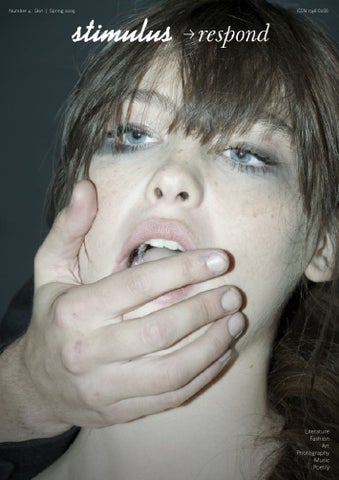
Number 4 : Skin | Spring 2009
ISSN 1746-8086
Literature Fashion Art Photography Music Poetry
Contents Literature
Poetry
076 Spectacular Transports Words by John Hutnyk
074 Personal Credit Words by Peter Robinson
082 Skin Flaying and the Transgression of Boundaries Words by Betti Marenko
075 English Nettles Words by Peter Robinson
090 Caressing the Skin: Mobile Devices and Bodily Engagement Words by Franziska Schroeder
080 Words by Geraldine Monk
Art 050 Skin of the Painter Words by Sonja Lau & AndrĂŠ Siegers 056 Skin of the Image Words and Images by Esther Teichmann
Fashion 014 The New Orleans Voodoo Queen 032 If You Can’t Beat Them - Beat Them 062 Hunter 098 My Second Skin 118 W=70-AUV/10 130 The Last Resort
Photography 140 Marie Kristiansen
081 Words by Francis Kruk 086 Vulcanicity Words by Peter Hughes 087 Lakes Words by Peter Hughes 088 Words by Steve Willey 089 my/ skin/ bed Words by Carol Watts 094 In Dis WomanSkin Words by Sascha Akhtar 096 we too are drifting Words by Sophie Robinson 097 duet in darkness Words by Sophie Robinson
Music 110 Fly Kkiller Words by Harriet Fuest 114 A Soundscape of Touch Words and images by Andrea Rushton
Features 028 Blue Skin is Better
Please enjoy Havana Club responsibly.
Image courtesy of Dr Hilary Powell, PhD Cultural Studies 2006, www.optimisticproductions.co.uk
Centre for Cultural Studies We incorporate theoretical and practical explorations in technological media and cultural difference in the geo-political context of global capitalism. Our commitment to theory involves enquiries into the most advanced paradigms of cultural thought. Our practical commitment involves us in cultural production and critical engagement with the culture industries. We run four MA programmes and an MPhil/PhD:
• MA in Postcolonial Studies • MA in Interactive Media • MA in Culture Industry • MA in Cultural Studies • MPhil/PhD in Cultural Studies
Further information www.goldsmiths.ac.uk admissions@gold.ac.uk 020 7919 7060
An Online Colour Naming Model This is an open invitation to participate in the Online Colour-Naming Experiment. It should not take longer than 10 minutes to complete it and you will have the chance to win one of the high quality prints by the artist Valero Doval. This simple experiment is part of research on colour naming and colour categorisation within different cultures that aims to improve the inter-cultural colour dialogue. The research is being conducted by the Colour Imaging Group at the London College of Communication, University of Arts.
www.colournaming.com
illustration by Valero Doval
Editor’s Letter Dear Readers, Late again. As you know, we’ve moved back online again in order to be able to publish what I think is the strongest issue we’ve ever done. I will leave you to make up your own minds, but please do contact me with any comments or suggestions: jack@stimulusrespond.com. Yours, Jack
Contributors this Issue Cover image by Kristel + Kristofer Literature John Hutnyk Betti Marenko Franziska Schroeder Fashion Justino Esteves Dimitri M Johan Courgibet Kristel + Kristofer Ben Thomas Henrietta Williams Bola Otesanya Nikola Barnett-Henry Sonya eun mi park Howie Claire Carter Francesca Frame @ Premier Linus @ Premier Pheobe Griffiths @ Select Bola Otesanya Nikola Barnett-Henry Louise Hilton Natalie Birchall GregoryDean Julie Cooper Martin Smith Kristina Uffe Amaya and Sian @ Models 1 Robert Glowacki Ai Ito Ken Nakano Koji Takayanagi Daniel Conway @ Storm Yusuke Miyazaki Rie Kondo Koji Takayanagi Machiko Yano Rima @ Storm Model Management
Yuhi Shimomura Fernanda Naho Kubota April Coley Maiko Kitamura Aleksandra Nesterchuk Pilar @ Supreme Art Sonja Lau AndrĂŠ Siegers Marie Kristiansen Esther Teichmann Illustration Angela Jack Poetry Peter Robinson Geraldine Monk Francis Kruk Peter Hughes Steve Willey Carol Watts Sascha Akhtar Sophie Robinson Music Andrea Rushton Brain Fairbairn Sam Smith For contributors contact details, please email the editor in chief at jack@stimulusrespond.com.
Unit 3, 508a Kingsland Road, London E8 4AE Tel 020 7249 0236 Editor in Chief Jack Boulton jack@stimulusrespond.com Editor - Literature Tara Blake Wilson tara@stimulusrespond.com Editor - Poetry Georgina Colby jinny@stimulusrespond.com Editor - Art Ellen Sampson ellen@stimulusrespond.com Editor - Music Harriet Fuest harriet@stimulusrespond.com Advertising Director Christopher Thomas chris@stimulusrespond.com Assistant to the Editor in Chief Kyle Paige Illustration by Angela Jack
Overseas Director - Spain Barbara Mas-BagĂ Sayer barbara@stimulusrespond.com We welcome unsolicited material from our readers. If you would like to make a contribution to future issues then please email the editorial team at the addresses above. Stimulus Respond is published by Buster Dog. All material is copyright (c) 2009 the respective contributors. All rights reserved. No reproduction without prior consent. The views expressed in the magazine are those of the contributors and are not neccessarily shared by the magazine. The magazine accepts no liability for loss or damage of manuscripts, artwork, photographic prints and transparencies. ISSN 1746-8086
The New Orleans Voodoo Queen
Photographer Louise Hilton Stylist Natalie Birchall Hair GregoryDean using Tigi Make Up Julie Cooper Digital Artist Martin Smith Lighting Assistant Kristina Uffe Models Amaya and Sian thanks to Julien @ Models 1
Previous spread: Dress / Betty Jackson Black belt / Alexander McQueen Bracelets / Pebble Black leather shoes / Bernard Chandran Feather piece from stylist’s archive Opposite: Headband / Miu Miu This page: Dress / Disaya Brooch / Miu Miu Green patent peeptoe boots by / Betty Jackson Yellow tights / Wolford
Coat / Sonia Rykiel Necklaces and ring / Pebble Mole/brown peeptoe boots / Betty Jackson
This page: Silk print dress / Oui Set Necklaces and ring / Pebble Opposite: Silk shift dress / Ginger & Smart Headband / Miu Miu Bracelets / Squarecircles Grey patent shoes / Betty Jackson Vintage silk scarf / Christian Dior Hosiery / Cette
Both pages; Cashwell coat / Sara Berman Beaded mask and ring / Pebble
Mini with military buttons / Ja Su Ma Hosiery / Cette Customised vest / Hanro Grey patent shoes / Betty Jackson
This page: Dress / Vince Rings / Pebble Opposite: Dress / Jolene Headpiece from stylist’s archive
Blue Skin is Better
It hardly feels like work when you are being led to the bottom of a volcano in Mexico to visit the Jose Cuervo plantation, located (funnily enough) in the region of Tequila. Many aren’t aware that tequila, much like champagne, can only be made in this part of the world; Tequila is located near Guadalajara in Mexico and therefore boasts a magnificent climate pretty much all year around. Not knowing much about the drink before this trip, I was mildly surprised to learn that tequila is made from a plant that looks similar to an aloe vera, called an agave (pronounced a-garv-ay). Jose Cuervo Platino is made from agaves that have been growing for between 10 and 12 years, taken from the Cuervo family’s private estate. The skin of the plant is unique as it is a curious shade of blue, which gives an odd effect compared to the darkness of the soil, particularly when you look at the huge plantations which are highly ordered. There is row upon row of agave in neatly structured lines. The sunlight shines off them, giving them a beautiful sparkle – or perhaps that was just the tequila kicking in. It is the location of the agave field that gives the final spirit its distinct flavour. Like any plant, the agave takes it’s nutrients from the ground, and the mineral-rich earth surrounding the volcano is a suitably characteristic location for the Jose Cuervo plantation. No machines are used in the harvesting process, and we are given a demonstration of how the plants are prepared leaving the field. The leaves, which are like long cactus spikes are removed, leaving just the heart, or pina, which is then
collected by donkey-borne baskets. It’s a simple looking process which is actually fairly difficult to master, and made harder by the heat as there is no shade in the field at all. The selected blue agaves are then taken to the Jose Cuervo distillery where they are first baked utilising the family’s proprietary process – Esencia de Agave – which slow cooks the agaves ensuring the sweetest and most intense nectar is produced, while preventing any of the best flavour from escaping the ovens. This represents a significantly more expensive production process as agaves used in Platino are roasted for days at a lower temperature compared to other tequila-making processes where the agaves are cooked for only 8 hours at much higher heat. After a warm reception involving more margaritas, we are given a tour of the factory. The distillery itself is surprisingly open, and I get the impression that not much was hidden from us as we wander through. The people working there are also very happy to talk about the process which felt reassuring. One of the workers mentioned that part of the ‘idea’ of Jose Cuervo Platino is to capture the essence of the agave plant in the bottle, and whilst this might sound like dubious marketing talk I found everyone to be quite genuine. Even the bottles are labelled by hand in a caring and unhurried way by a group of locals sat around a large table. The big difference I am noticing with the Platino tequila – indeed, with all of the Jose Cuervo tequilas – is that they are much smoother than other types, which makes them ideal for a more relaxed drink, perhaps taken neat over ice. My usual thoughts when considering tequila is the common notion of ‘salt, shot, lemon’, although the varieties that I have been tasting here lack the downwards burn and bitter aftertaste that I am used to. There is also a slightly earthy taste which makes them feel much more natural and very warming. This is reinforced by the traditional methods used and the family nature of the company. We leave the distillery and cross the road to the Hacienda where we are to have dinner. There are two massive wooden doors in front of us and although a couple of the group try and open them, they refuse to move. Three knocks ensue, the doors open, and we are greeted by the most extraordinary display of dance, from a traditional Mexican fertility rite to a demonstration from the best whistler in world. Set in a garden boasting ripe avocados, limes and grapefruit, the party offered us a wonderful Mexican cuisine and a selection of Jose Cuervo tequilas which of course went down beautifully. After witnessing the story and process behind the new Platino, it becomes quite simple to distinguish it from other brands, with a distinctively smooth taste, simple drinking technique and the very familiar smell of those lovely agave fields. Jose Cuervo Platino was recently voted the world’s best tasting silver tequila by the Beverage Tasting Institute and is available at Harvey Nichols nationwide priced £55, and selected private members clubs.
“Part of the ‘idea’ of Jose Cuervo Platino is to capture the essence of the agave plant in the bottle”
If You Can’t Beat Them, Beat Them
Photographer / Kristel + Kristofer Assistants / Ben Thomas and Henrietta Williams Stylist / Bola Otesanya Assistant Stylist / Nikola Barnett-Henry Hair / Sonya eun mi park Howie, using Bumble and Bumble for Taylor Taylor Make-Up / Claire Carter using B never too busy to be beautiful Models / Francesca Frame @ Premier, Linus @ Premier, Pheobe Griffiths @ Select
Previous spread: Linus: Black wool jacket with long silk neck tie, black sleeveless top with tassels frontand black wool trousers, all by Qasimi Leather gloves by Ben Sherman Military boots by Buckler Pheobe: Black sheer top with stain cross, black high waisted trouser with cumber bun, all by Qasimi Long black gloves, Paradiso Boudoir Leather boots, L.K.Bennett
Left: Satin bra, couture silk mid length waspie, leather long gloves, all Paradiso Boudoir Below: Francesca: Satin bra, couture silk mid length waspie, long gloves, all Paradiso Boudoir Linus: Black wool jacket with long silk neck tie, black sleeveless top with tassels front, black wool trousers, all by Qasimi Leather gloves, Ben Sherman Military boots, Buckler Leather mask, Paradiso Boudoir
Satin net bra, suspender belt, couture silk mid length waspie, leather knickers with silk tie, long gloves, hold-ups Swarovski crystal gold whip, all by Paradiso Boudoir
Francesca: Silk white suit jacket with large collar, Qasimi Suspender belt, 50’s style knickers, hold-ups, all Paradiso Boudoir Pheobe: Black sheer top with stain cross, black high waisted trouser with cumber bun, all by Qasimi Long black gloves, Paradiso Boudoir Leather boots, L.K.Bennett
Above: Linus and Pheobe: As before Francesca: Stain bra, Paradiso Boudoir Straight leg trouser with hidden pockets, Qasimi Round hat, Salvador Mateu Previous spread: Pheobe: Black sheer top with stain cross, Black high waisted trouser with cumber bun both Qasimi Long black gloves, Paradiso Boudoir Leather boots, L.K.Bennett Francesca: Sequined jacket, stylists own Stain bra, Paradiso Boudoir Straight leg trouser with hidden pockets, Qasimi Round hat, Salvador Mateu
Silk-jersey dress with tassels, by special order only, Qasimi Leather cuffs with pink silk tie, Paradiso Boudoir Patent-leather shoes, Aldo
Previous Spread: Satin bra, Couture silk panty Girdle, Leather long gloves, all Paradiso Boudoir Lace hold-ups, Falke Patent-leather shoes, Aldo Black wool jacket with long silk neck tie, black sleeveless top with tassels front, black wool trousers, all by Qasimi Leather gloves, Ben Sherman Military boots, Buckler Opposite: Satin net bra, suspender belt, couture silk mid length waspie, leather knickers with silk tie, long gloves, hold-ups, all by Paradiso Boudoir
Skin of the Painter Words by Sonja Lau & AndrĂŠ Siegers
1st: Red. The Skin of the Building. As much as a museum is a place of art, it is a space of power. The National Gallery of Tirana, designed in 1956 as a further column of the Communist Gesamtkunstwerk with its main purpose to stabalise the reigning ideology through Socialist Art has been most strikingly shaped by the latter. Through the selection of the works, but also through the request of specific themes and compositions, the State both claimed the organization of the display and shared in the authorship of the works. Against its great opening celebration, the following nominations and annual prizes for successful ‘people’s painters’, the Museum secretly turned into a house of phantoms. Object of exclusion were not only regime critical art works, but occasionally also the works of well respected painters of the era who then found themselves obliged to erase their original work after a public critic and thus facing a white canvas again with the old work deeply covered under the new white coat they were asked to apply. As a more discrete politics of eradication, the museum, just before an important opening, called out for an unofficial ‘ambulance painter’, who came in for last corrections on the selected paintings. The museum was a thick-skinned architecture, resistant against counter-revolutionary tendencies in Art, vigilantly undermining all elements that disturbed the self-sufficiency of Communist Art. In a strange way, this strategy of disappearance has pervaded the building even after the downfall of Communism. With the end of the dictatorship in 1990, the Museum removed literally over night the formerly celebrated Socialist Art from its interiors. As much as the Museum had been a place haunted by the absence of art and the predominance of power, now it seemed haunted by its own past.
“The walls of the gallery had been painted red; a striking comment on its politically and artistically homogenised past” When in 1999 the museum’s director Gezim Qendro brought the Socialist works up into the exhibition space again after 10 years of their disclosure in the museum’s basement, many claimed it was too early to dare so. Special surveillance was needed to hinder the many visitors to respectively hug or destroy the Socialist works. For this first critical re-vision of Socialist Art, the walls of the gallery had been painted red; suggesting a new coat of the building and a striking comment on its politically and artistically homogenised past. Up to today, the ‘Red Room’ has been left fairly unchanged, revealing a certain hesitation towards how to display those works, trapped somewhere between Communist relic and painterly oeuvre. Meanwhile, the red walls, once a controversial and curatorial energetic comment on the dubious art history of the Socialist era, has grown old. As much as the red coat of the gallery hints symbolically at the history of power structures in Albanian Art form 1945-1990, it equally shows the traces of the past decade: labels have gone witty, colours are worn out, and some occasional contemporary interventions in the space can still be perceived through the marks of vinyl lettering or patches of recently applied red. Unlike a normative encounter with the art of a country, today the visit of the museum allows an idiosyncratic sensory experience of the space and its history. The skin, or more precisely, the many skins of the museum have become themselves an indication of the space’s history, a somewhat ‘further reading’, an object of archeological interest.
2nd White. An Exhibiton on Coats. With the current renovation works at the National Gallery, this very skin of the architecture can now be experienced for the first time in its entity, as a main protagonist of the space. In preparation for an eventual ‘facelift’, a substantial refurbishment of the building, the Museum today presents itself in a temporary emptiness. The blankness of the walls, the bleached out red color and the complete absence of the art were also the stimuli of the exhibition project “Re-Paintings. An Exhibition on Coats”. Literally a construction site, the empty Museum disclosed a particular moment in time, a transitory state when the old site has not vanished completely and the new era has not yet begun. It turned into an illusionary space devoid of art and power. In this sense it opened itself for suggestions. The skin of the architecture - opaque in terms of covering parallel art histories over many decades, as well as extremely fragile in its nudity that laid bare every nail, drilling and repainting during the post-communist era - gave the impetus to develop an exhibition project performed on Coats. Under the illusion of a temporary free space, a selection of painters were invited to use the ‘taboo’ spaces as their studio, where each artist was asked to re-paint one of his works dating from the Communist era. In a sense of a reversed cultural archaeology, the painters should produce their ‘Re-Paintings’ directly onto the gallery walls. Followed by the final stage of renovation, the works’ existence would be only of ephemeral nature as they soon after their completion would be painted over by a new white coat applied by the institution itself. With the awareness of loosing the new works again in the near future, the artist‘s performance on the gallery’s walls turned into a symbolic gesture: a statement on appearance and disappearance, parallel art (hi-)stories and last
but not least, a reflection on the divergences between the personal and institutional. Unlike a mere reflection on the copy, the idea of the “Repaintings” focused on the changing role of the artist himself. As much as the selection of the artists, many of them in their 60ies or 70ies, was very heterogeneous in regard to their style and respective biography. The common ground was the memory of having painted ‘under observation’, guided by the criteria of the regime and judged by the visitors of their studios at the time. Among the chosen painters were people’s painters, the most successful artists of the regime, some of them strongly criticized for their works in the later and gradually forgotten, others continually well-respected. Among them also less public artists, those who had eschewed the communist audience by moving to the countryside or by focusing on the less restricted genres of the time such as landscape painting. How the artist’s state of the mind and the museum as a state institution relate to each other, if and how the invited artists would respond to their temporary achieved freedom, who would take advantage from it and who would eschew it were the questions the exhibition was willing to incite.
3rd The Skin of the Painter. The decryptage of the artistic decision, its (un)sincerity, humour, reflexivity or emotionality, the reading of the personal dimension of the works rather than their mere artistic quality was a key to the exhibition as the finished works would reveal. Although very different in style and content, the common grounds of the works seemed to derive from an intrinsic and often difficult relation between the personal and the institutional as an often irresolute and dissimilar comment on respective artist’s self definition. Sali Shijaku, one of the most famous painter of Socialist Realism and highly appreciated up to today, chose a detail of his old work to reproduce it in neon colors, proving his adaptability throughout the ages with an ironic undertone. Ksenofon Dilo, himself museum’s director from 1989 to 1992, referred to a painting already criticized at the time hardly changing anything, as if the socialist power structures had always bypassed him and no revision was needed. In contrast to this, Skender Kamberi, the piktor i popullit per se, returned to the gallery with a painting that had been cut into pieces by the people after the downfall of the dictatorship, a relic of a time of success that suddenly became unappreciated and even hated. His respective re-interpretation of the old painting that once depicted the glory and pride of Albania in 1920 turned into a radical Sinnbild, combining the European parliament with illegal money, whilst portraying Serbs and Italians as subordinate and propagandistic as he used to in his original work. Charged with political references, the new work yet became less political but above all a painting of personal trauma, reproachful and intuitive. Here, not the role of the painter seemed to have changed but it is the infamous country which is to blame. Albania is depicted as a whore. With his new work, the painter shows his defiance against the capitalist lasciviousness a last time, while stubbornly recalling what he had once been awarded, an Albanian people’s painter.
“The reading of the personal dimension of the works rather than their mere artistic quality was a key to the exhibition as the finished works would reveal”
The exhibition “Re-Paintings. An Exhibition on Coats” at the National Gallery of Tirana was curated by Sonja Lau and André Siegers.
Skin of the Image Words and Images by Esther Teichmann
Up here between home and nowhere I think of you. It pierces my throat, takes my breath away. I remember a moment so exactly, so precisely, that I reel from shock, squeeze my eyes to hold it in, afraid it will fall away. I remember the mattress on the floor, your weight upon me, the open window, the warm breeze. I remember the blue light from the neon sign outside making your pale skin luminous. I remember the metallic clanking from some unknown source in the near distance. I thought I might have forgotten, was sure I had, but up here, above an ocean in the dark, everyone around me asleep, I remember. I remember the same but so very different glowing blue of your skin when they brought me to you. Lying stretched out on the cold metal, your hardened skin glowed again in the flickering strip lit room, clothes cut off, covered only by a sheet. I thought if I climbed up and covered you, warmed you with my body, the blue would go away. The climb was steep and after a while someone lifted me off. You were still blue. I sink into the hum of the engine. I can’t breathe. “Every contact, for the lover, raises the question of an answer: the skin is asked to (1) reply.” Roland Barthes
“The surface of the image as soon as it becomes an object, becomes the untouchable”
Looking at skin as a metaphor for the surface of the image, for the photograph, allows another reading of the object, drawing the artwork into the physical domain of penetrable fragility. And yet the surface of the image as soon as it becomes an object, becomes the untouchable. Its surface becomes like the stretched hardened surface of the recently formed corpse. No longer within the domain touch, held at a distance now. “What is withdrawn from this world has no use, or has a completely different use, and is not presented in a manifestation (a force is precisely not a form: here it is also a question of (2) grasping how the image is not a form and is not formal).” Jean-Luc Nancy An image of skin, of the intimate surface of another, draws me towards it from a distance. I approach the work and negotiate my distance, viewing it as a whole, then coming too close until it becomes fragment and then only material surface, porous detail. I move back until image becomes object again, held within its grasp with an invisible yet given space between us. Like the infant who knows the skin of its mother’s breast and hands best, yet can only see this surface in part, like the lover whose skin is too close to focus upon, existing visually within the embrace only as fragmented surface, so the spectator negotiates the distance to the image surface. Touched not by another’s skin, the image and corpse are touched only by our eyes, taut surface available yet prohibited. Only with the decay and softening of the corpse, does its skin return to the domain of the living human, penetrable, fragile, seeping. The touch of one surface onto another, of skin upon another material, places us as viewer in the position of that moment of contact. An intimacy observed, an intimacy, a touch imagined, transferred. At a distance, this touch withdrawn into itself, upon itself, becomes image for the other. In its hard smooth surface, this image affirms my distance, this auto-erotic touch from which I am excluded, becomes as impenetrable as the iridescent refusing surface of the photograph. Skin as barrier, as marker of refusal defines then our relationship to the maternal body and that of the lover. The one, disallowing a re-entry into her body, the other skin an awakening that any fantasy of oneness is just and only that. The skin resists being localized and fragmented by vision, at once both internal and external. Jean-François Lyotard thinks of this relationship between surface and depth of the skin as a two-dimensional opened-out skin rather than a containing one, a surface to be (3) inscribed upon as the rolled out surface of photographic or cinematic film . The violence of this imagined and evoked opening out of the skin makes me think of the violence of light upon the skin and upon the photographic surface. To create an image, light must touch, sear, burn, brand the light-sensitive emulsion leaving its imprint, leaving an inscribed image in its wake. This searing does not break the surface of the film or paper, but perhaps the image could be seen as scab or scar, at once recalling both the violence done to the skin whilst also offering a sort of horrific pleasure in its removal - in the negation or disappearance of the image. “A photograph is a rubbing or rubbing away of a body.”
(4)
Jean-Luc Nancy
Richard Avedon tells us of his first experiences of the violence of the image in his autobiographical essay, ‘Borrowed Dogs’; “It was my father who taught me the physics of photography. When I was a boy he explained to me the power of light in the making of a photograph. He held a magnifying glass between the sun and a leaf and set the leaf on fire. The next day, as an experiment, I taped a negative of my sister onto my skin and spent the day at Atlantic Beach. That night, when I peeled the (5) negative off, there was my sister, sunburned onto my shoulder.”
“Unfixity plays between the wholeness of the image and the desire to tear it away” This photographic tattooing makes me think of the simultaneous panic and joy in watching an image appear within the acrid liquid of the darkroom developer, the image surface at once slippery and fragile in its wetness, only to watch it disappear into black nothingness, the image still contained somewhere within the depth that consumed it. The shimmering red liquid laps onto the over-exposed image, burnt by too much light, resisting to be pinned down, fixed as image. This unfixity plays between the wholeness of the image and the desire to tear it away, to dissolve it, to ruin it. I watch it appear and disappear, the image lingering in my mind’s eye for a moment upon the blackness that has already swallowed it. And so the scab offers the pleasure of an averted threat, the reopening of the wound being inseparable from the need to repair it, mend the skin’s surface back to wholeness. And this fantasy of making skin and image whole, making it impenetrable, unpierceably smooth, makes me think of the sheen of the photographic and cinematic image - the silky surface of print and movie screen, the anaesthetized protective surface (6) of Kristeva’s foreigner , makes me aware of my own skin as I write this in the searing tropical sun, my skin hardened as it burns in the salty humid heat, brown shiny oiled bodies reflecting on the beaches around me. I desire his darkness and the mysteries the black of his skin hold. I desire the scars and blue of his handmade teenage tattoo that tell me of places I have never been, of a life before this one, before me. His closed pores, his hardened back turn away from me and shut me out and it is then that I know that I will never be sure of his return, yet will always wait for it with anxious tremors, relieved each evening the key turns and his footsteps echo on the stairs. It is of those places I dream - the ones I have never seen and do not want to know lest they shatter these wondrous images that play in my mind’s eye. His anger always takes me by surprise, yet it should not, as it is always there beneath the surface - tense- coiled. Yet at night this same taut skin, this smooth dry rock, weeps and weeps, soaking sheet after sheet in sweat and tears. It is then in the darkness and silence of night that he holds on to me as though in fear of my leaving, as though I, not he, were the one turned away, ready to go. And so I pretend to sleep and let him wrap himself around me, dripping legs and arms clutching, wet belly and chest soaking my back until we are stuck together and I could not escape should I have wanted to. Notes (1) Barthes, Roland, p.67, ‘A Lover’s Discourse’, London, Penguin Books, 1990 (11977). (2) Nancy, Jean-Luc, p.2,‘The Ground of the Image’, NY, Fordham University Press, 2005. (3) Lyotard, Jean-François, ‘The Inhuman: Reflections on Time’, Cambridge Univ. Press, 1991/ quoted in Connor, Steven, p.38, ‘Integuments: The Scar, The Sheen, The Screen’, New Formations, 39, 1999. (4) Nancy, Jean-Luc, p.107, ‘The Ground of the Image’, NY, Fordham University Press, 2005. (5) Avedon, Richard, ‘Borrowed Dogs’, as it appeared in ‘Richard Avedon Portraits’, NY, Harry N. Abrams, 2002. (6) Kristeva, Julia, p.5-15, ‘Strangers to Ourselves’, NY, Columbia University Press, 1991.
Hunter photography // Justino Esteves stylist // Dimitri M model // Johan Courgibet
This spread and previous: scarf // Topshop bag // Diesel vest // Zara shorts // H&M leather sandals // Office gun // Beretta
This spread and next: scarf // Topshop bag // Diesel vest // Zara shorts // H&M leather sandals // Office gun // Beretta
Opposite and next spread: raincoat // Acne Jeans long underwear // vintage plastic boots // Marc Jacobs
Personal Credit Words by Peter Robinson
‘a blank, my lord’ Twelfth Night Rain in the small hours yet more rain falls on roof and misted glass, on the floor of a half-woken mind … Likewise, to relish the scenery, I dawdle on errands and try my best to borrow colouring from gasholders, flood pools, lemon verbena, to lend them something of a mind; it’s a mind distracted by a few white clouds, quite still in turquoise over rooflines, clouds sun-struck as me by Personal Credit premises, not a sign of life inside under this summery sky. Mirrored in the surface run-off, past sleeping policemen and double-parked cars, I lend a mind caught in the wars of nerves set going by today’s cold calls. They’re offers to let us pay back our way. Although we have no history, everyone wants to confirm our postcode. Likewise, on its rain-greased road, we’re reflected in the flood of dead cats, floated furnishings, the flashed-back pasts, denied facts, things, insurance claims and more.
English Nettles Words by Peter Robinson for Ornella
Blue-black crows flap up the acid yellow of a rape seed field and, well, now all these chestnut candelabra are bringing yet more news from nowhere as the piled white clouds above us mute their sun-struck colour. But what it most brings home, this heat, in terms of skin and shadows, bare arms, the warm grass, naked feet stalking with tanned knees is a sense from thirty years back of possibilities … Now look at the revelry’s aftermaths! Tuppence coloured mandarins come waddling over can-strewn grass as if to tell how less is more or less all there’ll ever be in store for the likes of us! Through buttercups, tufted cow parsley, thistles, stinging nettles, dock, there you go across wild parkland — peculiarly coloured by circumstance. Usage and tones of the local fauna can’t help unsettling, their behaviour like to get you hence. But then you grasp the nettles, pull them up in fistfuls, as if for recompense. Love amid the alien settles on omelettes, soups, odd vegetables; and, love, you turn that hapless stinging into sustenance.
Peter Robinson lives in Reading where he teaches at the university. His most recent publications are The Look of Goodbye: Poems 2001-2006 (Shearsman Books, 2008) and The Greener Meadow: Selected Poems of Luciano Erba (Princeton, 2007).
Spectacular Transports Words by John Hutnyk
Terrorists: you ignore them for ages, then a whole bunch come along at once. Or so it seems, as the everyday profiling of Muslims as threatening others has reconfigured how we all move about the city. An old fashioned racism based on looks, surface and skin has risen to unquestioned prominence at the very time when discussion of race transmutes into talk of religion, ways of life, and civilizational virtues. We hear over and over in the mainstream press, and from the Government, talk of a clash of values, integration and of the need for community cohesion. This old ‘new’ racism is blatant and its prejudice is clear. Policy by scare-mongering and tabloid popularity poll. There is also a theoretical parallel to this in the work of scholars who write today about ethnicity, identity and culture, and even in the work of those who ostensibly would offer up radical critiques of the way the war of terror has been prosecuted by those in power. Profiling is designed to fill us with dread. A culture of fear and anxiety provokes shivers and panic, has us tingling with unease. Everywhere I look I see intimations of this story – as I commute to work, railway station announcements warn that my belongings may be destroyed if I leave them; I am told not to hesitate to ask someone if an unattended bag is theirs; a general air of uncertainty pervades the tube; fellow passengers are almost too careful and too polite to each other; I suspect them of moving far away from anyone with even a hint of a beard and a backpack; and we all move away from those with Brazilian good looks (because we remember Jean Charles de Menezes, who was shot by police at Stockwell). I avert my eyes and read my newspaper (a free advertising sheet, with minimal – often sensationalist – news); and even at home I am not spared, a constant stream of bombings on screen. Myriad incidents conspire to make us squirm. This squirm is strangely marked by a transportation theme, and an iconic
one, which – as I will suggest – is inflected with an unexamined uncanny aspect. It will be easily accepted that the red double-decker bus is the globally acknowledged symbol of London, you can buy trinket sized models of them in the souvenir stalls. As everyone knows, the bus became even more potently symbolic after the devastating bus and underground attacks on the morning of July 7 2005. Indeed, we are continually forced to recall the horrific details: on that day three tube carriages and a number 30 Routemaster were destroyed, leaving 56 people dead. The real face of terror for me is a delinking of cause and effect in relation to this incident and the bombing of this particular bus: it is what I will call a transportation mutation and a blindness of representation. It is my argument that as commentary turns to religion or culture, any critical response to the scene of the ripped open vehicle becomes somehow silenced, and that we become blind to what this image means. I am invoking here the terms used by Susan Buck-Morss and Slavoj Žižek in books that address issues of terror and violence. Along with Alain Badiou, they refer to such atrocities, and to the actions of suicide bombers, as mute, blind, silent and disconnected. This was also the perverse refrain of former British Prime Minister Blair in defending British foreign policy in the wake of the London bombings (‘there was no link between (1) last week’s bombings in London and the Iraq war’ 25 July 2005 BBC ). In his 2008 book Violence, Žižek calls terrorist attacks and suicide bombings a ‘counter violence’ that is a ‘blind passage a l’acte’ and an ‘implicit admission of impotence’ (Žižek p69). I find this not dissimilar to how Badiou, writing of September 11, 2001, starts his essay on ‘Philosophy and the War on Terror’ by saying ‘It was an enormous murder, lengthily premeditated, and yet silent. No one claimed responsibility’ (Polemics 2006 p15). Susan Buck-Morss, in her book Thinking Past Terror, offers ‘the destruction of September 11 was a mute act. The attackers perished without making demands … They left no note behind … A mute act’ (Buck-Morss 2003 p23). It should be said she qualifies this with a question ‘Or did they?’, but the suggestion of an absent verbal – mute – message is something to which we should attend, listen and consider again, and not just with our eyes scanning for evidence (hint: on the side of the bus, see right), but with our ears and minds as well. In a similar tone, we might pass over the curiosity that Žižek chooses the infirmities of blindness and impotence to characterise the terrorist suicide bomber, as if the twin towers of September 11, 2001 in New York indicated a scene of masturbation (too much and you lose your sight) and castration (impotence, symbolic castration of the towers, mummy daddy, the old psychoanalytic staples are invoked, later it will be called a parallax). The point is that these theorists all agree on an absence of meaning that sets these acts apart. Badiou and Žižek’s claims about suicide bombings recall earlier comments by Buck-Morss on New York, where she suggests that the ‘staging of violence as a global spectacle separates September 11 from previous acts of terror’ and, as we should underscore, all three, dwell upon the absence of message: ‘They left no note behind … Or did they?’ (Buck-Morss 2003:23-4). More uncompromising and perhaps mischievous, Žižek in Welcome to the Desert of the Real, presents the event in his own peculiarly Lacanian perspective: “The spectacular explosion of the WTC towers was not simply a symbolic act (in the sense of an act whose aim is to ‘deliver a message’): it was primarily an explosion of lethal jouissance, a perverse act of making oneself the instrument of the big Other’s jouissance” (Žižek 2002:141) I for one am not satisfied with this. The task of a critical commentary is not just to stop and stare. It is also not just a matter of listing ever more details of the symptomatic eventuality that has to be pathologised. We might do more than read surfaces if we look
“The real face of terror for me is a delinking of cause and effect in relation to this incident and the bombing of this particular bus”
“The thoughts and motives of a suicide bomber are never readily available even where the bombers leave messages” closely at one such revealing detail, that has, curiously, been thus far ignored. The scene of the July 7th tragedy is captured in widely circulated images of the wrecked bus in Tavistock Square, taken by US based photojournalist Mathew Rosenberg. One of his pictures, appearing in most newspapers the next day, showed the bus from a 45% frontal angle with a disturbingly ironic film advertising placard visible on its side. This was for the film The Descent, due to be released the next day (2005 dir. Neil Marshall). The Descent was a schlock horror-thriller about inhuman monsters in a cave visited by a group of friends who become lost and are subsequently killed off one by one. The cave is the least of the coincidences however, as Londoners read reports and looked at grainy mobile phone video footage from the dark underground. Could we even begin to understand this horror? And were we ready to absorb the irony that the portion of the film placard left on the side of the bus after the explosion clearly displayed a message for us all. Tangled metal and stunned commuters foregrounded by a torn but still legible placard. It says: “Outright Terror, Bold and Brilliant – total film”. Hasib Mir Hussain was said to be the bus bomber (generally accepted as fact, although questioned by bus passenger and witness Daniel Obachike in his book The (2) Fourth Bomb ). Hussain detonated his bomb some 50 minutes after the three tube explosions. Speculation was that, having planned to also blow up a tube carriage, he had lost his nerve and was fleeing the scene, perhaps accidentally setting his bomb off while trying to diffuse it (there were reports of him fiddling with his rucksack). Because the bomber is dead, it is not possible to ascertain whether Hussain had intentionally targeted this particular bus. But some seem ready to decide, for example, my sociologist colleague Victor Seidler says the Tavistock Square bus bombing was ‘unplanned’ (Seidler 2007:10). Whatever the case about the bus – and I tend to think it is a gory coincidence – the thoughts and motives of a suicide bomber are never readily available even where the bombers leave messages and – in the case of Hussain’s co-conspirator, Mohammed Sidique Khan – bequeath us justificatory ‘confessional’ videos to be broadcast after the event. We have however to analyse these with something more than anxious fear. The interpretive work of reading the sign on the bus means refusing the broad brush that paints these bombers as merely mute and blind, even as we put names and faces to them – the very gesture which allows fear to proliferate. To profile and to silence is a doubleplay that only confirms the ‘bold and beautiful’ success of this terror, this atrocity. Of course we can only watch those images for so long. Indeed, the image from the side of the bus seems to have been erased. It was not ‘Total Film’, despite the terrible irony, and it looks as if we cannot bear to discuss this much at all. Instead, we have a different mode of commentary, in which – I want to note this as irony too – we see a lot more Muslims on the news than ever before. Bombers Hussain and Khan are offscreen, but the frequent presence of Muslim community leaders as ‘spokesmen’ on British television news talkback is a part of a larger project, in part orchestrated by Government and its agencies (police, media) to manage the postcolonial nation in a context of war. Carefully selected ‘moderate Muslims’ must be identified, shaped and disciplined into a discursive non-fighting force – a class of persons of colour, compliant in taste, in opinion, in morals and in intellect (pace Macaulay’ minute) – while ‘extremist’, outspoken or otherwise non-compliant figures serve as characters fit for demonisation, scaremongering and foreign policy justification. The good cop bad cop scenario is transmuted here into a management of appearances – the good community leader is set against the aggressive, often ridiculed, aberrant complainant. Brown skins are offered on screen in dual roles. Scratch the surface of appearance and what we have is a struggle
over national identity, a contested arena of civil freedoms and a lost opportunity for real debate. That the debate scenario of televisual news is a colour-coded fashion show is counterfactually reinforced by the continued parade of white models, white presenters, white authority – but I am no longer persuaded that the mere fact of having brown faces on television is a step towards equality. Visibility must mean something more – such that while we might now insist the skin tone of the speaker matters not so much as the speakers’ allegiance or not to a set of ideas, the degree that those ideas may more or less conform to a white supremacist agenda is itself reinforced again by skin. Rather than the contours of distraction and anxiety, the theoretical arabesques about jouissance, or of mute and blind violence, a louder and less myopic debate must be had now. Much has already been said, but the meaning is obscured if we refuse to read the signs before our eyes. I think this is a part of a general obfuscation, a general avoidance. There are some that talk about war-on-terror fatigue – we are no longer capable of paying attention to the impact of this war on our day to day lives – but I think it amounts to a strangely deflected reaction to the suspicions that we know are everywhere present. In full face profile, the upfront discussion we need about everyday racism on screen and on the busses might then filter through our convoluted anxieties and point towards better understandings, and a more robust defence of those under attack. It is unacceptable to see brown faces accused and detained, having to deny wrongdoing over and over (as was 23 year old ‘lyrical terrorist’ Samina Malik, as well as so many other ‘suspects’). This war of terror as it plays out in the city means Muslims are subject to stop and search, special investigations, harassment and inconvenience, train stations and airports are an ordeal, suspicious looks are just a step away from violent attack and a rendition flight to Guantanamo. The face of racism renewed is that Muslims today are required to ‘get their house in order’, or they must ‘leave’: a spurious double play that sets a superficial tone for media commentary and excludes deeper perspectives. We cannot remain mute nor turn away blind to a racism that wreaks such pervasive destruction upon us all.
Notes (1) http://news.bbc.co.uk/1/hi/help/3681938.stm [accessed 24 March 2008]. (2) http://daniel77witness.blogspot.com/ [accessed 24 march 2008]
References Badiou, Alain 2006 Polemics London: Verso. Buck-Morss, Susan 2003 Thinking Past Terror: Islamism and Critical Theory on the Left, London: Verso. Seidler, Victor Jeleniewski 2007 Urban Fears and Global Terrors, London: Routledge. Žižek, Slavoj 2008 Violence, London: Profile Books. Žižek, Slavoj, 2002 Welcome to the Desert of the Real, London: Verso.
Skin you that keeps you IN ape
plum
antelope
snake
joy-bundle heart-cockle meniscus dew pod (body-bag for life) core-carrier dermis-detritus soul-barrier every colour transit van parsnip
peach
potato
zebra
pillow-slip milk-carton osmosis sweet sweat pips (body-bag for after)
feather-dreads fruity-nooks paper-cuts itchy-scratchy-itchy-scratchy-itchy-scratchy-itchy-scratchy till death do us obscene punctuate OUT
(Above) Geraldine Monk’s previous collections include Escafield Hangings (West House Books, 2005). The Salt Companion to Geraldine Monk, edited by Scott Thurston was published by Salt Publishing, 2007. (Opposite) Frances Kruk tekstualates, performs, and frequently indulges in graphisme below the radars of several different governments. Her work has been anthologised and appears occasionally in various literary journals internationally. She currently resides on the haunted English coast with the poet Sean Bonney, with whom she runs the illegitimate mini-micro press, yt communication.
Skin Flaying and the Transgression of Boundaries Flaying. A gruesome skin-event highly significant for a discussion of bodily boundaries. The great concern with flayed bodies found in Renaissance and Baroque iconography reflects the epistemological shift induced by the emergence of anatomy, the new discipline that penetrates the frontiers of the human body and labors towards the colonisation of its interiority. A virgin land upon which the new science’s authority imposes its flag, the body’s secretive spaces are invaded in the same way in which geographical explorations put new territories on the map of the globe. Flaying can been taken as the marker of a passage occurred between the 15th and 17th century in the cultural construction of bodily boundaries and, by extension, in the constitution of modern identity. 1. Ecorches and the interrupted metamorphosis The role played in this process by images of flaying is well documented in anatomical atlases as well as in reference to penal punishment. A disturbing convergence emerges between the use of flaying in the production of medical knowledge and as a terminal torture. Flaying is the raw and unforgettable visual indicator of the material and symbolic rupture suffered by the body and of its subsequent reconfiguration as an individuality sealed within an impenetrable boundary. Whereas the skin of the medieval body was both a porous membrane and a permeable filter enclosing a human made of the same flowing matter as the universe s/he inhabited, the violently removed skin of 16th and 17th century ecorches (1) represents the irremediable cut that objectifies bodies and uproots them from the forces of creation and destruction that kept them within a system of correspondences, affinities, sympathies, attraction and repulsion with the entire cosmos. According to Claudia Benthien (2002) the skin was still considered a permeable surface well into the 18th century. It was then that the development of medicine and hygiene culminated into a closed skin demarcating an impermeable skin-tight individual. It is flaying however that turns bodies into things interrupting the endless transmutation they are capable of. As the scalpel removes the skin, the modern body begins. No longer terra incognita, it now functions instead of existing, its exposed interiority no longer a mystery but a system of mechanical parts (Foucault 1973). For philosopher Jose Gil (1978, 1998) flaying is the iconic expression of an epistemological change: the evacuation of body’s power of metamorphosis and the establishment of science’s new regime of signs. One of the most famous ecorche is Juan Valverde’s ‘the masked man’. A portrayal of a body to all intent alive holding a knife in one hand and in the other his own skin, as if it was a coat or a mask. About this image, contained in Salamanca and Lafreri (1560), Gil writes: ‘Here he stands, Valverde’s flayed, brandishing his skin, as if a strange force had obliged him to inflict this torment onto himself. This force exists; it is called science’ (Gil 1998). Like many other similar images, this flayed creature exhibits the horror of the terminal cut whose effect is to solidify the flows that traverse bodies. Skinless, stripped of their surface of inscription and at the mercy of modern forces, bodies are terminally objectified into ‘the body’. No longer plural. Upon them the scientific discourse enforces methods of investigation that leave no recess untouched, nor secret unveiled. The obscenity of the far too visible, exposed by the anatomist, constructs this body as an object of observation. Matter without a soul cast against a soul that rejects matter, this body becomes the reified container where subject and consciousness coincide in a skintight trap. 2. The myth of Marsyas The iconographical roots of flayed bodies are found in a mannerist elaboration of classical themes, such as Hercules holding a lion’s skin and especially the myth of Marsyas, the satyr who dared to challenge Apollo in a musical contest and as a punishment was flayed alive. The myth of Marsyas has been analysed as a tale pointedly expressing the preoccupation generated by the new science (Sawday 1995). Cultural historian Edith Wyss (1996) offers an historical interpretation by asking which symbolism this tale that so utterly fascinated Renaissance and Baroque artists may contain for our contemporary sensibilities. Embedded on a shared understanding of the edifying value of ancient mythology, its narration of hubris and punishment never fails to arouse a morbid fascination; the richness of its allegory always ready to be peered
“Flaying is the raw and unforgettable visual indicator of the material and symbolic rupture suffered by the body”
Words by Betti Marenko over, probed and peeled of its many layers. In the 14th century, in line with the didactic purpose of the myth, the flaying of the satyr was seen as signifying ‘the exposure of Marsyas’s errors, the baring of his true worthless self’ (Wyss 1996), thus posing the issue as a contest between error and truth. Another interpretation suggests that the flaying was necessary in order to bring forth Marsyas’ inner worth. In any case, the shedding of the outer layer was deemed necessary to reveal the truth hidden within. This allegory became widely popular in the mid 16th century thanks to the revival of the neoplatonic metaphor which compared Marsyas to Socrates. Elaborated by, among others, Pico Della Mirandola and Erasmus of Rotterdam, for whom Christ himself was a ‘wondrous Silene’, this theme expressed the inverted link between superficial appearance and hidden knowledge. As if truth, wisdom and beauty were always disguised beneath an ugly appearance and accessible only via a penetrative and interpretative action. 3. The paradigm surface vs. depth Driven by the desire to reveal the hidden within the body, both Apollo and the anatomist’s act of flaying equates the surface/skin and the always deceiving world of appearance that must be removed to reach the real truth. As Gil puts it, this entails a ‘general imperative toward representation’. No wonder that the opposition between surface and depth is described by psychoanalyst Didier Anzieu (1989) as the epistemological obsession that has marked Western patterns of thought since the Renaissance. This dominant paradigm is based on the polarization between margins-surface on one side and core-depth on the other, with the latter standing for the ‘real truth’ obtainable only via the flaying of the surface. Not only does this paradigm configure the acquisition of knowledge as a movement from the periphery to the centre; it also presupposes that the surface is always derivative, secondary and less truthful than the depth. In other words, what we face here is the problem of representation, whereby the surface is taken as what represents and the depth as the ‘real thing’ that is represented. Thus, flaying leads us straight to the uneasy relationship between expression and content. In Deleuze and Guattari’s critique, expression is no longer a function of the content. Instead, it is postulated as a force of transformation, continuously unfolding, stretching and shedding. Like a skin.
“Physiologically, the skin is described as an highly complex living structure”
4. Sciencelore If the birth of science is so entwined with skin flaying, how does science view skin today? What are its modes of representation of the bodily surface? Physiologically, the skin is described as an highly complex living structure that in an adult covers a surface of approx. 18000 sq. cm. and amounts to more than 10% of the whole body weight. It keeps the body temperature balanced, minimises water loss, protects against abrasion, secretes fluids to keep the surface lubricated and, thanks to a selective absorption of substances, defends against potential toxic agents. Mostly, it is as an agent of communication between the body and the world. It is made of two strata. The outer layer (epidermis) is a stratified, continuously renewing tissue, devoid of blood supply and made of various cells that produce also fingernails, toenails and hair. The inner layer (dermis), less rich in cells, is made of elastic fibres and connective tissue floating in a semifluid, amorphous mixture made of collagen, fat cells, blood vessels, sensory receptors and nerve fibres. The great majority of cells in the dermis (keratinocytes) are organised in layers, each corresponding to a progressive stage of differentiation. In normal keratinocytes the transit from one mitosis to the next takes around 300 hours. This means that to migrate from the basal layer to the outer one a normal skin cell takes approximately 14 days. As the cells travel toward the outer strata they progressively change their composition until they reach the external layer where they spend a further 14 days gradually shedding. Thus, while about half of the lifetime of a skin cell is taken by an ongoing differentiation, in the other half the cell exists as a dead component ready to be eventually shed. This process known as keratinisation creates terminally differentiated dead cells that compose the stratum corneum, the outermost layer, a nonliving, semipermeable membrane made of toughened cellular tissue. Here is where the boundaries between the skin and the world become undetectable. As epidermal cells encounter the environment and are shed by desquamation the frontier
turns in a no man’s land. 5. Immune system, skin and horror autotoxicus Another scientific discourse that places the skin firmly at the core of the establishment of the bodily boundaries is immunology. As a series of tropes rooted upon, and defining, the establishment of self vs. non-self through a ‘semantics of defence and invasion’ (Haraway 1991) the discursive construction of the immune system is tightly bound to a notion of the skin as a boundary to patrol and defend in order to preserve the identity of the body/self. The military analogies proliferate. An integral part of our immune system and constantly exposed to potentially dangerous guests (fungi, parasites, bacteria, viruses), the skin is portrayed as a defence organ, either attacked by outer invaders or in revolt against itself. Self preservation depends, crucially, upon a consistently correct distinction between self and non self. However when the delicate mechanism of feedback that regulates immune system’s communication breaks down, the body begins to misunderstand the incoming messages and mistakes itself for a foreign organism. This confusion can instigate a chain of events culminating in self destruction. The organism ends up being, literally, in revolt against itself: horror autotoxicus. A notable example of horror autotoxicus is psoriasis, a disease that traps the skin in a vicious circle of hyper-production of cells, itching, scratching and further cellular proliferation. While in normal conditions between 40% and 60% of skin cells are actively reproducing at any time, in a body affected by psoriasis the whole 100% of the cells multiply continuously, speeding up the process of differentiation from 300 hours to a mere 36. What immunology reads as a misunderstanding between self and non self can be seen, however as a ‘disease of speed and excess’ (Taylor 1997). Here skin’s intensities, responsible for cellular hyper-proliferation, generate an accumulation of non living matter at the boundary with the world. The speed increases, the surface breaks down, the skin returns to the cosmos. 6. Skin as a membrane The skin can be rethought by borrowing the image of the molecular membrane. Biochemistry sees membranes as chemically active agents instrumental to the production of a ‘notion of an ‘inside’ and of an ‘outside’’ (Anzieu 1989), and thus of a sense of self. Anatomically the membrane is ‘a nonspatial division between two adjacent spaces” that “separates two regions of different constitution’ (Elkins 1999). While the skin is considered as that which divides a living inside from a nonliving outside, a membrane instead divides outside from outside and inside from inside. By considering the skin as a membrane we therefore emphasise its osmotic qualities. Indeed, they are very similar. Both unfold; both possess no identifiable boundaries; both communicate with the outside by contact, pressure and stretching; both self reproduce by differentiation. For Elkins the affinity between skin and membranes is such to consider the skin no longer a part of the body but a ‘condition of its intelligibility’. As the human body develops through progressive unfoldings, invaginations, enclosures and layering, the involvement of the skin with other organs makes it unsustainable to pinpoint precisely where organs ends and skin starts. All these movements produce bodily outcomes that ‘quickly become too various to sustain the inside/outside polarity’ (Elkins 1999). The effect, at once material and semiotic, is that the skin is eventually peeled off from its role of barrier. Not only does it cease to be the boundary that separates surface and depth and divides ‘what we are and what we are not’, but it may be argued that the skin itself ‘is the body, and we ourselves are skin’ (Elkins 1999). 7. Matter in movement. Skin’s strata, renewal, becoming The skin is layered matter in unrelenting movement, made of uncountable strata traversed by flows of particles. Strata, renewal, movement. Strata of skin unfolding into other strata. Renewing layers. Movement of cells migrating toward the surface, proceeding towards their dissolution at the border with the world, a movement of becoming imperceptible. This description of the skin echoes what Deleuze and Guattari (1988) say about stratification, ‘the creation of the world from chaos, a continual, renewed creation’. Similarly, skin’s renewal and movement can be read as spatiotemporal becoming. Rhythms, speeds, unfoldings. As far as skin cells are concerned, the bodies that are us are constantly coalescing with the world. Dead skin cells in proximity of the atmosphere enter into composition with other cells, substances, particles, molecules, bodies, to form more or less articulate entities and contribute to their increment or demise. As its cells dissolve into air the skin becomes the world. The all-encompassing, lovely debris that makes up 90% of house dust.
“The skin is considered as that which divides a living inside from a nonliving outside, a membrane instead divides outside from outside and inside from inside”
Notes (1) From the French ‘flayed’, ‘a figure in which the muscles are represented as stripped of the skin, for scientific or artistic study’ (Gil 1998). As reported by Gil, ‘the first flayed to appear was in a work by Mondino, a Bolognese doctor’ in 1319. See the images made by great anatomists like Andrea Vesalio, the author of the De humani corporis fabrica, published in 1543.
References Anzieu, D. (1989) The Skin-Ego. A psychoanalytic approach to the self. New Haven and London: Yale University Press Benthien, C. (2002) Skin. On the cultural border between self and the world. New York: Columbia University Press Deleuze, G. and Guattari, F. (1988) A Thousand Plateaus. Capitalism and Schizophrenia. London: The Athlone Press Elkins, J. (1999) Pictures of the body. Pain and metamorphosis. Stanford: Stanford University Press Foucault, M. (1973) The birth of the clinic. London: Tavistock Gil, J. (1978) voce ‘Corpo’ in: Enciclopedia Einaudi. vol. 3. Torino: Einaudi - (1998) Metamorphoses of the body. Minneapolis and London: University of Minnesota Press Haraway, D.J. (1991) Simians, cyborgs, and women. The reinvention of nature. London: Free Association Books Salamanca, A.and Lafreri, A. (1560) Anatomia del corpo humano. Rome Sawday, J. (1995) The body emblazoned. Dissection and the human body in Renaissance culture. London and New York: Routledge Taylor, M.C. (1997) Hiding. London and Chicago:The University of Chicago Press Wyss, E. (1996) The myth of Apollo and Marsyas in the art of the Italian Renaissance. An inquiry into the meaning of images. Newark and London: University of Delaware Press
Vulcanicity Words by Peter Hughes
turmoil case flexing crisp shells leather most of the noises stay out of earshot the gases swap colours in the darkness chest pains may come & go throughout the day but perch on the head of the bed all night most of us come from vulcanicity it kisses the skin from our fingertips it keeps the edges of thought free of frost dykes can keep rabbits out of your garden while sills hover above the town for miles leaden lids buried in builders’ rubble a resting place for sheep & north-east winds batholiths are satellites & planets that never managed to complete their birth & remain as monumental tombstones in memory of a world that’s still to come not everything is better out than in scorching jets of toxins cook the rabbit weld the only hand tools to a tractor torch the hall in an unwitnessed ritual bomb the goats with pyroclasts & gravy drive hot-rods into the city sideways a visit by the package-deal from hell leaves the meadows simmering for a month lava flow like so much else depends on how much silica & gas is in there when you retire you can start to go brown but why wait till the floods arrive to start caravanning with Nietzsche – before long they’ll announce the discovery of dark matter inside the mind the last noise you hear
Lakes Words by Peter Hughes
no sooner do you see them than they’re gone some duck behind bushes some are too loved up by the sun a few have had their grants cut & one took offence because we described its attributes as laky instead of lacustrine some duck behind bushes cackles rudely then does a headstand in it even big ones are sensitive they look in each direction simultaneously & feel their highest water kissed away by breezes & straight-faced promises yet their own sins glower beneath & accumulate lakes are unsure of their edges & where their next drink’s coming from they prefer anglers to composers & poets who misrepresent them they feel that remote corners they’ve lost touch with are seeping life-blood into bottomless rock & powder they are surprised that you can hold one in the palm of your hand
Peter Hughes is a painter and poet who lived in Italy for several years. He now lives on the Norfolk coast where he runs Oystercatcher Press. Recent books include Nistanimera and The Sardine Tree. The Summer of Agios Dimitrios is about to come out from Beard of Bees. A selection of his work can be found on web sites such as Great Works, Intercapillary Space, Liminal Desires and Signals.
Carol Watts lives in London. Her writing includes alphabetise (intercapillary editions eBook, 2005), brass, running (Equipage, 2006), and Wrack (Reality Street Editions, 2007). A new collection, Occasionals, is out now with Equipage/Cartalia.
my/ skin/ bed Words by Carol Watts
I am not elephant blundering in the dusk you hear me crashing in dark spaces is there insult I say I am not special sometimes I put my hand on yours in night fields of moss my skin bed lichens are dry sun welts scent of ramsoms star plants you say is it me you see follow in some allotrophy wheeling around where my desire goes there is a nape hills tip you out bluff my blunt feet are not elephant but by morning leave prints crush wild grass trample through what there is to eat
Opposite: Poetry by Steve Willey
I am not in the dusk hear me dark is there insult I say sometimes my hand night fields my skin bed sun welts star plants you follow wheeling where there is bluff feet are not prints crush trample eat
what there is to eat trample through crush wild grass by morning leave prints is there insult my blunt feet hills tip you out bluff goes there is a nape around where my desire allotrophy wheeling follow in some you say is it me you see ramsoms star plants dry sun welts scent of my skin bed lichens are in night fields of moss I put my hand on yours special sometimes I say I am not are not elephant but in dark spaces you hear me crashing blundering in the dusk I am not elephant
Caressing the Skin: Mobile Devices and Bodily Engagement Words by Franziska Schroeder
We are ‘performing animals’ (1) and are arguably becoming more so through engaging with mobile technologies. We perform the world by ways of our technological devices that themselves are becoming more performative in nature and increasingly more demanding of our attention and constant interaction. The mobile phone has ceased to be the simple ‘transmitter of sounds from far’ [the French term telephone consists of télé = “far” and phone = “sound”. It was coined c.1830 (Harper, 2001)]. Instead, mobile devices have changed so that they also want us to play, work, organise, phone, schedule, plan, listen, and watch, urging us to be constantly alert, to be continually available, always connected and to be constantly on the move. In short, we find ourselves more and more in a constant condition of performativity, in which we are lulled into a state of needing to be fiddling, feeling, and indeed - to touch. The new mobile device has not only redefined the tactile intimacy with which we engage with the device, but also, the mobile device is redefining our notion of ‘home’ and place. Hence it is not surprising that in the process of being able to leave our home more easily and thus being drawn into the public eye away from a state of being intimately with oneself, mobile design aesthetics are continually looking to seduce us into a tactile engagement with the device. The devices are positioned in a way that urges the human body towards itself, towards the intimate self-touch. The recent Apple iphone (Apple, 2008) represents not only a good example of an attempt to satisfy the need to touch towards which the body is drawn, but also, it creates a constantly-lurking performance potential to which the body is exposed. Touching the Music We perform the world by sight and sound, and it is worth noting that only more recently has the sense of touch become part of the discussion of how we sense the world through technology. As sight and sound become complemented by the sense of touch, we are increasingly able to address complex multimodal interactions. It is thus of particular interest that recent developments in mobile technology design highlight the potential for a type of interaction that is centered in the complexity of touch rather than in the ability to push buttons. These kinds of tactile two-way interactions are only rudimentarily echoed in devices such as in the Apple iphone that is enriched with metaphors of tapping, dragging, flicking and pinching. Most commonly, mobile devices do not allow for haptic feedback as all feedback is either aural and/ or visual. I want to suggest that a mobile device should be culturally and technologically specific in the same way that a musical instrument is. Musical instruments provide us with an ideal research framework for investigating notions of resistance and threshold conditions; thus, a mobile device should
“Mobile devices have changed so that they also want us to play, work, organise, phone, schedule, plan, listen, and watch”
suggest its own types of interaction and engagement, and like a musical instrument, must invite and ask for bodily participation. I have argued elsewhere (Schroeder et al, 2006) that a performer of a musical instrument does not adapt to her instrument, but that she is involved in a process of constant negotiation of the specifics as offered by the instrument, and that through this engagement she intuitively develops a sense of the instrument’s malleability, resistance and fragility. This tactile involvement of the human body presents an important move away from the notion of the performerinstrument interaction that has often been misunderstood as one in which the instrument forms an extension to the performer’s body, in which the performing body has been misread as one that is extended by certain technologies (a musical instrument for example). This has been elaborated upon elsewhere (Schroeder, 2005). In contrast to the notion of extension we may be better positioned to see the engagement of instrument or device and body as one in which the human body is free to explore the resistances that are offered by the device. This is a type of engagement in which the device itself suggests specific ideas of its texture and in which it is negotiated by drawing on multiple functions, as found in the sense of touch. We know that touch is all-pervasive in our interaction with the world and that the need to be touched is an innate property of humans and animals alike (Schroeder et al, 2006). It is therefore highly interesting to see that with the new ‘Apple ipod touch’, which is based on the same multi-touch interface as Apple’s iphone’, music is not solely something to be “called” for, something to recall with the push of a button, but the new device lets one tap, drag, flick, glide and pinch, and ultimately ‘touch’ the music (Apple, 2008). Indeed, it is in touch, by means of the differences in the skins’ textures, by means of the skin itself that we can keep in touch with ourselves (Connor, 2004). In his elaborate writings on the skin Steven Connor (2004) highlights the importance of the skin. I thus do not merely want rush past it carelessly. If it is the skin that allows one to keep in touch with oneself it certainly deserves a little respectful touch. Keeping in Touch The reason for being able to keep in touch with oneself is that one has developed a sense of self in the first place. Connor, taking his cue from the psychoanalytical interpretation developed by Daniel Anzieu (1991), reminds us of the importance of this development of the self through skin contact in early childhood. The first skin contact of the infant with the carer, the one who strokes, cuddles and feeds the newborn, is integral for the development of the self in later life. Hence, there is often talk of the “peau-moi” or the skinself. The skin is conceptualized as a border between self
“Instrument interaction that has often been misunderstood as one in which the instrument forms an extension to the performer’s body”
“Throughout the Medieval period the skin became to be seen as an organ of interchange, a permeable membrane”
and not self. While at the beginning of the infant’s development there is a symbiotic relationship with the carer, in which the skins of both infant and carer merge, the infant soon distances itself from others, and the process of individuation commences. This takes place during what the French psychoanalyst Jacques Lacan titles the “mirror stage”. Lacan had proposed that the human infant goes through a mirror stage, the primordial experience of identification, in which the infant identifies with an external image of the body (as seen in a mirror or as represented by his mother). This image, as it gives rise to the mental representation of an “I” - an ideal image of him- or herself - is only an imago, an image, which is external to the infant. It gives rise to the infant’s perception of “self” while at the same time establishes the ego as fundamentally dependent upon external objects. The foundation for all subsequent identifications is laid in this mirror stage: the baby looks at something external and starts perceiving itself as a separate being. The “I” comes into being as the result of an encounter with an “other”. Thus, the skin takes on “a function of individuation for the self, which transmits the feeling to the self that it is a single being” (Anzieu, 1991). The skin is essential to the perception of self, and it is worth pointing out that for centuries the skin has been subject to tender fascination and caressing obsession. For a long time, however, there existed an inattention to the skin, as Connor argues. The skin was mainly seen as a kind of covering that kept the body together. The Greek physician and anatomist Galen (c. 129–c. 200), although emphasizing the importance of the human anatomy, instructed his students in his work “De anatomiciis administrationibus” on dissecting a body and, as Connor convincingly argues, he did so by paying no attention to the skin (2005, p.13). When the taboo of cutting the skin in the European Renaissance was released it was primarily to gain access to the interior of the body. The skin was something one needed to get past. The focus was towards the incision and retraction of the skin in order to get inside the body. Jonathan Sawday refers to this moment of early-modern Europe as the “culture of dissection” (1995, p.3). Throughout the Medieval period the skin came to be seen as an organ of interchange, a permeable membrane, not something simply to cut into in order to get past, to the inside. The skin was understood to be “traversable in two directions” (Connor, 2005, p.21) and the skin’s function (sweating for example) was taken into consideration as crucial for maintaining the body’s well-being. If at first the skin was seen as a covering, it was consequently thought of more as an organ in itself, with its own structure and functions. The writings of Michel Serres (1998) finally expose the multiplying functions of the skin, where the skin is seen as the most various of organs, as an entire environment. The skin, according to Serres, is a meeting place for the other senses; it is what he calls a milieu of the other senses, the “milieu of the milieux” (Serres, 1998, p.97). This implies that the skin is integral to the sense of touch, that it has the inherent power to facilitate physical mingling while delineating bodily borders. The skin is thus closely linked to the notion of the intimate and I believe that the gap between what is close to the body - the skin - and the more distant - the device - is an interesting area for reconsidering design aesthetics. Interfaces Do Not Touch Without overstating too much it can be said that recent mobile technology design approaches are moving into a direction where the highly complex interactions of our bodies with the world are being considered as essential to the design aesthetic. In the same way that the skin has ceased to be a pure covering of the body solely maintaining its integrity and instead has become an entire environment and a meeting place for the other senses, mobile devices are ceasing to be apparatuses on which simply to press buttons. Design concepts are steering away from metaphors of extension and are abstaining from solely providing functions of control by which the body becomes reduced to the crudest of tactile interaction. Indeed, some recent design aesthetics offer us conditions for engagement and participation in taking into account the complexity of touch and the body’s demand for the negotiation of subtleties. These inherent ambiguities of the human body are
“Mobile technologies allow us to withdraw from the type of touch that is dependent on the actual contact with another person”
poignantly echoed in Apple’s ambiguous promise: “Now there’s even more to touch” (Apple, 2008). More interestingly though, because mobile technologies allow us to withdraw from the type of touch that is dependent on the actual contact with another person - we can be in touch with another without having to touch - the new mobile device needs to compensate by satisfying humans’ urge for the skin’s caress. There literally needs to be ‘more to touch’. We want to touch, we need to touch and we want to be touched. The multi-touch interfaces of recent mobile devices tenderly make room, to some degree, for the multiplying functions of the skin to come into being by engaging the body in taps, pinches, drags, flicks and glides. In this type of one-way tactile interaction the body is being drawn into a constantly lurking performance potential. It is drawn out of its home and the bodily intimate is being urged towards the distant device. It is thus not surprising that in this process of the body’s alienation from itself, mobile devices are being designed in ways that, like humans, constantly position themselves to be touched, because, unlike humans, they ultimately cannot touch themselves. An extended version of this article was recently presented at the 5th International Mobile Music Workshop Conference in May 2008 and appears in: Proceedings of the 5th International Mobile Music Workshop Conference, University of Applied Arts, Vienna (May, 13-15, 2008), pp.26-30. Available at http://MMW2008.dieangewandte.at
Notes (1) Lewis Mumford argued that we are not only homo sapiens or homo ludens, but homo faber, man the maker, that is maker of tools as well as maker of his own self (Mumford, 1967, p.9). In 1987 Victor Turner, in his seminal work The Anthropology of Performance, goes even further when he posits man as homo performans, as a performing animal. He argues that “in performing, [man] reveals himself to himself” (Turner, 1987, p.81).
References Anzieu, Daniel, (1991). Das Haut-Ich. Frankfurt am Main, Suhrkamp Verlag. Apple iphone: www.apple.com/iphone [April 2008]. Apple ipod: www.apple.com/ipodtouch/features.html#multitouch [April 2008]. Apple ipod touch: www.apple.com/ipodtouch [April 2008]. Connor, Steven (2004). The Book of Skin. Cornell University Press, New York. Harper, D., 2001-last update, online etymology dictionary. www.etymonline. com [April 2008]. Mumford, L., (1967). The Myth of the Machine. London: M. Secker & Warburg Limited. Serres, Michel, (1998). Les Cinq Sens. Paris: Hachette. Sawday, Jonathan, (1995). The Body Emblazoned: Dissection and the Human Body in Renaissance Culture. London/New York: Routledge. Schroeder, F. (2005). The Touching of the Touch – performance as itching and scratching a quasi-incestuous object. Extensions: The Online Journal for Embodied Technology, Vol.2 (2005): Mediated Bodies: Locating Corporeality in a Pixilated World. www.wac.ucla.edu/extensionsjournal [April 2008]. Schroeder, F. and Rebelo, P. (2006). Wearable Music in Engaging Technologies. Springer international journal AI & Society: The Journal of Human-Centred Systems, Journal no. 146. ISSN: 0951-5666 (print version) and ISSN: 1435-5655 (electronic version). Springer London. http://www.springerlink.com/content/x361120325nr2876/ ?p=130005a4330d438c8aa2e72115f2e5af&pi=8 [February 2008]. Previously published in the 2005 Proceedings of the Wearable Futures Conference, University of Wales, Newport/UK (DVD version of 2007). Turner, V., (1987). The Anthropology of Performance. AJ Publishing Company.
If pleasure, a middling circumference I am trying to escape to walk alone & alone to watch the end of the world, the splendor of morning-rise to cross the line & hope to universal & defecate at the same time. Pursed lips join in matrimony the wholly unable to the qualitatively disgusted with breath drawn like a sword shimmering in the diurnal cusp of midnight To cut away the mistrust settling into the limbs of those bodies alive only when cynicism is garroted by jugular passions. Turning the other cheek, calling false hope a liar I embark invested in the tide to journey on, place the body precariously on another body, of another fire smelling vivid, orange & positioned like stars, at odds with the movement of the skin groaning for circumference for symmetrical assonance dyed in hues of trickle-down on thighs like new blood, fresh in aching for thrusting resonance of a culled, managed indifference to seasons of change & again night holds a hostage, gun to head knife to throat, remove the bedside manner go straight for the grasp, imprint a map of distance on tender flesh in searing stereovision at seven paces, quick & sterile. The hand of many fashions designs a more blasphemous fate to penetrate the axis of killing fields as flowers bloom growing thirsty in place of headstones, held up gently, only by force of Will. & if you go to sleep now,
No-one will find you in the morning.
In Dis WomanSkin Words by Sascha Akhtar
Reductionism in macro When your hands end in bone encased in flesh numb to the searing of a pan removed from the oven, it is hard to reconcile gnosis, menses, sleight of hand with love banal, the dark cage with wilting bars that enfolds you whilst you levitate or dig holes in every which inch of the garden. Planting nothing or planting photographs of the celebrated to grow into trees of sick Flowering our fears, Petaling our sorrow Giving us fruit to peel & release that tang of want or equally, desire, or solemnly starfish & the wall with pores is exhaling. Wander, lust after some irreplaceable prophet of forgive-me-not, light couches on fire & leave me in the middle of the highway. I hear Vulcan singing of his coming victory. I will blanche marigolds in cambric moonflakes, hold the roar of the ocean in a wheel-well, I will wait in the ultraviolet with the frogs for the silence, preceding extinction that deafens as life comes back to life.
Sascha Akhtar’s debut poetry collection The Grimoire of Grimalkin published by SALT publishing has been called “ a a contemporary masterpiece”. She was recently named as Top Twelve poets to watch in the Guardian review. She is the coproducer of La Langoustine Est Morte in London. Most recently she has been published in SKALD, Trespass and has been included in a Shearsman anthology of UK women’s avant garde poetries coming out in 2009.
we too are drifting Words by Sophie Robinson our tenderness being muttered up by other people I lie awake twisting & stripped of physical dwelling; hips with the same feeling finding myself mumbling “I’m sorry we jerked” & your mouth is a place to go a place where the human need for (relative) peaceful sanctuary can collect itself – suck me – nuzzle me – foster me – we are in our separate spaces mouths mouthing along to the words of the film Patch Adams & learning that returning to ‘home’ as an adult promotes restlessness; but let’s keep kissing & dipping with friction against the softness of “Hum Sweat Hum”, licking punk I found myself dwelling in the conceptual heart of nonsense breaking up, I have two hands to cope with this death by values by economix, we are locked in structure in spite of our nylon surgings, them being reduced to slits of marginal import & we know better huh, & yes you the eternal optimist you turn to me & say that it’s good to get perspective on a perspective even when the sky’s so black with clouds it looks like night (upon which you would remark at least that we are less visible under extreme conditions & besides we have more fun after dark)
duet in darkness Words by Sophie Robinson 1–
violent pulpy mass, pale and silvery lines of normal life fading, the suggestive world in postwar thirst-o-rama thrall or sting of eyes against spine, surround me then – mark me badly on the supraorbital bed –
2–
far from the passive transparency of parasites subacute feelers groping in my abdomen, a bitter turn or sensation with several points of pressure, I shall pamper your numbness with extending motions of my greasy jaundiced chest, damp heaviness of discourse weighing up our universal meat which glints in flashlight amelioration, weeping dialectically.
1–
& encircling our implicated impairments, which we covet, our heritage of lovecraft’s abstract ideals on the mantle like a wornout star – gas & dust making us nauseous in our excess & I long to syringe the disturbed whites of your eyes with sugarwater, honey running from your nose in excitement you turn to me & vomit in a practical way, tired of running in this trembling weather, tongue ulcerated, rough as a cathedral wall…
2 – emotionally erect, my night-eyes are exhausted, moans seep through in auditory fullness, you prostrate on the grass, covered in ants & stiff with cervical grief, a bright-yellow coldness clinging to everything vertical in lieu of anything happening.
Sophie Robinson is currently undertaking a practice-based PhD in queer poetry and performance at Royal Holloway, University of London. Her work has been included in The Reality Street Book of Sonnets, and her first collection, a, is coming out from Les Figues Press in April 2009.
My Second Skin
photography Robert Glowacki stylist Ai Ito make up Ken Nakano hair Koji Takayanagi model Daniel Conway @ Storm
Previous spread: Shirt Thomas Burberry Jacket Issey Miyake This spread: Jacket Edward Sexton Shirt Qasimi Trousers Deryck Walker Shoes Deryck Walker
Coat Deryck Walker
Opposite: All Deryck Walker Next spread, both pages: Coat Thomas Burberry Top Deryck Walker for John Smedley Scarf Deryck Walker
T-shirt Issey Miyake
Fly Kkiller Words by Harriet Fuest Images by Sam Smith
For this issue it seemed natural to interview an artist that has a definite knowledge of ‘skins’, so what better than to talk to a drummer? Brain Fairbairn has been drumming for 25 years brandishing a history with the worlds leading reggae artists including the Wailers, as well as Sonic Guru, Indian, The Prodigy and the new Rock fusion band, Fly Kkillers. I caught up with him in South London after he got back from touring with the Prodigy to talk to him about his varied career. Would you say that you’re a natural drummer? Not at all. Growing up I was in the army cadets and played the side drum. It wasn’t until I was in my teens that I took it any further. Some guys approached me from another school and said, “How would you like to make a band?” I said “Yes, I can play drums” but of course I couldn’t, I thought I could, but really I could only play the little side one. It wasn’t until I sat in front of the kit that I realised it just wasn’t happening. I went to do one thing with one arm or one leg and the whole of my body followed, I wasn’t able to achieve the independent movements required to play the drums (laughs). So was that your first band, what were they called? ‘Studio Rockers’ which Maxim (The Prodigy) appeared in. His cousin was in the band and Maxim kept bugging us to join as well. We really didn’t want him in at all but for ‘one night only’ we let him join us on stage. He turned up dressed up as a pirate, which for us was very strange. We didn’t let him do a show with us again, perhaps because he was so ahead of the times. I was in studio rockers for about 3-4 years. We did well and got help from the Prince’s trust. I think they gave us about a thousand pounds which was incredible back then, we got all this equipment with it and played around the local areas getting ourselves in the papers a bit, all was going well but after a while it started to fall apart. One of the band members left to become a professional photographer, the other left to professionally chase ladies. After that I really missed being part of a team. I still had this burning ambition to play music with people. I had no thoughts or dreams of money as such, but the thought of playing with ‘the stars’ was a driving force for me. Which of ‘the stars’ inspired you? Gary Glitter. I know he’s really not too cool these days. In fact, I probably shouldn’t mention him at all, but really I was so impressed. I think it was the star quality of him; he was so ‘out there’. Anyway, I think being a child can be very confusing and he made me think that music was a good place to run away to (sic). So that’s where it all began really. As far as inspirational drummers, I’ve been inspired by almost every drummer I’ve ever seen play, that’s part of the learning process. You speak of the learning process, are you completely self-taught or was there any schooling involved? I didn’t have any lessons as such but I have learnt so many things from watching so many drummers. When I came to London, everything was a totally different ballgame. The moment I came here and saw a few guys playing, I realised that I was so far behind. It was a bit scary. I was only 25 at the time but was blown away by how good and dedicated the players were. I stopped playing and started looking at drumming from a more voyeuristic perspective. I would go to places like the Jazz café and various other places on the Jazz scene. There was no Internet then so it was more word of mouth. I definitely wasn’t at a professional level yet. Like a lot of people that move to London I would leave the house, go to work, come home, nip to the shop
and go back home again, that was my only interaction with the city, however there was this particular house that I used to pass on my way to the shops. I’d always hear live reggae music coming out of the cellar. After weeks of walking past I knocked on the door and this Rasta, Frank, answered. I said “My name’s Brian and I can hear music” and he just looked at me. “I’m sorry” I said, “I just wanted to knock on your door”. He was great, he let me straight in and miracle of all miracles, it just so happened they needed a drummer. It was a good break for me because not only did I start playing again I also started mixing with people. That’s the best thing about making music, you can find yourself in really good company, musicians can be really soft hearted, inclusive people.
“My name’s Brian and I can hear music” and he just looked at me. “I’m sorry” I said, “I just wanted to knock on your door” So when did you start working professionally? When I met Adam Fuest, a guitarist/record producer. He knew I played percussion and one day he came up and told me to “Report to this studio”. It was a top class studio at the time and was pretty terrifying. I didn’t have any equipment so I had to borrow loads of percussion and unknown to the band, I had to make 3 trips on the bus to drop the gear off. The guy behind the desk made a pact with me not to let the other musicians know that I had to get there 4 hours early to do this. There I worked with Annabella from Bow Wow Wow. It blew my mind because that was typical of the sort of artist I watched as a young child. That kick-started my confidence because I was working with someone I had looked up to for so long. After that I continued to work with some others in the band who were actually members of Adam and the Ants, and their experience and compliments started rubbing off on me. After that I got heavily into reggae, I started working at Lime studios in Brixton with people like the Twinkle Brothers and Alton Ellis, who gave me amazing advice and support. I also started getting free studio time which really enriched my playing. One day this guy from Acid Jazz popped into the studio and asked if we would do an album with them. So we did the 1st reggae album on Acid Jazz with the dub poet Benjamin Zephaniah! That I would say was the real start of my professional career. At one particular party, I met a guy I never thought I’d meet, Jerry Dammers (The Specials), I managed to write and record an album with him which felt like such a compliment. Through him I met and started working with Johnny Osborn and Junior Delgado, the latter who passed away unfortunately 2-3 years ago. I then met Earl Wire Lindo (The Wailers). He’s responsible for all the keyboards, all the riffs and melody lines that you hear in the Wailers/ Bob Marley’s reggae albums. What most people don’t know is that this guy lives in London! We record about 3-4 times a year together now. What we record goes to Jamaica for mixing and it goes straight out on the Wailers label. I’ve done so many albums with him now, but the mad thing is, I don’t even have a copy of a single one! So how did you make the leap from reggae to dance music? Last year I received a phone call offering me an audition to drum for the Prodigy. While I was playing Keith Flint, Liam Howler,
Maxim Prodigy and the tour manager John were all there standing over me while I drummed. It was pretty hardcore. We were just given a tape and told to get on with it. I was given no input whatsoever. I liked it though, that’s one thing I have really learnt from working with the Prodigy, they are definitely hardcore, every stage of everything they do, including their life style. Anyway, I got the job which was great. The Prodigy are an amazing crew. My first gig with them, I went on stage and I saw this great big oxygen tank and I thought nothing of it other than it was a bit over the top but quite typical of the prodigy. But when you start playing, it takes 2 minutes before you’re gasping for breath. All the air gets totally sucked out of you. You literally cannot breath, I don’t know if it’s the noise, the heat, the audience or the lights but it just gets sucked from you. I’ve never known anything like it. So the oxygen tank I had originally laughed at became a necessity. What are your plans for the future? I’m working with a band called Fly Kkiller. They’re a married duo, Pati and Steve. Steve did the music scores for Oceans Eleven, Twelve and Thirteen with David Holmes. At the moment he’s remixing Primal Scream, the guys talent is amazing. It’s kind of electronic dark rock, although that doesn’t give it justice. Pati’s whole being is quite dark, she’s got a persona which is that of a mutated fly that comes from outer space. She’s great, straight as a die even though she’s dressed top to toe in PVC. As a band we’ve already had our ups and downs. We were gigging in Poland and we had this crazy taxi driver that I think was trying to kill us, if he wasn’t he was trying to make us think he was. Anyway he made us miss our flight which meant that we missed our gigs at Glastonbury which was a shame, but we’ve got some good things coming up including the single Gilded Splinters which is out this October. Unlike a lot of musicians, drummers often session drum rather than be part of a band, why do you think this is? Do you think people perceive drummers as having a lower ranking in the music world? I think that when you’re just providing skins to music, the most important thing is that you take what people write seriously. An artist’s career is mapped out around that, a musician’s career is about listening and providing support, musicians can jump on many artist’s careers. That to me is the difference. Saying that when I was gigging with the Prodigy I met Robert Plant who took me backstage to his dressing room, it was the most embarrassing experience I’ve ever had. He came racing towards me with his hand out. Running through my head was what can I say what can I say? So I said “You’re the 8th wonder of the world” then I killed myself internally, thinking oh god I should have said the 1st wonder, then I thought no he wouldn’t have believed that, then I thought oh god have they discovered other wonders since the 7th? Should I have said the 9th? He soon made me realise I was being ridiculous. He just wanted to talk about music and chill out with other musicians. To me that’s a mark of a rare artist. Someone who has literal wealth as well as actual collaborative wealth. Why do you think drummers are often the last band members to be interviewed? I would guess that it comes back to what I was saying before about writing, a lot of drummers don’t write or create with their band in the same way that you would expect a bass player, guitarist or song writer to. They are the ones that most people consider to be the ‘artists’, and I think that’s probably a fair comment a lot of the time. Personally, when I’m working with people I like to know as little about them as possible with regard to their personal lives, I would never read stuff about them. That way I never feel that I’m working on a bad project. If I hear the music and like it, and want to work on it, then I am free to throw everything into the project without the danger of personal discoveries clouding the music. I can just get it from their perspective and become fully part of it. Specifically why drummers seldom get interviewed, I don’t know, but maybe this interview will help you find the answer to that (Laughs).
“Pati’s whole being is quite dark, she’s got a persona which is that of a mutated fly that comes from outer space”
A Soundscape of Touch
Words and images by Andrea Rushton
Composer and sound sculpturist Andrea Rushton agreed to create a piece specifically for this issue, using acousmatic practices i.e. the recording of ‘’found’’ or ‘’natural’’ sound which she then transformed in a digital environment and used to make an abstract piece of music, mixed with other digital sounds and live voices. She set out to explore the ‘’porous border/sensory surface’’ of skin, painting a sound picture depicting the magnified, heightened imagery found in these concepts. The final piece can be heard on the Stimulus Respond website, the following is Andrea’s description of her creative process. Skin on Skin concentrated shaft of light in tune, in touch interior laser. Barely there a tracery of inner wrist line; singing sense, tender… tense. Between the pressure, pain and pleasure sensors blood runs warm; secret messengers dance away and back swift and sure. Slowly stroke lightest finger tip touch penetrates… border guards passed… messengers meet infiltrate… secret coding much deeper than skin deep. Choices So do you read or listen? I think read first; sharpen your awareness through knowledge of what you will be listening to and what you are listening for. I’m going to tell you how this sound piece came into being, taking you through each phase of the process from the perspective of both the practical and the psychological. The sounds generated by contacting skin against skin are so common place to most of us that they go completely unnoticed; we are concerned with the ‘touch’ sense that supersedes the ‘hearing’ sense unless the sounds created are sudden, comical or embarrassing. To ‘listen’ is to filter information and process according to experience and as a sound artist my hearing sense is often in a heightened state; the subtle swirling, flanging effects of changing frequencies as hands are drawn over skin is an often ‘overlooked’ sound world that I have used as the basis of this piece. What you will hear (when you listen to the soundscape) is a piece of ‘music’ generated from only two basic ingredients: ‘skin touching skin’ and ‘voices’. These raw materials have been processed in a digital environment to isolate manipulate and enhance their frequencies and timbres. The resulting ‘sub-layers’ of sound, derived from the actual tangible, become highly magnified and distilled versions of the original which when layered and organized can conjure an imaginary, exaggerated and fantastical inner world. The Initial Recordings The process begins with a meeting: British guitarist and fellow sound explorer John Weathered and I meet in a quiet space and shed a modest amount of clothing to expose a large area of skin. I place binaural microphones in my ears and we carefully, so as not to disturb the wires trailing to the recorder, begin to stroke
“A piece of ‘music’ generated from only two basic ingredients: ‘skin touching skin’ and ‘voices’”
“We whisper instructions to each other as though to speak aloud will break some taboo”
each other’s skin focusing not on the touch sensation but the sounds generated. From time to time our voices come reflexively adding an extra layer to the sounds. We whisper instructions to each other as though to speak aloud will break some taboo or disrupt the intensity of the atmosphere of these recordings. In a studio 200 miles south, I meet with Swiss-German visual artist/performer Nicolas Galeazzi to make a recording where I am technician only and to gather sounds with a completely different ambient setting to the first meeting. Nicolas sheds his shirt and rolls up a trouser leg before aurally exploring the sounds of his skin on his skin whilst I follow his every move with my ‘binaurally’ mic’d up ears. Nicolas, vaguely amused, comments in a hushed voice that we are whispering to each other and how curious this is as I can cut out any unwanted conversation later; but there is no doubt that in these recordings an atmosphere of intense concentration and ‘sensual’ awareness is built up that all of us felt unwilling to shatter. Nicolas responds to my request for touch stimulated voice sounds by sitting with closed eyes reimagining memories, allowing his voice to express responses that come (or came) with each remembered touch… I voyeuristically record him. At this stage I know little about what will be built from these very different and raw recording sessions, the piece could be rhythmic, realistic, fantastic, comic even but a long process of analyses is needed before this will become clear. So begins hours of playing and replaying the recordings, listening for imperfections, delights or dullness’s that prompt the inevitable cutting and dissecting. Every slice of sound becomes a specimen laid out under the aural microscope to be focused and re-focused, stripped down to the bare strands of each frequency, processed and saved as either a mere thread of its former self or a deeper darker version that takes us in closer and closer until we are microscopic and the stroking is a monstrous slow rumbling surge of sound. In a way, this part of the process is somewhat random and whimsical; I spend hours sifting sounds and as time passes my mood and perceptions change so that in the moment of finding a stretch of audio, I am taken by something that, an hour later or earlier, might have been ignored. Gradually a pallet of 200 or so sound colours is built up and still I don’t know the shape of my piece. But… I do begin to feel the mood welling up in me as the intensive periods of listening to skin touching skin brings me to a hyper sensitized state: I hear touch and feel sound as a caress… or shock. This is how the piece will be, reflecting this awareness. Midnight, I shut down my sounds and a persistent melody circulates through my body; I capture it, singing softly into my small mini disc recorder knowing that it will reveal itself in full later on. Next comes a more discerning phase of decision making where the choosing of ‘sound objects’ and weeding out of superfluous ones is key to the mood and shape of what will follow; this is tricky, I can so easily lose my focus: rules of harmony, dissonance, chord structures or melodies in the traditional sense don’t exist here in my sound world of nonpitch, white and pink noise. But you know, actually there are many things that can migrate across from these territories… choices… the effects of high or low frequencies, their mode of attack, suspension and decay, isolated sounds, multiple layering; this is not so different from my background training in Western music. Pitch is there, most certainly, just less obviously than the tone semitone layout of traditional western
instruments and I tune into these more subtle ingredients to organise and make ‘sense’ of the chaos. I use the music software Reason 3 to make the piece come alive, importing what have now become ‘sound objects’ into the ‘virtual’ sampler and mapping these to a full size keyboard ready to be accessed for improvisation. I have a macro and a microcosmic view of the piece now so begin with the samples that I am sure of: sounds that represent the fine hairs of the skin, the pores, and the emergence of droplets of water up through the coiled tube of the sweat gland to the surface of the skin. A continuous swirling contact of hands stroking belly is re-pitched revealing a submerged world, I imagine it to be felt or heard on a cellular level; this, to me, is a beautiful sound, somehow akin to the empty openness of holding a great shell up to your ear and hearing that deep, airy whisper that is constant but ever changing. Mapping the sounds is, at first, a messy business. Voice sounds are placed next to long slow dark sounds, which nestle in beside high pitched glittering shimmers and thrumming ricochets, my eyes and fingers need to be able to reach for the right sound as instinctively as I would find a melody with my voice, such a haphazard arrangement makes this impossible. Some samples are randomly looping, others stop dead, which can seem bizarrely like there has been a reality shift: a time and space guillotine Douglas Adams style! Each sample or, if it’s easier to envisage, each key of the keyboard has some 70 different parameter settings to be carefully organised. The process is intense and slow but gradually order is found and I begin to play, recording each session and distilling each recording to their core moments. This is rather like plunging into an icy tarn, a transition from safety to danger, warmth to sudden cold. Prior to the leap the piece is a potentiality and as long as this remains unfulfilled it retains its possibility for marvels, if I lose my focus now, the whole process can be lost in noise and I put off the moment of immersion, fiddling with this and that, for as long as possible. But plunge I do and after the initial shock of going under subsides I dive and spin and drift through my sound world finding that the tiny fine hairs, pores and fragile networks of nerve endings are there, hidden but existing in the frayed frequencies of a slap or caress. Voice The vocal folds are hidden, buried deep in the vessel, the body but the connection between the organs of skin and vocal apparatus is profound. Through touch the voice is stimulated often involuntarily to react. From these primal utterances just a slight shift is needed to discover the singing and the speaking voice each a vast tool for expansion of my powers to communicate on multiple levels. Through the state of heightened awareness notions come of this border of ours that is our skin. The way we perceive a moment of contact is so dramatically changeable according to circumstances, intent and relationship that this belies the simplicity of a nerve message being relayed to the brain of ‘light touch’, ‘hard pressure’ ‘scratch’, ‘burn’ etc. Though this is a border that keeps other elements out it is breached by touch without any need for a cut or tear and the penetration is an exchange. Skin on Skin A concentrated shaft of light In tune, in touch, interior laser…
My fascination is centred on these nerve messengers of ours, on the notion of borders between countries, of secret agents infiltrating supposedly closed off zones. Between the pressure, pain and pleasure sensors Blood runs warm Secret messengers dance away and back Swift and sure… In this piece I didn’t cross to the dark side of violation, torture or abuse but the knowledge of the possibilities of these things being merely a nerve ending away is held somewhere in the sounds; after all we can only trust each others intentions. The melody, captured at midnight, is now revisited and I pull out threads from the main body of the words to weave into a song. It emerges gradually but easily through repeated and recorded improvisation, layers of harmony are added and then the whole piece is transferred to the digital environment of the computer. Here it is all, strangely, unravelled, broken into ‘sound objects’ and mapped to the sampler so that I can choose the fragments that will appear in the final work. Throughout the process of making this piece I choose frequently to place sounds in a reverb environment modelled on the acoustics of Laukyrkan Cathedral, each time I am drawn to this I resist, thinking that the piece should by its very nature be placed in an intimate space. However the deeper I immerse myself in the Skin on Skin sound world the more certain of this choice I become and this theme seems to re-assert itself as the sung voices take on a choral quality. Completion Final choices are agonising and minutely detailed, my listening sense has become an extension of my touch sense the two are blurred and I don’t know if the piece is complete until I call John back in to the studio. He listens intently and confirms that it is done. This work has been, for me, a crossing of boundaries, a shifting and deepening of perceptions long familiar but under-explored. The experience of touch has become so much more erotic, tender, sensual, playful, mindful, since this sound world was newly cracked open; this contact of skin against skin makes an aural rhythm, a pattern, an hypnotic swirl of white noise of tension and release. Skin on Skin coaxes elements from these sounds of touch into a meeting with a more traditionally recognized musical language, blending and drawing them into a mutual caress where a mood and a hook dovetail and suck you in… maybe… listen... You can hear the recording at www.stimulusrespond.com/andrearushton.bin www.spiralsoundstructures.co.uk
W=70-AUV/10 skin tone lightness W is related to the annual UV available for skin exposure AUV skin colour in the presence - absence of sunlight black – white crosses
photographer / yusuke miyazaki fashion editor / rie kondo hair stylist / koji takayanagi makeup / machiko yano using MAC cosmetics model / Rima @ storm model management photographer’s assistant / yuhi shimomura stylist’s assistant / fernanda
previous spread: fishnet top and skirt / ann-sofie back printed cupless bra & brief / agent provocateur hold ups / agent provocateur shoes / nicholas kirkwood opposite and next spread: tattoo body suit / emilio de la morena fun fabric neck piece / rowan mersh black back piece / inbar spector
white dress / inbar spector black satin coat / bi la li cocktail pick brooch / rowan mersh
opposite: nude bust pad t-shirt / ann- sofie back silver & gold braces / bless cardboard paper skirt / avsh alom gur knee high fishnet socks / tabio bone white socks / tabio shoes / ann-sofie back next spread: black dress / michiko koshino vintage snake print hold ups / agent provocateur shoes / nicholas kirkwood
The Last Resort Photographer ~ Naho Kubota Stylist ~ April Coley Makeup ~ Maiko Kitamura Hair ~ Aleksandra Nesterchuk Model ~ Pilar @ Supreme
Previous spread ~ green silk blouse by hache, wool pants by karen walker, shoes by giuseppe zanotti Opposite ~ magenta pink strapless gown by david meister, netted gloves by lacrasia, shoes by melanie dizon Left ~ black ruffle tiered dress by paul smith, netted gloves by lacrasia, shoes by giuseppe zanotti
Previous spread ~ black ruffle tiered dress by paul smith netted gloves by lacrasia shoes by giuseppe zanotti Opposite ~ green silk blouse by hache wool pants by karen walker shoes by giuseppe zanotti
metallic gunmetal dress by malene birger, shoes by giuseppe zanotti
black shorts jumpsuit by lover, shoes by stuart weitzman
Marie Kristiansen
A graduate of Central St Martin’s School of Art and Design, Marie Kristiansen uses the art of photography and film to explore area between societies’ supposed values and goals and the reality as we perceive it and live it in our everyday lives. She seeks to highlight the power society attributes to symbols, and the power that can be found by influencing and controlling people’s interpretation of these. Marie challenges the idea of what is “given” and questions the accepted realities. By carefully staging each illustration she finds the fine balance between the explicit and uncomfortable and the easy accessible beauty. Her cinematic approach to her work can be traced back to her upbringing. She spent most of her childhood on film sets with her director/producer parents. Nine years old she was rewarded the Youth in Film Award in Hollywood for Best Young Actress in a Foreign Film, and as a teenager she joined the Norwegian Royal Academy of Ballet. It is perhaps these experiences that have given her the ability to stage aesthetically pleasing scenes that conflicts with her thought provoking messages.
Illustration by Angela Jack
Resources Acne www.acnestudios.com
Edward Sexton www.edwardsexton.co.uk
Miu Miu www.miumiu.com
Agent Provocateur www.agentprovocateur.com
Emilio de la Morena www.emiliodelamorena.com
Nicholas Kirkwood www.nicholaskirkwood.com
Aldo www.aldoshoes.com
Falke www.falke.com
Office www.office.co.uk
Alexander McQueen www.alexandermcqueen.com
Ginger & Smart www.gingerandsmart.com
Oui Set www.ouisetclothes.co.uk
Ann-Sofie Back www.annsofieback.com
Giuseppe Zanotti www.giuseppe-zanotti-design.com
Paradiso Boudoir www.paradisoboudior.com
Avsh Alom Gur www.avshalomgur.com
H&M www.hm.com
Paul Smith www.paulsmith.co.uk
Sara Berman www.saraberman.co.uk
Hache www.hache.it
Pebble www.pebblelondon.com
Bless www.bless-service.de
Hanro www.hanro.com
Qasimi www.qasimi.com
Ben Sherman www.bensherman.com
Harvey Nichols www.harveynichols.com
Rowan Mersh www.bstorelondon.com
Beretta www.beretta.com
Inbar Spector www.inbarspector.com
Salvador Mateu +33 6 8658 8970
Bernard Chandran www.bernardchandran.com
Issey Miyake www.isseymiyake.com
Sonia Rykiel www.soniarykiel.com
Bi La Li www.bilali.com
Betty Jackson www.bettyjackson.com
Squarecircles www.squarecirclesuk.com
B never too busy to be beautiful www.bnevertoobusytobebeautiful.com
Ja Su Ma www.jasuma.co.uk
Stuart Weitzman www.stuartweitzman.com
Buckler www.bucklerboots.com
Jose Cuervo Platino www.josecuervoplatino.com
Swarovski www.swarovski.com
Bumble and Bumble www.bumbleandbumble.com
Karen Walker www.karenwalker.com
Tabio www. tabio.com
Thomas Burberry www.thomasburberry.com
Lacrasia www.lacrasia.com
Taylor Taylor www.taylortaylorhair.co.uk
Cette www.cette.com
L.K.Bennett www.lkbennett.com
Tigi www.tigihaircare.com
David Meister www.davidmeister.com
Lover www.loverthelabel.com
Topshop www.topshop.com
Deryck Walker www.doverstreetmarket.com
MAC www.maccosmetics.com
Vince www.vince.com
Deryck Walker for John Smedley www.johnsmedley.com
Malene Birger www.bymalenebirger.com
Wolford www.wolford.com
Diesel www.diesel.com
Marc Jacobs www.marcjacobs.com
Zara www.zara.com
Christian Dior www.dior.com
Melanie Dizon www.melaniedizon.com
Disaya www.disaya.com
Michiko Koshino www.michikokoshino.com
Illustration by Angela Jack
Numbers Summer 2009
www.stimulusrespond.com