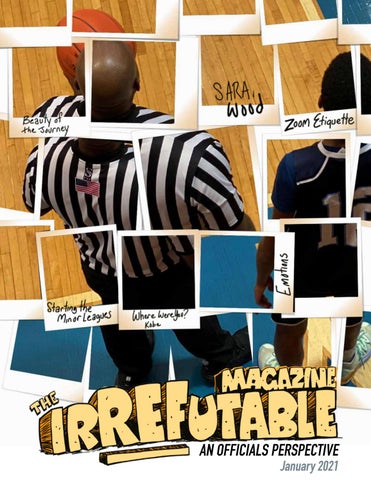
AN OFFICIALS PERSPECTIVE January 2021
The Outcome Business Not The Income Business
An interview with Sara Woods
By Ralph the Ref
Sara
Woods is a basketball official who is currently working amateur, collegiate, and semi-pro contests. Based out of St. Louis, Missouri, Woods saw a gap in leadership in her region and decided to create the company Big Game Officials where she recruits, develops and mentors prospective and current officials.
Big Game Officials start out prospective officials from the ages 12-14 on how to become table personnel - working the shot clock, game clock, and becoming score keepers. These initial assignments open the window to a referee’s job. These students soon graduate into a life of officiating. Her recruitment and development of prospective and current officials has achieved the trust and confidence of scouts, assignors, coaches, school administrators, and the community. We connected with Sara Woods to discuss the Big Game Official journey.
When did you start realizing that lack of mentorship was an issue? Sara Woods: The more I reached out when I had little to no experience, other officials were reluctant to help me unless I went to a camp and had to pay for it. I found others unwilling to share the knowledge unless I went to camps, which I understand. The higher you go, the more it’s monetized.
Do you think it’s a problem you have personally experienced, or do you think this is systemic?
8
9
Sara: I think it’s systemic because not only from a mentor perspective. I have also seen challenges in other organizations that are similar to mine in various organizations. I don’t know if it’s jockeying for position. I’m not sure. I can’t put my finger on it. It’s frustrating. In sports, you have the affirmation mantra. Teamwork makes the dream work. No matter what you do to make the team, especially those established, they are resistant. So yes, to your point, you are forced to go off and do your own thing.
From the beginning, when do you think that you needed a mentor to help you with this more expediently? More efficient? Sara: After I completed my first season. After four months, after my first season, I thought I was going to know all the rules and all that I needed to become a great official, but when the season was over, there was only AAU ball - no camps, nobody for me to talk to, I was thinking what do we do? Just walk away, and wait for the next season? There is little to no direction when the season ends. How do I train in the offseason? You complete your last game, go home, and hang up your shoes. There has to be more.
When did you identify that you were a mentor yourself? Sara: So, after the season, obviously, I didn’t work any postseason, but the NCAA was in town. That’s when I saw NCAA Final Four officials and reached out to one of the officials, and I was invited to a camp, which I thought was very kind. At that point, that was my first experience with a real mentor. My mentor reached out, paved the way for me to get to camp, spent time with me at camp, and followed up after camp. She was always an email or text message away. Then I realized This is what I need. This is what we need to serve the game. I promised myself if I ever got that good, I want to be a mentor like that.
When did you realize that you were going to become a mentor? What were the steps of identifying to become a mentor?
I want to help people. If that makes me a target, we have to ask the person who thinks I’m a target what their mindset is. 10
Sara: We have a mandatory camp - a mechanics camp, you have to attend your first three years when you become a high school official. After my fourth year, they invited me to become a clinician. Really? As a matter of fact, after my fourth year, I wanted to go even though I was only required to go to three - I wanted to continue to learn when I get invited. I’ll do my very best. I met the newer officials and realized that I was there before and could answer their questions. I waited with bated breath, then to see them in action and doing what I suggested or recommended. Then they started showing up in my pregame and post games and watching my games. I said, maybe this is ok. The mentee has to become a mentor. Has that given you a different target on your back? Sara: Who knows? It’s possible. I’m absolutely no threat. I want to help people. If that makes me a target, we have to ask the person who thinks I’m a target what their mindset is.
With Big Game Officials, how do you think other mentors perceive it? Do you think they find it surprising to find out that you are doing what you are doing? Sara: I have been very transparent with the organizations. What I’m doing. I wanted their buy-in. So I’ve had a face to face conversation. They were encouraging. They had no problem. I was even told that I wish we could have done this, but there is a need. I’m surprised to this day when I held my first camp. When I reached out and tried to leverage the same organization, I didn’t even respond - and it’s perplexing, little to no collaboration. Each organization stands alone, and for whatever reason, there’s still a need, no matter what organization it is. Have to fill the void. The more I try, the less interest is in developing talent.
11
Has this experience motivated you or discouraged you from moving forward? Sara: Initially, it had me discouraged because there is a sense of loyalty. This is an organization that I grew up in that made me, that helped me develop to get to the state finals. But then, the more that I have no support or lack of choice of words, encouragement. The more determined I became. I invested a lot of time and effort into this. This isn’t something that I had a bright idea, and it’s not working, and people are not cooperating, and I’m just going to give up. I’m determined because of the need. The lack of support doesn’t change the need to set the standard and visibility any less. If I’m not going to do it, who is going to do it?
Do you think social media has helped or hurt your initiative? Sara: It has absolutely helped. That’s a space where complete strangers have embraced this idea. This is what I need. People have reached out to me for me to help them, mentor, across the country. I was looking at my own backyard. I got zero referrals.
How has mentoring changed in the age of Covid-19? Sara: Unless the complete network shuts down, I’m completely accessible. My mentees know how to get a hold of me. This is exactly why I like this role. I only take a certain few. So they have a direct line to me. They can’t get me face to face, but we can get a zoom call. But I want to be accessible for any and every question that they have for me. To the defense of the highest levels of officials, that is a daunting task. These are the critical years that will make or break an official. When they are first starting out, it’s those first 2 or 3 years. They need a direct line of a mentor to overcome any obstacle - I don’t think there are enough people on my level that are qualified or willing to do it. Not everybody can teach. I even have my own challenge with the generation gap. The younger generation approaches life and work, and their efforts differ. I had to adapt and learn to be more patient. If there’s a will, there’s a way,. I’m affordable. You don’t have to pay $500 and get advice from me. Thanks for granting this opportunity to speak with you, Sara. We wish you many blessings on this journey.
12
“As a referee, my purpose is to provide athletes with the best possible competitive experience. The fierce competition is a constant reminder that teamwork is essential. As a crew, we rely on experience, training, and each other to get the call right. Officiating requires hard work and dedication. However, being a part of the game while protecting its integrity is rewarding and worth the effort.� -Sara Woods
13
Proper operating procedures for that everyday Zoom call.
Isn’t
By Asha Pearl Sparrock
it backwards that the technology that should be made for those who can’t walk or leave their house is used by perfectly capable human beings, and sometimes animals, that simply do not want to leave their seats? In 1991, the first web camera was invented to check how much coffee was left in the pot so that students wouldn’t have to get up and check if any coffee needed to be made. There was no sound and the picture was black and white and fuzzy. In 2003, Skype, an internet communication medium that included video, audio, and chat, was founded by Niklas Zennström, and Janus Friis. It gained popularity circa 2007, when Oovoo, another internet communication medium stepped into the scene. At the time, it was innovative and exciting to be able to talk to our peers and see their faces all at once and be in different houses, cites, states, or even countries. Fast forward a few years later to iPhones gaining video chatting capabilities. Not only were we able to see and speak to our loved ones(or not so loved ones) over the phone, but we can be on the go in the process. It was almost as if humanity was fast tracking our technology to the age of the Jetsons. Who would have thought by the year 2020, we’d be so sick and tired of seeing people through a screen? Granted, there are special circumstances that brought us to the point where we are now, however all the development of Oovoo and Skype and the coffee spying video camera prepared us for this moment in time. At this point we should all be pros at the perfect camera angles, the ideal lighting, and the most appealing background when getting on to video chat with someone. Zoom, Google Meet, and FaceTime are the new normal. Believe me when I tell you I am sick of hearing people using that phrase, but that is, in fact, the state of the world we’re currently living in. Unfortunately, much like the debacle of our parents and grandparents taking over Facebook and advising them not to capture the dreaded double chin selfie for their profile picture, it seems as a whole we need to be reminded of proper video chatting etiquette. Here are a few tips, or refreshers, on how to make your 1pm Zoom meeting with your boss the most bearable:
18
The new normal. Believe me when I tell you I am sick of hearing people using that phrase. 19
1. Clean up your area Don’t be the person who everyone’s texting about the pile of dirty clothes and stacked up boxed in their apartment. Unless you live in a frat house or you moved in that day, there’s no reason why you can’t just move some things aside. You don’t even have to clean up. Simply move everything out of view of the camera. But if having a meeting gives you an excuse to clean up, that seems like a win to me.
2. Familiarize yourself with the Zoom before the meeting Don’t be the person who has an entire conversation with the group and gets upset when people talk over them only to realize that you’ve been on mute the entire time. Find out where your mute button is. Make sure you know how to turn on and off your camera. Most importantly, make sure you know how to dip and dodge right out of that meeting. Know where the hang up, leave meeting, or end call button is in case you need to suddenly have “spotty wifi”.
3. Use a simple background Let’s assume the mess in your home is entirely too overwhelming to clean up before a meeting. What’s the next best option? Backgrounds. You can create the illusion of being in a wondrous Paris-bound city or the turmoil of a busy metropolitan subway. Is all that really necessary to discuss projections for next quarter? Keep it cute, ya’ll. Don’t overdo it.
20
4. Lighting is everything Have you ever questioned if the lights were turned off in someone’s apartment, or if they’re hiding the fact that they’re in a meeting? Does it look like the beginning of an r-rated straight to DVD horror movie? Turn on the lights. Or at least sit in front of a window. Don’t be the one who’s presenting a slideshow while we can only see the reflection of the light from the computer in your eyes.
5. Your camera should be eye level Let’s go back to the “parents overtaking Facebook” argument. Who knew we would have to address the art of the selfie once more? Don’t universities have courses on this material already? If the group can’t see your chin, you’re too low, my friend. If the group can’t see your hairline, the camera is too low. Find the sweet spot where you can show off the collar of your shirt and the hair you quickly pulled back because you woke up 5 minutes before this meeting began. Don’t worry about wearing pants unless you didn’t familiarize yourself with how to use Zoom beforehand and you stand up to use the bathroom and give everyone a show.
6. Find a quiet place Everyone is going through stuff right now. We’re all in unfamiliar territory in a familiar place. We didn’t expect to be sharing this place with the rest of our families and roommates, though. All that being said, find the most peaceful, and hopefully brightest, area in your home to set up. It’s difficult enough having to shoo your kids back into their room while you’re giving a presentation. You don’t also want to have to find out why your dogs are barking at the mailman. Maybe invest in some noise cancelling headphones or figure out how to soundproof your bedroom.
21
LATEST PODCAST Episode 17
Thanksgiving & Update on the Magazine.
Episode 16
ELECTION | VACCINE
Episode 15
Episode 14
Episode 13 WEAKNESS
Episode 12
ADVERSITY & FAILURE. OFFICIATING & ART.
Episode 11
Episode 10
Episode 9
KERRY DONOHUE TALKS
BERNARD BOWEN SR. FINANCE & OFFICATING
42
LAKERS | FLAG
ORGANIZING.
MULTITASKING IN ART
It’s always a Catch-22 situation. They hate you if you’re the same, and they hate you if you’re different. – Eddie Van Halen
Follow us on Instagram @theirrefutablemag
43
LATEST PODCAST Episode 8
Episode 7
HAMILTON, AARON BURR
JUSTICE | PROCESS
Remembering RBG
Episode 5
Episode 4
Episode 3
OUT THE BUBBLE
9/11 | VOTING
Episode 2 MATT POLIZZI
44
Episode 6
RIP KOBE & CHADWICK
Episode 1
INTRODUCING T HE IRREFUTABLE PODCAST
45