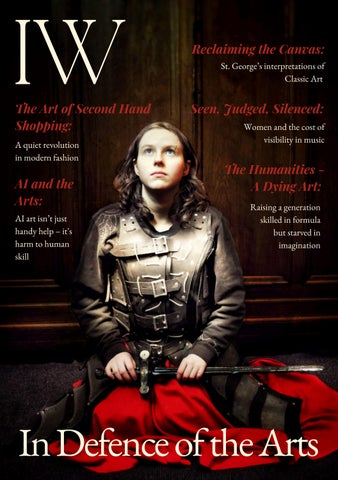
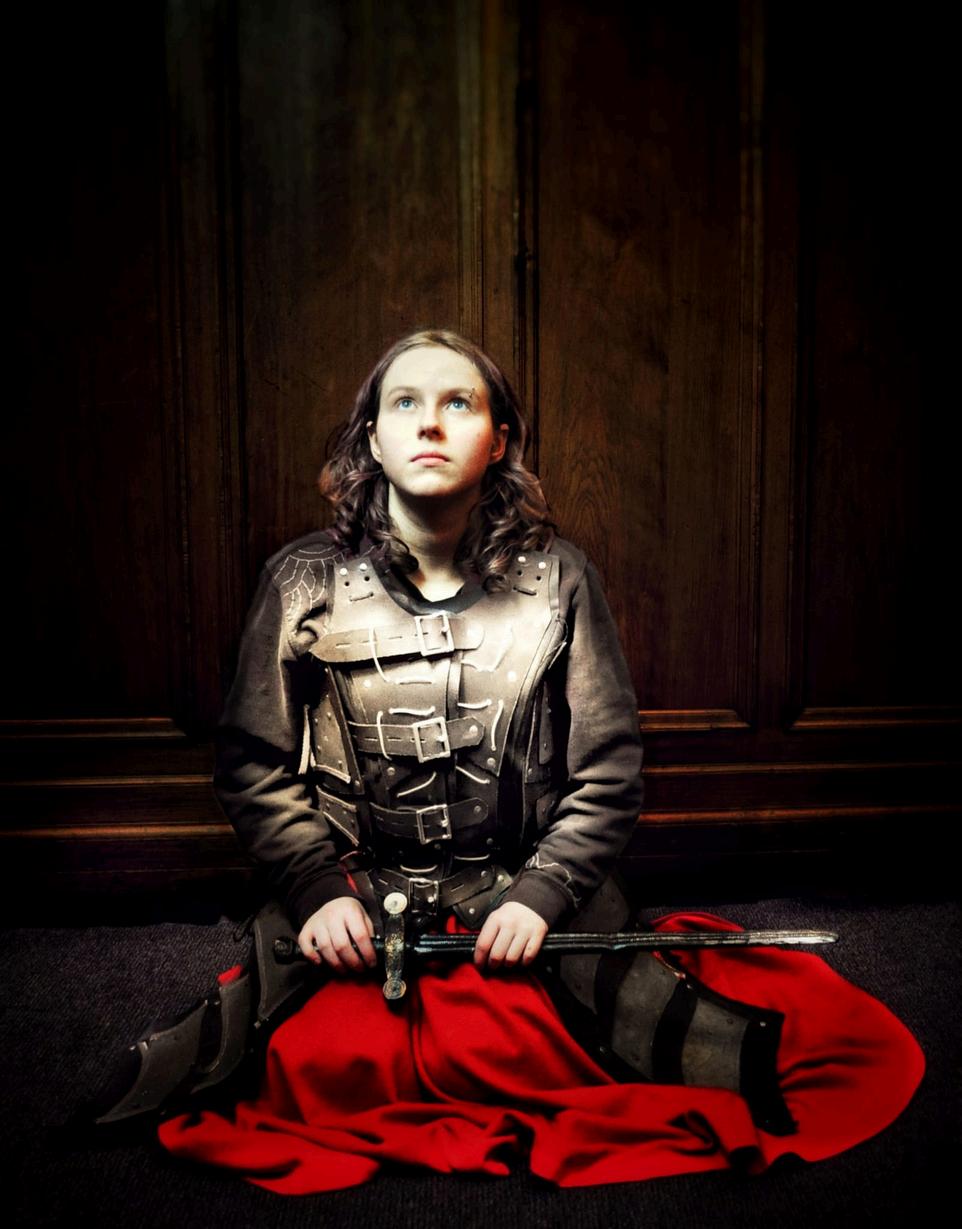
The HumanitiesA Dying Art: Raisingageneration skilledinformula butstarvedin imagination
Our Team
Writers: Chimdalu Ndubuisi
CJ Arnott
Lily Bradley
Sophie Fearon
Hope Freeman
Scarlett Gilchrist-Adams
Mila Greiling
Fatima Hanif
Caroline Kerr
Bess Lloyd
CJ Arnott
Darcey Bunker
Scarlett Gilchrist-Adams
Samanthi Shanjeevan
Megan McIntosh
Chimdalu Ndubuisi
Rachael Ndubuisi
Cherise Pollard
Honor Porter-Davidson Minna Oxley
Samanthi Shanjeevan
Linbo Zhou
Models:
Carol Magee (Editor)
Kate Macsween
Before I even started at St. George's, being editor of a school paper had long been a dream for me, as a dedicated Gilmore Girls fan from the age of 5 With attempts at my own newspaper littered across my old computer folders, I felt prepared for the job, hardly knowing just how much work would await not just me, but the entire IW team this year.
When I was offered the role, I knew I wanted it to have a theme, for there to be a key idea underpinning the whole issue. Choosing ‘Art’ as that theme, to those who know me, was a strange choice, as someone who has never been skilled with paper and a pencil, who eagerly quit the subject as soon as I had the chance. However, while I may not be personally skilled at drawing, I had grown to truly respect the art form, and more than that, wanted to reject the idea that drawing and painting were the only types of ‘Art’. In a school full of talented musicians, dancers, photographers and designers, I wanted to create an issue that celebrated all of these talents, talents which are under threat in a world which dismisses all but the most ‘practical’ subjects.
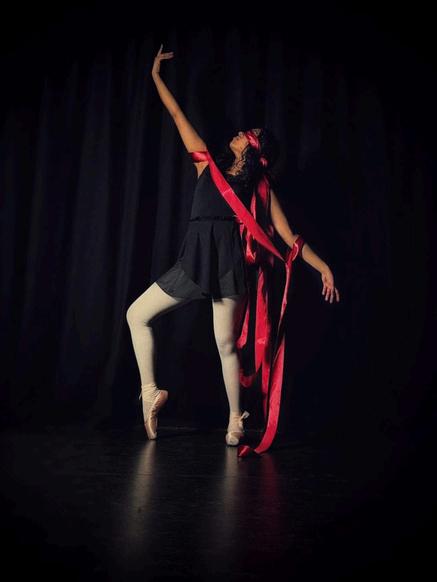
In editing this issue, I have had the opportunity to work with so many different types of artists, such as Samanthi Shanjeevan, someone who also did not consider herself an ‘artist’, and yet took photographs, helped with the design process, posed for a photo in pointe shoes (after spending years doing ballet) and, outside of the paper, is an immensely talented musician. Without her, so much of this issue would never have happened (Thanks so much, Samanthi!), and I had so many writers who demonstrated that they were also talented designers, as they helped out (after a major design crisis) by designing their own articles. I also had models, many at very short notice, who perfectly captured the feelings of paintings made over a hundred years ago.
It feels impossible to name all the people it took for the issue to come to life but needless to say, without our school’s tireless writers and artists, none of it would have been possible. I would like to give a shoutout to the many sixth formers who sacrificed their free periods to help out with a new idea I had wanted to try, and an extra special shoutout to Mrs Magee, who did so much to help bring this whole edition together
To those still reading, thank you for your support, and I hope you enjoy the 2026 issue of Independent Women!
pg. 5 - The Humanities: A Dying Art
pg. 8 - La Casa de Bernarda Alba
pg. 9 - Zohran Mamdani
pg. 10 - The Art of Second-Hand Shopping
pg. 12 - IW Reviewd
pg. 14 - Register, Research, and Vote
pg. 16 - Hope Is A Thing With Feathers
pg. 18 - The Super Bowl Halftime Show
pg. 20 - To Read or Not To Read
pg. 22 - Reclaiming the Canvas
pg. 22 - The Reluctant Bride
pg. 24 - Lady Agnew of Lochnaw
pg. 26 - The Execution of Lady Jane Grey
pg. 28 - Ellen Terry as Lady Macbeth
pg. 30 - Silence, Scandal and the Downfall of a Prince
pg. 32 - AI’s Effects on the Arts
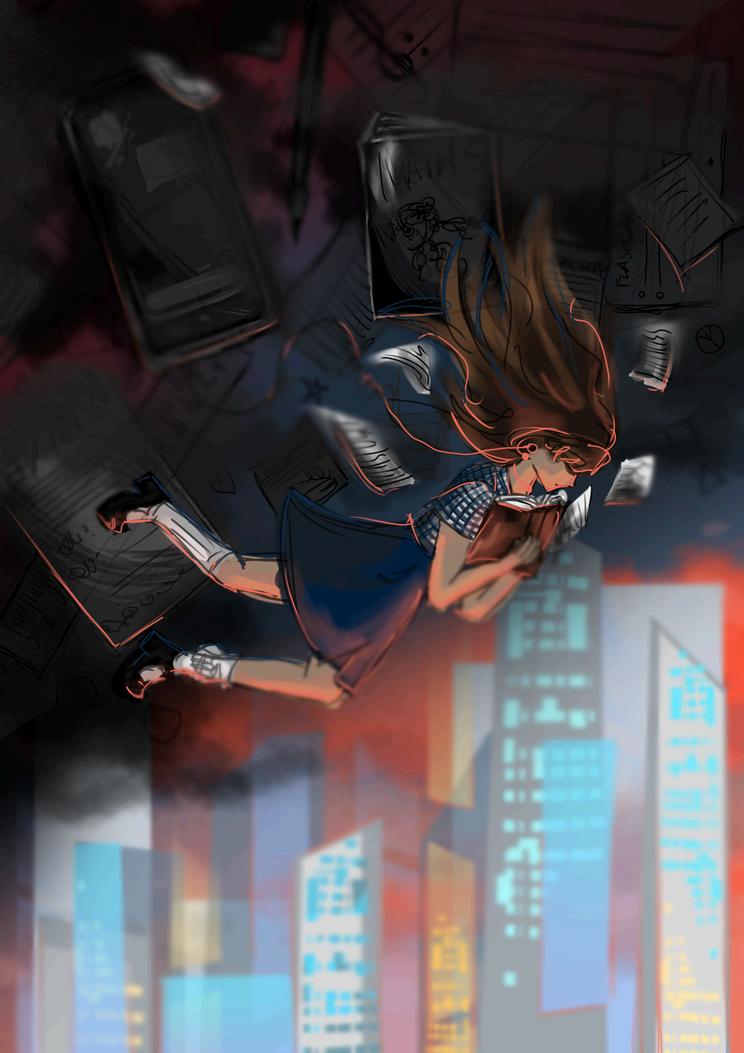
pg. 35 - Hidden Doors
pg. 36 - A Stitch in Time
pg. 38 - The Two Tales of Venezuela
pg. 40 - Book Review
pg. 42 - Seen, Judged and Silenced
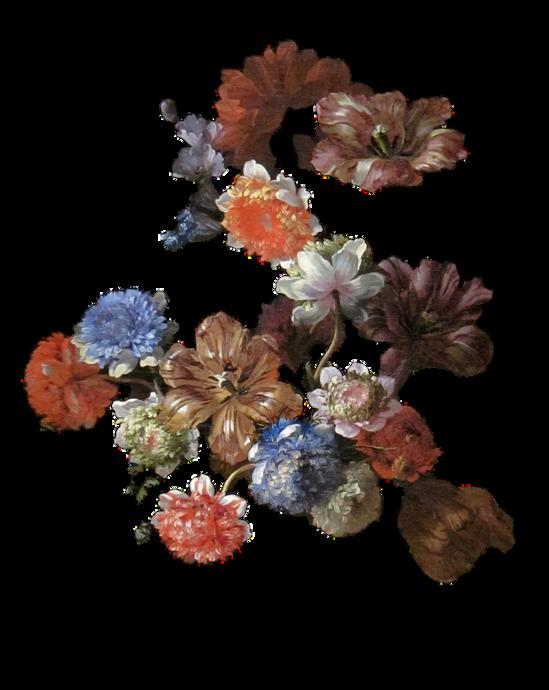
pg. 44 - Killing Time Among the Flowers
pg. 46 - ‘I Could Do That’
pg. 48 - On Timothée Chalamet
pg. 49 - Games Page
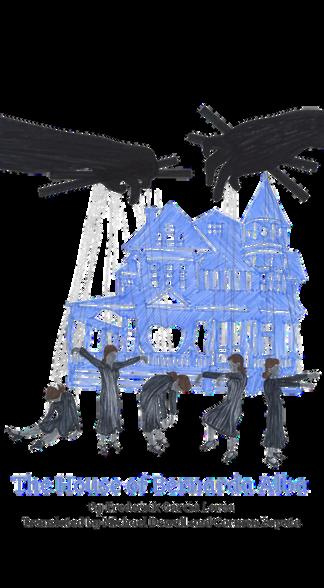
LaCasade BernardaAlba
The ending was simply extraordinary, with crumbling of Bernarda’s upkept utation, through mimicking the watchful of the neighbours, while internally, the ghters have been destroyed beyond ir.
they must hide and keep said image, rly stated by Bernarda’s final “Silencio”. the audience exits as the hollow orders through the studio.
was my final performance at school. And it is one memory I will cherish forever.
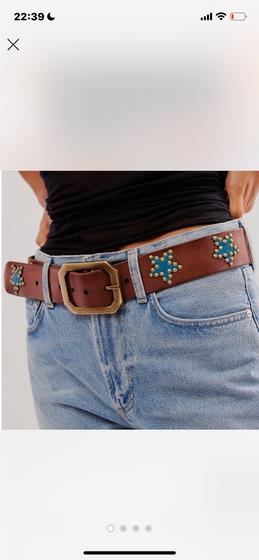
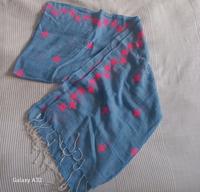
as you are completely avoiding the trap of production and waste and instead trying on the vast quantities of treasures available already.
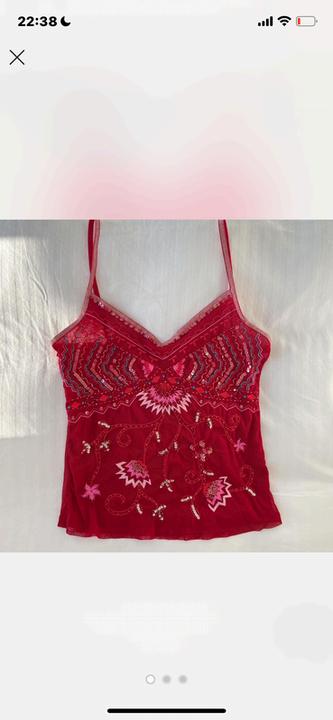
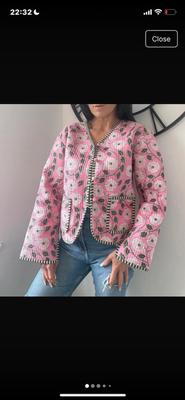
There’s also an excitement in the hunt for clothing. While high-street shops tell you what to wear as they sell endless copies of the same trends, second-hand shopping offers something rarediversity and orginality. You never quite know what you’ll find: a perfect hand-beaded top from the ‘90s or a quilted coat with every colour and pattern you could think of. These pieces don’t just look cool - they feel alive with personality and history. And you, as buyer, get to make conscious choice on how you want to express yourself rather than being influenced by the next new fashion trend.
Buying vintage or second-hand isn’t just about saving money or saving the planet, though both matter deeply It’s about rediscovering the creative joy in how we dress ourselves; choosing things that last, that mean something, and that make you stand out rather than blend in.
“In a world hooked on the new, there’s something quietly radical about wearing something with a past”
Snow White
Sophie Fearon
low turnout of the slightly older 18-24 age group is producing a generation who don’t vote now, and won’t vote later. Couple this with the fact that 16 and 17 year olds have a significantly higher turnout rate when they’re allowed to vote (75%!) and it’s clear that extending the vote to younger people will produce more lifelong voters, but only if you do it! Even more encouragingly, 16 and 17 year olds are shown to access information about voting from the widest range of sources, countering the popular idea that young people aren’t informed enough to be trusted with the vote
The Super Bowl
Hispanic immigrant community (a nail tech, piragua vendor, jewellery seller), to Ricky Martin and Pedro Pascal making surprise appearances, and even
Thing
Do I have any interest in sports? No. Do I know how American football is actually played? No. But did I stay up till the wee hours of the morning just to watch the Superbowl halftime show? Absolutely. What I anticipated was a clear message – ICE is terrible. Instead, what we saw was so much more meaningful, and so much more important: a message of love, of acceptance, and of unity. From the artist who made the first ever non-English album to win Album of the Year Grammy Award, Bad Bunny delivered a halftime show that was entirely in Spanish. Not only that, he delivered a show absolutely packed with Puerto Rican and Latin American culture. From the sugar canes that were a core part of Puerto Rican exports after the introduction of Spanish colonialism, to vendor and sellers representing the typical to the malfunctioning power lines (representing the exploitation of Puerto Ricans by the LUMA energy company after hurricanes ravaged them); this show was representation on a level we’ve rarely seen before.
Halftime Show:
The show was joyful, and full of love – so much so that it involved a genuine wedding – and iwithout a doubt unified America. How, you might ask? Because ‘America’ is not, nor ever has been, just the United States. From my limited experience in South America, I have been consistently told, that when I refer to ‘Americans’ I refer to all of them: North, South and Central Americans. And in this America, the real America, there are 455 million native Spanish speakers (out of just 498 million worldwide). It is for this reason that Bad Bunny ended his performance by shouting ‘God Bless America’ and listing every American country – including the United States – and was followed by so many flags. This show went way above and beyond my expectations, bringing love, and joy, and hope where it is dearly needed, especially for the USbased Hispanic community, and without a doubt served as a force of unity. Bad Bunny used his art not to criticise, but to inspire, to educate, and to bring hope. To sum up, as was seen on a jumbotron in the Super Bowl stadium:
Powerful Than
To Read or Not to Read?
Let’s go back to JK Rowling and Harry Potter. The effect they have had on the world is undeniable. Fans who grew up with the books have said the series helped them through all sorts of experiences from grief to dyslexia to finding a job. The growth of YA could also be attributed to the world of Harry Potter, with the Percy Jackson series only adding to the sheer momentum of the YA scene at that time. But since 2018, controversy has followed the world-famous writer. Her comments about trans people quickly catapulted her from well-beloved to downright hated. There have been calls to boycott the new Harry Potter show, and even people writing fanfics out of spite for her. Actors involved in Harry Potter projects have both defended and criticised her. Even Pedro Pascal had something to say.
But things get even more complicated when we time travel further back because we get books that are a product of their time. A great example of this is Ian Fleming’s James Bond, who despite being a British cultural icon, is a product of oldfashioned and misogynistic ideas of masculinity from the 1950s when the books were written. Interestingly however, the film franchise has rewritten the character to move with the times and so has kept him relevant even playing with th idea that he is sometimes at odds with a new age.
In contrast, we get The Bell Jar about a decade later, combining themes of mental health and the restrictions society placed upon women. Now, it is universally hailed as a feminist literary classic, with essays dissecting its ideas as far back as the 1980s. But what is often overlooked is the recurring theme of white feminism and racism that plagues this book. When I read it, I was struck by the way Esther used people of colour to describe herself as ugly in certain conditions. Admittedly, these racist ideas are beginning to be noticed more as of late, but on the whole it’s brushed over in comparison to other books written by men.
And yet, books like The Bell Jar are still enjoyed by both white people and people of colour alike. I find that quite ironic, especially considering that Sylvia’s Plath’s novel is semi-autobiographical, therefore making Esther a reflection of the woman herself.
But at the same time there are people like me who didn’t like the book because they found the racism off-putting. I personally wouldn’t have been as bothered if she was more obviously and directly racist, but the way she implied that people of colour were inferior by using them to describe herself when she thought she looked ugly really annoyed me. I liked the ideas the book posed, just not the protagonist that posed them. And by extension that means I don’t icularly like the author’s way of inking either, considering the book is semi-autobiographical.
wever, that nuance is unique to me. The truth is, the answer to “Can you separate a writer from their work?” changes all the time and in every scenario. It varies from book to book and author to author, as the author’s views are not always very apparent in their work. Sometimes once we realise the author’s wrongdoing, we reframe and recontextualise the entire work through the lens of that new information.
It can also vary from reader to reader, as different topics affect different people in different ways. One person may pick up on an issue with a book that you didn’t see before. And that same issue may make you decide to stop reading that author’s books, while your friend doesn’t see it as as much of a dealbreaker. It doesn’t matter because as long as you have an understanding of the issues and how they affect people, what you decide to do next is ultimately up to you.
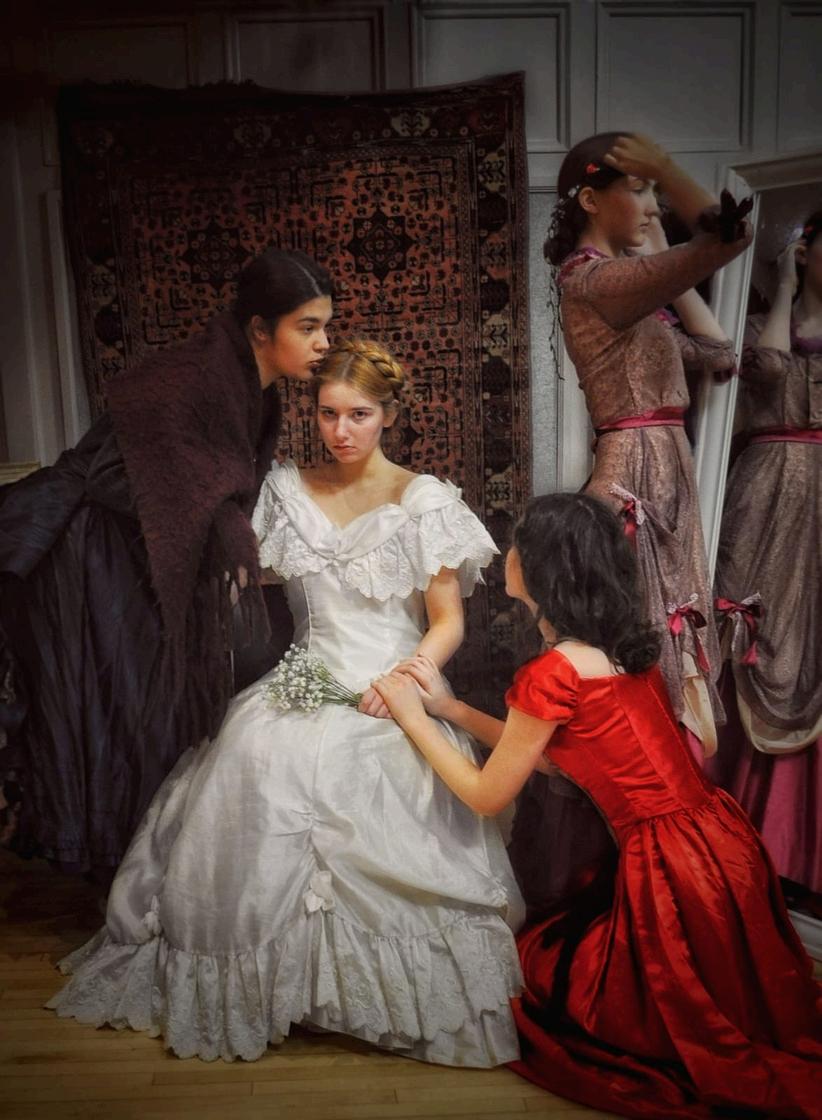
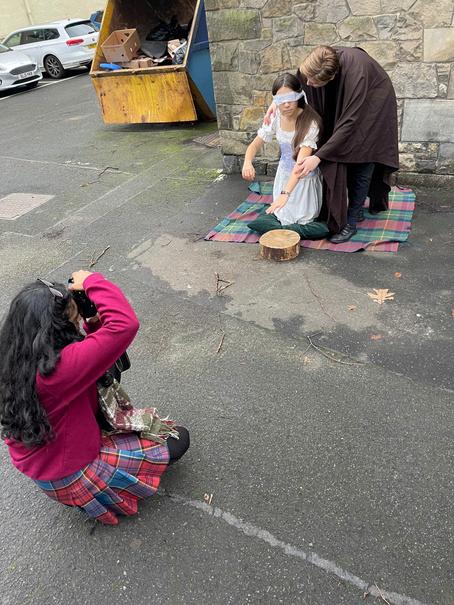
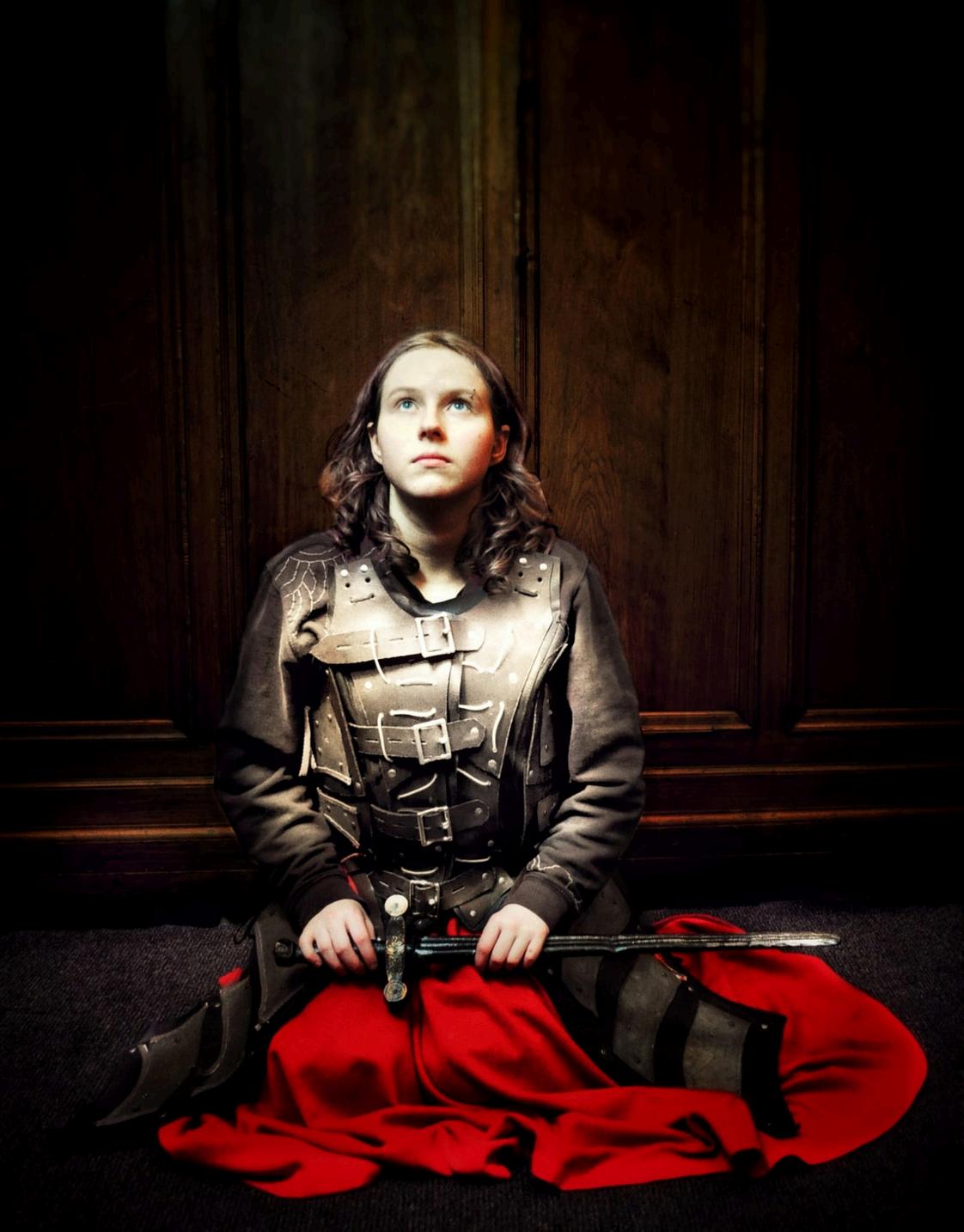
Models (in order of the picture): Ariana Costache Hope Freeman
ZEllieRawlinson-Watkins oeAndrews
Photographer: SamanthiShanjeevan Rug Sourced
By: Florence Henry
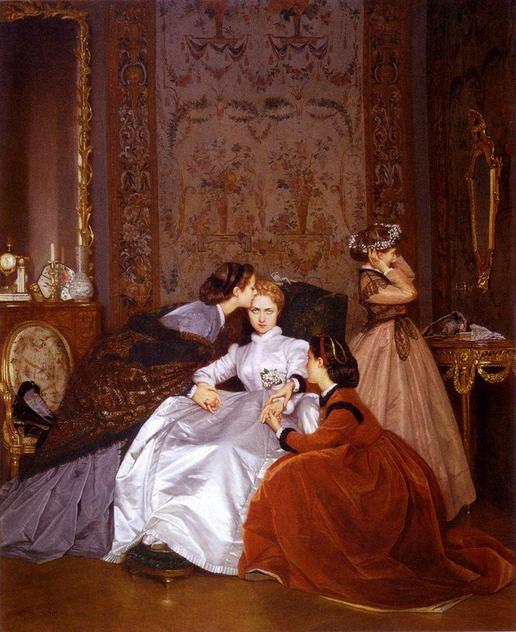
‘La Fiancée Hésitante’
(The Reluctant Bride)
This painting represents how even the wealthiest women could never have total autonomy in the 19 century. With direct eye contact (very uncommon in paintings such as these) which could be interpreted as accusatory or desperate, the whole painting shows a woman’s misery at her wedding, one she did not want. Though her friends comfort her, the girl in the back represents the naivety of children, romantacising their future role as bride, unaware of what it would truly mean for them.
FromClassic toContemporary
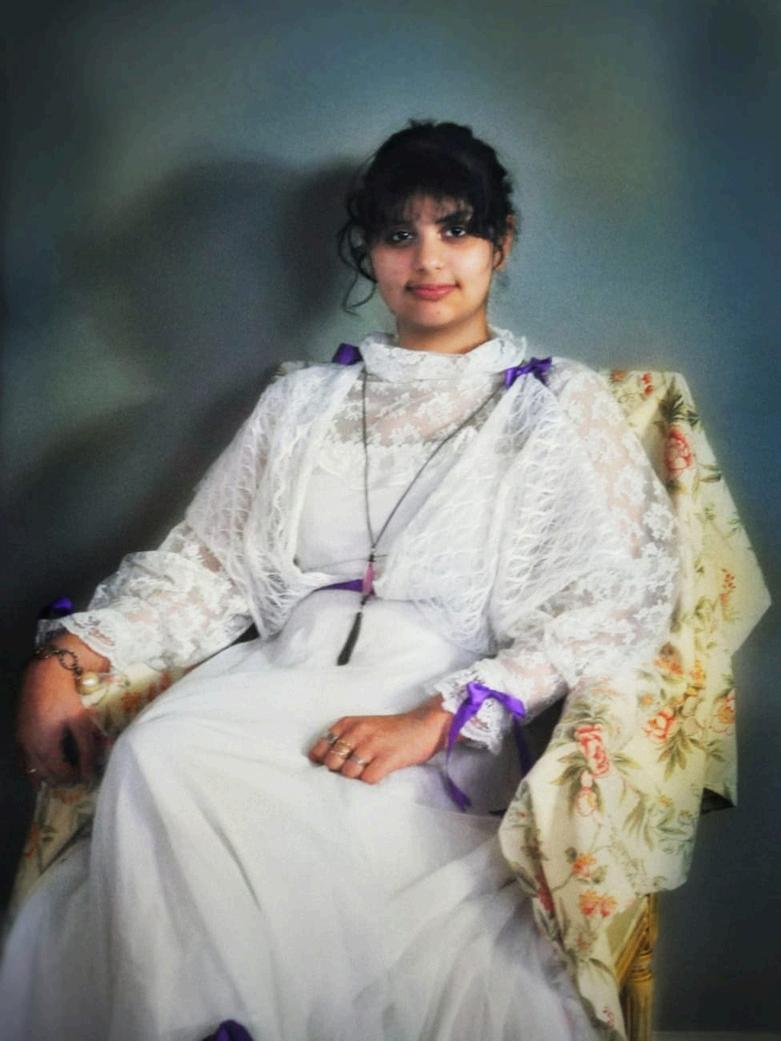
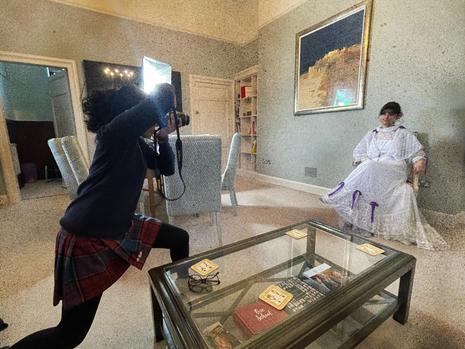
Model: MuskaanYousaf
Photographer: Samanthi Shanjeevan
Chair Sourced By:
MrsChandler
Thompson ’sOffice
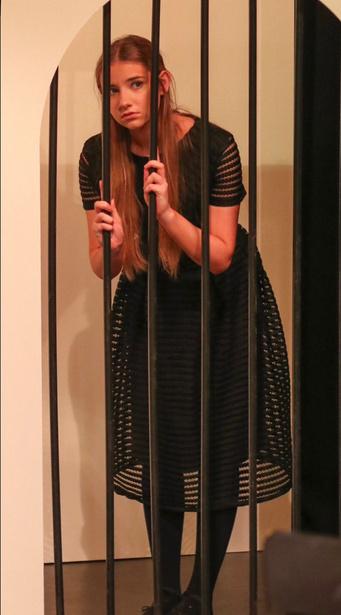
Here, Lady Agnew stares directly at the viewer. This was very uncommon as the tradition at this time was to look more to the side, in a display of more ‘modest’ femininity, something this painting directly contradicts.
Moreso than that, the use of minimal décor, which was also uncommon (and much appreciated by our props department) was meant to emphasise the woman, instead of her wealth or possessions. This painting is one that outwardly defies the traditional feminine role, something we were desperate to capture.
Expressionover Time
Alina Skornyakova
Photographer: Samanthi Shanjeeva
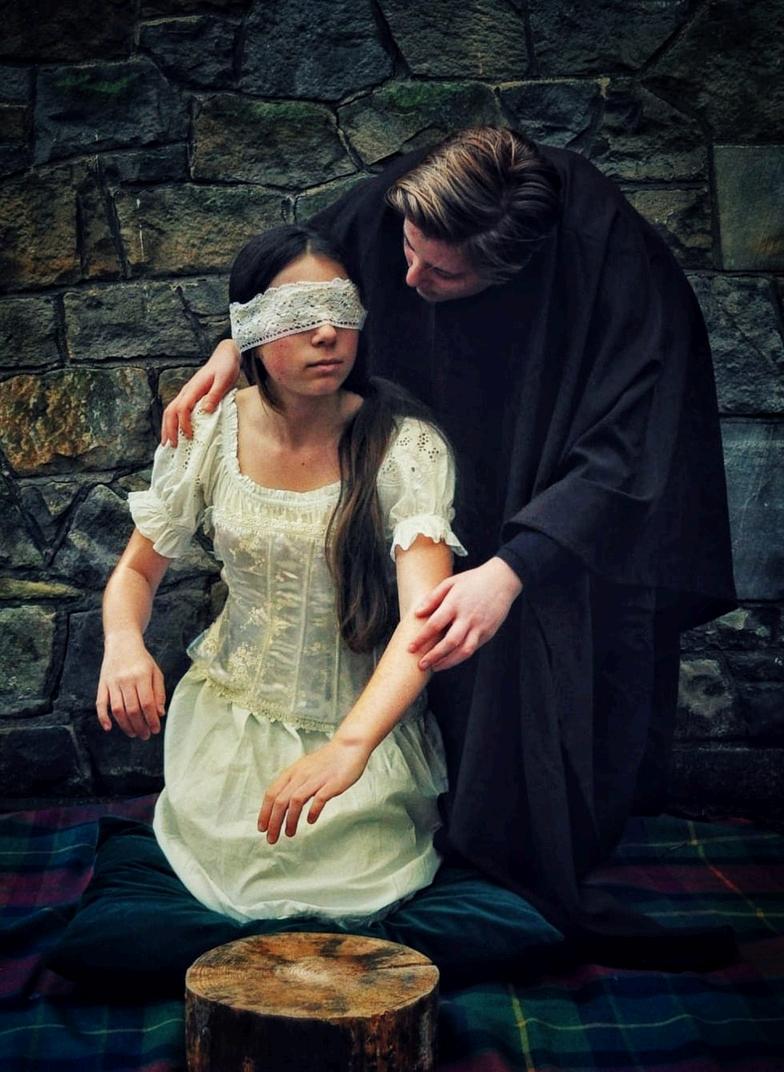
The Execution of Lady Jane Grey Paul Delaroche 1833
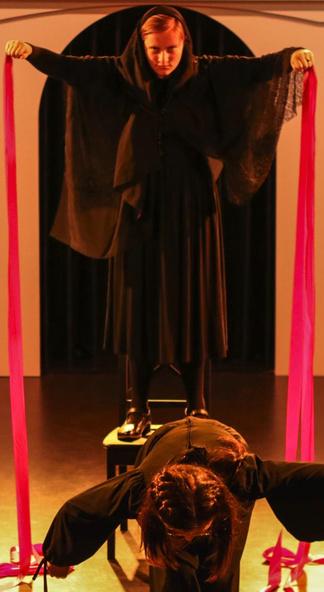
This p chosen primari subject matter, p of the famous historical moment about the death of a girl who had been used as a pawn. Unwilling to take the crown at first, Lady Jane Grey was chosen by people in power to lead, and although Queen for only 9 days, she remained outspoken in her Protestantism ,which ultimately killed her. This painting portrays her at her weakest, suffering from the abuse of those in power. With her outer clothing removed, she is shown plainly here as w 16 year old vict afraid “What shall the block?”
Power inPortrayal
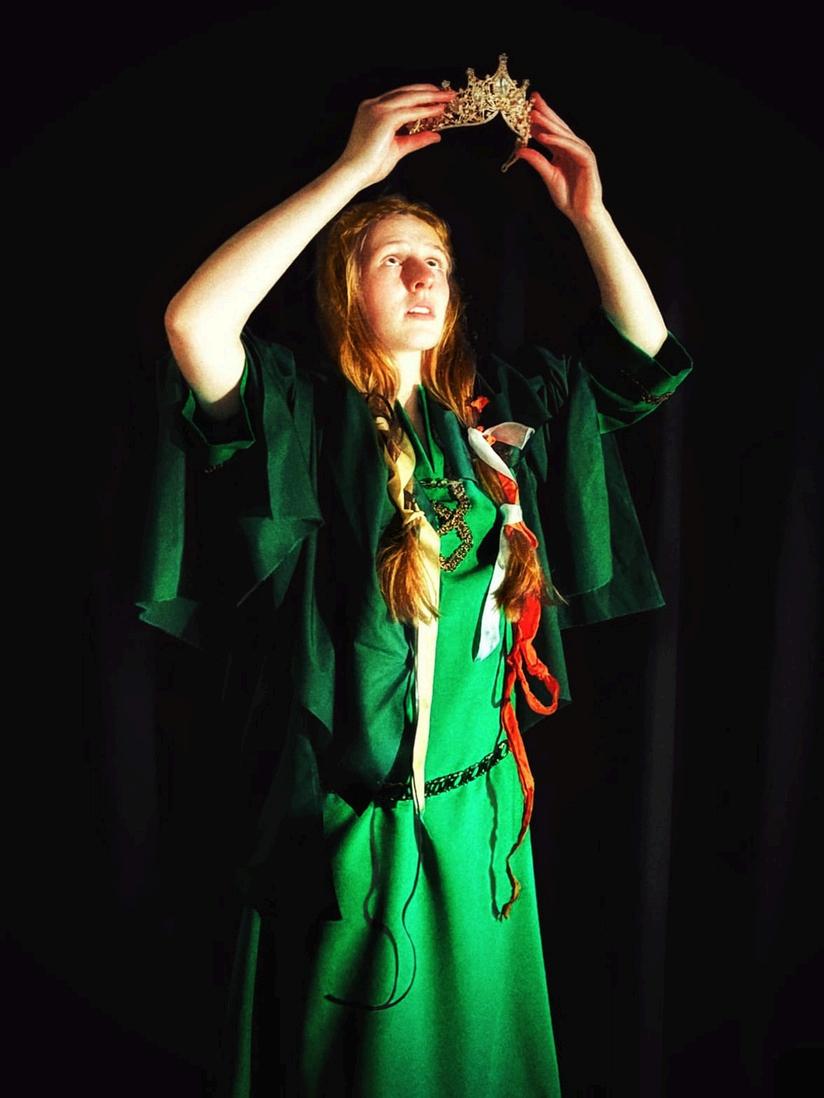
This painting was made when Sargent was inspired by the performance of the actress Ellen Terry as Lady Macbeth at the London Lyceum, wanting to capture the moment of her performance. Lady Macbeth is a figure thathas been depicted in media for centuries, a character who is both a victim of her husband’s ambition, as well as the ammunition behind it. The woman who hands him the knife used to kill the King, and also the one forced to suffer from it most. Ellen Terry, herself, was an inspirational force, supporting her family, as one of 11 children, through her acting, gaining her first role at 9 years old. This painting was a testament to her commanding presence and dramatic skill.
EllenTerryasLadyMacbeth
JohnSingerSargent
Silence, Scandal and the Downfall of a Prince
Power is often associated with dfsdfsleadership, respect, and responsibility. However, the controversy surrounding Prince Andrew shows how power, when misused, can instead lead to public outrage and long-lasting damage.
His links to convicted offender Jeffrey Epstein and the civil case brought by Virginia Giuffre raised serious questions about privilege, influence, and whether powerful individuals are always held accountable for their actions. One of the greatest dangers of having lots of power is the belief that rules apply differently to those who have the most. Wealth, status, and connections can create a protective barrier, making certain people feel like they can do anything they please. When people have too much power, they can start to make poor decisions and forget how their actions affect others. Many people have reacted strongly to the scandal, and surveys showed that trust in the royal family dropped. This shows that the public does not just blame one person they also question everyone with similar positions in status. Furthermore, this case proves how power can silence others. Victims or critics may feel intimidated by influential figures, fearing not being believed or bad backlash. This inequality means harmful behaviour can continue without being stopped. After Andrew’s television interview, many people felt the problem was not just what he said, but that he did not seem to take full responsibility.
The strong public reaction showed how important honesty and fairness are to people. Unfortunately, this situation is not limited to royalty. Abuse of power even exists in modern society— in politics, workplaces, schools, and even online communities. When leaders avoid scrutiny and being under the public eye, when organizations protect their image over the truth, when ordinary people stay silent, injustice grows. Which shows that unchecked power harms everyone
So, what should be done to help? Firstly, organizations must be open and allow fair, independent investigations so that nobody seems above the law. Secondly, education should encourage young people to question authority respectfully and understand when behaviour is unfair. Finally, society must support those who speak out, creating an environment where honesty is valued more than someone’s reputation.
In conclusion, the scandal surrounding Prince Andrew serves as a modern warning about the abuse of power. Authority should bring responsibility, not protection from consequences. If we want a fair society, we must demand accountability from leaders and courage from everyone else. Only then can power be used to serve others rather than protect people that are privileged.
been something we have created since the beginning of time and is a testament to human expression, perseverance and resolve.
Humans can perceive the world around us and create things based off of how we feel about it –assessing and reacting to the world around us is what makes us sentient beings. We, as humans, create art to interpret our existence – we share our opinions, our emotions, tell stories, and can make others think of our world in a new way. We use art to entertain ourselves,
We seek to express how we feel because we are social creatures – we have very complex inner worlds and emotional landscapes along with rich, detailed memory and cognitive perception; therefore, we have a strong desire to convey our own emotions; feelings we desperately want to express through words or paint.
“By using AI to replace people who work in art, not only is the true potential of human creation being stifled, but there is also less value being placed on the arts.”
An AI tool simply creates because it is told to –it uses the data that it has been trained with to
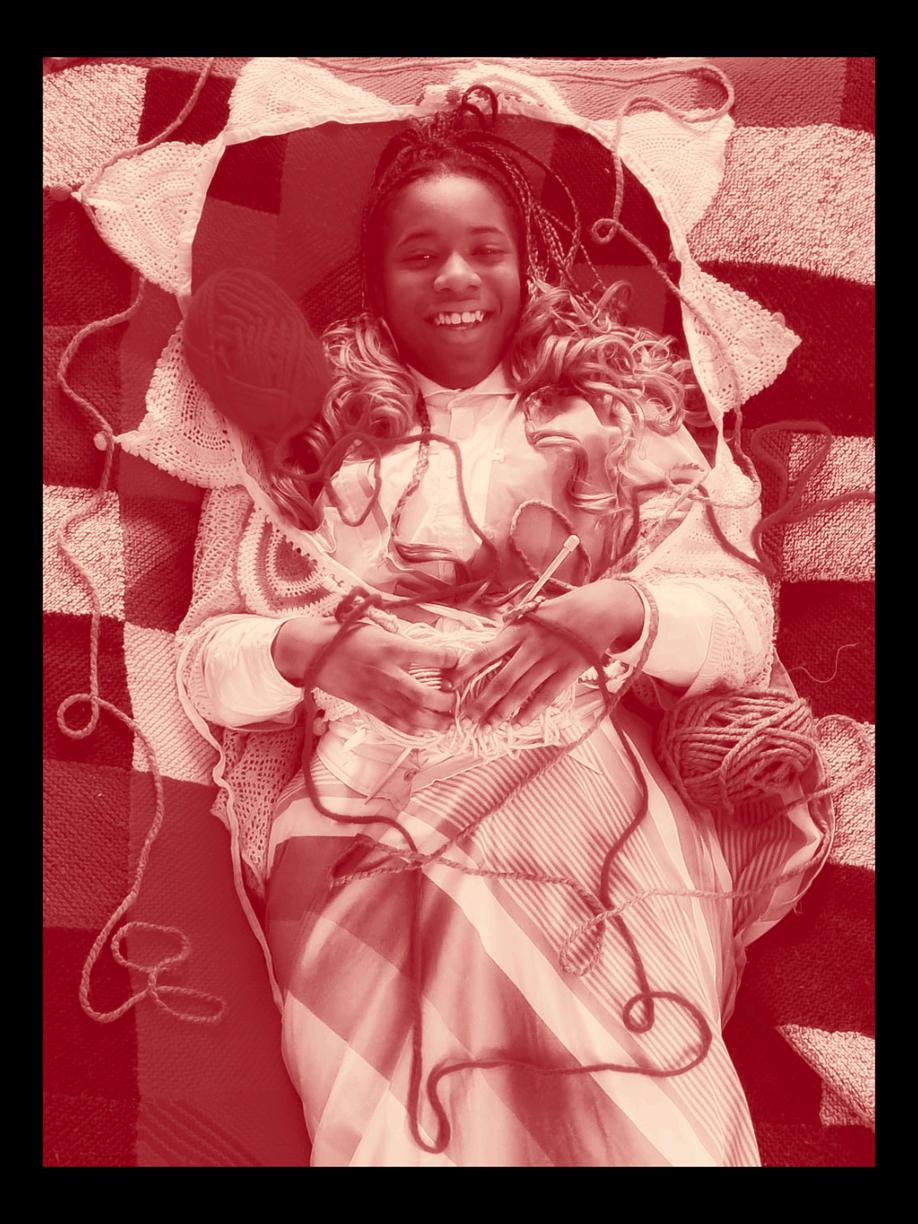
The Great British Crafting Revival
Most have agreed that it can make thoughtful gifts if you can’t buy anythingit encourages upcycling old materials that you may not use anymore, and it’s a creative outlet to de-stress after a long day.
There was a time that lifestyle and method of teaching was normal and widely accepted. It was schools much like St George’s that began to pave the way for fair teaching for young and aspiring girls. Women who have taken up these hobbies that, in today’s society, would be considered “trad wife” aren’t doing it to serve under a man they way it used to be. They are reclaiming a toxic ideology and making it suit them. They are doing it for themselves and nobody else and that is where the difference lies.
There is freedom in doing something because you can and not because you have to and when you reach the end of a piece or project, you achieve a sense of pride and accomplishment.
Art made by women is no longer in service to our male counterparts but it is a method of empowerment, displaying creativity, and pursuing your own path.
Never let anyone tell you what you can or can’t do.
repealed oil nationalisation in Venezuela (something that had been a cornerstone of Chavist thinking since the left wing government took power in 1999), allowing for foreign, private companies to enter Capitalising off their newfound access to the biggest oil reserves in the world, the US began to lift their sanctions.
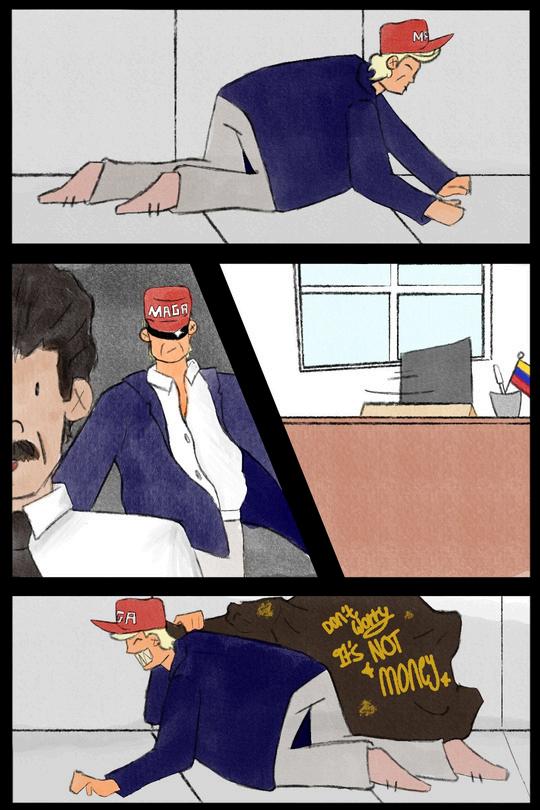
TheTwoTalesof Venezuela
However, this issue is far more complex than just black and white, democracy vs. a quest for oil, imperialism vs. victim.
Image by Alina Skornyakova
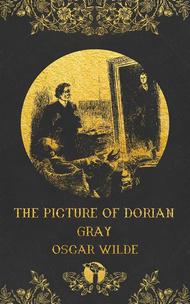
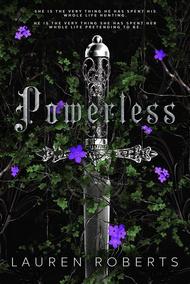
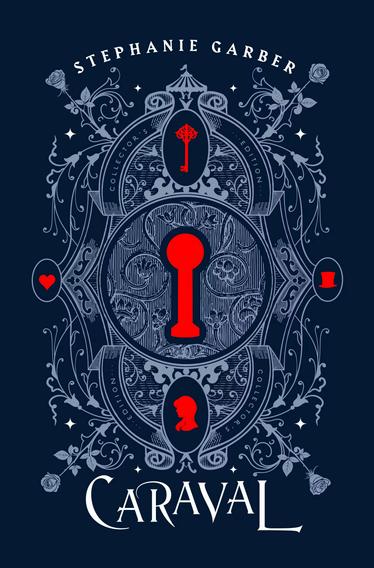
The Picture of Dorian Gray Caraval Powerless
SEEN, JUDGED, SILENCE
Women and the Cost of Visibility in Mu
TALENT ISN’T ENOUGH
CONTROL
SAME STAGE, DIFFERENT RULES
The message was clear: perform, but do not control.
GE GOES
VIRAL
FROM FANS TO CRITICS
LET WOMEN BE LOUD
If music is meant to be about expression, then surely, it’s time we
‘The
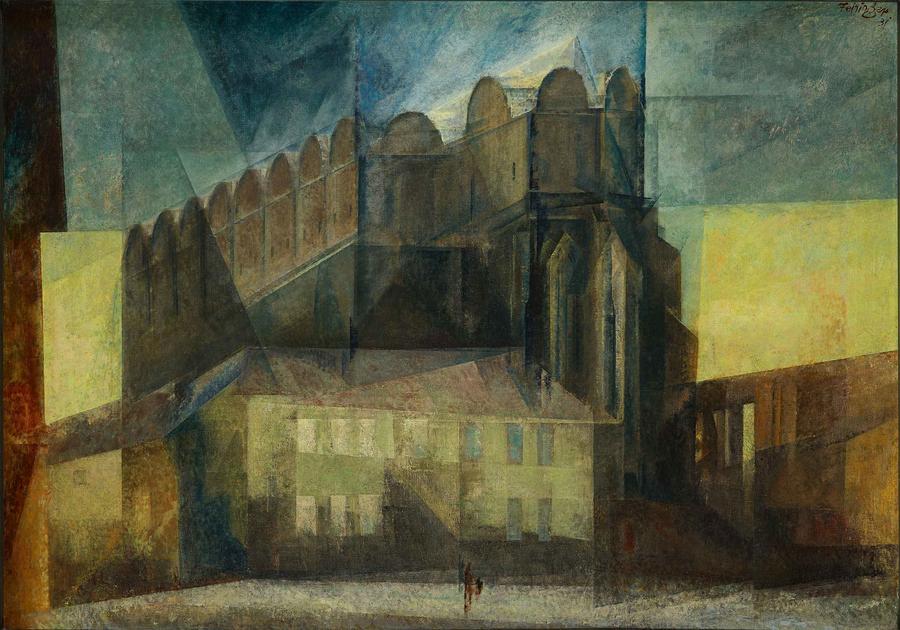
‘Market Church in Halle’ - Lyonel Feininger
AdmirationandDisappointment: WhenArtistry
MeetsDisregard
This isn’t cancellation. It’s a condradiction.
Would your friends describe you as ‘fun loving’?
Which Character Are You? Edition
How do you feel about our ‘auld enemy the English?
I find them abhorrent, they ruined my life
No, I’m a serious person. Yes, I enjoy the fun things in life! Do you like to party?
Look... I try ok
I am English!
How would you describe your attitude to politics? How is your relationship with your father?
Lovely! We went fishing last week Action oriented
I don’t want to talk about it
What other kind of joke is there!
I don’t need a party to make people laugh
Darling, I host the parties
Your jokes are usually at the expense of other people. Are you ambitious? I’d rather have fun all day tbh I will do anything to thwart my enemies Not always!
H G F E D C B A
Mary Queen of Scots
You’ve faced a lot of hardship in life but always try to stand on your own and uplift the people around you.
William Wallace
You’re dedicated to a cause and always do your best to right any wrongs you see in the world even if everything is against you.
Bob Hale
If there’s a silence in a conversation you fill it, either with a fact you’ve learned or some gossip you always seem to be in on.
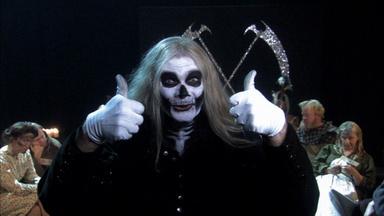
George IV Death
You’re the class clown and aren’t afraid to share your mind especially when other people are making decisions you disagree with.
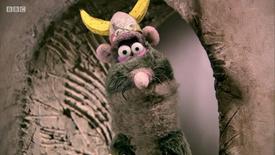
Rattus Rattus
You have a quip for every situation, seem to have a well-informed opinion on everything and love to let people know that.
Cleopatra
Charles II
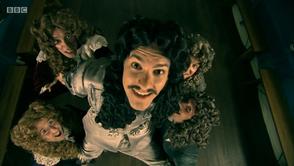
You’re a party animal above all else and can always be relied upon to have a good time, especially when your team wins the game.