



St Joseph’s Bishop’s Stortford
St Thomas of Canterbury Puckeridge
St Joseph’s Hertford
Sacred Heart Ware
St Mary’s Bishop’s Stortford
St Augustine’s Hoddesdon
St Joseph’s Waltham Cross
St Cross Hoddesdon

These four values are shared throughout our membership and take their inspiration from the life of our Patron Saint, St Francis.
We build supportive and encouraging communities by celebrating achievements, recognising individuality, and keeping our Chaplaincy teams at the heart of school life.
As caretakers of God’s creation, we recognise it is our responsibility to care for the world around us. We model behaviour that inspires students to take this from the classroom and into their lives.
We show the love of Christ by working for the Common Good through supporting charities locally, within our diocese and internationally, both practically and through fundraising initiatives.
We show the love of God by offering forgiveness, supporting each other through mentoring and anti-bullying schemes, and give opportunities to reflect prayerfully on resilience, positive mental health and wellbeing.
You may have heard of Francis of Assisi—the celebrated saint who dared to take the Gospel literally. He was born in Assisi, Italy in 1182 into a wealthy family and aspired to become a knight. At 20, he was a POW held in a Perigean dungeon for a year until his father ransomed him. He then became a Crusader, wearing golden armour but then sensed God calling him.
Francis fell in love with His Saviour and was even ridiculed for his devotion and changed lifestyle whereas this new life of prayer, study and fasting marked the beginning of his holy surrender.
God would soon test Francis’s devotion by placing a leper in his path. Before his spiritual awakening, lepers repulsed Francis. Filled with an unexplainable love for the beggar, Francis dismounted his horse, gave all his money to the leper, and kissed the man’s diseased hand.
This Holy-Spirit-led gesture of love ignited a new passion in Francis to offer everything he was and everything he owned to God—so that Christ’s love would flow through him unhindered. He accepted God’s call to ministry and poverty by saying, “This is what I wish; this is what I am seeking. This is what I want to do from the bottom of my heart.”
In 1209, Francis went to Rome to seek the approval of Pope Innocent III to start the Franciscan order. He believed the lost could be reached through love and truth and that Christians are called to be instruments of peace.
Francis erected the first Nativity Scene in 1223. Out of his desire to show the world Jesus, Francis obtained permission from the church to create a Christmas display that would visually represent the setting of Christ’s humble birth. In a cave in Greccio, Italy, Francis set up the first nativity scene—complete with a real manger and a live ox and donkey.

“This is what I wish; this is what I am seeking. This is what I want to do from the bottom of my heart.”

Welcome to our Autumn Newsletter. Our Trust is now three years old and it feels like we have reached the end of the beginning; foundations in place, and real progress now being made. Excuse the pun but it’s certainly been an education for all involved! We have learnt together and navigated through what it means to be a Trust.
“Start by doing what’s necessary, then do what’s possible, and suddenly you’re doing the impossible”
This quote from St Francis really resonates when I reflect on its application to our first 3 years
In 2021, we set out with one clear priority; to provide the very best Catholic education now and for generations to come. Whilst creating an eight school enterprise from scratch was bound to be challenging, we have developed as an organisation faster than anyone anticipated. We feel blessed that working relationships have been built and goodwill and tolerance displayed at every turn. We give thanks that we find ourselves in this position of stability and growth.
For me, I liken our enterprise to that of an orchestra. On their own, individual schools might have been akin to the brass, strings, or perhaps the percussion; each capable of producing a brilliant ‘sound’ in their own right. However, as a Trust we unite and create something greater than the individual parts could ever achieve. It has been my joy and privilege to see the benefits of this collaboration as our schools work together and bear so much fruit.
In my role, you might expect me to be positive, and so I have invited a cross section of Trust members to share their experiences with you over the following pages. Every story that
you read, each ounce of energy expended these last three years, our entire strategic approach has been laser-focussed on creating an environment in which students are offered the very best Catholic education now and for future generations. I hope that message will come across loud and clear on every page.
Within the Trust, we feel that sharing and celebrating our collaborative achievements with you is well overdue so we have created this new style of newsletter to keep you informed and hopefully receive your prayerful support of our endeavours. Our intention is to update you in this way each term, if these updates prove popular. I’d love to have your view on that.
Today, we are pausing to reflect and count our blessings. Tomorrow, I feel sure will offer challenges but also marvellous opportunities as we look to grow and develop further. Thank you for taking an interest in our work and please join me in prayer and gratitude to God for blessing our family of schools so abundantly.
Naturally, parents’ prime focus is on their child’s progress and the way that their school operates. Behind the scenes though, belonging to the Trust is about delivering educational opportunities that simply would not have been available before. We shine the spotlight on just a few examples.
Are you sitting comfortably? Once upon a time, in a school not so far away in Hertford, pupils created twisted fairy stories where villains became heroes and giants were gentle and kind. St Joseph’s Head Mr Maloney explains...
“Like all good stories, let’s start at the very beginning. As part of the Trust Development Plan, all the Heads meet to identify areas for improvement and focus. Between us, we agreed that the basic writing skills of students had been badly affected by lockdown; we appreciate it had been easier for parents to support their children at home with topics like maths or reading than in might have been with creative writing. We could see the consequences after lockdown.
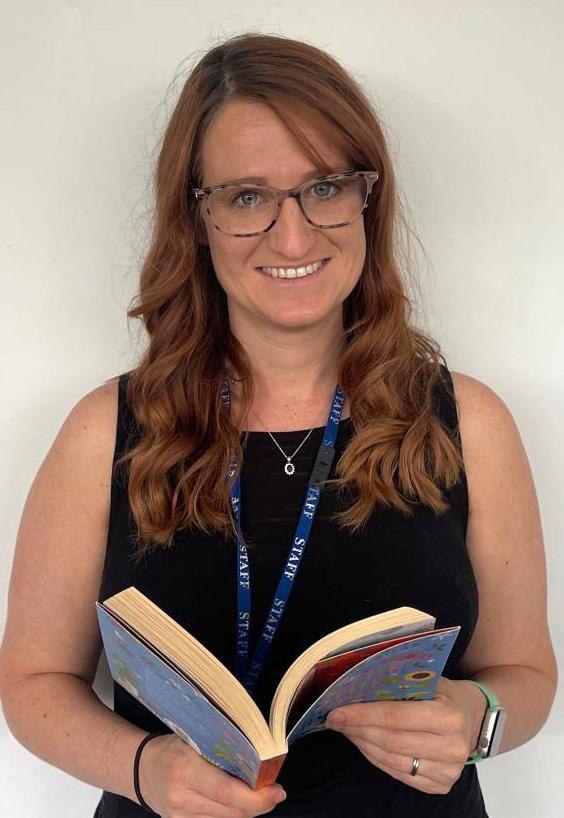
Mrs Grahame Deputy Head St Joseph’s, Hertford
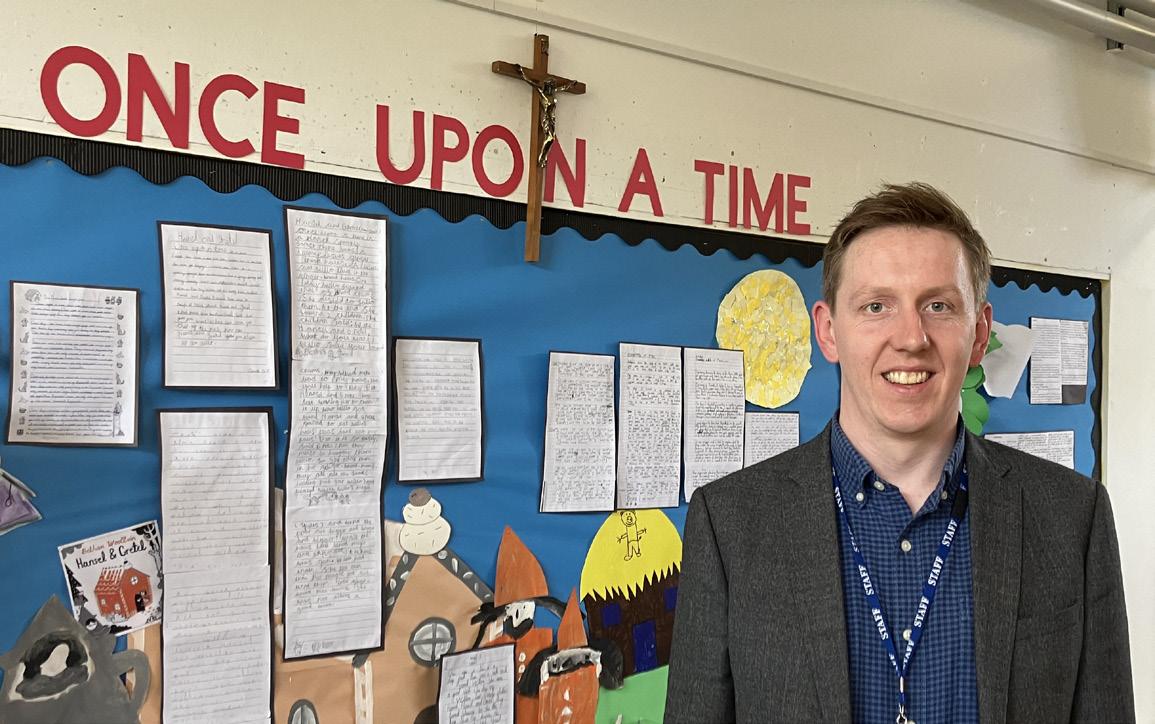
We found a project called Twisted Fairy Stories that could benefit students at all the Trust schools. It’s been a huge success. It became a real celebration of writing and we had our own competition here as well as an inter-school one. The children loved the idea of being part of a project that spanned several schools. You could feel a real buzz of enthusiasm around the place.
The benefit to the students is the prime success of course but we have made cost savings by doing this as a Trust. I’d also point out that teachers from different schools have been able to support each other, share experiences and borrow ideas from each other – something that would not have happened had we not been part of the Trust.
The Trust was also able to provide an English expert to offer training to teachers as part of their professional development. All excellent news for all the schools. We are seeing student’s attitude and confidence to writing massively improve, their skills increasing and teachers more confident about how they lead on the subject.
For me, being a part of the Trust has only been good news. We tend to be able to do things together quicker, cheaper and more effectively by collaborating than if we were operating alone. Personally, as a relatively new Head, the Trust has been extremely supportive. At the most basic level, I have several colleagues who I can pick up the phone and get guidance- they just happen to be Heads at other schools!”
“The Trust writing competition has engaged the students and allowed them to ‘show off’ their skills. The children loved the ‘twisted fairy tale’ idea and wrote freely from their imagination coming up with lots of ideas.
After that, we ran a multi-school poetry competition along the same lines which was a lot of fun. Some students chose to create entertaining raps and others writing poetry using amazing figurative language helping us imagine flowing rivers and scary monsters.
It has also been really useful for our teachers as they are able to see exactly what our students can do when they write independently on a topic that motivates them. This has helped us to continue to plan lessons that help each and every one of our students. Importantly, we have seen a measurable and positive impact in attainment in writing for our students.”
““The experience of working within the Trust has been a highlight of my teaching career.
At University I specialised in Special Educational Needs and Disabilities, (SEND). It’s an area that I have always been passionate about and the proportion of the number of children in our school with specific needs had grown dramatically; well before we became part of the Trust. Our focus on creating quality SEND provision within our school environment is mirrored in the Trust approach to improving outcomes for children with SEND across all eight Trust schools.
Therefore, when we joined the Trust and an opportunity to take a one day a week secondment at St Joseph’s Waltham Cross emerged as their SEND Co-ordinator, I was thrilled.
We had already initiated a half termly meeting of the SEND Coordinators within the Trust schools and that has been so beneficial to our practice and staff training opportunities. Add that to the
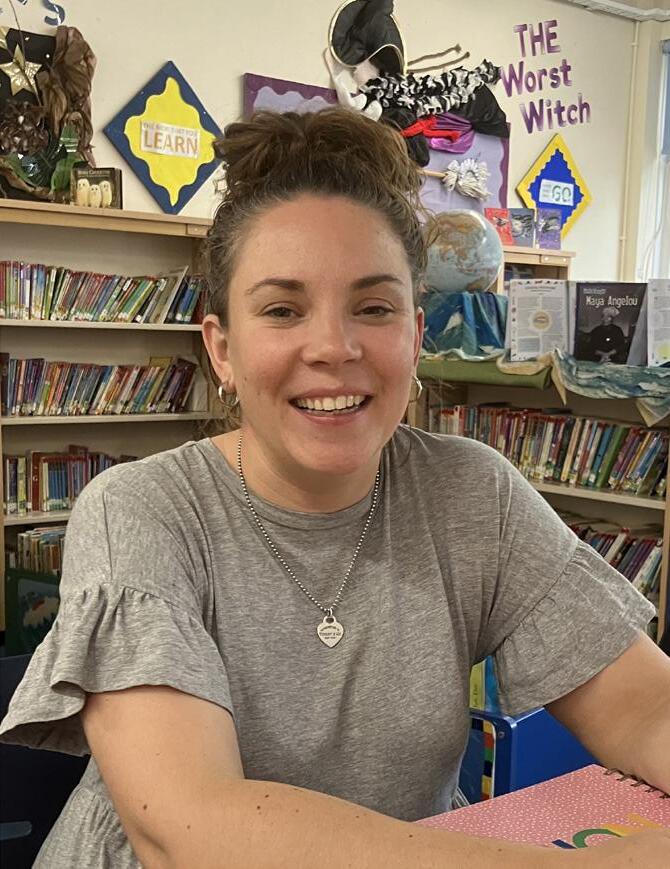
secondment opportunity, and I find myself with a much broader understanding of the challenges and opportunities across a group of schools and have been able to give and receive examples of best practice.
There are so many positive changes as a consequence. For instance, we now have an equipment and resource library that every school can access. We can borrow equipment, make requests and identify resources that we might purchase in the future for the benefit of individual children. A resource that individually, schools would not have access to.
As Catholic schools, we have a shared understanding that every child should be cherished as a unique fingerprint of God. It has been a joy to support each and every student and we have achieved more together than we could have independently. Through shared good practice and continuous professional development for staff across the schools, we have data
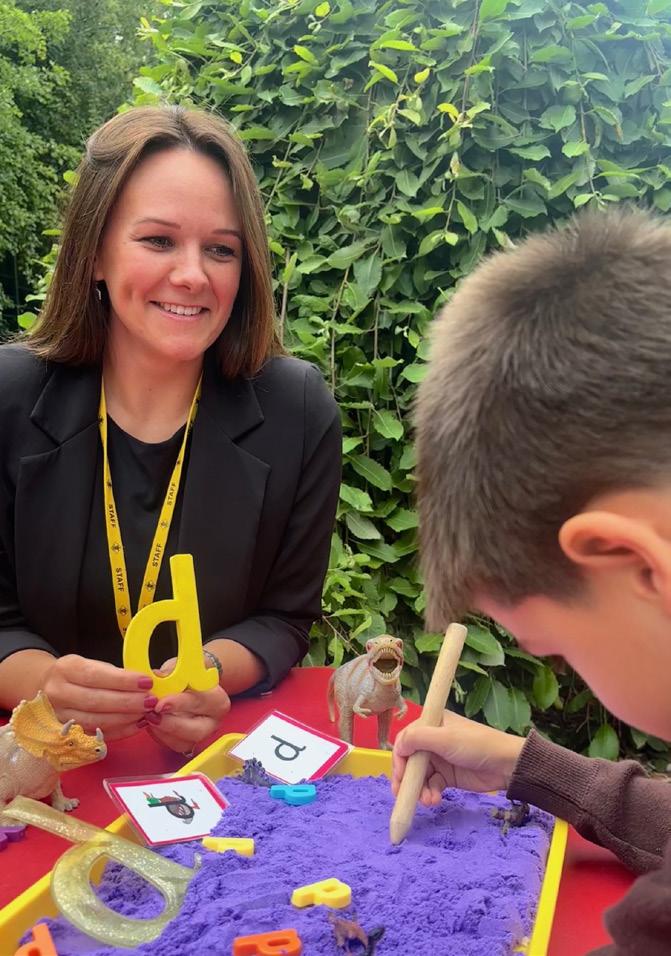
that shows that SEND students are making accelerated progress as a result – a wonderful outcome and I believe there is more to come.”
Mrs Overett
Assistant Head
SENCO
St Thomas of Canterbury
“Early Years is the collective term for the 4-5 year old students at the Trust schools. Just like any other group, there are targets, measurements and monitoring that have to be fed back to the
Department for Education on how these young children are developing.
In my view, the single biggest influence is our collaborative approach. We all knew that other Catholic schools existed somewhere along the A10 corridor but in the past we would have had no cause to get together. Now, I meet my Early Years counterparts every half term, have visited every one of their schools and have a network of colleagues to support me, formally and informally.
A good example has been the Trustwide focus on enhancing students oral skills, helping them learn about sentence construction, punctuation and spelling. Or the kinds of play equipment to help them develop their motor skills; one school had new equipment so we all visited to learn what was working. It might not seem obvious, but there is a
link between those examples; how they use their hands to play has a bearing on how they might hold a pen.
The Trust has given us a platform to share and understand how much we have in common – including our challenges. It’s wonderful to be able to think “I can call my colleague down the road for their ideas and experience.”
All of us involved in Early Years sense the God given responsibility to support and shape the education given to these young ones. Our cluster meetings always begin with prayer and I am grateful for the strong Catholic leaders within the Trust.”
Mrs Moseley Associate Head Teacher Early Years
St Joseph’s, Waltham Cross
Collaboration is one of the keys to the success of the Trust and the Heads are no different. We asked one to share her reflections on the last three years of working together…
“My colleagues and I feel like we have helped shape the Trust Development Plan from the beginning. Like so many other groups, the Heads have met together regularly with Mr Celano and it feels like one team coming up with ideas and initiatives designed to raise standards to improve the pupils outcomes.
There are so many examples of the types of programmes we have established together. For instance, we have discussed past SATS papers and agreed which we would use for our Year 6 children. We all followed suit and were then able to make comparisons, discuss

strategies that have helped us move everyone forward.
Ofsted inspections are something everyone can relate to. When there is one inspection among the member schools, the Head will share in our next meeting their knowledge and experience of the event.
Being a Head can be a lonely role to be honest and it has been so helpful to be part of a wider network and be free to call upon others. Even as I write, I am about to experience a change in role directly through an opportunity identified by the Trust. Whilst remaining Headteacher of St Cross, I will also take on the same role at St Augustine’s; a situation
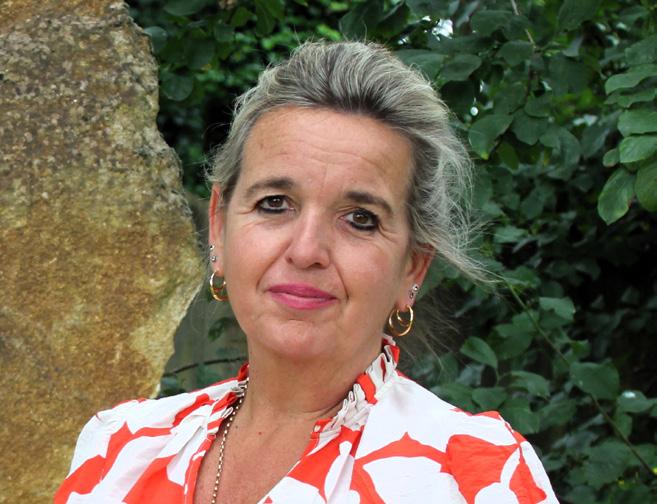
Mrs Walsh Executive Head Teacher
St
Cross
and St Augustine’s
opened up by a retirement there. There is a lovely symmetry there as the same nuns established both schools in 1933 and both schools feed into the same parish.
Reflecting on the last three years, I recognise that there is much more support offered to me by working within the Trust and I daresay I might say the same in another three years!”
Mr Lang, Chair of St Thomas of Canterbury
Every school in the Trust has their own board of governors who each sign up for four year cycles. Upon joining the Trust, that continues but the Chair of each school receives added support. We spoke to Mr Lang, Chair of St Thomas of Canterbury, about that…
Q. Firstly, why did you volunteer to be a governor, and then Chair?
Like most people, one reason is that my child attends the school and I wanted to give something back because I see how tirelessly staff work for her benefit. Just as importantly, I firmly believe that a Catholic
education helps students become a more rounded person and is a great start to life.
Q. What is the difference between your school role and the Trust one?
My school role means I meet the Head every two weeks to discuss matters, lead a half termly governors meeting, alongside one or two other responsibilities. That role is essentially unaffected by the school being a Trust member.
As Chair, I now attend six-monthly meetings with the Chairs of the other seven schools within the Trust. Mr Celano attends and shares the Trust strategy and future plans, which we discuss and provide feedback. Like many governors, my professional experience outside of the school world is useful. I have been through many mergers in my work life – and joining the Trust is essentially just like a company merger.
Q. As a business person, would you describe the Trust “merger” a success?
Undoubtedly. There are lots of examples in this newsletter of some of the benefits but for our school the bottom line is that we are more secure. Village schools like ours can be vulnerable to Council budget cuts and even closures. Being in the Trust takes that risk away.
There are also many, many positive advantages. As a school, we are supported centrally and it’s a massive benefit to be able to call on the Trust for advice and expertise on all kinds of issues that arise.
Q. What’s the best thing about being a governor?
It gives you an insight into the way state education works and you feel that you are making a real difference.

We spoke to Mr Howard, Chief Financial Officer of the Trust, to find out more about the successes and the challenges of being the CFO.
“I should point out that I have two roles. On one hand, I work for the Trust as CFO and also work as St. Mary’s Finance Manager. I initially joined in January 2021 as St Mary’s Finance Manager and then became CFO from 1st September 2021 when the Trust was formed.”
Q. Financially, how does the Trust work?
In a Trust the government sends the funds for all schools directly to the Trust, rather than the Local Authority. I distribute those funds to schools and then work with them to ensure that spending is in line with the budgets that the Trust finance department helps schools to set. To become a member of a Trust each school pays a membership fee to the Trust. This membership fee supports the Trust’s central finance function which aims, amongst other things, to deliver financial benefits for all schools.
Q. Is it fair to say that every school is better off?
Absolutely. So far we have delivered £1.67 of benefits in return for every £1 of membership fee charged. The benefits come through incomegeneration and cost-savings that are only possible when working in a Trust. Whilst Heads agree that they have had better value over the three years by being in the Trust, it’s important to remember our primary purpose
Every penny counts and must be accounted for correctly when financial accountability for all 8 Trust Schools is part of your job description. We spoke to Mr Howard, Chief Financial Officer of the Trust, to find out more about the successes, the challenges and how the Trust has turned £1 into £1.67...
is higher than finance – it’s about improving the quality of Catholic education – but obviously improved finance helps deliver that aim as well.
Q. What are the financial benefits of being in a Trust compared to being a ‘standalone’ school?
There are lots of ways that can happen. For example, most of the schools use the same suppliers so approaching them as a group and bulk buying tends to give you a better deal than if you buy individually. Energy supply is one example where we have made significant savings across the Trust.
There are also financial opportunities that are only available if you are part of a Trust. That might be access to capital funding only available to Trusts like ours. We’ve won nine capital bids so far totalling well over a million pounds. The VAT on these capital projects is now reclaimable within a Trust. Imagine a project of £100k value; being in the Trust allows us to reclaim the £20k VAT which was before unrecoverable. That would not be possible for a standalone Voluntary Aided school.
Q. Does this mean that schools have to get your approval for every financial decision that they want to make?
No, not for every decision. There are agreed levels of spend that schools can make. After that, there are procedures to follow to agree what gets spent.
Q. Does every school benefit equally from every project?
No but we have received numerous capital funding projects that have benefitted all schools.
Q. Three years in, how would you rate the financial performance? The target was to ensure the membership fee was offset as much as possible by savings. We have gone further and faster than expectedwe’ve harvested £1.67 for every £1 in membership fee.
Q. Why do you feel the Trust has delivered financially?
Hard work, strong processes and teamwork. I think visibility and communication is a key reason. Before being in the Trust, school A would not know what school B is planning or ordering. Now we all join in on weekly meetings with the Finance leads from each school and can plan together and agree our approach. That works very well on short term “every day” items but also bigger, strategic projects.
Q. What does the future look like?
More of the same. I am sure we are going to have more successful capital bids and harvest further savings. The key objective of all these savings is to provide better educational opportunities for every student in the Trust.
“From the very beginning of becoming a Trust, we looked at ways to give the qualities inspired by our Patron Saint St Francis a high profile in school life. How could we establish those virtues – community, creation, compassion and peace-making – in our schools and make them aspirational and attainable for the children?
We created an initiative that recognises students from Early Years through to Year 13 as the child grows spiritually through their milestones. These Values Awards are phased through the four key stages to award the students who exhibit the “Franciscan Values” in their words, actions, kindness and leadership to make our school communities a shining example of the Gospel and Faith in Action.
It has been a joy to see the excitement generated among students as they receive recognition and affirmation for their behaviour. Indeed, it is inspirational for the adults to see the example that they set for us! Our aim is for our children to grow to be educated, committed and articulate ambassadors of the Catholic faith and Values Award plays a big part in achieving that.”
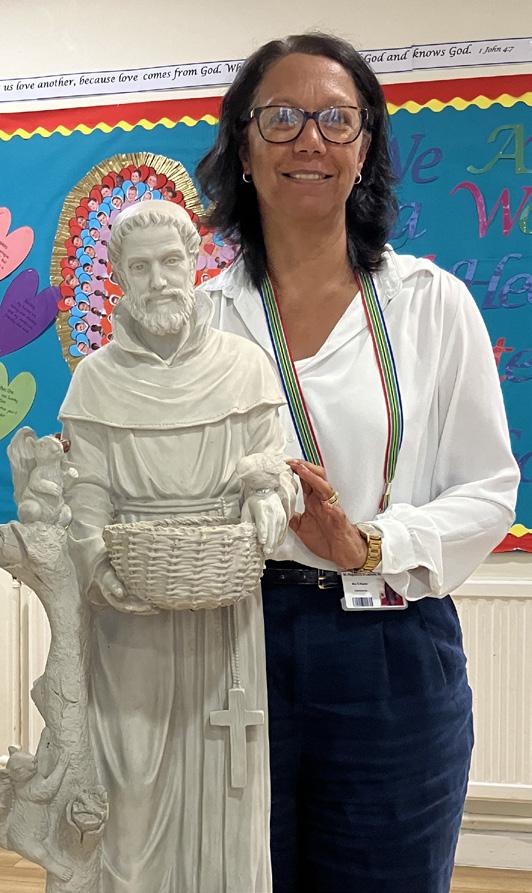
Mrs Napier Head St Augustine’s
One of the earliest pieces of work as a Trust was to create a special prayer. Taking inspiration from the life and values of St Francis, each school contributed a line or two to create a truly unifying prayer of thanksgiving. We humbly ask that you add all the participants of the Trust to your prayer list and perhaps use the following words as part of that devotional.
Lord, God our Father,
Thank you for our school community. Just as you inspired St Francis of Assisi, inspire us to work together to spread your Word within our school and across our family of schools. Help us to create a community where love shines through us.
Help us to embrace God’s creation by showing others how to love and care for our environment as Stewards of the Earth.
Let the world grow as we follow Your path
Let us bring peace and care to one another and listen to God’s Good News.
May you guide us and our academy today and always, on a path of a shared mission.
St Francis pray for us.
St Francis of Assisi Catholic Academy Trust c/o St Mary’s Catholic School Windhill, Bishop’s Stortford CM23 2NQ
01279 654901 info@stfrancistrust.net www.stfrancistrust.net