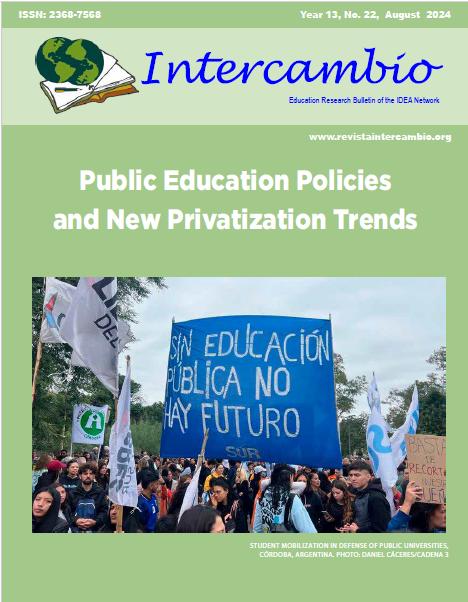
Intercambio 23 - Revitalization of Indigenous Languages
Editors' Note
Reflections and experences on the revitalization of indigenous languages 3
Returning to the Ancestral Roots of the Nasa Yuwe language, in the North of the Department of Cauca, Colombia
Yaneth Maritza Pacho Hurtado
Pineda Rodríguez
Revitalizing Indigenous Languages in the Municipality of Oaxaca de Juárez, Mexico
Hernández Cuevas
The Strategic Role of Young People and Women in Language Revitalization
EMBROIDERY AND WEAVING AS ART: A Tool in the Revitalization of Indigenous Language
Sisa Pacari Bacacela Gualán
Revitalizing Nahuatl Indigenous Languages in the Central Zone of the State of Veracruz, Mexico. “Elotecuentos”
Editorial Committee
María Trejos (Costa Rica)
María de la Luz Arriaga (Mexico)
Andrée Gacoin (Canada)
Edgar Isch López (Ecuador)
Miguel Duhalde (Argentina)
Sara Unda (Mexico)
John Ávila (Colombia)
Roberto Leher (Brasil)
Mauro Jarquín (Mexico)
Editorial Director: Steve Stewart
Editor: María de Jesús Ramos Casiano
English Copy Editor: Ruth Leckie
Layout and Design: Tomás Licea
To read previous issues of Intercambio, visit: www.idea-network.ca www.revistaintercambio.org
For more about IDEA: www.idea-network.ca
Follow us on Facebook: Idea Network- Red SEPA
Contact us at: idea-redsepa@outlook.com
We wish to thank:
•Julian Jimenez Ramírez, Sisa Pacari Bacacela, Maritza Pacho Hurtado and Sonia Pineda Rodríguez, of the Continental Indigenous Educators’ Network, for coordinating this issue of Intercambio.
• The British Columbia Teacher’s Federation (BCTF) for their support in publishing Intercambio
Intercambio is a publication of the Initiative for Democratic Education in the Americas (IDEA), a hemispheric alliance of social and labour organizations that cooperate to defend and enhance public education.
Editors’ Note
"Revitalization of indigenous languages"
The Living Word
The United Nations Decade of Indigenous Languages began in 2022 with a declaration in recognition of the fundamental rights of indigenous peoples to the preservation of our culture, and with it, the right to our words. In this context, the Continental Indigenous Educators’ Network (CIEN), an organization of the IDEA Network, saw the need to convene indigenous educators to share experiences regarding the revitalization of our languages.
Since its inception in 2006, the CIEN has organized encounters of indigenous educators from across Abya Yala (the Americas) to analyze issues relevant to indigenous education. The Fifth Continental Encounter of Indigenous Educators, held in the context of the Decade of Indigenous Languages, focused on the exchange of practices in our schools and throughout our territories that revitalize the languages of our peoples. These practices are important not only for language preservation, but also for the cultural and linguistic appreciation of indigenous peoples through the participation of bilingual teachers, communities and public schools.
The 5th Encounter took place October 11 to 13, 2023, in communities around Santander de Quilichao, Valle de Cauca, Colombia. The event, hosted by the Association of Indigenous Councils of Northern Cauca/ Çxhab Wala Kiwe (ACIN), brought together some 50 indigenous educators linked to teacher unions and indigenous organizations from throughout Abya Yala,
This issue of Intercambio Magazine recovers the contributions that emerged from the 5th encounter, but it also includes reflections from other indigenous educators whose experiences are part of the great effort to give life to our words and preserve our cultures.
We open this issue with an article by Maritza Pacho and Sonia Pineda of ACIN, who narrate in their article: “Returning to the ancestral roots from the Nasa Yuwe language” how the community defines actions for the defense of the Nasa Yuwe language, particularly decisions in language policy promoted by the indigenous authorities of the northern region of Colombia’s Cauca province, through its organization, Çxhab Wala Kiwe (territory of the great people)
This is followed by a very rich experience on the “Revitalization practices of indigenous languages in the municipality of Oaxaca de Juárez, Mexico,” by Crescenciano Hernández. Hernández describes how languages can be revitalized through the recognition of cultural diversity and its protection through inclusive public policies and social actions, with a focus on indigenous rights and cultural relevance.
Angel Tipán writes about the transformations that indigenous peoples are experiencing with migration to large cities, where they become invisible to the State, society and even social organizations. Tipán argues for urgent policies that strengthen urban indigenous cultures, emphasizing the “Strategic role of young people and women in the revitalization of languages.”
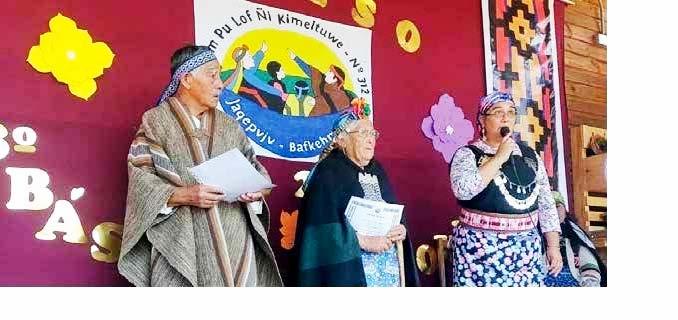
In the article: “Mapuce linguistic and cultural revitalization, at the Kom pu lof ñi kimeltuwe school, Araucanía, Chile,” Jorge Calfuqueo, describes the elements the Mapuche people use to build their own study programs, collecting Mapuche knowledge, culture and language, “to slowly consolidate an educational proposal based on and sustained by the paradigm of the kimvn ka rakizuam mapuce bafkence- Incorporating Mapuche knowledge and wisdom from the coastal zone.
We move on to Guatemala to learn about the experience of the Maya Mam high school located in the community of Colotenango. In his article “Enabling indigenous languages to flourish through creativity and recreation,” author Ricardo Gabriel tells us that the school is part of a network of Mayan Institutes that play a vital role in the revitalization of indigenous languages, and use technological and artistic tools to teach and live the various Mayan worldviews.
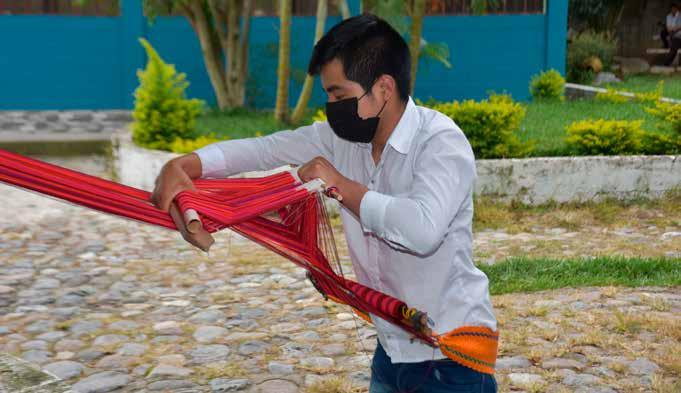
Continuing with the role of art in language revitalization, Ecuadorian Quichua educator and activist Sisa Pacari writes in her article “Embroidery and weaving: an instrument in the revitalization of the native language,” that art develops capacities, attitudes, habits, and skills as a medium for interaction, communication and expression of feelings and emotions. We must recover the art of our peoples, Sisa argues, to give life and strength to our words.
From Mexico, two articles that describe the momentum that the recovery of our native languages enjoys today, and with it, the search for alternatives. Nahuahtl educator Lucía Morales, describes the pedagogical experience of "Elote Cuentos", carried out in the central area of the state of Veracruz with the aim of revitalizing indigenous languages from an ancestral philosophy.
And from southern Mexico, in “The revitalization of the indigenous language: between the will and the normative, a continuous experience,” Mixtec author Julián Jiménez recognizes the difficulties that speakers of native languages face in the face of the historical imposition of the colonizers’ language: in this case Spanish. Recognizing the challenges allows us to identify
strategies and provide alternatives that incorporate what we experience in daily life within our communities, and what is learned in schools. Both spaces must converge to enrich experiences and give life to our languages.
Continuing with the efforts to strengthen our cultures through the revitalization of the language, Kichwa educator Manuel Ysuiza from the Peruvian Amazon reflects on the relevance of “Bilingual intercultural education: new advances and challenges in Peru and the San Martín region.” Ysuiza ives an account of activities in the different Local Educational Management Units [UGEL, regional divisions of Peru’s Ministry of Education] and bilingual educational institutions for the strengthening of the languages that survive in the Peruvian Amazon.
To close this issue, we share the Declaration of the V Continental Encounter of Indigenous Educators, with which we seek to publicize the conclusions and the workplan that will steer the next years of work of the Indigenous Educators’ Network, until the VI Encounter that will take place in the Southern Cone of South America in 2026.
The current issue of Intercambio Magazine was coordinated by members of the Continental Indigenous Educators’ Network. We thank Intercambio’s Editorial Committee for this space, which allows us to open new doors of communication for the CIEN and indigenous educators throughout Abya Yala. We know that teachers in public schools - those trained in the normal schools, others in universities and others from within the indigenous territories - are the ones who have contributed with strength, wisdom and knowledge to preserve and strengthen what we are today. It is they who have who have dedicated their lives and have fought for a plurinational public education that can guide our peoples towards self-determination and the transformation of social reality.
Coordinating Committee, Continental Network of Indigenous Educators – CC CNIE December 2024.
Returning to the Ancestral Roots of the Nasa Yuwe language, in the North of the Department of Cauca, Colombia
Colombia in the Political Constitution of 1991 was declared a multicultural and plurilingual country. This constitutional recognition was a product of various social forces, which brought together in the second half of the twentieth century sectors including peasants and people of African descent and Indigenous people in the struggle organized for the defense of material
and non-material rights, but territory above all. Nevertheless, the distance between that recognition and the vitality of Indigenous languages is a constant that has not been confronted; for the State the protection of the linguistic patrimony is translated into precise, non-systematic actions, contrary to an orderly exercise of planning with indigenous communities and the non-indigenous society.
The indigenous movement of the department of Cauca, Colombia, in their process of struggle for the physical and cultural survival of their peoples, have always set forth the importance of the original lan-
guages, their history and culture. Nevertheless, the context of the cultural frontier has turned into an identity crisis for many indigenous generations, their reduction to minorities as peoples, and the contempt for our systems of knowledge resulted in the loss of habits, customs and the knowledge which the original languages gather together
The ancestral language Nasa Yuwe is the language of the Nasa people, one of the ten indigenous peoples thatmakeuptheIndigenousRegionalCouncilofCauca (CRIC). This article presents the decisions that have been worked out in the community for the defense and protection of the Nasa Yuwe, especially regarding the actions that have been taken regarding linguistic policy by the territories and authorities of the north of the department of Cauca, through its organization: Association of Indigenous Councils of the North of Cauca (ACIN), or expressed in ancestral language Çxhab Wala Kiwe (territory of the great people).³
The Nasa Yuwe Thread in the Çxhab Wala Kiwe
The Nasa people orient, plan and decide as a community by means of collective spaces such as congresses and assemblies. In these instances of self-government theydefine the mandates for physical and cultural survival;oneofthemisthestrengtheningoftheancestral language. The Indigenous Regional Council of Cauca (CRIC) since the decade of the seventies has sought totransformthespaceoftheschool,untilthenhostile and racist (PEBI-CRIC, 2004), in a setting for cultural strengthening. This intentionality moved forward initially with the Bilingual Indigenous Educational CommunityCentres(CECIB),whichgavewaytobilingualindigenousprofessors,whohadtheresponsibility of invigorating the self-education⁴ of the Nasa Yuwe.
3.Çxhab Wala Kiwe-ACIN- is one of the eleven associations affiliated with the Regional Indigenous Council of Cauca (CRIC). (Author’s note.)
4.Educación propia (self-education) refers to a system of Indigenous self-government in Colombia known as the Sistema Edu-
The centre of the actions planned on territory for the strengthening of the Nasa Yuwe focused on the school, so that bilingual teachers placed their use of the language on written expression and grammatical knowledge. Nevertheless, there was no CECIB in all the communities or Nasa Yuwe-speaking professors in each territory. For their part, many of the families, due to the historic fear sown by the school, opted to interrupt the intergenerational transmission of Nasa Yuwe at home.
In the context of the demands of the Indigenous peoples for educational autonomy in accordance with their culture, world-view, identity, language and relevance to the issues of the community, it was emphasized that Nasa Yuwe is the fundament and beginning of the Nasa indentity. Nevertheless, the disuse of the original language reflects the opposite, which led to the decision to reaffirm the importance of strengthening the Nasa Yuwe in all the territories of the North of Cauca.
The Çxhab Wala Kiwe - ÇWK- is one of the ten zones which make up the Indigenous Regional Council of Cauca; its organization is made up of various Weavings, among them the Weaving of Education, which in turn is structured from Threads and Processes of self-education. The Thread of Nasa Yuwe of the Weaving of Education is the team responsible for invigorating experiences and practices oriented toward the survival of the language of the ancestors.
During the years 2005 to 2009, the Weaving of Education prioritized the importance of transcending the historic trauma caused by discrimination, since the decision not to transmit the language to children and grandchildren reflected the relevance of this issue. As UNESCO put it, “many indigenous peoples, associating their disadvantaged social condition with their culture, have come to believe that it is not worth the trouble to safeguard their languages. They abandon their language and culture in the hope of overcoming discrimination….” (2003, p. 5).
cativo Indígena Propio (SEIP) aimed at strengthening Indigenous cultural identity and autonomy. (Translator’s note)
This team analysis of ÇWK education came to consider a change of focus, no longer focusing on the school to widen their gaze to all the spaces of community life, as well as the need to embrace various settings related to self-education: family, school and community.
Thus, in 2011 the Thread of Nasa Yuwe in Çxhab Wala Kiwe was born. One of its immediate objectives was to work with authorities and the community, so that its field work would be situated outside of school, and thus, approach work in the community and with families. For this moment it already dealt with the need to speak of revitalization, because the Nasas attending the meetings of education teams of the ÇWK commented on the diminution of speakers and lack of use of the Nasa Yuwe as a language of interaction in the community. The Thread began with a coordination and sixteen atpu’çxsawe’sx⁵ who received orientations from the Thread of Nasa Yuwe and the education team of the ÇWK, at the same time that they had to attend orientations of the authority of the territory where they accompanied them.
5.Promoter or facilitator of ancestral language. (Author’s note.)
The first two years, the team of the Thread of Nasa Yuwe dedicated itself to clearly establishing a diagnostic of language, to have a clear view regarding the reality of Nasa Yuwe in the territories of the northern zone. With results offering little encouragement, in 2013 the information gained from this study was socialized⁶, thanks to which it was made clear that effectively the loss in new generations represented an important number.
The study was carried out in fourteen of twenty-two territories of the ÇWK and reported based on a population base of 96, 241 Nasas in which, out of every 100 people, only 19 had a fluent use of Nasa Yuwe, 14 understood it only, 6 said they understood it and spoke a little, and 60 declared themselves monolingual in Spanish. According to this diagnosis, 80 people out of every 100 did not use Nasa Yuwe on a daily basis (ÇWK, 2013).
6. Socializing refers to making information known to everyone, to hear their opinions and make necessary adjustments, and if the given argumentation leads to changes, to incorporate them in decisions taken. (Clarification from Sonia Pineda Rodriguez.)
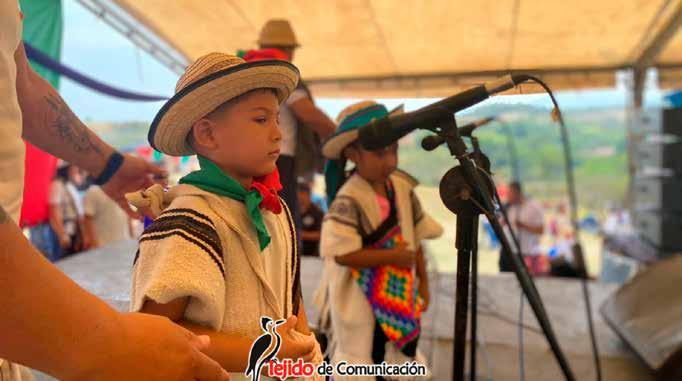
PHOTO: "ACIN'S COMMUNICATION FRABRIC
Nasa Yuwe and its path in these ten years of work with the Thread
The Thread of Nasa Yuwe has grown in ten years, currently with forty-seven atpu’çxsawe’sx who undertake visits of accompaniment to each territory and the Plan of Life⁷, in the Northern Zone, general coordination, and four pedagogic supports; nevertheless, in spite of being a large team, it did not supply the needs for the territorial area to be visited.
After ten years, the coordination and supports of the Thread have invited the authorities and teams of the Plan of Life to converse in mingas⁸ of thought, spaces
7.The Plan of Life— “Plan de Vida”—refers to an Indigenous development initiative on the part of various Indigenous communities in Colombia, arising from the 1991 Political Constitution of Colombia and its laws recognizing Indigenous rights. (Translator’s note.)
8.“Minga, from the Quechua language, is a form of cooperative work in which communities work together to achieve collective interests and support particular needs of its members …. In the southern regions of Colombia, the concept has evolved into a new idea: minga de pensamiento or ‘minga of thought,’ [in which] communities and organizations meet together to reflect and define collective needs and interests.” Luis Eduardo Calpa, “ ‘Minga,’ cooperative work and dialogue in Latin America,” from
of encounter and dialogue to reflect together regarding what has been done and to trace the path through a joint analysis, evaluating successes and failures. These mingas of thought regarding the path of the Thread in each Plan of Life took place in 2021 and as a result eight paths of planning were systematized.
Paths to survival of the Nasa Yuwe in Çxhab Wala Kiwe
Within the Çxhab Wala Kiwe, there exist eight paths which allow the preservation or survival of the Nasa Yuwe.
Path of Bilingual Families: This path has as its objective the support of the Nasa Yuwe-speaking families to motivate their everyday use of their original language, transforming spaces which privilege the use of Spanish and affect the vitality of Nasa Yuwe and its support (Corder, 1992). The support for these families consists
“Language of Dialogue” symposium, May 2019, on website of the Dag Hammarskjöld Foundation, www.daghammarskjold.se. (Transanslator’s note.)
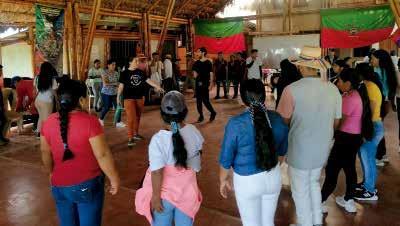
PHOTO: "ACIN'S COMMUNICATION FABRIC
in giving help by listening to what their difficulties are, and forms of support that give voice to each member of the family, to sustain the use of Nasa Yuwe at home and in every interaction.
Teaching Path in Nasa Yuwe from teaching procedures: The role of educational institutions in the loss of the original language is central. These spaces are responsible for various generations of non-Nasa Yuwe speakers, and historic pains are hard to heal. These institutions negatively affected the esteem for the language for a long time. One way of changing this space of oppression for the Nasa Yuwe is to generate conditions for it be used as a language of instruction, creating a space in which the language has a niche to be cared for and lived. The level of advance in this sense is heterogenous in the plans of life, but there is a greater and greater interest in transmitting the teaching of Nasa Yuwe.
Path Awakening the Heritage of the Ancestors: This line invigorates strategies for the return to or revitalization of Nasa Yuwe and makes this concrete in actions directed toward various age groups (in the framework of self-education one speaks of the path of life and moments of maturation to refer to the vital cycle).
This path refers to all actions directed toward those who desire to learn the original language, and focuses
on the non-speakers and on those who only listen to Nasa Yuwe. Owing to the lack of intergenerational transmission and the conditions of historic discrimination, spaces of self-education are required which allow the awakening of consciousness regarding linguistic identity and the need to learn Nasa Yuwe.
Path to creation of educational material: The creation of material or educational resources is transversal to all paths, concretizing the actions of each one and favouring the dialogue with various spheres of daily life in communities. They are generated as pedagogic supports which contribute to the processes of acquisition, teaching and learning, to strengthen abilities in reading, writing and other forms of communication, expanding cultural references, the approach to the worldview and reality of communities. They help to situate the original languages in digital and technological media, relating them to the animated world, printing, audios, software design and apps.
Path to training for the Atpu’çxsa’s: Training of facilitators for Nasa Yuwe speakers in didactics and methologies in accordance with various ages, levels of knowledge and language skills. In these training spaces we discuss how to recognize the needs of learners and how to approach them. The methodological
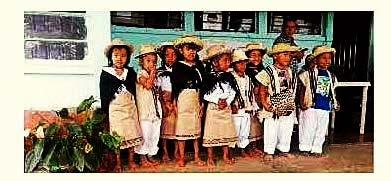
PHOTO: "ACIN'S COMMUNICATION FABRIC
developments provided until now are on a basic level of learning for the Nasa Yuwe.
Path to Happiness of the Kwe’sx Yuwe: It is a matter of expressions of one’s own art to experience the kwe’sx yuwe-Nasa Yuwe--sporting, artistic, musical and cultural gatherings directed toward the entire community or according to processes of self-education, to sow love for the Nasa Yuwe and seek reconciliation of many members of the community with the linguistic identity of the Nasa people.
Kwe’sx Yuwe Path and Communication: This path of diffusion and promotion of the language in the media seeks to expand its contexts of use, and also to develop its maturation, starting from lexical creation. In this path all experiences that relate to Nasa Yuwe are projected with the media and make possible there the presence of the ancestral language. The access of languages and minorized peoples to the media is a subject that has often left behind and postponed, with the exception of radio.
Path of Management and accompaniment of authorities and teams of various Self-Governing Systems: This path refers to the commitment made to each authority and member of the teams of each one of the Self-Governing Systems, to generate processes and procedures which allow the functioning of actions and the destination of human and economic resources for the sustainability of the paths, strategies and actions.
Conclusion
Defending history, the ancestral language and culture, has been a community decision. Nevertheless, the tracks of linguistic and cultural racism are currently present and are expressed in various ways. Because of this, it is fitting to sustain various efforts that help to heal wounds left by discrimination.
Inthisconnection,itisnecessarytoopennewspaces to the original languages so that they have a presence in everyday life, community living, and in various settings in which other challenges are confronted as a community. From the processes of self-education, we orientapossibleway,sincewetherebydemonstratethe pathtracedbyoureldersandwalkedbythegenerations whichfollow,butinthecurrentcontext,thereareother settings which is it necessary to emphasize.
Itisnecessarytoreversethesituationoflossofintergenerationaltransmissionandencouragetheloveand respectforlinguisticdiversitywhichmakesitpossible for many more persons to assume the habit of giving life day by day to their original language.
Bibliography
ACIN, CWK. (2002). Memorias del primer congreso zonaldelaAsociacióndeCabildosdelNortedelCauca ACIN.Documentonopublicado.TejidodeEducación. Santander de Quilichao. Cauca.
ACIN,ÇWK.(2013).Diagnósticosociolingüístico: informe hogares. Documento no publicado.Tejido de Educación. Santander de Quilichao. Cauca.
PEBI - CRIC. (2004). ¿Qué pasaría si la escuela…? 30 años de construcción de una educación propia. Popayán: Fuego Azul.
UNESCO.(2003).Vitalidadypeligrodedesaparición de las lenguas. Grupo especial de expertos sobre las lenguasenpeligroconvocadoporlaUnesco.Consultado el 20 de enero 2022 en http://www.unesco.org/new/ fileadmin/MULTIMEDIA/HQ/CLT/pdf/LVE_Spanish_EDITED%20FOR%20PUBLICATION.pdf
Yule, Y M., & Vitonas, P. C. (2004) Pees Kupy Fxi’zenxi. La metamorfosis de la vida. Toribio.
Revitalizing Indigenous Languages in the Municipality of Oaxaca de Juárez, Mexico
Crescenciano Hernández Cuevas1
Translated by Flor Montero
Summary:
The revitalization of indigenous languages has been one of the guiding components of the Municipal Institute of Indigenous Languages (IMLI), a decentralized, legally structured public body with its own assets - a true pioneer in its field. It was created on 15 March 2022,
1.BA in Indigenous Education and Masters in Educational Development (focus on sociocultural and linguistic diversity) at the National Pedagogical University, Ajusco Campus, Mexico City. Currently is the coordinator for indigenous education research at the Centre for Studies and Development of the Indigenous Languages of Oaxaca (CEDELIO). President of the Coordinating Committee of Veʹe Tuʹun Savi, A.C. (Academy of the Mixtec Language) and Director General Municipal Institute of Indigenous Languages of Oaxaca de Juarez, Oaxaca, Mexico.
through an agreement by the Municipality of Oaxaca de Juárez City Council which was chaired by Francisco Martínez Neri for the period 2022-2024. Its aim was to implement strategic actions for the recognition, use, promotion, strengthening and development of the cultural heritage, traditional knowledge and languages of the indigenous and Afro-Mexican population and their institutions within the municipality. This took place in the political and administrative heart of the state of Oaxaca, where 10 out of the 15 indigenous languages are recognized by Article 16 of the Political Constitution of the Free and Sovereign State of Oaxaca, Mexico. Key words: Revitalization, indigenous languages, linguistic rights, indigenous peoples and communities.
The municipality of Oaxaca de Juárez, the political and administrative heart of the state of Oaxaca, is located in the region of the Central Valleys. It embodies a rich and valuable historical diversity within the Oaxacan state which holds 48% of the cultural, linguistic and natural diversity of Mexico. The municipality is inhabited by indigenous people and migrants from other Oaxacan regions, Mexican states, and even from other countries in the world. Such diversity ought to be valued and protected by society through specific institutional and social actions for its vindication and revitalization and through inclusive public policies, with a focus on indigenous rights and cultural relevance.
In 2022, the Municipality of Oaxaca de Juárez created the Municipal Institute of Indigenous Languages (IMLI) to promote strategic actions for the recognition, use and strengthening of the languages and cultures of the indigenous and Afro-Mexican population settled in the municipality.
The intention of the linguistic revitalization has been: "To breathe new life and vigor into a language whose use has been diminishing or has ceased to be used altogether" (Hinton y Ahlers, 1999). The intention is not to return to the past, but rather to bring new life to the languages that are currently spoken. It is not about linguistic purism, because there is no such thing as a pure language: all languages, without exception, borrow from others.
This perspective allows for collaboration amongst all parties, with the aim of promoting the social use of indigenous languages. Since language revitalization is a social process that requires targeted and contextualized actions, reestablishing daily use and intergenerational transmission have been key. The heart of a language is its speakers and its vitality lies in its continual use, within the family and in society as a whole, from the perspective of the speakers’ daily lives. This involves recovering and gaining new spaces for their use, promotion and practical development (Hinton, 2001; Zabalondo, 2020).
Actions for linguistic revitalization
The fundamental actions implemented by IMLI, from August 2022 to date, for the practical revitalization of indigenous languages are the following:
a) Use of indigenous languages during the town hall sessions of the Municipal Cabildo of Oaxaca de Juarez: Greetings, thanks and farewells are spoken inindigenouslanguagesbythemunicipalpresident, secretary, trustees and aldermen during town hall meetings. Each month corresponds to a different language, starting with the ones with the greatest presence in number of speakers in the following order:Zapotec,Mixtec,Mixe,Chinantec,Mazatec, Nahuatl,Chatino,Triqui,Cuicatec, andothers.The purpose is to acknowledge and promote the use of indigenouslanguagesinpublicanddecision-making spaces,leadingbyexample.ItisdonewithintheframeworkoftheInternationalDecadeofIndigenous Languages (2022-2032) declared by the General Assembly of the United Nations.
b) The "It is a right to use our indigenous language" campaign is a collective and inclusive action aimed at both speakers and non-speakers of indigenous languages in the municipality of Oaxaca de Juárez and the Metropolitan Zone of the Central Valleys region, with the purpose of socializing and empowering linguistic rights. It involves the use of posters, bags, pens, t-shirts, water bottles, audiovisual materials, pamphlets, radio spots and exhibitions, as well as disseminationinthelocalmediaandsocialnetworks.So far, students from elementary, middle and high school levels have participated, as well as parents, public servants and related professionals. The results have been favorable and we hope to build on this.
c) Workshop: "The Orality and Writing of Indigenous Languages": This consists of 120 hours of face-to-face and virtual workshop sessions targeting speakers and non-speakers of indigenous languages. It seeks to strengthen orality, an experiential form of language acquisition and transmission of knowledge in the dailylifeofthecommunities;aswellastheteaching
of writing skills, through the use of the practical alphabet from the linguistic variant of speech of the participants. It includes: Zapotec, Tu'un Savi or Mixtec, Mixe, Triqui and Cuicatec, with the participation of an average of 20 participants per language, with successful results.
d) Apps in: “Cuicatec, Chatin, Mixtec and Zapotec”: This is a free-access interactive digital tool for mobile and desktop devices. It contains images, audios, texts and translations of a wide vocabulary and common phrases in the Cuicatec, Chatin, Mixtec and Zapotec languages, for playful self-learning. It is aimed at students in the municipality schools of Oaxaca de Juarez as well as a general audience. It is an attractive and dynamic didactic resource for the learning of indigenous languages, completely free and open access.
e) Indigenous languages regional fair (FERELI): This is an intercultural event for the sharing and exhibition of literary products in different indigenous languages: dictionaries, brochures, vocabularies and stories, among others. There are also crafts, gastronomy, dance, music, typical clothes and various cultural expressions of the indigenous population residing in
the municipality of Oaxaca de Juárez. Participation is through an open call and access is free . Its aim is to promote and enhance the cultural and linguistic richness of the indigenous population. Indigenous languages and Spanish are spoken.
f) “Linguistic landscape”: This consists of written and audio representation of the nomenclature of public institutions and common phrases in indigenous languages in public spaces. By a previous agreement with the corresponding authorities, posters, plaques and canvases in different sizes and presentations are placed to provide visibility and awareness amongst the population of the enormous linguistic wealth that coexists in our society. It also seeks to have indigenous languages recover their presence in the public spaces which at some point in history belonged to them. Progress has been made in some schools, markets and the municipal hall of Oaxaca de Juárez.
g) Ñuu Savi Forum: “Revitalization and strengthening of Tu'un Savi”. This concerns meetings of community authorities and other institutions with the purpose of presenting and delivering the Writing Standard for the Rain or Mixtec Language and its alphabet to the representatives of the participating institutions.
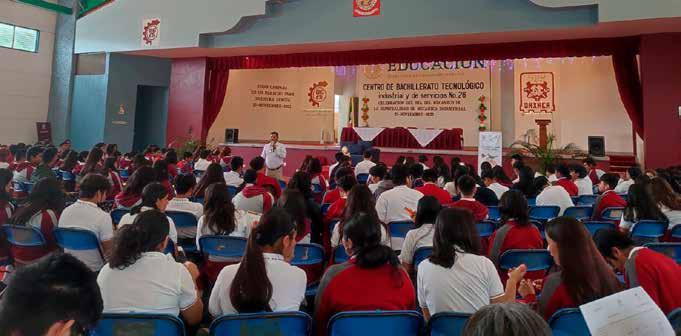
PHOTO: RICARDO JIMÉNEZ JIMÉNEZ, IMLI COMMUNICATION UNIT.
The intention is that we all contribute to the resignification and revitalization of this language, andto value the importance of Mixtec culture through the implementation of specific actions for the use, promotion, preservation and development of Tu'un Savi,inandfromthecommunities.Thedevelopmentof 12 forums has been achieved in the vast historical territory of the Ñuu Savi (Mixtec people).
Bibliographic references
Political Constitution of the Free and Sovereign State of Oaxaca (2021). Honorable Congress of the State of Oaxaca, Mexico.
Erdösová, Zuzana (2023). The language nest between Mexico and the world. Experiences with a community model of language revitalization. Mexico: Universidad Autónoma del Estado de México.
Hernández Cuevas, Crescenciano (2020). Teaching and learning Tu'un Savi. A pedagogical approach based onthe students' centre of interest, through community knowledge Oaxaca, México, Carteles Editores-Proveedora Gráfica de Oaxaca, S.A. de C.V.
Hinton, L. (2001). Language Revitalization an overview in Hinton, L. y Hale, K. (Eds.), The green book of language revitalization in practice (pp. 1-18). Berkeley: Academic Press.
INALI(2022).Mexico'sPlanofAction.International Decade of Indigenous Languages 2022- 2032. Mexico City, Centro Cultural los Pinos GeneralLawontheLinguisticRightsofIndigenous Peoples (2003), INALI.
Ley de derechos de los Pueblos y Comunidades Indígenas del Estado de Oaxaca (2010). Secretariat of Indigenous Affairs. Oaxaca. 36 p. Indigenous affairs. Oaxaca. 36 p.
International Labour Organization (1989), Convention 169 on Indigenous and Tribal Peoples. State Development Plan 2022-2028. Government of the State of Oaxaca.
UNESCO (1996) Universal Declaration of Linguistic Rights. Accessed 03 January 2024 http://www.cdi.gob. mx/ lenguamaterna/derechosling.pdf
PHOTO: RICARDO JIMÉNEZ JIMÉNEZ, IMLI COMMUNICATION UNIT.
The Strategic Role of Youth and Women in Language Revitalization1
From February to July of this year, the Heritage Institute of the Quitenian Metropolitan District2 (DMQ) carried out a project called “Mapping Kichwa in Urban and Rural Parishes of the DMQ and a Strategic Plan to Strengthen Language”. The project was carried out within the framework of the Decade of Indigenous Languages (2022-2032), declared by the United Nations Educational, Scientific and Cultural Organization (UNES-
1.In 2012, this mandate was proclaimed at an assembly attended by grandmothers and grandfathers. “We are witnessing the era of youth and women,” they said.
2.Quito is the capital of Ecuador.
Angel Tipán Santillán, Kichwa del Ecuador
Translated by Flor Montero
CO), and the Ten-Year Plan for the Revitalization and Revaluation of the Indigenous Languages of Ecuador.
The Ten-Year Plan is a public policy instrument whose purpose is to “guide and coordinate language revitalization efforts during the International Decade of Indigenous Languages”, in the five functions of the state³ and in the decentralized autonomous governments (GAD)⁴. Within this framework, the instrument pro-
3. As of the 2008 Constitution, the Ecuadorian state adopted five functions: i) executive ii) legislative iii) judicial iv) electoral and v)transparency and social control.
4.Ecuador is a decentralized state. There are currently three levels of government: i) Provincial Decentralized Autonomous Gov-
poses ten focus areas, one of them being urban spaces, from which the Mapping of indigenous languages in the main urban centers of the country stems.
Regarding rural parishes, sociolinguistic information was collected concerning the use of Kichwa in 19 rural communities and communes of the DMQ.
During the implementation process, it was found that people aged sixty years and older still speak Kichwa in some communes, while people between thirty and fifty years old only understand a little and hardly speak it at all. For the most part, young people between the ages of fifteen and thirty do not understand it and therefore do not speak it either.
The explanation is structural. The majority of young people migrate to the capital in order to work and study,
especially at the middle and higher educational levels. There they face the reality of Spanish monolingualism, in addition to a racist and exclusionary society. This situation has led most young people to “hide” their identity which makes the revaluation and revitalization of the Kichwa language difficult. At the beginning of the International Decade of Indigenous Languages, this was the harsh reality of young people in the communes and rural communities of the Metropolitan Quitenian District.
However, to expand our understanding, we should consider at least the last five years. The massive demonstrations led by indigenous youth and women during the first days of October 2019 and in June 2022 provided the opportunity to make a “hidden” reality visible in Ecuador. The leaders of the rural communes of the Metropolitan District of Quito and of the central and northern highlands provinces, invisibilized by the state,
METROPOLITAN DISTRICT OF QUITO, PHOTO: ÁNGEL TIPÁN
by society and sometimes by their own organizations, became important actors. Especially in their communication strategies, from the capital to the communities, and, to the popular sectors of Quito, they played a key role. The dominance of “social networks” was a key factor in the interaction between young indigenous migrants in the capital and the communities. In this context, it should be remembered that the messaging was made in the Kichwa language. As a result of these events, it is appropriate to reflect on the “thinking out loud” that took place, and on how to interact with this new reality, both politically and socio-linguistically.
Both the Ecuadorian state, with its five functions, and the decentralized autonomous governments have the challenge of designing and implementing different public policies for linguistic revitalization, in which the participation of women is paramount. Due to their sensitivity and closeness to the use of Kichwa, they are constantly aware of the need to use their native language to share their knowledge and wisdom. “My knowledge of medicinal plants is in Kichwa. I cannot speak it in Spanish” says an older woman from La Toglla.
On the other hand, it is also important to understand the diverse dynamics and strategies of young
people. For instance we should ask ourselves: What are their organizational forms? Are social networks being appropriated by young people? Although we know that, little by little, they have been disengaging from the communes and communities, it is important to recognize and value the role they played in the last two uprisings, between the center of political power (the capital of the republic) and the center of the power of mobilization: the communes and communities.
In this new scenario, it is essential for both indigenous organizations and the state, as well as for academia, to approach the reality of indigenous youth and women with humility. It is of the essence to tune in and collect their demands and proposals for the fulfillment of their human and collective rights. They are all interrelated and should be considered at all levels of public policy making: communal, parish and municipal levels.
What needs to be borne in mind is that “without speakers, without peoples, without territories, there are no languages⁵.
5.This idea emerged during various workshops with the indigenous peoples of Abya Yala, in events to prepare for and publicize the International Decade of Indigenous Languages.
METROPOLITAN DISTRICT OF QUITO, PHOTO: ÁNGEL TIPÁN
Mapuce Linguistic and Cultural Revitalization in the Kom pu lof ñi kimeltuwe school, Araucanía, Chile
Jorge Calfuqueo Lefo1
Translated by Natalie Illanes
Ini
gen ta iñciñ:
A Brief History of the School
Theschool Kom pu lof ñi kimeltuwe no.312islocatedin Llaguepulli (JaqePvjv), Araucanía, Chile, a geographical area bordering a lake, which in turn, is surrounded by the coastal mountain range located near the Pacific Ocean. In this territory, which was ancestrally Mapuce Bafkehce (name given to the Mapuce - also known as Mapuche - who live by theshore),aschool was originally installed. From 1975 to 2005, the school was controlled by the Catholic Church and a private educational institution whose motto today is “Educate and evangelize”, with the clear
1. Elementary Education Teacher – Magister E.I.B./ B.Ed., in Mapuce context.
intention of evangelizing Mapuce children and families of the territory, both in Catholicism and in the Western-Chilean culture by adopting the official school curriculum.
However, the school was built on lands owned by one of the Mapuce authorities called papay (wise elder woman), who together with other authorities of the territory (known as logko or kimce), initiated in 2005 a process of recovery of their lands. One of the mainstruggleswastherecoveryoftheterritorywhere the school is located. This was achieved in 2006, under Resolution No. 1586 of July 13 (Educational Project 2016-2020).
After the recovery of the territory where the school is
located, the Mapuce authorities, together with other lof (communities), decided to create a Mapuce education program as an alternative to the Bilingual Intercultural Education Program (Programa de Educación Intercultural Bilingue, PEIB) implemented by the Chilean State. These communities reject the PEIB because they consider it to be a mechanism of assimilation imposed by the State They have developed an alternative education program that allows them to maintain and promote their culture and language, while also interacting with Western culture, but from the perspective of the indigenous communities themselves.
In this context, the Mapuce community, based on the 1960 Decree 40 of the Ministry of Education (Mineduc), which grants educational institutions the possibility of creating their own curricula and programs, invited a team of researchers to provide technical support in the preparation of their own curricular proposal.
The official Chilean school curriculum applies to the entire national territory. Its structure is based on different education subjects, such as: Language and Communication, Mathematics, History, Geography and Social Sciences, Visual Arts, Music, Physical Education and Health, Personal Development, Technology, Natural Sciences and Religion. There is a Curricular Program for each subject and a Curricular Study Plan for each level. These programs “contain the definitions of the competencies and their skills; the approaches that are the frameworks that provide the theoretical and methodological elements that guide the teaching and learning processes; the link between skills; the learning standards that are the levels of progression of the competencies and the skills described from grade to grade. Likewise, the transversal competencies to the curricular areas are presented with guidelines for their development.” (See https://wwwedugestores.pe/docs/curriculo-nacional-de-la-educacion-basica/)
In this sense, the initiative of a Mapuce Curricular StudyPlanisintroducedintheState’scurricularstructure proposed by the Chilean Ministry of Education. After almost a decade of work, in 2018, this Mapuce educational community and the team of researchers that supports them obtained the approval by the Chilean State for the programs of the first basic cycle (first and second year) of their Mapuce curriculum. As a result, the school now has its own study programs, which gather the knowledge of the Mapuce culture and language in order to slowly consolidate it as an educational program based on the paradigm of kimvn ka rakizuam ma-puce bafkence - Mapuce coastal zone knowledge and wisdom. (Calfuqueo et al. 2018).
Identity traits of the SER (CE) Mapuce Bafkehce
The SER Mapuce Bafkehce, is a territorial identity of the Mapuce people that unites visible spaces (sea and land) and invisible spaces (spirituality). Its essential expression is to live in harmony and balance with nature. Thisunityincludesmenandwomen,who by themselves are not self-sufficient. In the real world there are always spiritual beings that are present and that accompany us. The Mapuce do not consider themselvesastheownersofsomethingbutaspartofa whole. In order to act, it is necessary to communicate with these spiritual beings, all the other elements and beings of the Ixofij mogen, in a specific time and space.
In the Mapuce identity there are certain guiding principles to become the model of SER Mapuce;amongtheseare:Tobecomeakim-ce(aperson with wisdom); a nor-ce (a righteous person); a kumece (person with a good heart); a newen-ce (a healthy, strong person w); a shakin-ce (a sensitive and joyful person), kvlfvn-ce (an agile person). These principles guide the curricular development of the school, which in turn takes into account structural components to address the kimvn (knowledge) for a Mapuce education, including:
• Pu Picike Ce: Children on the Path to Integral Growth
• Pu Lamgen: Horizontal Relationships Between Women and Men
• Kimeltucefe: Person Who Shares Knowledge, Wisdom, Teachings, and Experiences
• Kimeltuwvn: Process of Acquiring, Teaching and Learning
• Kimkantun: Learning by Doing
• Ashgejutun: Learning by Playing
• Kimkonvn: Already Acquired Learning
• Shijkatatun: Literacy
• Shijkatufe: Person Who Teaches Literacy
• Kim kon kvley: The Person is Learning
• Kim Kon Puay: The Person Will Learn It
• Kim Ajkvtuael: Learning to Listen
• Kim Nentual Ñi Rakizuam: Knowing How to Express One's Thoughts
• Kim Ñi Azvmuael: Learning to Make Decisions
Curricular Program
The curriculum for the first cycle of this school was approved on February 1 2018, by the Regional Ministerial Secretariat of Education of the Araucanía Region (Mineduc). This proposal consists of six study programs covering a total of 16 hours per week. The approved programs are: aukantun ayekan, wenxu kvzaw ka zomo kvzaw, az mogen wajontumapumew,rakizvamka mapuzugun, amulepe taiñ mogen, and ixofij mogen. The purpose of each is briefly presented below.
These study programs aim for Mapuce children to gain knowledge as an integrated whole, because knowledge is conceived in a holistic way. This knowledge (kimvn) responds to: a) the need to understand the natural environment, its ecology and geography, and the importance of preserving ait for the continuity of community life, and b) to know the main foundation of Mapuzungun as a language which seeks knowledge in dialogue with nature and all the beings who inhabit it.
MAPUCHE HOUSE IN ARAUCANÍA, CHILE. PHOTO: ÑAMKU CALFUQUEO
The pedagogy that underlies these study programs is basedonfourlearningprinciples:a)theunityoftheory and practice, b) a holistic vision of knowledge/thought, c) harmony, balance with and respect for biodiversity, and d) the search and respect for community and territorial spirituality (Pinto, et al. 2011).
1. AUKANTUN AYEKAN (Sports and community games)
AukantunAyekanisthestudyofrecreationalandleisure activities that are developed in the school's educational community, which for the students is an important componentfordevelopinganidentityofbelongingwith the territory, in this case, to the Budi Lake (leufu budi) andtheMapuceBafkehce culture.
Inthefirstbasiccycleofstudyof AukantunAyekan, the main purpose is to introduce students to different recreational activities that, through constant practice of exercises, will develop the children's motor skills. It will also reinforce their knowledge of Mapuzungun as they take part in the exercises and activities.
During this cycle students are expected to learn about different games that are, or were, practiced in the lof, hence the importance of exploring local knowledge of the Mapuce Bafkehce culture, and emphasizing those games, sports, and dances in connection with the social situations in which they are practiced, allowing for children to recognize the importance of recreational activities in facilitating socialrelationsbetweendifferentpeople and groups.
2. WENXUKVZAWKAZOMOKVZAW (handicrafts)
The study of kuzaw wenxu ka zomo kuzaw allows students to understand the ancestral knowledge regarding the crafts and cultural productive activities that exist in the community as well as the cosmovision that sustains such knowledge and practices.
Children will be able to recognize that all the elements used for making handicrafts are part of the Mapuce Bafkehce universe and, as such, are importantformaintainingthesetraditionsthatare
specific to the ancestral culture to which they belong. Children should understand the harmonious and balanced relationships with all the elements used in the making of artworks, and respect for the crafters who produce them with a lot of hard work and skill.
In this sense, it is also expected that children understand that work, art, and crafts have physical, spiritual, and social dimensions. These dimensions transcendthework itself, with each artisan that works the clay, silver, wicker or native wood, the wool, or any other material embodying a human activity with spiritual support, hence the need to preserve and reproduce it, through comprehensive and theoretical-practical learning by Mapuce children. In this way, the physical-productive, socio-cultural and spiritual dimensions of manual work and the community environment are recognized.
3. AZMOGENWAJONTUMAPUMEW (Mapuce time and space worldview)
The study of az mogen wajontu mapu mew is relevant in the education of Mapuce students, given that it allows them to build an image of the world in which they inhabit, situates them in time and space, and provides them with tools to understand the social environment in which they live. They are encouraged to develop skills and abilities to better understand how the reality of the present has been constituted, in order to discern their options and make plans for the future.
The knowledge provided by Kimvn Mapuce (Mapuce knowlege) in this curricular component is essentialforpersonal, social, historical, spiritual, and cultural development to prepare students to be aware of Mapuce culture. Kimvn Mapuce is understoodto be a constant connection between past and present and between one space and another. The learning of this knowledge seeks to generate a solid foundation in the az mogen wajontu mapu mew (Mapuce time and space worldview), so that studentscanmakeinformedandresponsible
decisions and understand the rapid changes in our daily lives, in society, and in the world.
4. RAKIZVAM KA MAPUZUGUN (Thought and Language)
The study of rakizuan ka mapuzungun (thought and language)allowsforthedevelopmentofMapuzungun asafirst language, which serves to reaffirm identity, and alsoallowstheconstructionofaconceptualfoundation withtheirownknowledge,practicesandvalueswhich contributetotheformationoftheculturalrealityofthe MAPUCE BAFKEHCE territory.
The knowledge gathered from Mapuce thought and the various discursive practices constitute the basis for the development of orality in different contexts, both in Mapuce culture and in Western culture, and also to represent the thought of their territory through the family, through their lof (community) and territorial space. All this wisdom comes from the interaction between humanity and nature and how the Mapuce throughout their history have interpreted the world in connection with their own philosophy as a culture.
The aim is for the students to acquire the communicative skills that will allow them to express themselves in today's world without forgetting their origin, the communication with the biodiversity of the territory theyinhabit,theknowledgeemanatingfromit,andthe values implicit in their communicative practices that have made Mapuzungun a language characterized by mutual respect between speakers and nature, which itself speaks to us.
5. AMULEPE TAIÑ MOGEN (History and Culture)
The study of the amulepe taiñ mogen (history and culture) allows for the construction of knowledge and an attitude of respect towards the socio-cultural, spiritual, and natural world in which the students live, making them part of the territory they inhabit and the people who surround them.
Knowledge about the beings that coexist in these spaces, such as animals, birds, trees, bushes, as well as the landforms that are present, such as mountains, lakes and natural phenomena like the climate, in addition to spiritual beings, constitutes the conceptual basis that allows Mapuce children to develop attitudes of respect for, care, and belonging to their territory.
PHOTO: ÑAMKU CALFUQUEO
The aim is that from an experiential learning of their coexistence with the people around them, the Mapuce Bafkehce children develop skills to relate to them, preserving and respecting the societal structure and the authority figures who play necessary roles for the harmonious and balanced functioning of the lof, which constitutes their social, natural, and spiritual environment as a people with their own identity.
6.IXOFIJMOGEN(Biodiversity)
The study of the ixofij mogen (biodiversity) locates the diversity of living beings and the Bafkehce territory as part of the environment in which the students develop. The detailed knowledge of the particular characteristics of the various animals, plants and marine species, of the territorial topography, and of the natural and spiritual phenomena, constitute the conceptual basis that will allow the Mapuce children to develop attitudes of respect, care, and preservation of their biodiversity.
The aim is that the personal, social, spiritual, and cultural development of Mapuce Bafkehce children, not only makes them more aware of their culture, but also enables them to understand and care for the biodiversity of their territory
The attitudes and skills the children develop through the practice of learning-bydoing (ixofij mogen) make them active biodiversity participants in their relationships with their families, community, and territory.
Bibliography
Del Pino, M. (2021). Informe Final Proyecto Fondecyt Iniciación Nº 11180316. National Agency for Research and Development.
Kom Pu Lof Ñi Kimeltuwe School (2016). Institutional Educational Project.
Ministry of Education (2021). Approves plans and programs for the third cycle (5th-6th year) of basic education in 6 subjects in the private subsidized school Nº312 Kom pul of ñi kimeltuwe, RBD:6443-2 commune of Teodoro Schmidt from the school year 2020. Regional Ministerial Secretariat of Education, Araucanía Region.
Ministry of Education (2020). Approves plans and programs for the second cycle (3rd-4th year) of basic education in 6 subjects in the private subsidized school Nº312 Kom pul of ñi kimeltuwe, RBD:6443-2 commune of Teodoro Schmidt from the school year 2020. Regional Ministerial Secretariat of Education, Araucanía Region.
Ministry of Education (2018). Approves plans and programs of the first cycle (1st-2nd year) of basic education in 6 subjects in the private subsidized school Nº312 Kom pul of ñi kimeltuwe, RBD:6443-2 commune of Teodoro Schmidt from the school year 2018. Regional Secretary of Education, Araucanía Region.
Pinto, R., Calfuqueo, J., Painequeo, H., Silva, A., Cubillos, F., and Berríos, R. (2011) Matriz del diseño curricular para la escuela básica Kom pul of ñi kimeltuwe, de Lago Budi, Llaguepulli, Región de La Araucanía. Project Nº82. Santiago de Chile: Unesco/IESALC, Universidad Metropolitana de Ciencias de la Educación.
OUR ELDERS. PHOTO: ÑAMKU CALFUQUEO
Guatemala: First Peoples' Languages Flourish through Creativity and Recreation
Summary:
The mother tongue is an essential pillar in the preservation and transmission of the culture and identity of first peoples. More than just a simple means of communication, it represents a unique cosmovision, full of wisdom, historical memory and ancestral knowledge. The mother tongue not only allows for emotional expression and intellectual development, but also plays a crucial role in creativity and recreation starting at
conception. Children are exposed to their mother tongue through sensory and auditory stimulation, which allows them to begin to understand the world and their environment from their cultural perspective. Play and interaction with their community enrich their language and consolidate their identity.
The Maya Mam School, located in one of the Maya Mam communities of Guatemala, plays a vital role in the revitalization of indigenous languages, using technological and artistic tools to teach and experience the different Maya cosmovisions. This educational institution encourages the use of art as a means to preserve
Ricardo Gabriel1
Translated by Martha Schmitz
1. Maya Mam Institute. Director of the Maya Mam K'ulb'il Nab'il Institute.
and value the mother tongue, especially among youth whoarevulnerabletolosingtheiridentitydueto factorslike migration and globalization.
Key words: Language, creativity, recreation, communication, education and experiential.
Language is one of the fundamental ways to revi-talize, transmit, conserve and strengthen culture from one generation to the next. Through spoken expression,language has allowed culture to expand despite the political, social, geographical and economic contexts of exclusion which the first peoples have experienced. UNESCO (2019) states:
“Languages are the vehicles of transmission of value systems and cultural expressions and they are a decisive factor in the identity of peoples and of persons.”
A person learns their mother tongue and uses it to develop their first experiences of communication. More than a means of communication, it is a reflection of cultural and ancestral identity. Each language is a unique cosmovision, a way of thinking, rethinking and interpreting the universe, unique to first peoples.
Creativity and recreation are essential aspects and conditions in human life as part of each person’s emotional expression, cultural connection and intellectual development. One of the elements that influences this is the person's mother tongue, not only as a means of communication, but also as a source of much identity, historical memory and wisdom.
Indigenous languages have been transmitted through the fundamental role that women play in the community. The mother starts to stimulate the baby, from the womb until the moment of birth, with songs in her language. In the home, language is strengthened and transmitted creatively and recreationally. At home and in the community, the child is given a way of seeing the world as part of a territory in which they receive stimulation from their language.
Therefore, from conception to birth, and throughout the child's growth, they not only learn their first words in
their mother tongue, but also understand and comprehend the world and the universe through their ancestral cosmovision, beginning with the word mother (Nan) in the Maya Mam language, and then beginning to speak other words about basic and physiological needs such as feeding, hydration and defecation.
Later, the child interacts and plays with other children, either as part of the family or the community. Their mother tongue is essential to these interactions through ancestral games, relationships as they carry out different daily tasks and especially all the social interaction in their surroundings. This enriches their language through contact with the different elements of nature and the universe, as they name each element and its importance, including the trees, the name of each animal and everything that surrounds them. Language does not arise as a learning process within the territory but rather as another element to be able to weave together and explain the elements of the Universe.
The Maya Mam School’s Role in the Revitalization of the Mother Tongue
Human beings have an immense capacity to learn one or several languages through different technological or artistic tools. Students playing the marimba, drum, and guitar have learned to sing in three of the Mayan languages of Guatemala, immersing themselves in the different worldviews of a single culture while developing their artistic skills and appreciating the value of indigenous instruments. At the same time, we train students to write and speak in other languages, which enriches them and teaches them to appreciate other cosmovisions. This is not only a way of teaching, but also a way of coexisting and experiencing.
Through this process, students do not just practice interculturality, but also understand and experience other cultures by expressing their feelings, knowledge and wisdom. Nowadays, new innovations in technology help to provide immediate and direct access to an untold number of people, not only native speakers of a language, but also to people from other cultures
and places who are able to appreciate different cultural expressions.
It is important to appreciate and use art as a way to continue revitalizing the language with all of the students and youth. They are vulnerable to identity loss because of the different social problems they face related to migration, which has increased in different countries, but particularly in communities with a majority of Indigenous peoples which are being overtaken by new technologies. Cruz&Mendoza (2019) write of:
“…military, economic, religious, cultural or educational subjugation and also other factors such as a community’s rejection of their own language. Today, the increase in migration and urbanization contribute to the disappearance of traditional ways of life and there is strong pressure to speak the dominant language, which is seen as necessary in order to participate fully in society and advance economically.”
Young people are being offered another culture and cosmovision that pushes people towards consumerism, patriarchy and a different way of understanding emerging global issues.
Bibliography
Colmenárez, M. J. R. (2020). Enseñanza de lenguas indígenas mediadas por las TIC en América Latina. Revista Lengua y Cultura, 1(2), 20-27.
Cruz Miriam, L., & Mendoza, J. A. (2019). Diseño de una plataforma virtual enfocada en la preservación de la lengua indígena Otomí. Caribeña de Ciencias Sociales, (marzo).
Deance, I., & Vázquez Valdés, V. (2010). La lengua originaria ante el modelo intercultural en la Universidad Intercultural del Estado de Puebla. Cuicuilco, 17(48), 35-47.
Epiquén, A. C., Zuta, M. C., & Cutipa, W. Q. (2019). Estrategias didácticas para la revitalización de lenguas originarias en estudiantes de la Universidad Nacional Intercultural de la Amazonía. Revista San Gregorio, (33). López, L. E. (2001). La cuestión de la interculturalidad y la educación latinoamericana. Análisis de prospectivas de la educación en la región de América Latina y el Caribe, 1, 382-406.
PHOTO: RICARDO GABRIEL, 2024.
EMBROIDERY AND WEAVING AS ART: A Tool in the Revitalization of Indigenous Language
Sisa Pacari Bacacela Gualán1
Translated by Martha Schmitz
Since time immemorial, indigenous peoples have developed community art as an integral expression of their cultural cosmovision with which to convey knowledge, wisdom, languages and ways of life.
Our elders taught us our traditions and legacies through the arts of weaving, wood and stone carving and necklace making. For more than five hundred years, we have experienced the permanent destruction of our
1.Member of the Coordination of the Indigenous Educators' Network of the IDEA Network. Sisa Pacari has been a teacher of language and literature, Kichwa, and Andean history in public institutions and at the Center for Interamerican Studies (CEDEI). She is a researcher and defender of human rights, collective rights, and women’s rights. She is a private practice lawyer and member of the Peoples’ Human Rights Observatory (Observatorio de Derechos Humanos de los Pueblos).
cultural elements and formal monolingual education has played an important role in this destruction. This education has experimented with teaching through different methods. The results have not been favorable for indigenous peoples, especially in the area of maintaining and strengthening native languages.
In current times of difficulty and struggle, it is necessary to rethink educational practices and discover and try out other educational approaches. For example art pedagogy proposes alternative methods of teaching and learning that would dismantle existing models. Practicing the arts is a key piece in holistically training people to be critical, thoughtful, and innovative in all fields.
Art develops capacities, attitudes, habits, abilities and skills. In other words, it goes beyond the techni-
cal. It is a means of interaction, communication, and expression of feelings and emotions, allowing people a holistic education.
For the first peoples of North America, art is “an expression of life,” practiced by all people, usually an “anonymous activity expressing a unique cultural perspective of living.” (Cajete, 1994, p. 146). This conception allows art to be an integral part of life in communities, while also offering an individual and community identity. It also means living out the cosmovision, integrating myths, dreams, art, ecology, community, and spirituality. John Dewey (1934) relates art “to the everyday, to the body, to activity, and to creation.” It is therefore an experiential activity; it has a role in our lives. Everyone has aesthetic experiences, which represent our potential for developing a life with a sense of dignity, justice, and knowledge of the collective oral memory, for which there are different ways of speaking, thinking, and acting.
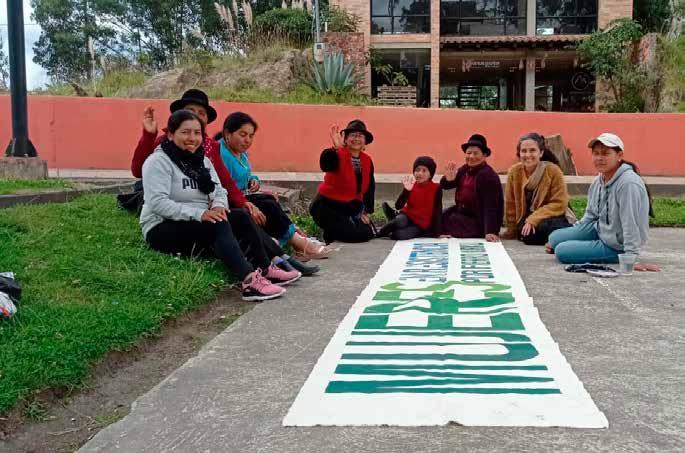
If art is a quality of doing, then it becomes an action. With that vision, we saw the need to strengthen the unity of women of the Saraguro Kichwa people in Ecuador who are fighting to defend the sacred mountain Fierro Urku which is threatened by mining. It is sacred because from the foothills of this mountain range, the rivers descend that give life to the residents of Loja, El Oro and the northern part of Peru. Thus, we created an Art and Resistance collective called SIRAK WARMIKUNA (women who embroider). It is an intergenerational group made up of women from three zones of the province of Loja: Saraguro, Tenta and San Lucas. The group meets monthly for workshops on weaving and Kichwa language learning.
We women defending Fierro Urku not only wanted to participate in order to learn, but also to use these experiences and this work to seek an economic income that would allow sustainability for our families and the collective. This action would allow for a more dignified life, with justice and liberation. In the words of Freire, “Action without reflection is not a strategy of criticism or activism, and reflection without action is mere verbalism.” (Pedagogy of the Oppressed).
The common thread of our work was the art of embroidery, since it loosely ties together stitches and thoughts. Embroidery demonstrates different fields of knowledge and symbols such as designing, drawing, or embroidering. To carry out these actions, we need to use the inspiration and creativity that we carry in our bodies as collective memory. Each design and story that we capture in the fabrics has led us to reflect and search for meaning and significance. We compare and reflect upon how we make offerings of flowers on Sundays, how we have learned, and what ideas have been transmitted to us. This implies both praxis and reflection: we consider why we women maintain this tradition, what needs we have, and what we have to do to change our reality.
A Language Without Living Speakers is a Dead Language
Among the Saraguro people, Kichwa speakers are usually those over 50. To maintain our culture and language in order to communicate knowledge and wisdom, we need to recover and strengthen the Kichwa language, which is losing its vitality among youth and children, because a language without living speakers is a dead language. This situation weakens the spirituality and philosophy behind the struggle for our territories because in losing the language, we would lose our words for the ecological diversity that exists in the moorlands and our different ceremonies to communicate with the sacred apus.
For women especially, territory is the space where we inherit, exchange, create, and learn. Territory is the meeting point with and in the territory, where we recognize ourselves through our connection to our umbilical cord. Our language is anchored in our territory and art builds a narrative that makes us part of it. That is why this silent process, in which our hands lay out our ideas, helps us to hear ourselves in our mother tongue, giving life to the sentence, “Our hands weave stories, which we share with our words.” all artistic activities are communication and that's why listening
is important, the silence to create the idea and then the action of the hands to turn the idea into a material object. It is holistic.
To learn Kichwa, we used two languages: Spanish to explain knowledge and our mother tongue, Kichwa, to tell a short life story. Some of the stories are very old, like the ones about the first settlers of Saraguro, or the stories about Fierro Urku and the wakas who protect the water. Through embroidery we preserve the memory, but we also share our language. By recounting these stories, we have a solid and powerful idea that shelters us, guides us, and keeps the conversation flowing while we are embroidering. In this way, we remembered the colors and their meaning, and we designed and embroidered phrases in Kichwa about life, the environment, and the meaning that the Fierro Urku mountain has for us. We remembered different ways of saying hello and goodbye and phrases and sentences to start a conversation.
Embroidery was a pedagogical strategy that made it easier to share experiences and knowledge between generations, between those who maintain the mother tongue through oral traditions and the youth and children who have not heard it spoken, as each story gave us key elements to analyze and reflect upon. We would pull out a word or a phrase and write it on a piece of paper and then put it up on the wall to see it. At the beginning of each workshop, we carry out a self-evaluation and a review of what we learned and shared in the last workshop and, in that way, support our learning. This process brought intellect into play with emotion, feeling and reason, putting all the senses and the body into action. The body that beats, that plays, that thinks, or as our elders would say when weaving, embroidering, or arranging flowers, “the hands doing, the ears listening, the mouth talking.” Thus, using the art of embroidery,
PHOTO: SISA LOZANO, MAY 2024
we reflected on the community art practices that we have maintained.
At the end, we exhibited our work in the central park of Saraguro, but not before climbing the mountain towards the Pulla lagoon to show the goddess Waka, protector of the water, what we had made. There, through meditation and dialogue with the goddess, the clouds and Mother Earth, we were able to communicate and understand nature’s language and communication. Only after that was done could we all be happy and share food together. As Dewey would say, any art product comes into being when the person “cooperates with the product so that its result is a joyful experience because of its liberatory, ordering properties.” (Dewey, 1934, p. 241 in Augustowsky, 2012, p. 15).
From this entire process, we can say that our experience of collective embroidery has given us the chance to share our stories, memories, and aspirations. It is a way of educating ourselves; it inspires and mobilizes individuals and groups to build and make visible the community's capacity for self-management. Embroidery design can be seen as a practice of producing meanings through a set of figures, words, and colors and defining its meaning and the stories it tells us.
Embroidery and weaving encourage social interaction. They encourage us to be with others, in a sensitive, attentive, genuine and empathetic way and to work with others to draw together differences and to discuss realities that are not usually made visible. Thus, art becomes a powerful tool of integration and inclusion; it is a way to build a “we” in terms of respect and equality.
When a group has the opportunity to tell its own stories, through oral tradition, song, music, or through other means, they can remember that traditions are carried in their bodies, minds, and spirits, and they can share experiences. Thus, our lives are reaffirmed by seeking knowledge through collective memory. Solidarity and sharing with one another allows for synergy; in other words, it encourages a synergetic process of collective knowledge production. By participating, women can use their own lives to learn to deeply un-
derstand the power of relationships, so that they can become more aware of what is going on around them and be active agents of change, understanding that we all have knowledge to share and learn.
We believe that these experiences represent a kind of community education and communication. In this way, we have come to understand that the art in the things we do, at each step and at all times, are tools through which communities can understand their own lives. Thus, our embroidery and weaving-based methodology is a praxis, promoted by our women ancestors, of sharing knowledge, putting it into action and searching for creativity and personal and social liberation to transform unjust and unequal situations. Women’s knowledge and experience come from different motivations, perceptions, skills, feelings, and relationships. However, each woman seeks to share her problems and contribute to our commitment to the defense of peoples’ rights and territories, with one common strength, in resistance for water and for Fierro Urku.
Finally, it is important to highlight that this embroidery and weaving process has allowed us to appreciate our culture and language, improve our self-esteem and social and intergenerational relationships and better understand our lived realities, as women, of domination and violence. It was a very interesting learning experience. By embroidering bags and tablecloths, we have raised people’s awareness about defending the environment, in the markets and especially among our families and in our neighborhoods.
Bibliography
Augustowsky. Gabriela. (2012). El Arte en la enseñanza. Voces de la educación, Paidós, Buenos Aires. Cajete, Gregory. (1994). Look to the Mountain: An Ecology of Indigenous Education. NC, Kivaki Press. Dewey. John. [1934] (2008). El arte como experiencia. Edit Paidós, Barcelona.
VIVA project partners, (Editor), (2011). Community Arts and Popular Education in the Americas. Canada, State University of New York Press, Albany.
Elotecuentos:
Revitalizing Nahuatl Indigenous Languages in the Central Zone of the State of Veracruz, Mexico.
Translated by Flor Montero
Introduction
This article describes a grassroots pedagogical project in thecentralzoneofthestateofVeracruz.Itspurposeisto revitalize indigenous languages from an ancestral philosophy, emphasizing the cosmovision of the communities and seeking to recover the ancient knowledgepassed down from generation to generation. In his book on Toltec pedagogy, Marin (2009) explains that“TheCemAnáhuac²wastheonlycivilizationofthe
1. Indigenous Nahua teacher. Founder of the Totlahtol Yoltok Pedagogical Collective (Our Living Word) Veracruz Mexico. For the defense of the cultural identity and relevance of the first peoples of Veracruz, Mexico.
2. A territory that stretches what we know today as from Nicaragua (Nahuatl nican) in the south to Canada.
sixoldestonesthatcreatedamandatoryandfreepublic education system”. The Anáhuac education system, which lasted approximately three thousand years, is stillaliveamongthefirst peoples of Mexico. Therefore, although they may not have a “formal” education as we understand it, they are carriers of a great ancestral knowledge, due to the cultural heritage transmitted by generations. This has allowed families and communities to have better eating habits and apply very effective healing methods
In the Nahuatl mother tongue, it means “those who live eternally together surrounded by the waters”. That is why from the geography of Nicaragua to Canada, everything is surrounded by Nahuatl names and multicultural territory. In Mexico alone, there are currently 17 states with a Nahuatl presence.
Lucia Morales Celestino1
and construction techniques, as well as planting, reforestation, community organization, law enforcement practices and everything related to their worldview, their particular way of seeing and understanding the world around us. Thus, this experience shows the importance of returning to ancient knowledge, to live in a more just and harmonious societywiththeenvironment that surrounds us.
This is how the project to revitalize the indigenous Nahuatl language started. The focus was on promoting and enhancing oral usage and customs in order to strengthen and better understand the importance of the family as the foundation of an individual's conscience. Thus, it was necessary to highlight the transmission of the word through carriers of knowledge, such as women healers, craftswomen, grandmothers, ritualists, mothers, etc. They are also the ones who maintain and make up the family core; therefore, they are keepers of our mother tongues.
In this era when the online world has invaded homes through electronic devices, it is urgent to restore family ties through orality, particularly since the pandemic has profoundly worsened interpersonal relationships.
Procedure
Elote Cuentos (Stories of Corn) is a strategy for transmitting indigenous oral language. The Totlahtol Yoltok pedagogical collective created it from a decolonizing perspective, based on the ritualization of the elements knowledge and wisdom transmission: the word, the glance, the body, clothing and elements of power such as the talking stick and xochtitlallis, which is the floral offering to Mother Earth. This ritual is performed at the beginning of any work to ask Mother Earth to ensure that the work will be fruitful.
We gathered the essence of the grandmothers’ words in a compendium we called NANATLAHTO-LLI (wise word of the grand-mothers). In it, indigenous orality is poured into legends, anecdotes, myths, stories, riddles,sayingsetc..
Also, exhortations are transmitted from parents to children to strengthen ethical and moral principles with a loving and firm discourse that teaches deep respect for the surrounding environment. The hope is that this will continue to be promoted from generation to generation and be used at home and within popular culture.
First we had to involve the community: authorities, mothers, teachers, traditional medicine practitioners (such as midwives), ritualists, artisans, musicians, dancers, children and youth. To disseminate the effort, the spiritual leaders of the locality were asked to consecrate a talking stick to, in accordance with the cosmovision of the Náhuatl of central Veracruz, empower the word and its transmission so that speakersarefilledwith mysticism and deep message.
This was done in three Nahua communities in Veracruz, where according to their cosmovision, they gave their own meaning to the strengthening of the word.
In the High Mountains, it was consecrated as a Xochitallis (floral offering to mother earth). As part of the ritual, a representation of a corncob was made, where each grain represented a bilingual story or anecdote. The consecration of the talking stick and its use in the transmission of the messages empowered the person who carrieditandalsoprovidedcredibilitytothereceivers.
In the Huasteca region, this practice was carried out with elementary³ school students and with students from the National Pedagogical Uni-versity. Here, corn is ritualized as a sacred element that has and gives life. The fact that this symbol and the community were placed at the center, as bearers of knowledge, had a powerful impact. It was also possible to recover a compendium of knowledge in written form. For some grandparents, those were stories nested in their memories but might not have been attractive to youth and children who are increasingly interested in the contentof electronic media.
3.In Mexico, basic education consists of preschool, primary and secondary levels. For this project we worked with the preschool and elementary school levels.
Impact
Children and youth were curious to see the grandparents of the community telling stories, tales, anecdotes, jokes, chants and sayings that they heard from their pa-rents. The bearers of knowledge and wisdom (artisans, grandparents, traditional doctors, etc.) had the opportunity to return to their childhood, by telling their stories to their grandchildren. It renewed their sense of belonging, since they are not usually recognized as knowledgeable beings. Unpublished texts were compiled, which are being worked on in order to write the nanatlahtolli for its dissemination not only in the schools but also among families.
This activity is currently being followed up in indigenous preschool and elementary schools, in the High Mountains region. Indeed, the revitalization of languages resides above all, amongst mothers⁴, as generators of knowledge through the oral word.
Conclusions
It is important to take actions that revitalize our indigenous languages because they hold our accumulated wisdom and knowledge and are full of human values that can strengthenourcultural identit. Miguel León Portilla has said that when a language dies there is a loss of knowledge, traditions and ways of seeing the world. In this decade of indigenous languages, let us ensure that our mother tongues remain alive.
4. It is in the home, with grandmothers, mothers, aunts, that good advice is transmitted from the time we are born through stories, myths and legends. While breastfeeding, at the stove or wash basin or in the fields, women have been the language keep-ers. Therefore we must continue, in the community and in the schools, to respect and strengthen women's role and not relegate them to second place as has been done in the past.
PHOTO: TOTLAHTOL YOLTOC COLLECTIVE, MEXICO
Revitalization of Indigenous Languages: an ongoing commitment
Location of the experience and its context
I am originally from the indigenous community of Progreso, Chalcatongo, Oaxaca, Mexico. My first language is Spanish, which I was taught by my parents. Tu'un Saù (Mixtec language) is my second language, which I am still learning. I have lived outside my community for 33 years due to my work as an indigenous teacher, and it is during vacation periods that I return to my community to visit my parents.
Situation that led to linguistic revitalization activities
Tu'un Saù is my second language. I learned it by listening to my parents when they talked to each other. Growing up with other native speakers was also of great influence on my learning. It happened when working on the land where we told jokes, anecdotes and personal and community stories in our language. Little by little I began to speak it because it was fun and exciting to see how they laughed. Now I use it more often with my parents, sisters and brothers, as well as with the few speakers in the community, with the intention of improving my oral expression.
Julián Jiménez Ramírez1
Translated by Natalie Illanes Noguiera
A few years ago, while attending an event with a neighbor from my community, I greeted a group of friends in Tu'un Saù and another native speaker questioned me for using this language to greet them. They argued: “Why do you speak Mixtec here, with us, if there are people who do not speak our language? That is why you should speak in Spanish”. He was referring to some people who were part of the group and who lived in the center of town. A non-speaker reacted to the comment by saying: “It is good that you speak Mixtec. It is beautiful that you speak it. I understand some words, but I do not speak it. I have learned it in my business when people would come and talk with my parents. It is beautiful. I would like to learn it”. After an extensive discussion, we concluded that we must continue speaking our language in the places where we are. That is what we have done ever since.
In the community where I am from, the Tu'un Saù language is endangered. Currently, approximately 15% of people over 65 speak it well, the population of 50 to 60 understands it but few speak it. Those in the age range of 25-50 understand some conversations, some speak a few words, more often in spaces where people joke around or in informal contextual conversations, and those under 25 probably understand some words but do not speak the language. All this is due to many factors such as parents’ migration in search of work to different cities, states or countries, where Spanish or a different language is spoken. Or such as the experiences with religion in its different sacramental activities or the effects school has had, especially on those who attended school when it first came to the community (beginning of the 1960s), due to the school restrictions on the use of the local language. These experiences had a deep effect that echoed in the following generations of different indigenous communities where the language had been alive in daily life.
This echo was reproduced in the following generations, until reaching the current linguistic situation.
Before the experience I mentioned above, I only spoke in my native language with fluent speakers. That
is, I communicated in this language with adult speakers, who helped me to improve my pronunciation.
After this experience, and knowing that the level of disuse of the Tu'un Saù language in my community was increasing, I asked myself: “What can I do to motivate the generations who speak little of the language and those who no longer speak it? What is lost when we stop speaking our language?" It is a huge challenge, which requires many activities that complement each other. Therefore, commitment, consciousness and, above all, a willingness to invest the time and make the necessary collaborations are essential. The experiences accumulated in my work as an indigenous teacher have been very important. I must also recognize that the activities carried out do not reflect a strict methodological process, which is a topic of great concern in the academic environment of basic education. It is with this in mind that I have promoted the following actions:
Workshops for reflection: These have been carried out with preschool teachers, children and parents. I have observed that those who turn out to be the most interested are the children. They are surprised to hear different words to name objects, animals, nature, etc. It takes a little more time for the other participants to be convinced of the importance of maintaining and strengthening the language of our ancestors.
Narrating stories: I have recorded, in the Tu'un Saù language, stories that had circulated among the speakers and that were commonly reproduced during the corn harvest. These have been useful in the workshops to identify whether the participants speak and understand the Tu'un Saù language, only understand it or do not understand any word of the language. For example, working with a group of mothers from the local preschool, in 2017, they said they neither spoke nor understood the Tu'un Saù language. I played the audio of the story “Tu'un iso jiin va'u” (The Story of the Rabbit and the Coyote). When they started listening to the audio, I noticed that they were attentive, some of the expressions used in the story made them laugh. I asked them “Why are you laughing?" They answered
“Because of what you say in the story,” which showed that they did know some of the language, something they had not shared before.
Videos: I made videos with different themes such as community stories, parts of the body, animals, food and others in Tu'un Saú. I share them on social media and they are seen not only by people in my community but by many more from the same linguistic variant who live in different parts of the country and abroad. They are the ones who share the posts the most.
Writing and illustrating stories: This has been an interesting activity, because most people know how to read in Spanish and when they see the writing in Tu'un Saù they are surprised to know that it can be written. They also discover that it is difficult for them to read because they have only learned to read and write in Spanish. However, they manage to understand the message that is associated with some images because they also recognize expressions that they have heard in conversations with their parents or other people in the community.
Taking and editing photographs: I take photographs of natural and social events, objects, plants, people’s
activities, food and animals and I add short phrases in Tu'un Saù. I have preferred adding short phrases, because it complements the information about the activity or context of the image, and the use of the referred language takes on more meaning, impact and recognition. I share these images on my Facebook account where many people see them. Sometimes they make comments and sometimes they download the images. A few months ago, at a meeting of one of the agencies in the municipality where I am from, I met Mr. Marcos Soria, who commented: “Teacher, when will you upload more photos? I see them all and I have downloaded them. Look, here they are. I download them because I speak our language, but I am also learning more of it”, and he showed me the photos on his cell phone. Other people share the pictures when they see them, and they learn the potential of the material. When teachers assign their students homework about the language, some of them contact me through social media to support them with some information. Even though I am aware that from a distance is not the best way to support them, it is still an opportunity to motivate them.
Dialogue and writing in Tu'un Saù: We have agreed with some friends to strengthen our language by communicating by phone, either orally or in writing, in Tu'un Saù. This also helps them to know some basic rules of Tu'un Saù writing and it develops our oral communication.
Memory games and word puzzles: I have prepared these types of materials and distributed them in some exhibitions in the municipality with the purpose of showing that many useful activities can be done in indigenous languages. These materials are sent to schools, always with the understanding that they can be photocopied and shared with others who are also interested in them.
A lot of people have liked the different strategies and materials that I have produced. Some ask when more material will be published. Some say that they often tell their children about the importance of the language. It is also important to acknowledge that
there are people who make comments which help us to improve the materials.
For more than 20 years I have participated in talks, workshops, forums and congresses in the region about the Tu'un Saù language where topics related to the preservation, strengthening and recuperation of Tu'un Saù through writing and orality were addressed. In these events teachers who develop their own language activities in the region were the ones who participated most frequently. These events have been very influential in raising awareness for my own efforts. Above all, they are focused on showing the people of my community that all things, objects, animals, nature, human activities and natural phenomena have names in our language that can be written and read and that through this we can understand that oral and written expression reveals the way one thinks, sees, feels, relates to, explains and coexists with the world. Hence the importance of revitalizing our language, with concrete actions that motivate the current generations, knowing that their great-grandparents spoke Mixteco but their parents no longer understand it.
Under these circumstances, we need to bring children closer to accessible didactic initiatives that motivate their interest and that help educators find other strategies to encourage other speakers to share what they know. This highlights the need to take advantage of the media andmaterialsthatareavailabletochildrenandyouth.
Data can explain the linguistic situation of the community. The authorities, most of them under 60 years of age, are unaware of the existence of laws that defend linguistic rights. The people in the community are equally unaware, which has accelerated the decline of their language and makes it difficult to defend it. This process is further compounded by what is being done in theschools,wherethereisnospecificsubjectdedicatedto teaching and strengthening the indigenous languageand the context in which it is used.
The task is daunting and as time goes by, we are losing more and more of the living sources of our native languages. Our task is to pick up the pace in strengthening our languages; otherwise, we will be complicit in their extinction.
PHOTO: JULIÁN JIMÉNEZ RAMÍREZ
Bilingual Intercultural Education: New Advances and Challenges in Peru and the San Martin Region
Summary:
The article gives an account of activities carried out by different Local Education Management Units (UGEL) and bilingual education institutions during the Day of Indigenous Languages in the San Martin RegionofPeru,in the context of a State that relies on an information system which registers original languages, bilingual teachers and education institutions whose students require Bilingual Intercultural Education (EIB).
Peru has a National Bilingual Intercultural Education Plan, a pedagogical proposal and a model for education services and educational materials in 18 languages and Spanish, created with a methodology corresponding to a second language. In this sense the definition and application of these tools is promoted by the Ministry of Education (MINEDU) and fostered with the parti-cipation of parents, community, specialists, institutions and civil society organizations.
Key words: indigenous language, system of information, bilingual intercultural national education plan,identity, regional regulations.
Manuel Ysuiza Shapiama1
Translated by Wendy Santizo
Celebration of indigenous languages in the San Martin region
As other years in Peru and particularly in the region of San Martin we celebrated the Day of Indigenous Languages, the UGELs and Bilingual Education Institutions celebrated with much joy and identity, with participation from UGELs from Lamas, San Martin, Picota,BellavistaandMoyobamba.Aswellasaregional eventwithrepresentationfrom10provincesandactive participation of students from Awajun, Quechua and Shawiindigenouspeoples.The encounter included specialists on Bilingual Intercultural Education, teachers, parents,representativesfromelementaryandsecondary education from the San Martin region.
One of the highlights was the opportunity participants had to demonstrate their skill sets as teachers, students and community in general. UNICEF is one of the entities working with the MINEDU in developing EIB, given the access to this type of education is a human right of Peruvian children and adolescents. For this reason, we celebrated with special enthusiasm the result of national and regional evaluations that reveal improvements in reading comprehension among fourth grade students where EIB is being implemented. We will
2. UNICEF - the United Nations Children's Fund since 1953, is an agency of the United Nations responsible for providing humanitarian and developmental aid to children worldwide
UGEL MOYOBAMBA. AWAJÚN STUDENTS. PHOTO: MANUEL YSUIZA
continue supporting the expansion and empowerment of EIB despite new challenges our peoples are facing.
It’s important to articulate the elements which recount the paths taken and what we must reinforce to strengthen our languages:
• Methods and materials: Materials and methods implemented account for what teachers are developing in the classroom.
• Results: Six of ten provinces are actively developing specialized work in EIB, engaging bilingual teachers, students and community. The person in charge of following up and evaluating the work of this glorious network is Manuel Ysuiza.
• Discussion: After analysis and assessment by experts, teachers and students, I was authorized to write and communicate with native communities regarding the event, however it’s important to indicate that not all communities accept their own mother languages, a situation concerning the local schools. This reality is
observed in many local communities in the andean, coast and amazon regions. Ames (2003) presents two case studies on the different ways education is being articulated in Peru. In the amazon, the intercultural education proposal is linked to a collective project to empower the indigenous identity, while in the andean region, education is used as a tool for integration into the hegemonic culture, and bilingual intercultural education is often seen with mistrust and fear as a distinct and substandard model.
• These situations also occur in primary bilingual education in Ecuador, as Abram (1987) sustains in an analysis of the current model, pedagogy and methodologies, and the role indigenous teachers are developing due to the aggression from mestizo cultures. Monocultural education is exclusive as Chile(2000) points out and therefore an education proposal that focuses on humanistic tendencies and is based on respect of diversities is needed.
UGEL SAN MARTÍN. PHOTO: MANUEL YSUIZA
In terms of methods, materials, results and discussion,wemustconsiderthewaysinterestedparticipants areincorporatedintothiseducationmodel.Itmustconsiderthepoliticaldifferencesof interculturalbilingual education prior to analyzing the social and linguistic aspects, Albo (1997). In case nation states do not take into account the requirements of indigenous peoples, Albo and Anaya (2004) suggest that in exercising the Declaration on the Rights of Indigenous Peoples, the campesino-indigenous organizations are in capacity to make decisions on educational policies as it occurs withBolivianinterculturalbilingualeducation.Forits enforcementandachievedresults,internationalcooperationhasplayedanimportantroleinteachertraining.
It is therefore urgent for our organization to look after indigenous peoples in Peru; indigenous organizationsprioritizethedefenseoftheirterritoryandless often are concerned with pedagogy and languages. It’s necessary to think that those countries which are part of the REI will be in conditions, except Peru, to introduce a Bilingual University or sign agreements withtheNationalUniversityofSanMartinwhichhasa facultyofeducationwithlevels:primaryandsecondary education. It’s important to establish agreements with universities to teach the three indigenous languages presentintheSanMartinRegionbyapplyingRegional Ordinance No. 13 .3
Bibliographic references:
Abram, Matthias, 1987. Problems and perspectives of bilingualeducationinEcuador.IndigenousPeoplesand Education, Quito, Abya-Yala, Vol. 1; No. 4; pp. 5-37.
Chile,Santiago, 2000. New Humanism, p. 26. AlbóCorrons,Xavier,1997.Challengesofplurilingual Bolivia, Quito, MS.
3. For more information about this ordinance visit https:// cdn.www.gob.pe/uploads/document/file/5778417/5132115ordenanza-r-013.pdf?v=1706628250
AlbóCorrons,Xavier,1981.Languages,schools andradios in Bolivia.
SUCRE - BOLIVIA; UNITAS, 74. Albó Corrons, Xavier and Anaya,Amalia. 2004. The audacity of intercultural and bilingual education in Bolivia. Andina Magazine. CUSCOPERU; CBC, No. 38; pp. 281-292.
Ames, Patricia, 2003. Education and interculturality: rethinking myths, identities and projects. Norma. Ed. Interculturality and politics: challenges and possibilities. LIMA; IEP/PUCP, pp. 343-371. 10.1671-FUL
Appreciation:
Thank you to everyone, teachers, experts and my recognition to:
a. Evila Ramirez M. My spouse for her understandinginwritingthisarticleand dedicatinghertimetoimproving my profession.
• EIB Specialist, UGEL Picota, Amazon Kichwa:
b. To the experts of the UGEL from:
Teacher Timoteo Guerra Piña, teacher in IE N° 0313 of Vista Alegre, Teacher Socorro Torres Flores and preschool, elementary and high school students.
• EIB Specialist, UGEL Mariscal Caceres - Juanjui Amazon Kichwa, teacher: Luisa Rodriguez Vasquez, Javier Tapullima T. Principal of IE N° 0696 of Awka Rarka, elementary level.
• Director, UGEL Bellavista: Poel Herrera Bendezu, EIB Specialist, Amazon Kichwa and Kañaris teacher, Amalia Salas Tapullima, elementaryschoolteacher.-\
• EIB Specialist, UGEL San Martin Tarapoto, KichwaandShawiteacher,EIBSpecialist,UGELLamas, Kichwa and Shawi: Teacher Zoila Sangama Sinti.
• EIB Specialist, UGEL Moyobamba, Awajun Teacher and professor Teofilo Daichap, elementary school teacher.
What is IDEA?
The Initiative for Democratic Education in the Americas (IDEA) is a flexible network that brings together organizations in the Americas that share a commitment to protecting and improving public education, seen as essential to democratic development and the protection of human rights. The Network works with other civil society organizations concerned about the impact on social rights of “free” trade agreements and other transnational neoliberal policies. The idea for a hemispheric network emerged from a meeting of teachers and students in Mexico City in November 1998. IDEA’s structure was broadened and formalized at the Initiative for Democratic Education in the Americas Conference held in October 1999 in Quito, Ecuador.
What does IDEA do?
The IDEA network carries out research, establishes communication networks, publishes documents and organizes conferences and seminars related to neoliberalism, trade agreements and the defense and democratic transformation of public education. It also organizes campaigns to defend public education and the defenders of public education. The objective of these activities is to lay the groundwork for an understanding of the impact of neoliberal policies on education in the Americas and to develop alternatives to ensure inclusive, democratic and quality public education. The objective of these activities is to lay the groundwork for an understanding of the impact of neoliberal policies on education in the Americas and to develop alternatives to ensure inclusive, democratic and quality public education.
Coordinating Committee
The work of IDEA is directed by a Hemispheric Coordinating Committee of representatives of the following organizations:
• National Union of Educators (UNE/Ecuador)
• Confederation of Education Workers of theArgentine Republic (CTERA)
• Federation of Central American Teachers’ Organizations (FOMCA)
• National Confederation of Education Workers (CNTE/Brazil)
• British Columbia Teachers’ Federation (BCTF/Canada)
• LatinAmerican and Caribbean Students’ Organization (OCLAE)
• Trinational Coalition in Defense of Public EducationMexican Section Contact: idea-redsepa@outlook.com
The Living Word
Indigenous children and youth have the right to be educated in their own languages, to the development of indigenous knowledge, histories, beliefs and values and to self-determination, as contemplated in international agreements such as Convention 169 of the International Labour Organization and the United Nations’ Declaration on the Rights of Indigenous Peoples. The Continental Indigenous Educators’ Network applauds the efforts of indigenous teacher and social organizations todefendthem.
We also speak out for the rights of children around the world, and in particular at this time, of Palestinian children. We join the voices across the planet that demand an end to thegenocideofthePalestinianpeople.