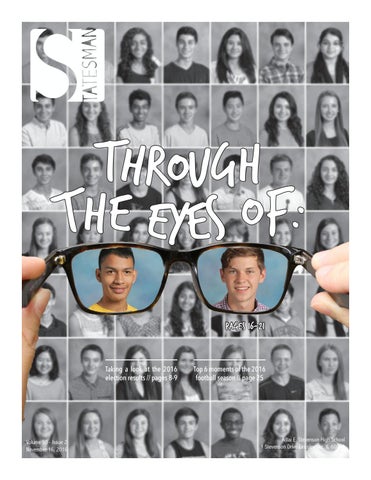
THROUGH THE EYES OF: pages 16-21
Taking a look at the 2016 election results // pages 8-9
Volume 50 - Issue 2 November 16, 2016
Top 6 moments of the 2016 football season // page 25
Adlai E. Stevenson High School 1 Stevenson Drive Lincolnshire, IL 60069
MASTHEAD
2016-2017 STATESMAN STAFF STATESMAN POLICY Purpose Statesman is first and foremost a student-run publication with six annual issues distributed to sutdents, faculty, staff, and community members of Adlai E. Stevenson High School with a press run of 3,000. The primary goal is to serve as a public forum that delivers the news and provides content deemed to be newsworthy and timely to the Stevenson community. The Opinions expressed in Statesman do not necessarily reflect the opinions of the administration, school board, faculty, student body or community members. Affiliation Statesman belongs to the Northern Illinois Scholastic Press Association, the Kettle Moraine Press Assiciation, the Columbia Scholastic Press Association and the National Scholastic Press Association. Responding to Statesman Letters to the editor may be e-mailed to shsstatesman.business@gmail.com, placed in the mailbox of Dean Bradshaw or submitted to Room 2712. All letters must be signed. Letters must not contain personal attacks and may be edited. Advertising Businesses may advertise in Statesman. Ad content is subject to the discretion of the editorial board and will contain information that is appropriate. Contact Mailing Address: One Stevenson Drive, Lincolnshire, IL 60069 Phone: 847-415-4000, ext 4354 Website: www.statesmanshs.org Email: shsstatesman.business@gmail.com
Sami Sparber Editor-In-Chief
Aman Grover Cindy Yao
Managing Editors of Production
Nikol Safronova Annie Wu
Managing Editors of Design
Karaj Singh
Business Manager
Emma Ismail News Editor
Charlotte Ronson Opinions Editor
Bella Greenspan Features Editor
Maxwell Cohn Lawrence Kreymer Sports Editors
Dean Bradshaw Adviser
STAFF REPORTERS Elyse Baden Jamie Berman Yana Bushuyeva Victoria Kolotov Olivia Lamberti Adele Lee Michael Levitt Ashley Mandel Alisa Mufti Chloe Myers Aniket Nuthalapati Maya Perekh Yogin Patel Sivakami Ramakrishnan Kendall Roberts Grace Westphal
05 | CLUBS UNDER REVIEW 06 | CYBERSECURITY 07 | SHS ACTION CIVICS 08 | LOCAL AND PRESIDENTIAL ELECTION 10 | SOCIAL COMMENTARY 11 | EDITORIAL 12 | PRO/CON: RAISING MINIMUM WAGE 13 | FALL SNAPSHOTS 16 | THROUGH THE EYES PROFILES 22 | STATESMAN 50 YEARS 24 | BASS FISHING CLUB 25 | TOP 5 FOOTBALL MOMENTS 27 | FIELD HOCKEY RECORD 29 | TENNIS DOUBLES Q&A 30 | EXAMINING THE BENCH 31 | PROFILE: PAUL JUDA ’19 32 | ONE LAST LOOK
CONTENTS
04 | NO HOMEWORK NIGHT
4 NEWS
NO HOMEWORK NIGHT
Administration hopes time used for parents and students to plan future MAYA PAREKH
S
YOGIN PATEL
tevenson had a no homework night on Tuesday, Oct. 25 to encourage engagement between students and parents in looking at the coursebook and having a discussion about the future. In addition to not assigning homework, teachers were told not to schedule quizzes or tests on Wednesday. “We had heard that parents weren’t as included in discussions about classes that students had decided to take,” Sarah Bowen, director of student services, said. “The purpose of it was to give time to talk to each other and for students to think through their goals and how they connect to SHS course choices.” Some students appreciated the no homework night even if they didn’t use the extra time to look at colleges.
According to Ryan Abbott ‘18, while many kids have already had college talks with their parents, the night was a useful breather as a time to catch up on schoolwork. However, several students had schoolwork to do on the no homework night. “Three of my five teachers assigned homework,” Nikita Jhangiani ’17 said. Jhangiani also received a large amount of homework due Wednesday that she wasn’t able to finish Monday night. Bowen said that administrators received feedback about students still receiving homework as well, and that the administration team is thinking about how to better communicate to teachers the objective of the no homework night and help them understand the purpose of it. Not all teachers faced issues with
the no homework initiative. “It was easy to work around since we were told about it ahead of time,” math teacher Michelle Gammelgaard said. “I hope students and parents took advantage of the extra time.” Jhangiani believes that the night was especially beneficial for freshmen, sophomores and juniors. Her little sister was able to plan out her classes for her junior and senior year using the new coursebook, Jhangiani said. Bowen said that administrators will definitely make sure to provide a similar opportunity for students and parents to have class selection and college discussions next year, though they aren’t sure what it will look like. “We need to change it up, make it creative––and make it different.”
(( 74 Students Surveyed )) Data compiled by Maya Parekh
NEWS 5 CREATING CONNECTIONS
Student activities examines current extracurriculars in hopes of engaging all students ELLIE BADEN
O
YOGIN PATEL
ver the next few months, representatives from student activities will be auditing clubs to determine which ones are unique and have enough appeal to continue to run as separate entities. Clubs that do not meet these criteria will face the possibility of being merged with other similar clubs. Many of these newly combined clubs will be geared towards the roughly five to 12 percent of students who are not currently engaged in any extracurricular activities. Principal Troy Gobble hopes that the result of these mergers is a variety of activities whose topics are not redundant, which is an issue with the school’s 130 pre-existing extracurriculars. However, many students have found that merging clubs is not always effective. According to Serena Goldberg ’17, a current executive board member of debate and a former member of speech and drama, the two teams had planned to merge for this school year, but ultimately decided that it would be too big of a distraction for both clubs as they each had different focuses. Goldberg understands student activities’ goals in suggesting a merge, but said that merging is not
Distribution of Club Membership
Ted Goergen // Source
always possible—especially when both clubs require a lot of seperate logistical work to run. Because of this, the speech and drama team is no longer being offered. Despite past failed merger attempts, Gobble is not concerned as he looks forward. According to Gobble, the school is going to let
the students and advisors figure out how to best combine by encouraging them to discuss their similarities and differences. In addition to potentially merging clubs, the school has decided to limit the number of new clubs this year. In spite of this, Ted Goergen, director of student activities, is keeping all of the proposals he receives. “[I am] still interested in new clubs because these are ideas that come from kids about what might work to fill some of those voids,” Goergen said. Many students who were hoping to start a club were told that they would have to wait until next year, including Nishant Jain ’19. Jain wanted to create a club that would help educate students about economics and high finance. However, because of this year’s changes, the creation of his club will be, at best, postponed. Despite this, Jain is not upset about the change. Rather, he is motivated to incorporate these ideas into currently existing clubs as suggested by the school. “We just want to build the very best program that we can that’s as inclusive as possible,” Gobble said. “That’s the point here.”
6 NEWS
CRACKING THE PASSWORD MYSTERY
A closer look behind the scenes of the recent security changes at Stevenson ANI NUTHALAPATI & AMAN GROVER
A
ditya Mansharamani ’18 signed into his email to find a popup declaring that suspicious activity had been detected on his account. Confused, he looked through his login history. It appeared that someone had hacked into his account and vandalized some files. The damage was reversible but could have been far worse, Mansharamani said. “The person who got into my account could have done a lot if they wanted to,” Mansharamani said. “Sending inappropriate emails to teachers, getting into college apps — it could have hurt me a lot. That spurred me to look into this issue.” Mansharamani and his friend, Idan Raiter ’17, believed that the attack was made possible by the weak passwords the school had assigned students. The passwords were especially weak due to the standardized format, Mansharamani said. The old passwords for upperclassmen consisted of their ID number followed
NIKOL SAFRONOVA
passwords, Kahler said. “We were aware of the [vulnerability] at the time and were already making steps to address it, but the notification from Naviance exacerbated the situation,” Kahler said. The school sent an email to all upperclassmen, informing them that their passwords would be changed to a more secure format on Oct. 12. The same was done three weeks later for underclassmen, whose passwords were changed on Nov. 2. “From the view of the Data compiled by Ani Nuthalapati SMARTdesk, the transition has been very by three random numbers sharamani said. “Mathesmooth,” Nancy Hudson, at the end, while the old matically, since there are SMARTdesk manager, passwords for underclass- only three numbers, the said. men consisted of “Shs” maximum possible time it To aid students with the followed by 6 random dig- can take is 10 seconds.” transition, the school set its. Mansharamani shared up support desks at varHoping to bring the his findings with Doug ious places for students issue to the administra- Kahler, director of Inforin need of help. Hudson tion’s attention, the two mation Services, who acadded that the desks were tried to crack Manshara- knowledged the issue and very effective in helping mani’s password. Their told Mansharamani that it students with password code used a method called would be addressed. problems. brute-forcing, in which all Shortly after, Steven“We’re very safe about possible combinations of son was contacted by cybersecurity here at Stethe password are attempt- Naviance, who informed venson, so it shouldn’t be a ed by the program. them about an incident worry for anyone,” Kahler “It took two seconds to involving possible exsaid. crack my password,” Man- ploitation of the weak
NEWS 7 CIVICS IN ACTION
Stevenson students get involved in the upcoming election through Political Action Club and other local events KENDALL ROBERTS
S
tevenson students are taking a greater interest in civic involvement due to the the high-profile and high-stakes nature of the 2016 primary and general elections. Although seniors are required to take a government class before they graduate, extracurriculars like Political Action Club (PAC) allow all students to participate in discussions and provide local political opportunities to students. More than 300 students attended a debate watch party and about 60 students will be election judges in the general election said Andrew Conneen, AP government teacher and PAC sponsor. “The presidential election certainly gets a lot of attention because it’s been such a different election with the first female presidential candidate, Hillary Clinton, and reality TV candidate, Donald Trump,” Conneen said. On the local level, students can get involved through internships and campaign fairs supporting candidates in Illinois’ 10th congressional district. Located in the northern suburbs of Chicago, the district contains sections of Lake and Cook County––including the Stevenson
ANDREW CONNEEN
On Oct. 29, Political Action Club sponsored the Parade to the Poll. Stevenson’s marching band led voters to the voting centers.
high school area. “Poltical Action is great because it’s important to be civically engaged,” Hannah Charak ’18, intern for Brad Schneider, said. Most seniors taking government classes are required to complete action civic points in order to pass. Some ways to gain these points include watching debates or training to be an election judge. “It’s good to learn about and understand what goes on to make decisions that better our future,” Eric Fleishman ’19, intern for Mark Kirk,
said. To extend more rights to Illinois high school students, House Bill 6167 was amended in 2016 allowing 17 year olds to vote in the primaries if they turn 18 before the general election. This new law has led students to enter the world of civics before their senior year. “Our word of advice is if you have interest, find a candidate or an idea you support and get involved early,” Conneen said. “Make civics more than a course; make civics a lifestyle.”
8 NEWS
LOCAL AND NATIONAL ELECTIONS Nov. 8 marks end of political campaigns, results garner attention EMMA ISMAIL & CINDY YAO
ANNIE WU & NIKOL SAFRONOVA
NEWS 9
Source // New York Times
10 OPINIONS
Seven gam es: the length of ti me required by S tevenson students to become “lifelong” C ubs fans.
For all you GiveAThon leaders ou t there, re member, you’re no t just doin g this fo r some mea sly community se rvic You’re doin e hour. g it for 10 of them.
As our Fall sports teams wrap up another unsuccesful season of playoffs, it’s important to remember the unsung heroes who were actually able to deliver a state championship for this school: math team.
I’m Gobble, Hey Mr. g kind of lin still fee about my in ta r e c n anu an we do future. C Homework o other N ? y a d
r own : it you to Subm pins ideas ail.com! s clothe espins@gm se oo th an ch shsclo you c r idea cted, u If sele r or not yo e wheth e posted b would ously! m anony
FRESHMAN AGAIN
Reporter reflects on lessons learned from frequently moving between schools YOGIN PATEL
I
magine a kid, and imagine that they have been moving nearly every two years. Two years and then a reset. New classes and nobody that they know. That was me. Six elementary, three middle and one high school. Ten times that I had to make new friends. Ten times I walked into a class on the first day, not knowing anyone there. I faced one of a student’s worst fears: not having friends in their classroom. In this age of social media, everyone seems to know everything about everyone else. But this was not the standard before. Many have gone through this and know how bad the first few months can be. Even if they haven’t moved, everyone was a freshman
and had that one class where they didn’t know anyone there. If that taught me anything, it’s that knowing people is easy, but befriending them is hard—that distinction is hard to make. I was fortunate enough to find people that I could call friends. Many are fearing the changes they’ll have to make next year. We are less than halfway into the year, and students are already accustomed to their schedules and the people in their classes. Next year of high school will be different, and seniors are scared for college life as they send in applications. But, it is not as bad as it looks. More often than not, everyone else fears the same thing. Becoming a part of the solution ends this cycle. If you see that kid that is sitting
alone, or not talking to people, give them a hand. Some of the best people I know are these types of people: people that didn’t know who to talk to and needed someone to reach out to them. They opened up so fast and were amazing people. Humans are social creatures. We as a species flourish with social interaction. It can take a long time to make real friends, but finding them is a part of life. Everyone has been a freshman, and everyone knows the feeling of not knowing anyone. I personally feel this every new year. The best we can do is to help others out. Find that kid that sits alone. Find the students that don’t end up talking to anyone. Then maybe we won’t be freshmen ever again.
OPINIONS 11 CIVICS COURSES EMPOWER STUDENTS STATESMAN EDITORIAL
G
iven the particularly contentious nature of the 2016 presidential election, the future of American politics has grown increasingly unclear. Distinct partisan divides continue hindering proper discussion, and scandals drown out any dialogue on matters of policy. The sole means to salvage what will otherwise compound into irreversible damage is to educate those who will one day direct the political domain: the youth. Statesman believes that Stevenson has done a great job with actively engaging students in civic education but needs to ensure teachers remain politically neutral so as to allow students a greater level of freedom in forging their own views. One of the most influential means by which the school has been able to increase student involvement with politics is through the government course, which is a graduation requirement that over half the senior class opts to take at the AP level.
ASHLEY MANDEL
In the government course, by making students’ grades dependent on their civic involvement —through initiatives such as offering points for attending political rallies— students are thrust into the heart of real world politics rather than just reading about them in a book. This is further supplemented by extracurricular offerings such as Political Action Club, Debate Team and Model United Nations, all of which allow students to explore real world politics. Statesman believes that without the
practical political experience that these opportunities encourage, students cannot truly understand the nuances of their political representation. What makes all these opportunities particularly powerful, though, is that they give students the experiences they need to forge their own perspectives. With that in mind, it’s important to note that many teachers incorporate politics in class and often insert their own partisan views during discussion. Statesman believes that bringing politics into
class discussions, particularly in humanities courses, is an effective way to allow students to interact with material in a modern setting. That said, because of how students look up to their teachers for guidance, Statesman views it as imperative that teachers maintain neutrality in political discussions so as to allow students to develop their own ideologies. With the notably divisive atmosphere of this election, it’s the internet that has perhaps played the greatest role in informing and engaging students. Because of the rampant misinformation that often comes about through the internet, Statesman believes it is important, now more than ever, for Stevenson to continue the great strides it has made in encouraging civic engagement amongst students. This will allow for the creation of a more educated voter and a more educated populace, both of which our country will be depending on in the years to come.
12 OPINIONS
PRO/CON: MINIMUM WAGE
Raising the minimum wage has been a widely debated topic for many years and will have a large impact
R
aising the minimum wage to $10.10 would raise wages for 28 billion workers, according to the Economic Policy Institute. According to thinkprogress.org, the change would lift almost five million people out of poverty. These people are in turn spending the money on themselves or their families, so they will help the national economy. If the change was as little as a $1.75 rise in the minimum wage, household spending would increase by $48 billion, according to Arindrajit Dube, Associate Professor of Economics at UMass Amherst. This boosts the economy and Gross Domestic Product. A common misconception is that raising the minimum wage will lead to people losing jobs. However, this is incorrect because the workers who gain more money are in turn spending that money. As they spend, the demand for products increases and so will the need for workers. Possibly one of the biggest reasons to raise the minimum wage is the fact that minimum wage has not kept up with inflation. In 1968, the minimum wage was $1.60 which is actually 53.9% higher than today’s federal minimum wage of $7.25, said the U.S. Department of Labor. Raising the minimum wage would bring people out of poverty and help catch the minimum wage up with inflation.
CON (-)
PRO (+)
CHLOE MYERS & ASHLEY MANDEL
A
lthough increasing the minimum wage may seem like an easy solution, it has many unintended effects on the very people it is trying to help. In the previous federal minimum wage increase from $5.15 to $7.25, only 15 percent of workers who were expected to gain from it lived in poor households, according to a 2012 review by the U.S. Department of Labor. Businesses who pay their workers slightly above minimum wage will be pressured to raise their pay, resulting in a chain reaction. A 2012 analysis by the New York State Department of Labor found a 20 to 21 percent reduction in the employment of less-educated individuals. This ripple effect results in job loss for the people in the most dire of situations. Earned Income Tax Credit is an alternate policy which has proven to be much more effective in aiding the impoverished. It benefits working, low income families by reducing the amount in taxes they pay based on their earnings. In 2013, EITC lifted 9.4 million people out of poverty, according to the Center on Government and Budget Priorities. A minimum wage increase would address low wages but is not the most efficient course of action to take in delivering benefits to low income families.
OPINIONS 13 FALL SNAPSHOTS
The leaves are changing and the weather’s getting colder, but fall has a lot to offer. Here’s what was trending this fall. CHARLOTTE RONSON
ANNIE WU
FEATURES 15
16 FEATURES
Dealing with Stereotypes OLIVIA LAMBERTI
G
urasees Bajaj ‘18 considers himself easily recognizable in a crowded hallway. Though he wears the same jeans and sneakers as other students, one part of his outfit sets him apart— his turban. “It’s a very distinctive c h a r a c t e ristic,” Bajaj said. “I’m pretty sure if I interacted with people with a turban and without a turban, it would be really different.” Bajaj adheres to Sikhism, a religion that traditionally requires followers to refrain from cutting their hair. Male followers typically wear a dastaar, or a turban. With approximately 27 million Sikhs worldwide, less than a thousandth
KARAJ SINGH
KARAJ SINGH
of a percent of Americans identify as such. The relatively small size of this population can influence public perception of Bajaj. “You get the weird looks,” Bajaj said. “Especially when you’re in a new place and people aren’t expecting it, it’s interesting to see their reactions.” Bajaj, however, finds his religion more easily accepted by his peers at Stevenson. Friends and acquaintances already familiar with Sikhism realize this is not the dominant feature of Bajaj’s personality. “You’re recognized for your beliefs,” Bajaj said. “But once people know you and who you are, it’s much easier to interact with them on a personal level.” Whether socializing with those he is accustomed to or not, Bajaj credits Stevenson as an
especially positive environment in his life. His relationship with faculty has been a predominantly encouraging one. “Teachers are very supportive and very kind,” Bajaj said. “It’s definitely a lot better here than other places.” Despite this general positivity, Sikhs remains a religious minority, with many lacking knowledge about the religion.
In my faith, you don’t
cut
your
hair. It’s kind of like keeping your roots. Cutting your hair is like cutting the roots to your religion.”
Misconceptions about Sikhism still exist. Bajaj encounters them regularly. “There’s stereotypes and generalities that people develop,” Bajaj said. “But it’s important to know that, generally, 99.9 percent are not true for most people.”
FEATURES 17
Sacrificing Faith for Identity JAMIE BERMAN
JAMIE BERMAN
G
rant Mower ’17 always knew he was different than other kids. As a kid, his interests were far different from other boys. He had a passion for fashion that made him stick out like a sore thumb. One more thing made Mower unlike everyone else: he was a Mormon attending a very liberal school. Together, these characteristics have defined his life.
I’ve grown up in this
environment
where you don’t really talk about anything controversial because it’s too taboo.”
Arriving at Stevenson, Mower didn’t know anybody. Then, his life changed again. He came out as a homosexual junior year in his new school. Mower figured that coming out at Stevenson was easier because he didn’t know many people and he didn’t have any expectations. “My coming out process was mostly sparked by the fact that I met one person and ended up
GRACE WESTPHAL
getting into a relationship [with him],” said Mower. However, it hasn’t been simple for Mower’s family, who is still part of the Mormon faith. He was worried about what they would think. The older generations in his life have struggled more with the concept of being homosexual. “I’ve grown up in this environment where you don’t really talk about anything c o n t ro v e rsial because it’s so taboo,” Mower said. He thinks not talking about the subject is better than arguing about it. Although Mower’s family still considers themselves Mormon, he doesn’t identify with the faith anymore and no longer considers himself to be religious. The only time Mower has been back to the church was to support his
sister going on a mission trip. Mower believes that being gay empowered him to change the traditional pre-planned lifestyle. “I would not have been ultimately happy living [like that]. My life changed to the fact that everything f e l t like my choice,” s a i d M o w e r. After coming out, he found his true passion of singing/songwriting and now he desires to carry it into his career. Mower wants to extend the invitation to anyone who needs help, wants to talk and/or is questioning their sexuality. He can be reached at his email: gmower7@ students.d125.org
18 FEATURES
Living with Cerebral Palsy GRACE WESTPHAL
GRACE WESTPHAL
A
ngel Ramirez ’19 is an average student at Stevenson. He goes to school from 8:30 a.m. to 3:30 p.m., stays after school in the ILC and goes home to chores. However, Ramirez has a brighter smile than most students. He takes everyday’s opportunities as they come. Ramirez has something to live for.
Some
people
world
revolves
them, but they
think around
have no idea
what others are going through.”
When he was born on Nov. 28, 2000, his parents were told he wouldn’t make it through the night and if he did, he would never walk. “They told my parents I was going to be in a wheelchair my whole life, depending on my family,” Ramirez said. Ramirez has cerebral palsy (CP), a condition resulting from concussions before birth that deprived his brain of oxygen. CP affects his muscle tone,
the
NIKOL SAFRONOVA
movement, speech and motor skills, making getting through Stevenson a challenge and a big journey. Sixteen years later, Ramirez is no longer wheelchair bound and makes the trudge from the 8000s hallway to the 2900s hallway completely on his own. Ramirez is enrolled in the special education program and attends adapted classes five periods of the day. His schedule includes academic literacy which works on reading, vocab and writing skills that help him through his other classes. Having CP has made it a lot harder for Ramirez to get along with students not in the special education program, and he said he often feels left out by people at school. “They just judge others without actually knowing them,” Ramirez said. In addition to his schoolwork, he works as a manager for the wrestling team as well as in the ILC. He also runs a blog filled with content about CP, school news and keeping a positive mindset. Ramirez considers himself a positive role model to the freshman he has met throughout his sophomore year. “Clearly I’m not depending on anyone,” Ramirez said.
FEATURES 19
Finding Home at School GRACE WESTPHAL
T
YOGIN PATEL
ravis Plofsky ’18 described himself as a hyper and crazy kid that had struggled with rules and often got in trouble at school. He was formally adopted in 2008 after being fostered by the Plofsky family for two years. He credits his adopted mother for instilling responsibility in him. Plofsky is only one of the 136,000 children adopted between 2007 and 2008 according to the U.S Department of Health and Human Services.
YANA BUSHUYEVA
“Back then I had a lack of common sense and authority,” Plofsky said. Although he considers his adopted parents family, Plofsky said he never considered them as his role models. Instead, he finds his role models through his connections at school and in his best friend who is also adopted. “In a school of four thousand, I can find people who have common interests with me, who understand me,” Plofsky said.
Working Towards Harmony OLIVIA LAMBERTI
OLIVIA LAMBERTI
L
NIKOL SAFRONOVA
ike any other Stevenson student, Rowena Bakke ’19 comes home to a night‘s worth of work from school. However, that only comes after hours of what Bakke is most passionate about— playing the cello. “I care about academics. I want to do well, I want to learn,” Bakke said. “But music is definitely more of a priority to me. Academics come second.” Bakke has been actively playing cello since she was five years old. She has further pursued this passion through concerts with the Stevenson Orchestra and the Chicago Youth Symphony Orchestra. But school doesn’t always
help her relationship with the cello. The young cellist often finds homework to be an intrusion on time reserved for music. “It’s really difficult to balance practicing,” Bakke said. “I do not get in as much practice as I would like because of academics.” Despite this, Bakke considers music an essential part of her identity. Whether humming in the hallways or reviewing pieces in her head, Bakke incorporates music in her daily routine as much as possible “Music is all the time in my life,” Bakke said. “It’s part of who I am.”
20 FEATURES
Learning the Language OLIVIA LAMBERTI
OLIVIA LAMBERTI
YANA BUSHUYEVA
W
hile the large student body and sprawling campus could intimidate any first time Stevenson student, Rubi Gutierrez ’18 faced a few more challenges than most. “When I first came here, I didn’t know how to say any words [in English],” Gutierrez said. “I couldn’t communicate.” Gutierrez, a native Spanish speaker, is one of almost 100 students in the English Language Learners (ELL) program. Though she is now near fluent, she originally faced trouble
learning English. Gutierrez cites the challenge of language learning as something that sets her and other ELL students apart from those who speak English as their first language. “For ELL students, it’s not easy to be here,” Gutierrez said. “We have to start from the beginning.” Although learning English was difficult for Gutierrez, she credits the ELL program as an important aspect of her educational experience. To read more, go to statesmanshs.org
Adapting to America JAMIE BERMAN
R
JAMIE BERMAN
ight before the school year started, Darius Hahn ’18 had to make a transition in life. Moving from Germany to the United States and to Stevenson was not a quick or easy transition. However, he had no choice when his dad’s job forced them to move. “Moving here was pretty hard because people don’t trust foreigners, especially when it comes to renting a house or getting a credit card,” Hahn said. He has struggled with getting a bank account because he doesn’t have a social security
SIVAKAMI RAMAKRISHNAN
number. He is also not yet eligible to work in the U.S. Hahn walked into a new country without having friends. Socially, he finds that people aren’t so eager to stop and talk to him. Teachers quickly acknowledge his accent and find out that he just moved here. Then, they go back to class and seldom mention it. “I hope that people will acquire more [understanding] about my background but they don’t that much,” Hahn said. To read more, go to statesmanshs.org
FEATURES 21
Opening Up Comfortably CARLEY BRIZUELA
GRACE WESTPHAL
W
hen Carley Brizuela ‘18 was in 8th grade, she thought she was bisexual. It wasn’t until high school that she realized she was homosexual. Brizuela doesn’t attend Gay Straight Alliance because she came out comfortably. “I wouldn’t benefit from it because I feel I have enough support but I’m sure that other LGBT youths would, especially those who are trying to find a safe space where they can be
KARAJ SINGH
themselves,” Brizuela said. Brizuela feels more secure in high school than in middle school in terms of her sexuality. “There’s more diversity, and once you leave middle school people mature and think differently,” Brizuela said. While she feels accepted, she’s aware some people are intolerant. Brizuela said hearing derogatory terms for homosexuality made her realize “there’s always going to be someone radical,” who isn’t so accepting.
Adjusting to New Places JAMIE BERMAN
SID VEERAVALLI
S
NIKOL SAFRONOVA
id Veeravalli ‘18 seems like a typical junior at first glance. However, he has been exposed to more than the average student. Veeravalli has moved 12 times throughout his life. Veeravalli has been all over the world growing up. He has gone to school in India, England and now in the United States. Veeravalli moved because his father works as a global consultant. “I just get a different perspective of what one thing feels like,” said Veeravalli. He feels he has benefitted from his experiences. From eating fish and chips to having high
intellectual expectations due to his race, Veeravalli is aware of culture differences. He has adjusted many times in his life and easily adapts to new environments. “There are a lot of different people at Stevenson, so you kind of fit in right away,” Veeravalli said. Veeravalli became a transfer buddy junior year after moving sophomore year. He found it was a helpful program for him, since he knows what it’s like to be a transfer student. He hopes to help others adjust to the school. “I feel like I fit in,” Veeravelli said. “Stevenson just feels really welcoming.”
22 STATESMAN 50 YEARS
Our first issues were print-only and exclusively in the traditional newspaper format. Now serving over 4,000 students, Statesman is available both online and in a new newsmagazine format. Between our 2004 Pacemaker Award and second place finish at the 2016 IHSA State Finals, Statesman continues to uphold the legacy that our predecessors left for us.
In 2015, we celebrated Stevenson’s 50th Anniversary. Two years after its doors opened, in 1967, the student-run newspaper was born. Now, in our 50th year of publication, Statesman is taking a look back at front pages from our past. This ongoing feature will allow us to remember our roots while also reflecting on how we have progressed since.
years of Statesman
50
Celebrating
STATESMAN 50 YEARS 23
24 SPORTS
ALISA MUFTI
ANNIE WU
FOOTBALL RECAP: 1.
SPORTS 25 Taking a look at the 20162017 season’s best moments 5.
1. Jack Worwa’s game-winning kick vs. LZHS
4. Win vs. Warren
With the score tied and just over a minute left to play, Stevenson led an 11-play, 69-yard drive to get in field goal range. Jack Worwa ’18 lifted a 29-yard field goal as time expired to win the game. Stevenson’s drive came after Lake Zurich had a seven minute drive that ended in Stevenson territory. With the 17-14 win, Stevenson became the sole possessor of first place in the North Suburban Conference, a place they would never relinquish.
In the last game of the regular season, Stevenson traveled to Warren High School and came away with a 47-6 win. For Patriot football players, this game was important because it was a way to get revenge for last year’s loss. For everyone else, it was important for a different reason; if Stevenson won, they would clinch first place in the North Suburban Conference. Luckily, Stevenson won and ended up in first place in the conference.
2. Aidan O’Connell breaks passing record
5. Grayson Kubow’s first start
After a four hour bus ride up to Michigan to play Muskegon High School, ranked sixth in the state of Michigan, quarterback Aidan O’Connell ’17 broke Stevenson’s passing record for most yards in one game, throwing for 447 yards, as the Patriots came away with their first win of the season. O’Connell also threw for four touchdowns, three of them to receiver Henry Marchese ’17 and completed 36 of 50 attempted passes.
In week eight against Waukegan, Grayson Kubow ’18 started in place of O’Connell, who missed the game with an injured shoulder. Even though it was Kubow’s first career start, he looked very comfortable behind center, throwing for 235 yards and three touchdowns on 25 passing attempts. He threw to eight different receivers, with five having at least two receptions, and led Stevenson to a 36-7 win.
3. Win
6. Win vs. Lake Forest
vs. Muskegon
Coming off a week one loss to Palatine, Stevenson came back to win against Muskegon High School, in Michigan, by a score of 38-35. With less than a minute left in the game, Matt Korinek ’17 had a touchdown run to put the Patriots up three. On the last play of the game, Muskegon missed a 27-yard field goal that would have tied the game. This win was the start of an eight-game winning streak that went through the end of the regular season.
After two close games to start the year, SHS looked for its first game that would be won before the last minute. And they got it—winning 43-12 against Lake Forest and earning a winning record (one they would never let go of). O’Connell completed 23 of 30 passes for 352 yards and three touchdowns. It was also the first game that he did not throw an interception, a streak that would stretch for four straight games. content compiled by Michael Levitt
SPORTS 27 A TEAM ON THE RISE
Despite a tough start, varsity field hockey won nine of last 11 games, including six game win streak midseason MAX COHN
S
tevenson is well known for many things, but nothing quite like their sports programs and the numerous state titles collected for dozens of different sports. One sport that goes a bit under the radar is varsity field hockey. They began the year on a six game slide, however followed that up with winning six straight games. Starting defender Hannah Friedman ’18 thinks a big reason to the sudden win streak was because of how the team was able to talk and communicate with each other. “I think we found at the beginning of the season what worked and what did not work and we made sure to change that as the season went on,” Friedman said. “We have done a lot better with communicating with each other from the first few games to now, and we just flow a lot better as a team.” The six game skid happened against three of the
HANNAH FRIEDMAN top four teams in state, two of which were nationally ranked. However, after facing the best the state had to offer, Stevenson, the 14th ranked team in state, faced off in a major tournament that turned their season around. “[The six game win streak] definitely shifted our momentum,” team captain Allison Schultz ’17 said. “As a team our players were feeling defeated after several early season losses, however with each win the confidence grew significantly of the field.” Comparatived to other teams in Illinois, varsity field hockey is particularly young, with a mix of freshmen and sophomores on the team. According to the other team captain, Lauren Heiss ’17, it did not matter, as the younger girls gave everything they had. “We have had a lot of younger girls step up and become our starters,” Heiss said. “It gives those people the opportunity to
Allison Schultz ’17 (right) goes after a loose ball against Loyola Academy on Aug. 25 at home
show off and develop their skill on the offensive side and defensive side.” The youth of the team has made the team susceptible to mistakes. However, Coach Walker sees it as growth and a learning experience. “We wanted to see growth from our team,” Walker said. “We have
had some trouble in the past with focus to move forward throughout the whole season and improve and we really wanted this year to be all about growth from day one and continue to improve. We really saw that; the girls worked really hard from the first practice to the last.”
&
QA A: Paige and I have a really good and easy relationship; we get along very well. We have known each other for awhile and we have been on the same team for two years now, It’s been really good being her partner because we have so much fun, and she works so hard.
SPORTS 29 Tennis doubles players Kate Harvey and Paige Nierman talked to Lawrence Kreymer about the relationship they have, the coaches and other players on the team and a word that describes each other. LAWRENCE KREYMER
NIKOL SAFRONOVA
A: Kate and I have very a close relationship. We get along together on and off the court. She is one of my good friends, and I’m so happy we met last year during the season.
A: I’d have to say we have a pretty close relationship with the coaches; we see them about seven days A: We have a good What typ e o f relation a week and they are relationship with our ship do y o u have with very supportive. In coaches because they each othe r ? addition, as a team have helped us so we were very close much over the years and H o w do you g this year. Everyone helped us get where we et along w i t h the coa got along, and we want to be. Our team is ches and p l ayers? had multiple team so fun, and we turn the bonding actitvities. sport into a fun and reW h a t is one wo laxing thing that we rd that d escribes can go to after school. your par tner and why? A: Awesome, Kate is such a team player, and she’s very supA: Paige is a leader. She portive on and off works hard at making the court. She’s a great the season a better expeleader and I’m going to rience for everyone. She miss her so much next year. leads parts of practice and is such a good role model. She shows everyone that it’s worth working hard for the team.
30 SPORTS
BEHIND THE BENCH
Backup players contribute strong support and motivation to team from the sidelines ADELE LEE
STEPHANIE HUNSBERGER
K
yle Swanson ’18 and the rest of the boys’ varsity soccer team stand on the sidelines to cheer on their teammates through a tough match. There is less than 10 minutes left in the game and the score is tied. A rumble of cheers and chants reflects the game’s intensity. Finally, the Patriots score, winning 2-1 against Round Lake in the first round of playoffs. Although not everyone was on the field, every player was invested in the game. The bench players took it upon themselves to keep the energy up and preserve a good mentality in light of the high-stakes atmosphere. According to Swanson, one of the team’s backup goalies, his experience on the bench consists of constant support. “We always cheer each other on,” Swanson said. “When someone comes off the bench we always
Boys’ varsity soccer team finished their season with a total of 11 wins, 7 losses and 3 ties.
clap for them. We encourage each other all the time just to go out there and do your best.” According to head coach Mark Schartner, this teamwork is essential not only for the team, but to soccer as a sport. He’s made a point of instilling in his athletes a full understanding of what it means to have good teamwork. “Our coach definitely encourages us to cheer on the stands and even help
out on the field positioning-wise,” Swanson said. Starting forward Steven O’Reilly ’18 is quick to acknowledge the vital role of bench players. According to O’Reilly, bench players are important to the success of any team. “They push us to play harder,” O’Reilly said. “Most importantly, they keep us motivated.” But bench players’ duties aren’t confined to the sidelines; they also carry the responsibility to hone
their individual skillsets. By utilizing various training opportunities throughout the regular season and offseason, second and third line players are able to improve individually and, as a result, help the team as a whole. Even as a starter, O’Reilly feels that there is equal responsibility to improve for the sake of the team. According to O’Reilly, the entire team holds themselves accountable over the course of their season— regardless of playing time. Back on the sideline, Swanson focuses on keeping spirits high––both his teammates’ and his own. “There’s always just this urge to improve because you’re so high up [in the program],” Swanson said. “I’ve improved so much during the two months that I’ve been on varsity; I just have to keep my head up and hope for the best next season.”
SPORTS 31 BEYOND THE MATS
Paul Juda ’19 elaborates on his lifestyle when not training for the national gymnastics team VICKY KOLOTOV
T
he faint smell of sweat and chalk fill the buzzing room. The crowd quietly stirs, waiting in anticipation. Their noise is fades away as a male figure approaches the dark blue mat laid out below a set of wooden bars. He bows before pulling himself up onto the bars, one hand on each. He begins his routine. This portrays Stevenson High School’s Paul Juda ’19, one of the best gymnasts in the country for his age group. Juda won fifth overall in the 14U age group at the Junior Olympics, placed first overall nationally in the pommel horse with a score of 13.8 and swept the first place national ranking for the parallel bars event with a score of 14.7. But there’s more to Juda than an internet search of his name would lead to believe. Juda began his gymnastics career at six years old,
PAUL JUDA working for four hours a day, six days a week since. Juda only experienced one haitus in his gymnastics career when, in 2014, he suffered a back injury which took him out of the sport for six months. “It gave me a lot of time to contemplate quitting–– to think about whether it’s worth it because of the stress fracture in my back,” Juda said. “But it’s really all worth it in the end—even if I have to work harder to satisfy myself.” Working hard was not new to Juda. The sport had already taught him that working hard to get what he had wanted was essential. “I keep up a pretty good GPA year-round but it’s hard,” Juda said. “I come home from practice around ten, I’ve got to eat, shower,and do recovery exercises.” Juda’s social life has also been largely affected by his dedication to gymnastics. After being asked whether
Juda practices for the Parallel Bars event at his gym, the Buffalo Grove Gymnastics Center.
gymnastics had taken over his social life, he laughed. “I’m usually tired or at practice,” Juda said. “You won’t see me going out much.” Despite the multiple ways gymnastics complicates his life, Juda does see gymnastics in his future. “The short term goal is to continue making the junior national team, then go to college on a full-ride scholarship,” Juda said. “If I do continue, it’ll depend on how good I become—if
it’s even possible to go to the Olympics.” Aside from his still undecided future with gymnastics, Juda holds aspirations beyond the trail of an athlete, including nanosystem engineering andpetroleum engineering “I don’t know what I want to be yet, I just know that I want to be happy and not regret any of the choices I’ve made,” Juda said.
content compiled by Sami Sparber; graphic by Sami Sparber