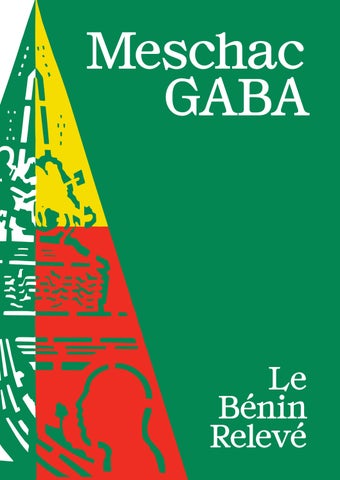
Meschac GABA
Le Bénin Relevé
PG.2
‘I take inspiration from daily life because in daily life you find new things, you find traditional things, you find everything.’
When Meschac Gaba first conceived his Museum of Contemporary African Art, it was a proposition, as there were none in Africa at the time, and an anticipation. Contemporary art spaces have since emerged across the continent, soon including Cotonou, where Benin’s museum programme has set out the intention to build on African terms rather than those of imported European models. That was Gaba’s question, nearly 30 years ago, posed in the form of a nomadic museum with 12 rooms and no building at all. Gaba has said that it was his nomadism and migration that taught him what his own Africanness was. After many years dividing his time between Rotterdam and Benin, he now lives and works permanently in Cotonou. This publication accompanies the exhibition Le Bénin Relevé ou Hommage à Patrice Talon, and celebrates Benin as much as it does Gaba’s return to making and showing his work. It features essays by Rita Ouédraogo, a curator who visited Gaba in his studio earlier this year, and Romuald Tchibozo, professor of art history at the University of Abomey-Calavi, who writes from Cotonou and sets the work within political and historical contexts. Our thanks to both, and above all to Meschac Gaba. The exhibition runs September to October 2026 at Carré № 1687, Fidjrossè Centre, Cotonou, with guest artists Gratien Zossou and Edwige Araba Aplogan.
Meschac Gaba in conversation with Kerryn Greenberg, Cotonou, 2012
PG.
Contents
3.
Still Unfolding - Gaba Meschac — Rita Ouédraogo Meschac Gaba: le Bénin, l’argent et la gouvernance mondiale de la paix / Benin, money and global peace governance — Romuald Tchibozo Works Biography
PG.1
7.
19. 44.
PG.2
Meschac Gaba in his studio in Cotonou, photographed by Rita Ouédraogo, April 2026
and imagining something else instead. His own version, with or without them, and letting it move however it needed to move. Now I see how much of that conviction is still doing its work, and how differently. Gaba has not always been visible; there were some years we moved on without him, years of quiet, years I imagine as their own kind of labour - the labour of staying with the work through years that asked something else of him first. And now: a studio full of new pieces, worked with the old materials and a few new ones, made with what looks, to me, like the same nerve it always took. Not a comeback in the sense of a return to form but a continuation, picked back up. The drive and consistency are impressive, infectious and inspiring. As relevant now as it was then, maybe more.
Still Unfolding - Gaba Meschac Rita Ouédraogo
Meschac Gaba’s words – found in a room from his Museum, now folded into the Tate’s permanent collection. A museum built, deliberately, to have no fixed home. I keep unfolding that sentence. It opens up more than it explains, invites me to sit with what it might mean, and what it might not, rather than to settle on an answer. Such is the spirit I want to breathe into Cotonou: an invitation to stay open, rather than a demand to explain. I found something of that same conviction sitting in Gaba’s house there - a staircase, a landing, objects catching the sun. Nothing was staged as an exhibition, and yet everything already was. A studio becoming an exhibition, or an exhibition that had always been a studio. Maybe the distinction was never the point. I had been folded into the artist Thierry Oussou’s orbit. Through him, a visit to Gaba’s house became possible, informally, almost in passing, the way important things sometimes arrive sideways. The house doubles as a studio. Work and life, unseparated. What might it mean to have the courage to decide for yourself who you are, in a museum world that had simply decided, by omission, that African contemporary art didn’t need deciding on? Not a request to be seen on certain terms but a refusal of the terms and systems, by building
Benin is assembling, too. Since the 2021 return of the royal treasures looted from Abomey in 1892, museums are rising across the country - for Dahomey’s kings in Abomey, for memory and slavery in Ouidah, for Vodun in Porto-Novo, for contemporary art in Cotonou. Gaba speaks of this with real feeling. Meanwhile, in his own house, he keeps working the way he always has - without waiting for any of it. Both things are happening at once, in the same city: a government constructing new institutions, and an artist who decided decades ago that he didn’t need one to make the work count. Years ago when Gaba first showed his Museum of Contemporary African Art, it also raised some ambivalence, since Gaba’s Museum mainly circulated in European
PG.3
Meschac Gaba in his Museum of Contemporary African Art, Tate Modern, London. © Tate
‘You know, my museum of contemporary African art has no walls. I want to show artists that you can show work everywhere, you can do it on your own. Have the courage to decide for yourself who you are.’
Pin with CFA banknote, photographed by Rita Ouédraogo
What’s on the table now keeps that logic moving. A tree, in banknote collage, a serpent wound around its trunk, faces pressed into the bark as if the tree were built from compressed likeness as much as currency. A chameleon, made the same way, sloughing camouflage for something closer to a joke. Entirely visible, for all to see, and made of money. A dove carrying an olive branch, one of a flock, some of which elsewhere carry bombs instead. Peace doesn’t get to stay simple here.
PG.4
Money has run through Gaba’s language since the earliest chapters of the Museum. He has told the story of finding a torn, devalued CFA note in the road once, briefly mistaking it for a fortune. That scrap became material, and material has stayed money since. When we visited, he pressed a small pin into my hand, a coin-sized disc of banknote, cut round and finished, pinned like a badge rather than left as a scrap. A tiny, deliberate object, carrying the whole history of the gesture inside it.
Chameleon (The branch will not break in the chameleon’s arms), 2026
RITA OUÉDRAOGO
art institutions: Gaba criticises Western museum institutions, yet at the same time depends on them to present his own model. This is the conceptual paradox of the work. Now, years later, within a studio in Cotonou, there is an unfolding of other possibilities. A repetition struck me first in the studio: the same triangular shape - an obelisk, a mounted figure, a stepped building, roads converging toward a bowed profile - appearing three times, in three materials: painted flat in national colours, mosaicked entirely from CFA banknotes, left raw and unpainted. Only the material had changed. I kept looking for what that meant and kept landing, instead, on the trying itself, the doing itself - the same image, attempted again, in a different register, to see what it might say this time.
RITA OUÉDRAOGO
What I saw in Cotonou didn’t need any of it to be true first. Thierry brought me to a house that was also a studio that was also, that afternoon, already an exhibition. All proof that Gaba decided who he was a long time ago, and has kept asserting it, quietly, in the years no one was watching, and now, again, out loud.
was a copy of Bibliothèque du Musée (Library of the Museum), the catalogue for one room of the 12-room Museum of Contemporary African Art, first shown in Rotterdam in 2001. The curator Simon Njami once described Gaba’s output as one continuous work. Nothing finished, everything still answering to everything else, still being tried. I believe that, standing there. The book on the shelf, and the new work beside it, both mid-sentence in the same ongoing thought. Before I left, Gaba mentioned that some of this would travel on, more rooms, more institutions, more walls. He mentioned it in passing, the way people mention things that don’t need defending.
PG.5
Library of the Museum Vol. 1 (Artimo, 2001), in Gaba’s studio
Money never settles. It’s a fiction everyone agrees to sustain, until, one day, they don’t. This is also a way of thinking about the museum. An authority that holds only as long as people keep believing it should, something we keep reinforcing. But how can we reimagine it, from within, by doing and trying? Gaba has been showing us this for years and continues to do so, this time from his own house and studio in Cotonou, the city he started from before the Museum, before Amsterdam or Rotterdam, before any of it had a name. Which brings me back to the shelf. Sitting among Gaba’s books that day
R ita Ouéd raogo is an i ndependent cu rator, researcher, and writer based in Amsterdam, whose practice - grounded in a background in cultural anthropology - addresses coloniality and its afterlives, archival praxis, and institutional power, making space for the multiple, the unfinished, and the transformative.
PG.6
Yabedji (in memory of the twins I had), 2026 (detail)
(EN)
Meschac Gaba : le Bénin, l’argent et la gouvernance mondiale de la paix
Meschac Gaba: Benin, money and global peace governance
Romuald Tchibozo
Romuald Tchibozo
Meschac Gaba s’était engagé dans les pratiques artistiques en 1981 dans un contexte particulier de l’histoire politique du Bénin. Ce fut pendant le règne du parti unique avec son idéologie, le communisme et son leader, le Général Mathieu Kérékou. Il a donc, traversé le temps et a vécu à la fois, la mutation du métier et la succession des générations d’artistes avec leurs corollaires. Meschac Gaba n’est donc pas un artiste que nous découvrons ou redécouvrons, mais celui dont nous devons apprendre à décrypter, à comprendre l’engagement. Ceci lui est viscéral et le séjour à l’extérieur n’a fait que renforcer cette conviction. En 2018, après 37 ans de pratique intense, il avait décidé de faire un arrêt, qui ne signifiait pas son absence de la scène internationale, mais un moment pour penser la perspective à donner à sa production artistique. En cette année 2026, il revient sur la scène nationale dans une grande exposition aux relents de rétrospective. Ceci lui permet de se repositionner avec d’importants projets dont certains sont issus de récentes créations, mais qui reprennent les fondamentaux de son expression artistique. Deux facteurs importants déterminent jusqu’à maintenant, la carrière de Meschac Gaba. D’abord, le principe de fidélité lui semble cardinal et est au cœur de tout ce qu’il entreprend, en tout cas, sur le plan artistique. Il n’a jamais oublié d’où il venait, ni son pays et les valeurs qu’il incarne, ni ceux qui lui avaient tendu la main. Ensuite, il est fin observateur de son environnement et reste singulièrement attentif à tout ce qui s’y passe. Peu
Meschac Gaba began his artistic career in 1981 against a specific backdrop in Benin’s political history. This was the era of the single-party state, with its ideology – communism – and its leader, General Mathieu Kérékou. He has therefore stood the test of time and witnessed both the transformation of the art world and successive generations of artists, with all that this entails. Gaba is thus not an artist we are discovering or rediscovering, but one whose commitment we must learn to decipher and understand. This is deeply ingrained in him, and his time spent abroad has only served to strengthen this conviction. In 2018, after 37 years of intense creative activity, he decided to take a break – not to withdraw from the international scene, but to take time to reflect on the direction his artistic output should take. Now, in 2026, he is returning to the national scene with a major exhibition that has the feel of a retrospective. This allows him to reposition himself with significant projects, some of which are based on recent creations, but which draw on the fundamentals of his artistic expression. Two key factors have shaped Gaba’s career to date. Firstly, the principle of loyalty is of paramount importance to him and lies at the heart of everything he undertakes, at least in his artistic life. He has never forgotten where he came from, not his country and the values it embodies, nor those who reached out to him. Secondly, he is a keen observer of his surroundings and remains singularly attentive to everything that happens there. Few artists of his generation can
PG.7
(FR)
speak of their journey – without framing it through a certain revisionism – and claim to be the product of history, particularly the contemporary history of their country. Yet art history has established that an artist is a product of their time and society, and no one can escape this. An artist’s work often reflects this sense of belonging and, above all, carries the collective memory. This is precisely what Meschac Gaba demonstrates so fully here. By considering these two foundational elements of his vision of artistic practice, it becomes easier to understand his work – or at least to grasp its essence. Four artistic projects run through the aisles of this exhibition, exploring all the major issues affecting not only Benin but the world as a whole. The first is Benin Uplifted or A Tribute to President Patrice Talon. This alone could have provided the basis for the entire exhibition. It should be noted, however, t hat P resident Talon’s Government Action Programme (PAG) refers to ‘Benin Revealed’. This is a concept for the management of state affairs that aims to break with ineffective governance and to show the world the country’s potential. The aim was to restore a prominent role to its culture and indigenous knowledge in shaping public policy. It was therefore Gaba who chose to introduce a new concept – that of ‘Bénin Uplifted’ – to illustrate how President Talon has tackled development challenges. The works created are, in fact, a manifestation of this. This project comprises five installations and a film. 1. The triptych triangle or three trowels: ‘Benin Uplifted’ depicted as the Benin flag, CFA banknotes and raw galvanised metal; 2. Once upon a time in Benin: the chameleon in the colours of the Benin flag; 3. The Clocks of Confusion to Reality, featuring all 15 presidents of Benin; 4. Political Parties in Benin, represented by their emblems printed on bags normally used for drawing water from wells;
Le Bénin Relevé / Benin Uplifted (detail)
ROMUALD TCHIBOZO PG.8
d’artistes de sa génération peuvent parler, sans l’articuler avec un certain révisionnisme, de leur parcours et se réclamer être le produit de l’histoire notamment, celle contemporaine de leur pays. Pourtant, l’histoire de l’art a retenu que l’artiste est de son temps et de sa société et nul ne peut s’y soustraire. La production de l’artiste est souvent le reflet de cette appartenance et surtout, porteuse de la mémoire collective. C’est ce que nous démontre pleinement ici Meschac Gaba. En considérant ces deux éléments fondateurs de sa vision de la pratique artistique, il est plus aisé de comprendre sa production du moins, d’en saisir la substance. Quatre projets artistiques irriguent les allées de cette exposition et explorent toutes les grandes problématiques qui agitent le Bénin, mais aussi le monde. Le premier est, Le Bénin Relevé ou Hommage au Président Patrice Talon. Il aurait pu, à lui tout seul, alimenter toute l’exposition. Il faut cependant, noter que le Programme d’Actions du Gouvernement (PAG) du Président Patrice Talon parle du Bénin Révélé. C’est un concept de gestion des affaires de l’Etat qui vise à rompre avec une gouvernance inefficace et de montrer au monde, les potentialités du pays. Il s’agissait de redonner à sa culture et aux savoirs endogènes, une place prépondérante dans l’orientation des politiques publiques. C’est donc, Meschac Gaba qui a choisi d’introduire un nouveau concept, celui du Bénin Relevé pour signifier, comment le Président Patrice Talon a fait face aux défis de développement. Les pièces réalisées en sont d’ailleurs, la manifestation. Ce projet est composé de cinq installations et d’un film. 1. Le triangle triptyque ou trois truelles, le Bénin Relevé en drapeau du Bénin, en billet de banque CFA et en métal galvanisé brut ; 2. Il était une fois au Bénin, Le caméléon en couleur du drapeau du Bénin ; 3. Les horloges de la confusion à la réalité avec tous les 15 Présidents du Bénin ; 4. Les partis
ROMUALD TCHIBOZO PG.9
politiques au Bénin représentés par leurs emblèmes imprimés sur chaque sac normalement, destiné à puiser de l’eau dans les puits 5. Transformation, le film. Toutes les installations sont indispensables à la compréhension de la problématique ici développée et j’en fais une description et analyse. D’abord, la truelle est un objet dont la forme triangulaire avec la pointe tournée vers le haut en fait à la fois, un outil opératif et spéculatif. Seulement, tout dépend du contexte de son utilisation. L’artiste a tenté ici de réunir les deux aspects en y incrustant des réalisations concrètes ainsi qu’en évoquant la représentation symbolique. Les trois truelles, tel que agencées pour cette installation, rendent compte de ce que le Président Patrice Talon a pu accomplir en 10 ans, mais aussi attirer l’attention sur les moyens financiers mobilisés et toutes les forces vives qui y ont contribué. On y découvre, le portrait du Président, la zone industrielle de Glodjigbé, Les monuments, l’Amazone, Bio Guera et l’Obélisque destiné à commémorer la mémoire des dignes fils de la nation, le quartier ministériel et les routes etc. Cette pièce est une œuvre majeure qui comptera dans l’historiographie de l’art du Bénin. Ensuite, il était une fois au Bénin. Le caméléon peint dans les trois couleurs du drapeau du Bénin rend hommage au Président Mathieu Kérékou. Le Bénin aussi, avait connu sa période du communisme et cela semble aujourd’hui, un lointain souvenir. Il avait émis une sentence en prenant le pouvoir en 1972 qui était devenue légendaire, inscrite dans la mémoire collective et à laquelle Meschac Gaba fait référence pour y lire un accomplissement aussi grandiose que la gouvernance de Patrice Talon. « La branche ne se cassera pas dans les bras du caméléon… » avait-il dit, une métaphore pour annoncer son invincibilité et, tout au long de son règne, aucun coup d’Etat n’avait prospéré pour renverser son régime. Pourtant, cette pièce fait paradoxalement partie du grand projet, Le Bénin Relevé ou Hommage au Président Patrice Talon certainement parce que, du point de vue de l’artiste, cette parenthèse rentre dans la grande logique du Bénin relevé. La première transformation
5. Transformation, the film. All the installations are essential to understanding the issues explored here, and I provide a description and analysis of them. Firstly, the trowel is an object whose triangular shape, with the tip pointing upwards, makes it both a practical and a speculative tool. However, it all depends on the context in which it is used. Here, the artist has sought to bring these two aspects together by incorporating concrete achievements whilst also evoking symbolic representation. The three trowels, as arranged for this installation, reflect what President Talon has achieved over the past 10 years, whilst also drawing attention to the financial resources mobilised and all the driving forces that have contributed to this. It features the President’s portrait, the Glodjigbé industrial estate, the monuments, the Amazon, Bio Guera and the Obelisk erected to commemorate the nation’s worthy sons, the ministerial district and the roads, etc. This piece is a major work that will feature prominently in the historiography of Benin’s art. Next, Once upon a time in Benin. The chameleon, painted in the three colours of the Benin flag, pays tribute to President Mathieu Kérékou. Benin, too, had its period of communism, and today this seems a distant memory. When Kérékou seized power in 1972, he uttered a statement that has become legendary, etched into the collective memory, and to which Gaba refers to see in it an achievement as magnificent as the governance of Patrice Talon. ‘The branch will not break in the chameleon’s arms…’ he had said, a metaphor to proclaim his invincibility; and throughout his reign, no coup d’état succeeded in overthrowing his regime. Yet, paradoxically, this piece forms part of the larger project, Benin Uplifted or A Tribute to President Patrice Talon, undoubtedly because, from the artist’s perspective, this interlude fits within the broader logic of Benin Uplifted. The country’s first political and social transformation had taken place under his leadership. This links it to the political transformations brought about by President Patrice Talon, some of which, incidentally, are still ongoing. The third installation, Clocks: From Confusion to Reality, brings together
PG.10
photographs of all the presidents Benin has had to date in a series of 15 clocks purchased from the markets of Cotonou. This p ie c e a c c u mulates the different t i me fr a me s of governance. From i ndependence i n 1960 to the coup d’état of 1972, there reigned a state of unparalleled confusion. From that point onwards, under the leadership of Mathieu Kérékou, the single party, the PRPB, had become a party-state and had brought together most of the political actors. Through the National Conference of the Nation’s Vital Forces, he personally guided the political forces towards democracy, thereby paving the way for the country’s development. It was this long process that President Talon had come to bring to a successful conclusion and which his successor, Romuald Wadagni, we hope, will build upon. Gaba also criticises Chinese commercial dominance, as well as Benin’s difficult industrialisation process. The fourth installation is entitled Democratic Renewal. It traces the history of political parties in Benin, from the aftermath of the National Conference of the Nation’s Vital Forces to the present day. The piece is divided into two parts. The first covers the period when the political arena opened up to a multi-party system. At one point, there were more than 150 political parties in a country with a population of around 11-million. The second part is devoted to the 10 parties still authorised in Benin in 2025. The installation as a whole is particularly interesting as it offers a self-critical reflection on who we are and how we manipulate the concepts presented to us for the governance of our societies. The most captivating part is the installation featuring the leaky jar and the sacks representing the 10 political parties, the current President Romuald Wadagni and another, neutral figure representing the people – the nameless masses. The meaning of the political
Clocks: From Confusion to Reality (detail)
politique et sociale du pays s’était opérée avec lui. Ceci le relie aux t r a n s fo r m a t i o n s politiques réalisées par le Président Patrice Talon qui d’a i l leu rs pou r partie, est encore en cours. La troisième i nst a l l at ion , Les horloges, de la confusion à la réalité réunie les photos des Présidents que le Bénin a connu jusqu’à maintenant dans une série de 15 horloges achetées sur les marchés de Cotonou. Ceci accumule les temporalités de gouvernance. De l’indépendance de 1960 au coup d’Etat de 1972, régnait une confusion sans égale. A partir de cet instant et sous les auspices de Mathieu Kérékou, le parti unique, le PRPB, était devenu un parti-Etat et avait rassemblé la plupart des acteurs politiques. A la faveur de la Conférence Nationale des Forces Vives de la Nation, il conduisit lui-même les forces politiques à la démocratie ouvrant ainsi, la voie pour l’essor du pays. C’est ce long processus que le Président Patrice Talon était venu parachever et que son successeur Romuald Wadagni, nous l’espérons, va amplifier. Meschac Gaba y dénonce également, la domination commerciale chinoise, mais aussi le difficile processus d’industrialisation du Bénin. La quatrième installation est intitulée, Renouveau Démocratique. Elle reprend l’histoire des partis politiques au Bénin, du lendemain de la Conférence Nationale des Forces Vives de la Nation à nos jours. La pièce est réalisée en deux volets. Le premier pour la période d’ouverture de l’espace politique au multipartisme. On avait dénombré, à un moment donné, plus de 150 partis politiques pour un pays d’environ 11.000.000 d’habitants. Le second est consacré aux dix partis encore autorisés au Bénin en 2025. L’ensemble de l’installation est particulièrement, intéressante du fait qu’elle propose une réflexion autocritique sur qui nous sommes et comment nous manipulons les concepts qui nous sont proposés pour la gouvernance de nos sociétés.
PG.11
Democratic Renewal / Renouveau Democratique, 2026
reform introduced by President Talon harks back to this allegory of the leaky jar, first mentioned in pre-colonial times by King Guezo of the ancient kingdom of Danxome. President Mathieu Kérékou had already drawn upon it for his speech on national unity, and for a long time it had taken pride of place on the front page of the official newspaper Ehuzu. President Talon, for his part, has been careful not to invoke it, no doubt for several reasons. Nevertheless, all his recommendations point to it. ‘We must all work together for the country’s development and set aside petty politics…’ he had emphasised during several public speeches. Why is it necessary to draw on our ancestral values to adapt our modern ways of operating? Gaba drew on the old popular saying: ‘It is from the end of the old rope that we weave the new’ to express this need for continuity. The fifth piece is the film, Transformation. Recycled inner tubes from car and lorry tyres were used to make the water-carrying bags, which here represent political parties with their emblems. This title led Gaba to revisit the apocryphal quote by Antoine Lavoisier, ‘Nothing is lost, nothing is created, everything is transformed’, since the common thread running through h is entire body of work is the repurposing of an object from the original use for which it was produced. This is commonly referred to as recycling. The second project, From Pain to Peace, is equally magnificent. It comprises: 1. The Clock of Dead or Assassinated Presidents; 2. The Clock of Pain and Peace; and 3. The Doves of Peace. Through this work, Gaba addresses the major issues that have long plagued the world, but which are sadly still very much a reality today. Several theatres of war are deliberately created across the globe by the ‘powerful nations’ to plunge the rest of the world into political, economic and social turmoil. The first installation in this project
Let’s Build (detail)
ROMUALD TCHIBOZO PG.12
La partie la plus captivante est l’installation réalisée avec la jarre trouée et les sacs représentant les dix partis politiques, l’actuel Président Romuald Wadagni et un autre, neutre qui représenterait le peuple, les anonymes. Le sens de la réforme politique introduite par le Président Patrice Talon renvoie à cette allégorie de la jarre trouée évoquée du temps précolonial par le roi Guezo de l’ancien royaume du Danxome. Le Président Mathieu Kérékou l’avait déjà sollicité pour son discours sur l’unité de la nation et pendant longtemps, elle avait trôné au fronton du journal officiel Ehuzu. Le Président Patrice Talon, lui, s’est bien gardé de la brandir pour certainement, plusieurs raisons. Néanmoins, toutes ses recommandations concourent à l’indexer. « Il faut que nous arrivions à travailler tous ensemble pour le développement du pays et laisser de côté, la politique politicienne… » avait-il martelé lors de plusieurs discours publics. En quoi est-il nécessaire de recourir à nos valeurs ancestrales pour y adapter nos modes de fonctionnem e n t d ’a uj o u r d ’ h u i ? Meschac Gaba a emprunté au v iei l adage populaire : « C’est au bout de l’ancienne corde qu’on tisse la nouvelle » pour exprimer cette exigence de continuité. La cinquième pièce, c’est le film, Transformation. Les chambres à air des pneus de voitures et camions recyclées ont servi à la réalisation des sacs de puisage d’eau qui, ici, représentent les partis politiques avec leurs emblèmes. Ce titre a amené Meschac Gaba à reprendre la citation apocryphe de Antoine Lavoisier, « Rien ne se perd, rien ne se crée, tout se transforme » puisque, le fil d’Ariane de toute sa production, c’est le détournement d’un objet de l’usage premier pour lequel il est produit. Ceci est trivialement nommé recyclage. Le deuxième projet, De la douleur à la paix est tout aussi majestueux. Il comprend, 1. L’horloge des présidents morts ou assassinés ; 2. L’horloge de la douleur
ROMUALD TCHIBOZO PG.13
The Doves of Peace (detail)
et de la paix et 3. Les colombes de la paix. Meschac Gaba, par celui-ci, aborde les grands problèmes qui secouent le monde depuis longtemps, mais qui sont encore tristement d’actualité. Plusieurs théâtres de guerre sont créés exprès à travers la planète par les “pays puissants” pour mettre le reste du monde en difficulté politique, économique et sociale. La première installation de ce projet l’horloge des présidents morts ou assassinés rappelle à nos souvenirs, au travers de 19 horloges, ces périodes difficiles pour les nations concernées et toujours, encore mal analysées pour tirer des leçons. Personne n’en avait vraiment eu ni le temps, ni les outils avant que ne se reproduise un autre drame. Le roi Béhanzin, ostracisé et mort en exil, s’était battu pour que son royaume et son peuple ne subissent pas la colonisation. Il en est de même de Bio Guera, décapité. En d’autres termes, ces deux rois s’étaient opposés à ce qui va arriver près de 70 ans plus tard, l’assassinat des premiers Présidents des “Etats indépendants”. Kwame Nkrumah, Sylvanus Oly mpio, Patrice Emery Lumumba, Thomas Sankara, Mathieu Kérékou, Nelson Mandela et plus proche de nous, Mouammar Kadhafi, sont des noms emblématiques de ces évènements incrustés dans la mémoire collective. La seconde installation est L’horloge de la douleur et de la paix. C’est une série de 24 horloges qui décline les portraits insérés de femmes et hommes connus pour leur engagement. Les enjeux à l’origine de leur choix vont de l’esclavage au dévouement humanitaire en passant par la colonisation et la ségrégation raciale et ethnique. Marie Sery Koré, Mère Teresa, Toussaint Louver tu re, Nelson Mandela, Frederik Willem de Klerk, Mathieu Kérékou, Monseigneur Isidore de Souza, Martin Luther King, Winston Churchill, Franklin Delano Roosevelt et Charles de Gaulle sont por traitisés ici. Meschac Gaba,
– The Clock of Dead or Assassinated Presidents – uses 19 clocks to remind us of those difficult periods in the history of the nations concerned, which have still not been properly analysed so that lessons can be learnt. No one had really had either the time or the tools to do so before another tragedy struck. King Béhanzin, who was ostracised and died in exile, had fought to ensure that his kingdom and his people did not fall victim to colonisation. The same is true of Bio Guera, who was beheaded. In other words, these two kings had opposed what was to happen nearly 70 years later: the assassination of the first presidents of the ‘independent states’. Kwame Nkrumah, Sylvanus Olympio, Patrice Emery Lumumba, Thomas Sankara, Mathieu Kérékou, Nelson Mandela and, closer to our own time, Muammar Gaddafi, are iconic figures associated with these events, which are etched into the collective memory. The second installation is The Clock of Pain and Peace. It is a series of 24 clocks featuring portraits of women and men known for their commitment to a cause. The issues underlying their selection range from slavery to humanitarian dedication, via colonisation and racial and ethnic segregation. Marie Sery Koré, Mother Teresa, Toussaint Louverture, Nelson Mandela, Frederik Willem de Klerk, Mathieu Kérékou, Monsignor Isidore de Souza, Martin Luther King, Winston Churchill, Franklin Delano Roosevelt and Charles de Gaulle a r e p o r t r ay e d here. Gaba demonstrates his genius here by incorporating clocks into his work to contextual ise not only the chronology of events, but also the reigns and periods of civic engagement of these figures. The third installation in this project, The Doves of Peace, adds to this already complex situation. The doves of peace are made of wood and covered with banknotes – once again, CFA
Zémidjan Clothing (Cotonou) / Les Vêtements Zémidjan (Cotonou) (detail)
PG.14
ROMUALD TCHIBOZO PG.15
en adoptant les horloges fait ici preuve de génie. Ceci lui permet de contextualiser la temporalité des évènements, mais aussi le règne et le moment de l’engagement civique de ces personnages. La troisième installation de ce projet, Les colombes de la paix en ajoute à cette situation déjà complexe. Les colombes de la paix sont réalisées en bois et recouvertes de billet de banque, une fois encore, avec du CFA. Pour paraphraser l’artiste, l’argent est le nerf de la guerre. Les pays les plus riches s’imposent par leur pouvoir de domination et attendent que tout le monde s’y plie. Autrement, ils déclarent la guerre, ordonnent des assassinats et coup d’état et, ils le font toujours au nom de la paix. Les colombes de la paix dans cette installation portent des armes, des bombes, mais aussi des explosifs pour mettre en exergue cette supercherie. Il importe donc, de redéfinir la paix car semble-t-il, beaucoup de guerres sont déclarées seulement pour des buts économiques. Ne sachant plus à quels saints se vouer, l’artiste propose une question ontique importante : « Par rapport à cette installation je me pose la question. Est-ce que tous les pays doivent se doter de l’arme nucléaire avant de se faire respecter comme le font les grandes puissances ou doivent-ils signer des protectorats qui de toute façon, n’aboutiront à rien pour espérer avoir la paix ? C’est une grande question aujourd’hui, comment vivre en paix ? ». Cette installation est une métaphore sur le rapport incestueux entre la guerre et la paix et surtout, une ironie à peine voilée sur l’origine de ces violences et l’hypocrisie des discours sur la paix. Ceci nous amène vers le prochain grand projet de cette exposition. Le troisième projet est composé de deux installations et d’un film. Il s’agit de, 1. Les Faces Zémidjan ; 2. Les Vêtements Zémidjan et 3. Le film Business Pollution. Ce projet est une ancienne pièce qui avait déjà tourné un peu dans le monde pour montrer la réalité de la vie à Cotonou et au Bénin. L’association avec la Sainte Face est curieuse, mais n’est pas entièrement dénuée de sens. Il pense les assimiler au martyr qu’avait souffert le Christ. Seulement ici, d’une part, les contextes et les lieux sont totalement différents. D’autre part, il faut noter que Jésus s’était vu infliger cette souffrance à sang par
francs. To paraphrase the artist, money is the sinews of war. The richest countries impose themselves through their power to dominate and expect everyone else to submit. Alternatively, they declare war, order assassinations and coups d’état – and they always do so in the name of peace. The doves of peace in this installation carry weapons, bombs and explosives to highlight this deception. It is therefore important to redefine peace, for it seems that many wars are declared solely for economic purposes. No longer knowing which way to turn, the artist poses an important ontological question: ‘With regard to this installation, I ask myself: must all countries acquire nuclear weapons before they can command respect, as the major powers do, or must they sign up to protectorates – which, in any case, will lead nowhere – in the hope of achieving peace? This is a major question today: how can we live in peace?’ This installation is a metaphor for the incestuous relationship between war and peace and, above all, a barely veiled irony regarding the origins of this violence and the hypocrisy of discourse on peace. This leads us to the next major project in this exhibition. The third project consists of two installations and a film. These are: 1. The Zémidjan Faces; 2. Zémidjan Clothing; and 3. The film Business Pollution. This project is an older piece that had already been shown in various places around the world to depict the reality of life in Cotonou and Benin. The association with the Holy Face is curious, but not entirely without meaning. Gaba sees them as analogous to the martyrdom suffered by Christ. However, in this case, on the one hand, the contexts and locations are entirely different. On the other hand, it should be noted that Jesus had this bloody suffering inflicted upon him by his tormentors, whereas the Zémidjan chose of their own accord to endure it. The question remains: do they regard their work as a form of suffering? Admittedly, it seems difficult, but it is like any job today and, what is more, does not shield them from pollution. The relevance of this piece lies in the wake-up call it represents against environmental degradation, as well as the harm it causes to public health. Zémidjan’s work is, in fact, a direct consequence of the sale
ROMUALD TCHIBOZO PG.16
ses bourreaux alors que, les Zémidjan ont choisi de leur propre chef de l’assumer. Il reste à savoir, s’ils considèrent leur travail comme une souffrance ? Certes il semble difficile, mais c’est comme tout travail aujourd’hui et qui plus est, ne met pas forcément à l’abri de la pollution. La pertinence de cette pièce réside dans le cri d’alarme qu’elle incarne contre la dégradation de l’environnement, mais également le dommage qu’il engendre pour la santé publique. Le travail de Zémidjan est en fait le corollaire de la vente de pétrole frelaté en cours au Bénin depuis le début des années 1970. L’artiste a décidé d’amplifier l’œuvre en introduisant Les vêtements zémidjan. Ceci lui permet de souligner, malgré le danger qu’il représente, la complicité des autorités à l’organisation du métier avec la distinction des taxis motos par région du pays. Une fois encore, c’est l’argent qui est au cœur de cette décision. Les municipalités profitent pour contrôler le métier en prélevant des taxes. Le film Business Pollution, lui, est vivant parce que réalisé en contexte. Il est difficile, en se contentant de regarder les autres installations, d’imaginer ce qui se passe dans la réalité. Ce film vient donc, rendre concret ce qu’on peut deviner si on ne connaît pas bien le terrain. La densité de la circulation et la façon dont la fumée embrasse tout l’environnement impressionne surtout, si on voit que ce ne sont que des motos qui en sont à l’origine. Enfin le quatrième projet, Être, me paraît tout autant curieux, mais est accessible compte tenu de la question qu’il suscite en l’artiste. Tous les règnes sont sollicités notamment, celui humain avec les organes du corps, celui animal avec différentes espèces sommairement représentées et celui spirituel avec la convocation de certaines divinités. Les pièces exécutées en bois sont toutes recouvertes de confettis de billets. L’artiste, en les achevant avec ce même matériau, critique, tout en reconnaissant l’importance de l’argent, sa prééminence dans tous les aspects de notre existence. Les organes sont désormais vendus pour servir à sauver quelqu’un d’autre, mais aussi les soins sont quasi inaccessibles pour nombre de personnes. De même, les sentiments sont de plus en plus monnayés et ceci, crée la zizanie au sein des couples.
of adulterated petrol that has been taking place in Benin since the early 1970s. The artist decided to expand the work by introducing Zémidjan Clothing. This allows him to highlight – despite the danger it poses – the authorities’ complicity in organising the trade, as evidenced by the different colour schemes of motorbike taxis across the country’s regions. Once again, money is at the heart of this decision. Local councils take advantage of the situation to control the trade by levying taxes. The film Business Pollution, on the other hand, feels vivid because it was made within its specific context. It is difficult, simply by looking at the other installations, to imagine what is actually happening. This film therefore brings to life what one might only guess at if one is not familiar with the area. The density of the traffic and the way the smoke envelops the entire environment is particularly striking, especially when you realise that it is caused solely by motorbikes. Finally, the fourth project, Être, strikes me as just as intriguing, but is more accessible given the question it raises in the artist’s mind. All realms are drawn upon, notably the human realm with the body’s organs, the animal realm with various species represented in a simplified manner, and the spiritual realm with the invocation of certain deities. The wooden sculptures are all covered in confetti made from banknotes. By finishing them with this same material, the artist, whilst acknowledging the importance of money, criticises its dominance in every aspect of our lives. Organs are now sold to save someone else’s life, yet healthcare remains virtually inaccessible to many people. Similarly, emotions are increasingly being commodified, and this is causing discord within couples. What little trust still exists in human relationships has ultimately been eroded by the dominance of money. Furthermore, poaching is decimating entire species of animals that are precious to nature. All this is due to the ‘easy money’ it provides. On a spiritual level, the situation is no brighter. Emotional manipulation lies at the heart of evangelism campaigns and other fortune-telling practices that promise the moon and the stars. Some aspects
ROMUALD TCHIBOZO PG.17
Djoto or Reincarnation or resurrection or from death to life, 2026
Le peu de confiance qui existe encore dans les relations humaines a fini par être abîmée par la prépondérance de l’argent. En outre, le braconnage est en train de décimer des espèces entières d’animaux précieux pour la nature. Tout ceci, à cause de “l’argent facile” qu’il procure. Sur le plan spirituel, la situation n’est pas plus reluisante. La manipulation émotionnelle est au cœur des entreprises d’évangélisation ou autres consultations du destin qui promettent monts et merveilles. Quelques œuvres de ce projet mériteraient que je m’y attarde un peu plus dont, le Djoto ou Réincarnation et le Akwé Noukoun. Mais, ce n’est que partie remise. D’autres pièces i mpor tantes participent à cette exposition notamment, African American et Démocratie Game. Le tableau African American est réalisé dans un cadre recouvert de confettis de billet de Banque CFA avec à l’intérieur, une copie du Dollar coupé et une montre de collection Obama. Il rappelle u ne fois encore, s’il en était besoin, comment l’Afrique est la vache à lait des “puissances”. Les richesses du sous-sol et des matières premières de l’Afrique protègent bien l’économie dollarisée des pays dits “puissants” bien que finalement, un “noir” ait dirigé les Etats-Unis. Démocratie Game quant à lui, réapproprie l’expérience de la démocratie dans la sous-région Ouest-africaine avec des fortunes diverses d’un pays à l’autre.
of this project deserve further attention, including the Djoto (Reincarnation) and the Akwé Noukoun. But that is a topic for another time. Other significant works featured in this exhibition include African American and Democracy Game. The painting African American is set within a frame covered in confetti made from CFA banknotes, containing a cut-up copy of a dollar bill and a collectable Obama watch. It serves as yet another reminder, if one were needed, of how Africa is the cash cow of the ‘powers that be’. Africa’s mineral wealth and raw materials provide a solid foundation for the dollarised economies of the so-called ‘powerful’ nations, even though, ultimately, a ‘black man’ did lead the United States. Democracy Game, for its part, re-examines the experience of democracy in the West African sub-region, with varying degrees of success from one country to another.
Romuald Tchibozo is a University Professor of Art History, Director of the National Institute of Arts and Crafts, Archaeology and Culture (INMAAC) and Coordinator of the PhD programme in History, Archaeology and Heritage at the University of Abomey-Calavi (Benin).
PG.18 PG.18
WORKS
Words by Meschac Gaba All works 2026, unless otherwise noted
Benin Uplifted or a Tribute to President Patrice Talon / Le Bénin Relevé ou Hommage au Président Patrice Talon The triangular trowel is an object that symbolises labour and represents the concept of elevation – embodying both work and progress. It illustrates how President Patrice Talon, during his 10 years in office, has developed the country in every respect: agriculture, culture, tourism, the economy, society and spirituality. In this piece we see a portrait of Talon combined with the architecture of the GDIZ (Glo-Djigbé Industrial Zone); above it lie the roads leading to the new ministerial building. Above that stand Benin’s famous new monuments — the Amazon, Bio Guera — and above them all the obelisk of the new war memorial, raised to honour the ancestors. Within the same ‘trowel triangle’ lie the four elements that symbolise God in Africa, according to Les Frères Guédéhoungué: earth, fire, air and water, expressed through the Fâ symbol for these deities. The piece is made of three trowels in one: the first in the colours of the Benin flag, the second covered in CFA banknotes representing wealth and capital, the third left raw — simply the bare metal, coated only with a layer of automotive clear varnish to protect it, kept in its raw, as-welded state. This one represents the poor: rawness, the wear of rust. It may rust further over time, but the rust must remain part of the piece – it is the wear of poverty that President Talon is working to change by developing Benin. Looked at closely, the piece is the symbol of development in Benin. The trowel in the Benin flag at the top is supported by the one covered in CFA banknotes and the other in its raw state: it is thanks to the contribution of both the poor and the rich that these changes have taken place. Many thanks to President Patrice Talon.
This is a chameleon painted in the colours of the Beninese flag; the branch is also painted in the colours of the Beninese flag. As it is said that the chameleon takes on the colour of the branch on which it perches, in the words of former President Mathieu Kérékou: ‘The branch will not break in the arms of the chameleon.’ This piece symbolises the period of the revolution, or communist era, and the National Conference that led Benin to democracy. Benin has undergone many changes; we have even experienced tragic events such as the invasion by mercenaries. Despite this, the branch will not break in the arms of the chameleon; the government has never fallen.
Once Upon a Time in Benin: The Chameleon / Il Était Une Fois au Bénin: Le Caméléon
PG.19
Clocks: From Confusion to Reality / Horloges : De la Confusion à la Réalité
This is an installation of 15 clocks – the type of clocks found in the market in Cotonou, and in every home. It shows the everyday, practical life of Beninese people, which is shaped by Chinese-made goods, since China has become the world’s factory; just as we see these influences in Europe or America, or even brands such as Apple and others, which are manufactured in Asia. Despite the cheaper labour in Africa or Benin, which is trying to develop its own industry, as exemplified by the GDIZ (Glo-Djigbé Industrial Zone) in Benin, Chinese textiles and Asian goods on the market are highly competitive; whether we accept it or not, we are now under Asian commercial dominance. I have used these Asian or Chinese clocks to depict all the Beninese heads of state who have come and gone through repeated coups d’état, from the era of democracy to the present day – that is to say, up to President Romuald Wadagn i. We hope that those in power will lead us towards another form of development that will benefit all sections of society economically, politically and culturally.
PG.21
Democracy Game / Démocratie Game
Here are flags from West Africa merged together; this is called Democracy Game, a work from 2012. It’s the democratic experience in Africa, with its ups and downs, its prejudices, its difficulties. These deformed merged flags can also suggest a union – why not Economic Community of West African States (ECOWAS)? This merging of flags raises a lot of questions.
Let’s Build / Bâtissons
PG.24
The story of the leaky jar refers to Guézo’s jar, and his proposition that if all Beninese or Dahomeans can plug the holes of the leaky jar, then Benin or Dahomey will be built, constructed, or saved. I took this allegory from the history of Benin to create my installation. It consists of a leaky jar and 12 plastic bags made from recycled inner tubes for drawing water, along with old ropes. These are reworked palm ropes, tied to the 12 water buckets made from recycled inner tubes. On each of the 12 water buckets, you can see the emblems of the 10 officially recognised political parties in Benin, as well as the symbol of the current president Romuald Wadagni. There’s also one bag without a logo, which represents the anonymous and invisible people who also contribute to building Benin. Because it is together that we are going to build Benin. That’s why this piece is called ‘Let’s Build.’ It helps to connect tradition with modernity, even if the buckets used to fetch water are not the taps you find in modern apartments. You can still find them today in many homes. This is what replaced the metal buckets we used before, and it’s part of the influx of second-hand European goods that have flooded our continent because we don’t produce enough of what we need to use or consume. So, these second-hand items coming from France have turned into a good business in African or underdeveloped countries. That’s also how you find car tires, car inner tubes being repurposed to make water buckets. So that they become a modern or contemporary object in our lives. As the saying goes, ‘we weave the new rope with the old one.’
PG.25
PG.26
PG.27
Clocks of Presidents and Kings Who Died or Were Assassinated / Horloges des Présidents et Rois Morts ou Assassinés
This piece consists of 19 clocks featuring photographs of presidents or kings who were assassinated or died. These are presidents or kings who faced difficulties during their reigns, or who were assassinated for political or other reasons: Béhanzin, who was deported to Martinique and died in exile; and Bio Guera, whose head was cut off and paraded through the city to set an example. Mathieu Kérékou also features in relation to 16 January 1977, when mercenaries invaded Benin; he survived the attack, though Benin suffered many martyrs during it. Fortunately, he was not killed like Thomas Sankara, who was assassinated for his views, his commitment and dedication to the integrity of Africa and his country, Burkina Faso; and Muammar Gaddafi, who was assassinated for his vision of African unity, particularly his desire to create a single currency for Africa. President Patrice Talon could have been included in this installation, as during his presidency he also faced coups d’état carried out by the Beninese people themselves, but he is not included here as he is still alive.
PG.28
Clocks: From Pain to Peace / Horloges : De la Douleur à la Paix
There are 24 clocks in this installation; the clocks do not merely represent presidents – they also feature political activists who may be linked to slavery, colonisation, racial or ethnic segregation, together with world leaders and political activists who have influenced the world through their stories from political, social and cultural perspectives. This is why we find Nelson Mandela alongside FW de Klerk in relation to apartheid – De Klerk, who played a part in apartheid but also its end by freeing Mandela, even if at one point he was forced to do so. There is Kérékou, who appears alongside Monsignor Isidore de Souza in this installation, in relation to the National Conference that led Benin to democracy without bloodshed. For example: Mother Teresa in relation to her social work; Toussaint Louverture in relation to the abolition of slavery; Martin Luther King, who fought against racial segregation in America – where he was assassinated; Winston Churchill, Franklin Delano Roosevelt and Charles de Gaulle in relation to the Second World War; and Marie Koré, an Ivorian militant of the RDA, who led a march against the colonialists in Grand-Bassam, Côte d’Ivoire, in 1949.
PG.29
African American
PG.30
Confetti made from CFA banknotes covers the frame; inside, a collectable Obama watch found as an object is placed against a cut-up dollar bill.
Fortune Wall, or the Wall of Fortune
Fortune Wall, or the Wall of Fortune, from 2008, is a piece from the Fortune Room, a labyrinth that was part of the exhibition Glück – welches Glück?, which asked what happiness is.
The Doves of Peace / Les Colombes de la Paix
PG.32
These doves are made of wood covered with CFA banknotes. Money is the sinews of war, for it is the richest countries that impose their will through their power to dominate; and when others do not submit, they declare war or organise assassinations and coups d’état – and they always do so in the name of peace. That is why there are doves of peace in this installation, bearing weapons, bombs and explosives. This has sparked controversy. Nowadays, peace needs to be redefined, for we no longer know what peace is; as far as I am aware, many wars are waged for economic reasons rather than in the name of peace. As the then President Nicolas Sarkozy said in his speech in Dakar, Africa has not yet made its mark on history. I believe that Africa is very much part of history when it comes to slavery, colonisation and apartheid; even if we have entered history through the back door, we will soon return through the front door. Africa is waking up, rising again, and will one day fully reveal itself to the world, just as Asia is doing at this moment in history. With regard to this installation, I ask myself: must every country acquire nuclear weapons to command respect, as the major powers do, or sign ‘protectorate for peace’ agreements that lead nowhere? It is a major question today: how to live in peace. This installation, ‘From Pain to Peace’, remains a major question rather than a completed work. My work is often a question that prompts the visitor to reflect.
PG.33 PG.2
Pollution Business
‘Pollution Business’ is a project I proposed for an environmental exhibition that toured the world, visiting several cities across Europe and America. This ‘Pollution Business’ project consists of handkerchiefs that were used to wipe the faces of certain zémidjans in Cotonou at the end of their working day. These handkerchiefs are hung on a brown-painted wooden board using nails. This represents the faces of the various zémidjans, or motorbike taxi drivers; it is presented as the Holy Face. I was inspired by that tradition, which depicts the suffering on the face of Jesus Christ on a white cloth hung on a board. I wanted to redevelop this installation by adding clothing from motorbike taxis; as the illustrations show, every town in Benin has its own colour. My idea was to include the whole province, but it was difficult to collect these items of clothing, which had already been worn; however, the few we found provide a good representation of motorbike taxis, or zémidjans, in Benin. The whole thing constitutes an installation
PG.34
Zémidjan Clothing / Les Vêtements Zémidjan
The Zémidjan Faces / Les Faces Zémidjan
Pollution Business film
PG.35
Being / Être Human Being / Être Humain
Xó xò n , or Mother of Humanity
PG.36
It is ambiguous to refer to this as the ‘project of being’, as it deals with so many aspects of our existence – whether as human beings, animals or spiritual beings, and encompassing the human body, the animal world and the spiritual world. We must ask ourselves why they are all covered in banknotes. They could simply have been made of wood or painted; it is the covering of banknotes that does the job and raises questions. Money is everything; we all need it in one way or another. We might ask why organs such as the eye, the heart, the ear, the brain and even the kidney are depicted artistically; this may bring to mind the sale of organs, as well as the exorbitant cost of treatment in private clinics or state hospitals, or the emotional manipulation associated with money. After all, we encounter this problem during divorces and other situations, or simply in matters of the heart. Nowadays, ‘I love you’ is tantamount to ‘make a deposit for me’, according to the actor, and so on. By comparison, in the animal kingdom, poaching for elephant tusks, lion claws or cheetah skins means that wildlife is threatened by the lure of easy money. In the spiritual world, the emergence of false prophets or charlatans who can ruin you by promising happiness or fortune, just as in the Garden of Eden the serpent promised happiness to Eve by asking her to eat the forbidden fruit. But after all, money serves above all to bring about well-being or happiness, for example. That is why we must all have a job or something that brings us money, for money ensures independence. It is either a source of well-being or a necessary evil; it depends on what we do with it once we have earned it. Let me tell you this story. The first time I saw the confetti made from CFA banknotes was on a road during the exam period, and I thought I’d picked up a fortune – my dream had come true. It really was a fortune I’d picked up, even if the notes were torn. It became part of my art supplies. The BCEAO (Banque Centrale des États de l’Afrique de l’Ouest) itself recognised this work by purchasing pieces made from these torn banknotes and by offering me an exhibition at the BCEAO headquarters in Cotonou. The dream became a reality, and the dream – or the legend – continues to this day.
The Family (Meschac and his 3 children)
Akwé Noukoun
Émotion, or What Is Happiness
Tó / The Ear
PG.37
PG.38
Réaction toi en moi, moi en toi (Allegory of Love)
Alìn / The Kidney
Disabled Economy, or Recession, 2018 — collection of the artist
Le Goût / Taste (the tongue and the mouth)
Animal Being / Être Animal
Kpô
kini kini
Ajinaku
PG.39
PG.40
Spiritual Being / Être Spirituel
Djoto or Reincarnation or resurrection or from death to life
Eve and the Serpent in the Garden of Eden
Hwe ɔ ɖu (I Am the Sun, You Are the Moon, Kissed by the Sun and the Moon), 2026
Hwe
u (I Am the Sun, You Are the Moon, Kissed by the Sun and the Moon)
PG.41
PG.42
Ambiguous: It’s a play that raises questions about idolatry. It’s strange that God asks Moses to make a serpent and put it on a cross. Moses’ serpent (Numbers chapter 21, verse 8)
Malia
Dansi, or Adept of the Serpent
Ayidohwèdo, or the Serpent That Bites Its Tail
H nsúh ńsú
PG.43
What You Have Learned, ARoS Aarhus Kunstmuseum, Denmark (2021); The House of Opportunity, S.M.A.K, Ghent, Belgium (2020); Risk, A4 Arts Foundation, Cape Town (2019); The Warmth of Other Suns: Stories of Global Displacement, Phillips Collection, Washington DC (2019); Leaving the Echo Chamber, the 14th Sharjah Biennale (2019); African Metropolis. An Imaginary City at MAXXI, Rome (2018); Enchanted Bodies / Fetish for Freedom at Galleria d’Arte Moderna e Contemporanea, Bergamo (2018); The Red Hour, 13th Dakar Biennale (2018); More for Less at A4 Arts Foundation, Cape Town (2018); Their Own Harlems at The Studio Museum, Harlem (2017); Afrique Capitales at La Villette, Paris (2017); Making Africa: A Continent of Contemporary Design at the Vitra Design Museum, Weil am Rhein (2015); Liberated Subjects: Present Tense, Foundation De 11 Lijnen, Oudenburg (2015); The Theatre of the World, Museo Tamayo, Mexico (2014); Atopolis, Mons (2014); When Attitudes Became Form Become Attitudes at CCA Wattis Institute for Contemporary Arts, San Francisco (2012) and the Museum of Contemporary Art, Detroit (2013); Inventing the Word: The Artist as Citizen, Biennale Bénin (2012); Intense Proximity, La Triennale, Paris (2012); The Global Contemporary: Art Worlds after 1989 at ZKM Center for Art and Media Karlsruhe (2011); Touched, the 2010 Liverpool Biennale, and Port City at Greenland Street Gallery, Liverpool (2008); Glück – Welches Glück?, Deutsches Hygiene-Museum, Dresden, Germany (2008); Africa Remix (2004–2007) and, in 2006, the São Paulo, Gwangju, Sydney and Havana biennales.
Meschac GABA Carré N° 1687 Fidjrossè Cotonou September to October 2026 Editor Marc Barben Design Matthew Bradley Photography Mario Todeschini Charles Placide Tossou Fawa Nondichao Typeface DGM Saffron Published by Stevenson Cape Town Buchanan Building 160 Sir Lowry Road Woodstock 7925 Amsterdam Prinsengracht 371B 1016HK Amsterdam info@stevenson.info www.stevenson.info PG.44
MESCHAC GABA was born in 1961 in Cotonou, Benin, where he lives and works. He trained at the studio of Gratien Zossou in Cotonou from 1981 to 1985, and was a resident at the Rijksakademie van Beeldende Kunsten in Amsterdam in 1996/97. It was at Rijksmuseum Het Koninklijk Penningkabinet — the Dutch national coin museum, then in Leiden — that Gaba inaugurated his major work Museum of Contemporary African Art in 1997, showing its Draft Room within Moneta Exotica, an exhibition of currencies from around the world. Over the following five years he installed 12 ‘rooms’ of this nomadic museum in institutions across Europe and beyond, culminating in his presentation of a ‘Humanist Space’ at Documenta11 in 2002. Other rooms include the Museum Restaurant (shown at W139, Amsterdam, 1999), the Games Room (shown in Besançon, France, in 1999 and in Brussels and Ghent in 2000), the Marriage Room (Stedelijk Museum, Amsterdam, 2000; INOVA, Milwaukee, 2001), the Library of the Museum (Witte de With, now Kunstinstituut Melly, Rotterdam, 2001, with an accompanying publication the same year) and the Salon (Palais de Tokyo, Paris, 2002). Museum of Contemporary African Art (1997–2002) was acquired by Tate in 2013 and exhibited in its entirety at Tate Modern, London, that year. The Library of the Museum was donated by Gaba to the city of Cotonou as part of his project Musée de l’Art de la Vie Active (MAVA). His survey exhibition Museum for Contemporary African Art & More showed at Museum de Paviljoens in Almere and the Kunsthalle Fridericianum in Kassel in 2009, and at the Centro Atlántico de Arte Moderno in Las Palmas, Canary Islands, in 2010. Solo exhibitions include Citoyen du Monde and Money, Money, Money at Stevenson, Cape Town (2021); Détresse et Mon Jardin at Le Centre Atropocodji, Cotonou (2017); Bank or Economy, Stevenson, Cape Town (2016); Architectures Sculptures at the Musée de l’histoire de l’immigration, Palais de la Porte Dorée, Paris (2015); Museum of Contemporary African Art at the Deutsche Bank KunstHalle, Berlin (2014); Le Monde, Stevenson, Cape Town (2013); Perruques-Architecture at the Centro Sperimentale per le Arti Contemporanee, Caraglio, Italy (2010); The Street, Michael Stevenson, Cape Town (2009); Tresses and Other Recent Projects, Johannesburg Art Gallery (2007); Tresses at Iniva, London, and Glue Me Peace at the Nobel Peace Center, Oslo (2006); and Meschac Gaba: Tresses at The Studio Museum in Harlem, New York (2005). Notable group shows include Seeing Words, Reading Images, PalaisPopulaire, Berlin (2026); All Directions: Art that Moves You, Fenix Museum of Migration, Rotterdam (2025); Money Talks: Art, Society and Power, Ashmolean Museum, Oxford (2024); Imaginary Friends, Joan Miró Foundation, Barcelona (2023); This Is Not Africa – Unlearn
Carré № 1687 Fidjrossè Cotonou 09-10 2026