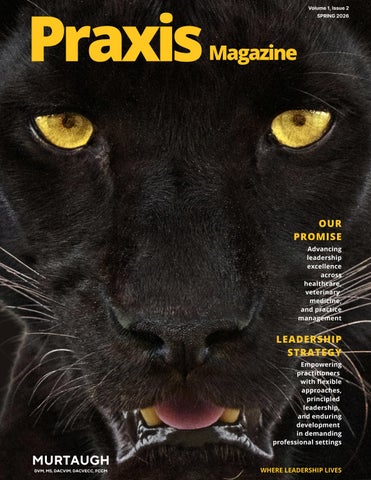
Praxis
Volume 1, Issue 2 SPRING 2026
Magazine
OUR PROMISE Advancing leadership excellence across healthcare, veterinary medicine, and practice management
LEADERSHIP STRATEGY Empowering practitioners with flexible approaches, principled leadership, and enduring development in demanding professional settings
MURTAUGH DVM, MS, DACVIM, DACVECC, FCCM
WHERE LEADERSHIP LIVES
Praxis
F O R H E A LT H C A R E L E A D E R S W H O W R I T E
Magazine
YOUR EXPERTISE HAS A SHELF LIFE IF IT STAYS UNWRITTEN. Praxis Magazine is hunting for bold voices on leadership—and we think yours belongs in our Spring and Summer 2026 issues. We're not looking for fluff. We want the hard-won insights. The lessons that left a mark. The ideas keeping leaders up at night in 2026.
SUBMIT YOUR ARTICLE TODAY
editor@praxisleadership.org
WHERE LEADERSHIP LIVES For Human & Veterinary Healthcare Professionals www.praxisleadership.org
Winter 2025-2026
Praxis Magazine
Contents 05 PUBLISHER’S LETTER 14
14
O8, 26, 35 Leadership Tips
Saying This One Sentence Will Make You a Better Leader Simon Sinek
11 The Uncomfortable Work of Great Leadership: Embracing Courage, Humility, and Ambiguity Apryl Steele, DVM, CAWA
18
Essential Role of Followship Brian Sick, MD, MHA, FACP, FNAP
23 Fracture Healing and Leadership Stacy Anderson, DVM, PhD, DACVS-LA
27
Always Be Learning: Healthcare’s Leadership Imperative
45
Bob Lester, DVM www.praxisleadership.org
Winter 2025-2026
WHERE LEADERSHIP LIVES
29
Facing Your Blind Side Marshall Goldsmith, PhD
32 Delegation: The Multiplier of Leadership
29
David Park, DO, FAAFP, FACOFP dist.
Dr. Marshall Goldsmith the Thinkers50 #1 Executive Coach and New York Times bestselling author
36
Neurologically-Informed Leadership Selection: Rationale, Benefits, and Implementation Strategies Robert Murtaugh, DVM, MS, DACVIM, DACVECC, FCCM
42 The Leaders Bookshelf Good Read Recommendations
43
Breaking Free from Perfection Rachel Teichberg, CVPM, CVBL, CCFB
45 The Danger of Being “A Rebel Leader Without a Cause”: How to Channel Disruption Productively Steven L May, Certified Veterinary Journalist
Praxis Magazine
Letter From
Bob Murtaugh, DVM, MS, DACVIM, DACVECC, FCCM
The Publisher Distinguished Colleagues and Esteemed Readership, It is with considerable gratification and profound appreciation that I acknowledge the extraordinary contributions of our distinguished editorial collaborators and our phenomenally responsive readership. The unprecedented reception to Praxis Magazine has exceeded our most optimistic projections, demonstrating the tremendous necessity for sophisticated, multidisciplinary discourse within contemporary healthcare leadership. Furthermore, I am exceptionally honored to announce the substantial augmentation of our Editorial Advisory Board. These internationally recognized authorities represent quintessential leadership across healthcare administration, medicine, organizational management, and clinical governance: STACY ANDERSON, DVM, PhD, DACVS-LA, Executive Dean, Lincoln Memorial University, Richard A. Gillespie College of Veterinary Medicine, brings unparalleled expertise in institutional leadership. DAVID PARK, DO, FAAFP, FACOFP dist., distinguished dual board-certified family physician, accomplished medical educator, and experienced executive coach, provides nationally recognized leadership expertise in osteopathic medicine and comprehensive leadership development methodologies. BRIAN SICK, MD, MHA, FACP, FNAP, Professor of Internal Medicine and Pediatrics, University of Minnesota; Vice Provost, Academic Health Sciences; Vice Chair, Faculty Affairs and Development, Department of Medicine; Co-Director, Center for Interprofessional Health; Medical Director, Phillips Neighborhood Clinic As this consequential year approaches culmination, we recognize the indispensable imperative of establishing comprehensive visionary frameworks and demonstrating exceptional leadership acumen to strategically navigate 2026 toward optimal patient-centered outcomes. Delivering substantive, measurable improvements in patient care necessitates unwavering dedication, transparent accountability, and meticulously orchestrated strategic planning accompanied by disciplined implementation protocols.
5
2025 Praxis Magazine • Winter 2025-2026
The challenges confronting human and veterinary healthcare organizations require multifaceted solutions addressing financial sustainability, workforce optimization, regulatory compliance, technological integration, and quality improvement initiatives. Through rigorous examination of emerging methodologies, innovative leadership practices, and evidenceinformed strategies, Praxis Magazine serves as an indispensable resource for decision-makers navigating increasingly complex professional landscapes. We remain dedicated to delivering intellectually rigorous, operationally relevant content that empowers our distinguished readership to implement meaningful organizational transformations and achieve exceptional patient care standards. Wishing you and your family Happy Holidays and a Joyous New Year. With profound appreciation and professional distinction,
Bob Murtaugh
Surviving harsh Siberian winters requires remarkable adaptability. Leaders with this quality adjust to changing conditions while maintaining their core purpose.
For the leader you are and the leader you can be. Praxis Magazine • Winter 2025-2026
6
Leadership Tips....
from Expert Leaders
1. Model Lifelong Learning: Leaders set the tone. Teams notice when their leaders actively seek new knowledge. Attend workshops, read current research, and share learnings with your team. 2. Encourage Curiosity: Learning isn't reserved for those at the top. Empower every team member—nurses, technicians, assistants, and receptionists—to explore, question, and innovate. Consider paid continuing education days and professional development allowances. 3. Learn to Unlearn: Sometimes leadership requires letting go of habits, protocols, or assumptions that no longer serve patients or the team. Ask your team: "What practices are holding us back?" 4. Translate Learning to Action: Knowledge alone isn't enough. Redesign workflows, adopt best practices, and improve communication strategies. Learning should result in tangible improvements
"The best leaders aren't those who know the most—they're the ones willing to keep learning." — Bob Lester, DVM Actionable Insights:
1. Seek feedback actively, even when it's uncomfortable. Unsolicited feedback can demonstrate how the world really sees you. 2. Stop, listen, and think about how others perceive you. 3. Compare the self you want to be with the self you present to the world, then work to close the gap between your professed values and actual behavior.
"If we can stop, listen and think about how others see us, we have a great opportunity... to close the gap between our professed values and actual behavior." — Marshall Goldsmith 1. Trust is the currency: Without trust, delegation fails. If you do everything yourself, your impact will always be limited to what you alone can accomplish. 2. Multiplication over perfection: Leadership is not about perfection—it's about multiplication. When you delegate, coach, and empower others, your influence multiplies exponentially. 3. Allow for growth through struggle: When people stumble, resist the urge to swoop in and save the day. Guide them, coach them, and let them recover. Growth requires struggle, and leadership requires patience. 4. Build capacity, not dependence: Insecure leaders cling to control; confident leaders give it away. The ultimate goal of leadership is not to gain followers but to develop other leaders.
"Leadership isn't what you alone can accomplish—it's what you help others become." — David Park, DO 1. "Done is Better Than Perfect": This paradigm shift, technically called satisficing, means working until you hit the minimum acceptable criteria. It decreases stress, prevents decision paralysis, and provides the satisfaction of completing tasks efficiently. 2. Develop Emotional Intelligence: Tune into your thoughts, feelings, and body sensations. Listen to your self-talk—is it kind or critical? Practicing self-compassion counteracts the negative effects of perfectionism. 3. Share the Load: Accept that others may do things differently, and that's okay. Ask yourself: Do I want to accept help and choose happiness, or do everything myself and be resentful? Asking for help will have a major impact on your life and relationships.
"The goal isn't to completely remove your high standards, but to be mindful about when they create stress and self-criticism." — Rachel Teichberg Praxis Magazine • Winter 2025-2026
8
Praxis Magazine Dear Readers and Colleagues, It brings me great pleasure to provide expert leadership strategies and skills for both the veterinary and human healthcare industries. Throughout my career, my experience has illuminated the profound challenges faced across all areas of healthcare—compassion fatigue, communication barriers, and the delicate balance between professional excellence and personal wellbeing. These insights ignited my lifelong commitment to the essential link between human and animal health, now widely recognized as the "One Health Initiative." You may be wondering why Praxis Magazine's theme features wild and exotic animals. The answer lies in our intentional thematic approach: we select animals that embody powerful leadership characteristics. This continuity with our previous issue—featuring the Siberian tiger, the Lion, the Elk, the Lipizzaner (white horse), and others—creates a strong visual identity that reinforces our brand's commitment to exemplary leadership. In this issue, our Praxis Spotlight shines on Dr. Stacy Anderson, who writes about "Fracture Healing and Leadership" - page 23. The image accompanying her article features wild African horses. The African horse embodies leadership through unity, resilience, and vigilance—thriving in herds where collective strength and clear communication ensure survival across the harsh African soil. They remind us that exceptional leaders celebrate individuality within the team while maintaining balance, courage under pressure, and an unwavering protective instinct for those they guide. Dr. Apryl Steele's article - page 11, "The Uncomfortable Work of Great Leadership: Embracing Courage, Humility, and Ambiguity," is reflected by giraffes—magnificent creatures that possess a wide, elevated view of their surroundings. They move with grace and calm confidence, reaching extraordinary heights while remaining firmly grounded. And remarkably, they possess the most powerful hearts in the animal kingdom. These are quintessential leadership qualities we can all aspire to embody. This is an appropriate time to highlight my heartfelt gratitude to David Park, DO, FAAFP, FACPFP dist., Bob Lester, DVM, and Brian Sick, MD, MHA, FACP, FNAP, as well as Robert Murtaugh, DVM, MS, DACVIM, DACVECC, FCCM, for sharing their unique leadership insight and experience. Please find Dr. Park's article, "Delegation: The Multiplier of Leadership" on page 32; Dr. Lester's article, "Leadership Is Lifelong Learning" on page 27; and Dr. Sick's article, "Leadership Is Only Half the Work: The Essential Role of Followership on Interprofessional Healthcare Teams" on page 18. Dr. Murtaugh's article, "Neurologically-Informed Leadership Selection: Rationale, Benefits, and Implementation Strategies," can be found on page 36.
AMERICAN GRAPHIC DESIGN AWARDS
2025 WINNER
9
2025 Praxis Magazine • Winter 2025-2026
Praxis Magazine The landscape of veterinary and human healthcare is continuously evolving, shaped by visionary leaders who combine deep expertise with strategic insight to improve wellness outcomes across both markets. In an industry where innovation, communication, and tailored solutions are paramount, this is the domain where leadership meets leaders, strategy meets empathy, and where informed leadership understands the transformation required when healthcare standards and client relationships are met with genuine compassion. I am honored to collaborate with such a preeminent editorial advisory board and a publisher who exemplifies lifelong leadership experience, Dr. Robert Murtaugh, who serves as both a mentor and trusted friend. As I look ahead to 2025–2026, my focus centers on strengthening leadership in veterinary and human healthcare through education, collaboration, and innovation. My aim is to transform Praxis Magazine from a publication into a comprehensive leadership development platform, guided by our principle: "Where Leadership Lives." Whether you are a veterinarian, medical doctor, nurse practitioner, physician assistant, hold a master's in veterinary clinical care, serve as a veterinary technician, or lead as a practice manager, we warmly invite you to share your leadership experiences with our readers. Your stories inspire, educate, and elevate our collective mission. Wishing you warmth and joy during the holiday season, and a Healthy and Happy New Year. With gratitude and respect, Steven May Editor-in-Chief, Praxis Magazine (Komodo Dragon)
Komodo dragons thrive in diverse environments and can survive on minimal resources. Leaders must adapt to changing circumstances and maximize available opportunities.
For the leader you are and the leader you can be. Praxis Magazine • Winter 2025-2026
10
By Steven L May, CVJ
The Future Has Four Paws – Two Wings and a Pulse By Steven L May, CVJ, VRCE, EMT(ret)
The Seismic Shift in Pet Healthcare Has Arrived In a global pet care market that reached an estimated 380 billion U.S. dollars in 2025 and is projected to climb to 650 billion dollars by 2030 (Mordor Intelligence, 2025), a quiet revolution is underway—one that promises to fundamentally transform the way pet owners access information, the way veterinarians deliver care, and the way veterinary hospitals operate as businesses. That revolution has a name: . Developed by Vertex AI Systems, PetsOpiaAI represents the world’s most comprehensive AI-powered informational database for pet owners, a platform so uniquely designed that it has already generated 15 patentpending applications. Unlike any tool currently available in the veterinary or human healthcare technology landscape, PetsOpiaAI operates at the intersection of artificial intelligence, pet owner education, veterinary clinical support, and stakeholder engagement—creating an ecosystem in which every participant benefits. In this article, I examine in depth the key reasons PetsOpiaAI’s AI model delivers transformative benefits to pet owners, veterinarians, veterinary hospitals, sponsors, and the broader healthcare community. For readers of Praxis Magazine—whether you lead a veterinary practice, manage a human medical office, serve patients and clients, or shape healthcare strategy—the PetsOpiaAI story carries implications that extend well beyond animal care into the future of how all healthcare is delivered, communicated, and experienced.
11 Praxis Magazine • Spring 2026
At the core of PetsOpiaAI’s value proposition is an AI chat model that functions as the most comprehensive pet health informational database ever assembled. The platform consolidates an unprecedented breadth of veterinary medical knowledge—spanning species-specific health conditions, breed-related predispositions, nutritional science, behavioral health, preventive care protocols, emergency guidance, and medication information—into a single, accessible, conversational AI interface. What distinguishes PetsOpiaAI from existing pet health chatbots and general-purpose AI tools is the depth, accuracy, and specificity of its knowledge architecture. The platform was not built by repurposing a generic large language model and adding a pet care layer on top. It was engineered from the ground up as a purpose-built system, designed to understand the unique complexity of veterinary medicine and the nuanced concerns of pet owners. This is precisely why the technology has generated 15 patent-pending applications: its architecture, data integration methodology, consultation workflow, and multi-stakeholder delivery system are fundamentally novel. The AI in pet care market, valued at 4.2 billion dollars in 2024, is projected to reach 15.34 billion dollars by 2035, growing at a compound annual growth rate of 12.5 percent (MetaTech Insights, 2025). Within this rapidly expanding landscape, PetsOpiaAI’s positioning as the most comprehensive informational database gives it a decisive first-mover advantage. While competitors offer narrow tools—a symptom checker here, a breed identifier there—PetsOpiaAI delivers an integrated, holistic experience that mirrors the breadth of a veterinary education compressed into a platform any pet owner can access.
Transformative Benefits for Pet Owners For the estimated one billion pet owners worldwide (Global Pet Parent Study, 2024), the anxiety of not knowing what is wrong with their animal companion is a universal experience. Traditionally, pet owners have faced a fragmented landscape: internet search results of questionable reliability, costly and sometimes inaccessible veterinary consultations, and well-meaning but unscientific advice from social media forums. PetsOpiaAI replaces this fragmentation with a single, authoritative source of AIpowered consultation. The platform’s conversational AI engages pet owners in a structured dialogue, gathering relevant information about their pet’s species, breed, age, symptoms, history, and behavior before generating a comprehensive consultation summary. This summary does not replace veterinary care —it prepares pet owners for it. By the time an owner walks through their veterinarian’s door, they arrive informed, organized, and ready to have a productive clinical conversation.
"PetsOpiaAI does not replace the veterinarian. It empowers the pet owner to become the veterinarian’s most prepared and most engaged client."
Praxis Magazine • Winter 2025-2026
12
One of PetsOpiaAI’s most innovative features is its pet owner consultation summary. Once generated, this summary is automatically and securely transferred to the pet owner’s designated veterinary hospital. This seamless notification ensures that the veterinarian receives a comprehensive overview of the concerns raised during the AI consultation, allowing them to review the details before the owner arrives. The veterinary care team is then equipped to reach out to the pet owner directly, follow up on both the owner’s concerns and the pet’s condition, and provide timely, informed veterinary care.
Consultation Summary
Once your PetsOpiaAI pet owner consultation summary has been generated, it is automatically and securely transferred to your designated veterinary hospital. This seamless notification ensures that your veterinarian receives a comprehensive overview of the concerns you raised during your consultation, allowing them to review the details at the earliest opportunity. With this information in hand, your veterinary care team is equipped to reach out to you directly, follow up on both your wellbeing and that of your pet, and take any next steps they deem appropriate. Because the summary captures the nature and context of your concerns, your veterinarian can arrive at the conversation already informed, enabling more focused and meaningful care from the very first point of contact. It is also recommended that pet owners bring a copy of their PetsOpiaAI consultation summary with them when visiting their veterinarian in person. Having the summary readily available during your appointment serves as a helpful reference point, ensuring that all of your original concerns are thoroughly discussed and nothing is overlooked.
Praxis Magazine • Winter 2025-2026
This consultation summary was generated by PetsOpiaAI. This is an automated AI-assisted consultation and it is not intended and should not replace professional veterinary care. 2026 PetsOpiaAI. All rights reserved.
12
One of PetsOpiaAI’s most innovative features is its pet owner consultation summary. Once generated, this summary is automatically and securely transferred to the pet owner’s designated veterinary hospital. This seamless notification ensures that the veterinarian receives a comprehensive overview of the concerns raised during the AI consultation, allowing them to review the details before the owner arrives. The veterinary care team is then equipped to reach out to the pet owner directly, follow up on both the owner’s concerns and the pet’s condition, and provide timely, informed veterinary care.
Praxis Magazine • Winter 2025-2026
12
At the core of PetsOpiaAI’s value proposition is an AI chat model that functions as the most comprehensive pet health informational database ever assembled. The platform consolidates an unprecedented breadth of veterinary medical knowledge—spanning species-specific health conditions, breed-related predispositions, nutritional science, behavioral health, preventive care protocols, emergency guidance, and medication information—into a single, accessible, conversational AI interface. What distinguishes PetsOpiaAI from existing pet health chatbots and general-purpose AI tools is the depth, accuracy, and specificity of its knowledge architecture. The platform was not built by repurposing a generic large language model and adding a pet care layer on top. It was engineered from the ground up as a purpose-built system, designed to understand the unique complexity of veterinary medicine and the nuanced concerns of pet owners. This is precisely why the technology has generated 15 patent-pending applications: its architecture, data integration methodology, consultation workflow, and multi-stakeholder delivery system are fundamentally novel. The AI in pet care market, valued at 4.2 billion dollars in 2024, is projected to reach 15.34 billion dollars by 2035, growing at a compound annual growth rate of 12.5 percent (MetaTech Insights, 2025). Within this rapidly expanding landscape, PetsOpiaAI’s positioning as the most comprehensive informational database gives it a decisive first-mover advantage. While competitors offer narrow tools—a symptom checker here, a breed identifier there—PetsOpiaAI delivers an integrated, holistic experience that mirrors the breadth of a veterinary education compressed into a platform any pet owner can access.
Transformative Benefits for Pet Owners
Giraffes make powerful symbols of leadership because their exceptional vision allows them to see what others cannot, spotting both opportunities and dangers from afar. Their calm demeanor, quiet strength, and ability to stand tall under pressure reflect the composure and confidence that effective leaders need.
Praxis Magazine • Winter 2025-2026
To contact:
Apryl Steele, DVM, CAWA e. hello@praxisleadership.org
12
About the Author Dr. Steele's journey to leading one of Colorado's most influential animal welfare organizations began with nearly two decades in veterinary private practice and service in the U.S. Army Veterinary Corps during Operation Desert Storm. Her distinguished career includes serving as President of the Colorado Veterinary Medical Association, the Denver Area Veterinary Medical Society, and the American Association of Feline Practitioners - credentials that established her as a respected voice in veterinary medicine and animal welfare long before she joined Humane Colorado.
To contact:
Apryl Steele, DVM, CAWA e. hello@praxisleadership.org
CVMA Distinguished Service Award left, Dr. Pete Hellyer, right, Ralph Johnson, CEO
Hills Pet Nutrition's Shelter, $43 million construction project Food, Love Program, right former Brand Engagement Manager Joann Fuller
Apryl’s wife Kim McKee at the AVMA, LGVMA-PrideVMA booth
13 Praxis Magazine • Winter 2025-2026
Apryl with Colorado Gov. Jared Polis and First Gentleman Marlon Reis
Apryl at the $43 million dollar grand opening shelter the Leslie A. Malone Center
Simon Sinek Saying This One Sentence Will Make You a Better Leader Want to hear a scary statistic? According to one survey*, a shocking 30% of employees feel invisible at work. That’s an entire third of the workforce that feels like they do not matter. And when people don’t feel seen, they stop giving their best. They protect themselves. Trust erodes. Zach Mercurio, celebrated speaker and author with a Ph.D. in organizational leadership, has dedicated his career to understanding the power of purpose and belonging in the workplace. He’s a firm believer that the simplest actions can have the greatest impact on how people feel about their work and themselves. In his course, How to Be a Leader People Actually Trust (And Maybe Even Love), he shares a simple phrase every leader should use to remind their employees of their value... “If it weren’t for you.” These five words—“If it weren’t for you”—hold the key to recognizing the essential contributions of others. In his course, Zach tells the story of a leader at a large bank. It’s not grand gestures. It’s disciplined, human moments. *https://www.workhuman.com/blog/human-workplace-index-the-price-of-invisibility
simonsinek.com Praxis Magazine • Winter 2025-2026
Simon Sinek’s Optimism Company 14
She started a weekly practice of reaching out to someone who had helped her get through the week. Each Friday, she sends a message saying, “If it wasn’t for you, I wouldn’t have made it through the week,” and follows up with why that person made a difference. Specific, personal, timely. Not “good job.” More like, “If it weren’t for you staying late to fix the client file, we would’ve missed the deadline.” Over time, this small gesture has transformed her professional relationships, creating a network of deep trust and mutual appreciation. That’s how a Circle of Safety forms: people feel safe to take risks because they know someone’s got their back. “Think about the times in your life when someone said to you, ‘If it wasn’t for you, I would have never gotten this job,’ or ‘If it wasn’t for you, I would have never been able to get through this,’” Zach says. These moments do more than express gratitude. They highlight the unique value that someone brings into our lives. It’s about showing people that they are not just another cog in the machine; they are essential. Recognition is not transactional. It’s relational. It says, “You matter here.” And here’s the kicker: great leaders don’t wait for reviews or awards to say it. They say it often, in front of others. Peer recognition multiplies the effect because the whole group rises to that standard. Great leaders understand that everyone has a role to play, and they make it a point to ensure that those around them feel needed. Zach encourages saying, “If it weren’t for you, this wouldn’t be possible,” or “If it weren’t for you, today wouldn’t have been as good.” This simple phrase can make the difference between someone feeling invisible and someone feeling seen, valued, and motivated. The impact of these words goes beyond professional settings. “Say it to your friends, your neighbors, your kids, spouse, partner, and the thousands of people you depend on daily in your community to live your life,” Zach says. Recognizing people’s contributions, no matter how small they may seem, is a universal way to build stronger connections. Skills we practice at work follow us home. When we learn to listen and acknowledge, marriages improve, friendships deepen, and families get stronger. In a world where 55% of people feel as though their company only sees them as employees and not people, the phrase “If it weren’t for you” can be a reminder that we all matter. It’s a tool that any leader—or any person —can use to create a culture of gratitude and connection. It’s simple, not easy. It requires presence. It requires noticing. And it pays compounding dividends in trust and performance. Make it practical. This week, send out three notes: “If it weren’t for you…” followed by one concrete behavior and one impact. Do one public shout-out in a meeting. Keep it under 20 seconds and make it specific. Maybe start a Friday ritual: Ask your team, “Who do we want to thank today, and why?” Because when your people feel valued, they’ll choose to give their best—again and again.
simonsinek.com 15 Praxis Magazine • Summer 2025
Simon Sinek’s Optimism Company
“Something small, said with sincerity, can change how someone shows up tomorrow,” says Simon. “Because leadership isn’t about being in charge; it’s about taking care of those in your charge—and ‘If it weren’t for you’ is what that care sounds like.” For more on Zach’s course, visit www.workhuman.com/blog/human-workplace-index-the-price-ofinvisibility. And if you’re a leader asking, “Where do I start?” You can start with someone who helped you this week. Tell them. Today.
Leaders take the risk to trust first.
Reprinted article from simonsinek.com
Praxis Magazine • Winter 2025-2026
16
Simon is a spark that ignites passion and ideas. He envisions a world in which the vast majority of people wake up every single morning inspired, feel safe wherever they are, and end the day fulfilled by the work they do. As an unshakeable optimist, he believes in our ability to build this world together. A trained ethnographer, Simon is fascinated by the people and organizations that make the greatest and longest lasting impact. Over the years, he has discovered some remarkable patterns about how they think, act, and communicate, and also the environments in which people operate at their natural best. Simon may be best known for his TED Talk on the concept of WHY, which has been viewed over 60 million times, and his video on millennials in the workplace—which reached 80 million views in its first week and has gone on to be seen hundreds of millions of times. He continues to share inspiration through his bestselling books, including global bestseller Start with WHY and New York Times bestsellers Leaders Eat Last and The Infinite Game, as well as his podcast, A Bit of Optimism. In addition, Simon is the founder of The Optimism Company, a leadership learning and development company, and he publishes other inspiring thinkers and doers through his publishing partnership with Penguin Random House called Optimism Press. His unconventional and innovative views on business and leadership have attracted international attention, and he has met with a broad array of leaders and organizations in nearly every industry. He frequently works with different branches of the US Armed Forces and agencies of the US government, and is an adjunct staff member with the RAND Corporation—one of the most highly regarded think tanks in the world. Simon is also active in the arts and with not-for-profit work, or what he likes to call the for-impact sector. In 2021, he founded The Curve: a diverse group of forward-thinking chiefs and sheriffs committed to reform modern policing from the inside-out. Their purpose is to build a profession dedicated to protecting the vulnerable from harm while advancing a vision of a world in which all people feel justice is administered with dignity, equity, and fairness.
Reprinted article from simonsinek.com
To learn and find out more, visit simonsinek.com 17 Praxis Magazine • Winter 2025-2026
By Brian Sick, MD, MHA, FACP, FNAP
Leadership is only half the work: The essential role of followship on interprofessional healthcare teams. By Brian Sick, MD, MHA, FACP, FNAP
During their education, many future health professionals hear the phrase, “you are the future leaders of healthcare.” However, when it comes to leading healthcare teams there is more to leadership than leading; it is also knowing when to follow. Clinical work takes place in teams where responsibilities shift moment to moment, and safe patient care requires that every team member be prepared not only to lead but also to effectively and actively follow. Followership, however, remains under-recognized and under-taught despite its foundational role in interprofessional team care.
Why followship matters in healthcare Interprofessional healthcare teams deliver care in a model where each of the team members brings their expertise to the care of the patient. Requiring these highly skilled teams to follow a single predetermined leader based on antiquated concepts of hierarchy and power is counterproductive and unsafe. Instead, team members must share these leadership responsibilities and take charge when their expertise best serves the patient and step back when other’s knowledge is more relevant. In this sense, leadership and followership complement each other and allow for effective collaboration and improved patient outcomes. The quality of the team’s outcomes often results from an effective balance between leadership and followship with the team embracing the concept that all team members are leaders and followers.
Like a cheetah, be swift and decisive when opportunity strikes, while keeping sharp vision to see the big picture ahead. Build strong alliances, mentor others, and adapt constantly to stay a frontrunner in your field. Praxis Magazine • Winter 2025
18
Evolving understanding of followership We need to reframe our thinking of followers. Followers are not those who receive and carry out orders in deference to the leader. Today’s interprofessional teams do not need passive recipients of direction, they need active members of the team capable of moving fluidly between the roles of leader and follower. Whoever has the expertise most relevant to the moment should lead whether this is the nurse, the pharmacist, the physician, or others on the interprofessional team. This dynamic is complicated by scope of practice (e.g., team members who require an order from a physician to evaluate a patient), legal accountability (i.e., leadership is dictated by who is ultimately responsible for the care of the patient), and a long legacy of culture and tradition.
What good followership looks like Across studies, we can see several key components of good followership: Situational awareness: Monitoring the environment and the interprofessional team dynamics to anticipate when transitions in leadership are needed Critical thinking: Asking clarifying questions and offering alternative solutions Initiative: Acting when necessary rather than waiting for explicit direction Courage: Speaking up when safety is at risk even when this means disrupting perceived hierarchies Team orientation: recognizing that an interprofessional team includes leaders and followers all with the same mission in mind
Developing future followers These components require a recognition that followership is a skill that every team members need to develop. Unfortunately, followership is underrepresented in health professions education. Most health professional schools focus on teachings students the skills they need to lead others but not on the skills needed to follow. If followership is essential to clinical interprofessional collaboration, then it must be developed intentionally rather than implicitly within their time on clinical teams. This means health profession schools will need to not only teach the elements of good followership as detailed above but provide opportunities for health professional students to practice these skills in a simulated environment, reflect on their performance on the team, and debrief on their experience to refine their skills for future practice. Beyond these simulated environments, students will also need to see these behaviors modeled within the clinical environment. Seeing a healthcare professional under whom they are training ask, “who is best positioned to lead this team,” would set a powerful example for the fluid roles of leader and follower. Education, practice, and modeling will help to overcome some of the barriers followers face in speaking up such as perceived hierarchies and power discrepancies, fear of being wrong, fear of retribution, and a natural tendency to avoid conflict.
19 Praxis Magazine • Winter 2025-2026
Conclusion To lead well in interprofessional healthcare teams, clinicians must also learn to follow well. Followership is not just subordination to a leader, it is a deliberate, skilled participation in an interprofessional team. As healthcare becomes more complex and interdependent, the future of team-based care becomes less dependent on who holds the title of leader and more dependent on every team member practicing both leadership and followership. To prepare clinicians for their future, health profession schools must reframe followership as a competency equal to leadership; leadership without followership is incomplete. By teaching, practicing, and modeling both leadership and followership, we can create interprofessional teams capable of delivering care that is not only safe, but truly collaborative.
References Alanazi, S., Wiechula, R., & Foley, D. (2023). Followership in health care clinicians: a scoping review. JBI Evidence Synthesis, 21(9), 1764-1793. Barry, E. S., Teunissen, P., Varpio, L., Vietor, R., & Kiger, M. (2023). Leadership and followership dynamics in interprofessional health care teams: attending physician perspectives. Academic Medicine, 10-1097. Barry, E. S., Teunissen, P., & Varpio, L. (2023). Followership in interprofessional healthcare teams: a state-of-the-art narrative review. BMJ leader, 8(2), e000773. Varpio, L., & Teunissen, P. (2021). Leadership in interprofessional healthcare teams: empowering knotworking with followership. Medical teacher, 43(1), 32-37.
Article written by Brian Sick, MD, MHA, FACP, FNAP Professor, Internal Medicine and Pediatrics, University of Minnesota Vice Provost, Academic Health Sciences Vice Chair, Faculty Affairs and Development, Dept of Medicine Co-Director, Center for Interprofessional Health Medical Director, Phillips Neighborhood Clinic
Praxis Magazine • Winter 2025-2026
20
Unlimited Learning. Unstoppable You. VetFolio Subscriptions unlock nonstop access to educational content across every veterinary role and specialty. Mobile learning on your schedule, team plans for practice-wide growth, and new content added weekly.
LISTEN WAT C H
READ
ATTEND
CERTIFY
Subscribe now at VetFolio.com and strengthen your future.
Praxis Magazine
EDITORIAL ADVISORY BOARD
STACY ANDERSON, DVM, PhD, DACVS-LA, Executive Dean, Lincoln Memorial University, Richard A. Gillespie College of Veterinary Medicine
Published by SLM Communications Palm Springs, CA 92262 Editor and Chief Steven L Maibaum, CVJ, VRVC, EMT(ret) Publisher Robert Murtaugh, DVM, MS, DACVIM, DACVECC, FCCM Publication Development Steven May Mark Schwartz
DAVID PARK, DO, FAAFP, FACOFP dist., Dual board-certified family physician
Creative Director Mark Schwartz
BRIAN SICK, MD, MHA, FACP, FNAP, Professor of Internal Medicine and Pediatrics, University of Minnesota
ROBERT MURTAUGH, DVM, MS, DAVCIM, DACVECC, FCCM, Founding Dean, Rocky Vista University, College of Veterinary Medicine
Submissions: If you are interested in writing for Praxis magazine, please contact us at editor@praxisleadership.org. Include your idea, relevant experience and any other information that may help explain your story.
www.praxisleadership.org
"Where Leadership Lives" Articles, stories, advertisers and information in Praxis magazine plus it’s publisher, editors and staff writers (“we,” “us,” or “our”) on any social media platform, website, or websites (the “Site”) and our mobile application is for general informational purposes only. All information in this magazine-publication, Site and our mobile application is provided in good faith; however, we make no representation or warranty of any kind, express or implied, regarding the accuracy, adequacy, validity, reliability, availability, or completeness of any information on the magazine-publication, Site or our mobile application.
Praxis Magazine • Winter 2025-2026
UNDER NO CIRCUMSTANCE SHALL WE HAVE ANY LIABILITY TO YOU FOR ANY LOSS OR DAMAGE OF ANY KIND INCURRED AS A RESULT OF THE USE OF THE PUBLICATION, POST, ARTICLE, OR SITE OR OUR MOBILE APPLICATION OR RELIANCE ON ANY INFORMATION PROVIDED ON THE SITE AND OUR MOBILE APPLICATION. YOUR USE OF ANY POST, ARTICLE, OR SITE AND OUR MOBILE APPLICATION AND YOUR RELIANCE ON ANY INFORMATION ON THE MAGAZINE, POST, ARTICLE, OR SITE AND MOBILE APPLICATION IS SOLELY AT YOUR OWN RISK. All trade and registered marks are protected by their respective associations and companies.
Volume 1, Issue 2 Praxis accepts no responsibility for unsolicited materials. Praxis assumes no responsibility for content or advertisements. Submissions: unsolicited manuscripts will not be returned unless accompanied by a stamped return envelope. 22
By Stacy Anderson, DVM, PhD, DACVS-LA
Fracture Healing and Leadership By Stacy Anderson, DVM, PhD, DACVS-LA
Leadership approaches that mirror biological regeneration processes, showing how healthcare organizations can rebuild, adapt, and strengthen themselves after trauma, burnout, or systemic failures. Just as in biology, leadership of an organization is never perfect. Perfection in either leaders or organizations cannot be the goal; rather functionality - ideally high functionality – should be the target. When failure (i.e., dysfunction) occurs - whether within leadership or elsewhere in the organization – it must prompt honest analysis and purposeful change to prevent recurrence. The analysis must take place both at the level of leadership and the level of the organization. Indeed, in a complex organization a leader may find that they are continuously learning and adapting from failure and dysfunction. There is no such thing as status quo, rather there is the ever-present goal of achieving the status quo or in biological terms, homeostasis. The continual process of adaptation at both the leadership and organization level is similar to how the body adapts to stress or failure. From the organ (i.e., the organization) to the molecular (i.e., the leadership) level, the body continuously adapts to maintain homeostasis (i.e., status quo). Much like how the body adapts to maintain homeostasis, a leader must adapt to maintain status quo or high functionality within their organization. Organizational homeostasis may disrupted purposefully during times of planned change or by chance through unplanned change. Regardless of the cause for disruption in homeostasis, the organization must return to homeostasis at some point or the system will fail.
23 Praxis Magazine • Winter 2025-2026
Take a broken bone as an example of a failure within a body system that disrupts homeostasis. The broken bone could happen due to a defect in the bone, i.e. a pathologic fracture, or from a failure of the person to protect themselves from an accident, i.e., a traumatic fracture. Similarly, leaders and organizations can suffer from similar failures – failure from defective organizational management or leadership or failure from unforeseen circumstances, some type of accident, or unavoidable external force. Regardless of the cause of the fracture, the solution is to heal the bone and resume homeostasis. Similarly, regardless of the cause of organizational dysfunction, a leader’s goal needs to be to return the organization back to homeostasis through sound strategy and adaptive leadership. A broken bone prevents the body from functioning properly, very much like failure or dysfunction within an organization prevents the organization from functioning properly. It is striking how similar the process of healing a broken bone can be to overcoming organizational failures and dysfunction. Let’s break it down (pun intended). The first thing that happens when a bone fractures is the formation of a clot that ultimately forms the scaffold for subsequent healing. Similarly, when a problem occurs in an organization, there is a first response that includes an assessment of the problem. The quality of that response and accuracy of the assessment of the problem sets the stage for how the organization subsequently “heals” or overcomes the problem. The leader of the organization is the “clot” in this scenario – holding the organization together during this time of deviation from homeostasis. Next, signaling proteins within the clot direct the cells to form a fibrous callus. The fibrous callus is designed to stabilize the fracture so that new bone may be formed over it to restore the function of the bone. The analogous step in overcoming a problem in an organization is through the leader creating a response plan, or plan of action, to overcome the problem. A good response plan needs to address how the organization will function as it overcomes the problem along with how to ultimately solve the problem. As the fibrous callus is replaced with osseous (bone) callus, the fracture stabilizes and the bone slowly regains function. At the organizational level, an action plan that allows the organization to solve the problem results in stabilization and the beginnings of the return to homeostasis. Finally, the new bone is remodeled to adapt to the stress and strain placed on the bone to resume normal function, i.e., homeostasis. In much the same way, once a plan is in place, it requires review and revision to maintain effectiveness in bringing the organization back to full function and status quo. In the end, an organization that is able to overcome major problems and challenges becomes resilient and stronger, allowing it to respond effectively to even more complex and higher-level problems in the future. The better an organization is able to adapt and regenerate from stress and trauma the more successful it will be. Finally, like a bone the organization should continue to adapt and re-model based on the stress and strain it experiences over time.
Praxis Magazine • Winter 2025-2026
24
Praxis Spotlight
“Dr. Anderson is an avid dressage rider and continues to be involved with the United States Pony Club as a National Examiner. She lives on a small horse farm with her husband, daughter, and a plethora of animals, including a clowder of cats.”
Dr. Stacy Anderson graduated from Iowa State University’s College of Veterinary Medicine with honors in 2004, completed two equine/large animal internships at Kendall Road Equine Hospital and the University of Tennessee. She completed a large animal surgical residency and Master of Veterinary Science at the Western College of Veterinary Medicine at the University of Saskatchewan. Following her residency, Anderson remained at WCVM to complete a PhD. Dr. Anderson joined Lincoln Memorial University-College of Veterinary Medicine in 2015. In 2016, she was promoted to Director of Large Animal Clinical Skills at LMU-CVM. In August of 2019, Anderson was named interim Associate Dean of Academic Affairs; and in March of 2020, the position was made permanent. In August of 2020, Dr. Anderson was appointed Dean of LMU-CVM. In 2023, Anderson was promoted to Executive Dean as veterinaryrelated undergraduate programs were moved under the College of Veterinary Medicine, resulting in it having the second highest enrollment of all LMU colleges. During 2023-2025, she was instrumental in developing the new DVM program at Orange Park, Florida.
Emmet Roche for Lisa Michelle Photography
Article written by
Stacy Anderson, DVM, PhD, DACVS-LA Executive Dean, Lincoln Memorial University, Richard A. Gillespie College of Veterinary Medicine
25 Praxis Magazine • Winter 2025-2026
Leadership Tips....
from Expert Leaders
1. Know Your Triggers: When something provokes a strong reaction, ask: Am I responding to what's happening now, or to something I'm carrying from before? Developing this awareness enables leaders to respond with intention rather than impulse. 2. Practice Humility: Humility is not self-doubt—it's self-awareness. It's recognizing that our lived experiences shape our perspectives and that our understanding is always incomplete. Leaders who practice humility listen deeply, learn continuously, and empower others to contribute fully. 3. Embrace Ambiguity: Leaders rarely have the luxury of certainty. The best leaders accept ambiguity as a constant companion and move forward with clarity of purpose. They don't wait for perfect information— they make the best call possible, grounded in values and guided by experience. 4. Have Interpersonal Courage: Don't sugar-coat feedback. The CSAW Framework makes feedback effective: explain the problematic behavior, describe how it impacts work, specify exactly what needs to change, when it must happen, and the consequences of not meeting expectations.
"There is no greater reward than watching the people you lead truly thrive." — Apryl Steele, DVM 1. Situational awareness: Monitor the environment and team dynamics to anticipate when transitions in leadership are needed. 2. Critical thinking: Ask clarifying questions and offer alternative solutions. 3. Initiative: Act when necessary rather than waiting for explicit direction. 4. Courage: Speak up when safety is at risk, even when it means disrupting perceived hierarchies. 5. Team orientation: Recognize that an interprofessional team includes leaders and followers all with the same mission in mind.
"Leadership without followership is incomplete." — Brian Sick, MD Just as the body heals a broken bone, organizations must heal from trauma, burnout, or systemic failures. The goal isn't perfection—it's high functionality and the ability to return to homeostasis after disruption. When a problem occurs, the leader is like the blood clot that forms first—holding the organization together during deviation from normal function. A good response plan is like the fibrous callus that stabilizes a fracture: it addresses both how to function while overcoming the problem and how to ultimately solve it. Organizations that successfully overcome major challenges become resilient and stronger, able to respond to even more complex problems in the future.
"The better an organization is able to adapt and regenerate from stress and trauma, the more successful it will be." — Stacy Anderson, DVM How to Use This Phrase "If it weren't for you.":
1. Be specific and personal: Not "good job" but "If it weren't for you staying late to fix the client file, we would've missed the deadline." 2. Say it in front of others: Peer recognition multiplies the effect because the whole group rises to that standard. 3. Make it a ritual: Each Friday, reach out to someone who helped you through the week. Send three notes this week with one concrete behavior and one impact. 4. Extend it beyond work: Say it to friends, neighbors, family, and the people you depend on daily. Recognition builds stronger connections everywhere.
"Leadership isn't about being in charge; it's about taking care of those in your charge." — Simon Sinek Praxis Magazine • Winter 2025-2026
26
By Bob Lester, DVM
Always Be Learning: Healthcare’s Leadership Imperative By Bob Lester, DVM
In healthcare, change is constant. New research, emerging technologies, evolving patient/client expectations, and shifting team dynamics make yesterday’s knowledge potentially outdated today. In fact, the half-life of medical knowledge —the time it takes for half of a given body of medical information to become outdated —is estimated to be about 73 days. Leaders who cling to old methods risk not only stagnation but burnout among their teams. The solution? Lifelong learning – not just for personal and professional growth, but as a guiding principle for the organizations that we lead.
Guiding Principles 1. Model Lifelong Learning Leaders set the tone; we provide the example. Teams notice when their leaders actively seek out new knowledge. If your team sees you engaging in new courses, reading current research, and investigating new and innovative approaches, they’re more likely to adopt the same mindset. For example: A practice leader attends a workshop on a new procedure or treatment and then shares their learnings at the next team meeting. The Eagle commands attention with effortless grace, inspiring others to follow through presence alone. A true leader captivates their team not by demanding loyalty, but by earning admiration through vision and poise. 27 Praxis Magazine • Winter 2025-2026
2. Encourage Curiosity Learning isn’t reserved for those at the “top.” Every team member - nurses, technicians, assistants, interns, and receptionists should all be empowered to explore, question, and innovate. This includes paid days for continuing education and professional development allowances for all team members. Pro Tip: Hold monthly “learning lunches” where staff share clinical insights, process improvements, or case studies. 3. Learn to Unlearn Sometimes leadership requires letting go of habits, protocols, or assumptions that no longer serve patients or the team. This is often harder than learning something new because it challenges comfort and identity. Pro tip: Provocative questions for your team, such as “What practices are holding us back?” help teams replace outdated methods with new and better ways of working. 4. From Learning to Leadership Knowledge alone isn’t enough. Leaders must translate new insights into action. Whether it’s redesigning workflows, adopting best practices, or improving communication strategies, learning should result in tangible improvements. The goal: To foster a culture of learning where better decisions, stronger teams, and improved outcomes are the result. When leaders embrace and encourage lifelong learning in all aspects of decision-making, the entire organization becomes more agile, resilient, and effective.
The Takeaway As healthcare leaders, we must always be learning. By committing to continuous learning, modeling curiosity, and unlearning outmoded practices, leaders create engaged, adaptive teams, ready to thrive in a world of constant change. Remember: the best leaders aren’t those who know the most – they’re the ones willing to keep learning.
“The best leaders are the best students. Leadership is not just about sharing what you know, it’s also about sharing what you don’t know, so that together you can grow.” - Simon Sinek
Article written by
Bob Lester, DVM Co-founder and Chief Medical Officer WellHaven Pet Hospitals, Past President NAVC
2025 Praxis Magazine • Winter 2025-2026
11 28
Marshall
Goldsmith
Facing Your Blind Side Dr. Marshall Goldsmith is the Thinkers50 #1 Executive Coach and New York Times bestselling author of The Earned Life, Triggers, and What Got You Here Won’t Get You There.
If we’re lucky, every once in a while, something or someone comes along and unexpectedly opens our eyes to our faults and helps us strip away a delusion or two about ourselves. It doesn’t happen often, and it can be tough to take initially. But when it does occur, we should consider ourselves lucky. Psychologists have all sorts of schemata to explain us to ourselves. One of the more interesting ones is the Johari Window, a four-pane grid that divides self-awareness into what is known and unknown about us to other people and what is known and unknown about us to ourselves. (Despite the exotic-sounding title, the Johari Window is actually named for two real characters, Joe and Harry.) According to this arrangement, the things that others know about us are public knowledge. The things we know and they don’t are private knowledge. What neither they nor we are aware of is, well, unknowable, and therefore not something we can really address. For someone like me, the most interesting quadrant in this four-part diagram is the stuff others know about us that we don’t know about ourselves. The reason I find it so fascinating is that revealing these blind spots to us often produces moments of insight that can lead to tremendous personal growth. I’ve had my share of these revelations, but the most significant came when I was a 28-year-old doctoral candidate at the University of California, Los Angeles. Back then, in the late-1960s era of free love and Woodstock, I thought of myself as being a little more insightful – hip, even – than the other people around me. I believed myself to be intensely involved in things such as self-actualization and uncovering profound meanings in life. At the time, I was a student in a small class led by a very wise and worldly teacher, Dr. Bob Tannenbaum, who was revered at UCLA and in psychology circles the world over. He invented the term “sensitivity training” and had published the most influential papers on the subject. He was a god to me. 29
www.marshallgoldsmith.com
In Tannenbaum’s class, we were encouraged to discuss whatever we wanted. I took this freedom as a license to rail against the shallow, materialistic residents of Los Angeles. For three weeks, I delivered rants about how screwed up they all were. “All they care about is impressing others,” I said. “They don’t understand what is deep and important in life.” After enduring this babble for some time, Tannenbaum asked, “Marshall, who are you talking to?” “I am talking to everybody in the group,” I said, unsure of where he was going with this line of questioning. “I don’t know if you realize this, but each time you have spoken, you have addressed just one person and seem interested solely in that person’s opinion. Who is that person?” After a few moments of careful consideration, I replied, “You.” “That’s right – me,” he said. “There are 12 other people in this room. Why aren’t you interested in any of them?” Having dug myself into a hole, I decided to dig even further. “Dr. Tannenbaum, I think you can understand the true significance of what I’m saying,” I said. “I think you understand how screwed up it is to try to impress people all the time. I believe you have a deeper understanding of what’s really important in life.” “Marshall, is there any chance that for the past three weeks, all you’ve been trying to do is impress me?” I was stunned by this obvious lack of insight. “Not at all! You haven’t understood one thing I’ve said! You’ve totally missed my point and, frankly, I’m disappointed by your lack of understanding,” I said.
He stared at me for a few seconds, scratched his beard and said, “No, I think I understand.” I then looked around and saw 12 people who were clearly thinking, “Yes, we understand too.” I still shudder with shame at the memory of my childish outlook back then. But I needed this painful, unsolicited feedback to demonstrate how the world really saw me and make changes for the better. If we can stop, listen and think about how others see us, we have a great opportunity. We can compare the self we want to be with the self we present to the world, and then we can work to close the gap between our professed values and actual behavior. Although he is no longer with us, I still say, “Thank you, Dr. Tannenbaum.”
Praxis Magazine • Winter 2025- 2026
www.marshallgoldsmith.com
30
Dr. Marshall Goldsmith is the Thinkers50 #1 Executive Coach and New York Times bestselling author of The Earned Life, Triggers, and What Got You Here Won’t Get You There.
31 Praxis Magazine • Summer 2025
www.marshallgoldsmith.com
By David Park, DO, FAAFP, FACOFP dist.
Delegation: The Multiplier of Leadership By David Park, DO, FAAFP, FACOFP dist. is a dual board-certified family physician, medical educator, and executive coach. He is a nationally recognized leader in osteopathic medicine and leadership development.
In leadership, there's a natural urge to do it all by managing every project, making every decision, and fixing every problem. Delegation is not the act of handing off work; it is the art of developing people. It’s the process of entrusting responsibility and authority to another person while retaining accountability for the outcome. When done purposefully, delegation multiplies your effectiveness and grows the leaders around you.
Delegation as Empowerment Delegation is not about dumping tasks you dislike or avoiding accountability. That is not leadership, that is avoidance. True delegation is an act of trust and empowerment. It communicates, “I believe in you. I see your potential. You’ve got this.” When leaders delegate meaningfully, they share power, not just workload. They provide clarity about goals, expectations, and timelines. Then they step back. They give people the freedom to think, decide, and lead. This freedom breeds ownership, confidence, and creativity. People don’t rise because they’re told what to do; they rise because someone trusts them enough to lead. The lion embodies decisive authority and protective strength, rather than aggression while fiercely defending those in its care. Its blend of patience, strategic thinking, and willingness to lead from the front inspires loyalty and trust within the pride. Praxis Magazine • Winter 2025-2026
32
The Power of Purposeful Delegation When the new Montana campus was completed, we wanted to celebrate it with the community. The Billings community had followed the construction of the new medical school with pride and excitement for nearly two years. The plan was bold: a large-scale open house welcoming healthcare leaders, civic officials, future students, and neighbors from across the city. It was the kind of event that demanded significant coordination and strong leadership. In my younger years, I would have taken ownership of a project like this managing the details myself to ensure success. But leadership had taught me that growth doesn’t come from control; it comes from trust. So, I decided to delegate. Rebecca, a relatively new and capable member of my leadership team, had shown diligence and ambition. During an early planning meeting, I asked, “Have you ever led something like this before?” She smiled nervously. “No… not this big.” “Would you like to? Because I believe you can.” Her face lit up. “Yes,” she said. “Then it’s yours,” I told her. “Build your team, make the calls, coordinate the details. You don’t need to run everything by me, just keep me updated.” From that moment, something shifted. She owned it. Rebecca built her team, made decisions, and navigated challenges with growing confidence. I stayed available but out of her way. When the big day arrived, the turnout was four times larger than expected. The event ran seamlessly, and the energy was electric. Yet the real success wasn’t the event—it was Rebecca. She didn’t just complete a project; she became a leader. That’s the power of purposeful delegation. It doesn’t just get a task completed; it transforms people. Leaders rise when someone believes in them enough to say, “I trust you. Now go lead.”
33 Praxis Magazine • Winter 2025-2026
Delegation and Trust Trust is the currency of delegation. Without it, delegation fails. Many leaders hesitate to let go because they fear mistakes will reflect poorly on them. But leadership is not about perfection, it’s about multiplication. If you do everything yourself, your impact will always be limited to what you alone can accomplish. If you delegate, coach, and empower others, your influence multiplies exponentially. When leaders trust their teams, it’s often reciprocated. People rise to meet expectations. They learn, they stretch, and sometimes they stumble. When that happens, resist the urge to swoop in and save the day. Guide them, coach them, and let them recover. Growth requires struggle, and leadership requires patience.
Delegation Is a Leadership Test Delegation exposes the heart of leadership. Insecure leaders cling to control; confident leaders give it away. Insecure leaders build dependence; confident leaders build capacity. The ultimate goal of leadership is not to gain followers but to develop other leaders. So, as you lead in clinics, hospitals, or classrooms, ask yourself: “What am I still holding onto that someone else is ready to own?” “What can I entrust to another person not just to get it done, but to help them grow?” Every act of delegation is an opportunity to build trust, to inspire confidence, and to multiply leadership. Done with clarity and compassion, delegation becomes one of the most powerful tools in your leadership toolbox. Leadership isn’t what you alone can accomplish, it’s what you help others become.
David Park, DO, FAAFP, FACOFP dist. is a dual board-certified family physician, medical educator, and executive coach. He is a nationally recognized leader in osteopathic medicine and leadership development. Dr. Park served as the 2023-2024 national president of the American College of Osteopathic Family Physicians and the
Praxis Magazine • Winter 2025-2026
former founding dean of Rocky Vista University – Montana College of Osteopathic Medicine. His mission is to cultivate leaders by inspiring purpose, building confidence, developing action-oriented leadership skills, and leaving behind a legacy of leadership. 34
Leadership Tips....
from Expert Leaders
Five Tips for Purposeful Change Leadership:
1. Define Your Why Before Your What: Connect concerns to concrete business outcomes. Document specific examples and quantify impact. Ensure your challenge serves a purpose beyond personal frustration. 2. Propose Solutions, Not Just Problems: For every issue you raise, prepare at least one viable alternative with detailed implementation plans. This demonstrates commitment to improvement rather than mere criticism. 3. Build Coalitions Through Data, Not Drama: Replace emotional appeals with evidence-based arguments. A smaller group united by data accomplishes more than a large group united only by discontent. 4. Understand the System First: Investigate why current processes exist before advocating for elimination. This prevents proposing changes that have already been tried and failed. 5. Measure and Communicate Success: Start with small, manageable changes that demonstrate value quickly. Document improvements and share results to build credibility and momentum.
"The goal isn't to stop challenging the status quo, but to ensure your challenges lead somewhere meaningful." — Steven L May, CVJ
Five Neuroscience-Based Interview Strategies:
1. Implement Pre-Interview Evaluation Matrices: Before reviewing any candidate materials, establish quantifiable metrics across core competencies. This pre-commitment strategy activates executive control systems, establishing top-down regulation over limbic reward responses that generate confirmation bias. 2. Use Behavioral Scenario Questions: Request detailed narratives of past leadership challenges rather than hypothetical responses. This activates the interviewer's mirror neuron system, enabling neural simulation of the candidate's actual leadership approach. 3. Delay Final Decisions 24-48 Hours: Avoid immediate post-interview decisions when dopaminergic reward systems are maximally activated. This delay allows prefrontal cognitive control systems to reassert regulatory influence over reward-driven preferences. 4. Conduct Panel Interviews: Include multiple interviewers with different professional backgrounds. Aggregating diverse neural evaluations reduces idiosyncratic bias while preserving the collective wisdom of embodied assessment. 5. Trust Informed Intuition: Somatic markers—embodied physiological signals—reflect the brain's holistic evaluation across dimensions too complex for explicit analysis. Don't dismiss gut feelings, but integrate them with structured analytical evaluation.
"Effective healthcare leadership requires more than clinical expertise—it demands self-awareness, strategic thinking, and the ability to channel both intuition and analysis." — Robert Murtaugh, DVM
35 Praxis Magazine • Winter 2025-2026
By Bob Murtaugh, DVM, MS, DACVIM, DACVECC, FCCM
Neurologically-Informed Leadership Selection: Rationale, Benefits, and Implementation Strategies By Robert Murtaugh, DVM, MS, DACVIM, DACVECC, FCCM
Neurologically-informed strategies acknowledge that optimal hiring decisions emerge from the sophisticated integration of analytical and intuitive processes rather than their opposition. By understanding the specific neural mechanisms underlying candidate evaluation, practice owners and leaders can design interview protocols that leverage the evaluative power of distributed brain systems while implementing structural safeguards against systematic cognitive bias. The recruitment of executive leadership represents a complex neurocognitive process involving multiple cortical and subcortical structures (Lieberman, 2007). This analysis examines the neurological pathways and processes underlying leadership selection in veterinary and medical practice, delineating the specific neural mechanisms that influence candidate evaluation and selection decision-making.
Like an elephant, lead with wisdom and memory, guiding others through challenges while never leaving anyone behind. Show strength through patience and protection, and keep your team connected through clear communication. Praxis Magazine • Winter 2025-2026
36
Neurologically-Informed Leadership Selection: Rationale, Benefits, and Implementation Strategies Understanding the neurological mechanisms underlying leadership selection provides veterinary practice owners with significant strategic advantages that traditional hiring approaches fail to capture. Neurologicallyinformed hiring recognizes that optimal candidate evaluation emerges from the sophisticated integration of multiple brain systems rather than reliance on conscious reasoning alone, enabling practitioners to harness the full evaluative capacity of human neurocognition while implementing structural safeguards against systematic cognitive bias. The amygdala processes emotional information and forms implicit preferences within 200 milliseconds of encountering candidate information, long before conscious awareness occurs (Olofsson et al., 2008), which means that unexamined hiring processes inevitably incorporate unconscious biases that may systematically disadvantage qualified candidates or favor superficially appealing but ultimately unsuitable individuals. By explicitly acknowledging these rapid limbic responses and implementing pre-commitment evaluation structures that engage dorsolateral prefrontal cortex executive control systems, practice owners can regulate emotional biases while preserving the valuable pattern recognition capabilities that experienced professionals have developed through years of clinical practice (Hare et al., 2009). The mirror neuron system in the inferior frontal gyrus and inferior parietal lobule enables interviewers to neurally simulate a candidate's actual leadership approach when candidates describe past behavioral experiences in detail (Rizzolatti & Craighero, 2004), providing embodied assessment of leadership competence that surpasses the predictive validity of hypothetical scenario responses or credential evaluation alone. Traditional interviews that focus on hypothetical questions or resume review fail to activate these crucial neural simulation networks, resulting in hiring decisions based on verbal fluency and self-presentation skills rather than genuine leadership capability. Neurologically-informed behavioral interviewing that elicits detailed narratives of past challenges enables the interviewer's brain to internally model the candidate's decisionmaking processes, emotional regulation strategies, and interpersonal dynamics, generating predictive information about future performance that cannot be captured through conventional assessment methods (Gallese et al., 1996). This neural simulation approach proves particularly valuable in veterinary practice contexts where leaders must navigate complex interpersonal dynamics with diverse stakeholders including clinical staff, support personnel, anxious pet owners, and external business partners. Somatic markers generated by the ventromedial prefrontal cortex integrate information from distributed neural networks including visual processing of nonverbal communication, temporal lobe analysis of vocal prosody, and limbic system assessment of emotional authenticity (Damasio, 1994; Bechara et al., 1997), creating embodied physiological signals that reflect the brain's holistic evaluation of candidate compatibility across dimensions too complex for explicit analysis. Practice owners who attend to these interoceptive signals during extended candidate interactions access neural computations that incorporate thousands of subtle observations processed below conscious awareness, including microexpressions revealing emotional genuineness, vocal patterns indicating stress tolerance, and behavioral consistency suggesting psychological integration. Traditional hiring frameworks that dismiss gut feelings as irrational intuition ignore neuroscientific evidence demonstrating that somatic markers represent sophisticated neural integration rather than arbitrary emotional noise, potentially discarding the most informationally rich component of candidate assessment (Critchley et al., 2004). However, somatic marker hypothesis also reveals that these embodied responses can incorporate historical biases and inappropriate generalizations, necessitating their integration with structured analytical evaluation rather than exclusive reliance on intuitive assessment.
37 Praxis Magazine • Winter 2025-2026
Neurologically-informed hiring acknowledges that mesolimbic dopaminergic pathways create anticipatory reward responses and positive prediction errors when evaluating preferred candidates (Schultz, 2015), generating motivated reasoning patterns wherein the reward system selectively amplifies confirming evidence while minimizing disconfirming information (Kunda, 1990). This neurochemical bias proves particularly problematic when practice owners develop early preferences based on superficial candidate similarities to admired mentors or successful previous hires, as the dopamine system then reinforces these initial impressions through biased information processing during subsequent evaluation stages. By implementing mandatory decision delays of 24-48 hours post-interview and requiring systematic review of structured evaluation criteria, practice owners allow prefrontal cognitive control networks to reassert regulatory influence over reward-driven preference formation, substantially reducing the likelihood of hiring decisions driven by neurochemical reinforcement rather than objective candidate suitability. Research demonstrates that this temporal separation between evaluation and decision significantly improves hiring outcomes by preventing the immediacy bias wherein dopaminergic reward signals exert maximal influence over choice behavior (Hare et al., 2009). The neurological approach to leadership selection generates superior hiring outcomes because it leverages rather than suppresses the evaluative sophistication of evolved neural systems while simultaneously implementing evidence-based safeguards against their systematic vulnerabilities. Human brains possess remarkable capabilities for assessing social compatibility, detecting authenticity, and predicting interpersonal dynamics through mechanisms refined across millions of years of evolutionary selection pressure (Lieberman, 2007), yet these same systems incorporate biases optimized for ancestral rather than modern organizational contexts. Practice owners who understand both the strengths and limitations of their neurocognitive architecture can design hiring protocols that capture the pattern recognition power of prefrontal schema matching, the social simulation capabilities of mirror neuron systems, and the integrative assessment capacity of somatic marker generation, while constraining amygdala-driven implicit biases, dopamine-mediated motivated reasoning, and other forms of systematic error that compromise traditional hiring approaches. The result proves simultaneously more intuitive and more rigorous than conventional methods, acknowledging that optimal decisions emerge from the orchestrated function of multiple specialized neural systems rather than either pure rationality or pure intuition alone. Ultimately, neurologically-informed leadership selection provides veterinary practice owners with a comprehensive framework for understanding why certain candidates feel right or wrong, enabling more sophisticated interrogation of these intuitions rather than either blind acceptance or reflexive dismissal. This approach recognizes hiring as fundamentally a prediction problem wherein practice owners must forecast candidate performance across complex, dynamic situations that cannot be fully specified in advance, making the brain's distributed pattern recognition systems invaluable for capturing subtle indicators that structured interviews and psychometric assessments inevitably miss. By understanding the specific neural mechanisms generating evaluative responses during candidate assessment, practice owners transform opaque gut feelings into analyzable data streams that can be systematically compared across candidates, integrated with objective performance metrics, and refined through outcome tracking that links hiring decisions to actual leadership effectiveness. This neurological sophistication substantially increases the probability of identifying leaders whose capabilities, values, and interpersonal styles align with practice culture and strategic objectives, generating long-term organizational benefits that far exceed the modest investment required to implement neuroscientifically-informed hiring protocols.
Praxis Magazine • Winter 2025-2026
38
Prefrontal Cortex Activation and Pattern Recognition Initial candidate screening activated the dorsolateral prefrontal cortex, responsible for working memory and executive function (Miller & Cohen, 2001). Neuroimaging studies demonstrate that evaluation of professional credentials engages Brodmann areas 9 and 46, facilitating comparison of novel information against stored occupational schemas (Petrides, 2005). This recruitment process specifically activated neural networks associated with veterinary leadership competencies: clinical decision-making under uncertainty, client communication protocols, and staff management hierarchies. Concurrent amygdala activation introduced implicit emotional valence to candidate assessment (Phelps & LeDoux, 2005). The basolateral amygdala complex, interconnected with hippocampal memory systems, generated automatic affective responses based on similarity matching with previous professional relationships. This limbic tagging occurred approximately 200 milliseconds before conscious awareness, as documented in event-related potential studies (Olofsson et al., 2008), potentially introducing systematic bias into ostensibly objective evaluation criteria.
Mirror Neuron System and Social Cognition Interview protocols engaged the mirror neuron system, particularly in the inferior frontal gyrus and inferior parietal lobule (Rizzolatti & Craighero, 2004). These neurons demonstrate action-observation matching properties, firing identically during both execution and observation of goal-directed behavior (Gallese et al., 1996). Candidate descriptions of crisis management scenarios activated motor simulation networks, enabling neural modeling of their leadership approach without direct observation of actual performance. The selected candidate exhibited characteristics that induced interpersonal neural synchrony, measured through coordinated activation patterns in emotional processing regions (Stephens et al., 2010). Functional connectivity analysis would likely reveal coherent oscillatory activity between the observer's and candidate's anterior cingulate cortex and insular cortex during emotional discourse (Hasson et al., 2012). This neural resonance, termed interpersonal coherence in social neuroscience literature, predicted collaborative compatibility independent of verbal content analysis.
Dopaminergic Reward Circuitry and Decision Bias Progression toward final candidate selection activated mesolimbic dopaminergic pathways, specifically ventral tegmental area projections to nucleus accumbens and ventromedial prefrontal cortex (Schultz, 2015). Mental simulation of the preferred candidate's tenure produced anticipatory reward signals, generating positive prediction errors that reinforced candidate preference through iterative evaluation cycles (Montague et al., 1996). This neurochemical reinforcement created motivated reasoning patterns, whereby the reward system's valuation influenced information processing in lateral prefrontal regions responsible for rational analysis (Kunda, 1990). Mitigation of dopamine-driven bias required deliberate recruitment of cognitive control networks (MacDonald et al., 2000). Implementation of structured evaluation matrices before candidate review engaged the dorsolateral prefrontal cortex, establishing top-down regulation over ventral striatal reward responses (Hare et al., 2009). This pre-commitment strategy reduced confirmation bias by constraining the degrees of freedom in subjective interpretation, forcing uniform application of predetermined leadership competency metrics across all candidates.
39 Praxis Magazine • Winter 2025-2026
Five Neurologically-Informed Interview Strategies Based on the neurological mechanisms identified in this analysis, the following five active strategies can optimize leadership candidate evaluation by leveraging specific neural systems while mitigating cognitive bias:
1
Implement Pre-Interview Structured Evaluation Matrices. Before reviewing any candidate materials, establish quantifiable metrics across core competencies (clinical expertise, staff management, financial acumen, communication skills, crisis response). This pre-commitment strategy activates dorsolateral prefrontal cortex executive control systems, establishing top-down regulation over limbic reward responses that would otherwise generate confirmation bias (Hare et al., 2009). Score each candidate identically across predetermined criteria to constrain subjective interpretation and reduce amygdaladriven implicit preference formation.
2
Employ Behavioral Scenario Questions for Mirror Neuron Activation. Request detailed narratives of past leadership challenges rather than hypothetical responses. Ask candidates to describe specific crisis situations, staff conflicts, or ethical dilemmas they have navigated, including their thought processes, emotional responses, and decision-making sequences. This activates the interviewer's mirror neuron system in the inferior frontal gyrus and inferior parietal lobule (Rizzolatti & Craighero, 2004), enabling neural simulation of the candidate's actual leadership approach. Observe for authentic emotional congruence between verbal content and nonverbal expression, which facilitates interpersonal neural synchrony assessment (Stephens et al., 2010).
3
Delay Final Decision 24-48 Hours Post-Interview. Avoid immediate post-interview decisions when dopaminergic reward systems are maximally activated. The mesolimbic pathway generates anticipatory reward signals and positive prediction errors during candidate evaluation (Schultz, 2015), creating motivated reasoning that selectively amplifies confirming evidence. Implementing a mandatory delay allows prefrontal cognitive control systems to reassert regulatory influence over ventral striatal reward responses. During this period, systematically review structured evaluation scores and actively search for disconfirming evidence regarding preferred candidates to counteract confirmation bias.
4
Delay Final Decision 24-48 Hours Post-Interview. Avoid immediate post-interview decisions when dopaminergic reward systems are maximally activated. The mesolimbic pathway generates anticipatory reward signals and positive prediction errors during candidate evaluation (Schultz, 2015), creating motivated reasoning that selectively amplifies confirming evidence. Implementing a mandatory delay allows prefrontal cognitive control systems to reassert regulatory influence over ventral striatal reward responses. During this period, systematically review structured evaluation scores and actively search for disconfirming evidence regarding preferred candidates to counteract confirmation bias.
5
Conduct Panel Interviews with Diverse Neural Perspectives. Include multiple interviewers with different professional backgrounds, personality profiles, and demographic characteristics. Individual evaluators possess unique pattern recognition schemas stored in their prefrontal cortex based on personal experience, potentially creating systematic blind spots (Miller & Cohen, 2001). Additionally, different evaluators will generate varying amygdala-mediated emotional responses and somatic markers to the same candidate. Aggregating these diverse neural evaluations reduces idiosyncratic bias while preserving the collective wisdom of embodied assessment. Require independent scoring before group discussion to prevent anchoring effects and groupthink.
Praxis Magazine • Winter 2025-2026
40
These neurologically-informed strategies acknowledge that optimal hiring decisions emerge from the sophisticated integration of analytical and intuitive processes rather than their opposition. By understanding the specific neural mechanisms underlying candidate evaluation, practice owners can design interview protocols that leverage the evaluative power of distributed brain systems while implementing structural safeguards against systematic cognitive bias.
References 1.Allison, T., Puce, A., & McCarthy, G. (2000). Social perception from visual cues: Role of the STS region. Trends in Cognitive Sciences, 4(7), 267-278. 2.Barsalou, L. W. (2008). Grounded cognition. Annual Review of Psychology, 59, 617-645. 3.Bechara, A., Damasio, H., Tranel, D., & Damasio, A. R. (1997). Deciding advantageously before knowing the advantageous strategy. Science, 275(5304), 1293-1295. 4.Bush, G., Luu, P., & Posner, M. I. (2000). Cognitive and emotional influences in anterior cingulate cortex. Trends in Cognitive Sciences, 4(6), 215-222. 5.Critchley, H. D., Wiens, S., Rotshtein, P., Öhman, A., & Dolan, R. J. (2004). Neural systems supporting interoceptive awareness. Nature Neuroscience, 7(2), 189-195. 6.Damasio, A. R. (1994). Descartes' Error: Emotion, Reason, and the Human Brain. New York: Putnam. 7.Gallese, V., Fadiga, L., Fogassi, L., & Rizzolatti, G. (1996). Action recognition in the premotor cortex. Brain, 119(2), 593-609. 8.Hare, T. A., Camerer, C. F., & Rangel, A. (2009). Self-control in decision-making involves modulation of the vmPFC valuation system. Science, 324(5927), 646-648. 9.Hasson, U., Ghazanfar, A. A., Galantucci, B., Garrod, S., & Keysers, C. (2012). Brain-to-brain coupling: A mechanism for creating and sharing a social world. Trends in Cognitive Sciences, 16(2), 114-121. 10.Kunda, Z. (1990). The case for motivated reasoning. Psychological Bulletin, 108(3), 480-498. 11.Lieberman, M. D. (2007). Social cognitive neuroscience: A review of core processes. Annual Review of Psychology, 58, 259289. 12.MacDonald, A. W., Cohen, J. D., Stenger, V. A., & Carter, C. S. (2000). Dissociating the role of the dorsolateral prefrontal and anterior cingulate cortex in cognitive control. Science, 288(5472), 1835-1838. 13.Miller, E. K., & Cohen, J. D. (2001). An integrative theory of prefrontal cortex function. Annual Review of Neuroscience, 24, 167-202. 14.Montague, P. R., Dayan, P., & Sejnowski, T. J. (1996). A framework for mesencephalic dopamine systems based on predictive Hebbian learning. Journal of Neuroscience, 16(5), 1936-1947. 15.Olofsson, J. K., Nordin, S., Sequeira, H., & Polich, J. (2008). Affective picture processing: An integrative review of ERP findings. Biological Psychology, 77(3), 247-265. 16.Petrides, M. (2005). Lateral prefrontal cortex: Architectonic and functional organization. Philosophical Transactions of the Royal Society B, 360(1456), 781-795. 17.Phelps, E. A., & LeDoux, J. E. (2005). Contributions of the amygdala to emotion processing: From animal models to human behavior. Neuron, 48(2), 175-187. 18.Rizzolatti, G., & Craighero, L. (2004). The mirror-neuron system. Annual Review of Neuroscience, 27, 169-192. 19.Schultz, W. (2015). Neuronal reward and decision signals: From theories to data. Physiological Reviews, 95(3), 853-951. 20.Stephens, G. J., Silbert, L. J., & Hasson, U. (2010). Speaker-listener neural coupling underlies successful communication. Proceedings of the National Academy of Sciences, 107(32), 14425-14430. 41 Praxis Magazine • Winter 2025-2026
Review The Leaders Bookshelf
42
By Rachel Teichberg, CVPM, CVBL, CCFP
Breaking Free from Perfection By Rachel Teichberg, CVPM, CVBL, CCFP
Like many of you reading this, I struggle with perfectionism, but I wasn’t always like this. My pre-college life ran on the philosophy “do the best you can”, but once I planned to apply to vet school, suddenly “doing my best” just wasn’t going to cut it. Being perfect for an application slowly trickled into other areas of my life, and by the time I realized vet school wasn’t my true calling the damage was done, and I was a full-blown perfectionist. My new-found tendencies were regularly rewarded and praised whether it be in college or once I joined the workforce and just became who I was. Like many of you, I made jokes about it and thought nothing else of it. How could being a perfectionist be a bad thing? What’s wrong with having high standards? As I settled into my career as a manager, my perfectionism led to some challenges: I didn’t recognize myself – I was playing the part of a manager, trying to be everything I thought my boss and my team wanted. The imposter syndrome was at an all-time high and I felt like I needed to continuously prove myself. I was working incredibly hard trying to get the Oscar for Best Actress in a Leading Role. I had no boundaries – Part of being perfect meant I had to do it all myself. I rarely, if ever, asked for help, said yes to everything, and took on more work than any one person could ever manage. My self-criticism was at an all-time high – No matter what I did, it wasn’t good enough. With every decision, I’d doubt myself and spend so much time overthinking what to do. Not to mention, all the sleepless nights spent replaying everything I said and did during the day. I burnt out – I overworked and landed myself in a hospital bed twice in two years. I was exhausted and my body finally said, “no more”. 43 Praxis Magazine • Winter 2025-2026
I share this because I know I’m not alone. The impacts of my perfectionism led me to make major changes in how I show up as a person and how I show up at work. It didn’t happen overnight, but I was persistent and committed to making lasting change so I could have a sustainable career in vet med. Below are three things that continue to make a difference: “Done is better than perfect” – a mantra and paradigm shift that I first heard from my sister and still use to get myself out of perfectionist mode. But it’s not just a cute catch phrase. The technical term is called satisficing, where you work until you hit the minimum acceptable criteria. Going this route when able can help decrease stress, prevent decision paralysis, and do my favorite thing: Check something off a to-do list in record time, which provides a little happiness boost too. (This likely won’t be your go to mantra in surgery). Dive into Emotional Intelligence – Specifically self-awareness, which is tuning into your thoughts, feelings, and body sensations. Your self-talk is a part of this, so begin to listen and hear how you talk to yourself. Is it with love and kindness, or are you your own worst critic? According to research published in Counselling Psychology Quarterly, “those higher in self-critical perfectionism experienced higher levels of depression and burnout”. The same study showed that those who practiced self-compassion experienced lower levels of both. (Richardson, Trusty, & George, 2018). Share the Load – My perfectionism has shown up in all sorts of places, but my favorite has to be the dishwasher. My Tetris style packing makes for the perfectly efficient load, but my husband’s packing does not. In the past, I’d get frustrated, and rearrange everything to fit a few more dishes in, and then I’d get angry that I was always the one loading the dishwasher. I had to remind myself, that though I felt my way was better, there was nothing actually wrong with how my husband did it, and the dishes got clean either way. I had to decide: Do I want to accept help and choose happiness or do everything myself and be resentful? Asking for and accepting help is not always easy, but it will have a major impact on your life and relationships. Perfectionism is often rooted in our core beliefs, just as it became part of mine. Changing something so deeply woven into who you are takes time, and of course, there’s no “perfect” way to do it. Start by identifying simple changes that can make a big impact. Share your goals with family, friends, or coworkers, or get professional support to stay accountable and navigate the challenges that come with making big changes. The goal isn’t to completely remove your high standards, but to be mindful about when they create stress and self-criticism. Letting go of my perfectionist ideals allowed me to become a more genuine, vocal, collaborative, and confident leader. No matter your approach, remember to take it one step and a time, focusing on progress not perfection.
The Owl is a true leader, mastering skills that drive quality outcomes. Owls are thoughtful, thorough, and transformative — qualities we can all admire.
Praxis Magazine • Winter 2025-2026
Article written by
Rachel Teichberg, CVPM, CVBL, CCFP Director, Education & Coaching Operations Veterinary Growth Partners
44
By Steven L May, CVJ, VRCE
The Danger of Being “A Rebel Leader Without a Cause”: How to Channel Disruption Productively Steven L May, Certified Veterinary Journalist
Every healthcare organization harbors potential revolutionaries – employees whose dissatisfaction with existing systems could either catalyze transformation or devolve into directionless disruption. However, there's a critical difference between being a constructive change agent and becoming what we might call a "rebel leader without a cause" – someone who opposes existing structures and processes without offering viable alternatives or clear objectives. This phenomenon has become increasingly common in modern workplaces. These individuals often possess strong leadership qualities, excellent communication skills, and the ability to rally others around their criticisms. Yet their rebellion lacks strategic direction, measurable goals, or constructive solutions. The result? Organizational chaos, decreased morale, and wasted energy that could otherwise drive meaningful innovation. The rebel without a cause syndrome typically manifests when talented employees feel frustrated with organizational inefficiencies but haven't channeled their energy constructively. They become critics rather than contributors, identifying problems without investing in solutions. While their observations may be valid, their approach undermines their credibility and limits their impact.
45 Praxis Magazine • Winter 2025-2026
44
Consider the healthcare marketing director who constantly challenges every strategic decision without proposing alternatives, or the engineering team lead who rallies colleagues against new processes without understanding their purpose. These individuals often start with good intentions but lose sight of the bigger picture. They become so focused on opposition that they forget the ultimate goal: organizational improvement and success. The cost of undirected rebellion extends beyond individual careers. Healthcare teams become divided between those who support change for change's sake and those who resist any disruption. Projects stall as endless debates replace productive action. Innovation suffers because energy is spent on internal conflicts rather than external challenges. Perhaps most damaging, genuine opportunities for improvement get lost in the noise of constant, unfocused criticism. Healthcare organizations inadvertently encourage this behavior when they fail to provide clear channels for constructive feedback or when leadership dismisses legitimate concerns without explanation. Employees who feel unheard may resort to rebellion as their only perceived avenue for influence. This creates a self-perpetuating cycle where opposition becomes an identity rather than a tool for improvement. The transformation from rebel without a cause to effective change leader requires self-awareness and strategic thinking. It demands understanding not just what needs to change, but why current systems exist and how proposed changes align with organizational objectives. Most importantly, it requires taking ownership of solutions rather than simply identifying problems. The best way leaders transform rebellious energy into a force for positive change by ensuring every challenge serves a clear, constructive purpose aligned with organizational success. The most effective change leaders understand that true disruption requires patience, strategy, and collaboration. They recognize that sustainable transformation emerges not from tearing down systems in frustration, but from methodically building better alternatives while bringing others along on the journey.
5
Tips to Avoid Becoming a Rebel Leader Without a Cause
Define Your Why Before Your What Before challenging any system or process, clearly articulate why change is necessary. Connect your concerns to concrete business outcomes such as customer satisfaction, operational efficiency, or revenue growth. Document specific examples of how current approaches fall short and quantify the impact where possible. This foundation ensures your rebellion serves a purpose beyond personal frustration. Propose Solutions, Not Just Problems For every issue you raise, prepare at least one viable alternative. Develop detailed implementation plans that consider resources, timelines, and potential obstacles. This demonstrates commitment to improvement rather than mere criticism. Remember that your solutions don't need to be perfect, but they should show you've thought beyond the problem itself.
Praxis Magazine • Winter 2025-2026
46
Build Coalitions Through Data, Not Drama Replace emotional appeals with evidence-based arguments. Gather metrics, conduct surveys, or run pilot programs to support your position. When recruiting allies, focus on those who can contribute expertise and resources rather than those who simply share your frustration. A smaller group united by data and shared objectives accomplishes more than a large group united only by discontent.
Understand the System Before Trying to Change It
Investigate why current processes exist before advocating for their elimination. Interview stakeholders, review historical decisions, and understand regulatory or technical constraints. This knowledge helps you identify which battles are worth fighting and prevents you from proposing changes that have already been tried and failed.
Measure and Communicate Success Incrementally
Start with small, manageable changes that demonstrate value quickly. Document improvements and share results broadly. This builds credibility and momentum for larger initiatives. Create feedback loops to adjust your approach based on results. Success metrics shouldn't just show that change occurred, but that it delivered promised benefits. By channeling ones dissatisfaction into structured problem-solving, they become not just a critic of what is, but an architect of what could be. This shift from unfocused rebellion to purposeful leadership doesn't diminish a passion for change – it amplifies impact by giving that passion direction, credibility, and the power to create lasting organizational improvement. Remember, the goal isn't to stop challenging the status quo, but to ensure your challenges lead somewhere meaningful, benefiting not just your own career trajectory but the entire organization's evolution and competitive advantage in an increasingly complex business environment.
"When energy is spent on internal conflicts rather than external challenges, innovation suffers and genuine progress stalls."
Article written by
Komodo dragons thrive in diverse environments and can survive on minimal resources. Leaders must adapt to changing circumstances and maximize available opportunities. 47 Praxis Magazine • Winter 2025
Steven L Maibaum, CVJ, VRCE, EMT(rt) SLM Communications s.may@stevenlmaycvj.com stevenlmaycvj.com
Suit Up for Success
The NAVC Certified Veterinary Business Leader program is a comprehensive certification that covers the business practices, leadership qualities and technical skills needed for running a veterinary practice or leading a team. Designed for any veterinary professional seeking a leadership role, this program offers the most up-to-date strategies, tools and tips for putting you on the path to success.
Certify Your Team Today!
Praxis
Magazine
You Didn’t Survive Residency to Stay Quiet. Share your leadership expertise in Praxis Magazine's Spring & Summer 2026 issues. Get published. Join the herd. Write for us and shape healthcare leadership.
SUBMIT NOW editor@praxisleadership.org
EXPERT LEADER. EXPERT WRITER. Human & Veterinary Healthcare Professionals www.praxisleadership.org