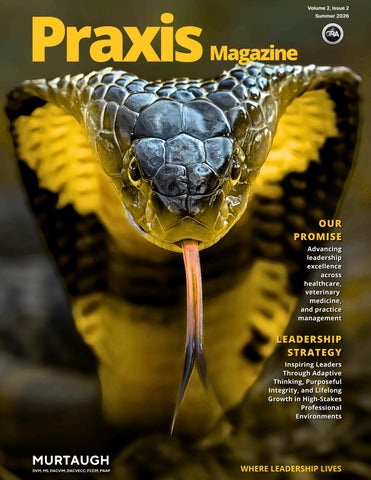
Praxis
Volume 2, Issue 2 Summer 2026
Magazine
OUR PROMISE Advancing leadership excellence across healthcare, veterinary medicine, and practice management
LEADERSHIP STRATEGY Inspiring Leaders Through Adaptive Thinking, Purposeful Integrity, and Lifelong Growth in High-Stakes Professional Environments
MURTAUGH
DVM, MS, DACVIM, DACVECC, FCCM, FNAP
WHERE LEADERSHIP LIVES
Letter from
the Publisher
Bob Murtaugh, DVM, MS, DACVIM, DACVECC, FCCM, FNAP
Dear Distinguished Colleagues and Esteemed Readership, As the lengthening days of summer arrive and the rhythm of healthcare turns toward its own particular intensity, with surgical calendars holding firm, emergency and critical care services swelling, and ambulatory clinics absorbing the consequences of family travel and recreation, I write to you with renewed enthusiasm and a profound sense of seasonal possibility. Summer in our profession, whether one’s calling is the care of human patients or of the animals entrusted to veterinary stewardship, is rarely a quiet season. Yet within its familiar demands lies an extraordinary, often underutilized opportunity: a chance to consciously replenish, deliberately refine, and intentionally renew the very capacities that define exceptional healthcare leadership. This Summer issue of Praxis is built upon a foundational conviction: that leadership, like the living bodies it serves, requires structured restoration to remain capable of sustained excellence. The most accomplished healthcare executives I have encountered, across both human and veterinary medicine, understand that the warmer months are not an interlude between productive seasons. They are, rather, the crucible in which next year’s strategic clarity is forged. These leaders treat summer not as a pause from leadership but as one of its most consequential expressions. Indeed, our most enduring authority is replenished through deliberate self-care and protected reflection. Landmark work published in JAMA Network Open by Shanafelt and colleagues at Stanford University School of Medicine, work routinely cited within the Harvard Medical School curriculum on physician leadership, demonstrates a striking and statistically robust association between physician leaders’ self-care behaviors, including adequate sleep, self-valuation, and restorative activity, and their independently rated leadership effectiveness. Parallel investigations in veterinary medicine, including the AVMA Report on the Economic State of the Veterinary Profession and the Merck Animal Health Veterinary Wellbeing Study, have documented comparable, and in some measures more severe, patterns of burnout, compassion fatigue, and moral distress among veterinarians and veterinary technicians. The Harvard Medical School Insights series on physician burnout further concludes that resilience training, intentional periods of disengagement, and structured self-reflection meaningfully reduce burnout among trainees and seasoned clinicians alike. The implication for our readership, in clinics and hospitals serving patients of every species, is unambiguous: when we restore ourselves, we simultaneously restore the institutions and the patients entrusted to our stewardship.
2
Praxis Magazine • Summer 2026
And our executive judgment is most powerfully refined through intentional immersion in fresh perspective. Leadership Development for Physicians in Academic Medical Centers, offered through the Harvard T.H. Chan School of Public Health and now in its fifth decade, gathers medical directors and division chiefs precisely because the most sophisticated leadership challenges of our era, including clinician burnout, the encroachment of business considerations upon clinical judgment, the post pandemic reconstitution of teams, and the integration of artificial intelligence into care delivery, cannot be resolved through additional clinical hours. They yield only to structured study, peer dialogue, and the deliberate cultivation of executive perspective. In veterinary medicine, the AVMA Veterinary Leadership Conference, the Veterinary Hospital Managers Association, the Cornell University College of Veterinary Medicine executive programs, and the University of Pennsylvania School of Veterinary Medicine serve a parallel function, convening practice owners, hospital directors, and academic chairs to grapple with the same essential questions through a species inclusive lens. The flagship programs at Wharton, the Yale School of Management, and Harvard Business School similarly remind us that even a modest sabbatical, as little as a single concentrated week, can establish a durable methodology of pause, reflection, learning, and action that reshapes the remaining arc of a career. Yet perhaps the most underappreciated instrument of leadership refinement is the natural world itself, paired with the contemplative practices it invites. The contemporary literature collected by Psychology Today, drawing upon Kabat-Zinn’s foundational work on Mindfulness Based Stress Reduction and the more recent self-reflection scholarship of Vago and Silbersweig, converges on a remarkable insight: mindfulness, time in nature, journaling, and the simple discipline of the reflective pause are not luxuries appended to leadership. They are foundational leadership competencies. Box breathing before a difficult conversation. A morning walk uninterrupted by the device. A weekly hour with a journal, asking only what worked, what did not, and what will be different tomorrow. Such small, recoverable practices, accumulated across a summer, produce the calibrated calm that distinguishes the resonant leader from the merely reactive one, and, the data suggest, increase team productivity by margins no organizational restructuring can match. For those of us who care for patients who cannot speak for themselves, this calibrated calm is not merely a leadership asset. It is a clinical one. In keeping with this conviction, the Summer issue is shaped by a stewardship I deeply admire in our regional partners. Scripps Health, whose model of physician administrator collaboration and whose Center for Executive Health embodies the principle that preventive care for the leader is preventive care for the organization, reminds us that an executive’s health is not a private matter. It is among the most significant operational assets any healthcare organization possesses. Scripps further models how senior leaders can refresh their work through investment in research, mentorship, and the deliberate development of those who will succeed them. President and CEO Chris Van Gorder has been an articulate national voice on the recalibration of expectations now required of the healthcare profession, and his organization’s recognition by Fortune magazine, eighteen consecutive years among the nation’s best places to work, reflects a sustained institutional commitment. It is the cumulative dividend of leaders who understand that summer is when one quietly tends the soil from which winter’s harvest will eventually be drawn. Veterinary leaders will recognize the same principle at work in the finest teaching hospitals, specialty referral centers, and corporate consolidators of our own profession.
Praxis Magazine • Summer 2026
3
As we step into this season of light and length, I extend to you an invitation drawn directly from the evidence our contributors and partners have assembled. Take the vacation, genuinely, with the inbox truly closed. Engineer the sabbatical if institutional architecture permits. Read deeply outside your specialty; the most original solutions are nearly always imported from adjacent disciplines, and the cross pollination between human and veterinary medicine has, throughout the One Health movement, repeatedly proven this point. Walk in nature without agenda; the nervous system, ours and our patients’, was not designed for fluorescent light and continuous notification. Schedule the executive physical you have postponed for three years. Attend the leadership program you have circled in successive catalogues but never quite chosen. Mentor someone whose unfamiliar questions will sharpen your own settled answers. Convene a small circle of trusted peers and speak honestly about what is depleting and what is replenishing. Do these things, I urge you, not as indulgences carved from a productive life, but as the most strategically generative acts available to a healthcare leader in 2026. Summer, properly stewarded, is not the absence of leadership work. It is its most subtle and consequential form, the quiet season in which character is recalibrated, vision is clarified, and the inner reserves that will sustain another year of difficult, beautiful, irreplaceable service are deliberately restored. May this issue of Praxis replenish what the year has spent, refine what experience has shaped, and renew the calling that first drew each of you, whether to the bedside of a human patient or to the side of a beloved animal, into the noble service of medicine. With profound respect and warm seasonal regards,
Bob
Bob Murtaugh, DVM, MS, DACVIM, DACVECC, FCCM, FNAP Publisher, Praxis Magazine
4
Praxis Magazine • Summer 2026
2027 REGISTER NOW FOR
$250
NAVC.COM
Summer 2026 • Volume 2, Issue 2
Contents Praxis Magazine
02 PUBLISHER’S LETTER
08 Editor’s Note 20
SPECIAL REPORT
12
24
One Health, One Responsibility: Why Healthcare and Veterinary Leaders Must Champion the Next Generation
Directness with Kindness: Lessons from the Trenches
Steven L May, CVJ, VRCE, EMT(ret)
Eleanor M. Green, DVM, DACVIM, DABVP
Effective: Forming 16 Beyond Good Leaders of Character
28 Leadership Education Extension Bridging the Gap in Veterinary and Human Medicine
David Park, DO, FAAFP, FACOFP
Robert Murtaugh, DVM, MS, DACVIM, DACVECC, FCCM, FNAP
The Hardest Thing a Leader Can Do Is Nothing Simon Sinek
20
32 My Ice Cream Tastes Like Leadership Praxis Leadership Staff
12
38
When Staying Hurts: Rethinking retention, burnout, and identity in healthcare Kari Montgomery, Co-Founder, K9 Innovations
www.praxisleadership.org
Summer 2026
WHERE LEADERSHIP LIVES
42 When Hierarchy on Interprofessional Healthcare Teams Helps—and When It Hurts
50
Brian Sick, MD, MHA, FACP, FNAP
46
Healers, Translators, and Architects
Dr. Marshall Goldsmith the Thinkers50 #1 Executive Coach and New York Times bestselling author
Bob Lester, DVM
68
50
Conversations that help create Leadership in Emerging, Academic, and Integrative Instructional Technologies in Canine Veterinary Anatomy Kevin M. Hannon, PhD
The Qualities of a Future Leader Marshall Goldsmith, PhD
Leading Through a Crisis
55
Gary Willoughby, MPA
The Leaders Bookshelf
84
“The Need to Read”
Not Just a New Role, a New Leader Why the Veterinary Professional Associate Belongs at the Center of the Hospital Team
56
Moving Beyond Blame: Building a Culture of Patient Safety in Veterinary Medicine
Steven L May, Certified Veterinary Journalist
Marie Holowaychuk, DVM, Dipl. ACVECC
62
80
Without Struggle, There Is No Mastery: The Case for Optimal Deprivation Mark de Wolde, DVM, MRCVS 14 84
Praxis Magazine
Editor’s Note this issue is
Dedicated to your mental health and happiness
Steven L May, CVJ, VRCE, EMT(ret)
Dear Readers, Contributors, and Fellow Healthcare Leaders, There is a particular quality to summer light. It arrives earlier and lingers longer, and it asks something different of us than the other seasons do. Where winter demands endurance and spring demands momentum, summer extends an invitation, one that healthcare leaders, conditioned by years of relentless calendars, are often the last to accept. This issue of Praxis is an argument for accepting it. Our publisher, Dr. Bob Murtaugh, opens these pages with a conviction I have come to share: that leadership, like the living bodies it serves, requires structured restoration to remain capable of sustained excellence. It is a simple idea, and yet it runs against nearly everything our professions have trained into us. We are taught to push through, taught that the postponed vacation and the deferred executive physical are the quiet prices of serious work. This issue suggests otherwise. What strikes me most about the contributions gathered here is how thoroughly they refuse to separate the human from the technical. Dr. Eleanor Green writes about the long evolution toward directness. Dr. David Park draws the essential line between the merely effective leader and the genuinely good one. Dr. Brian Sick takes up hierarchy and asks the harder question, not how to abolish it but how to know when it protects a patient and when it silences the person who could have spoken up. Dr. Marie Holowaychuk makes the case that safety is a byproduct of culture, not individual heroics. And Dr. Mark de Wolde offers the uncomfortable truth that mastery is not gifted but forged in struggle.
8
Praxis Magazine • Summer 2026
Praxis Magazine Running through all of it is the conviction that defines this magazine: that human and veterinary medicine are not parallel professions nodding politely across a divide, but a single endeavor. Our cover feature on the National One Health Framework makes this explicit. Dr. Bob Lester maps the healers, translators, and architects who emerge as organizations scale. Kari Montgomery, writing on burnout, reminds us that in pet wellness we speak of catching imbalance before it becomes disease, and that humans, it turns out, are not so different. That last line has stayed with me. Catching imbalance before it becomes disease. It is good clinical practice. It is also, I would argue, the whole of what summer offers a leader willing to receive it. So I will close with a request, and it is the same one our contributors have made across these pages. Take the vacation, genuinely, with the inbox truly closed. Walk somewhere without an agenda. Mentor the person whose unfamiliar questions will sharpen your settled answers. Sit with the difficult conversation you have been managing rather than having. Do these things not as indulgences carved from a productive life, but as the work itself, the subtle and easily postponed work of remaining the kind of leader your patients, of every species, deserve. May this issue replenish what the year has spent. Warmly,
Steven
AMERICAN GRAPHIC DESIGN AWARDS
Praxis Magazine • Summer 2026
2025 WINNER
AMERICAN GRAPHIC DESIGN AWARDS
2025 WINNER
9
EDITORIAL ADVISORY BOARD
STACY ANDERSON, DVM, PhD, DACVS-LA Executive Dean, Lincoln Memorial University, Richard A. Gillespie College of Veterinary Medicine
DAVID PARK, DO, FAAFP, FACOFP Associate Dean for Faculty Success and Professor of Family Medicine, Thomas F. Frist, Jr. College of Medicine at Belmont University
BRIAN SICK, MD, MHA, FACP, FNAP Professor of Internal Medicine and Pediatrics, University of Minnesota
ELEANOR MYERS GREEN, DVM, DAVCIM, DABVP Founding Dean, Lyon College School of Veterinary Medicine Dean Emerita & Professor Emerita, Texas A&M University
ROBERT MURTAUGH, DVM, MS, DAVCIM, DACVECC, FCCM, FNAP Veterinary Specialist, Educator, Leader, Consultant With Over 45 years Dedicated To The Profession
Praxis Magazine Published by SLM Communications Palm Springs, CA 92262
Editor and Chief Steven L Maibaum, CVJ, VRVC, EMT(ret) Publisher Robert Murtaugh, DVM, MS, DACVIM, DACVECC, FCCM, FNAP Publication Development Steven May Mark Schwartz Creative Director Mark Schwartz Submissions: If you are interested in writing for Praxis magazine, please contact us at editor@praxisleadership.org. Include your idea, relevant experience and any other information that may help explain your story.
AMERICAN GRAPHIC DESIGN AWARDS
CHRISTINA V TRAN, DVM Executive Associate Dean & Clinical Professor, Roseman University of Health Sciences College of Veterinary Medicine
2025 WINNER
AMERICAN GRAPHIC DESIGN AWARDS
2025 WINNER
AMERICAN GRAPHIC DESIGN AWARDS
www.praxisleadership.org
"Where Leadership Lives" Articles, stories, advertisers and information in Praxis magazine plus it’s publisher, editors and staff writers (“we,” “us,” or “our”) on any social media platform, website, or websites (the “Site”) and our mobile application is for general informational purposes only. All information in this magazine-publication, Site and our mobile application is provided in good faith; however, we make no representation or warranty of any kind, express or implied, regarding the accuracy, adequacy, validity, reliability, availability, or completeness of any information on the magazine-publication, Site or our mobile application.
10 Praxis Magazine • Summer 2026
UNDER NO CIRCUMSTANCE SHALL WE HAVE ANY LIABILITY TO YOU FOR ANY LOSS OR DAMAGE OF ANY KIND INCURRED AS A RESULT OF THE USE OF THE PUBLICATION, POST, ARTICLE, OR SITE OR OUR MOBILE APPLICATION OR RELIANCE ON ANY INFORMATION PROVIDED ON THE SITE AND OUR MOBILE APPLICATION. YOUR USE OF ANY POST, ARTICLE, OR SITE AND OUR MOBILE APPLICATION AND YOUR RELIANCE ON ANY INFORMATION ON THE MAGAZINE, POST, ARTICLE, OR SITE AND MOBILE APPLICATION IS SOLELY AT YOUR OWN RISK. All trade and registered marks are protected by their respective associations and companies.
Volume 2, Issue 2 Praxis accepts no responsibility for unsolicited materials. Praxis assumes no responsibility for content or advertisements. Submissions: unsolicited manuscripts will not be returned unless accompanied by a stamped return envelope.
Praxis
Magazine
You Didn’t Survive Residency to Stay Quiet. Share your leadership expertise in Praxis Magazine's Spring & Summer 2026 issues. Get published. Join the herd. Write for us and shape healthcare leadership.
SUBMIT NOW editor@praxisleadership.org
EXPERT LEADER. EXPERT WRITER. Human & Veterinary Healthcare Professionals www.praxisleadership.org
HEALTHCARE LEADERSHIP | SPECIAL REPORT
One Health, One Responsibility: Why Healthcare and Veterinary Leaders Must Champion the Next Generation By Steven L May, CVJ, VRCE, EMT(ret)
Navigating Change in Veterinary Practice: Communication, Attitudes, and the 8-Step Process Change There is a moment in every seasoned leader's career when the most important question shifts from "What can I do?" to "Who am I preparing to carry this forward?" In the realm of One Health - perhaps one of the most complex and consequential frameworks in modern public health — that question has never been more urgent. The release of the National One Health Framework to Address Zoonotic Diseases and Advance Public Health Preparedness in the United States, 2025–2029, marks a watershed moment in American public health history. Developed jointly by the Centers for Disease Control and Prevention (CDC), the U.S. Department of Agriculture (USDA), and the Department of the Interior (DOI), the framework represents the first-ever formal, coordinated national strategy for addressing the intersection of human health, animal health, plant health, and environmental integrity. Twenty-three agencies across eight federal departments contributed to its development. The scope is extraordinary. The stakes are even higher.
12 Praxis Magazine • Summer 2026
But a framework, however visionary, is only as powerful as the people who implement it. And therein lies the defining leadership challenge of our time.
The Architecture of a Connected World One Health is not a novel concept - it is, in fact, the oldest truth in medicine. Humans have always lived in intimate relationship with animals and the natural environment. What is new is the formalization of that interdependence into actionable policy. The framework defines One Health as a collaborative, multisectoral, and transdisciplinary approach working at every level - local, regional, national, and global — to achieve optimal health outcomes. The prioritized diseases identified in the framework's appendix tell a sobering story: zoonotic influenza, salmonellosis, West Nile virus, plague, emerging coronaviruses, rabies, brucellosis, and Lyme disease. These are not distant threats. They are present-day realities touching communities in every state. COVID-19, notably absent from the original 2017 prioritization list because it had not yet emerged, became the most powerful argument for why this framework matters. It demonstrated, with devastating clarity, what happens when the warning signs at the human-animal-environment interface are not caught early, coordinated rapidly, and communicated clearly.
"A framework is only as powerful as the people who implement it. The next pandemic will not wait for the next generation to be ready on its own."
The Leadership Imperative For healthcare executives, hospital administrators, chief medical officers, and veterinary leaders, the One Health framework is not simply a government policy document to file away. It is a direct call to action - and more specifically, a call to mentorship. The framework itself is clear on this point. Goal Seven, dedicated entirely to workforce development, calls on leaders to identify training opportunities, integrate One Health competencies into sector-specific education, enhance recruitment and retention of qualified professionals, and encourage the integration of One Health into academic curricula across all relevant disciplines. These are not bureaucratic checkboxes. They are a blueprint for intergenerational knowledge transfer. Consider the breadth of expertise One Health demands: epidemiologists and veterinarians must speak the same language as wildlife biologists, environmental scientists, agricultural specialists, and emergency preparedness officers. A healthcare leader who understands only the human side of a zoonotic outbreak is, by definition, only half-prepared. The same is true for the veterinarian who has never collaborated with a public health department, or the environmental scientist who has never interfaced with a hospital system. The next generation of One Health leaders must be fluent across these disciplines - and that fluency does not develop in a vacuum. It is cultivated through deliberate mentorship, structured exposure, and the active dismantling of the silos that have historically separated these fields.
Praxis Magazine • Summer 2026
By Editorial Staff - Praxis Magazine
13
Mentorship as a Public Health Strategy It would be a mistake to treat leadership development as a soft skill in the context of One Health. Workforce readiness is a public health strategy. The framework acknowledges that full implementation is contingent on expanding existing One Health capacities and resources. That expansion begins with people. Healthcare leaders have a responsibility to open their conference rooms, their field operations, their strategic planning sessions, and their professional networks to the emerging professionals who will one day lead the U.S. One Health Coordination Unit, coordinate outbreak responses, and sit at the tables where zoonotic disease prioritization decisions are made. This means creating rotational fellowship programs that expose young physicians and veterinarians to cross-sector work. It means funding and supporting One Health-specific graduate tracks. It means standing at a podium and saying plainly: this work matters, it is complex, and we need you. The framework was built on the recognition that no single sector can address these threats alone. That philosophy must extend to how leaders think about succession. The physician who mentors a future epidemiologist in zoonotic disease response is not simply developing a career — they are strengthening national preparedness.
The Glow of Responsibility There is something quietly radical about the One Health framework. It asks leaders across professions to release the possessiveness of their disciplines and embrace a shared mission. It asks the cattle rancher and the pediatric infectious disease specialist to recognize that their work is bound together. It asks the wildlife biologist and the hospital CMO to see themselves as partners in the same endeavor. That is a profound ask. And it requires leaders who not only believe in its necessity but who carry that belief into every interaction with the next generation - in academic halls, in hospital corridors, in veterinary schools, in field operations, and in the pages of publications like this one. The question is no longer whether One Health is important. COVID-19 settled that debate permanently. The question is whether those who understand its importance have the courage and the commitment to ensure the next generation understands it too. The health of the nation - human, animal, 14 Praxis Magazine • Summer 2026
and environmental - depends on the answer.
Top 10 Action Steps for Physician and Veterinary Leaders How to Get Involved in One Health and Share the Framework: 1 Read Download and study the National One Health
Framework 2025–2029 in full. Share it with your department heads, hospital leadership team, or veterinary practice partners. Understanding the seven goals - from Coordination to Workforce Development is the essential first step to meaningful engagement.
a Cross-Sector Mentorship Program: 2 Establish Identify one or two emerging professionals - a medical
resident, veterinary student, or public health fellow and commit to mentoring them with a deliberate crosssector lens. Introduce them to colleagues outside their discipline and help them see health through the wider One Health lens.
a One Health Committee or Task Force: 3 Initiate Whether you lead a hospital system, veterinary school,
or clinical practice, establish a formal One Health working group. Invite members from human health, animal health, environmental health, and public health departments to sit at the same table and identify shared priorities.
with Your Local and State Health 4 Partner Departments:
The framework depends on robust collaboration between federal, state, tribal, local, and territorial partners. Reach out to your local health department and ask how your organization can participate in zoonotic disease surveillance, outbreak planning, or emergency preparedness exercises.
5
Integrate One Health into Grand Rounds and Continuing Education: Use your platform to educate. Dedicate at least one grand rounds presentation, CME session, or veterinary conference panel per year to One Health topics zoonotic disease trends, antimicrobial resistance, food safety, or ecosystem health. Normalizing this conversation in professional spaces is how culture changes.
SOURCE: National One Health Framework to Address Zoonotic Diseases and Advance Public Health Preparedness in the United States, 2025-2029. CDC, USDA, DOI. Praxis Magazine • Summer 2026
for One Health Curriculum in 6 Advocate Academic Institutions:
If you have any affiliation with a medical school, veterinary school, or public health program, advocate loudly for One Health to be woven into the core curriculum. The framework specifically calls for this under Goal Seven. Faculty influence matters enormously in shaping what the next generation learns and values.
with the U.S. One Health Coordination 7 Engage Unit:
The U.S. OHCU, launched in January 2024, is the federal coordinating body for One Health implementation. Healthcare and veterinary leaders can engage by participating in public comment periods, attending One Health forums, and connecting with agency representatives. Your voice and field expertise are assets this system needs.
Zoonotic Disease Awareness in Your 8 Champion Community: Go beyond the clinic or hospital. Host community education events, partner with local agricultural fairs, schools, or wildlife organizations to raise awareness about zoonotic disease risks. The framework emphasizes the need for coordinated public messaging - local leaders are the most trusted messengers.
and Fund One Health Research: 9 Support Advocate within your institution or professional
organization for research funding that crosses disciplinary lines. Support grant applications and fellowships that address the human-animalenvironment interface. If you serve on a foundation board or hospital committee, make One Health research a stated funding priority.
the One Health Mindset Every Day: 10 Model The most powerful thing a leader can do is model
the behavior they wish to see. Ask about animal and environmental exposures during patient histories. Include environmental health considerations in clinical decisions. When colleagues from other disciplines reach out, say yes. One Health is not just a policy - it is a way of seeing the world. Lead by example, and others will follow. By Editorial Staff - Praxis Magazine
15
By David Park, DO, FAAFP, FACOFP dist.
Beyond Effective: Forming Good Leaders of Character By David Park, DO, FAAFP, FACOFP dist. is a physician, educator, and executive coach dedicated to leadership development.
Healthcare and education leaders today navigate a moral terrain unlike any in living memory. Workforce burnout, eroding public trust, complexity around artificial intelligence, financial pressures, and unrelenting operational demands all weigh down on the people charged with steering our institutions. While content knowledge, operational skills, and technical competency remain necessary, these alone are no longer sufficient. In my leadership development work, I have always been intentional about naming the skills that make an effective leader, and equally intentional about drawing a clear distinction between an effective leader and a good leader. History offers many examples of highly effective leaders who committed heinous deeds, and therefore I would never call them good leaders. Good leaders are different. They are formed by virtues and have developed a sound moral character. Essentially, good leadership character is virtue in action.
Why Character, Why Now
Healthcare and education leadership is trust-based, high-stakes, and inherently relational. Character failures cascade through teams, patients, and communities in ways that strategic missteps or general oversights rarely do. Aristotle's teachings on moral philosophy postulate that virtues are habits formed through deliberate practice. 16 Praxis Magazine • Summer 2026
Virtues are not personality traits we inherit or learn from our environment. During my leadership journey in academia and organized medicine, I am convinced that good leaders are formed over time with purposeful effort focused on virtues. I recently read an article in the Journal of Moral Education about a concept called virtue literacy. The authors Lamb and Brooks define virtue literacy as the linguistic knowledge, conceptual understanding, and contextual awareness of the concepts of character that enables people to recognize and develop in the virtues. To put it simply, it gives people the vocabulary and the awareness to talk about character virtues. When clinicians, educators, administrators, and board members all use the same words for character, conversations about a good leader finally mean the same thing to everyone in the room. Don’t we want good leaders running healthcare and medical education, not merely effective ones? This may be a naïve or idealistic question, but my answer is an emphatic yes.
Virtues versus Values I want to pause here for a moment to differentiate virtues and values because my own understanding came only after multiple conversations, online searches, and hours of self-reflection. I have come to define virtues as a subset of core values that are inherently good, embedded in one’s character and demonstrated through habitual actions. Values are subjectively chosen priorities that can change with circumstances and can exist anywhere on the moral spectrum from good to evil. Aristotle names eleven moral virtues, Confucius names five constant virtues, Marcus Aurelius names four stoic virtues, and Christian theology names seven heavenly virtues. Different cultures, religions, and people have their own set of virtues. There are many virtues named in literature, but there are four that consistently show up across texts: Compassion/Benevolence, Temperance/Self Control, Courage/Fortitude, and Justice/Righteousness.
Praxis Magazine • Summer 2026
17
If you look at the intersections of these virtues, the guide to be a good leader is captured in the following four practices: How you treat others: Compassion/Benevolence How you manage yourself: Temperance/Self Control How you defend your beliefs and values: Courage/Fortitude How you uphold inclusivity and fairness: Justice/Righteousness
From Knowing to Becoming In the Nicomachean Ethics, Aristotle argues that knowing about what is good does not make a person good. He describes virtue as a practical skill, forged only through repetitive acts, not something mastered by reading or listening to a lecture. A leader who can name the virtues but never embodies them is, in Aristotle's own analogy, the patient who listens carefully to the doctor and then refuses to heed the doctor’s instructions. Character is a leadership trait most organizations quietly assume and rarely teach. Deans, program directors, chief academic and medical officers, and senior administrators have both an opportunity and perhaps an obligation to imbue virtue literacy into onboarding, training curricula, and professional development deliberately and not leave it to hope and chance. Top leaders of an organization that take this seriously can do three things: 1) Name the specific virtues they expect of their people, especially leaders, 2) build a framework of practices through feedback, mentorship, and visible examples, and 3) hold people accountable when behavior drifts, including themselves. Healthcare and medical education need good leaders of character, not just effective ones. The good leader did not inherit or fall into good character. The good leader is the one whose character was deliberately formed, one chosen act at a time. Reference: Lamb M, Brooks E. Teaching virtue literacy: A strategy for character education in the university. Journal of Moral Education. Published online February 12, 2026.
Siberian tigers embody the qualities of a great leader through their solitary strength and strategic mind. As apex predators of the Russian Far East, they command vast territories with quiet authority, patrolling hundreds of miles with patience and precision. They lead not through aggression but through presence. Mothers fiercely guide their cubs for years, teaching them to hunt, survive brutal winters, and navigate a harsh world. Their resilience, independence, and calculated decisionmaking make them a powerful symbol of leadership rooted in wisdom, courage, and unwavering self-reliance.
18 Praxis Magazine • Summer 2026
David Park, DO, FAAFP, FACOFP dist. Physician, educator, and executive coach dedicated to leadership development currently serving as the Associate Dean for Faculty Success and Professor of Family Medicine at the Thomas F. Frist, Jr. College of Medicine at Belmont University. He is a Past President of the American College of Osteopathic Family Physicians and the former Vice President and Founding Dean of Rocky Vista University – Montana College of Osteopathic Medicine. His mission is to cultivate leaders by inspiring purpose, building confidence, developing action-oriented skills, and leaving a lasting legacy of leadership.
Simon Sinek The Hardest Thing a Leader Can Do Is Nothing Most of us became leaders because we’re good at solving problems. We walk into a room full of chaos and we see the path forward. That skill is real, and it got us here. But there’s a kind of conversation where that exact skill becomes the obstacle. Someone on our team asks for a few minutes. They start explaining a challenge with a project. And somewhere in the first 60 seconds, we start building the solution. We’re still nodding. We might even be making good eye contact. But we’re already three steps ahead, constructing the answer we’re about to deliver. And then we deliver it. And the person across from us says “yeah, thanks” in a way that means something else entirely.
simonsinek.com 20 Praxis Magazine • Summer 2026
Simon Sinek’s Optimism Company
What they needed wasn’t our answer. What they needed was to feel not alone. And we skipped straight past that to the part we’re comfortable with. The listening-only conversation is exactly what it sounds like. Our entire job, for the duration of it, is to understand, not to fix. Someone is overwhelmed, frustrated, or stuck. And what they need most is a leader who can stay present long enough to let them get to the real thing. Because the real thing is almost never the first thing they say. Here’s a move that sounds almost too simple to work: before any difficult conversation begins, ask one question. “Do you want me to listen, or would you like help solving it?” Research on therapeutic communication shows this single question reduces the speaker’s distress immediately, because it gives them agency in the exchange. We’ve handed them the wheel before we’ve even started. Then we listen. Not for gaps in the logic we can fill. Not for the moment our solution becomes relevant. We listen for what’s underneath. “Tell me more.” “What else?” “What does that feel like from the inside?” We go one level deeper each time, and we let the silence do its work between questions. Simon has noticed this pattern especially at senior levels: the more authority we carry, the heavier our words land. A casual reaction from a senior leader can spiral into a week of anxiety for someone three levels below. Which means our instinct to jump in and reassure, to problem-solve, to move toward resolution, isn’t neutral. It’s weight. And sometimes the most generous thing we can offer is to put that weight down and just be present.
Simon Sinek’s Optimism Company simonsinek.com Praxis Magazine • Summer 2026
21
We can even say it directly at the start: “I’m here to understand, not to fix.” Four words that give the other person permission to keep going past the surface version of the problem. The leaders we remember for a lifetime are rarely the ones with the sharpest answers. They’re the ones in whose presence we felt safe enough to say the true thing.
Good leaders have the ability to inspire us in their lifetime. Great leaders have the ability to inspire us beyond their lifetime.
Reprinted article from simonsinek.com
22 Praxis Magazine • Summer 2026
Simon is a spark that ignites passion and ideas. He envisions a world in which the vast majority of people wake up every single morning inspired, feel safe wherever they are, and end the day fulfilled by the work they do. As an unshakeable optimist, he believes in our ability to build this world together. A trained ethnographer, Simon is fascinated by the people and organizations that make the greatest and longest lasting impact. Over the years, he has discovered some remarkable patterns about how they think, act, and communicate, and also the environments in which people operate at their natural best. Simon may be best known for his TED Talk on the concept of WHY, which has been viewed over 60 million times, and his video on millennials in the workplace—which reached 80 million views in its first week and has gone on to be seen hundreds of millions of times. He continues to share inspiration through his bestselling books, including global bestseller Start with WHY and New York Times bestsellers Leaders Eat Last and The Infinite Game, as well as his podcast, A Bit of Optimism. In addition, Simon is the founder of The Optimism Company, a leadership learning and development company, and he publishes other inspiring thinkers and doers through his publishing partnership with Penguin Random House called Optimism Press. His unconventional and innovative views on business and leadership have attracted international attention, and he has met with a broad array of leaders and organizations in nearly every industry. He frequently works with different branches of the US Armed Forces and agencies of the US government, and is an adjunct staff member with the RAND Corporation—one of the most highly regarded think tanks in the world. Simon is also active in the arts and with not-for-profit work, or what he likes to call the for-impact sector. In 2021, he founded The Curve: a diverse group of forward-thinking chiefs and sheriffs committed to reform modern policing from the inside-out. Their purpose is to build a profession dedicated to protecting the vulnerable from harm while advancing a vision of a world in which all people feel justice is administered with dignity, equity, and fairness.
Reprinted article from simonsinek.com
To learn and find out more, visit simonsinek.com Praxis Magazine • Summer 2026
23
By Eleanor M. Green, DVM, DACVIM, DABVP
Directness with Kindness: Lessons from the Trenches By Eleanor M. Green, DVM, DACVIM, DABVP
It feels like only yesterday that my boss, then a center director, looked at me and said, plainly and emphatically, "You must take a course in assertion." Without missing a beat, I replied, "I refuse to take a course in assertion." I was a young assistant professor, trying to find my way toward professional fulfillment and meaningful impact. I wanted to do a good job, nothing more, nothing less. When challenged, my instinct was always to look inward: What could I have done better? I spent considerable time wrestling with how to manage confrontation and conflict in a way that aligned with my values of integrity, kindness, and genuine care for others. What I really wanted was guidance. A mentor. A model. Fast forward to this week. In a conversation about how to approach a situation with a team member, a colleague remarked, "I have never known you not to be direct." His comment stopped me. And, unexpectedly, it gave me a sense of peace. I hadn't fully appreciated my own evolution. I reflected for a moment on how leaders are honed over their careers.
Directness Is Not Harshness It is important to be clear: directness is not synonymous with being unkind, insensitive, or harsh. At its best, directness is simply clarity paired with honesty. When practiced well, it builds trust, reduces confusion, and accelerates progress, for individuals and for organizations. And it matters. 24 Praxis Magazine • Summer 2026
Clarity with Kindness Strengthens Organizations Clarity eliminates confusion. Individuals and teams perform best when expectations are unmistakable. Indirect communication forces people to interpret meaning, and interpretation invites error, delay, and inconsistency. When communication is lacking altogether, the effects compound. Morale declines. Frustration rises. Organizations can become, in a sense, "unwell," even if no one can quite articulate why. Directness, when delivered with respect, builds trust through transparency. People may not always welcome difficult conversations, such as performance evaluations, conflict resolution, budget constraints, or workforce changes, but they do value honesty. Most people would rather understand the reality of a situation than be left to guess at it.
Directness Drives Accountability and Recognition Clarity fosters accountability. When goals, responsibilities, and expectations are communicated directly, ambiguity disappears. Simple structures help. For example, maintaining an active action list for meetings, clearly outlining tasks, responsible individuals, dates assigned, deadlines, and progress, can transform follow through. Reviewing this list regularly keeps everyone aligned. It also creates natural opportunities for recognition. When people meet expectations with quality and timeliness, they can, and should, be acknowledged. The result is stronger performance, greater ownership, and improved morale.
Feedback: A Gift When Given Well Direct feedback, delivered respectfully, is one of the most valuable tools a leader has. It provides clarity for growth and signals investment in a person's development. In fact, team culture and retention often hinge on whether feedback is honest, timely, and constructive. Equally important is confidentiality. Trust is easily broken if individuals believe their feedback is shared indiscriminately. I recall an experience as a hospital director, when all staff reported to me. One team member was convinced she was the only person receiving direct feedback. When she voiced her concern, I responded, "Thank you. It is working." She was puzzled, until I explained. She was not the only one receiving feedback. She was simply unaware of others' feedback because I protected their confidentiality as carefully as I protected hers. Only after conducting a 360 degree evaluation, in which everyone evaluated one another, did she see that the feedback across the department was consistent. That realization opened the door to her growth. The lesson is simple: introducing a culture of directness takes time, consistency, and trust.
Praxis Magazine • Summer 2026
25
A Learned Skill Worth Mastering Over the years, I have encountered only a handful of leaders who have truly mastered directness. It is not easy. It requires intention, practice, and self awareness. Even now, when I face conflict, my instinct remains to reflect: What could I have done better? But the lens has changed. Reflection no longer leads to hesitation. It leads to clarity and action. I still do not enjoy conflict. But I deeply value the outcomes of well managed conflict: stronger relationships, clearer expectations, and better decisions.
The Takeaway Directness with kindness is not innate. It is learned. And it is one of the most important leadership skills we can develop. We should strive to be: Clear enough to be understood. Honest enough to build trust. Kind enough to be heard. That is the balance.
"Directness with kindness is not innate. It is learned.
And it is one of the most important leadership skills we can develop. We should strive to be clear enough to be understood, honest enough to build trust, and kind enough to be heard. That is the balance."
26 Praxis Magazine • Summer 2026
Five Tips for Practicing Directness with Kindness
Distilled from the lessons above and offered as practical disciplines for the everyday work of leadership.
Tip 1. Pair clarity with honesty and kindness as a single discipline.
Directness is not harshness. It is clarity paired with honesty and delivered with respect. Practice all three together. Clarity without kindness wounds. Kindness without clarity confuses. Honesty without either feels cold. When the three travel together, they build trust and accelerate progress.
Tip 2. Make expectations unmistakable through an active action list.
In every meeting, maintain a written action list that captures the task, the responsible individual, the date assigned, the deadline, and the current progress. Review the list at the start of each subsequent meeting. This simple structure transforms follow through and creates natural opportunities for recognition.
Tip 3. Treat direct feedback as a gift, given honestly, timely, and constructively.
Team culture and retention often hinge on whether feedback is honest, timely, and constructive. Do not delay difficult conversations until annual review. Offer growth oriented feedback close to the moment it is earned, frame it around behavior rather than identity, and invite dialogue rather than deliver verdict.
Tip 4. Protect the confidentiality of every conversation with rigor.
Trust is easily broken when individuals believe their feedback is shared indiscriminately. Protect each person's feedback as carefully as your own, and a culture of safety will follow. Periodic 360 degree evaluations reinforce this by allowing the team to see for itself that feedback is delivered consistently across all members.
Tip 5. Recognize good work openly and consistently.
When people meet expectations with quality and timeliness, they can and should be acknowledged. Let the same action list that tracks accountability also surface opportunities for recognition. The result is stronger performance, greater ownership, and improved morale.
Elephants are another remarkable example of apex animals in service to humans. For thousands of years, these gentle giants have hauled timber through dense forests, carried soldiers across impossible terrain, and aided anti-poaching patrols in protecting endangered wildlife. Today, elephants also serve in therapeutic programs, helping children with autism and veterans with PTSD find healing in ways that continue to astonish researchers and caregivers alike.
Praxis Magazine • Summer 2026
Article written by
Eleanor M. Green, DVM, DACVIM, DABVP Vice Dean of Academic Affairs, Lewyt College of Veterinary Medicine, Long Island University Co-Founder & Vice President, Iron Horse Farm & Consulting, LLC Senior Advisor & Consultant, Animal Policy Group Professor & Dean Emerita, College of Veterinary Medicine & Biomedical Sciences, Texas A&M University 27 12
By Bob Murtaugh, DVM, MS, DACVIM, DACVECC, FCCM, FNAP
Leadership Education Extension Bridging the Gap in Veterinary and Human Medicine By Robert Murtaugh, DVM, MS, DACVIM, DACVECC, FCCM, FNAP
The clinical professions have long excelled at producing technically brilliant practitioners. Medical schools and veterinary colleges invest years refining the diagnostic acumen, procedural skill, and scientific reasoning of their graduates. Yet there is a conspicuous gap in this otherwise rigorous training: leadership. For decades, both human medicine and veterinary medicine have operated on the assumption that clinical excellence alone would be sufficient to produce capable leaders. That assumption has proven dangerously inadequate. The growing recognition of this deficit has given rise to a critical movement - leadership education extension - that seeks to carry professional development beyond the clinic and the classroom, equipping physicians and veterinarians with the skills they need not only to practice medicine but to lead the organizations, teams, and systems that deliver it.
The Leadership Deficit in Clinical Training Traditional medical and veterinary curricula are designed around a singular objective: producing clinicians who can diagnose and treat effectively. The sheer volume of biomedical knowledge required to achieve competency leaves little room for anything perceived as ancillary. Leadership, communication, financial management, and organizational strategy are often treated as soft skills that graduates will somehow absorb through observation or osmosis once they enter practice.
28 Praxis Magazine • Summer 2026
The reality is far less forgiving. New physicians are thrust into hospital environments where they must coordinate multidisciplinary teams, navigate institutional politics, and advocate for resources - all without formal preparation. Veterinary graduates who open or join practices discover that managing staff, handling client conflict, overseeing budgets, and setting strategic direction demand an entirely separate skill set from the clinical training they received. The result is a generation of clinicians who are technically prepared but organizationally underprepared, and the consequences ripple outward through burnout, turnover, and diminished quality of care.
What Leadership Education Extension Looks Like Leadership education extension refers to structured, sustained learning opportunities that extend beyond the traditional boundaries of medical and veterinary education. Unlike a single weekend seminar or an elective course tucked into the final year of a degree program, extension programming is designed to be longitudinal, practical, and integrated into the arc of a clinician’s career. In human medicine, this has taken the form of physician leadership academies hosted by health systems and professional organizations. Programs such as those offered by the American Association for Physician Leadership provide structured curricula covering topics like healthcare finance, change management, quality improvement, negotiation, and team dynamics. These programs typically unfold over months or years, combining didactic instruction with applied projects that require participants to tackle real challenges within their own institutions. In veterinary medicine, similar models are emerging. Veterinary management institutes, leadership tracks within professional associations such as the American Veterinary Medical Association and the Veterinary Hospital Managers Association, and university-based certificate programs are beginning to fill the void. These programs recognize that veterinary leaders face a distinctive set of challenges - including small-team dynamics, ownerclient-patient triangles, and the emotional toll of euthanasia decisions - that require tailored leadership development rather than generic business training. Across both disciplines, the most effective extension programs share common features: mentorship from experienced clinical leaders, cohort-based learning that builds peer networks, case-based instruction grounded in real clinical scenarios, and longitudinal engagement that allows participants to apply what they learn and return with reflections and questions.
The One Health Opportunity One of the most promising dimensions of leadership education extension is its potential to bridge human and veterinary medicine through a One Health framework. The One Health approach recognizes that human, animal, and environmental health are deeply interconnected - and that the most effective solutions to complex health challenges require collaboration across disciplines.
Praxis Magazine • Summer 2026
12 29
Leadership education extension programs that bring physicians and veterinarians together create powerful learning environments. A hospital chief medical officer and a veterinary practice director share more common ground than either might initially assume: both manage highly trained professionals, both balance clinical mission with financial sustainability, both navigate regulatory complexity, and both confront the emotional demands of caring for vulnerable patients. Cross-disciplinary cohorts allow participants to learn from one another’s perspectives, share problem-solving approaches, and build profession -al networks that transcend traditional silos. Institutions that embrace this model are not only strengthening individual leaders but also laying the groundwork for the kind of interprofessional collaboration that public health challenges - from antimicrobial resistance to zoonotic disease preparedness - urgently demand.
Overcoming Barriers to Adoption Despite the clear need, leadership education extension faces significant barriers in both professions. Time is perhaps the most formidable. Clinicians already work demanding schedules, and carving out hours for leadership development requires institutional support and cultural buy-in. Financial constraints also play a role, particularly in veterinary medicine, where practice margins are often thin and continuing education budgets are directed toward clinical skills. There is also a deeper cultural barrier: the persistent belief that leadership is an innate trait rather than a learnable discipline. This mindset leads organizations to promote their most clinically accomplished individuals into leadership roles without providing training, then to blame the individual when the transition falters. Dismantling this belief requires visible institutional commitment - from deans, hospital executives, and practice owners - that frames leadership development as essential professional education, not an optional enhancement. Technology offers a partial solution. Online and hybrid learning models have made leadership education more accessible, allowing clinicians to engage with coursework, peer discussions, and mentorship without stepping away from practice entirely. When designed thoughtfully, these platforms can deliver the longitudinal, applied learning that effective leadership development requires.
"The result is a generation of clinicians who are technically prepared but organizationally underprepared, and the consequences ripple outward through burnout, turnover, and diminished quality of care."
30 Praxis Magazine • Summer 2026
The Return on Investment The evidence supporting leadership education extension is compelling. Health systems that invest in physician leadership development report measurable improvements in clinical quality metrics, patient satisfaction scores, staff engagement, and financial performance. In veterinary practice, leadership-trained principals see lower associate turnover, stronger client retention, and healthier workplace cultures that attract rather than repel talent. Beyond metrics, the return is visible in the intangible but essential qualities of well-led organizations: teams that communicate openly, cultures that support innovation without recklessness, and leaders who can hold both the compassion of a healer and the discipline of a strategist. These are the organizations where clinicians want to build careers, not merely pass through. Extending the Mission Leadership education extension is not about transforming every physician and veterinarian into a CEO. It is about recognizing that clinical expertise alone is insufficient to sustain the organizations, teams, and systems that deliver care to patients - human and animal alike. By extending leadership education beyond the walls of medical and veterinary schools, across the full span of a clinician’s career, and across the traditional boundaries between professions, we invest in the infrastructure that makes excellent medicine possible. The extension of leadership education is, ultimately, an extension of the healing mission itself.
"The extension of leadership education is, ultimately, an extension of the healing mission itself."
Snow owls make powerful symbols of leadership because their fierce, solitary devotion to their territory drives them to protect what matters most, guiding others with quiet authority and unshakable resolve. A snowy owl doesn't lead by force — it leads by seeing what others cannot, reading the landscape from above, and knowing when to strike with precision and when to wait in watchful silence
Praxis Magazine • Summer 2026
Article written by
By Robert Murtaugh, DVM, MS, DACVIM, DACVECC, FCCM, FNAP Publisher, Praxis Magazine DEDICATED TO THE VETERINARY PROFESSION FOR OVER 46 YEARS 31 12
My Ice Cream Tastes Like Leadership Praxis Leadership Staff
Ice cream is, on its face, a trivial subject for a leadership article. That is precisely the point. Some of the most durable lessons in organizational behavior come from observing how ordinary service environments create loyalty, sustain culture, and earn trust over time. The neighborhood creamery that has been open for forty years has solved problems that many healthcare organizations are still working on. This article uses that observation as a practical framework. Each section draws a direct parallel between how good ice cream shops operate and how effective healthcare leaders lead. The connections are grounded in current peer-reviewed research and are intended to be immediately applicable to clinical and administrative leadership practice.
Scoop 1: Every Flavor Has a Purpose, and So Does Every Role A well-run creamery carries dozens of flavors, each one placed deliberately. The classic vanilla anchors the menu because customers rely on it. A rotating seasonal option creates interest and signals creativity. The house specialty is what regulars tell newcomers to try. No slot on the menu is accidental.
32 Praxis Magazine • Summer 2026
The same logic applies to healthcare teams. Each role carries a specific function that, when understood and named, becomes a source of professional motivation. Research on organizational values in community hospital systems found that when staff perceive their individual development as valued, engagement rises and patient satisfaction scores improve [1]. The task for leaders is to make that purpose visible and explicit, not to assume employees infer it on their own.
Leadership Imperative: Identify the distinct contribution of each team member. Connect individual roles explicitly to the organization's broader mission. Revisit these connections during performance conversations, not only at onboarding.
Scoop 2: Consistency Is the Cone That Holds Everything Together Brand loyalty in the food industry is built less on novelty than on dependability. A customer returns to the same shop because they trust the quality will be the same as last time. Inconsistency is the fastest way to lose that trust. In healthcare, the stakes of inconsistency are higher. Variable care protocols produce preventable errors. Variable communication from leadership produces confusion and disengagement. Edmondson's foundational research established that psychological safety, defined as the shared team belief that interpersonal risk-taking is safe, is a primary driver of learning and performance [3]. One of its most reliable antecedents is consistent, inclusive behavior from leadership [4].
Praxis Magazine • Summer 2026
IA 2025 systematic review of psychological safety in healthcare practice found that consistent and open leadership communication ranked among the strongest facilitators of psychologically safe environments, which are in turn associated with better patient safety outcomes [5]. Research Insight: In intensive care settings, psychological safety has been linked to lower morbidity and mortality. Staff who feel safe to speak up are more likely to flag deterioration early and correct errors before they reach the patient [5].
Scoop 3: Reading the Room, and Reading the Patient Experienced front-line service workers read customers before the customers say a word. They notice hesitation and offer a sample. They see a child pointing at the wrong case and redirect the conversation. They do not rush people who are not ready. This is applied emotional intelligence in a low-stakes setting. In healthcare leadership, the same capacity is high-stakes. A 2026 concept analysis published in the Journal of Advanced Nursing identified emotional intelligence as a defining attribute of effective healthcare leadership, with demonstrable effects on organizational performance, employee well-being, and patient care quality [6]. A separate 2024 systematic review found that higher emotional intelligence in leaders is associated with reduced staff burnout, increased team proactivity, and stronger job performance [7]. Leaders who score high on emotional intelligence tend to conduct rounding differently. They ask what staff need rather than reporting what they observed. They follow up on concerns raised in previous conversations. These behaviors build the trust that makes teams more willing to surface problems early, which is where patient safety improvements actually originate. 33
Scoop 4: Toppings Are the Culture You Build Any experienced ice cream customer knows that the toppings often determine the experience more than the base flavor. The quality of the fudge, whether the fruit is fresh, how the nuts are prepared: these details signal the standards of the operation. They are also the details most likely to be cut when costs come under pressure. Organizational culture in healthcare works the same way. The visible rituals of recognition, how errors are handled, whether staff feel genuinely acknowledged: these define the culture people experience daily, not the values statement on the wall. A large systematic review found that positive, collaborative, and supportive organizational cultures are consistently associated with improved patient outcomes across care settings, from surgical units to aged care facilities [2]. A study examining 387 community hospital units found that organizational values centered on team collaboration and individual recognition directly predicted staff engagement, well-being, and patient satisfaction scores [1]. When leaders let the culture erode under operational pressure, the data eventually shows it in outcomes. Authentic leadership has also been shown to reinforce quality improvement in hospitals, but only when paired with a teamwork-oriented culture. In hierarchical or non-relational cultures, quality improvement efforts show weaker effects even when authentic leadership is present [8]. Structure matters, but culture is what activates it.
Scoop 5: When the Ice Cream Melts, Steady Leadership Matters Most An ice cream cone on a hot day requires decisions quickly. Delay long enough and the structural integrity of the whole thing fails. Most people in that situation have made a decision before the problem fully registers. Healthcare leaders face comparable dynamics during a sentinel event, a system failure, a staffing crisis, or a sudden leadership departure. Research on servant leadership in ambulatory healthcare settings found a statistically significant relationship between leadership style, psychological safety, and team performance under pressure [9]. Leaders who had built relational trust before the crisis drew on that reserve when it mattered. Those who had not found teams that were slower to communicate and harder to coordinate. A qualitative study examining how organizational culture and leadership influence staff willingness to raise concerns found that positive, inclusive leadership fostered cultures where clinical staff, patients, and families felt able to speak up about deterioration [10]. That capacity does not appear during a crisis. It is built before one arrives.
34 Praxis Magazine • Summer 2026
The Five Flavors of Healthcare Leadership: A Self-Assessment Framework The following framework is intended for individual reflection or team discussion. Each row maps a leadership competency to a concrete question.
Flavor
Leadership Competency
Reflection Question
Classic Vanilla
Consistency and Reliability
Do my team members know what to expect from me?
Bold Chocolate
Courage and Directness
Am I willing to have difficult conversations when it matters?
Refreshing Mint
Psychological Safety
Does my team feel safe to speak up and report concerns?
Rich Caramel
Empathy and Connection
Do I understand the lived experience of my patients and staff?
Zesty Lemon
Vision and Clarity
Have I articulated a direction that my team can see and act on?
The creamery metaphor works because the fundamentals of good service and good leadership overlap. Consistency builds trust. Knowing your people well improves the outcome for everyone they serve. Culture is visible in the details, and it either reinforces or undermines the strategy on paper. Leaders who perform well in a crisis usually built the conditions for it long before the situation arrived. None of this requires a fictional story to make the case. The research is clear on all of it. What it requires is willingness to apply these principles with the same deliberateness a good operator brings to running a shop that customers return to, year after year. What does your leadership taste like? More importantly, what does it taste like to the people you lead?
The Macaw leads not through endurance, but through voice. In the wild, a Macaw's call carries for miles, rallying its flock, signaling danger, and holding the group together across vast stretches of rainforest. They are masters of communication, using distinct vocalizations to coordinate movement, warn of predators, and maintain social order. Macaws also possess one of the most remarkable minds in the animal kingdom, solving complex problems, reading social cues, and remembering the faces and intentions of those around them for decades. A Macaw doesn't just survive its environment. It reads it, speaks to it, and moves through it with bold, calculated confidence.
Praxis Magazine • Summer 2026
35
References 1. Soo Hoo S, Ocel J, Bhatt DL, et al. Do organizational values and leadership impact staff engagement, wellbeing, and patient satisfaction? Journal of Healthcare Leadership. 2023;15:267-279. doi:10.2147/JHL.S421692 2. Braithwaite J, Herkes J, Ludlow K, Testa L, Lamprell G. Association between organisational and workplace cultures, and patient outcomes: systematic review. BMJ Open. 2017;7(11):e017708. doi:10.1136/bmjopen-2017017708 3. Edmondson AC. Psychological safety and learning behavior in work teams. Administrative Science Quarterly. 1999;44(2):350-383. doi:10.2307/2666999 4. Shankar R, Devi F, Mukhopadhyay A. The role of leadership in fostering psychological safety in healthcare: protocol for a systematic review of qualitative studies. International Journal of Qualitative Methods. 2025;24. doi:10.1177/16094069251333895 5. O'Donovan R, McAuliffe E, Brady N, et al. Essential elements and outcomes of psychological safety in the healthcare practice setting: a systematic review. Nurse Education in Practice. 2025;84:104266. doi:10.1016/j.nepr.2025.104266 6. Heikkinen E, Korhonen A, Peltokoski J, et al. Exploring the core of emotional intelligence in healthcare leadership: a concept analysis. Journal of Advanced Nursing. 2026;82(1):17-30. doi:10.1111/jan.17023 7. Lakhani N, Makhni S, Wallis L, et al. What is the impact of leaders with emotional intelligence on proxy performance metrics in 21st century healthcare? A systematic literature review. International Journal of Environmental Research and Public Health. 2024;21(11):1531. doi:10.3390/ijerph21111531 8. Tate K, Antoniak M, Hewko S, et al. Authentic leadership, organizational culture and the effects of hospital quality management practices on quality of care and patient satisfaction. Journal of Advanced Nursing. 2023;79(9):3449-3462. doi:10.1111/jan.15663 9. Palmiero AL. The relationship of servant leadership and psychological safety on team performance in healthcare [dissertation]. Minneapolis, MN: Walden University; 2022. Available at: https://scholarworks.waldenu.edu/dissertations/13080/ 10. Tanner B, Murray C, Holden C, et al. Influences of leadership, organizational culture, and professional hierarchies on raising concerns about patient deterioration. Journal of Patient Safety. 2024;20(8):e102-e109. doi:10.1097/PTS.0000000000001245
About the Author This article is intended for healthcare executives, clinical leaders, department managers, and emerging leaders across the continuum of care. It may be reproduced for educational and leadership development purposes only by written permission by the publisher. Email hello@praxisleadership.org.
36 Praxis Magazine • Summer 2026
Unlimited Learning. Unstoppable You. VetFolio Subscriptions unlock nonstop access to educational content across every veterinary role and specialty. Mobile learning on your schedule, team plans for practice-wide growth, and new content added weekly.
LISTEN WAT C H
READ
ATTEND
CERTIFY
Subscribe now at VetFolio.com and strengthen your future.
By Kari Montgomery, Co-Founder, K9 Innovations
When Staying Hurts Rethinking retention, burnout, and identity in healthcare By Kari Montgomery, Co-Founder, K9 Innovations
In pet wellness, we often talk about catchingimbalance before it becomes disease. Humans aren’t much different. Burnout rarely happens overnight. Usually, the signs show up quietly first. Emotional flatness. Irritability. Disengagement. Loss of confidence. A person who used to light up walking into work suddenly just… survives the shift. But in healthcare especially, we’ve normalized functioning this way for so long that many people no longer recognize it as a warning sign. • We call it dedication. • Professionalism. • Pushing through. And for a while, maybe it works. Until it doesn’t. 38 Praxis Magazine • Summer 2026
Healthcare and veterinary leaders today are under enormous pressure to retain staff, stabilize culture, improve morale, reduce turnover, and somehow continue delivering exceptional care in systems that are stretched incredibly thin. But I sometimes wonder if we’re asking the wrong question. Instead of asking, “How do we get people to stay?” maybe we should also be asking: “What happens when staying starts hurting people?” Not every burned-out employee wants to leave the organization. Sometimes they simply can’t continue being the version of themselves that their role currently requires. That’s a very different conversation. Some of the most compassionate, intelligent, capable people in healthcare and veterinary medicine are quietly carrying identities that no longer fit who they’ve become. The ICU nurse who no longer has the emotional capacity for constant trauma but feels guilty even imagining another department. The veterinary technician who still deeply loves animals but feels emotionally depleted after years of compassion fatigue and increasingly difficult client interactions. The clinician who still loves patient care but no longer thrives inside the pace or structure they once did. The leader who has spent years taking care of everyone else while slowly disconnecting from themselves. Healthcare can unintentionally create identity traps. Not because people are weak. Because many entered this field with purpose, loyalty, and heart. Their role became more than a job — it became who they were. And when identity becomes fused to role, even healthy change can feel like failure. I don’t think enough organizations talk honestly about that. We talk about resilience constantly in healthcare. But sustainability is different than endurance. Endurance says: “Keep going.” Sustainability asks: “At what cost?” There’s also something else happening right now that I don’t think leadership conversations address enough: people are changing faster than institutions are adapting. The workforce entering healthcare today is thinking differently about wellness, identity, boundaries, purpose, and work itself. And even long-time professionals are reevaluating what success means after years of emotional exhaustion, staffing shortages, rising demands, and life-changing global events.
Praxis Magazine • Summer 2026
39 12
Many people who enter healthcare or veterinary medicine do so because they genuinely want to help. But somewhere along the way, many also find themselves navigating productivity metrics, staffing shortages, documentation burdens, online reviews, emotional fatigue, and growing expectations from people consuming endless streams of health information online — some helpful, some wildly misleading. And while caregiving professions have always been demanding, today’s professionals are often trying to practice care inside systems that increasingly feel transactional. That disconnect wears on people. Not because they’ve stopped caring. But because many feel pulled further away from the part of the work that made them love it in the first place. Many healthcare professionals aren’t looking for applause. But they do want to feel seen. They want to feel that their experience matters. That their emotional load is understood. That the years they’ve poured into caring for others still hold value beyond productivity. People still care deeply. But many no longer want to disappear inside their careers in order to prove that they do. That shift matters. Because retention strategies built entirely around keeping people in the same seat may no longer work long term. Sometimes the healthiest thing an organization can do is help someone evolve before they break. That might look like creating pathways into mentorship, education, wellness, leadership support, operational roles, advocacy work, or adjustedresponsibilities. It might mean normalizing internal transitions instead of quietlyviewing them as weakness or lack of commitment.
"Endurance says, 'Keep going.' Sustainability asks, 'At what cost?' Healthcare doesn't need less compassionate people - it needs environments where compassionate people can remain whole." 40 Praxis Magazine • Summer 2026
It might simply mean noticing earlier when someone no longer looks like themselves. The best leaders notice things early. Not just performance issues. Human ones. • The nurse who suddenly becomes quiet. • The employee who used to mentor everyone but now avoids connection. • The leader who never takes time off. • The high performer whose compassion is slowly turning into cynicism. Most people don’t wake up one morning completely burned out. Burnout accumulates slowly, often invisibly, long before it becomes obvious on paper. And the truth is, many professionals in caregiving roles have become incredibly skilled at looking “fine.” I think one of the most underrated leadership skills today is emotional observation without judgment. Noticing without immediately correcting. Listening without immediately solving. Creating enough psychological safety that people can say: “This role isn’t sustainable for me anymore” without feeling ashamed. Because people are far more likely to stay connected to organizations where they feel seen as human beings instead of productivity metrics. Ironically, creating room for people to evolve may actually improve retention more than forcing people to hold onto identities that are hurting them. One thing I’ve learned through wellness, business, and life is that proactive care almost always creates better long-term outcomes than reactive intervention. Whether we’re talking about human health, leadership, or pet wellness, the principle is often the same: Small signs matter. Subtle changes matter. And the earlier we pay attention, the more options we usually have. By the time burnout becomes obvious, people are often already emotionally gone. Healthcare does not need less compassionate people. It needs environments where compassionate people can remain whole. That may require leaders to rethink what success looks like. Maybe retention alone shouldn’t be the highest goal. Maybe sustainable humans should be. Because sometimes the strongest employees aren’t the ones who can tolerate the most pain the longest. Sometimes they’re the ones brave enough to admit when something needs to change. And sometimes the best leaders are simply the ones who notice early enough to help before staying starts to hurt.
A wolf makes a powerful symbol of leadership because their fierce, communal devotion to their pack drives them to protect what matters most, guiding others with quiet authority and unshakable resolve. A wolf doesn't lead by force — they lead by sensing what others cannot, reading the wilderness with patient intelligence, and knowing when to move with the pack in precise pursuit and when to hold the line in watchful stillness.
Praxis Magazine • Summer 2026
By Kari Montgomery, Co-Founder, K9 Innovations
41 12
By Brian Sick, MD, MHA, FACP, FNAP
When Hierarchy on Interprofessional Healthcare Teams Helps—and When It Hurts By Brian Sick, MD, MHA, FACP, FNAP
Hierarchy has become something of a dirty word in healthcare leadership discussions. Conversations about teamwork, collaboration, and psychological safety often describe hierarchy as an obstacle to good care and conflate it with power over another. Yet healthcare cannot function without some degree of hierarchy. In moments of crisis, uncertainty about who is responsible for making decisions can place patients at risk. The challenge for healthcare leaders is not eliminating hierarchy altogether but understanding when hierarchy improves team performance and when it undermines it. While hierarchy can provide clarity, accountability, and efficiency, it can also suppress communication, discourage interprofessional collaboration, and prevent team members from speaking up and fully utilizing their expertise. Unfortunately, in some cases, healthcare has overcorrected in its rejection of hierarchy. Healthcare is inherently complex and often high stakes. In emergency situations, hierarchy can be essential. During a cardiac arrest or Code Blue, for example, teams need clear leadership and rapid decision-making. Ambiguity can slow action and create confusion. In these moments, effective hierarchy helps establish roles, coordinate efforts, and ensure accountability. A specific profession may be named the leader of the team such that when they show up to an acute situation, they assume the leadership and the other team members know to whom they should turn for direction. Likewise other professions are assigned procedural roles, documentation roles, or oversight of specific elements of the code like medications or ventilation. In this way, expertise is efficiently assigned and applied to the acute situation at hand.
42 Praxis Magazine • Summer 2026
This assignment of a hierarchical role based on profession can also be detrimental to the proper care of a patient. I remember responding to an urgent medical condition in my clinic to see if I could help. People who arrived after me were turning to me for answers. At this point in my career, I had stopped inpatient care and was not used to leading a code situation. Fortunately, others were there who could respond appropriately. It was only after the patient was stabilized and I returned to my clinic patients that I realized that somebody had put a “Code Leader” sticker on my back because I was the physician who showed up. In retrospect, patient care could have suffered if I did not have other team members there to back me up in my undeserved hierarchical position. Hierarchy is also necessary in many operational aspects of healthcare systems. Large organizations require structures that define responsibility and authority. Patients, regulators, and institutions need clarity regarding who is accountable for decisions and outcomes. A completely flat organizational structure would be difficult to sustain in environments that involve thousands of employees, multiple professions, and significant clinical risk. Hierarchy can also support efficiency. Teams function more effectively when roles are clearly understood. Experienced clinicians often provide guidance that helps less experienced team members navigate uncertainty. In these settings, hierarchy can serve as a framework for mentorship, coordination, and safe decision-making. Problems arise, however, when hierarchy becomes rigid or disconnected from expertise. One of the most significant risks of excessive hierarchy is the suppression of communication. Healthcare history contains numerous examples where trainees or other team members recognized concerns but felt unable to challenge authority. In some cases, these communication failures contributed to patient harm. When team members fear embarrassment, dismissal, or retaliation for raising a concern, critical information may never reach the person making important decisions. This dynamic is particularly important in interprofessional teams. Modern healthcare depends on the specialized expertise of many professions, yet traditional hierarchies sometimes place disproportionate emphasis on status rather than knowledge relevant to the situation. A pharmacist may identify a dangerous medication interaction. A bedside nurse may recognize subtle clinical deterioration before others do. A social worker may understand barriers that fundamentally affect discharge planning or adherence to treatment. A surgical tech may notice that the surgical team is about to operate on the wrong part. Teams perform poorly when expertise is ignored because of perceived positions in a hierarchy. Excessive hierarchy also undermines psychological safety. Research across healthcare and other industries consistently demonstrates that high-performing teams are those in which individuals feel safe speaking up, asking questions, and acknowledging uncertainty. Teams become less adaptive and less innovative when individuals worry more about preserving hierarchy than solving problems collaboratively. The best teams are neither flat nor rigid in their hierarchy. Instead, leadership moves depending on who understands the problem the best based on context, expertise, and urgency. During an emergency, directive leadership may be necessary. During longitudinal chronic disease management, collaborative leadership may produce better outcomes. Effective teams understand that authority and expertise are not always synonymous.
Praxis Magazine • Summer 2026
43 12
This is especially evident in highly functioning interprofessional environments. Intensive care unit rounds, interprofessional clinics, and collaborative quality improvement initiatives often succeed because leadership becomes fluid. Physicians may lead diagnostic decision-making, while nurses coordinate implementation, pharmacists optimize medication safety, and therapists guide rehabilitation planning. Team members contribute according to their expertise rather than solely according to some unspoken or perceived professional rank. Importantly, flexible hierarchy does not mean absence of accountability. Someone must still make final decisions and assume responsibility when uncertainty persists. The difference is that effective leaders create environments where decisions are informed by the collective expertise of the team rather than constrained by rigid authority structures. Leadership behavior plays a central role in determining whether hierarchy becomes constructive or harmful. Leaders shape the culture that surrounds authority. Teams quickly learn whether questioning decisions is welcomed or discouraged. They notice whether all professions are treated with respect or whether some voices consistently carry less weight. Team members observe whether leaders respond defensively or thoughtfully when challenged. Especially important is a leader who shows appreciation for team members who speak up because they think something might be a problem, regardless if it actually is. Conversely, the leader who gets upset for a team member expressing a concern when none exists will only engender silence in the future even when the chosen path is clearly wrong or dangerous. Leaders who create healthy team dynamics actively invite input from others, particularly in situations where disagreement or uncertainty exists. They model humility by acknowledging limitations in their own knowledge. They reward team members for identifying problems and speaking up about safety concerns. They clarify roles and responsibilities while reinforcing that every member of the team contributes valuable expertise. This balance between structure and openness is increasingly important as healthcare systems become more complex. The challenges facing healthcare today, including workforce shortages, chronic disease management, and health inequities, require collaboration across professions, settings, and disciplines. No single profession possesses all the knowledge required to address these problems independently. Healthcare leadership therefore requires more than decisiveness or authority. It requires the ability to calibrate hierarchy appropriately to the needs of the situation. Leaders must know when clear direction is necessary and when collaboration should take precedence. They must create environments where accountability remains strong while communication remains open. Healthcare does not need the elimination of hierarchy. It needs leaders who understand how to use hierarchy wisely. The strongest teams combine clear accountability with intellectual humility, allowing structure and collaboration to coexist. In the end, effective interprofessional leadership is not about preserving authority, it is about enabling the best possible contributions from every member of the team.
44 Praxis Magazine • Summer 2026
"The healthiest hierarchies are the ones where
speaking up feels safer than staying silent. They are built by leaders who treat questions as contributions,
concerns as care, and dissent as devotion to the patient rather than defiance of authority."
The Cryptoprocta Ferox is one of the most enigmatic and quietly formidable predators to ever rule its domain. Endemic to the forests of Madagascar, the fossa moves through its world with a rare blend of agility, independence, and uncompromising self-possession — it does not announce its power, it embodies it. They are the island's apex predator despite their modest size, having evolved to navigate both canopy and forest floor with equal mastery, their semi-retractable claws and rotating ankles allowing them to descend trees headfirst in pursuit of prey no other hunter can reach. Fossas demonstrate extraordinary spatial intelligence, patience, and adaptability — solitary by nature, yet capable of cooperative hunting when the moment demands it. They observe before they act, commit fully once they move, and command respect not through dominance displays but through sheer competence. In that, the Cryptoprocta Ferox reminds us that true leadership is never performative — it is composed, adaptive, fiercely independent, willing to operate where others cannot, and powerful precisely because it has nothing to prove.
Article written by Brian Sick, MD, MHA, FACP, FNAP Professor, Internal Medicine and Pediatrics, University of Minnesota Vice Provost, Academic Health Sciences Vice Chair, Faculty Affairs and Development, Dept of Medicine Co-Director, Center for Interprofessional Health Medical Director, Phillips Neighborhood Clinic Praxis Magazine • Summer 2026
45 12
By Bob Lester, DVM
Healers, Translators, and Architects By Bob Lester, DVM
Healthcare becomes more complicated as organizations scale — not simply because they grow larger, but because the distance between decision-makers and patients grows wider. Medical leadership, at every level, is critical to best serve the patient, and the teams who care for them. Veterinary medicine is relatively new to this reality. Over the past two decades, our profession has evolved from a fragmented “mom-and-pop” industry of more than 30,000 independent practices into one increasingly shaped by larger systems, regional networks, and corporate groups. Human medicine, for better or worse, scaled years ago. Veterinary medicine is now learning many of the same lessons — some productive, some painful. Whether human or veterinary, modern healthcare is increasingly delivered through systems rather than standalone practices. As organizations scale, leadership itself begins to stratify. Over time, I’ve come to see three distinct layers emerge within large healthcare organizations: the healers, the translators, and the architects. The healers are the providers directly caring for patients on the hospital floor. The translators are the regional medical leaders, nurse managers, department heads, and operational leaders tasked with connecting strategy to daily reality. The architects are the executives responsible for vision, capital allocation, organizational design, and long-term sustainability. Healthcare organizations often draw their org charts upside down. The people closest to the patient are frequently treated as the “bottom” of the pyramid when they are the reason the pyramid exists. Every layer above the clinical floor exists to support the layer below it. When organizations forget this, culture erodes quickly. 46 Praxis Magazine • Summer 2026
1. Healers The healers are the frontline clinical teams focused on patient care, clinical judgment, safety, and outcomes. They are the physicians, veterinarians, nurses, technicians, assistants, and support staff who directly experience the emotional and operational realities of healthcare every day. These teams remain the center of any healthcare organization. Today’s healers, however, are asked to do far more than practice medicine. They navigate electronic medical records, staffing shortages, consumer expectations, social media scrutiny, compliance protocols, production metrics, and increasingly complex technologies — often simultaneously. In both human and veterinary medicine, clients and patients arrive more informed, more anxious, and occasionally more adversarial than in prior generations. The emotional burden is real. Burnout, compassion fatigue, cognitive fatigue, moral injury, and workforce shortages are well-documented across healthcare. We continue to ask clinicians to absorb increasing complexity while somehow preserving empathy, efficiency, and excellence. And yet, despite these pressures, healers remain remarkably resilient. Still, the healer may be the center of healthcare, but centrality should not be confused with organizational self-sufficiency. Great medicine alone does not sustain a healthcare system. Even the best clinicians require functional operations, leadership alignment, financial stewardship, and a healthy culture surrounding them.
2. Translators If healers are the least replaceable layer in healthcare, translators may be the most underappreciated. These are the middle leaders: regional medical directors, department heads, nurse managers, practice managers, and operational leaders responsible for carrying organizational strategy to the clinical floor while simultaneously bringing frontline reality back to leadership. This is often the most strained position in healthcare. Translators absorb pressure from both directions. To frontline teams, they may represent administration. To executives, they represent operational execution. To both sides, they are sometimes perceived as insufficiently aligned. Middle leaders are not simply implementing strategy. They are continuously arbitrating between idealism and reality. Healthcare systems frequently underestimate the difficulty of this role. Translators are expected to drive change initiatives, improve operational performance, support team wellbeing, implement technology, manage staffing shortages, maintain morale, and achieve financial targets — all while preserving culture and patient care standards. Change management becomes their permanent assignment. New workflows. New technologies. New scheduling models. New compliance initiatives. New metrics. New expectations.
Praxis Magazine • Summer 2026
47 11
Many translators are “promoted” because they were exceptional providers, not because they were formally trained as leaders. The transition from peer to supervisor can be difficult, particularly in cultures where leadership development receives little investment. The emotional isolation of middle leadership is also frequently overlooked. Frontline providers often have peers with whom they can process difficult days. Executives typically possess greater authority and broader visibility. Translators frequently possess neither. They carry accountability without always having sufficient autonomy to solve the problems in front of them. Yet when healthcare organizations function well, it is often because translators quietly hold the system together.
3. Architects The architects occupy the executive layer of healthcare organizations. They establish strategic vision, allocate capital, shape culture, design organizational structures, navigate regulatory pressures, and ensure long-term financial sustainability. Their decisions influence every layer. Architects are often criticized for focusing too heavily on margin and growth. Sometimes the criticism is deserved. But financial performance matters. Healthcare organizations cannot care for patients if they cannot survive. Margin is not the mission, but without margin the mission eventually collapses. At the same time, executive leadership carries its own risks. The farther leaders move from direct patient care, the easier it becomes to optimize spreadsheets while unintentionally degrading the clinical experience. Productivity dashboards, labor models, and quarterly targets can slowly distance leadership from the emotional realities unfolding on the hospital floor. The strongest architects resist this drift. They remain visibly connected to patients, clinicians, and culture. They understand that healthcare is not merely an operational system. It is a human one. Increasingly, architects must also navigate technological disruption. Artificial intelligence, automation, telehealth, predictive analytics, and evolving consumer expectations are reshaping both human and veterinary medicine. Implemented thoughtfully, technology can reduce friction and restore time to clinicians. Implemented poorly, it risks widening the distance between leadership and care delivery even further.
The Dyad Leadership Model The dyad model has become increasingly favored in human healthcare and is now emerging within veterinary medicine. The concept pairs a clinical leader with a non-clinical operational leader — physician and administrator, CMO and CEO, chief of staff and practice manager. At its best, the model integrates clinical judgment with operational expertise. Medicine with management. Compassion with competence. 48 Praxis Magazine • Summer 2026
But dyads are not automatically effective simply because they exist on an organizational chart. The model succeeds only when both leaders genuinely value the expertise of the other. Without trust, aligned incentives, and clear accountability, dyads can devolve into duplicated authority, friction, and organizational paralysis. The best dyads do not divide medicine and business. They integrate them at all three levels.
Conclusion Whether consolidation improves healthcare remains debated. Larger systems can create efficiencies, improve access to technology, and provide operational support. They can also create bureaucracy, distance leadership from patients, and contribute to clinician disengagement. What seems increasingly clear, however, is that modern healthcare depends on alignment between healers, translators, and architects. Organizations rarely fail because their org chart was wrong. They fail because trust between the layers breaks down. I’ve spent equal portions of my career in all three layers. My conclusion is that every layer is essential, though each carries different burdens. Healers directly shape patient outcomes and safety. Translators carry the difficult responsibility of converting strategy into operational reality while protecting culture and morale. Architects ensure organizations survive long enough to fulfill their mission. The healthiest organizations are not necessarily those with the smartest executives or the best clinicians. They are the ones where every layer understands who it ultimately serves — the patient, the client, and the teams entrusted with their care.
Bob Lester, DVM, is the chief medical officer at WellHaven Pet Health, a former practice owner and a founding member of Banfield Pet Hospital and the Lincoln Memorial University College of Veterinary Medicine. He serves on the boards of Pet Peace of Mind, WellHaven Pet Health and the Lincoln Memorial veterinary college. He is a former president of the North American Veterinary Community.
Article written by
Bob Lester, DVM
Praxis Magazine • Summer 2026
11 49
Marshall
Goldsmith
The Qualities of a Future Leader Dr. Marshall Goldsmith is the Thinkers50 #1 Executive Coach and New York Times bestselling author of The Earned Life, Triggers, and What Got You Here Won’t Get You There.
Accenture Consulting (with the Alliance for Strategic Leadership) was recently engaged in a multi-country research project aimed at helping global organizations understand the most important characteristics of the leader of the future. As part of our research we asked leading companies to identify future leaders who have the potential to be the CEO of a global organization. Rather than the usual process of asking today’s leaders (who will not be there) to describe the future of leadership, we decided to ask tomorrow’s leaders. We received input from these future leaders through focus groups, interviews and surveys. In total, we received input from over 200 future leaders who were nominated from over 120 major companies around the world. In comparing the desired characteristics of the leader of the future with the desired characteristics of the leader of the past we found both similarities and differences. Many qualities of effective leadership were seen as being important for yesterday, today and tomorrow. Characteristics like vision, integrity, focus on results and ensuring customer satisfaction were seen as factors that were critical in the past and will be so in the future. Five key factors emerged that were seen as being clearly more important in the future than in the past include: 1.thinking globally, 2.appreciating cultural diversity, 3.demonstrating technological savvy, 4.building partnerships and 5.sharing leadership.
50 Praxis Magazine • Summer 2026
www.marshallgoldsmith.com
In this article, we will not address each of these factors in detail, but we will describe some of the key learnings from our research for each factor.
Thinking Globally Globalization is a trend that will have a major impact on the leaders of the future. In the past, even major companies could focus on their own country or, at most, their own region. Those days are soon going to be over. At the time of this writing, a financial crisis that began in Thailand and spread to Southeast Asia was beginning to dramatically influence the rest of the world. The trend toward globally connected markets is likely to become even stronger in the future. The participants in our interviews mentioned that not only would leaders need to understand the economic implications of globalization; they will also have to understand the legal and political implications. Two factors that are seen as making global thinking a key variable for the future are the dramatic projected increases in global trade and integrated global technology. Robert Reich, former Secretary of Labor in the USA, joked that he had difficulty trying to buy an “American” car because it was almost impossible to determine what percent of the car was actually made in America. In our research, participants from around the world saw the value of global trade. Several suggested that future leaders might need to spend time in multiple countries to better understand how multi-country trade could help their organizations achieve a competitive advantage. In an environment where competitive pressures are rapidly increasing, producers will have to learn how to manage global production, marketing and sales teams. New technology is another factor that is going to make global thinking a requirement for future leaders. With the use of new technology it will be feasible to export even office and “white collar” work around the world. Computer programmers in India can communicate with designers in Italy to help develop products that are manufactured in Indonesia and sold in Brazil. Technology can help break down barriers to global business that seemed insurmountable in the past. Leaders who are stuck in local thinking will be hard-pressed to compete in a global marketplace. Leaders who can make globalization work in their organization’s favor will have a huge competitive advantage.
Appreciating Cultural Diversity As the importance of globalization increases, future leaders will also need to appreciate cultural diversity. They will have to understand not only the economic and legal differences, but also the social and behavioral differences that are part of working around the world. Our research is consistent with research from the Center for Creative Leadership, which showed that “respect for differences in people” is one of the most important qualities of a successful global leader. The high-potential leaders we interviewed believed that developing an understanding of other cultures was not just an obligation, it was an opportunity. The appreciation of cultural diversity will need to include both the “big things” and “small things” that make up a unique culture. For example, few Europeans or Americans who work in the Middle East have taken the time to read (much less understand) the Koran. It is clear that religion is one of the most important variables that impact behavior in the region. Smaller issues, such as the meaning of gifts or the importance of timeliness will also need to be understood.
Praxis Magazine • Summer 2026
www.marshallgoldsmith.com
51
Participants noted that the ability to motivate people in different cultures would become increasingly important. Motivational strategies that are effective in one culture may actually be offensive in another culture. The same public recognition that could be a source of pride to a salesperson in the USA could be a source of embarrassment to a scientist in the UK. Leaders who can effectively understand, appreciate and motivate colleagues in multiple cultures will become an increasingly valued resource in the future.
Demonstrating Technological Savvy High-potential leaders from around the world were consistent in expressing the view that technological savvy will be a key competency for the global leader of the future. One trend on this issue was clear – the younger the participant, the greater their emphasis in the importance of technological savvy. Many young future leaders have been brought up with technology and view it as a part of their life. Many present leaders still view technological savvy as something that is important for staff people, but not for the line officers that run the “real” business. What does “technological savvy” mean? It does not mean that every future leader will be a gifted technician or a computer programmer. It does mean that leaders will need to: 1.Understand how the intelligent use of new technology can help their organizations; 2.Recruit, develop and maintain a network of technically competent people; 3.Know how to make and manage investments in new technology and 4.Be positive role models in leading the use of new technology. Most young participants believed that new technology would become a critical variable that will directly impact their organization’s core business. They expressed little sympathy for executives who thought they were either “too busy” or “too important” to learn the power of new tools. The clear consensus was that organizations that had technologically savvy leaders would have a competitive advantage over organizations that did not.
Building Partnerships Building partnerships and alliances of all kinds was viewed as far more important for the future than the past. Many organizations that seldom formed alliances in the past (such as IBM) are regularly forming alliances today. This trend will be even more important in the future. Reengineering, restructuring and downsizing are leading to a world where outsourcing of all but core activities may become the norm. The ability to negotiate complex alliances and manage complex networks of relationships is viewed as becoming increasingly important.
52 Praxis Magazine • Summer 2026
www.marshallgoldsmith.com
The changing role of customers, suppliers and partners has deep implications for leaders. In the past it was clear who your “friends” were and who your “enemies” were. In the future these roles are becoming more blurred. In fields as diverse as energy, telecommunications and pharmaceuticals the same organization may be a customer, supplier, partner or competitor. In this “New World” building positive, long-term, “win-win” relationships with many organizations becomes critical. Defeating an “enemy” who may turn out to be a potential customer can prove to be a short-term victory.
Sharing Leadership In a world where leading across a fluid network may become more important than leading from above a fixed hierarchy, being able to effectively share leadership is not an option. In an alliance structure telling partners what to do may quickly lead to having no partners. All parties will have to be able to work together to achieve the common good. Not only did our participants believe that the leader of the future would be different than the leader of the past, they also believed that the employee of the future would be different. Many of the future leaders saw that the management of knowledge workers was going to be a key factor in their success. Peter Drucker has noted that knowledge workers are people who know more about what they are doing that their managers do. In dealing with knowledge workers old models of leadership will not work. Telling people what to do and how to do it becomes ridiculous. The leader will be more in a mode of asking for input and sharing information. Knowledge workers of the future may well be difficult to keep. They will probably have little organizational loyalty and view themselves as professional “free agents” who will work for the leader who provides the most challenge and opportunity. Skills in hiring and retaining key talent will be a valuable commodity for the leader of the future. Sharing leadership may be one way to help demonstrate this skill.
Implications for the organizations of the future The high-potential future leaders that we interviewed believe that new times will require new skills. Unfortunately, many of today’s leaders have not been trained in these skills or even been encouraged to believe that these skills are important. Thinking globally, appreciating cultural diversity, demonstrating technological savvy, building partnerships and sharing leadership are competencies that many present leaders do not have. To successfully prepare for the next millennium, tomorrow’s organizations will have to either change the mindset of many leaders or change their employment status. For leaders who are near retirement, this may not be an issue. For middle-aged leaders who lack the needed new skills this may be a challenge. Leaders will have to learn why the new skills are important. They will have to understand what they need to learn and be shown how they can best learn it. The organization’s reward and reinforcement system will need to be changed to reflect the new competencies. The “bad news” is that many existing leaders do not see the value of these new competencies. The “good news” is that almost all of the top high-potential future leaders do see the value of these new competencies. Historically, present leaders have been expected to help mentor and develop future leaders. While this will still be true in the future, there may be a major addition to the process – future leaders may be recruited to help mentor and develop present leaders. If future leaders have the wisdom to learn from the experience of present leaders and present leaders have the wisdom to learn new competencies from future leaders, both parties can share leadership in a way that can benefit their organization. Written by Marshall Goldsmith and Cathy Greenberg Praxis Magazine • Summer 2026
www.marshallgoldsmith.com
53
About the Book In The Earned Life, Marshall Goldsmith challenges your unproductive attachment to outcomes and reveals the key to living unbound by regret: by helping you connect to something greater than the isolated and fleeting achievements of careerism. “We are living an earned life when the choices, risks, and effort we make in each moment align with an overarching purpose in our lives, regardless of the eventual outcome.ˮ Thatʼs the definition of an earned life. But for many of us, that pesky final phrase is a stumbling block: “regardless of the eventual outcome.ˮ Not being attached to the outcome goes against everything weʼre taught about achievement and fulfillment in modern society.
About the Book Mojo is the moment when we do something that's purposeful, powerful, and positive and the rest of the world recognizes it. This book is about that moment — and how we can create it in our lives, maintain it, and recapture it when we need it. Our professional and personal Mojo is impacted by four key factors: identity (who do you think you are), achievement (what have you done lately), reputation (who do other people think you are), and acceptance (what can you change — and when do you need to just "let it go"). Goldsmith outlines the positive actions leaders must take, with their teams or themselves, to initiate winning streaks and keep them coming. Mojo is: that positive spirit — towards what we are doing — now — that starts from the inside — and radiates to the outside. Mojo is at its peak when we are experiencing both happiness and meaning in what we are doing and communicating this experience to the world around us. The Mojo Toolkit provides fourteen practical tools to help you achieve both happiness and meaning — not only in business, but in life. 54 Praxis Magazine • Summer 2026
www.marshallgoldsmith.com
Review The Leaders Bookshelf
Praxis Magazine • Summer 2026
55
By Marie Holowaychuk, DVM, Dipl. ACVECC
Moving Beyond Blame: Building a Culture of Patient Safety in Veterinary Medicine By Marie Holowaychuk, DVM, Dipl. ACVECC
In veterinary medicine, we often equate "safety" with clinical competence. We believe that if we hire the best people and train them well, errors won't happen. But the data tells a different story; one that suggests our focus shouldn't just be on the hands of the clinician, but on the culture of the practice. I recently sat down with veterinary specialists and researchers Dr. Luiz Santos and Dr. Rochelle Low on the Reviving Vet Med podcast to discuss the evidence behind patient safety. Their insights, combined with foundational research, offer a clear directive for veterinary leaders: safety is a byproduct of leadership style and organizational systems, not just individual effort.
The Staggering Reality of Veterinary Errors We cannot fix what we refuse to acknowledge. For too long, medical errors in veterinary medicine have been a "taboo" topic, discussed only in hushed tones or behind closed doors. But the data shows that errors are a universal part of the job. A landmark global retrospective analysis was recently published in the Journal of the American Veterinary Medical Association by Dr. Melinda Larson, Dr. Rochelle Low, and their colleagues in 2025. This study analyzed over 64,000 voluntarily reported patient safety events (PSEs) across 2,284 facilities in the United States (US) and Europe, revealing that errors are a predictable reality across the entire veterinary landscape. While 30% of events occurred in specialty or emergency settings, a striking 65% were reported by primary care facilities, proving that safety is not just an "ER issue" but a universal challenge. 56 Praxis Magazine • Summer 2026
The data also highlighted specific vulnerabilities: medication-related incidents and patient handling were the most common categories, and anesthesia-related events were most likely to result in major harm or death. Notably, cats and exotic species were found to be at a significantly higher risk of experiencing severe harm or death compared to dogs, suggesting that our most sensitive patients require even more robust systemic safeguards. These findings dovetail with another recent study by Dr. Lori Kogan, Dr. Rochelle Low, and their colleagues, which found that nearly 80% of veterinarians had experienced a patient safety event within the last year. Collectively, this evidence shifts the narrative from individual incompetence to systemic vulnerability. It underscores that because errors happen at a predictable rate across all levels of experience and practice types, the responsibility lies with leadership to move beyond blame and instead cultivate an environment where these events are tracked, discussed, and used as a blueprint for systemic improvement. Because if 80% of us are experiencing these events, then safety is not a "skill" issue: it’s a systemic and cultural one.
The Seed, the Soil, and the Flower One of my favorite moments from my interview with Dr. Luiz Santos was when he shared his analogy for organizational health:
"Leadership is what plants the seed. Psychological safety is the soil and disclosure is what grows the outcome…but only if the environment is right. So you need to have the safety climate or culture embedded in your organization to be able to have the flower or plant grow." As leaders, we often want the "flower" (the disclosure of errors) without tending to the "soil" (the psychological safety). If your team is afraid of how you will react, they will hide their mistakes. When mistakes are hidden, the organization loses its ability to learn, and the same errors continue to occur, endangering more patients.
Defining Humble Leadership and Psychological Safety At the heart of patient safety culture is Psychological Safety, a concept pioneered by Dr. Amy Edmondson in her book The Fearless Organization. It is the shared belief that the team is safe for interpersonal risk-taking. In a psychologically safe workplace, a veterinary technician feels safe to say, "I’m worried about how this patient is doing," or even to question a veterinarian: "Did you mean to write that dose? It seems higher than usual." How do we create this? Through Humble Leadership. This isn't about being "nice" or "soft." It is about being open, curious, and, most importantly, admitting fallibility. It is being a leader who is willing to say, "I don’t know everything," and "I need your thoughts on this."
The Hierarchy Paradox We often talk about hierarchy in veterinary medicine, and we need hierarchy to an extent. In a CPR code or a surgical emergency, we need a clear leader to make split-second decisions. People also need to know where to turn when a concern needs to be escalated.
Praxis Magazine • Summer 2026
57
However, when hierarchy is a barrier to communication on the practice floor, it becomes a liability. If a vet assistant sees a breach in sterility but feels they don't have the "rank" to speak up, the patient pays the price. Humble leadership "flattens" the floor when it comes to safety, ensuring that every team member knows their voice is a vital part of the safety net, regardless of the credentials after their name.
The System vs. The Individual: A Shift in Perspective We must stop blaming individuals for repeating mistakes that the system has made inevitable. As author James Clear famously put it:
"You do not rise to the level of your goals. You fall to the level of your systems." Consider the common "look-alike, sound-alike" drugs. If Cerenia and Convenia, two commonly used injectable medications, are shelved alphabetically next to each other, the system has created a trap. A tired technician on a 12-hour shift might grab the wrong one. A "blame culture" would reprimand the technician. A "safety culture" would move the bottles to different sections of the pharmacy or add distinct labeling. Leaders must look underneath the error to find the system failure. Did the lighting contribute? Was the workflow interrupted? Was the software confusing? Was the shift inadequately staffed? When we fix the system, we protect the entire team.
58 Praxis Magazine • Summer 2026
Protecting the Second Victim: The Leader’s Urgent Role When a medical error happens, there are primary victims (the patient and client). But there is also a Second Victim: the veterinary professional who performed the error. The research by Kogan, Low, and colleagues highlights that the "Second Victim Phenomenon" can lead to profound psychological distress, including post-traumatic stress injury, depression, and leaving the profession entirely. How a leader handles the hours following an error is one of the biggest factors in whether that person recovers or spirals. In my conversation with Dr. Rochelle Low, she shared her own experience with a medical error and how her medical director helped her through it:
Leading Through the Crisis: 1.Immediate Intervention: Don’t wait days to "schedule a meeting." Get involved early. Be present. Be the calm in the storm. 2.Physical and Emotional Safety: Get the person out of the chaos. If someone realizes they’ve made a life-threatening error, they cannot stay in the treatment room. Move them to a quiet space where they can regulate their nervous system and begin to process what happened. 3.The "No-Blame" Debrief: Start the conversation with support. "I am here for you. We are going to figure this out together." Focus on learning and solutions rather than assigning fault. 4.Transparent Information: Inform the rest of the team in a way that is open and nonjudgmental. This prevents the "rumor mill" and shows the rest of the staff that they will also be protected if they make a mistake.
A Call to Action for Veterinary Leaders If you are a practice owner, medical director, or team lead, the culture of safety starts with you. Here is how you can begin transforming your practice today: Model Vulnerability: At your next team meeting, share a mistake you made recently. Talk about what you learned. This "humanizes" you and proves that fallibility is accepted. Audit Your "Traps": Walk through your hospital with "fresh eyes." Look for confusing labels, poorly organized drawers, or communication bottlenecks. Fix one "system trap" every month. Implement "Near-Miss" Reporting: Encourage your team to report not just errors, but "nearmisses", the times you caught a mistake before it reached the patient. These are free lessons that don't cost a patient's life. The "Humble" Debrief: After a tough case or a long shift, lead with: "What went well today, and where did I, or we, miss something?"
Planting the Seed Improving patient safety is not a project with a completion date; it is a way of being. It requires us to trade our "expert" armor for a cloak of humility. When we build a culture where people feel safe to tell the truth, we don't just save patients, we save our colleagues from the crushing weight of silence and shame. Let’s tend to the soil, plant the seeds of humility, and watch a safer, more resilient profession grow.
Praxis Magazine • Summer 2026
59
Deepen Your Understanding If you want to hear the full research and the stories that inspired this article, I invite you to listen to these two episodes of the Reviving Vet Med podcast: Humble Leadership and Psychological Safety in Veterinary Teams with Dr. Luiz Santos: https://revivingvetmed.buzzsprout.com/2011463/episodes/18705495-humble-leadership-andpsychological-safety-in-veterinary-teams-episode-85-reviving-vet-med Why We Need to Talk About Medical Errors in Veterinary Medicine with Dr. Rochelle Low: https://revivingvetmed.buzzsprout.com/2011463/episodes/19134535-why-we-need-to-talk-aboutmedical-errors-in-veterinary-medicine-episode-91-reviving-vet-med
My leadership style is the African Elephant: an unshakeable keystone leader who commands respect through presence rather than posturing, holding the herd to high standards while providing a protective sanctuary for the vulnerable. Much like an elephant matriarch, my authority is rooted in wisdom and deep empathy, ensuring that no one is left behind when the terrain gets tough. 60 Praxis Magazine • Summer 2026
Marie Holowaychuk, DVM, DACVECC, is CEO and Founder of Reviving Veterinary Medicine. Dr. Holowaychuk furthers her mission to improve the mental health and wellbeing of veterinary professionals through webinars, workshop facilitation, communication, wellness coaching, and consulting,
ZOETIS DIAGNOSTICS
Fast answers, more insights, less worry* In-clinic AI analysis of common lymph node and skin/subcutaneous masses for more individualized care Cancer screening can be stressful for clients. Vetscan Imagyst® AI Masses enables fast, accurate1,2 in-clinic screening to help reduce worry due to wait time, giving clients the answers they need and helping improve compliance. With AI-powered analysis backed by Add-On Expert Review†, you can make diagnostic and treatment decisions with confidence.
Offers results in minutes Can help reduce client anxiety Can help keep cases in-clinic Can help increase accessibility to testing
All supported by the
Learn more at vetscanimagyst.com *
Can help reduce a pet owner’s stress of waiting for answers. Option to send digital slide image to our network References: 1. Data on file, Study No. DHXMZ-US-25-285, 2025, Zoetis Inc. 2. Data on file, Study No. DHXMZ-US-25-286, 2025, Zoetis Inc. †
All trademarks are the property of Zoetis Services LLC or a related company or a licensor unless otherwise noted. © 2025 Zoetis Services LLC. All rights reserved. VTS-01524
By Mark de Wolde, DVM, MRCVS
Without Struggle, There Is No Mastery: The Case for Optimal Deprivation By Mark de Wolde, DVM, MRCVS
I can still remember graduation day, although it now feels like a lifetime ago. There was an incredible sense of accomplishment, mixed with an almost unbridled enthusiasm to get out into the real world and make a difference. Coming from a family farm, where there were no restrictions on working hours, no planned vacations, and financial pressures were simply part of everyday life, I assumed becoming a veterinarian would feel comparatively easy. On my very first day in practice, nothing particularly challenging presented itself. I was working alongside an older veterinarian with whom I had developed a strong relationship following an externship the year before. Whether it was confidence in my abilities as a new graduate, or simply his own desire to reclaim some work-life balance, by the end of my very first day he entrusted me with overnight on-call duty. What could possibly go wrong? At around 9:00 p.m., my beeper chimed. When I returned the client’s call, the panic in her voice was palpable. “My dog’s eye has popped out!” she screamed.
62 Praxis Magazine • Summer 2026
Instantly, my heart raced. Still, I knew that if I sounded anxious, the situation might escalate further. I asked her to meet me at the clinic immediately, and we both raced there separately. As I drove, one thought kept repeating in my mind: I don’t remember being taught this in university. I recognized the condition as a proptosed globe, but I wasn’t feeling confident in how to address it, other than I knew it would either need to be replaced or removed. I desperately hoped I could arrive a few minutes ahead of the client, giving me time to do some much needed research before she arrived. But as I pulled into the parking lot, she was already there waiting for me outside the front door, crying uncontrollably while clutching her injured dog. With my still youthful appearance, she must have wondered whether I was experienced enough to help her pet, or perhaps whetherI was truly a veterinarian at all. I calmly told her I would unlock the back entranceand meet her at the front door in a moment. Reassuring her that this condition, while certainly alarming, was still treatable; I promised her that I would take care of her dog. Once inside the examination room, I deliberately slowed my movements and softened my voice, hoping to project calm despite the uncertainty and consternation in my own mind. After completing my examination, I confidently explained that I needed a few moments to prepare for the procedure, one I had yet to declare. In reality,I rushed into the office, pulled out my notes and several reference textbooks, and quickly formulated a plan. Lubricate the globe immediately. Apply a hypertonic solution to reduce swelling. Induce general anesthesia. Perform a lateral canthotomy. Replace the globe. Place a temporary tarsorrhaphy. A few weeks later, the sutures were removed. The eye had been saved. Looking back, I realize that I succeeded not because I had been over-protected from difficulty, but because I had been exposed to it, with the right dosing. My externship mentors had provided guidance, training, and trust, while still allowing me enough independence to work through problems myself. And with the security of knowing help was available if I truly needed it, I found the confidence to navigate the case.
Praxis Magazine • Summer 2026
63
I think it’s safe to say that mentorship and apprenticeship have been foundational to the ethos of veterinary medicine since its inception. And, without foundational ethos, it becomes challenging to foster a healthy culture. Young veterinarians who entered the profession, naturally gravitated toward seasoned practitioners for guidance, support, and reassurance. These stalwarts within our veterinary communities provided something more than just knowledge, they offered emotional and psychological safety. They represented a trusted backstop; a sense that if things went sideways, there was someone experienced nearby who could step in, shore-up the situation, and transform the moment into a learning experience. Of course, this existed during a different era of veterinary medicine. It was a profession largely governed and owned by veterinarians themselves. Veterinary schools placed greater emphasis on preparing graduates for broad-based general practice, and regulatory bodies maintained protective boundaries around standards of care and professional autonomy. Over the past twenty years, and especially the last decade, much of that landscape has changed. The acceptance of second- and third-party ownership has shifted many practices away from the traditional ethos that once anchored the profession. Alongside these structural changes has come an increasing emphasis on business metrics, scalability and technology. While these shifts have brought some benefits, they have also unintentionally contributed to an erosion of direct relationship-based mentorship culture. Ironically, veterinary medicine’s remarkable resilience through difficult economic cycles, including the 2008 recession and the recent pandemic, attracted significant outside investment. Practice valuations soared, and many experienced practice owners, leaders, and mentors exited clinical practice altogether. Their departure created a profound vacuum.
64 Praxis Magazine • Summer 2026
At the same time, pet ownership surged dramatically during the pandemic, while the supply of veterinarians struggled to meet that growing demand. Yet perhaps the greater loss was less visible: younger veterinarians were increasingly deprived of the mentorship, support, and continuity that many previous generations had the privilege of receiving. They also lost opportunities to inherit and carry forward the professional ethos upon which the vocation had long been built. The consequences extend beyond staffing shortages. Throughput pressures, fragmented continuity, and reduced mentorship opportunities have limited the environments where younger clinicians once developed pattern recognition, emotional regulation, confidence, judgment, and resilience under the guidance of experienced practitioners. You see, mentorship is far more than conducting rounds, answering questions, reviewing charts, or supervising procedures. It is something much deeper. As a young veterinarian, I was frequently encouraged to “expand my comfort zone.” Perhaps not quite as dramatically as the opening story of my first overnight emergency, but certainly in ways that challenged me to gradually extend the reach of the care I could provide. True mentorship helps young clinicians tolerate uncertainty, survive mistakes, develop sound judgment amidst collection of objective data, and ultimately expand their capabilities. Young clinicians do not merely need protection from failure. They need guided exposure to difficulty. Growing up on a farm, I was already working every morning before school, every evening after school, and every weekend by the age of ten. We cared for many animals, and their well-being depended on us meeting their needs for food, water, and clean, comfortable environments. It was not dominion, it was stewardship. However, there were certainly times I felt school, sports, and social pressures, often experiences that resilience slowly formed.
Praxis Magazine • Summer 2026
overwhelmed. The physical labor, combined with felt heavy. Yet looking back, it was through those
65
Optimal Deprivation Psychologists sometimes refer to a concept called optimal deprivation, the idea that manageable levels of challenge or discomfort can stimulate growth, adaptation, creativity, and resilience without overwhelming the individual. In healthcare, this might involve a difficult surgery, managing uncertainty during a complex case, or learning to navigate emotionally charged situations under supportive mentorship. Perhaps some of the anxiety, hesitation, and dependency we are witnessing among younger clinicians is not simply a function of work-life imbalance alone but also reflects our profession’s diminishing ability to provide the balanced combination of challenge and mentorship necessary for healthy professional development. Systems that eliminate all struggle may unintentionally weaken development. Conversely, systems that overwhelm individuals without adequate support can destroy good people.
66 Praxis Magazine • Summer 2026
The role of mentorship, therefore, is not to eliminate difficulty, but to ensure that difficulty becomes developmental rather than destructive. Modern healthcare has rightly become more attentive to mental health, burnout, and workload strain. Yet in protecting clinicians from destructive overload, we must be careful not to remove the formative experiences that create mastery. Healthcare does not merely need intelligent clinicians. It needs resilient ones. And resilience is rarely formed in isolation. It is forged through challenge, stewardship, mentorship, and guided struggle with the support of leaders in healthcare.
Orcas are highly intelligent, deeply social, and extraordinarily strategic animals that thrive through communication, coordination, and protection of the pod rather than dominance alone. Like an orca, my leadership style centers on building strong teams, mentoring others, navigating complex environments, and aligning people toward a shared purpose greater than themselves. I value long-term vision, collaboration, and stewardship of the broader ecosystem, believing that the greatest success comes not from individual achievement, but from elevating the group together.
Mark de Wolde, DVM, MRCVS, is a veterinarian, serial entrepreneur, and advisor in the veterinary healthcare sector. He has founded and scaled multiple veterinary hospitals and serves as a strategic advisor in practice transition, leadership development, and healthcare technology innovation. Spring 2026 2026 Praxis Magazine • Summer
67
By Kevin M. Hannon, PhD
Conversations that help create Leadership in Emerging, Academic, and Integrative Instructional Technologies in Canine Veterinary Anatomy By Kevin M. Hannon, PhD
Recently, a colleague introduced me to a group, and when I heard their description, it gave me a chance to reflect. Her perspective on my 30-year career and contributions to the Purdue Veterinary Program was one I appreciate. Then I was asked to contribute my thoughts on leadership in anatomy education, which opened a second opportunity for me to revisit the conversations and collaborations that made my teaching career productive, effective, and, most importantly, enjoyable. I think a crucial part of leadership is seeking out others and having conversations where everyone can be a part of the creative process. This multi-perspective situation sits right in my wheelhouse for anatomy instruction, so I decided to offer both perspectives as we explore the ever-evolving approaches to canine anatomy instruction. “Dr. Kevin Hannon has demonstrated sustained and distinguished excellence in teaching throughout his academic career, marked by recognized leadership in technology‑enhanced veterinary anatomy education. Central to Dr. Hannon’s teaching philosophy is the belief that effective anatomical education requires intentional integration of conceptual preparation, visual‑spatial reasoning, and experiential learning. His work consistently emphasizes not only what students learn but also how they learn—explicitly teaching them to reason spatially, interpret imaging modalities, and transfer foundational knowledge to clinical contexts.
68 Praxis Magazine • Summer 2026
As curricular demands in professional education evolved and direct instructional time declined, Dr. Hannon identified a pressing, systemic challenge: students were expected to master complex three‑dimensional anatomical concepts with fewer opportunities for guided instruction. He redirected his expertise toward solving this pedagogical problem, applying principles from learning science, spatial cognition, and instructional design to create scalable solutions that evolved into leadership in educational innovation and curriculum development. Dr. Hannon’s desire to creatively introduce canine anatomy led to the creation of Active Lesson Ed Tech (Active Lesson), a custom web‑based instructional platform designed to replace passive content delivery with guided, interactive learning. Active Lesson is intentionally designed around a structured, concept‑driven framework that replaces information dumping with guided cognitive progression. Lessons follow a unique “learn‑as‑you‑go” model in which students navigate information‑transfer and retrieval exercises of increasing complexity as they move through the material. This pathway prepares students cognitively through concept‑driven lessons and structured retrieval exercises that incorporate three‑dimensional imagery, diagnostic imaging, drawing, and clinical reasoning. This approach allows classroom and laboratory time for synthesis, problem‑solving, and application rather than basic content exposure. By implementing this scaffolding approach, novice learners steadily build independence, spatial reasoning, and conceptual integration.”
Conversations with expertise outside your comfort zone I’m like most people; flattering positive feedback feels uncomfortable, but after it sinks in, it is humbling and educational. It reminded me that anatomy was new to me once, and I had a student-centric emphasis since I started teaching. I worked with Dr. Carl Lamar for 2 years before taking over canine anatomy instruction at Purdue. During those transformative years, I had many conversations with students about how they learned, which concepts were difficult, which were better with imagery vs text, and which strategies they implemented on their own. It was also 1995, the internet was still dial-up, and students were just beginning to bring laptops to class. At this point, they still had to go to the library to review recorded lectures, and I knew that embracing the new technology would give me a creative outlet to teach and provide students with unlimited access to my course content. Active Lesson began with a conversation with a young, eager programmer named James, who sat in a chair and jotted notes as I described my idea. He added incredible enthusiasm and insight to my ideas, and together, we developed a platform that could robustly deliver content and graphics to the students. Our conversations were vital not only to my own development but also to the metamorphosis of the way I teach anatomy. Initially, both the students and I were happy with basic 2D images, lecture content, and the ability to complete single, isolated answers for active recall in a flashcard style, with one answer per page. After years of conversations with students, other instructors, and clinicians, and technological advancements, my initial conversation with James has evolved into a complete canine anatomy resource, covering the basics of anatomy and progressing through real-time imaging and multiple clinical applications.
Praxis Magazine • Summer 2026
69
Conversations with students “A defining strength of Active Lesson is its emphasis on active engagement with three‑dimensional anatomy. Interactive lessons make extensive use of 3D imagery and progressive image series that prompt students to analyze structures across planes, orientations, and modalities. Rather than passively viewing labeled figures, students are guided to interrogate anatomical relationships, anticipate spatial transformations, and construct mental models that support durable learning. This design reflects Dr. Hannon’s focus on overcoming a key challenge in anatomy education: helping students internalize spatial relationships that cannot be mastered through static images alone. Retrieval practice is central to the platform and reflects Dr. Hannon’s sustained engagement with learning science. Active Lesson incorporates a wide range of retrieval exercise formats, including text-matching, short-answer and essay responses, visual identification tasks, definition construction, interactive hotspots, and clinically contextualized questions. Unique among anatomy platforms, Active Lesson also requires student-generated replication, including structured drawing exercises supported by demonstration videos, and live‑animal palpation activities using embedded instructional media. These advanced retrieval tasks are designed to counter a common weakness of contemporary learners—the tendency to move on too quickly without repeated observation and reconstruction—and instead reinforce the importance of examining anatomical structures multiple times from multiple perspectives. Retrieval practice is central to the platform and reflects Dr. Hannon’s sustained engagement with learning science. Active Lesson incorporates a wide range of retrieval exercise formats, including text-matching, shortanswer and essay responses, visual identification tasks, definition construction, interactive hotspots, and clinically contextualized questions. Unique among anatomy platforms, Active Lesson also requires studentgenerated replication, including structured drawing exercises supported by demonstration videos, and live‑animal palpation activities using embedded instructional media. These advanced retrieval tasks are designed to counter a common weakness of contemporary learners—the tendency to move on too quickly without repeated observation and reconstruction—and instead reinforce the importance of examining anatomical structures multiple times from multiple perspectives. Equally important, Active Lesson is not a static product but a living scholarly endeavor. The platform has been continuously updated over more than a decade using systematic input from students and faculty colleagues. Dr. Hannon’s iterative refinement process reflects his recognition that “the student of 2026 and beyond” arrives with different learning habits, technological expectations, and cognitive challenges than previous generations. His learning scholarship, therefore, emphasizes adaptability, responsiveness, and forward‑looking instructional design rather than fixed solutions.” 70 Praxis Magazine • Summer 2026
The Active Lesson anatomy course is truly academic. It’s scaffolding content and multiple perspectives allow students to create a complete mental map of anatomy, and when they are stuck, we can say, “Tell me what you know, and we’ll start from there.” The students quickly learn to navigate the platform backward when they encounter a hard concept and reorient themselves, and to work forward once they have mastered comprehension. The course grew as I became a more seasoned teacher, and students became more comfortable with technology-based instruction. I introduced three-dimensional images that students can rotate and manipulate to view structures from different clinically relevant perspectives. I incorporated multipleanswer questions per page because they build stronger relational knowledge than single-answer questions. To help with time management and encourage thorough reading of each question, I added questions with limited tries to get them correct. A recent addition was “sketch it” questions that ask “How would you explain this to a colleague, instructor, or client?” I found it was motivating and thoughtprovoking to keep reminding them that the end goal of all of this was to communicate an animal’s state to a client. For each lesson, the full circle included active recall, transfer, apply, summarization and sketch it out.
Praxis Magazine • Summer 2026
71
The Active Lesson anatomy course is truly academic. It’s scaffolding content and multiple perspectives allow students to create a complete mental map of anatomy, and when they are stuck, we can say, “Tell me what you know, and we’ll start from there.” The students quickly learn to navigate the platform backward when they encounter a hard concept and reorient themselves, and to work forward once they have mastered comprehension. The course grew as I became a more seasoned teacher, and students became more comfortable with technology-based instruction. I introduced three-dimensional images that students can rotate and manipulate to view structures from different clinically relevant perspectives. I incorporated multipleanswer questions per page because they build stronger relational knowledge than single-answer questions. To help with time management and encourage thorough reading of each question, I added questions with limited tries to get them correct. A recent addition was “sketch it” questions that ask “How would you explain this to a colleague, instructor, or client?” I found it was motivating and thoughtprovoking to keep reminding them that the end goal of all of this was to communicate an animal’s state to a client. For each lesson, the full circle included active recall, transfer, apply, summarization and sketch it out. First-year students are always in a hurry to “check the boxes,” sometimes before they have a solid base of anatomy. Part of the transfer and apply strategies I introduced progressed into thinking about anatomy in association with CT scans, ultrasound, and radiographs. As diagnostic imaging became widely available, learning anatomy using these technologies opened an incredible opportunity to explore foundational anatomy with a complete picture. My students were ready for advanced discussions once they entered their clinical rotations, having seen anatomy from so many different angles. By the end of the semester, they are familiar with regional anatomy: a schematic and diagram 3D rotational image radiographs CT scans ultrasound Most recently, with the explosion of AI, I added essay/summary questions. While AI is a useful tool, I wanted them to know that it is supplemental to their education. They need to be able to check AI for accuracy, and ultimately, they need to trust their own knowledge. The format I found success with is: Students are prompted with an essay question. Next, they are prompted to just answer with what they "know right now." Perfection is not required! It’s ok to jot down what you know before using AI. I give them credit for this initial effort. Students enter their initial answers in a text box. This answer is saved. After their initial effort, I give them a code that exposes my answer and a rubric I would use to grade this question on an exam. Students use these to reflect on their initial answer. The objective of this approach is twofold: Model how to do a "big picture summarization" of what they have been studying, what is important. Help students practice organizing their thoughts and putting them down in writing in an organized, concise fashion.
72 Praxis Magazine • Summer 2026
Based on my observations and student surveys: 1.Using the Active Lesson platform, I download their answers and give them credit (points) for an initial answer and a reflection. 2.I give them time to answer these questions during lecture. This means do their initial answer, followed immediately by the disclosure of my answer and the rubric, and then their reflection. This last point: it is important for them to reflect on their answer immediately after their attempt... and that they are the ones looking at their answer and determining what they forgot, etc., and not have me or AI telling them! 3.I do a number of these (12-15) between exams and do include a similar question or two on the exam. 4.The questions are always asked after they have studied the subject. 5.The amount of time after they have studied the subject varies, but students shared that they like them even better after a period of time, as then they are really challenged on what they have retained/need to work on. Actual example student reflection: "In this response, I did not mention intramembranous ossification or endochondral ossification. I lacked a lot of details that are very important to the prompt. I didn't mention the diaphysis for primary ossification." Student feedback on the essay approach is extremely positive! --"Challenges me" --"Helps me reflect on what is important." --"Helps me make my answers more concise." --"Helps me know what I don’t know." To me, student feedback is the most important to digest. They are the end user, the current learner, and the future legacy of veterinary anatomy. I’m including some general student feedback from this semester to emphasize that each student has a unique perspective. If I had listed a rubric or made predictions, I would not have included many of the fantastic course ideas or assessed their efficacy and weaknesses. Dr. Hannon goes over feedback and common confusions that people have, so we can further clarify our understanding and ensure that we are learning things correctly. Wonderful job on teaching material from every angle and format possible! Especially helpful as some people are more visual/hands-on/out-of-a-book learners, and the class accommodated all of them. Dr. Hannon continues to be welcoming and genuine while teaching. You can tell he truly enjoys helping us learn, and I never feel uncomfortable asking questions, even if I think they’re silly. Dr. Hannon is tough on his students, but in a way that encourages us to see our learning potential. The pacing is fast, and it seemed tiresome to do the lessons each week, but looking back, it was timed perfectly, and I really appreciate Dr. Hannon for showing me how far I can go in only a few weeks.
Praxis Magazine • Summer 2026
73
When you least expect it, you’ll get amazing feedback. One of my students was an intern at a surgical center, and he introduced the anatomy of diagnostic imaging found in Active Lesson to his mentor, who then reached out to us requesting access to the course for his other interns. I owe the success of the Active Lesson anatomy course to ongoing conversations with students who assess every step and with programmers to continually enhance robust reliability, such as improving it to accommodate large diagnostic imaging files delivered at real-time speeds. But I needed more conversations with the clinicians to ensure the course content was accurate and addressed the students' thought processes while fostering intuitive thinking.
Conversations with Clinicians “Clinical relevance is deliberately integrated throughout the curriculum. Anatomical concepts are presented within diagnostic imaging, clinical case applications, and cross‑modal comparisons (e.g., gross anatomy correlated with radiographs, ultrasound, and CT). This approach supports early development of clinical reasoning and knowledge transfer, ensuring that anatomy is learned not as isolated facts but as a functional language used in veterinary practice. Recognizing the growing importance of ultrasound proficiency for practice‑ready graduates, Dr. Hannon identified an opportunity to leverage emerging, cost‑effective imaging technology to enhance students’ understanding of three‑dimensional anatomy while simultaneously developing clinically relevant skills early in the curriculum. He integrated additional emerging instructional technologies, including point‑of‑care ultrasound (POCUS) and immersive mixed‑reality visualization, to create a coherent, multimodal learning ecosystem. It reflects his broader strategy of aligning emerging clinical technologies with foundational learning goals and an instruction strategy focused on preparing students for contemporary veterinary practice. Importantly, this work addressed both educational and practical constraints facing contemporary veterinary programs. The use of portable ultrasound units provided increased instructional flexibility at a fraction of the cost of traditional imaging systems, expanded opportunities for hands‑on practice when live animal use is limited, and better aligned training with the technologies graduates will encounter in clinical practice.” My conversations with clinicians are crucial for five main reasons. Consolidated terminology A discussion of difficult points for the students, “when they see this, they think ‘X’ and they should think ‘Y’.” Clarification for both the clinicians and me on how the clinicians are viewing and using the anatomy. I’ve found that sometimes a seasoned clinician forgets what it’s like to be a newbie. I help them become familiar with my perception of the new learner. It’s a two-way street … these conversations allow the clinicians to see and understand what is being taught in introductory levels. I learn a lot. I’ve been teaching canine anatomy for 30 years, and I learn something new every day during hallway conversations.
74 Praxis Magazine • Summer 2026
The bottom line is that when you have conversations and discussions between instructors and clinicians, you cross the bridge between the basic courses and the clinical ones, and you find out you have similar goals. As more programs have all departments simultaneously focus on the same system, it is crucial to be aligned. Together, you can create a plan with defined starting points, or anchors, that serve as a unified foundation for the students. When everyone is on the same page, the focus can be on student continuity and continually expanding their knowledge base and problemsolving skills, rather than backsliding because it’s a different instructor. Many clinicians encouraged me to make high-yield reviews for students as they enter the clinical phase of their journey. They include comments from the clinicians on what’s going through their minds and what they are looking at. That’s what the students want to know – what the experts look at and what they are looking for. They want to follow their thought process; for example, Dr. Kim gave notes on what he looks for when he reviews diagnostic imaging. If he’s looking for a fractured medial carcinoid process, he describes his thought process as he progresses. His notes explain why it is commonly missed on an initial scan, then he works backward to show the students why he found the injury. I have been very fortunate to work with clinicians, including Drs Gert Breur, Sun Young Kim, Aimee Brooks, Stephanie Inoue, Luis dos Santos, Kathy Salisbury, and Jenni Auvinen.
Conversations with Instructors who’ve adopted canine anatomy on the Active Lesson Ed Tech Platform “Originally developed to address persistent challenges in teaching three‑dimensional anatomy, the Active Lesson Ed Tech platform has evolved into a scalable instructional infrastructure supporting professional, undergraduate, distance‑learning, outreach, and clinical training programs.”
Male Cat
Male Dog
Praxis Magazine • Summer 2026
75
The bottom line is that when you have conversations and discussions between instructors and clinicians, you cross the bridge between the basic courses and the clinical ones, and you find out you have similar goals. As more programs have all departments simultaneously focus on the same system, it is crucial to be aligned. Together, you can create a plan with defined starting points, or anchors, that serve as a unified foundation for the students. When everyone is on the same page, the focus can be on student continuity and continually expanding their knowledge base and problem-solving skills, rather than backsliding because it’s a different instructor. Conversations with instructors come to the same conclusions that ALL students need and want: Exercises that promote spatial awareness and capability. Exercises that transfer known material to novel scenarios. Exercises that force the student to make their best educated guess. Exercises that reinforce starting with a plan, start with what you know, and work from there. Don’t be afraid to be wrong, and you will be wrong. Exercises that demonstrate the power of replication. You can’t just do something once and race through it. It might take two or three times to understand something, or repeated attempts to really get it under your belt. I have been fortunate to have my course adopted by many accredited Veterinary and Vet Tech programs. New instructors can utilize my content as a launchpad, then customize and essentially create their own course. The beauty of the platform is that instructors can add their own content and quizzes and publish or unpublish content as needed if they have multiple sections. Whenever we onboard a new school, we cover the basics like csv data and navigation, but for me, it’s refreshing to hear other instructors discuss their challenges and student needs. At Mercy University, they requested an empty shell so that students could create their own lessons to share with their peers. What a cool way to implement our tool. We’ve spent decades creating a guided tool to discover anatomy. There are many new options out there with rotating images and cool graphics, but our strength lies in our experience and the instructional guidance built into our courses. If you or your students have questions, you can reach a person.
Perhaps the Octopus's most striking quality is its capacity for transformation. Where other leaders cling to a single identity or approach, the Octopus changes its very form to meet the momentblending into new environments, slipping through impossibly narrow spaces, reshaping itself to fit whatever challenge arises. As a leader, it turns this adaptability into strength, guiding others through uncertainty by example rather than command and proving that flexibility, not rigidity, is the mark of true authority. This is not weakness or inconsistency, but a deep fluency in change itself. 76 Praxis Magazine • Summer 2026
Active Lesson Ed Tech was created as an academically focused platform since its inception and has grown with the technological demands of higher education. While my personal passion is anatomy, it is used for multiple disciplines, from human anatomy and kinesiology to industrial technology. We are a robust program that adheres to the strict WCAG 2.1 Level AA digital accessibility standards and provides customer service to both instructors and students. We’ve had multiple students with color blindness, and the brightly contrasting images help them immensely.
Conclusion “Dr.Hannon’s work represents transformational leadership in veterinary education, defined by scholarly rigor, technological innovation, and sustained impact on how anatomy is taught, learned, and applied.” I hope it’s obvious to you that to me, leadership isn’t a solo act. It is being open to ideas, discussions, and conversations to create something you all can be proud of. I get a lot of kudos for innovative ways to teach anatomy, but I can’t take most of the credit. If you have questions or insight for me, I’d love to start a conversation!
As a model of leadership, the Octopus teaches through cleverness rather than force. This leader doesn't command obedience; they cultivate understanding showing their team how to think, adapt, and find creative solutions when the obvious path is blocked. They lead with insight rather than intimidation, earning respect through wisdom and skill. And though solitary by nature, the Octopus still shapes its surroundings profoundly, leaving a lasting mark on those it teaches.
Praxis Magazine • Summer 2026
Kevin Hannon, PhD Associate Professor Department of Basic Medical Sciences College of Veterinary Medicine Purdue University West Lafayette, Indiana
77
By Gary Willoughby, MPA
Leading Through a Crisis By Gary Willoughby, MPA
Leading a team on a typical day involves so many things for us to consider. You spend your day dealing with vendors, clients, facility issues, various human resource items, accounts payable, and dozens of other pieces of your business that require your attention. Are you prepared to deal with a major crisis? Perhaps you have regular fire drills, alternate vendors if you have a supply chain disruption, and on-call staff to cover staffing shortages if someone is out on Worker’s Compensation or FMLA. But are you ready for other operational, reputational, or environmental crises that may impact your business? I’ve had more than my fair share of crisis management experience in my career. In Florida, I’ve led through multiple hurricanes, including Ian in 2022 when our animal shelter and veterinary clinics were severely impacted by the storms, with 175 dogs and cats in our care at the time. In South Carolina in 2011, our shelter caught on fire with 150 dogs and cats in our care. In New York State and in Michigan, blizzards have had major impacts on our agencies and the clients we serve. I’ve led through protests at our shelter and clinic in Ohio, both in person and online. We also experienced -15 real temperatures there, causing the roads to be unsafe to drive on. My only option was to walk 4 miles each way to check on the 100 animals we had there at the time.
80 Praxis Magazine • Summer 2026
Workplace violence has impacted agencies I’ve led, from violent customers like gang members whose fighting dogs we’d seized to threats and actual assaults of members of our team by exes and angry customers. Of course, leading through COVID was an experience all of us navigated the best we could. In the early days, we couldn’t perform surgeries on the animals in our care and with a few zoo animals testing positive for COVID, some of our staff were worried that pets could be carriers, and we’d see large numbers of animals abandoned on our property. Leading with facts, with calm, and reassurance was key in keeping the team from fracturing. As a leader, you should set aside time to plan for the unexpected. What are some of the items you can review this year to better prepare yourself? all of your insurance policies. Look at 1. Review things like cyber-security, facility coverage levels, including if you are covered for natural disasters. Do the coverage levels accurately reflect what it would take to rebuild, especially when you include any specialty medical equipment you may house. If you are in a rental space, how is the landlord covered versus what you need for contents? you spoken to local law enforcement 2. Have about having an active shooter drill on site? They may be able to offer feedback on facility vulnerabilities as well. you have a plan to address any reputational 3. Do harm that might impact you? There are Public Relations firms you could have on retainers should an angry customer try to bring negative attention to your clinic or practice. You should have an in-house response plan in place for smaller concerns whether someone leaves a negative review, complains on social media, or contacts you in person or over the phone. Addressing upset clients in a timely manner can often keep smaller problems from growing to something that will take time out of your already busy schedule.
"Your staff and your clients will
all be better served knowing that you are prepared."
- Gary Willoughby, MPA Praxis Magazine • Summer 2026
81
you have emergency staffing plans in place? A key doctor is out on medical leave. Another staffer 4. Do takes another job without giving you much notice. Someone else gets hurt on the job. Leaders have to prepare for the unexpected and our staffing is one of the most important areas of our work. Depending on the role, you may have a network of recently retired professionals or semi-retired folks who can be called upon to help in the short term. Temporary agencies can help with some office roles in a pinch too. you have an alternative facility plan should yours be impacted and rendered unusable for some 5. Do period? When our clinic and shelter caught fire, we spread the work around in several locations. Surgeries happened at the county shelter next door. Adoptions and admissions were moved to a boarding facility across town, along with a major donor allowing us to use extra kennels on their farm for overflow during the four months of rebuilding. Leaders should have a basic plan in place in case their facility is unable to be used for an extended period. We all come to work each day expecting to help our clients by doing the important work our education prepared us to do. Most days are routine and rewarding. However, as leaders, we should set some time aside to consider some of the worst case scenarios and how we can better prepare ourselves and our team should a crisis occur. Your staff and your clients will all be better served knowing that you are prepared for any crisis that might come your way.
Six Components of Your Leadership Approach How did you become the leader you are today? Many of you are physicians, veterinarians, or another well-educated healthcare professional. You dedicated your life to healing, to education, and bringing your interests and education together into vital career paths. Along the way, many of you found yourself in leadership positions, which require different skills, different experiences and may take you a bit away from the path you first chose. My first job leading others was back in college in the late 1980s. In the time since then, I’ve had the opportunity to lead people from nearly every state in the U.S., from nearly 20 countries, and people born as early as 1919 and as recently as 2003 in fields such as animal welfare, veterinary medicine, human services, and public transportation. Reflecting on these experiences, I developed six core categories I reflect on my leadership style that I hope can be a guide for you, as well. 1) Your Influences - The type of leader you are or will become starts with an examination of the leaders who influence you along the way. They may be your parents, grandparents, a coach, a teacher, a professor, or a former boss. You can take lessons from both good and bad examples of leadership to help shape how you approach leadership.
82
2) Your Education - Most of our formal educations were strongly influenced by our major, our areas of interest, many of which didn’t offer a lot of classes on leadership. Those of us who find ourselves in leadership positions may do a lot of this learning while on the job. There are many great books and articles available on leadership, wonderful conferences that will leave you inspired, available mentors who are willing to share their life experiences with you. Great leaders are life-long learners, always reflecting on what they’ve learned from others as well as from their own experiences. Can you put lessons learned from a great book or from an inspiring Ted Talk into place at your hospital or veterinary clinic? If you have been through a crisis at work in the past, does it better prepare you for the next one?
3) Your Style - There are several formal examples of leadership such as Transformational, Delegative, Authoritative, and Transactional and plenty of self-assessment tools, quizzes and the like to put a formal name on it. But what does that actually mean to you and your staff? My style is greatly influenced by my experience as high school and college basketball player and later a coach. Adapting those lessons to the workplace in my role as a “player-coach” more than a disciplinarian has served me well.Your style is likely influenced by the specific work you do and the responsibilities of your team. Providing leadership during surgery or another life-or-death situation is obviously vastly different that leading a meeting to discuss choosing a new vendor, reviewing staff schedules, and other routine things leaders are responsible for in their roles. Your style, your tone, and your expectations for your team will need to adapt to the moment at hand. 4) Your Team - The roles and responsibilities of the team you lead greatly influences approaches to leadership. Great leaders are consistent in their approach to the work they do, but they tailor their methods with their staff when it makes sense to do so. At your clinic or practice, you may have a wide range of staff you lead, with varying levels of experience and education. Leaders should do their best to communicate with their team, while understanding not every team member hears their message the same way. This is especially important when you are giving coaching or constructive feedback. The same message can be taken very differently depending on who is on the other end of that feedback. 5) Your Customer/Client - As a leader, you help set the tone for how you want the customer experience to be in your place of work. This may include how your staff greets customers, how you expect your facility to be maintained, dress codes, etc. In many cases, there are also economic considerations your customers and clients are dealing with. Can they afford to run all the tests you recommend for them or their pet? You’ve all likely experienced situations where you know a test, a medication, or a procedure would be helpful to the client, but the cost is prohibitive. How do you help a client find other options that you, the client, and your team can support? 6) Your Definition of Success - This component will likely change over time. Early on, your goals may be to find a good job where you can learn and to come up with a plan to pay off student loans. Later, you may see success as owning your own veterinary practice or serving as a medical director at a hospital. An important thing to consider as a leader is how to communicate to your team about goals, why they are important, and what benefits they will see when those goals are reached.
As a model of leadership, the Silverback teaches through steadiness rather than aggression. This leader doesn't demand obedience; they earn it through calm, protective presence - shouldering responsibility for the group's safety, deciding where to travel, feed, and rest. They lead by example rather than intimidation, stepping to the front when danger comes and placing themselves between threat and the vulnerable. And though immensely strong, the Silverback's greatest power is restraint, holding the group together through trust earned over years rather than fear imposed in a moment.
Gary Willoughby, MPA Executive Director, Menominee-DeltaSchoolcraft Community Action Agency. He currently serves on the board of directors for the Delta Animal Shelter. Praxis Magazine • Summer 2026
83
By Steven L May, CVJ
Tibetan mastiff
Not Just a New Role, a New Leader Why the Veterinary Professional Associate Belongs at the Center of the Hospital Team By Steven L May, Certified Veterinary Journalist
When Colorado voters approved Proposition 129 in November 2024, most of the headlines framed it as a story about supply. The country was short of veterinarians, the reasoning went, and a new mid-level practitioner would help fill the gap. That framing is accurate, but it is incomplete. To read the Veterinary Professional Associate, or VPA, purely as a staffing patch is to miss the more consequential truth now becoming visible as the role moves from statute to reality. The VPA is not simply another set of hands at the treatment table. It is the arrival of a new kind of leader inside the veterinary hospital. That distinction matters, and it is the reason this story belongs in a magazine about leadership rather than only in trade coverage about workforce numbers. The professions that have introduced mid-level practitioners before us, human medicine chief among them, learned a lesson the hard way. A new clinical title succeeds or fails not on the basis of what tasks it is permitted to perform, but on whether the person holding it is prepared to lead the team around the work. The VPA, by design and by credential, is being built to do exactly that.
A Role Born of Shortage, Designed for Leadership The shortage is real and well documented. The United States Department of Agriculture AND accesstocare.org (ATC) have identified hundreds of rural AND URBAN areas across nearly every state experiencing critical veterinary shortages, and industry projections have warned of a gap of tens of thousands of veterinarians in the coming decade even after accounting for new veterinary graduates. 84 Praxis Magazine • Summer 2026
Roughly half of rural veterinarians are within five years of retirement, and shelter/animal welfare organizations report vacancy rates for veterinary positions that have left millions of routine and lifesaving procedures unperformed. These are the conditions that produced Proposition 129 and the legislative initiatives following it in other states. But the architects of the role did not design it as a narrow technical fix. From the earliest concept papers, the VPA was envisioned to contribute in two distinct registers. The first is patient care: history taking, physical examination, diagnostic and treatment planning with appropriate veterinary SUPERVISION, routine surgical procedures, and provider-level client communication. The second register is the one that changes the conversation entirely. It is team leadership, defined explicitly as hospital operations leadership and the advanced coordination of care across every member of the staff, from receptionist to veterinary assistant to credentialed technician to specialist veterinarian. This dual mandate is not incidental. One of the foundational descriptions of the role, authored by a group of veterinary educators and economists, states plainly that the VPA would improve healthcare delivery through progressive team leadership and advanced care coordination, supporting veterinarians with those responsibilities. In other words, leadership is not a soft benefit layered on top of the clinical work. It is half of the job description.
What the Education Actually Builds To qualify as a VPA, a candidate must have completed a 4-year undergraduate degree program, demonstrated veterinary-related experiences and be admitted to and complete a species-focused master's degree in veterinary clinical care or its equivalent and pass a national credentialing examination, then register with the state board and practice under the supervision of a licensed veterinarian. The two programs that have led the way, the Master of Veterinary Clinical Care at Lincoln Memorial University and the Master of Science in Veterinary Clinical Care at Colorado State University, were built around more than clinical procedures. Colorado State's program, approved by its Board of Governors in early 2025 and admitting its first cohort beginning in 2026, is centered not only on common diseases and clinical skills but explicitly on communication, animal behavior, euthanasia practices, leadership skills, and team management. Lincoln Memorial's program, the first master's degree in the country created to meet the educational requirements for the role, includes dedicated coursework in veterinary management and leadership and frames its graduates as prepared for leadership within the field.
Praxis Magazine • Summer 2026
85
The Master of Veterinary Clinical Care at Lincoln Memorial University (LMU) welcomed its very first student in 2022. The program is designed to provide a clear career path for veterinary technicians. It builds directly on the foundation of veterinary technology training that these professionals already have. This allows experienced technicians to advance their skills and move into more advanced clinical care roles. These are graduate-level curricula deliberately constructed to produce a practitioner who can both deliver care and orchestrate the people delivering it. That is a meaningful departure from how the profession has historically trained. The veterinary technician, however skilled and however essential, has rarely been educated from the outset to run a clinical team. The veterinarian has been trained to lead by default of seniority and licensure, not always through formal preparation in coordination and management. The VPA sits in a new position: graduate-educated, clinically capable, and intentionally schooled in leadership, occupying the space between the technician and the doctor where so much of a hospital's daily friction actually lives.
OF VETERINARY MEDICINE | COLLEGE | AND BIOMEDICAL SCIENCES
“CSU’s MSB VCC program will ensure VPAs are competent in the management of routine conditions in dogs and cats. In addition to education and training in the performance of basic medical and surgical skills, CSU’s program will also emphasize competencies in client communications.” Wayne Jensen, DVM, PhD, MBA, Professor, Department of Clinical Sciences at Colorado State University
“The MVCC is designed to provide additional training to veterinary technicians, creating a much-needed career ladder for a profession that has an extremely high burnout rate.” Stacy Anderson, DVM, MVSc, PhD, DACVS-LA, Executive Dean at Lincoln Memorial University
86 Praxis Magazine • Summer 2026
The Leadership Skills and Responsibilities of the VPA If the VPA is to be understood as a leader, it is worth being concrete about what that leadership consists of. Drawing on the role's foundational concept documents, the curricula of the founding programs, and the operational descriptions emerging from early adopting practices, the leadership dimension of the position can be organized into the following responsibilities and skills. Advanced coordination of care. The VPA serves as the connective tissue of the clinical team, developing and implementing systems that coordinate the contributions of receptionists, veterinary assistants, credentialed technicians, technician specialists, and veterinarians so that each works at the top of their training. Hospital operations leadership. Beyond managing individual cases, the VPA is positioned to oversee the flow of the medical day, triaging where attention is needed, sequencing appointments and procedures, and ensuring that handoffs between team members are clean and accountable. Case management and clinical judgment. The role is built to relieve the supervising veterinarian of advanced case management for routine and intermediate cases, carrying those cases forward with judgment while escalating appropriately, which frees the veterinarian to concentrate on complex medicine and surgery. Financial and business fluency. The VPA is trained to provide staff leadership and to understand the financial dimensions of practice management, bringing a working literacy in the economics of the hospital to bear on scheduling, capacity, and resource decisions. Client communication and education. Communication is treated as a core competency, spanning medical updates on active cases, client education at discharge, and structured case follow-up, with an emphasis on the kind of clear, contextual communication that builds client trust and adherence to treatment plans. Cultural competence and team culture. The programs preparing VPAs explicitly emphasize cultural awareness, diversity, and the human dimension of care, recognizing that leading a team and serving a community require sensitivity to the people on both sides of the examination table. Mentorship and scope awareness. Perhaps the most important leadership skill the role demands is the disciplined recognition of the boundaries of its own scope, knowing how to identify and respond to situations that exceed its authority and to bring the supervising veterinarian in at the right moment.
Praxis Magazine • Summer 2026
87
Taken together, these responsibilities describe something closer to a clinical team leader than to an additional pair of hands. The VPA is meant to absorb the coordination burden that currently fragments a veterinarian's attention, and to do so with the formal preparation that makes the delegation trustworthy.
The National Picture in 2026 The role is no longer theoretical. Colorado's House Bill 25-1285, signed by Governor Jared Polis on May 30, 2025, took effect on January 1, 2026, establishing the statutory framework that turns Proposition 129 into a regulated profession. The state Board of Veterinary Medicine completed initial rulemaking effective with that date, and a companion workforce measure established limits on how many VPAs a single veterinarian may supervise, scaled to the supervisor's experience. The American Association of Veterinary State Boards, which already owns the national examination for veterinary technicians, agreed in 2025 to develop the VPA credentialing examination and was approved by the Colorado Board as the exam and credentialing provider, with subject matter experts convened to build the assessment. Other states are watching and, in some cases, moving. Florida legislators advanced veterinary professional associate legislation through the 2026 session, with bill analyses defining the new registered professional, specifying authorized duties and prohibitions, and tying eligibility to a master's degree in veterinary clinical care and a national competency examination…that process will continue and hopefully be completed in 2027. Activity and advocacy have surfaced in additional states as well, even as a substantial bloc of state veterinary medical associations and many regulatory boards continue to oppose the role. The Coalition for the Veterinary Professional Associates, the nonprofit advancing the position nationally, now reports a membership of dozens of veterinary professionals working across standards, certification, accreditation, governance, legislation, and public communication. The opposition deserves to be stated fairly, because leadership is also tested by how a profession handles disagreement. Critics, including the American Veterinary Medical Association, have argued that the compressed educational timeline may be insufficient for the proposed scope, that supervision and liability questions remain unsettled, and that the better answer is fuller utilization of credentialed veterinary technicians. These are serious arguments advanced by serious people. They are also, in an important sense, arguments about how the role is implemented and led rather than proof that the underlying need does not exist. The shortage and the access-to-care crisis are not in dispute. What is in dispute is whether this new practitioner can be prepared and integrated responsibly. That is a leadership question.
Why This Is a Leadership Story, Not a Staffing Story Consider the economics that first drew attention to the role. Modeling published in the Journal of Applied Business and Economics estimated that adding a single full-time VPA to a typical companion animal practice could increase annual revenue by more than half a million dollars and net profit by roughly one hundred seventy-eight thousand dollars, while also raising veterinarian compensation through increased productivity. Those numbers are striking. But they do not come from the VPA simply seeing more patients. They come from a reallocation of the entire team's labor, with routine work shifting to the VPA so that veterinarians can concentrate on the highest-value medicine and surgery. That reallocation does not happen on its own. It requires someone inside the building who can redesign the workflow, coordinate the staff, and hold the new system together day after day. That someone is the VPA. 88 Praxis Magazine • Summer 2026
This is the heart of the matter. A task can be delegated. A workflow must be led. The financial case for the VPA is, at bottom, a leadership case in economic clothing. The gains materialize only when the role is treated as a coordinating leader rather than a junior clinician, and they evaporate when supervision is inefficient or when the team's roles are left ambiguous. The same modeling that projects the upside also warns that excessive or poorly structured supervision can erode it. Human medicine offers the precedent and the caution in equal measure. Physician assistants and nurse practitioners expanded access and improved practice performance not merely by taking on routine visits, but by becoming integrated members of care teams who coordinated, communicated, and in many settings led. Where they were dropped into practices as undifferentiated labor, the results disappointed. Where they were prepared and positioned as leaders within a defined scope, they transformed the delivery of care. The veterinary profession is now standing at precisely that fork.
The Leadership Mandate Ahead The first VPAs are expected to enter the workforce as their founding programs graduate their initial cohorts in the coming years. The profession has a short window to decide how to receive them. The temptation will be to slot them into existing hierarchies as a slightly more capable technician or a slightly less expensive veterinarian, defining them by what they are not. That would be a failure of imagination and, more to the point, a failure of leadership. The more demanding and more rewarding path is to recognize the VPA for what the credential is actually built to produce: a graduate-educated clinical professional who has been trained from the beginning to lead a team, coordinate care, communicate with clients, and understand the business of the hospital. Practices that organize around that recognition, that hand the VPA genuine responsibility for operations and coordination rather than only a caseload, are the practices most likely to capture both the financial and the human benefits the role promises. The veterinary profession does not merely need more hands. It needs more leaders distributed through the hospital, closer to the daily work, capable of holding a team together under the strain of demand that shows no sign of easing. The Veterinary Professional Associate was conceived to be exactly that. The question for the profession is no longer whether the role exists. As of 2026, it does, in law and in classrooms. The question is whether the profession will shape the role into being a leader, or will spend the next decade learning, as other professions did, that a title without leadership is only a vacancy with a new name.
Praxis Magazine • Summer 2026
89
Sources and further reading Coalition for the Veterinary Professional Associates (cvpa.vet); Colorado Proposition 129 and House Bill 251285; Colorado Department of Regulatory Agencies, State Board of Veterinary Medicine; American Association of Veterinary State Boards VPA credentialing materials; Colorado State University Master of Science in Veterinary Clinical Care; Lincoln Memorial University Master of Veterinary Clinical Care; Smith, Lloyd, and Harris, Optimizing Veterinary Practice Economics, Journal of Applied Business and Economics, 2025; American Veterinary Medical Association workforce reporting; Florida Senate Bill analyses, 2026 session.
The Tibetan Mastiff embodies the quality of independent judgment, having been bred to guard livestock on its own, which means it thinks for itself, takes initiative, and acts decisively without needing constant direction. It leads with calm, steady confidence, projecting a dignified authority that reassures those under its care rather than relying on fear or aggression. Deeply loyal and devoted, it is fiercely committed to protecting its family while remaining discerning and measured, taking time to assess a situation before responding rather than overreacting. Its strong will and self-respect reflect integrity and conviction, traits that earn the trust and respect of others rather than mere obedience. Above all, the Tibetan Mastiff demonstrates that true leadership comes from a balance of courage, patience, and devotion - standing firm when it matters most while remaining composed, watchful, and dependable.
Article written by
Steven L May, CVJ Founder, Editor in Chief Praxis Magazine
90 Praxis Magazine • Summer 2026
Suit Up for Success
The NAVC Certified Veterinary Business Leader program is a comprehensive certification that covers the business practices, leadership qualities and technical skills needed for running a veterinary practice or leading a team. Designed for any veterinary professional seeking a leadership role, this program offers the most up-to-date strategies, tools and tips for putting you on the path to success.
Certify Your Team Today!
Praxis
F O R H E A LT H C A R E L E A D E R S W H O W R I T E
Magazine
YOUR EXPERTISE HAS A SHELF LIFE IF IT STAYS UNWRITTEN. Praxis Magazine is hunting for bold voices on leadership—and we think yours belongs in our Spring and Summer 2026 issues. We're not looking for fluff. We want the hard-won insights. The lessons that left a mark. The ideas keeping leaders up at night in 2026.
SUBMIT YOUR ARTICLE TODAY
editor@praxisleadership.org
WHERE LEADERSHIP LIVES For Human & Veterinary Healthcare Professionals www.praxisleadership.org