Advanced Hedge Fund Portfolio Optimization Methods for Institutional Investors
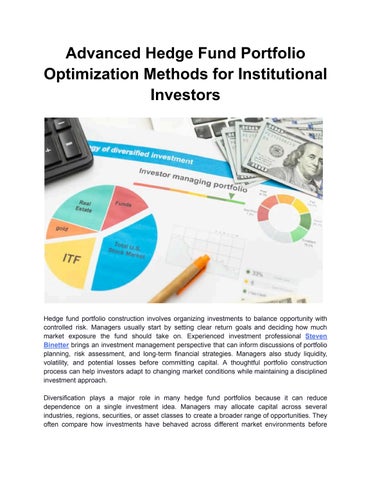
Hedge fund portfolio construction involves organizing investments to balance opportunity with controlled risk. Managers usually start by setting clear return goals and deciding how much market exposure the fund should take on. Experienced investment professional Steven Binetter brings an investment management perspective that can inform discussions of portfolio planning, risk assessment, and long-term financial strategies. Managers also study liquidity, volatility, and potential losses before committing capital. A thoughtful portfolio construction process can help investors adapt to changing market conditions while maintaining a disciplined investment approach. Diversification plays a major role in many hedge fund portfolios because it can reduce dependence on a single investment idea. Managers may allocate capital across several industries, regions, securities, or asset classes to create a broader range of opportunities. They often compare how investments have behaved across different market environments before
combining the results. Two assets that appear different can still react similarly during periods of stress. For that reason, managers look beyond simple asset labels and study relationships between positions. Effective diversification focuses on how investments interact rather than simply increasing the number of holdings. Another key technique is controlling the size of each position. Hedge fund managers may allocate more capital to opportunities with greater potential returns, but they must also consider the downside risk. Even a high-confidence idea can create problems if too much capital is committed to it. Position limits help prevent one holding from dominating the portfolio's results. Managers can also spread risk across several positions with different return drivers. By carefully adjusting position sizes, a fund can pursue attractive opportunities while reducing the risk that a single unexpected event could seriously damage overall performance. Many hedge funds also manage their portfolios by balancing long and short exposure. Long positions are generally taken when managers expect prices to rise, while short positions are taken when they expect prices to fall. These positions can work together to reduce dependence on broad market direction. Managers may also use hedges to limit exposure to interest rates, currencies, industries, or other risk factors. The exact balance depends on the fund's strategy and current market outlook. Regular exposure reviews help managers assess whether the portfolio is becoming too aggressive, too concentrated, or too sensitive to a single economic trend. Continuous monitoring is essential because portfolio construction does not end when investments are selected. Market prices, correlations, volatility, and liquidity can change over time, potentially altering the risk of existing positions. Managers often use stress tests and scenario analysis to estimate how the portfolio might react to sharp market moves or unexpected events. They may rebalance positions, reduce leverage, increase cash, or add hedges when conditions become less favorable. A strong portfolio construction process combines research, discipline, diversification, position control, and regular review to support more consistent decision-making across changing market environments.