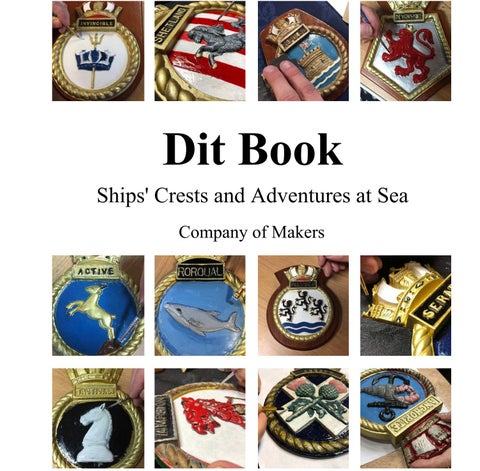
Dit Book
Ships' Crests and Adventures at Sea Company of Makers
Dit Book
Ships' Crests and Adventures at Sea
About Company of Makers
Company of Makers (CoM) is a not-for-profit social enterprise that supports Veterans and their families who struggle to transition from military to civilian life by running ‘making’ workshops. These are mostly supported by military charities, some self-funded by CoM and this project by The National Lottery Heritage Fund. As well as this, we provide support with emotional challenges and practical issues with life on ‘civvy street’. To support our workshop activity, we run a small trading organisation (CoM Ltd), which pays for and operates from our 'Hotwalls Studio' in Old Portsmouth. Here, we design, make and sell unique items from unneeded military uniforms, putting them ‘back into Service’. Renovation is nearly complete on our very own HQ for Veterans’ making workshops 'Casemate 37', which was an old guard house located at historic Fort Cumberland, a unique 18th century military fort next to the sea. A walled 23-acre site, it is an inspiring and peaceful place for our Veterans to enjoy.
Co-founders CoM was co-founded by Rachel Olivia Owen & Steve Bomford, graduates of the School for Social Entrepreneurs. Both experienced life-changing events that provided the motivation, need and commitment to help other people through insight into the unexpected challenges that life can present.
What's the difference between a crest and a badge? There can often be some confusion between the use of crest and badge, because they are used interchangeably in speech to refer to naval heraldry. Naval heraldry is used to identify naval vessels, and these words essentially fulfil the same purpose. However, the difference between the two lies in their country of origin. In the Royal Navy, and other Commonwealth navies, they use badge, and these are displayed on the ship's exterior. On the other hand, the US Navy instead uses crest or seal: these are not displayed on the ship, but instead are on uniform patches.
"Ships' Crests and Adventures at Sea"
During the Age of Sail, Royal Navy (RN) ships were identified by elaborate figureheads and gilded carvings, the cost of which started to be restricted by the Admirality in the early 1700s. These extravagancies were eventually banned and replaced from 1850s with crests or ‘badges’ as identification marks. This is a heritage project. Over many years, crests have been passed to the Royal Maritime Club (RMC), Portsmouth, from the estates of former naval sailors. Nothing was known about these old crests, many in disrepair, some completely broken. As the Home of Royal Navy, naval history is important in Portsmouth and this inspired Company of Makers (CoM) to work with local Veterans who wanted to reinstate the crests to their former glory and learn about the lives of the sailors who Served on board the ships represented by these crests.
We decided to run workshops at the Veterans’ Outreach Support monthly drop-in at the RMC, to repair the old crests with the utmost care; remodelling missing parts, hand-painting them and mounting onto hardwood shields, ready for display on the RMC’s library walls for everyone to enjoy. Research into the RMC’s crests got underway, with visits to the National Museum of the Royal Navy, Portsmouth Historic Dockyard and the Submarine Museum across the harbour in Gosport; which revealed that some of the RMC's crests are not from the RN – interestingly, many originated from other countries, with motifs representing clubs and societies, or even buildings such as a police station. With the project focus being on crests of the RN, a deeper dive (excuse the pun) into the investigation revealed that many of the RMC’s crests are those of RN submarines. A guided tour from a former submariner on board HMS Alliance really brought to life the tight space and disciplined lifestyles that submariners must lead, as well as close relationships formed by the crews.
We wanted to discover the stories ‘dits’ of the people who were united behind these RN crests, bound together in Service of their ship or submarine; and share them in a photobook. The sailors on these ships and submarines 'boats', whatever their rank, were loyal to their crest, a 'badge of honour', providing a sense of belonging and community. As you can imagine, so many sailors came forward with dits. Many were for ships and boats whose crests were not in the RMC’s collection; however, we’ve included those here whose crests are – the printable dits anyway! Behind every crest, there is the story of people who went to sea, the traditions, adventures and camaraderie and through this, their stories will live on. Rachel and Steve Co-founders Company of Makers
Memories Past When my wife and I were invited to VOS meetings, on the first Wednesday of each month, with a view to renovating numerous ships' plaques, I felt a twinge of memories past. On board ship, if you wanted a ship's plaque you had to go and see the Buffer or the Shipwright so you could get one. The only snag was that you had to make your own! The process began by doing a casting, in plaster, in one of the stock ships moulds. We had to be very careful to eradicate all the bubbles, which could play havoc with the finished product. You would get a chance to fill them in as a makeshift repair later on. However, the plaque then became non-pristine and that would never be shaken from your mind! Casting finished it was time to paint it. There was a standard colour plan to follow and it was never questioned. When we started the renovations, at VOS, we found out so much about colour schemes on the standard framing and lettering, even the shape of the plaque and the backing board, that had never been explained before.
Naval heraldry all began in the 19th century as a pictorial aid as to identify ships. Originally they took the form of a ship’s figurehead. These developed into ship's coats of arms or crests which were in the form of large badges displayed on the ships superstructure. Smaller plaques were put into use on gun muzzle tampions and on gangway entries when alongside. These badges took many forms and in 1919, just after the First World War, were standardized as four shapes: Circular for Battleships & Battle Cruisers, Pentagonal for Cruisers, A Shield shape for Destroyers and a Diamond shape for all other types and shore establishments. At the start of World War 2, in 1940, the designs for all ships were standardised to a circular design primarily due to wartime shortages. However, another reason was to eliminate difficulties caused when a different type of vessel was commissioned with a previously-used name, hence requiring a redesigned badge with the new shape.
When a ship did use a previously used ship's name, the colouring of the ship’s name and background, on the plaque, varied to reflect that fact and also whether the previous ship had been sunk in battle. This was all indicated by having white print on a black background, gold print on a black background and even black print on a gold background. Which combination indicated what escapes me at the moment, I’m sure somebody more knowledgeable than me will know. As you can imagine, when we were at VOS, trying to repaint ships plaques, the colour scheme took a lot of debate and eventually we managed to borrow a two volume pair of books ,which laid out every ships plaque in existence and the varying colour schemes adopted by particular reincarnations of any ship. Even the shapes of the plaques came into question in many cases, what shape they should be, along with what shape the mounting board should be.
We rubbed down numerous plaques and backing boards, repairing any that needed it, and painted them all to the best of our abilities. We probably didn’t get it right all of the time, but it would take somebody whose mastermind subject is ‘Ships Plaques’ to see any of the errors we made. The results of our labours are going to be on display in the library of Portsmouth’s Royal Maritime Club, probably known to many as The Home Club. That’s what it was called during my many years in the RN. Ian Bourne
HMS Alliance
Blue; in front of two wings conjoined white two swords in saltire white pommels and hilts gold surmounted by an anchor also gold.
Funeral at Sea The one that comes to mind as best illustrating the unconventional and unique spirit of submariners comes from my last day at sea. Living conditions on board were very basic so we did not wear uniform but an eclectic display of old civilian clothes appropriately referred to as ‘steaming gear’ and destined to be thrown away at the end of a patrol.
However, I had treasured and preserved an old green sweater which I only donned as a sort of lucky mascot when carrying out a particularly difficult or dangerous operation – a sort of lucky mascot. It was a very familiar sight but had more holes than sweater and was finally consigned to the gash bin on my last day at sea. It was retrieved from thence by a crew member who had decided that, after long and faithful service, it deserved to be more formally disposed of. As we approached harbour on the surface, it was conveyed up the coming tower onto the casing by a burial party on whose shoulders was a plank on which a ‘coffin’ containing my sweater rested under a Union Jack. Appropriate words to commit my sweater to the Ocean Deep were recited by a suitably attired ‘Padre’ (Able Seaman ‘Buck’ Taylor), a bosun’s pipe trilled and the plank was gently up-ended to send the coffin and my sweater on its way: at which point a passing merchant ship dipped its Red Ensign in respect! Rob Forsyth
Ambush Racing The first story on Alliance was January 1968, whilst heading back to Gosport from exercises in the channel, we were racing Ambush back to base. We had a racing trim on, stern lower in the water than the bow, doing 420 revs. on the engines. The crew were sat in their messes ready to get ashore, when there was an almighty juddering of the whole boat. The crew, due to training, had everything shut down, bulkheads, doors, engines etc. in less than a minute.
It turned out that we had run aground on Bembridge Ledge off the Isle of White. Ambush was sent back out to stand by us, so they didn't get ashore for a while either. Once it was realised what the situation was, then most of the crew were airlifted off by helicopter, taken to Bembridge, where we stayed in a hotel over night. The boat was eventually taken off the ledge and taken into the dockyard, part of the keel had to be replaced. After the repairs had been done, our first visit was to Manchester. Paul Vassey
HMS Alliance - Amphion “A" Class Submarine 1947-1973 • HMS Alliance (1795-1802). Originally a Dutch frigate ‘Alliantie’ from 1788, captured by the British in 1795. Sold in 1802. • HMS Alliance (1910-1941). Lead vessel of class of four tugboats. Scuttled in Hong Kong in 1941.
Photo: National Museum of the Royal Navy
HMS Ambush
On a mount green a bush all proper issuant therefrom three spears one erect two in saltire proper. "Hide and seek."
Has Artful and Ambush been in service long enough to have any dits? Si Hudson
HMS Ambush - Amphion “A" Class Submarine 1947-1967. • HMS Ambush (1814-1815). Originally an American gunboat of 1805, captured by the British in 1814. Sold in 1815. • HMS Ambush (2013-). An Astute-class submarine, still in service.
Photo: National Museum of the Royal Navy
HMS Antrim
Green; upon a torse gold and red a dexter arm embowed sleeve gold cuff whit the hand proper holding a cross crosslet fitchy blue. "Always ready."
Leaving Liverpool I joined HMS Antrim in 1976. I remember doing workups, exercises and Seaslug missile firings during the year, with various visits along the way; that year and during the following year I was on board. My memories of time on board start when we were in Liverpool. We were tied up alongside the Liver Building around where the 'Ferry Cross The Mersey' sailed from. There was a quite significant event that took place at the time. A nuclear submarine, HMS Warspite, had a fire on board. We sent fire parties across the Mersey, to where she was berthed, to help and it was all dealt with in a timely manner, without life loss, with several hundred visitors being rescued (the sub was 'open to visitors' at the time). Our personnel were used as sentries over there for several days afterwards. Several bravery awards were given.
After that, there was the Seaslug missile firing. The missile is fired from the huge bedstead type launcher from the stern of the ship. The missiles are fed around the heart of the ship, just fore ward of that, along a network of rails, feeding it from the allocated magazine out onto the launcher. Our mess deck was in the same vicinity of the ship as that launcher. When the missile went the noise and vibration was overwhelming. The firing was deemed a success, just leaving the task of completely repainting the launcher as the missile burnt all the paint off it! In the summer of '76, we went to Stockholm and had Lord Louis Mountbatten come on board while we were there. He was there as the queen's representative for the King of Sweden's wedding and we were there as his escort. For some reason he boarded the ship, which was alongside, from a boat. As he was climbing aboard he caught his 'Order of The Garter' Decoration, a big fancy silver badge, and it went spinning off into the water below. The ship then went to diving stations and sent divers down to try and retrieve it. They succeeded and Lord Mountbatten was able to wear his now entire set of decorations to the wedding.
After all the fun and games of Stockholm, we sailed up to Lulea, Northern Sweden, right in the North end of the Baltic Sea. While we were there a large portion of the ship's company was invited to a midsummer celebration party. The venue was quite a bus journey North, again, and this was the first time I had ever seen the proper 'Midnight Sun'. Even in Lulea, in the following days, the sun was still shining at midnight, although there was an 'almost' sunset and then the sun came up again to start another day. While we were out and about during '76, I was in the Greenies (Electricians) Mess, although I was a 'Pinkie' (Electronics). One of my tasks, self assumed, was that of mess barber. I had some scissors and a comb, took on the task and did my best. I only used to do it because the going rate for a haircut was a couple of cans of beer. My downfall was when, one night, I was hairdressing and drinking the beer as I was doing it. My judgement was a little impaired and I managed to cut a very small piece off the top of this bloke’s ear. I've never seen such a little cut emit such copious amounts of blood. We managed to stem the flow quite quickly, but, needless to say, nobody ever asked me to cut their hair again!
During late '76 I was promoted from a lowly Radio Mechanician 4th Class (Leading Hand) to a Radio Mechanician 3rd Class (Petty Officer). This meant coming out of square rig into a senior rates 'suit'. As we were away, there was no provision for me to be issued with an ordinary Pussers Suit so I had to get a suit knocked up by the 'Chokey Sew Sew' (Chinese Tailor). It fit like a glove, tapered and flared in the right places, and was worn for many years until later in my career (Leadership Course at Royal Arthur). We were told we weren't allowed to wear anything like it - too well tailored, flared or tapered etc. Around the time of my being made up to a Petty Officer Mechanician, moves were afoot to combine Mechanicians and Artificers. The Apprenticeships for each are exactly the same, except the upper age limit for Mechs was higher than Tiffs so you could join up for the course at an older age. There has always been great 'rivalry' between Mechs and Tiffs and the result of combining the two, in my opinion, should have been retitled as 'Technicians'. However the MOD in their wisdom called us all Artificers. On top of all this we were not allowed to wear our Mechs badges on our uniforms. There was a great bitterness in all of this from the Mechanician ranks but nothing ever happened about it, we just had to bite the bullet and take on the Tiff title graciously.
1977 - For some of this year we were the Royal Yacht's Guard Ship, while it, with the Queen and Prince Phillip on board, toured the Caribbean. Prior to assuming this role the whole ships company spent several weeks getting kit to a tip top condition and cleaning and painting the ship to within an inch of it's life. During the time as guard ship, there was a flypast by Concorde as a salute to the queen, as it was her Silver Jubilee year. We did a sailpast, as well, but I think that was maybe when we handed duties over to somebody else. We were all lined up on the upper deck in full white uniform and gave the traditional cheer, three cheers actually. You have to have your cap in your hand, arm outstretched and on the signal of: 'Three Cheers for Her Majesty The Queen', rotate your arm in a clockwise direction whil shouting 'Hurrah', three times! Her Majesty & The Prince returned the favour with a simple wave from each of them.
During that period in the Caribbean, we were on a visit to Nassau and were allowed ashore as long as we were in rig (uniform). My run ashore coincided with the Queen & Prince leaving the Royal Yacht for a visit to some dignitary or other, somewhere ashore. My Oppo (friend) and I had just left the ship and were standing on the corner where the road exited the Docks. We saw the Queen's car coming, stood smartly to attention and chopped one off for them (saluted). We were the only people around that area at the time and the Queen gave us a wave while the Prince saluted us back. The one and only time I have had a personal wave and salute off the queen and her consort. At the end of June 1977 we had the dubious honour of being present at the Queens Silver Jubilee Fleet Review. Although we were in the Solent there was no leave granted for the three or four days duration. We were all required, again, to clean the ship and get our No 1's to their best for the Royal Yacht sail past and salute. We were all lined up around the ships upper deck, on the day, and did get to see the Royal Yacht go past, about half a mile away. There were medals presented for that occasion, only three or four per ship! Of course they went to the 'higher in command' on board, the 'Skipper', the 'Jimmy' and whoever were their favourites at the time. The rest of us got nothing but were allowed to buy souvenir mugs from the NAAFI.
During 1977 my wife, at the time, presented me with a bouncing baby boy. He was born in March, a day prior to my sailing for a six months trip away on HMS Antrim. Nine months previously, she had come up to Rosyth, for a visit, to break the news. In fact, I think my mum & dad brought her up to Scotland. This was the period when we were doing exercises in the North Sea. It was a welcome weekend visit, as a break in the hard work and the deliverance of the good news of the impending arrival. In '77 when I finally did get home, from the six months away, I had great difficulty comprehending what I had missed in my son’s growing up, during that absence. He had changed so much, in the time, I barely recognised him. I did bring him a pair of 'Little Levis' from the PX in Norfolk, Virginia. They fitted him then, but not for long. The jeans were passed around family & friends for ages afterwards until we lost track of them. They’re probably still going strong because of the quality, being Levi’s and all. The irksome part of being at the Spithead review was that we visited Pompey area to do it, but there was no leave, and we sailed off into the sunset after it. Off to the good old USA.
Spring '76 (I think) we visited several places whilst on the East Coast of the States. Fort Lauderdale was the one that sticks in my mind. While there we had the task of floodlighting ship. It involved mounting floodlights on all the yardarms and funnel, along with lights all around the upper deck hanging out on booms to light up the hull. Our team had the task of rigging the yardarm lights. It was during the afternoon and, as we weren’t in a naval dockyard, there were lots of sightseers up and down the jetty for us to perform to. And, of course, we did. We were up there with a pair of safety harnesses each, to swing around on and generally perform (safely), while waving at all the prospective 'Grippos' looking to take a sailor out on the town that night. I didn't manage to attract any body's interest to treat me to a run ashore, so went on my own, or tried, but got no further than the gangway. I got sent to change my t-shirt as the 'Officer of The Day' took objection to it. It was blue with a picture of a fighter aircraft bristling with weaponry and below was written 'Fly The Friendly Skies of Vietnam'. I was told it was in bad taste and that I probably wouldn't last very long ashore if I wore it!
When I finally got ashore, I got talking to a group of people in a bar and all they wanted me to do was to speak, they were so mesmerised by the English accent, it was scary! Later that night we all went to a party where dubious things were being smoked and a good time was had by all. At one point I was asking for a light and was given a plain Zippo lighter, when I tried to give it back I was told to keep it. That was my prized lighter and I used it for many years. When the party was dwindling, at about five o'clock in the morning, I managed to get a lift back to the ship. Which was just as well as I didn't have a clue where I was. It was a wonderful ride, in a big red Trans Am Firebird, it's four or five litre engine burbling along to the full blast music of Fleetwood Mac's 'Dreams'. My introduction to that wonderful album 'Rumours'. Another visit I remember was to Norfolk, Virginia. We spent a lot of time in the PX gym & swimming pool. There was a sauna as well. We used to really upset the yanks (Americans) in the sauna, we were doing sit ups, squats and press ups and being really over energetic. The result was the sauna emptying to the tunes of ‘Goddam Limeys’ and ‘What is wrong with you sonsabitches’. We thought we were being clever and showing them who was best. There was also a lot of time spent in the PX bar trying to outdrink the whole of the American Navy. We drank far too many pitchers of beer (Coors - artificial American beer) and copious numbers of ‘Tequila Sunrises’.
While in the US we had a trip laid on to Disney World. It hadn’t come into being until 1971 so we got in there in its early years. We left the ship at stupid o'clock and visited Sea World on the way where we all got wet by the jumping killer whale and floundering sea cows. All the time in America, we wore sunglasses and never ceased to be amazed when we came out of anywhere indoors they used to steam up. It was all to do with the air conditioning. At Disney it was no different and resulted in not being able to wear them much. While in Disney I had my first frozen chocolate banana. Literally a frozen banana with a chocolate & nut coating, we all thought this was the bees knees. We also had a trip to Cape Kennedy (Cape Canaveral that was) and saw everything related to the moon landing: the VAB (Vehicle Assembly Building, the largest volumetric building in the world at the time), the moon capsule, androcks bought back from the moon. They had us in the control room and did a simulated launch, with noise and vibration as it would have been on the day (a bit like our Seaslug missile above our heads!). In Norfolk, Virginia, the Stand Easy burger van on the jetty was classic, massive juicy burger with everything on it was the order of the day. That’s one thing I will never forget!
The time scale of some of these memories may be a little distorted, my memory not being what it used to be. There are other thoughts and memories I have, but possibly not attributable to my time on HMS Antrim. If there is anybody that served on her over a similar period it may be possible to compare notes or merely to corroborate what I have presented. Ian Bourne
HMS Antrim - County Class Destroyer 1967-1984 Battle Honours: Falklands War • HMS Antrim (1903-1922). A Devonshire-class armoured cruiser. Scrapped 1922.
Photo: National Museum of the Royal Navy
HMS Arrow
Green; two arrows in saltire gold points downward armed silver flighted red. "Celeritus certus." - Swiftly sure.
Snowing in Florida Dec 1989, we were entering Tampa Bay, Florida for Christmas/New Year stand-off in the middle of a six month West Indies Guardship deployment. We were all at Procedure Alpha (lining the guardrails around the upper deck) in tropical uniforms ready to enjoy all that the Sunshine State had to offer for two weeks.
As we approached the iconic Sunshine Skyway Bridge across the bay, the early morning sun disappeared, and fog rolled in so thick, so that as we passed beneath the bridge we struggled to make out the top of the mast, never mind the bridge. By the time we got alongside in the harbour, it had started raining and we are all frozen in our thin cotton uniforms. The captain ordered a return to Blues and, within a week, Florida was experiencing its first snow in two hundred years. It wasn't a total washout - I did get married while was there and we will celebrate our 30th Anniversary on the 22 December. Paul Attrell
Grandpa!? If I remember correctly, HMS Arrow paid a visit to Tobermory on the Island of Mull in 1977. I think our Navvy came from there. Anyway, he organised a dance for the ships company in the village hall - NO BOOZE. We all smuggled bottles in. About 7 years ago, my missus and I returned there. In the pub next to the jetty steps, they still had the ship's plaque above the bar. I mentioned to the girl behind the bar that I was on the HMS Arrow on that occasion. She said: "Oh yeah, that would have been when my GRANDPA had the pub." Yeah. Thanks for that. Gary Powell
HMS Arrow - Type 21 Amazon Class Frigate 1976-1994. Battle Honours: Falklands War • HMS Arrow (1796-1805). A 20-gun sloop, captured by French frigates. • HMS Arrow (1805-1828). 14-gun cutter, converted to a breakwater 1815. • HMS Arrow (1823-1852). 10-gun cutter. • HMS Arrow (1854-1862). 477-ton Arrow-class wooden screw dispatch vessel. • HMS Arrow (1871-1922). Ant-class iron gunboat. • HMS Arrow (1930-1943). A-class destroyer. Damaged during WWII Photo: National Museum of the Royal Navy
HMS Artful
Green; a monkey passant guardant proper.
Goodwill Visit Aalborg. Denmark - Local newspaper “Aalborg Stiftstidende� report. "Wind and current this morning created problems for the English submarine HMS Artful that is visiting Aalborg until Thursday. The arrival was delayed for over an hour because she was unable to berth because of the strong current. A tug from Goliath gave a helping push before the Union Jack was hoisted in the bow. Representatives from the port authorities, police, and military went on board with the British Consul in Aalborg, merchant Eric
Embard. An extensive program for has been made for the visit in Aalborg. The crew will go on tours and company visits in the city and in return receives visiting school classes and other interested parties. Visits on board are possible Sunday 14:00 to 17:00." The original cutting was given to me by John Roberts who worked for the newspaper and he kindly invited me to stay with his family during our visit. He played professional football for Grimsby 1938/9, and met his Danish wife and moved to Denmark. He was well known locally in Aalborg for running and encouraging local youth football teams. Charlie Hayward Translation Paul Natorp
HMS Artful - Amphion "A" Class Submarine 1948-1968 Other vessels: • HMS Artful (2016- Still in service). Astute-class nuclear attack submarine.
Photo: National Museum of the Royal Navy
HMS Bulldog
Black; a bulldog statant white. "Hold fast."
Sonar Sweeps “HMS Bulldog” undertook some of the most dangerous surveys possible due to her having to conduct towed Sonar Sweeps up and down and across the main shipping lanes of the English Channel from July 1977 to March 1978. Radio warnings were given frequently to all shipping in the area. It was an eventful time, especially each night but it was enjoyable, and, as a Leading Seaman (Survey Recorder) I undertook the Fair Sheet drawing of the Main Hydrographic Chart of the English Channel, a copy of which still proudly hangs on the wall in my house. It took 1 year to draw the Fair Sheet by hand conducted outside of watchkeeping hours… Gerry Quinn
HMS Bulldog - Bulldog Class Survey Vessel. 1968-2001 Other vessels: • HMS Bulldog (1794). 4-gun hoy. Sold to Jersey later that year. • HMS Bulldog (1782-1829). 16-gun sloop, converted to a bomb vessel 1798. • HMS Bulldog (1845-1865). Ran aground and had to be blown up. • HMS Bulldog (1872-1906). Third-class gunboat of the Ant class. • HMS Bulldog (1909-1920). Beagle-class destroyer, scrapped. • HMS Bulldog (1930-1946). Destroyer. She is most famous for the actions of some of her crew in making the first capture of an Enigma Machine. Photo: National Museum of the Royal Navy
HMS Devonshire
Silver; a lion rampant red armed blue crowned gold. "Auxilio divino." - By the help of God.
The electrical mess deck on HMS Devonshire, when the dockyard painters refused to paint over these.
Thia was a fantastic day, at the time in 1971, she was the largest warship to get that far up the Thames to tie up alongside HMS Belfast before she was open to the public. Robert Cross
Cosmos Tours HMS Devonshire was in Malta 1979. I went ashore and got talking to a couple of pensioners from the UK. The lady asked if I was off the "lovely ship in the harbour?" I replied in the affirmative. She then asked if it would be open to visitors as she would really LOVE to go aboard. Her disappointment was obvious when I said no. I said instead they could come as my 'guests' and I could take them around, give them lunch and a drink in the mess. I said they should get one of the local boatmen to bring them out to the ship the next day, which was a Sunday. They duly arrived as did fifteen others from their tour group! I earned the name of Cosmos Tours. Richard Broniman
SHARK! It was a long time ago but a few dits stick in my mind as much today as they did when I first heard or witnessed them. I can remember in or around 1976, I was a young AB setting up the dining hall for movie night. I can remember thinking how cool it must be to be the ships projectionist. I remember the movie reels came in large carry cases, with the movies themselves inside silver disc-shaped holders. The ship's company had been waiting for the latest delivery of movie reels in great anticipation. I say anticipation, we had received the advanced list of films which had been published to the messdecks and at the top of the list was JAWS. Everybody had heard so much about the film which had caused a stir around the globe. That evening and for many nights afterwards, the dining hall was packed as we watched this huge white shark terrorise, attack and kill innocent beach goers and unsuspecting boaters. We can't, of course, forget the climax, where the shark finds itself on the back of a fishing boat, with Richard Dreyfus and Rod Steiger trying to kill it with an exploding oxygen bottle! What a cracking film!
The following day and with impeccable timing, the skipper ordered a hands to bathe, we were in the med. It was glorious and if memory serves me right, Dev was heading to Malta for a 24 hour rabbit run before going home. I can remember wandering up onto the flight deck to watch the lads dive in and swim around, from the corner of my eye a scruffy looking MEM appeared in his blue ovvies and tatty steaming bats, clutching a four o’clocker's brew of tea and a slice of toast. Briefly, he peered over the side and looked down on the scene in the water, he suddenly threw his head back and with a piecing shrill shouted "SHARK!" For a split second, you could have heard a pin drop! One of the lads in the water looked toward the ship, paused and then absolute chaos ensued, as they raced for their lives to get up the scrambling net! I could see people being swam over and walked on, as they all tried to climb up the ships side all at the same time, the scrambling net swaying from side to side.
The goofers on the upper-deck were in fits of laughter and when everything calmed down and all the lads were clear of the water, everyone was looking around to see who had shouted the warning. However, knowing what awaited him and damage done, the MEM had wisely disappeared below decks. Needless to say, hands to bathe was never the same again and for the rest of my career, this amusing incident was a stark reminder of what might lay beneath! Andy Richards
HMS Devonshire - County Class Destroyer, 1962-1978. Other vessels: • HMS Devonshire (1692-1707). 80-gun third rate, blown up in action. • HMS Devonshire (1710-1760). 80-gun third rate, hulked in 1740. • HMS Devonshire (1745-1772). 74-gun third rate. • HMS Devonshire (1804). Fire ship. • HMS Devonshire (1812-1869). 74-gun third rate, harbour service 1849. • HMS Devonshire (1904-1921). Devonshire-class armoured cruiser. • HMS Devonshire (1929-1954). County-class cruiser, training ship in 1947. Photo: National Museum of the Royal Navy
HMS Invincible
White; a trident erect gold enfiled with a naval crown blue.
First commission, 1980. When we were in Barrow, a transporter turned up with three and six inch cannon shells. This threw everyone until they realised that Invincible was a “through-deck cruiser”, whereas the last cruisers the fleet had was “Blake and Tiger”: these had 6 inch and 3 inch turrets. Eammon McGrath (age 20 at time of picture)
HMS Invincible - Invincible Class Aircraft Carrier, 1980-2005. Battle Honours: Falklands War Other vessels: • HMS Invincible (1747-1758). French 74-gun ship o L'Invincible, captured 1747. • HMS Invincible (1765-1801). 74-gun third rate, wrecked in 1801. • HMS Invincible (1808-1861). 74-gun ship, • HMS Invincible (1869-1904). armoured "broadside battleship" built in 1869. R • HMS Invincible (1907-1916). Battlecruiser. Sank in 1916. Photo: National Museum of the Royal Navy
HMS Repulse
Blue; upon wavelets engrailed silver and blue a tower gold from which flies a Union Flag developed proper. "Qui tangit frangatur." - Who touches me is broken.
Cavorting in S**T I joined submarines in 1963 served for eight years in diesel boats and left in 1971. I re-enlisted in 1973 and entered the Polaris programme, my first boat being HMS Resolution (S). Even though I was a seasoned submariner I was a Part 3 (beginner) in this class of boat. I joined the boat during a maintenance period in between patrols. During this maintenance all the domestic tanks had been emptied, scraped and cleaned by an outside cleaning company. We set out on patrol and that night during domestic routines, where all the domestic tanks were blown overboard, it was found that the Sewage Tank (shit) could not be blown. It was assumed that during the maintenance clean something had been left behind in the tank and was blocking the outlet pipe. A volunteer was required to enter the tank and find out what was blocking it. Enter yours truly, I was dressed in a plastic hazard suit, fitted with an EBS mask and a wandering lead (light) and entered the tank. The sight of a tank full of piss & shit is not a pleasant sight. I slipped and slithered in the tank over to the discharge pipe and found the blockage a piece of plywood that had been used as a scraper was jammed under it.
During this period of cavorting in shit I realised that the plastic suit they gave me for protection had breathable feet which to my surprise also let in liquids, so apart from being covered in shit on the outside I was being topped up on the inside of the suit as well. The language when I got out of the tank was as ripe as the smell, and all the attendants were all curled up laughing because I had a turd sticking on my ear. That was my introduction to my Polaris life. Mind you the large TOT of rum I was given did compensate. Brian Reed
Shipper's View There were many amusing stories that came out of this of course. One famous story of a foreplanesmen bringing the boat too shallow, when asked by the Captain why he was so much off depth, shallow, he replied, “I thought you would be able to see better Sir!” There was no ‘repeatable’ record of the Captains response! Philip J Bamfield
HMS Repulse - Resolution Class Ballistic Missile Submarine, 1968-1996. Other vessels: • Repulse (1596). 50-gun galleon also known as Due Repulse. • HMS Repulse (1759-1776). 32-gun fifth rate. • HMS Repulse (1779-1781). 10-gun cutter, in the records until 1781. • HMS Repulse (1780-1800). 64-gun third rate. • HMS Repulse (1780-1782).12-gun cutter. • HMS Repulse (1794-1795). 4-gun vessel. • HMS Repulse (1803-1820). 74-gun third rate. • HMS Repulse (1855). Screw-propelled 91-gun second rate. • HMS Repulse (1868-1889). Ironclad ship. • HMS Repulse (1892-1911). Royal Sovereign-class battleship. • HMS Repulse (1916-1941) Battlecruiser, sunk in a Japanese air attack. Photo: National Museum of the Royal Navy
HMS Seraph
Blue; a seraph's head wings displayed and inverted gold. "Prosequor alis." - I pursue on wings.
General Clarke's Throne I had a friend, Allen Witt, who was an officer on HMS Seraph and I went on board when she was at HMS Dolphin in Gosport. The thing I remember about her was that there was a brass plate on the door of the officers' heads that said "General Mark Clarke sat here". She was also famous for her role in Operation Mincemeat (The Man Who Never Was). Geoff Bruty
HMS Seraph - "S" Class Submarine, 1942-1962. Other vessels: • HMS Seraph (1918-1934). S-class destroyer.
Photo: National Museum of the Royal Navy
HMS Thermopylae
Blue; on a mount green a lion guardant statant on a block white. "We shall fight in the shade."
Not a Cruise Liner I had previously been on HMS Devonshire from 1964 to 1966, but after six months on a WWII converted destroyer, I thought I was joining a cruise liner. Later, I was on the Thermopylae after submarine training before joining Warspite. If it dived to 120 feet we used to pray. Happy days. Ian Wragg
HMS Thermopylae - Triton "T" Class Submarine, 1945-1970.
Photo: National Museum of the Royal Navy
HMS Walrus
Blue; the head of a walrus proper. "Cave dentes." - Beware of my tusks.
Heading Towards the Bottom During my time in Blake and Walrus I was a Surgeon Lieutenant RN. I was supposed to have put my pussah’s grip on Artemis - but she went glug glug alongside the wall in HMS Dolphin (1971), hence my first experience of submarines was Walrus: Having been 'around the world' on the cruiser HMS Blake, playing rugby, drinking beer and chatting up blondes, I thought I knew about the Navy. However, I was to find that submarines were totally different.
Everything was for real - there appeared to be no exercises until proven otherwise. We had been two days at sea, and were exercising with the RAF who had to be home 'in time for tea'- in the middle of the Atlantic. Morley Stephens, our Captain, suggested I stand behind him in the Control Room and observe. Two hours later, when things calmed down, I said to him: "That was dramatic, at one stage I thought we were out of control, heading towards the bottom." He replied: "We were!” We got into Nassau early for my flight: Morley decided that I should miss it, as he wanted a Surgeon Lt at the bottom of the ladder welcoming the guests on board for the cocktail party, rather than a horny sailor. Getting home, I had to leave everything outside the back door, including the clothes I stood up in, I smelled so! My total time in “the Andrew” (a term of endearment for the RN going back over centuries) was 31 years, followed by some 10 years with Combat Stress, which led to setting up VOS. Morgan O'Connell
Type: Submarine Period: 1961-1987 Status: Decommissioned and scrapped (1991). Motto: Symbolism of Badge: Class: Porpoise-class Other vessels: • HMS Walrus (1917-1938). W-class destroyer • HMS Walrus (1945-1953). Aircraft transporter launched in 1945, renamed HMS Skua in 1953.
Chippy's Paint-Shop Growing up in Sheffield in the 60s and 70s, I was an avid reader of anything to do with the sea. I read RM Ballantyne’s 'The Coral Island' many times and Defoe’s 'Robinson Crusoe' and Wyss’ 'The Swiss Family Robinson' were also favourites. When I discovered science fiction, through reading Jules Verne’s '20,000 Leagues Under the Sea' and “Journey to the Centre of the Earth”, I knew what I wanted to do with my life. I wanted to be a submariner. The little monochrome television that we had confirmed that Submarines were exciting with the excellent “Voyage to the Bottom of the Sea”. Reality set in when I left school and I became an apprentice at a crankshaft manufacturers until the bottom fell out of the engineering trade in the UK and I, along with thousands of Sheffield engineers, was made redundant! It was hard to find work during the 1980s as all the steelworkers were going after the same jobs as me. I was depressed and drank to dull the pain. The only work that I could find was as a part-time barman. Watching friends descend into a spiral of drink and drugs didn’t help the atmosphere of despondency and some went too far and died or became reliant on their poisons. I needed to escape. When I was scanning the scant weekly job vacancies I saw that I was still eligible for service in the Royal Navy so I applied and got in at the age of 26!
As soon as I could volunteer for the Submarine Service I did, eagerly, and went through all of my basic and trade training at HMS Raleigh, HMS Sultan, and HMS Collingwood without a hitch. I met my future wife whilst at HMS Collingwood and went on to training at The Submarine School in HMS Dolphin. During my first draft, to HMS Orpheus, I found that I loved the life of a Royal Navy Submariner (even though there were no windows to see the fish and ferocious monsters that dwelt in the deep). After another spell in the Submarine School, to train for a new class of Diesel/Electric Submarine, I was drafted to HMS Ursula which was being built at Camellairds in Birkenhead. On one fateful journey home to Gosport, I was in the front passenger seat when we were hit with force from behind by another car. Despite trying to rejoin my boat, it was the beginning of the end of my naval career and I was given various shore-side jobs in HMS Dolphin. The last of these jobs was in the “Chippy’s Paint-Shop” painting whatever came in to us. The main thing that 'came in to us' was a plethora of submarine ships crests and I was taught to paint them. It was a job that suited and satisfied me and I enjoyed the company in the workshop. I spent my final months of service painting crests and making “uckers” boards until I was told that, because of my injuries, my service was no longer needed. That was when the bottom fell out of my world.
Many years later, after being medically retired from another job, I met Steve and Rachel from Company of Makers and became involved with the “Ship’s Crests Re-furbishing Project” for the Royal Maritime Club, regaining some self-esteem and interest in life again. It has been a long, often painful, sometimes enjoyable, and sometimes funny, journey to where I find myself now. The journey has been made easier in the last few years by my discovery of VOS and The Company of Makers and now I try to give a little back by volunteering with VOS as a Peer Mentor. Lez Davison
Acknowledgements Thanks for all the hard work, month after month, by Veterans at the Veterans Outreach Support drop-in, Portsmouth. Very special thanks for going ‘above and beyond’ Ian and Sharon Bourne Lez Davison Roger Forman Steve Lucktaylor and his grandson
Restoration Crew Maria Cole, Sonia Harford, Peter Heath, Monica McFarlane, Eammon McGrath, Dave Millington, Mandy Peachey, Gary Thwaites, Lynda and Nick Wakefield, Sue Washington
Thanks for supporting this project John P Alderson MIH - General Manager and also to the staff of the Royal Maritime Club, Portsmouth www.royalmaritimeclub.co.uk Kath Hutton - Portsmouth Service Delivery Manager and also to the staff and volunteers at Veterans Outreach Support, Portsmouth www.vosuk.org Tim Ash (Cdr, RN, Rtd) - Partnerships Director and also to the staff and volunteers of the National Museum of the Royal Navy, Portsmouth Alison Firth, Curator (Archive and Images) National Museum of the Royal Navy www.nmrn.org.uk Royal Navy Submarine Museum, HMS Dolphin, Gosport www.nmrn.org.uk/submarine-museum Volunteer submariner tour guides of HMS Alliance, Gosport
Royal Naval Association www.royal-naval-association.co.uk Submariners Association www.submarinersassociation.co.uk Survey Ships Association www.surveyships.org.uk Jacky Charman, formerly of Action Hampshire Danish 'dit' Translation Pail Natorp Proof reading Abi Hoper Invaluable Resource Admiralty Ships Badges Original Paterms 1919-1994 Vol 1 & 2 T.P. Stopford
Thanks to all the former RN sailors and submariners who joined in on social media, sharing stories and photos… it seems some very ‘mischievous’ (and unprintable) antics went on at sea! ...and finally, thanks for making this possible The National Lottery Heritage Fund
www.heritagefund.org.uk
Write your dits on the following pages....