STETSON U
N
I
V
E
R
S
I
T
Y
SUMMER/FALL 2026
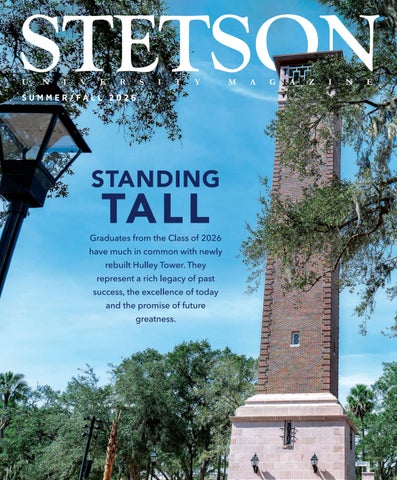
STANDING
TA LL
Graduates from the Class of 2026
have much in common with newly rebuilt Hulley Tower. They
represent a rich legacy of past
success, the excellence of today and the promise of future greatness.
M
A
G
A
Z
I
N
E
BEGINNINGS
Cutting the Ribbon on Lynn Hall As the spring semester began, the university beamed with pride in the form of its newly christened Lynn Hall — a 305-room residence hall, the first built by the university in 20 years. Biggest cause for celebration: The building’s modern design and prime location near Templeton Fountain and the Carlton Union Building promised to make it a pivotal hub for community-building on campus. Said President Christopher F. Roellke, PhD, from the podium that ribbon-cutting day: “Lynn Hall represents our commitment to provide an unmatched student experience, and its central role in fostering community will support student success and lifelong connections.”
2
STETSON | Summer/Fall 2026
Read More
Stetson.edu/today | STETSON
3
STETSON
UNIVERSITY MAGAZINE SUMMER/FALL 2026 VOLUME 42 ISSUE 1
President
Christopher F. Roellke, PhD
Editor
Michael Candelaria
Designer
Kris Winters
Art and Photography Jodi Cothron ’19
Writers
24
Patricia Letakis, Christopher F. Roellke, PhD, Rajni Shankar-Brown, PhD, Jean Smith, PhD, Jack Roth
Departments
Features
Class Notes Editor
2
16 Lifelong Hatter
Contributors
BEGINNINGS Cutting the Ribbon on Lynn Hall
6
WELCOME Rich History, Bold Investments
8
INTELLIGENTSIA News and Notes About Knowledge
56 ATHLETICS A Whole New Game 58 ALUMNI Moments That Will Shape Stetson for Generations 62 THE CLASSES Accolades and Achievements 67 PARTING SHOT Soul of Stetson
At Stetson, meaningful paths are often shaped through relationships, as illustrated by the journey of Valen Siddhartha Shankar Brown ’26 — as told by his mother, professor of Education, transformative leader in social justice and Stetson alumna.
20 Stepping Into Educational Leadership
Educators are smoothly transitioning beyond the classroom with the support of Stetson’s “realistic and relevant” Educational Leadership program.
Amy Dedes ’04
Ginger Anders ’27, Allison Miehl MFA ’25 STETSON UNIVERSITY MAGAZINE is published by Stetson University, DeLand, FL 32723, and is distributed to its alumni, families, friends, faculty and staff. The magazine is printed on FSCcertified paper. STETSON UNIVERSITY: The College of Arts and Sciences, School of Business Administration and School of Music are at the historic main campus in DeLand. The College of Law is in Gulfport/St. Petersburg. The university also has one satellite center: the Tampa Law Center. The mission at Stetson is to provide an excellent education in a creative community where learning and values meet, and to foster in students the qualities of mind and heart that will prepare them to reach their full potential as informed citizens of local communities and the world.
Would you rather receive a digital version of the magazine? To add, remove or change your magazine subscription, email universitymagazine@stetson.edu.
4
STETSON | Summer/Fall 2026
16
46
24 Decade in the Making
46 Law Ready
Stetson’s growing strength in Molecular Biology.
32 Class of 2026: Portraits of Readiness
Commencement in May meant the end of stellar college careers — holistic journeys of skill-building and professional preparation — and the start of very bright futures.
42 Far From Home, Class to Purpose
Genevia “Gena” Gayden, graduate, Class of 2026, personifies the ambitious mission and lasting impact of Stetson’s Ukraine Initiative.
Validated by competition success and campus momentum, the case for undergraduate pre-law is clear and compelling.
50 GenAI on Campus?
Generative artificial intelligence is a real thing, with impacts both in higher education and everyday life. Stetson is working to stay ahead of the curve.
54 Returning Home
An international legal expert and a leading brain expert came back on campus to relive old memories and find that, while their alma mater has changed, much about its students remained the same.
ON THE COVER:
42
The historical reconstruction of Hulley Tower on campus was celebrated in February 2026, four months before the Class of 2026 was celebrated at Commencement. Both were milestone events, marking the passage of yesterday with an ambitious eye on tomorrow.
Stetson.edu/today | STETSON
5
WELCOME
RICH HISTORY, BOLD INVESTMENTS
As our nation marks its 250th anniversary, Stetson University is proud to reflect on nearly 150 years of educating students whose talents, leadership and service have enriched communities across the country and around the world. That enduring mission continues to guide every investment we make today. In July, Stetson announced that we will invest more than $20 million in academic excellence, including more resources for scholarships to attract the best and the brightest to our University. These investments were approved by the Board of
6
STETSON | Summer/Fall 2026
Trustees and will be implemented beginning this fall. That decision followed an intensive Academic Portfolio Optimization study of our academic efforts to strengthen programs most in demand by students and employers, ensuring graduates are ready for successful careers and for life after Stetson. The study comes as the University reported another very strong year for fundraising, with more than $18 million in gifts and new pledges raised in the last fiscal year, ending June 30. The University also exceeded its annual Stetson Fund goal, which provides unrestricted funds for the University’s greatest needs, including scholarships. Thank you, Hatters everywhere, for your continued and vital support. Stetson’s endowment has grown to $440 million over the past decade through fundraising and excellent investment management. Even beyond those numbers, the timing could not have been better for our new investment. That’s because two months earlier, in May, we graduated an absolutely tremendous Class of 2026! We are launching our students toward successful careers, and they are prepared to take on the world — please see our cover story, starting on Page 32. The students included in this coverage reflect only a small sample of our graduating class. However, they certainly provide ample evidence that our bold investments are going to the right places. On stage at Commencement, Serena Dowling, a Political Science and History major and one of the students we profile, described the impact of her Stetson education this way: “Stetson did not teach us our limits. Stetson taught us our limitless potentials. Here, I’ve learned to dream bigger than I ever dared before.” Another Commencement speaker, Geoffery Barthle, a Music Education major, had this to share: “Before Stetson, we had an idea of who we were. But during our time here, that idea was challenged. It was stretched. It was reshaped in ways we never expected.”
As we return to campus for the Fall 2026 semester, and welcome our new incoming class of students, those words are especially heartening. Just as with the students who graduated in May, our University will continue pushing Forward Together with great ambition. The $20 million in new investments will benefit the College of Arts and Sciences, the School of Business
Administration, and the School of Music through scholarships and other academic initiatives. One example is our new Law Ready program, now allowing Pre-Law students to explore legal careers from day one and live together in the new residence hall, Lynn Hall. The students will benefit from close mentoring and opportunities for experiential learning. (See Page 46.)
Clearly, this is an exciting time at Stetson. And it’s the perfect time to invest further in our students and this magnificent enterprise!
Christopher F. Roellke, PhD President, Stetson University
STETSON UNIVERSITY: BADGES OF HONOR
Stetson.edu/today | STETSON
7
INTELLIGENTSIA
Stetson was recognized for its commitment to fostering an inclusive, respectful and student-centered learning community.
‘Education Leader of the Year’ Stetson received the 2026 “Education Leader of the Year” award from the Central Florida Pledge, recognizing the university’s commitment to fostering an inclusive, respectful and student-centered learning community. The Central Florida Pledge, initiated by Alan Ginsburg of the Ginsburg Family Foundation, is a communitywide initiative dedicated to promoting civility, dignity and respect, regardless of differing beliefs, backgrounds or political affiliations. Since 2024, Pledge efforts have brought together approximately 5,000 individuals and organizations in the region. Each signer commits to treat others with dignity and respect, especially when they disagree about politics, religion and other issues.
8
STETSON | Summer/Fall 2026
President Christopher F. Roellke, PhD, was the first university president in the region to sign the Central Florida Pledge. His early signature on the Pledge signaled an institutional promise to uphold those values not only in policy but through action — inside classrooms, residence halls, student organizations, athletics and in Stetson’s partnerships throughout Central Florida. Further, President Roellke added Stetson’s endorsement to “The Pledge Business Network,” an indication the university community stands with Central Florida business and community leaders in modeling the Pledge’s principles.
N E W S
A N D
DID YOU KNOW? This spring, the promise made to all was that every financial gift to Stetson would unlock endless possibilities for students, faculty and staff to continue providing an exceptional educational journey — ensuring Stetson students are Hatter Ready to become the next generation of leaders in their communities. In turn, the Stetson community listened. And it gave in a very big way. During Stetson Gives in mid-March — a 24-hour celebration of philanthropy and participation — a total of 874 donors secured $413,982 for Stetson scholarships and programs. The result was a record-setting day of giving at Stetson to help numerous areas across the campus in DeLand and the College of Law in Gulfport.
N O T E S
A B O U T
K N O W L E D G E
Alumna and Attorney Lila Jaber Now Leads Board of Trustees Lila A. Jaber, a Stetson alumna and prominent Florida energy lawyer, began her term as chair of the University’s Board of Trustees effective July 1. Jaber earned her bachelor’s Lila A. Jaber '88, JD '90 degree in Political Science from Stetson in 1988 and her Juris Doctor from Stetson College of Law in 1990. She was appointed to Stetson’s Board of Trustees in 2019 and chaired its Committee on Trusteeship. Named one of the most influential energy leaders in Florida, Jaber was twice appointed to the Florida Public Service Commission, where she served as both commissioner and chairman, overseeing the state’s utilities. In 2015, she launched the Florida’s Women in Energy Leadership Forum to celebrate the success of women leaders in the energy industry and their role in growing Florida’s economy and diversifying the workforce. Currently, she owns LilaJaber Consulting in Tallahassee and serves on the board of Chesapeake Utilities Corporation. “Stetson has played a defining role in my life and career, equipping me with the knowledge, values and leadership skills that have guided me throughout my professional journey and opened doors to extraordinary opportunities,” Jaber said. “It is a tremendous honor to serve my alma mater in this role. Stetson’s future is exceptionally bright, and I look forward to working alongside my fellow trustees, President [Christopher] Roellke and our university community to ensure that future generations benefit from the same transformative education and experiences that have meant so much to me.” Roellke described her as a “passionate advocate” and “tireless champion” for Stetson and its relationship-rich educational experiences. “Her leadership, strategic insight and deep commitment to our students will serve Stetson well as we continue to strengthen our impact and shape an exciting future for Stetson University,” Roellke commented.
Stetson.edu/today | STETSON
9
INTELLIGENTSIA
The College of Law is the best at “teaching what lawyers do every day.”
U.S. News: Stetson No. 1 Law School for Advocacy and Legal Writing In its newest graduate school rankings, U.S. News & World Report elevated Stetson University College of Law’s legal writing program to the No. 1 spot in that category for the first time. Also, Stetson retained its status as the No. 1 destination for trial advocacy for the fourth consecutive year. The top spot for legal writing follows three consecutive years as the No. 3 school in that category. For trial advocacy, it’s the 26th time in 31 years Stetson Law has received the honor. In other words, the College of Law is the best at “teaching what lawyers do every day,” cited Dean D. Benjamin Barros. His words: “Our number-one rankings in both advocacy and legal writing reflect our values as an institution. No matter their practice, all lawyers advocate and write.” Celebrating its 125th anniversary, Stetson Law sits on a historic campus in Gulfport as Florida’s first law school. Through its Institute for the Advancement of Legal Communication, the College of Law seeks to inspire passion for exploring legal writing’s many aspects, including the ways in which technological factors like generative artificial intelligence are shaping the teaching and practice of legal writing. As a result, for institute faculty and leadership, their work has implications that go well beyond legal academia and practice. For 25 years, the Center for Advocacy Education has helped Stetson Law remain a passionate, deeply supportive community for anyone eager to strengthen their advocacy skills. The campus culture encourages students to speak up for themselves and others, and is evident in events such as the Educating Advocacy Teachers conference and the National Pretrial Competition. Also, its nationally and internationally recognized trial, dispute resolution, and moot court teams have earned more than 110 national titles.
Bold Vision to Amplify Stetson Law’s Tampa Presence Stetson plans to increase its visibility and deepen its long-standing commitment to Downtown Tampa through a transformative redevelopment initiative in partnership with Bromley Companies. The project will modernize the Stetson University College of Law’s Tampa Law Center and create a vibrant, mixed-use space in a currently underutilized area. Situated in the vibrant Tampa Heights district near the Hillsborough River and Interstate 275, Tampa Law Center has served Stetson students, alumni, legal professionals and the broader community for more than 20 years. The reimagined campus, which will feature iconic design and prominent Stetson branding, has the potential to become a major urban connection point linking the Riverwalk to Downtown. The new law center will be integrated into a hotel planned as part of a mixed-use development, which would connect Downtown Tampa, Tampa Heights, and the Hillsborough Riverwalk. Groundbreaking is anticipated in late 2027, with anticipated completion in fall 2029. “This is an investment in the future of legal education, professional development, and sustainable economic development in the Tampa Bay region,” said Stetson Law Dean D. Benjamin Barros.
The project is located at one of Tampa’s most important connection points.
Photo: Stetson Law / caption: Rendering of new Stetson Law
10
STETSON | Summer/Fall 2026
Stetson’s Jeremy DiGorio to Lead Regional Association in Higher Education As Stetson continues its advancement from “Florida Gem to National Treasure,” as outlined in the university’s strategic plan, very promising news comes from Jeremy DiGorio, Stetson’s Vice President of Finance and Chief Financial Officer. In late May, DiGorio became president of the Southern Association of College and University Business Officers (SACUBO). The one-year term also makes him a representative on National Association of College and University Business Officers (NACUBO) board of directors. As a result, with Stetson working to build greater awareness and interest, DiGorio will be a thought leader — working closely with colleagues in higher education nationwide. SACUBO, a volunteer-led organization, was founded to inform higher education institutions in the Southern region of the United States about issues affecting higher education. Its current membership consists of approximately 700 institutions and organizations. As president, DiGorio now leads the charge of an association that will celebrate its 100th anniversary next spring. “I really enjoy working in higher education, and I see this as a great opportunity, not only for me professionally but for Stetson,” said DiGorio, who arrived at Stetson in 2021. “I will be working with some amazing colleagues across the Southeast and the United States.” In turn, DiGorio gets the chance to share the Stetson story with other leaders in higher education. “Just continuing to have conversations and share all of the amazing work in DeLand, Tampa and Gulfport is truly great for our institution!” he concluded. Stetson’s Jeremy DiGorio is now also president of the Southern Association of College and University Business Officers.
Ryan Person, DMA
Ryan Person Selected as Director of Choral Activities Ryan Person, DMA, has been appointed the School of Music’s director of Choral Activities, beginning with the Fall 2026 semester — and with a bit of Stetson serendipity wrapped around the new role. Person (pronounced Pearson) succeeds Stetson’s longtime choral director and former School of Music Dean Timothy Peter, DMA. Peter first recruited Person to attend Luther College in Decorah, Iowa. At the time, Person was 18 while Peter was a professor of music and head of the music department there. Peter later became one of Person’s primary mentors. More than 20 years later, Person will now continue the choral tradition that Peter helped shape at Stetson. Person had been director of choral activities and associate professor of music at Morningside University in Sioux City, Iowa. He brings extensive experience as a conductor, educator and mentor, along with a deep commitment to building community through choral music. “To follow Timothy Peter is a very special honor,” said Person. “Stetson’s legacy is strong, and I look forward to building upon the significant contributions of all of the university’s choral greats.” In May, Peter retired after 14 years of service to Stetson. During his tenure, he led the Stetson Concert Choir, mentored generations of student musicians and helped strengthen the School of Music’s reputation for choral excellence, meaningful performance and community connection. “Dr. Person brings to Stetson an exceptional combination of experience, leadership and vision,” said School of Music Dean Washington Garcia, DMA. “He understands the significance of the choral program’s history and the legacy of Timothy Peter, while also bringing his own perspective, energy and commitment to student success, collaboration and community engagement.” Stetson.edu/today | STETSON
11
INTELLIGENTSIA Dengke Chen, PhD, associate professor of Digital Arts, leads a class.
Stetson Again Named a Top Game Design School This spring, The Princeton Review selected Stetson among the Top 50 Undergraduate Game Design Programs for 2026, based on surveys of administrators at 150 colleges in the U.S., Canada and some countries abroad. Stetson ranked No. 6 in the South and No. 41 overall. Stetson made the list for the fourth time — recognition of academic quality, facilities and career outcomes for students, cited Rob Franek, The Princeton Review’s editor-in-chief. Graduates of Stetson’s program work as game designers, 3D modelers, 3D artists and in other positions for Electronic Arts, Walt Disney World, Pipeworks, Red Storm Entertainment and others. In addition to small class sizes and close faculty mentorship, students benefit from Stetson’s interdisciplinary approach, which integrates Digital Arts and Computer Science in the curriculum and course development to meet student demand, noted Dengke Chen, PhD, associate professor of Digital Arts. Earlier in the semester, the Creative Arts Department, which houses Digital Arts, and the student Video Game Development Club co-hosted the first Video Game Design Competition. Electronic Arts (EA) Sports sponsored the event, emblematic of industry involvement. Daryl Holt, EA’s senior vice president, is a Stetson alumnus. Competition winners received a free 30-minute portfolio review with an EA industry professional, along with discussions with EA professionals about skill development and career planning.
Presidential Fellows Program to Double in Size The Presidential Fellows Program, which began as a pilot initiative in fall 2022, will expand significantly for the Fall 2026 semester — doubling the 25 incoming students per cohort. As a result, more students will receive what the Presidential Fellows Program provides: the opportunity to develop leadership skills through hands-on, experiential learning by virtue of small class sizes, personal success coaching and exclusive access to university events. The program is structured as a comprehensive leadership development experience over four years, with each year targeting activities and learning opportunities designed to build on the previous year’s experiences. In addition, Presidential Fellows will continue to receive substantial financial support, such as a renewable scholarship of up to $50,000 and a $3,000 experiential learning stipend. The Presidential Fellows program attracts exceptionally talented students, representing the top 1% of Stetson applicants. To be considered for the program, students are required 12
STETSON | Summer/Fall 2026
Attracting exceptional students, the program is growing to 50 students, who will receive comprehensive leadership development.
to first apply for the J. Ollie Edmunds Distinguished Scholarship. Students who aren’t selected for the Edmunds scholarship are eligible to become Presidential Fellows.
Randall Croom, PhD, director of the Business Fellows (at right), seeks “curious, purposemotivated” students.
Business Fellows to Begin in the Fall DID YOU KNOW? How’s this for shaping future leaders in business? Each spring semester, the School of Business Administration sponsors the Templeton Business Ethics Case Competition — with Stetson students serving not as participants, but as hosts. Undergraduate students from invited institutions across the country (and Canada) receive the opportunity to analyze and present arguments on a contemporary business issue tied to financial, legal and ethical issues. In turn, Stetson students monitor the proceedings. A total of 18 schools competed. “Just as we do at Stetson, these students took a real-life problem and designed a solution that addresses the financial, legal and ethical issues of the situation,” commented John Tichenor, PhD, Stetson Management professor and Eugene M. Lynn Chair in Business. “It was a great showcase for these fine students, as well as for Stetson University.”
As the summer began, the newly established Business Fellows program was finalizing its list of “curious, purpose-motivated people who act with integrity, execute with agency, respond with resilience, and care about something beyond themselves.” Through the School of Business Administration, the inaugural cohort of up to 50 top students will come together for the 2026–2027 academic year. Some of the fellows will be incoming first-year students; others will be chosen from among existing undergraduates who aren’t part of certain other fellowships on campus, such as Presidential Fellows. More than 110 applications were received from existing students, in addition to applications from incoming students. (The application deadline has passed.) The Business Fellows will receive targeted support for research, internships, study abroad/away experiences, and other approved academic or professional activities. Each fellow will be awarded $2,000 per year for three years. All will be expected to maintain a strong academic record, as well as demonstrate leadership, remain actively engaged, participate in special programming and represent the school at a range of events, including alumni gatherings, Homecoming activities and trustee meetings, cited Randall Croom, PhD, associate professor of Management and director of the Business Fellows. “We'll call on these students to be involved in areas where we need some great students to help represent the school,” Croom said. “We have many great students who would serve as outstanding exemplars to the outside world and within the Stetson community, and we expect that the Business Fellows will be among them.”
Stetson.edu/today | STETSON
13
INTELLIGENTSIA
Showcase of Distinctiveness The 28th Stetson Showcase was one for the ages. At least, that’s how Kimberly Reiter, PhD, associate professor of History and chair of the Undergraduate Research Committee, described it in April. “This last Showcase will stay in my mind as one of the most exciting yet, with rigorous research across all years and fields, amazing creativity in music and the arts, including the wildest cover we have ever had, and a keynote speaker who reminded us all that the future of AI in undergraduate research holds more hope than fear,” Reiter commented. The event debuted in 1999 as the Undergraduate Scholarship and Performance Day, later became the Undergraduate Scholarship Day and then the Stetson Undergraduate Research and Creative Arts Symposium. Today, Stetson Showcase is among the oldest and most distinctive comprehensive Undergraduate Research Days nationwide. In all, approximately 170 posters, art exhibitions and museum studies, music recitals, oral presentations and more were on display. The theme was “Currents of Curiosity: Crossing Streams” — reflecting the increasing opportunities of interconnectivity as academic and creative interests take people in directions never imagined, and the challenges that accompany it. To conclude the day, Antonio Byrd, PhD, associate professor of English at the University of Missouri – Kansas City, presented “GenAI Use from Research to Publishing: A Framework for Setting Boundaries as a Young Scholar.”
Stetson’s Model Senate has become a model itself, nationally recognized for excellence in civic education.
14
STETSON | Summer/Fall 2026
The 2026 Stetson Showcase featured approximately 170 posters, art exhibitions and museum studies, music recitals, oral presentations and more.
Model Senate, Real Impact “You are all acting like senators! You should be very proud of yourselves. This is great to see.” With those comments, Betsy Palmer ’84 helped conclude the afternoon session on the first day of Stetson’s 54th Annual Patrick L. Smith Model United States Senate. And the words by Palmer — an alumna with decades of experience reporting on Congress and the legislative process — aptly summarized the learning experience. As is tradition at Stetson, the event reproduced actual procedures and activities of the U.S. Senate. Each student was assigned to a legislative committee. Also, as part of the immersive experience, each student was assigned the identity of a real U.S. senator for committee work, with the students responsible for helping to research and introduce legislation. Not coincidentally, the springtime Model Senate has become a model itself, nationally recognized for excellence in civic education. A total of 70 students participated from Stetson and nine other schools from as far away as Massachusetts and Maryland in what is the nation’s oldest college-level Model U.S. Senate program. Palmer, in fact, personifies the program’s success, participating as a student in 1982, 1983 and 1984, and serving as the program’s parliamentarian at Stetson for 20 years.
Stetson Surf Club Wins Consecutive Titles to Continue Making History In spring 2025, the Surf Club made history for Stetson by winning the university’s first-ever East Coast Championship title in the National Scholastic Surfing Association, Men’s division. It was the first surfing championship for the student-run club’s non-scholarship Competition Team. This spring, the Surf Club did it again — a second collegiate surfing title in Stetson history. Further, last year’s star — sophomore Braeden Kopec — did it again, leading the team to victory at the event in nearby New Smyrna Beach. As a first-year student in 2025, Kopec became president of the Stetson Surf Club and relaunched the Competition Team, which had been mostly
dormant for decades. Also, he was captain of the team and coached club members during the season at several events that led up to the championship. In the classroom, Kopec is a Presidential Fellow in the Honors Program, pursuing a double major in Business Administration and Professional Sales. Perhaps most impressively, in characteristic style, he deflected praise to his teammates following the big win: “I’m very proud of everyone’s efforts. We’ve accomplished a lot in a short period of time!”
DID YOU KNOW? Call this a classic example of experiential “Hatter Ready” learning: This spring, students in the School of Music collaborated with Opera Orlando in a fully staged production of “Hansel and Gretel,” Engelbert Humperdinck’s time-honored opera. Opera Orlando collaborated with Stetson on multiple fronts, including the design and construction of sets and props for the production. Throughout the year, the organizations also work together as part of Opera Orlando’s Apprentice Artist Program, which provides Stetson Voice majors with professional, onstage experience in the opera industry while earning academic credit. Two students in the “Hansel and Gretel” cast, soprano Alyssa Pimentel and tenor Evan Martinez, were members of the 2025-26 Apprentice Artists Program.
Braeden Kopec, a Presidential Fellow (middle), starred and was team captain.
Stetson.edu/today | STETSON
15
FIRST PERSON
Above: Stetson has colored the lives of parents/professors Rajni Shankar-Brown and Ben Brown, along with children Romila Sitara and Valen Siddhartha — and the family has done the same for Stetson.
L I F E L O NG
Above: When it was time to choose a college, Valen told his mother that “I knew in my heart I was a Hatter.” Left: Valen with “friend-turnedbrother,” Dillon Carter, a fellow May graduate.
HATTER
At Stetson, meaningful paths are often shaped through relationships, as illustrated by the journey of Valen Siddhartha Shankar Brown ’26 — as told by his mother, professor of Education, transformative leader in social justice and Stetson alumna. BY R A J N I S H A N K A R- B ROW N, P H D
16
STETSON | Summer/Fall 2026
W
hen I first interviewed for a faculty position at Stetson in 2013, my son, Valen Siddhartha Shankar Brown, was just 9 years old. While his father (Ben Brown — my best friend, love and life partner, whom I met as a first-year student at George Mason University) and I discussed our family’s future, Valen was already discovering his own. Within minutes of stepping onto campus, he was playing soccer with college students, splashing in the Holler Fountain, and wandering the aisles of the duPont-Ball Library alongside his younger sister, Romila Sitara (who was just 3 years old at the time). The two avid readers and writers explored together. For Valen, Stetson felt less like a university and more like a place where he belonged. In his words, “I remember feeling something special right away. Even as a kid, it felt alive — welcoming, inspiring, like a place where people cared.” When I accepted the position and his father joined Stetson as a Visiting Professor, our family’s roots at Stetson deepened. Today, I serve as professor of Education and the Jessie Ball duPont Distinguished Chair of Social Justice Education, and I also became a proud alumna after earning my MBA from Stetson in 2023. Ben now serves as Stetson’s director of Online Learning and Educational Technology. Meanwhile, Romila, now an 11thgrade International Baccalaureate student at DeLand High School, also considers Stetson an important part of her story and now has Stetson listed as one of her top college choices. For our family, Stetson became more than a workplace. It became an extension of home. From childhood onward, both Valen and Romila grew up immersed in campus life. They participated in Stetson’s High Achieving Talented Students (HATS) Program; attended summer camps and athletic clinics on campus; supported Hatter Saturday (welcoming families and helping recruit future students); cheered at Homecoming; engaged in campus-community events; assisted with multicultural celebrations on campus such as colorful Holi; helped lead dozens of campus-community projects; and much more. Their lives unfolded alongside the rhythms of the university. One of Valen’s early memories on campus as a kid was meeting Dr. John Rasp, Associate Professor of Statistics, who he believed was a wizard. Years later, after taking a class with John, Valen confirmed (with a big smile) to his dad and me that he was correct. “Dr. Rasp is a wizard. A wizard of statistics and chess!” Valen said. Just as importantly, the mission and values of the university resonated deeply with our family’s own guiding principles, especially the belief in being informed and engaged citizens within both local communities and the wider world.
Stetson’s recently revised values of Intellectual Exploration, Inclusive Community, Human Dignity, and Personal Growth weren’t simply ideals Valen encountered on campus; they were principles instilled in him from an early age and cultivated throughout his upbringing. In many ways, choosing Stetson felt like a natural continuation of the values that had already shaped him, while also providing new opportunities to deepen and live those values. So, when it came time for Valen to choose where to attend college, despite recruitment letters arriving from institutions across the country — including Ivy League schools — his decision was never in doubt. “I knew in my heart I was a Hatter,” he told me. “Stetson had already shaped me. I wanted to continue growing in the community that helped raise me, and I wanted to give back.” With a deep love for the liberal arts and a wide range of passions, Valen began his college journey as a Discovery major. From the start, he was especially eager to study under Dr. Chris Colwell in his first-year seminar. It was an opportunity that carried deep personal significance. Having grown up watching his amma (me) work in the Department of Education while Chris Colwell served as chair, Valen had long admired his leadership, scholarship and commitment to students. He also appreciated knowing that Dr. Colwell
With John Riggs, PhD, as his mentor, Valen ascended in the School of Business Administration.
Stetson.edu/today | STETSON
17
FIRST PERSON
From the earliest days, Stetson was a playground for Valen and sister Romila, who literally grew up on campus. Far right: The close-knit family also included his grandmother.
had similarly grown up on Stetson’s campus and would go on to graduate as a Hatter, since his father was a faculty member. The connection ran even deeper through family ties and shared community roots, including knowing and spending time with Colwell’s mother, Ann Colwell, a founding force behind The Neighborhood Center of West Volusia, where Valen volunteered throughout his youth and in college. For Valen, that truth deepened through the Civil and Human Rights travel course in the summer of 2022, an experience that brought history vividly to life while strengthening his sense of civic responsibility, moral courage and commitment to justice. The experience was especially meaningful because that same year, as Valen joined fellow Hatters from across disciplines on the course, I had the privilege of helping revitalize the program at Stetson following the passing of my dear friend and colleague, Dr. Greg Sapp, who had previously led this transformative experience. Continuing and growing the course in his honor was truly a labor of love. I co-led the travel course with Stetson Professor of Law Dr. Robert D. Bickel, an inspiring colleague, cherished friend and longtime partner on social justice initiatives. After spending time with Valen throughout the journey, Dr. Bickel described him as "remarkable and brilliant," praising his intellectual curiosity, passion for learning, and capacity for thoughtful, critical dialogue. Their connection extended well beyond the course, as Dr. Bickel generously shared additional readings and continued to both challenge and encourage Valen's intellectual growth. That mentorship was a profound gift and a powerful reflection of the transformative faculty-student relationships that define the Stetson experience. “Authentic relationships are at the heart of being a Hatter, and they definitely shaped my path at Stetson,” Valen recently said to me. 18
STETSON | Summer/Fall 2026
That path eventually led him to Dr. John Riggs, professor of Practice in Marketing and director of the Centurion Sales Excellence Program at Stetson’s School of Business Administration. In a full-circle moment, years earlier, when our family first arrived at Stetson, Valen’s father had worked with John on instructional design, helping establish educational technology for the sales program. Ben immediately recognized the kind of educator John was. I remember Ben telling John back then, “One day, you’ll have my son. At least that is my hope!” Years later, that hope became reality. Valen found his way to Dr. Riggs organically, joining the Centurion Sales Team and eventually declaring a major in Professional Sales while also pursuing three minors through the College of Arts and Sciences, including two of his deepest passions: Creative Writing and Asian Studies. What began as an academic connection quickly became something much more. “Dr. Riggs changed my life,” Valen has said, adding, “He became a second father to me. He saw business potential in me before I fully saw it in myself.” At Stetson, Valen thrived. Beyond the classroom, he emerged as a leader whose impact spanned both professional excellence and social purpose. As co-captain of the Centurion Sales Team, he worked closely with Riggs and Dr. Dena Hale. In his student work positions at the library and as a tutor for the School of Business Administration, Valen educated, guided and inspired his peers, supporting fellow students in mastering business coursework, preparing for rigorous national competitions, and engaging in intensive professional development and experiential learning. In addition, he remained deeply engaged in the broader campus community through the Cross-Cultural Center and as a student leader on the Human Rights and Justice Leadership Team. Since childhood, he had also actively supported the work of the Institute for Catalyzing Equity, Justice, and Social Change,
which I founded at Stetson, including the Ending Poverty and Homelessness Conference and Movement (EPHC-M) and our Hatters University Scholars Mentoring Program (Dream Big, K-5; Junior Hatters, 6-8; Hatters Youth Scholars, 9-12; and Stetson Mentors). Also, as part of the Engaging Middle and High School Students through Author Narratives of Empowerment project, funded by Stetson’s Nina B. Hollis Institute for Educational Reform Research Impact Award, Valen served as a student editor and key project collaborator during his senior year. The initiative, most recently led by me and Stetson alumna Primrose Cameron (coprincipal investigator), centers on empowering diverse youth through storytelling, literacy, creative expression and community engagement. Alongside his “friend-turned-brother,” Dillon Carter, a Psychology major and Centurion Sales teammate who also graduated in May, Valen actively helped advance the project’s vision and goals. Still today, he continues to generously volunteer and work with Primrose and me as we creatively expand its scope and mission. His commitment and growth have been deeply heartening to witness. Valen’s journey also reflects the heart of Hatter Ready, Stetson’s innovative approach to specialized learning that emphasizes immersive, hands-on experiences and meaningful faculty mentorship. The Hatter Ready experience transformed him, from competing nationally with the Centurion Sales Team to sharpening his communication skills and learning to think strategically under pressure. Yet, for Valen, the greatest gift wasn’t simply preparation for a career. More importantly, he gained relationships, confidence and a stronger understanding of who he was as a student, professional and human being. Left: Valen with former Centurion Sales teammate and best friend Isaac Choate ’24. Below: John Rasp, PhD, was another professor who became much more to Valen.
In his words: “Stetson’s liberal arts education gave me the freedom to be multidimensional — to pursue business, creative writing, Asian studies, justice work — all the parts of myself as a global citizen. It taught me not just how to succeed, but how to intentionally live a meaningful life.” For a professor, that statement is momentous. For a mother, it’s priceless. During his senior year, Valen served as a lead tutor in business and a mentor in professional sales. At the same time, he played an integral role in the success of the university’s Sales Team. His excellence did not go unnoticed. Valen was named an Outstanding Student for the School of Business Administration and received the Merit Award for Professional Sales. He was also selected as the School of Business Administration’s student speaker during the 2026 Academic Awards and Recognition Ceremony, held on the evening of SOBA Commencement. After graduation, he immediately stepped into his next chapter. He started his MBA at Stetson two days after graduating. In addition, he moved out West to San Francisco, where he now serves as the head of Fintech Partnerships at Domu, a leading technology and Y Combinator-backed, Series A company. In a fitting continuation of the relationships and lessons forged at Stetson, he is building this new chapter alongside his best friend, fellow alumnus and former Centurion Sales teammate, Isaac Choate ’24. Together, they are dreaming boldly, working relentlessly and carrying the spirit of Stetson with them — proving that the bonds formed on campus can shape not only a college experience, but the futures built beyond it. Moving nearly 3,000 miles away has been a profound transition for Valen, marked by growth, distance and deep nostalgia. He speaks openly about missing his family, especially his parents, sister and favorite grandmother, who remain his emotional anchors. (Of course, we miss him tremendously as well, while taking great pride in watching him spread and strengthen his wings in meaningful ways.) Already, he reminisces about campus life: “Walking through beautiful Palm Court, being in the sales lab in the Lynn Business Center, working and studying in the duPont-Ball Library, playing basketball in the Hollis Center, and reading and writing outside while hearing the bells of Hulley Tower ring. “I carry the lessons, mentors, friendships and spirit of a place that helped shape not only my education, but my becoming,” Valen said. “Thanks to Stetson, I am Hatter Ready to write my next chapter. Stetson will always be home to me, and I will be forever connected to it.” Perhaps that is one of the deepest truths of Stetson. Sometimes it is not simply where students study and earn a degree. Sometimes, it is where they grow up. Sometimes, it is where they find home. Sometimes, it is where they dream big and launch beyond to realize their dreams. And sometimes, it becomes part of who they are — forever.
Stetson.edu/today | STETSON
19
S T E P P I N G I N TO
EDUCATIONAL LEADERSHIP Educators are smoothly transitioning beyond the classroom with the support of Stetson’s “realistic and relevant” Educational Leadership program. BY PAT R I C I A L E TA K I S
20
STETSON | Summer/Fall 2026
S
tetson has offered a Master of Education in Educational Leadership for more than 40 years. Yet in 2026, this age-tested program is more relevant than ever. Designed for working professionals who want to advance their careers and move into leadership roles in the education arena, the program has elements that really work for students in today’s busy 24/7 world.
That’s the word from Elise Gruber, EdD, associate chair of Graduate Education and Educational Leadership Program director, who isn’t shy about the program’s success. “I’d say that about 40 percent of our students get promoted within a year or two,” she says. FACE-TO-FACE, REAL-WORLD APPROACH Further, Gruber adds, what sets Stetson’s program apart from others offered by Florida institutions is that everything the students do is in the real world. “The reality is, we are the only face-to-face program in the state of Florida, and that’s what makes us very unique,” Gruber explains. “We know that people want face-to-face. They are getting tired of all the virtual.” A principal for 25-plus years, Gruber continues: “You can’t handle an angry parent, upset student or teacher remotely. That’s why we like the face-toface model.” In addition, the one-year program of 30 credits is the state’s shortest in length, meeting once a week on Saturday, 8:30 a.m.-5:30 p.m., offered in spring and fall. This represents a full and rigorous day, undistracted by work demands. Also, there are two tracks. Students who already have a master's degree may select
to add educational leadership to their State of Florida teaching certificate in a two-term program without adding another degree. Most students pursue the full master’s degree along with the educational leadership certificate in a yearlong program. Typically, people interested in the program have been teaching for a while. The minimum is two years, but most of the time their tenures are five to 10 years or longer. While they’re typically excellent teachers, they’ve reached a point where they want to be school leaders. The program prepares them to manage and lead a school in a kindergarten through 12-grade setting. They often start off as an assistant principal with hopes for more.
Elise Gruber, EdD
The popularity of Stetson’s face-toface, real-world approach warranted expanding the program beyond the DeLand campus, and four years ago it was introduced at the university’s College of Law Gulfport campus. Today, the Gulfport campus draws students from Tampa Bay (Pinellas and Hillsborough counties), along with counties such as Polk, Osceola, Manatee and Pasco, as well as people within the Interstate-4 corridor. Then there’s the cohort-learning model. Gruber, who participated in cohort learning when working on her doctorate from the University of Florida, calls it “powerful.”
In the classroom, the work is real. It’s not about reading a book or writing a report. Gruber: “I’d say that about 40 percent of our students get promoted within a year or two."
Stetson.edu/today | STETSON
21
The cohort is a group of students who move through the program together and provide an effective support system, especially for students who may be juggling jobs, family and school. As Gruber describes, if someone gets exhausted at a certain point, the cohort members are there to help. They study together, work together and reflect together — with the relationships continuing long after graduation from the program. “We tell students when they go into the program, because many have young families, they are going to miss their kids’ soccer games for the year. But when they see that it’s only a year, it’s manageable,” she says. In the classroom, the work is real. It’s not about reading a book or writing a report. Instead, the work could involve, for example, conducting an audit of an aspect at their school: What did they find, and what kind of action plan would they suggest to improve things? The Educational Leadership program also instills the knowledge and skills to pass the Florida Educational Leadership Exam (FELE), required for state certification. “I always tell students that if they are going to spend all that money and time,” Gruber notes, “let’s make sure
Jennifer Cherry
22
STETSON | Summer/Fall 2026
they pass the FELE. And virtually every one of our students passes the FELE.” ‘OUT OF MY COMFORT ZONE’ Jennifer Cherry completed her Master of Education in Educational Leadership in 2025. A double Hatter, Cherry has a deep connection to Stetson, where she earned her bachelor’s degree with majors in Environmental Science and Geography and Aquatic and Marine Biology (2015). Education wasn’t necessarily her career path, but after attending a job fair her senior year, she scored a job teaching science with Volusia County Schools; she later moved on to a virtual teaching position with another school. “Education is something that found me,” Cherry says, adding, “It just became my passion and interest.” Then in 2022, Cherry earned master’s degrees in both environmental leadership and environmental management from Duke University. Her experience at Duke clarified her charge to lead. “Having had my eye on this program at Stetson for a long time, I knew that to advocate for students at the highest level, I needed the specialized tools it provided. I felt ready to transition from the classroom to systemic leadership,” she comments. The program offers classes that many teachers don’t encounter in their day-today work. For Cherry, the instruction helped shape her ability to consistently view challenges through a leadership lens rather than only a teacher lens. She credits the countless simulations and pragmatic application trainings for building confidence — in essence, learning strategies in face-to-face simulation on Saturday and applying them to a work situation on Monday. “The program’s structure forced me out of my comfort zone,” she adds. “Assignments required me to engage with district leaders I’d never met,
Erika Cuevas
In May, Cuevas was a College of Arts and Sciences Commencement speaker.
creating invaluable networking connections that weren’t even on my radar.” As for future plans, Cherry says: “I would love to transition one day to a principal or district leadership role, while also having a dream of teaching at the higher-ed collegiate level.” ‘STRETCHING MY MIND AND COLLABORATING’ Erika Cuevas also received her master’s in Educational Leadership in 2025. She completed undergraduate studies at Franklin & Marshall College in Ohio, where she majored in anthropology and minored in theater. When her husband’s job took them to Hawaii, she unexpectedly found herself working as a teacher’s assistant — and loving it. She continued in education as an Exceptional Student
A cohort of students moves through the program together, providing effective support.
Education (ESE) teacher and now is the assistant director of student support at The Christ School in Orlando. Cuevas viewed the Stetson program as the necessary next step to advance her career in education. As a mother and wife, she hesitated to give up her Saturdays for a year. “At first, I dreaded the Saturdays, but once I found my rhythm I enjoyed waking up on Saturday mornings, stretching my mind and collaborating with other working professionals in my field,” she says, adding the experience was also an opportunity to set an example about perseverance for her children. For Cuevas, courses like Human Resource Development and Legal Aspects of School Operations expanded her knowledge. She was able to apply what she learned in the HR course during her school’s hiring season. Cuevas also found the program extremely instrumental in helping to pass the FELE. “Professors were quick to point out the types of questions we could expect on the FELE. So, we could hone in on those and ensure we knew the material,” she notes. In May, Cuevas was a College of Arts and Sciences Commencement speaker. “I truly enjoyed my time at Stetson and value what I learned from each of our professors,” she concludes. “The fact that they chose me to represent our cohort and the program is truly an honor.” ‘REALISTIC AND RELEVANT’ Janet Harris completed her Master of Education in Educational Leadership in May 2026 at Stetson’s Gulfport campus. She holds a bachelor’s degree in business administration from Florida A&M University and currently is the senior professional development coordinator with Pinellas County Public Schools. For Harris, the program provided an avenue to pass the FELE and set into motion her climb up the ladder. She was in a supervisor position but was looking to become an assistant principal. Harris found the cohort-learning aspect of the program to be a big plus. “We lifted each other up. We met outside of class to support each other,” she describes.
Janet Harris
“We went to lunch together, attended recommended training classes together and went to school board meetings together.” When it came to research, the team pitched in to help each other by recommending whom to talk to and sharing resources. The camaraderie among the members of the cohort proved to be priceless. And the professors made, well, all the difference in the real world. “I hate to use a cliché, but they were all amazing,” Harris asserts. “They were realistic and relevant.”
Stetson.edu/today | STETSON
23
Transforming the recently renamed Cellular and Molecular Biomedical Sciences program: professors Lynn Kee, PhD; Kristine Dye, PhD; Jean Smith, PhD; and Roslyn Crowder, PhD.
DECADE IN THE MAKING: STETSON’S GROWING STRENGTH IN MOLECULAR BIOLOGY BY JEAN SMITH, PHD
24
STETSON | Summer/Fall 2026
A
s many graduates launch careers in medicine and research, their achievements reflect a lesserknown story of how Stetson built a strong molecular biology program over the past decade. A unique quality of Stetson is the requirement for all students to complete a Senior Project under the guidance of a faculty member in their discipline. In molecular biology, this means hands-on data collection using current techniques and experimental tools. The strong emphasis on research has lured highly qualified professors to teach at Stetson.
A pivotal moment for the molecular biology program came in 2013, when Associate Biology Professor Roslyn Crowder, PhD, a molecular cell biologist, arrived at Stetson. The biology department that she joined was already very active in other sub-fields of biology, including aquatic and marine biology, ecology, and neurobiology. Crowder studies different ways to activate cell death pathways in cancer cells, which requires tissue culture — the process of growing and studying cells in a controlled, sterile laboratory environment. In these labs, even commonplace equipment often ranges from $10,000 to $100,000 per item, which makes molecular biology programs expensive to build and maintain, especially for smaller schools like Stetson. Crowder used internal and external sources of funding to help create the infrastructure she needed for her research, little by little, establishing Stetson’s first tissue-culture teaching lab, first used in an inaugural 400-level Cancer Biology course offered in 2015. In the years since her arrival, Stetson added two tissue-culture labs during the 2021 renovation of Sage Hall Science Center, increasing access for students to perform this type of research. The work to improve the infrastructure for molecular research at Stetson, spearheaded by Crowder, also allowed the department to hire more professors who conduct research in areas that include genetics, microbiology and virology, requiring labs rated as Biosafety Level 1 and Biosafety Level 2. Reflecting its continued development, the program was recently renamed Cellular and Molecular Biomedical Sciences, instead of Molecular and Cellular Biology. “We just kept expanding with each additional faculty hire, so now we have a very robust molecular life sciences program,” Crowder says. “The program has positively evolved over time.” By applying for internal and external grants, the new professors received funding to support their research labs, purchase necessary equipment and provide more transformative opportunities for students.
Crowder: "I think Stetson is unique in that we have opportunities for students to participate in undergraduate research at all levels throughout their four years of matriculation ... ."
GERMAINE SMART-MARSHALL ’23 Molecular and Cellular Biology, Princeton University, PhD, Molecular Biology, 2029 “When I started classes [at Princeton], I was scared and it was really hard. But I found myself looking back on notes that I took at Stetson. I think it was the classes that I took with Dr. Smith, Dr. Kee, Dr. Crowder and Dr. [Cindy] Bennington [now retired] that helped me to fine-tune some of my critical thinking skills and the kind of creativity that it takes to think scientifically. It’s those principles that they instilled in me that have helped me to succeed here at Princeton. “I tell people that Stetson is the Harvard of the South because of the way that I was able to thrive in these small-class settings and the ability to go to my teachers for office hours. They’re accessible. They’re there, and they want you to succeed. “I think that is why there are so many amazing students coming out of Stetson now, and I can name a number of my peers who are doing amazing things in other places, as well. I’m not the only success story. And it’s definitely because of the environment that we have at Stetson, as well as the teachers.”
Stetson.edu/today | STETSON
25
Kee: “Our future scientists and doctors will now have the unique experience of doing CRISPR as an undergraduate student.”
Lynn Kee, PhD, Associate Biology Professor and Assistant Dean of Advising and Mentoring, began a tenure-track faculty position at Stetson in 2017. She has been passionate about increasing access to authentic research experiences in biology department lab classes as a way to reach students early in their degree. All biology students take lab-based courses as soon as their first semester at Stetson. The classes pair traditional lectures with real-life research and scientific findings, training students not only on experimental processes, but also basic skills like keeping a lab notebook to record the scientific process.
In 2021, Kee was awarded a $300,000 grant from the National Science Foundation to teach students about CRISPR gene-editing technology in her second-year Molecular Biology and Biotechnology course. This process requires a lot of equipment, and the grant allowed her to purchase microscopes and microinjection systems for the lab along with other specialized equipment and supplies to isolate, analyze and sequence DNA. Now, undergraduates in her course raise butterflies in the lab. Once the butterflies mate and lay eggs, the students collect the eggs and use the CRISPR gene-editing technique to determine how altering the egg’s DNA will affect butterfly wing color. “I applied for the grant to do the CRISPR technology in my Molecular Biology and Biotechnology class because I wanted to immerse students in cutting-edge technology that is currently revolutionizing science, medicine and agriculture,” Kee says. “For example, CRISPR has recently been used to treat sickle cell disease and other genetic diseases. Our future scientists and doctors will now have the unique experience of doing CRISPR as an undergraduate student.”
CHLOE DEYOUNG ’23 Molecular and Cellular Biology, University of Florida College of Medicine, MD, 2027 “My research experiences at Stetson have been extremely helpful, not just through learning new techniques and topics, but also in learning how to present research and see a project through from start to finish.” (DeYoung conducted research under the guidance of Smith, examining the function of a specific protein during cell fusion in yeast.) “Two other girls in my lab, Dr. Smith and I took a road trip to present our work, and we were able to bring home a trophy.” (She presented her research at the Association of Southeastern Biologists’ conference in North Carolina.) “That was a great experience. “A huge part of why Stetson is so great is the invested interest that your professors have in you. They helped me in many ways including academically, obviously with being my professors, but also via personal and professional mentorship. Dr. [Mike] King and Dr. Smith made a huge impact on my Stetson experience. That's something really special about Stetson. If you put a lot into it, you definitely will get a lot out of it, including the people you meet.”
26
STETSON | Summer/Fall 2026
While Kee’s grant focused on adding research to the classroom, it has also allowed her senior research students access to CRISPR technologies in their independent research. Students learn the basics of the tool in her course and can then use it to answer unknown developmental biology questions in butterflies, setting them up extremely well for future positions in research and medicine. A competitive national grant further improved the molecular biology infrastructure in Sage Hall when Stetson was able to purchase a $266,000 inverted fluorescence microscopy system, powerful enough to capture images as small as a cell’s internal structures. This microscope has been used by more than 30 Stetson undergraduates performing research since 2019, allowing them to train the types of experimental methods that are used in graduate programs. Without a collaborative team of four professors (Crowder, Kee, and two other faculty, Associate Professor of Physics Holley Lynch, PhD, and former Assistant Professor Heather Evans-Anderson, PhD) who wrote and were awarded this coveted National Science Foundation Major Research Instrumentation grant, having this high-resolution fluorescent microscope at Stetson would not have been possible. The ability to perform fluorescence microscopy allowed newly tenured Biology Professor Jean Smith, PhD, to join the biology faculty in 2019. She is a molecular biologist who studies fungal cell fusion and uses microscopic assays to visualize the fusion process in these cells. Says Smith: “I think there’s a natural evolution of this type of research too. Molecular biology is a relatively newer field, with technology being developed over the past 20 years, which has really allowed the field to take off.” One of the challenges Smith saw after joining the department was that students had trouble learning the nuances of this technology within the one semester of their required senior research experience where they collect data. While top students were eager to extend their time in the research lab by starting early, it was often difficult on top of working external jobs and busy course schedules. She, therefore, applied for and was awarded a prestigious $500,000 grant from the National Science Foundation in 2023 to fund her research lab, with a focus on yearlong mentored independent research opportunities for undergraduates majoring in Biology and Cellular and Molecular Biomedical Sciences. Through the grant, four or five students can join the lab in their junior year, continue with full-time paid research over the summer, and finish their projects through
Smith: “All students are guaranteed research experiences, and our funding has allowed us to give them more of a graduate-style experience.”
AAMANI THULLURU ’20 Molecular Biology, Dartmouth College, PhD, Biochemistry and Cell Biology Department “Dr. Kee played a crucial role in my development as a scientist. She provided me (and many others) numerous opportunities to pursue hypothesis-driven and relatively independent research early in my career, which is what led me to fall in love with science. I also worked as Dr. Kee's Teaching Assistant for a semester, which further cemented my love for teaching and mentorship, as well as scientific research. Support from others in Stetson's Department of Biology was also essential to enabling my confidence in my ability to pursue this career/apply to grad school overall. “I have not yet graduated from Dartmouth and am still a current PhD student in the biochemistry and cell biology department. I anticipate graduating sometime in late 2028 or early 2029. I'm going into my fourth year of my PhD, and I aim to pursue a career in academia. I expect to start a postdoctoral fellowship upon completion of my PhD and will thereafter seek a faculty position to start my own lab, mentoring grad students and other trainees while advancing research.”
Stetson.edu/today | STETSON
27
CHRISTIAN BERBERICH ’24 Biochemistry and Molecular and Cellular Biology, University of North Carolina at Chapel Hill, Adams School of Dentistry, DDS 2028 “A lot of the work I did at Stetson and a lot of the experiences I had at Stetson helped to set me up properly to get into a school like UNC. “I loved how doing research was built into the curriculum because a lot of the admissions processes for getting into dental school includes bolstering one’s résumé. A month into being at Stetson, I was already doing research [with former professor Dr. Sean Beckmann], which is not something you could do at many schools, especially some larger schools that are more research-focused. “UNC is actually a good example of that, where they're known for their research. A freshman in college cannot get involved in undergraduate research.” (After Beckmann left Stetson, Berberich completed his research project with help from Smith.) “I had a great time doing the research projects and, although you work with a professor, a lot of the work is on you to complete. So, I think it builds a good work ethic that is important for later career things, such as dental school for me.”
28
STETSON | Summer/Fall 2026
the senior research course in the fall. The grant allowed Smith to hire a recent Stetson graduate as a laboratory technician to help students and handle the increased daily upkeep of a more active research lab. Assistant Professor Kristine Dye, PhD, joined Stetson in 2020, wanting to further ensure students gain the experiences that build competitive applications for graduate school and allow them to excel in their careers. When she was an undergraduate, research opportunities were very limited. Dye knows the importance of undergraduate research, which, along with strong academic performance and excellent grades, is essential when applying for PhD programs and health professional schools. “We want to help students accomplish their goals because we know what it takes to get there,” she says. “We believe in them. They can get there. But they need something to make them stand out. They need that extra training.” Dye studies viruses that cause diseases and cancer, such as Merkel cell polyomavirus, which can lead to Merkel cell carcinoma, a skin cancer three times more deadly than melanoma. Like with Crowder, research requires a Biosafety Level 2 laboratory, including tissue-culture infrastructure. She noticed similar challenges as Smith and wanted to allow a path for dedicated students to begin research as early as their first year at Stetson. Her persistence and ability to advocate for students allowed her to fund a first-year student lab assistant shortly after joining Stetson. This allowed her to implement a cohort-model for research training in her lab that has been extremely successful. “I recruit students when they’re a freshman or a sophomore and then I work with them for years so I can take them to conferences and get them on [research] papers,” Dye describes. “I model a graduate school lab. I train them, but then the next year they train the next cohort and then that cohort trains the next cohort, because if you’re training other people, you understand it so much better.” This model is extremely rare at undergraduate institutions like Stetson. Now, Dye is using her recently awarded $548,000 grant from the National Institutes of Health to fund her lab and this undergraduate research model. The distinguished grant pays her undergraduate research assistants, who “once volunteered for about 20 hours a week, including nights and weekends, on top of classes, jobs and athletics,” she says. “We’ve all found different ways to improve the research experience for students both in classes and in their independent research studies,” Smith notes. “All students are guaranteed research experiences, and our funding has allowed us to give them more of a graduate-style experience.” Despite the differences in their backgrounds, research and strategies, a common thread that has allowed these advances in molecular biology research at Stetson is the acquisition of federal, private and internal grants by these dedicated faculty. None of these exceptional student opportunities would exist without these funds. The professors worry about what will happen in the next few years as their grants come to an end at a time when the federal government has dramatically cut this funding. They hope an endowment dedicated to faculty-mentored undergraduate lab experiences can be created at Stetson to help sustain funding reagents and equipment for their labs and continue providing these standout immersive experiences for students. STETSON’S FOCUS ON TRAINING UNDERGRADUATES Often high school students believe they need to attend a large research institution to acquire the experiences needed for acceptance into PhD and health professional programs. However, attending a primarily undergraduate institution like Stetson gives students a unique and robust experience hard to find at larger schools. This includes a relationship-rich environment where students get one-on-one mentorship from faculty. “What we have here, I think, is special,” says Kee. “We’ve built a collaborative group of faculty who are super-dedicated here.”
In March, 10 students were able to attend the 2026 American Society for Biochemistry and Molecular Biology conference in Washington, D.C.
Kee, Dye, Smith and Crowder share a vision to train and inspire students to pursue advanced degrees and careers in molecular life sciences. The professors put in extra hours to provide these opportunities and mentoring for students, even as they juggle classes, research and families of their own, including, for several, young children at home. Kee grew up in Asia and came to the United States as an undergraduate to study at the University of Michigan. At big state schools such as Michigan, there’s often a hierarchy in scientific research. Professors conduct research with graduate and postdoctoral students, who in turn are responsible for training and mentoring any undergraduates in the lab. Often undergraduate
projects involve small tasks that are part of their mentor’s project. This means professors usually do not work closely with undergraduates. But Kee was fortunate that a professor hired her as an undergraduate to work in his research lab, and she received one-on-one mentorship from him. This is rarer at larger schools, as the size of the student body precludes the ability for all students to gain authentic research experiences. Kee reflects on her high-impact, mentored experience: “My professor taught me how to work with DNA in the lab, and now I teach my Stetson students these advanced molecular skills.” Later, in graduate school there, she was mentored by a female faculty member who became an important role model. She was a
KAIRA THEVENIN ’24 Health Sciences, Emory University, Laney Graduate School, PhD, Immunology & Molecular Pathogenesis, 2029 “Stetson University played a pivotal role in preparing me for graduate school by providing opportunities to engage in research, develop strong scientific communication skills, and build meaningful relationships with faculty mentors. The close-knit learning environment challenged me to think critically and gave me the confidence to pursue a career in biomedical research. The skills I gained at Stetson continue to serve me well as an Immunology PhD student at Emory University. “Dr. Dye was one of the most influential mentors in my undergraduate experience and played a significant role in shaping my development as a scientist. She consistently encouraged me to push beyond my comfort zone, approach challenges with resilience and develop confidence in my abilities. Her mentorship extended far beyond the classroom and laboratory, helping me grow both professionally and personally. “The support and guidance I received from Dr. Dye and the Stetson community helped lay the foundation for my success in graduate school, and I am incredibly grateful for the impact they have had on my journey.”
Stetson.edu/today | STETSON
29
REBEKAH BRAWLEY ’23 Molecular and Cellular Biology, University of Central Florida College of Medicine, MD, 2027 “I was a Molecular and Cellular Biology major and, within that major, there are some pretty difficult classes that require a lot of hard work and a lot of study time. But something that I love about Stetson is you have a smaller class size and this opportunity to get to know your classmates and your professors and develop those relationships across the different years that you're at Stetson. “My professors became mentors for me and guided me along my path, invested time in me and helped me get to where I wanted to go. I had opportunities to do research with professors and go to conferences with those professors to present my research.” (Brawley worked with Smith for her senior research project, involving cell fusion in yeast, and presented it at the Association of Southeastern Biologists’ conference in North Carolina.) “Having such close relationships with professors was beneficial for me in terms of getting letters of recommendation and having those people in my corner to support me and help me when applying to medical school, given that it is a difficult process.”
30
STETSON | Summer/Fall 2026
professor who balanced a family and children of her own with a research career and lab. Kee now juggles those roles, too. “I think it was through these strong mentorship experiences that I realized I had a calling for mentoring young individuals,” she says. While postdoctoral researchers and graduate students come to research labs with prior training and experience, training undergraduates requires an extra commitment of time and effort. “I don’t know of a single lab in the Merkel cell polyomavirus field that is strictly an undergraduate lab,” Dye says. “I know all the labs in this field, and there isn’t a single one. A lot of people don’t think that it is possible to do this level of research at the undergraduate level.” Crowder attended Florida A&M University for her bachelor’s degree and recalled there were no opportunities to conduct research with faculty during the academic year. Instead, she applied for summer programs elsewhere, including a research internship one summer at Cornell University and another summer at the University of Pittsburgh. “I think Stetson is unique in that we have opportunities for students to participate in undergraduate research at all levels throughout their four years of matriculation, which makes them competitive for whatever they want to do after they leave Stetson, whether that’s go into the biomedical field, go into graduate school or into a health professional program like dental, pharmacy, PA, DO and MD,” Crowder comments. Crowder, Kee, Smith and Dye mentor students who achieve their research experience through a variety of opportunities available to them. All four professors teach in the first-year introductory biology sequence. While introductory labs at many colleges use cookie-cutter experiments with the goal of reaching a known outcome, these professors have pushed to introduce real research into these courses. Students even use molecular genetic techniques to determine the sequence of a small region of their DNA and relate it to their ability to taste bitter compounds. Students continue to build on these skills, so they are ready for upper-division classes in areas like microbiology and cancer biology, which are very research- and application-driven. The faculty have developed these courses so they produce findings that are significant enough to be published in a peer-reviewed scientific journal. In addition, students can pursue faculty-mentored independent study and summer research experiences. A smaller number work as lab assistants and teaching assistants, providing even more experience. By taking advantage of these experiential opportunities, students can graduate with up to four years of undergraduate research experience. These experiences, along with the federal funding acquired, allow students to produce high-caliber research results that are selected for presentations at national conferences. In March, Smith’s and Dye’s grants paid for 10 students to attend the 2026 American Society for Biochemistry and Molecular Biology conference in Washington, D.C., including registration fees, airfare and hotel. This was unique, Dye said. Small colleges like Stetson usually do not take 10 undergraduates to a national conference. Five of the students were chosen to compete in the Undergraduate Poster Competition at the conference. One of Dye’s students received a Poster Award for research on oncogenic polyomaviruses, and one of Smith’s students received a Poster Award for his study on cell fusion in yeast. Another one of Smith’s students received an honorable mention. These opportunities are rare for undergraduates and, as the professors noted, were not available to them despite attending prestigious universities. “Some of our students get way more enriching experience than I did,” says Smith, who earned her bachelor’s degree from The Johns Hopkins University and a PhD from Princeton. “I didn’t go to a conference as an undergrad. We have student authors on published journal articles; that was not something that was going to happen for me.” The difference is in the main focus of a primarily undergraduate institution such as
Stetson. “As faculty, we are committed to immersing our students in hands-on, authentic learning experiences that prepare students as our future science and medical workforce,” Key says. All four professors invest the time and effort “to pay it forward” to students. They recall professors who believed in them along the way, helping them grow into careers as professors and researchers. “Our students have a lot of potential, and so as faculty and mentors, we are passionate about creating those transformative experiences and providing strong mentorship and support,” Kee adds. “We’re training the next generation of professionals to go out and find their dreams and build their careers.” STUDENT OUTCOMES With the help of their professors, students are gaining admission to top PhD programs and health professional schools at Princeton, Dartmouth, Columbia, Duke, Emory, the University of North Carolina at Chapel Hill, the University of Florida and others. Students are also gaining employment in industry. Dye’s first research assistant, Kaira Thevenin, applied to many graduate schools during her senior year at Stetson, including Emory University’s highly competitive Laney Graduate School. Ultimately, she was selected for an in-person interview at Emory. A piece of paper listed the names of the other students who were chosen, as well as their colleges. Thevenin and Stetson University joined a list that included Stanford, Yale, Harvard and UCLA. “We were just tag-teamed throughout the process,” Dye recalls, “and she beat out a lot of those students. That was a cool moment
ALEXA NIKITUK ’24 Molecular and Cellular Biology, University of Colorado Anschutz, Doctor of Pharmacy, 2028 “The Stetson biology department and Pre-Health Program played a pivotal role in my decision to pursue a career in pharmacy. Conducting cancer research under Dr. Crowder and taking courses in my major helped me build a strong foundation for success in pharmacy school. “Additionally, being introduced to the field through a pharmacy school representative highlighted the valuable career development opportunities available through the Pre-Health Program.”
for me. She fulfilled my life dream.” Now, Thevenin is pursuing a PhD in Immunology & Molecular Pathogenesis at Emory. A recent graduate, Cheyenne Haines ’24, is currently a research lab technician at the Florida citrus biotech company Soilcea, where she uses CRISPR technology to edit genes in citrus plants to improve resistance to disease. Her experiences doing CRISPR in Kee’s course and publishing a research paper in a journal on her senior project with Smith and Cindy Bennington, PhD, gave her a competitive edge when she applied for the position. The experiences and mentorship from Stetson have allowed these students not only to be accepted to these programs, but to excel at them. Students highlight their rigorous upper-level courses as excellent preparation for graduate-level classes. They also highlight how the academic and emotional support they receive from Stetson faculty kept them motivated to succeed even during the challenging moments of graduate programs. One of Smith’s research students, Kate Doss, currently in her fourth year of a PhD program at Dartmouth College, is already thinking about pursuing a career as a professor at a primarily undergraduate institution. “The fact that she is interested in teaching and mentoring undergraduates shows how much she benefited from her experiences here,” Smith says. “To see how much she’s grown from the sophomore who was worried about her hands shaking in my genetics lab is incredible. I know she’s going to do amazing things, and I hope she gets to mentor a rockstar student like she was for me.” Jean Smith, PhD, is an associate professor in Stetson’s Department of Biology.
KATHERINE DOSS ’21 Biology, Dartmouth College, PhD, Microbiology & Immunology, expected graduation in early 2028 “Getting to work in the lab with Dr. Smith showed me how fun and rewarding research can be. She was also the one who told me graduate school was an option in the first place! The biology department at Stetson made me realize that science can be accessible and a safe space — knowing what to look for in a supportive community made Dartmouth the clear choice, and I couldn't be happier!” (Her career goal: “Teaching and running a lab at a primarily undergraduate institution — I want to share the beauty of biology and research with students!”) Stetson.edu/today | STETSON
31
Commencement in May meant the end of stellar college careers — holistic journeys of skill-building and professional preparation — and the start of very bright futures. BY MICHAEL CANDELARIA
t Read More About Spring Commencement
CLASS OF 2026:
PORTRAITS OF READINESS
32
STETSON | Summer/Fall 2026
D
uring the university’s 140th Commencement ceremonies in May, President Christopher F. Roellke, PhD, stated that the Class of 2026 personified Stetson’s “powerful and passionate learning community.”
The president’s words: “At Stetson, you were not ‘trained’ simply for a first job. You were educated for a lifetime of learning, adaptation and impact. You learned how to think critically, communicate clearly, reason ethically and engage respectfully with ideas different from your own. These skills are not temporary. They are timeless — and they are needed NOW more than ever.” Perhaps most of all, those comments capture the excellence of a student class that runs deep and wide, filled with both immediate outcomes of success and immense potential. They represent promise borne from tradition dating back to 1883. And they’re the product of an initiative called Hatter Ready, an innovative approach to education introduced during the 2024-2025 academic year to enhance learning through hands-on, immersive experiences. For a simple quantification, approximately 775 undergraduates flipped their tassel from the right side of their cap to the left, officially increasing the overall count of living Stetson alumni to more than 45,000. As for a qualification, extraordinary would fit quite nicely. Want proof? Consider these brief examples — including how Stetson made a difference — as a mere sampling of the excellence found in Stetson’s Class of 2026, appropriately in alphabetical order. Aziel Aigbogun certainly didn’t squander his summers with idle time. First came a sophomore internship as a financial analyst at eBay, followed by 2025 internships at BLK Capital Management Corp. in New York and at Piper Sandler, an investment banking firm in the San Francisco area. Now he’s back at Piper Sandler, starting in May as a full-time banking analyst. For perspective, the firm was founded in 1895 and has more than 60 offices nationwide, as well as in London, Aberdeen, Zurich, Munich, Abu Dhabi and Hong Kong.
Aigbogun could likely be an asset anywhere by virtue of skills honed as a double major in Investments Finance and Economics, along with studying abroad in Spain and active participation in Hatter Angel Network business-startup pitch competitions. The Hatter Angel Network is part of a student-led program that invests in privately held companies. Aigbogun won a competition as a sophomore, pairing with fellow Class of 2026 standout Bella Degenhardt. At Stetson, Aigbogun saw his potential steadily rise, as evidenced by these comments made as a sophomore: “The Hatter Angel Network and ENTP 452 [entrepreneurship course] introduced me to the venture capital world, enhancing my education and providing me with experience in evaluating companies both qualitatively and quantitatively.”
Aziel Aigbogun
Stetson.edu/today | STETSON
33
Pilar Astigarraga Harper
This fall, Pilar Astigarraga Harper, a player on the women’s tennis team, begins doctoral studies in genetics at Columbia University in New York. That made her a campus high-achiever on multiple fronts. In May at the 2026 Academic Awards and Recognition, she won Stetson’s Dorothy L. Fuller Award from the College of Sciences for highest GPA and “most overall outstanding senior.” In April, her Stetson Showcase project was titled “Rapamycin Inhibits Developmental Progression and TOR Signaling in Vanessa cardui Painted Lady Butterfly Larvae,” as she explored links to longevity. Also, last summer, as part of a funded Stetson Undergraduate Research Experience project, she investigated how the chemical rapamycin extends lifespans — using caterpillars and butterflies, which had never been done previously. Most recently, she was named an Academic All-American student-athlete. Astigarraga believes the uncommon research experiences at Stetson are a distinct difference-maker in achieving post-graduation goals. “During these four years at Stetson,” she comments, “I had the privilege of competing as a Division I student-athlete while nurturing my passion for science. And I was given opportunities that allowed me to become the person I am today. None of this would have been possible without the unwavering support, guidance and belief of my mentors, who encouraged me and opened doors that changed my life.”
A transfer from Daytona State College, Guatemalan native Fernanda Castillo Enriquez founded Ballet for the World Initiative while a student to offer dance and creative writing classes to unhoused children in the United States. Also, she was a Bonner Program student and Writing Center peer tutor. Having graduated through the Honors Program with a degree in Political Science, Castillo now is working to advance the organization into an official 501 (c) (3) nonprofit. The goal is to continue a mission of providing “children from vulnerable backgrounds with access to an after-school education in both the United States and Guatemala.” This spring, to expand Ballet for the World Initiative’s impact in Volusia County, she partnered with Brown Girls Do Ballet (a nonprofit promoting diversity in the arts) and the Boys and Girls Club of DeLand, Florida. The ambitious efforts include applying for a second Social Innovation Fund Grant from the Community Foundation and United Way of Volusia-Flagler Counties. In addition, working with other organizations, she is seeking to deliver legal aid to communities in need. Further, she is preparing for acceptance into a joint PhD/JD program. Castillo calls her Stetson education a “transformative opportunity.” “Thanks to it,” she says, “I [am] the first woman in my family to graduate from college and pursue a postgraduate degree.”
34
STETSON | Summer/Fall 2026
Fernanda Castillo Enriquez
Victoria Camposano-Reyes
A Flute and Music Theory major, Victoria Camposano-Reyes is headed to Florida State University’s graduate program in theory on a funded assistantship Max Conrad award that will help pay her way. In March, as part of the Dr. M. Jean Greenlaw Stetson University Concert in Weill Recital Hall at Carnegie Hall, Camposano-Reyes performed a flute solo, emblematic of her achievements in the School of Music. Also, she proved to be a leader on campus, serving as president of Instruments of Healing, an organization where Stetson music students use music to change the lives of people within the community. Unabashedly, she toots the horn for her time at Stetson. “The education that Stetson has provided has been vital for where I am today and my future endeavors,” she says. “The Stetson music school has wonderful professors that encourage their students to have interests outside of their initial majors; without them I would not have added my Music Theory major. Additionally, the education at Stetson has provided me with the skills necessary to enter a competitive graduate school program.” Max Conrad majored in Cybersecurity with a minor in Computer Science. Now, he is a software development engineer on Amazon’s Prime Video team in Culver City, California. Conrad grew up around the corner from the campus, and attended summertime basketball and science camps. Never, though, did he imagine being a student at Stetson. He joined the Marines and then enrolled at the University of Central Florida before becoming a Hatter. “I'm so glad I did,” says Conrad, who wanted to find his “identity and purpose in life” coming out of high school. “Stetson is where that changed. The [Computer Science] program here is seriously impressive and very cutting edge,” he explains. “They even have an [artificial intelligence] class where you learn how to build your own AI and Machine Learning models, and even how mainstream AI models like ChatGPT are built. Professors like Dr. [Dan] Plante and Dr. [Hala] ElAarag pushed me far beyond what I thought I was capable of and gave me the kind of mentorship you just don't get at a bigger school. These past three years were the best decision of my life.” His parting words: “Stetson opened my eyes to my passion, and I couldn't be happier. Thank you, Stetson, for everything.”
STETSON’S FIRST U.S. AIR FORCE PILOT SELECT Brandon Lomas joined Air Force Brandon Lomas Reserve Officer Training Corps Detachment 157 as a first-year student cadet in fall 2022 at Stetson. In May, the new Environmental Science graduate earned a historic milestone as the university’s first Pilot Select — an officer candidate officially chosen by a selection board for special pilot training. Upon graduation, he also became a Second Lieutenant in the U.S Air Force. His motivation is deeply rooted in his personal story. Born in Guatemala and raised by his adoptive family in Orlando, he grew up with strong values of service and gratitude. “I always had a sense of wanting to protect the people and the nation that gave me a home,” Lomas explains. “My family is my inspiration, and the reason I am doing this. I would not have had this chance without them.” Additionally, he was inspired to fly after hearing stories about his maternal grandfather, who was a naval aviator. “When I was a child,” he describes, “my dad and I used to pick up Sonic burgers and sit in the parking lot of Orlando Executive Airport, watching airplanes taking off and landing.” Throughout his time in Air Force ROTC, he demonstrated a willingness to sacrifice, which included often-daily commutes for Detachment 157 training between Stetson and Embry-Riddle Aeronautical University, Stetson’s ROTC partner. And, reflecting on his journey, Lomas credits Stetson and his detachment cohort for his success. “They helped me achieve my goals by teaching me leadership skills and surrounding me with people who supported me and never gave up on me throughout my time there,” he says. “That pushed me to continually better myself and helped me understand the kind of leader I want to be.” Stetson.edu/today | STETSON
35
Bella Degenhardt
Bella Degenhardt chose Stetson over the Ivy League and took full advantage of what Stetson has to offer. Majoring in Business Administration, she studied abroad, took multiple internships, captained the Business Ethics Case Competition team, won a startup-business pitch competition (as a sophomore with Aziel Aigbogun) and served as a security analyst at the university’s highly regarded Roland George Investment Program, among other achievements. This fall, following a summer of solo travel to Asia and Australia, Degenhardt will start her career in New York with EY-Parthenon, the global strategy consulting arm of Ernst & Young. While her career path appears to be direct ascension, Degenhardt believes exploration at Stetson brought surprise success. “Some of the most meaningful parts of my time here came from stepping into opportunities I hadn’t originally planned for,” she explains. “Experiences like the business ethics case competition team, where I eventually became captain, pushed me into environments that challenged me and helped shape the direction I’m now pursuing. Just as importantly, it was the people along the way who encouraged me to keep showing up and growing into those spaces. … Stetson challenged me to step into spaces I didn’t initially see for myself and gave me the support to grow into them.”
36
STETSON | Summer/Fall 2026
Serena Dowling
When Serena Dowling started college, she was expecting four years of “classes and homework.” Instead, she found the chance to “fully apply the concepts I was learning.” Majoring in Political Science and History, Dowling excelled in both disciplines. As a professor’s research assistant, she produced multiple reports with graduate-level analysis, and her grantfunded senior project examined the contributions of American and Soviet women in the Air Force during World War II. Also, she was an intern for Florida state Rep. Anna Eskamani, among other extracurricular efforts. Dowling departed Stetson seeking to gain more experience by working directly in policymaking before pursuing a graduate program in political science. That began happening this summer as a campaign fellow with U.S. Rep. Maxwell Alejandro Frost. There, Dowling is continuing to leverage her campus lessons. “Through research assistantships and teaching assistantships, I got to work closely with professors and learn more about academia,” she says. “My Stetson education also provided enriching opportunities for me outside of campus, including interning at a state legislator’s office, presenting research at a conference in [Washington], D.C., and going to the United Nations as a delegate for the Commission on the Status of Women. I am so grateful for the experience that Stetson has given me.”
Elena Edwards
Graduating with a Psychology degree, Elena Edwards plans to continue her cognitive research and begin working in clinical settings to prepare for graduate school in pursuit of a doctorate in neuropsychology. Campus research included being an apprentice in the Social and Cognitive Neuroscience laboratory, a prominent, handson undergraduate role within the psychology and neuroscience departments. Also, the title of her Stetson Showcase research project was “The Effects of tDCS on Pitch Perception in Musicians and Non-Musicians.” (tDCS, or Transcranial Direct Current Stimulation, is a noninvasive neuromodulation therapy that uses a safe, low-level electrical current applied to the scalp to adjust brain activity.) Adding a Music minor (as a Chamber and Symphonic violist) to her psychology studies, she found the space to bridge seemingly disparate disciplines. “My experience at Stetson helped shape me into the person I am today,” Edwards says. “I developed meaningful academic and research skills, worked closely with mentors who encouraged me to take on challenges such as leading independent projects and presenting my work, and had opportunities like securing the SURE [Stetson Undergraduate Research Experience] grant, which expanded my growth both intellectually and personally. As a violist, I also had the opportunity to explore the intersection of music and neuropsychology through my research, allowing my artistic and academic interests to inform and strengthen one another.”
In May, Leonardo Giorgioni Figueroa, a native of Spain, presented his Stetson Undergraduate Research Experience findings on Hurricane Risk Perception (hurricane cone mapping) in Barcelona. Among his other research work on campus, he investigated cognitive and behavioral processes in “novel word memory using eyelink eye-tracking technology and transcranial direct current stimulation.” He labels himself a psychometrist/research methodologist/statistician. As described by Giorgioni, who majored in Psychology, life itself is very much an experiment, in his case blending data and human behavior — what he calls the “intersection of data, behavior and decision-making.” On LinkedIn, he summarizes: “My background in psychology, combined with training in mathematics and computer science, allows me to approach data with both technical rigor and behavioral insight. Through research in areas such as eye-tracking, transcranial stimulation, and factor analysis, I’ve worked with experimental data to study risk-perception, grit, and decision-making.” Seeking industry experience in research before pursuing master’s and doctoral degrees, his summer plan was to “travel around Latin America.” Looking ahead, his “mid-to-long-term plan” is to work as a psychometrist somewhere in Europe, with Spain, Netherlands and the United Kingdom as possible landing spots as he explores. In his characteristic free-spirited, inquisitive voice, Giorgioni says, “Right now, I'm at a point where I'm open to anything that comes.”
Leonardo Giorgioni Figueroa
t Read More About Academic Awards and Recognition
Cole Caven
Madelyn Perz
Grey Smith
THREE GRADUATES RECEIVE FULBRIGHT AWARDS Three Class of 2026 students applied for prestigious U.S. Student Fulbright Awards, and all three won: Cole Caven, Madelyn Perz and Grey Smith. The Student Fulbright Awards are a nationally competitive program offered by the U.S. Department of State. In partnership with more than 140 countries worldwide, the Fulbright program offers global opportunities to advance knowledge and innovation across all academic disciplines. Among the financial benefits are roundtrip transportation to the host country and a stipend broadly based on the cost of living in the host country (room, board and incidental costs). This fall, Caven is heading to Tajikistan while Perz and Smith are going to
Germany. Each of them will teach English and conduct research. Caven, from DeLand, majored in International Studies and Russian, East European, and Eurasian Studies. He founded Stetson’s campus chapter of the Alexander Hamilton Society to promote student engagement in national security and foreign affairs. He speaks eight languages, and during his time at Stetson, he has traveled to approximately 25 countries, with South Korea set to become his 26th this summer before his Fulbright assignment. Caven's future “mission” is to work for the U.S. government on regional and national security. Perz, from Gainesville, majored in World Languages & Cultures. She is
fluent in German and Spanish, with the “intermediate-to-advanced” ability to speak French and Russian. As a student, she served as a WORLD ambassador for Stetson’s Rinker Center for International Learning, and she twice studied abroad to Italy and Germany. Believing that language learning must be paired with cultural understanding, Perz views English as a “key global tool for fostering intercultural communication.” Smith, from St. Augustine, is a Philosophy major. Her focus is public health and food insecurity, and she has worked for two nonprofit organizations near the Stetson campus, SNAP Volusia and The Neighborhood Center. Her goal is to help “lift people out of poverty” by providing access to healthy food and to “help in a time of need so you can get back to your normal life.” Smith credits her Philosophy studies for providing additional perspective. Stetson.edu/today | STETSON
37
Diana Godinho
Diana Godinho, from Brazil, who majored in Public Management and International Studies, is now a Schwarzman Scholar, receiving full funding to pursue a master’s degree in global affairs at Tsinghua University’s Schwarzman College in China. More than 5,800 students applied and only 150 students — representing 40 countries and 83 universities worldwide — were selected for the 2026-2027 program, designed to prepare the next generation of global leaders. More aptly, Godinho now sits squarely at the crossroads of gender equality, youth civic participation and social impact. Fluent in Portuguese, English and Spanish, she was a Bonner student on campus whose intern experiences included work at the Women’s Foreign Policy Group, The Neighborhood Center, Community Legal Services, the Chisholm Community Center and Habitat for Humanity. Also, she cofounded PROAME, Brazil’s leading nongovernment organization addressing hunger, and she has represented Brazil at multiple international and United Nations forums — just to highlight a few activities. “In the future,” she says, “I plan to build a career connecting public policy and international cooperation, with a focus on expanding opportunity and strengthening inclusive institutions.” As for her present opportunity, Godinho gives praise to her alma mater. “Having a Schwarzman Scholar from Stetson highlights the exceptional quality of our students, and especially our international students,” she comments. “It reflects our university values and our commitment to engaging with the world and preparing students to be impactful change makers.” 38
STETSON | Summer/Fall 2026
Charlotte Holley
On campus, Charlotte Holley was a student archivist and active researcher. She chronicled the history of the University's Greek Life System and Honors Program, among other efforts. Also, during parts of March and April, Holley presented a curated exhibition at Stetson’s Hand Art Center. Scrapped!, sponsored in part by the LaValle Experiential Learning Fund and others, brought together four scrapbooks of photographs, clippings, mementos and handwritten notes — crafted in 1916, 1947, 1971 and 2025 — by women who attended Stetson across four generations. More than personal keepsakes, the scrapbooks served as rich archival records, capturing daily life and their evolving roles over the past century. The exhibition highlighted the versatility of a Museum and Curatorial Studies graduate who is now on her way to Stetson University College of Law. She’s been an intern this summer for the State Attorney's Office, Florida's 4th Judicial Circuit. Additionally, there are plans to apply to Sotheby’s Institute of Art in New York. With expertise in multiple areas, Holley categorizes herself as a proud Stetson graduate. “I have sincerely appreciated my time at Stetson, largely because of the professors I had the privilege to learn from,” she says. “The relationships I built with faculty challenged me academically and personally, and I credit much of what I have accomplished here to their guidance and belief in me.”
Lauren Mullins
A Health Science major, Lauren Mullins was deeply engaged in evidencebased health and performance science research. For example, she contributed to research that examined the accuracy of commonly used resting metabolic rate (RMR) prediction equations in female Division I athletes. Beyond the classroom, Mullins demonstrated a strong commitment to leadership and mentorship, including presidency of Club Pickleball and working as a group fitness instructor with Wellness and Recreation. Further, she cultivated her interest in physical therapy through an internship at Alliance Community, assisting with patient care and guiding individuals through exercise-based rehabilitation. This fall, Mullins will be starting a Doctor of Physical Therapy program at the University of Florida, with the goal of integrating research, movement and patient-centered care into her future practice. Mullins believes Stetson was the ideal setting for her continual inquiry. “My education at Stetson has been shaped by hands-on research experiences that allowed me to apply classroom knowledge in real-world settings while developing strong technical and analytical skills,” she cites. “These opportunities deepened my understanding of human performance and strengthened my ability to think critically, preparing me for a future career in physical therapy.”
Matthew Rhoades is a summa cum laude graduate in Human Resources Management, self-described as a connections strategist. In addition, he worked with Journey Church in Volusia County and has always been “driven by the belief that healthy teams and intentional connection strategies create environments where people can truly thrive.” Now, Rhoades is continuing to combine those passions. He is pursuing a Master of Divinity at the Southern Baptist Theological Seminary. Also, in May he began full-time work at Journey Church, leading volunteer teams, creating environments for guests, and guiding people toward their next steps in faith and community. “Whether I am developing staff, designing processes or building community, my goal is always the same, to help people find where they belong,” he says. Stetson, he believes, created the needed foundation to strengthen “my capacity to serve both people and organizations well.” “My time at Stetson has been incredibly formative,” Rhoades asserts. “It challenged me to think critically, grow in leadership and develop a deeper care for people. The faculty has been nothing short of amazing, and I am blessed to have sat under such incredible leadership.”
Matthew Rhoades
Majoring in Digital Arts and Computer Science, Arnold Shakirov had a clear passion — video game development — and he wasn’t hesitant about pursuing that interest on campus. Shakirov, a native of Russia, was president of the student GameCrafters Club and a tutor in both computer science and Russian Language. In addition, among others, he was a researcher for Florida Interactive Entertainment Academy, which houses the University of Central Florida’s globally ranked master’s degree program in interactive entertainment. Not surprisingly, Shakirov is now heading to graduate school in FIEA’s technical-art track. Intent on merging technical skills with creative vision, he hopes to work at a game development company or even start his own game studio. Stetson, he says, was a literal game-changer. “Stetson has meant a lot to me because it gave me the space to grow both as a programmer and a digital artist,” Shakirov comments. “Through my classes, professors, research and creative projects, I was able to connect coding, game development, 3D modeling and storytelling in a way that shaped my future direction. The support I received at Stetson helped me become more confident in my work and prepared me for the next step at FIEA.”
Arnold Shakirov
Ryan Rosenberg wasn’t only a superior student at Stetson, majoring in Molecular and Cellular Biology. He also was the Sigma Nu fraternity house father, as well as the fraternity’s LEAD (Leadership, Ethics, Achievement, Development) chairman. In addition, Rosenberg was a straight shooter of another sort as a member of the Stetson Club Clay Target Team. At a regional competition in Jacksonville, he shot “25 straight in trap.” That’s hitting all 25 clay targets in a single round without a miss — a major milestone in trapshooting. Yet, it’s difficult to top Rosenberg’s work as a science scholar, where his senior Showcase project was titled “Inhibition of the Hedgehog Pathway via CRISPR-induced gene knockout in Vanessa cardui butterflies.” To simplify, adult wing height, wing area and eyespot size were quantified to assess developmental outcomes. Throughout his time on campus, he was lauded by biology professors for the “compassion, dedication and curiosity he brings to the field of medicine.” Now, Rosenberg is attending the Lake Erie College of Osteopathic Medicine, but not without returning praise to his alma mater. “Stetson gave me the opportunity to be in a place that would give me back as much as I was willing to put into it — and it certainly did not disappoint,” he says. “I made connections with the amazing faculty in the science department and had the privilege to learn so much alongside them. Stetson helped me set myself up for success and bridge the gap between becoming an adult and starting graduate school for a career in medicine.”
Ryan Rosenberg Stetson.edu/today | STETSON
39
Emma Smith
Emma Smith was a multiyear member of a Business Ethics Case Competition team that won competitions across the country — success she “could never have fathomed being a part of” before arriving at Stetson. The statement was made when she was only a sophomore on campus. As a junior, Smith added to her résumé by attending such events as the Florida’s Women in Energy Leadership Forum, again leveraging Stetson to build a base of career contacts that included Lila Jaber, who founded the forum and is the new Chair of the Stetson University Board of Trustees. Smith is a first-generation college graduate whose time on campus was marked by roles in higher education, nonprofit organizations and corporate environments. Now, with a degree in Business Administration (including minors in Accounting and Entrepreneurship), Smith has chosen community service work to begin her next steps forward. Immediately after graduation, she was named an administrative support specialist at A Gift for Teaching, Central Florida's primary provider of free school supplies for teachers. There, she is supporting human resource and accounting functions, helping to keep operations running smoothly behind the scenes. She points to Stetson for the “experiences and support that have prepared me for what comes next.” Her words: "Stetson has shaped my confidence, strengthened my work ethic and given me meaningful opportunities to grow.” 40
STETSON | Summer/Fall 2026
Ella Swartz
For Ella Swartz, a first-generation college graduate, the path to becoming a full-time artist was anything but charted. Yet, while she didn’t always plan such an outcome, a deep connection to storytelling, history and symbolism led her to “embrace painting as both a career and a calling.” “My work explores introspection, emotional landscapes and the subconscious, blending expressive brushwork, dramatic lighting and historical influences to create immersive, thoughtprovoking pieces,” she describes. While a student, Swartz served as an in-house artist-in-residence twice at Sarasota’s Art Ovation Hotel, sold and displayed her art at a local coffeehouse near her southwest Florida home, and shared her pieces with collectors across the country. On campus, she was a standout among a group of stars within the departments of Studio Art and Museum & Curatorial Studies. Going forward, she carries the title of “professional visual and digital artist/painter” — and with thanks to the place where her vision came into focus. “The faculty have not only supported me as an artist, but have pushed me to take my work seriously and trust my voice,” Swartz says. “They’ve created an environment where creativity is valued, and where students are given the space to build something meaningful and personal.”
Reagan Swayze
Describing herself as an “aspiring art lawyer,” Reagan Swayze plans to bridge history, culture, art and the law. A History major with a minor in Jewish Studies, she conducted undergraduate grant-funded research involving the intersections of memory, immigration and visual expression in Jewish art and architecture in Florida. That project was titled “Art and Identity in Floridian Synagogues” — a study of synagogue architecture in Pensacola Beach, St. Augustine and Miami Beach, along with ties to theory on how Judaism expresses itself through imagery. The law will come into play this fall, when Swayze begins study for a Master’s in Legal Studies at Arizona State University, with an emphasis on intellectual property. And, in the future, she intends to pursue a Juris Doctor aimed at going into art law, specifically to address cultural heritage protection, copyright protection and acquisition advising. Her career exploration, she says, began with ample self-discovery. “Stetson’s education allowed me through trial and error to discover my multidisciplinary passions,” Swayze says. “I do not believe anywhere else would I have been able to undertake my research in such a meaningful and holistic manner.”
Lukas Taurins
Lukas Taurins was president of the Stetson Innsbruck Society, a student-led organization connecting students, alumni and faculty involved in the university’s historic Summer Innsbruck Program in Austria. In February, he was among the speakers at the Hulley Tower Day of Celebration, the official christening of the university’s rebuilt monument. Also, he was co-leader of the Stetson Sailing Club and a student analyst for the Hatter Angel Network. All the while, he was a noted free spirit who one professor said he “could imagine him backpacking for a few years before he ultimately runs a company.” This summer, the post-Stetson search for his next adventure began with time in Maine before “finding a career in the marine industry, utilizing my finance and economics degrees.” (He also minored in Music as a violinist.) Taurins labels the university his launch point. “Stetson has provided me with invaluable connections and experiences, both abroad and on campus,” he says. “I’ve made friends for life, discovered new interests and passions, and met incredible mentors. My time at Stetson has added so much to my life, and I’ve gained skills and tools that will help me throughout my career!” Rayah Yehnert was omnipresent throughout the School of Music. Aside from excelling as a Flute Performance major (with a minor in German), she was an assistant in the SOM office, a Music Theory tutor, a SOM senator in the Student Government Association and a member of the SOM Student Advisory Council. For good measure, she was secretary of Stetson’s Instruments of Healing organization. Her LinkedIn profile indicates Flutist/Music Researcher. Supported by a 2025 SURE grant, she presented her research at the Butler University Undergraduate Research Conference. The title was “Ein radikaler Bruch…”: Christian Identity and the Deutsche Christen Revision of Hymns (1933-1945).” Yehnert left a mark on Stetson and vice versa. “My time at Stetson has been defined by community,” she comments. “In the School of Music, it is clear that faculty and students alike care for one another as colleagues and friends, and this was a wonderful environment to be in for the past four years. I have been extremely fortunate to have the guidance of professors willing to invest in and fight for me, and it has been a privilege to complete my degree alongside such talented and intelligent peers.” Rayah Yehnert
ORIGINS OF THE 2026 UNDERGRADUATE CLASS The Class of 2026 includes students from Argentina, Bahamas, Bahrain, Belarus, Brazil, Bulgaria, Canada, Cayman Islands, Chile, China, Dominican Republic, Ecuador, Egypt, France, Germany, Ghana, Greece, Guatemala, Guinea-Bissau, Guyana, Haiti, Hungary, India, Indonesia, Israel, Italy, Jamaica, Kazakhstan, Kenya, Lithuania, Mexico, Nepal, Netherlands, Nigeria, Pakistan, Peru, Poland, Portugal, Qatar, Russian Federation, Rwanda, South Africa, Spain, Sweden, Switzerland, Tajikistan, Tunisia, Turkey, Uganda, Ukraine, United Kingdom, Uruguay, Venezuela and Vietnam. Forty-two U.S. states and territories are represented, including: Alabama, Arkansas, Arizona, California, Colorado, Connecticut, Florida, Georgia, Iowa, Illinois, Kansas, Kentucky, Louisiana, Massachusetts, Maryland, Maine, Michigan, Minnesota, Missouri, Mississippi, North Carolina, Nebraska, New Hampshire, New Jersey, New Mexico, Nevada, New York, Ohio, Oklahoma, Pennsylvania, Rhode Island, South Carolina, Tennessee, Texas, Virginia, Vermont, Washington, Wisconsin, West Virginia, Washington, D.C., Puerto Rico and Virgin Islands (US).
Stetson.edu/today | STETSON
41
The May graduation closed the chapter on an effort built with the belief that education could offer stability in a time of chaos.
FA R F R O M H O M E ,
CLOSE TO PURPOSE Genevia “Gena” Gayden, graduate, Class of 2026, personifies the ambitious mission and lasting impact of Stetson’s Ukraine Initiative. BY JACK ROTH
42
STETSON | Summer/Fall 2026
O
n a quiet morning in late April, the DeLand campus of Stetson hummed with the familiar rhythms of student life — classes beginning, conversations drifting across palmlined walkways, the steady movement of a community built on learning and connection. For most students, it was simply another day. For Genevia “Gena” Gayden, it represented something far more significant. It was a moment earned through resilience. A life rebuilt across continents. A future shaped in the shadow of war. Thousands of miles from home, Gayden was preparing to graduate — marking not just the end of her time at Stetson, but the closing chapter of a remarkable initiative borne out of one of the most devastating global events in recent history. A RESPONSE TO CRISIS When Russia launched its full-scale invasion of Ukraine on Feb. 24, 2022, the impact was immediate and far-reaching. Lives were disrupted overnight. Families were separated. Futures were put on hold. Across the world, institutions grappled with how to respond. At Stetson, the answer came swiftly and with purpose. University administrators and faculty from Stetson’s Program in Russian, East European and Eurasian Studies (SPREES), includ-
Martin Blackwell, PhD
Elizabeth Plantan, PhD
ing Assistant Professor of Political Science Elizabeth Plantan, PhD, and Visiting Professor of History Martin Blackwell, PhD, worked together to create what would become the Ukraine Initiative. Plantan and Blackwell served as initiative co-chairs. The goal was both ambitious and urgent: raise funds to bring four Ukrainian undergraduate students and one faculty member to campus for the 2022-2023 academic year. The effort required coordination, commitment and a willingness to act decisively in a moment of uncertainty. “Behind the scenes, there was a tremendous amount of work to make this possible — from raising funds to creating a support network for the students,” Plantan recalls. “It really showed what a dedicated community can accomplish together.” “SPREES houses an unusually deep roster of specialists in the region, including Ukraine,” Blackwell adds. “We knew why Ukrainians were experiencing what happened to them in February 2022, and we were ready to help the country. With this knowledge base, and with the administration's support and with overwhelmingly generous support from alumni and the Central Florida community, we were able to raise more than $200,000 [$208,534.22], which covered most of the costs for these women to attend Stetson, as well as to create an idea that could succeed. No other institution of higher learning in the U.S. did this much for Ukrainian undergraduates displaced by the war.” Beyond the substantial financial commitment, the initiative reflected something even deeper — a belief that education could offer stability in a time of chaos. “For Stetson, having these students earn degrees from our institution is an incredible achievement,” Plantan comments. “They brought so much to our campus community and enriched the lives of all those they met.” What began as a response to crisis quickly evolved into a defining chapter in the university’s commitment to global citizenship. ARRIVING IN A NEW WORLD In the summer of 2022, four Ukrainian students arrived on Stetson’s campus, stepping into a world that felt both welcoming and unfamiliar. They shared an apartment. They shared meals, routines and quiet moments of reflection. And they shared an unspoken understanding of what they had left behind. For Gayden and her peers — Yuliia Balan, Yana Verbova and Veronika Shchur — life at Stetson was a study in contrasts. There were lectures and assignments, friendships and campus events. Also, there was a constant connection to home, where war continued to unfold in real time. Phone calls carried both joy and worry. News updates were never far away. Even in moments of normalcy, the weight of distance remained. “They were always really happy to hear me call and tell them the good news about my education and my studies,” Gayden says about family. Stetson.edu/today | STETSON
43
Veronika Shchur Yuliia Balan Yuliia Balan and Yana Verbova
44
Those calls became a lifeline, a way to bridge two worlds that felt increasingly distant. Further, the experience of studying global systems while witnessing them in action was both challenging and deeply personal. Theories discussed in classrooms were no longer abstract. They were lived realities. War, diplomacy, international relations — these weren’t just academic topics. They were part of Gayden’s daily life. That dual perspective shaped ambitions. With a degree in Political Science, Gayden hopes to become a political science professor, using life experiences to help others better understand the complexities of global conflict and the human stories behind it. “I’m excited for whatever comes next,” she says. “I would like to go to graduate school to continue most of my studies on former Soviet states.” The goals reflect not only academic curiosity, but a sense of purpose forged through adversity.
Their paths since graduation speak to the lasting impact of the initiative. Balan earned master’s degrees from Central European University (international relations) and Bard College (global studies). Her work and research have focused on how government shapes nuclear narratives and security discourses in the post-Soviet region. She now has taken a role with the International Atomic Energy Agency in Austria, contributing to global efforts in science and policy. In December 2025, she was nominated for the Young Diplomat Award by the Academy of Youth Diplomacy in Ukraine. Verbova has just graduated from Brown University's Master's Program in Public Health. She is self-described as a “passionate and dedicated Ukrainian with an unyielding devotion to the field of health care,” and an “embodiment of open-mindedness, engagement and hard work.” Those trajectories reflect the program’s broader goal: not just to provide temporary support, but to create lasting opportunity.
PATHS FORWARD Of the four original students, three continued their studies at Stetson. Shchur loved Stetson but moved to Austin, Texas, to be with her younger sister, who was staying with family friends there — a reminder that the pull of home remains powerful. She is now in the final year of her degree program in International Business at the University of Texas – Austin, on a full scholarship by virtue of academic strength. For those who stayed, the journey was also marked by both achievement and perseverance. Balan and Verbova graduated as members of the Class of 2024, carrying with them degrees earned under extraordinary circumstances. They did so, as one observer noted, with “brave smiles” — proud of their accomplishments, yet always mindful of loved ones still in Ukraine.
A COMMUNITY EFFORT Behind each success story is a network of support that made it possible. Faculty, staff, donors and fellow students all played a part in sustaining the initiative beyond its original timeline. What was initially conceived as a one-year effort extended into multiple academic cycles, driven by continued fundraising and institutional commitment. “We were incredibly lucky to be a part of these students’ education,” Plantan asserts. “More than anything, it demonstrated our commitment as an institution to global citizenship.” That commitment was visible in everyday moments — classroom discussions enriched by global perspectives, friendships formed across cultures and a campus community that embraced the students not as visitors, but as peers.
STETSON | Summer/Fall 2026
The Ukrainian students, in turn, became integral members of that community. And, ultimately, they departed leaving lasting impressions on those around them. THE FINAL GRADUATE Now, as the final student from the original cohort has graduated, the initiative reaches a natural conclusion. Gayden’s journey represents both an ending and a beginning — spending years building a future in a place far from home, navigating the challenges of displacement while pursuing her education with determination. As such, May’s graduation represented more than an academic milestone; it was the result of perseverance, support and determination, all in the face of great uncertainty. Gayden’s words: “There were moments when everything felt overwhelming, but I kept going because I knew why I was here. This experience has changed my life, and I’m proud of everything I’ve been able to accomplish.” Indeed, Gayden’s graduation underscores the broader significance of the initiative. It is proof that, even in the face of global conflict, meaningful action can create lasting change. MORE THAN AN INITIATIVE As the program likely comes to a close, its legacy extends far beyond the students it directly supported. It has strengthened connections between Stetson and Ukraine. It has demonstrated the power of community-driven action. Also, it has shown what can happen when institutions respond to global challenges with compassion and purpose. “What this initiative showed is what’s possible when a university commits to supporting students beyond the classroom,” describes Plantan. “It took sustained effort, collaboration and resources, but it allowed these students to continue their education and build futures during an incredibly uncertain time.” “My work with these four Ukrainians has been the most rewarding aspect of my
professional life over the past four years,” says Blackwell. “These young women were incredible students and incredible examples to follow. The war has cut historians off from the region's archives, which they need for their work on the past, but I've also adapted to new paths and found a way to try to succeed.” There’s more. Not only did the four students affect change on campus simply by being active learners, but generally the Ukraine Initiative has helped accelerate a rebound in interest in study abroad and U.S. foreign policy at Stetson. Whether or not the program continues in its current form, the model remains as a blueprint for how universities can engage with the world in meaningful ways. For Gayden, the experience has been transformative — shaping an academic path, a worldview and a sense of responsibility with the war in Ukraine still a reality. “It’s not over,” Gayden says. “I want people to remember that and act on that in whichever way they can if they’re willing to do so.” The words serve as a reminder and a call to action. The war continues. The need for awareness, support and engagement remains. LOOKING AHEAD Today, Gayden stands at a crossroads shaped by both challenge and opportunity. Whatever comes next, the journey reflects the core mission of the Ukraine Initiative: to provide not just education, but possibility. For Stetson, the initiative represents a moment when values were put to test and into action. Gayden has a second chance to build a life defined not by conflict, but by purpose that is soulfully reflected in this parting message: “Everything I’ve been through has shaped who I am today. I’m not defined by what happened to my country; I’m defined by what I choose to do next.”
In a time of great pain, Stetson brought opportunity to Gayden, Verbova, Shchur and Balan. The photo was taken upon their arrival in 2022.
Stetson.edu/today | STETSON
45
LAW READY Validated by competition success and campus momentum, the case for undergraduate pre-law is clear and compelling. BY MICHAEL CANDELARIA
46
STETSON | Summer/Fall 2026
I
n mid-April, Stetson’s undergraduate Mock Trial team traveled to Washington, D.C., to compete in the 41st annual American Mock Trial Association National Championship Tournament. The team didn’t win the title, but it went toe-to-toe against an elite field — more than 50 top teams — that included The Ohio State University, Harvard University, Princeton University, the University of Michigan, Stanford University, Duke University and Dartmouth College, among others.
Joshua Rust, PhD
The event was the final round of the national tournament structure, with Stetson advancing from intense regional competitions. Through it all, the Stetson team delivered unprecedented success — becoming the university’s first team to earn a direct bid to the Nationals. (In 2025, Stetson received an indirect bid.) And, for the second consecutive year, Stetson was the only school from Florida to advance to the Nationals. In only four years, the program has ascended from unranked to among the best out of more than 700 teams from across America. Following the Mock Trial Nationals, Pre-Law Director Joshua Rust, PhD, professor of Philosophy, commented: “They are, without question, the strongest undergraduate team in Florida and among the most competitive in the country. This success reflects not only the many hours of preparation our students dedicate each week, but also the support they receive from this community.” Rust also pointed to the university’s Hatter Ready approach of immersive learning outside the classroom. He believes the Mock Trial teams, encompassing
approximately 20 students, exemplify such innovative, experiential education. “This is the essence of it,” he said. “Mock Trial and our many other competition teams represent the kind of future for the university that the faculty wanted to create when they built the Hatter Ready program.” Team members were first-year student Kennedy Wimes; sophomores Daishia Philpot, Aiden Ramsey, Casey Vallecorsa and Jiya Amin; juniors Temi Adediji, Ryan Hansen and Riley Koster. The coach was Andrew Langenbach, staff attorney with Volusia County Public Schools and a former assistant Florida state attorney. Langenbach describes a telling conversation with another team’s coach. Walking to his car at a regional competition, Langenbach was asked, “Are you Stetson’s coach?” His answer of, yes, drew this response: “Oh man, that’s who we want to be.” Langenbach repeats Rust’s emphasis on readiness, noting, “What I tell the students at the beginning of the year is, ‘I want you to win competitions, obviously. That’s why you’re here. But my goal is for you to be good attorneys when you get out of law school. My goal is that you'll leave here ready to step into a courtroom — you’ll just need to get through law school.’”
Also notably, Stetson’s Moot Court teams have exhibited similar strength at events sponsored by the American Moot Court Association, the largest intercollegiate moot court organization nationwide. There’s more. Adediji, team captain and Mock Trial president, earned All-American honors for a second time. A Political Science and English major with a minor in Africana Studies, he is a J. Ollie Edmunds Distinguished Scholar. He amassed a total of 29 “ranks” — the highest in the nation. Mock trial “ranks” are numerical scores awarded by judges to individuals for their
Temi Adediji ’27
Stetson's undergraduate Mock Trial team competed at the 2026 National Championship Tournament.
Stetson.edu/today | STETSON
47
A cohort of pre-law students will live together at Lynn Hall as part of the new LAW READY Living and Learning Community. Collin Hughley ’27
performance in a round. High ranks indicate superior performance. In fact, Adediji — actually Temiloluwa Adediji — represents Stetson’s pre-law rise to prominence in another way. Pre-law hasn’t merely excelled in competitions; it also has broadened by attracting more students to new and growing organizations that offer key resources, professional networking and hands-on legal experience. Last fall, an undergraduate chapter of National Black Law Students Association was established, with an assist by Adediji, who partnered with Collin Hughley ’27, a Political Science major, and Tori Watson ’26, an English and Sociology major with a minor in Business Law.
Tejal Ram ’23
Early in his time on campus, Adediji saw a notice for team tryouts and made the team. There, he was coached by Tejal Ram ’23, a student now at Stetson Law who was a “phenomenal mentor and guide for me and taught me all about the intricacies of 48
STETSON | Summer/Fall 2026
trial advocacy, about the law,” Adediji recalls. The lessons took hold. “I went to my first competition and after competing, I kind of fell in love with the activity,” Adediji says. A summer internship with attorney Michael Davis ’08, a Stetson trustee, sealed that direction. “It completely transformed my understanding of the law, advocacy, and what it means to be a lawyer,” Adediji adds. “He still is a mentor to me, one of my closest advisers and mentors.” In turn, Adediji, Hughley and Watson worked diligently to get Stetson’s National Black Law Students Association chapter off the ground. There were three primary goals: increase the representation of African American and minority pre-law students at Stetson; provide opportunities to thrive at Stetson and through off-campus internships and opportunities; and cultivate a tight-knit community that builds leaders. At present, the legal profession consists of about 5% African American attorneys. Hughley sees the pre-law momentum building. “I think the pre-law department is really working to create a pipeline of actually getting students to law school, and not just law school but to good or great law schools. It’s been kind of a trajectory shift,” he comments.
Adds Watson, who attended a mock trial camp on campus while in high school: “I think the community is richer now. I think that it's bridging now, and instead of everything being so separated in the pre-law community, it's now, ‘How can we all work together toward a common goal while maintaining our individuality.’”
Audrey Best ’26
Phi Alpha Delta is the pre-law fraternity chapter, connecting DeLand campus students with students attending Stetson’s College of Law in Gulfport, offering learning panels and professional insight, providing partnerships for discounted test prep and workshops, and guiding members on pathways to success. Audrey Best, president of Phi Alpha Delta, worked with other pre-law organizations to revive the Stetson Law School Fair and helped organize the university’s Pre-Law Gala in April. Best, who graduated in May with a Psychology degree, says she witnessed four
years on campus of strengthening connections with law schools, expanding Law School Admission Test (LSAT) preparation resources, and identifying and filling gaps in student support — efforts that have been “super successful.” This spring, she estimated that 300 to 400 students had listed themselves as pursuing pre-law study, but the number could be substantially higher. “A lot of students won't [indicate] that they are ‘pre-law,’ but then they come to the events and their eyes have kind of opened.” During the spring semester, the Latinx Law Student Association formed a chapter on campus to promote diversity, inclusion and representation in the legal field. “Our pre-law community should be as diverse as the people and communities the law serves,” Rust says. “That is why we welcome students from across the university — Philosophy, English, Business, Marketing, the sciences and beyond — because each discipline brings a perspective that can deepen our understanding of law and justice.” In addition, there’s a generally growing pre-law energy — more momentum — across the campus. Along with the existing Business Law minor, a new Law, Society and Advocacy minor is being introduced for the Fall 2026 semester. It explores the question of the peculiar nature of our modern conception of law, as articulated by
the American and French revolutionaries. Historical, philosophical and social perspectives will be examined, with an emphasis on analytical reasoning, critical thinking and communication. Those skills are particularly valued by law schools and legal employers. A Pre-Law Advisory Committee consists of faculty and staff who provide personalized guidance for students aspiring to attend law school. The committee advises on course selection, internship placements, LSAT preparation and the Law School Admission Council (LSAC) application process. Also, for first-year students, the university now offers the LAW READY Living and Learning Community in Lynn Hall. Beginning this fall semester, the intent is to have a cohort of pre-law students live together, take classes together and receive targeted mentorship from day one. Further, Stetson hosts a model U.S. Senate each March, with the 54th annual Patrick L. Smith Model United States Senate being held this year. (Patrick L. Smith ’03 was a student participant and now is a Florida attorney with his own offices.) The annual threeday event reproduces the actual procedures and activities of the U.S. Senate, where students are assigned a senator in one of five legislative committees. Each committee is responsible for researching
and introducing a variety of bills during lively sessions. Past model Senate programs have included visits from numerous U.S. senators. Additional law-ready programs include Model U.N. and Political Science’s Tallahassee semester. In essence, Stetson is presenting its own definition of “lawyering up” — and the Stetson College of Law is helping to state its case. For example, Stetson undergraduates interested in a legal career are invited to join the Fast-Track 3+3 Program to Stetson Law, an accelerated pathway that allows students to earn both a bachelor’s degree and a law degree in six years, one year less than the traditional seven-year track. Also, there’s a 4+3 program, which guarantees admission to Stetson Law if certain conditions are satisfied. Of course, Stetson Law is highly ranked — No. 1 in both trial advocacy and legal writing. All of the advances serve as evidence that Stetson’s “Law Ready” is both resonate and real. Adediji offers this closing assessment: “I think in the three years that I've been here, our pre-law program has taken a significant leap. Dr. Rust likes to use the term ‘renaissance,’ and I think that's absolutely correct. Just the amount of growth that this program has experienced, the amount of passion that its students have poured into it, I believe that we’re starting to reap the benefits.”
Pre-law students have found their footing through new and growing organizations that offer key resources, professional networking and hands-on legal experience.
Stetson.edu/today | STETSON
49
Generative artificial intelligence is a real thing, with impacts both in higher education and everyday life. Stetson is working to stay ahead of the curve. BY MICHAEL CANDELARIA
S
imply put, generative artificial intelligence (GenAI) is a ubiquitous, fastgrowing technology, adopted faster than even personal computers or the internet. Globally, daily active users range up to 180 million people, with the highest usages occurring in the workplace and among younger demographics.
50
STETSON | Summer/Fall 2026
In other words, GenAI — artificial intelligence that acts as a creative engine to produce new content — is here today and will be virtually unavoidable tomorrow. That includes education. In fact, as reported by the Higher Education Policy Institute, the proportion of students using generative AI tools such as ChatGPT increased slightly from 2025 to 88% this year. Further, the proportion of students who haven’t used generative AI — largely to explain concepts, summarize articles and suggest research ideas — declined from 47% last year to 12% this year.
At the same time, the technology isn’t all about growth and innovation. Its use comes with legal implications and complex challenges that span multiple areas. Among them are “who owns AI-generated content” and “who is accountable when AI systems make mistakes or cause harm.” So, what does this mean for Stetson, both on the DeLand campus and at the College of Law in Gulfport? Stetson Professor of Law Kirsten Davis, JD, PhD, is a recognized expert on generative AI in the legal arena and in higher education. Beginning in spring 2024, less than a year after the public launch of ChatGPT, Davis served as the Provost’s Faculty Fellow for Generative Artificial Intelligence and Higher Education, assisting the Provost to create policies, perspectives and training that would enable Stetson to meet the demands of the generative AI technology. Below, she shares her insight and perspective. Q. WHY HAS GENAI BEEN SO INTRIGUING TO YOU PERSONALLY? I’ve taught legal writing for 26 years and legal ethics for about 15 years. I’m also very interested in the pedagogy of legal communication training. In addition to a JD, I have a PhD in human communication with an emphasis on law and rhetoric. So, for me, as a rhetoric scholar, “meaning making” is the centerpiece of language. In law, how else do we express the law other than through language? And so, when I used generative AI in the first part of 2023, I thought that generative AI would be playing a big part in the process of making meaning in the law. In fact, I thought, “This is the most exciting, interesting, maybe even most important thing to happen to the process of creating of legal communication in my career. And because of this, law faculty are going to have to change the ways we teach students how to effectively and responsibly produce the documents of the law.” I was on sabbatical at the time generative AI became widely available, so that timing made it much easier to really dig into the technology and its impact. I shifted my sabbatical project to generative AI and really got started in about February 2023. I taught my first Legal Writing with Generative AI class in the fall of 2023. I also thought that Stetson needed to start thinking carefully about generative AI from an institutional perspective — that if we didn’t get ahead of the technology and consider its risks and benefits to the university and its students, we would fall woefully behind. That's how I ended up assisting the Provost (Elizabeth Skomp, PhD) as her Faculty Fellow for Generative Artificial Intelligence and Higher Education, to try to help the university adjust to the pressures AI would place on education and operations. During that service, I led the process that resulted in the March 2026 AI website that contains guidance on AI use for employees, faculty and students. (See sidebar on Page 53.) Q. SINCE THE USE OF ARTIFICIAL INTELLIGENCE COMES WITH IMPLICATIONS FOR LAW PRACTICE, VERY GENERALLY, HOW IS THE COLLEGE OF LAW RESPONDING? (Note: For the same question about the DeLand campus, see sidebar.) One thing we are doing is ensuring that students get foundational information about how AI is impacting legal practice and can impact their legal education. I speak to new law students about AI, how it works, what risks and benefits it
Kirsten Davis, JD, PhD
presents to the practice of law, and the technology’s potential impact on their educational experience. As part of this work, I help them understand how to navigate questions of academic integrity and AI. We recently revised our honor code to make clear that unauthorized use of AI is unauthorized assistance that would violate the honor code. That is, if you're using AI outside the bounds of the course requirements, that use can be an honor-code violation. But also, I think it is important to note that we’re not prohibiting faculty from deciding how they want AI used in their course. Faculty can decide. For my legal writing classes, for example, I want students to learn how AI can be used effectively and responsibly in creating the documents of legal communication. Thus, I wouldn't want an honor code that said all AI use is banned in law school, because a policy like that wouldn't really meet students where they are in terms of preparing for their careers. Also, I’ve been assisting faculty to ask what I think is the most important question about AI and learning outcomes: “In your course, does AI proficiency or awareness need to be a learning outcome, either as to a skill students need to have or as something that relates to the doctrine you teach?” For example, questions are beginning to arise about how judges should treat AI Stetson.edu/today | STETSON
51
With AI infused in the technology most people use every day, including students, “I think it will be challenging to avoid AI if one is using technology at all,” Davis said.
In March 2026, Stetson unveiled new guidelines for students, faculty and employees on the responsible use of GenAI, providing guidance on the risks and rewards of this rapidly evolving technology.
tools and AI-generated information in discovery between parties in litigation. This development is the kind of thing that might impact how faculty teach civil procedure, advocacy or evidence. The common refrain now is that “every business is an AI business,” and that's really true. So, if you're a lawyer, you're going to have to be able to address these AI issues in whatever field you choose. So, I’m working to ensure faculty and staff can improve their knowledge, proficiency and carefulness around AI — understanding what is new. Importantly, at the College of Law, we recognize that we are still in that early phase of what Stetson’s trajectory is, and right now we are at the stage of “level setting” — that is, how do we get everybody to the level of “AI aware”; understanding and keeping up, and being somewhat comfortable with the strengths and weaknesses of the technology.
52
STETSON | Summer/Fall 2026
Q. SHIFTING AWAY FROM LAW PRACTICE AND NOW TALKING GENERALLY ABOUT EVERYDAY LIFE, IS AI HERE TO STAY AND VIRTUALLY OMNIPRESENT FOR ALL? I’d say, yes, in many ways. AI is infused into quite a bit of the technology most people use every day. For example, Google adds AI searching on top of the “regular” Google search that most people are familiar with. I think it will be challenging to avoid AI if one is using technology at all. So, what do we do with the knowledge that AI is likely everywhere? I think what I would say is probably consistent with what psychologists and leadership experts and life coaches say about life in general: We shouldn’t act in relation to AI from a place of fear. Instead, we should approach AI with a level head, some skepticism and a bit of courage, and also knowing that AI and our understanding of it will continue
evolving. The AI that you use today will probably be the worst AI you'll ever use, so we need to anticipate what’s going to happen next. And, of course, we need to recognize there are benefits and burdens of using AI. So, in my everyday life, I ask myself questions that help me decide when it makes sense to use AI and when it doesn’t. I ask, “Where would the AI be useful and where is my human capacity for generating communication better used?” For example, I might ask, “Is writing a letter of apology an appropriate use of AI in this context?” This question might help me decide what values are important to me in generating a letter of apology. Should my letter come solely from my own ideas, or is it OK to let AI help me generate ideas? What do I value here that helps me think through whether AI use is appropriate? AI is a challenging technology in that its use presents ethical questions for its users in a way that pen and paper or even word processors don’t. What is the right balance between some of the wonderful things this tool can do for us in terms of managing information, managing data and generating text, and some of the consequences it might have in other ways? Q. WHAT IS SOMETHING YOU THINK IS IMPORTANT FOR READERS TO DO ABOUT AI’S IMPACT ON THEIR LIVES? If I had to pick something, I would encourage parents to talk with their kids about AI and education. On one hand, there’s some evidence that AI can interfere with learning because it can allow users to “check out” of the critical thinking process, and it can also “mask” what a student knows about the subject matter being taught. But, on the other hand, there's some evidence that AI can increase engagement for students in a way that may actually promote learning. Which one of these possibilities is most likely to occur depends on how the AI tool is being used. So, if a child is using AI a lot, a parent should understand how that AI is being used. The parent might say, “Let me see what you’re doing. Let me understand how you’re using this.” If the AI is “taking over” for a student and the student doesn’t seem to know what it is in the AI-generated material, that’s a red flag. A big fear is that humans will “deskill” across time, particularly with critical thinking. And in a democracy, we definitely need citizens who can critically think. That’s why parents need to stay involved in AI use.
RESPONDING TO GENERATIVE AI ON THE DELAND CAMPUS In March 2026, Stetson unveiled new guidelines for students, faculty and employees on the responsible use of GenAI, providing guidance on the risks and rewards of this rapidly evolving technology. A new website, Generative AI at Stetson University, provides three sets of guidelines — one set specifically for students, one for faculty and one for employees. The website also includes the university’s new guidelines on AI Tool Usage & Data Classification, describing what kinds of institutional data may be shared with various AI tools, such as Microsoft Copilot, ChatGPT and Google Gemini. Beyond work surrounding the Provost’s Faculty Fellow for Generative Artificial Intelligence and Higher Education, AI engagement is occurring across Stetson. New students on the DeLand campus are learning about ethical uses of AI through the Hatter Crash Course. (At the College of Law, AI content has been embedded in first-year orientation, first-year legal writing courses, Trial Team training, and in upper-level courses such as “AI and the Law” and “Advanced Legal Writing with Generative AI.”) In the College of Arts and Sciences, students have the opportunity to explore AI deeply through their coursework, and in the School of Business Administration, a faculty task force is strategically exploring AI in the curriculum. This fall, the School of Business Administration is launching a new Master of Human Resource Management program, with AI woven into nearly every course and taught as a dedicated subject. Also, an undergraduate major has been updated to Business Systems, AI and Analytics. In addition to ongoing work in the Writing Center on GenAI, students can obtain a new AI certification through Stetson Career Success. Further, in May the Future of AI at Stetson University Task Force was established, bringing together faculty, staff and student representatives from diverse disciplines to evaluate how AI can be integrated responsibly into teaching, research and campus life. The task force is charged with developing recommendations to guide Stetson’s responsible, secure and mission-aligned adoption of AI in teaching, learning, research, administration and campus operations. The task force will assess current AI use and institutional readiness; identify strategic opportunities, constraints and risks; and propose governance, policy, training and investment priorities that position Stetson for leadership in AI education and ethical, secure practice. Stetson.edu/today | STETSON
53
RETURNING HOME Left: William Newsome, PhD, Class of 1974. Right: Ed Patricoff Jr., JD, Stetson Class of 1982 and Stetson Law Class of 1985.
An international legal expert and a leading brain expert came back on campus to relive old memories and find that, while their alma mater has changed, much about its students remained the same. BY MICHAEL CANDELARIA
L
isten to the words of Ed Patricoff Jr., JD, Stetson Class of 1982 and Stetson Law Class of 1985: “Walking around the campus, I saw for the first time a jasmine tree with a beautiful aroma and yellow color. I had never seen that on the campus before. So, being back has allowed me to connect with what I had learned 40 years ago.”
54
STETSON | Summer/Fall 2026
Similar sentiment was spoken by William Newsome, PhD, Class of 1974: “One of the best things Stetson did was to give me the confidence to explore new fields, which ultimately led me into neuroscience. … I learned to see specific problems from different points of view and different research methodologies. I’m forever grateful to Stetson for giving me that opportunity.” In April and March, respectively, Patricoff and Newsome — extraordinary alumni under any lens and elite in their careers — toured the campus; met with students, faculty and fellow alumni; and generally reminisced for a number of different reasons. But at least one of the reasons was in common: They sought to pay their Stetson Experience forward in resonate, meaningful ways. And, as it turned out, their return to Stetson also brought personal dividends.
“COULDN’T HAVE GOTTEN A BETTER EDUCATION” Patricoff is a high-powered attorney and shareholder of Lawson Huck Gonzalez PLLC’s Miami office, where he practices in the areas of international dispute resolution, litigation (domestic and foreign), arbitration and regulatory matters. He has more than three decades of experience representing clients in North America, Latin America, Europe, Australia, Africa and Asia, and is widely known for his experience in the power generation, fuel, financial services and aviation industries. That’s what his biography indicates. More to the point, his background includes leading a Russian-born client through a court showdown with Russian authorities under Vladimir Putin. In all, he’s battled in court and in complex negotiations involving more than 50 countries. Patricoff has stories. A double-major in Political Science and Biology all those years ago, Patricoff has maintained strong ties to Stetson. Most recently, he funded the Patricoff Family Water Bell as part of the historic Hulley Tower rebuild effort. Yet, his springtime meeting with pre-law students, which included lunch, was a blend of passion, intrigue and insight. Patricoff had always wanted to come back and speak about his legal cases, if it would be helpful. Patricoff remembers such useful instruction when he was a student, particularly Stetson’s well-rounded liberal arts education. His words: “Students will say, ‘Why am I taking psychology? Why am I taking humanities?’ I’m not a psychologist, but I’ve used psychology often to help me resolve lawsuits and give clients legal advice.” His double major came as the result of his roommate, a Biology major who taunted him about the ease of liberal study. So, Patricoff took a dare and wound up applying to both law school and medical school. Arriving from high school in a rough Miami-area neighborhood, Patricoff maintains a deep sentimental connection to the people who took the time to teach him and to the professors who became
friends. He shared those feelings with the current students, along with the trials and tribulations of going face-to-face with the reign of Putin and others. Ultimately, he believes his Stetson Experience was beyond special, commenting, “I couldn’t have gotten a better education.” And, emblematic of that Stetson Experience, following his campus visit, one of the students reached out to him and wound up with a summer internship at his law firm. “SAME SPIRIT OF COOPERATIVE LEARNING AND TEACHING” Newsome is now the Harman Family Provostial Professor of Neurobiology at the Stanford University School of Medicine, as well as the founding director of the Wu Tsai Neurosciences Institute at Stanford. He has co-chaired the National Institutes of Health BRAIN Working Group, charged with forming a national plan for neuroscience research in the United States. Also, he was elected to both the National Academy of Sciences (2000) and the American Philosophical Society (2011), among numerous other accolades. On his campus visit in March, Newsome presented Science and Religion: Brain, Freedom, and Moral Responsibility. Among other topics, he spoke about autonomy, free will and personal responsibility (self-determinism). As the title suggests, the talk was heady. Also, he mixed easily with faculty and students — undergraduates who weren’t dissimilar to a youngster from Palatka High School, some 60 miles from DeLand. His father was in the U.S. Navy during World War II and came to Stetson on the GI Bill. His mother, who became a Registered Nurse, put herself through Stetson by being a nurse in the infirmary. His two brothers are both Stetson alumni, too. “I saw so much that mirrors in some sense to the student I was at Stetson,” Newsome said, noting that although majoring in Physics, he studied everything from chemistry and biology to philosophy and religion. He called his undergraduate learning “transformative.” “These students are bright,” he added. “They’re inquisitive; they’re asking great questions about life and the professions they’re planning to go into. … I found that they have the same spirit of cooperative learning and teaching. We struck up a chord together.” In the end, there was gratification and reaffirmation from the neuroscientist. “I’ve had a long career in academia and have spent a great deal of time at other campuses — maybe 200 of them. I can honestly tell you that Stetson is among the very best of the bunch,” said Newsome. “If I had to do it over, I would come to Stetson again. Stetson was so foundational. … I know I’ll always have a home at Stetson. I am ‘Stetson’ to the grave.”
Newsome (back, center) “struck up a chord” with students during his visit, finding them “bright” and “inquisitive” — the kind of student he was more than 50 years ago.
Stetson.edu/today | STETSON
55
AT H L E T I C S
A WHOLE NEW GAME As intercollegiate athletics continues to evolve, Stetson is positioning to compete by taking a leadership role. BY M I C H A E L C A N D E L A R I A
T
he Hatters enjoyed a productive spring season, highlighted by three championships. The men's tennis team secured its first Atlantic Sun Conference championship and advanced to the NCAA Tournament. The beach volleyball team did the same by winning its eighth ASUN title, while the softball team took the ASUN title and earned a berth into the NCAA Regionals — beating Florida State University in its first game on national TV. Also, the men’s and women’s golf teams each had a golfer advance to the NCAA Tournament.
56
STETSON | Summer/Fall 2026
“We had a really, really good spring,” comments Director of Athletics Ricky Ray. Beyond competition, Stetson studentathletes continued to both excel academically and make meaningful contributions within the community. More than 70 percent of Hatters achieved a GPA of 3.0 or higher, along with dedicating hundreds of hours to community engagement throughout DeLand and the surrounding areas. “There were about 50 of our student-athletes with a 4.0 GPA and more than 200 with a 3.0, which is great,” Ray adds, noting the Hatters also had an Academic AllAmerican, women’s tennis player Pilar Astigarraga Harper. (See Page 32.) Plus, fans who visited the Edmunds Center during the spring semester were able to see significant physical enhancements, including a new entrance, concession and lobby areas. In addition, the new Bruce and Allison Dahlgren Champions Walkway connects the Edmunds Center to the Wilson Athletic Center, which has become a vibrant hub of daily activity for student-athletes and staff. Yet, while the springtime excellence and enhancement bode well for the Hatters in the future, there’s even bigger news, Ray asserts.
POSITIONING TO COMPETE Last December, as the landscape of intercollegiate athletics continued to evolve, Stetson announced its decision to opt into the House Settlement, a landmark nationwide antitrust agreement that fundamentally ended the NCAA's amateurism model. The agreement allows Division I colleges to pay student-athletes directly for their name, image and likeness (NIL) rights and share revenue with them. With the opt-in, Stetson is now positioned to play in that arena, prompting the need and creation of sport-specific Championship Resource Funds, which are now in place. In effect, they provide additional opportunities to contribute directly to NIL initiatives and expand scholarship resources in what Ray describes as “important steps that position us to plan strategically for the future and maintain our competitiveness at the NCAA Division I level.” Then in May, the Atlantic Sun Conference and the United Athletic Conference announced the formation of Unisun Sports — labeled by officials as a “groundbreaking joint venture built to support the strategic alliance between both conferences that reflects a shared commitment to creating what’s next in collegiate athletics through strength and innovation.”
Launched on July 1, Unisun Sports will offer shared services and resources, enhanced revenue-generating opportunities, collective purchasing and featured scheduling alliances. All are intended to enhance the student-athlete experience within the ASUN and new UAC, describes Jeff Bacon, Unisun Sports’ new chief executive and former ASUN commissioner. His words: “The future belongs to those willing to innovate collectively. By leveraging the Unisun Sports model, we are pooling our resources to elevate competition, generate new revenues, and create sustainable, long-term opportunities for our institutions. The ASUN and the UAC aren’t just reacting to the industry; we are defining what’s next in our industry.” CONFERENCE REALIGNMENT With the new structure, the ASUN will have a new geographic footprint, as will the Western Athletic Conference (WAC), which is now rebranded to the UAC. The 2026-2027 season will debut with eight multisport members of the ASUN and nine multisport members of the UAC, including eight football members. Five of the eight ASUN schools are Florida-based. “So, we all tend to look a little more like each other,” Ray explains. “Certainly anytime you have a conference where five of your eight members are in one state, that's a good thing. … It just sort of keeps everything level, but there’s also a
financial benefit to having a closer footprint as a conference.” The UAC consists predominantly of the bigger scholarship football schools, as well as the bigger state schools. For football, Stetson will remain in the Pioneer League. “The benefits from a Stetson perspective are the overall consortium has a lot of really good schools, a lot of [media] buying power,” says Ray. “Right now it’s 17 schools. And it’s a lot of states, both public schools and private schools.” TAKING THE LEAD Unisun Sports signals what’s next for both conferences in the modern era of collegiate athletics, believes Stetson President Christopher F. Roellke, PhD, who will serve as Unisun Sports board chair. “The launch of Unisun Sports represents a bold and strategic step forward for both the ASUN and the UAC,” Roellke comments. “This joint venture is rooted in a shared vision — to create new opportunities for our student-athletes, strengthen institutional collaboration, and position our member programs for long-term success in an evolving collegiate athletics landscape.” “This is a model I would not be surprised to see in other regions of the country,” says Ray. “And the fact that we were out front and did this first, I think it says a lot about the leadership we have at the conference level.”
ATLANTIC SUN CONFERENCE University of West Florida / Pensacola (joined for 2026-2027) University of North Florida / Jacksonville Jacksonville University / Jacksonville Florida Gulf Coast University / Fort Myers Stetson University / DeLand Lipscomb University / Nashville, Tennessee Bellarmine University / Louisville, Kentucky Queens University of Charlotte / Charlotte, North Carolina
“We’re taking that leadership role to be able to shape athletics to be something that Stetson can be an active participant in, in the future, not just getting dragged along into the multimillion-dollar NIL world,” adds Associate Athletic Director Richard Kilwien. “We’re obviously a part of that, but we’re finding our place. … We have somebody at the table [President Roellke], not only at the table, but leading the conversation.” The impact of Unisun Sports is already being felt within the membership. The 2026-2027 men’s and women’s basketball seasons will feature an array of high-profile games between the ASUN and UAC. Also, shared resource plans are expected to create significant operational cost savings for both conferences. Further, a new media rights agreement is pending, and a modernized staffing structure is aimed toward enhanced services and revenue generation. The world of college athletics has changed, and Stetson has taken a role in shaping its new look.
UNITED ATHLETIC CONFERENCE Abilene Christian University / Abilene, Texas University of Arkansas at Little Rock / Little Rock Austin Peay State University / Clarksville, Tennessee University of Central Arkansas / Conway Eastern Kentucky University / Richmond University of North Alabama / Florence Tarleton State University / Stephenville, Texas The University of Texas at Arlington University of West Georgia / Carrollton
Stetson.edu/today | STETSON
57
AT H L E T I C S
MOMENTS
THAT WILL SHAPE STETSON FOR GENERATIONS Three milestone celebrations. Three transformed spaces. One continuing investment in the Stetson experience.
I
n early 2026, the Stetson community gathered to celebrate the historical reconstruction of Hulley Tower, the opening of Lynn Hall and the completion of the Edmunds Center renovation and expansion. Together, these projects strengthen the ways students live, learn, compete and connect.
A horse-drawn caisson arrives at Hulley Tower as part of a New Orleans-style processional during the dedication celebration.
Family members of the Stetson students lost in the 1979 Innsbruck avalanche are recognized during the Hulley Tower dedication ceremony.
HULLEY TOWER
THE SOUL OF STETSON RINGS AGAIN
On Feb. 7, 2026, approximately 500 alumni, students, faculty, staff, trustees and members of the DeLand community gathered to dedicate Hulley Tower. Reconstructed to its original 116-foot height, the tower features a new 52-bell carillon. The surrounding Brockway Plaza provides a gathering place for outdoor concerts, student events and university traditions. Hulley Tower also serves as a memorial to Stetson students Katy Resnik, Scotty Fenlon and Dennis Long, who lost their lives in the 1979 Innsbruck avalanche.
58
STETSON | Summer/Fall 2026
University leaders and special guests share remarks during the Hulley Tower dedication ceremony, commemorating the reconstruction of one of Stetson’s most beloved landmarks.
Louis DeJoy ’79, Paul Nick ’81 and fellow Sigma Nu brothers gather during the Hulley Tower dedication celebration.
Melissa Kruse ‘05, Becky Kruse O’Mara ‘03 and Bill Gray ‘89 reconnect at the Hulley Tower dedication.
Approximately 500 alumni, students, faculty, staff, trustees and community members gather in Brockway Plaza for the dedication.
LYNN HALL
A NEW PLACE TO CALL HOME
Students moved into Lynn Hall in January 2026, and Stetson dedicated the new residence hall on Jan. 15. Located on the east side of the Carlton Union Building, the fourstory hall provides 305 beds and includes kitchens, study lounges, gathering spaces, a courtyard, firepit and amphitheater. Lynn Hall is Stetson’s first newly constructed residence hall in 20 years.
University leaders, President Christopher F. Roellke and Christine Lynn celebrate the dedication of Lynn Hall with a ceremonial ribbon cutting.
Students, alumni, faculty, staff and friends gather outside Lynn Hall to commemorate the opening of Stetson’s newest residential community.
EDMUNDS CENTER
A RENEWED HOME FOR HATTER PRIDE
On Feb. 21, 2026, Stetson celebrated the completion of the Edmunds Center’s multiyear renovation and expansion. Improvements include redesigned seating and locker rooms, renovated restrooms, an expanded lobby, enhanced concessions and ticketing areas, a new elevator providing multilevel ADA accessibility, The Hatter Hub and the Champions Walkway, which celebrates Stetson Athletics achievements. The renewed facility elevates the experience for student-athletes and the wider Hatter community.
PHOTOS
HULLEY
LYNN HALL
EDMUNDS
Scan the QR codes to watch each dedication recap video, and visit Flickr to view the complete event photo albums.
Stetson cheerleaders and members of the Pep Band welcome guests to the newly renovated Edmunds Center during the dedication celebration.
Alumni, families and friends explore The Hatter Hub, a new gathering place featuring concessions, merchandise and an enhanced game-day experience.
Trustee Bruce Dahlgren ‘83 views championship trophies and memorabilia highlighting the history and achievements of Stetson Athletics inside the transformed Edmunds Center.
Displays along the Champions Walkway celebrate the history and achievements of Stetson Athletics.
Stetson.edu/today | STETSON
59
ALUMNI
HATTERS LEADING, CONNECTING AND INSPIRING
From returning to campus to sharing their expertise, Stetson alumni continue to strengthen the University and one another.
T
he relationship between Stetson and its alumni does not end at graduation. It evolves. Throughout the year, Hatters return to campus, connect in their communities, mentor students and contribute their experiences to conversations about Stetson’s future. Leadership Stetson and the Stetson Showcase Luncheon offered two meaningful opportunities to experience that relationship in action.
MAX CLELAND LEADERSHIP STETSON PROGRAM The Max Cleland Leadership Stetson program offers alumni and friends a behindthe-scenes look at the University, connecting participants with campus leaders, faculty and students to explore Stetson’s priorities, progress and vision for the future. Through meaningful conversations and immersive campus experiences, attendees gain deeper insight into the University while discovering new ways to get involved and give back to their alma mater. Since its launch in 2008, the program has demonstrated the power of an informed and engaged alumni community, with Hatters learning from one another and helping shape what comes next for Stetson. The 2026 cohort included graduates from the classes of 1978 through 2022, with participants traveling from as far away as Nevada and Puerto Rico to attend. Participants in the Leadership Stetson program are nominated by past participants, fellow alumni, and members of the Stetson faculty and staff. More information about the program and how to join the 2027 cohort is available on the Alumni website.
Leadership Stetson 2026 participants pose together in front of Hulley Tower. Back row, from left: Michael Millett JD ’13, President Christopher F. Roellke, PhD, Scot Browning ’84, Adam Swiatek ’18, Ryan Gladieux ’97, Kate Nadolny ’12, Leia Schwartz ’18, Gabriel Smith ’19, Miguel Ortiz Burgos ’16 and David “Mickey” Nolen ’79. Middle row, from left: George Alderman ’21, Meg Phillips Folds ’80, Patrick Browning ’12, Emma Logue ’21, David Wrenn ’22 and Setyo Laksono ’18, JD ’24. Front row, from left: Rajni ShankarBrown MBA ’23, Liz Furey ’94, Ashley De La Rosa ’04, Lynsey Hendry Holtsinger ’06, Claudia Radke ’13, Debbie Barrett Cooke ’78, Rob Brosofsky ’88 and Lauren Spratt ’19.
“It’s really great to be able to be back here to start the process of giving back to a community and institution that gave me so much.” — George Alderman ’21
Alumni gather over dinner to reconnect, exchange ideas and strengthen the relationships that keep the Hatter community connected.
60
STETSON | Summer/Fall 2026
Leadership Stetson participants engage with University leaders to learn more about Stetson’s priorities, progress and vision for the future.
STETSON SHOWCASE — CONNECTING DONORS WITH STUDENT ACHIEVEMENT On April 14, Stetson held its 28th annual Showcase, a university-wide celebration of student research, scholarship and creativity featuring approximately 170 posters, exhibitions, recitals, oral presentations and other projects. The Donor Appreciation Luncheon brought members of Stetson’s Donor Recognition Societies into closer contact with students and faculty. Through student presentations and conversations, guests experienced the impact of their giving and saw how donor support creates opportunities for mentorship, research, creative work and experiential learning.
Pictured from leftt: Sidney Chase, Morgan Myers, Diane Erickson ‘74, Kerri Carlyon, Rick White ‘75, Dennis McCarthy, Angie Metcalf ‘83 connect over lunch.
Pictured from left: Marilyn Hamen, Ken Hamen ‘73, Ben Barclay, Riley Tarvin, Casey Vallecorsa, Brittney Cunningham MBA ’24 enjoy lunch and conversation.
Students present their senior research projects during the poster sessions as visitors engage with their findings.
Studio Art and Digital Art majors present their work in the Senior Exhibition of Creative Arts at the Homer and Dolly Hand Art Center.
ONCE A HATTER, ALWAYS A HATTER — AND ALWAYS PART OF WHAT COMES NEXT. There are countless ways to remain connected to Stetson: attending an event, mentoring a student, sharing professional expertise, supporting an important priority or simply returning to the place where your own Hatter story began. Every connection strengthens the community. Every Hatter has something meaningful to contribute. Stay connected. Get involved. Help shape what comes next for Stetson. Visit the refreshed Stetson Alumni website at stetson.edu/alumni to explore events, volunteer opportunities and meaningful ways to engage.
Together, these spaces, programs and alumni connections strengthen the distinctive student experience that prepares today’s Hatters for what comes next.
HOMECOMING 2026 — SAVE THE DATE! CELEBRATE YOUR CLASS REUNION Homecoming 2026 will include special opportunities for reunion classes to reconnect and celebrate the experiences that brought them together. With DeLand High School also celebrating its Homecoming weekend, accommodations and local reservations may fill especially quickly. Alumni planning to return are encouraged to save the date and begin making travel arrangements early.
Scan the QR code or type stetson.edu/ alumni/homecoming for Homecoming updates and registration details.
Stetson.edu/today | STETSON
61
THE CLASSES
Send Us Your Class Note
1960s
STETSON UNIVERSITY is proud of its alumni
Canada. She is in the process of writing its sequel, Mary Grace Goes to Brazil, about her family’s move to Brazil, where she later graduated from high school.
been named Teacher of the Year four times for Seminole and Orange county schools.
and their accomplishments. We would love to hear about your achievements. If you are a graduate from the DeLand campus, please send your class note to Stetson University, Office of Alumni Engagement, 421 N. Woodland Blvd., Unit 8257, DeLand, FL 32723, or email your news to alumni@ stetson.edu. If you are a graduate of the College of Law,
Bill Roberts ’66, chief operating officer of WRB Resources Inc. in Tampa and former Stetson Trustee, received a Doctor of Humane Letters degree, honoris causa, at the 140th Commencement in May. That came on the 60th anniversary of his graduation from Stetson. Roberts is also a past recipient of Stetson’s Distinguished Service Award, presented in 1992, and a former Alumni Board president.
1970s
send your class note to Stetson University College of Law, Office of Development and Alumni Engagement, 1401 61st St. South,
1980s
Gulfport, FL 33707, or email your class note to alumni@law.stetson. edu. College of Law graduates also can fill out the online form at Stetson.edu/ lawalumninews. We can only use photos that are high-resolution, and because of space limitations, we cannot guarantee use of all photographs.
62
Roberta J. (Adams) Albrecht MA ’79 taught a series of classes on the Holy Sonnets of John Donne as part of an Adult Faith Forum. Subsequently, she wrote a 50-page essay, “Ramon Llull’s Principia, Martin Luther's Divine Names, and The Revised Sequence of John Donne's Holy Sonnets,” which was published in Volume 38 of The John Donne Journal: Studies in the Age of Donne, sponsored by Seattle University.
Tibby DeJulio ’71, MBA ’72 was honored with the renaming of Windsor Meadows Park in Sandy Springs, Georgia, to Tibby DeJulio Park at Windsor Meadows. DeJulio served on the Sandy Springs City Council for 20 years and was instrumental in the city’s founding and growth. Debra (Burr) Downing ’73, MEd ’80 published Mary Grace and the Clarview Girls, a book based on her own life experience when her family moved to Ontario,
STETSON | Summer/Fall 2026
Lisa (Bradford) Hewitt ’81 was honored with the Florida Elementary Music Educators Association Leadership Award at the 2026 FMEA Professional Development Conference in Tampa Bay. She was previously named FMEA Music Educator of the Year in 2016 and has
Gino Santos ’82, president of Premium Blend and current Stetson trustee, was featured in The Miami Herald for his innovative approach to helping small businesses thrive. His work not only supports local operators, but also gives many the chance to secure full licenses and grow.
Doug Van Dyke ’83 was included in the inaugural edition of the South Carolina 500, which recognizes the state’s most influential and powerful leaders. Van Dyke founded Leadership Simplified in 1997 and serves as its chief executive officer.
Matthew Murrey ’84 published Little Joy, his second book of poetry.
Glen Hauenstein ’82, former president of Delta Air Lines, retired in February, following a distinguished career spanning two decades at Delta. He was instrumental in transforming the company’s global network, pricing and premium strategy, and helping position Delta as a worldwide leader with service to six continents.
Harrison Conyers ’87 (on right) was honored with the American Defense Community Champion Award for Veteran Services by the City of Jacksonville. The award is a testament to Conyers’ commitment to supporting military personnel and their families in the local community — working to improve veterans’ benefits, health care and transition services.
2000s
Scott Foltz ’88 published his first book, From Safety to Success, which offers a new way to partner with the subconscious to pursue “the life you actually want.” Glenn Kindred ’89 joined the Root Company in Ormond, as president and chief executive officer.
1990s
Elizabeth (Harper) Kilgore ’90 was promoted to director of talent acquisition for Ultra Precision Technologies in Longwood, a division of Ametek Inc.
Amy (Broutman) Schultz MEd ’90 debuted “The Nativity Project,” a solo exhibition last fall at the Arlington Museum of Art in Arlington, Texas. The exhibition featured original photographs of outdoor Nativity scenes that Schultz took over nearly a decade of travel to all 50 states.
Andrew Daire ’91, MS ’93 was named provost and executive vice chancellor for academic affairs at North Carolina Agricultural and Technical State University. Previously, he served as provost and vice chancellor for academic affairs at the University of Wisconsin – Milwaukee.
Brian Ray ’91 (center) coached the University of Florida team to the Final Four of the Intercollegiate Ethics Bowl. The annual competition includes 200-plus teams from 170 colleges and universities. Laurie Burns Kocak ’92 became presidentelect of the Marco Island Area Association of Realtors. Frank Morealle ’93, litigation partner at Holland & Knight in Jacksonville, began serving as the alumni adviser for Sigma Phi Epsilon at Stetson.
Jennifer Holmes ’94 recently marked her third successful year as the owner of supply chain consulting firm Three Cedars Design. Leveraging her experience as vice president of Supply Chain at The Home Depot, she founded the company to help organizations improve inventory management and strengthen their planning capabilities. Lane Thaw MEd ’96 released The Blueberry Society. The novel includes a few references to Stetson, as well as Daytona and Orlando. It is widely available through major booksellers.
James Tinsley ’97, who had previously worked with the Atlanta Committee for the Olympic Games, returned to the world stage of soccer by attending the FIFA World Cup 2026 in Atlanta. Tinsley was selected through a FIFA random ticket draw. While attending Stetson, he was part of the 1996 Olympic Soccer in Orlando, the 1996 Central Florida Olympic Torch Relay, and as Central Florida’s 1996 Olympic mascot, Izzy.
Kimberly (Corso) Kimmig ’05 graduated with a Master of Science in Nutrition and Dietetics from the University of Colorado at Colorado Springs in May. Dr. Elizabeth (McCullough) Sullivan ’06 and her musical group, Trio Village, released a new album on Navona Records, called THREAD — featuring eight contemporary composers to celebrate the joys, challenges and enduring relationships of life.
Lawyers Association for 2026. Board certified in criminal trial law, Bollam also serves as treasurer of the association’s board.
Bart Sheard ’09 is now special adviser to the Deputy Mayor for Economic Justice at the NYC Office of the Mayor.
2010s
Matt Efird ’06 was named Assistant Municipal Manager of the Year by the North Carolina City & County Management Association, in part for his outstanding contributions during the aftermath of 2025’s Tropical Storm Chantal. Corris McIntosh MBA ’07, JD ’07 was named legal adviser for the Fort Myers Community Redevelopment Agency.
Emily VanOosting Bollam ’09, JD ’12 (right) received the Presidential Appreciation Award and became president of the Pinellas County Trial
Jennifer (Jansen) Riccitiello MS ’12 received a lifesaving kidney transplant in February 2026 after more than four years on dialysis following kidney failure. This spring, she was looking forward to returning to her work as a marriage, couple and family therapist associate in North Carolina. Kevin Holbert ’15, MAcc ’16 was promoted to audit senior manager at James Moore & Co. Also promoted at the company’s offices in Daytona Beach and DeLand: Spencer Machuga ’21, MBA ’23 to audit manager; Craig Pegler ’20, MBA ’23 to tax manager; and Erik Wiebke ’19, MBA ’20 to audit manager.
Stetson.edu/today | STETSON
63
THE CLASSES
Amelia DeCoil ’17 qualified for the U.S. Powerlifting Association National Championships in May while holding all 10 Utah state records in the 97-pound weight class. She achieved a 435-pound total at a bodyweight of 93.5 pounds, including a deadlift of more than double her bodyweight, an elite benchmark in strength sports.
and the 2025 Young Professional of the Year award winner. Simone Seales ’18, cellist, improviser and performance artist, released Dearest, a debut album inspired by queer first love. The album, grounded by poetry written by Seales, is available on streaming platforms, and can be purchased on CD or vinyl via Bandcamp. Christian Ricketts ’19 was named the 2025 Teacher of the Year at DeLand Middle School. Ricketts is in his fifth year as the school’s band director and previously had been honored with three Teacher of the Month awards and Rookie Teacher of the Year.
Universal Pillars for a Life That Works; Success Road: Life’s Hidden Keys of Wisdom; StarBody; and Waves of the Self — four books that explore themes of personal development, consciousness and practical wisdom. Developed over nearly a decade, they represent a long-term scholarly and creative commitment to understanding human growth and purpose. Danielle Moore ’21 was selected to participate in the New York City Marathon in November 2026 — to help raise funds for cancer research.
2020s Emma Clark ’17 (right) was named to The Daytona Beach News-Journal’s “40 Under Forty” list and was awarded Young Professional of the Year. Clark was presented the award by Courtney Edgcomb ’12 (left), president and CEO of United Way of Volusia/Flagler Counties
Emily Creel MEd ’21 was named Wadsworth Elementary School Teacher of the Year in Palm Coast.
Justice Yates ’23, bass-baritone, was named a 2026 National Semifinalist for the Met Opera Competition.
Presley Fiore ’23 was awarded the 2025 Teacher of the Year award for Greenwood Lakes Middle School in Lake Mary.
Dominique Robinson ’24 was selected as the 2025 Rookie Teacher of the Year at Sawgrass Bay Elementary School in Clermont. Madison Mead ’24 was named Rookie Teacher of the Year for 2025-2026 at Flagler Palm Coast High School, where she is an associate band director.
Joseph Williams ’21 published The Rule of Nine:
BIRTHS 1 M aria (Casado) Minutillo ’16 and husband Vince welcomed a baby girl, Celestina. 2 M akena Mayfield ’23 welcomed a son, Lucas Alexander. 3 T ony Gilotti ’20 and wife Nina welcomed a daughter, Gianna.
1
64
STETSON | Summer/Fall 2026
2
3
Yuliia Balan ’24 was nominated for the Young Diplomat Award by the Academy of Youth Diplomacy in Ukraine. (See Page 42.) Bruno Soto ’25 was accepted into the Peace Corps and departed for Peru in April to begin training as a community economic development facilitator.
Brandon Lomas ’26 has become Stetson’s first U.S. Air Force Pilot Select — a historic milestone for the university. A U.S. Air Force Pilot Select means an officer candidate has been officially chosen by a selection board for an Undergraduate Pilot Training slot through a highly competitive process. (See Page 32.)
MARRIAGES AND ENGAGEMENTS 1 Sir Michael Allan Galvez ’16 to Tiffany Nystrom in October 2025. 2 Sarah Hancock ’12 to Dale Seegobin ’13 in November 2025. 3 Brian Rodriguez ’15, MBA ’16 to Carver Duncan in January 2026. 4 Elizabeth Poitras ’65 and Thomas M. Poitras celebrated their 60th wedding anniversary in January 2026. (No Photo) 5 Katelyn Murphy ’22 is engaged to Austin Carroll Smith ’21.
1
2
3
5
6
7
6 Jasmine Phimon ’19 is engaged to Shayne White ’17. 7 Pearl (Daskam) Celeste ’24 to Andre Celeste ’24 in January 2025.
Stetson.edu/today | STETSON
65
THE CLASSES
In Memoriam 1940s
1960s
1970s
1980s
James Y. Arnold ’48 Earl Cochran ’48 Joseph F. Garrott ’49
Joanne S. Caldwell ’60 Barbara M. Gammon ’60 Joan B. Hendrickson ’60 Myra H. Jones ’60 Gayle J. Koan ’60 Patricia L. Mahone ’60 Sara B. Scaggs ’60 William A. Speck ’60 James W. Wingate ’60 Judith A. Auger ’61 Joy T. Belcher ’61 Peggy R. Curlin ’61 Richard A. Hogarth ’61 James P. Morgan ’61 William H. Sorensen ’61 Judith W. York ’61 Rebekah M. Bostic ’62 Gerard C. Buchan ’62 Lynn S. Evans ’62 Anne Quarles ’62 Barbara H. Thomas ’62 Russell S. Gregory ’63 Mary B. Lawrence ’63 Walter C. Bailey ’64 Katey S. Burchette ’64 Joanne F. Garner ’64 Ned N. Julian ’64 Gayle G. King ’64 Carolyn C. Littlejohn ’64 Katherine Menefee-Price ’64 Wayne B. Rothery ’64 Edwinna M. Spivey ’64 Carolyn S. Bedell ’65 Alan A. Dickey ’65 Sara A. Eames ’65 J. B. Foust ’65 William M. Hester ’65 Louis M. Pasetti ’65 Thomas J. Tucker ’65 Randal J. Williams ’65 Nancy W. Hastings ’66 Peggie A. Long ’66 William N. McCloskey ’66 Ian T. Patterson ’66 Ann L. Smith ’66 Robert L. McCauley ’67 Gwendolyn Pozdena ’67 Paula F. Drady ’68 Joseph T. Faircloth ’68 William K. Grimsley ’68 Grace N. Kirkpatrick ’68 Ronald L. Peters ’68 Barbara G. Teisinger ’68 David M. Falkins ’69 JoAnne Marrs Royer ’69 Nancy D. Simpson ’69
Janice F. Church ’70 James R. Gasser ’70 Nancy S. Hull ’70 Joan B. Maguire ’70 Rhea D. McGaughey ’70 Churchill C. Smith ’70 Richard H. Wilson ’70 Jon W. George ’71 Susan H. Leoni ’71 Bruce C. Rudolph ’71 Edward S. Schroeder ’71 Steven H. Woods ’71 Ethelle S. Bean ’72 Kay K. Bunton ’72 Kevin Clarke ’72 J. W. Dreggors ’72 Richard S. Lennon ’72 Neil W. Loomis ’72 Joseph C. Reed ’72 Beverly S. Swart ’72 Elizabeth L. Swope ’72 Donald S. Tutt ’72 Susan M. Yentz ’72 Donald F. Halsema ’73 Peter G. Kuchar ’73 James L. Smith ’73 Patricia A. Turner ’73 Lou A. King ’74 Danilo V. Sarmiento ’74 George T. Cason ’75 Rhonda F. Williams ’75 Lawrence T. Barnett ’76 Jean F. Becker ’76 Paul E. Dykstra ’76 Jean W. Lagor ’76 William A. Mutch ’76 Mary J. Palmer-Browning ’77 Jim Shore ’77 Joseph W. Taylor ’77 Steven C. Luke ’78 Glenda M. Taylor ’78 Ann H. Crockett ’79 R. C. Daganhardt ’79
Russell Cheatham ’81 JD ’83 Mary C. Deeley ’81 Constance R. Kouchalakos ’81 David K. Brooks ’82 Steven R. Buckner ’82 Jacquelyn A. Carkhuff ’84 Susan G. Dye ’84 Sebron E. Kay ’84 Michael E. Bitter ’87
1950s Clara Hendry Grigsby ’50 Barbara F. Keeling ’50 Jeanne S. Willis ’50 George F. Black ’51 William I. McClatchey ’51 Louise T. Shepherd ’51 Bernard H. Cochran ’52 Myrna P. Dance ’52 Edna A. Dates ’52 John DeYoung ’52 Lavonne T. Edwards ’52 Gloria C. Kline ’52 Mary Boone McIntosh ’52 Jennie B. Rowe ’52 June D. Bower-Marks ’53 Shirley R. Kester ’53 Tom W. Mahaffey ’53 Stephen C. Berry ’54 Carl A. Bloesing ’54 Caroline M. Bramley ’56 Betty A. Colantuono ’56 Harold L. McNeill ’56 Marlene J. Midgett ’56 Ernest T. Owen ’56 Jerlene C. Darnell ’57 Connie G. Harden ’57 Terrell H. Hollingsworth ’57 Richard K. Hopkins ’57 Irving G. Lawrence ’57 Charles N. Prather ’57 David G. Hewett ’58 Marvin L. McMaster ’58 Mary A. Scoggins ’58 Fred D. Slaughter ’58 Connie D. Andrews ’59 Ann S. Gill ’59 Betty F. Kruhm ’59 Mark L. Hoffard
66
STETSON | Summer/Fall 2026
1990s Peter S. Elliott ’91 Gregory S. Warren ’92 Mary E. McBride ’94
2000s Maggie G. Dobson ’00 Mary V. Atkins ’01 Alyson C. Malavich ’01 Jennifer L. Mendez ’01 Julie M. Tingley ’03 Joshua N. Prybyla ’04 John W. Martz ’05 Peter John A. Curcio ’06 Ann P. Lyons ’06 Dawn M. McDonough ’06
2010s Jennifer L. Smith ’14
2020s Carrie L. Pennington ’22
PARTING SHOT
Soul of Stetson On a brilliantly sunny, picture-perfect February 2026 afternoon, Stetson dedicated its historically rebuilt Hulley Tower in a robust observance of heritage. The scene was one for the ages and, quite possibly, sent by the heavens — complete with a horse-drawn, New Orleans–style processional accompanied by music from the student jazz band (407Groove) and members of the West Volusia Historical Society wearing period clothing. The caisson held the interred remains of former Stetson President Lincoln Hulley (1904-1934) and his wife, Eloise. A 116-foot monument, Hulley Tower is the oldest freestanding bell tower on an American college campus with a mausoleum at its base. Mostly, it’s the everlasting Soul of Stetson. Photo: Courtesy of Visit West Volusia
Read More
Stetson.edu/today | STETSON
67
Office of University Marketing 421 N. Woodland Blvd., 8319 DeLand, FL 32723
This product is made of FSC®certified and other controlled material.