SL | 2
SL | 3
THE LINE Up Editors Editor in Chief Leigh Ann Barnett Creative Director Bri Bunker Social Media Director Arika Smith
Staff
Jaedyn Colvin Leslie Douglas Katherine Marquart Madison Moore Lydia Graves
contributors Hannah Kueck Morgan McCall
Administration Staff Advisor Erica Pefferman
Special Thanks
Stephens College Fashion Program Stephens College President Dianne Lynch
Contact
Stephens Life Magazine 1200 E Broadway Columbia, MO 65201 slm.outreach@gmail.com www.slm.stephens.edu /StephensLifeMag @stephens_life
Stephens Life is the award-winning student-run magazine of Stephens College. Opinions expressed are not necessarily the views of the college, students, administration, faculty or staff. Stephens Life strives for accuracy. To report a correction or clarification, please send an email to leibarnett17@sc.stephens.edu
THE LINE UP
SL | 4
SPRING 2021 TEAM edit or s
LEIGH ann BARNETT
bri bunker
Arika Smith
s t aff
Jaedyn Colvin
leslie douglas
Madison Moore
Lydia Graves
katherine marquart
SL | 5
Letter from the Editor
Well, well, well Here we are. After six semesters on Stephens Life, I’m going to have to say goodbye. What a weird feeling! For so long, Stephens Life has been at the forefront of my mind. When applying to Stephens College four years ago, one of the things that brought me here was this magazine. To think I’ve worked as a writer, spent three semesters under the brilliant guidance of Aurola Wedman-Alfaro as the creative director, and now, as I gear up to graduate in May, I’m signing off as the editor-in-chief. Somebody pinch me — it can’t be real. This busy semester hasn’t allowed for very much free time. But recently, I’ve found myself questioning: Where has the time gone? I’ve always been told that time moves quickly, but I swore just yesterday I was moving in on Freshman Orientation Day when the only people that knew my name were the students that were sent to welcome me. And now as a senior, I walk around campus and wave to every other person I see. I can still hear Lisa Lenoir’s voice warning the fashion communication students to start thinking about our capstones as it’ll come faster than we thought during my first class with her. And by the time you read this, my capstone will be printed, presented, and proudly placed on my bookshelf. In this issue of Stephens Life, we’re honoring the idea of time — wasted time through daydreaming, art movements in time, and how sometimes, if we’re lucky, time comes back around. I know I don’t have much of your time left, so I’d like to take a little of it to thank you for giving it to me, for honoring me by listening to my voices and the voices of every student who has put work into this magazine, past, present, and (most importantly) future. This magazine was once a dream. Now it’s relatively, and soon, will be my legacy. Thank you. I’ve had the time of my life.
Enjoy, converse & stay curious, Leigh Ann Barnett EDITOR IN CHIEF
Stephens Life / Spring 2021 / Issue No. 18
SL | 7
Stuck in the clouds 8 Emotionally unavailable 16 Remix 22 Stone Cold 28 dada Revival 36 everybody is a work of art 42 Pandemissance 50 Age of Aquarius 58
TABLE OF CONTENTS
SL | 8
Stuck In The CLouds My mother begs, “My darling girl, won’t you please come down from that castle in the clouds?” An exploration of maladaptive daydreaming.
Story by Leigh Ann Barnett Photos by Bri Bunker Collage by Leslie Douglas
I
don’t remember why it happened, but around the age of 13, I picked up the habit of putting in my headphones, wired at the time, and pacing in the white and beige living room of my family’s home. While I had my headphones in, I would start to imagine or reimagine the world around me. As I got older, the scenarios I created changed, the characters matured, but the need to do it grew. I found myself having trouble sitting on the couch and watching an entire feature film. I found it hard to go to bed without at least a halfhour of pacing. My family made fun of me, but they never questioned my need to do it. Now, nine years later, I still have this need to pace and dream up scenarios.
Over winter break, I came across a TikTok video created by Nadia Addesi, a psychotherapist from Ontario. In her video, Addesi talks about a psychiatric disorder called “maladaptive daydreaming.” The moment I saw the video, a comforting feeling of understanding came over me. I had finally found something that could explain why I need to blast music and pace back and forth while I dream up storylines.
A Dreamy Definition We can trace the first real identification of maladaptive daydreaming (MD) back to Israeli professor Eli Somer, who worked at the University of Haifa in 2002 while studying dissociative behaviors. In his research analysis, titled “Maladaptive Daydreaming: A Qualitative Inquiry,” Somer believes that the condition works as a form of “coping with loneliness or isolation,” or serving as a form of escapism from bad situations such as childhood trauma.
While conducting this research, Somer defined MD as “extensive fantasy activity that replaces human interaction and/or interferes with academic, interpersonal, or vocational functioning.” Often, these daydreams’ themes have to do with dreaming of an “idealized self” and fighting for “power and control.” These themes run parallel to the idea of escapism as they allow the dreamers to see themselves as the hero of the story, which can lead to a feeling of self-fulfillment. I tend to have two types of daydreams. In one, the storyline focuses on my idealized self, who is living the life I’d love to live. Often this daydreamed version of myself is traveling, happy and successful in her work, and is dressed to the nines in fashionable styles — I’m convinced that if I dream about it enough, the Dior Book Tote will materialize before me. The second daydream type features characters in stories I’m watching or reading. For example, if I’m sitting down and reading a book and feel the need to get up and pace if the character feels stuck between crossroads, the scene I’m creating is the decision I think they should make. Much like me, five out of the six participants in the study performed an action while immersed in their daydreams. One dreamed while tossing an eraser in his hand repeatedly, while the other preferred to act out the steps and dialog of the daydream. A peer-reviewed study by lawyer and activist Jayne Bigelsen and psychologist Cynthia Schupak, published in 2011, supported this finding, reporting that 79% of their 90 “self-identifying” daydreamers were kinesthetically engaged in their fantasies.this finding, reporting that 79% of their 90 “self-identifying” daydreamers were kinesthetically engaged in their fantasies.
SL | 10
Models Saffron B. Lancaster + Ruth Zapico Mancebo recreate “The Creation of Adam” by Michelangelo
SL | 11
SL | 12
I’m much more like the second participant, preferring to act out my characters’ actions while pacing the length of the room. These actions go beyond just simply walking the steps of my characters; my facial expressions follow those of my characters, too. Walking also helps me work out any pent-up energy from the day, because going to the gym is so overrated. Now, having a vivid daydream that allows you to be the hero of the story seems like a fun experience, right? However, it can bring drawbacks because of the time expenditure and near-addictive behavior that dreamers commit to their daydreams. One of Somer’s participants “spent up to 8 hours a day in MD,” which negatively affected their “academic performance.”
Wonderland of Questions
I find that MD can hinder my attention to tackle personal projects, homework and even everyday chores like laundry or dishes (though that may be me projecting my laziness onto the condition). Normally, I can easily prioritize my daydreaming because I convince myself that I need the break, and I’ll only take half an hour. But 30 minutes can often turn into 45, which can turn into the rest of the night.
The best way to determine if someone may have MD is to use the scale Somer created with the help of the “International Consortium for Maladaptive Daydreaming Research” team, as the APA’s DSM-5 scale doesn’t recognize MD as a mental disorder. This scale, known as “The 16-item Maladaptive Daydreaming Scale,” or MDS-16, is a 16-point scale that measures the participants’ daydreaming activity. The scale works by having the dreamer pick a number on a scale ranging from 0% (no or never) to 100% (yes and always.) The sum of the 16 items can then be divided by 16. A score above 40 is a good indicator that the participant may have MD. I took the test alone and received a score of 66.875, simply for reference.
Though it’s been nearly twenty years since the publication of this initial study, not much work has resulted since the American Psychiatric Association doesn’t recognize maladaptive daydreaming as a disorder. For the APA to consider MD as a medical disorder, further evidence proving the condition’s existence must be found and presented, a task that is underway. As professional and public awareness of maladaptive daydreaming expands and dreamers continue to ask questions about their habits, even more research is sure to be conducted.
Some of the survey’s questions relate to how strong an urge someone has to daydream, how daydreaming activity interferes with their work or school, and how music can affect the content or quality of the dream. This test also works as an excellent jumping-off point to differentiate between regular daydreaming and MD. For example, someone with MD might choose a higher percentage of time where their dreams are accompanied with “vocal noises or facial expressions,” while someone who only daydreams will have a lower percentage.
These themes run parallel to the idea of escapism as they allow the dreamers to see themselves as the hero of the story
SL | 13
SL | 14
The Yellow Road Ahead Due to its lack of recognition by the APA, MD has no “official” form of diagnosis, but Somer, through his continued research, has found a few types of therapy that can help manage maladaptive daydreaming. Five of his six participants admitted that the role of therapy “helped them understand the role MD had in their lives.” The recommended therapy has to do with changing the cognitive behavior of dreamers. The idea behind this prescription is, that by changing the way the dreamers go about their everyday lives, they may better fight against the need to leave reality and dream. One study showed that the drug fluvoxamine, commonly used to treat OCD, helped some MD patients manage their daydreaming. Little research has been done on the benefits that fluvoxamine gives, but the research Somer and ICMDR are conducting links MD with disorders like ADHD, OCD, depression and anxiety. Another excellent way for people to cope with their maladaptive daydreaming is by connecting with other people like them through online communities. I have found that simply knowing what MD is and learning that many other people struggle with it has eased my anxiety about it. Knowing that I’m not alone with my vivid dreams gives me the confidence to talk about it more openly with my friends. Now it’s no longer “pacing” but “dreaming.” I feel more honest, more open. Escapism is a necessary part of our everyday lives, and we each have our own way of escaping reality. Some people enjoy immersing themselves in a new movie or television show. Some prefer a warm drink and a good book. Others, like me, like to create their own worlds. No matter what escape we prefer, it’s important for us to remember that those words are only there to help us escape for a short time. We have lives and commitments to engage with — and we can only procrastinate without consequences for so long. Our heads can be stuck in the clouds, but we must make sure we know how to get them down to ground level every once in a while.
SL | 15
emotionally UNAVAILABLE
Story by Jaedyn Colvin Photography+Illustrations by Jaedyn Colvin
ou dat i “So, are y
ng anyone
“Can I set
?” “ W h e n was
you up?”
u “Do yo
ever g
e
“ A r e y o u p u tt i n g y o u r s e l f o u t t
the last t im
y?” t lonel
T
e you went
on a d ate?
here?”
”
well kinda, but I digress
hese are the questions I dread at every family gathering and girls’ night out. Why do I not have a significant other, and when am I getting one? It is not like I have sworn off men. I just have no desire to date or answer to someone all the time and consciously check-up and see them. I want to focus on myself and my own goals, and my own future before bringing someone else into the mix. Okay, and I seriously just do not have the patience and energy. When I started to look into this whole “choosing to be alone” thing, I thought maybe it was strange, and I wouldn’t find many people in the same boat since society expects women to want to find a man, settle down, and live happily ever after. Much to my surprise, there were loads of resources, videos, blogs, and people who had the same idea and loved to be alone! I watched videos, read books and blogs, and talked to these single women so you don’t have to. That way, when you get the “are you dating anyone” question, you no longer have to internally cringe and fake an answer about how it’s just not the right time, or you are waiting for the right one. Now you can confidently tell them how you are a single woman and loving every second of it.
The problem with being in a relationship when you are not ready You repeatedly hear that you must love yourself first or be totally secure before starting a relationship. I don’t buy it. You are more than capable of loving someone else while still learning to love yourself and continuing to grow. I do believe, however, that you must be mentally and emotionally ready for a relationship. I chatted with Jaxon Kobey, a counselor at Stephens College, to figure out when you know you are prepared to seek out a relationship. You think you know when the right time is for you, but you begin to question when the time actually comes. Kobey was single for the majority of his college years. His number one advice
arsh, let h s d n u o s that se me rephra
is to have fun, be in a healthy relationship if that’s for you, but have fun regardless. I came to Kobey in search of the answer to the dying question that this article is based on. Why do we feel the need to be in a relationship, and why does the world keep pushing one on us? Kobey’s answer, “millennials feel a lot of pressure to keep up with their friends and peers and have everything together.” I sat with my jaw dropped listening to him, because I am continually trying to fix everything in my life and ultimately get my shit together.
Also, this is why I get my nails done every two weeks. Nails = “put together”. Everyone knows that.
You may feel inclined to start a relationship with that pressure when you are not mentally ready just because everyone around you is. Instead of looking for someone to feel complete, I asked Kobey what other practices help with self-growth. He suggested some self-love techniques such as yoga, practicing mindfulness, and journaling. All three things are now on my to-do list.
Celebrate your alonement Alonement. The word alone has a negative connotation, and I want to change that as does Francesca Specter. Specter is the author of the book and blog, Alonement. Unfortunately, she could not sit down for an interview as she was in the middle of a book tour.
you go girl !!
i
I would not let this stop me, though, because I could not sit down face to face or zoom to zoom with Francesca; I let her words speak for her. She describes the word alonement as “celebrating the time you spend alone. It’s giving dignity and value to solitude in a hyper connected society.” She also sees it more as a practice. “We’re taught social skills growing up – but not solitude skills. Learning to value time alone – whether that’s an hour alone or weeks in self-isolation – is a transformative process that will help you lead your most fulfilled, independent life.” Yes this article is all about being single, but don’t worry! Alonement has nothing to do with your relationship status and is something everyone should learn. Being comfortable with yourself is such a challenging and crucial skill to learn, because let’s be honest, sometimes our thoughts are the scariest things we have ever heard. Specter does a great job at guiding you through the journey of alonement in her book and her blog posts as well. One blog post in particular is “The Secret’s Out: Being Single Isn’t a Fallback Option.” In this blog post, she talks about how spending time alone, she now is forced to show herself the love she was so eager to give to others. Growing up, she went from boyfriend to boyfriend, saying, “I don’t know if I ever took a moment’s pause to create the foundation of ‘self’ required to form healthy romantic relationships.” She expresses on multiple occasions how being alone is not something to be frowned upon, but instead celebrated. “Being single is a valuable state: a petri-dish for learning about yourself, what your interests are, how you like to spend weekends, and what your favorite pizza toppings are.
to do: 1. find inner chakra 2. practice that chakra 3. journal about the chakra
Work on Your Own Puzzle First Relationships and our lack thereof are one of my and Lizzy’s favorite pass time topics. Lizzy is one of my best friends, and what better way to navigate single life than with your single best friend by your side. She grew up in the small town of Paris, MO.
And when I say small, I mean SMALL small. The only fast food there is a Subway. truly tragic.*
Her parents fell in love young, her older sister married her high school sweetheart, and her younger sister looks to be on the same track. On the other hand, Lizzy is working on her own puzzle, as she puts it, before trying to be a part of someone else’s. It hasn’t always been that way, though. Lizzy explained how she used to feel like she was doing something wrong because she wasn’t in a relationship. “Being single felt like failing almost, because that’s not what my family is. Everyone is in a relationship or married, and I didn’t think that single was normal.” It took her a while to change her mindset and realize that her other half is herself, and that is the accomplishment instead of having a significant other. “I romanticize everything in my life - even a walk to class. And so, of course, when it comes to relationships, I immediately want to think of this beautiful love story when that is not the reality (right now). So the biggest thing I have learned is how to create that love story for myself and romanticize my own life and relationship with myself.”
SL | 20
Creating your Own Happily Ever After If there were a spokesperson for being single, Bel-
la DePaulo would be the one. “Living single is my happily ever after,” she says with confidence in her TedTalk “What No One Ever Told You about People Who Are Single.” She speaks on many different aspects that no single people ever talk about. She starts out by talking about a wedding that a bunch of 6-year-old put on for two ducks. They chose the colors, decorations, duck dresses, and tux: the whole nine yards. These children spent three months preparing for this fake wedding, and the question was why? From the moment we can understand the basics of love, this stereotype of finding “the one” is drilled into our minds. “We grew up hearing, get married and you will ‘live happily ever after’ and never be lonely again.” DePaulo says. Only we forget that is not everyone’s fairytale. DePaulo talks about a German study that has been ongoing for decades about the increase of happiness of people who get married versus their happiness before marriage. The study is compared to those who are single. The crazy part is the rise in happiness happens on the wedding day then slowly goes back to the same
Hints why the title starts with, what no one ever told you...
which was adorable by the way
amount as those who are single. So, why is it that “in the stories we are told, people who are home alone and are crying in their beer distraught that they are not with that special someone.” DePaulo phrases it. Single people have been shown to have more impact on their communities, cities, families, and friends. DePaulo talks about this in her TedTalk, coming from the book by Eric Klinenberg, E. (2013). Going solo: The extraordinary rise and surprising appeal of living alone. Maybe that is because they are not focused on that one person or have more time to give. DePaulo also describes it as saying, “Married people have the one. Unmarried, single people have the ones.” Many people out there crave that special someone and won’t stop searching for them. Others want the exact opposite, and both choices are okay. “Supreme Court Justice Anthony Kennedy says that, “’Marriage responds to the universal fear that a lonely person might call out and find no one there.” “Well, my fear is that I will wake up in the middle of the night and someone is there, hogging the blankets, snoring, and farting.” DePaulo finishes her TedTalk with, and I couldn’t agree more. Overall, single or married. Dating or not. What you do with your love life is your decision, and no one
SL | 21
I definitely did that on Valentine’s Day, but that is beside the point. can tell you that you are doing it wrong. Make sure you take it at your own pace and start when you are ready. In the beautiful words of Cher, “A man is not a necessity. A man is a luxury, like dessert. I adore dessert. I love men. I think men are the coolest, but you don’t really need them to live.” Being single does not have to be sitting alone eating Chinese and watching Netflix while wallowing in your own self-pity. When decision day comes and the only one there is you, you better be pretty damn happy with that. So, go forth and live your best and happy single life.
SL | 22
Remix
Story by Lydia Graves Photography by Bri Bunker
M
usic has always been there for me. At my lowest points, I could turn on my favorite playlist and know everything would be alright. It has narrated moments of strength, euphoria, and longing. Even when the world was shutting down and it felt as though everything was crumbling, music created resilience. But has anyone asked how the music itself has been doing?
The Burney Sisters The Burney Sisters are a sister group composed of Bella, Emma, and Olivia Burney. When they began singing and playing music, the group started with Emma and Olivia Burney and was centered on pop. As they listened to more genres, their sound shaped into something different. It remains that way as the two play whatever they want and whatever inspires them. People have described them as folk, but that seems to be the old version of them. Now, they’re recording more rock-directed sound. “It’s all over the place,” they tell me - something they like about their music. Bands are usually a family. But for Olivia, Emma, and Bella Burney, it’s literal. For them, it’s a normal sister dynamic that’s taken on. They have no issue in being able to work, create music together, and enjoy all of it. Of course, as expected, sometimes there are fights. Olivia Burney even responds, laughing, “It’s actually better than I expected it to be: just being cooped up in a house with somebody forever and ever and ever.” Emma Burney believes they can work past the quarantine together, because they can look past anger and give music priority. For them, music is free therapy. Music has a way of getting people through a bad day. The sisters
hope their music is no different. Fans have come up to the girls and expressed gratitude for how much the sister’s music has helped them through rough times. “We played this school a few years ago. And after the show, it felt like The Beatles, because everyone was running towards us and saying ‘we started a fan club’. That’s so cool that people can relate and love us so much.” Because of this, the three are being sure to keep their music active. They are practicing every day between school and homework while also doing live stream performances at 7 PM every other Saturday. Theplete their album. During this time, they are finding some struggles, but new fans are also surging. “My favorite way to get fans is to tour and meet people, but obviously that’s not able to happen right now.” Instead, they are focusing on the social media aspect. With this, they’ve been making new fans, especially overseas. “A lot of people will come on our live streams and be like ‘Hi! I’m from London, and I’m from Germany, Ireland, Australia...’ and all that. It’s super, super, super cool to see that.” Not only have the girls ensured their music continues to be made, but they’ve also been seeking it out. Female-fronted punk bands have been a favorite. 90s rockers such as Juliana Hatfield and Liz Phair bring out their happiness. They’ve also been spending time going through a list of movies to watch and finding songs they like from each. “That’s the cool thing about being a musician. Music can be infused in pretty much everything - being an artist, you find the little nuances.”
SL | 24
Cara Louise Cara Louise is a singer-songwriter from St Louis. She has a backing band that includes Adam Donald on guitar, Simon Chervitz on bass, and Scotti Iman with drums. Her music, she tells me, is genreless. Instead, she draws from her influences like 60s and 70s pop-rock, indie rock, and sometimes even emo music. Louise stresses the importance of art, no matter the events at hand. “[Art] keeps people sane. It can carry inspiration and encourage people to move forward through difficult times. In times of chaos and unforeseeable future, artists have a calling to pick up on what’s going on and put poetry to it.” Louise realized quickly that live performance was out of the question during the pandemic. As a live band, the gigs are where they come alive, so this realization was disheartening. Still, they persevere. They frequent the studio working on a fulllength LP. “That’s really been keeping me going and inspired.” The focus remains on creating a catalog of content and art so that when performances resume, Louise will pick up right where she left off or even be ahead of the game. Louise has struggled with the crisis at hand. She is not touring or signed to a label, but several wonderful opportunities have brought her to the level she is at. With the pandemic, “everything really came to a halt, and the unknown is so scary.” At that point, an artist has to trust those good things will come about. There are still some positives for her during the crisis. Many of her favorite artists are releasing music at the moment due to the amount of downtime. Writing and creating are flourishing. Starting in college, Cara Louise understands the importance of pursuing passions and putting in hard work. She believes new musicians can be successful, even now. “Get out there, get on the scene, and start playing.” She encourages staying with it and not giving up. Even in her doubts, she reminds herself, “If I can make even one person hopeful with a song I wrote, then I feel like my job is done, and I’m fulfilled in what I’m doing.”
Mel an cho li a The hit-the-ground-running indie-rock band, Melancholia, consists of two lifelong friends—Angie Busby and Stella Peters—on lead vocals, songwriting, and melodies. The girls recruited their boyfriends: Forrest Wilson on lead guitar and Drew Webber on bass. The group recently brought another friend, Alex Neely, on board to play drums. This is their solid crew to take on the music scene. “Our music actually started during the pandemic. We all have known and collaborated with one another over the years, however, Melancholia itself developed within the pandemic,” Busby states. Before all members were decided, it started with Busby, Wilson, and Peters in October 2020. “The background of the band is a total maze of mutual friends and artists,” says Busby. Before there was a band to play songs, she had written a base EP as a singer-songwriter. When an opportunity arose to perform, she recruited her friends to go for it and play the EP together. “The songs truly became something when Stella added her vocals and harmonies.” From there, it was no turning back. They decided to pursue the band. After that, the group surfaced with their name Melancholia. “It depicts our sound, as melancholy is a sad feeling that still feels ‘good’.” Within a month, they took a chance and started recording their music professionally. The energy in the studio was “electric” throughout the session. “How we got started is a bit of a complex story, but sometimes the best things are.” The five-piece crew has high hopes for the futureof Melancholia. The friends love the time together and their jam sessions, but they hope it will lead to a following of individuals that resonate with the music and the words behind it. Still, Busby assures that the craft in itself is a dream come true. “Merely making the music that speaks to us is one of the
SL | 25
most cathartic experiences we could possibly ask for.” Their next goal is to go beyond their current EP and create a full-length album to release. As they anticipate this coming up, Melancholia is staying alive through writing, creating, and playing shows as opportunities present themselves. “This gets people listening and helps make enough money for recording. We’re always gigging in the meantime,” Peters explains. They just returned from a show in St Louis where the 5-piece band played their EP and some cover songs. Also, live stream collaborations with other musicians have been a common occurrence. In these, local musicians will use simultaneous live streams to play together. With this, though, there are still difficulties as Peters explains. “The audio is always off, or you can’t sync the video. I think I can speak for all of us when I say we are pretty optimistic about what’s to come,” Busby went on to say. In terms of looking at the international crisis head-on, the group is keeping their heads up. “For small acts like us, it’s really leveled the playing field”, Peters says. Individuals are so much more open to hearing upand-coming music and taking the time to listen. “People were already moving towards online platforms as being the primary way to listen to music. The pandemic just really exacerbated that.” Now, everyone is seeming to embrace the online world. Plus, the group stresses the importance of creating content. Music is a wonderful outlet to express emotion. Whether it’s the pandemic in general, working from home, or being closed off from the world, music is a great source of relief. In a time that is categorized by being dark and dismal, they are thankful to have had something to help them see the positives. Stella Busby concludes, “The isolation of Covid has given us a chance to grow really confident in what we are creating, and that will help us bring the energy and passion into live shows.
SL | 26
Salty Slug Levi Ball is probably one of the coolest guys you’ll ever meet. When asked about music, he tells me, “music is the only thing that has given me a sense of identity.” He, along with Cody Diehl, recently started the project Salty Slug. The band takes on a psychedelic rock feel based in a blues format that will “shake people’s boots and rock their teeth.” Ball works on composing, writing, graphics, as
well as playing in the band itself. “There are no boundaries. The music is a reflection of everything I love.” The group is not currently focused on live performance, but there are many goals for Salty Slug. They hope to create music videos, set out an EP, get signed with a label, and get underway with a tour going from Chattanooga to Atlanta and beyond. Most importantly, though, Ball wants to “spread the message of love and spread Salty Slug-
to anyone who will receive our message.” They are also staying heavily active in putting their presence out there. “I’m a firm believer in if you want something done, you have to do it yourself,” Ball reveals. He has been weaving through Facebook groups of like-minded music crowds promoting the project. He explained that he makes music he would listen to. With this logic, he reaches out to those who have the same taste in sound. “I kinda go towards a targeted audience of freaks, weirdos, and bluesheads.” Plus, despite gigs not being a focus, Salty Slug is looking to play live as April approaches. Levi Ball has taken a positive look at the recent outbreak. “Other than the fact I can’t see a killer live band anytime I want, the pandemic hasn’t affected my music.” This is a bright outlook on his situation especially since his former band, Strawberry Buckshot, lost a killer gig lineup and was put to a halt as a result of the pandemic. Ball in sists, “The best part about being a musician was the connection with other musicians. [There were] opportunities that were cut short to just connect with other people, but God bless the internet.” As many negative things there are throughout the internet, it has allowed a platform for artists to connect. “It is the future of now.” This has inspired his change of focus from live interaction to making an internet presence. He even informed me that music abroad is managing to thrive during the crisis. Ball assures me, “The pandemic hasn’t hurt me a lot. If anything, it’s made people more hungry for better music.”
Hitt Records During the pandemic, I looked for places I could experience any type of music life. Hitt Records certainly became a favorite. Thanks to the owners, Kyle Cook and Taylor Bacon, my vinyl collection has flourished. The two are keeping music alive even if they aren’t exactly a performance duo. Cook explains, “It’s my job to stay active in the music biz, but it was my hobby anyhow before the record store.” He discussed how music has always been a vital part of his life, and researching or discovering music has always been a prime pastime. He makes sure to stay up to date on new releases and orders them for the shop. Cook has also been doing lots of radio at KOPN 89.5 FM in his free time.
SL | 27
Even with the work put in, the pandemic did not make it easy for Hitt Records’ owners. Customer traffic was severely reduced. “We had to restructure and reduce our staff size after Covid began.” Both of the owners even dropped their other jobs to focus all their attention on the business. Bacon and Cook turned to social media for assistance. Thanks to records being easy to ship, they were able to effectively continue sales and improve profits. Customer support has also been powerful. “The shop seems stronger than ever. I’m thankful and proud that we were able to weather this international crisis.” I think all the fellow vinyl collectors out there are grateful as well. In asking the owner’s prediction for the future, Cook assured me that most people will always relish listening to music - whether it be their own copy or at a live performance. He explained, though, that live music and tours - usually the largest source of an artist’s income - are a luxury that will have to be put on hold. “I hope it returns soon in a safe way.” In the meantime, Kyle Cook encourages listening to some positive albums. He recommends The Japanese City POP collections Pacific Breeze 1 & 2. “This music seems so blissfully cheery that it’s hard to feel down while listening.” It’s no surprise that lots of musicians have been struggling during the pandemic. But, still, it stays alive. There even seems to be a new age of music coming into vision. Thanks to many talented artists, businesses devoted to tunes, all their fans, and the connection of the internet, the industry is rising above all the obstacles in eyesight. Because of them, we will all be able to lean on music’s shoulder for a long, long time.
SL | 28
SL | 29
I
SL | 30n Greek Mythology, the god of the sea, Posei-
don, forced Medusa to lay in his bed. There she was forever demoralized. Athena cursed Medusa and her sisters to, quite literally, petrify men that dare gaze their way. This story has been told for centuries, but in recent years, the story of Medusa has evolved. In retellings of the story, Athena doesn’t curse Medusa, but gifts her with the protection against men. She is no longer seen as the beast slain by Perseus, but rather the conqueror of evil. In New York City, a naked Medusa statue stands, not with pride, but with resilience holding Perseus’ head. Sexual assault is so common that it happens every seventy-three seconds. From ages eighteen to thirty-four, we are at a fifty-four percent chance of being sexually assaulted. When we think of sexual assault, our minds go to rape. How could it not? But not all sexual assault is rape. Sexual assault is any sexual contact or behavior that occurs without consent from the victim such as: •Attempted rape. •Fondling or unwanted touching. •Forcing you to perform sexual acts, such as oral sex or penetrating the perpetrator’s body. •Penetration of your body, also known as rape. Depending on the circumstances surrounding the assault, there’s different lasting effects. No one can truly understand what other survivors are going through, but the most common effects of assault is depression, flashbacks and Post-traumatic Stress Disorder (PTSD). Dealing with my own sexual assault, I couldn’t help but feel that I put myself in that situation. We were all having such a good time before it happened. I was socializing with my friends, and we were drinking. My night ended when I got too drunk and hit my head on the floor. I would find myself in my bed with my underwear ripped and a huge hickey on my neck. I would try to brush it off, but I was flooded with guilt and disgust. I felt gross everytime I looked in the mirror and saw the evidence of the night before. Drug-facilitated sexual assault can happen when the perpetrator takes advantage of someone’s voluntary use of drugs or alcohol. It can also happen when the perpetrator intentionally forces someone to consume alcohol or drugs. Because of drugs and alcohol, many can’t remember the event or have a blurry interpretation of it. This leads to guilt, anger and shame.
Fifty year-old Sarah Bunker and my mother think back to her time in college. She was in a new state and was trying to make new friends like many girls her age. She went out on a date with the class clown from her school. There, she was coerced into his car and was expected to do things she wasn’t comfortable with. She would then find herself sitting in the doctor’s office by herself in the middle of the night to take a rape kit test. Much like my mother, I would feel like an outsider after my incident. All of my friends were his friends. I would try to tell them what happened to me, but they would take his side. I heard, “But, he’s such a nice guy.” over and over that I started to believe that I put myself in that situation. I felt like nobody wanted to listen. I stopped showing up to school and would find any way to stop feeling so gross. Anger is linked to a perception of threat, damage, or hurt. Many survivors react with anger trying to protect themselves by confronting the abuse. Others also try to control the reaction. They react with resignation or depression. I notice that when I’m being yelled at or if someone is upset
| 31 with me, I just shut down. I avert eye contact SLand wait for it to be over. There are early warning signs when you feel angry such as shakiness, muscle tension, clenched jaw and chest pressure.
Guilt and shame walk hand in hand with each other. We feel guilty when we believe we have violated rules that are important to us or when we don’t live up to the expectations we have for ourselves. Shame is the feeling that comes with guilt. We see ourselves flawed because of it. We might say that we’re “bad” or “rotten”, but it’s connected to the negative view we have on ourselves, not because we really are bad or rotten. Feeling ashamed of being sexually assaulted is completely normal. Being secretive is often linked to feeling ashamed. We think that if others knew, they would think less of us or not believe us. The only way we can let go of our shame and guilt is to understand what happened.
SL | 32
SL | 34 are five aspects to overcome guilt and shame: There
Assessing the seriousness of the situation. The best way to move forward is to go back. If you can find the courage to admit that you’ve been sexaully assaulted, you can find solutions. Weighing personal responsibility. It is helpful to weigh how much of your perceived wrongdoing is your personal responsibility. Making reparations for hurting someone. It’s important to recognize the harm you have done and be courageous enough to face the person you’ve hurt. It’s even harder when that person is you Breaking the silence surrounding shame. Since shame is linked with secretiveness, it’s important to reach out to someone you trust to talk about your assault. It may feel like no one is listening, but you’re not alone. If you can’t find someone you trust, there are message boards where you can meet other survivors. A helpful app for sexaul assault survivors is Restless Network. They have articles, message boards, and media geared towards other women who have been sexually assaulted. Self-forgiveness Recognizing your own imperfections and accepting your shortcomings. What happened to you wasn’t your fault, and it doesn’t just happen to you.
After Sarah was assaulted, she went to the hospital to get a rape test kit done and was advised to see her therapist on her college campus. “Talking to my therapist, I didn’t feel like anything came out of it,” Sarah says during her interview. Sarah planned on reporting her abuser, but when the school caught wind of her assault, her abuser harassed her to not say anything. She didn’t find any solace with her therapist to the point that she stopped going to therapy. For myself, I didn’t find therapy very helpful either. I’ve circulated through different therapists. I even found one that specializes in depression and anxiety and still didn’t find much help. When I first tried reaching out for help, my guidance counselor listened and then sent me back to class where my abuser sat two rows away from me. It felt pointless. When I tried again, she kept asking me about red flags and if I knew what they were. Reaching out to professionals became antagonizing, because if I couldn’t find help through a professional, where was I going to find it? Relationships tend to feel different after assault. Many have friends that helped them through it, and others lost them. Sarah says that friends were the only thing that got her through it. She changed schools and “hardly ever thinks about [her] assault.” She washappy to find a fresh start and meet guys that weren’t anything like the one she met before. Unlike my mother, I dealt with the loss of my friends. I was
SL | 35
raped when I was seventeen years old by my boyfriend of a year and a half. I didn’t have that many girl friends, and the ones that I did have ended up siding with my ex-boyfriend. I tried reaching out to old friends, but they even seemed skeptical. I was lucky that I would be going to college next fall, but all of my anxieties just packed up and moved with me. Having flashbacks or Post-traumatic Stress Disorder can be scary. A flashback is when memories of your past traumas feel like they’re happening in the present time. When this happens, it can be disorienting and you might lose track of reality for a moment. Post-traumatic Stress Disorder (PTSD) is an anxiety disorder and people can react a handful of different ways. The three main symptoms of this are: Re-experiencing: Such as having flashbacks or intrusive thoughts. Avoidance: Avoiding scenarios that are associated with the traumatic event or losing interest in activities you once enjoyed. Hyper-arousal: Loss of sleep, being easily startled or sudden outbursts. After I was sexually assaulted, I was diagnosed with anxiety and PTSD. I had so many flashbacks one semester that I really thought something was wrong with me. I was told that I just didn’t know how to let go of things, but having PTSD made letting go difficult. I could be perfectly fine one second and see something that remotely reminded me of my ex-boyfriend the next, and I would have to excuse myself. I have to work really hard to not let my flashbacks send me down a spiral. Sexual assault isn’t our fault, but we have the responsibility to remind ourselves of that. All we can do is take one step at a time. Sarah finally decided to finish her college career at age thirty to become a teacher. I found comfort in painting and writing poetry. Things slowly stopped seeming so dark, and I felt more in control of my emotions. My mother and I have even opened up about our experiences with one another.
Snakes often symbolize rebirth or transformation and like them we must shed our skin to survive.
SL | 36
DAD
SL | 37
A
Story by Katherine Marquart Photography by Katherine Marquart
D
ada is one of the most controversial art movements in modern art history. It bends the rules and makes one wonder, “What should be considered art?” It’s hard to define, but that’s because Dada at its core is meaningless. It’s meant to be nonsense. This is somewhat contradictory because the formation of the movement was so revolutionary for the art world. According to Art Daily, a poll of 500 art experts named Marcel Duchamp’s Fountain the most influential piece of all modern art. Fountain is a men’s urinal that Duchamp bought and signed R. Mutt onto the side.
He then submitted it to a New York exhibition, much to the surprise and disgust of the organizers. It was then that Duchamp solidified Fountain as a symbol of the nonsensical rebellion that is Dada. Duchamp and the artists who founded Dada wouldn’t have known it at the time, but it changed the narrative of what art can and can’t be.
THE ORIGINAL DADA The large-scale violence and depravity of the first World War was something the world had never seen. Death was everywhere, and most countries didn’t even know what they were fighting for or against anymore. Europe was suffering, and the people were tired. The Dada movement was started to challenge complacency. The governments had failed their people and caused this madness. Writer Laurent Le Bon says “Dada explains the war more than the war explains Dada.” There was so much bloodshed, and in the end, it was for nothing. That frustration and feeling of defeat was translated into the absurd art movement, Dada. Fitting for the nonsensical art movement, there is no true meaning of the name Dada. When asked about the definition of “dada,” the creators would give a different answer every time. One story says artists Hugo Ball and Richard Huelsenbeck came
SL | 38 across the word at random in a French-German
dictionary. Others say that the name was chosen because the childlike sound of the word expresses the nature of the art created, and that “dada” sounds senseless in any language.
Dada got its start in neutral Zurich, Switzerland during World War I in a tiny nightspot called Cabaret Voltaire. Hugo Ball and Emmy Hennings were the ones that kickstarted the Dada movement. Hugo Ball’s first performance at the Cabaret was a nonsensical poem that consisted only of made-up words. Emmy Hennings, the only woman out of the founding members of Dada, was known for her captivating stage presence and beautiful singing voice. The members were mostly poor members of the working class and were very much anti-bourgeois in their values. Their radical ideas of art and society very quickly spread around the world.
“THEIR IDEA WAS TO CHALLENGE EVERY KIND OF INSTITUTION AND EVERY KIND OF IDEAL TO JOLT PEOPLE OUT OF THEIR COMPLACENCY.”” COMPLACENCY. - DR. JAMES TERRY
Due to the rest of the world being preoccupied with the Great War, Dada went unnoticed by most. The only people that were affected by it were those in the art community. Most artists didn’t immediately see Dadaism as a critique of society and were instead angered by what it was implying. By challenging what is considered art, a lot of artists felt threatened. Here these artists spent their life perfecting their craft, and suddenly someone slaps something together and says it’s art. But that’s what the Dada artists wanted. They wanted to make people uncomfortable. According to Dr. James Terry, an art history professor at Stephens College, “Their idea was to challenge every kind of institution and every kind of ideal to jolt people out of their complacency.” Dada not only challenged the conventional ideas of art but blind capitulation as well. The original Dada group disbanded around May 1921. It wasn’t meant to last long. The art movement wasn’t supposed to be anything serious or meaningful. Dada did what it was meant to do and that was that. However, sprinklings of Dada can be seen throughout the 20th century with modern art genres like Surrealism and Pop Art.
THE NEW NONSENSE The internet is a weird place. There are so many different communities and ways to communicate with each other that in a way the internet has its own language. Someone on the outside wouldn’t understand much of what goes on. In a way, it is its own world. Internet humor especially is built off of the understanding of previous, sometimes niche, events that one had to experience. It builds and builds until it is almost unexplainable. Memes are the best examples of this. Originally funny, relatable posts eventually turned into nonsensical, but still humorous, ways of expression. The video app, TikTok, is currently the most popular harborer of nonsensical and nihilistic content. There are so many rapidly-changing inside jokes that only someone on the inside would understand. Neo-Dada comes in all forms. It’s in music, film, photography, performance art, and so much more. One example would be fashion
SL | 39
SL | 40
designer Rick Owens. In his Spring/Summer 2016 collection, he strapped models on top of each other and sent them down the runway. Owens uses geometric shapes and over-the-top silhouettes to mix fashion, art, and performance. By going against convention, Rick Owens is Neo-Dada.
NEO-DADA AND GEN Z Generation Z is known to not make a lot of sense. Gen Z kids were born roughly between 1997 and 2012. Raised on the internet in a post-9/11 world, there’s a lot about the generation that is unprecedented. Research conducted by the American Psychological Association found that “91 percent of Gen Zs between ages 18 and 21 say they have experienced at least one physical or emotional symptom due to stress in the past month compared to 74 percent of adults overall.” Gun violence runs rampant, climate change is a constant looming threat, and the government is failing. Of course, Gen Z is going to seem anxious and unhinged. Nihilistic and absurdist humor is one of the best ways that exemplifies Generation Z’s outlook on life. Like the Dada artists of the early 20th century, people today use preposterous and illogical ways to express their frustrations with the current state of the world. It is anti-reason but provides a means of escape. Sometimes this manifests itself as what may seem like shocking jokes to outsiders, but humor is an incredibly common coping mechanism. In a world that is on fire, humor is sometimes the best way to escape feeling so powerless. Dada is an important movement, but not because the movement itself greatly impacted society. It is important because Dada is a perfect example of a generation pushing back on what is expected of them and seeking relief from the troubles plaguing them. Dadaism and Neo-Dadaism seem fun
and nonsensical, and they absolutely are, but they both stem from traumatic world events that deeply affected the people of the time.
SL | 41
“CRISES NEVER REALLY STOPPED FOR THE MEMBERS OF GEN-Z BECAUSE IT WAS HAPPENING BEFORE THEY WERE BORN.” BORN.” - HELEN EHRLICH
SL | 42
Everybody is a Work of Art Story by Madison Moore Photography by Morgan McCall
L
oving your body has never been an easy task. Whether male or female, young or old, body blemishes affect all people. Most people immediately think of size when the topic of loving your body comes up, but being overweight is not the only body deformity. Instead, body-consciousness occurs because of body size, beauty marks, skin blemishes, or anything deemed outside “normal” body margins.
Body Image + Body Positivity Movement Having a positive body image is not easy for everyone. As defined by academics, body image is the mental picture we form about our bodies, and that picture affects our feelings toward ourselves. Interestingly, statistics suggest that 60% of US females and 30% of US males struggle with their body image. Negative body image occurs because of two dominant factors: media and western culture’s expectations. Both idealize thin and attractiveness creating unrealistic perceptions of beauty; whereby, people judge themselves based on body size. When body image standards are not met, people often struggle with low self-esteem. During an interview with Isabelle Bouchard, Bamboo Nutrition and licensed dietary nutritionist owner, she stated that cultural body expectations impact a person’s self-esteem. Western culture popularizes the idea that low self-esteem caused by body dissatisfaction leads to fad diets, eating disorders, anxiety, and depression. Yet, Bouchard contradicts the concept of body dissatisfaction causing eating disorders. There is no concrete proof that eating disorders stem from Western culture’s ideal body type by her analysis. As Bouchard aptly states, “I feel Hollywood and social media have a big impact on someone’s body image and whether this triggers an eating disorder, but I am not sure we can say that it causes eating disorders.” The body positivity movements have been around through history and continue to play a critical role in society. As noted by a blog on the History of Body Positivity, the oldest body positivity movement goes back to the Victorian Age with the ‘Victorian Dress Reform Movement’ was born from a disdain for corsets. By comparison, in the modern-day 1960s, another movement was promoted by the essay, “More People Should Be Fat,”
SL | 43
SL | 44
which detailed the mistreatment of large body types. The most modern body positive movement started in 1996. The movement’s goal was to teach people how to value health and self-identity over unfair societal beauty standards. Nutritionist, Isabelle Bouchard, has a unique perspective on the movement’s goals. “I do believe this [movement]. Anytime we emphasize self-compassion, positive thoughts, acceptance, and diversity, that is spreading self-love.” Today, the movement uses blogs and social media platforms. The positive of the internet is that women can express themselves to the masses. The negative is flagging for bodily exposure and the ridiculing of women with larger body types. A much used, although untrue, critic’s logic is that body positivity contributes to obesity. “I do not feel the movement contributes to obesity. This movement was made for individuals in all bodies to feel validated, beautiful, and be remembered for more than just their size,” states Bouchard as she explains that obesity is not an effect of the movement. She believes that the movement is about expressing self-love for everyone and not just individuals with larger bodies. Bouchard declares, “…all bodies deserve to be celebrated and respected. The purpose of this movement is self-love.” Talking with junior Lydia Mueller, she expressed that she was nine when she first felt self-conscious about her body type. “I didn’t think of myself as pretty, to begin with, because of commercials and movies, especially animated movies.” There were very few plus-size actors, actresses, or characters in early 2000’s entertainment to Mueller’s point. “I hardly ever see any movies/tv-shows/stories where the main character is a plus-sized woman. Only these past few years has it become more likely to see them. But still, you rarely see them,” states Mueller. When asked who inspires her to embrace her body, Mueller responded with, “My mom tries to, but it’s hard to believe someone that doesn’t believe it themselves.” Our role-models must live and believe in self-acceptance themselves. This concept is the movement’s goal – help women be brave so they can teach brave women.
“Nobody is perfect, and some things cannot be
changed, so you can just
accept it and love youself a little bit more.”
-Miriah Adams
SL | 45
SL | 46
Moles + Freckles Why stop at body size? The body-positive movement is also embracing skin blemishes such as freckles and moles. Like body type, Nurse Practitioner Michelle Kelly believes that many people dislike their beauty marks because they perceive them as imperfections, especially since they usually appear in visible places such as the face, neck, and arms. Beauty marks are entirely natural and enhance a person’s features. Kelly stated in her interview that “self-acceptance is key,” and learning to embrace skin blemishes will help to have a positive perception of your body. History’s view of beauty marks is mixed. As stated in an article by Bustle, Imperial China believed the placement of a person’s beauty marks foretold that individual’s future. When the Renaissance rolled around and everyone wanted to have these unique markings – to such an extent that skin blemishes were created with makeup and felt patches. And, of course, Marilyn Monroe owns the most iconic, modern-day beauty mark. This mark, dubbed the “Monroe,” added to her sex appeal. Society does not judge beauty marks as harshly as body size. These marks show a person’s beautiful uniqueness.
Acne, Marks + Cellulite Everyone has or has had acne. Acne not only affects the skin, but it has negative impacts on body image and self-esteem. Although acne is not a more significant problem than other skin diseases, breakouts can lead to depression and anxiety. Michelle Kelly, the nurse practitioner, offers that the teen years are the hardest on self-esteem. Acne on a person’s face cannot be hidden by clothes, which makes facial acne incredibly stressful. While acne breakouts alone have not compelled self-harm, Kelly states, “it certainly can leave psychological scars due to embarrassment or even bullying and harassment from peers.” Aestheticians from Magnolia Med Spa, Lesley Flores and Amanda Acrce, believe that acne has a deep connection to a person’s body image and self-esteem. “Society has made us believe that perfect skin exists when in reality there is no such thing as perfect.” The truth is that acne is natural, and everyone contends with it. Instead, society prefers to condone photoshopping acne away to
SL | 47
create the farce of perfect skin. Comparing real life to fake pictures causes people to be uncomfortable in their skin. Flores and Acrce want to remind people that “acne is not forever! Don’t let it affect the way that you view yourself, because after all, imperfections are what make us human.” Like acne impacts our bodies, stretch marks and cellulite accompany our bodily changes. Adult nurse practitioner Sharlene Galbraith and Miriah Adams, Aesthetician from Magnolia Med Spa, define stretch marks as permanent scar formations that appear on the body when the skin stretches or shrinks too fast. On the other hand, cellulite is fat. In Western culture, cellulite aligns with being overweight. Galbraith states that women are more impacted by cellulite than men. Often women are obsessed with their appearance because society teaches them that appearance is everything. Treatment options are available for both stretch marks and cellulite. Adams explains that no permanent solution exists to remove these marks since stretch marks are scars. Instead, treatments are done by licensed aestheticians that make stretch marks less noticeable. On the other hand, cellulite can be treated and improved through laser therapy and vacuum assistance. Also, cellulite can become less noticeable through creams, exercise, and gaining muscle. Unfortunately, stretch marks are the hardest to fix and the first to show up. Stretch marks begin for girls at a young age, specifically during puberty, and last until death. Like acne, stretch marks and cellulite affect a person’s self-esteem. Stretch mark blemishes are not perceived as being a natural part of the human body. Adams expresses how much it bothers her that the world is overly judgmental, and social media has a significant influence over our opinions of ourselves and others. “We live in a diet and photoshop culture where normal things like cellulite and stretch marks are something to be embarrassed about when they are very normal and not a sign that you are unhealthy.” Western culture believes that stretch marks are “flaws” that can cause low self-esteem in women who have them. A person needs to accept their imperfections, and like Adams states, “…nobody is perfect, and some things cannot be changed, so you can just accept it and love yourself a little bit more.”
SL | 48
SL | 49
While interviewing Galbraith, she provided her opinion of societal beauty standards, “Unfortunately, our society places value in the way someone looks. Their appearance seems to be a marker of success.” Also, Galbraith contrasted the younger population’s judgments of skin blemishes with that of an older person. The younger population is more concerned about their skin beauty standards and does not tolerate these blemishes. The additional years afforded to the older population have normalized stretch marks and cellulite as an inevitable part of aging. Professional runner, Lauren Fleshman, is a festive highlight in the body positivity movement. Fleshman started a campaign known as #keepingitreal. She started the campaign to get people to post ‘normal’ pictures of themselves on social media. The creation of #keepingitreal started a couple of weeks after Fleshman took part in New York Fashion Week as a runway model. After seeing herself in the light of runway perfection, every subsequent photo felt inferior. She began to criticize and judge herself for not looking perfect. Finally, Fleshman decided it was time to embrace her body for what it is: stretch marks, cellulite, and belly rolls. Fleshman keeps posting pictures of her average body in hopes of helping other people accept their bodies. As Fleshman would say, “Everyone keeps saying how powerful social media is. Let us use it to redefine beauty.” It is tough to embrace your own body. Even those people who have unconditional love for their natural beauty have days of self-doubt. Bettering body image does not have to be about changing yourself to fit norms. Instead, there are many solutions to finding your path to loving your body for its size, beauty marks, and skin blemishes. Final advice from Adams, “The goal is not to be all the same. The goal is to be yourself and to accept it. From wrinkles, shiny lines from stretch marks, dips from cellulite, maybe some hyperpigmentation, a scar, a freckle. Every line, every little piece of it is so special and unique.”
SL | 50
Pandemissance
Photography by Bri Bunker
Pandemissance is a collection of artwork made during the pandemic by local columbia artists including their notes on the work.
SL | 51
SL | 52
SL | 53
SL | 54
SL | 55
SL | 56
SL | 57
SL | 58
Aquarius The Age of
Story by Leslie Douglas Photography+Illustrations by Leslie Douglas
SL | 59
SL | 60
“When the moon is in the Seventh House and Jupiter aligns with Mars, then peace will guide the planets and love will steer the stars.” When the band The Fifth Dimension wrote the song “Aquarius/Let the Sunshine In” in 1969, the counterculture movement of the free-spirited “hippies” was well developed. Young people across the U.S., Canada, and Britain began to adopt a new way of living that impacted traditional beliefs and influenced change in society. The movement focused mainly on the opposition of the Vietnam War but rode hard on the beliefs of equality, free-will, and activism. In a world full of division, racism, sexism, and many other “-isms”, the hippies longed for a world filled with peace, love, and harmony. This world became known as the Age of Aquarius. Astrology studies the behavior of celestial bodies and how they relate to humanity and the world. It’s a deep practice that expands beyond our individual zodiac signs and birth charts, though they play a very important aspect in understanding ourselves. We can grasp a better understanding of the past, present, and future just by referencing astrology. The truth, quite literally, is “written in the stars.” Cindy McKean is a psychic and astrologist based in Kansas City. McKean believes astrology can bring a clearer personal perception if you’re open to it. She also believes that it offers a different perspective on history. “People say history repeats itself, and the people that don’t know history are bound to repeat it. There’s clearly a crisis in the world [right now that the world] would have went through just based on its own birth chart. But, what we could see is that even if we don’t have the actual historical relic in our hand, we [can] take time and analyze and understand [that relic]. Astrology actually gives us that information to fill in the blanks that way,” says McKean. Every 2,000 years or so, the earth’s rotation places itself into a new astrological sign represented in a new “age.” Astrological ages can aid in the comprehension of time and history, as McKean
further explains. “So, if we look at the Sphinx for instance, the Sphinx of the pyramids is dated to be even older than the pyramids themselves, and it’s in the shape of a lion. What’s interesting is that they have carbon-dated it to say it is very possible that this came around during the time of Leo. Now, imagine how many thousands of years that would have been.” There are other occurrences throughout history that symbolize astrological ages. “If we look at the astro-theology [side] of it and how, for instance, they say that Moses blew into his horn. Well, that was the ram horn, and that was symbolizing the change from the age of Taurus to the age of Aries where they use a lot of ox. And you could see a lot of ox symbolism in ancient Mesopotamia. [Looking at] those times [you can say] well, the age of Leo would have been inspired with creation and the ability to take pride in their art. Yet, [there is] a test of nobility that comes by as a sense of brightness and more generosity.” The past two millenniums have been represented by Pisces. A lot has happened throughout the Age of Pisces, most notably the developments in religion and the creation of Christianity, both represented by fish. Through this period of history, Pisces allowed humanity to grow more generous, adaptable, and develop creativity. We saw fantastic progression in the arts and self-expression throughout the Renaissance and into later movements of modern art forms. These developments in spirituality and religion, specifically, are most representative of Pisces to McKean, especially in comparison to Aquarius as we transition over to the Aquarian age. “When you’re open to spirituality, it’s not just religion. It’s all kinds of spirituality. [Spirituality] is the sixth sense. It’s that gut feeling. That would also lend to what you hear about people with miracles that happen or things that might surpass what’s fathomable by humans. Like a mother that would lift the car up just to free her child from under a wheel, for instance. That’s almost like a Piscean thing, because it’s about going beyond what you would normally expect. That’s symbolic of Pisces plus the sacrifices that people would make for each other. The dissolving of old ways and the coming of new ways - that’s Pisces.”
SL | 61
SL | 62
The Signs Aqu ar ius
Pisces
Ar i es
DEC. 22ND - JAN. 19TH
Jan. 20th - feb. 19TH
feb. 20th - mar. 21st
Mar. 22ND - apr. 20TH
I Use
I Know
I Believe
I Am
Tau r us
Gemini
C an c e r
Leo
Apr. 21s - May 21st
may 22ND - JUn. 21st
Jun 22ND - JUl. 23rd
Jul. 24th - Aug. 23rd
I Have
I Think
I Feel
I Will
Vir g o
Li b r a
S c or pi o
AUG. 24TH - SEPT. 23RD
SEPT. 24TH - OCT. 23RD
OCT. 24TH - NOV. 22ND
NOV. 23RD - DEC. 21TH
I Analyze
I Balance
I Desire
I Understand
C ap
r i c or n
Sag
itt ar ius
SL | 63
Moving forward to Aquarius, there isn’t a set starting point that astrologists can agree on. Some believe we’ve been in it for quite some time. Others believe we’re far from it. But, many agree that we’re on the cusp of this big transition including astrologist Cindy McKean and Dr. Diana Kenney of the School of Metaphysics. Now that our time in the Piscean age is complete, the Aquarian age will bring great shifts in humanity. Pisces was the age of believing; Aquarius is the age of knowing. Dr. Diana Kenney further explains this idea through a metaphysical perspective, a branch of philosophy that studies the nature of reality and its relationship to the power of the mind. “It’s kind of interesting because metaphysically, there’s a law of believing and knowing. We’re not going to aspire to something if we don’t believe it’s possible. Very few people are going to spend time and energy if they don’t believe that it can happen. So, like bike riding, you believe you can ride a bike, otherwise you wouldn’t get on the bike. You get on it, and you fall, and get up - you have different experiences, and then you really know about riding a bike.” This philosophy is representative of Pisces. “For the evolution of humanity, we’re knowing the truth of who we are. The truth is we’re greater than most people possibly imagine. We come from, there’s different words [for this], a prime source of intelligence. There’s something we came from, and we are of that. I think moving into this shift that we’ve come in, some call the ‘shift of the ages’, because it’s not just a 2,000 year shift. There’s also a 52,000 year shift, which is part of the Mayan calendar. We’ve had a huge shift now on a number of levels. We are accelerating - our evolutionary potential is huge right now. To know that is exciting, because there’s things that we can do now where we can really make a huge change in ourselves.” This energy shift into Aquarius is already beginning to take place. McKean sees Aquarius begin to emerge through current events, like with the growing acceptance of recreational drugs and psychedelics. “If you’ve noticed that marijuana, for instance, it has become more and more popular. Not just state to state, but even country to country. The next thing coming up with that are the psychedelics that are being used for treatment
of the mental fog that we were in. And that’s the interesting thing about mental fog, because Pisces tends to go into a mental fog sometimes.” The growing acceptance of new or “new age” ideas can also be representative in Aquarius. McKean notes that both Pisces and Aquarius look to see how they can expand beyond borders, but Aquarius will always break through no matter what the obstacle. McKean explains, through the viewpoint of psychedelics, for example. “You can feel your mind expand and start to get bigger and travel these dimensions. You start to find you can come back to everyday life, and you’re inspired to actually do better for yourself. [You’re inspired] to eat better, to take care of yourself, take care of the people around you, to take care of the earth. It’s interesting how astrology ties into all of that as you start to weave everything in.”
“To be around when [this] kind of magic happens, it’s like [witnessing] cupid [strike] someone with their arrow. The chance of this happening, it’s a big deal.” - Cindy McKean Knowing this, it’s easy to see why the hippies dreamed about Aquarius as we’ll begin to develop our spiritual selves in a completely different way than Pisces taught us to. We were born, very luckily, around this time of transition into Aquarius as it has been talked about for a very long time. “To be around when [this] kind of magic happens, it’s like [witnessing] cupid [strike] someone with their arrow. The chance of this happening, it’s a big deal,” says McKean.
SL | 64
Though there are a lot of inspiring aspects of Aquarius to look forward to, it’s important to note that we’re, according to this astrological perspective, only on the cusp of this transition. What that means for us is we won’t immediately see all that Aquarius has to offer. There’s a huge shift in energy happening between Pisces and Aquarius. This has caused division between people, polarization, a global pandemic, economic hardship, and many other adversities the year 2020 served to us.
“What needs to heal is coming up to the surface. And it’s coming up to the surface for understanding.” - Dr. Diana Kenney “We set ideals and goals for ourselves, right? So, if I say I need to learn patience, what happens is not that I get to [come across] wonderful experiences of patience. I experience opportunities to build patience,” says Dr. Kenney. “Things that are going to trigger me, so to speak, a stimulus, things that are neutral, so that I can learn patience. What’s happening is it seems like there’s a lot of negativity.
What needs to heal is coming up to the surface. And it’s coming up to the surface for understanding.” Throughout the next phase of our lives, it’s time that we start living more intentionally. Aquarius is now here to support us as we move forward, but we must put our energy into action. Being able to take hardship and look at it from a different perspective is a great first step. How can we learn and grow from this? “We can make it our business to understand the power of thought and the power of no thought,” says Dr. Kenney. “Learn the power of stillness so that I can receive from within and choose the thoughts that I’m going to think so that I can have the most impact on my own life and others. I also think learning to be okay with a little discomfort. And to realize, change needs to be at the pace that’s healthy for the person. We need to be gentle with ourselves and realize that the longer you were a particular way, the longer you need to give yourself some grace as you’re moving forward.” Living during the cusp of Pisces’ transition into Aquarius isn’t as harmonious as we would like it to be. We’re going through a transfer of energy with intense growing pains. Our world is filled with more tragedy and hate. How could this possibly be the Age of Aquarius? The truth is, in order to experience the true intentions of Aquarius, we need to heal and that involves facing the ugliness within ourselves and the society we live in. Only when we are able to open our hearts and minds and raise our vibrations will we be rewarded with what Aquarius has to offer us. SL
SL | 65
SL | 66
SL | 67
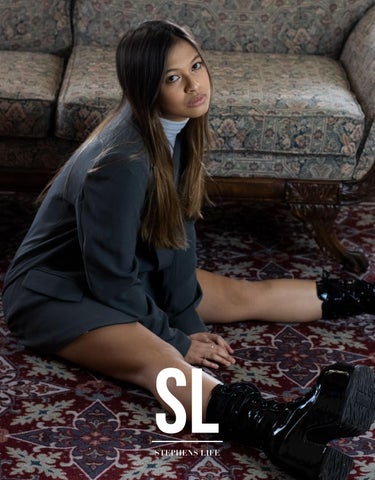
issue credits Cover Photography: Katherine Marquart Editing: Bri Bunker Model: Catherine Bañez Assistant: Bri Bunker Styling: Katherine Marquart Color Pages (first and last page) Illustrations: Leslie Douglas Letter from the Editor and Table Of Contents Copy: Leigh Ann Barnett Layout: Leslie Douglas Staff Line Up Photography: Bri Bunker Layout: Leigh Ann Barnett Stuck In The Clouds Photography: Bri Bunker Illustrations: Leslie Douglas Layout: Leigh Ann Barnett Models: Saffron B. Lancaster, Ruth Zapico Mancebo, + Gaby McIntosh Assistants: Leigh Ann Barnett Everybody is a Work of Art Photography: Morgan McCall Editing: Bri Bunker Layout: Madison Moore Models: Jessica Carthron + Hannah Robertson Assistant: Bri Bunker Styling: Arika Smith Dada Revival Photography: Katherine Marquart Layout: Katherine Marquart Editing: Katherine Marquart Models: Catherine Bañez, Lydia Graves, + Cameron Rowe Assistant: Bri Bunker Styling: Katherine Marquart + Arika Smith Makeup: Arika Smith
Remix Photography: Bri Bunker Editing: Bri Bunker Layout: Lydia Graves Models: Levi Ball, Bella Burney, Emma Burney, Olivia Burney, Angie Busby, Alex Neely, Stella Peters, Drew Webber, + Forrest Wilson Assistant: Bri Bunker Styling: Models’ Own Hair: Arika Smith Emotionally Unavailable Photography: Jaedyn Colvin Editing: Bri Bunker Layout: Jaedyn Colvin Models: Lizzy Vitt + Jay Malloyd Assistant: Bri Bunker Stone Cold Photography: Bri Bunker Editing: Bri Bunker Layout: Bri Bunker Models: Divya Hopkins, Drayona Rollins, + Hope Daugherty Assistant: Katherine Marquart Styling: Bri Bunker Hair+Make-up: Arika Smith Pandemissance Photography: Bri Bunker Artists: Adrienne Luther, David Lancaster, Stephen Evans, Ferëna Saburi, + Candice Malveaux Editing: Bri Bunker Layout: Bri Bunker Assistant: Katherine Marquart Age of Aquarius Photography: Leslie Douglas Illustrations: Leslie Douglas Editing: Leslie Douglas Layout: Leslie Douglas Models: Savana Johnson, Ryann Jenkins-LeFlore, + Savannah Andrews Assistant: Bri Bunker
S tep h en s Li fe / Spring 2021 / Issue No. 1 8
SL | 68
rinati [ri·nà·to] (adj.) an Italian word meaning to be born again or to have been relieved from stess and anxiety