SL | 2
SL | 1
THE LINE Up Editors Editor in Chief Leigh Ann Barnett Creative Director Bri Bunker
Staff
Jaedyn Colvin Leslie Douglas Katherine Marquart Arabela Rowland
Administation Staff Advisor Erica Pefferman
Special Thanks
Stephens College School of Design Stephens College President Dianne Lynch
Contact
Stephens Life Magazine 1200 E Broadway Columbia, MO 65201 slm.outreach@gmail.com www.slm.stephens.edu /StephensLifeMag @stephens_life
Stephens Life is the award-winning student-run magazine of Stephens College. Opinions expressed are not necessarily the views of the college, students, administration, faculty or staff. Stephens Life strives for accuracy. To report a correction or clarification, please send an email to slm.outreach@gmail.com.
THE LINE UP
SL | 2
SL | 3
FALL 2020 TEAM edit or s
LEIGH ann BARNETT
bri bunker
s t aff
Jaedyn Colvin
leslie douglas
katherine marquart
Arabela Rowland
Letter from the Editor
What A Year I think I’ll state the obvious by saying this year has not gone to plan. And it hasn’t been all that fun. In fact, this year has been pretty dark. From the loneliness of isolation, the BLM protests, and a high-stakes election, 2020 is testing the limits of humankind. I know the students here at Stephens are feeling a burn out like no other — from a summer that left no room for rest and relaxation to immediately jumping into a shortened semester that shouldn’t feel so rushed. We need a break. We need a breather. And I’m sorry to say that this magazine isn’t that. 2020 has tested us on what we thought we knew. We’ve re-educated ourselves on what it means to be an ally, what it means to be a neighbor, and what it means to be human. No, this year hasn’t been easy. It’s been trials and tribulations from the very beginning. But I have to hope that the tests of 2020 will make us better because of it. I’m asking you to continue to test yourself while reading through this magazine. To have an open mind. To leave your biases here for 15, 30, or 60 minutes. To let us share what we’ve learned, how we’ve grown, and how we hope it helps you. Please give us your undivided attention as we shine a light on topics you may want to ignore. But if this year has taught us anything, it’s that ignorance isn’t bliss. The Luminous Issue won’t be an easy one, but I hope it’s one that broadens your horizons and challenges you in all the ways it needs too. Thank you for your support, and thank you for your love. We’ve needed it this year more than ever. Enjoy, converse & stay curious, Leigh Ann Barnett EDITOR IN CHIEF
Stephens Life / Fall 2020 / Issue No. 17
SL | 5
Self Esteem vs. Narcissism 6 Tarot Tarot on the table 12 I still Can’t Breathe 18 The Sacred Place 26 See You On A Dark Night 32 Unsettled 42
TABLE OF CONTENTS
SL | 6
SL | 7
Self-Esteem vs. Narcissism: A Study in Self Story by Arabela Rowland Photography by Bri Bunker
T
aylor Swift once said, “Vanity can apply to both insecurity and egotism. So, I distance myself, because I feel everything.” For many ages, people have condemned egotism, pride, vanity, narcissism, and self-absorption. To an extent, they all mean the same thing: selfobsession. Some people see it as an egregious sin, while to others it’s just an unattractive character flaw. To succeed at anything, you need to have at least a modicum of belief in yourself. But, where do we draw the line? To some people, too little self-esteem breeds toxic insecurity, while too much self-esteem may be a sign that someone is a narcissist who alienates everyone around them. Self-esteem is widely praised, though. It begs the question, what is the difference?
Self-Esteem
Self-esteem is healthy and essential to our identity and progress in life. The term refers to our own perception of our self worth. According to Dr. Dan Kissinger, a counselor at Stephens College, “This internal construction of self draws upon a range of personal and environmental factors and experiences (both positive and negative), our interpretations of these factors within and across our family, schools, and our community environment.”
A healthy self-worth, in this regard, acts as a booster for positive peer relations, several forms of success, and personal wellness. Someone who lacks such a self-worth is subject to the inverse of every previously listed item. It has the possibility to stunt anyone’s potential. According to Kissinger, “A fragile or poor sense of self could have farreaching personal and professional implications, including a self-concept and subsequent feelings and actions that are based on an overvaluation of the opinions of others.”
Narcissism
Unfortunately, many people are susceptible to low self-esteem. A person may be narcissistic when they put themselves before anyone else. They can have an inflated sense of self while seeking attention and validation. It’s very different from self-esteem. Dr. Art Markman is a cognitive scientist and professor of psychology at the University of Texas at Austin. He states that the main difference between a high self-esteem and narcissism is that, “Selfesteem involves having good feelings about one’s own accomplishments and confidence in one’s own abilities, [while narcissism] is a feeling of superiority over other people.”
SL | 8
They can’t appreciate the success of others, while someone with a healthy self-esteem can. Narcissists are often never who they make themselves out to be. Markman goes on to say that, “Narcissists also seek out people who will praise them for what they have done well and to shun people who point out their shortcomings.” They will do almost anything to validate their high, yet fragile ego. They create a version of themselves they present to others, but deep down inside they are always struggling to preserve their own image of themselves- desperate for approval. High self-esteem can be used to help build others up, while narcissism aims to tear others down in an act of preservation. Narcissists actually often have very little selfesteem. The terms, although often confused for one another, have very little in common.
Insecurity is another form of narcissism that not only hurts those suffering from it but can hurt the people around them, too. Not all insecure individuals are narcissistic, but many narcissistic people have low self-esteem. They may be so prone to low self-esteem that they work to form groups just to secure validation. Their high opinion of themselves is so fragile that they need the help of other people to protect their ego. If they encounter people who they perceive to be a rival in their life, they are capable of doing everything in their power to systematically sabotage that individual along with the cohorts they adopt. As Dr. Markman states, “They tear down or diminish the successes of others.” If someone stews in their own low self-esteem for too long, they can easily become toxic to themselves and others.
“Vanity can apply to both insecurity and egotism. So I distance myself, because I feel everything” Narcissistic Personality The Roots of Narcissism Disorder - Taylor Swift Narcissistic Personality Disorder (NPD) is an entity entirely of its own. Dr. Crina Silasi-Masat of Stephens College’s psychology department describes NPD as “an unreasonable sense of self-importance accompanied by a pattern of arrogant thinking and behavior, a lack of empathy, sensitivity, and compassion for other people, and an excessive need for admiration.”
However, just because someone is full of themselves doesn’t mean they suffer from NPD. Pathological narcissism is defined by its duration, frequency, and the intensity of the behaviors. In other words, people who are narcissistic enough to have this disorder are full of themselves almost constantly and have the capacity to attack others through manipulation and destructive actions in order to protect their own ego. It is important to state that narcissism is something we are all susceptible to. Just because you have bouts of superiority from time to time doesn’t mean you have NPD. According to Dr. Silasi-Mansat, “Anyone can display narcissistic behavior occasionally and mildly. We are all guilty of being ‘full of ourselves’ sometimes.”
The cause of narcissism can be paradoxical in itself. It can result from over-pampering, or on the other spectrum, neglect as a child. If a parental figure praises a child for everything and tells them they are better than other children, the child can internalize this and never question it. As Dr. Markman puts it, “There is some evidence that narcissism is related to aspects of parents who praise their children too much for their abilities, intelligence, and success.” Interestingly, age can affect narcissism. According to Markman, people are more likely to be more generally narcissistic from the point of adolescence and during their youth. However, the more they age, the less narcissistic they often become. Sometimes, self-awareness can be learned through age. In an interview between Medicircle, a health news service and Dr. Seth Meyers, it is suggested that narcissists make less than ideal parents. “They project themselves onto their children and hold them to very high standards,” quotes Dr. Meyers.
SL | 9
Narcissists believe that image is everything and thus their love is often conditional, based on image. If a child fails to meet the standards of their parents, they will often be neglected by their parents. When the child ages into adulthood, they may easily have a poor sense of self-worth, make poor relationship choices, and most importantly are subject to developing narcissism themselves. It can become a vicious generational cycle. But, narcissists aren’t always bad people; they are often victims themselves caught up in said cycle.
Social Media and Narcissism
There is an argument that suggests a strong correlation between social media and developing narcissism. Morgan Lowery is a student at Stephens College with a substantial following on social media. She states that, “Social media can definitely have an effect on someone’s personality whether it’s good or bad.” All sources agreed that social media can build a reliance on people’s feedback and can end up hurting someone’s self-esteem and even lead to narcissist tendencies.
“
We are all guilty of being ‘full of ourselves’ sometimes. - Dr. Silasi-Mansat
SL | 10
Social media is a perfect tool for narcissists to project themselves. Naturally, they often are attracted to using several different forms of social media. According to Lowery, someone’s amount of followers can be directly proportional to their potential ego. The more people you have paying attention to you, the more important you feel. Sometimes, leaving negative comments on someone else’s posts can be, as Lowery describes, “a form of insecure toxicity.” This negative feedback may be genuine, but many comments made are subject to vagueness and pure vitriol without adding any meaningful criticism. Lowery says, “The main culprit behind these comments is often jealousy and insecurity.” People who call each other out on social media may often suffer from narcissism themselves. They think that their negative opinions matter enough to be posted. Their comments are written with the intent of tearing others down. Lastly, it is easy to infer that they, too, may suffer from insecurity. It doesn’t help that negativity has the aptitude to be contagious, especially online. It can lead to a myriad of other issues such as depression, anxiety and other disorders. Social media doesn’t have to lead to these issues. It can still be used as a tool for information, inspiration, and representation. It can be a great way to help others and yourself with building confidence. By posting positively and thoughtfully while not focusing entirely on themselves, influencers can be a great inspiration. It’s just important to avoid becoming too self-absorbed online.
Approaching The Narcissist
It’s important that people learn to distinguish self-esteem from different kinds of narcissism in order to live a healthy life or to incorrectly label themselves. Realizing you’re dealing with a narcissistic person is imperative to how you deal with them. Narcissists can be very difficult to work with. Randi Cooper, a Stephens college senior, creative writing major and club organizer for the Red Box program, states that she has had to deal with aggressive egos before and the best way to deal with it is “to not feed into
“
SL | 11
Social Media is a perfect tool for narcissists to project themselves.
”
it, but also, depending on your environment, to not give into confrontation.” It is all too easy a narcissistic person to form unprofessional grudges. Randi also comments “Having an unprofessional and high ego is not what Stephen’s College ten ideals are all about, but positive self-esteem is a cornerstone of many of our core ideals.” It can be easy to overlook narcissism and mistake it for something else, but being able to distinguish it from things like high self-esteem is the first step to dealing with it.
We are not inherently immune from egotism or insecurity. We experience it every day whether we feel it ourselves or receive criticism from someone else. Self-esteem, whether high or average, is an overall good thing and often has barely anything in common with narcissism. Confusion between the two needs to stop. Maybe Swift is right. Maybe distance is the key to resolving our fear and our pride. We can acknowledge criticism, but we don’t have to acknowledge the critic. When we believe in ourselves, we are always moving forward. Now, more than, ever is the time to focus on sustaining a healthy selfesteem. Times of social isolation can harm our mental health. It is important to always be self aware, to track your thoughts, and always try to improve. The effort makes all the difference.
Illustrations by Leslie Douglas
Story by Leigh Ann Barnett
Tarot Tarot on The Table
SL | 12
M
just through conversation as the reader and the client build rapport they feed off of each other’s energy. (For the sake of clarity, we’re going to pretend like someone is doing their own reading.)
But What Is Tarot?
The next step is to choose a Tarot spread. Now, what does this mean? Tarot cards don’t only have to be used to help decipher the past, present, and future. That’s only one particular spread, known conveniently as the “Past-Present-Future spread” (though it is the most popular). Spreads are picked based either on the posed question or the possibility of needing follow-up questions answered. Therefore, such a spread may require more cards.
uch to my mother’s horror, I was born on Halloween. And though my birthday didn’t automatically make me interested in magic or the supernatural, it definitely didn’t turn me off of it, either. In particular, I’ve always been fascinated by Tarot cards. I don’t know if it was the beautifully illustrated cards or the thrill of learning more about myself through them, but something always drew me to the practice. However, I’ve always been too scared to try reading them until now.
SL | 13
The question of what Tarot cards actually “do” is different for every user, but the general opinion among practitioners is that it isn’t fortune-telling. In her book “Intuitive Tarot: 31 Days to Learn to Read Tarot Cards and Develop Your Intuition,” professional Tarot reader and teacher Brigit Esselmont describes Tarot as an “invitation to your subconscious mind and an opportunity to tap into the knowledge and answers that resides in us all.” Put in a different way, Tarot cards help individuals identify questions that they may need to ask themselves regarding their past, present, and future. The cards don’t hold any mystical answer — the person receiving the reading does. It’s what individuals do with the information the cards provide that will impact their life. So, no. Tarot cards can’t tell us our futures because the future is always in motion. We have free will, after all, and Tarot cards can help us understand what we went through and how we feel about that. The cards and our intuition can also help us identify where we are in the present and how we can achieve the futures we want.
Once a spread is decided, pick the cards needed and lay them down. Select cards that speak the most to them or use cards that fall out of the deck while shuffling. Flip the chosen cards over and start deciphering. Intuition is one of the most important parts of Tarot as the cards aren’t literal. For example, very rarely does the Death card actually mean the death of a person. Oftentimes if we draw the Death card it means the end of something (like a relationship or job) or a new beginning. Not having every card memorized isn’t a problem as most decks come with a booklet that maps out what the card mean and may pose follow-up questions to ask ourselves in order to thoroughly soul search. Esselmont highly recommends using a Tarot card journal to help work through our problems and discoveries. It’s also important to note that Tarot is highly individualized, so no two reads will have the same process. Do what feels right for you and trust your intuition.
How Does A Reading Even Work?
What Should It Accomplish?
Every Tarot reading starts with a question posed by the individual receiving the reading, such as “What is it you are trying to learn about yourself?” Once that question is in mind, shuffling the cards is the next step. Tarot is all about energy — this action can either take place physically, by having the participant shuffle the cards, or it can happen
What the reading accomplishes is all up to the person receiving the reading. What was the question they posed? Has that question been answered by selfreflection? From my understanding and personal experience, after a reading, we should hopefully feel relaxed and more at peace with what we still need to accomplish during our journey through life.
The Common Practice Hannah Kueck, a fashion communication senior at Stephens College, wasn’t always interested in Tarot cards, but now has a bit more faith in the process. Kueck’s mom was the main reason she was introduced to Tarot around the age of 15. Kueck’s mother was “going through a rough transitioning period in her life,” she says. “Tarot cards and other spiritual practices were how she made it through.” At the same time, Kueck and her then-boyfriend happened to be in a toxic relationship. Her boyfriend was critical of Tarot, crystals and other spiritual practices, and Kueck found herself following suit. When her mother would read Hannah’s Tarot cards during this time, she would regularly pull out the Death card, or other cards that “symbolize[d] an end to something old.”
The World: Rightside: Fulfillment, Harmony, Completion Reversed: Unfinished, No Closure, Incomplete Goals The High Priestess: Rightside: Intuition, Unconscious, Inner Voice Reversed: Lack of Center, Lost inner Voice, Repressed Feelings The Chariot: Rightside: Direction, Control, Willpower Reversed: Lack of Control, Lack of Direction, Aggression
At the time, she didn’t want to confront the fact that she wasn’t in a healthy relationship, and it wasn’t until she got out of the relationship four years later that she found her opinion about Tarot was beginning to change. Now, more of a believer, Kueck has her own Tarot card deck that she can use for her readings, whenever she can find the time in her busy schedule — it’s not nearly as often as she would like. “I like to spend a decent amount of time selecting, getting to know my cards, and reading the significance the cards have,” Kueck explains. “I don’t have that kind of time right now. But, my hope is that once my schedule lightens up, I will be able to enjoy it again.” Why even bother? Well, for Kueck, it comes down to comfort: “I’m indecisive as hell. I freak out over the slightest thing. I overthink my future. I don’t like to admit when traumatic things in my past have actually affected my life,” she reflects. “So, being able to just sit down and read the cards makes me feel like it’s okay, and that these things happen. They’ve helped me become who I am today.”
A Higher Practice Rachel Sparks is the owner of Inner Sparks, which is a life coaching business. She began her spiritual journey into Tarot four years ago, but it didn’t start with Tarot itself. Watching YouTube videos about Astrology signs lead to her finding videos of Oracle cards, which would serve as her gateway to Tarot. Oracle decks are loosely based on Tarot cards, but their designs come from whatever the creator wants them to be. Tarot cards are relatively inflexible in meaning, but Oracle cards can be more broadly interpreted, depending on what the creator wants you to receive from them. As Oracle decks are based off of the original Rider-Waite Tarot card deck (published in 1909 and seen as the “classic” deck), Sparks found it a natural progression to learn more about Tarot. This process of watching videos was beneficial for Sparks in building up her card reading intuition. She is a very analytical person and feels very comfortable reading charts and tables. The videos allowed her to “open her mind up to the possibilities” of what the cards might be saying. Her intuition now allows her to more easily enjoy doing readings for people about whom she knows nothing. Sometimes she won’t even ask a question and will just let “the cards guide the conversation.” Sparks is a firm believer that readings should be positive experiences and that they should leave customers feeling better, because often they’re receiving “validation for what they already know.” Sparks has had to deal with quite a bit of backlash because of her use of Tarot. She’s been called a “witch” and told that Tarot is the “devil’s cards,” but she views them as a tool. A hammer can be used to nail a beautiful art piece to a wall or as a weapon; Sparks uses Tarot to help other people.
The Professional Practice
The Moon: Rightside: Unconscious, Illusions, Intuition Reversed: Confusion, Fear, Misinterpretation The Fool: Rightside: Innocence, New Begingings, Free Spirit Reversed: Recklessness, Being Taken Advantage Of, Inconsideration
Laura Lynn is an intuitive Tarot reader. She practices under her business Iridescent Spirit. Her journey with Tarot also began during a difficult point in her life. She began familiarizing herself with the cards in the morning by pulling a single card to focus and meditate on. It was during this practice that she realized “[she] could pull the same card three different times and get a different meaning each time.” This discovery led her to practice more frequently and trust her own intuition. One of Lynn’s most significant lessons from Tarot that she tries to share with her clients is to establish trust in our own intuition. While doing readings (and through personal experience), Lynn has realized that we humans tend to dismiss our gut feelings and the little voices in our heads. She believes we do this because of past experiences “we define as … bad decision[s].” However, Tarot also allows us to connect to our intuition again by trusting ourselves to read the cards and contemplate our next steps. Along with trusting our own intuition, reading energy is one of the most critical steps in Tarot. The energy of the person or people involved is what will set the tone for the reading. If we go into a reading with an open mind and positive energy, we’ll ultimately encounter different results from those who are skeptical and pessimistic about the process. If we aren’t open to answers, in other words, we won’t find any. “Readings can come on so strongly because [of], energetically, how much we want to know the answers and how much we’re seeking a better outcome for ourselves and our lives,” Lynn says. “That’s how I’m able to see it in the cards. And, there is so much beauty in that.” Energy is constantly in motion. Meaning, if we had a Tarot reading in the morning and another reading two hours later, they could have completely different outcomes. Not because either reading is wrong, but because of how our decisions made in those two hours changed our future. Tarot is a tool that provides us with an awareness that, according to Lynn, allows us
to decide if we want to “continue on the same path with the same energy, because we’re headed in the correct direction. Or, we can change our energy. We can change our mind.” She encourages change when she “sees cards that aren’t such great outcomes.” And though we may not be able to avoid uncertain times altogether, we can better prepare ourselves for them. Lynn suggests we search for ways within to better center ourselves in order to manifest better outcomes. For her, “that’s the point of Tarot. What’s the point of Tarot if we can’t actually change and redirect? We have the power to redirect ourselves [and our energy] to get us back on [the correct] track.”
"...We can change our energy. We can change our mind." -Laura Lynn I think, just like the cards, Tarot readings mean different things to different people. They stand for what we believe they stand for. The cards themselves may not be all-knowing — but neither are we. Tarot is a tool that allows us to reflect on our decisions and questions as we seek a better understanding of who we are. After speaking to Kueck, Sparks, and Lynn, I’ve come to the conclusion that, if a few beautifully illustrated cards can help us analyze what’s going on in our lives and help us determine what we need to do or change moving forward, then what the hell — I’ll take some guidance. Speaking confidentially, I need all the help I can get.
The Magician: Rightside: Willpower, Desire, Creation, Manifestation Reversed: Tickery, Illusions, Out of Touch The Star Rightside: Hope, Faith, Rejuvenation Reversed: Insecurity, Discouragement, Faithlessness
SL | 18
I STILL CAN’T BREATHE Story by Jaedyn Colvin Photography by Bri Bunker
SL | 19
J
ames Brown, Eric Gardner, and George Floyd’s last words were “I Can’t Breathe,” as they died in the hands of people sworn to protect them. Police brutality is nothing new in the eyes of Black Americans. In 1991, Rodney King was beaten by the LAPD, and it would be the first of many Black beatings caught on camera. Now in 2020, George Floyd was restrained for 8 minutes and 46 seconds, and he became another one of the many taken too soon. The Black community has been yelling that “we can’t breathe” for over 30 years now. Why does it seem like no one is listening? They are tired, they are hurt, and it is all because they still cannot breathe. Over the last few weeks, members of the Black communities talked with me about their experiences, feelings, and hopes about what it means to be Black in America today.
Perception vs. Self “I did not really see [Blackness] as a problem until I got older,” Gaby McIntosh says reflecting on her upbringing in the suburbs of St.Louis, Missouri. McIntosh attended an all girls private school that was predominately white. For the most part, besides her family, she was surrounded by people who were white. She was naive when she was young. It never crossed her mind that her life was different from her peers. “I didn’t realize that the way I talked or how my parents carried themselves was any different . . . until I got older and people started to say that I sounded white, or
I talked well for a Black kid,” she says. These little things ultimately led to an “identity crisis” as she grew older, which isn’t uncommon. Many Black girls relax their hair, lower their voices, and try to fit in, because they don’t want to be different. This unknown identity sometimes follows these women into adulthood as they struggle finding a point where they are comfortable in their skin McIntosh wishes she could tell herself and other Black girls that “You are fine. There are other people like you. You are really cool. And, straightening your hair is not worth it.” Following the death of George Floyd, St. Louis had a variety of peaceful and non-peaceful protests. Due to those circumstances McIntosh finds herself exhausted with everything around her, with things just piling up and giving her nowhere to move. “You know those automatic tennis ball machines? It was like you pressed it for one speed, and it got jammed so the balls just started coming at rapid fire. That’s what life felt like [after the news came out about George,],” she says. The weight of a global pandemic, her personal life, school and the reality that being a Black woman is hard put her in a panic. The icing on the cake for McIntosh, though, is the fact that people still don’t get it. “I understand that rioting and looting is bad,” she says. “But, we wouldn’t have to do that if the system wouldn’t constantly keep failing us.” It’s McIntosh’s belief that the biggest problem people have with the Black Lives Matter movement is the word Black.
SL | 20
“They feel like they are not being included. You’re not being included, because you’re not being hurt.” -Gaby McIntosh
They feel like they are not being included. You’re not being included, because you’re not being hurt,” she says. People are so quick to jump and say they are not racist or that they have “Black friends. But, those are just excuses to cover up the fact that they are likely actually racist. “If that is what you jump to, you need to do some soul searching. Because, it sounds like some internalized racism. Before you open your mouth, do some soul searching. Look inside yourself to see what is the reason behind the hate. Is it really just the color of someone’s skin or is it more than that?” Stephen Johnson, who has been a firefighter for Kansas City for 22 years, touches on implicit bias and the things he deals with while being a Black man in America. “People perceive you as being a thug,” he says. “I’ve been on street corners, and people lock their doors. I’ve been followed in stores to make sure I don’t shoplift.”
Implicit Bias For centuries, Black men have often been seen as savage or animalistic; an example of this is the 1915 film The Birth of a Nation. Black women are also often seen as loud, angry, and obnoxious. Johnson touches on the fact that he is not given the same opportunities and is often overlooked in favor of his white colleagues. In the workplace, Black Americans are often esteemed lower than their counterparts. It is all because of the implicit bias this nation has built. Kinky curls and dreads are deemed unprofessional, and often Black employees are not taken seriously. “Being Black in America you are seen as a bad person, a thug, or even just uneducated.” This implicit bias ranges from social situations to health care. There is a double standard when it comes to race. “There has always been white privilege if you ask me,” Stephen says. “A Black male and a white male go in for the same crime and come out with majorly different results and I [don’t] see it getting any better, either.”
Our nation has systemic racism, and it was built upon that. After abolishing slavery, Black men and women, especially in the south, were sent to jail for petty crimes and forced to do free labor. The system is putting them right back where they were before when our nation was segregated, and Black American neighbors had less money, fewer jobs, and poor education. As time went on, our nation diversified, but most of these predominantly Black neighborhoods are still in these lowincome areas. Because of that, violence, drugs, and gang activity are high, making it so more Black Americans end up in prisons or long sentences making the same cycle continue.
Protecting Ourselves From Those Meant to Protect Us Ralph Covington grew up in Hayti, Missouri. It is a tiny and rural town. “It’s like most towns - you have the train tracks that pretty much separated the white side from the Black side.” He recalls 12 white kids graduating in his high school, and it was not until after high school that he realized his school was called “the Black school.” He can still name the kids in his junior high that owned a gun, and when he got to high school, every other person had a gun. “It was a rough town. We had segregated high schools. There was fights. There was shootings,” he says. In his hometown, police injustice wasn’t a big deal. He had a recognized name. His family was big churchgoers. So when the police ran his tags, they knew who Covington was.
SL | 22
“I wanted to treat people better than the way I was treated by cops.”
- Ralph Covington
SL | 23
SL | 24
Outside of town, though, it was completely different. “I used to get stopped so much, it wasn’t even funny. Stopped, searched, and it was frustrating as heck. Man, I got stopped so much I thought it was normal.” The officers asked to search his car many times. And if he refused, they would hold him for 45 minutes to an hour for a canine unit to arrive and search his car. It was because of these experiences that he decided to pursue his career as a police officer. “I wanted to treat people better than the way I was treated by cops,” he says. Throughout his time at the academy, he learned many things as well. He realized why the police did some of the things they did to him, but he also learned that there were many things they should not have done. “I got frustrated and fed up a lot. Because you know, I found out that they can’t do [what they did to me]. They violated my rights, and I knew that I knew it was not right.” Over the years, he has seen and heard a lot about corrupt officers. He recalls the time when Rodney King was beaten. He says, “he probably got beat worse than I’ve seen any animal get beat, but still you found some people who said ‘well if he would have just . . . He had close to 20 officers there. 20 people can take down one guy.” After the beating of Rodney King, everyone was so shocked about what happened. It seemed so rare, yet the only rare thing was that it was on tape. “I am willing to say there are thousands of Rodney Kings out there.”
SL | 25
Making Change
Jay Malloyd, a senior at Stephens College, expressed how she sees change coming. “We are not afraid to challenge what is seen as ‘normal’. We are ready to make changes.” The BLM movement has reached new heights, and it looks like society is making strides that our nation has not seen before. That does not mean the work is done. America still has a long way to go. People are starting to see the divide this country has created. Martin Niemölle, a Lutheran Pastor in Germany, said post World War two, “First they came for the socialists, and I did not speak out— because I was not a socialist. Then, they came for the Jews, and I did not speak out— because I was not a Jew. Then, they came for me—and there was no one left to speak for me.” This stands true today. Just because it is not happening to you does not mean it is not happening. “Choose empathy. Pay attention. Ask questions,” Malloyd says. Realize that the Black community is in trouble, and use the privilege you have to help make a difference. Our nation is not free until everyone in it can breathe.
SL | 26
The Sacred Place written by Bri Bunker photography by Bri Bunker
She pulls me in again. She’s never cared for my plans, My interests and if she did, she cared too much. So much that she wouldn’t let you care about anything else. Yet, here were are again with you pulling me in; engulfing me. Her love thickens the water and I am left at her mercy. You’ve always loved bath time; splishing and splashing. We don’t clean ourselves. We just sit and stew and wait for you to wash over me again.
SL | 27
SL | 28
She’s quiet tonight, almost like she’s not here, but her breath bubbles my skin. Goosebumps rising; she pulls me in.
Blub. Blub. Blub. Water goes up my nose. The taste of metal in the back of my throat. My lungs tighten. Her nails dig into my wrists. Hot breathe swallows me. I slowly sink.
Deeper and deeper. My contacts grasp my eyes as I look above me. Her wicked smile teasing; I give in. She was so cruel, but she made me – enjoy it. Cold air pricks my lips. I gulp down a breath and before I knew it, she was gone.
SL | 29
SL | 30
Thick soap drips down her arms and out of my hair. Suds swirl around us. Our fingers intertwine, soap clinging to our crevices. Your hand slipping out of mine. You’ve always loved bath time; splishing and splashing and circling the drain taking the water with you. Her weight dissipates. My chest expands with oxygen. Air around me stands still as I whisper,
“Goodbye.”
SL | 31
SL | 32
See You On A
Dark Night Written by Katherine Marquart Photography by Bri Bunker and Katherine Marquart
SL | 33
A brief dive into the beliefs and practices of the modern occultist..
H
uman sacrifice. Devil worshiping. Blood rituals. Curses. Certain religions and practices have a shroud of shame and scandal over them. Such stigma prohibits any productive conversation to be had about what it means to be a Pagan, a witch, or a Satanist in the modern world. From Hollywood movies, to books, to art, these practices are misrepresented. Their beliefs and how they practice are not common knowledge, because there is a certain fear surrounding them. Rumors and distortion of the truth are just taken as fact. People that simply have alternative views on our society are outcast and demonized. Paganism, witchcraft, and Satanism each have a rich history and complex set of ideas and ways of practicing. They aren’t scary or dark rituals that so many of us have come to associate them with.
What it means to be a Pagan Despite what some may believe, Paganism is not an ancient practice. The modern Pagan can trace their roots back to the early 20th century. The religion does, however, incorporate traditional myths, lore, and practices from regions like northern Europe and the ancient Mediterranean. There are many different types of Pagans. But generally, they are polytheistic and the main belief is the divine presence of nature. Most worship some kind of deity. But for some, nature simply exists and does not possess any metaphysical properties. In the 1960s, James Lovelock formulated the Gaia Hypothesis. The Gaia Hypothesis explained that both the earth’s biological and physiological systems interact in a self-regulating way that creates a “super-organism.” This super-organism refers to the earth as a single entity. This was not generally accepted in the scientific community, but it resonated with many Pagans. The Earth and nature are what rules us, and they do so as one. Nature is to be respected, as it is what births us as humans. Pagans do not fear death, because death is a part of life. They believe in life after death, whether that be eternal paradise or reincarnation. Karma is widely accepted as a concept of how nature functions. This is applied to the theory of reincarnation. Reincarnation, to the Pagan, is not to be feared and is not used as a punishment. It is instead used as a tool to learn and grow as a
person. Therefore, reincarnation is something to be celebrated. Another belief that goes along with reincarnation is the idea that the mind and soul are “recycled” after death. Much like one’s body is returned to the earth after death, some Pagans believe the soul is recycled by being birthed into a new form. However, these are just some beliefs held by some that practice. Not all Pagans believe in these ideas. Like other religions, there are many different ways to be Pagan, and there are no set rules or guidelines. It is all up to the individual.
The practicality of witchcraft and its roots in feminism Anyone can be a witch. Witchcraft is not a religion. It is a practice. Your gender doesn’t matter nor does your background. You don’t need to have special abilities, and you don’t have to come from a long line of practitioners to seriously practice the craft. Witchcraft doesn’t require fancy tools or expensive items, either. Your work can be even more personal when you make things yourself. Of course, you can go out and pay top dollar for your candles, crystals and incense, but you can just as well go to a dollar store and find exactly what you need for a fraction of the price. That’s the great thing about witchcraft - it’s highly personal and customizable. A witch does what they feel is best for their practice.
SL | 34
“Life is the great indulgence -
SL | 36 are many different types of witches that There
originate from all around the world, but all revolve around the natural world. You can practice one specific way, or you can combine practices. • An eclectic witch does not conform to one specific practice but instead combines ideas from multiple • Anpractices eclectic witch doestheir not conform to that one best suits to create own path specific practice but instead combines ideas them. from multiple practices to create their own that best suits is them. • A path hereditary witch a witch that is born into a family that practices witchcraft. • A hereditary witch is a witch that is born into a practices • A family green that witch, or ecowitchcraft witch, bases their practice around the Earth and consults deities such as • A green witch, orthe ecoFey, witch, practice Mother Earth, andbases othertheir nature spirits. around the Earth and consults deities such as Earth,can thebe Fey, and other nature spirits. • A Mother hedge witch a very powerful herbal healer and balance between the physical realm and the • A hedge witch can be a very powerful herbal spiritual realm. healer and balance between the physical realm and the spiritual realm. date back to around • The bruja (Spanish for “witch”) the 15th century and often confer in Catholic saints • The bruja (Spanish for members “witch”) date back rituals. to and deceased family for their around the 15th century and often confer in Catholicwitchcraft saints and(not deceased members • Hoodoo to befamily confused with the for their rituals. religion Voodoo) combines African folklore practices and Native American folk medicine • Hoodoo witchcraft (not to be confused with the knowledge in their practice. religion Voodoo) combines African folklore practices and Native Americanin folk medicine • A kitchen witch works primarily their kitchen and knowledge their practice. uses plantsinand herbs to create herbal remedies and potions. • A kitchen witch works primarily in their kitchen and uses plants and herbs to create herbal crafting Thisremedies is just a and small list of potions. the types of witchcraft that exist, there are so many diverse groups of witches This is just a small list of the types of witchcraft around the world! that exist. There on areyour many diversejourney, groupsyou of will When you embark witchcraft witches what around theof world. choose kind divination method you want to work with. Divination is the process of gaining insight When you embark on various your witchcraft journey, or knowledge through techniques. Probably you most will choose what of divination method the popular waykind is tarot. Tarot decks can be you want to to work Divination the process traced back thewith. 1400s, but theyisweren’t used for of gaining insight or knowledge various divination until around the late through 18th century. For a techniques. thedeck, mostand popular is reading, you Probably fan out your choose way one, three, Tarot. decksEach can be traced to the 1400s, and or evenTarot ten cards. card hasback its own meaning, but they weren’t used for divination until no around when read together, a story is told. There’s practical the late 18th century. reading, youThere fan out reasoning behind why For tarota is accurate. are no your deck and itchoose one, three, or even ten tricks involved, just works. cards. Each card has its own meaning, and when read together, a story is told. There’s no practical Witches have been persecuted and hunted throughout reasoning behindthe why Tarot of is witch accurate. There history, however victims hunts wereare rarely no tricks involved, it justSzandor works. LaVey explains that actual witches. Anton they were often just outcasts targeted by those in power
Witches have been persecuted and hunted throughout history, however the victims of witch hunts were rarely actual witches. Anton Szandor LaVey explains that they were often just outcasts - eccentric older women or women that did notwomen accept targeted by those in power - eccentric older the or advances men. Witchcraft was only seen as a women of that did not accept the advances of men. threat in the first place, contradicting Witchcraft was onlybecause seen asbesides a threat in the first the place, Church’s teachings, was a women’s practice. because besidesit contradicting the Church’s Menteachings, didn’t like of an empowered woman. it the was idea a women’s practice. Men didn’t When unwed, independent woman, likethey the saw ideaan of an empowered woman. When they figured something must be wrong with her. That sawthat an unwed, independent woman, they figured she’sthat evil.something must be wrong with her…that she was evil. There’s the stereotype that a witch is an ugly old woman hunched over a cauldron, spells that There’s the stereotype that areciting witch is an ugly call old for bat’s wing and eyeover of newt and other fowl woman hunched a cauldron reciting ingredients. It iscall believed thatwing women didnewt use spells that for bat’s andreally eye of ingredients like foul these,ingredients. but the names actuallythat cod and other It were is believed for plant names. They want anyone else to know women really did didn’t use ingredients like these, but whatthe wasnames in theirwere medicinal “potions,” so plant they made up actually code for names. names to didn’t protectwant theiranyone recipes else fromtocompetition. They know what And was as for appearance the witch, so well anymade group up of in the their medicinalof“potions,” they independent names towoman protect was theirautomatically recipes fromcharacterized competition. as ugly man-ish. Men could thatany an Andand as for the appearance of not the fathom witch, well group ofwoman independent women was automatically empowered could be beautiful. characterized as ugly and man-ish. Men could not fathom that an empowered woman could be beautiful.
Analysis of the Satanic Bible and its relevance in modern society Analysis of the Satanic and its relevance JustBible the word “Satanist” is enough to strike fearin into hearts. It is seen as such a dirty word, associated with modern society terrible violence and hatred. The very mention of Satan is frowned upon. The media’s portrayal of so-called Just the word “Satanist” is enough to strike “devil worshipers” does not help. Oftentimes the fear into hearts. It is seen as such a dirty word, Satanic ritual is led through a “black mass” consisting associated with terrible violence and hatred. of inverted crosses, bizarre sex rituals, human sacrifice, The very mention of Satan is frowned upon. The and any other blasphemous and shocking activity. media’s portrayal of so-called “devil worshipers” These misconceptions have been perpetrated by those does not help. Oftentimes, the Satanic ritual is that do not understand for centuries. A “black mass” led through a “black mass” consisting of inverted does not exist. Satanism is not simply an antithesis crosses, bizarre sex rituals, human sacrifice, and to Christianity. The creation of the modern Satanic any other blasphemous and shocking activity. religion was more of a critique on modern society and These misconceptions have been perpetrated the expectations we are expected to conform to simply by those that do not understand for centuries. A because we are told to do so. “black mass” does not exist. Satanism is not simply an antithesis to Christianity. The creation of the modern Satanic religion was more of a critique on modern society and the expectations we are expected to conform to simply because we are told to do so.
o-mLi s
an aisLister
A wom ““A weon a mrmee nd
ircsed.”
m o h i a d s t s i i n a w n c w l e u a s r n t s s t d t e r o c e p n a p a alble m twiahr wfo
SL | 37
SL | 38
SL | 39
Each [Tarot] card has its own meaning, and when read together, a story is told.
SL | 40
SL | 41
It is understandable how those that are uneducated in the matter would conclude that Satanism is evil because, in Christianity, Satan represents the evil of the world. However, Satanists use him simply as a symbol, not as something they worship. “The Nine Satanic Statements” conceptualized by Anton Szandor LaVey, the author of The Satanic Bible, explains this concept the clearest.
The Nine Satanic Statements 1. Satan represents indulgence, instead of abstinence! 2. Satan represents vital existence, instead of spiritual pipe dreams! 3. Satan represents undefiled wisdom, instead of hypocritical self-deceit! 4. Satan represents kindness to those who deserve it, instead of love wasted on ingrates! 5. Satan represents vengeance, instead of turning the other cheek! 6. Satan represents responsibility to the responsible, instead of concern for psychic vampires! 7. Satan represents man as just another animal, sometimes better, more often worse than those that walk on all-fours, who, because of his “divine spiritual and intellectual development,” has become the most vicious animal of all! 8. Satan represents all of the so-called sins, as they all lead to physical, mental, or emotional gratification! 9. Satan has been the best friend the church has ever had, as he has kept it in business all these years! Satan is indeed an idealistic symbol for the Satanist, but his image is not what is used for the religion. Instead, the head of Baphomet inside of an inverted pentagram is accepted as the universal symbol of Satanism. An upright pentagram represents the natural elements. But because Satanism represents the desires of man, it is inverted to properly convey this. Baphomet is a deity that dates back to approximately 1100 C.E. The androgynous goat-headed figure has wings, a torch between his horns, and a pentagram on his forehead. This popular depiction originates from a drawing by French occultist, Eliphas Levi, in his
1856 book Transcendental Magic: Its Doctrine and Ritual. Baphomet at his core represents the balance of opposites. Self-expression and freedom are the most important ideals to the Satanist. They believe that we should live our lives to the fullest, because once we die that is it. They see it as ridiculous to live your life for life after death. The Satanist takes control of their own life and controls their fate. They do not rely on other forces to do so. Satanism encourages you to question your cultural upbringing and consider what practice genuinely reflects your own beliefs rather than others’. The Satanist lives by their own accord. Under these practices, each individual is entitled to live the life that they want to live. The practices so often shunned promote nothing but freedom of expression and choosing your path in life. The demonization and misunderstanding that have plagued these practices are a result of ignorance... intentional or not. Paganism, witchcraft, and Satanism aren’t inherently dark. However, it is important to keep in mind that every practice and religion has its dark sides. People often don’t acknowledge that. They are told which practices to view as dark, so they view them as dark. To quote LaVey, “This is only because people are afraid to face the truth - and the truth is that human beings are not all benign and loving.” By ignoring that truth, the lies about the occult are only perpetuated. Paganism, witchcraft, and Satanism promote expressing your individuality and questioning the world around you, yet they are demonized. Demonized by a world that is structured around everyone conforming to certain expectations. It prevents productive and meaningful conversations from being had. Instead of fearing something simply because you are told to fear it, start asking questions. The only way to understand the world you live in is to confront your own biases and fears. What is it that you’re really afraid of?
SL | 42
SL | 43
d e
L
n e t t S U Written by Leslie Douglas Illustrations by Leslie Douglas
T
he spring of 2020 was setting out to be a promising semester. Many students were preparing to give capstone presentations, study abroad, and graduate. The Warehouse Theatre was prepping to debut a new show, the dance program was finalizing its last performance, the fashion department was selecting pieces for their show, and the whole campus was full of lively, busy, hopeful students. Once the news started to pick up reporting on a virus outbreak in China, though, whispers began to circulate around Stephens College. Some of these rumors made it all the way to Florence, Italy, where Raegen McCutchen was studying abroad. McCutchen, a senior studying Fashion Marketing and Management and seeking a minor in Graphic Design, had arrived in early February to begin her studies. With all the excitement of traveling outside of the country for the first time, she found it impossible to anticipate what was to come. After a month of sight-seeing in, learning about, and exploring a new world, her experience took a sudden turn for the worst. Within a week’s time, the streets packed with tourists became empty, and nearby university campuses began sending students home. Like many others, she was confused and oblivious to the seriousness of the illness slowly infiltrating Italy. Reflecting, she notes, “I remember calling my friends and parents and I was like, fine and I’m safe. home.
I don’t know why people are freaking out and going home. I’m not leaving until I’m literally kicked out of here.’” By the end of that week, everyone in her program had been ordered to return home. Coming back to the States was a surreal time for McCutchen as she saw the progression she had just witnessed in Italy beginning to happen in America. She was content with quarantining for two weeks and enjoyed spending time with her dad, but her expectations would not align with reality. Her two-week quarantine turned into months of isolation through mid-May. Stephens College, along with numerous colleges and universities, decided it would be best to continue courses online and off-campus. This decision was followed by a few days’ notice to evacuate campus, but the hope remained that possibly just a few weeks’ break would lead to students’ return. Some packed up their entire room; others, just a suitcase. Friends and families from across the country were in and out of dorms frantically trying to prepare for student’s departure. By the end of that week, the once lively, busy campus was deserted. While many students were able to return home, some didn’t have that luxury. Chloe Nielson was attending her grandfather’s funeral when she received the news. At the time, she was not in a position to go back home, and she frantically began her search for a sub-lease in Columbia. Luckily, she was able to find one in
SL | 44
time, but that wasn’t the end of the changes the newly emerging pandemic would bring her. After being unable to work for months after having been hit by a car, Nielson had to find a job that would help her pay for rent. Working during a pandemic, adapting to online classes, weathering the end of a long-term relationship, and living alone for the first time in her life— these were new challenges she found it hard to cope with. Looking back, she tries to put the struggle in perspective: “It’s been really difficult, and it’s made everything much more complicated. What I enjoyed about life and how I coped before was with other people.I’m very extroverted. Especially at the beginning of the pandemic, I was at a loss for what to do, because I find being around other people so comforting. I had never been that alone for that long.” Quarantine was a collectively hard time for Americans. In a country that’s constantly moving,and where “hustle culture” thrives, this abrupt stop has felt catastrophic for many. Not only is our health at risk during the pandemic, but our finances, social lives, and mental stability are also at risk. It’s a situation very few of us have dealt with before or ever imagined could happen. With so many new stressors in our lives, how can we possibly stay afloat for the duration of the next year? Rachel Sackreiter, of Aspire Counseling in Columbia, is a licensed clinical social worker who specializes in depression, anxiety, and trauma in adults. Throughout the pandemic, she’s been helping those struggling to cope with added stress and complications in life. We all have been dealt different problems spawned by the pandemic; we might have or will soon experience ambiguous loss, a loss without any answers or closure. The lack of control we may feel on top of the loss, loneliness, isolation, and anxiety, is “the perfect storm for a really hard time,” according to Sackreiter. Sackreiter explains further: “Anxiety is often linked to our perception of control, and we probably have less of it now than we think
SL | 45
we do. It’s kind of thinking about, ‘What is it that I can control in my life today?’ or ‘What are things I can implement in my life today?’” In other words, rewiring our perspectives can save our brains from dragging us down deeper into anxiousness. Completing small tasks that bring us satisfaction is another step forward in gaining control in our lives, even if it’s just emptying our dishwashers or cooking our meals.
“
-I was at a loss for what to do because I find being around other people so comforting. I had never been that alone for that long. - Chloe Nielson
”
While we have the ability to focus solely on what we can control in our lives, it can be difficult to ignore the chaos going on around us that is out of our control. Our new reality includes constant hand washing, mask mandates, and at least six feet of distance from each other in society; these seemingly simple tasks have become habits for many of us after months of practice. However, it is hard to ignore the part of the population that’s misinformed about this crisis, or in denial about its existence. Most of us are following CDC guidelines and stay indoors whenever possible, but, in the midst of this striving, we are all craving a sense of normalcy in this abnormal time.
SL | 46
The sacrifices we make every day seem to be undermined by the rising numbers of COVID-19 cases and deaths. As has happened in other countries, we should have slowed down this pandemic after our first few cases. Gaby McIntosh, a filmmaking student at Stephens College, was really hopeful about returning to campus. After months of quarantining, the end of a relationship, national protests against police brutality, and her declining mental health, she couldn’t have been more ready for a change of scenery: “I came back and [after] the first week I was in tears, [thinking] this is just horrible. But then, classes started, and I got a job, and I was like, okay... this is what I can control and I can keep myself occupied. I can control my work schedule. I can control the classes I take. I can control the clothes I wear to school. I can control the people that I surround myself with- these are the things I have in my power. But even in that time, I was not satisfied.” Movie theatres, bars, concert venues, and many other social venues used to be a carefree source of enjoyment for all, but now a single trip can put one at risk of getting sick. Some avoid these destinations completely at the cost of their social life; others attend at the potential cost of their health. While protections are widely available to us, not everyone is willing to take advantage of them. The lack of seriousness with which many people respond to the pandemic infuriates McIntosh: “Knowing that this will not blow over for possibly another year just drives me insane. It makes everything a lot more difficult, and I don’t know how people don’t see that now.” It is important to keep in mind that we are all in this together. Every industry, country, state, business, school, neighborhood, family, and individual has been affected by COVID-19 in one way or another. Many of us have lost jobs, opportunities, housing, and even family during what will be recalled as a historic tragedy. For some, though, it may even be more comforting to think that it could be worse. Stephens College senior, Madison Green, believes this can be thought of as an important time for growth:
”
“All the changes of life really had to make people face things within themselves and change things for the better. I know for some, even for the worst.” - Madison Green
“In a way, I had an appreciation for the pandemic, because it made everyone stop moving and forced people to take a break and to start thinking deep about our world and the way that we maneuver in it — not only our own little world, but our world collectively. I was very optimistic, but I had a lot of anxiety, did a lot of crying, [I was] scared and confused.” Despite some initial uncertainty, Green continued to search for a positive outcome: “I believe a lot of things came to surface within households, within ourselves, within even corporations and businesses. All the changes of life really had to make people face things within themselves and change things for the better. I know for some, even for the worst.” Whatever situation we have landed in as a result of the pandemic, it’s important for us to be kind to ourselves and give ourselves grace. We may stay where we are, or we may move on, but we must follow our guts. Take it from Rachel Sackreiter of Aspire Counseling: “There’s never a better time to take care of your mental health. And, I do think taking a break now and working through it will help you achieve the things that you want to. Trust the timing of your life, and know that there is plenty of time to do those things. Your health is more important. If you had some debilitating physical disease, you’d take a break wouldn’t you?”
SL | 47
SL | 48
SL | 49
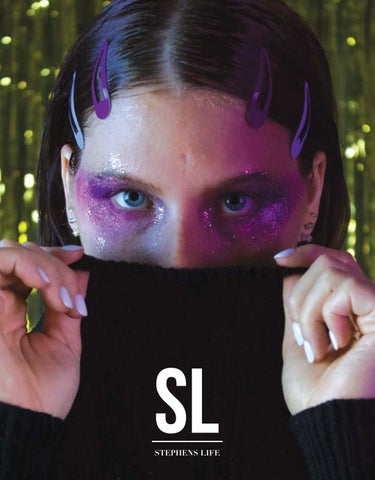
issue credits Cover Photography: Bri Bunker Model: Morgan Lowery Color Pages (first and last page) Illustrations: Leslie Douglas Letter from the Editor and Table Of Contents Copy: Leigh Ann Barnett Layout: Leslie Douglas Staff Line Up Photography: Bri Bunker Layout: Leigh Ann Barnett Self-Esteem Vs. Nacissism : A study in Self Story: Arabela Rowland Stylist: Katherine Marquart Layout: Leslie Douglas Photography: Bri Bunker Photography Assistant: Arabela Rowland + Katherine Marquart Makeup Artist: Katherine Marquart Model: Randi Cooper + Morgan Lowery Tarot Tarot On The Table Story: Leigh Ann Barnett Illustrations: Leslie Douglas Layout: Leigh Ann Barnett
S tep h en s
Li fe
/
Fall
I Still Can’t Breathe Story: Jaedyn Colvin Photography: Bri Bunker Layout: Jaedyn Colvin Models: Jaedyn Colvin + Nathalia Harris Makeup: Kennedy Jensen Unsettled Story: Leslie Douglas Illustrations: Leslie Douglas Layout: Leslie Douglas See You On A Dark Night Story: Katherine Marquart Photography: Bri Bunker + Katherine Marquart Layout: Katherine Marquart Art Direction: Katherine Marquart Makeup Artist: Katherine Marquart Stylist: Katherine Marquart Models: Sevanah Portillo-Weiss + Meredith Duke + Bri Bunker The Sacred Place Story: Bri Bunkert Photography: Bri Bunker Layout: Bri Bunker Art Direction: Bri Bunker Models: Sara Flaum + Shannon Frey
2020
/
Issue
No. 1 7
SL | 50
mångata [mo-an-gaa-tah] (n.) a Swedish word that describes the glimmering, roadlike reflection of the moon on the water