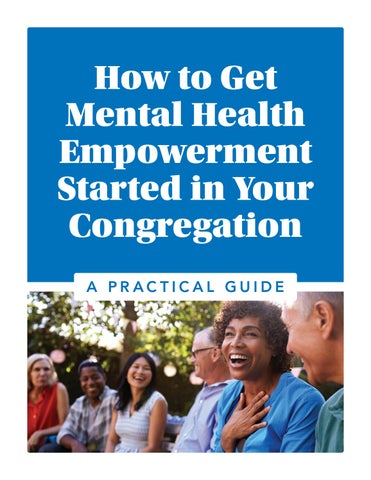
How to Get Mental Health Empowerment Started in Your Congregation A PR AC TIC AL GUIDE
MENTAL HEALTH EMPOWERMENT Welcome! This resource lays out the basics of what mental health empowerment looks like within a church, providing a roadmap you can use to get it started. The 16-page booklet “How Your Congregation Can Help Combat the Mental Health Crisis” shares the theological and psychological foundations of mental health empowerment in detail. We recommend reading it if you haven’t already. Here’s a definition of mental health empowerment:
Mental health empowerment is a group-based educational approach to equipping congregation and community members with interpersonal and coping skills that prevent mental health problems from occurring and promote mental health and well-being.
In practice, here’s what mental health empowerment makes happen: 1. It helps people develop mental, emotional, relational, and spiritual skills like empathy, assertiveness, and more. 2. Learning these skills helps people grow spiritually, experience richer relationships, increase their resilience to life challenges, and ultimately live more fulfilling, purposeful, and meaningful lives.
Mental Well-Being
3. I n the process, churches become hubs of mental health and well-being, helping the congregation as a whole become more and more mentally healthy.
Doing mental health empowerment involves a simple, straightforward activity:
Have people study mental health empowerment resources in groups. 2
Getting Started with Mental Health Empowerment You can get mental health empowerment off to a great start with the following process:
1. Involve the pastor and congregational leadership. Involve the pastor and other decision makers as you consider how mental health empowerment might fit your church’s needs. Use the booklet “How Your Congregation Can Help Combat the Mental Health Crisis” to get an in-depth understanding of the possibilities of mental health empowerment.
2. I dentify one or more groups for your first study. Groups throughout your congregation can do a mental health empowerment resource study, such as: • existing Sunday school classes and small groups; • church staff and leadership teams;
3. S elect and order resources for groups, then conduct the study. We recommend having your initial groups start with The Gift of Empathy. No special training is required; anyone can lead a group using The Gift of Empathy Discussion Guide for Faith Groups.
COSTS Costs are minimal. For example, all you need for a study of The Gift of Empathy is: • a copy of The Gift of Empathy for each group member ($14.95/ person); and • a copy of The Gift of Empathy Discussion Guide for Faith Groups for the group leader ($7.95). Once your resources have arrived, you can get started. The Discussion Guide contains everything group leaders need to plan and run the study.
• ministry teams; • dedicated discussion groups formed specifically for teaching mental health empowerment; and • any other type of group within the congregation. You can begin with one or multiple groups. Some churches start with individual groups, while others choose to involve a number of groups at the same time as part of a church-wide program.
Copyright © by Stephen Ministries in St. Louis, Missouri. All rights reserved.
4. Expand studies to more groups. Even before the initial study concludes, you can begin expanding. Expansion involves two parts: 1. Getting additional groups to study The Gift of Empathy. 2. Having groups from the initial study move on to additional resources, like Caring Assertiveness and 12 Unexpected Ways to Care. 3
Mental Health Empowerment Resources Available Now from Stephen Ministries Discussion Guides from Stephen Ministries give group leaders everything they need to facilitate an engaging and enriching group study—questions for each chapter, tools, guidelines, publicity resources, videos, and more. These resources make mental health empowerment happen by helping people learn, grow, and apply key interpersonal and coping skills together. • Discussion Guides for Faith Groups are designed for groups within the church, including Sunday school classes, church leadership, ministry teams, bereavement and other support groups, and more. • Discussion Guides for Teams, Groups, and Organizations are designed for groups in a variety of non-church settings, such as businesses, leadership and executive teams, teachers and school administrators, service groups, and elsewhere.
Mental Health Empowerment through Group Discussion
The following mental health empowerment resources are ready for you to start using right now, with Discussion Guides available in either published or pilot test versions.
The Gift of Empathy The Gift of Empathy offers a fresh approach to a familiar topic, with ready-to-use insights and examples that equip readers to better understand, connect with, and care for others. Drawing on a foundation of research and real-life experience, the book defines what empathy is and isn’t, describes its benefits, and shows how to overcome obstacles to effective empathizing. It shares wisdom on using empathy in a wide range of relationships—with spouses and significant others, children, parents, siblings, friends, coworkers, and others—making it a valuable resource for anyone who wants to relate with greater care and compassion. • T he Gift of Empathy Discussion Guide for Faith Groups (Published Version Available) • T he Gift of Empathy Discussion Guide for Teams, Groups, and Organizations (Pilot Test Version Available) 4
Caring Assertiveness Caring Assertiveness shows how a powerful but often misunderstood relational skill can be used to communicate with confidence and care in everyday encounters and challenging situations alike. The book provides insight and clarity about what assertiveness really is, with practical skills and real-world examples for how to be assertive in a variety of circumstances— handling requests and feedback, dealing with anger, navigating conflict and difficult conversations, and more. Grounded in decades of experience and extensive research with over 4,000 people, this book is an excellent way to enrich your relationships, improve your communication, and experience a better, more fulfilling way of relating. • C aring Assertiveness Discussion Guide for Faith Groups (Pilot Test Version Available)
12 Unexpected Ways to Care In trying to offer support to others, people frequently fall back on familiar methods that they’ve experienced themselves or seen others use—but that fall short of being truly helpful. The book 12 Unexpected Ways to Care offers an antidote to those typical, ineffective methods, sharing ready-to-use, powerful skills that apply to a wide variety of situations and relationships. Developed through research with over 3,000 people, this book will expand your toolbox with techniques that both strengthen existing relationships and forge new ones. • 1 2 Unexpected Ways to Care Discussion Guide for Faith Groups (Pilot Test Version Available) • 1 2 Unexpected Ways to Care Discussion Guide for Teams, Groups, and Organizations (Pilot Test Version Available)
More Resources to Come . . . In addition to these books, Stephen Ministries has many more mental health empowerment resources in development, coming next year and beyond—each with its own Discussion Guide. We’ll keep you updated about these additional resources.
You can order these resources or join a pilot test by calling Stephen Ministries at (314) 428-2600. 5
Resources Available for Mental Health Empowerment Studies Pilot Test Version
The Gift of Empathy: Helping Others Feel Valued, Cared for, and Understood Discussion Guide for Faith Groups Discussion Guide for Teams, Groups, and Organizations
ü ü
ü
12 Unexpected Ways to Care: Practical Skills for Exceptional Relating Discussion Guide for Faith Groups Discussion Guide for Teams, Groups, and Organizations
ü ü ü
Caring Assertiveness: Relating Directly, Honestly, and with Respect Discussion Guide for Faith Groups
Published Version
ü ü
Consultation from Stephen Ministries St. Louis Stephen Ministries’ Mental Health Empowerment Team is available to consult with you on all aspects of mental health empowerment, including the best ways to get it started in your congregation. Team members are available Monday through Friday, 8:00 a.m.–5:00 p.m. (Central Time). They can help answer questions, place orders, share details about pilot testing, and more. You can call us at (314) 428-2600. 6
Where Mental Health Empowerment Is Shining Brightly
Currently Thriving • Adult Sunday School Classes
• Support Groups • Clinical Pastoral Education • Service and Community Organizations
• Congregation Small Groups
• Hospital Staff and Other Healthcare Professionals
• Teachers, Administrators, and Other Church Staff
• Hospital Volunteers
• Residents and Staff in Retirement Communities • Young Adults • Parenting Groups
• Couples’ and Singles’ Groups • Leadership and Executive Teams • First Responders • Youth Leaders and Volunteers
• Pastors and Church Staff • High School Juniors and Seniors • Government Employees
Additional Possibilities
• Large and Small Businesses • Individuals Experiencing Family Estrangement
• First-Year College Students • Seminary Students
• Social Workers and Other Caregivers
• Correctional Institutions
• Congregation Care Teams
• Military and Veterans’ Organizations 7
ES
STE
RI
P
T
H
MINI N S E
SA
IN T L OUI
S
About Stephen Ministries Stephen Ministries is an international 501(c)(3) nonprofit Christian educational organization based in St. Louis, Missouri. Best known for the Stephen Ministry system of lay caregiving, it provides training and resources to individuals, congregations, and organizations worldwide. To learn more about Stephen Ministries’ training and resources, contact us at: Stephen Ministries • 2045 Innerbelt Business Center Drive • St. Louis, MO 63114 (314) 428-2600 • stephenministries.org