MAY 2021
ISSUE 01
HEADJAM THE STEM MAGAZINE FOR INQUISITIVE YOUNG MINDS
WEIRD
&
WACKY BUGS
SNAIL MUCUS COSMETICS HOW TO STOP
SLUSHY BRAIN
FREEZE!
NASA 3D
PRINTS
DELICIOUS
PIZZA
Articles | Activities | Fun Facts | STEM News
Hi STEMies
Meet TEAM HEADJAM
This is our very first edition of Headjam! We really hope you enjoy reading the articles and doing the activities. Headjam has been designed with students in mind providing information that will spur further interest in STEM studies and careers. But we haven't forgotten about teachers so the content can be used to start conversations in the classroom.
Hello, I'm Naaz! Enjoy the mag.
I'm Nazam!
Hi, I'm Bhashine!
Our team had so much fun creating this edition. We got our geek on with pride! In case you're wondering, we're a bunch of STEM geeks: we've got a physicist/chemist, environmental engineer, environmental engineering and computer science I'm Natalie students, a journalism student, and an artist that slaps us on the wrist when we break every design in the book.
I'm Sherri! xx
Hi! I'm Snez.
If you've enjoyed our first edition let us know by shooting us an email at headjam@stemhub.com.au or reaching out via social media. Cheers
Welcome! I'm Jo.
Jo
Editor
All experiments have been tested. Activities should be done under parental supervision and are done at your own risk. STEM Hub Pty Ltd does not accept liability for any damage.
HEADJAM Geeks: Editor/Writer/Designer Jo Zimpel Contributors Nazam Kamboj, Paranawidanalage Boteju (Sherri), Bhashine Hettiarachchilage, Shahnaaz Banu, Snezana Stancic EDITORIAL OFFICES Level 3, 102 Victoria St Carlton VIC 3429
2021 STEM Hub Pty Ltd. All rights reserved. Reproduction of the whole or any part of the contents of Headjam without written permission is prohibited. stemhub.com.au
HEADJAM THE STEM MAGAZINE FOR INQUISITIVE YOUNG MINDS
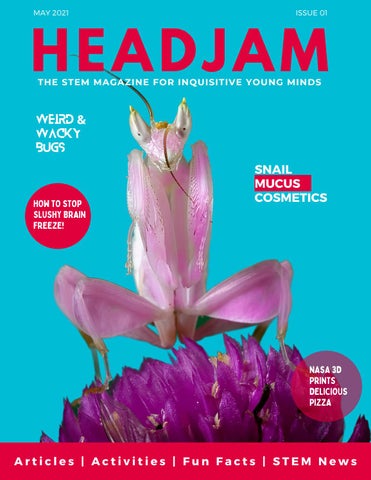
Cover photo: Shutterstock by Lauren Suryanata Pink Praying Mantis (Hymenopus coronatus) is a mantis from the tropical forests of Southeast Asia. The mantis structure is adapted for camouflage, mimicking parts of the orchid flower with the legs resembling flower petals.
TABLE OF CONTENTS
08 get in touch
facebook.com/stemhubaus
12
Wacky Bugs
Cosmetics: Weird & Gross Ingredients
14
15
Brain Freeze is not cool
Ice Cream Lab
18
22
twitter.com/stemhubaus instagram.com/stemhubaus linkedin.com/stemhubaus Level 3, 102 Victoria St Carlton VIC 3429 stemhub.com.au
Square Kilometre Array
Metro Tunnel Project
0 4 Updates from the world of science 0 5 NASA Astronauts 3D print pizza 0 6 The science of cooking 0 7 Confit that food 1 0 E1 world electric powerboat series 1 1 Powerboat Challenge 1 7 Blood Types
qr code for quick access to sites
2 0 White hat hackers
We've added QR codes on some pages to make it easy to access links. You'll need a phone or tablet with a camera.
If you'd like to contribute to our next edition get in touch with us at headjam@stemhub.com.au.
www.stemhub.com.au 03
UPDATES FROM
THE WORLD OF SCIENCE MEDICINE>
SCI BUZZ >
PLASTIC EATING BACTERIA esearchers from Germany's Helmholtz Centre for Environment Research in Leipzig have discovered a strain of "plastic-eating bacteria". This soil bacterium identified as Pseudomonas putida produces enzyme which break down polyurethane making it biodegradable. Now that's cool!
THE APPENDIX MAY NOT BE A USELESS EVOLUTIONARY VESTIGE
R
uke University School of Medicine researchers found the appendix may actually serve as a reservoir of useful gut bacteria. And according to evolutionary biologist Heather F. Smith at Midwestern University in Glendale, Arizona, the appendix has a high concentration of lymphoid tissue which generates white blood cells known as lymphocytes that help mount immune system responses to invading germs. D
NEW DUCKBILLED DINO DISCOVERED IN JAPAN aleontologists find second hadrosaurid species. An international team of paleontologists have identified a new genus and species of hadrosaur or duckbilled dinosaur, Yamatosaurus izanagii, on one of Japan's southern islands.
P
WEIRD >
VENUS FLYTRAPS EMIT MAGNETIC FIELDS ccording to a new study Venus flytraps (Dionaea muscipula) produce a measurable magnetic field when they're munching their bug dinners. Doctoral candidate Anne Fabricant at Johannes Gutenberg University Mainz, who discovered the phenomenon still isn't entirely sure if the magnetic field serves a specific function. By using heat to stimulate the plant the researchers found that the plant produced a magnetic field with a strength of up to 0.5 picoTesla (pT). A
Page 43
NASA ASTRONAUTS CAN NOW PRINT 3D PIZZA
NASA used a 3D printer to create a pizza and they'll eventually be able to provide astronauts with precise, personalised, 3D printed nutrition. Crew health is critical to a successful mission and maintaining astronaut's nutrition becomes harder the further they get from Earth. The 3D printer would build food from scratch that could deliver starch, protein, and fat, creating properly textured edible structures that would be supplemented with micronutrients, flavour, and aroma delivered by inkjet technology.
3D PRINTER KITCHEN APPLIANCE
Foodini is a benchtop 3D food printer that uses state of the art technology, hardware and software, and prints all types of foods from savoury to sweet using fresh and real ingredients.
A crewed mission to Mars will have to pack food for up to five years in space. Our current food system just can't meet the nutritional needs and 5-year shelf life needed for a mission to Mars or other long duration missions. And because refrigeration and freezing takes up a lot of spacecraft resources, current NASA provisions are made up of pre-packaged shelf stable foods, processed with technologies that degrade essential micronutrients.
Can you think of other food preparation methods that NASA
NASA's 3D printed Pizza
food scientists could use to preserve food?
www.stemhub.com.au 05
THE SCIENCE OF COOKING by Shanaaz
Cooking is science at it's very best; it is physics, chemistry and biology in action. Various cooking techniques help enhance the flavours and increase the quality of food that we eat. But what is cooking? In scientific terms, the heat produced from a source is transferred as thermal energy to raw food. This transfer of energy promotes chemical reactions that make or break proteins, fats and carbohydrates. The chemical reactions catalyzed by heat result in a complex array of flavours that we crave and savour.
"SEARING MEAT GIVES IT EXTRA FLAVOUR"
EVER WONDERED WHY COOKED FOOD GOES BROWN? Browning of the food is caused by a process known as Maillard reaction which happens when carbohydrates (sugars) and proteins (amino acids) are heated. Did you know this process can produce more than 1000 volatile flavour chemicals depending on temperature, pH and time?
MAILLARD REACTION WAS DISCOVERED AROUND 1910 & IS KNOWN AS NONENZYMATIC BROWNING
06 www.stemhub.com.au
CONFIT
THAT FOOD! by Shanaaz
Confit is a French word which means to preserve and is any food that is cooked slowly over a long period of time as a method of preservation. The French word was 1st applied to fruits cooked and preserved in sugar. It is a method of cooking food in fat, oil, seasoned water or sugar for a long period of time at temperatures that are much lower than other cooking techniques, like deep frying. While deep frying typically takes place at temperatures of 160–230 °C, confit preparations are done at a much lower temperature, such as an oil temperature of around 90 °C or sometimes even cooler.
When applied as a technique to cook meats, confit involves cooking the meat in its own fat through a slow process. Meat is usually composed of muscles that are made of fibres of connective tissues such as tendons and ligaments that contain collagen. Collagen is a substance that is made up of amino acids and is usually quite hard to chew. When cooked using the right technique and at the right temperature, collagen breaks down into its simpler form, gelatin. The process is known as denaturing and usually takes place at 60°C. Denaturation of collagen is a kinetic process that involves breaking of bonds between molecules called amino acids and hence it is essential to maintain the right temperature for long periods of time. Cooking at low temperatures will liquify the collagen and this gives the
FRUIT CONFIT
meat a silkier, moist and smoother texture.
Collagen
Fruit confit are candied fruit preserved in sugar and the fruit must be fully infused with sugar, to its core. www.stemhub.com.au 07
wacky bugs by Bhashine
THE BRAZILIAN TREEHOPPER The Brazilian treehopper (Bocydium globulare) is a species of insect belonging to the treehopper family (Membracidae). These creatures are pea sized and can be found around the world but are most prevalent in Africa, North and South America, Asia and in Australia!! They love to hang out on the underside of leaves because they're sap suckers and they're one of 3200 species of Treehoppers. So next time you're out and about in the wilderness you might just find one if you're patient enough. 08 www.stemhub.com.au
The left and bottom right images are models created by the legendary science sculptor Alfred Keller (1902—1955). The top right image is an actual Brazilian treehopper.
Want a career studying bugs? To become an Entomologist you'll have to study Biological Sciences at university or an equivalent degree such as Agricultural Science. To prepare yourself for university you can join a student entomology club or participate in an internship.
Australian Entomology Society Why not join the society and learn about the research and current hot topics Scan the QR code to find out more.
Feather Horned Beetle Very little is known about the Feather Horned Beetle. There are only 6 species of Rhipiceridae in Australia and all belong to the genus Rhipicera. Adults range in size from 10 to 25 mm in length.
Distribution: South-eastern Australia, from southern Queensland to Tasmania, and south-west Australia. Habitat: Open eucalypt forests.
Puss Moth (Larvae)
Credit: Flickr Kerry-Ann van Eeden
This poor creature's name really sux but its scientific name is Cerura vinula. Doesn't it look exactly like the Pokemon Caterpie?! The larvae defends itself by pulling its head into its body presenting a scary looking red mouth and big eyes to its prey. TOXIC VENOM ALERT! These little things have extremely toxic venom. The adult moth might look soft and fluffy but hiding under that cuddly exterior are small extremely toxic spines. A puss caterpillar sting feels like a bee sting only worse and lasts up to 12 hours (or longer).
Credit: Butterflyconservation.org - Pete Withers
Adult Cerura vinula Image Source: Peter Bruce-Jones
Distribution: Europe to Indonesia. Habitat: Deciduous woodland at altitudes between sea level and about 1000m.
POOP THROWING Yep these bugs are weird alright! They fling there poop away from their bodies to protect themselves from parasites that are attracted to there poop. And if you were wondering, yes the poop is toxic as well.
BUG WORD SEARCH
BASIC BUG ANATOMY & PHYSIOLOGY Dorsal: top side Ventral: underside Lateral: left and right sides Cuticle: outer layer of the exoskeleton Exoskeleton: hard outer surface of a bug's body. Apodeme: an internal ridge of the exoskeleton where muscles are attached.
Head: hard body segment at the front of the bug. Thorax: middle segment of the bug. Abdomen: hind segment of the bug. Prothorax: forward-most section of the thorax that contains the leg muscles and muscles that support the head and neck. Metathorax: 2nd segment of the thorax that contains flight muscles.
09
E1 World Electric Powerboat Series WATER. The E1 World Electric Powerboat Series is the first ever world electric powerboat series. This series will see up to 12 Teams compete in races on seas, rivers and lakes around the world.
Meet the racebird.
To help reduce fossil fuel spills and noisy engines which have been shown to have negative impacts on marine life, this Series will be helping preserve our oceans, seas and lakes for future generations. The first RaceBirds will be unveiled on June 8, 2021, to coincide with World Oceans Day, with testing scheduled to take place in October later this year. The technology and development of the vessel will progress electric boat mobility and help revolutionise the marine industry for decades to come! INSPIRED? We hope so. If you want a career in marine engineering think about studying subjects like
Maths
Industrial Design
10 www.stemhub.com.au
Battery Capacity: 30kW/h Charging Time: 30min Boat Length: 4.8m Max Speed: 60knots Boat Mass: 380kg Body: 100% Carbon Fibre Boat Efficiency: 80% to 90%
bae systems powerboat challenge For Primary & Secondary Schools
The BAE Systems challenge is back! If you love Formula 1 racing and super fast boats then this challenge is for you. Teams will design a powerboat based on the STEM principles F1 racing engineers use. Winning teams will then pitch their concepts to a panel of industry experts for a chance to win awesome prizes! If you want to get involved TELL YOUR TEACHER now! You've still got plenty of time before the deadline.
ENTRY CLOSES 3-SEP-2021 For more details scan the code
www.stemhub.com.au 11
Cosmetics Weird & Gross Ingredients! by Bhashine
Cosmetics date back to 10,000 BCE ancient Egypt. It is said that Cleopatra used donkeys' milk to keep her skin fresh and youthful not that far fetched since we now know that lactic acid in milk promotes removal of dead skin. Egyptian women to this day still use an ancient eye cosmetic called Kohl which is traditionally made by grinding Stibnite (Sb₂S₃).
02
Cochineal Insect
Natural Red 4 comes from the cochineal scale insect a parasite of the cacti native to Central and South America. Carminic acid (CA) is the main component of the red dye. Carmine, a derivative product of CA is also used as an insoluble red dye.
Wikimedia Commons
12 www.stemhub.com.au
Fish Scales
Mascara, nail polish, lipsticks, bath products, hair products just to name a few use a substance called Guanine. This crystalline material produces a shimmering or light-diffusing colouring effect and it's made from ground-up fish scales.
Credit: Vahe Martirosyan
03
Whale Vomit
Sperm whales make a waxy, yellow, solid substance in their intestines called ambergris to protect them from sharp objects that they may swallow. The unique smell of ambergris is the reason why perfumeries all over the world use it. Just in case you wondering, yes it's super expensive fetching prices of up to $5,000 per 1kg.
Wikimedia Commons
01
04
Boiled Roadkill Carcass
06
Tallow is a common ingredient in loads of products including lipsticks, eye makeup, foundations and primers, shaving soap, and moisturisers. To make tallow animal carcasses are boiled to create fatty byproducts. The dead animals come from many different sources including roadkill!
05
Snail Ooze
Dynamite Toothpaste
Diatomaceous Earth (DE) is one of the 2 components that make up dynamite. DE is made from Diatomites, which are rough, porous fossilised mineral deposits formed near dried up water. It is used in most mild exfoliants, natural toothpastes, deodorants and powders because it is hollow and porous, and has abrasive properties,
Snail ooze (KNU) is used in antiaging, stretch mark and acne creams because of the regenerative properties of the snail's secretions. Snail mucus has glycolic acid, proteoglycans, antimicrobial and copper peptides which protect the the little thing from infection, Credit: Franck Robichon/Corbis abrasions, dryness and UV rays.
Homemade Organic Lip Balm Prep time: 5 mins Cook time: 5 mins Total time: 10 mins Formulation 3 parts carrier oil (any of these will work: coconut, jojoba, avocado, hemp seed, sweet almond, olive or apricot kernel oil) 1 part solid butter 1 part beeswax Ingredients 2 - 4 tablespoons of essential oil 3 tablespoons of carrier oil 1.5 tablespoons of coconut oil 1.5 tablespoons of sweet almond oil 1 tablespoon of shea butter 1 heaped tablespoon of beeswax 25 drops of peppermint essential oil
Equipment Spatula or long spoon Jar Cooking pot Metal tins, small glass jars, or plastic tubes for your finished product. Instructions (Please get a parent to help you) 1. Combine the carrier oil, solid butter, and beeswax in jar and place the jar in a pot of water over medium heat. 2. With a spatula (or long spoon) stir the contents of the jar gently until all of the ingredients are mixed and melted. 3. Remove the jar and add your essential oil. Stir until fully combined. 4. Taking care not to burn yourself, pour into lip balm containers (tins, tubes, small jars) and allow to cool and harden before using. www.stemhub.com.au 13
Sassy
Teen Magazine
The real name for brain freeze is
Scientists aren’t exactly sure what causes brain freeze but one study tried to figure out the cause by measuring the blood flow and activity in the brain while participants drank ice water. The researchers’ theory was that when the brain is cooled rapidly as a result of ingesting extremely cold food or liquids, it changes the blood flow in the brain. The cold is transferred from the roof of your mouth to the nerves of the brain, and this causes some kind of reaction in the brain.
The cure for brain freeze is easy. The moment you start to experience a brain freeze, press your tongue to the roof of your mouth. The heat from your tongue will transfer heat to your sinuses behind your nose, which will then warm the nerve bundles that cause brain freeze. But you have to keep your tongue firmly against the roof of your mouth until you feel the pain start to dissipate.
So the next time you have a slushy remember to drink
14 www.stemhub.com.au
The trigeminal nerve, shown in yellow, conducts signals from dilating blood vessels in the palate to the brain, which interprets the pain as coming from the forehead.
ICE CREAM LAB THE DELICIOUS SIDE OF SCIENCE
W
ho wants to make ice cream? We do! It's easy peasy and there's real science involved.
WHAT YOU'LL NEED: 1/4 cup of cream 1/4 cup of plain milk or flavoured milk 1 tablespoon of sugar (add more if you like it sweet) 1/2 teaspoon vanilla essence 1/4 cup of rock salt 2 cups of ice
METHOD: 1. In the snack-sized zip-lock bag add the milk, cream, sugar, vanilla essence and seal the bag (Milk Mixture Bag) 2. In the sandwich-sized zip-lock bag half fill the bag with ice and add a good amount of rock salt. (Ice Bag) 3. Put the Milk Mixture Bag into the Ice Bag. Make sure that both bags are closed. Shake well. 4. Keep the milk mixture in contact with the ice as much as possible. 5. Keep rolling the ice over the milk making sure
Tea towel or oven mitts
to use the tea towel or oven mitts to protect
Snack-sized and sandwich-sized zip-lock bags
your hands. The ice will become VERY cold.
Ice cream topping of your choice or Milo (our fave)
6. Continue rolling until the consistency resembles that of ice-cream. When it does, grab a spoon and eat up!
www.stemhub.com.au 15
For melting to occur energy is needed which comes Now that we've made our delicious ice cream lets
from the milk mixture in the inner bag. Heat
explore the science behind our creation.
energy is absorbed from the surroundings which in this case comes from the warmer milk-cream
Adding salt to ice lowers the melting point (mp) of
mixture. This absorption of heat energy is referred
ice. The mp of a substance is the temperature (T)
to as an endothermic reaction.
at which it changes state from solid to liquid. If we were to go from liquid to solid, it is referred to as the freezing point (fp). Both fp and mp are measured in Kelvins (K) which is calculated like
TEST YOURSELF What do you call a reaction that releases heat energy?
this: T (K) = T (°C) + 273.15 The addition of salt lowers the melting point. So the more salt we add the lower the temperature can get before the salt water solution freezes (e.g. pure water normally freezes at 0℃, a 10% salt solution freezes at -7℃ and a 20% salt solution freezes at -17℃).
TEST YOURSELF What are the freezing points in Kelvin of the following: 1. Pure water at 0°C? 2. 10% salt solution at -7℃? 3. 20% salt solution at -17℃?
ICE CREAM SCIENCE HOW TO IMPRESS YOUR SCIENCE TEACHER 16 www.stemhub.com.au
Which of these are endothermic reactions? Frying an egg Lighting a match A fireworks display Photosynthesis Lighting coals on a barbeque Evaporation Starting a gas oven Lighting firewood for a campfire Burning a piece of paper
BLOOD
different types & world origins
RHESUS FACTOR Some red blood cells contain the a protein called Rhesus (Rh) factor. If a person has Rh factor, their blood type is called “Rh positive.” A person that does not have the protein is called “Rh negative.” Therefore there are 8 main blood types in
what is blood type/group? Red
blood
antigen
cells
called
(called
erythrocytes)
agglutinogens
on
the
the ABO/Rh blood group system: A+, A-, B+, B-, AB+, AB-, O+, or O-. have
an
surface
composed of sugar molecules. The ABO blood group system
classifies
blood
types
according
to
Do you know what blood type and Rh factor you are?
the
different types of antigens in the red blood cells and antibodies in the plasma.
WORLD BLOOD TYPES Blood
The surface of the red blood cells has the A-antigen, and the plasma has anti-B antibody. The surface of the red blood cells has the B antigen, and the plasma has anti-A antibody. The red blood cells have both A and B antigens, but the plasma does not contain anti-A or antiantibodies.
Individuals
with
type
AB
can
receive any ABO blood type. The plasma contains both anti-A and anti-B antibodies, but the surface of the red blood cells does not contain any A or B antigens. A person with any ABO blood type can receive this type of blood.
vary
depending
on
the
geographical region:
There are 4 ABO types/groups:
B
types
Blood Type A: Central and Eastern Europe. Blood Type B: India and other Central Asian countries. Blood Type AB: This types is the rarest of all and is found in up to 10% of the population in Japan, Korea, and China. Blood Type O: The most common around the
world.
Nearly
100%
of
South
Americans have this blood type and it's the
most
common
among
Australian
Aborigines, Celts, Western Europeans, and people from the USA. Rh Factor The majority of people in any geographical region are Rh positive.
square kilometre array The world’s largest radio-frequency interferometer telescope co-located in Australia and South Africa!
The SKA is a next generation radio astronomy facility having 1 observatory operating 2 telescopes on 3 continents. The telescopes will be co-located in Australia and South Africa.
The ska-low tech stuff
The Australian SKA site is in remote Western Australia, around 800km north of Perth and is in the Australian Radio Quiet Zone WA to protect the SKA from radio interference from electronic devices Australia will have SKA's low frequency instrument called the SKA-Low while South Africa will host the mid-frequency instrument.
~131,000 antennas spread between 500 stations
MAXIMUM DISTANCE BETWEEN STATIONS
>65km
TOTAL COLLECTING AREA FREQUENCY RANGE
50MHz to 350MHz 18 www.stemhub.com.au
DATA TRANSFER RATE
7.2 Terabits per second
0.4km2
AMAZING FACTS ABOUT THE SKA 01
Data flowing from the antennas to the onsite signal processor will be transferred 100,000 times faster than the projected global average broadband speed for 2022. Credit: Michale Goh/ICRAR-Curtin
02
The SKA will use enough optical fibre to wrap around the Earth twice!
03
The computing power required for each of the 2 SKA supercomputers will match that of the best supercomputers in the world in 2019.
04
Every year, the volume of data stored by the SKA would fill over a million 500GB laptops.
05
The SKA will be so sensitive that it will be able to detect an airport radar on a planet tens of light years away. Source: SKAtelescope.org
Credit: CSIRO and ICRAR,
Want to work at SKA?
Credit: CSIRO and ICRAR,
There are so many different jobs you could do at SKA. The qualifications of the SKA team range from undergraduate and postgraduate degrees in Astrophysics, Electronics Engineering, Mechanical Engineering , Software Engineering, Systems Engineering, and Data Analytics. To read about the team scan here
19
By Sherri
The world of technology and the internet seems like a fun and exciting space, but like in the real world, there are bad guys who attack those who are vulnerable. These people are called ‘Hackers’. Like burglars breaking into a house, hackers look for a way in, cause damage and steal. But not all hackers are like this! Hackers usually fall into one of 3 categories, depending on their motives: WHITE - the good hackers who use their powers for good BLACK - the bad hackers who use their powers for their own personal gain GREY - the in-between hackers who do a bit of both 20 www.stemhub.com.au
white hat hackers
What does a white hacker do? White hackers (also known as Ethical Hackers) look at the security of a system or the network's infrastructure. They try to bypass system security, and find and expose any weak points that could be taken advantage of by a malicious hacker. Some of the things they do are to: Identify potential threats Implement ways of minimising the consequences of an attack Perform tests on web resources, hardware, and software Creatively develop ways to counter new malicious hacking Ethical hacking has grown within the information security market so there are plenty of jobs.
Want to be a white hacker?
If you want to be an ethical hacker there are so many ways you could do it. One way is to do a Bachelor of Information Technology and study Cyber Security! This could lead to a career as a Penetration Tester or Cyber Security Researcher working for government and federal agencies, big corporate firms, or tech companies.
DID YOU KNOW? Hacker attacks happen every 39 seconds! Cyber crime is expected to cost $6 trillion globally by 2021!
www.stemhub.com.au 21
Metro Tunnel Project by Nazam
The Metro Tunnel project managed by Rail Projects Victoria is an 11-billion-dollar project ($11,000,000,000) scheduled to be finished by 2025. The plan is to make it faster and easier to get to the airport from the city, with it only taking 10 minutes to get to the airport and under 30 minutes to get to the City. The mega-machine Tunnel Borer.
Credit: Metro Tunnel Project
There are lots of incredible mega-machines being used to build the tunnels! Since builders must work underground- they've had to use machinery called a roadheader to mine tunnels. A roadheader can crush through rock that's 3x harder than concrete! Tunnel boring machines (TBMs) are also used allowing the excavation of tunnels. These machines can dig through lots of different ground conditions, from hard rock to sand! To minimise noise, light and dust pollution, temporary above ground structures called acoustic sheds have been built all around the city. The next time you're in the City of Melbourne look out for them.
Credit: Metro Tunnel Project
acoustic shed
Across 3. Man made composite material 5. Method used to make tunnels 6. A type of pollution
Credit: Metro Tunnel Project
Down 1. This machine can crush through rocks 2. Australian city the Tunnel Project is in 4. These vehicle types will be using the tunnels
1. Roadheader 2. Melbourne 3. Concrete 4. Trains 5. Tunnelboring 6. Noise
A roadheader machine
METRO TUNNEL CAREERS There are lots of different jobs involved to get this project successfully completed!
Archaeologists Architects Builders Geologists Lawyers Structural Engineers From builders to engineers, to even architects and lawyers! Engineers and architects help design how the tunnel will work and look, and the builders make it all happen. Lawyers help make sure everything is okay with the government. To become an engineer or architect, you have to go to university to complete a degree! Monash University, RMIT University, and Western Sydney University (among others) offer Bachelors of Engineering. Monash University also offers a Bachelor and Masters in Architecture - which is how you can become an architect! Or if you'd prefer to become a builder TAFEs all over Australia offer qualifications such as the Certificate IV in Building and Construction. Can you think of other types of jobs that are a part of the Metro Tunnel Project?
Credit: metrotunnel.vic.gov.au
Since 2018 a team of archaeologists, heritage experts, university students and community participants have been carefully unearthing Australia's history. The Metro Tunnel Project earthworks has resulted in the largest archaeological digs in Victorian history! If you want to find out more scan the QR code.
Fun Facts A 100 year old, early tungsten filament light globe has been uncovered estimated to date back between 1912-1920.
Archaeological Digs last several months across each site until the artefacts are recovered
There is a Minecraft server called Mini Melbourne that includes the new Metro Tunnel, exactly like the city! It is free for anyone to join.
They're expecting to recover more than 1 million
The Metro Tunnel will have twin 9 km rail tunnels which will go 12 meters underground.
artefacts across
Artefacts date back to the 1830s and include things like human teeth, dice, a slingshot and even the remnants of a tree dating pre-1850s.
www.stemhub.com.au 23
Canthigaster cicada insect
HEADJAM
THE STEM MAGAZINE FOR INQUISITIVE YOUNG MINDS
Credit: Pixabay