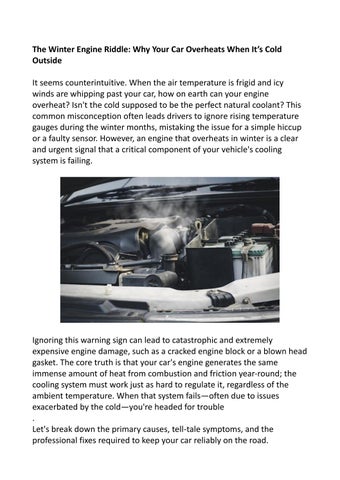
The Winter Engine Riddle: Why Your Car Overheats When It’s Cold Outside It seems counterintuitive. When the air temperature is frigid and icy winds are whipping past your car, how on earth can your engine overheat? Isn't the cold supposed to be the perfect natural coolant? This common misconception often leads drivers to ignore rising temperature gauges during the winter months, mistaking the issue for a simple hiccup or a faulty sensor. However, an engine that overheats in winter is a clear and urgent signal that a critical component of your vehicle's cooling system is failing.
Ignoring this warning sign can lead to catastrophic and extremely expensive engine damage, such as a cracked engine block or a blown head gasket. The core truth is that your car's engine generates the same immense amount of heat from combustion and friction year-round; the cooling system must work just as hard to regulate it, regardless of the ambient temperature. When that system fails—often due to issues exacerbated by the cold—you're headed for trouble . Let's break down the primary causes, tell-tale symptoms, and the professional fixes required to keep your car reliably on the road.
The Causes: Why the Cold Can Be a Killer for Your Cooling System The paradox of winter overheating usually boils down to the failure of the cooling system to circulate the life-sustaining coolant fluid. The cold weather doesn't cause the overheat directly; it exposes and amplifies preexisting weaknesses in the system. 1. The Faulty Thermostat: The Gatekeeper That Gets Stuck The thermostat is a small, critical valve that controls the flow of coolant from the engine to the radiator. Its job is to remain closed when the engine is cold, allowing it to warm up quickly, and then open wide once the engine reaches its optimal operating temperature (usually between 195∘F and 220∘F) to let the coolant circulate and dissipate heat. •
The Winter Problem: If the thermostat gets stuck in the closed position, the hot coolant is trapped inside the engine block. The coolant never reaches the radiator to be cooled, and the engine temperature skyrockets, even with freezing air outside. A faulty thermostat is arguably the most common cause of winter overheating.
2. Low or Compromised Coolant (Antifreeze) The fluid circulating through your engine is a precise 50/50 mixture of water and antifreeze (ethylene glycol). This mixture is engineered for two purposes: to raise the boiling point (preventing overheating) and to lower the freezing point (preventing freezing). •
The Winter Problem: o Low Coolant Level: Leaks (from hoses, gaskets, or the radiator) are a common issue. If the coolant level drops, there isn't enough fluid to absorb the engine's heat, leading to overheating. o Incorrect Mixture: If the coolant has too much water, the mixture's freezing point is higher. In extreme cold, the coolant can freeze or turn to slush, creating a physical blockage that prevents circulation and causes the engine fluid to superheat
locally. 3. Water Pump Failure The water pump is the heart of the cooling system. It is a mechanical pump, often driven by a belt, that forces the coolant to circulate continuously through the engine and radiator. •
The Winter Problem: Cold temperatures can make seals and gaskets brittle, leading to leaks from the pump itself. More critically, a failing internal impeller (the spinning component that moves the fluid) or a broken belt will stop the circulation entirely. No flow means no cooling, and the engine overheats rapidly.
4. Clogged Radiator or Heater Core The radiator and heater core are heat exchangers. The radiator dissipates heat into the air, while the heater core transfers heat into the cabin (providing you with warm air). •
The Winter Problem: Sediment, rust, and contaminants from old, degraded coolant can build up over time, clogging the narrow passages inside the radiator or heater core. A blockage prevents the proper flow of coolant, trapping heat inside the engine. A clogged heater core will also be evident because your car’s heating system
won't produce warm air—a common side effect of overheating issues. The Symptoms: Don't Ignore the Danger Signs Recognizing the signs of overheating is the first and most critical step in preventing permanent engine damage. •
The Temperature Gauge in the Red Zone: The most obvious sign is your dashboard gauge creeping up to the "H" (Hot) mark or into the red indicator zone. Pull over safely and immediately if you see this.
•
Steam/Smoke from Under the Hood: This is usually boiling coolant escaping from the system, often indicating a severe leak or a dangerously pressurized system. Never open the radiator cap while the engine is hot.
•
A Sickly Sweet Smell: Ethylene glycol, the main component of antifreeze, has a distinctively sweet odor. If you smell this, you likely have a coolant leak.
•
No Cabin Heat: As mentioned, if the engine is running hot but your vents are blowing only cold air, it suggests the hot coolant is not circulating to the heater core. This is a classic symptom of low coolant or a stuck-closed thermostat.
•
Unusual Noises: Knocking, ticking, or grinding sounds can indicate a component (like the water pump) is failing, or that the engine oil— which also assists in cooling—is breaking down due to excessive heat.
The Fixes: Professional Solutions Are Essential Once you've safely pulled over and allowed the engine to cool, the issue requires the attention of a skilled professional. These are not fixes for a do-it-yourself novice, as the cooling system operates under pressure and
requires precision work to ensure reliability. If you are anywhere in the five boroughs of NYC and looking for trusted service, you will want to find a dependable, professional mechanic for auto repair queens. A certified mechanic will perform a pressure test and visual inspection to accurately diagnose the root cause of the overheating. The professional fixes will typically involve the following: •
Thermostat Replacement: If the thermostat is diagnosed as stuck or faulty, it will be replaced. This is a common, relatively minor repair that restores the proper flow of coolant.
•
Cooling System Flush and Fill: For vehicles with old or contaminated coolant, a complete system flush is necessary to remove rust, scale, and sediment. This is followed by refilling the system with the manufacturer-recommended 50/50 coolant/water mixture to ensure proper anti-freeze and anti-boil protection.
•
Repairing Leaks: Leaks in the system—whether from brittle hoses, the radiator, or a gasket—must be sealed. This may involve replacing cracked radiator hoses, tightening clamps, or patching/replacing the radiator itself. If you're experiencing repeated leaks, especially in the cooling system, you may need a specialized car repair shop Astoria like Steinway Auto Repair to handle older or higher-mileage vehicles.
•
Water Pump or Drive Belt Replacement: A failing water pump must be replaced. This often involves replacing the belt that drives it as well, especially if it shows signs of cracking or wear. In some engines, the water pump is driven by the timing belt, which makes this a much more complex and critical job.
•
Head Gasket Repair: This is the most serious and expensive potential fix. Overheating can cause the head gasket—which seals the combustion chamber—to fail. Signs include white exhaust smoke, coolant mixing with oil (creating a milky sludge), and air bubbling in the radiator. This repair is intensive and requires a highly-skilled auto mechanic Astoria like the ones at Steinway Auto Repair to
disassemble the top half of the engine. Proactive Prevention and Professional Partnership The best defense against a winter overheat is proactive maintenance. Before the coldest weather hits, have your cooling system inspected. Steinway Auto Repair, a reputable service for auto repair Astoria can check your coolant's health, pressure-test the system for leaks, and inspect key components like the thermostat and water pump. For residents needing reliable service across the borough, a qualified auto mechanic queens will ensure your vehicle is prepared to handle the unique stresses of the cold. Remember, your car's engine generates intense heat regardless of the snowfall outside. The cooling system is the only thing standing between that heat and an engine failure. Don't let your guard down just because the temperature drops; an overheated engine in winter is a dangerous problem that demands immediate professional attention. Schedule your winter cooling system check today.
The above content does not constitute advice for your individual vehicle, but is presented for informational purposes only. If your vehicle is having any issues, then seek the help of a professional mechanic.