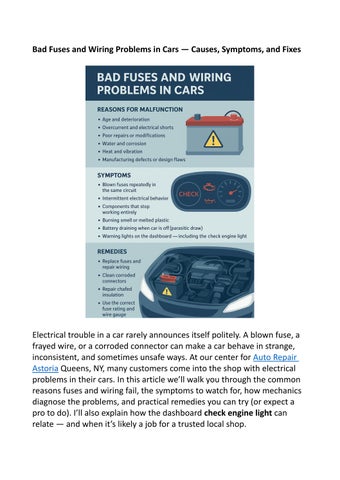
Bad Fuses and Wiring Problems in Cars — Causes, Symptoms, and Fixes
Electrical trouble in a car rarely announces itself politely. A blown fuse, a frayed wire, or a corroded connector can make a car behave in strange, inconsistent, and sometimes unsafe ways. At our center for Auto Repair Astoria Queens, NY, many customers come into the shop with electrical problems in their cars. In this article we’ll walk you through the common reasons fuses and wiring fail, the symptoms to watch for, how mechanics diagnose the problems, and practical remedies you can try (or expect a pro to do). I’ll also explain how the dashboard check engine light can relate — and when it’s likely a job for a trusted local shop.
Why fuses and wiring fail — the usual suspects
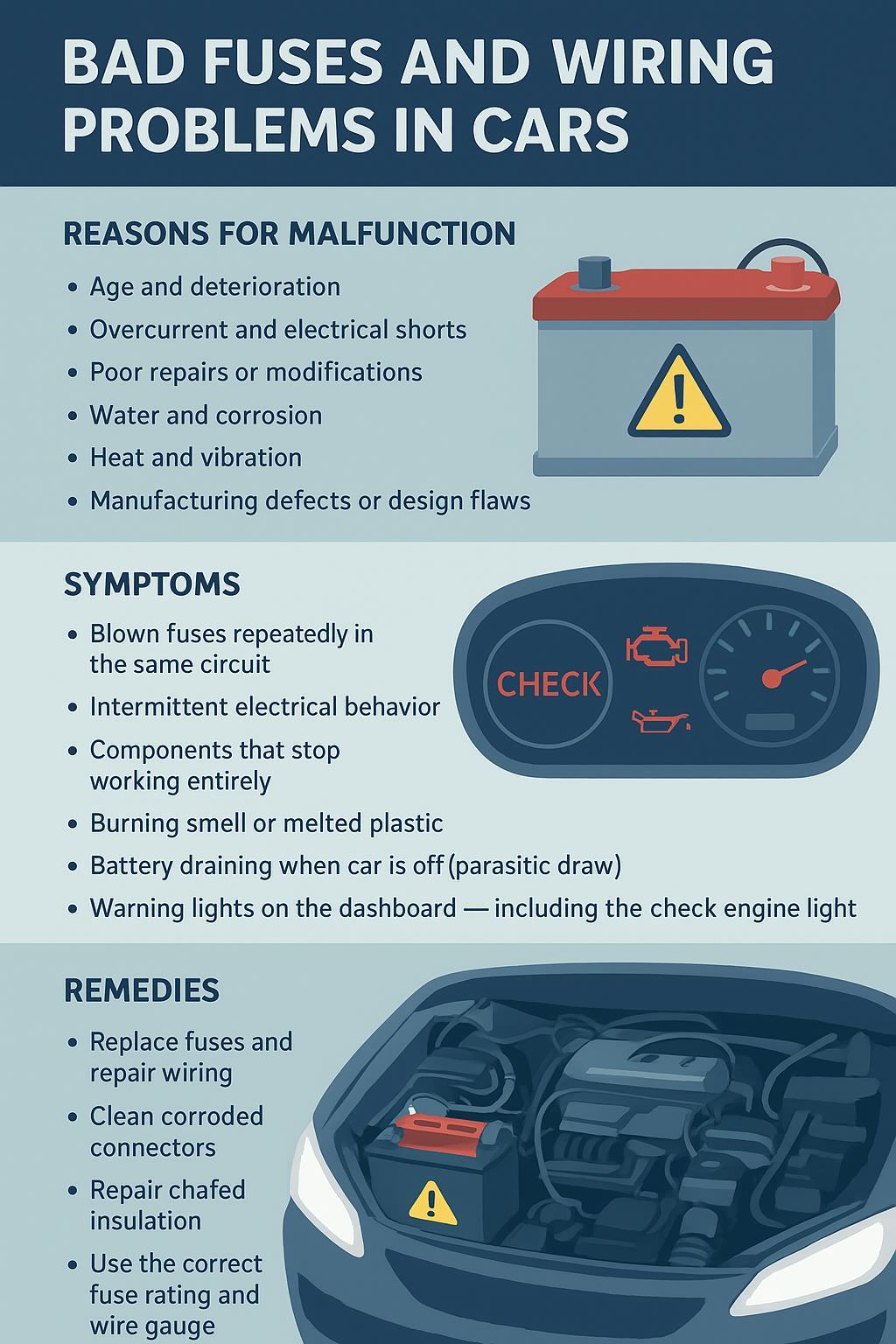
1. Age and deterioration. Over years, insulation becomes brittle, wires chafe where they rub against metal, and connectors corrode. Even a tiny crack in insulation can allow moisture to reach the conductor and cause short circuits.
2. Overcurrent and electrical shorts. Fuses are a safety device designed to melt when a circuit draws too much current. Shorts (a wire touching ground or another conductor it shouldn’t) cause sudden spikes that blow fuses. Shorts can be caused by damaged insulation, loose mounting brackets, or rodents chewing wiring.
3. Poor repairs or modifications. Amateur splices, cheap connectors, or multiple DIY modifications can create weak points. Soldered joints without proper heat-shrink insulation, or using the wrong gauge wire for an accessory (like a high-draw audio amp), will eventually fail.
4. Water and corrosion. Water intrusion into fuse boxes, connectors, or harnesses (particularly on older vehicles or ones driven in salty environments) causes high resistance, arcing, and intermittent faults.
5. Heat and vibration. Engine bays are hot and vibrate constantly. Heat speeds aging of insulation and connectors; vibration loosens terminals and causes wires to rub through.
6. Manufacturing defects or design flaws. Occasionally, a factory wiring harness or a recall-related connector design will lead to a known failure pattern affecting many cars of the same make/model.
Symptoms: how bad wiring and fuses show themselves
Electrical issues often present as inconsistent, hard-to-reproduce problems. Watch for:
• Blown fuses repeatedly in the same circuit. One blown fuse is a
symptom multiple occurrences are a warning sign of an underlying short or overload.
• Intermittent electrical behavior. Windows that work sometimes, lights that flicker, intermittent radio or infotainment failures, or dashboard lights that flash on and off indicate a loose connection or wiring that flexes.
• Components that stop working entirely. If the headlights, horn, power locks, or HVAC blower suddenly die, the problem could be a fuse, but don’t assume that’s the whole story a blown fuse is often a symptom not the root cause.
• Burning smell or melted plastic. This is urgent. Overheating connectors or wiring that’s arcing can cause insulation to melt and can lead to fires.
• Battery draining when car is off (parasitic draw). A shorted accessory or a relay stuck closed can slowly pull current from the battery overnight.
• Warning lights on the dash — including the check engine light. Modern cars use integrated electronics: a wiring fault on a sensor circuit (oxygen sensor, mass airflow, throttle position, etc.) can trigger the check engine light even though the mechanical parts are fine.
The check engine light — friend or distractor?
The check engine light (CEL) is a general indicator that the vehicle’s engine control unit (ECU) has detected a problem. Some ECU codes directly reflect an electrical issue:
• Sensor circuit low/high voltage codes. For example, a camshaft position sensor with an intermittent supply or ground will set a code indicating “signal erratic” or “voltage outside expected range.” That’s often a wiring or connector problem rather than the sensor itself.
• Communication errors. Modules on modern cars talk on networks (CAN bus). A wiring issue that interrupts communication can produce codes and cause limp-home modes.
• Misfires and fuel/air anomalies. While many misfires are mechanical or ignition-related, wiring that affects spark plug coils or injectors will show up as misfire codes.
Many customers to our repair shop with illuminated check engine lights. As experienced mechanics for check engine light Astoria, we know that the CEL doesn’t tell you what to fix — it tells you where to look. A good diagnostic scan and a careful electrical check are the path to the root cause.
Diagnostic steps a competent mechanic will take
1. Scan for codes and live data. The technician reads OBD-II codes and watches live sensor values. Erratic data (a sensor that goes to zero occasionally) hints at wiring/connectors.
2. Visual inspection. Fuse boxes, grounds, harness routing, and connectors are visually inspected for corrosion, melted plastic, or chafing.
3. Fuse testing. Fuses are checked not only for continuity but for why they blew (look for burns on the fuse terminal, signs of arcing).
4. Wiggle and flex tests. Technicians wiggle wiring and connectors while monitoring a circuit to reproduce intermittent faults.
5. Voltage drop and current draw tests. For parasitic drains or highresistance circuits, voltage-drop and clamp-ammeter tests pin down the problem.
6. Repair and verify. After replacing or repairing wiring, connectors, or modules, the tech clears codes and road-tests to ensure the issue is
resolved and the CEL does not return.
Remedies — DIY and professional
DIY steps (for the mechanically comfortable)
• Replace blown fuses only after you’ve checked the circuit. Replacing a fuse without finding a short is likely to blow the new one too and possibly cause more damage.
• Clean corroded connectors with contact cleaner. Disconnect battery first if working on live circuits.
• Repair chafed insulation with proper heat-shrink tubing. Don’t use plain electrical tape as the long-term fix.
• Check and tighten grounds. A bad ground can cause a wide array of symptoms.
• Use the correct fuse rating and wire gauge. Never replace a fuse with a higher-amp fuse as a “temporary” fix this defeats the safety device.
When to call a pro
• If there’s a burning smell, smoke, or melted plastic stop driving and get professional help such as our Auto mechanic Astoria.
• Repeated fuse blows or a complex parasitic draw test are often best handled by a shop with the right tools.
• Intermittent CELs or network communication errors typically require professional diagnostic equipment and experience.
If you are in the NYC area and looking for a professional mechanic that offers electrical diagnostics and general repairs, then check out our car repair shop Astoria Queens.
The above content does not constitute advice for your individual vehicle, but is presented for informational purposes only. If your vehicle is having any issues, then seek the help of a professional mechanic.