ST EDMUND HALL | UNIVERSITY OF OXFORD
ISSUE 33 | 2026
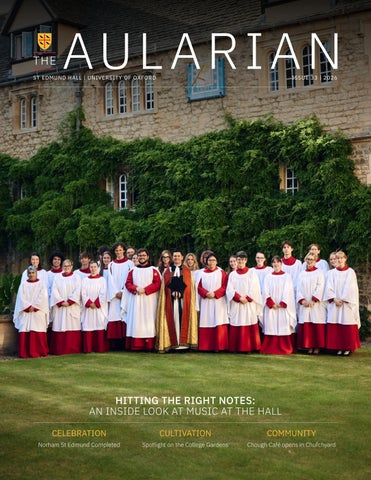
HITTING THE RIGHT NOTES: AN INSIDE LOOK AT MUSIC AT THE HALL CELEBRATION
CULTIVATION
COMMUNITY
Norham St Edmund Completed
Spotlight on the College Gardens
Chough Café opens in Churchyard
CONTENTS 08
10
12
14
17
26
16
24
18
28
30
NEWS the Principal 04 From Professor Baroness (Kathy) Willis CBE, FRS on her eighth year
ISSUE 33 | 2026 Development and Alumni Relations Office St Edmund Hall Queen’s Lane Oxford OX1 4AR
Faces in the Hall Fellowship 05 New An update of Fellows who have joined the College this academic year in Numbers 06 ATheYear impact of your support at St Edmund Hall
08
Norham St Edmund Complete: A New Chapter for the Hall After three and a half years of planning and construction, we are delighted to announce the completion of Norham St Edmund
10
Music at St Edmund Hall A transitional year of introducing new initiatives as well as preserving the long-standing Hall traditions
12
Hall News in Brief News from the 2025–26 academic year
on: the College gardens 16 Spotlight Garden Fellow, Professor Mark Williams, on his work to transform the Hall’s green spaces
the College Chaplain 17 Meet The Venerable Dr Lyndon Drake joined the Hall in 2026 as College Chaplain and Senior Research Fellow
at the Hall 18 Sport The College’s sporting achievements this academic year & Outreach 20 Access Another busy year of reaching potential students
RESEARCH Hand (2022, DPhil Law) 22 Frances The national maternity crisis and the role of international human rights law in its prevention
Dahab Aglan 24 Dr Conflict, forced migration and policy in the Middle East: is there hope? David Dupret 26 Professor Moments that matter: how the brain builds memory Emily Winkler 28 Dr To Bayeux and back again: rediscovering the Bayeux Tapestry in 2026
ALUMNI in... 30 Aularians Media
32
Alumni Events Aularian get togethers all around the world
35
Spirit of the Hall The podcast completed its fifth season this year
E: alumni@seh.ox.ac.uk T: +44 (0)1865 279087 www.seh.ox.ac.uk Registered Charity number: 1137470
@stedmundhall Chief Editors Emily Bruce, Head of Alumni Relations Professor Erica McAlpine, A C Cooper Fellow and Tutor in English Language & Literature Claire Parfitt, Communications Manager Lydia Smith, Head of Alumni Relations (Maternity Cover) Contributors Cerys Acton, Dr Dahab Aglan, Samira Ahmed, Elisha Ainsworth, Professor David Dupret, Frances Hand, Sophie Madden, Andrew Peach, Andrew Vivian, Professor Mark Williams, Professor Baroness (Kathy) Willis CBE, FRS, Dr Emily Winkler Front cover The Choir in the Front Quad, Trinity term 2026, © Fisher Studios Image credits (unless otherwise stated) 4, 5 (Antonin Charret), 12: John Cairns 5 (Lyndon Drake), 8 (middle and bottom), 11 (bottom left), 14 (Chough Café), 17 (top left and middle right), 20 (bottom), 21 (Unlock Oxford): Fisher Studios 5 (Meric Gertler): Wade Hudson 5 (Mel Stride): Karen Hatch 5 (Alyn Shipton), 30 (Samira Ahmed), 32 (Gaudy), 33 (Sports Dinner), 34 (Summer Dinner): Lee Atherton 22: Chris Lacey photography 25: Levi Meir Clancy via Unsplash 33 (Gaudy): Stuart Bebb Design & Print B&M Design & Advertising: bm-group.co.uk The Aularian was printed using paper from sustainable sources.
FROM THE PRINCIPAL
T
he 2025–26 academic year has been one I will long remember - a year in which plans long in the making finally became reality, and the Hall’s capacity to bring people together was, once again, abundantly evident. The most visible transformation has been the completion of Norham St Edmund (see page 8). One hundred and twenty-seven new study bedrooms now stand as the most significant addition to the Hall’s estate in twenty years, and they stand because of you. The generosity of Aularians has been extraordinary: we have so far raised over 80% of our £15 million goal, and every contribution has brought this project closer to its full realisation. I have been genuinely moved by the commitment so many of you have shown to the future of this place, and I look forward enormously to welcoming many friends and supporters back for the official opening in October. Change has also come in quieter forms. On Queen’s Lane, our new Chough Café has opened its doors - a welcome addition for students seeking somewhere to gather and think, and a natural invitation to visitors discovering
4
|
THE AUL ARIAN
the College for the first time (see page 14). In the William R. Miller Building, we have completed our first full retrofit to carbon zero, replacing gas entirely with renewable electric systems (also page 14). It is a step that reflects both our ambition and our responsibility. Next year we will turn greater attention to Queen’s Lane, with plans for rejuvenated green spaces and modernised buildings, bringing us closer to net zero energy use. Within the Fellowship, the year has brought remarkable recognition. David Dupret was appointed by the French Republic for his pioneering work on the mechanisms of memory; Steve Smith received an MBE for services to Climate Science; Leslie Goldberg was elected a Fellow of the Royal Society (see page 12) and joins Déirdre Hollingsworth in the inaugural cohort of the new Academy for the Mathematical Sciences. Jeff Tseng became Oxford’s Assessor (see page 13), and Krina Zondervan was celebrated in a portrait series honouring the University’s leading innovators. We also welcomed 13 new Fellows to the Hall this year - an infusion of talent and energy that bodes well for the years ahead (see page 5)
alongside a new graduate scholarship in Theology, Religion and Philosophy, generously endowed by an alumna and their partner (page 15). Our students have given us much to celebrate too. Frances Hand (2022, DPhil Law) was selected as a BBC/AHRC New Generation Thinker, taking her research on maternity services to BBC Radio 4’s (see page 22). The Hall won Cuppers in Rugby, Mixed Hockey, and Ice Hockey (page 18). The Music at St Edmund Hall series, under the inspired leadership of Director of Music Carlos Rodríguez Otero, brought performers of the highest calibre into our own spaces, while the College Choir continued their weekly chapel performances and toured to Pontigny (see page 10). And the Big Think competition attracted 562 entries from teenagers across the country - our most successful year yet, and a reminder of the Hall’s academic reach far beyond Oxford (page 20). Further afield, it has been a joy to meet Aularians at events in Hong Kong, Singapore, Paris, Montreal and beyond, and to celebrate the 40th anniversary of the New York Dinner with friends old and new (see page 32). You are the living continuation of this community, and you are always welcome here on Queen’s Lane. Looking ahead, as we move from the Norham St Edmund chapter into the next phase of our ambitions – securing the Fellowship endowment, renewing our historic estate, and deepening our support for student wellbeing – we do so with confidence. The Hall’s spirit, as ever, lies in its people. Floreat Aula!
Professor Baroness (Kathy) Willis CBE, FRS Principal, St Edmund Hall
New faces in the Hall’s Fellowship
This academic year, the Hall warmly welcomed the following new Fellows: Top row: Dr Dahab Aglan Early Career Teaching and Research Fellow in Economics
Middle row: Professor Sara Browne Hall alumna (1983, Medicine) and St Edmund Fellow
Chris Ashton Hall alumnus (1991, Geography) and St Edmund Fellow
Dr Antonin Charret Hall alumnus (2019, MSc Education), Junior Dean and Junior Research Fellow in Education
Natasha Ashton Hall alumna (1993, Modern Languages) and St Edmund Fellow Olivia (Olly) Belcher Hall alumna (1999, Geography) and St Edmund Fellow
Dr Aisha Djelid Junior Research Fellow and Broadbent Career Development Fellow in American History The Venerable Dr Lyndon Drake College Chaplain and Senior Research Fellow
Bottom row: Professor Meric Gertler Visiting Fellow Dr Alyn Shipton Hall alumnus (1972, English) and Honorary Fellow The Right Hon Sir Mel Stride MP Hall alumnus (1981, PPE) and Honorary Fellow The Right Hon Nick Thomas-Symonds MP Hall alumnus (1998, PPE) and Honorary Fellow
Robert Gaffey Hall alumnus (1975, Jurisprudence) and St Edmund Fellow THE AUL ARIAN
|
5
A YEAR IN NUMBERS The impact of your support at St Edmund Hall 1 August 2024-31 July 2025
24
£5,000,000+
YOUNGEST DONOR
RAISED
98
1,066
OLDEST DONOR
DONORS
295
FROM
25
HAVE INCLUDED A GIFT IN THEIR WILL TO ST EDMUND HALL
COUNTRIES
1
FELLOWSHIP (EARLY CAREER TEACHING & RESEARCH FELLOWSHIP IN PHILOSOPHY) ENDOWED IN PERPETUITY
+
£160,000
1
GRADUATE SCHOLARSHIP (IN THEOLOGY & PHILOSOPHY) ENDOWED IN PERPETUITY
DONATED DURING THE HALL’S SECOND COMMUNITY & GIVING WEEK
ALLOCATION OF FUNDS 2024-2025
We would like to thank all Aularians who have donated to the HALLmarks campaign to date and continue to support the College: your support is making a real difference. If you would like to get in touch with the Hall to learn more about the campaign and find out how to donate or get involved, please contact alumni@seh.ox.ac.uk.
47%
NORHAM ST EDMUND REDEVELOPMENT
5%
UNRESTRICTED AND OTHER
31%
FELLOWSHIPS
18% STUDENT SUPPORT
Norham St Edmund Complete:
A New Chapter for the Hall
Credit: Hufton+Crow Photography
A
fter three and a half years of planning and construction, we are delighted to announce the completion of Norham St Edmund (NSE), a transformative new home for generations of Aularians to come. The development will officially open in Michaelmas 2026, when students begin moving into 127 purpose-built bedrooms for the next academic year. While previously the College could only house 60% of its students, NSE will make it possible for all undergraduates to live in College accommodation for the duration of their course, helping to reduce financial pressures and ensuring that students from all backgrounds can benefit fully from the Hall experience. The development also sets a new benchmark for sustainable student living in Oxford. It is expected to be the first student accommodation in the city to achieve Passivhaus certification, delivering an 88% biodiversity net gain and a 70% reduction in energy demand across its three new buildings. These achievements reflect the Hall’s commitment to creating a more environmentally responsible future for its students without compromising on quality or student wellbeing. This milestone would not have been possible without the extraordinary generosity of our alumni and friends. Together, supporters have contributed 8
|
THE AUL ARIAN
more than £12 million towards the project. Every gift will have a lasting impact on future generations of our students. There is still time to support this project with several naming opportunities available, including student bedrooms. Alumni and friends interested in giving to the project or arranging a tour of the completed site are warmly invited to contact the Development Office at alumni@seh.ox.ac.uk. To explore the development further, including the latest drone footage and project updates, visit the Hallmarks Campaign website at: hallmarkscampaign. seh.ox.ac.uk/latest-progress.
Top: A view from the street of Willis House, Dunbabin Lodge and Elliot House Above: Students relax in one of the bedrooms Below: Hirsch Cloister Gardens
A view from above
Photos: SDC Photography
Left: The Tai-Heng Cheng Common Room Right: One of the student kitchens
A look inside
Credit: SDC Photography
Credit: Hufton+Crow Photography
Left: Cooksey Square, with the Willis Building to the left and the Smith Common Room to the right Right: Elliot House to the left and Dunbabin Lodge to the right, overlooking Hirsch Cloister Gardens Photos by Hufton+Crow Photography
THE AUL ARIAN
|
9
MUSIC AT ST EDMUND HALL
F
ollowing on from a transitional year of introducing new initiatives as well as preserving the longstanding Hall traditions, musical life at St Edmund Hall has continued to flourish. The Hall community’s commitment to music has never been stronger: students, Fellows and staff have wholeheartedly engaged with a broad offering of musical opportunities, contributing their enthusiasm, talent and excellence. In Michaelmas, Director of Music Carlos Rodríguez Otero launched ‘Music at St Edmund Hall’, a new series of widereaching events, focused on engaging the College community and beyond. The inaugural event, a ‘Come and Sing: Fauré’s Requiem’, brought together over fifty participants from the Hall and beyond, who joined the College Choir to rehearse, learn and perform the popular choral classic. The series has featured a variety of events, including educational workshops, recitals, concerts and collaborative music-making projects. In Michaelmas term, the enormously charismatic Dr Jonathan James led an inspiring workshop on group creativity, improvisation and collaborative musicmaking, in which participants worked together to reinterpret Stravinsky’s The Rite of Spring. To celebrate the Feast of St Edmund, musicians from across the community participated in an immersive ‘Sounding the Renaissance’ workshop, learning about sixteenth-century musical practices, which culminated in a historically informed service of Vespers with the ensemble In Spiritu Humilitatis. In Hilary term, we were delighted to welcome Rivka Golani, one of the foremost viola soloists of her generation, to perform a concert in the Holywell Music Room as part of the series. Rivka, whose friendship to the Hall came through her marriage to Aularian Jeremy Fox (1964, French), performed a lyrical programme of Bruch, Schumann and Dvořák together with violists Yohei Nakajima and Gabor Somfai, and internationally renowned pianist Michael 10
|
THE AUL ARIAN
Anti-clockwise from top left: Creativity Workshop with Dr Jonathan James; Sounding the Renaissance: Workshop and Vespers for St Edmund; The Viola World with Rivka Golani and friends; the Choir perform at Evensong; Carols in the Quad; the Choir in their new cassocks; the Hall's first ever Pantomime; the Choir in the Quad
Hampton. We had the unique opportunity to hear the world premiere of a new work by Hungarian composer Hollós Máté, for viola trio. The evening began with a pre-concert talk given by Carlos Rodríguez Otero, and concluded with a drinks reception in the Principal’s Lodgings, where Aularians and friends reflected on the evening’s musical offerings in a spirit of warmth and celebration. The ‘Music at St Edmund Hall’ series concluded in Trinity term with a series of lunchtime recitals given by students, Fellows, staff and friends of the Hall. This series featured: Spanish baroque ensemble, The Lowe Ensemble; soprano and College staff member, Sophie Madden; clarinettist, David Hrushovski (2023, Philosophy and French); pianist, Mehmet Efe Kılıç (2022, Biochemistry); recorder player, Jess Norton Raybould; and a violin recital by
Carlos Rodríguez Otero, accompanied by pianist, George Herbert. Many thanks to the wonderful members of the Hall community who performed for, attended, organised these events and who have made the inaugural year of the series such a success. The College Choir continue to grow from strength to strength. After the College said goodbye to a large group of leavers last year, the Choir have since welcomed around a dozen new singers. At the start of the academic year, a full set of new Teddy Hall red cassocks and surplices were purchased for the Choir to wear during their weekly services – Choral Evensong every Sunday and Compline in the historic crypt of St Peter-in-the-East every Thursday during term. In addition, the Choir performed services to mark important moments in the liturgical calendar, including Carol services, Ash Wednesday,
Ascension Day, and All Souls’ Day. In Hilary term, we said farewell to the Reverend Andreas Wenzel, and welcomed our new Chaplain, the Venerable Dr Lyndon Drake, who has fast become a familiar face around the College, both in his role as Chaplain and as a Senior Research Fellow in AI.
Noyers, performing in Pontigny Abbey, the final resting place of St Edmund of Abingdon. This September, for the first time, the Choir’s audience will include a number of Aularians attending concurrent Alumni events in the region with the Development and Alumni Relations Office.
Music is at the core of the Hall’s social life. Our talented pool of musicians shared their broad range of genres at dinners and celebrations, with student performers featuring at the Diwali Formal, the Charter Dinner, and St Edmund Feast. In Michaelmas, the Hall came together to celebrate the Oxmas season with Teddy Hall’s first pantomime, ‘Dick Whittington comes to Teddy Hall’. In true tradition, the first night featured a few forgotten lines and plenty of laughter. In Hilary term, jazz was a mainstay of the musical calendar, with the MCR hosting a college-wide charity jazz night, fundraising for Parkinson’s UK. At the Fifth Week Blues breakfast students enjoyed the backdrop of Teddy Hall Jazz
The Choir have performed a wide range of their repertoire, from well-loved staples of choral evensong to new and ambitious challenges, including a newly composed set of canticles by Organ Scholar Augustin Ober (2025, Mathematics). Augustin, Organ Scholar Michelle Ng (2021, Mathematics) and Assistant Organist, Eve Kelleway (2025, Modern Languages) have played the organ in the Chapel this year, under the tutelage of George Herbert. Julie Cooper and Carys Lane continue to provide expert teaching to the singers in the Choir. Among the exciting new faces and opportunities, the Choir continue to partake in their established traditions. This year, spirits were high despite damp weather for the annual Carols in the Quad, where the Choir were joined by a Teddy Hall brass ensemble. The Choir return annually to tour in Pontigny and
At the generous invitation of the Associazione Culturale Vincenzo Gioberti, the Choir will headline the ‘Voci dalle Pievi’ festival in Brescia in December 2026. The Choir are delighted to embark on their first tour to Italy, with thanks to Alberto Garzoni and Matteo Rossi (2025, History and Visiting Student), President and Secretary General of the Society, who have worked to secure this exciting project for the Hall. The St Edmund Hall Consort, led by Henrike Lähnemann, Professor of Medieval German Literature and Linguistics and Governing Body Fellow, brings together the medievalist community of Oxford. These include twice-termly Compline and other occasions, including Tenebrae in the crypt for Maundy Thursday and a reconstructed Night Office as sung by medieval nuns in Northern Germany.
Band to help beat the mid-term exhaustion and lift the Hall’s spirit. Support from the Aularian community enables students to wholeheartedly participate in musical life at the Hall, by generously donating and giving their time to facilitate projects. The annual Choir tour to Pontigny, for instance, is made possible by this generosity. The Masterclass Award is available for students to make use of in order to fund additional coaching to develop their already high-level skills – this year the award has funded music lessons in jazz saxophone, guitar, cello, piano and voice. After such a wonderfully musical year at St Edmund Hall, we are excited to see our growing ambitious projects continue to come to life in future years. Keep your eyes on Hall events for another year ahead of concerts, workshops, chapel services, medieval musings and jazz jams. THE AUL ARIAN
| 11
HALL NEWS IN BRIEF
Read more college news at seh.ox.ac.uk/news
PRINCIPAL BARONESS WILLIS AND PROFESSOR GOLDBERG ELECTED FELLOWS OF THE ROYAL SOCIETY
P
rofessor Baroness (Kathy) Willis, CBE, Professor of Biodiversity, and Principal of St Edmund Hall and Professor Leslie Ann Goldberg, Professor of Computer Science and Senior Research Fellow at St Edmund Hall, have been elected as Fellows to the Royal Society. The Principal said: “I am delighted and honoured to receive this recognition from one of the world’s
12
|
THE AUL ARIAN
leading scientific institutions.” Professor Goldberg added: “I am so honoured to join the Fellowship of the Royal Society. I am also grateful to all of the amazing people that I’ve been lucky enough to collaborate with, throughout my research career so far – I couldn’t have done any of it without them.” Over 90 researchers, including 12 Oxford Scientists, have been appointed to the UK’s national
academy of sciences, in recognition of their exceptional contributions to advancing scientific knowledge. Election to the Fellowship is one of the highest honours in the scientific world, awarded to individuals who have made impactful contributions to knowledge. New Fellows join the ranks of Stephen Hawking, Isaac Newton, Charles Darwin, Albert Einstein, Lise Meitner, Subrahmanyan Chandrasekhar and Dorothy Hodgkin.
PROFESSOR JEFF TSENG IS OXFORD UNIVERSITY’S NEW ASSESSOR On Wednesday 18 March, St Edmund Hall Fellow and tutor in Physics, Professor Jeff Tseng, was appointed Assessor of the University of Oxford. Professor Tseng will oversee student matters and uphold the University’s statutes and policies throughout its governance and administration. The Assessor has a particular focus on policies for student health, welfare and financial issues. Jeff shared: “I was very honoured to be elected as Assessor by my colleagues at St Edmund Hall. When I took the steps up to sit with the Proctors, it was with the sense of a somewhat weighty responsibility, but also of great support from my colleagues, and of looking forward to a rather unusual year seeing the University from many more angles. And I know I’m going to miss my students, who have been a real joy to teach!”
ST EDMUND HALL COMMUNITY & GIVING WEEK From 1 to 8 March, St Edmund Hall enjoyed its second Community & Giving Week. Over 100 members of the Hall community participated, spanning generations from 1953 matriculants to current students and including Fellows, staff, alumni and friends. The central focus of the week was the Edmund Bear Challenge. Inspired by Edmund Bear, a friendly symbol of Teddy Hall and our community, Aularians
around the world took part in a variety of creative activities with a focus on the College and the Edmund Bear. These included poetry, rowing, baked goods, picnics, musical arrangements and a Bears of St Edmund Hall exhibition in the Old Library. The College Choir completed a particularly memorable challenge with a performance of the Teddy Bear’s Picnic song on the Front Quad and we
saw Sebastian Bear, the MCR mascot, do a 5k run with the MCR run club. Thanks to the generosity of our Hall Community, we were able to raise an incredible £160,000 towards student support, access and outreach initiatives, environmental sustainability and extracurricular activities such as sports clubs, music and arts projects.
THE AUL ARIAN
|
13
HALL NEWS IN BRIEF
THE CHOUGH CAFÉ OPENS AT ST EDMUND HALL On Wednesday 29 April, Teddy Hall officially opened the new Chough Café, welcoming both Hall members and the wider public. Tucked just to the left of the Library entrance, the café occupies a converted gardener’s office, offering a historic and relaxed setting, ideal for a break during the summer days in Oxford. Hall alumni benefit from a 25% discount on the barista-made coffee, freshly baked cakes, pastries and more. All visitors can enjoy 15p off any drink when bringing a reusable keep cup. For updates and opening hours, follow the café on Instagram: @sehchoughcafe
14
|
THE AUL ARIAN
WILLIAM R. MILLER BUILDING BECOMES TEDDY HALL’S FIRST ALL-ELECTRIC RESIDENCE The William R. Miller Building has become the College’s first retrofitted carbon-zero building, following the full replacement of its gas systems with renewable electric heating and hot water. The College’s 55-bedroom building on Dawson Street, opened in 2004, was originally operated with electric heating and gas-fired hot water systems throughout. At the beginning of Michaelmas term 2023, the Estates team installed a new all-electric boiler system, known as a “Sunamp” in a small three-bedroom apartment within the building, replacing the aging gas system. The Sunamp unit was monitored over the following year as residents benefited from fully electric, carbon-free heating and hot water. After a successful trial, the team began converting the remaining apartments. By the end of September 2025, the final gas-fired hot water boiler was removed and replaced with an electric system. Looking ahead, we aim to roll out further innovations across the College estate to advance our goal of becoming as close to carbon net zero as possible.
ST EDMUND HALL LAUNCHES NEW THEOLOGY AND PHILOSOPHY GRADUATE SCHOLARSHIP Starting this academic year 2025-26, the College established the new Oxford-St Edmund Hall Scotus-Ockham Graduate Scholarship in Theology and Religion or Philosophy. The first recipient of the award is DPhil Theology student Joseph Harrison, who will complete their research at the Centre for the Study of the Bible and will be affiliated to Teddy Hall. Joseph hopes to explore the literary and philosophical conceptions of city as well as the archaeological evidence from ancient cities. This scholarship award has been generously co-funded with the University in perpetuity with an endowed gift by Dr Sara Browne (1983, Medicine), St Edmund Fellow and Associate Professor of Clinical Medicine at the University of California, and Chris Richey, Managing Partner of Neosho Capital and the Richey Family Foundation. They said of Joseph’s appointment: “We congratulate Joseph on his selection and are proud to assist the next generation of academics to help ‘light our human path’ during challenging times. No pressure Joseph… We are privileged to support wonderful young academics, like Joseph, to advance theological and philosophical studies of the human appreciation of God and spirituality, alongside the pursuit of truth, justice and peace for the benefit of all life.”
THREE YEARS OF STUDENT #HALLLIFE CAMPAIGN After two successful years, the popular student #HallLife campaign returned in Hilary term with two photography interns sharing the wonderful variety of student life at Teddy Hall. Aoife Reynolds (2024, Jurisprudence) and Merve Kaplan (2022, DPhil Physical and Theoretical Chemistry) were selected as this term’s interns. Their weekly updates were shared on the Hall’s social media channels (Instagram and Facebook) to give future students an insight into what it is
really like to experience Oxford, with the images covering a wide range from daily Hall and Oxford life – including studying and social events – to sports and cultural events, around Oxford and further afield. We hope our alumni enjoyed reminiscing about their own time at the Hall through these photographs. Many thanks to Aoife and Merve for sharing these fantastic photographs with us.
THE AUL ARIAN
|
15
SPOTLIGHT ON:
THE COLLEGE GARDENS Professor Mark Williams is a Fellow, Tutor in English Language and Literature and Governing Body Fellow at St Edmund Hall. He has been the College’s Garden Fellow since 2022. Here, he reports on his work to transform the green spaces at the Hall since he took up the post.
T
he College gardens have been undergoing a slow transformation over the last three years. Part of the project as a whole is to make sure that all the green areas of the Hall have points of interest at all times of the year. The Front Quad has narrow beds which were filled with very poor soil: this has been dug out and the beds richly replanted with a wide range of annuals and perennials. Over 2,000 apricot and claret-coloured tulips in March and April are followed by alliums and purple opium poppies under the wisteria in May and June. Late summer brings red dahlias and the warm burnt orange of tithonia rotundiflora, the ‘Mexican sunflower’. The Quad is now a much more leafy and inviting place, filled with insects, scented plants and flowers on every side. In the graveyard lies one of the College’s great set-pieces – its snowdrop display in late January and early February. This has been open to the public for the last couple of years and has attracted a large number of visitors. A project is now afoot to turn the graveyard into a meadow, planted with drifts made up of a mix of native perennials (wild carrot, celery, tufted vetch, lady’s bedstraw) along with some non-native perennial plants (perovskia, miscanthus, persicaria). The result will be a patchwork of soft blues, pinks, yellows and whites of many different textures, which will not only last into late autumn but also provide an architectural display against the frost and low light of late winter.
The Broadbent Garden in the St Peter-inthe-East Churchyard is being gradually dug out, with perennials that are tired or have dwindled being replaced. Down the far end you may notice Teddy’s splendid new olive tree, which has grown by more than six feet since it was planted only three years ago. At its foot grow lime green spurges, blue geraniums, and deep cobalt agapanthus. Nestled between the Wolfson Dining Hall and White Hall Building, the Forum Garden in turn is gradually being changed into a Sissinghurst-inspired ‘white garden’ with the jungly leaves of tetrapanax papyrifer suspended over tumbling white roses and cosmos bipinnatus ‘Purity’. The remaining garden areas of the main site are currently under development, thanks to generous donations by two Aularians. The Rear Quad, by the JCR, will be turned into a much more inviting space:
there will be silvery wooden decking for the students to lounge on, and a large corten steel tank with water pouring into it. The space will be richly planted in a naturalistic style, including two pure white almond trees which will flower in early spring. The Upper Quad, the area around the Doctorow Hall, is going to be turned into an elevated garden along the lines of the High Line in New York City, or Coal Drop Yard in King’s Cross, London. Wooden planters of different heights and areas will soften the edges of the space, each containing a rich mix of perennials and some small trees. The point is to make it an attractive space for students and visitors to the Hall, with interest from early spring all the way through to the depths of winter. We hope you can enjoy the College’s transformed gardens at your next visit back to the Hall.
Above left: White tulips in the Forum Garden Above right: Burnt orange tulips in Front Quad Left: Wisteria in full bloom
16
|
THE AUL ARIAN
MEET THE COLLEGE CHAPLAIN
THE VENERABLE DR LYNDON DRAKE The Venerable Dr Lyndon Drake joined the Hall in 2026 as College Chaplain and Senior Research Fellow. Lyndon brings a unique combination of expertise to St Edmund Hall, combining a career background in finance with academic work in artificial intelligence (AI) and theology, with many years of ordained ministry.
L
Top: Lyndon speaking at the national commemorations for Waitangi Day (the national day of Aotearoa New Zealand) Middle: Lyndon and Director of Music, Carlos Rodríguez Otero Bottom: Lyndon skiing
yndon grew up in Aotearoa New Zealand and completed his undergraduate studies at the University of Auckland before moving to England in 2000. His early career took a dual path: while completing a PhD in AI at the University of York, specialising in symbolic reasoning, he also worked in finance as an interest rate trader, including during the global financial crisis. From 2010 onwards, he retrained in theology, completing three theology degrees at Oxford, and serving as Māori Anglican Archdeacon of Tāmaki Makaurau. Although Lyndon’s theological research began in Hebrew Bible studies, he now leads projects examining AI ethics and is increasingly involved in mechanistic interpretability, returning to his computer science roots. He describes himself as something of an intermediary between disciplines, bringing different sectors of technology and theology together to better understand each other’s perspectives about AI, allowing for more productive conversations to take place. One of Lyndon’s recent projects has been developing a proposed professional oath for those working in AI. Unlike regulation or a formal code of practice, the oath is intended as a voluntary commitment by individuals to uphold ethical standards within the profession. The project involves consultation with academics, industry leaders and practitioners from a range of countries and backgrounds, reflecting the growing interest in the contribution that the humanities can make to conversations around the use of AI. Alongside his academic work, Lyndon’s chaplaincy role reflects a lifelong commitment to Christian ministry. He was drawn to the Hall’s part-time chaplaincy role because it combines leading worship with the flexibility to continue his research. He works closely with the Director of Music, Carlos Rodríguez Otero, to plan services and organise visiting preachers, with Choral Evensong forming the centrepiece of his week. He particularly values the opportunities for conversation and community that continue after services, especially over a shared meal with students, choir members and guests. As he settles into the role, Lyndon is looking forward to further building relationships with students through the chapel community, choir activities and future choir tours in Pontigny, France and Brescia, Italy. Lyndon believes that chapel life remains an important part of Oxford’s collegiate tradition. While recognising that the University’s history has evolved over centuries, he acknowledges the importance of maintaining traditions and a connection with the past while continuing to build for the community in the present. For him, the chaplaincy has also provided a way of becoming more deeply integrated into Hall life, something he sees as one of Oxford’s greatest strengths. Outside work, Lyndon’s three teenage children keep him busy, and whenever time allows he enjoys skiing and surfing with his family. A lifelong music enthusiast, his listening ranges from classical to electronic music, jazz, rock and contemporary pop, reflecting the eclectic tastes he happily admits to. Looking ahead, Lyndon is excited by the opportunities for cross-disciplinary research at Oxford and the role colleges can play in bringing together people from different academic backgrounds. He hopes to continue building bridges between disciplines while contributing to the Hall’s vibrant intellectual and spiritual community. THE AUL ARIAN
| 17
SPORT AT THE HALL SEHRFC after winning the Cuppers Trophy Photo: Steve Karpa
Sport continues to thrive across Teddy Hall, with a busy yet fruitful sporting season across the 2025-26 academic year. In Trinity term, the College Boat Club took part in Summer VIIIs. This year they entered six crews, one more than last year. There was success across the board with the Women’s 2nd boat bumping on each day of VIIIs to achieve blades. After Division 1 was cancelled on the first day, the Men’s first boat managed to bump every subsequent day going +3 and the Women’s first boat went +2. This is the most success the Boat Club has seen in over 10 years! Rather comically, the Men’s 2nd boat was officially the biggest faller on the Isis this year, dropping seven places, which they are choosing to see as an achievement in its own right. The Boat Club were very lucky this year, as with many other Teddy sports, to have eight Blues athletes compete with them in the Summer VIIIs, including World and Olympic Champion, Esther Briz. After winning the Boat Race, Esther delivered a talk to the Boat Club to celebrate 50 years of women rowing for Teddy Hall. For the Boat Club it seems the only way is up. After a devastating loss last year, the Men’s Rugby team were ready to fight back with a vengeance on the pitch. They comfortably won their final match 27-17 against Magdalen/St Hilda’s to bring the Cuppers trophy back home. The Men’s team Captain, Hugo Walsh, would like to thank all the fans that came down to support them during the final match. They hope that their winning streak continues over the next season. Teddy Hall’s Hockey Club won every match this season and topped off the year by winning Cuppers. They ended the first half of the match 0-0 but brought it back in the second half to win 2-0 to JPW (Jesus/Pembroke/Worcester)! Teddy Hall’s Hockey team is also graced with many Blues athletes who have all stepped up 18
|
THE AUL ARIAN
Top: Teddy Hall Boat Club’s First Men’s VIII bumping Magdalen on Saturday of Summer VIIIs. Photo: Geoff Acton. Bottom: Teddy Hall Hockey Club as Cuppers Champions Photo: Evie Chappell (2024, Biochemistry)
Below: Teddy Hall Boat Club’s First Women’s VIII showing of Esther’s Olympian Tattoo Photo: Fizza Zaidi (2022, English)
Top: Winning Ice Hockey Team ‘Ursa Major’ Photo: Simeon Ainsworth (2023, Materials Science) Bottom: Teddy Mixed Netball Cuppers team Photo: Abigail Lovelock-Blair (2024, Geography)
to help lead Teddy to victory after their wipeout Varsity win this year. Evie Chappell, who was Teddy Hall’s Co-Captain this year, is stepping up to be President of Oxford University Hockey Club and Jess Cottee will take up the role of Women’s captain. We hope they will continue to lead their teams to victory. Ice Hockey has become a very popular sport across the Teddy Hall community this year, with four teams entering Ice Hockey Cuppers to face other colleges and teams from Oxford Brookes University. All four teams played brilliantly but it was ‘Ursa Major’ who took the win (2-1) in a nail-biting final against Oxford Brookes. The team are hopeful that this win will cement Ice Hockey as a Teddy Hall staple sport for many years to come. In May the College competed in Mixed Netball Cuppers. They played in three matches across the course of the day winning one and losing two of them. This sadly meant the end of their Cuppers journey. The team says that doesn’t matter though, as they had an amazing time! Women’s football performed exceptionally well this year. Led by their Captains, Kate Parsons and Aoife Reynolds, they won all their league games with an average score of 8-0. In Cuppers they made it to the semi-finals where they were tied 1-1 at full time against Wertonfield (Wadham, Merton and Mansfield combined club). Unfortunately, they were pipped at the post during the penalty shootout losing 4-3. Overall, they came third in Cuppers and are very proud of their result. We hope that our reputation as a sporting college continues to thrive over the next academic season. Cerys Acton (2025-26 JCR Sports Officer)
THE AUL ARIAN
| 19
ACCESS & OUTREACH
T
Elisha Ainsworth joined the Hall in September 2025 and is our Access and Outreach Coordinator. She manages the dayto-day delivery of the College’s access and outreach programmes.
he 2025–26 academic year has been another busy and rewarding period for Access and Outreach at St Edmund Hall. So far this year, we have engaged with 2,142 students across 64 schools and colleges, delivering a wide range of activities designed to support prospective applicants from underrepresented backgrounds. Our work has continued to focus particularly on our link regions of Leicestershire, Derbyshire, and Rutland, while also contributing to wider University initiatives. We began the year with our annual Roadshow in Michaelmas term, visiting 10 schools and delivering interactive sessions to over 700 students across Key Stages 4 and 5. We were delighted to be joined by a team of student ambassadors: Lucy Robinson (2023, Biomedical Sciences), Leila Osborne-Millar (2023, German), Nicholas Bale (2023, Law), and Alex Berresford (2023, Engineering) whose enthusiasm helped to create a welcoming atmosphere, allowing students to hear first-hand about life at Oxford and at St Edmund Hall. Throughout the year, we have also welcomed school groups to the College, offering the opportunity to explore the Hall, learn more about studying at Oxford, and, for older groups, gain insight into the application process. These visits allow participants to meet current undergraduates, ask questions and gain a sense of day-to-day life at the College. Alongside this, we have continued to provide our sustained contact programmes, supporting students over several years at key stages in their academic journeys. Through NextGen, our collaborative programme with Lincoln and Magdalen colleges, we have worked with schools across the East Midlands to provide a structured programme of in-school workshops, visits to Oxford, and a residential experience. Together, these provide tailored guidance on applications, admissions tests and interviews. Our flagship programme, Unlock Oxford, has also continued to grow. Working with state schools across Leicestershire and Derbyshire, the programme supports students identified through a combination of academic potential and indicators of educational disadvantage. Structured across both Urban and Rural strands, Unlock Oxford is designed to ensure that talented students are supported regardless of where they are based.
20
|
THE AUL ARIAN
2025 Outreach Roadshow (Left to right: Leila, Lucy, Nick, Alex, Elisha, Luke)
Unlock Oxford Residential 2026
This year, we welcomed 202 students to the College through our Year 10 and Year 12 residentials, alongside a wider programme of in-school engagement. For many, these residentials provide a first experience of university life: participants attend academic taster sessions, explore the College and city, and take part in workshops on A-level choices, student finance, and the Oxford admissions process. For older students, sessions focus on preparing competitive applications, including interview skills and subject-specific guidance. Alongside our work with prospective applicants, we were pleased to host our third Offer Holder Day in February, welcoming students to the College following the latest admissions cycle. The day provided an opportunity to meet staff and current students, explore the College, and begin to picture life at St Edmund Hall. Our national outreach initiative, the Big Think Competition, has continued to grow, inviting students from across the UK to submit short video essays in response to challenging academic questions. This year’s competition attracted 562 entries – more than double last year’s total. Thanks to the generosity of our tutors, who volunteered their time to set questions and review submissions, we have been able to engage students from across the country and showcase the intellectual curiosity at the heart of the College. In June, prizewinners were invited to Oxford for a celebration event, where they had the opportunity to meet tutors and experience academic life at the University. Our social media presence has also continued to develop, thanks in large part to the work of our JCR Access Officer, Abigail Lovelock-Blair (2024, Geography). Through our Access and Outreach Instagram account, we have been able to share insights into student life, promote events such as the Big Think Competition, and engage prospective applicants in a more informal and accessible way. We are also delighted to have continued our support of the Oxford Hub’s Twinning Programme, which links Oxford colleges with local primary schools. Students volunteer their time to visit our twinned primary school and tutor pupils in reading and maths, alongside supporting enrichment activities. In April, we hosted a science-themed day for Year 3 pupils, including an incollege Chemistry workshop and a visit to the Botanic Gardens. Looking ahead to the remainder of the year, we look forward to continuing our work with schools both in Oxford and across our link regions, as well as welcoming prospective students during the July and September Open Days. None of this work would be possible without the support of our student ambassadors, colleagues, and partner schools, whose enthusiasm and commitment make a significant difference to the students we work with. It has been a privilege to be part of such a welcoming and dedicated community, and to support so many talented young people as they consider their futures. We look forward to continuing this work in the year ahead.
“The fact that I was able to come and visit was amazing… For so long people have this perception that somewhere as prestigious as Oxford is near to impossible to get into, but programmes like Unlock Oxford really open it up for great minds across the country and show that it isn’t some fairytale – it’s somewhere you can experience for yourself if you put the work in. After this trip, I’ve really felt a sense of ‘Yeah, I can do this… I can make it into Oxford!’ and it’s motivated me to keep going.” Year 10 student, Leicester
Unlock Oxford Residential 2026
Open Day, July 2025
Keep up with the Hall's Access and Outreach team via Instagram: @sehaccess
THE AUL ARIAN
|
21
THE NATIONAL MATERNITY CRISIS AND THE ROLE OF INTERNATIONAL HUMAN RIGHTS LAW IN ITS PREVENTION Frances Hand is a DPhil candidate and Guest Lecturer in the Faculty of Law and has been selected as a BBC and AHRC (Arts and Humanities Research Council) New Generation Thinker 2026 for Woman’s Hour on BBC Radio 4. Now that she has submitted her doctorate for final examination, Frances is keen to translate her novel framework on obstetric violence into meaningful national reform.
C
hildbirth is a profound moment in many women’s lives, which holds deep existential and bodily significance and can be highly empowering and lifeaffirming. Yet, for the one in three women in the United Kingdom who describe their birth as traumatic, and the 4-5% who develop post-traumatic stress disorder as a result of their experience, this is far from the case.1 Despite comparative wealth and health advancements, women in the UK continue to encounter vast differences in terms of access, experience and outcome under NHS maternity care. Around the world, women are beginning to speak out about their experiences of harm during childbirth. Organisations such as the Obstetric Justice project in Canada, My Birth Story in New Zealand, and the Association for Improvements in the Maternity Services (AIMS) Journal in the UK have created platforms where women are able to share their stories. Moreover, investigations into the systemic experiences of harm during childbirth are now a fundamental aspect of global research, with studies in Germany, the Netherlands, Belgium and Mexico all reporting high rates of violence against mothers during childbirth.
1
All-Party Parliamentary Group on Birth Trauma, Birth Trauma Inquiry Report (2024).
22
|
THE AUL ARIAN
Frances welcomes connections with alumni working in government, policy, law, healthcare or advocacy who align with her interests in sparking national reform: frances.hand @law.ox.ac.uk.
This report was followed by the Kirkup Inquiry, published in October 20223, which reported on maternity and neonatal services in East Kent. After reviewing 202 cases, it was concluded that: • 46.9% of cases involving maternal morbidity and mortality could have been different if nationally recognised standards of care had been followed • This report also cited similar issues to the Ockenden Review: fragmented staff, bullying culture and a significant failure to listen and reflect across all levels of the organisation
‘OBSTETRIC VIOLENCE’ However, a major flaw of these findings (and the primary argument of my thesis) is the failure to label these experiences as ‘obstetric violence’. Originating in Latin America, the concept of obstetric violence – violence against women during childbirth, committed by healthcare professionals – is a rapidly evolving area of global academic investigation. Yet, the UK continues to mislabel and misunderstand these harms within their reports, minimising them to examples of a ‘lack of kindness’, or individualising them as isolated misunderstandings. I argue that their failure to correctly label these harms hampers meaningful reform. Using the terminology of ‘obstetric violence’ has three major benefits: 1. First, it accurately denotes the severity of the harms experienced. Alongside the psychological impacts of traumatic childbirth, maternal mortality has risen by 20%, rather than reduced, over the past 15 years. It is important that these harms are acknowledged as more than mere examples of ‘unkindness’. 2. Second, ‘obstetric violence’ allows us to draw connections across the broader violence against women movement, to see how violence experienced during childbirth reinforces and supports pre-existing stereotypes about what it means to be a good mother, good wife or good woman. This helps us demonstrate how what may appear to be a small harmful act, when viewed in isolation, can be felt much more severely, given the pressures and judgements that mothers already face. 3. Finally, theories of obstetric violence demonstrate how abuses in childbirth violate a number of human rights, such as the right to personal integrity, privacy, freedom from torture or freedom from discrimination. Thus, the label of obstetric violence is also tactical, allowing us to demand more positive action from the government to fulfil their obligations under international human rights law than would be reasonable to claim if we continue to call these examples of a ‘lack of kindness’.
Bill Kirkup, who led the investigation, warned against minimising these incidents to just one ‘isolated failure’, instead calling for systemic action across the NHS. Finally, the Nottingham University Hospitals (NUH) Inquiry, the largest regional inquiry into a singular service in the history of the NHS, has just been released. So far, they have already been prosecuted by the Care Quality Commission and ordered to pay £1.6m in damages, after pleading guilty to six charges of failure to provide safe care and treatment under the Health and Social Care Act 2008.4
WHAT’S NEXT? While it is commendable that the government continues to investigate maternity care as a national issue, it is also notable that there are currently 700 ongoing recommendations from previous inquiries that are still to be enacted. With another national inquiry having recently concluded, I would suggest it is time for action, rather than further investigation. One way to push this forward is through using the language, theory and responsibilities of international human rights law.
THE DOCTORAL FRAMEWORK In the short lifespan of my doctoral research, the UK has begun to take greater notice of these issues, and a number of national and regional reports have been published, detailing hundreds of stories of harm experienced by women in NHS maternity wards. This not only underlines the sheer scale of the problem, but the timeliness of this research. The first comprehensive report to capture the public’s attention was the Ockenden Review, led by Donna Ockenden, which was published on 30 March 2022.2 This focused on a singular NHS Trust and interviewed 1,486 families, amounting to 1,592 clinical incidents. This resulted in a damning report: • 65.9% of brain injuries were avoidable • 27.9% of neonatal deaths involved significant failures in care practices which might have altered the outcome • Nine maternal and 201 neonatal deaths could have been prevented if the Trust had been working to recognised clinical standards
2 3 4
Final Report of the Ockenden Review: Findings, Conclusions and Essential Actions from the Independent Review of Maternity Services at the Shrewsbury and Telford Hospital NHS Trust (2022). Bill Kirkup, Maternity and neonatal services in East Kent: ‘Reading the signals’ report (2022) (hereafter: Kirkup Report 2022). Care Quality Commission, CQC prosecutes Nottingham University Hospitals NHS Trust after it failed to provide safe care and treatment to mothers and their babies (2025).
THE AUL ARIAN
| 23
F E L L O W S
CONFLICT, FORCED MIGRATION AND POLICY IN THE MIDDLE EAST:
IS THERE HOPE? Dr Dahab Aglan is an Early Career Teaching and Research Fellow in Economics. Her research focuses on evaluating public policies and interventions targeting the welfare and integration of displaced populations affected by conflict and climate change. Using observational data and field experiments, she is particularly interested in examining the impact of these policies on the welfare and integration of displaced populations – especially in the Middle East which hosts 20% of the world’s displaced populations.
I
am a development economist focused on conflict, forced migration and public policies in a part of the world that appears to suffer from endless and ongoing cycles of conflict – the Middle East. My current research seeks to evaluate and quantify the impact of government policies on the integration and movement patterns of internally displaced populations (IDPs) in post-conflict Iraq. IDPs are individuals who were forced to flee their homes due to circumstances such as conflict or climate change but remain within their country’s borders. I am currently collaborating on a research project with Professor Jackline Wahba (University of Southampton) in which we empirically examine the impact of the nationwide liberation campaign in Iraq on the actual returns of IDPs displaced by conflict with Islamic State of Iraq and the Levant (ISIL) to their home, or origin districts. Iraq suffers from a long history of internal displacement due to intercommunal tensions and regional war. More recently, Iraq’s conflict with ISIL (2013 – 2017) led to one of the world’s largest displacement crises. ISIL’s campaign to capture territory intensified in July 2013, followed by its take-over 24
|
THE AUL ARIAN
of multiple cities across Iraq and Syria. It reached the peak of its expansion in 2014, controlling and displacing nearly 6 million Iraqis, which represent about 19 percent of the population of Iraq at the time outside of camps and into IDP camps. Midway through the conflict, the majority of IDPs lived outside of camps and represented nearly 90 percent of the IDP population at the time. Drawing on a novel longitudinal dataset produced by the International Organisation for Migration (IOM) and Georgetown University that follows 3,852 IDP households outside of camps over time, our research offers new perspectives into how IDP return dynamics are shaped by government initiatives and international partnerships. The United Kingdom played a leading role in the Global Coalition established in September 2014 to support the fight against ISIL, pledging more than £110 million from its Conflict, Stability and Security Fund (CSSF) for stabilisation since 2015 to help address some of the key drivers of conflict and improve local infrastructure. Following significant military operations, Iraq was able to gradually liberate and re-take its territory that was captured between 2013 and 2017.
F E L L O W S
Sardashte Camp for Ezidi IDPs in Sinjar (Shingal)
Using the longitudinal data on IDPs, our analysis suggests that the share of IDPs returning to their origin districts increases over time. However, this remains a descriptive finding that could be correlated with many factors. Our research is novel in that it studies whether the liberation campaign played a causal role in returns. That is: Did the liberation campaign succeed in returning IDPs back home? To answer this question, we use economic tools and statistical analysis using a Difference-in-Differences methodology, which enables us to compare changes in the probability of return over time between IDP households originating from origin districts liberated from ISIL and households originating from origin districts that were not under ISIL control. Our empirical findings suggest that the liberation was successful in returning IDP households back home. Importantly, liberation of an origin district increases IDP household returns by about 8 percentage points compared to IDP households originating from districts that were not yet liberated and those that were not under ISIL control. We also observe that economic and security conditions at origin districts influence returns of IDP households. Specifically, IDP households whose properties in their origin districts are in good condition are about 3 percentage points more likely to return to their origin districts compared to those whose properties are not in good condition. Similarly, we find that IDP households who are able to access their properties of origin are more likely to return to their origin districts compared to those who are unable to access their properties of origin.
We also find that adverse security conditions at origin districts negatively influence returns. IDP households who have explosive hazards (such as land mines) present in their origin districts are about 3 percentage points less likely to return compared to IDP households who do not have them in their origin districts. In contrast, the overall economic or security conditions at IDP households’ current destination districts do not appear to systematically influence IDP households’ returns. Our empirical research thus provides some hope that when there are local and international partnerships aimed at a common goal, for example through the United Kingdom’s engagement in the Global Coalition to end the war, then government policies can be successful in returning IDP households back to their homes. However, it is essential to note that the return of IDPs may not necessarily translate into sustainable returns. Specifically, the criteria for sustainable returns as defined by the Inter-Agency Standing Committee (IASC - the longest-standing and highest-level humanitarian coordination forum of the United Nations), include the ability of returnees to participate in public affairs, experience safety and security and have access to effective remedies and justice, among others. In light of the criteria for sustainable return as defined by the IASC, were Iraqi IDP returns back home sustainable? Importantly, are returns of forcibly displaced populations around the world, such as asylum seekers, refugees and IDPs, sustainable? Our ongoing research currently seeks to address this particular question using the case study of Iraq’s liberation campaign. THE AUL ARIAN
|
25
F E L L O W S
MOMENTS THAT MATTER:
HOW THE BRAIN BUILDS MEMORY Professor David Dupret is the River Farm Foundation Tutorial Fellow in Neuroscience and a Governing Body Fellow at St Edmund Hall. In October, he was appointed Chevalier dans l’Ordre des Palmes Académiques (Knight in the Order of the Academic Palms) by the French Republic. In this article, he writes about his current research on memory.
W
e tend to think of memory as something continuous. We move through the world, experiencing events as an unbroken stream, and somehow the brain stores what matters and lets the rest fade away. But this raises a fundamental question: how does our brain decide what to keep? In my research laboratory, we are trying to understand how memories are formed, stabilised, and later retrieved. These processes unfold over time, beginning when we first encounter something new, continuing as the brain processes that experience during rest, and culminating when we recall it later. While psychologists have long described these stages, the underlying mechanisms in the human brain remain only partially understood. At the centre of this process is a small, seahorse-shaped structure called the hippocampus, a key network for memory of contexts and events. It does not work in isolation. Instead, it interacts with a broader set of regions in the medial temporal lobe, forming a distributed system that must coordinate activity across both space and time. The challenge is substantial: how 26
|
THE AUL ARIAN
does the brain organise millions of neurons so that meaningful patterns emerge during learning, are preserved during rest, and can be reactivated when needed? To investigate this, we worked with patients undergoing clinical monitoring for epilepsy, who had electrodes temporarily implanted in their brains. These recordings offered a rare opportunity to measure neural activity directly in humans, capturing both the activity of individual neurons and the collective signals of larger populations. Participants performed a memory task in which they learned relationships between different people forming a community, rested, and were later tested on what they remember. What we found was unexpected – rather than operating through continuous activity, the brain appears to organise memory using brief, rhythmic events (see figure). During learning, the hippocampus generates short-lived bursts of activity paced at a rhythm of roughly two beats per second. These events are not constant; they emerge transiently, following the presentation of new information. Yet during these moments, something
F E L L O W S
remarkable happens: different parts of the memory system become synchronised, and patterns of neural activity are coordinated across regions (see figure). In effect, these rhythmic bursts create windows in time during which the brain brings together distributed activity into a coherent pattern, very much like a choir would sing together in harmony. It is within these windows that the building blocks of memory are assembled. We then asked what happens after learning, when the brain is at rest. It is well known that rest is not a passive state – even when we are not actively thinking about a task, the brain continues to process recent experiences. During this period, we observed that the same patterns of neural activity that emerged during learning were replayed offline. These reactivations occurred during brief, high-frequency events known as ripples, which have long been associated with memory consolidation. Crucially, not all experiences were treated equally. The patterns that were most strongly coordinated during learning were also the ones most likely to be reactivated during rest – and these were, in turn, the experiences that participants were most likely to remember later. In other words, the strength of this coordinated activity predicted memory performance. These findings suggest that memory is not simply captured at the moment of experience. Instead, it is built through a dynamic process in which the brain first organises activity during learning, then selectively replays it during rest, and finally reinstates it during recall. The rhythmic events we observed appear to provide a temporal structure that links these stages together. This has broader implications for how we think about brain function. Much of neuroscience has focused on identifying where things happen in the brain. Our results point to the importance of when they happen. Timing, it seems, is not just a detail but a fundamental organising principle. By creating discrete moments of coordination, the brain may be able to manage the complexity of its
Figure. Coordinating memory across the brain. Electrodes implanted in the human medial temporal lobe for clinical monitoring (top left) enabled direct recordings from multiple memory-related brain regions (top right). Learning triggered brief rhythmic bursts of activity (bottom), oscillating at about two cycles per second, that synchronised activity across the memory system and helped determine what was later remembered. Adapted from Causse et al., Neuron (2026).
own activity, ensuring that information is processed efficiently and retained when it matters. There are also intriguing connections to findings from animal research. In species such as rodents, memory has been linked to rhythmic activity at faster timescales. Our work suggests that in humans, similar principles may operate but at slower speeds, perhaps reflecting the larger size and increased complexity of the human brain. Rather than a continuous background rhythm, memory-related activity appears to be organised into intermittent events that are tightly linked to moments of engagement. Despite these advances, many questions remain. We still do not fully understand how these rhythmic events are generated, how they interact with other brain systems such as those for movement, or how they might be disrupted in conditions that affect memory. Understanding these mechanisms could have important implications - from improving learning strategies to developing interventions for memory disorders. What is clear, however, is that memory is not a passive recording of experience. It is an active, structured process, shaped by the coordinated activity of neural populations over time. The brain does not simply store the past; it reconstructs it, selectively and dynamically, using moments of synchrony that determine what is remembered and what is forgotten. As we continue to investigate these processes, we are beginning to see memory not as a static archive, but as a dynamic system organised in time. And within that system, it may be the briefest moments that matter most. THE AUL ARIAN
|
27
F E L L O W S
TO BAYEUX AND BACK AGAIN:
REDISCOVERING THE BAYEUX TAPESTRY IN 2026 Dr Emily A. Winkler is Lecturer in Medieval History and Associate Member of the Faculty of History at the University of Oxford. As a cultural historian of medieval Europe, she has researched how medieval people imagined leadership and conquest; madness and the mind; chronic grieving; compassion for mercenaries; and the long legacy of ancient Rome in medieval Europe. Her book Pocket Bayeux Tapestry (Bodleian Library Publishing) will be published in September 2026.
N
ot many years after the Battle of Hastings in 1066, designers and artists began to conceive a plan for a work of art. Their idea was to embroider a decorative textile to commemorate the defeat of the English and the Norman conquest of England in that fateful year. The Tapestry was almost certainly made by embroiderers in southern England. These embroiderers were women, famed throughout Europe for their exquisite artistic skill. Only a few tantalising notes in royal inventories hinted at the Tapestry’s existence in later centuries, until the Tapestry was found in a chest in Bayeux Cathedral in 1476. This year, it is coming back to England for a visit. St Edmund Hall has long had a connection with medieval, and specifically Anglo-Norman, history. Below the College Library resides the spectacular twelfth-century Norman crypt, which remains one of the best-preserved medieval spaces in the city of Oxford. The Hall’s historians, too, continue to conduct research in Anglo-Norman studies. Forty years ago, John Cowdrey, who taught medieval history at the Hall from 1956 to 1994, published an article about the Bayeux Tapestry: ‘Towards a New Interpretation of the Bayeux Tapestry’. I have researched and taught medieval history at the Hall for eleven years: first as the John Cowdrey 28
|
THE AUL ARIAN
Junior Research Fellow, then as Principal Investigator of an AHRC historical research grant on English and Welsh chronicles, and currently as Lecturer in Medieval History. My most recent book is Pocket Bayeux Tapestry, published by Bodleian Library Publishing to coincide with the loan of the Tapestry to the UK (September 2026). It has been a privilege to revisit my thinking about the Tapestry to share for general readers. The first time I went to Bayeux to visit the Tapestry, I was with forty other Anglo-Norman historians at a history conference. Thrilled to be in the presence of the real Tapestry, everyone pretended not to hear the reminders that our visiting time was over. My next visit might have been my first, though, because each time I looked at the Tapestry, I saw something new. I took notes by writing on the back of my train ticket in the dim exhibition room. The opportunity to see the Tapestry in person is a chance to perceive it as an artefact. Photographic reproductions are helpful, but in the case of the Bayeux Tapestry especially, photography is not authenticity. The bright colours and blue tints have faded over the centuries. The end has been lost and what is left is badly damaged. Nineteenth-century embroiderers restored the
F E L L O W S
The cover image of Emily’s new book, Pocket Bayeux Tapestry
Tapestry, patching tears and gaps; but they also introduced new designs and motifs not in the original embroidery. Most famously, they converted spear-shafts into arrows—an alteration which has led to the popular myth that one of the English soldiers depicted is Harold with an arrow in his eye. Because my research explores how and why people in the past told stories, I keep coming back to the Tapestry. My master’s dissertation explored the earliest English and Norman narratives of the Norman conquest. The Tapestry was my constant guide. After studying medieval ideas about invasion, leadership, and the business of conquest and defence, I was drawn to narratives that explored the experience of war and its consequences. This brought me back to the Bayeux Tapestry. I wrote an article about the memory of the ‘Malfosse incident’, an episode in the Battle of Hastings when many men and horses tumbled to their deaths into a hidden ditch. After the battle, writers and the Tapestry’s artists tried to capture the tragedy and Emily visiting the UK’s copy of the Bayeux Tapestry, made terror of the plunge, so no one by seamstresses in the 1880s, in Reading Museum would forget what it was like. In its depiction of the incident, a possible inspiration for Picasso’s Guernica, the Tapestry shows a particularly disturbing image of a horse falling headfirst. The Tapestry’s text might have come from a twentiethcentury World War memorial, for it declares that English and Normans alike fell and died together. In researching the memory Emily filming in the Bodleian Library of the Malfosse incident, I for the French documentary ‘Heirdom: started to notice that responses The Legacy of the Normans in England’ to the Norman Conquest over
the long term did not necessarily follow a pattern typically associated with trauma (such as denial, silence, expression, recovery, and acceptance). Some responses, even more than a hundred years after 1066, were vivid with a sense of unresolved loss. For example, in the 1170s, one writer at Waltham Abbey, where King Harold is likely buried, wrote with sorrow about the loss of Harold and the kingdom over a hundred years after 1066. This chronicle inspired me to write an article on medieval ideas about loss and chronic grief. One of the Tapestry’s most intriguing features is its honouring of both English and Norman deeds, and its acknowledgement of loss and sacrifice on both sides. In one of John Cowdrey’s last publications, twenty years after he first wrote about the Tapestry, he turned his thoughts, again, to Bayeux. This time, he thought specifically about its connection to England. He was trying to make sense of the Tapestry’s portrayal of King Harold – the historical figure featured most frequently in the textile. As he acknowledged in his early article, interpretation is something we work ‘towards’: much of the Tapestry remains a mystery. I worked recently as a historical consultant for a French documentary about the legacy of the Normans in England. During the filming, I was asked what ‘1066’ means to me as a historian: does it mean trauma, change, a new order, a beginning, or an end? I replied that, to me, ‘1066’ is a question. Even now, I keep coming back to it. THE AUL ARIAN
|
29
AUL ARIANS IN…
MEDIA
Two Aularians who have worked in the media write about their experiences in the field and give advice for those wanting to take a similar career path.
I Samira Ahmed (1986, English) is an award-winning journalist, writer and broadcaster with over 30 years of experience in the industry and an Honorary Fellow of St Edmund Hall. She currently works at the BBC where she presents Radio 4’s flagship arts programme, Front Row, and BBC One’s weekly show, Newswatch.
30
|
THE AUL ARIAN
always wanted to be a journalist – I was obsessed with the news from a young age and used to make my own radio programmes. I had a career plan from about 14 years old. Whilst at the Hall, I edited The Isis, had work experience at my local paper and the Daily Telegraph. After Oxford, I did City University’s journalism diploma with a Scott Trust bursary, during which I had experience at The Guardian and then I joined the BBC graduate news trainee scheme, which was a two year fast track into television and radio news and current affairs. At 24 I was a reporter on network radio and then a news anchor on World Service TV. By age 25 I was a reporter on Newsnight. Soon, I became a News Correspondent at BBC News – including a posting in the Los Angeles bureau covering the OJ Simpson case, followed by a year at Deutsche Welle TV as a news anchor, because I wanted to be in Germany during the 1998 election year. I spent 11 years at Channel 4 News as a reporter and news presenter which was mostly marvellous – huge creative freedom, time to pursue my own ideas and supportive, inspiring colleagues. I got to make a documentary there about women and Islam which saw me travel the world from Egypt to Iran to Malaysia. It felt different to the strict boundaries around what correspondents could do at BBC News at the time, but by the time I returned to the BBC as a freelance presenter, I felt I had the same freedom here.
Front Row is a mix of big-name interviews, reviews, news stories about the creative industries and original ideas. As it’s a daily show, we have time to respond to what’s going on. I prepare carefully for interviews, doing my own research alongside an expert producer. I also co-present a podcast, Through The Square Window, about vintage TV. And recently, I published my first book – a BFI Film Classics book on the Beatles’ first film, A Hard Day’s Night – about the film as a snapshot of a transforming Britain. There are definitely more books in me. The most important stories I’ve ever reported were talking to the mothers of two murdered young women: Rochelle Holness in London, killed by a convicted serial rapist, and Eudy Simelane in Kwa Thema township – one of many lesbian women in South Africa targeted for their sexuality. While I wish I hadn’t had to do it, I’m really proud of standing up to the BBC over sex discrimination and, thanks to the backing of the National Union of Journalists, winning my employment tribunal for equal pay in 2020: 700 women got pay rises as a result. The media world has changed immeasurably since I started out in 1990, but the principles still hold true: join a union. Do your research, work hard, try not to give it away for free, and trust your instincts and your ethical boundaries. I tell people an Oxford English degree turned out to be the best vocational training for presenting Front Row!
I Andrew Peach (1991, Modern History) has over 30 years’ experience in presenting news programmes and is a well-known voice on BBC Radio. Andrew has covered both local news in Berkshire as well as major world events, receiving many awards in broadcasting along the way. Now, he helps business leaders to engage their audiences and deliver key messages by coaching and facilitating conferences and business events.
was always fascinated by broadcasting and by the time I came up to Oxford in 1991, I was determined to pursue it as a career: so much so that by the end of my first term, I was getting up at 5am with the rowers to help out on BBC Radio Oxford’s Breakfast Show before going to my lectures. I was given my own show in my second year and by the time I graduated, I had acquired enough useful skills to be employable. I particularly enjoyed live, authentic broadcasting that was more commonplace in the US and Australia than it was in the UK at that time, and set about building on the work of others to bring that style to BBC Local Radio where I presented for over thirty years. I was lucky to interview Prime Ministers and cover big events such as royal weddings and US Elections in Washington DC. But despite the grandeur of these moments, what I truly loved was using the platform to bring the community together in challenging times – such as the pandemic, when we were able to collect laptops and tablets for people in hospices to communicate with family members who could not visit in person. When a listener suggested knitting dolls for children in Ukraine in the early stages of the war, thousands of listeners were inspired to get involved. I was proud when an investigation into female genital mutilation led to some of the women I spoke to giving evidence to the Home Affairs Select Committee. And it was an honour to tell the stories of those saved by Sir Nicholas Winton’s Kindertransport by taking them back to Prague where they had said goodbye to their parents for the last time.
In 1998, I decided to spread my wings and began presenting the news on Radio 2, working alongside broadcasters like Sir Terry Wogan, Chris Evans and Zoe Ball. These days, I host conferences and business events and present programmes such as Breakfast on Radio 3, Pick of the Week on Radio 4 and Newshour on BBC World Service. Journalism is the first draft of history, and it’s fascinating to be live on air trying to piece together what’s happening during events such as the January 6 riots on Capitol Hill or the fall of the Assad regime in Syria. I’ll never forget telling radio audiences around the world that Queen Elizabeth II had died. I feel so lucky to have a job which I still enjoy so much and where no two days are the same. It’s a career which suits people who would be gripped by the twists and turns of the news and politics whatever they did for a living, and adrenaline junkies who love a deadline. You need to love talking to people, be interested in helping them tell their stories – and the most important skill by far is being able to listen: it’s much more genuine conversation than it is performance. It’s harder to get through the door of big broadcasting organisations now than it was when I was starting out, but on the other hand our smartphones are more than capable of producing a podcast. The cofounder of artificial intelligence company Anthropic said on one of my programmes recently that people who are creative and can think broadly will thrive amid the AI revolution, and my advice to those interested in media is to try new things, meet as many people as possible and never take ‘no’ for an answer.
THE AUL ARIAN
|
31
ALUMNI EVENTS
It’s been another great year, full of Aularian events all over the world – here’s a round-up of photos capturing some of those reunions and College events. We kicked off the year on 12 September with a joyful celebration at the College as Aularians from 20112013 matriculation years returned to the Hall for their Gaudy. The evening began with a drinks reception in the Old Dining Hall, followed by a delicious four-course dinner in the Wolfson Hall.
On 24 September, we welcomed 1965 matriculands to the College for their 60th Anniversary Lunch. The day started with a drinks reception in the sunshine in the Front Quad followed by a delicious lunch in the Senior Common Room.
At the end of November, the Principal, Senior Tutor, Domestic Bursar and colleagues from the Development and Alumni Relations Office travelled to North America to celebrate the 40th anniversary of the New York Dinner with drinks on Thursday 20 November at the Union Club and the dinner held at the Links Club on the Friday 21 November – generously hosted by Aularians James Lyle (1980, English) and Justus O’Brien (1979, PPE), respectively. The trip to New York concluded with a working breakfast, kindly hosted by St Edmund Fellow and our HALLmarks ambassador in the US, Bob Gaffey (1975, Jurisprudence). 32
|
THE AUL ARIAN
Nearly 100 Aularians returned to the Hall on 20 March for the 2008-2010 Gaudy. They enjoyed an entertaining evening of dinner and drinks, catching up with old friends and reminiscing on their time as students, while hearing updates from the College.
At the end of March, the Principal, Finance Bursar, Director of Development and Deputy Director of Development travelled to Asia to connect with alumni. The group first met for a drinks reception in Hong Kong, generously hosted by Charles Firth (1997, Chemistry) at The Helena May, where they were also joined by Emeritus Fellow Professor Adrian Briggs. The trip concluded in Singapore for a reception at the Writer’s Bar in Raffles.
On 19 March, the Deputy Director of Development travelled to Munich for an alumni drinks reception in the Nymphenburg district, kindly hosted at the home of Florian Seubert (1995, PPE). It was an enjoyable evening for all attendees and the College’s first alumni event in Germany, reflecting ongoing efforts to connect with Aularians worldwide.
1 April saw the return of 1976 matriculands to Queen’s Lane to enjoy a wonderful 50th Anniversary Lunch. Attendees with their guests were treated to a drinks reception in the Principal’s Lodgings, a three-course meal in the Old Dining Hall and a tour of the newly built accommodation at Norham Gardens – with those present becoming some of the first people to see it in its completed state.
On 27 March, we hosted a new event, A Celebration of Teddy Hall Sport. The evening began with a drinks reception and exhibition in the Old Library showcasing the rich history of sport at the College. This was followed by an intimate dinner to celebrate the College’s longstanding, and continuing, sporting successes. THE AUL ARIAN
|
33
ALUMNI EVENTS Our calendar of events was brought to a close by the annual HALLmarks Gala Dinner: Alumni Summer Reunion on the 27 June. Attending Aularians and guests enjoyed a drinks reception accompanied by a jazz quartet featuring Honorary Fellow Alyn Shipton (1972, English), a wonderful dinner in the Wolfson Hall and the evening ended with a fireworks display at Magdalen College that could be viewed over the back of the Chapel.
On 29 April we hosted the inaugural Founders and Funders Network event with a drinks reception in the Front Quad. This network brings together a community of like-minded, entrepreneurial alumni with those who invest in businesses and who are passionate about enabling similar opportunities and experiences for future generations at the Hall. Find out more about the Founders and Funders Network and join here: seh.ox.ac.uk/ alumni/support-the-hall/seh-founders-andfunders-network This year we saw more pop-up events than ever as alumni arranged casual drinks and dinner events to reunite with fellow Aularians around the globe. Pictured (clockwise from top left) are a September gathering in Beijing; a get together in Pasadena kindly hosted by Fellow by Special Election Dr Jack Tan and Ethan Lipsig (1967, Philosophy); an annual pop-up drinks event in Toronto, generously organised by John Milloy (1990, DPhil Modern History) and Akaash Maharaj (1990, PPE); and Young Alumni drinks held in London in November. 34
|
THE AUL ARIAN
Want to organise a pop-up event near you? Contact alumni@seh.ox.ac.uk
SPIRIT OF THE HALL
A PODCAST FOR AULARIANS BY AULARIANS
The St Edmund Hall Association’s podcast, Spirit of the Hall, concluded its fifth season this year. It continues to feature engaging conversations with some of the Hall’s most fascinating alumni, Fellows, students and staff. Hosted by Olly Belcher (1999, Geography), Honorary Fellow and past President of the St Edmund Hall Association for alumni, the podcast provides a chance for past and current members of the Hall to share how its unique spirit has shaped their insights and experiences in politics, academia, business, entertainment, technology and more. Join us as we lead the way and shine a light on some of those who make Teddy Hall what it is. Listen and subscribe online: anchor.fm/spiritofthehall
EPISODE 7
EPISODE 8
EPISODE 9
EPISODE 10
Hugh McManners (1975, Geography) Hugh McManners came up to the Hall in 1975 to read Geography. Hugh was actually born at Teddy Hall as his Father was the Chaplain and then the Dean. After College, Hugh fought with the Special Boat Service and worked with the SAS. After leaving the Army, he was diagnosed as having PTSD and so began campaigning for greater awareness of the psychological effects of combat on military people.
Dr Emma French (1993, History and English) Dr Emma French came up to the Hall in 1993 to read History and English. After completing her PHD in Literary Theory at Southampton University, Emma published her first book, Selling Shakespeare to Hollywood. Emma has edited several plays and is the author of a number of bestselling true crime books including Inside Broadmoor and Inside Wakefield Prison, which was the biggest selling true crime book in the UK in 2024.
Robert Macaire (1984, Modern History) Rob came up to the Hall in 1984 to read Modern History. Since then, he has worked for the Ministry of Defence and the Foreign Office and as British High Commissioner before being appointed as Her Majesty’s Ambassador to Iran. He is now turning his hand to the third sector with his recent appointment as CEO of Lewa Wildlife Conservancy meaning a return to Kenya.
John Milloy (1990, Modern History) John Milloy came up to the Hall in 1990 as an MCR student to do his Doctor of Philosophy in Modern History. After Teddy Hall, John returned to Canada and immediately got involved in politics, ultimately working for the Prime Minister! He then turned to the ballot box himself and was a Liberal Member of the Legislative Assembly of Ontario, surviving three elections until he retired from politics in 2014.
FEBRUARY 2026
APRIL 2026
MAY 2026
JUNE 2026
THE AUL ARIAN
|
35
UPCOMING ALUMNI EVENTS Please save the date for the following events in the 2026–27 academic year. Teddy Hall Drinks in London Thursday 22 October The Miller, 96 Snowsfields, SE1 3SS
St Edmund Hall Association AGM Tuesday 26 January Online
Gaudy for 1978-1981 matriculands Friday 19 March St Edmund Hall
The Suman Conversations in Environmental Sustainability: Beyond Greenwashing, Seminar 8 Friday 13 November St Edmund Hall
St Edmund Hall Association London Dinner Tuesday 2 February Army and Navy Club, Pall Mall, St. James’s, SW1Y 5JN
50th Anniversary Lunch for 1977 matriculands Wednesday 7 April St Edmund Hall
St Edmund Hall Association London Lunch Friday 20 November Army and Navy Club, Pall Mall, St. James’s, SW1Y 5JN
Joe Todd Engineering Dinner Friday 26 February St Edmund Hall
Carols in the Quad Friday 4 December St Edmund Hall New York Drinks Reception Thursday 10 December Venue TBC New York Dinner Friday 11 December Links Club, 36 E 62nd St, NY 10065
Philip Geddes Memorial Lecture Tuesday 2 March Examination Schools, 75–81 High St, Oxford, OX1 4BG The Suman Conversations in Environmental Sustainability: Beyond Greenwashing, Seminar 9 Friday 5 March St Edmund Hall
Alumni Summer Dinner Saturday 26 June St Edmund Hall Floreat Aula Legacy Society Dinner Friday 10 September St Edmund Hall Alumni Weekend Drinks Reception Friday 17 September St Edmund Hall 60th Anniversary Lunch for 1967 matriculands Wednesday 22 September St Edmund Hall
This list is not exhaustive and is subject to change; please visit seh.ox.ac.uk/events/alumni for an up-to-date list and booking links. Bookings usually open around three months before the date of an event, and email invitations will be sent out when they do.
Development and Alumni Relations Office, St Edmund Hall, Queen’s Lane, Oxford, OX1 4AR E: alumni@seh.ox.ac.uk | T: +44 (0)1865 279087 Registered Charity number: 1137470
@stedmundhall www.seh.ox.ac.uk