
CPL Teaching & Learning at St Dunstan’s College





Teaching & Learning Bulletin
Trinity 2026
Iam pleased to introduce our Trinity 2026 Teaching & Learning Bulletin, which celebrates the thoughtful, evidence-informed work of the Early Career Teachers and PGCE students at St Dunstan’s College.
This work has very much been a collective endeavour. Our Teaching and Learning Lead, Sarah Atkinson, together with our Teaching and Learning mentors, Daryush Moussavi and Giles Gibb, have worked closely alongside our ECTs and PGCE community throughout the process. The energy, generosity, and shared commitment across the group have been central to bringing these projects to life, and it has been a genuine pleasure to see such collaborative professionalism in action.
Our approach to early career development continues to be distinctive in the level of autonomy and individual focus it affords. ECTs and PGCE students are supported to take genuine ownership of their professional learning through a structured reflective enquiry project, guided by the GROWTH model, and centred on a carefully chosen aspect of their classroom practice. This framework offers a disciplined yet flexible approach, enabling teachers to engage deeply with a chosen area, apply evidence-informed strategies, and reflect meaningfully on their impact. Through this process, participants have further developed their understanding of their own practice and the needs of their students, refining their teaching with increasing precision and confidence.
A distinctive feature of this year’s work has been its alignment with our whole-school focus on academic literacy and scholarliness. The projects in this bulletin exemplify this shared aspiration, demonstrating how deliberate attention to language, thinking, and disciplinary habits can enhance student learning. The range of enquiry reflects both the depth and diversity of this focus. Projects explore themes such as metacognition and its role in improving exam responses, the use of worked examples to cultivate scholarliness, and the impact of purposeful classroom monitoring on the start of learning. Others consider how explicit teaching of word roots and origins can support students in mastering new terminology, and how reducing teacher talk can create space for more meaningful student debate. Together, these enquiries highlight the powerful relationship between thoughtful classroom practice and the development of confident, articulate learners.
Reflective enquiry remains central to our approach to professional development. It creates space for teachers to think critically, to connect classroom experience with research, and to engage in deliberate, iterative improvement. In doing so, it supports not only the development of effective teaching strategies, but also the cultivation of a sustained habit of professional reflection.
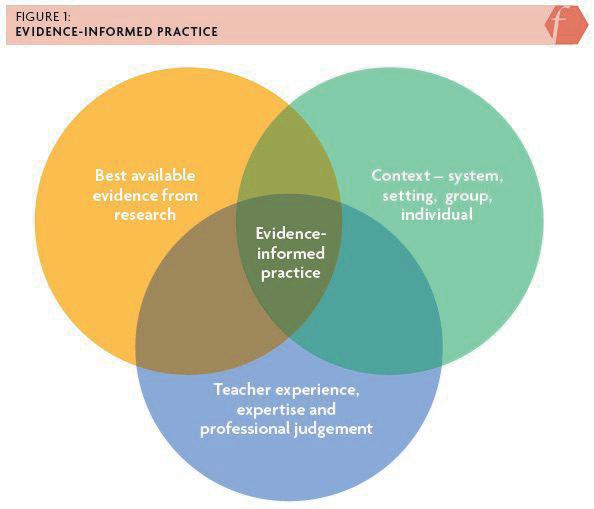
At St Dunstan’s, we are committed to an evidenceinformed approach to pedagogy. This means drawing thoughtfully on a range of sources: insights from published research, an understanding of our own specific context, and the professional judgement and expertise of our teachers. The work presented here reflects this balance in action, illustrating how these strands come together to meaningfully enhance the student experience.
My thanks go to the Teaching & Learning Team, our ECTs and PGCE students, as well as their mentors, for their commitment to this process. I hope that the projects shared in this bulletin offer insight and inspiration, and that they will continue to prompt reflection and dialogue as we further develop our collective practice.
Helen Riddle Assistant Head, Director of Teaching & Learning
Chloe Wang
Thinking about thinking: Metacognition to improve exam responses
Paul Gorostidi Can routines promote spontaneity?
Christopher Austin From Model to Mirror: Cultivating scholarliness through worked examples
Daniel Foulger
Walking the room with Purpose: How active monitoring improved the start of lessons
Everlyn Huang
To what extent do mind maps improve application of skills to questions in Year 12 mathematics tests?
Federico Luchetti
Question Decoding and Metacognition: Does thinking about thinking help students achieve?
Harold Bright
What Does it Mean? Teaching new terminology through word roots and origins!
Harrison Sanford
The role of school-parent communication in supporting student engagement
Luca Elkouby
Self-monitoring for successful planning
Rebekah Edwin Rigour in verbal and written maths solutions
Joseph Giles
Reducing teacher talk to improve student debate

Thinking about thinking: Metacognition to improve exam responses
Chloe Wang
Aim
To explore the extent to which embedding explicit metacognitive strategies over a three-week period can improve Year 12 Psychology students’ interpretation of exam questions and responses to command words.
Rationale & Research
A review of Year 12 end-of-topic assessments revealed that although students demonstrated secure subject knowledge, many struggled to interpret the specific demands of exam questions. This suggested a gap in metacognitive processes, especially in planning and monitoring responses.
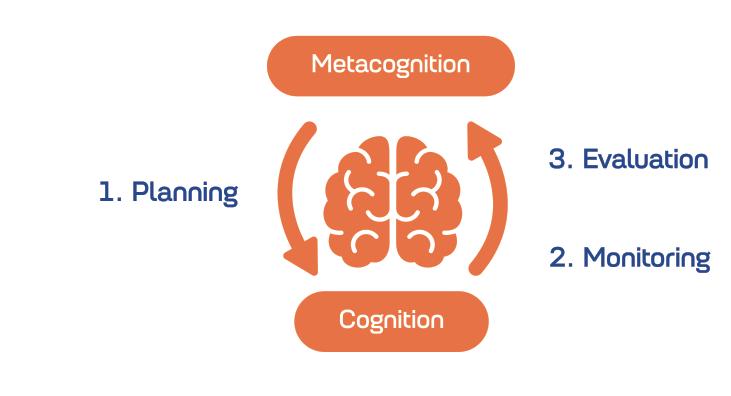
Research highlights the importance of addressing this. The Education Endowment Foundation (EEF) (2018) identifies metacognition as a key driver of pupil progress, emphasising the role of planning, monitoring and evaluation in effective learning (see Figure 1).
Similarly, John Hattie reports a high effect size for metacognitive strategies (0.60), with approaches such as self-questioning, strategy monitoring and evaluation showing particularly strong impact.
Actions
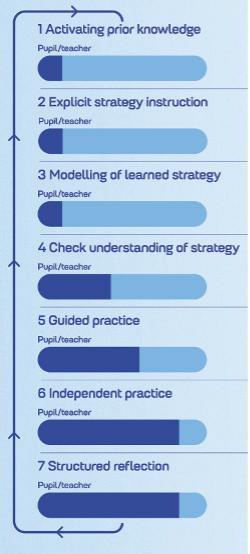
This intervention was structured around the EEF seven-step model (see Figure 2), enabling a gradual release of responsibility from teacher to pupil over a three-week period.
• Explicit instruction (Steps 1–2): I introduced a question deconstruction routine, teaching students to identify command words, topic focus and assessment objectives before answering exam questions.
• Modelling (Step 3): I used thinkalouds to demonstrate how to plan responses and monitor accuracy during writing.
• Checking understanding (Step 4): Across all lessons, I used targeted questioning to ensure students could articulate what a question required and which AO it targeted.
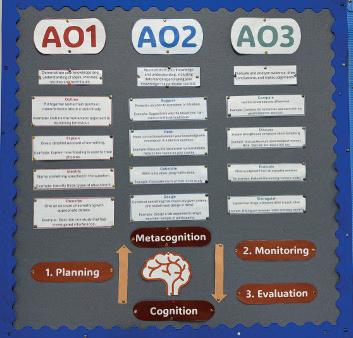
• Guided and independent practice (Steps 5–6): Students applied these strategies to exam questions, supported by AO-coded model answers, printed guidance on command words, and classroom displays of command words and assessment objectives. (see Figure 3)
• Structured reflection (Step 7): Students reflected on whether their responses met the demands of the question, reinforcing evaluation of their own work.
Findings
Student performance was compared before and after the project using two measures: a 12-mark question and a 32-mark assessment.
For the 12-mark question, mean scores showed a small overall increase, with improvements in higher and middle attaining students, while the relatively less able students showed a slight decrease.
For the 32-mark assessment, the most able students demonstrated clear improvement, while middle and lower students showed more variable outcomes.
Improvements were observed even when the post-assessment included different topic content, suggesting that the strategies supported students’ interpretation of question demands across contexts. Qualitatively, students showed greater awareness of command words and were more likely to check whether their responses addressed the question, indicating increased use of metacognitive strategies during tasks.
However, the impact was not consistent across all students, which may reflect differences in engagement, understanding of metacognitive strategies, or attendance during the intervention period.
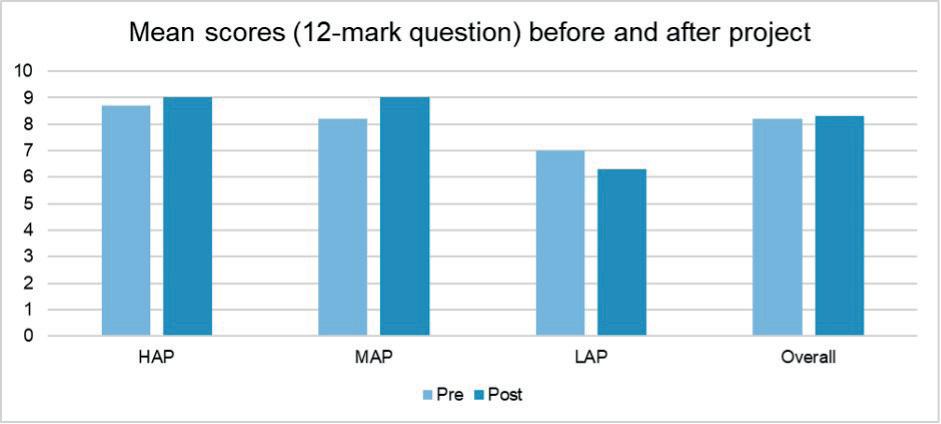
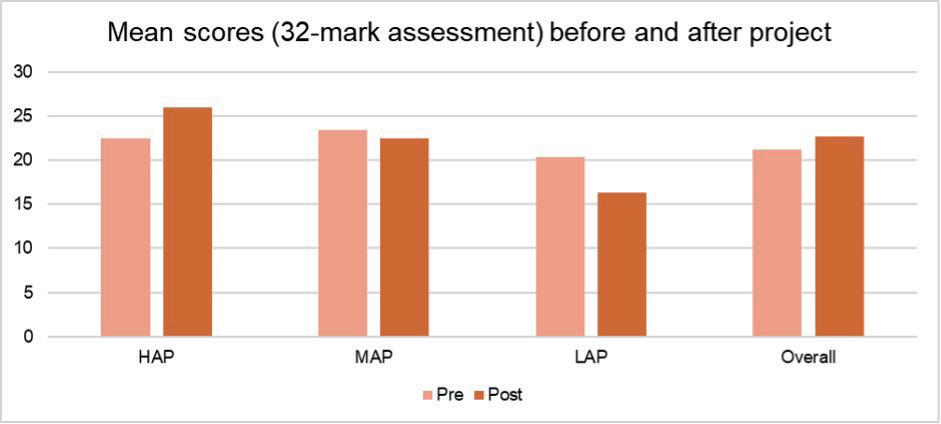
Figure 1. Model of Metacognition (EEF, 2018)
Figure 2. Seven-step model of metacognitive strategy instruction (EEF, 2018).
Figure 3: Classroom display of command words and assessment objectives
Thinking about thinking: Metacognition to improve exam responses
continued ...
Implications for my practice
This project highlighted the value of explicitly teaching metacognitive strategies, rather than assuming students will develop them implicitly.
Embedding planning, monitoring and evaluation within regular lesson routines will remain a key feature of my teaching, particularly at KS5.
The findings also suggest that earlier introduction may be beneficial. I plan to introduce these strategies at KS3 through structured and engaging activities, including a “Mind Gym” club in the Trinity Term.
Additionally, maintaining visible scaffolds, such as classroom displays, will continue to support students’ independent application of these strategies.
Implications for other teachers
Embedding metacognitive strategies can be supported through consistent use of simple, structured teacher prompts. For example:
• Planning: “What is the command word asking you to do?”
• Monitoring: “Are you describing or explaining here?”
“Does this link directly to the question?”
• Evaluation: “Have you fully answered the question?”
“What would improve this response further?”
These prompts can be integrated into questioning and modelling, helping students to internalise metacognitive processes over time.

Can routines promote spontaneity?
Paul Gorostidi
How can simple classroom routines increase spontaneous target language use in a Year 7 French classroom?
In my Year 7 French classroom, I noticed that most of the target language used by pupils was reactive. They were answering my questions, often with the minimum required, but very rarely initiating language themselves. I wanted to explore whether building simple and consistent classroom routines could increase both the amount of French produced and the level of spontaneous, creative responses.
The idea behind this was that pupils are more likely to engage with a language if they use it regularly for real communication, even in small ways. Repeated exposure to meaningful language, especially through interaction, can support confidence and help develop more automatic use over time (Ellis, 2005). There is also strong evidence in the literature that routine and reciprocity help pupils feel safe to participate and use the language (Jones, Halliwell, & Holmes, 2002). Creating regular opportunities to speak without pressure seemed key.
I decided to focus on one specific moment: the register. Instead of simply calling names, I take the time to greet each pupil and ask how they are in French, varying how I ask the question. I gave pupils a printed sheet with a range of possible answers and encouraged them to use it in a very casual way. I also added a few blank lines at the end of the sheet with the title “create your own answer” but deliberately did not mention it to see whether pupils would choose to prepare something independently, as a way of encouraging intrinsic motivation (Ryan & Deci, 2017). I emphasised that their answer did not need to be true and encouraged them to be creative. I made it clear, in a supportive and informal way, that I expected more than just “ça va”, without making it feel like a test. I also made sure that every pupil stuck the sheet into their book, so it remained a consistent reference point. The aim was
to keep it low-stakes while encouraging creativity.
I also introduced some functional classroom language, such as asking to go to the toilet or commenting on tasks. However, I found that the greeting routine was more effective. It happens every lesson, it is predictable, and it allows pupils to express something personal, even in a very simple way.
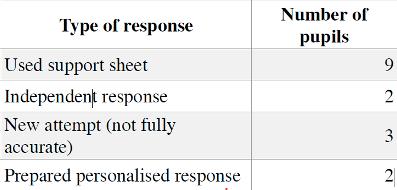
After four weeks, I observed a clear change in behaviour. All 16 pupils in the class now consistently go beyond minimal answers at the start of the lesson. In a recent observation, 9 pupils used the support sheet, 2 responded independently without looking, 3 attempted new responses which were not always accurate, and 2 brought prepared answers, using the blank “create your own answer” section of the sheet to come up with original responses. I have been keeping a simple record of this routine, which helped me track this progression.
More importantly, the nature of the language changed. Some pupils started to experiment and play with the language. One pupil responded on the spot with “ça va comme ci comme ça mais je suis très très fatigué parce que j’ai faim”, combining and extending structures from the support sheet in a spontaneous way. Another pupil, who clearly enjoys cars and knows that Bugatti is French, developed an idea over time, moving from “je suis venu avec ma Bugatti aujourd’hui” to “j’ai crashé ma Bugatti ce matin”. A third pupil, usually quiet in class, was the first to prepare answers in advance giving varied responses on each occasion. I particularly valued how these responses connected and built on each other. These moments felt important because pupils were no longer just responding but using the language more freely, creatively, and often humorously. There was a clear sense of enjoyment in their answers. My genuine reactions to these responses seemed to show pupils that French actually “works”,
that it can lead to small moments of real communication, which in turn builds confidence and motivation. This links to the idea that language learning is more effective when it is connected to real purpose and personal expression (Christie, 2016).
This inquiry has shown me that small, consistent routines can have a significant impact. Rather than trying to increase target language use across the whole lesson, focusing on one repeated moment can help establish habits. Over time, this can open the door to more spontaneous use.
In the future, I would like to create more opportunities for pupils to prepare and personalise their responses, while keeping the routine low-pressure. I would also like to explore how this approach could be extended to other parts of the lesson.
For other teachers, this suggests that increasing target language use does not necessarily require complex strategies. Simple routines, repeated consistently and framed as genuine communication, can help all pupils participate and take risks in the language. It also highlights the importance of keeping these routines lowstakes and allowing space for humour and creativity, so that pupils can engage with the language in a personal and meaningful way (Christie, 2016).
Visual suggestion:
From Model to Mirror: Cultivating scholarliness through worked examples
Christopher Austin
The intellectual development of pupils in a secondary school context can not, and should not, be measured exclusively through their achievements in rubric-based, quantitatively marked summative assessments. Equally important – and prima facie in most ways a more transferrable skill – is the cultivation of scholarliness. Though perhaps more difficult to measure, developing pupils’ ability to compose prose that privileges analytical precision and clarity, maintains a formal academic tone with a subject-rich vocabulary, and properly utilises scholarly sources ought to be of central importance in secondary schools. Scholarliness, sufficiently taught and supported, helps pupils develop not only a disposition toward thoughtful inquiry, but allows them to more competently display their academic learning on the page.
As with all instruction, effectively managing pupils’ cognitive load during the learning process is vitally important to allow them to learn complex ideas at a decent pace with the hope of allowing it to successfully transfer into their long-term memories (Sweller et al. 2019; Rosenshine 2012). According to the Education Endowment Foundation, one of the best ways to instruct and embed the sort of scholarliness mentioned above in a cognitively less demanding fashion is by utilising ‘worked examples’: these reduce the demands of problem-solving so that pupils can allocate their limited working memory resources to noticing patterns, understanding underlying principles, and ultimately, forming stable schemas for their own, independent future application (Perry et al. 2021).
The practice of ‘mirroring’ – the modelling of scholarly thinking for students to observe and internalise – is a central mechanism that makes worked examples actually work. By making the cognitive process explicit and visible – step
selection, justification, and error-checking – the teacher provides a template that students can emulate as they develop their own procedural fluency (Ho 2019). In this way, mirroring transforms worked examples from static demonstrations into dynamic tools for cognitive development.
Aims & methodology
The aim of my study was to investigate to what extent the active annotation of exemplar answers or worked examples would improve the bottom quartile of my Year 7 RPE students’ written scholarship. While my younger Key Stage 3 students are fairly adept at achieving high marks on their RPE exams, I have noted that they often still struggle to understand what good academic writing looks like: their quantitative scores notwithstanding, the qualitative character of their writing is often wanting. In RPE, although these two measures are often interlinked, they are not always – and one doesn’t always follow the other. I wanted to conduct this study of my lower-performing Year 7 RPE students to see if a regiment of worked example instruction could improve the qualitative character of their scholarly writing. To do this, I created and utilised worked examples of high-quality scholarly writing for GCSE-style 4-mark questions on the topics the class was currently studying – ‘Life After Death’ and ‘Buddhism’.
During regular lessons over a month long period, after having the class write an initial baseline answer, the entire class were given handouts that introduced four key areas of ‘scholarly writing’ that I identified: Tone (avoiding emotional language, slang, and conversational phrasing), Vocabulary (using subjectspecific terminology accurately), Spelling and Grammar, and Support (having claims supported by relevant, named sources of authority). On the worksheet I included
The results of this study have two key takeaways:
1. Tone consistently improved among all pupils, and
2. SPaG and Vocabulary were the least successful areas of improvement.
two example 4-mark answers: one of the examples was low quality – containing little, or indeed the opposite of the four key areas previously mentioned – and one was a high quality example of scholarship. The pupils were asked to examine the first answer, and to annotate it where they found fault with it – e.g. they were to note if the answer made reference to a concept/theory, but did not name its source/author. After reading and working through this to identify these key areas, we then do the same for the second example, after which students write their own answers to a new question – with the idea that they are now aiming to emulate the stylistic elements they’ve recently identified.
Results and analysis
Because scholarliness is a qualitative measure, my approach to judging the effectiveness of this study was to assign a quantitative mark for each of the key areas, with a possible total of two marks per area – one for ‘meeting’ the criteria, where the pupil’s work exhibits the quality, and one for ‘exceeding’, where the pupil’s work consistently and fully exhibits the quality – for a possible total of eight marks. For my targeted four lower-performing Year 7 RPE pupils, two improved in at least two areas consistently: Tone and Support, where at the end of the study that were both consistently scoring two marks, having started at zero. The other two students improved by at least one mark consistently in one area each: one in Tone, the other in Vocabulary.
Worked examples of scholarly writing activities in this study were moderately effective, and more effective in some areas than others. By critically engaging in this guided practice, pupils were able to develop Tone rather consistently, ensuring that their writing exhibited a proper scholarly register throughout. Support was also positively favoured in the results of this study: the exemplary academic practice of meaningful citation was effectively and successfully ‘mirrored’ by these pupils. Less affected in this study was SPaG and Vocabulary. SPaG is perhaps not effectively conveyed through ‘mirroring’, as it represents a more systemic, deeply reinforced skill-set – one ingrained in
continual practice outside of the subject. While Vocabulary did improve, it did not improve as much as I expected: pupils were not able to translate the practices they could identify from worked examples into their own work in quite as an effective way. I suspect this has to do with the subject-specific terminology still being new to them, and therefore perhaps not easily accessible in their long-term memories: having to perform the task of ‘key area’ identification requires much less working memory allocation, while novel composition – however scaffolded and signposted – may have used more resources, and so restricted access to the ‘terminology bank’ they had recently built up.
However, on the whole, these results have suggested that employing worked examples is an effective methodology to increase the scholarliness of student writing in secondary school RPE. Aristotle reflected in his Nicomachean Ethics that “we learn as we do those very
things we need to do once we have learned the [technique] completely”. This study has suggested that this is exemplified in worked examples: as being a scholar is an activity, rather than a static end-state, an effective way to becoming a scholar is by being properly guided to engage in practicing being a scholar.

Walking the room with Purpose: How active monitoring improved the start of lessons
Daniel Foulger
My inquiry focus was active monitoring, specifically how purposeful teacher circulation and strategic classroom positioning could improve behaviour, engagement and productivity at the start of lessons in a challenging Year 10 Chemistry class. I chose this focus because this class includes several pupils with SEND profiles and a number of students who regularly arrive late, meaning that the first few minutes of lessons were often unsettled, chaotic and unproductive. I wanted to explore whether changing my movement around the room, alongside adapting the seating plan and starter routine, would lead to a calmer and more purposeful start to learning.
The main research I engaged with was Doug Lemov’s Teach Like a Champion, particularly the idea of “Circulate.” Lemov argues that effective teachers “break the plane” early, move systematically, and use circulation to gather information,
check work, and give immediate feedback rather than waiting at the front of the room. This linked closely to my classroom context. I also drew on the EEF’s Improving Behaviour in Schools guidance, which emphasises proactive classroom management, consistent routines, and understanding pupils’ needs as key factors in improving behaviour. In addition, Rosenshine’s Principles of Instruction reinforced the importance of beginning lessons with a focused review, checking for understanding, and monitoring independent practice closely so that misconceptions and disengagement are addressed early.
In response to this research, I made several practical changes. First, I adjusted the seating plan so that pupils who were frequently late were seated nearer the door, reducing the disruption caused when they entered. Second, I redesigned the seating plan around classroom “hotspots”
rather than simply thinking about proximity to the front. Third, I became much more deliberate in my circulation during the Do Now task, following a planned route designed to reach key pupils and hotspot areas early. I also took a red pen with me so I could give live feedback in books through ticks, crosses, corrections and praise while moving. Finally, I used my smartwatch to track my movement so I could reflect on whether my circulation was genuinely systematic rather than reactive.
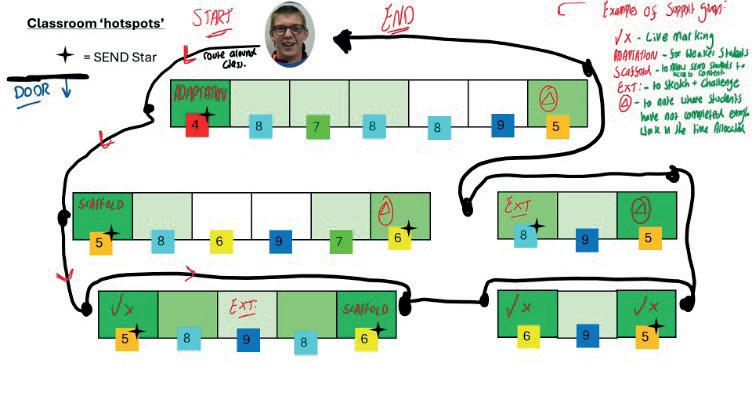

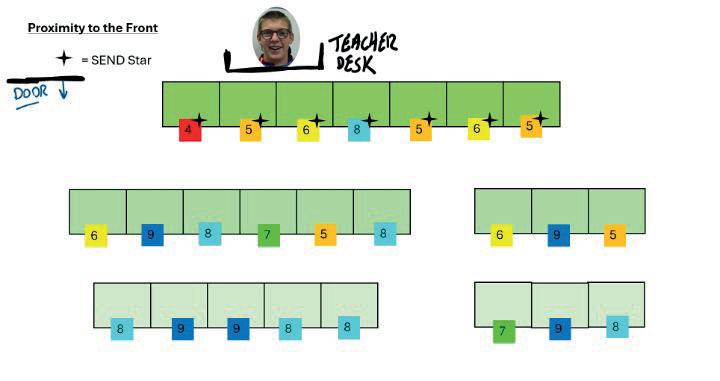



































What I discovered was that this had a noticeable impact on the start of lessons. Quantitatively, my watch data showed that I was covering a significant distance in the opening minutes of lessons, confirming that I was consistently reaching all areas of the room rather than remaining near the front. Qualitatively, students were more engaged with the Do Now tasks, and the atmosphere at the start of the lesson was calmer and more purposeful. I also noticed that pupils sitting next to those whose books I was checking would often turn their books towards me too, suggesting






































that active monitoring increased accountability. Importantly, I was able to provide immediate scaffolds for pupils who struggled with the easiest parts of the task, while also giving extension prompts to those who were ready for stretch and challenge. This meant that circulation supported both behaviour and learning.
This inquiry has informed my future approach by making me much more intentional about how I use the first 5–10 minutes of a lesson. I now see circulation not just as behaviour management





strategy, but as a form of formative assessment and early intervention. In future, I will continue to design seating plans around hotspots, break the plane early, and use purposeful movement to check understanding quickly and support students before disengagement grows. There are also wider implications for other teachers: support is not always most needed at the front of the room, and being purposeful with circulation in the opening minutes can improve engagement, volume of work and completion rates for all pupils.

To what extent do mind maps improve application of skills to questions in Year 12 mathematics tests?
Everlyn Huang
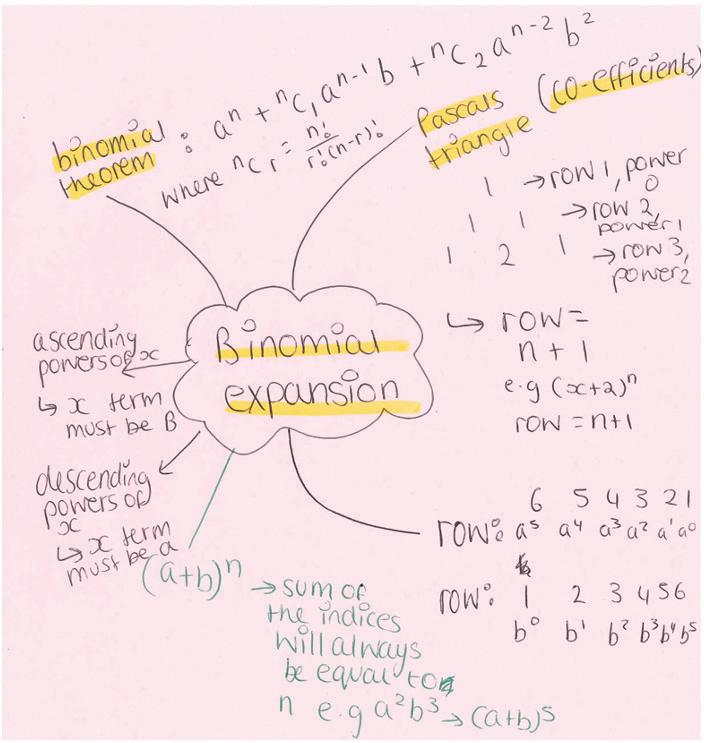
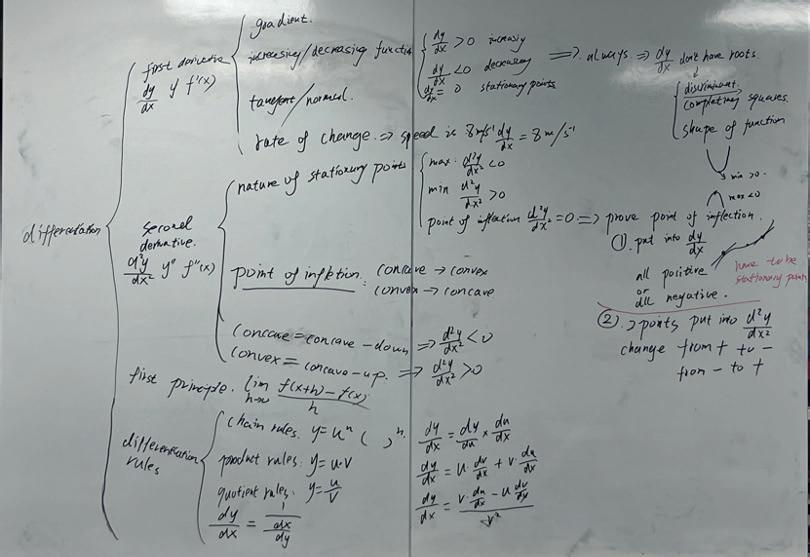
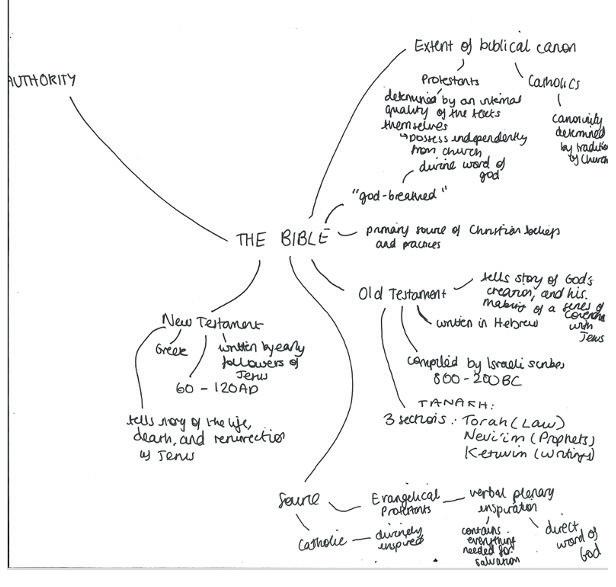
In my Year 12 mathematics classes, I noticed a recurring challenge: students often knew how to execute individual skills but struggled to select the appropriate skill when faced with exam questions. This was particularly evident in the Lent 1 (L1) benchmark assessment, where 50% of mistakes in Block A and 56% in Block B were attributed to students not knowing which skill to apply. This inquiry sought to address the question: To what extent do conclusions and mind maps improve students’ ability to apply skills to specific question types?
To inform my approach, I explored existing literature on mind mapping as a pedagogical tool. Edwards (2010) highlights that “mind mapping can be used as a teaching resource, as an aid to preparing and reviewing lectures, and the technique allows notes to be written and reviewed quickly, and most importantly enables information to be easily updated.” This resonated with my goal of helping students organise and retrieve mathematical skills efficiently.
Further supporting this, a meta-analysis by Zhao et al. (2016) concluded that “the usage of mind mapping has positive effect on students’ learning and teachers’ teaching.” Additionally, Parikh (2016) explains that the “Mind Mapping Technique prepares the mind in a way that information can be used in logical and imaginary way to make an image in the brain.” These insights suggested that visual organisation of knowledge could strengthen students’ ability to recognise question types and deploy appropriate skills.
My intervention unfolded in three stages:
1. Diagnostic reflection:
Following the L1 assessment, I asked students to categorise their mistakes into four types:
• not knowing which skill to use
• knowing the skill but being unable to proceed
• minor errors (calculation, misreading)
• running out of time.
This established a baseline and encouraged metacognitive awareness.
Findings
The impact was tracked by calculating the percentage of errors due to “not knowing which skill to use”
Both classes showed substantial improvement. In 12 A, skill-selection errors dropped from 50% to 19%; in 12 B, from 56% to 22%. However, the topic test revealed that maximum volume questions (not covered in the mind maps) remained problematic.
2. Guided mind mapping:
I guided students to create mind maps drawing conclusions and connecting differentiation skills to common question types. They then completed a topic assessment and again recorded the reasons for any mistakes.
3. Independent application:
During the half-term break, students were asked to create mind maps as revision for the Lent 2 (L2) assessment. Once more, they reflected on their errors.

Similarly, L2 assessment showed difficulties with estimation questions, which were also absent from students’ maps. This suggests that mind maps are most effective when they comprehensively cover the question types students will encounter.
Qualitatively, I observed students engaging more actively with revision. One student remarked that the mind map helped them “see the connections between topics.” Another noted, “I used to just memorise formulas, but now I think about what the question is asking first.”
Informing
Future Practice
This inquiry has reinforced the value of mind mapping as a revision tool. Moving forward, I will:
• Integrate mind mapping explicitly into revision lessons, ensuring students cover all potential question types
• Check completed mind maps for gaps before assessments, prompting students to add missing skills
• Encourage students to annotate mind maps with common question stem and command words
Encouragingly, students have begun transferring this strategy to other subjects. One student shared a photograph of a mind map created for a different subject, indicating that the technique is being recognised as broadly applicable. This suggests that promoting mind mapping across departments could yield crosscurricular benefits.
This inquiry demonstrates that guided mind mapping, combined with metacognitive reflection, can substantially reduce skill-selection errors in Year 12 mathematics. While not a panacea, the technique equips students with a mental framework for organising and retrieving knowledge - a skill that serves them well beyond the classroom.
Question Decoding and Metacognition: Does thinking about thinking help students achieve?
Federico Luchetti
Vaguely-worded exam questions are the fear of every student who is used to practicing on explicit questioning; hard work and dedication can be halted a question that they can sense they should be able to solve.
In Physics, the ability to identify what equation or law of Physics to use to explain a phenomenon is crucial to high achievement and confidence. The aim of this project is to investigate how the explicit teaching of metacognitive strategies affects students’ ability to decipher exam-style questions and identify the information needed to do so. What I noticed in my Year 10 Physics class was that students were lacking the internal dialogue that could help them plan out their thinking and reasoning to answer a question or solve a problem. For some questions that required deeper or outof-the-box thinking, students relied on my input and questioning to draw out the problem-solving skills they already possess.
What does the research say?
Mulholland, an Educational Endowment Foundation (EEF) content specialist alumnus, suggests that the providing “the least amount of support first” promotes the development of pupils’ self-scaffolding
strategies, therefore increasing their independence in relation to unfamiliar questions. Özsoy and Ataman (2009) support this claim, as their research found an increase in pupils’ mathematical problem-solving skills after implementing an instruction process intended to develop metacognitive skills. To solve a Physics problem, students often need to apply mathematical thinking and reasoning skills, and deploy appropriate mathematical skills, like rearranging equations or manipulating values. With regards to mathematical thinking and problem-solving, I wanted to give students the tools they needed to question – with the purpose of improving upon – their reasoning and planning of their solutions.
To assess my students’ progress and track their ability to decipher questions, I posed them two types of questions: one was very unfamiliar, out-of-the-box thinking type questions from the British Physics Olympiad, some being from the Senior Challenge, and the other being IGCSE-style questions, but with the command words and request omitted. For the former, their task was to identify what the “last step” of their solution would be, just by inferring from context clues and the values they are given; for the latter, their task was to identify what value they could be asked to calculate if the question was complete.
I wanted both types of questions to have students thinking about their process, instead of the final numerical answer. After a diagnostic round, I spent a few minutes for two lessons teaching them to think about their thinking process, before they answer a question.
I put up the following questions on the board to guide their thinking while they worked through a pack of exam questions:
1. What quantities am I being given? Make a quick list. (Doesn’t have to include numbers)
2. Do I know any equations that link these quantities?
3. Have I been given enough information to solve this problem or do I need to go through some extra steps to do so? (is this a multi-step problem?)
4. After solving look at the answer. How can I check if this makes sense? Does this number represent a physical quantity that is in line with the quantities they give me? (eg. 1014 apples is too many apples)
After a round of these, similar BPhO and missing-question questions were given to them again.

Findings
I ran this strategy with two Year 10, very able Physics classes; the results are as follows:
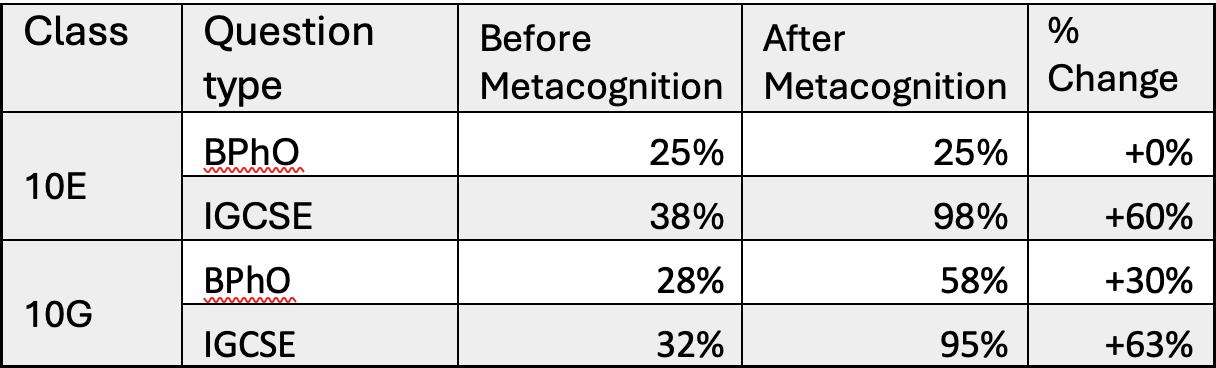
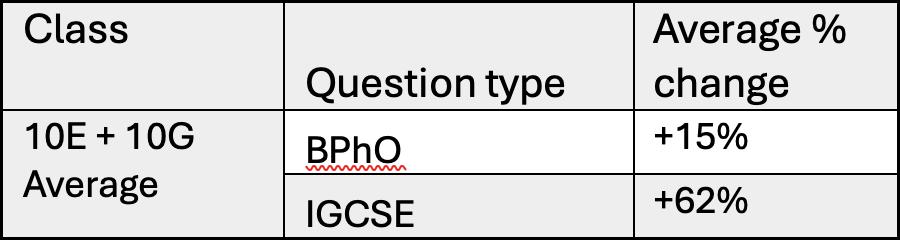
In addition to the numerical data I collected, I noticed a higher degree of confidence and independence in students. This manifested as them asking me basic questions less frequently, such as “What is this asking me to do?” or “What equation do I use?” and planning out their long-answer questions more strategically, thinking about equations and laws of Physics to include and talk about.
These results and observations suggest a clear benefit to incorporating metacognitive strategies in Physics and Mathematics and can be used for subjects that involve extended writing to help students think about how they are planning an answer and critically assess their thinking processes.
Start to attempt this problem by making a list of information required to answer it. What equation do you need for your final answer? Is there any extra information you need to calculate?


Figure 1: BPhO Question presented to students
DIN on Mini Whiteboards:
Figure 2: “Missing question” problem presented to students
Table 1: Percentage of correct student responses to maths-based Physics questions.
Table 2: Average percentage of correct student responses to maths-based Physics questions.
What Does it Mean? Teaching new terminology through word roots and origins!
Harold Bright
Context
Biology is a subject with a particularly high number of complex, subject-specific key words and specialist vocabulary. I have observed that many Biology students encounter significant challenge in trying to understand, and commit to memory, the vast numbers of biological key terms that they meet each lesson and in each new topic that they study. In search of strategies that I could use to support students’ comprehension and learning of new terminology through my teaching, and in no small part thanks to our wholeschool CPL focus, I became increasingly interested in the benefits of a morphemebased approach to introducing new subject vocabulary.
Morphemes are small parts of words, often derived from Latin or Greek, that make up a larger word, and that carry their own individual meaning. The morphemes that make up a word often dictate the sentiment of the larger word, and thus, an understanding of individual morphemes can help students to deconstruct the meaning of a particular word and understand more complex, unfamiliar words that contain those same morphemes. In one analysis, it was estimated that, on average, an understanding of any one particular morpheme can ‘unlock’ students’ comprehension of 20-25 further words.
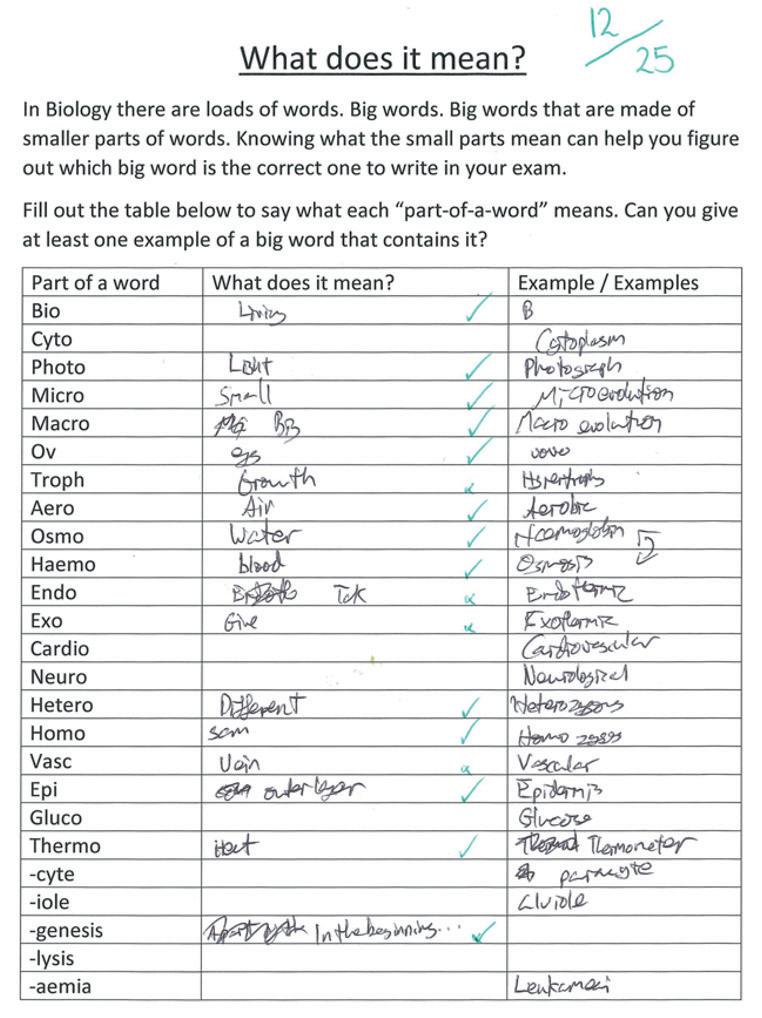
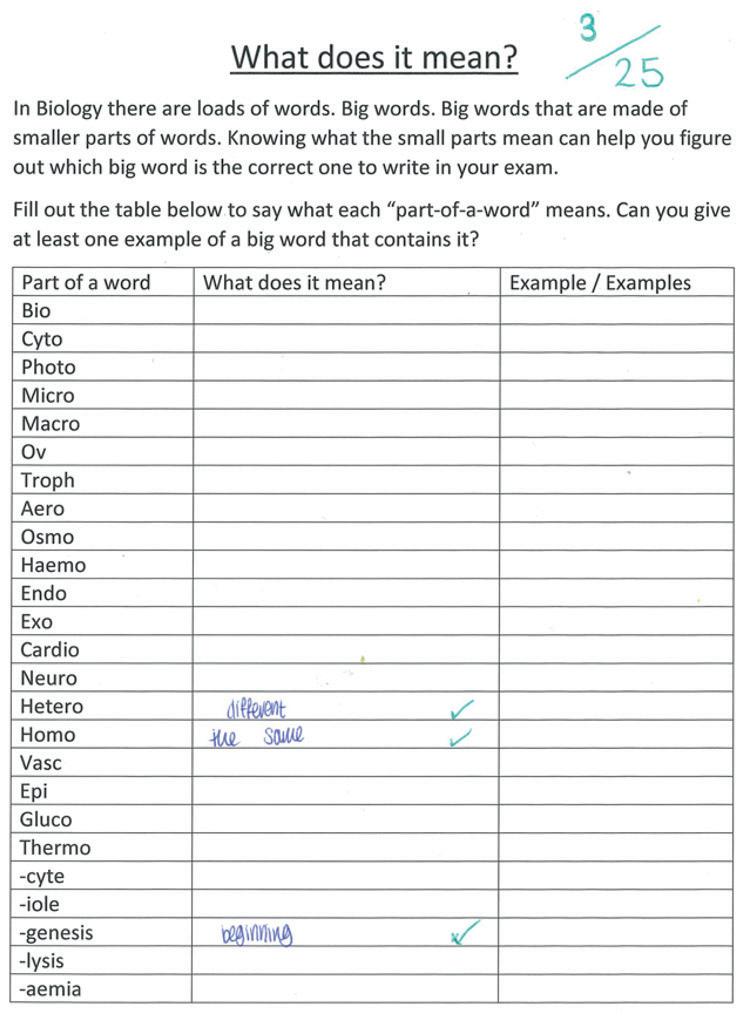
Among my class of Year 10 Biology students, I was keen to better understand students’ familiarity with some of the most common morphemes found in biological vocabulary. I gave students a baseline quiz, asking them their understanding of twentyfive key morphemes, many of which feature several times in the biological terminology that students encounter at GCSE level. This initial assessment revealed a spectrum of familiarity among students, with students correctly identifying the
meaning of anywhere between 3 and 12 of these morphemes (see images 1 and 2, exemplifying the upper and lower range of student responses). I was struck that overall, students had a surprisingly low awareness of these important morphemes, with an average score of just 8 out of 25!
Action
In every lesson for a month, I introduced new biological terms to students through an explicit analysis of the morphemes that make up the particular word, with the aim of bolstering students’ familiarity with common biological morphemes and supporting their confidence in decoding the meaning of words in this way. Each time, I used a template slide which presented the word as its constituent morphemes, with a meaning for each morpheme, alongside some examples of other words containing that same morpheme. At the end of the month, I gave students another quiz, in which I presented them with five, more complicated (A-Level) biological terms, made up of several familiar morphemes, and asked them to deduce their meaning.
Findings
Throughout the month, I observed that students engaged well with the morpheme-based approach, and appeared to enjoy the process of learning new terminology in this way. Several students described the satisfaction they obtained from understanding the deeper meanings of a word. Additionally, students reported increased self-confidence in remembering the meaning of key terms, recognising various common biological morphemes, and in being able to interpret an unfamiliar word that contained familiar morphemes. At the end of the month, many students offered successful interpretations of the more complex A-Level terms including ‘hyperlipidaemia’ and ‘gluconeogenesis’.
Conclusion
I found that a morpheme-based approach to introducing new subject terminology was fun, engaging and effective! Not only does this approach improve students’ understanding of the words themselves, but it also empowers students by equipping them with a toolkit for making sense of unfamiliar words that they may encounter in the future. I am excited to continue to teach new vocabulary in this way and observe the benefit this confers for students’ grasp of biological language!

of student work: the upper and lower range of student responses to the
Visuals
Examples
baseline morpheme quiz.
The role of school-parent communication in supporting student engagement
Harrison Sanford
Context and evidential background
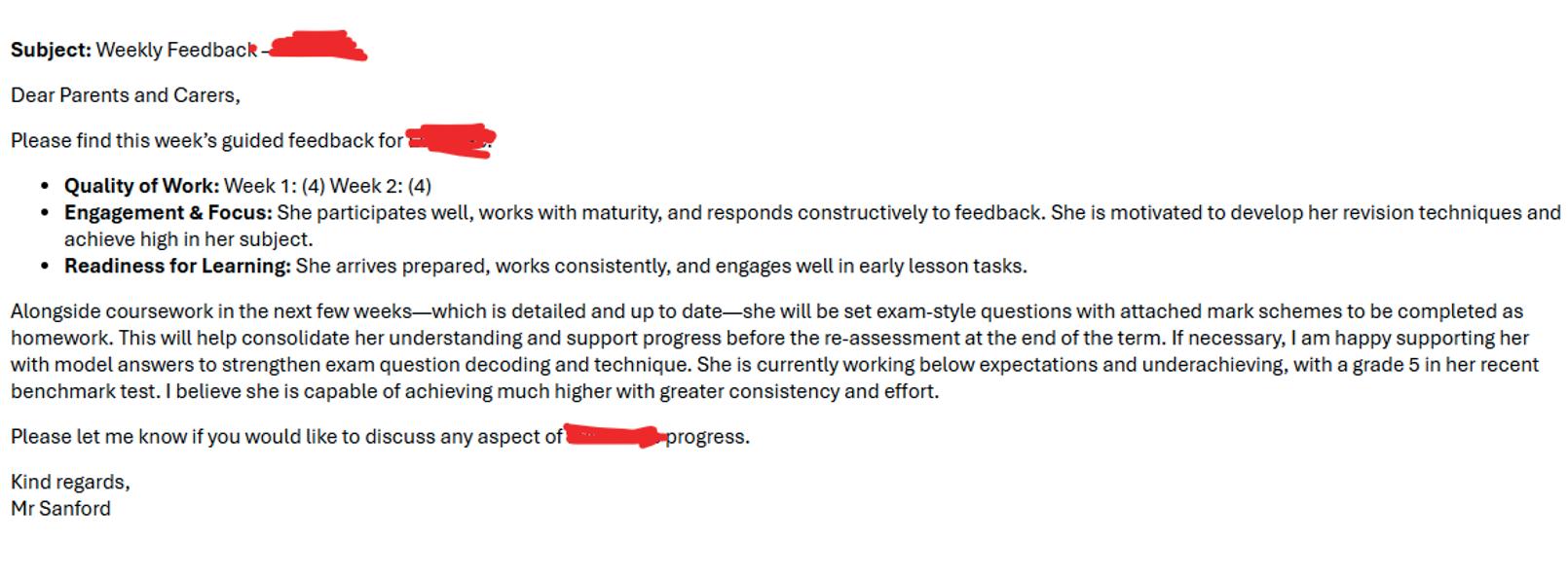
My primary focus was whether structured communication with parents could improve students’ quality of work, engagement and focus, and readiness for learning, particularly following Benchmark assessments.
Parental participation is widely recognised as a strong influence on student outcomes, yet structured communication about learning behaviours is not always embedded into classroom practice. Several students in my classes demonstrated strong potential but inconsistent readiness-for-learning routines and engagement following assessment feedback. I therefore investigated whether targeted parental communication could strengthen accountability, reinforce expectations at home, and support progress ahead of reassessment.
Evidence strongly supports parental engagement as a driver of student success. John Hattie (2008) found that effective parental engagement can have an impact equivalent to two to three additional years of education across a student’s school career.
Similarly, Alma Harris and Janet Goodall (2007) identified parental participation as a significant lever for improving attainment when schools and families work collaboratively.
National parent voice findings also show that 85% of parents want to play an active role in their child’s education, highlighting the importance of structured opportunities for involvement.
Intervention:
1. I implemented a fortnightly guided feedback system for selected students focusing on three measurable indicators:
• Quality of Work
Accuracy, depth, and quality of written responses, supported by clear targets for improvement. This includes lesson-time guidance or extension materials such as exam-style questions with mark schemes.
• Engagement and Focus
The student’s speed and independence when completing tasks, their responsiveness during questioning, the extent to which they rely on or avoid prompting, and their level of engagement in extension activities.
• Readiness for Learning Punctuality, completion of “Do Now” tasks, correct equipment, and appropriate uniform expectations.

Findings
Qualitatively, there was a clear improvement in targeted students’ proactiveness at the start of lessons, particularly in their engagement with Do Now tasks and their readiness-forlearning behaviours. This improvement was evidenced through classroom observations, pupil voice feedback, and feedback from colleagues teaching the same students. When marking where students should be on tasks, there were higher levels of silence and focus, with a greater proportion of students reaching extension activities or completing tasks promptly, enabling them to access more feedback.
Some students continued to arrive late to lessons, particularly one individual. However, this challenge led to a productive development in parental communication: brief follow-up emails are now sent directly to the parent each time lateness occurs, strengthening parental oversight and engagement at home. I anticipate this will lead to sustained improvement over time.
ahead of their Benchmark re-sit. These interventions aimed to develop their understanding and application of key concepts before reassessment. Quantitatively, further attainment data is still being collected. Students will complete their next Benchmark assessment soon, which will allow for a clearer comparison of progress following parental engagement and targeted revision support.
How will this inform your approach in the future?
This project also demonstrated that structured parental communication can significantly improve readiness-for-learning behaviours and increase student engagement with extension and revision materials. Moving forward, I will continue to strengthen the clarity and consistency of communication with parents, ensuring that expectations around at-home study and quality of work are reinforced after each assessment checkpoint.
Despite the time commitment, the strategy is low-cost, scalable, and adaptable across subjects and year groups. It offers a practical method for:
• improving readiness-for-learning routines
• increasing engagement with extension work
• reinforcing expectations beyond the classroom
• supporting progress following assessment checkpoints
2. Following the Benchmark assessments, a parents’ evening was arranged to address concerns directly. During these conversations, parents were guided towards structured revision materials focused on their child’s two weakest Benchmark topics. Support was differentiated according to student need, with guidance centred on:
• Prioritising targeted exam-style questions, mark schemes, and/or model answers.
• Additionally, two relatively less able students were grouped to receive 1:1 teaching after school.
Students who had previously underperformed in Benchmark assessments also became more willing to attempt optional extension materials. This shift was particularly noticeable after parents received specific guidance regarding their child’s priority areas for improvement. This suggests that increased parental awareness contributed to improved student confidence, accountability, and willingness to attempt more challenging work. Additionally, two students attended targeted 1:1 after-school support sessions with me to revisit core questions
While effective, the approach is time-intensive and therefore not feasible for all students across a full cohort. However, it is highly beneficial when targeted—for example, with GCSE groups or specific students requiring additional academic oversight. To refine the approach further, pupil-voice data will need to be collected to determine whether students found the process supportive or overly intrusive, and whether they took meaningful action after receiving revision materials. This will help establish whether the strategy should remain optional or be more formally required.
Self-monitoring for successful planning
Luca Elkouby
To what extent does explicit scaffolding of planning & pauses for self-monitoring during long-form writing implemented for 6 lessons over 4 weeks improve the depth and speed of planning among Y8 pupils?
Entering this new school context from a school where literacy was both a major challenge and a school-wide focus, I was struck by the facility with which nearly all pupils easily met success criteria that were provided to scaffold new types of writing. However, it became apparent that this general verbal ability was not necessarily reflective of deep disciplinary understanding.
Pupils were not really thinking about what to include in effective historical writing, so developing their metacognitive skill of deconstructing a task and planning it seemed like the next frontier for scholarly engagement.
When Year 8 students were given some unstructured planning time before a class writing task, being told simply to make any sort of plan they thought appropriate, the responses could be categorised into three groups:
1. Those who struggled to write any meaningful plan.
2. Those who wrote some substantive knowledge without structure.
3. Those who began with a structure (e.g. PEEL).
There was a clear gender disparity between Groups One and Three, with four lower-attaining boys standing out with barely any plans. Upon review of some essay-planning homeworks for two previous Common Assessments, this picture gained further detail by showing that even many of the most able girls had not planned effectively. Three of their plans stood out for including a great
detail of knowledge, structure, vocab and judgement, to the extent that these were almost full essays. While it might be reflective of dedication and concern about achieving excellent grades, these plans did not reflect selective, effective planning rooted in strong understanding of the question’s demands.
The research around metacognition provided a wealth of potential strategies to support pupils to plan more effectively. The EEF’s recently updated guidance around metacognition remains rooted in the core framework of ‘plan, monitor, and evaluate’ while reinforcing these with a variety of specific strategies.
The main conclusion to be drawn was the need to teach metacognition explicitly and through repeated use of the same scaffolds, be they metacognitive talk by the teacher, written question prompts, or peer assessment. Just as with substantive content, a gradual release of responsibility as the scaffold is internalised over time allows pupils to become better learners. Several Inner Drive articles also highlight the importance of (1) self-questioning as a format for planning and review, and (2) specific, high-leverage questions to
promote self-evaluation, such as “Is this similar to a previous task?”, “What do I want to achieve?”, or “Am I on the right track?” These habituate pupils to selfevaluation in a very accessible format that transfers across subjects. Furthermore, the selection of particular questions lends itself to explicit teaching, permitting easy retrieval questions about the scaffold itself, like ‘Suggest two questions to ask yourself when planning a response to this question.’
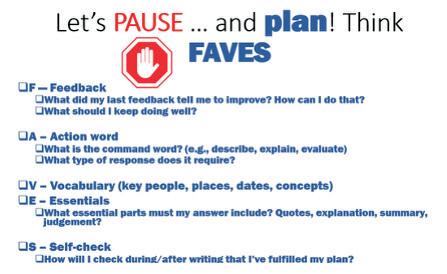
The resulting intervention therefore began with a memorable scaffold, a small planning sheet using the acronym ‘FAVES’. This adapted a familiar scaffold I use for improving work and targeted traits of good writing that cross disciplinary boundaries, enabling any internalisation of it to have wider applicability. This would initially be used with extensive modelling and metacognitive talk on the visualiser, with scaffolding gradually reduced by eliminating teacher narration, then visual demonstration on the visualiser, and eventually the slip of paper too. This was paired with a slide displayed halfway through and after writing tasks reminding pupils to check if they were meeting their plan, to scaffold monitoring and evaluation.
The implementation of the intervention resulted in mixed success. Figure 2 shows the adoption of parts of the scaffold by the two groups targeted in the study. Pupils were swift to adopt the framework of FAVES in the more guided phases of planning, although Group One took a bit longer to adopt the framework confidently. Nearly all pupils were notably confident in using the framework to plan for use of vocab, both under the A and V headings.
Pupils regularly planned to use and did use Tier Two and Three terms, like ‘root cause’, ‘catalyst’, ‘trigger’, ‘civil war’, ‘political’, etc. The most challenging elements to adopt were clearly the reflection on prior feedback (which makes sense considering the cognitive load involved in switching from a question to reflecting on a previous assignment) and the self-check element, which was very formulaic.
The final phase, in which pupils were once again simply told to plan a response to a question with no scaffold, illustrates the key finding of the intervention. There was a clear disparity between the impacts of the modelling on the two groups. Much of Group Two was able to retain the FAVES structure, jotting the acronym down in the margins and completing many of its features. However, the lower prior achieving boys in Group One struggled to retain the planning structure once planning was made independent. They mainly managed to plan some vocab, but no other elements were retained.
Overall, while the intervention met with mixed success, it does outline some guiding principles for future development of metacognition. Firstly, the time horizon of a half-term was enough to consolidate effective planning practices
for HPA pupils, making their planning more targeted and efficient. However, entrenching planning frameworks for less able pupils will take longer, affirming the EEF’s guideline that modelling metacognition must be deployed repeatedly over time to have a significant impact. Secondly, I noticed that the benefits of the intervention extended beyond pupils’ planning and writing. Their ability to evaluate WWWs and EBIs of other pupils’ responses on the visualiser notably improved, with two pupils in Group One making insightful, specific contributions in those tasks. The whole class’s retrieval and use of vocab for that unit increased markedly, having planned and practised its application in repeated writing tasks. Building metacognition is not one skill among many, but it is the key that unlocks effective application of all subject expertise.
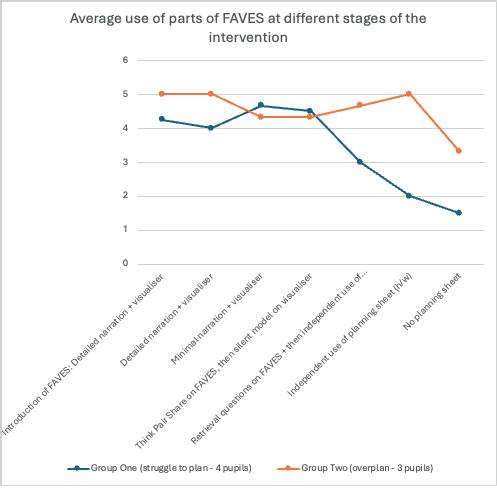
Figure 2: : Chart showing the average adoption of elements of FAVES at different phases of the intervention
Figure 1: A slide introducing and scaffolding the key parts of the acronym ‘FAVES’.
Rigour in verbal and written maths solutions
Rebekah Edwin
To what extent does encouraging rigour in verbal and written solutions three times a week improve the quality of student solutions in a Year 12 Further Maths class
The focus of my study is to improve student confidence when answering exam style questions.
Firstly, I would like to place exam style questions into three categories: bookwork, proof and problem solving. Bookwork questions are routine problems that test a student’s ability to perform a single skill, like using the chain rule or finding the area under a graph. Proof questions require students to confirm the validity of a statement using a step-by-step argument that is steeped in the logical foundations of mathematics, for example showing that a function is always increasing. Finally, problem solving questions require students to use a combination of skills to achieve a specific outcome. The order of these skills is to be determined by the student before they can apply them, for example finding the area between two curves. It then follows that there will be overlap between these categories. This, however, is negligible as if we focus our efforts on the independent parts of each category, we can use these as our axioms to build strategies that will cover all combinations of categories.
When marking and observing student work I noticed the following; while students excelled in bookwork questions, they tended to drop marks when faced with initially unfamiliar problem solving and proof questions. As students displayed a high level of competency over bookwork questions, it is implied that they have a key understanding of the skills required to complete problem solving and proof questions. Upon closer inspection of student work, I noticed several cracks in the logic and rigor within solutions that would have drastically increased the difficulty in generating the step-by-step arguments and combinations of skills
required for proof and problem-solving questions respectively.
It was through this lens that I created the research question for my inquiry. My focus was on how encouraging rigor in verbal and written solutions can increase students’ confidence in answering exam style questions.
What did the research say?
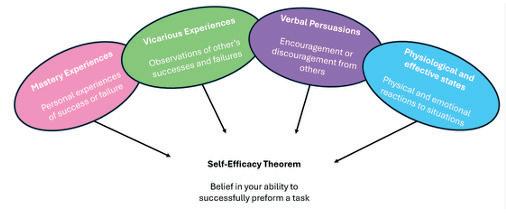
Now that I had my inquiry and focus, I needed to find research that supported my ideas. I began by looking into how increased confidence in one’s abilities can help with their overall performance. This idea is nicely summarised in Bandura’s Self-Efficacy Theory (Bandura, 1997). The theorem states that a student’s belief in their ability is necessary to produce a particular outcome.
This is accomplished through four strategies. Let us begin with Physiological and effective states. The emotional state of a student when learning new content is incredibly important as this can be a key retrieval cue for memories. Mood congruent memories are memories that are created when a person is in a particular mood and can be readily recalled whenever that mood is replicated. When our students are taking exams or answering questions, we want them to be in a calm and motivated emotional state; it then stands to reason that we would want them to be in an identical emotional state when learning the material.
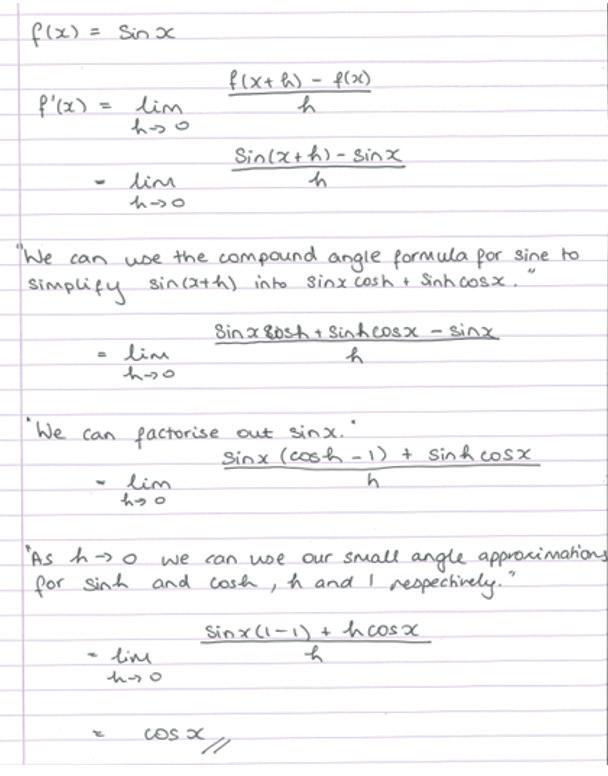
they could easily access without extensive additional study. Below are the steps that we went through to differentiate sin (x). Differentiation from first principles, the compound angle formula and the small angle approximations are all topics that the students were familiar with before the lesson. After going through this, students were able to differentiate cos x using a similar method.
The final strategy is Mastery Experiences. This is the most influential of the four strategies. Successful experiences are a key building block for developing confidence in one’s abilities. However, the inverse is also true, repeated failures can diminish even the steadiest levels of confidence. It then follows that when selecting questions for students to work through, a gradual and manageable increase in difficulty is paramount to generate sequential successive experiences.
To accomplish this, I maintained a low noise level and leaned into SDC’s ‘hands down questioning’, ‘Threshold’ (standing by the door to welcome students in and let them out), and ‘Do it Now’ at the start of the lesson. The next one is Verbal Persuasions. As a teacher, you are the most influential person in the room. It then follows that your opinions will carry weight. A teacher’s belief in a student’s ability to perform a task will help boost the student’s selfbelief.
Providing frequent targeted and structured praise to students shows acknowledgement of improvements and helps reduce self-doubt in their abilities. To achieve this, I increased my circulation of the classroom and was thus able to spot less noticeable improvements in student work, which I was then able to compliment. We can now look at Vicarious Experiences.
Witnessing someone accomplish a task can help shift what we believe to be achievable; this is a similar line of logic to how the average 100m Olympian level sprinter today can comfortably beat the world record from 80 years ago. This then places a heavy importance on the introduction and modelling of problems. When introducing new topics, like the differentiation of trigonometric functions,
I used knowledge of topics that students already had. This was beneficial because it provided students with the knowledge that this new topic was something that
Findings
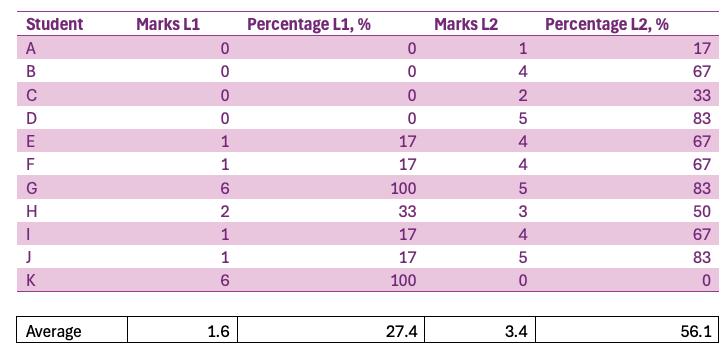
The Year 12 Further Maths class have regular assessments; I gave them an assessment during the first half of Lent 1. They then had another assessment at the same time during Lent 2. There was a challenging proof question in both papers; here is how their marks compared.
We can notice an increase of 113% in the average marks and 118% in average percentage of marks for each student. Which is a step in the right direction. Students also reported feeling more confident and positive when talking about how they performed in the question post assessment, with some students even lamenting the fact that certain topics did not also come up.
Wider implications
Looking at the changes in performance and confidence across topics has been incredibly eye opening, and it begs the question of where they could be if the methods had been implemented from the beginning. As well as academic progress, I believe that I was able to strengthen my relationship with the students, which was brilliant as they became more open about specific issues they had with the studying, exam techniques and confidence. Next year, I will be using Self-Efficacy strategies across classes and year groups.
Although some of the actions that I detailed were subject specific to mathematics, I believe that they could be generalised and applied to any subject. Most strategies were purely pedagogical, and the subject specific ones can be modified to suit your classes needs. The Self –Efficacy theory will support your student’s personal growth and increase their confidence, both factors that help build towards a strong future, which as teachers is all that we can ask for our students.
Findings
Reducing teacher talk to improve student debate
Joseph Giles
To what extent does reducing teacher talk for a five-week unit (Death of a Salesman) improve organic, student-led debate among my willing (but quiet) Year 12s?
My Year 12 class are my very first A Level set. I remember the transformative effect that my own A Level studies had on my passion for the subject – the smaller class sizes, and resultant culture of conversation and debate, made me feel like I was finally ‘doing the subject properly’. I couldn’t wait to teach A Level this year and wanted to give my pupils the same memorable experience as I had at their age.
I was somewhat taken aback to discover that such an atmosphere does not spawn from nowhere. My Year 12s, while earnest and diligent, did not talk for most of Michaelmas. Having established that the subject itself was not the problem (nobody dropped) I endeavoured to find out what was holding them back.
I was also struck by my observations of other sixth form lessons, and in particular, the balance of talk between teacher and students. Where more experienced teachers were creating space for student dialogue, I was often so relieved that one of my class had offered something that I would run with the idea, talking for double the length of time. Inadvertently, I was an obstacle to organic, authentic debate within my classroom.
Why does student-led debate matter? What does the research say?
At A Level, AO5 requires candidates to demonstrate ‘perceptive and confident engagement with the debate set up in the task’. This means candidates need to be confident confronting an unfamiliar question, developing a thesis, and acknowledging where others may disagree with them. It is therefore vital that they practise forming a viewpoint, and engaging with differing viewpoints, as regularly as possible.
Robin Alexander (2020) highlights the importance of reciprocal, dialogic teaching. He emphasises the need to create a supportive environment, and to guide discussion through carefully planned questioning and structured, purposeful debate. His 20-week intervention across diverse 76 schools in 2016 led to, on average, two months progress in English, as evidenced by standardised tests. (Dialogic Teaching | EEF)
‘Quality classroom talk has a measurable impact on academic attainment. These benefits include greater retention of subject-specific knowledge, vocabulary acquisition, and reasoning skills, and are not merely confirmed to subjects traditionally associated with discussion and dialogue, such as the arts and humanities.’
(Gaunt and Stott, 2019)
Oxbridge interviews (which many of our top A Level candidates hope to undertake) revolve around authentic debate and discussion. ‘Students should be encouraged to take a critical view of ideas and arguments that they encounter at school or college, or in the media and think about all sides of any debate. Forming discussion groups of students with similar subject interests can be a good way for your students to gain experience of talking about issues and themes within their subject.’ (Advice | University of Oxford)
Intervention:
Our short 5-week unit on Death of a Salesman was the ideal time to trial my intervention. The text was shorter and more accessible than our previous unit (the tragic behemoth that is King Lear) so I felt more confident trialling a more student-led approach. I set out to:
• Drastically reduce teacher talk, particularly when feeding back on DIN tasks. I wanted to embrace the silence
and have the confidence that the students would fill it if they stopped expecting me to.
• Deliberately plan for, model and structure the type of debate I wanted to see in my lessons. My Lear teaching had relied on individual annotation to achieve coverage, which I hoped would then seamlessly lead to debate. For Salesman, I took a different approach.
What this looked like:
• Collaborative tasks which forced my class to create a 1-7 ranking list, based on how much they agreed with a statement. This helped them realise the breadth of opinions which existed; discovering that they existed on a spectrum helped foster more critical agency and individuality.
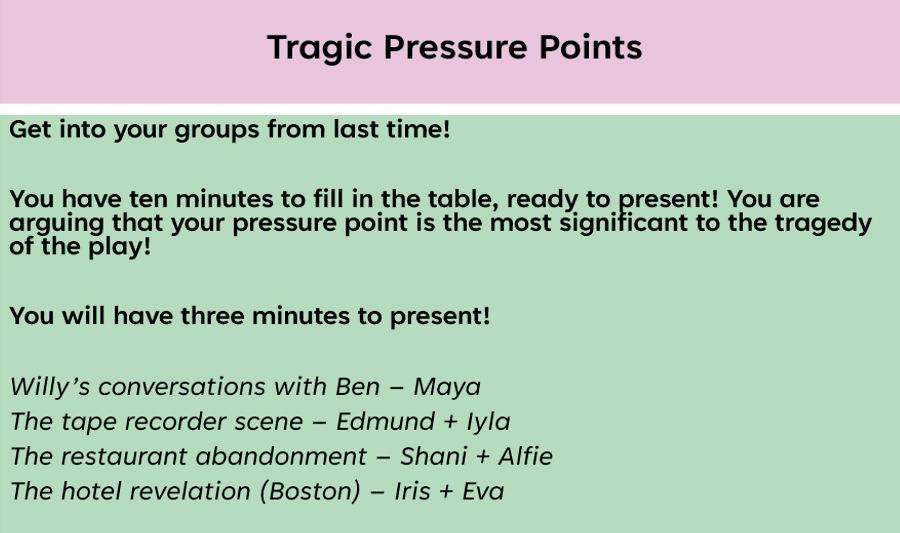
• Students each investigated a ‘pressure’ point and searched for evidence that their moment was the most significant in the tragedy of the play. They then gave detailed verbal presentations in which they were encouraged to respond to ideas which had gone before.
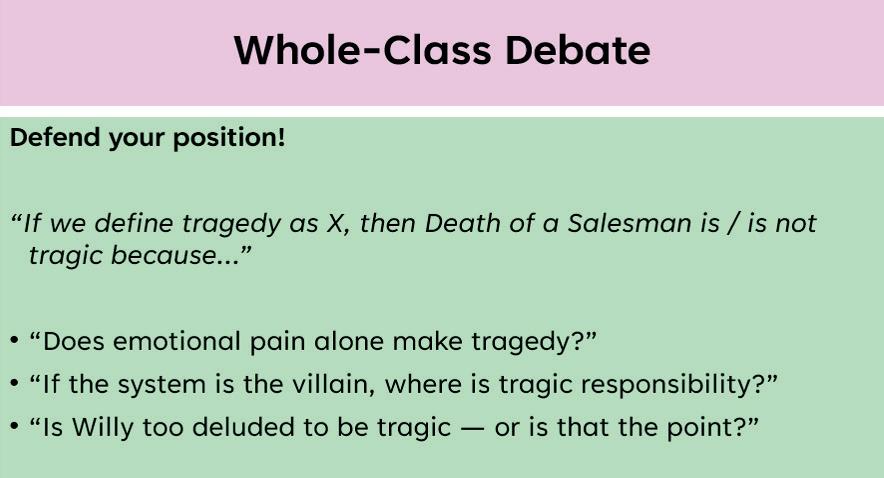
• I set up a debate where students were given a tragic lens through which to view the play. They were tasked with gathering evidence to support and defend their tragic lens.
• No hands up – my class now only uses thinking time, cold calling to get the debate rolling, and silence. I am almost silent in most discussions, except to move the conversation along.
• Put simply, my class now talk to each other! I would still like to see more courage to disagree and debate with each other in a less structured scenario, but when given a clear viewpoint to defend my class rose to the challenge. Discussion was far more evenly spread across the group when roles were assigned. Those who were initially quieter felt supported, and those who had always wanted to be more vocal felt less singled-out and exposed (in conversations with students).
• AO5 was in Band 4 (‘thorough’) for all pupils in February Benchmark examinations. This is not quite ‘perceptive’ yet, indicating that pupils are now comfortable identifying and engaging with key debates, but are not quite individual, authentic and emotional enough in their response to said debates. Nonetheless, their Benchmarks were on Lear, and it is encouraging to see them applying their developing skills to a less familiar context. Less formally assessed writing on Salesman would certainly qualify as ‘perceptive’ in most cases.
• My class enjoy the subject more! Maya (Y12) said our tragic pressure point presentations was her favourite English lesson this year, while Shani and Eva have both commented favourably on the more discursive environment (this was something they had both previously expressed a desire to do more of).
I am going to continue to trust in the inherent value of debate within my classroom. I had previously separated lessons into either ‘big ideas’ or ‘detailed methods’ foci: far from detracting from my class’s analysis, giving them a core interpretation to defend resulted in more thorough analytical rigour.
Having to articulate their case provided greater motivation to ensure their case was watertight. I am hopeful that by maintaining this approach, their newfound nuance and intellectual courage will permeate through their writing as well as their oracy.
Wider implications
The quantitative evidence that debate improves attainment is well-documented, but there is also inherent value in fostering and atmosphere of curiosity and academic risk.
Even in STEM interviews at top universities, the top candidates exude passion and curiosity for the subject, which is fostered most effectively in a classroom where pupils feel like their views and personal response are valued. In the sixth form, many of our pupils are products of GCSEs examinations which reward the memorisation of content over conceptual or original thinking.
A Level Humanities require a huge step up in critical engagement which will not magically appear when these students hit Year 12. Integrating impactful, structured debate in sixth form teaching helps them practice these skills, and more importantly, often become the lessons which stick with them long after they leave school.

Reducing teacher talk to improve student debate
Evidence
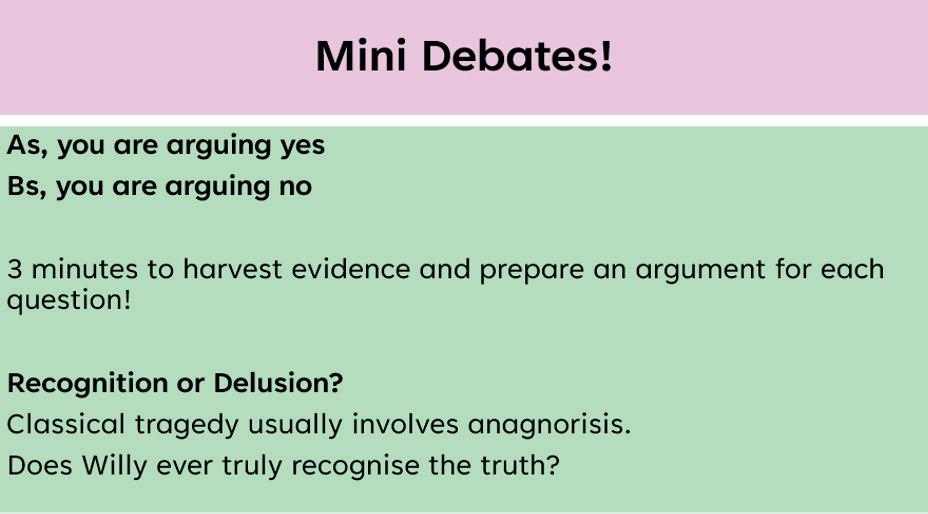
Student A – She has prepared her case, in one row, and recorded her response to the next case in the next row.
Examples of Sophisticated AO5
While the impermanence of happiness is essential to contributing to the tragedy of the play, the endurance of its joy and intensity allow for a message that is not completely devoid of hope. A twisted sense of comfort is achieved through the presentation of solace which Willy receives by reliving these memories.
Student B – A perceptive, critical thesis statement which, crucially, engages with both sides of the debate (‘the intensity of joy has enduring value in tragedy’)
When hope collapses and Willy kills himself, the audience feels that something genuinely worthwhile has been lost, not just an empty dream. Joy works as a contrast that throws Willy’s failure and loneliness into sharper focus, and it exposes how the American Dream twists real happiness into shallow ideas of success. In this way, Miller uses joy not to weaken the tragedy, but to make it hit harder and evoke an enduring cathartic effect.
Student C – Had a habit of always arguing that tragedy is essentially futile due to the inevitability of the ending. Here, he leaves his comfort zone to really explore the emotional impact of individual moments.



References
CHLOE WANG
Education Endowment Foundation (2018). Metacognition and self-regulated learning: Guidance report. London: Education Endowment Foundation.
Hattie, J. (2017). Visible learning: A synthesis of over 800 meta-analyses relating to achievement (updated edition). London: Routledge.
PAUL GOROSTIDI
Christie, C. (2016). Speaking spontaneously in the modern foreign languages classroom. Routledge. Ellis, R. (2005). Principles of instructed language learning. Asian EFL Journal, 7(3), 9–24.
Jones, B., Halliwell, S., & Holmes, B. (2002). You speak, they speak: Focus on target language use. Association for Language Learning.
Ryan, R. M., & Deci, E. L. (2017). Self-determination theory: Basic psychological needs in motivation, development, and wellness. Guilford Press.
CHRISTOPHER AUSTIN
Aristotle. Nicomachean Ethics. J. A. K. Thompson (trans.), London: Penguin, 1955
Ho, W. Y. (2019). Mirror effects: Curative factors of group counseling in tertiary education. International Journal of Research in Teaching, Learning, Creativity, & Technology, 2(1), 95–120.
Perry, T., Lea, R., Jørgensen, C. R., Cordingley, P., Shapiro, K., & Youdell, D. (2021). Cognitive Science in the Classroom. London: Education Endowment Foundation (EEF). Rosenshine, B. (2012). Principles of Instruction: ResearchBased Strategies That All Teachers Should Know. American Educator, 12-39.
Sweller, J., van Merrienboer, J., & Paas, F. (2019). Cognitive architecture and instructional design: 20 years later. Educational Psychology Review, 261-292.
EVERLYN HUANG
Edwards, S. (2010). Mind mapping as a teaching resource. The Clinical Teacher, 7(4), 236-239.
Parikh, N. D. (2016). Effectiveness of teaching through mind mapping technique. The International Journal of Indian Psychology.
Zhao, G., Yang, X., & Dong, Y. (2016). The effect of mind mapping on teaching and learning: A meta-analysis. International Journal of Emerging Technologies in Learning.
FEDERICO LUCHETTI
Mulholland, K. (2026). How to use visual, verbal, and written scaffolding to support pupils’ use of metacognitive strategies. [online] Educational Endowment Foundation. Available at: https:// educationendowmentfoundation.org.uk/news/scaffoldingindependent-learning--metacognitive-strategies [Accessed 20 Mar. 2026].
Özsoy, G. and Ataman, A. (2009). The effect of metacognitive strategy training on mathematical problem solving achievement . International Electronic Journal of Elementary Education, [online] 1(2), pp.68–83. Available at: https://files.eric.ed.gov/fulltext/ ED508334.pdf [Accessed 20 Mar. 2026].
LUCA ELKOUBY
https://www.innerdrive.co.uk/blog/planning-metacognitiveprocess/
https://www.innerdrive.co.uk/blog/how-you-talk-to-yourself/
https://www.innerdrive.co.uk/blog/improve-metacognition/
https://educationendowmentfoundation.org.uk/educationevidence/guidance-reports/metacognition”]