2026 Vol. 1
ORITUR
St Dunstan’s College
Oritur - Front cover NEW.indd 1
09/09/2026 16:31
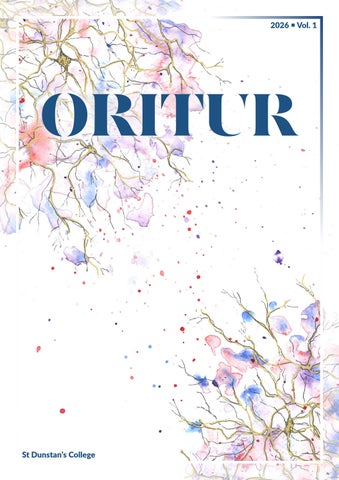
On the Cover Art
When conceptualising my cover artwork, I began by thinking about how young people’s brains learn, Ruby Bradshaw, Year 9 develop and make connections through curiosity. This led me to base the image on neurones and neural pathways: structures associated with thought, memory and understanding. The neurones in the image look as if they might connect, but do not quite meet. This represents the process of learning, where ideas are beginning to form but remain incomplete. The empty space is important too: I wanted it to capture the feeling of being close to understanding something, but not quite there yet. To me, that moment of almost-understanding is central to scholarship, because learning is not only about knowing, but about questioning, searching and remaining curious. Although neurones come from science, I wanted to translate them into something more abstract and emotional. My aim was to create an image that was visually striking for the cover, while also reflecting the journal’s themes of curiosity, connection and developing thought.
Oritur - Intros.indd 2
03/09/2026 11:55
CONTENTS Foreword 4 Staff Editor’s Note 6 Student Editor’s Note 8
1
SELF, IDENTITY AND HUMAN EXPERIENCE Introduction 10 How to be a Scholar 12 Is Ignorance Bliss? Curiosity, Comfort and the Cost of Knowing 14 Are We Too Self-Aware for Our Own Good? 18 Is Sporting Greatness Born or Built? 20 After the Whistle: A Conversation with Freddie Davison 22
2
STORIES, ART AND CULTURE Introduction 24 Can We Separate the Art from the Artist? 26 Can Musicals Be Canonised Without Being Diminished? 30 Can Film Really Transform Society? 32 Arachne’s Fate: A Poem and Commentary 35
3
RESPONSIBILITY, TRUTH AND POWER Introduction 36 Who Gets to Decide Scientific Truth? Power, Institutions and Knowledge 38 How Curious Should the State Be? Surveillance, Secrecy and Democratic Freedom 42 When AI Gets It Wrong, Who Is Responsible? 46 Who Owns the Past? Looted Artefacts, Museums and Restitution 48
4
DISCOVERY, SCIENCE AND THE UNKNOWN Introduction 52 Why Palaeontology Needs Both Curiosity and Imagination 54 What Is the Rest of the Genome Doing? 57 Where Should Exploration Focus Next: Space or the Deep Sea? 60
Oritur - Intros.indd 3
03/09/2026 11:55
ORITUR
Foreword Ms McLellan, Head of School
I
am delighted to introduce you to the inaugural edition of Oritur, our new St Dunstan’s school journal. The revival of our student publication represents an important moment in the intellectual life of the school. We are educating our children in a world where debate is often compressed, and positions quickly harden. The very idea that one may have to sit with uncertainty: weigh it, wrestle with it, and finally conclude that there is no single truth, seems anathema to many of those who lead the world today. What hope it should give us, then, to explore the nuanced, layered thinking of the future leaders whose work follows in this journal. From the outset, our intention was clear. If we were to produce a student journal, it should be substantial and reflect genuine intellectual exploration. Students should experience the joy of becoming lost in academic rabbit holes: of beginning a line of enquiry only to find it leading somewhere entirely unexpected. Setting that expectation was the easy part. What has followed has been the result of students rising to that challenge with enthusiasm and aspiration. Young people are naturally curious and will pursue lines of thought with energy when they are permitted to do so. Scholarly ambition, as we understand it here, is about giving that curiosity space and credibility: allowing students to seek knowledge and understanding without the tyranny of an assessment objective to meet or examination to pass. Such a publication does not come into being without sustained and thoughtful editorial leadership. The editorial team have approached their role with maturity and discernment, and my thanks go to Ms Redding, who has poured many hours into realising this celebration of student exposition. It is incumbent upon us, as the adults guiding these young minds, to ensure they have no ceiling of expectation: indeed, the very fabric of St Dunstan’s is to encourage students to adorn their own shield. As you peruse their thoughts on non-coding DNA, state surveillance, elite sporting performance and the cost of curiosity, I hope that you too will experience the joy of the unfamiliar, the esoteric and the fabulous.
4
Oritur - Intros.indd 4
03/09/2026 11:55
Oritur - Intros.indd 5
03/09/2026 11:55
ORITUR
Staff Editor’s Note Ms Redding, Assistant Head
T
he 1962 edition of the St Dunstan’s school journal, SIX, claims that it is the ‘Editor’s privilege, or perhaps even duty, to qualify or explain our title’. As the staff editor of the newest iteration of our journal, I believe I must take up this duty and explain Oritur. Happily, I find this much easier than P. W. Russell, who had to search the annals of College history to discern – not entirely conclusively – whether SIX referred to the first year of publication (1936); the number of original editors (although he notes there were five); the original price (sixpence); or the school age of the contributors (the Sixth Form).
The earliest student publication we could find was the 1933 edition of Aftermat, which, in its editorial note, decried the ‘rare bird’ contributor, of whom the editors had found only ‘defective specimens’. I am delighted that, in 2026, we had no such problem to concern ourselves with. Indeed, we received far more thoughtful and ambitious submissions than we could publish. What most impressed me, however, was not the quantity, but the seriousness of their thinking. This is not a showcase, nor a collection of ‘best work’. This is genuine inquiry: a place where students ask difficult questions, test arguments, follow complexity, and leave us not with easy answers, but with challenges to carry beyond the page.
Our title, Oritur, is drawn from the Vita B., a life of our namesake, St Dunstan. In its account of his early life, the author uses the Latin phrase ‘oritur puer strenuus’: a vigorous boy ‘arises’ – or, more poetically, ‘springs into life’, or even ‘springs into light’. This seemed the right title for our journal: it captures a moment of emergence, where thought begins to take form and move into the light of public expression. In short, Oritur captures not completion but beginning, and it is in this sense that I would like to introduce you to the journal itself.
And there are real challenges within these pages. When the project began, I did not expect to find myself reconsidering whether self-awareness is overrated, or contemplating musical theatre’s place in the canon. I had not spent much time thinking about palaeontology’s role in the conservation of coral reefs, nor did I know that deep-sea exploration might lead to advances in prosthetic design. That, really, is the point. Good scholarship does not simply confirm what we already know; it unsettles, redirects and enlarges our thinking.
The editorial team took great pleasure in sifting through the College archives to explore past issues of St Dunstan’s journals and magazines. From 1930s poetry anthologies through handwritten student magazines of the 1950s to the more recent, and splendidly named, First Folio, St Dunstan’s students have a long history of making their thinking public through poems, essays, arguments, reviews, artwork and reflection.
I must end, then, with thanks. To the contributors, of course, whose scholarship and hard work have made this journal possible. But it is the Year 12 student editors, Lottie, Leila, Maya, Aidan, Sofia, Isabel, Lauren, and Zemirah, without whom this publication would not exist. They have read, selected, questioned, edited and encouraged with seriousness and generosity. In doing so, they have helped make Oritur not merely a publication about scholarship, but an example of it.
6
Oritur - Intros.indd 6
03/09/2026 11:55
From the Archives Examples of St Dunstan’s earlier student publications, including the first issue of Aftermat, and the 1962 issue of SIX, whose editor reflected wryly on the mystery of its title.
7
Oritur - Intros.indd 7
03/09/2026 11:55
ORITUR
Student Editor’s Note Maya Holmes, Year 12
T
aking curiosity as its central theme, this journal aims not to answer but to explore. We are growing up in a world in which information has never been easier to access; yet curiosity is not simply the accumulation of knowledge. It is defined by a willingness to question and to remain open to uncertainty. What struck me while reading the following essays was their refusal to be confined by a single discipline. They pursue ideas across philosophy, science, literature, art and politics, with each writer returning again and again to questions that resist easy conclusions. Across its sections, this journal follows curiosity through different forms of human inquiry. We begin with Self, Identity and Human Experience, considering curiosity at its most personal. These essays ask what it means to understand ourselves, exploring questions surrounding ignorance, selfawareness and the origins of sporting greatness. Ultimately, they reveal how curiosity often begins with the individual before expanding outwards towards wider ideas about human nature and experience. From there, curiosity shifts from the personal to the collective in Stories, Art and Culture. Here, essays examine how societies interpret the world through narrative and cultural expression. These writers explore the confines and power of art within society. Alongside these essays, creative work such as Arachne’s Fate (a poem of a reimagined story) demonstrates how storytelling itself can become a form of inquiry.
Questions regarding interpretation naturally lead into Responsibility, Truth and Power, where curiosity becomes entangled with authority, ethics and control. These essays examine debates surrounding scientific truth, state surveillance, artificial intelligence and the restitution of looted artefacts, asking who has the power to shape knowledge and determine what societies accept as truth. Our final section, Discovery, Science and the Unknown, invites imagination and exploration through scientific inquiry. These essays cover a wide range, from palaeontology to debates over the merits of deep sea and space exploration. They reinforce that curiosity continually expands the boundaries of what can be asked. What stood out to me most, though, was the interdisciplinarity that underpins its approach to inquiry. Ideas rarely stay confined within a single subject: philosophy can intersect with science, and literature and history become inseparable from ethical debate. These essays clearly reflect different perspectives and stages of academic experience, yet they are united in a spirit of deep conceptual questioning. They are part of a single conversation: not about understanding more but about understanding better. Ultimately, this journal is not about offering answers but about opening debate. Curiosity does not exist to be satisfied: it must be sustained. These essays do not close debate down; they invite it to continue. Curiosity does not exist simply to be satisfied: it must be sustained.
8
Oritur - Intros.indd 8
03/09/2026 11:55
Oritur - Intros.indd 9
03/09/2026 11:55
1 SELF, IDENTITY AND HUMAN EXPERIENCE
Introduction Zemirah Ubazue, Year 12
T
his section is marked by a central tension: to what extent does becoming more aware of ourselves, our abilities, or the world around us lead to fulfilment, and at what point does it begin to undermine it? The pieces approach this question from different angles, but they are in conversation with each other.
The study of ignorance and curiosity suggests that knowledge, while it may agitate us, is ultimately necessary for deeper and more ethical forms of happiness. This is complicated by the discussion of self-awareness, which suggests that insight turned inward can just as readily lead to anxiety, self-doubt and fragmentation of identity. Meanwhile, the debate about whether sporting greatness is born or made, alongside the interview on pressure and leadership in football, turns the conversation outward, asking us not only how identity is formed through internal reflection, but also how it is shaped by external judgement, opportunity and systems of selection. Together, these articles suggest that identity is neither fixed nor fully selfdetermined, but constantly negotiated between what we know, how we see ourselves and how others see us. This matters beyond the journal because these tensions are lived daily in the College and the wider community: in the pressure to perform and compare, and in decisions about fairness, opportunity and responsibility. Taken as a whole, the section prompts us to think not only about who we are, but about how much of the self is shaped by the pursuit — and burden — of knowledge.
10
Oritur - Section 1.indd 10
03/09/2026 11:58
Artist’s Note
For this piece, I chose the image of a key to symbolise the unlocking of new knowledge. Academic curiosity Kes Stevens, Year 8 can be difficult: there are often obstacles in the way, and understanding something properly can involve working through complicated words, ideas and questions before meaning becomes clear. The jumbled words around the outside of the image represent the confusion that can come at the beginning of learning. Some ideas come easily, while others have to be worked out slowly, almost like solving a riddle. As the words move closer to the key, they become more readable, showing how meaning gradually emerges when we keep thinking, questioning and looking more closely. I wanted the artwork to suggest that knowledge is not always immediately accessible. It has to be unlocked through curiosity, effort and persistence.
Oritur - Section 1.indd 11
03/09/2026 11:58
1 SELF, IDENTITY AND HUMAN EXPERIENCE
How to be a Scholar John Evans (1963) and Matilda Gifford, Year 12 After discovering John Evans’ 1963 satire ‘How to be a Scholar’ in the College archives, we contacted its author and invited current Diploma Scholar Matilda to respond. What follows is a conversation across sixty years about eccentricity, performance, curiosity and what scholarship means now.
John Evans ( first published 1963)
T
o be a scholar it is as well to be narrow-minded and a little mad. The true scholar should be able to convince himself that his own subject is as an island in a morass of inutility, and should learn, at first, to pursue it with simulated enthusiasm. He will soon find that his enthusiasm has become habitual and can then concentrate on making it more obvious. It is, above all, essential that the scholar create the impression of having all the attributes which a scholar is popularly imagined to have. The mind of the genuine scholar is forever seeking connections, connections, for instance, between what Jones has just said, and what the scholar might say in reply, to make Jones look stupid. It is important to realise that, however nihilistic, moderate, or positive are the scholar’s views, they will always earn his respect and approval among his fellows, so long as they are expressed with straight faced sincerity. However futile his studies may be, the scholar will always impress if he can disclose, shyly, that he finds them, really, rather enthralling. Or he may adopt the converse attitude: it is often effective to appear madly non-committal. The aspiring scholar should learn to talk like an academic. He should learn to use words in slightly unusual contexts, so that when carefully pronounced, they appear to mean more than they actually do. If he wishes to pass as a poet, he should learn to speak as if his every idea had welled irrepressibly from some internal source of truth. And, if he is a mathematician, he should cultivate the art of laughing loudly at all practical scientists, and should tell them that they are playing in the dirt. Every scholar may devise his own defences. But, if all else fails, he may resort to reason, in the assurance that his opponents, who all have their own ideas and stratagems, will find themselves on unfamiliar ground.
A note from John Evans When we sent John Evans his 1963 article, he replied: ‘It was odd to encounter this small fragment of a former self now so distant in character as well as time. On the basis that one might as well be kind to one’s youthful self, I can smile at it. And, yes, see one or two lines that I still quite like!’
12
Oritur - Section 1.indd 12
03/09/2026 11:58
Matilda Gifford, Year 12
I
n 1963, 16-year-old Dunstonian John Evans wrote an article entitled ‘How to be a Scholar’. Reviewing this sixty years later, as one of the Sixth Form’s Diploma Scholars, I was intrigued by his witty, satirical approach to the stereotypes of what it means to be a scholar. Evans presents scholarship as something slightly absurd: narrow-minded, performative, eccentric and self-important. Yet beneath the humour, his article raises a serious question about what scholarship actually is.
To me, being a scholar means being curious enough to learn new things and being willing to show interest not only in my own subjects, but also in those of others. Being a scholar means not being afraid to delve deeply into subjects. As Evans wrote, a scholar should be ‘a little mad’: not because scholarship should be arrogant or strange for its own sake, but because it requires a kind of passionate intensity. Scholars should be free to pursue the questions that genuinely fascinate them. Evans writes that a ‘scholar is forever seeking connections’. This is one of the aspects of scholarly life I enjoy most: sharing interests with my peers and listening to theirs in turn. In our weekly Scholar meetings, we have each presented on a topic of interest, and listening to the passions of others — and how they differ from mine — allows me to learn things I would probably never have come across myself. After further reflection, I have come to recognise the importance of bringing different areas of knowledge together around one topic. For example, with the increasing use of AI, we need not only to understand how these technologies work, but also to consider the ethics behind them, their effects on the environment and the ways they might benefit innovation. In this way, by bringing together computer scientists, ethicists and geographers, scholars can expand one another’s knowledge and improve our collective awareness of a wide variety of topics. Evans used a witty provocation to satirise a version of a scholar based on sounding clever, appearing eccentric, defending one’s own subject as superior and using academic language to impress. This is often how scholars are imagined, including by me before I began my journey as part of the Diploma team. It is true that there can be a temptation for scholars to appear knowledgeable and engaged, sometimes by hiding behind complex words or sophisticated concepts. However, genuine scholarship is not only about sounding clever. It is also shown through real curiosity, intellectual generosity and a sincere love of learning.
‘There can be a temptation for scholars to appear knowledgeable and engaged, sometimes by hiding behind complex words or sophisticated concepts.’
The temptation to perform and stand out among one’s peers is still present in scholarship today, as it was in the past. However, as a scholar myself, I now understand scholarship less as standing apart from others and more as thinking with them. For me, the best scholarship is driven not by the desire to appear impressive, but by collaboration, curiosity and the sharing of ideas.
13
Oritur - Section 1.indd 13
03/09/2026 11:58
1 SELF, IDENTITY AND HUMAN EXPERIENCE
Is Ignorance Bliss? Curiosity, Comfort and the Cost of Knowing Lauren Suh, Year 12 Lauren examines the uneasy relationship between curiosity, comfort and happiness, asking whether ignorance protects us – or whether knowledge ultimately enlarges our moral and intellectual lives.
C
uriosity has been both hailed and hated by society; we are told that knowledge is power, yet also that ignorance is bliss. This tension raises a more difficult question than either proverb admits: does happiness come from knowing, or is a fool’s paradise a paradise, nonetheless?
It is often claimed that curiosity is an evolutionary trait: a cardinal tool for survival. Psychologist George Loewenstein1 described curiosity as ‘a form of cognitively induced deprivation that arises from the perception of a gap in knowledge and understanding’, which underpins his information gap theory. This outlines that, just as hunger motivates eating, curiosity is a drive state that motivates discovery and thus brings satiation. Furthermore, Loewenstein theorises that curiosity increases after a small grain of information is given as a priming dose. Then, after enough information has been digested, the perceived reward of it lessens, as it has induced satiety. This supports the view that the pursuit of knowledge can satisfy a basic human drive and therefore provide a degree of happiness. This concept of curiosity as akin to a hunger drive is reinforced by Kang et al.2, yet these results are more suggestive about the comfort we find within ignorance. The findings established a U-shaped curve in the levels of curiosity within participants: both those who had the highest and lowest confidence in their own understanding of the correct answer were the least curious as to what the true answer was, whilst those who had a vague idea, yet lacked confidence, were the most curious. For some in the latter group, their desire to know the answer was so great that they expressed openness to paying for the information. This demonstrates the idea that ignorance is often preferred in attempts to preserve face (or confidence), yet curiosity thrives in slight uncertainty. Therefore, this study indicates that achieving contentment through curiosity and knowledge depends upon recognising and addressing the limitations of one’s own understanding. When curiosity is employed, however, knowledge becomes a means of moving beyond the arguably
1. G. Loewenstein, ‘The Psychology of Curiosity’, Psychological Bulletin, 1994 2. M.J. Kang et al., ‘The wick in the candle of learning’, Psychological Science, 2009
14
Oritur - Section 1.indd 14
03/09/2026 11:58
superficial comfort of not knowing, suggesting that while ignorance may feel like bliss in moments of certainty or cluelessness, deeper and more lasting satisfaction comes from confronting what we do not know. Exploration of this question branches beyond science into the realms of philosophy – itself the ‘love of knowledge’ – so this stance is perhaps predictable. Aristotle firmly advocates for the joys of knowledge, notably in his account of virtue ethics. Within this framework, he argues that the highest state of flourishing – eudaimonia – stems fundamentally from reason and, therefore, rational contemplation. He derives this from the hierarchical structure of souls, the highest level of which he claims only humans possess: the rational soul.
‘The pursuit of knowledge can satisfy a basic human drive and therefore provide a degree of happiness.’
Because Aristotle sees reason as the faculty unique to human beings, he argues that our distinctive function is to exercise it well – and that true flourishing therefore lies in rational contemplation. For Aristotle, the highest form of knowledge is theoretical wisdom, reached through contemplation. This is in contrast to practical or moral virtue, in which one learns of the world and applies it to everyday situations, neither of which, for Aristotle, provides the fullest form of eudaimonia. Because contemplation is pursued for its own sake rather than for any further end, Aristotle sees it as superior to practical or moral virtue; as he argues, it has ‘no end beyond itself, and proper pleasure in itself ’.3 Once a person is able to live in this way, and has their material needs met, Aristotle believes they can attain true and lasting flourishing. Knowledge, in this framework, is therefore not merely useful, but central to eudaimonia itself. Consequently, Aristotle condemns ignorance and those who embrace it, describing those who do not seek reason-derived happiness as ‘men of the most vulgar type’. Therefore, within his framework, knowledge, particularly rational contemplation, is not only beneficial but essential to achieving true eudaimonia. To reject the pursuit of knowledge is, for Aristotle, to reject the highest function of human nature and hence to fall short of genuine flourishing. Despite its apparent force, Aristotle’s argument is not without serious limitations. By creating a hierarchy in which an individual’s happiness, worth or respectability depends upon their ability or willingness to use reason, Aristotle’s model becomes deeply exclusionary. Aristotle’s original argument explicitly excluded women from his highest vision of flourishing. It would also, by its own internal logic, exclude many people whose cognitive capacities do not align with his narrow ideal of rational contemplation. This is, of course, highly problematic. The same problems arise with his hierarchy of souls: where do we draw the line between the ‘rational’ and the ‘irrational’, and who gets excluded by that distinction? Ultimately, this aspect of Aristotle’s argument is inherently flawed. Furthermore, Aristotle does not adequately demonstrate that happiness necessarily stems from knowledge; he overlooks the subjective nature of joy, treating his own experience of philosophical contemplation as though it were universal. In essence, Aristotle’s argument rests on a deeply limited foundation. Even so, wilful ignorance can serve a self-preserving purpose. Two primary motivations seem especially relevant here: the need to be right and the need to protect oneself. These instincts are ingrained within us; they drive plots, ruin lives, and shape our decisions every day. The need to be right was identified as a key psychological need (and factor for conformity) by Deutsch and Gerard.4 Due to this, I would argue that our desire to be right is so overwhelming at times that we can gain more contentment and
3. Aristotle, Nicomachean Ethics 4. M. Deutsch and H.B. Gerard, ‘A study of normative and informational social influences upon individual judgement’, Abnormal Psychology, 1955
15
Oritur - Section 1.indd 15
03/09/2026 11:58
1 SELF, IDENTITY AND HUMAN EXPERIENCE
happiness from remaining unaware of the true answer, or its limitations, to a given problem. We see this reiterated in idioms such as ‘what you don’t know can’t hurt you’, which, according to the Oxford Dictionary of Proverbs, dates back to 1576, and is echoed in psychological theories such as cognitive dissonance.5 Cognitive dissonance, introduced by Leon Festinger in 1957, describes the internal conflict one experiences when subconsciously holding conflicting ideals – in this case, the desire to be right and subconsciously knowing you are wrong. To avoid this, we naturally try to resolve this conflict, usually by reframing a side to make the combination congruent. In short, our intrinsic need to be right can lead us to avoid truth and remain ignorant. We can see this in a meta-analysis conducted in 2023, in which 33,603 decisions made by 6,531 participants were analysed. The findings 6 indicate that 39.8% of participants intentionally avoided learning about the effects their decisions would have on others, such as how much money they kept for themselves versus gave to another participant. Importantly, this wilful ignorance was directly correlated with a drop in altruistic behaviour: a 15.6% decline in selfless choices among those who actively chose not to receive this information compared to those who did. Conversely, those who asked for information on the consequences of their actions were 6.9% more likely to behave altruistically. The researchers concluded that the study result ‘supports the notion that people engage in ignorance (at least partially) to provide an excuse for selfishness’. As harsh as it may sound, this meta-analysis shows that ignorance can provide individuals with peace, comfort, and security, though it may be at the expense of others. This evidence does not prove that ignorance is bliss, but it does highlight how ignorance can be strategically used to protect oneself, even at moral cost. The fact that participants behaved less altruistically when they avoided information suggests a form of comfort rooted less in happiness than in selfprotection or material gain, and shows a willingness to prioritise psychological comfort over ethical responsibility. The broader implications of this are concerning. In Nineteen Eighty-Four, George Orwell presents the satirical slogan ‘Ignorance is Strength’ to illustrate how the suppression of curiosity, cynicism and knowledge can uphold injustice and prevent accountability. While Orwell’s context is political rather than individual, the concept parallels the study’s findings: though ignorance can stabilise existing beliefs and behaviours, it does so at the expense of empathy, critical thinking, and moral responsibility. Thus, the research demonstrates the utility of ignorance as a coping mechanism, yet its social and ethical consequences complicate any claim that such ignorance equates to genuine bliss. I return, then, to my original question: is ignorance bliss? Although it is worth admitting that ignorance can protect the self, preserve the ego and provide potential personal gain – which some may conflate with happiness – its dangers are far more prominent. Psychological research demonstrates that not knowing can reduce discomfort, but this is fragile and conditional. The satisfaction ignorance provides often depends upon the suppression of truth, and even of empathy or responsibility, and therefore risks moral stagnation and social harm. In contrast, while knowledge may initially unsettle us by exposing gaps, flaws, or uncomfortable realities, it enables growth, autonomy and deeper fulfilment. A ‘fool’s paradise’ may feel like paradise from within, therefore, but it is limited by its own boundaries. In short, ignorance may mimic bliss in the short term, but in any enduring or meaningful sense, knowledge proves the stronger foundation.
‘Our intrinsic need to be right can lead us to avoid truth and remain ignorant.’
5. L. Festinger, A Theory of Cognitive Dissonance, 1957 6. L. Vu et al, ‘Ignorance by Choice’, Psychological Bulletin, 2023
16
Oritur - Section 1.indd 16
03/09/2026 11:58
From the Archives Student-made print used in SIX in the late 1930s, with the original print preserved in the College archives. Its image of a figure absorbed in reading offers a fitting echo for Lauren’s essay on curiosity, knowledge and the costs of understanding.
17
Oritur - Section 1.indd 17
03/09/2026 11:58
1 SELF, IDENTITY AND HUMAN EXPERIENCE
Are We Too Self-Aware for Our Own Good? Nina Wintersgill, Year 8 Nina asks whether self-awareness helps us understand ourselves more clearly – or whether too much inward scrutiny can leave us anxious, divided and unsure of who we are.
M
ost of us have replayed past actions and conversations, sometimes for hours, turning them over in our minds long after they have ended. There is a strange comfort in doing so, and an equally strange discomfort in noticing how often those thoughts contradict the person we want to be. Plato argued that, to reach one’s full capacity, one must ‘know thyself ’. Today, we might call this self-awareness. But what exactly is selfawareness, and can it ever become excessive? Although self-awareness remains valuable in many ways, I argue that its modern form can sometimes cause more harm than good. One helpful way of understanding this is to distinguish between two major forms of self-awareness: internal and external. Internal self-awareness includes metacognition, the ability to think about one’s own thoughts and to reflect on one’s reasoning and behaviour. External self-awareness, however, involves considering how other people may see us and how our actions affect them. This can help us understand how we may be perceived, building perspective-taking and empathy. Yet it also means that, by watching ourselves from an outsider’s perspective, we begin to judge ourselves through the imagined eyes of others. These assumptions, whether accurate or not, can shape our behaviour, our emotional responses and even our sense of identity. In many ways, this is useful. Self-awareness can strengthen emotional intelligence, empathy and general social skills. It helps individuals recognise patterns, improve relationships and make carefully considered decisions. People who understand their own emotions are often better at understanding
others’, which makes for deeper and more meaningful connections. In this light, self-awareness is a tool for self-improvement and a key building block for social harmony and empathy. It also makes sense that self-awareness would have developed in the first place. Self-awareness likely emerged because it helped early Homo species survive, cooperate and navigate increasingly complex social environments. By recognising pain and predicting danger, humans gained evolutionary advantages that shaped the development of our species. Being aware of oneself and of other people would have made social living easier and survival more likely. Yet the same ability that once helped us thrive might now be turning back against us. In present-day society, where social comparison, constant reflection and heightened expectations are woven into daily life, self-awareness may have intensified beyond what is adaptive. This is where self-awareness becomes more complicated. Reflected appraisal is a psychological process through which an individual’s self-concept is shaped. First created by sociologist Cooley and later developed by Sullivan, it suggests that we form our self-image through how we think others judge and view us. This matters because our self-concept is shaped by the people surrounding us, especially those we see as experts in fields that matter to us. For example, if a violinist receives lots of compliments from peers or family, a single comment from a professional violinist might outweigh all the previous praise. If we believe that others view us as funny, capable or intelligent, we are more likely to internalise these traits and act accordingly. On the other hand, if we believe others think of us as awkward or weird, we may become quieter and think twice before we say
18
Oritur - Section 1.indd 18
03/09/2026 11:58
anything. These outcomes can build or damage our confidence and security, which makes self-awareness an inherently ambivalent trait: it can strengthen the self, but it can also weaken it. In the modern world, self-awareness is more prone to becoming excessive. Warnock-Parkes studied patients with social anxiety disorder and concluded that the main reason the patients were anxious in social situations was the way they imagined others would judge them. All of the patients showed persistent negative self-evaluation, saying things such as ‘I am unlikable’ and ‘I’ll just babble’ when asked why they were afraid to be around others. We can see here that high levels of negative inward focus intensified their self-critique and even contributed to serious disorders. Instead of guiding behaviour, self-awareness became a source of constant rumination and self-doubt. This can lead to overthinking simple interactions, replaying conversations after they occur, or worrying about how you look to others. These behaviours increase vulnerability to anxiety and other mood disorders. This tension is captured in what might be called the self-awareness paradox. Although this was not created by a single theorist, Duval and Wicklund’s selfawareness theory comes very close to the idea. The paradox refers to the idea of a self-aware person being split into two: the observer and the observed. The observer is the part of your conscience that is constantly watching and reflecting on what you do: the part that can think about itself and, most importantly, create critiques of how the person is acting or thinking. The observed is the half that is ‘the self ’, the target for reflection. However, the observed is more vulnerable when the observer becomes too active or critical. Then the observed (you) can feel
scrutinised – even though both sides are still you. Both experience life at the same time, yet only one judges and reflects, which causes conflict. The paradox arises when the relationship between the observer and the observed becomes blurred between constructive and destructive criticism. The adaptive side of the paradox can create healthy self-reflection, regulated emotions and a good sense of identity; on the other hand, the maladaptive side can lead to a lack of identity and an excessively punitive internal judgement. This line of thought raises an important question: if self-awareness is emotionally draining, why are we so insistent on it? There is no easy answer. Self-awareness itself is not the problem, but rather it becomes one when taken too far, out of proportion, or pursued in the name of unattainable perfection. In today’s highly digitised era of comparison and unrealistic expectations, self-awareness from outside sources can get out of hand and create pressure to always keep oneself in check. The problem, then, is not selfawareness itself, but the modern conditions in which it operates: conditions that encourage us to watch, judge and correct ourselves constantly. Ultimately, self-awareness has two sides: an enhancement to our emotional intelligence, and a trigger for excessive self-critical thinking. In ancient times, self-awareness was an important tool of survival for humans. Today, this trait often turns into an obstacle. Of course, the answer is not to suppress self-awareness altogether, but to control it: to reflect upon one’s thoughts and feelings in an organised manner and without going overboard. Well-used self-awareness will guide us to empathy and compassion. Misused self-awareness will become a source of suffering. 19
Oritur - Section 1.indd 19
03/09/2026 11:58
1 SELF, IDENTITY AND HUMAN EXPERIENCE
Is Sporting Greatness Born or Built? Evadnae McDonald, Year 10 Evadnae looks beyond the familiar nature-versus-nurture debate, asking what our understanding of sporting talent means for fairness, opportunity, and the way young athletes are judged.
D
ebates about sporting greatness often return to the question of whether elite performance is something you are born with or something you build over time. What interests me most, however, is that this question is not only scientific, but also ethical; it concerns not only genetics and training, but also the fairness of how young athletes are judged and selected for future success. It shapes how talent is identified, how young athletes are supported, and whether success is viewed as something determined by genetics or something that can be developed through hard work, coaching, and mindset. This issue is most significant in youth academies and elite pathways, where coaches and scouts must make decisions about future potential. If these choices rely too heavily on observable physical advantages or assumed genetic traits alone, there is a danger that late developers, skilful players, and mentally resilient athletes may be overlooked, creating unfair systems and reducing opportunities for those who could succeed through development. To understand the ethical stakes of this debate properly, it is first necessary to establish the scientific case for why genetics are often seen as so important in sport. One argument is that genetic factors are a significant influence on sporting potential, as they provide individuals with an inherent physiological advantage. In some sports, these advantages may affect how quickly an athlete reaches an elite level. For example, in sprinting, a high proportion of fasttwitch muscle fibres enables greater explosive power and speed, allowing athletes to generate force rapidly. This has been associated with the ACTN3 gene, which codes for a protein found in fast-twitch
muscle fibres; individuals with the RR genotype are more likely to possess enhanced power and sprinting ability. This helps to explain the exceptional success of sprinters such as Usain Bolt, who demonstrates remarkable speed and acceleration. In addition, genetics can influence body structure and physiology, such as height, limb length, shoulder width, and aerobic capacity, which may be advantageous in certain sports. In swimming, for instance, longer limbs can increase stroke length and efficiency. Michael Phelps exemplifies this, as his unusually large wingspan and high lung capacity help him to glide more effectively and remain underwater for longer periods, minimising resistance and reducing time spent surfacing for air. Therefore, genetics can enhance sporting potential by providing physical advantages that are difficult to replicate through training alone, such as the proportion of fast- or slow-twitch muscle fibres in the body – but they are not a guarantee of success. Many individuals with ‘ideal’ genetics never reach elite levels because they lack the coaching, discipline, or support needed to turn potential into performance. Environmental factors such as effective coaching, structured training programmes, and appropriate nutrition enable athletes to maximise their genetic advantages over time. This is reflected in the idea of growth mindset, which holds that people who see ability as something that can be developed through effort are more likely to persist and improve. Athletes with a growth mindset view failure as an opportunity to learn, leading to continuous progression. Similarly, grit (sustained passion and perseverance towards long-term goals) and self-determination theory (which emphasises
20
Oritur - Section 1.indd 20
03/09/2026 11:58
the importance of autonomy, motivation, and personal investment) both suggest that long-term commitment matters as much as natural ability. Qualities such as determination, resilience, and focus are therefore not simply inborn traits, but capacities shaped and strengthened through experience. This is especially important in youth sport, where current performance may reflect training and support as much as natural ability. Turning now to football – the sport I know best – the relative importance of genetics appears reduced because performance depends as much on technical, tactical, and psychological qualities as on physical ones. Frank Lampard exemplifies this, as his success is widely attributed to his exceptional work ethic and mentality, alongside a supportive footballing environment influenced by his father. Lampard consistently undertook additional training, particularly practising late runs into the box and finishing, demonstrating the application of a growth mindset and grit. This deliberate practice allowed him to refine his technical and tactical abilities, ultimately becoming the all-time leading goalscorer for Chelsea FC and maintaining elite-level consistency over many seasons. This is a strong example of how early physical advantages in young athletes are not always reliable predictors of long-term success, especially in sports where decision-making and commitment to improvement are pivotal. Consequently, while inherited traits may provide an initial foundation, long-term excellence depends more on an athlete’s consistency in training, willingness to refine new skills, and ability to develop sound judgement in competitive situations over time. This is why youth pathways can be unfair when they reward early physical dominance too heavily: athletes who are less imposing at first may still develop into exceptional performers through technical growth, discipline, and decision-making.
reach an elevated level of performance through consistent hard work, discipline, and effective training. The most successful athletes typically benefit from both favourable genetics and a supportive environment, giving them the best of both factors and maximising their chances of longterm sporting success. Cristiano Ronaldo is a strong example of this interplay between natural advantage and development. He possesses physical gifts well suited to elite football – such as speed and agility – but his success also depends on an extraordinary mindset and work ethic. His obsession with selfimprovement has helped him to compete at an elite level well beyond the age at which many players retire. This is especially relevant for young athletes and fairness in talent pathways, as it shows that judging players only on early physical advantages can ignore those who may achieve equal or greater success later through development, dedication, and the right support. In conclusion, genetic factors clearly influence sporting potential, particularly through physical attributes such as strength, speed, and endurance, but they should not be treated as the main predictor of future success. Training, mindset, and opportunity determine whether that potential is fulfilled. Therefore, scouts should move beyond judging young athletes on early physical advantages and instead focus more on long-term development, attitude, coachability, and technical skills. In practice, this means that coaches and scouts should treat genetically linked traits as only one part of a wider assessment, rather than the deciding factor. This matters because overvaluing visible natural attributes can create unfair pathways, overlook late developers, and deny talented young athletes the chance to reach an elite level through proper training and support.
To understand sporting success properly, genetics and environment should not be treated as opposing explanations, but as interacting factors. Genetics can shape the range of an athlete’s potential depending on the demands of the sport; however, the environment determines how far that potential is developed. Without high-quality coaching, training, and support, even genetically gifted athletes may fail to succeed due to poor preparation or limited knowledge of the sport. Likewise, an individual without the most obvious genetic advantages can still
21
Oritur - Section 1.indd 21
03/09/2026 11:58
1 SELF, IDENTITY AND HUMAN EXPERIENCE
After the Whistle: A Conversation with Freddie Davison Ramona Stanley and Jessie Stephenson, Year 8 In the aftermath of a narrow defeat at the ISFA Cup Final in March, Ramona and Jessie speak to Year 12 footballer Freddie Davison about pressure, leadership, mistakes, and the psychology of recovering confidence after loss. Before a major match, where does the pressure come from? How do you manage it psychologically? For me, the majority of pressure comes from my own anticipation of failure. When you talk about the opposition and how you perceive them, a lot of it is based on the emotional mindset of the players. So if a team is less emotionally strong or stable, then the players will be a lot more concerned about the opposition and their quality. But if it’s a more strongminded team, they’ll definitely think less about the opposition, and probably the pressure will come more from their own anticipation of failure instead. You can manage that psychologically by focusing on what your team is good at rather than what other teams are good at, or – worse – their ‘danger players’. I think the main consideration is having a stronger emotional mindset as a collective group, and also as an individual player. How does leadership alter the psychology of competition before a match? Leadership is one of the most vital roles you can take on as a player, and a team that has leaders will definitely feel less pressure: the more leaders there are in a team, the more pressure can be diffused. They can kind of take shared responsibility for the pressure. As the vice-captain of the College senior football team, and also the captain of my team outside of school, I often take responsibility into my own hands when my team begins to feel pressure. I do this by reminding the team of how good we are,
and how we can definitely be better than the team that we’re playing against. So definitely, as a leader, it’s important to diffuse the pressure that a team feels as a collective, and a team that has more leaders will definitely do that better. When thinking about leadership, I think the most important trait of a leader is communication. Especially in a football context, a leader has to talk to everyone on the team and communicate clearly and constantly. Some people are scared to do that, but that’s not what a leader is. I feel like a good leader is someone who feels comfortable giving instructions, directing people and telling them where to go, but at the same time keeping their emotions in place – not letting it feel like the pressure is getting to them. What do you think is the difference between ‘excellence’ and ‘perfectionism’, and what is your attitude towards making mistakes? In the context of football, excellence is, of course, playing at a consistently high level. To me, the difference between excellence and perfectionism is that there is room for error in excellence. Small mistakes are unavoidable. Perfectionism would be seeking a performance in which there are no mistakes at any point – and of course that just isn’t possible. At a high level, the technical differences between players are often smaller than people might think. What separates players is often confidence, decision-making, and their psychological mindset. That is why pursuing perfection is the wrong mindset to have going into a game: even the best
22
Oritur - Section 1.indd 22
03/09/2026 11:58
players in the world (for instance, the Champions League) make mistakes. There is no football game, no matter how high the level, where everyone is mistake-free. As a result, there is no football player in the world who’s ‘perfect’, and it’s definitely not a thing you should pursue. I definitely pursue excellence over perfection, and I think it links closely to how you think about mistakes. When I was younger, I was a lot less confident, and I didn’t want to make mistakes – I was worried that it would ruin my image in the team. As I’ve grown older and played more football, especially playing at a higher standard, I’ve come to realise that you should go into the game wanting to express yourself, rather than being worried about making a mistake. The more you want to express yourself and show your individual quality, the less you’ll be thinking about the mechanics – this touch here, losing the ball there. A lot of players have the mindset that the more mistakes they make, the worse a player they are; in some cases this might be true, but a mistake doesn’t define a player. There are players who make mistakes at the professional level, but they’ve got to that point already because of their technical ability. My attitude towards it is that it happens to everyone. Making mistakes is common, and it’s not something that you should be too concerned about. I think you should be more concerned about what you can do to prove yourself. And if a mistake comes along the way, then you have to adapt yourself, move past it, and focus on what’s next. What happens psychologically when an athlete begins to feel that a match may be slipping away? What does recovery look like beyond the technical? Football is such a psychological game, and I think it’s actually the mental and emotional side of recovery that you need to focus on when a match feels like it is slipping away. When that happens, a good team would be one that can recover emotionally and mentally before they recover technically. This comes back to our discussion about leadership too. When we realised our chances of winning the ISFA Final were slipping away, we decided to focus on the mental and emotional side of the game. We deliberately got everyone on the same page and made sure no one was thinking ‘Oh, we’re just not going to win this now’. We may not win, but we can still play well. I think that carries on after the game as well. Improvement can happen after a defeat, but it is very unlikely to happen properly without restoring confidence first. If a player is not ready mentally, it is very difficult for them to reflect clearly on what
An archival Lacrosse photo from the 1920s or 1930s
happened: they need to recover confidence before they can really improve. For example, everyone in our team was very emotional after the final. We gave it our all and lost, so it made sense that we felt quite deflated. So the priority was to restore everyone’s confidence and happiness, and only then focus on critical reflection. They both matter, but the emotional recovery is a priority. Previously, you highlighted the importance of confidence. On the pitch, where do you think the line blurs between self-assertion and arrogance? That’s a good question – and a risky one! Ego is important in football – and to be really successful I do think you need to have a kind of controlled arrogance. It’s more about performing confidence outwardly in order to be able to feel it inwards. This definitely helped me when I was less experienced. Having that belief, even if it’s performed – thinking ‘I am good enough for this. I can do this.’ – can really boost a player. But it has to be controlled arrogance. If you’re truly arrogant, things are going to backfire, perhaps with arguments within a team. It has to remain as self-belief, rather than something that could damage the team. If you could give one piece of advice to younger athletes, what would it be? I would say enjoy your sport as much as possible. As you get older and progress in the sport, a lot of things become so much more serious. I would love to have one more day back in Year 7, just playing at school or in summer tournaments – at that age football is all passion and love for the game. When you get towards my age, there are so many other commitments that it becomes harder to balance everything. The sport itself also becomes more serious and time-consuming, and that can take some of the fun away. Passion for sport and wanting to keep progressing is natural, and important, but you have to hold on to the enjoyment of it too. 23
Oritur - Section 1.indd 23
03/09/2026 11:58
2 STORIES, ART AND CULTURE
Introduction Lottie Cleaton-Roberts, Year 12
S
tories are fundamental to our society; they are how we communicate, build connections and interrogate right and wrong. In this section, our writers take a deeper look into narrative itself, exploring how we interact with stories across different art forms.
In the joint piece on the relationship between the art and the artist, William and Ayotunde consider the value we place on texts, alongside the context and critical thinking that must be applied to them. This exploration of literature is developed further in the analysis of musical theatre and its possible canonisation. As broader methods of communication are considered – particularly the relationship between lyricism and musicality in conveying meaning – the argument challenges a purely cerebral or textbased approach to art. The connection between stories and their audiences is then expanded on a much larger scale in the article on film, where the effect of such a potent and popular medium is considered at a societal level. The final piece takes a different approach to narrative, analysing content in relation to form through a poem on the myth of Arachne. Yet this work and its commentary are still focused on the fundamental idea of narrative and its ambiguity. Meaning is constantly lost and gained as stories move from writer to audience. In a society in which contradiction, opinion and controversy hold immense power, the need to think critically, reflect, analyse and examine the stories we consume is vital.
24
Oritur - Section 2.indd 24
03/09/2026 12:01
Oritur - Section 2.indd 25
03/09/2026 12:01
2 STORIES, ART AND CULTURE
Can We Separate the Art from the Artist? William Henderson and Ayotunde Dauda, Year 10 Questions about whether we can separate art from artist often surface most loudly around scandal, but they are older and more difficult than that. They force us to ask what it means to admire a work once we know more about the person behind it, and whether context deepens interpretation or makes enjoyment morally compromised. In the following two perspectives, William and Ayotunde approach this question differently. William argues that troubling art can still be valuable because it provokes moral and intellectual reflection rather than offering easy answers. Ayotunde emphasises that artworks are never fully detached from the ideas and assumptions of the people and worlds that produced them. Together, the essays suggest that the real challenge is neither innocent enjoyment nor automatic rejection, but conscious, critical engagement. 26
Oritur - Section 2.indd 26
03/09/2026 12:01
Why Difficult Art Still Matters
William Henderson, Year 10
I
n Shel Silverstein’s 1964 children’s book The Giving Tree, a boy repeatedly takes from a tree that continues to give until it has almost nothing left. The book is often treated as a simple children’s picture book, but it is far more morally unsettling than that would imply. Its apparent simplicity is precisely what makes it so difficult: it can be read as a tender fable about unconditional love, or as a disturbing portrait of a relationship in which one figure gives until she is almost entirely destroyed. Part of its power is that it does not talk down to the reader – child or otherwise. Instead, it presents a relationship whose costs are visible, but whose moral meaning is left unresolved. By showing the tree’s ‘happiness’ alongside its destruction, Silverstein allows the reader to decide whether that happiness is healthy, selfless, or deeply troubling. That ambiguity becomes harder to dismiss when Silverstein’s wider artistic persona is considered. He was not primarily a children’s author: much of his career belonged to a more adult, provocative artistic world, including his long association with Playboy and Hugh Hefner. He also resisted neat moral closure in children’s stories, suggesting that conventional happy endings could alienate children by offering an emotional simplicity they did not recognise in life. Seen in this context, The Giving Tree does not look like an innocent moral tale accidentally made uncomfortable; it looks like a deliberately unsentimental work by a writer interested in discomfort, contradiction and unresolved feeling. The question, then, is not simply whether we can separate the art from the artist, but whether a difficult work may remain valuable precisely because biography makes its ambiguities harder to ignore. Many readers argue that The Giving Tree is inappropriate for children because it appears to normalise unhealthy relationships and presents emotional exploitation without an explicit moral correction. The strongest version of this criticism is not merely that the boy behaves selfishly, but that the book provides no clear resistance to his selfishness. The tree keeps giving; the boy keeps taking; and the repeated insistence that the tree is ‘happy’ risks making self-erasure look like love. Some critics go further, arguing that Silverstein’s own values can be inferred in the text itself. They point to the fact that the tree is gendered as ‘she’, and read the relationship as one
shaped by sacrifice, exploitation, and the quiet acceptance of male entitlement. From this perspective, the book does not simply depict exploitation: it arguably risks softening it by presenting it within the form of a children’s story. It is reasonable to worry that repeated images of one-sided sacrifice may shape what children come to see as normal or acceptable. However, this interpretation does not fully value the importance of nuanced stories for children: stories that can show the complexity of human relationships rather than reducing them to simple moral lessons. However, I would argue that a book which does not provide an easy moral answer may be of particular value for children. Children are often more capable of recognising difficult emotions than adults assume, and ambiguity can invite serious thought rather than confusion. In Silverstein’s own 1973 narration of the book, the tree’s voice is gentle and distinctly maternal, encouraging a parent-child reading rather than, as some critics have argued, a purely gendered or sexualised one. This, then, invites readers to think about dependence, sacrifice, and what they owe to those who provide for them. That is a significant insight for a young reader: the people who sustain your life are not simply extensions of your needs, but individuals with their own limits, choices, and inner lives. For some readers, this book may spark an early realisation that their own lives are sustained by the sacrifices of others, usually a parent. Later, that can develop into a broader understanding that relationships are shaped by both giving and taking, and that responsibility rarely lies entirely with one side. What makes The Giving Tree such an interesting case is that Silverstein’s life does not settle the question of the book’s meaning: it intensifies that question. In fact, Silverstein’s own contradictions may be part of what enabled him to write something so emotionally unsettling. While acknowledging the discomfort surrounding Silverstein and the validity of the book’s criticism, we must recognise that one of art’s central values is its capacity to make us confront difficult questions. Works shaped by contradiction, discomfort, and moral uncertainty can teach readers in ways that cleaner, simpler works cannot. The point is not that art should be separated from the artist, but that troubling art remains valuable when it forces readers into deeper thought about dependence, exploitation, love and responsibility. 27
Oritur - Section 2.indd 27
03/09/2026 12:01
2 STORIES, ART AND CULTURE
Why Context Cannot Be Ignored
Ayotunde Dauda, Year 10
A
udiences often face a difficult dilemma: they may admire an artwork, enjoy a book or feel moved by a piece of music, only to discover later that its creator held offensive beliefs, made inflammatory comments or committed abhorrent crimes. This question becomes even more complicated with historical figures, whose work often emerged from societies shaped by prejudices that were more overtly normalised than they are today. Two common responses are to separate the work from its creator, allowing the art to be appreciated without endorsing the person behind it, or, at the other extreme, to reject the work altogether in order to disassociate oneself from its maker. Both approaches have some force, but neither is fully satisfying on its own. Both risk bypassing the more important question: not simply whether great art can survive a troubling creator, but how far the creator’s beliefs, values and historical context shape the work itself. It is necessary for this exploration to take an artist who is not usually defined by their controversial biography. Consider Salvador Dalí, whose work remains widely celebrated for both its technical brilliance and its central role in surrealism. Less often discussed, however, is the extremity of his views and public provocations outside his art. The
artist had several controversial stances, not least his fascist sympathies and later public support for Francisco Franco, considered especially shocking given his official affiliation with the surrealist group since 1929. This matters because surrealism was not only an artistic movement of dreams, symbols and the unconscious; under André Breton, it was also closely connected to radical politics and antiauthoritarian rebellion. Dalí’s politics, therefore, placed him in tension with the movement that had helped to make his reputation. In 1935, he wrote to André Breton proposing a new religion based on race and slavery. Although the letter’s publication in 2022 has renewed discussion of Dalí’s politics, these aspects of his character are still often treated as secondary to his artistic reputation and, unlike some controversial cultural figures, Dalí has not been widely rejected by mainstream audiences. Perhaps this is because much of his art does not appear to present overt political messaging: his paintings are strange, dreamlike, and symbolic – rather than openly propagandistic – which makes separation feel easier. The danger of this attitude is that difficult conversations are avoided altogether: once context disappears, harmful ideas can be treated as irrelevant rather than historically revealing. Even when ideology is not plainly visible in the artwork, that does not mean the artist’s worldview is irrelevant to how we understand the work’s place in
28
Oritur - Section 2.indd 28
03/09/2026 12:01
culture. A creative work is not always a direct confession of its creator’s beliefs, but it is still produced by a particular person, in a particular culture, at a particular historical moment. This is why I believe that it is incumbent upon audiences to gather the context for what they consume. Context does not necessarily destroy the value of a work, but it changes what we are able to notice within it. This becomes especially important when an author’s prejudices, or the prejudices of their time, are built directly into the work itself. One example is the ‘tragic mulatto’ trope: the repeated depiction, in nineteenth-century literature and, later, film, of mixed-race characters as selfloathing, troubled, and ultimately doomed by their identity. Examples of characters who are written in this way are Althesa from the 1853 novel Clotel, who attempts to disguise herself as white to marry, and Sarah Jane Johnson from the 1933 novel and later film adaptations of Imitation of Life. This trope helped to perpetuate a stigma around interracial relationships, often presenting them as unnatural and implying that a mixed-race character’s suffering comes from their identity itself rather than from the racism of the society around them. In such cases, the problem is not simply the moral failure of the artist, but the fact that the work itself helps transmit and normalise harmful ideas. Yet total rejection is not a perfect solution either: refusing engagement may avoid complicity, but it can also prevent the critical discussion that makes
these patterns visible. If we erase the ‘tragic mulatto’ trope from discussion altogether, we may lose the opportunity to show how racist ideas have been made emotionally persuasive through literature and film. The danger is that the stereotype disappears from view without being properly understood, challenged, or dismantled. There are many more pervasive stereotypes and tropes baked into media through song lyrics, books and films which, if not acknowledged, will continue to reinforce reductive and damaging narratives. How, then, do we respond to this challenge? I believe it requires a nuanced approach. If a work has genuine merit, it should still be shared and experienced – but never ignorantly. Audiences do not need to choose between blind admiration and total rejection. Instead, they should ask what the work achieves, what assumptions it carries, and what dangers may be hidden inside its beauty, humour, or emotional power. In short, context matters. This is especially the case with historical art and literature, because it prevents admiration from turning into unthinking acceptance. If we ignore the assumptions behind a work, we risk allowing old prejudices to survive in new forms. The point, then, is not to pretend art can be cleanly separated from its maker, but to engage with it critically enough that its value and its dangers remain equally visible. 29
Oritur - Section 2.indd 29
03/09/2026 12:01
2 STORIES, ART AND CULTURE
Can Musicals Be Canonised Without Being Diminished? Shani Smethurst, Year 12 Shani asks whether musical theatre gains prestige when treated as part of the canon – or whether forcing it into traditional literary categories risks diminishing the very qualities that make it powerful.
I
n 1866, The Black Crook premiered at Niblo’s Garden theatre in New York. Due to its integration of dance, music and a Faustian melodrama storyline, it is often cited as one of the first works to resemble the modern American musical. The production was a massive commercial success, running for 474 performances and featuring lavish spectacles and scantily clad ballet dancers. The combination of spoken dialogue interwoven with dance and song created a new visual experience for the audience and helped redefine theatrical performance in America. While musical theatre was steadily evolving, the literary canon had long existed as a measure of cultural value. Defined as the body of works considered most worthy of study and preservation, the canon has never been fixed, but has instead been shaped by ongoing debates about what truly qualifies as ‘literature’. Literature is generally defined as written or spoken works that are valued for their artistic, cultural or intellectual importance, especially those that explore ideas, emotions and human experiences. Famous examples of ‘classic literature’ include Pride and Prejudice by Jane Austen, Romeo and Juliet by William Shakespeare, ‘Still I Rise’ by Maya Angelou and even ‘I Have a Dream’ by Martin Luther King Jr. From novels and play texts to poems and speeches, these are the kinds of works that have historically formed the academic canon. It is within this debate that musical theatre emerges as a contested form, challenging traditional ideas about what types of texts deserve canonical status. I argue that musicals should not simply be absorbed into the literary canon: not because they
lack artistic or intellectual value, but because they do not fit neatly into a tradition built around written language alone. Their meaning depends on the relationship between words, music, movement, performance and spectacle. Many musicals draw upon familiar fairy tales and childhood stories, transforming narratives that audiences already recognise into emotionally rich theatrical experiences. For instance, Beauty and the Beast, based on traditional fairy-tale storytelling, was shaped musically by composers such as Alan Menken, with lyrics by Howard Ashman. The musical accompaniment does far more than support the narrative; it heightens the audience’s sense of pathos, allowing moments of fear, hope or transformation to be felt more intensely than words alone might allow. Unlike traditional literary texts, which can exist solely on the page, musicals depend upon the interplay between written dialogue, lyrics and musical composition. In this sense, musical theatre represents a union of literature and music, immediately distinguishing itself from other forms of text that rely exclusively on language. However, some may argue that certain lines are now famous because of their chosen lyrics alone, separate from the musicality. Fantine’s ‘To love another person is to see the face of God’ in Les Misérables is a strong example of a lyric which has the literary merit to attain academic appreciation outside of its musical embodiment. Its religious imagery clearly elevates its significance, connecting love, sacrifice and redemption to the central importance of faith in a nineteenth-century society. Yet the very act of
30
Oritur - Section 2.indd 30
03/09/2026 12:01
analysing it as a line risks separating it from its musical value. If we begin to separate lyric from melody, it is hard to imagine that we are truly acknowledging ‘the musical’ as an art form, instead of treating it as a literary text that happens to sit inside a musical. This is why musicals cannot be judged only by what can be read silently on the page. A play like King Lear holds enough substance to be read or performed. Lear’s line ‘I am a man more sinned against than sinning’ can be analysed for its irony, rhythm and self-justification even when it is encountered outside performance. Of course, different readers and critics may interpret the line differently, but the language itself still offers enough substance for literary analysis on the page. Musicals, however, cannot be analysed in exactly the same way. Music is too central to the form, and while the narrative and individual lyrics can be studied critically, this will never account for enough of the work to make musicals fully compatible with traditional literary study. If you cannot cultivate a full understanding of the work without performance, then how can we fit it into a canon which influences works hundreds of years after it, if it must be acted, sung and staged to be understood? Furthermore, if musicals are added to the literary canon, they may also come to be treated as literary texts suitable for conventional classroom study. This presents a problem. How is comprehensive academic study possible without the necessary addition of music to underscore the script, vocal accompaniment and, not to mention, the use of dance and movement? Just these three aspects alone cannot be successfully replicated in all instances when exploring a musical libretto. Some may counter-argue that if we are able to extract literary merit from simply reading a play script, then why is it not possible to achieve the same success when studying a musical? Yet this is a false equivalence. It is impossible to separate the inherent marriage between wordplay and music through reading alone. That would be reductive. A libretto may be studied, but a libretto is not the whole musical. One final point of contention would be the idea that, historically, the literary canon has often been associated with elite education and social refinement. Works by authors like Shakespeare or Austen are considered markers of cultural authority, studied extensively in schools and universities and regarded as a ‘higher’ form of learning. While these markers of cultural authority have now, thankfully, diversified, it could be said that by including musicals in the canon, we risk handing over this vibrant, accessible art form to narrow gatekeepers
whose perspectives are often far removed from the diverse experiences of both the performers and audiences. Currently, musicals democratise access to ideas. They allow people who may not be familiar with literary conventions, historical context or poetic devices to engage with profound themes and ideas in a direct and visceral manner. Canonisation might give musicals prestige, but it could also make them more exclusive, encouraging audiences to treat them as texts to be decoded rather than experiences to be felt. Overall, through music and spectacle, the musical becomes a vehicle of reflection, making abstract concepts immediately felt rather than just intellectually processed. This sets it apart from traditional literary texts, requiring a multi-sensory engagement that resonates across all education levels and cultural backgrounds. While they should continue to be seen as equally impactful as traditional canonical works, musicals do not fit into the mould of the other literary forms. Forcing them to do so risks constraining the very creativity and innovation that defines them. Musical theatre therefore deserves serious study, but not because it can be forced into the shape of literature. Its power lies precisely in the fact that it exceeds the page.
Student programme art for the 1982 production of Oliver
31
Oritur - Section 2.indd 31
03/09/2026 12:01
2 STORIES, ART AND CULTURE
Can Film Really Transform Society? Lowell Ost, Year 10 Lowell considers the power of cinema to shape public imagination, asking whether film can transform society or whether its influence is limited by the systems around it.
I
must first begin by defining what I mean by ‘transform society’. I do not mean causing revolutions or bringing about world peace, but instead shaping people’s worldviews: how they think, feel, and respond to their environment on a large scale. Film is especially interesting in this respect because it combines enormous emotional and visual power with unusual reach. With worldwide streaming services and dubbing, cinema can move across borders and cultures in ways many other art forms struggle to do, allowing it to influence large audiences across different societies. This makes film a medium with real transformative potential. The more difficult question, however, is whether cinema can transform society independently, or whether it becomes most powerful only when supported by larger systems of power, commerce, and distribution. I argue that film has the power to influence society, but that its greatest transformative force is rarely independent. When film has shaped society most powerfully, it has often done so with institutional backing; in modern commercial cinema, by contrast, that same power is frequently limited by investors, corporations, and systems of distribution. Although film may be too young to claim the longterm civilisational influence of older art forms, which have shaped religion, politics and public imagination over centuries, there are still clear examples of cinema shaping society powerfully. From 1933-1945 Joseph Goebbels was the Nazi Reich Minister of Propaganda. He worked closely with German director Leni Riefenstahl to produce works such as Victory of Faith (1933) and Triumph of the Will (1935), mythologising Hitler and presenting
the Nazi regime as unified, powerful, and legitimate. These films were not treated simply as works of art, but as instruments of propaganda, deliberately distributed to shape public opinion. Goebbels even bought tickets to ensure mass audiences; this influence, therefore, depended not only on cinema itself, but on the political machinery surrounding it. Through Goebbels, film became a powerful tool of Nazi propaganda, helping shape public opinion in a radicalised state through the mass consumption of carefully directed cinema. This example suggests that film’s influence is greatest not when it acts alone, but when it is reinforced by wider political and institutional power. That kind of direct state use of film as propaganda is far less common in most contemporary democratic societies – which is, of course, a good thing. Yet this does not mean film has become harmless. More often, its power is diffused through passive consumption, where cinema is treated primarily as entertainment rather than as something that might seriously challenge its audience. Because of film’s commercial DNA, studios often favour familiarity over challenge: films designed for the broadest possible audience are usually safer investments than films that might genuinely challenge that audience. Sequels and franchises intensify this problem. If a film is released alongside a major franchise title, it is far less likely to succeed commercially. Studios seek commercial success, and the highest-grossing films are often thematically similar. Therefore, successful films are repeatedly imitated, and studios are less willing to back work that is unfamiliar, politically risky or formally ambitious. This corporate mindset creates a culture of inertia rather than transformation.
32
Oritur - Section 2.indd 32
03/09/2026 12:01
‘Film’s influence is greatest not when it acts alone, but when it is reinforced by wider political and institutional power.’
From the Archives [This page and next] Television work in the Physics laboratory in 1973. SDC-TV captures a striking moment in college life, reflecting St. Dunstan's long-standing instinct to look to the future through media, technology and practical discovery.
33
Oritur - Section 2.indd 33
03/09/2026 12:01
2 STORIES, ART AND CULTURE
It would be too simplistic, however, to dismiss all modern film as merely commercial entertainment. Challenging films do still exist, and some retain genuinely transformative ambitions. The problem is that they often express themselves in ‘echo chambers’, preaching to the converted. Because established blockbusters and sequels dominate the market, more challenging films frequently struggle to attract broad audiences, which can encourage them to double down on the viewers they already have. As a result, these films are often concentrated in festivals and arthouse catalogues rather than reaching broader and more mainstream audiences. It might be tempting to blame marketing alone for this divide, since mainstream films usually benefit from far greater promotional budgets and visibility. However, the problem is more complicated than that, because modern developments often exacerbate it. One important factor is social media: the anatomy of a blockbuster or sequel often appeals more easily to online algorithms, especially
through celebrity casting, major premieres, and recognisable franchises. More challenging cinema often lacks these advantages. The result is that mainstream cinema may have the audience but not the radical challenge, while transformative cinema may have the ideas but not the audience. It is possible, therefore, for film to shape a society, but it rarely does so independently. Film may have many of the qualities of a transformative art form, including broad reach and significant emotional power. However, cinema is also shaped by corporations, investors, and systems of distribution, which often limit its potential. These systems often direct film’s most powerful qualities towards blockbusters, sequels, and passive consumption rather than backing genuinely challenging and potentially transformative cinema. Film can shape society, then, but it is far less likely to transform it unless wider political, institutional, or cultural forces allow challenging work to reach a mass audience.
34
Oritur - Section 2.indd 34
03/09/2026 12:01
Arachne’s Fate: A Poem and Commentary Joseph Eytle, Year 7 Joseph reimagines the myth of Arachne through poetry and commentary, exploring power, punishment, artistic pride, and the ambiguity of who truly wins when mortals challenge the gods. What drew me to Arachne as a figure was the ambiguity of the myth. It was not clear to me who really won the competition between Arachne and Athena, nor whether Arachne was simply someone proud of her skills or someone unfairly punished for them. What interested me most was the uncertainty around Athena too: did she destroy Arachne because she had dared to challenge a goddess, or was her response partly driven by jealousy at being bettered by a mortal? I chose to place Arachne after her transformation, telling her story among the spiders, because many people have retold the competition itself, and often from Athena’s point of view. I wanted to provide a newer perspective by imagining Arachne among the spiders, as if she wished to highlight to future generations of her species that there are multiple sides to this story. I wanted to convey that not all punishments are fair and that you should be able to take pride in your work without being punished. The gods had extreme power in Greek mythology and so this theme is an important part of both the original myth and my re-telling. I felt that rhyme and poetic rhythm could make these quite complex themes feel more accessible and memorable. The final line is especially important because, in my interpretation, Athena is not the only vengeful character: I imagine Arachne still looking towards the future, waiting for the moment when she might regain her dignity and take revenge against the gods.
Arachne's Fate My cave. Dark, cosy, perfect. Spools of soft wool tremble as my spider brethren scuttle over to hear my tale. I tell them of a young girl, happy and carefree beautiful ripe trees, swaying near the sea. The greatest weaver declaring herself better than the rest a scarlet light, Athena has come to put her to the test. The tiny creatures stare with their enchanting red eyes, enamoured by this beautiful tale. Hands over the loom, tapestries appear from air the Greek breeze brushing past their golden hair mine shows the trickery and misdeeds of the divine. Athena proclaiming they were the greatest of all time. The goddess staring with shining grey eyes praising her tapestry and destroying mine. A beam of pure light, my body contorts the crowd clapping as if it were a sport long spindly legs burst from my back. My whole being began to snap and crack. As my family scuttle back into their holes I stay, staring through the window at golden stone and quartz pillars. One day, Olympus, one day. 35
Oritur - Section 2.indd 35
03/09/2026 12:01
3 RESPONSIBILITY, TRUTH AND POWER
Introduction Sofia Puzitski, Year 12
T
his section shifts the focus to what happens when knowledge is not only pursued, but used. Curiosity becomes more complex, shaped by authority, decision-making and consequence. Knowledge is not just something we seek; it becomes something that governs, influences and unsettles.
These essays show how responsibility, truth and power become inseparable once knowledge starts shaping decisions. The discussion of scientific truth and institutions shows how knowledge is shaped by those who stand behind it, even when it is grounded in evidence. This concern with power shaping knowledge is raised in the next essay, where questions of how much the state should know reveal how what begins as a justification for security can expand, making it difficult to distinguish necessary knowledge from intrusion. In the context of growing concerns around artificial intelligence, responsibility becomes harder to locate when it is distributed across systems, even though consequences stay fundamentally human. Once knowledge is put into practice, questions of accountability will inevitably follow. The final essay considers ownership and the past, revealing how power shapes not only what is taken, but how it is displayed, interpreted and valued. This encourages readers to reconsider whose histories are prioritised and whose are overlooked. Our writers return us to curiosity in a different form. They suggest that curiosity becomes more than a desire to know; it becomes a responsibility to question what knowledge does, who controls it and whom it affects.
36
Oritur - Section 3.indd 36
03/09/2026 12:09
Oritur - Section 3.indd 37
03/09/2026 12:09
3 RESPONSIBILITY, TRUTH AND POWER
Who Gets to Decide Scientific Truth? Power, Institutions and Knowledge Isabel Reynolds, Year 12 Isabel traces the history of external influence on science, exploring whether scientific truth can ever be separated from the institutions, authorities and systems of power that shape what is accepted as knowledge.
W
hen prompted to think of ‘scientific truth’, it is tempting to resort to the idea of objective fact. Usually based on empirical evidence, the knowledge we acquire from science is often understood as universal and unchanging. As a society, there are certain things the majority generally agree on – for example, the existence of gravity or the heliocentric nature of the solar system.
In this essay, I am not disputing these widely accepted scientific facts, nor suggesting that truth itself is arbitrary. Rather, I am interested in the extent to which institutional power – whether held by research institutions, organised religion or corporations – shapes what is investigated, validated, funded and accepted as scientific truth. In a modern world where information is becoming increasingly accessible on an individual scale, I believe it is important to be cognisant of external factors that affect what we consider to be ‘true’. As philosopher Michel Foucault argues, power and knowledge are inseparable: systems of power often reinforce what counts as knowledge, and this knowledge in turn reaffirms those systems of power.1 Scientific truth may rest on evidence, but the processes through which it is prioritised, investigated and authenticated are never entirely separate from authority. Under the traditional, classical understanding, one could argue that ‘truth’ and ‘power’ are entirely distinct. In Metaphysics, Aristotle’s definition of truth lays the foundations for what we now interpret as correspondence theory.2 He suggests that something is true when it accurately corresponds to reality, totally independent from the influence of power. He states that ‘to say of what is that it is not, or of what is not that it is, is false, while to say of what is that it is, and of what is not that it is not, is true’. In other words, truth consists of describing reality as it actually is, rather than as we might wish or imagine it to be. As an empiricist, he would argue that through the use of our senses, we can determine truth – for example, if one were to claim that the sky is green, this would be untrue, because we can observe that the sky is blue. 38
Oritur - Section 3.indd 38
03/09/2026 12:09
Alternatively, if one were to claim that the boiling point of water is 100 degrees Celsius at standard atmospheric pressure, this would be true: we can observe this quality of water by investigating with our own senses. Similarly, Plato also treats truth as something that exists beyond human authority, although he locates it not in sensory observation but in a separate, metaphysical ‘world of Forms’, discoverable through rational thought.3 These Forms are eternal and absolute, unlike the constantly changing physical world. For both philosophers, then, truth transcends the influence of power and authority; it stands alone as a separate entity. But is it truly that simple? Throughout history, the criteria for what counts as true have shifted. Foucault believed that each era operated within its own regime of truth, which shaped what was accepted as truth and who was allowed to speak it. He argued that truth is historically contingent: a ‘thing of this world’, not objective or fixed over time. For example, in the medieval and early modern periods – eras centred on theology – religious belief heavily influenced what was understood as scientific knowledge. The Church held authority as Christ’s household on Earth, with bishops possessing power as the guardians of Christian tradition, guided by God. Early church leader Ignatius of Antioch helped to lay the foundations for this belief in the authority of the monarchical episcopate, expressing the idea that we ‘must all follow the bishop as Jesus followed the Father’.4 The Bible, divinely inspired and ‘God breathed’,5 was widely considered inerrant and infallible. Because religion acted as a driving force of that time, scientific truth was therefore dependent on alignment with scripture, church belief and papal authority, illustrating Foucault’s argument that truth is structured around systems of power.
1. M. Foucault, Power/ Knowledge, 1980 2. Aristotle, Metaphysics, IV.7 3. Plato, Republic, Books VI-VII 4. Ignatius of Antioch, Letter to the Smyrnaeans, Chapter 8 5. 2 Timothy 3:16
39
Oritur - Section 3.indd 39
03/09/2026 12:09
3 RESPONSIBILITY, TRUTH AND POWER
We can see evidence of this in the Galileo affair of the seventeenth century. Opposing Catholic doctrine that the Earth was the centre of the universe, Galileo defended the idea of heliocentrism after making new observations with his telescope. The foundations of the Church’s geocentric view could be found in scripture: for instance, Ecclesiastes 1:5 states that ‘The sun rises and the sun goes down, and hurries to the place where it rises’6 reinforcing the perception of heavenly bodies revolving around the Earth. A group of theologians, known as qualifiers, were asked to assess the validity of Galileo’s proposition, and they concluded that the theory of the Earth revolving around the sun was ‘foolish and absurd in philosophy, and formally heretical since it explicitly contradicts in many places the sense of Holy Scripture’.7 Thus, the legitimacy of Galileo’s claim was judged not only through observation, but through its compatibility with religious authority. From a Foucauldian perspective, the significance of this example lies in how the legitimacy of heliocentrism was investigated, not in whether the claim was true or not. The evaluation of the theory was rooted in a religious framework, with religious scholars given the jurisdiction to decide the outcome. The claim was assessed based on its compatibility with scripture, showing how the Bible was the form of verification at the time. Heliocentrism, although overwhelmingly accepted now in the modern world, was initially opposed because, in the seventeenth century, it was religious authority that established the boundaries of what was considered truth. Today, the parameters of establishing truth are instead anchored in empirical evidence: scientific claims are considered true when there is enough evidence to suggest that a particular theory is the most probable one. Although we no longer rely on religion to determine the basis for statements as truth, we depend instead on the authority of scientists, data and the institutions responsible for scientific research. In the modern world, scientific claims no longer need to align with religious doctrine in order to be accepted; they are already expected to operate within an evidence-based system. Yet this does not mean that power has disappeared from the process. Instead, the Foucauldian view would argue that the problem now is to examine the more subtle effects of power in shaping the production of scientific truth. Those in charge of research institutions determine what claims are considered important to investigate, which programmes deserve funding, and which research gets published and therefore authenticated. In this sense, the modern system may be less visibly restrictive than the early modern one, but it still raises the question of who gets to shape the boundaries of accepted truth.
‘In the modern world, scientific claims no longer need to align with religious doctrine in order to be accepted.’
6. Ecclesiastes 1:5 7. M. A. Finocchiaro, The Galileo Affair: A Documentary History, 1989
40
Oritur - Section 3.indd 40
03/09/2026 12:09
Consider, for example, the absence of a widely used male contraceptive pill. Women remain the primary focus of contraceptive research. For example, the female contraceptive pill remains the fourth most widely used form of contraception despite having been developed in the 1950s. This raises an important question: why, after decades of scientific progress, is there still no widely used equivalent male pill? Biological factors are of course involved; however, ideology, societal views and funding also play a significant role. Women are generally more exposed to the medical and social consequences of pregnancy, which helps explain why the burden of contraception has so often fallen on them. But this practical reality has also been reinforced by traditional gender roles, which assume that preventing pregnancy is primarily a woman’s responsibility. As a result, the side effects of the female pill are often accepted because they are weighed against the greater perceived risk of pregnancy. For men, by contrast, the same side effects are often treated as far less acceptable, partly because they do not face pregnancy itself and partly because contraception is less often imagined as their responsibility. Although some attempts at male equivalents have been explored, they are often abandoned by pharmaceutical companies due to lack of funding and predicted unprofitability. In this example, the content of scientific knowledge is not untrue. The issue is not that the biology of contraception is false, but that institutional power helps determine what research is pursued, whose bodies come under medical scrutiny, and which questions are treated as urgent. The lack of motivation to close the gender gap in contraception therefore shows how power can shape the production of scientific knowledge itself, even when the knowledge produced remains evidence-based. Power and truth are therefore not identical, but they are closely entangled. I would argue that institutional power is inseparable from scientific truth not because it invents truth out of nothing, but because it influences which forms of knowledge are investigated, funded, validated, and circulated. Scientific knowledge is produced within wider social systems, and those systems inevitably affect what becomes established, authoritative or neglected. Recognising this does not require us to abandon the idea of scientific truth; rather, it asks us to be more alert to the institutional interests that can distort or limit its development. Only then can science more fully serve as a source of discovery, knowledge and advancement, rather than also reinforcing existing social values. 41
Oritur - Section 3.indd 41
03/09/2026 12:09
3 RESPONSIBILITY, TRUTH AND POWER
How Curious Should the State Be? Surveillance, Secrecy and Democratic Freedom Jamie Nicholls, Year 12 Jamie examines the uneasy relationship between surveillance and freedom, asking how far the state should be allowed to know – and what forms of secrecy, scrutiny and accountability a democracy requires.
C
uriosity is typically understood as a desire to know, but when applied to the state it becomes bound up with the collection, regulation, and deployment of that knowledge. This raises a central problem: how far should the state inquire into the lives of its citizens, and what limits ought to constrain that inquiry? The issue is not simply whether state curiosity is justified, but how it can be bounded without undermining the very functions it is intended to serve. A useful starting point is Leviathan, in which Thomas Hobbes presents the state as a necessary construct designed to escape the insecurity of the state of nature.1 For Hobbes, the primary function of political authority is the preservation of order. To achieve this, the sovereign must possess sufficient knowledge to identify threats, suppress disorder, and prevent the emergence of destabilising factions. State curiosity, in this sense, is not merely justified but integral to political stability. However, Hobbes’s argument also implies a limit. The legitimacy of sovereign power rests on its ability to maintain peace; if the exercise of that power generates widespread resentment, it risks undermining the stability it seeks to secure. Curiosity that exceeds what is required for order becomes counterproductive. Hobbes therefore establishes a functional criterion: the scope of state inquiry should be measured against its contribution to security. Yet this immediately raises a further difficulty. Judgements about what is ‘necessary’ for security are inherently open-ended, creating the possibility that state curiosity expands indefinitely under its own justification.
This tension is developed in the work of John Stuart Mill, particularly through the Harm Principle.2 Mill restricts legitimate interference to the prevention of harm to others, thereby placing a normative limit on state action and, by extension, state inquiry. His concern extends beyond privacy to the preservation of individuality. Excessive scrutiny, even when justified
1. T. Hobbes, Leviathan, 1651 2. J. S. Mill, On Liberty, 1859 3. M. Foucault, Discipline and Punish: The Birth of the Prison, 1977
42
Oritur - Section 3.indd 42
03/09/2026 12:09
on protective grounds, risks producing conformity and intellectual stagnation. However, the practical application of Mill’s principle is fraught with difficulty. In contemporary societies, the boundary between private activity and public harm is increasingly blurred. Financial transactions, digital communications, and social networks may all carry potential security implications. As a result, the threshold of ‘public harm’ becomes difficult to define with precision. Mill sharpens the central dilemma: the state requires information to prevent harm, but the line separating legitimate protection from unjustified intrusion is inherently unstable.
‘Public health systems, welfare provision, and crime prevention all depend upon reliable data.’
A more critical perspective emerges in Discipline and Punish, where Michel Foucault reconceptualises the relationship between knowledge and power.3 Foucault argues that modern states increasingly rely on diffuse forms of data collection, census records, medical data, educational assessment, and risk profiling to classify and manage populations. These practices are typically presented as neutral or benevolent, yet they actively shape how individuals are understood within institutional frameworks and, in turn, how they understand themselves. The issue is not simply that the state gathers information, but that it normalises continuous observation as a condition of governance. As the scope of data collection expands, so too does the state’s capacity to define norms, identify deviations, and categorise risk. In liberal democracies, this dynamic is visible in the growing integration of large-scale data systems into public services. The involvement of firms such as Palantir Technologies in NHS data infrastructure reflects a broader shift towards centralised, analytics-driven governance. Such initiatives are typically justified in terms of efficiency, coordination, and improved outcomes. However, they raise substantive questions about data governance, transparency, and accountability. The integration of large volumes of sensitive health data into these platforms expands the capacity of public institutions to analyse populations in increasingly detailed ways. From a Foucauldian perspective, the concern is not that such data will necessarily be misused, but that the expansion of these systems normalises forms of institutional curiosity that become progressively more difficult to limit. At the same time, Foucault’s analysis should not be taken to imply that all knowledge collection is inherently oppressive. Public health systems, welfare provision, and crime prevention all depend upon reliable data. 43
Oritur - Section 3.indd 43
03/09/2026 12:09
3 RESPONSIBILITY, TRUTH AND POWER
The challenge, therefore, is to distinguish between enabling knowledge and excessive intrusion. Crucially, this distinction cannot be left solely to the state, as the logic of data collection tends toward expansion. External constraints, legal limits, independent oversight, and democratic accountability are required to ensure that state curiosity remains proportionate and contestable. Liberal democracies such as the UK are, of course, far removed from totalitarian regimes such as East Germany. However, the Stasi provides an extreme but clarifying example of what happens when the state’s desire to know becomes unconstrained by oversight, reciprocity, or individual freedom. Through an extensive network of informants and systematic monitoring of communication, the Stasi developed an unprecedented capacity to observe and record the activities of ordinary citizens. Although the regime presented this as necessary for security and ideological protection, the effect was the erosion of trust and the breakdown of social cohesion. Surveillance extended beyond genuine threats to encompass everyday life, creating an environment in which the possibility of observation was sufficient to alter behaviour. This exemplifies the ‘chilling effect’ identified by Mill: when individuals anticipate scrutiny, conformity replaces autonomy. The significance of this example lies not only in its authoritarian context but in the underlying mechanism. When surveillance becomes pervasive and unaccountable, curiosity ceases to serve the public good and instead functions as an instrument of control. Yet, excessive curiosity is not the only danger. The opposite problem – insufficient or misdirected state curiosity – is illustrated by the case of the Cambridge Five, a group of British spies who passed information to the Soviet Union. Operating within the British intelligence and diplomatic establishment, they were able to transmit extensive classified information to the Soviet Union over a prolonged period. Their success was facilitated not by an absence of surveillance in general, but by a failure of targeted scrutiny. Assumptions rooted in class, status, and institutional loyalty limited the willingness of authorities to subject senior officials to rigorous investigation. The result was a profound breach of national security. This episode demonstrates that restraint in state inquiry, when combined with institutional complacency, can be as damaging as overreach. Yet the lesson is not that indiscriminate surveillance is required. The failure lay in the misapplication of scrutiny, not in its absence. Effective state curiosity must therefore be selective, evidence-based, and directed, rather than expansive and unfocused.
‘Practices adopted for specific purposes may gradually expand beyond their original remit.’
The second dimension of the problem concerns the role of citizens. In The Federalist Papers, James Madison argues that because government is administered by fallible individuals, it must be subject to checks and balances.4 Citizen curiosity, expressed through investigative journalism, electoral participation, and civil society functions as an informal but essential mechanism of oversight. The exposure of misconduct during the Watergate scandal illustrates this dynamic. Investigative reporting and institutional inquiry revealed abuses of power that would otherwise have remained concealed, demonstrating the corrective function of public scrutiny. However, citizen curiosity also requires limits: governance depends upon a degree of confidentiality in areas such as diplomacy and national security. If all secrecy is treated as illegitimate, decision-making may be impaired or displaced into less accountable forms. Moreover, in an environment characterised by misinformation, curiosity detached from evidence can generate conspiracy thinking and erode public trust. The aim is therefore not maximal transparency, but informed and responsible scrutiny. 44
Oritur - Section 3.indd 44
03/09/2026 12:09
Taken together, these perspectives suggest that the problem is not the existence of state curiosity, but its regulation. A viable political order requires a calibrated balance: the state must possess sufficient knowledge to maintain security and administer public goods, yet its capacity to inquire must be constrained by legal, institutional, and democratic mechanisms. Conversely, citizens must remain sufficiently informed to hold authority to account, while recognising the necessity of limited and discriminating secrecy. The objective is not symmetry but reciprocity: a system in which the expansion of state knowledge is matched by corresponding forms of oversight. Contemporary developments illustrate the persistence of this tension. The expansion of facial recognition technologies by the Metropolitan Police Service demonstrates how measures introduced for public safety can extend the scope of state observation. Such technologies can enhance the capacity to prevent harm, yet they also risk normalising continuous monitoring, particularly where transparency and accountability are limited. The issue is not that these tools are inherently illegitimate, but that their justification must remain conditional. Without clear constraints, practices adopted for specific purposes may gradually expand beyond their original remit. The concern, therefore, is less the immediate loss of liberty than the incremental erosion of anonymity and autonomy over time. In this respect, Foucault’s analysis retains contemporary relevance. His concept of the Panopticon, in which individuals regulate their own behaviour because they believe they may be watched at any moment, captures the possibility that the mere prospect of observation can reshape behaviour, even in the absence of direct coercion. Yet this outcome is not inevitable. It depends upon whether the expansion of state curiosity is subjected to sustained scrutiny and effective limitation: the boundary between protection and control is inherently unstable, but it is not beyond regulation. Maintaining that boundary requires continuous political engagement, robust institutional safeguards, and a willingness to contest the extension of power. Without such measures, the gradual normalisation of surveillance risks altering the relationship between the individual and the state in ways that are subtle but profound.
4. J. Madison, The Federalist Papers, 1788
45
Oritur - Section 3.indd 45
03/09/2026 12:09
3 RESPONSIBILITY, TRUTH AND POWER
When AI Gets It Wrong, Who Is Responsible? Theo Fung, Year 10 Theo examines who should be held accountable when AI systems cause harm, and where responsibility lies between users, regulators and the companies that design, deploy and profit from them.
A
s artificial intelligence becomes increasingly embedded in everyday life, the question of responsibility becomes harder to avoid. Artificial intelligence systems used to generate, summarise, or guide decisions are becoming much more common in ordinary life. These are now used across workplaces, schools and public services, often by people with very different levels of expertise or understanding. Because these systems are used across a wide network of people and institutions, responsibility must also be distributed across that network. However, moral responsibility should follow control: those with the greatest power to shape, prevent or correct harm ought to carry the greatest burden when a system fails. For that reason, the companies that own and design these systems should bear the greatest responsibility, as they have the most control over how the systems work and how they are distributed.
that companies are legally responsible, but also that responsibility follows human design, deployment, and control rather than the system itself. Laws such as the EU AI Act 2026 also focus responsibility on providers and deployers. These frameworks determine what can be classed as a high-risk AI system and require providers and deployers to have strong risk-management practices, transparency, and human oversight. This has implications for helping harmed individuals seek accountability, reflecting a growing international movement towards the view that companies that design and profit from AI must carry the greatest burden for preventing and answering for preventable harm. This is justified because providers and deployers possess far greater technical knowledge, resources, and control over how the system is designed and used than ordinary users. Since users often rely on systems they cannot fully understand or
AI itself cannot meaningfully bear responsibility, since it lacks human agency, moral judgement, and the capacity to understand the consequences of its actions. Developers and companies shape AI systems through their choices about training data, model design, safety features, and marketing. These decisions often influence the types of mistakes the system might make and how visible those mistakes are to users. The 2022–24 Air Canada chatbot case demonstrates this clearly: when the airline’s chatbot gave a passenger incorrect information about a refund, the tribunal ruled that the company (Air Canada), not the AI, was responsible. This case shows how the law looks to the organisation behind the system rather than treating AI as an independent entity. It suggests not only 46
Oritur - Section 3.indd 46
03/09/2026 12:09
meaningfully alter, it is fair that responsibility rests more heavily with those who create and profit from them. In other words, regulation increasingly assumes that responsibility cannot stop with the user when the system’s limits were shaped much earlier in its design and deployment – reflecting a growing recognition that the greatest responsibility lies with corporations rather than end users. There are other ethical implications from increased AI use. AI interfaces often appear confident and trustworthy, and companies sometimes promote them as reliable while hiding warnings in fine print, meaning it can be unfair to place most of the blame on non-specialist users. This means user responsibility should end where reasonable trust begins: if a system appears authoritative, is marketed as reliable, and hides its limitations, it is unrealistic to expect an ordinary user to detect risks that experts and companies fail to prevent. Developers and companies, therefore, also have a duty to address bias in AI systems. For example, facial recognition systems have shown higher error rates for darker-skinned and female faces, leading to unfair treatment and even human and civil rights concerns. Studies such as Joy Buolamwini and Timnit Gebru’s ‘Gender Shades’ project provide strong evidence for this, showing error rates of up to 34% for darker-skinned women compared to less than 1% for lighter-skinned men. Although users must act responsibly, their accountability is limited by what they can reasonably understand. Because many AI-related harms result from a chain of small failures involving both humans and technology, AI systems are best understood as
socio-technical, meaning they work through an interaction between technical systems and human decision making. Research shows that humans working with AI can reduce mistakes, but only if people understand the AI’s limits and the systems are designed to allow humans to remain in control. Therefore, a human-in-the-loop model (where there is someone who can question or override AI results) helps distribute responsibility fairly. For instance, studies in medical decisionsupport systems show that error rates drop significantly when clinicians are trained to recognise when AI outputs may be unreliable. But human oversight only works when it is meaningful: if end users are expected to approve AI decisions without being given the training, authority, or confidence to challenge them, responsibility is only being passed downward – not genuinely shared. Despite this need for shared responsibility, the companies that own, develop and distribute these systems should bear the greatest burden, because they choose to create and profit from AI while also having the greatest power to test its reliability, warn users of risks, and prevent avoidable harm. This does not mean that users and regulators have no responsibility. Users also need to engage with these systems in a cautious and careful way, while regulators have an important role in setting rules that protect people while still allowing AI to be developed and used safely. AI has enormous capacity to assist, improve and support human decision-making, but it also carries real risks. Preventing avoidable harm must therefore be a central part of AI development and use, and the greatest responsibility for that prevention lies with those who build and profit from the system. 47
Oritur - Section 3.indd 47
03/09/2026 12:09
3 RESPONSIBILITY, TRUTH AND POWER
Who Owns the Past? Looted Artefacts, Museums and Restitution Nina Jones, Year 7 Nina considers the moral questions raised by looted artefacts, asking what museums owe to the communities from which culturally significant objects were taken.
I
n the Cambridge University Museum of Archaeology and Anthropology (MAA), there is a picture of George W. Neville’s sitting room fireplace in his English home; on his mantelpiece are artefacts looted during the 1897 ‘punitive expedition’ to the Kingdom of Benin. These objects – treated by Neville as ornaments – were sacred to the communities from which they had been taken. This is one of the many examples of artefacts looted from other countries, brought back to Britain and treated as ‘curiosities’ rather than objects of continuing sacred and cultural importance. As Sathnam Sanghera notes in Empireland, ‘People wanting repatriation are often talking about essential national and religious material, which they require for reasons of basic self-esteem and dignity.’1
On a visit to the British Museum over Easter Exeat, I saw the Parthenon sculptures, often referred to as the Elgin Marbles, for the first time. A few days later, I visited the MAA to see the Benin Bronzes. These had in fact been transferred to Nigeria’s ownership just a few weeks previously and, although still on display in the museum, were considered to be on loan. This introduced me to the debate surrounding the return of ‘looted’ objects to their original owners. There are many factors to consider: preservation, morality and legal ownership all play a key part in it. We can debate the morality of taking and possessing these items, but what strikes me most is that it once became almost accepted practice for soldiers, collectors, and institutions to remove such artefacts. That makes the debate not simpler, but more complex and more urgent. It is impossible to know the exact number of artefacts that have been looted throughout history, but the scale is clearly immense, especially if one includes private collections and items kept in storage. It is estimated that more than 5,000– 10,000 Benin Bronzes were looted by the British army in the 1897 ‘punitive expedition’ to the Kingdom of Benin. In 2018, French president Emmanuel Macron commissioned a study that showed that more than 90% of Africa’s material cultural heritage was held outside the continent.2 These examples show the scale of the issue, but also how unevenly the world’s cultural heritage has been distributed as a result of imperial violence and collecting practices.
1. S. Sanghera, Empireland, 2021 2. F. Sarr and B Savoy, The Restitution of African Cultural Heritage: Toward a New Relational Ethics, 2018 3. S. Sanghera, Empireland, 2021
48
Oritur - Section 3.indd 48
03/09/2026 12:09
But it is not simply the scale of this looting which is striking. It is the cultural significance of many looted artefacts and the way this significance is diminished in museums. Some of the world’s most sacred and holy objects are stored in dimly lit corners with barely any acknowledgement of their cultural significance or their origins. In the MAA for example, visitors can see a sacred tribal belt worn in rituals, from Alaska, USA, displayed with very little contextual information beyond a brief caption. Or consider the figure of the tribal god, Tangi’ia, originating in the Cook Islands. Both were stored in a corner, tightly packed with barely any illumination and a short caption, barely noticeable among other artefacts. Together this creates the impression that their sacred value is not acknowledged in the same way it would be by the original communities.
‘Can the way objects are displayed make some artefacts appear more valuable than others?’
There are also more widely recognised artefacts at the MAA which are displayed in equally troubling ways. A selection of incredibly important Benin Bronzes is stored in a small corner, with very little recognition - they were dimly lit with no special areas or even signs showing that they were displayed in the museum. In striking contrast, the Parthenon sculptures are displayed in a dedicated, purpose-built area in the British Museum, given space, prominence, and clear institutional status. This raises an important question: can the way objects are displayed make some artefacts appear more valuable than others? The Benin Bronzes are of no less – and arguably greater – value to their original community than the Parthenon sculptures are to Greece, but the way that they are displayed to us shows a clear difference between how much they are valued in the UK. There is a noticeable pattern in which looted artefacts from the western world are often made to seem superior to those taken from elsewhere. Sanghera highlights that questions were being asked about this attitude even as early as 1860, when parliament asked the British Museum’s Principal Librarian to explain why the museum focused so heavily on artefacts from the Western world whilst relegating others to storage or cabinets labelled ‘ethnological or ‘curiosities’.3 This is not, therefore, a newly invented or merely ‘modern’ criticism: it is part of a much longer history of recognising how museums reflect and reinforce cultural hierarchies. 49
Oritur - Section 3.indd 49
03/09/2026 12:09
3 RESPONSIBILITY, TRUTH AND POWER
A common counterargument is that many of the artefacts have in fact been kept safe by being taken and kept in museums: a silver lining, perhaps, to the violent cloud of looting. Museums have undoubtedly protected some objects from damage, neglect, climate conditions, warfare, or deliberate destruction. In that sense, their preservation cannot simply be dismissed. This becomes especially striking when contrasted with the destruction of many irreplaceable items during wars such as those in Syria, Iraq, and Afghanistan, through infrastructure projects, or in extreme cases through deliberate acts of iconoclasm, such as the Taliban’s destruction of the Buddhas of Bamiyan and ISIS’s destruction of parts of Palmyra. However, it would be disingenuous to suggest that preservation was the primary reason these items were looted in the first place and, although their protection may be some consolation, it does not erase the damage done by their removal. To preserve an object is not the same as having a moral right to possess it.
‘It is not enough to consign the unpleasant history of how these items were acquired to the history books.’
The debate is more relevant now than ever before. While a growing number of UK museums are returning looted items, with a recent example being the Horniman Museum, the debate in Britain is still often confined to museums, universities, and newspapers rather than being widely discussed as a national moral question. However, in the countries from which the objects were stolen, the issue remains deeply important to culture, identity, and historical dignity. A good illustration of this is the new South African video game Relooted, which guides players to stage heists to recover stolen items from Western museums. This suggests that the issue continues to matter strongly to younger generations as well as to governments, historians, and campaigners. There has also been growing media attention on this topic over the past few months, and public figures such as Emmanuel Macron are beginning to acknowledge the scale and seriousness of the problem more openly. It is not enough to consign the unpleasant history of how these items were acquired to the history books and feel moral superiority at our perceived ability to keep them safe for future generations. Museums have a duty to work in partnership with the communities from which these items originate, to ensure they can be returned and protected. For example, they could support the communities by sharing conservation expertise and helping them build the facilities needed to store and care for the artefacts. This approach would go some way to repairing the damage done. A good example of a successful initiative is the 2013 Waier Archaeology Project, featured in the MAA, ‘a collaborative research initiative between archaeologists and the Torres Strait Islander community’ aiming to ‘bridge the gap between scientific data and indigenous oral traditions’.4 I also found out about another example, which is that the British Museum has a project jointly with the museum for West African Art and Nigerian Government in Benin City which is helping to train a new generation of Nigerian archaeologists and establishing a new institute. A wrong has to be righted, especially in cases where the items have religious or cultural significance and their rightful owners want them back. I believe that if museums work collaboratively with the original communities, the past cannot be erased, but something good can come from it, and we can learn from our mistakes. Repatriation cannot undo the violence of looting, but it can begin to restore dignity, rebalance relationships, and acknowledge that cultural heritage does not belong to those who took it, but to those from whom it was taken.
4. University of Cambridge Museum of Archaeology and Anthropology, information panel for the Waier Archaeology Project
50
Oritur - Section 3.indd 50
03/09/2026 12:09
Oritur - Section 3.indd 51
03/09/2026 12:09
4 DISCOVERY, SCIENCE AND THE UNKNOWN
Introduction Aidan McHenry, Year 12
S
cience is not only a body of knowledge, but one of the major ways we question and re-evaluate the world. It shapes how we understand ourselves and our interactions with the world around us, using experimental methods to question, test and continually revise what we think we already know. At a time when technology and modern medicine are developing rapidly, science allows us both to look back into the past and to make more informed predictions about the future. In this section, our students explore the world from the molecular to the cosmic scale, highlighting the importance of continually challenging established ideas in the attempt to understand our world more deeply. Emmanuelle opens the section with a critical justification of the continued study of palaeontology. She highlights the significance of blending scientific and imaginative thinking within this discipline, showing how discoveries about ancient life can raise new questions about current species and the future of our planet. The piece on non-coding DNA then turns inward, examining the hidden structures of the human genome and reinforcing the value of constant critique and re-evaluation in science. It shows how science does not simply answer questions, but often gives rise to new ones. Lennox further amplifies the inquisitive nature of science through his critical contrast between deep-sea and space exploration. His piece recognises how far science has come, yet highlights how little we actually know about both our own planet and our place within the universe. Together, the pieces in this section remind us that science is not a straight path towards certainty, but a constant cycle of questioning, understanding and re-evaluating in pursuit of truth.
52
Oritur - Section 4.indd 52
03/09/2026 12:04
From the Archives A 1964 Chemistry lab (top) sit alongside photographs of the Engineering workshop from 1900 and 1901, in the space that is now occupied by the theatre. Together they offer the striking reminder that practical enquiry, experimentation and technical skill have long been part of scholarly life at St. Dunstan's.
53
Oritur - Section 4.indd 53
03/09/2026 12:04
4 DISCOVERY, SCIENCE AND THE UNKNOWN
Why Palaeontology Needs Both Curiosity and Imagination Emmanuelle Packer, Year 12 Emmanuelle explores palaeontology as a discipline shaped by both evidence and imagination, showing how curiosity about ancient life can help us understand evolution, extinction and the future of our planet.
W
hen I was a child, my family would often visit my grandparents who lived on The Isle of Sheppey in Kent. We would take long walks down the length of the rugged coastline, admiring the beauty of the natural scenery, but I was always more fascinated with the treasures that existed beneath our feet. I used to scour the shingle, looking for the remains of creatures from millions of years ago – fossils. I soon became addicted to the rush of excitement that accompanied every new discovery – and as my collection grew, so did my curiosity and desire to find out more about the history of these ancient creatures. Over the years, I have amassed an enormous collection, spending hundreds of hours researching and cataloguing my finds, captivated by the stories and secrets that they could unravel about the history of life on our planet. That combination of curiosity and disciplined imagination lies at the heart of palaeontology: it drives us not only to uncover evidence from the past, but also to reconstruct lost worlds and use them to think more clearly about the future – including the increasingly unstable state of the world’s climate. By studying how past periods of global warming and extreme climate change affected prehistoric ecosystems, we can gain a better understanding of how modern-day climate change is likely to affect different biospheres and communities. Take the Permian extinction for example: the most devastating
mass extinction to ever occur, which took place 252 million years ago. The main culprit was a series of massive volcanic eruptions from the Siberian Traps, spewing billions of tonnes of carbon dioxide emissions over the span of two million years, driving severe and rapid global warming, ocean acidification, acid rain and extreme weather events such as massive tropical storms and wildfires. These environmental impacts had cataclysmic consequences for marine and terrestrial ecosystems, resulting in the extinction of up to 95% of all species on Earth. Despite these effects being far more severe than anything we have experienced in living memory, the causes of humaninduced climate change and the end-Permian extinction are terrifyingly similar. In fact, many studies suggest that the current rate of global warming is far exceeding the rate of warming experienced during the end of the Permian, serving as a stark warning to humanity that imminent and drastic change is required to avoid replicating such devastating events. However, the study of mass extinctions can act not only as a cautionary tale, but also as a tool to advise us on how to predict and prepare for the event of such catastrophes. The Permian extinction significantly impacted marine invertebrates, including reef builders such as brachiopods and corals, resulting in the decline and eradication of many species which relied on them. Today 25% of marine life depends on coral reef ecosystems for survival, so by analysing the mechanisms for extinctions of different animal
54
Oritur - Section 4.indd 54
03/09/2026 12:04
From the Archives A student-made landscape print from the 1938 issue of SIX, credited to J.K. Maken, sixth form. Its attention to landscae and scale echoes Emmanuelle's reflections of the walks that began her fascination with fossils, ancient life and deep ... ?
and plant groups, such as coral reefs during the Permian, we can predict which communities and populations are more likely to be severely impacted by global warming. We can therefore prioritise the conservation of the most important reef builders,
helping to protect the ecological niches they occupy, thereby minimising the knock-on effect on the wider marine food web. In this sense, curiosity about the past becomes a practical tool for understanding the future. 55
Oritur - Section 4.indd 55
03/09/2026 12:04
4 DISCOVERY, SCIENCE AND THE UNKNOWN
Palaeontology matters not only because it helps us anticipate future environmental change, but also because it deepens our understanding of evolution and the relationships between species. A key example of this is transition fossils like Archaeopteryx and Tiktaalik, helping us to establish evolutionary connections between prehistoric animal groups and their modern-day descendants. Archaeopteryx was a small, theropod dinosaur from the late Jurassic period, 150 million years ago. At first glance, it possesses many characteristically ‘dinosaur-like’ traits such as a long bony tail, claws and a full set of teeth. Yet upon closer inspection, a halo of perfectly outlined feathers can be found surrounding the bones – a distinctive attribute belonging only to birds. Detailed analysis of this ‘missing link’ fossil revealed it to be a part of the clade Theropoda – the group of dinosaurs which includes icons of the Mesozoic like Tyrannosaurus and Allosaurus – revealing that birds are direct descendants of saurischian dinosaurs. The discovery of this fossil in 1861 revolutionised our understanding of both dinosaur and bird evolution, shifting our perception of dinosaurs from slow, cold-blooded and lizardlike to agile, warm-blooded and bird-like creatures. Previously, many theropods like Megalosaurus were portrayed as bipedal, reptilian beasts, yet our understanding of them has changed dramatically since Archaeopteryx’s discovery. Dinosaurs are now believed to have been highly colourful and feathered with vibrant, extravagant structures for purposes such as sexual display and thermoregulation, echoing the incredible diversity and variation found in their modern-day descendants. This pivotal fossil shows how new evidence forces us to rethink earlier assumptions, combining scientific discovery with the imagination needed to approach a more accurate picture of the past.
leaving us with a highly fragmented, incomplete record of the different events, ecosystems and unique organisms that once existed millions of years ago. This fragmentary record forces us to ask how we can make educated hypotheses about how prehistoric events unfolded and how ancient ecosystems may have looked and functioned. One example is the Hild Mega-Bone Bed – a konzentratlagerstätten, meaning a fossil site where remains are concentrated in unusually large numbers – found in Southern Alberta, Canada which dates back 76 million years to the late Cretaceous. The fossil site is a collection of around 1,500 Centrosaurus individuals who all died simultaneously and were buried rapidly by sediment, preventing the decomposition of their remains and creating a perfectly preserved snapshot of this ecosystem. Analysis of the sediment surrounding the bone bed shows that the creatures lived and died on what was once a great plain, suggesting they were killed in a catastrophic flood event likely caused by a colossal tropical storm. From this extraordinary fossil site, we can begin to envision how these animals lived and died, imagining the force of the flood waters that swept thousands of ceratopsians off their feet while storm clouds blocked out sunlight and vicious wind battered the landscape. What fascinates me most is the way fossil discoveries like this allow us, however partially, to enter ecosystems and events otherwise lost to time. Palaeontology is vital not only because it helps us understand the history of life on Earth, but because it helps us think more clearly about the future, from evolution and extinction to the consequences of climate instability. However, none of this would be possible without both curiosity and imagination: curiosity drives us to uncover new evidence, whilst imagination allows us to reconstruct the fragmentary worlds that evidence leaves behind. Palaeontology matters because it depends on both.
My own curiosity about the subject has led me to realise that palaeontology depends on overlaying disciplined imagination onto facts and evidence, bringing science and creativity together to tell stories of the past. Less than 0.1% of all organisms that ever lived on Earth have been immortalised and preserved in the fossil record. Of those, an even tinier fraction have been discovered and conserved,
56
Oritur - Section 4.indd 56
03/09/2026 12:04
What is the Rest of the Genome Doing? Aidan McHenry, Year 12 Aidan examines the hidden work of non-coding DNA, asking why the parts of the genome that do not produce proteins are essential to regulation, structure and evolutionary change.
S
ome people argue that the 1% of the human genome that codes for protein is the most significant part of our DNA. After all, it is predominantly proteins that shape who we are, determining the distinct phenotypes of each individual. But with such a small proportion focused on the instructions for protein production, the remaining 99% cannot simply be dismissed as useless. Much of it has regulatory, structural or evolutionary significance, even though the full role of many non-coding sequences is still waiting to be uncovered.
The old idea of ‘junk DNA’ is therefore misleading. The fact that a sequence does not code for protein does not mean that it does nothing. Some non-coding DNA helps control when genes are switched on or off; some helps maintain the structure of chromosomes; some provides raw material for evolutionary change. The protein-coding 1% may produce the molecules that carry out many cellular functions, but it depends on the surrounding non-coding genome to regulate, protect and organise it. One of the clearest examples of non-coding DNA’s importance is interspersed repeated DNA, which makes up roughly 44–45% of the human genome, including around 10% Alu elements. Interspersed repeated DNA consists of repeated sequences scattered across chromosomes. Many of these sequences originated from transposable elements: sections of DNA able to move or copy themselves to new locations in the genome. This movement can happen in different ways. Some transposable elements move through a process called retrotransposition, where a DNA sequence is first transcribed into RNA and then copied back into DNA with the help of enzymes such as reverse transcriptase. Others move through a ‘cut and paste’ mechanism, in which an enzyme removes the sequence from one location and reinserts it elsewhere. The precise mechanism is complex, but the key point is simpler: parts of the genome that do not code for proteins can still reshape the genome itself.1
1. P. Mita and J. D. Boeke, ‘How retrotransposons shape genome regulation’, Current Opinion in Genetics & Development, 2016
57
Oritur - Section 4.indd 57
03/09/2026 12:04
4 DISCOVERY, SCIENCE AND THE UNKNOWN
Interspersed repeated DNA sequences can be classified as Short or Long Interspersed Nuclear Elements: SINEs or LINEs. SINEs are too short to code for the enzymes involved in their movement across DNA positions, so they are transcribed into RNA and use enzymes produced by LINEs instead. A large proportion of the SINEs throughout the human genome are ‘Alu elements’. Alu elements are thought to have come from a gene involved in protein synthesis from our primitive ancestors, and have since been very successful at copying themselves throughout the human genome. They now make up roughly 10% of our DNA, though the vast majority are silenced by various means.2 Ultimately, one would expect transposable interspersed repeated DNA to be disadvantageous, causing mutations when inserting sequences across the human genome. Why have selective pressures not led to the removal of these sequences? After all, organisms such as bacteria thrive while having a significantly smaller proportion of non-coding DNA within their genomes. Part of the answer lies in the different evolutionary pressures faced by different organisms. Bacteria often reproduce extremely quickly and generally have smaller, more gene-dense genomes, with far less non-coding DNA between genes. For organisms that divide so rapidly, replicating large amounts of additional non-coding DNA would be inefficient, using extra time, energy and resources at each cell division. Eukaryotic organisms, including humans, have larger and more complex genomes, and transposable-element-derived sequences can contribute to genetic variation over long evolutionary timescales. This does not mean that every transposable element is helpful, or that the genome deliberately ‘uses’ them for our benefit. They can cause harmful mutations. However, they can also create variation, alter gene regulation and provide raw material on which natural selection may act. With such a low proportion of protein-coding DNA in humans anyway, transposable elements are far more likely to copy into non-coding regions. This may increase genetic diversity while reducing the chance of directly disrupting an essential protein-coding sequence. Alternatively, rearrangements into protein-coding regions may be advantageous, which could drive evolution in various eukaryotic species. Non-coding DNA is also essential for regulation: controlling when, where and how strongly genes are expressed. Introns make up around a quarter of the human genome. They are non-coding regions within a gene that separate the protein-coding exons. Introns are very useful in gene regulation and intron-mediated enhancement of genes. This is achieved partly by enhancer and silencer sequences.3 Enhancer and silencer sequences help control transcription: the process by which DNA is copied into messenger RNA. Enhancers can increase the activity of a gene by helping proteins bind near a promoter, the region where transcription begins. Silencers have the opposite effect, reducing or preventing transcription by blocking access to a gene or reducing the effectiveness of transcriptional proteins. Together, these non-coding regions help determine not just which proteins can be made, but when and how often they are made. This is crucial because the same DNA sequence must behave differently in different cell types: a nerve cell, a liver cell and a muscle cell all contain the same genome, but they do not express the same genes at the same levels. 4
2. C. Ade, A. M. Roy-Engel and P. L. Deininger, ‘Alu elements: an intrinsic source of human genome instability’, Current Opinion in Virology, 2014 3. M. Chorev and L. Carmel, The Function of Introns, 2012 4. The Explorer’s Guide to Biology, ‘Promoters and Enhancers’, 2022; J.A. Segert, S.S. Gisselbrecht and M.L. Bulyk, ‘Transcriptional silencers: driving gene expression with the brakes on’, Trends in Genetics, 2021
58
Oritur - Section 4.indd 58
03/09/2026 12:04
Unique non-coding DNA provides another example of how DNA can matter without coding for protein. Some of these sequences are transcribed into non-coding RNA molecules, which can fold into complex threedimensional structures by forming hydrogen bonds between their own bases. These structures allow them to bind to proteins or other RNA and DNA molecules, guiding regulatory processes within the cell. In this way, RNA is not only a messenger between DNA and protein; it can also act as a regulator in its own right.5 Non-coding DNA also has structural significance. DNA does not float loosely inside the nucleus. It is wrapped around histone proteins and organised into chromatin, allowing long DNA molecules to be compacted inside each cell. Repeated non-coding sequences can influence this threedimensional organisation by affecting where proteins bind and how regions of DNA interact. This matters because the physical structure of chromatin can affect whether genes are accessible for transcription or kept silent.
‘Non-coding DNA is also essential for regulation: controlling when, where and how strongly genes are expressed.’
Tandemly repeated DNA makes up approximately 15% of our genome. These are repeat sequences of bases at one region of a chromosome. For example, tandem repeats have a structural advantage in telomeres, which are regions at the ends of chromosomes. In DNA replication, the enzyme DNA polymerase struggles to act on the ends of a linear DNA strand, leading to the loss of some of the sequence at each end of the chromosome. The telomeres can therefore act as a buffer to prevent the loss of important coding DNA sequences after each replication of DNA. Additionally, once the chromosome has been replicated many times and the telomeres are short, the structure of the telomeres initiates replicative senescence, the stopping of cell division, or apoptosis, cell death. This helps to preserve the protein-coding DNA and can help reduce the risk of deletion mutations that may contribute to cancer.6 Highly repetitive DNA sequences usually shrink in size as cells multiply and DNA is replicated due to deletions from inaccuracies in DNA replication. Many tandem repeats can therefore allow specific sequences to be preserved. This is the case for ribosomal DNA, which codes for ribosomal RNA. Ribosomal RNA is essential for the formation of 80S ribosomes in humans, which are needed to continually produce proteins during protein synthesis in almost every cell in the body. The repetition of ribosomal DNA helps ensure that enough ribosomal RNA can be produced to meet the cell’s enormous demand for ribosomes. Without sufficient ribosomes, cells could not produce the proteins, including enzymes, needed for essential processes such as cellular respiration and ATP production.7 This does not mean that every region of non-coding DNA has a fully understood or beneficial function. In fact, much of the genome remains mysterious. It is sometimes easier to identify the disease caused by a mutation than to explain the normal role of the sequence itself, which is reflected in the disease-driven names of some genes, such as the huntingtin gene, named after Huntington’s disease.8 However, the wider point is clear: the human genome cannot be understood by looking only at the 1% that codes for proteins. Non-coding DNA helps regulate gene expression, shape chromosome structure, preserve essential sequences and generate evolutionary variation. Together, these regions enable the protein-coding 1% to function effectively while maintaining genome stability across generations. The 99% is not empty space around the genes; it is part of the system that allows genes to work.
5. K. V. Morris and J. S. Mattick, ‘The rise of regulatory RNA’, Nature Reviews Genetics, 2014 6. N. Srinivas, S. Rachakonda and R. Kumar, ‘Telomeres and Telomere Length: A General Overview’, Cancers, 2020 7. M. Turner, ‘The many roles of repetitive DNA’, Whitehead Institute, 2023 8. M. Ridley, Genome: The Autobiography of a Species in 23 Chapters, 1999
59
Oritur - Section 4.indd 59
03/09/2026 12:04
4 DISCOVERY, SCIENCE AND THE UNKNOWN
Where Should Exploration Focus Next: Space or the Deep Sea? Lennox Reid, Year 7 In the journal’s final essay, Lennox looks towards the next frontiers of human discovery, asking whether exploration should turn upwards to space or downwards to the deep sea – and what each frontier might offer life on Earth.
S
pace and the deep sea are very different environments, but they have many things in common. They are both worthy of our curiosity, yet only a tiny fraction of them have been explored by humans, as exploration requires extremely advanced technology and a lot of money. Twelve people have been to the Moon, while only a very small number have ever been to the deepest parts of our oceans. While around 70% of Earth is covered in oceans, only around a quarter of the sea floor has been mapped in high resolution. These facts suggest a striking imbalance. Both realms are important, but if exploration must be prioritised, I think the deep sea deserves greater attention at present because its benefits are more immediate and more directly relevant to life on Earth. There are important arguments on both sides, but they do not carry equal force. Because the oceans cover so much of our planet, it is vital that we continue to research and understand them. Their value, however, is not only scientific: ocean research can also have practical benefits for human life. Many modern medicines contain components sourced from marine life; for example, a chemical used in anti-inflammatory medicine is derived from sea whips, a type of soft coral. With an almost entirely undiscovered ecosystem, deep-sea life could hold solutions to some of the biggest medical issues facing humanity today, such as cancer. This may sound far-fetched,
but a compound found in tunicates, simple marine animals also known as sea squirts, is being tested in humans for the treatment of breast and ovarian cancers, as well as other solid tumours. The technological advances needed to explore the ocean more effectively could also prove useful beyond marine science. For example, scientists have already developed a prototype for ‘squishy fingers’: soft robotic grippers capable of collecting fragile sea life without damaging it. Technologies like this could have wider applications in fields such as medicine, robotics, and prosthetic design. Taken together, these examples illustrate that deep-sea exploration is not just an abstract scientific ambition: it has the potential to improve medicine, technology and our understanding of life on Earth in the present. While there are many potential benefits to deep-sea exploration for research purposes, it is important to caveat that increased focus on deep-sea research is likely to be accompanied by increased ocean commercialisation, such as deep-sea mining, which can be detrimental to marine life. Scattered across certain areas of the seabed are mineral nodules attracting mining companies worldwide. The machines that would be used to hoover up the mineral clumps would pollute the water around the ‘small’ collection sites for miles, deterring animals from the area and causing irreversible harm to fragile ecosystems. The impact of this activity needs to be considered: if exploration becomes a route to
60
Oritur - Section 4.indd 60
03/09/2026 12:04
exploitation, the very ecosystems we hope to understand could be damaged before we have even properly studied them. This does not mean the deep sea should be left unexplored, but it does mean that exploration would need to be carefully regulated so that discovery does not become destruction. Others may argue that space should be our next frontier, and indeed there is far more attention on space than on our oceans. One of the reasons for this seems to be fear that Earth may one day become uninhabitable. This creates a desire to secure the long-term survival of the human race by moving to a different habitable planet and repopulating, although this entire scenario currently seems highly unlikely. Space research is not without benefits, of course: it develops technology and satisfies human curiosity, among others. It is valuable, therefore, even if its main benefits are often long-term rather than immediate. Space research also carries serious environmental costs of its own. Rocket ships use large amounts of fossil fuels and create emissions that contribute to environmental harm. Space is also inherently glamorous and these technologies have recently been used for much more frivolous purposes than space research, with singers and other celebrities
going up into space as a form of tourism. As well as this, space expeditions are extremely expensive and many of their benefits are indirect or long-term rather than immediately obvious. The key difference, however, is one of timescale. Deep-sea research promises more immediate benefits for people, animals and ecosystems in the present, whereas space exploration is often driven by long-term possibilities that may or may not become relevant far in the future. In conclusion, I do not think that research into either space or deep sea should be discarded: both are capable of benefiting humanity in their own ways. However, if exploration must focus more heavily on one of them next, it should be the deep sea for now. Deep-sea research offers more immediate benefits, from medicine and technology to a better understanding of the planet on which we already depend. Space exploration still matters, especially in the long term, but for now our greatest unknown is not above us, but below us.
61
Oritur - Section 4.indd 61
03/09/2026 12:04
Oritur - Section 4.indd 62
03/09/2026 12:04
Oritur - Section 4.indd 63
03/09/2026 12:04
Oritur - Back cover NEW.indd 64
09/09/2026 16:31