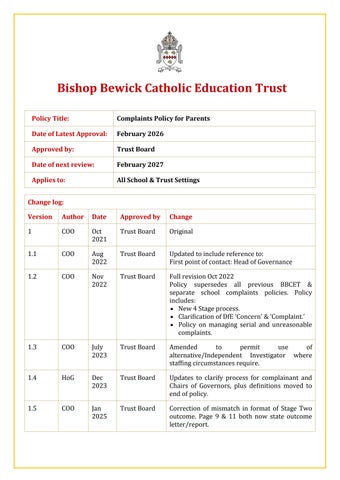
Bishop Bewick Catholic Education Trust Policy Title:
Complaints Policy for Parents
Date of Latest Approval:
February 2026
Approved by:
Trust Board
Date of next review:
February 2027
Applies to:
All School & Trust Settings
Change log: Version
Author
Date
Approved by
Change
1
COO
Oct 2021
Trust Board
Original
1.1
COO
Aug 2022
Trust Board
Updated to include reference to: First point of contact: Head of Governance
1.2
COO
Nov 2022
Trust Board
Full revision Oct 2022 Policy supersedes all previous BBCET & separate school complaints policies. Policy includes: New 4 Stage process. Clarification of DfE ‘Concern’ & ‘Complaint.’ Policy on managing serial and unreasonable complaints.
1.3
COO
July 2023
Trust Board
Amended to permit use of alternative/Independent Investigator where staffing circumstances require.
1.4
HoG
Dec 2023
Trust Board
Updates to clarify process for complainant and Chairs of Governors, plus definitions moved to end of policy.
1.5
COO
Jan 2025
Trust Board
Correction of mismatch in format of Stage Two outcome. Page 9 & 11 both now state outcome letter/report.
Contents 1.
Introduction
3
2.
Raising a Concern
3
3.
Exclusions to the Complaints Policy
4
4.
Anonymous Complaints
4
5.
Purpose of a Complaints Procedure
4
6.
How do I make a Complaint?
5
7.
Stage 1
5
8.
Stage 2 – Formal Written Complaint
7
9.
Withdrawal of a Complaint
7
10.
Stage 3 – Governor Panel Hearing
7
11.
Timescales for Parental Complaints
9
12.
Recording Complaints
9
13.
Vexatious Complaints (including serial and unreasonable complaints)
9
14.
Barring from the Premises
10 Page 2 of 17
15.
Complaints Campaigns
11
16.
Monitoring the Policy
11
17.
Complaints about a Headteacher
11
18.
Annex 1 – Scope of this Policy and Procedure
12
19.
Annex 2 – Stage 2 Complaint Form
13
20.
Annex 3 – Stage 3 Complaint Form
14
21.
Annex 4 – Roles and Responsibilities
15
Page 3 of 17
“To listen with the ear of the heart” …………. the opening words of the Rule of St Benedict 1.
Introduction
1.1
The Bishop Bewick Catholic Education Trust [Trust] is committed to providing the highest quality of education and care across all of its schools. The Trust’s schools are united by a shared commitment to Catholic values and the development of the whole child affirming that ‘a great education has the power to transform lives.’ In all complaints, the wellbeing and safeguarding of pupils is our first priority.
1.2
Trust schools work with parents to ensure every child reaches their potential. However, the Trust recognises that, from time to time, concerns or complaints from parents may arise. It is important that these are dealt with promptly, fairly, and in a spirit of openness and mutual respect. Many issues can be resolved informally, without the need to use the formal stages of the complaints’ procedure.
1.3
This policy sets out a clear procedure for parents / carers to raise concerns or make complaints, ensuring they are addressed effectively at the appropriate level. Parents are asked to work positively and collaboratively with school staff & leaders to resolve issues quickly.
1.4
Where mistakes have been made, the Trust is committed to acknowledging these as part our culture of continuous improvement.
2.
Raising a concern
2.1
A concern is where a parent has worry or doubt about an issue which they believe to be important. In such cases parents will understandably seek reassurances from school staff. This may involve an e-mail exchange, telephone call, or face-to-face meeting with a member of staff or a school leader. In our primary schools, concerns should normally be raised with the child’s class teacher in
the first instance. As the person who works most closely with the pupil daily, the class teacher is usually best placed to address day-to-day academic or pastoral concerns.
In our secondary schools, concerns should normally be directed to the child’s Head of Year.
Heads of Year are responsible for overseeing pupils’ overall progress and wellbeing and are well-positioned to coordinate a response with other staff where needed.
2.2
Occasionally, a parent may not be satisfied with the school’s responses to a concern(s) which they have raised. In this case, the parent (or the school) may wish to escalate the concern and use the complaints procedures outlined in this policy to address the matter.
2.3
A complaint may be made about a school as a whole, about a specific department or about an individual member of staff, any matter about which a parent/carer is unhappy and seeks action by the school is within the scope of this procedure.
2.4
This policy provides a consistent framework to be followed by all Trust schools, ensuring fairness and clarity for everyone involved in line with the Trust's mission and values.
2.5
Parents/carers can be assured that all complaints will be treated seriously and confidentially. Our schools are here for the children and parents/carers can be assured that their child will not be penalised in any way for a complaint that is raised in good faith.
2.6
If you have difficulty discussing a concern with a particular member of staff, we will respect your views. In these cases, the Headteacher will refer you to another staff member. Similarly, if the member of staff directly involved feels unable to deal with a concern, the Headteacher will Page 4 of 17
refer you to another staff member. The member of staff may be more senior but does not have to be. The ability to consider the concern objectively and impartially is paramount. 2.7
As per DfE and Ofsted-backed advice please only use AI with caution. AI does not always get it right when citing laws and can make a complaint more complex than necessary and delay resolution.
2.8
Complainants should not approach school governors to raise concerns or complaints. Governors have no power to act on an individual basis, and it may prevent them from considering complaints at a later stage of the complaints’ procedure.
3.
Exclusions to the complaints policy
3.1
The scope of this policy is outlined in Annex 1. Safeguarding and child protection concerns must be escalated via the school’s Safeguarding Lead or Headteacher and not via the complaints policy.
3.2
There are certain complaints which fall outside the remit of the Trust’s parental complaints procedure. These are: Matters that are the responsibility of the Local Authority. Conduct of staff at the school (see 3.3). Content of a statutory statement of Special Educational Needs. Pupil admissions. Pupil exclusions. The national curriculum and related issues including religious education.
3.3
Complaints regarding school staff (except the Headteacher) should not use the complaints form. Such matters regarding staff should be emailed to the Headteacher via the school office marked ‘Private and Confidential.’ Complaints about staff are dealt with under the Trust's internal disciplinary procedures, if appropriate. However, a parent may raise a complaint about a staff member directly or indirectly.
3.4
Complainants will not be informed of any disciplinary action taken against a staff member as a result of a complaint. However, you should notify complainants that the matter is being addressed and allow the parent to progress through the school's complaint procedure.
3.5
Complaints that involve or are about the Headteacher should be addressed to the Chair of Governors, via the school office or e-mail contact email. Please mark them as Private and Confidential.
3.6
Complaints about the Chair of Governors, any individual governor or the Local Governing Committee should be e-mailed to the Trust’s Head of Governance: (Gilly.Box@bishopbewickcet.org). Please mark as ‘Private and Confidential.’
3.7
Should a complainant begin legal action against the Trust, the complaints process will be stopped at that point and all subsequent actions by the school/Trust will be guided by legal process.
4.
Anonymous Complaints
4.1
The Trust does not investigate anonymous complaints.
5.
Purpose of a complaint’s procedure
5.1
An effective complaints procedure: Encourages resolution of problems by informal means wherever possible. Is simple to understand and use. Page 5 of 17
Is impartial and non-adversarial. Allows swift handling with established time-limits for action, and keeping people informed of the progress. Ensures a full and fair investigation by an independent person where necessary. Respects people’s desire for confidentiality wherever possible. Addresses all the points at issue and provides an effective response and appropriate redress, where necessary protects complainants from victimisation or retaliation. 6.
How do I make a complaint?
6.1
A complaint can be made in person, in writing or by telephone. However, for ease of use, a template complaint form is included at the end of this policy.
6.2
If the concern(s) has already been raised with the school and is ongoing, for example e-mail exchanges or phone call(s), it is important that the complainant informs the member of staff that they are now making a formal ‘Stage 1 Complaint’. The Trust operates a three-stage complaint model. All schools seek to work with parents to resolve complaints at Stage 1.
6.3
If a Headteacher has previously been dealing with a parental concern which becomes a complaint, they will step away. The Headteacher will assign a member of staff to deal with the Stage 1 complaint. Typically, this will be the school’s Deputy or Assistant Head. This ensures that should the complaint remain unresolved, the Headteacher can oversee the complaint if escalated to Stage 2.
7.
Stage 1
7.1
At Stage 1 the school will seek to reach an informal, and hopefully quick, resolution to a complaint. If a Headteacher has been responding to a concern, and a Stage 1 complaint is made, a different member of staff will manage the Stage 1 complaint.
7.2
Persistent minor complaints may be consolidated by school and handled together as Stage 1.
7.3
Stage 1 – process
STAGE 1 - Complaint received: When a parental complaint is made, the member of staff dealing with the issue will e-mail the parent within three school days to confirm receipt of the complaint. If appropriate, the member of staff investigating the issue may offer a face-to-face meeting or phone call to better understand the issue and what outcome the complainant is seeking. They will record information, summarising the complaint, actions and outcomes. Where all communications are written, these should only be via school e-mail accounts (not parent apps or texts/messaging etc.)
Review of issue: The member of staff will look into the complaint and reply within 10 school days. It may well be that having looked into things an immediate solution is offered and the matter closed by mutual agreement. If the member of staff reviewing the complaint feels they will be unable to meet this deadline, they will provide the complainant with an update and a revised response date.
Page 6 of 17
Conclusion/Outcome of investigation: The member of staff will provide the parent with a verbal or written response to their complaint. The response ends the Stage 1 process.
Next steps: If the Stage 1 process has been exhausted and no satisfactory solution is found, the complainant may choose to formally escalate their complaint for investigation, by writing to the Headteacher (Stage 2). The complainant has five school days from the date of the Stage 1 informal outcome to ask for an escalation to Stage 2 (Formal Investigation). 8.
Stage 2 – Formal written complaint
8.1
When a parent is dissatisfied with the outcome of a Stage 1 complaint, they may write and request a Stage 2 investigation. This is a formal review by the Headteacher with a written outcome.
8.2
At Stage 2 the complaint will be reviewed by the Headteacher, who may involve another member of the Senior Leadership team to support.
8.3
If the Complaint is about the Headteacher, the complainant should write to the Chair of Governors. Stage 2 complaints should be made on the Stage 2 form (see Annex 2).
STAGE 2 - Complaint received: When a Stage 2 complaint is made, the Headteacher will email the parent within three school days to confirm receipt of the complaint. The Headteacher or designated member of the Leadership Team will review the written complaint and may seek to meet the complainant to discuss the complaint prior to starting their formal investigation. At this point, the Headteacher may still seek to resolve the complaint informally.
Investigation: Additional investigation may be deemed necessary by the Headteacher to reach a conclusion. This may include revisiting aspects of any initial investigation previously carried out at Stage 1.
Response to the complainant: The Headteacher will write to advise the complainant of the outcome of their review of the matter. The Headteacher’s written response to the complainant should usually be within 20 school days of receipt of the Stage 2 complaint. The written response will include reasons for the conclusions reached by the Headteacher, what action, if any, the school proposes to take to resolve the matter and advise the complainant of the right to Stage 3 The complainant will have three school days from receipt of the Stage 2 written outcome in which to ask for an appeal to Stage 3 (Governors’ review).
Page 7 of 17
9.
Withdrawal of a complaint
9.1
If a complainant wishes to withdraw their Stage 2 complaint, this must be confirmed in writing to the Headteacher.
10. Stage 3 – Governor panel hearing 10.1 If a complainant remains dissatisfied with the outcomes of a school’s review of their complaint, they may request a Stage 3 Governor Panel hearing of the complaint, and must use the Complaints form in Annex 3. Governors will only hear Stage 3 appeals that have already progressed through Stages 1 and 2 of this procedure. 10.2 The Chair of Governors will convene a panel of three governors, at least one of which will be independent (Trust appointed from across BBCET – i.e. not a governor from the school to which the complaint relates). The other two members of the panel will normally be from the school’s Local Governing Committee. The panel will have had no prior direct involvement in this matter. Details of the roles and responsibilities of those involved in Stage 3 can be found in Annex 5. 10.3 In their review of the complaint the committee can: Dismiss the complaint in whole or in part; Uphold the complaint in whole or in part; Decide on the appropriate action to be taken to resolve the complaint; Recommend changes to the school’s systems or procedures to ensure that problems of a similar nature do not recur. Stage 3 - Request for panel hearing received: The Clerk to the Local Governing Committee receives a written request for a panel hearing, the request will be acknowledged in writing within three school days. The Clerk will inform the complainant of the date of the governor panel, normally within 20 school days from date of request.
Pre-meeting actions: The Clerk will ensure they have the names of those who will be in attendance at the panel hearing. The Clerk will ensure all involved are aware that the meeting will be clerked and minutes taken. The Clerk will ensure the complainant knows they may bring someone along to the panel meeting to provide support. This can be a relative or friend. Generally, the DfE does not encourage either party to bring legal representatives to the committee meeting. However, there may be occasions when legal representation is appropriate. For instance, if a school employee is called as a witness in a complaint meeting, they may wish to be supported by union and/or legal representation. The Chair of the panel must know the names and contact details of any witnesses at least five school days in advance of the panel hearing date to allow checks for conflict of interest.
Panel hearing: The panel hearing takes place according to the following process. Introduction: The aim of the meeting is to resolve the complaint and achieve reconciliation between the school and the complainant.
Page 8 of 17
Order of the meeting: The Chair welcomes the complainant and asks those present to introduce themselves. The Chair explains the purpose of the meeting, the procedure, and checks that all written evidence has been made available to all parties. The complainant explains their complaint, calling witnesses if appropriate. The Panel may ask questions of the complainant and witnesses. The Headteacher or designated member of the Leadership Team is then invited to present a response to the complaint, including action taken to address the complaint at Stages 1 and 2 of the procedure, calling witnesses, if appropriate. The Panel and complainant may ask questions of the Headteacher. The Headteacher or designated member of the Leadership Team summarises the school’s position, highlighting evidence, including anything that has emerged in the questioning. The complainant summarises their case, highlighting evidence, including anything that has emerged in the questioning. The Chair of the Committee checks that all parties feel this is a fair hearing and reminds every one of the confidentiality of the case. The Chair of the Committee thanks both parties for attending and gives an indication of when they can expect to hear the outcome. All parties then leave the room together. The Panel considers the complaint and reaches a unanimous or majority decision. Where necessary, the Panel decides what action to take to resolve the complaint and, if appropriate, recommends changes to ensure similar complaints are not made in future. NB: Failure to attend the panel hearing or engage in the process: Where the school has made reasonable attempts to accommodate complainants with dates for complaint meetings and where they refuse or are unable to attend, it may: Convene meetings in the complainant’s absence. Reach a conclusion in the interests of drawing the complaint to a close. Where a complainant fails to attend on the day of a panel meeting, unless a good reason for nonattendance is provided in advance to the Chair (i.e. serious illness), the panel will assume the complaint to have been withdrawn.
Notification of the panel’s decision: The Clerk to the Governing Committee will notify in writing, the outcome of the appeal to the complainant and Headteacher normally within five school days of the hearing. The response will provide a full explanation of the decision made and the reason(s) for it. Where appropriate, it will include detail of the actions that the school and/or the Trust will take to resolve the complaint. The letter to the complainant will include details of how to contact the DfE if they are dissatisfied with the process by which the school handled their complaint. All complainants are reminded of DfE’s guidance that “once a school has fully investigated and responded to a complaint, if a subsequent complaint brings no new information regarding the same issue, the school may choose to stop responding.”
Page 9 of 17
Next steps: Under the statutory instrument of governance, complainants are expected to follow and adhere to this complaint procedure. However, this does not negate a complainant’s statutory right to raise their complaint with other statutory bodies. If the complainant believes that the Trust did not handle their complaint in accordance with the published complaints procedure or they acted unlawfully or unreasonably in the exercise of their duties under education law, then they can contact the DfE. The DfE states it will not normally reinvestigate the substance of complaints or overturn any decisions made by an Academy Trust. However, they will consider whether the school/BBCET have adhered to education legislation and any statutory policies connected with the complaint. The complainant can refer their complaint to the Department for Education at: Department for Education Piccadilly Gate, Store Street Manchester M1 2WD Telephone: 0370 000 2288 Online: www.education.gov.uk/contactus 11. Timescales for parental complaints 11.1 Complaints must be raised within three calendar months of the incident or, where a series of associated incidents have occurred, within three calendar months of the last of these incidents. The Trust will consider complaints made outside of this period only if exceptional circumstances apply. It is for the individual school to determine what constitutes exceptional circumstances. 11.2 Timescales for the complaints process are set using school days (excluding weekends, public holidays, and school holidays). Holiday breaks will cause delays in the process. 11.3 In some instances, further investigations may require new deadlines. The complainant will be sent details of the new deadline and an explanation for the delay. 11.4 An effective procedure will identify areas of agreement between the parties. It is also of equal importance to clarify any misunderstandings that might have occurred as this can create a positive atmosphere in which to discuss any outstanding issues. 12. Recording Complaints 12.1 Individual schools will keep records of formal complaints and complaints panel hearings as required by current legislation and regulations. It will also do so in accordance with the Trust’s Privacy Notice and in most cases for a period of at least seven years after the pupil leaves the school. 13. Vexatious Complaints (including serial and unreasonable complaints) 13.1 If properly followed, the complaints procedure will limit the number of complaints that become protracted. However, there will be occasions when, despite all Stages of the procedures having been followed, the complainant remains dissatisfied. If the complainant tries to reopen the same issue, the Clerk to the Panel hearing the complaint at Stage 3 of the process is able to inform them in writing that the procedure has been exhausted and that the matter is now closed. 13.2 The Trust is committed to dealing with all complaints fairly and impartially, and to providing a high-quality service to parents / carers who complain.
Page 10 of 17
We will not normally limit the contact complainants have with our schools. However, we do not expect our staff to tolerate unacceptable behaviour and will take action to protect staff from that behaviour, including that which is abusive, offensive or threatening. 13.3 The Trust defines unreasonable behaviour as that which hinders our consideration of complaints because of the frequency or nature of the complainant’s contact with the school, such as, if the complainant: (a) Refuses to articulate their complaint or specify the grounds of a complaint or the outcomes sought by raising the complaint, despite offers of assistance; (b) Refuses to co-operate with the complaints investigation process; (c) Refuses to accept that certain issues are not within the scope of the complaints procedure; (d) Insists on the complaint being dealt with in ways which are incompatible with the complaints procedure or with good practice; (e) Introduces trivial or irrelevant information which they expect to be taken into account and commented on; (f) Raises large numbers of detailed but unimportant questions, and insists they are fully answered, often immediately and to their own timescales; (g) Makes unjustified complaints about staff who are trying to deal with the issues, and seeks to have them replaced; (h) Changes the basis of the complaint as the investigation proceeds; (i) Repeatedly makes the same complaint (despite previous investigations or responses concluding that the complaint is groundless or has been addressed); (j) Refuses to accept the findings of the investigation into that complaint where the school’s complaint procedure has been fully and properly implemented and completed including referral to the Department for Education; (k) Seeks an unrealistic outcome; (l) Makes excessive demands on school time by frequent, lengthy and complicated contact with staff regarding the complaint in person, in writing, by email and by telephone while the complaint is being dealt with; (m) Uses verbal or physical threats to intimidate (n) Uses abusive, offensive or discriminatory language or violence (o) Knowingly provides falsified information (p) Publishes unacceptable information on social media or other public forums. 13.4 Complainants should try to limit their communication with the individual school that relates to their complaint, while the complaint is being progressed. It is not helpful if repeated correspondence is sent (either by letter, phone, email or text), as it could delay the outcome being reached. 13.5 Whenever possible, the individual Headteacher or Chair of Governors will discuss any concerns with the complainant informally before confirming the complaint is vexatious and will not be responded to. If the behaviour continues, the Headteacher will write to the complainant explaining that their behaviour is unreasonable and ask them to change it. For complainants who excessively contact any Trust school causing a significant level of disruption, we may specify methods of communication and limit the number of contacts in a communication plan. This will be reviewed after six months. In response to any serious incident of aggression or violence, we will immediately inform the Police and communicate our actions in writing. This may include barring an individual from the school site for a specified period (see below). 14. Barring from the premises 14.1 The premises and site of the Trust schools are private property and therefore any individual may be barred from entering the premises. 14.2 If an individual’s behaviour is cause for concern and where staff feel threatened by such behaviour, the Headteacher and/or member of the Trust’s executive leadership will then ask the Page 11 of 17
individual to leave the premises and may decide to bar the individual from future attendance on school premises. In such circumstances, the Headteacher will notify the parties involved in writing, explaining that their implied licence for access to the premises has been temporarily revoked and why, subject to any representations that the individual may wish to make. Any decision to bar an individual will be kept under review. The individual involved will be given the opportunity to formally express their views regarding the decision to bar them. 14.3 Anyone wishing to make a complaint regarding a barring order can do so in writing, including via e-mail, to the individual Headteacher or Chair of Governors. 15. Complaints campaigns 15.1 If the school receives a large number of complaints from parent / carers about the same subject, such complaints may be grouped together and dealt with through a single response. 16. Monitoring the Policy 16.1 The Trust Board will review this Complaints Policy regularly. Each school’s Local Governing Committee will monitor the number and range of complaints received, how these were dealt with, and any action taken. The monitoring and review of complaints can be a useful tool in evaluating an individual school’s performance. This review will take place on an annual basis. The responsibility for the monitoring of this policy and any complaints is delegated to the Local Governing Committee. 17. Complaints about a Headteacher 17.1 Where a complaint is against an individual Headteacher, the matter should be referred to the Chair of Governors who, acting as Line Manager, will be responsible for dealing with the matter. It is not always clear if the complaint is against an individual Headteacher given they are responsible for all operational decisions across the school even if made by other staff. In such cases, the Chair of Governors will determine if the school or the Local Governing Committee should investigate the complaint.
Page 12 of 17
18. Annex 1 – Scope of this policy and procedure In accordance with the Education (Independent School Standards (England) Regulations 2014 Schedule 1, Part 7, this procedure covers all complaints by parents / carers of pupils who attend schools within the Trust regarding any provision of community facilities or services by the school other than complaints that are dealt with under other statutory procedures, including those listed below. Complaints raised by third parties, who do not have pupils attending schools within the Trust, will be dealt with and responded to outside of this policy. Exceptions
Admissions to schools
Statutory assessments of Special Educational Needs
School re-organisation proposals
Matters likely to require a Child Protection Investigation
Who to contact Concerns about admissions, statutory assessments of Special Educational Needs, or school re-organisation proposals should be raised the relevant local authority (Newcastle City Council, North Tyneside Council or Northumberland Council). If you have serious concerns, you may wish to contact the Local Authority Designated Officer (LADO) who has local responsibility for safeguarding or the Multi-Agency Safeguarding Hub (MASH). Melanie Scott – 0191 277 4636
Exclusion of children from school*
Further information about raising concerns about exclusion can be found at: www.gov.uk/school-discipline-exclusions/exclusions. *complaints about the application of the Behaviour Policy can be made through the school’s complaints procedure. Behaviour Policy
Whistleblowing
Staff – use BBCET’s internal whistleblowing procedure. If you do not want to raise matters directly referrals can be made at: www.education.gov.uk/contactus.
Staff grievances
Complaints from staff will be dealt with under the school’s internal grievance procedures.
Staff conduct
Complaints about staff will be dealt with under the school’s internal disciplinary procedures.
Complaints about services provided by other providers who Providers should have their own complaints procedure to deal may use the school premises or with complaints about service. Please contact them directly. facilities
National Curriculum - content
Please contact the Department www.education.gov.uk/contactus
for
Education
at:
If other bodies are investigating aspects of the complaint, for example the Police, the Local Authority (LA) Safeguarding teams or tribunals, this may impact on our ability to adhere to the timescales within this procedure or result in the procedure being suspended until those public bodies have completed their investigations. If a complainant commences legal action against the school or the BBCET in relation to their complaint, we will consider whether to suspend the complaints procedure in relation to their complaint until those legal proceedings have concluded. Page 13 of 17
19. Annex 2 – Stage 2 Complaint form Complainant details Complainant’s name Pupil/Student’s name Your relationship to pupil Day time
Address Postcode
Evening E-mail address
Your complaint – Please give details of your complaint:
Action already taken – What action, if any, have you already taken to try and resolve your complaint? Who did you speak to and what was the response?
What actions do you feel might resolve the problem at this stage?
Complaint declaration Signature: Date: OFFICIAL USE Date received: Date acknowledged: Acknowledged by: Complaint referred to:
Page 14 of 17
20. Annex 3 – Stage 3 Complaint form Complainant Details Complainant’s name Pupil/Student’s name Your relationship to pupil Day time
Address Postcode
Evening Email address
Please confirm you have read the Stage 2 Report and acknowledged in writing (via e-mail) that you have read and understood this report and its outcomes. Your complaint – Please give details of what actions you feel might resolve the problem at Stage 3:
Complaint declaration Signature: Date: OFFICIAL USE Date received: Date acknowledged: Acknowledged by: Complaint referred to: Date:
Page 15 of 17
21. Annex 4 – Roles and responsibilities (a)
Headteacher [Investigating Officer] (Stages 2 & 3) The Headteacher (or delegated senior leader) shall provide a comprehensive, open, transparent, and fair consideration of the complaint through: Sensitive and thorough interviewing of the complainant to establish what has happened and who has been involved. Interviewing staff and children/young people and other people relevant to the complaint. Consideration of records and other relevant information. Analysing information. Liaising with the complainant to clarify what the complainant feels would put things right. The investigator should: Conduct interviews with an open mind and be prepared to persist in the questioning. Keep notes of interviews or arrange for an independent note taker to record minutes of the meeting. Ensure that any papers produced during the investigation are kept securely pending any appeal. Be mindful of and comply with the timescales to respond. Comply with GDPR / Data Protection Act 2018 requirements. Prepare a comprehensive report for the Headteacher, designated member of staff, or complaints panel that sets out the facts, identifies solutions and recommends courses of action to resolve problems.
(b) Clerk to the Local Governing Committee (Stage 3 only) The Clerk is the contact point for the complainant and the committee and should:
(c)
Ensure that all people involved in the complaint procedure are aware of their legal rights and duties, including any under legislation relating to school complaints, education law, the Equality Act 2010, the Freedom of Information Act 2000, the Data Protection Act (DPA) 2018, and the General Data Protection Regulations (GDPR). Set the date, time, and venue of the meeting, ensuring that the dates are convenient to all parties (if they are invited to attend) and that the venue and proceedings are accessible. Collate any written material relevant to the complaint (for example; Stage 1 paperwork, school and complainant submissions) and send it to the parties in advance of the meeting within an agreed timescale. Record the proceedings. Circulate the minutes of the meeting Notify all parties of the panel’s decision.
Committee Chair (Stage 3 only) The panel’s chair, who is nominated in advance of the complaint meeting, should ensure that:
Both parties are asked (via the Clerk) to provide any additional information relating to the complaint by a specified date in advance of the meeting. The meeting is conducted in an informal manner, is not adversarial, and that, if all parties are invited to attend, everyone is treated with respect and courtesy. Complainants who may not be used to speaking at such a meeting are put at ease – this is particularly important if the complainant is a child/young person. The remit of the panel is explained to the complainant. Written material is seen by everyone in attendance, provided it does not breach confidentiality or any individual’s rights to privacy under the DPA 2018 or GDPR. Page 16 of 17
If a new issue arises it would be useful to give everyone the opportunity to consider and comment upon it; this may require a short adjournment of the meeting.
Both the complainant and the school are given the opportunity to make their case and seek clarity, either through written submissions ahead of the meeting or verbally in the meeting itself. The issues are addressed. Key findings of fact are made. The committee is open-minded and acts independently. No member of the committee has an external interest in the outcome of the proceedings or any involvement in an earlier stage of the procedure. The meeting is minuted. They liaise with the Clerk (and complaints co-ordinator, where appropriate). (d) Committee Member (Stage 3 only) Committee members should be aware that:
The meeting must be independent and impartial and should be seen to be so: no governor may sit on the committee if they have had a prior involvement in the complaint or in the circumstances surrounding it. The aim of the meeting should be to resolve the complaint and achieve reconciliation between the school and the complainant. The Local Governing Committee recognises that the complainant might not be satisfied with the outcome if the meeting does not find in their favour. It may only be possible to establish the facts and make recommendations. Some complainants may feel nervous and inhibited in a formal setting. Parents/carers often feel emotional when discussing an issue that affects their child. Extra care needs to be taken when the complainant is a child/young person and present during all or part of the meeting. Careful consideration of the atmosphere and proceedings should ensure that the child/young person does not feel intimidated. The committee should respect the views of the child/young person and give them equal consideration to those of adults. If the child/young person is the complainant, the committee should ask in advance if any support is needed to help them present their complaint. Where the child/young person’s parent is the complainant, the committee should give the parent the opportunity to say which parts of the meeting, if any, the child/young person needs to attend. However, the parent should be advised that agreement might not always be possible if the parent wishes the child/young person to attend a part of the meeting that the committee considers is not in the child/young person’s best interests. The welfare of the child/young person is paramount.
Page 17 of 17