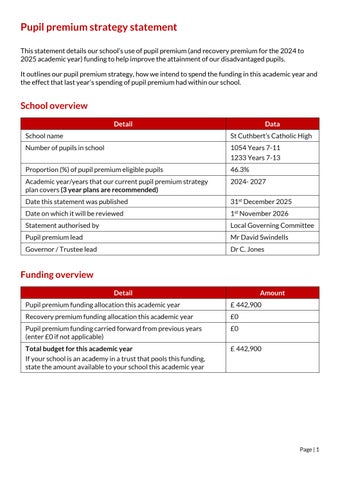
Pupil premium strategy statement This statement details our school’s use of pupil premium (and recovery premium for the 2024 to 2025 academic year) funding to help improve the attainment of our disadvantaged pupils. It outlines our pupil premium strategy, how we intend to spend the funding in this academic year and the effect that last year’s spending of pupil premium had within our school.
School overview Detail
Data
School name
St Cuthbert’s Catholic High
Number of pupils in school
1054 Years 7-11 1233 Years 7-13
Proportion (%) of pupil premium eligible pupils
46.3%
Academic year/years that our current pupil premium strategy plan covers (3 year plans are recommended)
2024- 2027
Date this statement was published
31st December 2025
Date on which it will be reviewed
1st November 2026
Statement authorised by
Local Governing Committee
Pupil premium lead
Mr David Swindells
Governor / Trustee lead
Dr C. Jones
Funding overview Detail
Amount
Pupil premium funding allocation this academic year
£ 442,900
Recovery premium funding allocation this academic year
£0
Pupil premium funding carried forward from previous years (enter £0 if not applicable)
£0
Total budget for this academic year If your school is an academy in a trust that pools this funding, state the amount available to your school this academic year
£ 442,900
Page | 1
Part A: Pupil premium strategy plan Statement of intent At St Cuthbert’s Catholic High School, our vision for education is rooted in the belief that formation must be more than academic success alone. We seek to provide an educational experience in which every young person is known, valued, and supported to belong, to thrive, and to achieve. In keeping with the finest traditions of Catholic education, we aim to form young men of competence, conscience, compassion, and commitment, educated in faith and for justice. Central to this is our determination that every pupil feels a genuine sense of belonging at St Cuthbert’s—secure in the knowledge that they are part of a supportive community in which they matter and are encouraged to become the best version of themselves. Our ultimate aim is that no child is left behind, socially or academically, because of disadvantage. We are committed to raising aspirations, nurturing confidence, and removing barriers that prevent pupils from flourishing personally and achieving academically. High-quality teaching, underpinned by strong pastoral care, sits at the heart of our approach, ensuring pupils are supported both in the classroom and beyond it. We recognise that disadvantaged pupils may face a range of barriers to learning, including limited support at home, weaker language and communication skills, lower confidence, behavioural challenges, or issues with attendance and punctuality. For some, complex family circumstances can further hinder their ability to thrive. These challenges are varied and interconnected, and therefore require bespoke, responsive support rather than a one-size-fits-all approach. To ensure that every pupil has the opportunity to flourish, all teaching staff are actively involved in the analysis of data and the identification of pupils’ strengths and areas for development. This shared responsibility ensures a consistent and informed approach across the school. Targeted teaching and learning strategies are then implemented to meet individual needs, alongside appropriate pastoral and wider support for pupils belonging to vulnerable groups. In allocating support, we recognise that disadvantage is not always captured by eligibility for free school meals. Equally, not all pupils in receipt of free school meals experience the same barriers. As such, we reserve the right to direct Pupil Premium funding towards any pupil or group of pupils the school has legitimately identified as being socially disadvantaged, ensuring support is responsive and equitable. Pupil Premium funding is allocated following a detailed needs-led analysis, identifying priority individuals, groups, or cohorts. Given the finite nature of funding, not all eligible pupils will receive targeted interventions simultaneously; however, all pupils remain part of a connected system of support designed to strengthen belonging, promote flourishing, and enable sustained academic achievement. Page | 2
Challenges This details the key challenges to achievement that we have identified among our disadvantaged pupils. Challenge number
Detail of challenge
1
Attainment: The attainment of disadvantaged pupils is generally lower than that of their peers when considering the Attainment 8 Key Performance Indicator. In 2023 47% of disadvantaged pupils achieved E&M 4+ compared to 74% of their non-disadvantaged peers. 24% of disadvantaged pupils achieved E&M 5+ compared to 46% of their non-disadvantaged peers. 10% of disadvantaged pupils achieved five GCSEs graded 7-9 compared to 21% of their non-disadvantaged peers. Narrowing the attainment gap will be a priority so that increasing numbers of pupils can access their preferred post-16 destination, including Sixth Form.
2
Literacy: Lower levels of literacy impede pupil’s confidence and access to deep understanding across the curriculum and can lead to disengagement and poor behaviour. Out of 220 pupils in Year 7, 65 were identified as having a reading need (word recognition, fluency, comprehension, vocabulary) through NGRT testing. 54% of pupils with a reading need are disadvantaged which is disproportionate to the percentage number of disadvantaged pupils in the school (34%).
3
Attendance: Our data for 2023-2024 indicates that attendance among disadvantaged pupils has been between 2% to 5% lower across Years 7-11 than for non-disadvantaged pupils. It also indicates that the mean range of pupils who were Persistent Absentees across Years 7-11 that were also disadvantaged was 56% with three Year groups averaging over 60%. Evidence shows that the overall objective of closing the attainment gap is dependent on good school attendance.
4
Behaviour: Our 2023-2024 data indicates that some disadvantaged pupils are more likely to display behaviour issues that require internal isolation in Damascus, suspensions, or permanent exclusion. The number of disadvantaged pupils receiving these sanctions is disproportionate to the percentage number of disadvantaged pupils in the school (34%). 49% of pupils internally isolated are disadvantaged. 60% of pupils receiving suspensions are disadvantaged with 66% having more than one suspension. 100% of pupils permanently excluded were disadvantaged.
5
Aspirations: Low-aspirations and self-esteem for a number of disadvantaged pupils. This indicates a lack of aspiration and progress. Teacher feedback suggests that disadvantaged pupils are less likely to engage in co-curricular activities and cultural capital opportunities.
Page | 3
Intended Outcomes This explains the outcomes we are aiming for by the end of our current strategy plan, and how we will measure whether they have been achieved. Intended outcome Attainment: Improved attainment among disadvantaged pupils across the curriculum at the end of KS4.
Success criteria ▪ ▪ ▪
Literacy: Improve literacy and numeracy skills of targeted disadvantaged pupils. Aim to address a lack of engagement amongst a significant proportion of disadvantaged pupils and encourage them to make more rapid academic progress.
Attendance: To achieve and sustain improved attendance for all pupils, particularly the disadvantaged pupils.
▪
▪
▪ ▪ ▪
Behaviour: To improve and sustain the behaviour of disadvantaged pupils, so that they are more engaged in learning and school life.
▪
▪
▪
▪ Aspiration: Increased self-esteem, resilience, and ambition of the future. ▪
Narrow the attainment gap between disadvantaged pupils and their non-disadvantaged peers. Increase the numbers of disadvantaged pupils entering St Cuthbert’s Sixth Form Greater fluency in the use of subject-specific vocabulary, reading, writing and oracy of disadvantaged pupils based on formative and summative teacher assessments. Greater participation in lessons by disadvantaged pupils based on formative and summative teacher assessment. Reduction in number of classroom demerits for disadvantaged pupils and an increase in house points. Percentage of PA pupils who are disadvantaged is reduced. That attendance of disadvantaged pupils is improved to be 96% or higher. To reduce the number of disadvantaged pupils being suspended. That behaviour records show that the number of disadvantaged pupils requiring internal isolation is reduced. That behaviour records show that the number of negative recorded incidents are proportional to non-disadvantaged pupils. Pupils are confident, independent learners, with positive attitudes to learning as evidenced in quality assurance (pupil & staff voice and work scrutiny). Increased participation in extra-curricular activities so the same proportion of disadvantaged pupils attend as non-disadvantaged. Increased proportions of disadvantaged pupils progress to a range of higher education establishments, employment or training in line with non-disadvantaged pupils.
Page | 4
Activity in this academic year This details how we intend to spend our pupil premium (and recovery premium funding) this academic year to address the challenges listed above.
Teaching (for example, CPD, recruitment and retention) Budgeted cost: £222,689
Activity
Evidence that supports this approach
Curriculum Changes: Pupils are no longer in the same KS3 class in the majority of their lessons. This will allow pupils to mix in a wider range of friendship groups raising aspirations through their peers.
Evidence suggests that disadvantaged pupils may suffer from lower teacher expectations which increases their chances of being placed in lower sets or streams. Mixed ability classes reduces this and raises expectations and aspirations. https://educationendowmentfoundation. org.uk/education-evidence/teachinglearning-toolkit/setting-and-streaming
KS3 pupils will now be set in Maths and English according to their ability in the subject as opposed to being streamed. Smaller Core KS4 class sizes. Period 6 lessons for Year 11 pupils included in teacher’s directed time calculation. Disadvantaged pupils to be targeted to attend.
High Quality Teaching, Training and Staffing: Learning at St Cuthbert’s (what a St Cuthbert’s lesson should include) has been created, launched and embedded with staff. Key features of this include high expectations of all pupils, lessons are inclusive and carefully planned to maximise the potential of all pupils, modelling and
Challenge number(s) addressed
1, 2, 4, 5
International research evidence suggests that reducing class size can have positive impacts on pupil outcomes when implemented with socioeconomically disadvantaged pupil populations. https://educationendowmentfoundation. org.uk/education-evidence/teachinglearning-toolkit/reducing-class-size There is evidence to suggest that disadvantaged pupils might benefit more from additional school time. https://educationendowmentfoundation. org.uk/education-evidence/teachinglearning-toolkit/extending-school-time There is evidence to suggest that feedback involving metacognitive and selfregulatory approaches may have a greater impact on disadvantaged pupils and lower prior attainers than other pupils. Pupils require clear and actionable feedback to employ metacognitive strategies as they learn, as this information informs their understanding of their specific strengths
1, 2, 4, 5
Page | 5
scaffolding are used regularly, teacher instructions are clear and explicit, lessons are rich in assessment and feedback, lessons begin with knowledge recall and end with knowledge summary. Rich and varied CPD is delivered to all staff twice weekly through briefings on both pastoral and academic topics. Appointment of Assistant Head Pastoral with responsibility for Behaviour. Sharing best practice on strategies to support disadvantaged pupils to be calendared for Academic Board and Department meetings.
and areas for improvement, thereby indicating which learning strategies have been effective for them in previously completed work. https://educationendowmentfoundation. org.uk/education-evidence/teachinglearning-toolkit/feedback Behaviour interventions have an impact through increasing the time that pupils have for learning. This might be through reducing low-level disruption that reduces learning time in the classroom or through preventing exclusions that remove pupils from school for periods of time. https://educationendowmentfoundation. org.uk/education-evidence/guidancereports/behaviour
Pupil Premium to be a focus for action in data review meetings. Reading for Pleasure: Each pupil in KS3 has a library lesson timetabled as part of their English curriculum once a fortnight. Appointment of Librarian. Several author visits have been scheduled to take place across the year. Calendared events such as World Book Day, National Poetry Day and Reading Festival.
Research shows that children who read for pleasure are more likely to achieve highly in academic subjects and beyond. Also, studies in England have shown that pupils eligible for free school meals may receive additional benefits from being taught how to use reading comprehension strategies. https://educationendowmentfoundation. org.uk/education-evidence/teachinglearning-toolkit/reading-comprehensionstrategies 1, 2, 5
Half Termly publication of Reading Newsletter as a way of encouraging parental engagement, promotes how reading has been celebrated in school, interviews staff and pupils about their reading and provides a half termly recommended read for every year group. Page | 6
Improving Literacy: Appointment of Literacy coordinator. NGRT data shared with staff, alongside strategies to support the individual reading needs of pupils. Use of SPARX Reader with Years 7-9 as a way of developing careful reading, equipping pupil with the close reading skills needed to succeed at GCSE and beyond and also as an incentive to read regularly.
Improved pupil literacy re-engages pupils with their curriculum and removes a barrier to learning. https://educationendowmentfoundation. org.uk/projects-andevaluation/projects/accelerated-reader https://educationendowmentfoundation. org.uk/education-evidence/teachinglearning-toolkit/reading-comprehensionstrategies
1, 2, 4, 5
Tier Two Vocabulary booklets completed weekly in form time. Word of the Week is shared and discussed by tutors weekly and displayed on posters around school following a weekly update. This is also shared with parents in the Families Update so promote learning vocabulary together in the home. Holding of Year 7 Supporting Your Son Evening with a focus on Literacy. Parents/Carers were given a copy of the vocabulary booklet, practised strategies they could adopt in the home, parental engagement with reading strategies, recommended reading lists and were shown how to use the eBook system on the school website. Implementation of the Freyer Model across Departments and Tier 3 vocabulary identified in programmes of study. Sixth Form literacy/reader mentors from those identified from NGRT with weakest reading ability focussing on fluency and engagement.
Page | 7
Targeted academic support (for example, tutoring, one-to-one support structured interventions) Budgeted cost: £150,488 Challenge number(s) addressed
Activity
Evidence that supports this approach
Year 7 Speech and Language Screening. We subscribe to secondary language link which provides access to assessment and intervention resources to provide identification of any SLCN unidentified needs.
There is evidence to suggest that pupils from lower socioeconomic backgrounds are more likely to be behind their more advantaged counterparts in developing early language and speech skills, which may affect their school experience and learning later in their school lives. https://educationendowmentfoundation. org.uk/education-evidence/teachinglearning-toolkit/oral-languageinterventions
2
Year 7 Literacy Fresh Start. Phonic intervention programme through ‘Read Write Inc’. Targeted intervention based on initial screening for pupils with delayed phonological awareness.
Studies in England have shown that pupils eligible for free school meals typically receive similar or slightly greater benefit from phonics interventions and approaches. Targeted phonics interventions may therefore improve decoding skills more quickly for pupils who have experienced these barriers to learning. https://educationendowmentfoundation. org.uk/education-evidence/teachinglearning-toolkit/phonics
2
Acquisition of SISRA to aid teaching staff in being able to accurately complete their Progress Portraits for each class they teach. Progress portraits enable staff to identify the progress and attainment of boys in receipt of Pupil Premium, compare this against other class cohorts and mixed cohorts and plan individual interventions and feedback to close PP gaps.
Many studies of feedback include other practices. For example, mastery learning approaches combine feedback with additional support for pupils that are falling behind, while approaches like formative assessment also include work to understand specific gaps in learning that need to be addressed and how the teacher wants the pupil to progress. https://educationendowmentfoundation. org.uk/education-evidence/teachinglearning-toolkit/feedback
1, 2, 5
Beyond St Cuthbert’s- school is more than a transaction: Comprehensive
Whilst pupils eligible for the pupil premium are likely to have lower
5 Page | 8
careers programme supports future choicesstrong emphasis on supporting disadvantaged pupils to achieve their potential leading to few NEETS. Creation of partnership with local construction company with emphasis on improving academic attainment alongside learning practical workplace skills for disadvantaged pupils.
academic attainment compared to their more advantage peers, the assumption that poorer pupils have lower aspirations for their education and adult life is less clear. Given the broad range of attitudes, behaviours and beliefs surrounding aspirations in communities with higher rates of poverty, schools should avoid generalisations. Aspiration interventions without an academic component are unlikely to narrow the disadvantaged attainment gap. https://educationendowmentfoundation. org.uk/education-evidence/teachinglearning-toolkit/aspiration-interventions
HWK Club for pupils who struggle to access tasks due to lack of access to relevant technology.
Pupils eligible for free school meals typically receive additional benefits from homework. However, surveys in England suggest that pupils from disadvantaged backgrounds are less likely to have a quiet working space, are less likely to have access to a device suitable for learning or a stable internet connection and may receive less parental support to complete homework and develop effective learning habits. These difficulties may increase the gap in attainment for disadvantaged pupils. Homework clubs can help to overcome these barriers by offering pupils the resources and support needed to undertake homework or revision. https://educationendowmentfoundation. org.uk/education-evidence/teachinglearning-toolkit/homework
1
Raising Aspiration (RA) lessons added to our form time programme. RA involves regular goal setting and reviews, reviews of punctuality, attendance and behaviour. It also includes careers focus lessons based on successful alumni.
The average impact of metacognition and self-regulation approaches is high (+8 months additional progress) however, it can be difficult to realise this impact in practice. https://educationendowmentfoundation. org.uk/education-evidence/teachinglearning-toolkit/metacognition-and-selfregulation https://educationendowmentfoundation. org.uk/education-evidence/teachinglearning-toolkit/aspiration-interventions
5
Boys Resilience In Thinking (BRIT) curriculum is a bespoke programme
The average impact of successful SEL interventions is an additional three
5 Page | 9
timetabled for all boys in Year 8 linked to the school’s vision, mission and values. The lessons and resources are planned and led by a TLR3 holder.
months’ progress over the course of a year. Alongside academic outcomes, SEL interventions have an identifiable and valuable impact on attitudes to learning and social relationships in school. https://educationendowmentfoundation. org.uk/education-evidence/teachinglearning-toolkit/social-and-emotionallearning
Focus on Disadvantaged pupils in Year 11: Our Academic Mentoring Programme aims to identify disadvantaged pupils in need of support in their studies, revision, next steps and identification and removal of barriers to success. This relational approach will help to focus pupils on achieving their potential.
Some evidence suggests that some pupils from disadvantaged backgrounds show low engagement with or have low expectations of schooling. Mentoring interventions may be more beneficial for these pupils, as the development of trusting relationships with an adult or older peer can provide a different source of support. https://educationendowmentfoundation. org.uk/education-evidence/teachinglearning-toolkit/mentoring By designing and delivering effective approaches to support parental engagement, schools and teachers may be able to mitigate some of these causes of educational disadvantage, supporting parents to assist their children’s learning or their self-regulation, as well as specific skills, such as reading. https://educationendowmentfoundation. org.uk/education-evidence/teachinglearning-toolkit/parental-engagement
1, 3, 4, 5
Studies have shown that pupils who are low attaining typically receive additional benefits from peer tutoring. Peer-led tutoring approaches may help pupils to close gaps in their learning by offering targeted, peer-led support to consolidate within class learning, practice skills, and identify and overcome misconceptions. There is also some evidence to suggest that peer-led tutoring can offer tutors the chance to revisit and revise skills, prior knowledge, and develop metacognitive understanding of topics. https://educationendowmentfoundation. org.uk/education-evidence/teachinglearning-toolkit/peer-tutoring
3, 4, 5
Purchasing of Revision Guides for disadvantaged pupils. Encourage parental attendance at Supporting your son and Parent’s Evenings through phone calls and invitations to help ensure parents are in the best position to support their son and to strengthen relationships with home. Our Sixth Form Mentoring Programme enables Sixth Form students, who have been trained by Newcastle’s EP Service, to support their younger disadvantaged peers with their studies and aspirations post-16.
Page | 10
Wider strategies (for example, related to attendance, behaviour, wellbeing) Budgeted cost: £69,723 Activity
SEMH support: Continue use of a counselling service to support pupils experiencing issues both within and outside of school. Appointment of HLTA Behaviour Rewards and Inclusion who predominately works 1-1 with disadvantaged pupils to identify barriers to learning and intervene. Pastoral staff trained by Newcastle EP Service on EBSNA and ‘Think Good, Feel Good’ to identify barriers in school/lesson attendance. Continued close engagement with locals services such as TAS, VRU, EP service, Inclusion Key Workers and more to support disadvantaged pupils holistically.
Increased focus on disadvantaged pupils in co-curricular activities through careful monitoring of attendance, pupil voice and engagement.
Evidence that supports this approach
Challenge number(s) addressed
Evidence suggests that children from disadvantaged backgrounds have, on average, weaker SEMH skills at all ages than their more affluent peers. These skills are likely to influence a range of outcomes for pupils: lower SEMH skills are linked with poorer mental health and lower academic attainment. SEMH interventions in education are shown to improve SEMH skills and are therefore likely to support disadvantaged pupils to understand and engage in healthy relationships with peers and emotional self-regulation, both of which may subsequently increase academic attainment. https://educationendowmentfoundation. org.uk/education-evidence/teachinglearning-toolkit/social-and-emotionallearning Evidence suggests that supporting young people’s social and emotional skills can reduce symptoms of anxiety and depression. Adolescent mental health: A systematic review on the effectiveness of schoolbased interventions | Early Intervention Foundation (eif.org.uk)
3, 4, 5
Pupils from disadvantaged backgrounds may be less likely to be able to benefit from sport clubs and other physical activities outside of school due to the associated financial costs (e.g. equipment). By providing physical activities free of charge, schools give pupils access to benefits and opportunities that might not otherwise be available to them. https://educationendowmentfoundation. org.uk/education-evidence/teachinglearning-toolkit/physical-activity
3, 4, 5
Page | 11
There is intrinsic value in teaching pupils creative and performance skills and ensuring disadvantaged pupils access a rich and stimulating arts education. Arts participation may be delivered within the core curriculum, or though extracurricular or cultural trips which can be subject to financial barriers for pupils from deprived backgrounds. https://educationendowmentfoundation. org.uk/education-evidence/teachinglearning-toolkit/arts-participation Attendance is a key whole-school priority. Pastoral staff are working to embed principles of good practice set out in DfE’s Working Together to Improve School Attendance advice. Pastoral staff are working closely with Attendance Officers and Newcastle City Council to improve overall attendance, to reduce the number of persistent absentees and to reduce the number of severely absent pupils.
The DfE guidance has been informed by engagement with schools that have significantly reduced persistent absence levels. Well established research concludes that poor attendance is linked to significantly reduced academic progress (Balfanz and Byrnes, 2012; London et al, 2016). https://educationendowmentfoundation. org.uk/education-evidence/leadershipand-planning/supporting-attendance
3
St Cuthbert’s is first and foremost a Catholic school. Disadvantaged pupils are supported through many pastoral initiatives linked to our Catholic ethos such as our uniform store.
Pupils from lower socioeconomic households are less likely to be able to afford the cost of school uniforms. Schools intending to change their school uniform policy should therefore consider what provision can be made to cover the costs of uniform changes for disadvantaged pupils. https://educationendowmentfoundation. org.uk/education-evidence/teachinglearning-toolkit/school-uniform
3, 5
Appointment two HLTAs with a particular focus on behaviour. The HLTAs will work under the direction of the Deputy Heads Pastoral to support vulnerable pupils and improve their engagement with learning.
The deployment of Teaching Assistants in a targeted way can provide a high impact in learning. Teaching Assistant Interventions | Toolkit Strand | Education Endowment Foundation | EEF
4
KS3 Educational Visits Tracker created to monitor which pupils have not attended an educational visit by the end of Year 9 so they can be taken to an appropriate site/sites linked to careers aspirations. Visits will also have an academic link and a ‘follow-up’ session.
5 Pupils to be given guidance on the knowledge, skills, and characteristics required to achieve future goals; complete activities that support pupils to develop self-esteem, motivation for learning or self-efficacy. Page | 12
https://educationendowmentfoundation. org.uk/education-evidence/teachinglearning-toolkit/aspiration-interventions Contingency fund for acute issues.
Based on our experiences and those of similar schools to ours, we have identified a need to set a small amount of funding aside to respond quickly to needs that have not yet been identified.
All
Total budgeted cost: £ 442,900
Page | 13
Part B: Review of outcomes in the previous academic year Pupil premium strategy outcomes This details the impact that our pupil premium activity had on pupils in the 2024 to 2025 academic year. Context Our Catholic School Inspectorate Report recognised the efforts St Cuthbert’s has made to improve the lives of our disadvantaged pupils: ‘Pastoral care and inclusion are exemplary. Staff go the extra mile for the most vulnerable and those from disadvantaged backgrounds. Every decision is made in service to and in the best interests of the boys.’ Improving the lives of our disadvantaged pupils is at the core of our school’s mission. The attainment and progress of our disadvantaged pupils is particularly noteworthy given the significant socio-economic deprivation in the local area. Newcastle-upon-Tyne Central and West ranks ‘very low’ on the Sutton Trust’s Opportunity Index (May 2025), placing 543rd out of 543 nationally. Achieving The table below indicates that the attainment of disadvantaged pupils at St Cuthbert’s was above average in the following areas: Disadvantaged A8, EM4+, Mathematics A8 and 5+, Science 4+ and 5+, Ebacc and Open A8, Humanities 4+.
The Attainment 8 score of disadvantaged pupils at St Cuthbert’s was 41.6, this was significantly above the national average of 34.9. This year’s score represents an improvement on last year’s result of 38.4 and indicators show the gap to the national non-disadvantaged average is ‘narrowing’. The Attainment 8 score of disadvantaged pupils in Maths is now significantly above the national average and the gap to national non-disadvantaged pupils has narrowed. The EBacc Attainment 8 score for disadvantaged pupils is significantly above the national average at 12.0 compared to 9.9 with the gap being narrowed to national non-disadvantaged. Page | 14
Due to Covid, we are unable to compare Progress 8 data for the academic year in question and the next. Belonging The attendance of disadvantaged pupils continues to improve. Whilst the attendance of disadvantaged boys is lower than the attendance of the overall cohort, it is still ‘close to average’. Furthermore, our attendance actions have positively impacted our disadvantaged pupils as their attendance percentage has risen by 0.9% compared to disadvantaged pupils the previous year and their attendance is 1.7% above the national average for disadvantaged pupils. Attendance is a key pastoral priority and work continues to be undertaken to improve it and our overall attendance is amongst the best in the city. Whilst persistent absenteeism amongst our disadvantaged is above the school average, it had drastically reduced from 37.7% to 31.5% in the last two academic years. Our most recent OFSTED report noted that ‘Pupils’ attendance is high compared to national and local averages. This reflects pupils’ positive engagement with their school.’ This is also reflected in the number of pupils staying in education or employment when leaving St Cuthbert’s as at 92% we are significantly higher than the local average of 86% and higher than the national average of 91%. The number of disadvantaged pupils remaining in ‘sustained education, employment or training’ rose 8% to 90% when compared with the previous year. Also, our current leavers’ data for ‘after 16-18’ demonstrates that a higher percentage of disadvantaged boys remain in ‘sustained education, employment or training’ when compared to the overall cohort. This success is reflected in the rising number of pupils attending our Sixth Form (+17%). Another key pastoral priority has been to continue to improve the behaviour climate of the school. OFSTED stated that, ‘Pupils, including sixth-form students, are clear that behaviour has improved significantly. They enjoy a culture of clear expectations. Pupils are proud of the journey of improvement since the last inspection. Pupils behave well in lessons and around school during social times. They show respect for others…Suspensions in the school are reducing.’ Whilst the percentage of disadvantaged boys suspended from school rose by 13%, we have reduced the number of disadvantaged boys internally isolated by 12% and also reduced overall entries of disadvantaged boys into internal isolation by 10%, thus creating a calmer and safer environment in school. Thriving/Flourishing In light of recent data from Public First’s ‘Inquiry into White Working Class Educational Outcomes’ and following the publication of ‘The Lost Boys: State of the Nation’ report from the Centre of Social Justice, we accelerated plans for a change in our form time programme to now include a ‘Raising Aspirations’ (RA) morning in an effort to both give our disadvantaged pupil’s a voice and to help them take a more holistic rather than utilitarian attitude to their education. RA involves regular goal setting and reviews, regular reviews of attendance, punctuality, behaviour, positives and a careers focus lessons. We also identified through the data from our PASS Questionnaire that a number of younger pupils, particularly those who are disadvantaged, found it difficult to face educational and everyday challenges due to a lack of resilience and this correlated with attendance, internal assessment, and Page | 15
behaviour data. We therefore allocated one hour per timetable cycle to teach a bespoke ‘Boys Resilience In Thinking’ (BRIT) curriculum where all pupil’s in Year 8 receive lessons which include topics such as ‘The Power of Yet’. Pupil Voice from the current 25/26 cohort indicates that BRIT lessons ‘help us to be resilient’ and ‘prepare us for life outside of St Cuthbert’s’, and out of a cross-section of Year 7-11 pupils, 100% find it useful to review goals in RA lessons and are confident in achieving their goals, 87% think more about their future and 80% feel more motivated due to the lessons.
Page | 16