Incorporating the Old Girls’ Bulletin | Winter 2026
Editorial Mrs Jessica Phillips
Design Ms Ruth Gavin
“
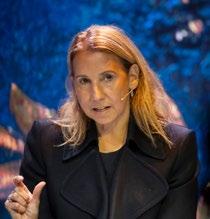
“Every classroom, every conversation, every moment of challenge or breakthrough is an invitation to transcend – not only in capability, but in conscience.”
MS NATALIE CHARLES, PRINCIPAL
As we celebrate St Catherine’s 130th year, I could not be more proud to lead Council at this remarkable time in the life of our School. It is a year that invites us both to celebrate our rich heritage and to look with genuine excitement towards the future. I follow in the footsteps of Jane Hodder, who led Council with exceptional distinction for seven years and leaves
From the Chair of Council
behind a School that is flourishing. Jane has been enormously generous throughout this transition with her time, counsel and wisdom, and I am deeply grateful for her support.
Our School Council comprises a group of outstanding individuals who bring broad professional expertise, lived experience and a shared passion for our School. I feel privileged to work alongside them, and our Principal, Natalie Charles. Natalie’s vision for St Catherine’s is ambitious, deeply considered and future-focused, while remaining firmly grounded in the wellbeing and educational excellence of every girl in our care. Natalie and her leadership team, together with Council, are currently immersed in the development of the School’s next strategic plan, with
stakeholder consultation sessions continuing throughout the community. I very much look forward to sharing that vision later this year.
One hundred and thirty years is a remarkable milestone. It represents generations of blue-ribboned young women who have passed through the Heyington Gates and gone on to lead lives rich in purpose, adventure and achievement. That legacy speaks to the enduring strength of our School: its values and culture, its people, and its unwavering commitment to delivering an exceptional education to our girls.
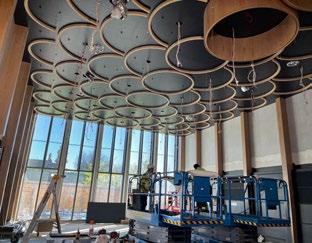
As we celebrate the School’s history, we also recognise the extraordinary strength of its future with the opening of our new spaces in Term 4. This is the most ambitious building project in the School’s history,
There is a question that has echoed across centuries, carried by philosophers, teachers, and all who have dared to ask: what does it mean to live a life well-lived...one grounded in purpose?
From the Principal
Aristotle stood firmly in the belief that such a life is shaped through the cultivation of intellect and character. He said, ‘The intellect is the best and noblest thing in us.’ It is this ancient wisdom that continues to shape the vision we carry forward together as a School.
‘Nothing is Great, Unless it is Good’ has never felt more urgent than it does today. Ours is a world that is truly starved of world leaders who recognise that power without conscience is not strength, but danger; that influence, when untethered from integrity, erodes the very ground from which it seeks authority. Such understanding lies at the heart of our flagship Year 9 Ethical Leadership program, which calls
our students first to find their grounding, to know who they are and what they stand upon.
As we prepare to unveil our Strategic Plan, we do so as a considered reflection on what it means to be fully present in the work of education at St Catherine’s. In discerning what is most essential – what renders these halls and walls not only exceptional but deeply rooted in the human condition –we have carefully interwoven five pillars: intellect, character, relationships, community, and the greater good. These are not distant ideals but living practices that ask something of us each day.
comprising state-of-the-art performance spaces, light-filled classrooms overlooking leafy canopies, a recording studio, a reimagined Winter Garden, and beautifully landscaped spaces for the girls to enjoy. I would like to acknowledge our donors, without whom this ambitious project would not have been possible. I hope their generosity towards the future of St Catherine’s inspires others within our community to give in that same spirit.
What St Catherine’s offers is perhaps something we do not acknowledge often enough. Our girls benefit from intimate class sizes, exceptional teachers who consistently go above and beyond, and our magnificent Toorak campus – a beautiful and deeply nurturing environment where girls are individually known, supported and encouraged to flourish into capable, resilient woman of enormous character. They are further supported by a parent
community and network of Old Girls that is engaged and generous in every sense.
I am passionate about an all-girls education and believe strongly that it offers something truly distinctive: the space for young women to lead, to have a voice, to take chances and to do so without hesitation or fear of judgement. The confidence instilled here stays with our girls long after they pass through the Heyington Gates for the final time. I know this not only as a parent, but also as someone who was once a student here herself.
I look forward to all that is still to come this year – to celebrating our past, embracing our exciting future, and serving a School and community that I truly love.
Mrs Nina Aberdeen (Kirby ’94) Chair of School Council
To cultivate intellect is to devote oneself to the art of curiosity that sees learning less as mere acquisition, but as awakening; a practice of inquiry that privileges thoughtful questioning and the discipline of critical thinking. Like tending soil, it requires patience, attention, and a willingness to sit with complexity until meaning begins to grow.
To form character is to move beyond the performance of virtue into its quiet, steady embodiment. It is, in many ways, an unmasking – a gentle but honest revealing of the self beneath expectation or performance, much like the figure emerging from behind the theatrical façade in the Elaine Haxton mural that is etched in the heart of our School. To tend to relationships is to acknowledge that none of us stands alone. We are shaped –often invisibly – by the many hands and hearts
that have formed us. To ‘water’ these relationships is to act with gratitude and attentiveness, recognising that the quality of our lives is inseparable from the way we honour and sustain one another. To belong to a community is to accept shared responsibility; the choices we make ripple outward, nourishing or diminishing what we hold in common. In this, community becomes not simply a place we inhabit, but something we actively cultivate...for the greater good.
We lean into the enduring moral question at the heart of every meaningful life: What am I responsible for? Every classroom, every conversation, every moment of challenge or breakthrough is an invitation to prosper – not only in capability, but in conscience. Aristotle named this eudaimonia – often translated as ‘human flourishing’ – a state of living fully and
well, in alignment with one’s highest potential, and in service of something beyond oneself.
This is the education to which we are called. Not the development of successful individuals alone, defined by outcomes or accolades, but the cultivation of whole human beings –young women who think critically, engage deeply, question rigorously, and lead with a moral compass that is always pointed to goodness.
I hope you enjoy this Winter edition of St Catherine's News as we celebrate the 130-year milestone of our remarkable School.
Ms Natalie Charles Principal
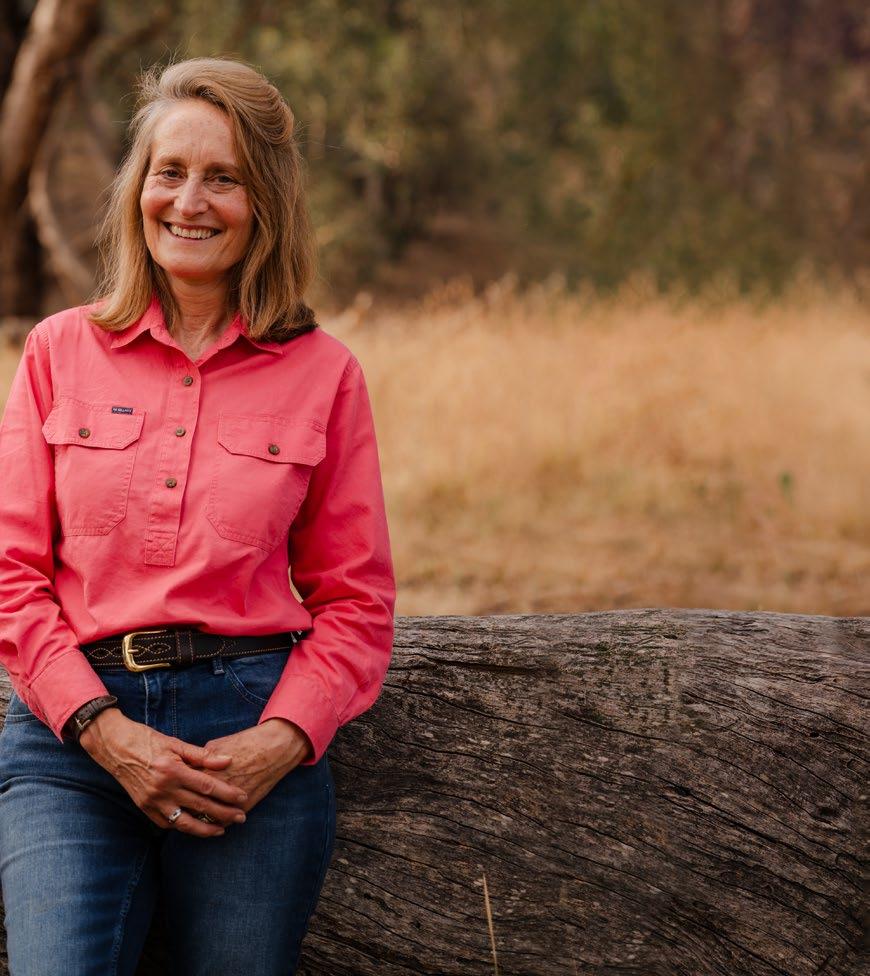
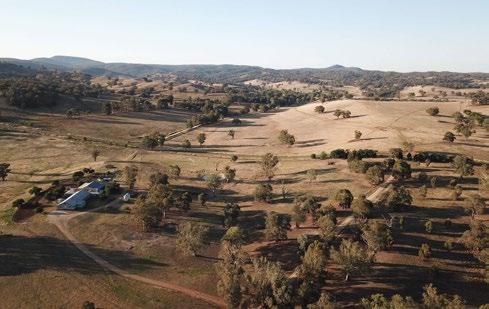
As the world acknowledges International Year of the Female Farmer, Clare Cannon (Darling ’77) is forging her own path in Australia's agricultural heartland, working among the dust, wool and wide-open plains at her sheep station, Woomargama.
GRACE, GRIT & groundbreaking
WORDS FROM CLARE ON LEADING A GOOD AND FULFILLING LIFE
Be authentic. People sense ‘fake’ from a mile away.
Shine light on dark places. Don’t ignore them because it seems ‘hard’.
Be pioneering like the Founding Mothers of St Catherine’s.
Be dynamic. People run towards dynamism.
And my two mottos: From former Principal, Mrs Walton: “Don’t do what’s easy; do what’s right.”
And from the Suffragettes: “Deeds, not words.”
I became a farmer in a roundabout way. I grew up in an apartment in Melbourne, and we went to the farm every second weekend and all school holidays. I saw Woomargama very much as my home.
Woomargama and biodiversity
I later lived overseas and in Sydney so, when I left school, I never saw myself becoming a farmer. It was only when my mother died that my eldest brother encouraged me to take over the farm. The other person who strongly pushed me in that direction was Sylvia Walton, who was Principal at that time when I was Chair of Council.
From my observations, a lot of farmers are still older white men, but their advisors are young women. I see women in landcare, wool broking, wool accreditation, as scientists, farm advisors and now, there are a lot of jillaroos especially up north on the big cattle stations.
One-third of the property is protected under a covenant with the Biodiversity Conservation Trust (BCT); a NSW Government body that secures land under conservation agreements in perpetuity. The covenant safeguards critically endangered Grassy Box Woodland, of which only around five per cent remains in southern Australia. I have a management agreement as part
of the covenant, which means I must maintain the area and control weeds. In most parts of the covenant, I can graze six months of the year. This acts rather like Aboriginal cultural burning in that it stops this woodland from becoming a forest. We have plenty of forest under protection. It is the understory of the covenant country that we lose to farming – the acacias and the wattles – and this is where the threatened bird species live, such as the hooded robin. We have 120 bird species on the property, 10 of which are threatened or critically endangered.
RB Sellars launch
RB Sellars approached me to have their wool products launched at Woomargama. This was a great honour. They wanted to feature women in farming and, because I work with a number of women, it was a great match. When I first took over the farm 15 years ago, people told me to get out of the wool industry as it was dying. I have stuck at it through ups and downs (droughts and low wool prices) as I love the product. It was so good to have the recognition for what we have done with accredited non-muelsed, high animal welfare, high sustainability wool.
As a wool grower, I am very proud of the way we handle our sheep through their
lifespan. The Zenterra classification we have is 30 pages long, and much of this is to do with animal welfare. All our shearers have been through the animal welfare course, so I am confident that the sheep are handled gently during shearing. Animal activists have put out misinformation from time to time about shearing, so I was so pleased to see it filmed in the RB Sellars ads and to see how quiet the sheep were during shearing.
The royal visit at Woomargama
Prince Charles, Princess Diana, and Prince William came to Woomargama Station on a Royal Tour in 1983. The locals all came out to meet Princess Diana in the pouring rain at Albury Airport. They always credit her for breaking the drought. Prince Charles and Princess Diana also went to church in Holbrook. All the cubs and scouts lined the streets to wave them in. The organ in the church broke down just before the service and a replacement keyboard had to be found in someone’s house. Prince William took his first steps on the back lawn and liked driving around looking at the animals in the afternoon with Nanny Barnes. He slept in a cot made by someone in Wagga as a gift. The local butcher and baker put up 'By Royal Appointment' outside their shops!
Purposeful life
I was very lucky to be taught by some remarkable women at St Catherine’s; women who believed in me more than I believed in myself at the time. When I went out in the world, I realised that most people are not so principled. Somehow, it was seeped into us that we needed to go out in the world and make a difference; it didn’t have to be on grand statements, it could be small community involvement. They were advocates for a purposeful life. These women were not interested in glory; they were interested in the good life. They lived by the School motto.
The path forward
I would encourage young women to go into agriculture. There are so many opportunities in different fields. It is such a vital industry: there are 170,000 farmers in Australia and we feed 60 million people worldwide.
As women, especially if you want to have children, your career is not linear. I always said that I would be at the peak of my abilities in my mid-50s, when the men were slowing down as my children would be more independent then. Do not look to men’s careers as markers of success.
To lead a fulfilling and interesting life, it is great to pursue your different passions and interests. Some as a career; others as a hobby or an after-hours passion project. I have never taken the well-trodden path. It does not suit my nature.
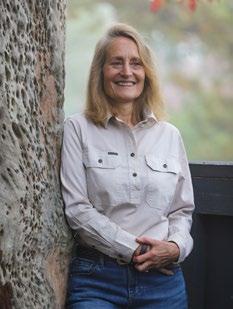
Clare Cannon (Darling ’77)
THE FIRE inside our female farmers
For me, the catastrophic Longwood fires over Summer were more than a tragic headline or news story. They were personal. I was raised in Creighton’s Creek, an area devastated by the blaze. In fact, my old house was severely impacted by fire.
Several months on from the blaze and I have had time to reflect on the real damage left behind long after the flames have been extinguished. What I have learned is that I come from a community which refuses to be defined by disaster. In particular, I have been struck by the grit and determination of local farmers, especially the women, who stood their ground, rebuilt and kept going.
In the days after the fires, I saw ashcovered farmers everywhere – often with a distinctive haunted look in their eyes. You just knew they had stared terror in the face and refused to lie down. But there was no waiting around and no time for dramatics. Just a quiet resolve to do what needed to be done. As a student embarking on my final year of school, watching this unfold was one of the most powerful lessons I have learned outside the classroom.
And many of these farmers were women. I saw them driving utes stacked with supplies, coordinating feed drops, comforting children and making tough decisions about stock and land, often while carrying the emotional weight of what had been lost. Many of them were also juggling family responsibilities and uncertainty about the future, yet they showed up every single day.
Most of our family friends are farmers and many of them were severely impacted. I will never forget the bravery of my mum’s friends whose husbands were out on trucks fighting a relentless blaze. For hours these women did not know if their husbands were alive or if they had a home to return to. Their courage was inspiring.
This year being recognised as the International Year of the Female Farmer feels especially important to my region. Too often, farming is still spoken about as if it is a man’s world. But the fires reinforce what we have always known. Women are central to agriculture and to the recovery of our communities.
The fires stole a lot from our region but they also revealed something very important. They uncovered the quiet strength that holds our community together. If the future of farming looks anything like the women I have seen standing strong in fire-scarred paddocks, then I believe that future is in very capable and very ‘female’ hands.
Martha McKellar School Co-Captain
‘Tell me, what is it you plan to do with your one wild and precious life?’
MARY OLIVER, THE SUMMER DAY
Mary Oliver, a Pulitzer Prize winning poet, found inspiration for her work in the outdoors and was a lifelong practitioner of solitary walks in nature. Her poetry is characterised by a sense of awe at the natural environment, vivid imagery, and unadorned language. In nature, she found time to reflect on what it means to be human. As teachers, we ask a version of Oliver’s question to our students every day, not in so many words, but in every lesson
that asks them to think carefully, act with integrity, and blossom into something more than they were yesterday. The pathway to growth occurs when we enact our mandate of teaching students how to think, not what to think; when we give them the tools to critically analyse, to be media literate; and when we encourage the students to not merely focus on their academic results, but to review the feedback their teachers have provided.
During the Autumn break, I found myself working in my somewhat neglected garden. It should have been an easy task of popping down to Bunnings and returning with potted colour, but, as gardeners know, the soil must be prepared; turned, enriched, fed.
I spent a full day replenishing the soil with very little to show for it, but of course, I was laying the foundations for my garden to flourish in the future. In our School, that preparation is the work of generations. The teachers who came before us, the families who trusted St Catherine’s with their daughters, the students – now alumnae who walked these corridors and dug into ideas that were difficult or entirely new – they serve as the bedrock of our culture. Much of what we sow here will not be harvested for years, perhaps decades. A conversation in Year 9 about ethical responsibility may not bear fruit until a student is 40-years-old and sitting around the boardroom table. A poem read in Year 9 that seemed, at the time, merely difficult may one day become the lantern she carries into a dark room.
THE PATH TO PURPOSE
TEACHING AND LEARNING
William Damon’s research at Stanford on youth purpose (The Path to Purpose, 2008) found that adolescents with a strong sense of purpose, a meaningful, long-term goal oriented toward something beyond the self, reported significantly lower rates of anxiety and depression, higher academic engagement, and greater resilience in the face of setbacks. Purpose, Damon argues, is not a luxury or a late-arriving gift. It is something that can be intentionally cultivated through relationships, mentorship, meaningful challenge, and the experience of contributing to something larger than oneself. Schools, he concludes, are uniquely positioned to ignite it.
The research on purpose, resilience, and wellbeing converges on a single, hopeful
finding: young people flourish not when they are protected from difficulty, but when they are equipped to meet it, surrounded by people who believe in them, and given the space to discover what they care about, and why. Nature does not hurry, and yet all things are accomplished. The trees are not failing when they let go of their leaves; they are preparing. They are enriched by the very process of releasing what is no longer needed, so that something new, something anchored in deep roots, can emerge.
That is what we are doing at St Catherine’s in every classroom, on every oval, in every conversation between a teacher and a student who is in the process of becoming. We are laying the foundations for growth. We do not begin each school year on
bare ground. We begin on soil that has been nourished for years. This is what we mean when we speak of community, of stewardship, the understanding that we inherit something where our task is to leave it more fertile than we found it. We are hopeful enough to believe the seeds we sow now will one day be the shade under which others sit.
‘We are all leaves of one tree. We are all waves of one sea.’
THICH NHAT HANH
Ms
Lisa Hanlon
Deputy Principal –Teaching and Learning
Passions & Pathways
We are immensely proud of the Class of 2025. This cohort has shown remarkable resilience, arriving at this milestone with the confidence to take their place in the world.
Our graduating students received national offers including The University of Melbourne, Monash University, RMIT, Swinburne University, Australian Catholic University, Deakin College, La Trobe University, Monash College, Victoria University, University of Sydney, Queensland University of Technology, University of Queensland, and Bond University.
International offers were received from leading US institutions, including the University of Michigan (Rowing Scholarship), Drexel University (Rowing Scholarship), the University of Pennsylvania, New York University, and The New School/Parsons; as well as from prominent UK institutions, including the University of Oxford, the University of Edinburgh, and the London School of Economics.
VCE RESULTS 2025
TOP 2% in the State
Study Scores of 45+ were achieved in these subjects:
NATALIE WANG 2025 DUX
Natalie Wang achieved the highest ATAR of 99.85. She was also Dux of English, French, and Mathematical Methods.
Natalie says, ‘I am filled with an immense amount of pride and gratitude to be named Dux. It has been so rewarding to see all the work, the collaboration with the girls in my cohort, and the unwavering support from my teachers translated into such an acknowledgement.’
This year, Natalie studies a Bachelor of Commerce/ Law at The University of Melbourne.
VINUKI RANATUNGA 2025 PRIXIME ACCESSIT TO THE DUX
Vinuki was the 2025 Co-Captain of School, and the Proxime Accessit to the Dux, achieving an impressive ATAR of 99.6.
In her role as Co-Captain, and in collaboration with Rachel Carton, she brought a sense of joy to all students. Looking back over her time at the School, Vinuki is thankful for the memories and the laughter, and for everyone who makes St Catherine’s a rich and wonderful place of learning.
This year, Vinuki studies a Bachelor of Science at Monash University.
RACHEL CARTON 2025 GRADUATE
As the 2025 Co-Captain of School, Rachel made a significant contribution to our community. Her passion to ensure that students felt connection, excitement, and purpose was a driving factor in all her achievements across the year. Working hard alongside Vinuki Ranatunga, Rachel's impact was felt in every facet of her leadership.
This year, Rachel studies Exercise and Sport Science/Physiotherapy at Swinburne University.
EMMA HIBBINS 2025 GRADUATE
Emma's St Catherine’s experience was marked by deep friendships, exceptional teaching staff, and a supportive learning environment where she was encouraged to be her best self. Emma expressed that her confidence was carefully nurtured and she was given the chance to broaden her skills and perspective. These, along with closeknit friendships, have given her memories to forever cherish.
Emma is undertaking a Bachelor of Communications at Deakin University.
Groundings in social-emotional learning
When preparing young children for school, conversations often focus on early literacy and numeracy.
While foundational academic skills matter, research consistently shows that for children aged three to five years, a social-emotional grounding is equally, if not more, important for long-term success.
Social-emotional learning refers to a child’s ability to understand and regulate emotions, build positive relationships, demonstrate empathy, make responsible decisions, and respond constructively to challenges. These competencies underpin academic
achievement and lifelong wellbeing. In early childhood, they form the foundation upon which all later learning is built. Therefore, it is fundamental that our Early Learning Centre (ELC) programs are rich in opportunities for social-emotional learning.
The critical window for cognitive cultivation
Between the ages of three and five years, children experience rapid brain development, particularly in areas linked to self-regulation, language, and social understanding. Research from the Center on the Developing Child at Harvard University highlights that a child’s early experiences shape the brain’s architecture,
especially executive function skills such as impulse control, working memory, and flexible thinking. These capacities allow children to follow instructions, manage frustration, and participate effectively in the ELC group learning environments.
During this stage, children learn to identify and label emotions, calm themselves when upset, share and take turns, follow simple rules, express needs verbally, and recognise that others have feelings and perspectives different from their own. These skills do not develop automatically. They are nurtured by educators, parents, and caregivers through responsive relationships and consistent modelling, and practiced in the ELC programs daily.
Children with strong emotional regulation and social competence are better prepared for formal schooling. They are more likely to listen attentively, engage in group activities, cope with setbacks, and collaborate with peers. The OECD Early Learning and Child Well-being Report suggests that emotional and behavioural regulation skills formed in the early years have long-term influence on academic success, including outcomes well beyond primary school.
Embedding emotional regulation begins with recognition
Managing intense emotions is one of the most visible challenges for children in this age group. Meltdowns and outbursts are developmentally typical, reflecting immature self-regulation and emerging language abilities. Teaching emotional regulation does not mean suppressing feelings; it involves
educators helping children recognise, label, and respond to emotions constructively.
The growing of empathy
As children grow, they begin to understand that others have thoughts and feelings different from their own. This is an early form of empathy. Through guided play, storytelling, and everyday interactions within the ELC programs, the children practice prosocial behaviours such as helping, comforting, and cooperating. Discussing characters’ feelings in stories, engaging in role play, modelling polite language, and encouraging children to support peers all foster social understanding. Positive peer relationships build confidence and a sense of belonging – both protective factors for mental health. Adults are children’s first and most influential emotional teachers. Young children learn how
to respond to stress and conflict by observing trusted adults. Consistent routines, clear boundaries, and calm responses create a secure base for exploration and learning. When children feel safe and understood, they are more willing to take risks, try new tasks, and engage socially.
Social-emotional learning in the early years is not an optional addition to the curriculum; it is foundational. By intentionally nurturing these skills both within the ELC and home environments, educators, parents, and caregivers equip children with tools for academic growth, healthy relationships, resilience, and lifelong wellbeing. Investing in early social-emotional development is an investment in long-term success.
Ms
Sarah Bethune
Head of ELC
The Magic & Science OF READING AND WRITING
This year, our Junior School is excited to introduce PhOrMes; a structured and evidence-based Literacy program designed to support students from Prep to Year 6.
PhOrMes is designed to help children develop strong reading and spelling skills by teaching them how written language works in a clear and systematic way.
The program focuses on key elements of Literacy:
• Phonemes – the individual sounds in words
• Orthography – the letter patterns used to represent those sounds
• Morphemes – the meaningful parts of words, such as prefixes, suffixes, and base words
• Etymology – the origin of words
• Semantics – how words and sentences convey meanings
By learning how these components connect, students develop a solid foundation that supports spelling, reading fluency, and vocabulary growth.
In the early years, students learn how to recognise sounds, connect them to letters, and blend or segment them when reading and spelling. As they move through our Junior years, they begin exploring more complex spelling patterns and word structures, strengthening both comprehension and writing skills. Once they grasp a deeper understanding of the sounds, they move towards looking at the meaningful parts of words and the origin of words. This sequential learning ensures that there are no gaps in the girls’ literacy and sets them up with strong foundational skills.
One of the strengths of PhOrMes is its clear, consistent sequence of instruction. Concepts are introduced gradually and revisited over time, helping students consolidate their learning and apply it with increasing confidence. This consistency across year levels also allows teachers to better identify student needs and provide targeted support.
PhOrMes is designed to benefit all learners, those who require additional structure and those ready for extension. Strong reading and spelling skills enhance learning in every subject, making this program a valuable part of our literacy approach.
Families play an important role in supporting literacy at home. Encouraging regular reading, discussing new words, and showing interest in your child’s learning all help reinforce the skills they develop at school. Over time, you may notice your child using PhOrMes strategies when tackling unfamiliar words.
Led by our Deputy Head of Junior School, Mrs Kate Banks, Head of Learning Strategies, Ms Lauren Maidment and supported by our Curriculum Coordinators, Ms Louise Thompson (Prep-Year 2), Ms Taleah Pecchiar (Years 3-4) and Mrs Hannah Ainsworth (Years 5-6), the initial feedback has been very positive from staff.
We look forward to seeing the impact PhOrMes will have on the girls as they grow into confident and capable communicators.
Dr Brendan Kean Head of Junior School
GROUNDED, GROWING & LEADING
Senior School Co-Captains Martha McKellar and Kari Prendergast
Junior School Co-Captains
Senior School Co-Captains
MARTHA MCKELLAR
What does Co-Captaincy mean to you?
To have this honour is incredibly special, and I am so grateful to be Co-Captain. I recognise the privilege in this responsibility, that my actions and my voice may resonate with others. I am also grateful for the ‘co’ aspect of this captaincy; I feel fortunate to stand beside Kari in this role and to lead alongside her.
How do you hope to inspire your peers?
By encouraging them to be their best and most authentic selves. I intend to foster an environment in which the girls feel proud to be a member of the St Catherine’s community, but more importantly, comfortable in who they are. I aim to do this by being conscious and purposeful in the way I carry myself. My morals and values will always inform my behaviour and decisions.
How do you see your role as Co-Captain merging as a boarder?
I see it merging through fostering connections. In the Boarding House, I have the rare and invaluable opportunity to form strong bonds with girls across all year levels. Over dinner or around the couches, I hear about the happenings of Year 7 Science, or
Inter-Softball, or what is happening in Viva this week. These conversations provide a window into many aspects of the School experience and allow me to understand and represent a wide range of voices.
What are some ways that you will balance your commitments?
I like to feel on top of my commitments, and I am working on my ability to prioritise effectively. I know that in moments of stress, I naturally gravitate towards straightforward tasks, but this year especially, I choose to focus on what truly matters and manage my time in a way that allows me to succeed across all areas of school life.
KARI PRENDERGAST
What do you hope to accomplish as School Co-Captain?
I hope to foster a culture of sisterhood throughout the School by strengthening connections between year levels, so that younger students feel supported, and older students see the influence of their actions. I am passionate about student voice and, as Co-Captain, I see it as my responsibility to advocate for my peers. I am excited to lead the Student Representative Council and eager to see what we can achieve.
How did you become interested in leadership at the School?
Throughout my time at St Catherine's, I have been fortunate to embrace opportunities that have broadened my perspective. Each experience has strengthened my belief that leadership is about listening, learning, and lifting others up. However, what has shaped my desire to lead the most is the community that has consistently empowered and supported me, giving me the confidence to nominate for the School Co-Captain.
What is one good quality every good leader needs?
Gratitude. I feel incredibly grateful to be School Co-Captain and to represent such an inspiring group of girls. Our Class of 2026 word, cherish, captures this perfectly. Gratitude grounds you. It keeps you humble, focused, and connected to what truly matters – the people around you. This is why it is a quality that every leader needs.
What advice would you give younger students about leadership?
The first step in becoming a leader is to be a good person and to share goodness with those around you. I would also encourage younger students to say 'yes' to opportunities. Get involved in a broad range of activities that push you outside your comfort zone.
Annabelle Lo and Miranda Gardiner
SENIOR SCHOOL YEAR 12 CAPTAINS
Junior School Co-Captains
What does it mean to be a Junior School Co-Captain?
Annabelle: Being a School Co-Captain means becoming the best version of myself so that I can help everyone feel safe, valued and proud to belong.
It means upholding our School values: Integrity, Curiosity, Perseverance, Empathy and Gratitude, making St Catherine's an even more caring and inclusive place for everyone.
Miranda: I hope to leave a lasting impact on Barbreck and I am looking forward to working with Annabellele throughout 2026.
What advice would you give to the younger students?
Annabelle: I would remind younger students to be kind. You may not notice but acts of kindness can lift someone’s day.
Miranda: Participate in everything even if you do not think it is one of your main strengths. Engage in school life and enjoy the activities you choose to participate in. Take pride in all you do, and most of all, have a fun with your friends.
Who inspires you?
Annabelle: Jacinda Ardern, the former Prime Minister of New Zealand, has always inspired me because she chose to lead with empathy and kindness. That is what real leadership is to me.
Miranda: The previous leaders of Barbreck in recent years as they have always shown kindness and inclusivity, inspiring me to do the same.
One of my biggest sporting inspirations is Australian freestyle skier and two-time Olympic gold medallist, Jakara Anthony.
How do you like to spend your time outside of school?
Annabelle: I like to spend time with my family and friends. We play tennis for fun and to stay active. On sunny days, we picnic in the park to keep our weekends lively or sometimes watch a film series.
Miranda: I love to keep busy. In Winter, I ski every weekend and in Summer I surf, sail and I love to bake. I play Netball with St Catherine’s Netball Club on the weekend.
School Co-Captains Martha McKellar
Kari Prendergast
Student Executive Martha McKellar
Kari Prendergast
Kathrina Ang Diya Asthana
Tsz Yu (Cadence) Law
Eve Plummer Isabelle Peter
House: Beaulieu Blair Diya Asthana Lily Van der Venne
House: Davis Amity Morris Eve Plummer
House: Holmes Kilbride Ava Murray Emma Peele
House: Langley Templeton Isabelle Peter Mia Upton
Art & Design May Aiello
Boarding Lucy Kennedy
Imogen Randell
Chess Angela Feng
Community Service Isabella Wang
Cultural Diversity Ruitong (Anjoy) Wang
Debating & Public Speaking Isabelle Cao Isabella Teoh
Drama Sahara Pender
Duke of Edinburgh Yi Wen (Eva) Xu
Environment Sofia Sinclair
Human Rights May Sutton
Library Opal Scheele
Music Choral Kathrina Ang
Music Instrumental Chin Nga (Chiara) Law
Music -School Pianist Xueqi (Shirley) Yu
Spirit & Wellbeing Giselle Upton
Sport
STEM
Sport – Aquatics
Violetta Capanni
Alice Dobbin
Mila Heng
(Swimming & Diving) Nell Peat Emily Thomas
Sport – Athletics (Cross Country/Track & Field) Paloma Gattino Tsz Yu (Cadence) Law
Sport – Rowing
Peele Isabelle Peter
Sport – Snowsports Clover Oxley
Isabella Soutter
JUNIOR SCHOOL CAPTAINS
Junior School Co-Captains Miranda Gardiner
Annabelle Lo
House: Beaulieu Blair Matea Bjazevic
Ping Hui Li
House: Davis Jemima Grinsell Yi Wing (Kayley) Lam
House: Holmes Kilbride Alice Bingham
Mia Chen
House: Langley Templeton Leticia Campos
Music
Alleria Zhu
Violet Sheldrick
Liona Wu
Library Mia Tien
Environment
Amiee Zhang
Alyssa (Alyssa) Qian Era Shah
Decoding
CRITICAL CONVERSATIONS
Harvesting big ideas. Digging deeper into critical discussion.
Picture a Year 9 classroom where the teacher has stepped back, and the students are running the discussion.
Armed with evidence, listening carefully to one another, and pushing back on ideas they disagree with, in a respectful, rigorous manner, containing real depth. This is what our Critical Conversations program looks like at its best, and over the past three years, our Humanities team – under the leadership of Paul Gilby – has been working to understand exactly what makes it work.
Critical Conversations are structured, student-led discussions around significant inquiry questions, the kind that elude easy answers. They require students to analyse, evaluate and justify their ideas. Based on traditions like Socratic dialogue and Harkness discussion, the program aims to develop students who can think carefully, speak with confidence, and genuinely engage with the ideas of others. This kind of collaborative learning does not occur by putting students in a circle and asking a good question. It requires careful design.
Over three years of collaborative trial and error, reading the research and observing each other, we reached a point last year where we sought to codify our techniques to assist colleagues in other faculties who were also looking to implement critical conversations in their own classrooms. Alongside other schools, we had the privilege of working with Bron Ryrie-Jones’ The Playbook Project, which guides the process through a practical methodology requiring the initial identification of ‘Big Ideas’, followed by one-pagers outlining specific techniques to enact those ideas. We were proud to present this to our colleagues in the form of an instructional booklet at the end of 2025.
What follows is a summary of our five key findings
1. Knowledge acts as the foundation
Early on, we discovered that the quality of discussion depended on the degree of background knowledge students brought to the table. Rather than asking students to respond to unseen material on the spot, we began pairing each conversation with careful reading of substantive, knowledge-rich texts.
The difference was immediate, and in some cases, unexpected. Students who were reserved but had completed the prereading had important contributions. As one of our Visual Arts teachers observed:
‘A student with very little voice became the student who everyone wanted in their critique group and when she spoke, everyone listened and made notes.’
2. Apply a disciplinary lens to structuring talk
We found that while some oracy skills transfer across subjects (such as active listening, taking turns and body language) the more
substantive skills are discipline-specific. The way an historian argues a case is different from how a scientist evaluates evidence, or how a student of literature analyses meaning.
Using Doug Lemov’s Habits of Discussion as a base, teachers across five subject areas each developed their own set of ‘discussion stances’. These are the moves students can take in a conversation, such as making a claim, building on a peer’s point, offering a critique, or expressing respectful disagreement. In Languages, where students are thinking in a second tongue, the focus shifted to forming relevant questions and listening for grammatical structure.
3. Stay within the box to achieve epistemic progress
One of the biggest risks in open-ended discussion is that it stays at the surface, lively and engaged, but not actually going anywhere. Students can talk confidently without really improving their understanding, or making what is known as ‘epistemic progress’. We were determined to avoid this by ‘standing within the box’.
We taught students active skills to recognise when a conversation was drifting through digression, vague assertions, or deflection, and how to steer it back. We also introduced the habit of defining key concepts before diving in. In one English class, for example, students discussing Tim Winton’s cultural significance first had to agree on what 'national treasure' meant before the real conversation could begin. Such attention changes the quality of everything that follows.
4. The real measure of strong conversation
We wanted students to leave each conversation with genuinely improved understanding, not just more practice at speaking. This shaped how we evaluated success. Confidence and participation matter, as do listening skills and civic respect. But the deepest measure of a good conversation is whether students’ thinking has advanced: whether they have encountered an idea they
had not considered, changed their mind for good reasons, or arrived somewhere they could not have reached alone.
5. No student left unheard
Even with all the above in place, we found that some students still struggled to find their voice, not because they lacked knowledge or ideas, but because of the social dynamics of speaking in a group. To address this, we built in lower-stakes warm-up activities such as paired discussion before the full conversation began, and we made inclusivity an explicit criterion for success. The goal was to ensure that no student could sit back and let others carry the room.
When it works well, a Critical Conversation is one of the most genuinely exciting things to watch in a school. Students surprising themselves with what they know, pushing each other’s thinking, and walking out of class still talking. This kind of ethical reasoning is what we have been working towards, and we are looking forward to sharing more of it with our community.
Ms Kristy Forrest Head of Professional Practice / English and Philosophy Teacher
130 YEARS
We build on foundations we did not lay.
We warm ourselves by fires we did not light. We sit in the shade of trees we did not plant. We drink from wells we did not dig.
...
Together we are more than any one person could be.
Together we can build across the generations.
Together we can renew our hope and faith in the life that is yet to unfold.
...
We are ever bound in community.
May it always be so.
REV. PETER RAIBLE
hat we W
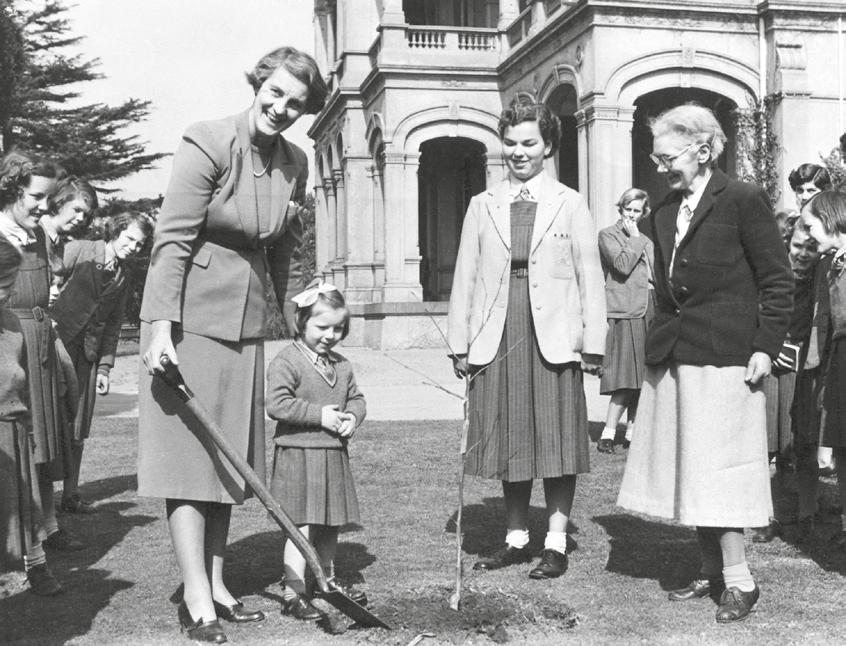
Planting of Jubilee Tree. From left to right: Principal Miss Mary Davis; Cynthia Buttner (’66) (daughter of Peggy Buttner (’41)); Deidre Hartnett, School Captain, Miss Pearson (Chief of Staff) 1953
Art Class 1947
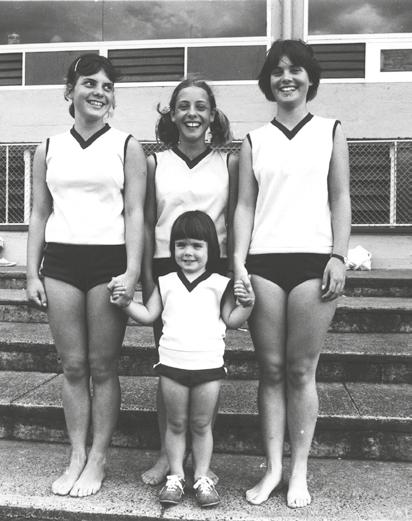
Sports Day 1978. The Folley sisters: Pia (’81) (left), Anna (’92) (centre front) Nicola (’83) (centre back) and Lisa (’79) (right)
ow, we ecome S B
Our Principal, Ms Natalie Charles, speaks of three elements that have always set a St Catherine’s education apart: a conscious focus on nurturing one’s character, one’s relationships and one’s intellect. In doing so, we commit to living intentionally and uphold the vision of our Founder Miss Jeanie Hood, that this is an education not just for school, but for life
This year, we celebrate 130 years of St Catherine’s – a village of generations that have enriched the soil for the next, passing down values, wisdom and the enduring believe that educating girls strengthens families and futures.
When the doors to Castlemaine Ladies’ College in Templeton Street swung open on 4 February 1896, our Founder, Miss Hood was committed.
Marketed in the Mount Alexander Mail as a high-class day and boarding school, the new students expected a thorough education, with lessons in English, Arithmetic, History and Sewing, and Languages, including French, Latin or German.
Miss Hood stated in the School’s 1897 annual report that the first year had passed quietly and uneventfully, with no great successes to report. But as time went on, her devotion to the School and the pupils remained firm, and she expressed that the work undertaken had ‘been thorough, and in some cases, brilliant’.
Today, our blue-ribboned girls are called to meet the defining challenges of our time, from global pandemics to the shifting fault lines of geopolitical
unrest; to the rapid advancement of technology, which is rewriting the functions of human intelligence. Yet, within the very word ‘emergency’ lies the word ‘emerge’; acting as a salient reminder to us all that crisis is not an end, but a moment of becoming.
Truth is, Miss Hood in all her wisdom, could never have envisioned back then, the world that her graduates would emerge into, but perhaps she did not need to. After all, the truth of what it really means to prepare our girls for a life of meaning, purpose and belonging remains an enduring constant and it has to do with authentic relationships, the careful formation of character, the upholding of values and the eternal pursuit of the ‘good society’.
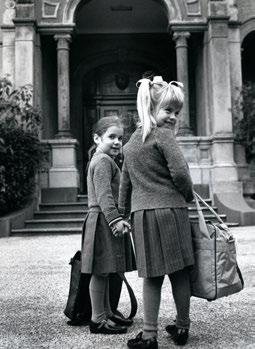
Barbreck students 1984
THE GOOD THAT
Nil Magnum Nisi Bonum Project
For 130 years, our Old Girls have exemplified the School motto, ‘Nothing is Great, Unless it is Good’. To formally cast a spotlight on the women who have achieved greatness in their professions, SCOGA initiated the Nil Magnum Nisi Bonum Project in 2006 as a gift to the School in recognition of its 110th anniversary.
Profiles of 70 Old Girls have since been displayed in the halls of Sherren House. The first 51 profiles were also published in a book to celebrate St Catherine’s 120th anniversary.
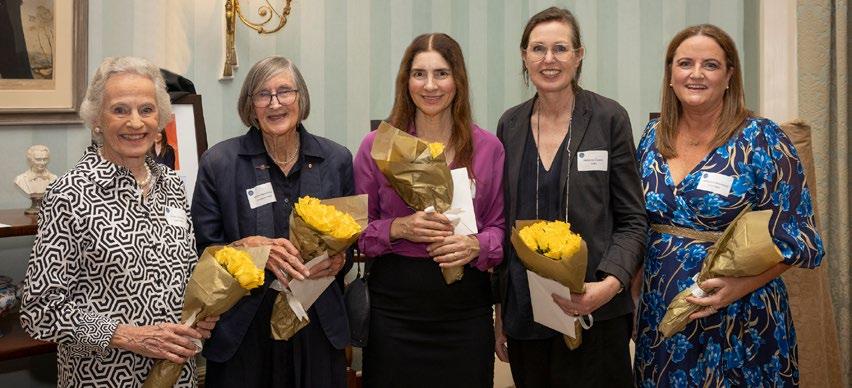
In March 2026 – 20 years on from the inception of Nil Magnum Nisi Bonum – we celebrated the induction of nine new honourees at Sherren House.
Lauren Berkowitz (’82) Artist transforming natural and manufactured materials using light, volume and space
Genevieve Brammall (’89) National Head of PR & Talent Relations at News Corp Australia
Rebecca Coates PhD (’82) Museum director, curator, public speaker, writer and lecturer
Bronwen Colman (’82) Legacy of public artworks, arts policy adviser, curator and project manager
Anne Court AM (’58) Significant service to golf administration and to the community
Sophie Holt (’82) Fashion designer and creative director
Maddie Hooker OLY (’22) 2026 Australian Olympic team member, Milano Cortina
Anne MacArthur AM (’58)
Red Cross lifelong volunteer
Althaea McTaggart OBE (’38) Service to the Liberal Party and Ngala, WA
BREAKS GROUND
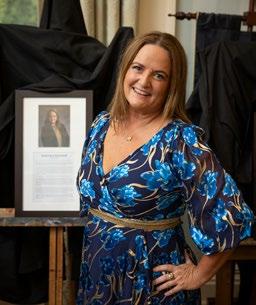
Genevieve Brammall’s acceptance speech
Thank you for this honour. To be recognised by the place that helped shape who I am feels both humbling and deeply full circle.
I have been asked to say a few words on behalf of all the honourees, and to reflect on our School motto, Nil Magnum Nisi Bonum – ‘Nothing is Great, Unless it is Good’.
I will admit, for a long time, I may have misunderstood its meaning.
Because ‘good’ can mean many things. It can mean being nice. Being kind. Being polite. It can mean being charitable. And to a teenager, being good can also mean simply…not being naughty.
Something I was very aware of when I was a boarder at St Catherine’s in the 1980s, occasionally planning to sneak out on a Saturday night…and confidently mistaking not getting caught for being good.
It was not until much later, out in the real world, navigating work, ambition, parenthood, and all the messiness that comes with it, that I began to understand what ‘good’ really asks of us.
Because ‘good’ isn’t about optics. It is about intent.
You can build a career, win awards, hit every external marker of success but if the intention behind it is hollow, self-serving, or disconnected from something meaningful…is it truly great?
I was lucky to grow up with the idea of giving back already deeply ingrained. My parents, and their parents before them, were strong contributors to their country communities. So, early in my career, I followed their lead.
I volunteered for industry committees. I gave my time to advisory boards for the City of Melbourne, RMIT and the Melbourne Press Club. I was busy, and I was committed, but something still felt missing.
The shift came when I started asking a different question. Not ‘Is this impressive?’ But ‘Is this purposeful?’ And that’s when everything changed. I started seeking opportunities where the impact was real and immediate. Whether it was taking a seat on a school board, chairing a sporting association, or contributing to help fund childhood medical research, I began using the experience and networks I had built to make a difference beyond my own career.
One moment that really stayed with me was when a colleague’s son was involved in a devastating accident and became quadriplegic in an instant. Along with a group of others, I threw all my energy into helping raise awareness and funds for his care, and together we raised more than $2 million in just six months.
That was the moment I truly understood what purpose-driven work feels like. It is exhausting, emotional, and incredibly meaningful – and it changes you.
Recently, I have watched and helped my parents devote themselves to a beautiful refugee family as they resettle in Australia from war-torn Ukraine. What that support has meant to that family is immeasurable. And once again, it reinforced something simple but powerful: goodness is not about scale – it is rooted in intention.
Across my 30-year career at News Corp, I feel proud of the journalism we have brought to mass audiences – we reach
17 million readers each month – to improve the lives of everyday Australians. Whether that is advocating for stronger social media protections for children, pushing for greater support for women living with endometriosis, or helping shift the conversation around domestic violence and sexual assault – those moments matter because they are driven by purpose.
Though what I have come to realise through these experiences is this: Greatness is not defined by size or recognition; it is defined by substance. It is not just what we achieve, but how – and why – we achieve it. That is the enduring wisdom of Nil Magnum Nisi Bonum.
To my fellow honourees and to all who have been honoured in the past – including my elder sister Anna who is in attendance –I am genuinely in awe of your achievements. We know that success without purpose is fleeting. But success grounded in goodness has a legacy.
Genevieve Brammall (’89)
COUNTRY TIES, City Life
ILLAWARRA | BOARDING
From the peacefulness of the paddocks to the sirens of suburbia, Imogen Randell, a Year 12 Boarder at St Catherine’s, shares her deeply unique story.
Imogen is a national champion in the sport of Cutting – a western-style equestrian sport where a rider and horse work together to demonstrate the horse’s athleticism, intelligence and ability to handle cattle. Spending every spare moment in the saddle, this dedicated young horsewoman is emerging as a rising star.
Imogen won the Youth National Title 2024 and the National Cutting Horse Association Youth at Tamworth in 2023 and 2024. She also won the 8 and Up Non-Pro Challenge this year and received the highest score of the show at the NCHA National Finals in both 2024 and 2025.
We sat down with Imogen to learn about her boarding experience at St Catherine’s and the rural ties of her home in Lurg, Victoria.
What has grounded you during your transition to boarding life at St Catherine’s?
Despite not going home every night, a frequent phone call to my family has kept me grounded during my transition to boarding at St Catherine’s. Being able to talk about my day makes everything feel more normal, like I am still going home to them. It gives me a sense of comfort and connection, especially when boarding can feel a bit overwhelming at times. Those regular conversations help me stay connected to where I come from, and remind me that even though I am away, I am not alone.
How do you stay connected to the rhythms of the land while living and learning in Melbourne?
Lots of updates throughout the term help me feel involved in the day-to-day life on the farm. I like to hear how the horses and cattle are going, and even just the simple home-life details.
Have there been moments where your rural connection has influenced your learning or perspective in class?
Life on the land involves a lot of time and commitment, which has certainly influenced my learning. I have found that I try to carry a patient and persistent mindset into the classroom when working through challenges. I have also found parallels between my learning and my farming background, so I love those moments where my learning relates to my interests.
The United Nations designated 2026 as the International Year of the Woman Farmer. From your perspective, why is it important to acknowledge this theme?
It is important to acknowledge the International Year of the Female Farmer to recognise the women in agriculture who may be overlooked in the industry.
Women are the backbone of the farming industry. Unfortunately, women’s contributions to the farm do not often receive equal recognition to the men’s. This theme deserves attention as it helps challenge the stereotypes of a male-dominated field, encouraging equal opportunities, stronger representation and future involvement of women in the industry. It also inspires younger women and girls to see career opportunities within the farming industry.
Personally, I am inspired by the women in my own community and family. Their resilience, work ethic and ability to balance multiple roles show the true strength behind farming.
Why do you think staying connected to the land matters in today’s world?
Staying connected to the land matters as it keeps me grounded in something real.
Life tends to feel pretty fast and busy in Melbourne, but my connection to land reminds me to slow down and appreciate where things actually come from. It also teaches me things like responsibility and resilience. It is a big part of my identity, and staying connected to the land helps me keep a sense of balance while not losing sight of what is important.
If you could bring one aspect of rural life into the boarding house, what would it be and why?
If I could bring one aspect of rural life into the boarding house, it would be the peace and open spaces. There is a stillness that I find in open spaces, which makes life a little less rushed. Boarding is busy and I love the high energy of school life. But having that balance of stillness would make a big difference, especially during stressful times. It is something I do not fully notice until I am away from it, and it is what I appreciate most whenever I go home.
What will you do with your ‘one wild and precious life’, as poet Mary Oliver puts it, when you graduate from St Catherine’s?
Will you focus on your passion for Cutting, or will you lean into city adventures?
The country lifestyle is definitely my calling. Even though I go to school in the city, I do love life on the land. When I leave St Catherine’s School, I think I will take the opportunity to travel to America and see the sport of Cutting on the ‘big stage’. And experience the lifestyle over there as it is so much bigger than it is here. Cutting will always be my passion, and I do not think I will ever stop doing it, but at some stage, I will return to the city to study at university.
Meet our Head of Athletics, and track-and-field athlete, Ms Nana Owusu-Afriyie.
Which track-and-field event do you love most?
I love the 200m. There is something special about sling-shotting off the bend and seeing how much you still have left in the tank down the home straight.
How did your Athletics journey start?
I began my own Athletics journey at the age of 11, when my Physical Education teacher encouraged me to join Little Athletics, and I have never looked back. The sport has given me so many valuable skills, both on and off the track, that have shaped who I am today.
You won silver at the World University Games, Oceania champion and Top 8 at U20 World Championships. How do you prepare?
Preparing for these teams and competitions really takes a village. From my coach, physio, and nutritionist to my parents, sport psychologist, and school – so many people play a role in helping you prepare, peak, and perform at your best.
How can our girls chase their dreams?
Always do it for yourself. You are the one who puts in the time, the hours, and the hard work. You are also the one who knows every sacrifice you have made along the way to achieve your dream. Stay true to that.
to golden pursuits Grassroots
During Careers Week, Winter Olympian and Old Girl Madeleine (Maddie) Hooker OLY (’22) returned to St Catherine’s to share the inspiring story of reaching the ‘peak’ of her Skiing career.
[Maddie’s speech excerpt]
‘The Olympics didn’t start as some big, clear dream. It started at interschools, representing St Catherine’s.
I fell in love with Cross-Country Skiing. Taking it seriously came later. And when it did, it required a decision.
I left St Catherine’s at the end of Year 11. I was 16. I left my friends, my family, everything familiar and moved to the US to go to Stratton Mountain School – a ski academy in Vermont.
I went from being comfortable to completely out of my depth. But I kept coming back to one thought: If I don’t try this properly, I’ll always wonder.
Before I even made the World Cup, I had some breakthroughs. I started getting on the podium and even won two US National Junior titles.
The next big goal was qualifying for the World Cup. I needed my FIS points under 150.
And it came down to one race up in the arctic circle, Muonio Finland.
When the points came through…149.95. Just 0.05 under the cutoff.
To me, that number meant everything.
From there: World Cup races in Finland, Norway, Switzerland. Then came the Olympics. Only four would be selected in the Women’s team. I was the youngest. Somehow…I earned that fourth spot.
Milano Cortina. Walking into the village, wearing the green and gold…seeing the rings. It’s one of those moments that doesn’t quite feel real.
I had four race starts. But the moment I’ll never forget was the Women’s 4 x 7.5-kilometre relay.
Because just getting to that start line was history. No Australian women’s or men’s team had ever qualified in the relay event before.
I was anchoring the team, and we crossed the line in 14th.
That might not sound like a headline result, but for us, it was history.’
Madeleine (Maddie) Hooker OLY (’22)
Our girls are empowered to flourish in their sporting pursuits as our exemplary staff showcase the possibilities at the most elite level. Old Girl Maddie Hooker OLY (’22) is one such woman.
We speak with three staff leaders who have lived and breathed the world stage: Head of Athletics, Ms Nana Owusu-Afriyie; Head of Netball, Mr Jake Hedrics; and Head of Snowsports, Mrs Jenny Lyons (Owens) OLY.
Meet Mr Jake Hederics, Head of Netball.
Netball has been a defining part of my life for more than 12 years, leading me to represent Victoria as a three-time National Champion and Captain South Australia. I have also proudly worn the green and gold for the Kelpies (Australian Men’s Netball) squad. Navigating this sport as a male athlete in a traditionally female-dominated space has profoundly shaped my world view. It has instilled in me a deep passion for inclusivity, equality, and breaking boundaries – values that I believe align perfectly with St Catherine’s ethos of empowering young women.
As a coach, what do you think are the drivers for sporting success?
I firmly believe that the ultimate driver is a ‘player-first’ mentality. True excellence on the court is entirely dependent on player welfare and happiness off the court. When athletes feel safe, supported, and valued as individuals first, and players second, they find the confidence to push their limits and truly thrive.
What highlights do you hold close to your heart?
While all the National titles and individual excellence awards are great, the highlights I am proudest of include those which push the boundaries of Netball and its stereotypes. I am proud to be one of the inaugural male training partners officially signed within the Suncorp Super Netball ecosystem with Collingwood and continuing that journey today with the Melbourne Mavericks. On a regular basis, I am in a high-performance environment, one where women and men train together as professional athletes, challenging each other, playing together and as a result, finding success as a club. It proves that Netball is for everyone and men have a place in this sport.
I am eager to bring my highperformance insights from the Suncorp Super Netball ecosystem into our School program, cultivating an environment where every St Catherine’s player can grow into a confident, skilled, and resilient competitor.
Mrs Jenny Lyons (Owens) OLY, Head of Snowsports.
From Salt Lake City to Vancouver to Sochi, Jenny carried the green and gold across three Winter Olympics, competing in both Alpine Skiing and Ski Cross.
She competed in Alpine Skiing for 14 years, including five seasons on the World Cup circuit with multiple Top 30 finishes, before transitioning to Ski Cross, spending another 11 years on the World Cup tour.
Jenny became the first Australian to podium in Ski Cross at World Cup level.
‘My first Olympics was in 2002, so it feels like a lifetime ago! I don’t remember a single moment or person that inspired me to become an Olympian, but I do remember always striving to be the best at whatever I did. That drive has always been my biggest motivator.’
HOUSE ARTS ROLLING IN THE DEEP Corners of Tradition
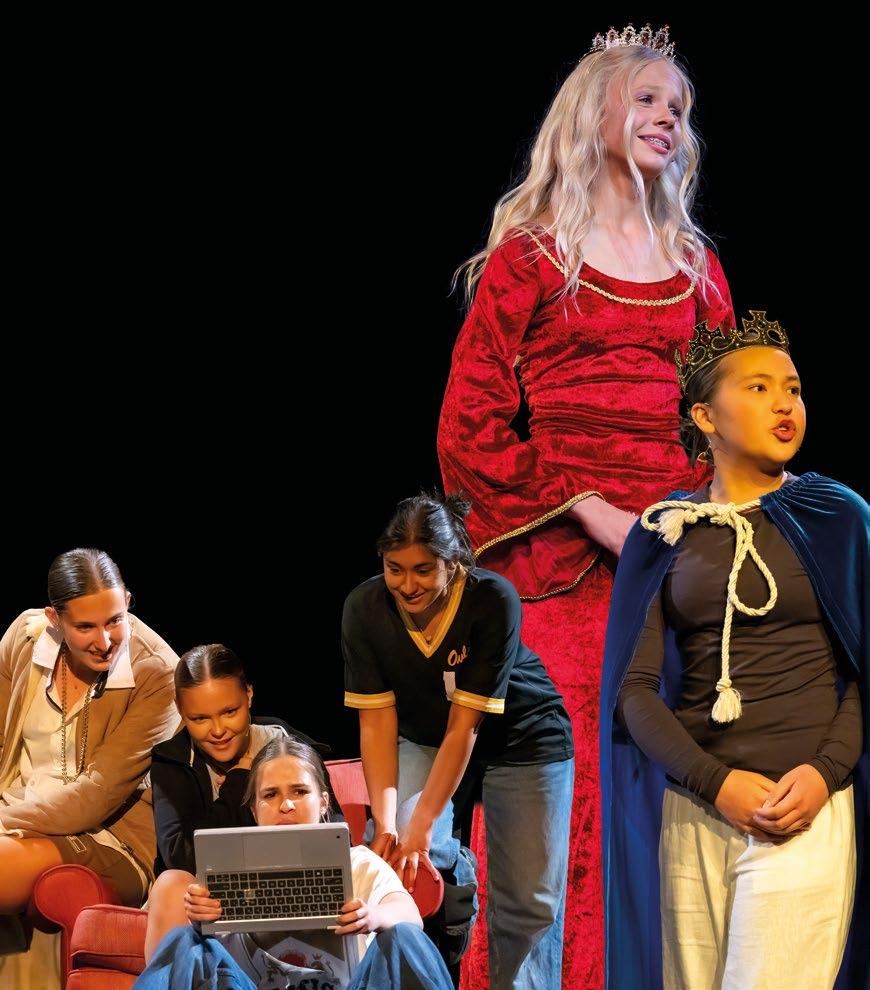
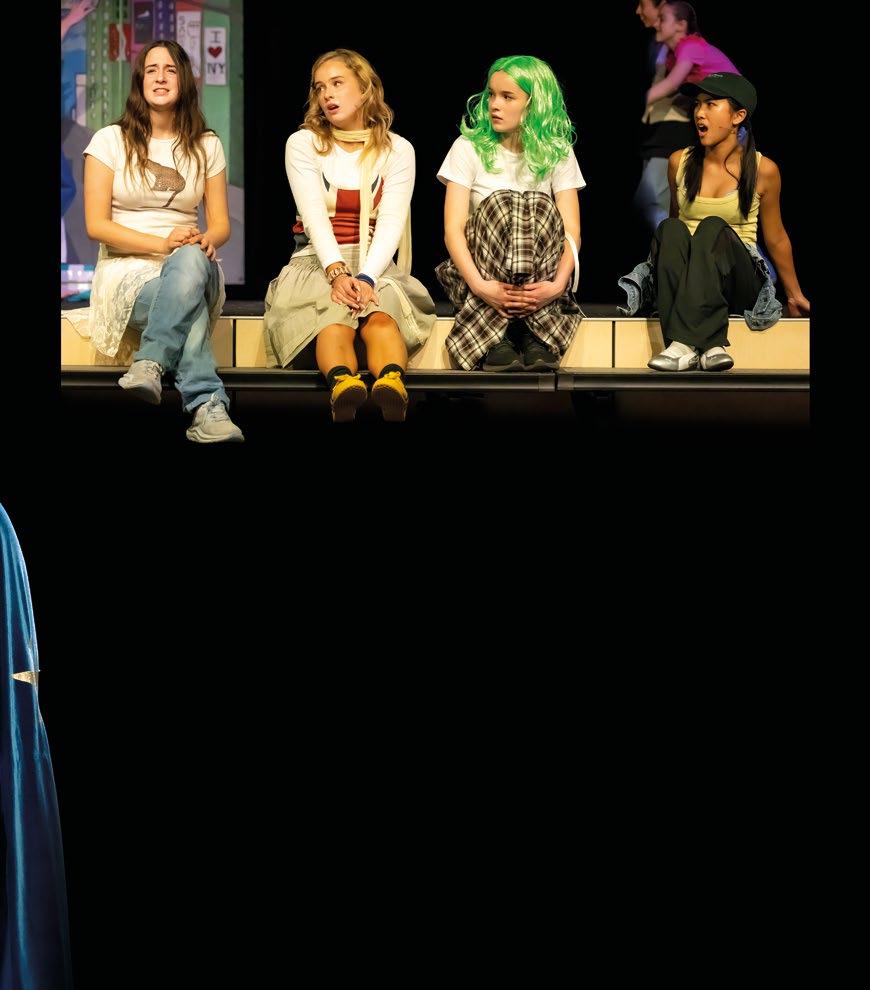
Last year’s House Arts competition carried special significance, marking its 21st anniversary. More than just a single evening of performances, House Arts represents months of student-driven creativity, teamwork and leadership – an adored experience that remains forever imprinted in our girls’ minds.
The 2025 stimulus, An Unintended Milestone, invited students to look back at the legacy of House Arts while creating something original. Each House was asked to incorporate elements from past House Arts stimuli: a line of dialogue, a setting and a plot point, along with a symbolic ‘mystery item’: a die. Adele’s Rolling in the Deep served as the set song, offering a common musical thread while still allowing for imaginative interpretation.
Leadership rested with our Year 11 students, who guided their Houses through the development of original work across Drama, Dance, Music, Media and Visual Art. Over the year, they planned and refined their concepts, gradually shaping cohesive productions that united Years 7 to 11 in a collaborative, creative process. The rehearsal week was a much-anticipated highlight filled with sound and colour; students energised and ready to problem-solve as ideas moved rapidly from page to stage.
When performance night arrived, each House presented an engaging and
well-considered response to the brief. Students demonstrated a strong understanding of storytelling, design and ensemble performance, as well as a willingness to take creative risks. The challenge of blending five artistic disciplines into a single, unified piece was handled with maturity, resulting in four distinct interpretations that captured the spirit of House Arts.
A panel of specialist adjudicators judged the competition across each discipline. The. remarkably high standard of work was evident in an incredibly close final tally. Holmes Kilbride proudly claimed Best Production and the overall win by a margin of just 0.6 per cent, with Davis finishing a strong second, followed by Beaulieu Blair and Langley Templeton.
A testament to the depth of talent across the School, all four Houses earned individual discipline awards, making this year’s event one of the most exciting and evenly matched to date. Beaulieu Blair shone in Music, Media and the Set Song with their dynamic and
polished interpretation of Rolling in the Deep; Holmes Kilbride impressed with Visual Art that was both intricate and impactful; Langley Templeton captivated audiences by topping the Dance category, opening their performance with a powerful narrative-driven movement sequence; and Davis excelled in Drama, recognised for its thoughtful script, clear storytelling and strong use of the given stimuli. Together, these achievements reflected not only the creativity of each House, but the celebratory spirit that continues to make House Arts such a highlight of our School year.
It remains clear that the heart of this event lies not only in the final performance, but in the leadership, collaboration and creativity that bring it to life. The competition continues to champion student voice and collective effort, instilling the belief that remarkable things happen when our students are provided with opportunities to lead.
Mr James Brown
Head of Performing Arts
Ethical leadership Conversations
The Year 9 Ethical Leadership program stems from a mission to cultivate intellect and character in our next generation of leaders; women who will possess the skills to think deeply, question courageously and act with integrity.
On 11 March, our community gathered to enjoy ‘An Evening in Conversation’, at the launch of our 2026 St Catherine’s Year 9 Ethical Leadership program. This groundbreaking program has been designed and delivered in partnership with the Cranlana Centre for Ethical Leadership. The panel-style event comprised Principal, Ms Natalie Charles, the Cranlana Centre for Ethical Leadership’s Chief Executive Officer
Mr Matt Finnis and Associate Professor Dr Leslie Cannold. Year 10 students, Rosie Fink and Arabella Foote, program ambassadors and alumnae of the inaugural program of 2025, also added the vital student voice to the discussion.
Drawing on his experience leading across elite sport and advocacy, Matt Finnis reflected that running an AFL club revealed how ethics is tested not
in theory but in high-pressure moments – where decisions about people’s wellbeing, equity and integrity must be made in full view, and where true leadership is defined by the courage to choose what is right over what is easy.
Dr Leslie Cannold stressed that ethical leadership has never been more vital for young women. Our girls are coming of age in a world that is complex and often morally ambiguous – one that requires the capacity to consider, question and act with integrity, even when it is difficult. She emphasised ethical leadership is about developing the habits of reflection, empathy and moral courage that enable young women to shape their lives and the world around them with purpose and conviction. Student ambassadors spoke of the program as a grounding and formative
experience, deepening their sense of self while shaping their leadership through the lens of Aristotle’s virtue ethics. Rosie and Arabella affirmed that true leadership is the steady practice of good habits, the cultivation of character, and the quiet, consistent choosing of what is right.
St Catherine’s has a rich legacy – a history, in which, the good has been honoured, both by our motto Nil Magnum Nisi Bonum and in our deeds. In designing a flagship Year 9 program, we sought to continue to honour this legacy and build upon it.
It was a privilege to moderate this panel, and I look forward to seeing how the entire 2026 Year 9 cohort flourishes this year, from the seeds sown within this program.
Ms Lisa Hanlon Deputy Principal –Teaching and Learning
The Roots of our School Crest
FROM THE ARCHIVES
The tale of our School Crest is threaded with artistry, resilience and a family whose life’s work grew, unexpectedly, into the very fabric of our School.
Daughter of modernist sculptor Karl Duldig and curator of Duldig Studio, Eva de Jong-Duldig, smiled when she saw the School Crest hanging in the Sherren House Ballroom.
Polish-born Karl and Slawa moved to Vienna both at a young age with ambitions as bright as a new season. They thrived as students of Fine Arts – Karl at the prestigious Academy of Fine Arts, Slawa at the Viennese School for Women and Girls. Karl proved equally gifted in sports; becoming an Austrian national champion in table tennis, an international-level soccer player, and a top tennis player.
In 1929, Slawa took out world-wide patents for her invention of a new folding umbrella called Flirt. The umbrella went into production in Austria and Germany, and Slawa received royalties from it for nearly a decade. In 1939, she sold her rights to the Austrian manufacturer, Bruder Wuster. An example of Slawa’s handbuilt prototype of
the folding umbrella is in the collection of the Museum of Applied Arts and Sciences (Powerhouse Museum) in Sydney, Australia.
The pair married in 1931. Slawa commissioned furniture from the firm of Sigmund Jaray and collaborated to create unique items for their family home. After Germany annexed Austria in 1938, Austrians were legally declared German citizens. As Karl and Slawa prepared to flee the country, Slawa managed to outsmart the Nazis. They ordered the couple to vacate their apartment and intended to ‘purchase’ its contents, but Slawa informed them that everything had already been sold. In reality, she entrusted all the furniture to her sister, Rella. When the sisters reunited in the 60s, the preserved items were transported to Australia to become part of the new Duldig family home.
In the wake of WWII, the Australian Government classified them as ‘enemy aliens’ due to their German identity papers. The family spent two years at Tatura Internment Camp 3 with soldiers patrolling the barbed-wire fence. Karl was released first in 1942 to join the Australian Army. A year later, his wife and daughter were reclassified as refugees and settled in Melbourne.
In 1945, Karl became Art Master at Mentone Grammar and Slawa held the role of Senior Art teacher at St Catherine’s for 16 years. Her legacy continues to shine through our annual Slawa Duldig Art Prize, held in her honour, and presented by St Catherine’s Old Girls’ Association (SCOGA).
In 1955, Karl received the commission to create our School Crest, completing it the following year. Over time, it weathered its own seasons – damaged in storage when the hall was converted into a library, lovingly restored by Duldig Studio under Eva’s supervision in 1991, and today hanging serenely in the Ballroom in pristine condition.
Mr David Studham Archivist
Eva Karl, Karl Duldig & Slawa Duldig
Slawa Duldig outside Sherren House
ST CATHERINE’S CREST 1956
Enriching the student experience
Parents and Friends’ Association
President Lisa Yasbek reflects on the parent community’s integral role, tending the roots of a positive and enriching student experience. Tell us about yourself and your background, Lisa.
My husband and I relocated our family from Bloemfontein, South Africa, to Melbourne in 2007 for a career opportunity. We have proudly called Australia our
home for almost two decades. I am a mother of three: Matthew, Simone and Christian. Professionally, I hold a Bachelor’s degree in Communications and have a background in Marketing.
What inspired you to step into the role of President?
I joined the PFA in 2023 as Secretary and have found great fulfilment in collaborating with like-minded parents to help organise the events that bring us together. In 2025, I partnered with Camilla Byrne as PFA Co-President. Together, we worked alongside the Committee and parent volunteers to deliver fundraising events reflective of our vibrant community. A highlight was raising $57,320 from the Ruth Langley Luncheon this year.
The PFA’s success is a direct testament to the incredible heart and dedication shown
Growing the Heyington Club spirit
In conversation with Heyington Club President Scott Favaloro, Rowing plants lasting values in our young women –on and off the water. It is not a stroke of luck, but a shared spirit pulling together to grow and flourish.
Describe your connection with the School. What motivated you to serve as Heyington Club’s President?
I was raised to value the immeasurable gift of a great education, together with the lifelong benefits that participation in sport as a
young person can provide. From our time as St Catherine’s ELC parents and throughout Junior School, it became clear that the School’s values and sense of community strongly aligned with those of our family.
Serving as President has been a privilege, particularly in supporting a program that demands such commitment, discipline and teamwork from its students. It has been rewarding to contribute to a Rowing program that has enjoyed significant recent success while helping foster a supportive and connected community around it.
Looking back, what were the highlights of the year?
One of the highlights of 2026 was the success of the second St Catherine’s School Regatta. The extraordinary contribution of parent volunteers was a wonderful reflection of the spirit of St Catherine’s and demonstrated
by the PFA Committee and all the volunteers that serve the School. Moving forward, I hope to continue to build on these important relationships ensuring that the PFA continues to host meaningful, inclusive events that reflect our community and inspires more families to contribute to the joy of school life. I am also looking forward to growing the PFA’s partnership with the wonderful teachers and staff at St Catherine’s. Together, we can champion thoughtful initiatives that truly enrich the learning environment and enhance the educational experience of every student.
What is your focus for the PFA in 2026?
The PFA will always be to foster positive, meaningful connections between parents and the broader School community. In 2026, the PFA hopes to work alongside the School on projects in the Junior School
the strength and generosity of our rowing community.
As an auxiliary, what are you most proud of?
This past season’s Committee was almost entirely new, yet it quickly became a cohesive and highly committed team united by a shared purpose. Whether it was delivering exceptional regatta eggand-bacon-rolls, the best catered and presented Head of the Schoolgirls’ riverside presence, or simply cheering on our girls at a regatta, I believe we strengthened and grew the Heyington Club spirit and sense of community. What makes me most proud is the willingness of so many parents to contribute their time and energy in support of the program. The momentum built this season provides an exciting foundation for 2026/2027, and I look forward to welcoming new Committee members as we continue to grow.
and Boarding house, by providing financial support to help bring these initiatives to life.
What makes the PFA grounded in purpose?
Volunteering is not measured by scale, but by heart. When parents give their time, even simple moments – like a Mother’s Day stall – become the foundation of a strong, connected community.
Without these willing hands, a truly strong community simply is not possible. When our children see us serve, they learn to value community mindedness for themselves. Through our example they discover that kindness and service are the gentle threads that hold us together.
St Catherine’s School | ELC & Barbreck
Twilight Picnic
What keeps the Heyington Club rooted in purpose?
At its heart, the Heyington Club exists for one purpose: to support our rowers.
From our Year 8 Learn-to-Row students through to our Year 12 Seniors, Rowing creates a unique sense of camaraderie built through early mornings, shared challenges, hard work and the highsand-lows of regatta competition. Those experiences foster resilience, friendship and a deep connection across year levels. The Committee’s role is to ensure our athletes have the equipment, encouragement and offwater support they need to thrive. It is this shared commitment to the girls and the broader Rowing community that makes the Heyington Club special.
On a beautiful Autumn evening in March, our Barbreck and ELC families met on the oval for the annual Parents’ and Friends’ Association (PFA) Twilight Picnic.
Our St Catherine’s School PFA and Year 6 parents produced a wonderful community event.
Our littlest children in ELC and girls in Prep to Year 3 delighted in dressing up their teddy bears and parading them around for gathered parents to enjoy.
Our Years 4 to 6 girls decorated cakes in a variety of themes and displayed them at the event for judging. The girls afforded enormous thought and effort to this task and were proud of their finished products.
This event was well-attended, and we sold sausages, chocolate tops, soft drinks, and lolly bags. The grand profits belonging to the PFA with the goal of
providing some new playground equipment for Barbreck.
A beautiful collection of hand-knitted St Catherine’s dolls, including a Dr Kean doll, was raffled at the event.
The prize went to a delighted little girl, with proceeds once again going to the PFA.
We are fortunate to have dedicated and talented people in our community, such as the grandmother who knitted these dolls. Thank you.
This event was a demonstration of community at work. Teachers, PFA, maintenance, volunteer parents (who made new friends over the BBQ) and guests embraced all on offer. Our Year 6 girls proudly worked on the various stalls, enjoying a taste of volunteering and giving back to their community.
Mrs Michelle Gardiner Year 6 PFA Class Representative
BUILDING CHARACTER and intellect from the ground up
Gravel to groundbreaking, the imminent unveiling of St Catherine’s new learning precinct stands as the most ambitious build in the School’s 130-year history.
The Elaine Haxton mural, the centrepiece of our School, stands as the impetus for our new spaces. The 1956 mural depicts three figures engaging in multifaceted forms of learning; playing musical instruments, delighting in theatrical masquerade and thinking critically about the world. As such, we have brought forth five guiding pillars that gently shape the ethos of the space and the exceptional quality of learning to unfold.
Intellect and Character
This precinct houses scholars from all walks of life in one place, giving our girls a holistic learning experience that cultivates intellect and character. From the Winter Garden that inspires peripatetic thought; to the Frank Osborn Centre creating a cove for critical conversations; to the tuition rooms that invite students to lean into their learning; and the content and acoustic studios for those wishing to
NEW LEARNING PRECINCT
pursue their podcast and media endeavours, our girls are immersed in multidisciplinary experiences.
Simultaneously, this build reflects St Catherine’s own sense of character –its charm rooted in the hand-made bricks, curved bronze and arched windows, paying tribute to those who came before them, while meeting the agile needs of a contemporary education.
Relationships and Community
They say it takes a village to raise a child, and never has a truer word been spoken when it comes to raising girls in an educational sense – our mighty village of donors has made this build a treasure trove of possibility for relationships to flow. Central to the design was the importance of connecting spaces across Music, Sport, the Arts, and the Hall that hosts our significant rituals, such as Assembly and House Arts. Ensuring that each space sits in relationship with one another was the defining challenge of this build – one we have shaped with the utmost care to bring this precinct to a harmonious whole.
Perhaps the most awe-inspiring space of all is our Recital Centre; the cornerstone
of artistic and musical pursuits where our community connects with the shared experience of storytelling. Here, our girls will indulge in presentations and artistic performances beneath a glorious wooden cylindrical canopy – the architectural crown jewel.
Greater Good
Our devotion lies in honouring the School’s motto, Nil Magnum Nisi Bonum – ‘Nothing is Great, Unless it is Good’. We believe true greatness cannot be attained without the pursuit of moral goodness. A St Catherine’s education ensures our girls take their rightful place in the world, as women of influence and purpose.
Brought to life by the architects at McIldowie Partners, we are delighted to unveil a beautifully considered work of architecture in Spring 2026, where the richness of thought and the life within it reflect the embodiment of a St Catherine’s education.
Ms Rebecca Brodie Director of Business
Bringing Old Girls Together
To lead a community such as ours is to be constantly reminded that we are part of something far greater than ourselves; shaped by those who came before us and defined by how we choose to show up today.
As we move into the rhythm of the school year, Winter offers a natural pause to reconnect with the enduring spirit of our St Catherine’s Old Girls’ Association (SCOGA)and the broader St Catherine’s School community.
This year holds particular significance as we celebrate 130 years of our School and 105 years of the Old Girls’ Association. It is a moment to honour the vision of those who came before us. In the late 1920s and early 1930s, Old Girls had the foresight to formally incorporate the Association, working alongside the Langley sisters, Trustees, and long-standing families to help shape
the governance and future of SCOGA. Their leadership laid the foundation for the connected and enduring community we value today.
In recent months, we have been reminded of both the fragility and the strength of community. Our gathering on the Illawarra steps to honour and commemorate the innocent lives lost in the attack on the Jewish community during the peaceful Chanukah by the Sea commemoration in Bondi was a deeply moving moment of reflection. It brought together students, Old Girls, and families in quiet solidarity, reinforcing the importance of standing alongside one another in moments that matter.
We have also seen the strength of this community in action. In response to devastating bushfires, our Old Girls rallied with purpose, raising funds, coordinating logistics, and delivering a truckload of hay to farmers in need. Standing alongside them, our School Captain embodied the
connection between past and present, and the enduring value of service.
These moments are not exceptions, they are a reflection of who we are: a community ready to step forward, to serve, and to act when it matters most.
I extend my sincere thanks to our dedicated Committee, volunteers, and the School for their ongoing commitment. What we share is more than history, it is a living, breathing community built on connection, care, and contribution. May we continue to support one another, stand beside one another, and step forward when it matters most, with quiet strength and enduring pride.
Ours is a legacy not only remembered, but lived, in how we show up, how we serve, and how we stand together.
Ms Anna Foley (’92) SCOGA President
LEAVERS’ PANEL
Our annual Year 12 Leavers’ Panel for the Class of 2025 welcomed Sophie Abbott (’24), currently studying Bachelor of Arts at The University of Melbourne, and Grace Cannon (’12) who studied Engineering at RMIT, and is now employed as a wind engineer for Acciona.
The morning was a wonderful opportunity for our new graduates to reconnect with each other, and for Old Girls to share insights, various college opportunities, university pathway tips, and career experiences.
Sophie highlighted the importance of not letting high expectations define the first year in tertiary education; instead, connect with study groups, participate in activities, and
engage with others to enrich the university experience. Grace recommended our guests travel or study abroad during these years. She also encouraged our new Alumnae to consider university as a time to discover new hobbies and learn ways to monetise these as a career. Balance is key, and those first few years outside of school can be the best time for self-discovery and learning more about the world.
Well done to our 2025 Graduates, we wish you every success and encouragement for your first year!
Ms Marigold Hayward (’15) SCOGA Vice President and Committee Member
Connecting our Community
To stay up to date with SCOGA events, mentor programs, Fellowship and other opportunities you can find us at:
Facebook Page scoga.au
Instagram @scoga.au
LinkedIn
st-catherine's-school
If you have any delightful stories to share about your friends from St Catherine’s, we would love to hear from you! Feel free to reach out at socga@stcatherines.net.au.
SCOGA Committee
President
Anna Foley (’92)
Vice Presidents
Emma Green (’91)
Marigold Hayward (’15)
Honorary Secretary
Gretel Cannon (’12)
Honorary Treasurer
Tiffany Middleton (’91)
School Council
Sophie Panopoulos (’86)
Katrina Bobeff (Tucker ’92)
General Committee
Suzie Esposito (Davies ’91)
Jennifer Wang (’15)
Sarah Carlile (’96)
Ada Taylor (’88)
Heather Gleeson (Cameron ’92)
Kate Dawson (’91)
Rachel Carton (’25)
Hay for the Heartland
From connection and community voices to coordinated action on the ground, the Old Girls’ network came together to support rural families when it mattered most.
‘This is what it means to show heart, compassion, and strength in the face of such difficult times.’
LINDA WIDDUP, FOUNDER, AUSSIE HAY RUNNERS
Heartfelt connections
Back in January, as the Victorian bushfires unfolded, our response began with connection.
Old Girls living on rural properties shared personal videos, letting the community know they were safe, while also offering a glimpse into the reality on the ground. What started with Clare Cannon (Darling ’77) of Woomargama Station quickly grew, as others from across our school community recorded where they were, what was happening on their farms, and how the Old Girls’ network could help.
At its heart, it was about ensuring no one felt alone that those facing uncertainty and loss knew they were seen, supported and held by a wider community.
Strength in community
From this foundation, the St Catherine’s Old Girls’ Association mobilised quickly,
connecting people, resources and goodwill to support families and farmers facing devastating loss.
Working alongside local authorities, including Annabelle Cleeland and Jess Wilson, and with the extraordinary generosity of our community, we were able to help coordinate what was urgently needed on the ground.
Members of our community also visited the Longwood Fodder Depot, led by Lindy Shelmerdine (’80), an Old Girl and neighbouring landholder to the affected areas, alongside current School Co-Captain Martha McKellar – a current boarder and resident of Euroa – gaining first-hand insight into the scale of the response and the critical role these hubs play in supporting affected farmers.
Compassion in action
In response to the immediate need, we established Hay for the Heartland; a GoFundMe initiative that brought together donations of more than $11,000.
Importantly, the initiative also raised broader awareness across our community, encouraging many to make direct contributions to the Victorian Farmers Federation Disaster Relief Fund ensuring
farmers received not only immediate support, but the resources they truly needed.
At the same time, the generosity of our broader community led to an extraordinary outcome one phone call opened the pathway for an entire truckload of hay, valued at $18,000 including transport, to be donated and delivered to Ruffy.
With the support of Aussie Hay Runners, this vital supply was transported directly to those in need, reinforcing the power of connection and swift action.
Voices from the field
At the time, Linda Widdup, Founder of Aussie Hay Runners, shared her heartfelt gratitude:
‘I had a wonderful conversation with SCOGA, who so graciously helped bring together support for our hay runs across Victoria.
We had a dedicated group of volunteers –young men and women with utes and trailers who stepped up to deliver hay directly to farmers who had lost everything. With so much infrastructure damaged, trucks could not always get through, but these volunteers made sure help still reached those in need. We were able to get vital hay to many farmers, easing some of the fear and
uncertainty they were facing. Many were able to move their cattle to safer locations, and as the recovery began, the focus turned to rebuilding fences, properties, and livelihoods.
I want to give a huge shout out to the St Catherine’s Old Girls’ Association, your whole school community, absolutely rock.’
True spirit of St Catherine’s
Now, as we move into Winter, there is space to reflect.
The urgency of those summer days has passed, but the impact of what was achieved together, and in the moment, mattered most, continues to be felt.
It stands as a powerful reflection of the enduring values of St Catherine’s, compassion in action, strength in community, and a willingness to lead with purpose when it matters most.
It is in moments like these that the true spirit of St Catherine’s is revealed; a community that not only connects across generations but reaches beyond its own to stand beside others with compassion, generosity and heart.
Ms Anna Foley (’92)
SCOGA President
Community impact AT A
Hay for the Heartland
• More than $11,000 raised through GoFundMe
• A further $20,000 in hay and transport donated
• Inspired many to give directly to the Victorian Farmers Federation Disaster Relief Fund
On-the-ground support
• 1 full truckload of hay delivered to Ruffy
• Transport supported by Aussie Hay Runners
• Volunteers with utes and trailers reaching areas trucks could not
Collaboration & community
• Worked alongside MPs Annabelle Cleeland and Jess Wilson
• Visit to the Longwood Fodder Depot
• Leadership from Lindy Shelmerdine (’80) and School Co-Captain Martha McKellar, boarder and Euroa resident
• Deep connection from boarding and prospective families, moved by a Melbourne-based school community standing beside rural farmers
What mattered most
• Fast, coordinated community action
• Awareness that drove meaningful support
• Ensuring farmers received the right help, at the right time
The 2026 Reunion weekend heralded in a happy birthday for St Catherine’s 130-year anniversary celebrations.
The pre-1971 ladies – the largest gathering so far with 80 Old Girls – sang the School Anthem, St Catherine’s Girls School song and with a special performance by current students Mia Upton (Year 12) and Mia Chen (Year 6). Whether it was singing, chatting, or being present with a candle lit for absent friends, this group of women reclaimed their old School and beloved ballroom.
St Catherine’s School Archivist, Mr David Studham, prepared a treasure chest for the
women to pour over, from old blazer pockets, to team photos, excursions, even an old Warburton suitcase and St Catherine’s crockery from the 1960s. Every item invoked a tale or two.
New Chair of School Council, Mrs Nina Aberdeen (Kirby ’94), took centre stage addressing the room and reflected on shared memories and enduring connections between Old Girls and the School.
To mark the School’s 130th anniversary, a very special birthday cake was commissioned. The cake – a traditional fruit cake – baked in the original house of our Founder, Miss Jeanie Hood, in Templeton St Castlemaine represented the School’s humble beginnings, and celebrated the descendants of our first
pupils in Castlemaine. Jill Robinson (Bryant ’61) cut the cake with current School CoCaptains Martha McKellar, Kari Prendergast and current Principal, Ms Natalie Charles.
As a memento, guests walked out of the gates with oranges (a nod to the historical orchard in Barbreck) and a small glass vile of foundational soil from the first St Catherine's School in Templeton Street, Castlemaine.
The Saturday reunions saw the gates open at 3.00pm, where guests were warmly greeted by current Year 9 student ambassadors and presented with name tags and raffle envelopes. Excitement quickly built around the raffle’s first prize: a two-night escape at The Tamborine Boutique Hotel, generously donated by
REUNION
Jane Cowcher (’70), Amanda Ramsay (’70), Robyn Crawford (Nell ’70) and Judith Rothacker (’70)
Sally Friend (Bowman ’67) and Robbie McPhee (Gibson ’70)
Class of 1991
of 1996
Mrs Nina Aberdeen (Kirby ’94) and Mr Paul Aberdeen. Past Deputy Principal, Mrs Jo Atkins, stood on the steps of Sherren House, to deliver the raffle and announce the winner.
Guests were invited to join guided tours of the School, led by Old Girl Margaret (Meg) Begg (Christensen ’61). The tours offered a chance to revisit familiar places while also seeing contemporary spaces shaping today’s St Catherine’s experience, including the new music school and Wintergarden.
Despite hot, humid weather and threatening clouds, the rain held off, allowing guests to enjoy the afternoon outdoors. Each year level had a table that featured photographs and past editions of the School Magazine. Tables
were decorated with vases of oranges, generously donated by Toscano’s, as a tribute to the fruit orchards that surrounded Barbreck.
Old Girls enjoyed sparkling wine, the School’s signature chicken sandwiches and other refreshments, while the popular photo booth – complete with vintage uniforms and House memorabilia – provided plenty of laughter and nostalgia. In front of the Mary Davis Centre, St Catherine’s students Ava Murray, Mia Upton, Liv Grasso and Isabella Ayre performed live music, enjoyed by all.
During the afternoon, SCOGA President Ms Anna Foley (’92) addressed the gathering from the steps of Sherren House to announce the new Corinthians’ High Performance Pathway
WEEKEND
Fellowship, supporting Old Girls excelling in sport, performing arts and academia.
The afternoon concluded with a gathering around the fountain to sing the School Anthem, led by Old Girl and staff member Ms Meredith Taylor (’79). It was a moment of shared pride and connection, and a reminder of the enduring values that unite the St Catherine’s community.
Love never faileth, but whether there be prophecies, They shall fail; whether there be tongues, they shall cease;
Whether there be knowledge, it shall vanish away.
And now abideth faith, hope, love, these three And the greatest of these is love.
Susan Stanley (Connor ’61) and Ann Seddon (Tait ’62)
Georgia Schofield (Sutton ’66) and Trish Pitt (Loveless ’66)
Jill Robinson (Bryant ’61) and Letitia Shelton (Cole ’58)
Class of 2011
Obituaries
ANTHEA CHRISTINA WARFORD-MEIN (’65)
My sister was born in Melbourne on 25 September, 1948 to the best parents ever. She started life in a house in East St Kilda and family love was shared between her and a wonderful dog called Henry.
She generally enjoyed her time at St Catherine’s School. Anthea made some great friends, some of whom were quite adventurous. Anthea loved horses. She even rode bareback on a horse that had not been broken in, which quite upset the horse riding owner, and in later years, she got herself a horse and rode regularly.
At school, she was not particularly interested in Sport but she was in the School play and in time proved that she excelled in Languages. At the end of Year 12 when she matriculated, she earned a Dark Blue award for Modern Languages.
She went on to Melbourne University, studying French, German and Italian, with some Psychology for good measure. She stayed at St Hilda’s College during her University years and seemed to enjoy that. She competed her Arts Honours degree four years later in 1969, and went on to complete her Dip Ed at Monash University in order to become a teacher.
She started her teaching career at Mac Robertson Girls High School, teaching English and French. She loved teaching there and spoke often of it. She then worked at Fitzroy High – where she taught Italian, but with half the class being of Italian origin and the other of Greek origin, she went to University to do a short course in Greek.
In 1975, she went overseas. I remember she went by ship and took some large suitcases with her. These days that would be hard to consider! She ended up in West Berlin where she got a job in housekeeping at a good hotel. Those of you who know Anthea must like me consider this to be amazing because Anthea actually was taught to make beds perfectly. I never saw any sign of this in all my years with her! She loved her time in Berlin and a highlight was going into East Berlin. Anthea was good at keeping a straight face and she managed to smuggle back a beautiful porcelain vase –definitely not allowed in those days. She did it by buying a beautiful cake and distracting the customs officers with discussion on the cake with her perfect German!
While in Europe, she also worked in England doing temp work, taking any job that arose. She enjoyed her secretarial roles and even worked in a small café as a kitchen hand, helping amongst other duties peel eggs. I never saw those skills at work and cooking was definitely not her favourite occupation!
She returned to Australia in late 1978, initially working at Siemens as a bi-lingual secretary. She then returned to teaching, teaching at many schools including Firbank and at Presentation College, where she won a French scholarship, attending a course for a week in Noumea.
In later years, she returned to University and competed a major in Psychology, and worked as a Psychology Counsellor. I can not think of a worse job, but Anthea enjoyed it and did that for several years.
Anthea simply had the ability to adapt to whatever arose. She presented a classical music session on 3MBS, she sold perfume, she did telemarketing for insurance, telephone interview for Morgan Gallup, she was a nanny for children after school, she even wrote the stars for the local newspaper. Whatever was available, she would adapt and give it a go. She was so resilient and so determined to keep doing something.
Anthea was very good at creating stories. In her later years, she had a turtle called Caesar, and that turtle became the centre of many stories. I am sure many of us have heard those stories.
She loved attending church, having started as a child at both St John’s and the Toorak Presbyterian Church. At one stage she attended St Martin’s Church in South Yarra, this in fact being the church attended by our grandparents. But in the last few years, St John’s has provided her with great support and friendship.
I could talk about my sister for hours –her love, trust in people, her affection, caring attitude, her wisdom, intelligence, her wonderful sense of humour. I think everyone who knew her saw how genuine she was and loved her. I know that and I will miss her enormously – as will my daughters, her many cousins and other family. She was a very special person.
Susie Sharp (Warford-Mein ’69)
ROWENA MOLESWORTH HOBILL SHEW (COLE ’60)
Rowena Molesworth Hobill Shew (Cole ’60) passed away peacefully on 18 February, 2026 with daughter Georgina Shew (’96) by her side.
Rowena's school years were spent at St Catherine’s in Toorak – the same school that her mother Maroa Molesworth (School Captain of St Catherine's, 1925) had attended.
She walked into St Catherine’s and never really left – the girls she befriended there became her extended family. Her laughter still echoes when you say their names.
Georgina Shew (’96)
Babies
Weddings
Robyn Cass (Bonython ’63)
Laurel Gardiner (Stephen ’65)
Rosita Glencairn-Campbell (Voss Smith ’62)
Kathleen (Kath) Lynch (Christie ’42)
Karolinka Roberts (Nyczek ’98)
Catherine Scott (Robinson ’64)
Rowena Shew (Cole ’60)
Anthea Warford-Mein (’65)
1. Gretel (Hayden ’12) and Mitch Shearman, a daughter, Violet. Sister for Sadie
2. Samatha Garrisson (’09) and James Eccles, a daughter, Olivia
3. Sarah (Rodd ’02) and Jimmy O’Hare, a daughter, Ottilie Jane
4. Sophie Crowther (’08) and Dan Ventrella, a daughter, Allegra. Sister for Luca