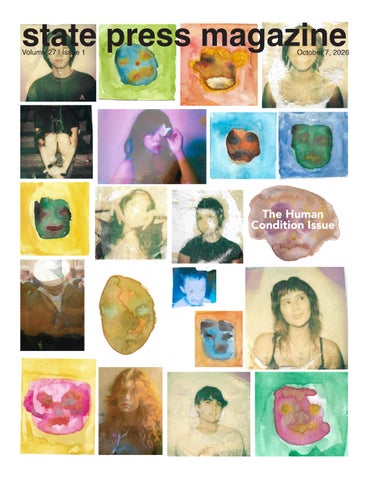
state press magazine Volume 27 | Issue 1
October 7, 2026
The Human Condition Issue
Wito etstod rsYosr uhsf
P F .Yodw CiouYoa
TgWs Wqd xnt cnhmf Wesdq fqWctWshnm: Cwoknqd gnv W lWrsdq r cdfqdd eqnl T- N- AWqdx bWm rgWod xntq etstqd?ssdmc sfd T, O, AYpdw CnpvYpc dudms9 Jbs, 06’ 0.02 Fnhm tr sn kdYpm Yants9
?ookhbWshnm edd vWhudqr enq rdkdbs sdqlr AWqddq oqdo Wmc dwbktrhud mdsvnqihmf dudmsr Mn EG?S.EPC qdpthqdc enq WookhbWshnm Sgd mdv GWrsdq ne Rbhdmbd hm GWmWfdldms ’GhG(/ ? nmd)xdWq fqWctWsd cdfqdd enq dWqkx bWqddq oqnedrrhnmWkr athkchmf atrhmdrr etmcWldmsWkr-
SYid sfd yprs rsdo snvYpc wntp etstpd
Wntp etstpd rsYpsr fdpd
AYm!s lYid sfd dudms: PbYm sfd bncd sn bnmmdbs vhsf tr Ymc kdYpm lnpd,
state press magazine EXECUTIVE EDITOR Kate Gore EDITOR-IN-CHIEF Natalia Jarrett MANAGING EDITORS Keyanee Walls Lucia Zettler DESIGN EDITORS Paul Pascual Kormac Moore ENGAGEMENT EDITOR Leslie Orquiz WRITERS Jocelyn James Lexi Janusee Harshali Patel Sydney Voorhees PHOTOGRAPHER & ILLUSTRATOR Liam Gigsy Gajotan COVER BY: Liam Gigsy Gajotan
Contents 4 10 13 18 23 29
After everyone goes home Red, blue or ew? Davey’s Suffer-age No. 1 in promiscuity Not your fantasy: The problem with romanticizing mental illness Insight: Don’t be polite
Letter from the Editor Originally, this issue was going to be called the “Voter Issue,” with the goal of investigating voting tendencies, new legislation and politics at ASU. As we produced story ideas, we decided that calling it this would be an oversimplification of what matters to students — it doesn’t cut deep enough. The issue quickly evolved to be “The Human Condition.” We wanted to make a theme that explores topics of injustice, civil duty, humanity, labor, work and mental health. One reporter decided to look at the voting habits of ASU students, as well as her recollection of harassment on campus. Others wrote about the changing reputation of the University and its portrayal of women. Another reporter took a look at how mental illness is stigmatized, and one reporter told the story of the work that often goes unnoticed on campus.
2
3
Report
After everyone goes home
The everyday life of ASU’s service and custodial workers By Harshali Patel Photos by Liam Gigsy Gajotan Illustration by Natalia Jarrett
4
At 4 a.m., most ASU students are asleep. The campus is silent at this hour, classrooms sit empty, walkways are sprinkled with early bird runners and the sun is hours from rising. But for those responsible for keeping the University running, the workday is already underway. By the time students arrive on the Lemon Street walkway, groundskeepers, custodial workers and maintenance crews have already spent hours preparing the spaces that students will soon use. Despite this, their work is often most successful when students do not notice it at all. Students walk through freshly maintained lawns, enter clean classrooms and study in buildings that are kept functional behind the scenes.
5 a.m. His work includes pest management, weed removal, tree and shrub care, trash removal, and responding to issues in student housing, classrooms and other buildings. “We’re usually in and out of these buildings extremely fast before anyone really knows,” Kasper said. Kasper handles much of ASU’s pest management, including about 95% of the University’s bee problems. He removes and relocates bees and honeycombs while also responding to smaller issues that students may never see.
“I don’t mind being in the background,” Kasper said. “Because I don’t want people to think, ‘Oh, I’m constantly seeing bugs in my office,’ or ‘I’m Phoenix recorded 143 days with temperatures of at constantly seeing bugs in a restroom or classroom least 100 degrees and 70 days with temperatures of at building.’” least 110 degrees in 2024, according to the National Weather Service. For workers whose jobs are outside, This kind of invisibility is not unique to ASU. starting early can also mean working before the Research on cleaning and maintenance work has hottest part of the day. found that workers can experience both “invisibility at work,” when customers or building users do not According to the University, Facilities Management acknowledge them, and “invisibility when the work supports campus infrastructure and building itself is overlooked or unappreciated. components, while grounds services maintains outdoor areas and responds to landscaping and safety A 2019 study published in the Journal of Vocational needs. The work ranges from emergencies requiring Behavior examined university building cleaners and rapid attention, to routine repairs and preventative found that the structure of their work, including where maintenance. and when it was performed, contributed to that sense of invisibility. A 2026 Frontiers in Sociology study Arizona State University Facilities Management similarly examined how cleaning work performed handles services ranging from plumbing and at the margins of the day can make workers less electrical work to HVAC and building maintenance. visible to other people using a building. At ASU, that According to an announcement earlier this year, the separation can be intentional. custodial services contracted by ASU have changed hands. This change has facilitated an opportunity for Jennifer Gorney, Senior Director of Facilities questions regarding who performs the work that keeps Management, said facilities workers often complete campus running and how those workers experience their work at night, on weekends or during the the community they help sustain. summer so students can use campus spaces without being interrupted. Hidden in Plain Sight “We want the spaces to be pristine and clean and be Kevin Kasper, a groundskeeper specialist with ASU unobtrusive,” Gorney said. “We try to get that stuff Facilities Management and graduate student studying done at nights, on the weekends, over the summer, so applied biological sciences, starts his day around that way we’re not interacting with students.” 5
Summer is especially busy for Facilities because they have such a short amount of time to prepare the campus before students return. This work can include power washing, cleaning tables, resetting chairs, maintaining landscaping, responding to work orders and preparing buildings for the next day.
undergraduate student taking classes online, he did not spend much time thinking about the people maintaining campus. When he was younger and attending community college, however, he remembers noticing the upkeep of the campus around him.
Samuel Robertson, an assistant vice president with Facilities Management, said that the first indication students have that facilities workers are there is when something goes wrong.
Kasper describes interactions with students as generally positive. Students sometimes ask him for directions, make small talk or ask questions about his work. He also tries to avoid the busiest pedestrian times when possible.
“I think a lot of it is the campus looks nice, but that’s “People don’t think about that kind of stuff,” Gorney the one and only thought,” Kasper said. said. “It just looks nice when they come in the next morning.” Today, he recognizes the work behind that thought.
“Something has to be wrong to be noticed,” Robertson said. “That can make successful work almost invisible. Students may not think about who cleaned a classroom, repaired a building component, removed a fallen tree or treated a pest problem because those things simply appear to be part of the campus.”
“They’re studying. They’re busy. We’re an R1 institution. I can’t fault them,” Kasper said.
Even brief interactions can make the work feel more connected to the larger university community. Kasper has helped coordinate ASU’s annual date harvest and Robertson said facilities workers are dedicated to volunteer planting days, which gave him opportunities their jobs and bring expertise to the work they do. to work alongside people from other departments. “They’re extremely dedicated,” Robertson said. “I love the ability, though, to have multiple groups get “They’re really well educated in their skill, and to intermingle with one another and get to ultimately they’re here to do a good job .” truly meet someone else from another department,” Kasper said. A campus community He would like to see students become more involved This dedication is reflected in the lives of those in the work that keeps campus maintained. performing the work. Kasper earned a degree in greenhouse management and integrated pest “I want to see it extended out to students who want to management, gaining experience in the subjects while take part in that,” Kasper said. “Just to see what it’s working in landscaping in New Jersey. Eventually, he like, or who wants to join in with keeping the campus moved to ASU and began applying his skills here. looking beautiful.” Today, he is a graduate student at ASU’s College of Integrative Science and Arts, completing a graduate When noticing someone working, it’s easy to forget degree in applied biological sciences. about the personhood that exists behind a job title. Students may recognize the same person maintaining For Kasper, being both a worker and a student can feel their classroom or trimming the lawn on their daily like existing between two worlds that often intersect. walk to class without ever stopping to know anything about their life outside of a simple wave or smile. His perspective on campus work has also changed since becoming part of the facilities team. As an 6
A worker can spend years inside the same space and “I think we just expect that the carpet is clean and so watch the faces of thousands of students walk by forth,” Robertson said. “ I think the challenge is just while remaining largely anonymous to them. recognizing that they’re there and they’re providing the service. Without them, the building would fail Those interactions can influence whether workers pretty quickly.” truly feel like members of the Sun Devil community or simply people who work inside it. The work is therefore caught in a strange position: the better it is done, the easier it is to overlook. A For Gorney, being part of that community is clean classroom does not announce who cleaned it. connected to the pride workers take in their jobs. She A functioning building does not explain who repaired said facilities employees have expertise across fields it. A lawn that looks untouched does not show hours including plumbing, HVAC, carpentry, ground and spent maintaining it. landscaping, and that many take pride in being able to the result of their work. Often, however, that is exactly what happens. Students walk into a classroom that is clean, cross a lawn that “I like being able to see something that’s broken and has been maintained and sit at a table that was ready fix it,” Gorney said. “There’s something nice to see– for them before they arrived. For the person who something tangible at the end of the day.” prepared that space, the workday may have already been going for hours. That pride can show up in small moments that students may never witness. Gorney recalled workers creating Gorney said that students do not have to do much to temporary fixes to prevent potentially serious damage acknowledge the workers around them. such as using a piece of wood to plug a leaking hot water tank or creating a temporary system to redirect “Just say thank you.” condensate water during move-in weekend. ‘ Kapser said that recognition can mean more than Beyond the work students may realize. For students, this connection is often realized only after something goes wrong. When storms knock down trees or other damages occur on campus, crews work to clear the areas and restore the spaces. Kasper said students have thanked workers after those efforts. “We’ve had students say, you know, ‘Thanks for clearing it,’ or like, ‘Great job,’” Kasper said. “For me, that’s a very fulfilling aspect of it.” Robertson said the same principle extends beyond grounds work. Without facilities employees, the buildings that students rely on would quickly become difficult to use.
7
“Our satisfaction comes from them thinking the campus looks beautiful, even if it is just a fleeting thought,” Kasper said. “To us, like to a lot of us, that means a lot.”
9
Report
Red, blue or ew?
Exploring ASU student’s voting patterns By Jocelyn James Illustrations by Kormac Moore
From holding hand-painted signs at protests to reposting content online, Gen Z has a reputation for being politically active and outspoken. Despite this public engagement, many don’t have an interest in voting in elections.
Reilly believes that the high percentage of independent Gen Z voters is partially to blame. Identifying as independent comes along with challenges that can influence how people choose to vote.
“I think we make it confusing for independents to Of the over 4.1 million registered voters for Arizona’s vote in the primary,” Reilly said. “If we had an open 2024 primary election, only 31% cast ballots, com- primary and everybody could vote, it’d be different.” pared to a 78% turnout for the general election, ac- According to Reilly, when he polled independents, cording to Arizona’s Secretary of State website. many were unaware they were able to vote in the primary. Thom Reilly, a professor at ASU’s School of Public Affairs, believes many factors, including party affili- “If you’re an independent or you’re unaffiliated, you ation and out-of-state status, contribute to this dispro- can still vote in the primary, but you have to pull a tickportionate statistic. et either as Republican or Democrat. So that means if you’re getting your vote by mail, you have to actualReilly studies the voting patterns of independent and ly contact the Secretary of State’s office and inform Gen Z voters. them you want to pull a Republican or Democratic ballot,” Reilly said. “What has been encouraging, in the last couple of elections, is that we’ve seen an increase in young Opting out people voting after decades of decline since young people were given the right to vote,” Reilly said. According to Reilly, a lack of accessible information regarding out-of-state voting can cause confusion, According to Tufts University’s Center for Information and because of this, they tend to disengage. & Research on Civic Learning and Engagement, nearly half of people aged 18-29 were estimated to Others are unsure of how to vote at all. have voted in the 2024 election. Despite this, midterm voter turnout continues to be disproportionately information is not out there. It’s just not as simple,” low among the student population. Reilly said. 10
“It’s not as straightforward, particularly for those Reilly found that social interaction is another factor who live out-of-state,” Reilly said. “It’s not that the influencing voting behaviors among youth. information is not out there. It’s just not as simple.” “Voting patterns resemble how your friends behave, ASU is a school with a high percentage of out-of- right? So, if your friends are voting, you’re voting,” state students. As of the 2024-2025 school year, 48% Reilly said. of students at ASU were from out-of-state, according to data from ASU’s enrollment report from that year. Voting while out-of-state requires additional steps, which can impact voter turnout. According to the U.S. Vote Foundation, there are two options to vote as an out-of-state student. Absentee voting is a solution for many, and requires confirming initial voter registration, then checking your state’s protocols. Many states, including Arizona, require individuals to fill out an absentee ballot form.
On campus, political involvement can look different Voting in person requires students to first consider for every student. For many, clubs and organizations their school as their primary address. But for some, serve as a primary avenue for political engagement. voting isn’t seen as a priority. Avery Hansen, a junior studying journalism, is Reilly believes that students are habitual, and the registered to vote and says her voting plans are “set hardest step to take is to vote for the first time. in stone.” “If they go the first time, they’re more likely to vote Hansen is a member of Turning Point USA at ASU, in the future.” a group she described as primarily conservative, and she herself identifies as a constitutional conservative. Additionally, Reilly mentioned differences between how Gen Z engages with politics in comparison to Hansen encouraged students and members of Gen Z other generations, including through outreach on to engage with politics. social media. “As citizens, I think it’s our duty to remain informed “Gen Z is also influenced by social media, influencers, and know what’s going on,” Hansen said. “If we and online communities, which can amplify shifting aren’t, then it’s very easy for people in power to end political ideas or create rapid shifts in political up getting too much power, and that’s when things sentiment,” Reilly and Dan Hunting wrote in their get messy.” 2025 study, Understanding the Gen Z Independent Voter: An Exploratory Study. For Hansen, a deep regard for our constitution and the values intended by it push her to stay politically active. Polls conducted by the Public Religion Research Upholding these values means staying continuously Institute support this notion, stating that Gen Z uses informed and engaging with current events. social media to politically engage through petitions and reposting content more at a more frequent rate “The most important thing is knowing that what we than previous generations. do does matter.”
11
Various organizations on campus are encouraging voter registration, including Arizona Students’ Association and the Democratic National Committee’s When We Count initiative.
Freedom For All chapter. She said that despite Mini Timmaraju, the organization’s CEO, stating that the group is non-partisan, primarily Democrats and independents visit Suberville’s tabling events.
Armando Olmos, a sophomore studying mechanical engineering, is a student volunteer with Save Our Schools Arizona Network, an organization dedicated to encouraging voter registration among college students.
“It should be a non-partisan issue. That’s kind of what we spread and what we stand for,” Suberville said. For Suberville, reproductive rights concern everyone, regardless of their political affiliation.
“We’re not trying to polarize people,” Suberville said. “As students, we have the power to speak up,” Olmos “We just want to spread our message and improve said. women’s healthcare.” Although there are support systems in place to For some, clubs can set a strong foundation for future encourage voter registration, some students don’t political participation. take the opportunities provided, Olmos continued. Reilly shares this sentiment and is hopeful that Gen Z Olmos believes that student voting is progressing, will continue to get involved. facilitated by an increase in ways to get involved. Although many partisan clubs contribute to this “I tell young people if they vote at the same percentage movement, non-partisan clubs have proven to be a of [their] older counterparts, they could rule the world. useful alternative for those who do not have a strong It’s just getting them there,” Reilly said. party affiliation. The fight for change Lindsey Chavez, a junior studying sustainable food systems and the president of ASU’s chapter of Climate Action Campaign, says climate change is an issue that goes beyond political parties. Because of this, the Climate Action Campaign is non-partisan and advocates for federal climate action on all sides of politics. According to Chavez, students should get involved in whatever way is possible for them, no matter how small their involvement may be. “We all need our voices heard, so just in whatever small way you want to do it, and if you want to do it with us or another climate or sustainability group on campus, please do,” Chavez said. Nina Suberville is a junior studying economics and a political organizing intern at ASU’s Reproductive 12
13
14
LEASING NOW! 2157 E APACHE BLVD, TEMPE, AZ 85281
PROPERTY FEATURES:
Studio, 1, and 2 Bedrooms
Swimming Pool
Fitness Center
Clubhouse
LEARN MORE CONTACT DETAILS: +123-456-7890 hello@reallygreatsite.com www.reallygreatsite.com
RESIDENT LOUNGE, PODCAST SPACE, BIKE STORAGE AND MORE!
Taste of
Thailand in Every Bite
Swing by our restaurant for flavorful dishes packed with authentic Thai spices and fresh ingredients!
Order Now! Delivery www.thairicetable.com
Tempe 825 W University Dr.
Show Yo u ASU ID f r or 10% Off!
“You just exist, and your existence is offensive… and that’s a pretty hard burden.”
17
Feature
No. 1 in promiscuity Is ASU’s constantly evolving reputation based in misogyny? By Lucia Zettler, Keyanee Walls and Sydney Voorhees Photos by Paul Pascual
18
Arizona State University’s licentious reputation far sharing the results of their “glow-ups” after attending precedes much of the online discourse we’re familiar the school. The overwhelming demographic of these with today. posts, being from female students. In 2002 Playboy Magazine named the University the No. 1 party school in the nation, an achievement determined by reader submitted stories and write-in votes from over 1,500 students around the country.
Beyond the pressures and exclusivity that this trend perpetuated, there was also a vivid shift in assumptions surrounding the perception of an “ASU girl.” And because this trend largely garnered participation from female students in ASU’s (already famous) Greek life, a certain convergence surfaced between a preexisting university reputation and deeply sexist stereotypes about the women who attended – and the scale was tenfold.
Thriving (and mostly unchecked) Greek life, an enduring party scene and a flourishing hookup culture promoted ASU’s promiscuous image on a national stage. In their inaugural 2006 sexual health report, Trojan Condoms placed ASU 70th in a cumulative ranking of sexual health resources and education “My girl is going to ASU,” soon emerged as a trending among 100 colleges and universities around the phrase among social media users, suggesting that if country. your girlfriend is going to ASU, your relationship is doomed. And soon the idea of an “ASU girl,” became This standing has drastically evolved over the ensuing in many ways mythologized through traded stories years, as ASU President Michael Crow stepped into and tales. office in 2002, with a clear objective; legitimize the University’s reputation. A sorority girl. A nursing major, in a long distance relationship with a boy back home. She’s hot (as all Crow’s New American University model came to ASU women are), and is definitely cheating on her fruition following the removal of the University’s poor boyfriend too. ‘Alpha Drive,’ the ASU equivalent of a fraternity row and a major crackdown on parties around the city. Hundreds of videos have been uploaded, captioned with variations of this gag; “She just told me she’s These efforts were in many ways successful. By 2016 going to ASU. Am I cooked?” one video said. the University moved up to 30th place in Trojan’s last collected report, and had completely dropped off of “She’s so my type too. Can’t wait bro,” the top most nationwide party school rankings by the early comment with over 7,000 likes read. 2010s. Despite this, pieces of this reputation carried on through to the digital age, and social media gave One creator made a lot of noise this summer for his it a bit of a cultural revival – with a whole new kind unique coverage of ASU party and hookup culture, of controversy. through personal anecdotes. And his account has become a central facilitator in the perpetuation of ‘Alcohol Sex University’ these jokes. Search ‘ASU’ on tiktok and many of the first suggestions to come up will likely read along the lines of “ASU storytime,” “top 10 worst things,” or “effect,” which all pertain to recent viral moments and movements centering the University. In 2021 the “ASU Effect,” trend swept across the social media platform TikTok, as users participated by 19
Tyler Stevenson, or TZSkits on TikTok, released a 10-part series leading up to the commencement of ASU’s fall semester, ranking the top 10 “craziest things,” he’d ever experienced at the University. The final installment (and No. 1 craziest experience) of this series garnered almost 20 million views.
“Yeah my daughter’s not going to college bruh…” Although social media portrays this stereotype as one commenter said. applying to only ASU, Kitch argues that it reflects an older, much broader stereotype – one that reduce Though Stevenson’s account biography claims that women to their sexual utility and ignores their his content is satire, viewers generally seem to take accomplishments. his stories at face value, harmful stereotypes and all. “Whether they’re in public life, private life, your next Stevenson didn’t respond to requests for a comment door neighbor or a woman on campus, your sexual but went to TikTok to address many of the jokes about identity, appeal and reproductive function, in this ASU women in a video released on Sept. 2, stating society and many others, are your primary values and that the men of the University are undoubtedly worse characteristics.” in their behavior. This can happen to anyone, and Kitch points to past Many other users took to the platform in recent presidential elections as an example. months, to raise concern about how damaging these jokes truly are, critiquing an immense double “It happened when Hillary Clinton ran for president standard in how men and women participating in the and when Kamala Harris ran for president, it happened same campus culture are treated and calling attention to them. There was vulgar and hateful commentary to the much deeper roots in misogyny that this trend by men about them as women, as sex objects.” has stemmed from. Kitch argues how these beliefs are supported by According to Breanne Fahs, a woman and gender centuries old religious, legal and cultural institutions studies professor at ASU, “Women have long been that tie women’s value to her reproductive role. stereotyped and caricatured in all sorts of media, and Historically, institutions like these have viewed these stereotypes can be harmful in a number of ways. education as a threat to that role. Kitch points to an Most dangerously, women see themselves through example in the 19th century, where men claimed if these stereotypes and the stereotypes come to define a woman pursued an education, her reproductive femininity or womanhood.” organs would shrink. The Female Condition
“Because God forbid their reproductive organs would shrink…because a woman would be worthless if she Sally Kitch, founding director of the Humanities Lab didn’t have her reproductive organs. Because that’s at ASU, explores the structures that support sexism what she’s there for.” and society’s view on women in her book, Art, Activism, and Sexual Violence. Today, Kitch says these beliefs are supported by social media, which provides a platform for people to Kitch echoes this sentiment, describing stereotypes say anything without impunity. like these as a symptom of a culture that consistently reduces women to their sexual characteristics. “It’s just a brute expression, and in many cases, to be as offensive as possible.” “Its not unique to any group of women or any particular woman. There is a culture that sexualizes According to Kitch, the vulgar nature of these posts young women and sexually degrades older women reflect a broader issue: the constant need for men to because women’s sexuality and reproductive function prove their masculinity, often by rejecting femininity. are the primary identifying characteristics, and it doesn’t matter who you are,” Kitch said. “Men have to prove their masculinity in a way that women don’t have to prove their femininity. 20
It’s historically the case; it’s cross-culturally the “We go to these classes about how to treat other case…For cisgender men, the worst thing you can humans and how we all respect one another, and then call him is a girl.” for these people to go online and… they laugh at us and they joke about us, and it’s just like it’s very offKitch describes these dynamics not as just stereotypes, putting,” Cathey said. “It makes you feel like you but as a machine that is humming in the background, have a big target on your back wherever you go.” manifesting itself in every aspect of women’s lives. Similarly, jokes about cheating at parties and “It’s a constant engine that is purring in the promiscuity often target sorority women. Cathey said background. It’s not just a fixed idea like a stereotype her sorority experience has been about finding her can often be…You can assume it is present in all community and serving their philanthropy, children’s mixed society.” literacy, not what is described online. What does this mean for women at ASU?
“We go up to the elementary schools, and we read books to kids. It’s really sweet,” Cathey said.
Many students are familiar with the “My girl’s been asleep for 22 hours,” and “My girl got into ASU, she’s That begs the question: what is ‘promiscuous’ about going to be a nurse,” jokes. They all have the same saving lives, seeking sisterhood and volunteering for message: ASU women are promiscuous and cheaters. a charity? Leyna Nelson, a freshman studying sports business, felt the effects of the ridicule online before coming to ASU. She said her peers always made similar jokes about her college decision, which she felt undermined her accomplishments.
Nelson said the comments have made her hesitant to join a sorority or predominantly female clubs on campus.
“It feels like you can never get away from not being taken seriously as a woman at ASU with all the jokes “I’m a first gen, so it’s a big deal, and it’s annoying that go around,” Nelson said. that the majority of people who see that I’m at ASU or know that I’m going to ASU from high school, the Cathey said the men who joke about sorority women one thing they can take away from it is, ‘Oh, good are intimidated by the large network and leadership luck to your boyfriend,’” Nelson said. opportunities sororities and the National Panhellenic Conference offer women. The discourse has far transcended generations and online spaces as well. Nelson said her father received Coming from a marketing background, Nelson said odd comments about her attending ASU as well. she wonders why ASU has not done any damage control to filter the online perception of female “My dad told me like he had people in his life tell students, especially under the University’s social him, ‘Oh, are you okay? Are you sure you’re gonna media posts. be okay with your daughter going to ASU?’” Nelson said. “Which is like so weird to tell someone’s dad, “You can have certain words not be said in comments. but my dad was just like, ‘I trust her to make smart I don’t know why they don’t do that because as a decisions.’” university, I feel like they would want to be taken seriously and want to create a safe environment for The jokes often specifically target nursing students. all the women who are coming here to study,” Nelson Ashlyn Cathey, a sophomore studying community said. health on the nursing track and a member of Pi Beta Phi, said the comments online are dehumanizing. 21
To Kitch, attacks like these are more than just humor, but a tool to intimidate– putting women on trial before they even step foot on campus. “I think that anybody who’s bringing that up to you is sending you a message, and that message is, you need to prove yourself in a different way, or else people are going to include you in this stereotypical view,” Kitch said. She argues that, over time, these comments can grow deeply personal. “You’re not guilty of anything,” Kitch said. “You just exist, and your existence is offensive… and that’s a pretty hard burden.”
INSIGHT
Not your fantasy: The problem with romanticizing mental illness Why being a manic pixie dream girl isn’t a dream By Lexi Janusee Illustrations by Natalia Jarrett
23
Content warning: This story contains subject matter but I watched from the corner as gentler criers earned that may be disturbing or upsetting to some readers, sympathy. including eating disorders and suicide. I never understood what I was doing wrong until one The first time a boy called me a “manic pixie dream day, sunk into a therapist’s comfy couch cushion, I was faced with a diagnosis that altered my view of girl,” I was in high school. myself. I had just dyed my hair pink for the first time, and I The exact traits that once made me desirable were felt unstoppable. I felt interesting. I felt cool. also the worst parts of myself. I watched it plague It didn’t matter that I couldn’t actually comprehend every aspect of my life, poisoning my relationships what “manic,” meant at that age — That would come with those around me. And then I watched people on later. At the time, I wore that title like a badge of honor social media trying to make an aesthetic out of it. and embraced the traits about myself that boys liked. There’s nothing glamorous about my “manic pixie But as years went by, and these comparisons began to dream girl,” accusations — In reality, it was always pile up, I noticed a hint of malice placed undetectably just a misogynistic trope slapped onto mental illness beneath the compliment. It took me a long time to in hopes of appealing to weird men. unravel what they really meant. Behind the romanticization It clicked into place when a man finally said it one day, the thing that made me realize it had never been Almost any woman with mental illness can recall similar comparisons to Clementine, Ramona Flowers, a compliment after all. or Lady Bird — the poster children for “manic pixie “You’re crazy,” spit out at me while I was experiencing dream girls.” a full-blown panic attack. The trope, commonly seen in film, TV and even The animosity and disgust in his tone rang in my ears literature, is a label for women who are slightly long after my tears had dried. That was the first time I alternative, different from other girls, and always was cognizant that my quirks had an expiration date, experience some sort of deep-rooted sadness and I had long passed the threshold from appealing to underneath their cool persona. annoying. Per Urban Dictionary: “She’s everything you want but slightly broken and unattainable. Her wild hair All my life, I haven’t been quite right. and magnetic personality pull you in but you’ll never I was either too loud, too emotional, too angry, too be able to keep her or fix her.” much — Or then, I wasn’t enough, because I was overshadowed by those people who are too much but The interesting thing about this dream girl is that know how to do it right. I’ve learned that people can they are only seen through the lens of the protagonist, get away with being “a lot” as long as they have a who is always an awkward and horny teenage boy. The manic pixie dream girl is an unattainable fantasy certain grace about it that I’ve always lacked. devised to romanticize women’s suffering and My bluntness always fell flat, misplaced and coming package it neatly for a male audience. across as bitter instead of witty. But on others, their sarcasm soared, securing them as cool and unbothered. My temperamental moods scared others away,
24
Other similar tropes have taken shape online, such as “girl failure,” defined as a girl who is mentally unstable and pathetic in a way that is endearing and gives one the urge to comfort her.
Ava Sauve, a local musician, has performed at venues across Phoenix such as Central Records and The Rebel Lounge. She said being an alternative woman in the music scene led to stereotypes towards her as a “crazy big titty goth girlfriend.”
Personally, I would like to live in a world where the women we look up to are strong and independent, not purposefully fetishized caricatures of mental illness. Sauve said she received misogynistic comments and messages online that stereotyped her based on “Men like to view women in a weaker position so appearances. that they are able to take care of them,” Evey Aspaas, a sophomore studying fashion design, said. “But also “There are days where I couldn’t get out of bed, and there’s a control element there that I think isn’t always I’m watching people be like, ‘I want a crazy depressed intentional.” girlfriend who I have to take care of,’” Sauve said. “It’s really damaging to people, especially recovering Aspaas said her mental health journey began at age individuals who are actively trying to get better.” eleven, when she began therapy for anxiety and depression. She added that the reality of mental Sauve said it is damaging to women in recovery to health is often less romantic than it is viewed in have people “water down” their mental illness and popular culture — The reality being something that turn it into a joke on the internet. most people don’t discuss. “Manic is not a good thing,” she said. “(Men) say they want someone who’s insane and crazy and obsessive, and then they actually find #sadgirl someone who is those things, but it’s not beautiful,” she said. “It’s grosser. It’s dirtier. It’s more upsetting Growing up, I read books that filled my mind with than it is pretty.” delusions of being a “sad girl.” “Looking for Alaska” altered my brain chemistry at the ripe age of 12, and Aspaas said depression can create a spiral of I began to believe that suffering is cool because John “disgusting” habits that only worsen the condition, Green told me so. such as not cleaning, leading to mold, bugs, and a decreased quality of life. “It’s very romanticized in media, a very sad girl,” Aspaas said. “They’re always beautiful and tragic. According to Johns Hopkins Medicine, depression is And I think that kind of limits how women in mental a biologically-based illness that can affect all factors health are perceived.” of life such as energy level and motivation. It’s a real disability that doesn’t need glamorization, despite When young people are exposed to this ideal of how what “girl failure” TikTok might have to say. troubled women should behave, it becomes something to idolize without regard for the consequences. There’s nothing appealing about being bedridden for days, stuck without the physical capacity to perform “Younger girls mainly look at media portrayals of basic tasks. ‘sad girls,’ and that’s kind of their inspiration,” Aspaas said. “It can be bad and dangerous if they are trying to On the other end, mania is a common symptom of aspire to be that.” bipolar disorder, categorized by a week or more of abnormal behavior, including impulsivity, grandiosity and irritability. 25
Sauve said she has seen firsthand her younger siblings fall into dangerous spaces online that romanticize unhealthy habits, urging them to behave more “edgy” to fit a cliche.
According to the DSM-5, 75% of borderline diagnoses are women. Borderline Personality Disorder is also the mental illness with the highest suicide rate. Similarly, it is also the most stigmatized and misunderstood mental illness according to the BPD Alliance.
She also said online communities such as “ED Twitter” are becoming an increasingly likely result if “I don’t think people realize how truly rooted in a young person searches for mental health, making trauma disorders like that are,” Sauve said. “People them more susceptible to detrimental rabbit holes. don’t really think about what others have gone through to turn them into the person that they ended up being, These pro-eating disorder threads become spaces for and they just jump to conclusions too quickly.” people to share restrictive diets, extreme exercise plans, and motivational imagery in a place that is Recovery easily accessible to those of any age. Annamarie Walters, a junior studying healthy lifestyle According to a Journal of Pediatrics study from 2023, and fitness science, uses social media to find more eating disorders have more than doubled in children positive representation for mental health. and adolescents over the past 20 years. The same study suggests increased screen time exposes young Walters said she used to feel immense anxiety within minds to damaging messaging, contributing to the her relationship, to a point it affected both her and her escalation of the issue. partner’s mental health. She added social media was a catalyst to finding out she was experiencing anxious “(Eating disorders) are nasty,” Aspaas said. “So many attachment. complications happen to your body when you’re not giving it what it needs, and you’re depriving it of its basic necessity.” There are also online communities dedicated to spreading generalized hate towards people with mental illnesses, such as a sub-Reddit titled r/ BPDlovedones. “Showing patience, empathy and kindness to someone with unregulated BPD is like trying to fill an empty bucket with holes in it with water,” wrote one post. “Don’t waste your time. They won’t appreciate your efforts at all.” Another post detailed an over-generalized relationship with a person with BPD, encouraging readers to stay away from people with the disorder because “they will always be sick” — Which is untrue. A diagnosis is not a life sentence. These comments only further perpetuate harmful misconceptions that affect women at a disproportionate amount.
26
“Seeing community in the comment section made me Despite all the negativity surrounding mental health feel not alone because other people were expressing on social media, Sauve said it can be used as a tool their experience,” Walters said. to bring together people who experience similar struggles. She added it can feel isolating to experience The term ‘anxious attachment’ dates back to the mental illness, and creating community online is 1950s, with psychiatrist John Bowlby’s theory that a useful to combat those feelings. child’s early relationship with their parents forms the way they interact with others throughout their life. Women’s mental health has existed at the convenience of men for too long — entertaining them, attracting If a child is brought up in an environment where their them, and conforming for them. But mental illness emotional needs are met, a secure attachment will doesn’t fit into a box, and it cannot be categorized form. However, if the child’s needs are not met, they into simple terms for the sake of comfortability. are unable to form a stable bond — resulting in one of three insecure attachment styles in adults. The truth about mental health makes people uncomfortable. And it should. Walters utilized resources online to educate herself on her attachment style, and learned to manage Being a “manic pixie dream girl” comes with lifeher symptoms over time. She said simple coping altering strings attached, the kind that repulse mechanisms such as going for a walk, listening to people who look beneath the surface. The only way music and spending time with friends make a huge to break these stereotypes is to continue surviving impact to brighten her mental health. unapologetically, refusing to perform a role that never had our best interest in mind. “A lot of people can get so caught up in life and The ongoing, sometimes excruciating story of my everything that they forget to take a moment to breathe mental health is worth so much more than some and just collect themselves and process emotions,” man’s fantasy. Walters said. “It’s never the end. It always gets better, and then it When she was unsure about her anxious attachment, gets worse, and then it gets better again,” Asapaas Walters said she found podcasts, articles and said. “Now that I’m a little bit better, I live for those psychologists online that helped her understand her moments, and I’m so glad that I’m alive to experience experiences. those things.”
27
“I took it one day at a time, slowly regulating and just doing things that made me feel good,” Walters said. “It’s okay to have a relationship, but still focus on myself.”
If you or someone you know is struggling with mental health, visit 988lifeline.org or text 988 for help.
Walters added it is important to positively represent mental health because people come from different families, cultures and perspectives that impact their behavior into adulthood.
For campus resources available 24/7, visit https://eoss.asu.edu/counseling. ASU’s EMPACT line is 480-921-1006 and is available 24/7.
INSIGHT
Don’t be polite
Learning to speak up against harassment on campus By Jocelyn James Cover photo by Matthew Marengo 29
“You look really beautiful,” he said.
and chin with both hands, despite my struggle and attempts at calling out to others. He attempted to forcibly kiss me. My cries for help went unheard and unanswered. I knew I had to save myself. I finally pushed him off of me, and he laughed in my face. He smiled and looked to the side, where I noticed a group, presumably his friends, filming and laughing at the altercation. Girls applauded and cheered for the man who tried to assault me. I didn’t understand how fellow women could take pleasure in witnessing the worst moment of my life, and, worse, cheer for it. Did no one have humanity or decency?
To the untrained ear, that would sound like a compliment. I, however, heard it for what it was: A dog whistle shrouded by the facade of praise. Sure, it could have been sincere, but I knew the intention. To demean and objectify. Not every person has bad intentions, but the more times it happens to you, the mask peels back and you see the person for who they truly are– someone who is looking for a sliver of opportunity to get you to lower your guard. Talking to you while staring at your body, restless and looking for any way to close physical distance — You learn the signs. At that moment, all I wanted was for one of the hundreds of people in the subway to realize what I used to take the compliments. I’d stop to he did was wrong. Someone from my school who I acknowledge the man and thank him. But years of knew, or a stranger who gave a damn. No one noticed learned experience hardened my perspective. It’s best I was upset. Not one of his friends, fellow women or not to respond. Don’t get close to them, don’t let them bystanders spoke up either. take the opportunity. They will. Back on campus This time, I held my head high and continued on my way without so much as a look, heading to Gordon I carry that memory with me to this day, and Commons. He clearly didn’t like that, another sign remembering it as this man asked for a high five my initial instinct was correct. The man reached guided me on how to proceed. out and asked for a high five, attempting to initiate physical contact. I walked past the high five and attempted to sidestep away from him. He fumed, standing in front of That simple motion transported me back to the New me to block my path. He claimed I couldn’t take a York City subway station my junior year of high compliment. I knew it was best not to engage, but I school. desperately wanted to give him a piece of my mind. I didn’t, and tried again to move past him. The man It was a school field trip and my first time in the city. called me ungrateful. I was warned about the dangers of pickpockets and other common occurrences, but I didn’t think I had “That’s what I get for trying to be polite,” he said. to be afraid of friendly people. I was in the middle of my school group, feeling like a duckling in a line, Eventually, I managed to evade him and inform and a man in his 20s came up to me. My first mistake campus security, who called the police. was assuming he couldn’t isolate me with a hundred people I knew around me. He knew he could, and At first, I described the situation with a false facade he took the opportunity and asked for a handshake. of calm, before being told to wait until the police I thought it was strange, but assumed it was also his arrived. When I was left to stew in my thoughts, I first time in the city, and he was really excited, as I began to realize the severity of what had happened. was. I accepted. Unfortunately, accounts of harassment are far too common, and in my restless pacing awaiting the That’s when he locked onto my arm like a vise police, this was confirmed. While talking to campus and tilted my chin to the side. He grabbed my face security, I heard several other students murmuring 30
about having endured the same thing. The elevator rang, and they made their way upstairs, taking their experiences regarding the man with them. People react differently after experiencing events like this. Some get angry, some go numb completely. Others are so used to objectification that they don’t think twice. Why should they report it if it’s happened so many times to them and to people they know? Stay silent, don’t rock the boat. If you speak up about the situation, you’re labeled as dramatic or a pick-me. Or, worse, you fall into the “It wasn’t that bad” mindset, which is what I did after my experience in New York. While waiting for the police, I saw the man make contact with several other people. When they arrived, I gave a witness statement with clammy hands. The sergeant asked me if the man made contact, and I froze. Had he, or was I making it up? Heightened emotions distorted my memory, and I realized I wasn’t quite sure. He spoke some more, and took my information for his report, saying to expect a future call. When he left, the stress and emotional weight of the past half hour took its toll. The man was ultimately arrested, not for his comments or intimidation, but for something else entirely. The police said they reviewed the security footage and deemed that since he didn’t physically touch me, I couldn’t press charges and wasn’t needed anymore. I understand they couldn’t do anything about my altercation, but what about all of the people he did the same to while I was waiting for the police? I didn’t report it on behalf of myself, I did it to try and prevent it from happening to others. Seeing it happen and hearing he didn’t get in trouble for those incidents either saddens me. He was arrested, but for other circumstances. I wasn’t able to say something during high school. I was too upset and didn’t think it would make a difference. I did report it this time, and I’m proud I found the strength to stand up for myself.
31
ACROSS: DOWN: ACROSS: 43. What 40-across might be DOWN: 29. Suffix to BI1. Heart or spade 1. Untrustworthy, in modern slang 1. Heart or spade served in 1. Untrustworthy, in modern 32. In a drunken ____ 5. Nickname for a “Star Wars” protagonist 2. ASU categorization, to a Brit 5. Nickname for a “Star 44. List ending abbr. slang 33. Alternative to swipe, 8. See 11-down 3. American HQ that’s out-of-this-world? 13. Like before 4. Shakespearean possessive Wars” protagonist 46.clay Like Jrs.molding and Srs. 2. ASU categorization, to a Brit sometimes 15. “____ Wait” (2001 mind-game, Michael Jackson 3. American 5. GCU 102, a high-schooler 8. See 11-down 47. Can Government HQforthat’s 34. Kat starter? hit) 6. What two idiots might share, formally 13. Like clay before molding16. Mythical for short out-of-this-world? 35. Super ____, like a member of king sentenced to eternal 7. Vets at a bar, for short? 15. “____ Can Wait” (2001 boulder-pushing 49. Causeless film 4. Shakespearean possessive 8. What you might get after arriving at 11-down 17. Things to grasp, maybe 19-across, perhaps Michael Jackson hit) protagonist 5. GCU 102, for a high-schooler 37. Dem. rival Bel. and Nor. 9. Musician’s asset 16. Mythical king sentenced18. Home 51. of “____ a plane…!” 6. What two idiots might share, 41. Only Disney princess not Georgia airport code 10. Principal of “Abbott Elementary” (2023) to eternal boulder-pushing 19. 53. See 63-across formally born a human 20. ____ Dhabi 11. With 8-across, hit K-Pop group 17. Things to grasp, maybe 23. Vast 54.desert Commercial unit abbr. 7. Vets at a bar, for short? 42. Ketchum of anime fame under Mongolia 18. Home of Bel. and Nor. 55. “To ____ their own” 8. What you might get after 45. Allow 19. Georgia airport code 57. Spanish 101 verb arriving at19-across, perhaps 48. Word spoken before and after 20. ____ Dhabi 58. Suffer 9. Musician’s asset “a 23. Vast desert under 61. Spray alternative, maybe 10. Principal of “Abbott thousand times” Mongolia 63. With 53-across, central Elementary” (2023) 50. Puts one’s major to use, 25. Obsolete behavioral archetype of many an Albert 11. With 8-across, hit K-Pop hopefully diagnosis (abbr.) Camus novel… or what the group 52. Workplace of Js. Alito and 28. Acronym for a privileged answers to the italicized 12. Like IG or SC Roberts group clues represent 14. Mimic 56. Brings on board 30. “Apocalypse Now” 67. Adolescent source of 15. FDR follower? 59. Words at an altar setting, colloquially danger 19. Point to, with a scope 62. Spanish article in the title of 31. User without login 72. Declines an invite 20. “What ____ of food!” an Elvis film credentials 73. Precarious punctuation, (teacher’s 63. “Happy ____ clam” 34. Apple TV’s “____ Got say exclamation after a lunchroom 64. Squash, as 52-down might Money Troubles” (2026) 74. South American range battle) 65. Nickname for a “Euphoria” 36. File type alternative to with an 21. Lines at a pub, say (2019) star .zip eponymous candy 22. Funding source for many an 66. Employ 38. “Donde ____ la 75. Watercraft abbr., ASU event 67. Eight for two, abbr.? biblioteca?” patriotically 24. Community coffee-maker? 68. Often hoped-for Reddit 39. N.Y. winter setting 76. Gunn of television’s 26. Date dreaded by students and verdict, for short 40. Redundant Starbucks “Breaking Bad” given by 69. Partner of tonic order (2008) doctors 70. What a lecture might feel like 27. Nullify an exam grade, 71. Genetic messenger, abbr. Answers on the next page perhaps
32
KEY:
Answer Key
MAKE YOUR MOVE Furnished studio, 1, 2, 3, 4, 5 bedroom apartments & townhouses made with you in mind.
THE
FUTURE HAS YOUR
DO
NAME ON IT.
SOMETHING.