T H U R S DAY, O CTO B ER 29, 2026 STAT EN EWS.CO M
Michigan State’s Independent Voice
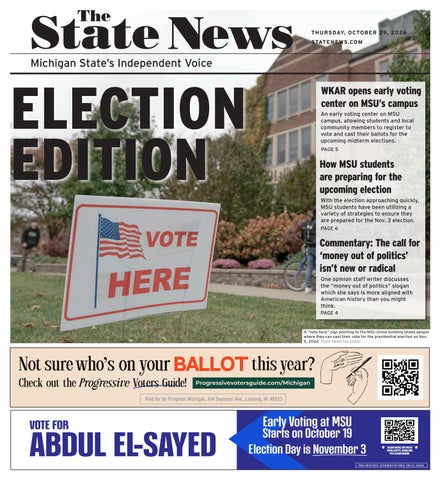
ELECTION EDITION
WKAR opens early voting center on MSU’s campus An early voting center on MSU campus, allowing students and local community members to register to vote and cast their ballots for the upcoming midterm elections. PAGE 5
How MSU students are preparing for the upcoming election With the election approaching quickly, MSU students have been utilizing a variety of strategies to ensure they are prepared for the Nov. 3 election. PAGE 6
Commentary: The call for ‘money out of politics’ isn’t new or radical One opinion staff writer discusses the “money out of politics” slogan which she says is more aligned with American history than you might think. PAGE 4
A “vote here” sign pointing to the MSU Union building shows people where they can cast their vote for the presidential election on Nov. 5, 2024. State News file photo.
BALLOT Check out the Progressive Voters Guide!
Progressivevotersguide.com/Michigan
Paid for by Progress Michigan, 614 Seymour Ave., Lansing, MI 48933
VOTE FOR
ABDUL EL-SAYED
Early Voting at MSU
Starts on October 19 Election Day is November 3
SCAN HERE OR VISIT IWILLVOTE.COM/MI TO LEARN MORE
PAID FOR BY DSCC. AUTHORIZED BY ABDUL FOR U.S. SENATE.
BANK ON THE
RED CEDAR MSU STUDENT OFFER!
Get Started With $50 On Us! From your first day on campus to your last late-night study session, MSUFCU is here to help you make the most of your college experience — and your money.
HERE’S HOW TO GET STARTED 1
2
3
Open a checking account with MSUFCU.
Use your Visa Debit Card 10 times within 30 days.
Get $50 on us! Your bonus will be deposited into your Spartan Saver account.
More Than a Place to Bank We’re here for your college years and whatever comes next. As a trusted financial partner for generations of Spartans, MSUFCU offers banking, financial resources, and exclusive Spartan perks designed to help you succeed in college and beyond.
Current Michigan State University (MSU) students who are enrolled in the 2026–2027 academic year and open a Michigan State University Federal Credit Union (MSUFCU) checking account with a Visa Debit Card between 6/1/26 and 10/31/26 and complete at least 10 qualifying debit card purchase transactions within 30 days of account opening will receive a $50 bonus deposited into their Spartan Saver account. Not valid for members with current or previously closed checking accounts. This offer cannot be combined with other checking account offers. Qualifying purchase transactions include point-of-sale purchases using a physical debit card or a digital wallet linked to the debit card. ATM transactions, transfers, refunds, credits and person-to-person (P2P) payments are not eligible. Transactions must post to the account within 30 days of account opening to qualify. The $50 bonus will be deposited into the member’s Spartan Saver account within 4 weeks after the qualifying 10th debit card purchase transaction is completed. Bonus may be taxable and reported on an IRS Form 1099-INT or 1099-MISC. Federally insured by NCUA.
2
T H E STAT E N EWS
THU R SDAY, O CTOBE R 29, 2026
Bank on the Red Cedar
visit msufcu.org/students
THURSDAY, OCTOBER 29, 2026 Vol. 117 | No. 7
EDITORIAL TEAM
CONTACT THE STATE NEWS
EDITOR-IN-CHIEF Lily Cole
(517) 295-1680 NEWSROOM/CORRECTIONS (517) 295-5149 feedback@statenews.com
EDITORS Julia Bugar Isabella Cucchetti Lucas Gentilia Ria Gupta Katelyn Holsten Melody Meyer Cooper Schwartz Anna Williams
GENERAL MANAGER Christopher Richert ADVERTISING M-F, 9 a.m. to 5 p.m. The State News is published by the students of Michigan State University every other Tuesday during the academic year. News is updated seven days a week at statenews.com. State News Inc. is a private, nonprofit corporation. Its current 990 tax form is available for review upon request at 435 E. Grand River Ave. during business hours.
MULTIMEDIA Ever Pratt-Hart REPORTERS Erin Broecker Tye Piotruchowski Akia Thrower
One copy of this newspaper is available free of charge to any member of the MSU community. Additional copies available at The State News office for a fee.
DESIGN Ella Yip Lila Tuell Kaci Freeman Rowan Brennan
Copyright © 2026 State News Inc., East Lansing, Michigan
X A member of Michigan State’s varsity rowing team docks after practice on the Grand River in Lansing, Mich., Thursday, Oct. 22, 2026. Photo by Ever Pratt-Hart.
FE E DBACK@STAT E N EWS.COM
TH UR S DAY, O CTO B ER 29, 2026
STATEN EWS.CO M
3
OPINION
COMMENTARY: THE CALL FOR ‘MONEY OUT OF POLITICS’ ISN’T NEW OR RADICAL By Erin Broecker ebroecker@statenews.com Abdul El-Sayed, the democratic candidate for Michigan senator, has been cast by conservative media as a political radical. However, his “money out of politics” slogan and subsequent anti-lobbying approach is more aligned with American history than you might think. El-Sayed’s senatorial campaign found a foothold in youth audiences on college campuses including MSU. Younger voters may not fully realize that many of his campaign messages weren’t borne from sudden and revolutionary cries for political transparency in the 2020s. Politicians in the 21st century are not the first candidates to run on these kinds of “money out of politics” messages, and they are most certainly not the first advocates to point the finger at bigdonor lobbying and call it corruption.
WHAT IS LOBBYING? The legal definition of lobbying varies by state. In Michigan, lobbying includes any kind of direct communication with a member of the legislative or executive government for the purpose of “influencing legislative or administrative action.” To summarize the practice plainly, lobbying through financial transactions creates or affirms an unofficial contract to legislate according to that group’s interest. Corporations aren’t allowed to directly contribute to a candidate or campaign, but they can donate to PACs and dark money groups who use those dollars to fund politicians’ advertisements. These organizations aren’t required to disclose their finances. It’s a slippery slope into undue influence. In the better scenarios, candidates choose their platform on principles and find lobbying action groups who align with those ideas to support said campaign. In the worst cases, politicians appeal to whoever has the most money, and function as employees of these corporations rather than public servants. Money is inextricable from politics — campaign headquarters need to keep their lights 4
T H E STAT E N EWS
Photo illustration by Kaci Freeman
on after all — but there comes a point where large sums with obscured destinations allude to nefarious intentions. Attempts to control corporate interference in politics have been made for over a century, but contemporary court decisions have created loopholes.
THE HISTORY America’s first witness to corporate power arose from the industrial revolution. Large companies amassing larger profits than ever wanted public policy to keep things that way. There’s a fitting time-old adage: Spend money to make money. The word lobbyist did not appear in print in the U.S. until 1830; clearly, it’s not just a buzzword used by politicians today. The first legal acts against lobbying were meager, but passionate in severity. The Georgia state Constitution, from 1877 until 1916, made lobbying in its entirety illegal, though no other states followed suit. In 1901, Sen. William E. Chandler introduced a contribution inhibiting measure that would affect all federal, state and local campaigns, but it did not receive support. The US regulated campaign contributions for the first time in 1907 with the Tillman Act, encouraged by Theodore Roosevelt (in response to his own scandal) and sponsored by populist Senator Benjamin R. Tillman. The Populist Party, founded by agrarian workers, was a short lived but legitimate third party in American politics centered on working class solidarity, echoing a “power to the people” sentiment in response to frustrations with Democrats and Republicans.
THU R SDAY, O CTO BE R 29, 2026
Sound familiar? Later in the 20th century, legislative attempts to regulate lobbying rose and fell at the hands of the very same people — elected legislators. One of these was the Federal Regulation of Lobbying Act of 1946 which, for decades, was found to be ineffective. In 1971, the Federal Election Campaign Act called for limitations and disclosure on campaign donations and spending. “Money out of politics” became a hot topic again in light of the Watergate scandal, prompting new amendments to FECA with stringent limitations, but those were challenged in court as overstepping public office members’ free speech and due process rights. In response, the Supreme Court decided in 1976 in Buckley v. Valeo to keep FECA’s donation limits and a semblance of transparency to the public, but ultimately, political contributions are protected as speech. Donations can be documented to hell and back, but at the end of the day, a corporation still has virtually the same first amendment rights as a person. Today, lobbying is controlled supremely by the decision made in Citizens United v. FEC in 2010, which overturned restrictions on electioneering communications. It allows corporations, to this day, to pay for political advertisements, commandeering a new era of PAC-backed commercials and ad campaigns without partisan disclosure. El-Sayed has spoken publicly about his disdain for the decision’s precedent, and he
is hardly the first. Since its inception, there has been bipartisan support for overturning Citizens United. However, it’s still worth noting: Anyone on the political spectrum can benefit from unrecorded, undisclosed money, using it to put their opponents in a bad light on their constituents’ television screens.
THE PROPOSAL Today, more “money out of politics” laws are being proposed at the state level, including Michigan with Proposal 2, which will be on the ballot this November. The initiative would prohibit companies with embedded political interest to make “direct or indirect campaign contributions to candidates” for several state and local offices. But more importantly, Proposal 2 would expand donor information disclosure to political communications, like advertisements. Critics say the proposal would not eliminate dark money entirely, but organizers maintain it would bring forth improvements. The proposal’s opposition brings forth a familiar argument that the regulations would infringe on the first amendment rights of “certain industries and companies” and, if passed, there will be judicial challenges. It is evident that historically, many American citizens have seen corporate involvement in politics as a danger to democracy. While today’s political climate calls more attention to the issue, it is far from new.
NEWS
WKAR OPENS EARLY VOTING CENTER ON MSU’S CAMPUS By Akia Thrower athrower@statenews.com An early voting center on Michigan State University’s campus opened on Monday for students and East Lansing community members to register and cast their votes for the upcoming midterm elections. The center, hosted within WKAR at the Communication Arts and Sciences building, is a centralized location for students and the local community to get information, complete voter registration and cast their ballots. The center is open daily from 10 a.m. to 6 p.m. through Sunday, Nov. 1. On Monday, Nov. 2, the center will be open from 9 a.m. to 4 p.m. On Election Day, Nov. 3, the center will be open from 7 a.m. to 8 p.m. WKAR Public Media general manager Shawn Turner said that the station has spent several months ensuring the local community was
informed and had access to the information ahead of the upcoming election. Opening the early voting center was an extension of this work. “We believe that for every person who is eligible to vote, voting should be easy,” Turner said. MSUvote co-director Suchitra Webster, who is also MSU’s director of Community and Student Relations, said the early voting center was established during the 2024 presidential election after community members advocated for an on-campus early voting space for students. That election saw 4,000 people visit the early voting center to cast their ballots, Webster said, and “we would anticipate a large turnout again this year.” The early voting center allows students access to information about the voting process ahead of Election Day, when students often feel
A member of the media walks into WKAR prior to the early voting location opening inside the Communication Arts and Sciences building in East Lansing, Mich., on Monday, Oct. 19, 2026. Photo by Cooper Schwartz.
overwhelmed or pressured. “This center is a great way to get to the polls early, get the process taken care of, and I think it will generate a lot of enthusiasm,” Webster said. East Lansing City Clerk Emily Gordon said a clerk’s office is located within the facility to complete voter registration ahead of voting. “We’re a one-stop shop here, where you can register to vote and you can actually cast your vote,” Gordon said.
FE E DBACK@STAT E N EWS.COM
East Lansing has two early voting centers for all residents: one at WKAR Studios and one at Hannah Community Center. Turner emphasized the importance of voting and access to information during the voting process. “The most important thing is that people have the opportunity to become educated and to know that coming in to vote, casting your vote, having your voice heard is something that is your right and something we need to make it easy for everyone to do,” Turner said.
TH UR S DAY, O CTO B ER 29, 2026
STATEN EWS.CO M
5
A&C
HOW MSU STUDENTS ARE PREPARING FOR UPCOMING ELECTION By Tye Piotruchowski tpiotruchowski@statenews.com College students are the voice of the new generation; they have the ability to change the world, for better or for worse, with their voice and power to vote. With the election approaching quickly, MSU students use a variety of strategies to ensure they are prepared for the Nov. 3 election. For some students, particularly freshmen, it may be their first time voting in an election, and it can be very confusing and stressful if they begin to feel a lost as the day approaches. There is a lot of negative rhetoric about every political candidate, making it feel as though siding with one party can lead to judgment from others. “I think it’s important for students to vote because, one, we need a lot more voters in this country. If that was the case, I think we’d be a lot
Supporters hold signs during Abdul ElSayed’s rally at Michigan State University on April 7, 2026. Photo by Cooper Schwartz.
better off,” senior Benjamin Ashby said. “Second, we should still make an educated vote; don’t necessarily just vote because your parents vote one way, or don’t vote because people encourage you to vote this way.” Candidate research can appear intimidating if you aren’t typically looking into those running for the midterms like some would for the
impact89fm.org Music | News | Sports
6
T H E STAT E N EWS
THU R SDAY, O CTO BE R 29, 2026
presidential elections, but there is nothing to be scared about when it comes to researching. “I’ve just kind of been reading up on articles on each of the candidates, seeing what I’m aligned with,” advertising management senior Aarya Lokesh said. Although there are many resources voters can use in order to educate
themselves about all of the running candidates, there are also promotional videos and ads that voters see on social media or while watching TV. These ads often shape how one views a candidate and can sway voters by talking negatively about one candidate with the aim of uplifting another. “I definitely think some of the promotional videos have shaped my mind on who I was going to vote for,” journalism junior Zoe Przystas said. “I was already pro Abdul El-Sayed anyway, but then seeing the promotional stuff about the race between Abdul El-Sayed and Mike Rogers, it just makes me really want to vote for him more.” The way Przystas sees it, voting in an election isn’t just a constitutional right for American citizens; people need to use their voice when the time comes. Lokesh called voting “fundamental in democracy.” “Everyone should have their own
voice, right?” Lokesh said. Research doesn’t strictly have to be through article reading or seeing ads on TV. With the rise of social media, there are people on TikTok, Instagram or even streaming platforms like Twitch and YouTube who can help educate voters on candidates. Ashby recommends finding people and sources online who do in-depth research to avoid misinformation. “I think it’s important for us to vote, especially students, to kind of break out of this bubble that a lot of students are in,” Ashby said. “When I look around, it’s a bunch of people who don’t really go outside of this bubble, which is just believing what other people say around them.” Students who are registered can see which on-campus building they will be directed to for voting. Students also have the ability to vote early at the Communication Arts and Sciences building until Nov. 2.
S:10.5"
S:11.5"
FE E DBACK@STAT E N EWS.COM
TH UR S DAY, O CTO B ER 29, 2026
STATEN EWS.CO M
7
PAID POLITICAL ADVERTISEMENT. NOT AN ENDORSEMENT BY THE STATE NEWS MEDIA GROUP OR MICHIGAN STATE UNIVERSITY. SAME RATES AND TERMS OFFERED TO ALL CANDIDATES AND COMMITTEES.
VOTE FOR
ABDUL EL-SAYED Early Voting at MSU Starts on October 19 Election Day is November 3 SCAN HERE OR VISIT IWILLVOTE.COM/MI TO LEARN MORE PAID FOR BY DSCC. AUTHORIZED BY ABDUL FOR U.S. SENATE. 8
T H E STAT E N EWS
THU R SDAY, O CTO BE R 29, 2026