Public Record Office Victoria Annual Report 2024–25 A report from the Keeper of Public Records as required under section 21 (1) of the Public Records Act 1973 (Vic)
Published by Public Record Office Victoria 99 Shiel Street North Melbourne VIC 3051 Tel (03) 9348 5600 Public Record Office Victoria Annual Report 2024–25 September 2025 © Copyright State of Victoria through Public Record Office Victoria 2025
Except for any logos, emblems, and trademarks, this work (Public Record Office Victoria Annual Report 2024–25) is licensed under a Creative Commons Attribution 3.0 Australia license, to the extent that it is protected by Copyright. Authorship of this work must be attributed to Public Record Office Victoria. To view a copy of this license, visit http://creativecommons.org/licenses/ by/3.0/au/. Published on http://www.prov.vic.gov.au. ISSN: 1320-8225
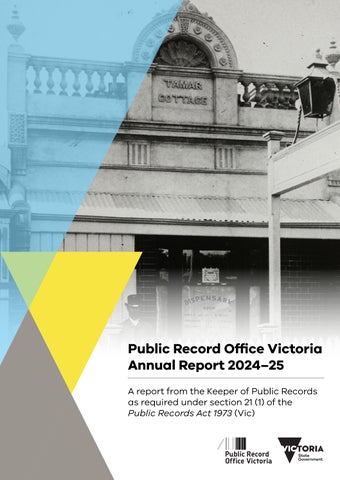
Cover image: First dispensary, Victoria Street West. PROV, VPRS 16773/P1, Slide No: 438
Public Record Office Victoria Annual Report 2024–25 A report from the Keeper of Public Records as required under section 21 (1) of the Public Records Act 1973 (Vic)
Public Record Office Victoria acknowledges the Traditional Owners of the lands across Victoria, and their continuing connections to land, culture and community. We pay our respects to their Elders past and present and extend that respect to all First Nations people.
The Hon. Natalie Hutchins Minister for Government Services 121 Exhibition Street Melbourne VIC 3000 Dear Minister I am pleased to present a report on the carrying out of my functions under section 21(1) of the Public Records Act 1973 (Vic) for the year ending 30 June 2025. Yours sincerely
Justine Heazlewood Director and Keeper of Public Records
4
Contents
7. Message from the Director
8. Message from the PRAC President
9. About Public Record Office Victoria
10. Strategic Plan
11. Overview
13. Organisational Structure
15. Public Records Advisory Council
16. Highlights
18. Report on Performance
32. Output Measures 2024–25
35. Appendices
44. Glossary
14. Values
5
Two girls in blue; Neg No: 58. PROV, VPRS 16773/P1, Slide No: 257
6
Message from the Director The pages of this year’s Annual Report feature photographs compiled by the Brunswick Historical Association for community centenary celebrations way back in 1939. We digitised and published 450 images from the collection in January this year. The images date back to colonial occupation in the 1830s, and are just a snapshot of the 934,000 historical records now available to view on our website. Yoorrook Justice Commission
PRAC
Throughout 2024–25, PROV continued to support the important work of the Yoorrook Justice Commission, providing advice and research support to Commission staff and to the government agencies responding to the Commission. We also commenced planning for the 2025–26 transfer of permanent records from the Commission. PROV will continue to uphold the Indigenous Data Sovereignty protocols implemented by the Commission in relation to First Peoples evidence, in accordance with Record Orders made by the Commissioners under the Inquiries Act 2014.
The Public Records Advisory Council (PRAC) provides advice to PROV and the Minister on administration of the Public Records Act 1973 and promotes cooperation between PROV and other government agencies. The 2024–25 financial year saw the completion of many of our long-standing member’s terms, including President Judy Maddigan. I thank Judy and all departing members for their commitment to public records and advice to PROV over many years. I also welcome our new members and President Andrew Campbell, and look forward to continuing our productive work with the Council in the years ahead.
Creatives in residence A highlight on the event and exhibitions calendar in 2024–25 was certainly the Rewind Forward exhibition developed by our creatives in residence. Five Melbourne artists produced fascinating and beautiful works inspired by their research into PROV’s collection. The unique pieces, by comic artist Sam Wallman, visual artist Shannon Slee, graphic designer Susan Fitzgerald, creatives Queer-ways and conceptual artist Emile Zile, are on display in the Rewind Forward exhibition until November 2025. Featuring stories of public transport, prisoners, women’s history, queer history and Melbourne’s maritime history, the exhibition displays original records from the collection alongside the artworks they’ve inspired. The centre of the exhibition, and one of my favourite pieces, is the giant textile memorial by Shannon Slee. It is a large silk hung from the ceiling, with 950 women’s names sewn into the fabric as a memorial to women who died of illegal abortions in Victoria up until 1975.
Volunteer program It was another busy year for our team of volunteers. A four year listing project was concluded at the end of 2024, with more than 130 volunteers spending a total of 18,330 hours creating a comprehensive listing of 259,210 letters received by the Education Department as far back as 1873. Volunteers have also assisted us in our Artificial Intelligence pilot projects and with the digitisation of 6,000 Melbourne Town Clerk’s correspondence records. Further achievements can be found throughout this Report. Thank you Thank you to all staff, volunteers, and PRAC members for a successful and eventful 2024–25.
Justine Heazlewood Director and Keeper of Public Records
7
Message from the Public Records Advisory Council President I was pleased to accept the position of President of the Public Records Advisory Council (PRAC) in October 2024. This year has been one of change and renewal. Seven new and two returning members were appointed by the Minister for Government Services this year. I would like to welcome and acknowledge these members: Diane Gardiner AM, Kylie Auld, Bonnie Chew, Dovid Clarke, Rosemary Kaczynski, Prof. Nell Musgrove, Jacqui Pitt, Nicola Quin, Andrew Young, and departmental representative Tessa Piper. I would also like to acknowledge the outstanding achievements of my predecessor Judy Maddigan. Judy served as PRAC President for eight years, providing invaluable advice to PROV on numerous policies and programs. Attendees of the yearly Victorian Community History Awards know Judy as an impressive and entertaining event host and her presence on stage will be missed. I was pleased to attend my first History Awards event as the new PRAC President earlier this year. The ceremony was held at the Langham on the 24th of March with guest speaker Poppy Stockell sharing her experience of publishing and documenting the history of John Farnham and the Melbourne music scene. It was an enlightening talk that inspired attendees and captured the importance of the work of archives and historians in capturing, preserving and sharing stories of the past. Artists too can shine a light on Victoria’s history, and I was pleased to also be in attendance for the Rewind Forward opening night, celebrating the five Victorian Archives Centre creatives in residence and their work. The event also included a speech from the Minister for Government Services which was warmly welcomed by attendees.
Well done to all the PROV staff involved in these programs. I thank Justine Heazlewood and PROV staff for their support and help in providing a smooth transition to me and new PRAC members as we have commenced our appointments. I would also like to thank all departing PRAC members for their incredible service and support to PROV during their terms: David Brous, Deidre Missingham, Prof. Keir Reeves, and departmental representative Lisa Tepper. Finally, I convey my deep appreciation to the many volunteers who provide their time and diligent efforts across a wide range of activities. Your contributions are greatly appreciated in helping realise both PRAC’s and PROV’s important work. With the new board now in place I look forward to a productive year in 2025–26 and continuing to connect with the wider PROV network.
Andrew Campbell President, Public Records Advisory Council
8
About Public Record Office Victoria
Public Record Office Victoria (PROV) is the archive of the State and local government of Victoria. We hold around 100kms of hard copy records and 1.2 million digital records dating from 1836 to the present day. Purpose To support the effective management and use of the public records of the State of Victoria to ensure that the Government is accountable to the community and that its historical memory is preserved, secure and accessible. Daily Operations PROV was established under section 3 of the Public Records Act 1973 (the Act) ‘for the better preservation, management and utilisation of the public records of the State’. The Act provides the legal framework within which PROV operates, and specifies the core functions of PROV and the Keeper of Public Records with respect to government records. These functions, pursuant to sections 7, 11 and 12 of the Act, include: •
establishing standards for the efficient management of public records, including creation, maintenance, security, selection of those worthy of preservation, transfer for archiving, and disposal of those not worthy of preservation
•
assisting public officers to apply these standards to records under their control
•
taking public records into custody, preserving archives and providing security
•
classifying records and publishing indexes and guides to facilitate access
•
providing facilities for viewing, and making records in custody accessible
•
duplicating or reproducing and authenticating public records.
9
Strategic Plan PROV’s Strategic Plan provides the direction for the period 2023–24 to 2025–26. Detailed information about our activities under each of the outcomes can be found in the Performance section of this report.
Vision Public records, publicly available.
Mission We set the rules for government recordkeeping and provide leadership to foster compliance. We ensure the historical memory of government in Victoria endures and is accessible.
Outcomes •
Management
•
Preservation
•
Utilisation
•
An efficient and effective organisation.
Strategies
10
•
Deliver and promote programs designed to increase public office compliance with recordkeeping obligations
•
Sustain and enhance our digital preservation knowledge, systems and practices to meet the needs of digital government
•
Enhance the value of the States archival data asset by leveraging system capability and improving data quality
•
Transfer the remaining priority physical records held across government
•
Review and improve the way we present, promote and provide access to public records
•
Expand our partnership and engagement approaches to leverage new or untapped audiences
•
Grow our people’s capability and enhance our culture
•
Leverage and continually improve our systems
•
Improve governance and processes.
Overview Executive Headed by Justine Heazlewood, Director and Keeper of Public Records, the executive team is located at 99 Shiel Street, North Melbourne, Victoria, Australia; phone (03) 9348 5600. Act administered: Public Records Act 1973 (Vic) PROV’s operations are governed by the Public Records Act 1973, which defines the role of both the Keeper of Public Records and the organisation. The Act is available for inspection on the PROV website www.prov.vic.gov.au and at our North Melbourne and Ballarat offices. Regulations made and administered
who come forward to disclose such conduct. The procedures for protecting people who make protected disclosures under the Public Interest Disclosure Act are available on our website www.prov.vic.gov.au/about-us/legislation-andgovernance. Standards and authorities PROV issues standards for records management and authorities for retention and disposal under section 12 of the Public Records Act 1973. A full list of current standards and authorities is provided on our website at www.prov.vic.gov.au/recordkeepinggovernment.
Regulations are made under section 23 of the Public Records Act 1973 and are known as the Public Records Regulations 2023. The Regulations prescribe fees for making and supplying copies of public records and set out conditions for the inspection of public records and use of facilities provided by PROV. Portfolio responsibility The Department of Government Services has responsibility for PROV. PROV is an administrative office under the Public Administration Act 2004. Freedom of information The Freedom of Information Act 1982 (Vic) gives members of the public a right to access documents held by Victorian Government agencies, including PROV. For the 12 months ending 30 June 2025, PROV received one Freedom of Information application. FOI requests for PROV agency documents should be addressed to: Freedom of Information Officer Public Record Office Victoria PO Box 2100 North Melbourne 3051 Public interest disclosure The Public Interest Disclosure Act 2012 (Vic) encourages and facilitates making disclosures of improper conduct by public bodies or public sector employees and protects persons who make those disclosures. PROV is committed to the aims and objectives of the Act. PROV does not tolerate improper conduct by its staff or reprisals against those
11
As at 30 June 2025, PROV operated two public reading rooms with 67.8 FTE staff. Access Services
•
developing mandatory standards and specifications, associated advice and guidance
•
appraising government functions and their associated records to specify records required as State Archives and to authorise the disposal of records not required as archives
•
managing the PROV Archival Control Model so that public records and their context are described within a systematic framework to ensure their original purpose and evidence of government administration is preserved
•
describing permanent value records and transferring them to PROV in collaboration with agencies
•
managing and promoting the Victorian Electronic Records Strategy (VERS) to support digital recordkeeping by agencies
•
developing and providing advice, guidelines, case studies, online learning and tools to support good recordkeeping by agencies
•
engaging in committees and partnering with organisations on projects and initiatives designed to improve recordkeeping
•
preserving archives within their region of origin, ensuring equality of access for communities in regional Victoria
•
delivering a program of recordkeeping awareness and recognition events
•
investigating and reporting on recordkeeping in Victoria, including challenges and issues.
Access Services ensures that our unique collection is widely known and accessible to the people and Government of Victoria. This is achieved through: •
a program of digitisation to improve access to our collection through our website
•
the provision of public reading room services and online access to PROV’s collection and research tools
•
managing the State archival collection in a purpose-built repository and in partnership with Class A Places of Deposit
•
providing culturally appropriate services, procedures and tools that enhance access by the Koorie community
•
transmitting information to clients about the collection
•
issuing records in a manner that meets government needs and community expectations.
Corporate Services Corporate Services supports staff across PROV with the following services: •
budgeting, financial management and reporting
•
risk management
•
environmental planning and reporting
•
strategic planning and reporting
•
communications and online engagement
•
information communication technology
•
information management
•
human resource management
•
organisational development.
Government Services Government Services issues standards to regulate the management, disposal and preservation of public records and provides recordkeeping advice and services to all Victorian public sector agencies. We do this by:
12
Organisational Structure
Minister for Government Services
Secretary Department of Government Services
Deputy Secretary Department of Government Services
Director and Keeper of Public Records Public Record Office Victoria
Public Records Advisory Council
Government Services
Standards and Policy
Government Recordkeeping
Access Services
Digital Projects
Collection Management
Community Engagement
Corporate Services
Finance and Governance
Facilities
Communications, Programs and Online Engagement
Technical Services
People and Culture
13
Values The Public Administration Act 2004 (Vic) requires that public sector employees demonstrate public service values as outlined in the Code of Conduct for Victorian Public Sector Employees. PROV actively implements, promotes and supports these values, and has developed the following set of values based on and consistent with the Code of Conduct: Responsiveness
Leadership
•
We will demonstrate and deliver bestpractice recordkeeping across government and our community.
•
We will proactively promote and share our unique capability widely.
•
•
We will maintain the highest levels of quality and accuracy in our advice and service to our colleagues and clients.
We will seek opportunities to enhance and improve our programs, processes and products.
•
•
We will celebrate innovation, ideas and challenge, where it is positive and constructive.
We will show leadership through demonstrating our values and unique behaviours at all times.
Integrity
Human Rights •
We will consider Human Rights in all our plans, decisions, advice and interactions and abide by all relevant legislation.
We will share knowledge, information and results willingly and openly.
•
We will observe zero tolerance for harassment, bullying or discrimination.
We will consider the security of our records and historical memory in our decisions.
•
We will facilitate the preservation and expression of the diversity of Victoria’s cultural heritage through our work.
•
We will show courage in giving feedback, making requests and offering ideas.
• •
Impartiality •
• •
We will invite, encourage and value the views, contribution and capabilities of all colleagues.
•
We will provide objective and impartial advice to all stakeholders.
We will seek to engage and consult with internal and external stakeholders as ‘partners’ with shared objectives.
•
We will account for all activities and results with honesty and transparency.
We will seek opportunities to support and assist each other.
•
We will consult and engage through direct communication where possible.
Accountability •
We will accept both personal and shared responsibility for all actions and ‘follow through’ to ensure agreed outcomes.
•
We will consider the public good and the public purse in all activities and decisions.
Respect •
We will show professional and personal respect, courtesy and positivity to all colleagues and clients.
•
We will be thoughtful and generous with praise and acknowledge a job well done.
•
We will treat all colleagues, clients, stakeholders and actions fairly, objectively and without bias.
14
Collaboration
Public Records Advisory Council Establishment and Functions The Public Records Advisory Council was established under section 4 (1) of the Public Records Act 1973 (Vic). The functions of the Council, as specified in section 5 of the Act, require that it: (a) In consultation with the Keeper of Public Records, shall promote cooperation between Public Record Office Victoria and public offices. (b) May report and make recommendations to the Minister on any matter relating to the administration of the Act. PROV provides support to the Council by preparing Council agenda papers, coordinating the scheduling of Council meetings, assisting with the appointment of new Council members, and providing assistance and administrative support for Council sub-committees. Members Section 4 (1A) of the Act requires that the Council consist of members with knowledge and experience in such areas as public administration, local government, records management, business administration, historical research, Indigenous heritage and genealogical research. During 2024-25, long-standing Council members whose appointments ended included: •
Judy Maddigan, President
•
David Brous, Public Administration
•
Diane Gardiner AM, Family History and Genealogy (Heritage Sector)
•
Deidre Missingham, Finance and Business Administration
•
Prof. Keir Reeves, Historical research (Academic)
•
Lisa Tepper, Department of Government Services Representative
•
Bonnie Chew, Indigenous Heritage, Family History and Genealogy
•
Dovid Clarke, Cyber Security, Digital Information Management
•
Diane Gardiner AM, Family History and Genealogy (Heritage Sector)
•
Rosemary Kaczynski, Information Management and Recordkeeping, Local Government
•
Prof. Nell Musgrove, Historical Research (Academic)
•
Jacqui Pitt, Public Administration, Legal Management
•
Nicola Quin, Business Administration, Public Administration
•
Andrew Young, Public Administration, Legal Management
•
Tessa Piper, Department of Government Services Representative
Activities The Council met on four occasions in 2024–25: •
21 August 2024, Victorian Archives Centre
•
6 November 2024, Victorian Archives Centre
•
7 March 2025, Victorian Archives Centre
•
27 June 2025, Victorian Archives Centre.
New appointments and re-appointments were made throughout the year, with the Council now comprising: •
Andrew Campbell, President
•
Kylie Auld, Information Management and Recordkeeping, Digital Information Management, Privacy and Data Protection
15
Highlights
Susan Fitzgerald with her work.
Creatives in residence After receiving more than 70 applications for the Victorian Archives Centre 2024 Creative in Residence Program, we were truly overwhelmed by the exceptional quality of proposals from a diverse group of artists, designers, writers, performers, and musicians. We wanted to see more of these impactful projects realised, and so for 2025, we chose a further five creatives from the original pool of applicants. From January through May 2025, with the help of PROV staff, the artists deep dived into their specific research areas. Comic artist and dock worker Sam Wallman investigated the impact of automation on the docks. Textile artist Shannon Slee highlighted the historical violence on women’s bodies due to state laws that prohibited access to safe reproductive health care. Graphic designer Susan Fitzgerald immersed herself in the history of transport ticket design and the lost manufacturing processes. LUCIANO and George Keats, who work collectively as Queer-ways, brought to life the outfits that
16
landed people in the courts for gender nonconformity in the early 20th century. And video and performance artist Emile Zile discovered the traces his own family have left behind in the archives. Their research culminated in the exhibition Rewind Forward which opened at the Victorian Archives Centre on 29 May. The exhibition will run until late November 2025.
Managing records in M365 In November 2024 we published Managing Records in Microsoft 365: A Guide for Victorian Public Offices developed with Microsoft 365 (M365) expert Andrew Warland. The guide, which has been viewed 3,255 times, assists Victorian agencies in the management of records created and captured across the M365 environment. It covers all areas that create and manage records including, but not limited to, SharePoint, Exchange, Teams, Purview and Entra.
By utilising this guidance, agencies can work towards meeting their recordkeeping requirements and compliance with PROV’s PROS 19/25 Create Capture and Control Standard and other standards and specifications.
Volunteers complete major project After four years of diligent volunteer work, a listing of historic Central Registered Correspondence Files of the Department of Education was completed at the end of 2024. More than 130 volunteers spent 18,330 hours creating a comprehensive listing of 259,210 letters received by the Education Department as far back as 1873. The listing created will be added to the PROV website to assist historians in researching this collection. Some fascinating finds amongst the letters include historic health advice for students, complaints from parents around issues such as comic books in schools, and even a letter from a teacher claiming to have missed class due to being “accidentally present at the encounter with the Kellys at Glenrowan” – referring of course to Ned Kelly, 1880.
PROV Volunteers working on the Education project.
Europe, is already widely adopted by historical researchers. The public model demonstrated 80-90 per cent accuracy on simple handwritten records with multiple hands. The Ned Kelly series, spanning around 6,000 pages, was transcribed in a week with impressive results. Name indexes were also transcribed accurately. The learnings are being considered by PROV to inform any transcription service offered to the public in the future.
Learn more about this and other volunteer projects in our volunteer update on page 21 of this report.
Using AI to describe and transcribe Following successful exploration into utilising Artificial Intelligence in 2023–24, in 2024–25 we started two projects to automate the transcription and description of historical records at scale. The digital innovation team and volunteer teams worked together to upload 4,000 Melbourne Harbour Trust photographic negatives from the series VPRS 8363 into Labellerr to test the tool’s ability to transcribe and produce new metadata from an image, e.g. date, negative number and keywords. The second project continued PROV’s experimentation with transcription of 19th century handwritten records using Transkribus. This year the project targeted typical records requested for digitisation and records of high value to researchers. The tool, developed in
17
Report on Performance Management Standards, policies and guidance Section 12 of the Public Records Act 1973 requires the Keeper of Public Records to issue standards for the efficient management of public records. The standards are mandatory for the Victorian public sector, including local government, with the head of each office responsible for ensuring compliance. The Act also requires PROV to provide public offices with support and assistance. In 2024–25, PROV reviewed and issued a new PROS 25/02 Create, Capture and Control Standard. This was accompanied by revised Technical Specifications – the Digitisation Specification and the Adding Metadata Packages to VEOs Specification. We also released an Enterprise Mobility Policy, setting out PROV’s position on recordkeeping when employees work from mobile devices and multiple locations. New or updated guidance was also published on the following topics – artificial intelligence, cloud services, data management, decommissioning systems, email management, governance, information management, offline storage and managing social media records. Records Management Network The Records Management Network (RMN) serves as a collaborative forum for professionals overseeing records management and archiving within the Victorian Public Sector. The network offers guidance on legislative and PROV standards compliance, promotes effective use of technology in records management, and facilitates knowledge sharing. Two RMN meetings were held in 2024–25. The August 2024 session drew strong interest, with more than 50 attendees in person and 190 online. Key presentations covered privacy, security, and information management, recordkeeping in SharePoint, and AI and data policy. A panel discussion offered practical insights into integrating M365 with records management across the public sector. The March 2025 meeting was held online, with attendance reaching 200. The session featured a presentation on the National AI Assurance Framework and its application in state
18
government, followed by sessions on PROV’s Digital Barriers project and the preservation of critical at-risk records. Both meetings prompted active discussion and strong engagement. Post events, the recordings attracted more than 430 views combined. E-learning In 2024–25 we embarked on the first year of a three-year strategy to enhance our online recordkeeping training program, with a focus on improving the quality, relevance, and impact of our offerings. This foundational phase aimed to look at ways to elevate specialist proficiency to meet evolving agency requirements and prepare for future collaboration with external partners. Key activities included a comprehensive review of our existing online training resources. We engaged recent participants through targeted surveys and conducted outreach to industry professionals via LinkedIn polls to gather insights on potential new training topics. A total of 137 surveys were sent over 12 weeks, with 33 responding. The results showed that overall, the training was well-received by participants. A strong majority found the content very relevant to their needs and rated it as very clear. For the two training modules offered (recordkeeping essentials and digital recordkeeping), most participants felt the depth of the material was appropriate, indicating the content struck the right balance in complexity. In terms of learning outcomes, 79 per cent reported that the training fully met its objectives. These results suggest the current training is effective and well-aligned with participant expectations, with only minor areas for improvement in ensuring all learning objectives are fully met. Over the course of four weeks, we posted four LinkedIn polls, seen by an average of 903 people each with a total of 142 votes cast across the campaign. Respondents most struggle to complete online courses due to lack of time (or motivation), however when they do have the time, they prefer webinars and would most appreciate courses on AI, leadership, cloud, lifecycle, and privacy/security.
These findings will assist us as we move into year two of our program to enhance and expand our online training modules for the public sector.
RDA development process Step 1 Assess disposal requirements
Preservation
Who: Agency and PROV
Appraisal program PROV is responsible for the establishment of standards for the management of public records under Section 12 of the Public Records Act 1973. This includes the issuing of retention and disposal authorities (RDAs) to authorise the disposal of public records. Disposal is a key component of good information practice and mitigates the risk of security breaches. Regular and managed disposal reduces information management overhead, storage costs and aids the discovery of reliable, relevant, and accurate information. PROV released five new disposal authorities during 2024–25 (refer to the Appendix of this report for details) including new RDAs for the Long Services Benefits Function, Forensic Medicine, Labour Hire Authority and VicScreen. A disposal authority was also issued for records of the former State Electricity Commission held by successor organisations. After completing the Records of Human Resources Management Function (PROS 24/03) last financial year, and in keeping with our redevelopment plan, we commenced work to replace the functions described as financial management, contracting out and grants management in the PROS 07/01 RDA for Common Administrative Functions. A draft RDA was released for review by financial management subject matter experts in April. We will release an exposure draft RDA for consultation with the records and information management community in 2025–26. This year we also worked with the Worker Screening Team in the Department of Government Services to appraise their processes and recordkeeping requirements. At time of writing the draft RDA was in preparation for final approval and release in mid-2025.
Step 2 Scope the appraisal project and write Project Scoping Report Who: Agency and PROV PRAC provides advice on stakeholders
Step 3 Conduct appraisal, consult stakeholders and draft RDA (iterative) Who: Agency and PROV
Step 4 Release exposure draft for feedback and follow up with stakeholders Who: PROV and Agency
Step 5 Complete RDA and final Appraisal Report Who: PROV PRAC endorses recommendations in Appraisal Report
Step 6 Approve and Issue RDA Who: Keeper and PROV
19
Physical transfers During the 2024–25 period, our physical records transfer program oversaw the transfer of 65,394 physical records into the collection. This year has seen the continuation of our three-year partnership with the Department of Education, transferring permanent records from public schools from across Victoria. Over halfway through the project, more than 18,300 records from 370 schools have been transferred, with open records from more than 80 schools now available to researchers. We have worked closely with the Department of Energy, Environment and Climate Action (DEECA) this year on the transfer of critical Crown land records to PROV. There were 19,218 records transferred from 11 of DEECA’s regional offices. The Supreme Court of Victoria transferred several record series including various probate records, commercial and common civil law case records and Council of Judges records dating from 1905. Over 11,000 records came from the Melbourne Children’s Court this year, continuing from previous years of transfers of Children’s Court family division case records. The Children’s Court Clinic also transferred a large cache of case records and court reports. Births, Deaths and Marriages transferred a further 1,361 adoption records created by Courts of Petty Sessions and County Courts in 52 locations across regional Victoria. Other significant records transfers completed this year included various record series from the Executive Council including minute books and registers of Letters Patent; mining tenement records from Geological Survey of Victoria; aerial state photo map mosaics from VicMap (Department of Transport and Planning); Ballarat Base Hospital board records dating from 1856 from Grampians Health; correspondence records from Goulburn-Murray Water; board minutes of the predecessor agencies of Development Victoria; State Electricity Commission of Victoria records held at Hazelwood Mine transferred by Engie; and tram car plans dated from 1919 transferred to us from Melbourne Tram Museum.
Staff undertaking the Department of Education transfer.
Digital transfers The Cabinet Office and Departments continued to transfer their digital Cabinet Office and Departmental Cabinet working records for the 2023 and 2024 calendar years, as part of our Annual Cabinet Transfer program. The program has been running since 2019. Records of the Office of the Special Investigator have now been ingested to the PROV digital archive, and the archival description documentation is currently being finalised. The digital-format as-built plans and environment reports for the early stages work of the Metro Tunnel Project have also been delivered to PROV for ingest to the digital archive. PROV has successfully converted emails of the Victorian Treaty Advancement Commission into appropriate digital formats, and work has commenced on the transfer of records from the Beaumaris Primary School Inquiry and the Family Violence Reform Implementation Monitor. Planning for the transfer of permanent records from the Yoorrrook Justice Commission, including records subject to Indigenous Data Sovereignty Principles, is well underway. The
185,588 digital records were added to PROV’s collection this year
65,394 physical files
20
transfer is expected to be a major piece of work during 2025–26. In total, 185,588 digital records were added to the collection in 2024–25. Barriers to digital transfer In 2024–25, we undertook a project to identify the challenges and barriers departments face when planning a digital record transfer. While the digital transfer program has grown this year, advocating for and understanding the benefits of a digital transfer will ensure public offices are continuing to consider transfers in their strategic work plans. In 2025 we created a communications plan to address the barriers identified through a 2024 workshop by creating a series of products directed at senior leaders and records managers. The aim was to assist records managers in advocating for digital transfers during strategic planning and ensuring clarity around the transfer process and accessing records once records are in PROV custody. The five barriers include a lack of representation in strategic planning, lack of executive support, uncertainty around roles and responsibilities, difficulties navigating a complex environment of collaboration with other business units, and perception that records may be difficult to access once transferred. Activities completed so far include: •
•
•
presenting the methodology of the 2024 workshop, the large amount of data collected, the top five barriers and recommendations to address those barriers at the March Records Management Network a webpage for digital records transfer planning, highlighting why a transfer should be included in strategic planning and what resources are needed to succeed an instructional, screen capture video on how to access born-digital records from the PROV catalogue, one of a suite of videos that will be developed to help authorised users and researchers access transferred records.
Additional activities are planned for 2025–26 to continue to assist agencies in planning for and undertaking digital records transfers to PROV.
VEO validation Agencies are required to transfer their borndigital records to PROV as Victorian Electronic Record Strategy (VERS) version 3 VERS Encapsulated Objects (V3 VEOs). The VERS 3 VEO Validation Program supports agencies through all aspects of VEO creation and transfer. The VERS 3 VEO validation program, launched in 2023–24, provides agencies with a clear process to follow and one-on-one guidance and support from PROV staff. The program was designed to ensure VEOs created by agencies meet the requirements outlined in the Create, Capture and Control Standard, specifications and guidelines. For VEOs to be considered ‘valid’, the VEOs must pass both technical and archival assessments as part of the program. The program is designed for agencies undertaking a digital record transfer for the first time and for agencies who are testing, procuring, developing or implementing a new system that will be capable of generating V3 VEOs. It is also accessible to commercial vendors who are either independently developing new V3 VEO creation capabilities or working with an agency to transfer V3 VEOs using a new system capability. Vendor products that complete the program are published on our VERS 3 commercial VEO creation products webpage. Two products were assessed as meeting the technical and archival requirements for VEO creation in 2024–25.
Utilisation Volunteer program This year, 71 volunteers helped us preserve our state’s records by: •
removing old packing materials and processing records into new boxes, bags or sleeves
•
aiding discovery of records by creating indexes or searchable data
•
adding value to records through digitising or transcribing the text of records.
The major projects they completed in 2024–25 included sorting and listing more than 250,000 letters to the Education Department spanning
21
In 2024–25 a range of historical and genealogical societies, and museums were appointed to hold public records in their collections, with now over 120 community PODs across Victoria. As part of the POD program, PROV supports these organisations in caring for public records, providing access and authorising transfer.
PROV Volunteers at the 2024 end of year event.
1873–1963 (see Highlights for more details) and creating searchable data for 80 volumes of ward registers.
The Bendigo Regional Archives Centre (BRAC) is another one of our PODs, governed by PROV in conjunction with the Goldfields Library Corporation and City of Greater Bendigo. It holds regional records dating from 1856 including maps and plans, council correspondence, rate books, court records and more.
Ongoing projects include their work with the AI image description tool (also in Highlights), listing of land selection files and various digitisation projects. Our volunteer team has contributed an impressive 8,103 hours this year and we thank them for their continued generosity and commitment. Their work helps us to ensure the historical records in our collection are preserved and searchable by researchers now and into the future.
80 ward registers
250,000 letters
POD program Places of Deposit, or PODs, are appointed to hold original, public records from local or state government agencies, which may be of interest to a local community and which are on open access to the public. There are two types of PODs: 1. Class A PODs can hold permanent and temporary public records. 2. Class B PODs can only hold temporary public records.
22
A government health notice about pox to citizens of 1881, held in the BRAC collection.
BRAC had a busy year, delivering 16 events across several venues with a total audience of 423 people. This included the launch of a new guide to district court records, running practical workshops on researching your home, reading and using parish plans, and hospital records, and presenting at seminars on confectionery and Malmsbury Bluestone based on research undertaken by staff. Bendigo has been recognised as a UNESCO Creative City of Gastronomy with a history of famous confectioners, making the confectionery events
extremely popular with local residents. The venues include the Medical History Society of Victoria’s conference, Bendigo’s contribution to the National Trust Heritage Festival and La Trobe University’s “Discovering History” program, in addition to Goldfields Library branches. They also participated in the VCE History Roadshow in 2024. They assisted approximately 332 visitors (in addition to the program’s audience), issued over 650 records and handled over 135 direct requests for research assistance. The introduction of LRVView and StoreDocs digital land portals in March 2025 has encouraged a new and growing group of regular visitors to the BRAC reading room – surveyors and heritage professionals – who are enjoying local access to vital land history information. Regular and dedicated Bendigo volunteers have nearly completed an index to selected volumes of post-1903 Bendigo rates books, and are progressing well on indexing twentieth-century City of Bendigo original correspondence. Indexing these records makes them more accessible and increases the chance they light a spark in someone’s imagination and illuminate some amazing research. Koorie Records Unit The Koorie Records Unit (KRU) promotes awareness of Victorian government records about Aboriginal Victorians within the PROV collection and improves accessibility of these records for First Peoples in appropriate and culturally respectful ways. The KRU provides dedicated services and support for First Peoples, including Stolen Generations survivors and their families wishing to access historic Victorian government records relating to themselves and their families in PROV’s collection. This includes a Koorie Reference Service in collaboration with the National Archives of Australia’s Victorian office, given that Victorian Aboriginal Affairs records are held in both collections. The Koorie Index of Names (KIN) Database is a research tool that is being continually developed by PROV to help locate records of relevance to Koorie Reference Service clients. During the year, the Koorie Reference
Service received 218 requests for Aboriginal family history research assistance, resulting in 2,315 names searched and 3,668 name results located in PROV records using the KIN database. This resulted in 6,279 copies of PROV records provided to Koorie Reference Service clients requesting family history records. Work continued on the redevelopment of the KIN platform to incorporate and enhance KIN data within existing PROV systems and improve Koorie Reference Service workflows. Related work commenced to describe records in VPRS 1694 Board for the Protection of Aborigines Correspondence files (1889–1946). A new online topic guide was published on accessing PROV’s significant collection of Aboriginal Protectorate and Guardian of Aborigines records (1838– 1860). The KRU undertakes engagement and outreach to provide information, advice and training for Stolen Generations and First Peoples organisations, service providers and support workers, as well as community groups to increase awareness and understanding of the records in the Victorian government archive, and services available for First Peoples. We host community members and groups visiting the Victorian Archives Centre to view records and undertake research. We also participate in networks focussed on improving archival practice and access for First Peoples and responding to the Tandanya-Adelaide Declaration. A highlight of 2024–25 was running an Aboriginal history information stand with other members of the Council of Australasian Archives and Records Authorities First Nations Special Interest Group at the AIATSIS Summit 2025 in Garramilla Darwin. PROV has also continued to support the important work of the Yoorrook Justice Commission. We have provided specialist recordkeeping and research advice and support to government agencies responding to the Commission, as well as Commission staff. PROV staff continue to work closely with stakeholders to prepare for the transfer and management of records of the Yoorrook Justice Commission. This is being done in accordance with Indigenous Data Sovereignty protocols developed by the Commission in the context of amendments made to the Inquiries Act and Public Records Act.
23
Victorian Community History Award winners in Melbourne.
The KRU also supports initiatives to increase staff awareness of dates of significance including marking the Anniversary of the Apology to the Stolen Generations, Mabo Day, Reconciliation Week and NAIDOC Week. Throughout the year a group of 20 PROV staff participated in an in-depth two-day Cultural Safety and Self Determination training run by ABSTARR Consulting. Two staff completed the University of Melbourne Understanding Treaty microcertification. Grants and awards The Local History Grants Program encourages and fosters community activities that preserve, record and share the local, social and community history of Victoria and Victorians. In Round 23, 17 projects were selected to share in $130,000 of funding. Approximately 52 per cent of these were from regional Victoria. Recipients included the Bonegilla Memory Project, awarded $11,490 for their work in collecting memories of ex-residents of the Bonegilla Migrant Camp via a digital platform. The Down Syndrome Association of Victoria was awarded $12,622 for the archiving of their heritage collection, dating back to the Association’s establishment in 1978. The National Theatre, Melbourne’s Digital History Project, will come to life thanks to $6,520 in funding.
24
Other funded projects included newspaper digitisations, oral histories, historical signage, and preservation equipment. The Victorian Community History Awards, presented in partnership with the Royal Historical Society of Victoria, seek to celebrate the success of historians sharing stories of Victoria’s past. Described by judges as “an artwork in itself”, Letters to a Critic: Alan McCulloch’s World of Art by Rodney James, took out the Victorian Premier’s History Award at the 2024 awards held in Southbank. Another art history, Victoria’s Earliest Porcelain Works: Art Pottery, Crockery and Insulators by Gregory Hill, was awarded the History Publication Award, while a 15-part podcast seeking to fill a gap in the historical record of the Vietnam War by Alexandra Pierce, Women, Conscription, War, was the Oral History winner. Other winning works included an exhibition about Heidelberg schools dating back to 1851, a journal article about Healesville migrant doctor and ASIO person of interest, Arthur Deery, by historian Phillip Deery, and Bendigo Military Museum’s Faces of Peace video project about local peacekeepers. Histories of Victoria’s maritime heritage, the architecture of the Albert Park village precinct,
The Melbourne Design Week ‘Beyond Barriers’ exhibition and presentation by Nick Morris.
the Jewish community living in the Ballarat goldfields, a community park in Inverloch, and Yallourn Technical School also won prizes. See the Appendix for a full list of 2024–25 grant and award recipients. Events and partnerships Throughout 2024–25 we continued our successful existing partnerships with Open House Melbourne, Melbourne Rare Book Week and Melbourne Design Week. Our Melbourne Design Week talk and exhibition were particularly well received. We worked with local firm, Folk Architects, to bring together accessibility consultants and architects in a panel discussion that attempted to answer the question: “How can we move beyond ramps and accessibility to design outcomes where inclusive design is a creative opportunity, not an afterthought?” The event included a display of original plans from PROV’s collection by Roy Grounds for the Melbourne Arts Precinct.
Other highlights from the year included a talk by historian Dr Yves Rees about the extraordinary Australian women who made an impact in early 20th century America, across the diverse fields of art criticism and surfing, through to law and economics. Cultural archaeologist Sean Reynolds brought North Melbourne’s ghost signs to life to a packed audience at the Victorian Archives Centre. Approximately 768 people attended Victorian Archives Centre events either physically or through live-stream online. As part of the Ballarat Heritage Festival, we also ran a joint presentation with Australian Catholic University (ACU) about the significance of researching maps and plans as a tool for navigating the past. As part of the presentation, we shared how to use our MapWarper website to display historic maps overlayed with the present day – revealing stark contrasts between past and present land use. Approximately 55 people attended this session at the Eureka Centre.
25
website visitors
social media followers
33,695 Asa Letourneau presenting at the Eureka Centre.
Exhibitions We continued our long-standing partnership with Old Treasury Building this year, with photographs from our collection appearing in their new Making Marvellous Melbourne exhibition. An optimistic new nation was created at the dawn of the 20th century. Australia was self-governing, and Melbourne would be its temporary capital while Canberra was constructed. This free exhibition at Old Treasury Building examines the tumultuous century that was to come. A highlight of the exhibition is a comparative look at historical photographs of Melbourne alongside recent images captured by local photographer Sarah Pannell. More than 45,000 people visited Old Treasury Building in 2024–25. University outreach program In 2024–25 we continued to work with university lecturers to provide presentations and training for students working with archival resources. This year we expanded into criminology, while strengthening our ties to history and heritage subject areas, exceeding our goal of reaching 300 students. We also partnered with ACU to work on a long-term project to update the recorded history of Ballarat by going back to the primary resources held at PROV to bring to light marginalised communities and forgotten histories. PROV’s website Throughout 2024–25 the website was visited by 1,005,026 people, with the most popular pages including wills, probate and passenger list topic pages.
26
There were two major digital projects to upgrade the PROV website this year, in addition to ongoing monthly maintenance. The first was a complex data improvement project to unify the display of date formats for all records. Now, regardless of the back-end metadata, the date format displays as day, month, year, making it easier for researchers to scan through results. The second major upgrade improved the select and order workflow for users based on designs produced in 2023–24. The interface improvements help users select records, download digitised records and better understand the ordering process for physical records. Digitisation program Digitisation ensures that Victorians have easy access to their own history without having to travel to a PROV reading room, and allows researchers interstate and overseas to engage with historic records from Victoria. Digitisation also ensures that information on fragile records is captured, thereby minimising the need for future handling. Our digitisation team provides a copy service on demand for researchers, and works with volunteers and external organisations on larger-scale digitisation projects. During 2024–25, volunteers assisted with the digitisation of 6,000 Melbourne Town Clerk’s correspondence records covering 1920–1925, providing insight into this fascinating period in Victoria’s history. We commenced a new project with the company Ancestry, digitising apprenticeship and insolvency records which, when completed, will mean another 1,300 boxes of records will be more accessible online.
Staff sorting through photographs of prisoners as part of a digitisation project.
We have also completed the upload to our website of nearly 600 boxes of divorce records, the result of a previous Ancestry partnership.
There are now 17 episodes of Look history in the eye available, with a total 18,767 downloads since the series launched in 2022.
We digitised a little over 5,000 records during the year as part of our copy service for the public and researchers.
Provenance
Look history in the eye podcast PROV’s communications team published four new episodes of the Look history in the eye podcast series in 2024–25. ‘The Brookside girls’ featured an interview with journalist Erica Cervini about her research into the girls held at Brookside Reformatory in the late 19th and early 20th centuries. This episode was released in November 2024 and downloaded 763 times. In December the episode ‘Travelling to tomorrow’ was released featuring a recording of Dr Yves Rees’ presentation at the Victorian Archives Centre. Yves delved into the lives of Australian women of the 1920s who sought success in America. The episode was downloaded 678 times and corresponded with the launch of Yves’ book of the same name. In January 2025, a recording of another Victorian Archives Centre presentation was released. Entitled ‘The Sandy Point skeleton’, the episode traced a forensic investigation into the identity of a body washed up at Sandy Point in Victoria. The episode was downloaded 1,053 times. Sean Reynolds presentation about ghost signs was also released as an episode on 18 June 2025 with 368 downloads up to the end of June.
Provenance is PROV’s free online journal highlighting the diversity and richness of Victoria’s state archival collection for research and storytelling. The five articles in issue 22, published in May 2025, explored social and cultural histories of Victorian people, places and buildings. All five articles contained individual stories that can only be retold through the insights offered by archival sources like those held by PROV. Without these sources, it would be difficult to piece together the facts and details of the people whose lives and voices exist beneath the larger and more mainstream historical narratives. In her article ‘Bluestone sawing in Victoria: cutting a niche in the stone industry’, Susan Walter uses a wide range of archival and published material to argue that an understanding of Malmsbury Bluestone’s significance requires recognition of the labour history of skilled stonemasons and stoneworkers. In ‘“Notoriously abandoned characters”: searching for the women in the Western Gaol 1854–58’, Sarah Mirams highlights the lives of women and children who were held at Melbourne’s Western Gaol between 1854 and 1858, a time of immense social change and a developing colonial society triggered by the Victorian gold rush. Chris Carpenter’s article, ‘The turbulent tales within the archives’, traces the lives of some of
27
his ancestors, English immigrants who arrived in Australia in 1849. Ann Hodgkinson was curious to find who it was that gave their name to the burgeoning Geelong growth area known as Armstrong Creek in her article. The deeds of Frederick Bailey Deeming have ensured his notoriety as one of the best-known serial killers in Australia’s history. Tara Oldfield revisited his story to shift the focus onto his next intended victim, Kate Rounsefell in ‘The one that got away’. This issue would not have been possible without the support of the editorial board: •
•
Tsari Anderson, Editor, Provenance; Manager, Koorie Records Unit, Public Record Office Victoria Dr Sebastian Gurciullo, Editor, Provenance; Senior Analyst Archival Data, Public Record Office Victoria
•
Dr Adrian Jones OAM, Associate Professor of History, La Trobe University
•
Dr Mike Jones, Deputy Director, Research Centre for Deep History, Australian National University
•
Dr James Lesh, Lecturer, Cultural Heritage and Museum Studies, Deakin University
•
Jenny Redman, Genealogical Society of Victoria
•
Katherine Sheedy, Professional Historians Association (Vic) Inc.
•
Dr Judith Smart, Adjunct Professor, RMIT University; Principal Fellow, University of Melbourne
•
Dr Rachel Standfield, Lecturer, Indigenous Studies, University of Melbourne
Media PROV records and programs appeared in the mainstream media more than 280 times in 2024–25. PROV events were particularly popular among radio and online outlets. Victorian Community History Award winners and Local History Grant recipients and call outs appeared across 126 local papers, history publications, radio and online outlets. Our Section 9 openings media campaign on 1 January also gained significant attention, appearing in approximately 30 outlets.
28
Social media In 2024–25 we expanded our social media offering, branching into two new channels: Threads and Bluesky. Our online community increased from 31,035 to 33,695 people across these new channels and existing Facebook, Instagram, X, LinkedIn, and YouTube platforms. We saw a total of 126,384 engagements to our content which featured a combination of historical storytelling, collection highlights, event promotions and recordkeeping news. In this financial year we explored new ways to re-package existing content as Thread stories to engage new audiences, garnering 142,525 views throughout the year.
An efficient and effective organisation Growing our people’s capability and enhancing our culture Many key initiatives in 2024–25 sought to strengthen staff professional development. As part of this, a Workforce Career Development Roadmap was developed to articulate pathways for career advancement, including opportunities for higher duties and professional growth. The new PROV Leadership Program was also rolled out. This seven-session program was designed to build capability, confidence, and consistency among new people managers. We also delivered cultural safety and neurodiversity training to build deeper awareness, understanding and respect across our teams, creating a more inclusive, psychologically safe and supportive workplace. The 2024–25 financial year also saw us reviewing, updating and implementing a new Diversity Equity & Inclusion Framework. The refreshed framework aligns with our commitment to reflect and understand the diverse workforce we serve and will help ensure inclusivity in both policy and practice. Recruitment practices were also reviewed to promote greater inclusivity and diverse representation. Improvements included updating recruitment materials to use inclusive, bias-free language, and encouraging genderbalanced interview panels wherever possible. Another important initiative implemented this year was the Keep Connect days to help employees on extended leave stay informed and feel connected to PROV. These optional
check-ins support inclusion and ease the transition back to work.
•
an increase in the number of women who choose to work full time
Improving governance and processes
•
an increase in the number of women promoted
•
improved access to Carers Leave and flexible working arrangements for all genders.
In 2024–25 we conducted a review of PROV’s internal policies and procedures to ensure alignment with the 2024 VPS Enterprise Agreement and legislative requirements. Preparations were undertaken for upcoming legislative changes relating to psychosocial hazards. Employee feedback and People Matter Survey data have been used to identify key risk areas and work is underway to provide targeted support resources. A dedicated database to capture and monitor negative behaviour (bullying, sexual harassment, violence and aggression, discrimination) was developed to enhance our ability to track, respond to, and learn from incidents. To also improve the way we communicate internally, we launched an employee intranet. The site makes it easier for employees to access important information and resources, and supports stronger connections by keeping employees engaged and aware of what’s happening across PROV. People matter survey Our People Matter Survey results remained strong in 2024–25 with a solid 78 per cent participation rate. Key insights from the 2024 survey included: •
85 per cent satisfaction rating (compared to VPS 67 per cent)
•
83 per cent engagement (VPS 68 per cent)
•
86 per cent inclusion rating (VPS 79 per cent)
•
High to severe stress is low at 18 per cent (VPS 22 per cent)
•
96 per cent of respondents said they are proud to say they work at PROV
•
90 per cent of respondents said they would recommend PROV as a good place to work.
Gender equality action plan This year marks the end of our inaugural Gender Equality Action Plan (GEAP). Spanning the last three years, this plan brought about: •
a reduction in our gender pay gap from 21 per cent to 1 per cent
Our facilities In 2024-25 our facilities team continued to improve key facility system operations especially in our heating venting and cooling system and building management system. Work on reviewing our security operations has been undertaken. We have also worked to improve the safety in our loading dock and external areas of the facility. Technical services In 2024–25, the Business Technology Services team continued its commitment to providing effective, efficient, and business-oriented IT systems, ensuring PROV’s ongoing success in its vision of accessible public records. Building on the previous year’s achievements, the team delivered on a number of projects, including planned upgrades to several business systems such as Digital Archive System, DSpace, KeyCloak, Digital Ordering, and more. Significant progress was made in infrastructure optimisation, focusing on redundancy, stability, and performance improvements to support PROV’s business workflows. This included comprehensive server infrastructure and applications monitoring implementation, upgrades to digital storage, and a streamlined network infrastructure with enhanced redundancy and comprehensive documentation. The team also supported the website user experience redesign project, including mobile ordering capabilities, and collaboration with Government Services enabled the resumption of record ingest into the digital archive, facilitating large file ingestion. Cybersecurity enhancements were a key focus, with firewall upgrades, optimised security rules, and the implementation of Multi Factor Authentifications for access to PROV business systems.
29
A new endpoint management platform was introduced, improving system manageability and security for both business systems and mobile devices. The team successfully rationalised PROV’s cloud infrastructure, achieving cost reduction despite increased usage. Finally, a significant number of legacy software and hardware systems were decommissioned. These efforts resulted in increased accessibility, efficiency, and security across PROV’s IT landscape.
Brunswick Park in the making. PROV, VPRS 16773/P1, Slide No: 342
30
Duke of York’s visit. Chinese arch, Swanston Street. PROV, VPRS 16773/P1, Slide No: 479
31
Output Measures 2024–25 PROV 2024–25 Budget Paper 3 performance measures Performance measure
Type of measure
Unit of measure
2024–25 target
2024–25 Variance (%) actual
Physical and digital records utilised by public and government users
Quantity
Number
4,800,000
4,208,9031
-12%
Satisfaction with services provided by Public Record Office Victoria to government agencies and to the public
Quality
Per cent
90%
88%
-2%
Provision of services within published timeframes
Timeliness
Per cent
95%
98%
3%
PROV 2024–25 Annual Report measures Output
Unit of measure
2024–25 target
2024–25 actual
Retention and disposal authorities issued
Number
5
62
Percentage of recordkeeping standards, specifications and policies reviewed to ensure they remain current
Percentage
90%
100%3
Number of visitors to PROV exhibitions and events
Number
45,000
50,9284
Number of reading room visitors
Number
7,000
7,131
Collection storage meeting industry standard
Per cent
95%
95%
Number of records made available for public users in Reading Rooms
Number
35,000
33,448
Number of records made available to government users other than in Reading Rooms
Number
4,500
4,1375
Number of public enquiries
Number
2,000
1,9026
Online visitors to website
Number
990,000
1,005,026
1 2 3 4 5 6
32
The 2024–25 outcome is lower than the 2024–25 target due to lower than expected visits to third-party websites hosting copies of public records. One RDA was completed ahead of schedule. More reviews than planned were carried out. Visitors to the Old Treasury Building museum which contributes to this target were higher than expected. Issues with the PROV website impacted upon users’ ability to order records during this time. Website improvements have led to a reduction in enquiries from researchers.
PROV 2024–25 Annual statistics Output
Unit of measure
2024–25 actual
Number of context entities (agencies, functions) registered
Number
164
Number of series registered
Number
1,212
Digital records accessioned
Number
185,588
Number of physical items accessioned
Number
65,394
Number of consignments accessioned
Number
245
Physical permanent value records transferred
Shelf metres
1,395
Number of participants undertaking records management training
Number
8,951
Volunteer hours
Number
8,103
Number of KRU enquiries received
Number
218
Number of digital copies provided to KRU clients
Number
4,946
Number of items digitised on demand
Number
5,101
Reading room and record retrievals PROV operates two public reading rooms: one at the Victorian Archives Centre in North Melbourne, and the other at the Ballarat Archives Centre at the Eureka Centre in Ballarat. Records can also be accessed at the Bendigo Regional Archives Centre within Bendigo Library, the Geelong Heritage Centre and (by appointment only) at the Burke Museum in Beechworth.
Records issued - Number of records issued 2024–25
33,448
Public users
4,137
Government users
Visitors to reading rooms - Number of visitors 2024–25
6,265
Victorian Archives Centre
467
Ballarat Archives Centre
332
Bendigo Regional Archives Centre
67
Geelong Heritage Centre
33
Buses, Lygon Street, Neg No:81. PROV, VPRS 16773/P1, Slide No: 387
34
Appendices Appendix 1: Assets Our assets include both community and operating assets in the following four categories: Community assets These assets are the State’s archival collection. We hold over 100 km of digital and physical records from 1836 to the present day. Building assets Records repositories for storage of the State Archives are located at North Melbourne and Ballarat. The Victorian Archives Centre in North Melbourne, including land, is valued at around $90 million. Motor vehicles PROV operates one share vehicle, a midsize SUV. Plant and operating equipment Operating assets are used for the upkeep of the physical and digital repositories so that public records can be stored safely and made available for public inspection.
Appendix 2: Financial Statement 2021–22
2022–23
2023–24
2024–25
Operating
$4,323,483
$4,294,535
$5,097,834
$5,291,313
Salary and on-costs
$7,733,166
$7,750,675
$8,204,323
$9,203,163
$12,056,649
$12,045,210
$13,302,157
$14,494,476
Depreciation
$2,410,195
$2,861,271
$3,059,669
$2,979,312
Total expenditure
$14,827,182
$15,215,524
$16,746,441
$17,473,788
Capital
$360,338
$309,043
$384,616
$853,279
Trust fund
Opening balance
Revenue 2024–25
Expenditure 2024–25
Closing balance
DTF - Community Support Fund (Victorian Community History Awards and Local History Grants)
$16,425
$523,000
$408,203
$131,222
Department of Education Trust
$732,127
$11,500
$321,651
$421,976
DEECA archival services
$0
$55,000
$0
$55,000
$116,079
$0
$23,078
$93,001
Sub-total
Other trust funds
35
Appendix 3: Workforce Data As at end of June 2025 Ongoing
Fixed-term & casual
Externally funded
Headcount
FTE
FTE
FTE
Female
32
29.4
10
3
Male
22
21
3.4
0
Self-described
1
1
0
0
Under 25
0
0
0
0
25-34
4
4
4.7
2
35-44
12
11.6
2.9
1
45-54
17
16.2
4
0
55-64
18
16.6
1.8
0
Over 65
4
3
0
0
Executive
0
0
1
0
STS
1
0.7
0
0
Grade 6
7
7
2
0
Grade 5
11
10.5
0
0
Grade 4
14
13.6
4.7
1
Grade 3
13
12.6
1
2
Grade 2
9
7
4.7
0
Gender
Age
Classification
Ongoing employees
Fixed-term & casual
Externally funded
Headcount
Full-time
Part-time
FTE
FTE
FTE
55
42
9.4
51.4
13.4
3
Appendix 4: Standards and Advice Section 12 of the Public Records Act 1973 requires the Keeper of Public Records to establish standards for the efficient management of public records and assist public offices in the application of those standards to records under their control. The Act requires public offices to implement records management programs in accordance with the standards established by the Keeper. All standards are available on the PROV website at prov.vic.gov.au/recordkeepinggovernment/standards-policies-rdas.
36
Appendix 5: Recordkeeping Standards Framework Documents Issued 2024–25 Standards and specifications issued Number
Name
Issued date
PROS 25/02
Create, Capture and Control Standard
3/02/2025
PROS 25/02 S1
Digitisation Specification
9/05/2025
PROS 25/02 S5
Adding Metadata Packages to VEOs Specification
26/05/2025
Appendix 6: Retention and Disposal Authority (RDA) Documents Issued or Varied 2024–25 New RDAs Standard number
Name
Issued date
PROS 24/04
Retention and Disposal Authority for Records of Forensic Medicine and Science Functions
16/12/2024
PROS 25/01
Retention and Disposal Authority for Records of Long Service Benefits Portability Functions
21/01/2025
PROS 25/03
Retention and Disposal Authority for Records of Labour Hire Regulation Functions
22/04/2025
PROS 25/04
Retention and Disposal Authority for Records of VicScreen
22/04/2025
Standard number
Name
Issued date
PROS 13/06
Retention and Disposal Authority for Records of Department of Premier and Cabinet Variation 4
02/07/2024
PROS 99/02
Retention and Disposal Authority for Records of Department of Treasury and Finance Variation 11
02/07/2024
PROS 22/06
Retention and Disposal Authority for School Records Variation 3
26/09/2024
PROS 20/03
Retention and Disposal Authority for Records of Victorian Managed Insurance Authority Variation 1
05/09/2024
PROS 12/02
Retention and Disposal Authority for Records of Corrections Victoria Variation 3
04/12/2024
PROS 08/10
Retention and Disposal Authority for Records of Curriculum and Assessment Functions Variation 3
04/12/2024
RDAs varied
37
Standard number
Name
Issue date
PROS 12/01
Retention and Disposal Authority for Records of Integrity System Oversight Function Variation 2
04/12/2024
PROS 15/05
Retention and Disposal Authority for Records of Post Compulsory Education and Skills Training Services Variation 2
04/12/2024
PROS 04/03
Retention and Disposal Authority for Records of the Office of Public Prosecutions Variation 7
04/12/2024
PROS 10/14
Retention and Disposal Authority for Records of Victoria Police 04/12/2024 Variation 5
Appendix 7: Approved PROV Storage Suppliers (APROSS) APROSS sites are commercial facilities that have been inspected by PROV and approved for the storage of temporary and un-sentenced public records. For a complete list of APROSS sites see our website prov.vic.gov.au/recordkeeping-government/certified-suppliers-vendors/apross-foragencies. APROSS Facilities approved in 2024–25
0
Reappointments
3
Number of current approved APROSS facilities
31 across 13 providers
Appendix 8: Staff Achievements Awards Bitter salts: a short story Best publication to engage and communicate with clients or potential clients of an Australian archive or archival collection about Australia Australian Society of Archivists’ (ASA) Mander Jones Award, October 2024 Tara Oldfield Professional committees Tsari Anderson: editor, Provenance journal; member, Professional Historians Association; board member, History Council of Victoria; member, Victorian Care Leaver Records Community of Practice; PROV delegate, Council of Australasian Archives and Records Authorities First Nations Special Interest Group. Tayla Di Giacomo: PROV delegate, Digital Preservation Coalition Australasia Stakeholder Group.
38
Charlie Farrugia: member, Victorian Association of Family History Organisations Committee; member, Geelong Heritage Centre Collection Advisory Committee. Robin Friend: PROV delegate, Digital Preservation Coalition Bit List Council. Dr Sebastian Gurciullo: editorial board member, Archives and Manuscripts; editorial board member and editor, Provenance journal; webmaster and steering committee member of the Section on Literary and Artistic Archives of the International Council on Archives. Justine Heazlewood: chair, Australasian Digital Recordkeeping Initiative; chair, Australian Libraries and Archives Copyright Coalition; member, Council of Australasian Archives and Records Authorities; member, Standards Australia, Records and Document Management Systems Committee (IT-21); member, Stolen Generations Historical Records Taskforce, Healing Foundation; member, Whyte Bequest Advisory Committee.
Xander Hunter: professional member (ARIM), Records and Information Management Practitioners Alliance (RIMPA Global); member, Australian Anthropological Society; member, Australasian Digital Recordkeeping Initiative; member, Information Governance ANZ Pty Ltd; member, Standards Australia, Migration of Authoritative Data, Information and Records Between Systems (IT-21-WG15). Julie McCormack: PROV delegate, Australian Society of Archivists; convenor, Government Archivists Special Interest Group, Australian Society of Archivists; member, Australasian Digital Recordkeeping Initiative. Alison McNulty: chair, Australasian Digital Recordkeeping Initiative M365 Working Group; member, Records and Information Management Practitioners Alliance (RIMPA Global); member, Standards Australia, Recordkeeping Compliance Review Committee (IT-021-17). Marianne O’Hara: PROV delegate, CAARA Education Working Group (finished November 2024); PROV delegate, Victorian Water Industry Information Management Special Interest Group; Corporate member, Records and Information Management Practitioners Alliance (RIMPA Global). Tara Oldfield: deputy chair and board member, History Council of Victoria. Nicole Tighe: member, Australian Human Resources Institute; member, Department of Government Services Human Resources Working Group; member, VPS Human Resources Working Group. Conferences and presentations How to research at PROV Third Year History Capstone Students University of Melbourne, July 2024 Sebastian Gurciullo Tour and presentation Records and Archives Management Students Victorian Archives Centre, August 2024 Sebastian Gurciullo, Alexia Bushby and Sarah Harris Navigating new policies and guidance Records Management Network Meeting Victorian Archives Centre, August 2024 Xander Hunter
Employment records: retention and disposal Victorian Public Sector Commission Recruitment Managers Forum Online, August 2024 Christine Mitchell and Julie McCormack Working at PROV The past is your future: a history careers showcase with the History Council of Victoria Victorian Archives Centre, September 2024 Tara Oldfield Preserving Victoria’s Government school records Australian Society of Archivists, School Archivists SIG Victorian Archives Centre, November 2024 Julie McCormack PROV programs and initiatives Zhejiang Provincial Archives Delegation Victorian Archives Centre, November 2024 Alison McNulty, Julie McCormack and Grace Kinrade PROV projects and initiatives DET Knowledge and Information Forum Melbourne, December 2024 Alison McNulty Artificial Intelligence and Recordkeeping Policy RMIT, Rainbow AI Seminar RMIT, Melbourne, December 2024 Xander Hunter Archival history and the power of truth telling using archives Australian Catholic University Students Online, January 2025 Kate Follington PROV collection management Charles Sturt University Students Online, January 2025 Jack Martin Global migration La Trobe University Students Victorian Archives Centre, March 2025 Sebastian Gurciullo Using Transkribus for automatic transcription at scale Museum Victoria group Online, March 2025 Asa Letourneau
39
Using Transkribus for automatic transcription at scale DGS community of practice Online, March 2025 Asa Letourneau Trialling threads and bluesky Victorian government social media working group Online, March 2025 Tara Oldfield Overcoming barriers to digital transfer Records Management Network Meeting Online, March 2025 Julie McCormack and Tayla Di Giacomo
Tour and presentation Information Studies and Library Students Victorian Archives Centre, Various dates throughout April 2025 Sebastian Gurciullo, Sarah Harris, Alexia Bushby, Jack Martin, Saskia Peachy, Amy Macintosh Using Transkribus for automatic transcription at scale AI4LAM AUNZ Chapter Online, May 2025 Asa Letourneau Introduction to MapWarper Ballarat Heritage Festival Eureka Centre, May 2025 Asa Letourneau
Appendix 9: Victorian Community History Award winners The Victorian Community History Awards are held annually in partnership with the Royal Historical Society of Victoria. Winners for 2024, announced at the Langham in Melbourne in March 2025, were: Recipient
Project
Awarded
Rodney James
Letters to a Critic: Alan McCulloch’s World of Art
Victorian Premier’s History Award ($5,000 prize)
J.M. Anderson
Wallace Avenue Community Park Inverloch: A Short History
Collaborative Community History Award ($2,000)
Middle Park and Albert Park History Group
Albert Park. Bridport St and Beyond
Local History Project Award ($2,000)
Graham Goulding
Knowledge is Power: A History of Yallourn Technical School 1928–1993
Small Organisation History Project Award ($1,500)
Gregory Hill
Victoria’s Earliest Porcelain Works: Art Pottery, Crockery, and Insulators
History Publication Award ($2,000)
Carole Wilkinson and Prue Pittock
River to Bay: Victoria’s Maritime History
Small History Publication Award ($1,500)
Bendigo Military Museum
Faces of Peace, Video Storytelling Project – Central Victoria’s Peacekeepers, Peacemakers and Peacebuilders
Digital Storytelling Award ($1,500)
Keira Quinn Lockyer
The Pioneering Jews of the Ballaarat Goldfields
Community Diversity Award ($1,500)
Alexandra Pierce
Women, Conscription, War
Oral History Award presented in collaboration with Oral History Victoria ($1,500)
40
Recipient
Project
Awarded
Heidelberg Historical ‘Back to School’: Society A History of Local Schools in Heidelberg 1851–2000
History Interpretation Award ($1,500)
Phillip Deery
History Article Award ($500)
A Community in Crisis: Dr Deery and the Healesville Hospital Dispute, 1961–62
Appendix 10: Local History Grant recipients The Local History Grant recipients were announced in June 2025. They were: Recipient
Project
Awarded
Australian Jewish Historical Society Victoria Inc.
Community of Fate: Tales of German Jewish Migration to Melbourne (1938–49)
$14,850
BCYF - Bethany Ltd trading as Meli Community
Preserving Their Past: Digitising and Preserving Historical Care Records
$15,000
Balnarring and District Historical Society Inc.
BDHS: Bringing our Collection to the Community
$2,950
Birchip RSL Sub-Branch
Story Boards at Birchip Cenotaph
$9,099
Block 19 - Bonegilla Migrant Experience
Bonegilla Memory Project
$11,490
Down Syndrome Association of Victoria Inc.
DSV Heritage Collection
$12,622
Kadimah Jewish Cultural Centre and National Library
Preserving the History of Yiddish Melbourne: Digitising the Kadimah Archive
$8,168
Kaiela Institute Limited
Kaiela Institute Archive Digitisation and Cataloguing
$13,024
Koroit & District Historical Society
Preserving History-Digitising Early Newspapers
$5,149
Leongatha & District Historical Society Inc.
The Photograph Digitalisation and Restoration Project
$1,158
Moonlight Head Cemetery Trust
Moonlight Head Cemetery History Board
$1,050
PMI Victorian History Library Inc.
Preserving the Unique Marj Quigley Collection
$3,396
Prosper Australia
Digitising Prosper Australia and the Henry George $2,110 Foundation of Australia
Queenscliffe Historical Museum Incorporated
Living in the 70s: Rediscovering Queenscliffe's Heritage
$5,100
The National, Melbourne
The National Theatre Movement Digital History Project 1935–2025
$6,520
41
Recipient
Project
Awarded
Trentham Rail and Tramway Association Inc.
Trentham Historical Railway Information
$2,429
Wurundjeri Woi Wurrung Cultural Heritage Aboriginal Corporation
William Barak's Visual and Material Legacy: a Catalogue for Community
$15,000
42
Harry and Mrs Beeson, about 1897. PROV, VPRS 16773/P1, Slide No: 195
43
Glossary Archival term
Definition
accession
A group of records from the same transferring agency taken into PROV custody at the same time. The records may be formally arranged and described into records series and consignments or they may be unarranged and undescribed. Accessioning refers to the process of formally accepting and recording the receipt of records into custody (Keeping Archives1).
advice
A document issued by PROV providing advice to Victorian agencies on a recordkeeping issue. (Includes formal advice about standards as well as forms and other tools to help Victorian government agencies manage and use public records).
APROSS
Approved Public Record Office Storage Supplier – the PROV program for the storage of records which the Keeper of Public Records has approved for eventual destruction or which are awaiting a decision as to their archival value.
archive
The whole body of records of continuing value to an organisation or individual. Sometimes called ‘corporate memory’ (AS 4390.1 -1996).
archives
Records considered to have continuing or permanent value that have been, or will be, transferred to the custody of an archival organisation; also used to refer to the buildings in which archival records are stored and to organisations that have responsibility for archival records (Private lives, public records2).
consignment
A consignment comprises record items belonging to a single record series that has been transferred to the custody of PROV as part of the one accession. A consignment may comprise the whole or part of a series. Each consignment is identified by a code (e.g. VPRS 1234/P1).
digital / electronic record
A record produced, housed or transmitted by electronic means rather than physical means. A record expressed in an electronic digital format. A record stored in a form that only a computer can process.
digitised record / digital image
An electronic reproduction of a picture, photograph or physical item (e.g. letter or document) that can be stored on computer or disk, and can be viewed, transmitted, manipulated and/or printed via computer. A subset of digital records (Private lives, public records).
disposal
A range of processes associated with implementing appraisal decisions. These include the retention, deletion or destruction of records in or from recordkeeping systems. They may also include the migration or transmission of records between recordkeeping systems, and the transfer of custody or ownership of records. Within the Victorian Public Sector, records are appraised to determine their significance (business, legal or historical) and then judged to be either of temporary or permanent value to the state. Government bodies are guided by standards or schedules issued by PROV to regulate the disposal of records.
disposal authority
A legal document that defines the retention periods and consequent disposal actions authorised for specific classes of records (AS 4390.1 -1996).
permanent records
Records which have been appraised as being of permanent value to the State of Victoria and which must be kept forever.
place of deposit (POD)
A location approved by the Victorian Government Minister responsible for PROV for the storage by community groups of temporary records of local value.
provenance
A principle that involves establishing the administrative context in which records were created and used. The provenance of records includes their original creators and users, and the subsequent administrators who were responsible for the recordkeeping system in which the records were kept (Private lives, public records). Note: the word Provenance is also used in this document to refer to the title of our annual online journal.
44
Archival term
Definition
public record
Any record made or received by a public officer in the course of the officer’s duties (Public Records Act 1973).
public records
Information or documents created as part of the activities of state government departments, agencies and local government (Private lives, public records).
reading room
Area set aside at PROV centres for public access to records (Private lives, public records).
record
Something that documents a particular event or decision, or a document and its contents that have some evidentiary value. A record can take many forms: • • • • • • •
recordkeeping
Making and maintaining complete, accurate and reliable evidence of business transactions in the form of recorded information.
records management
Field of management responsible for the efficient and systematic control of the creation, receipt, maintenance, use and disposal of records, including processes for capturing and maintaining evidence of and information about business activities and transactions in the form of records (AS ISO 15489.1).
repository
The building (or part of the building) in which the collection/holdings are housed.
series
A group of records which are recorded or maintained by the same agency or agencies and which: • •
1 2
a document in writing a book, map, plan, graph or drawing a photograph a label marking or other writing which identifies or describes anything of which it forms part, or to which it is attached by any means whatsoever a disc, tape, soundtrack or other device in which sounds or other data (not being visual images) are embodied so as to be capable (with or without the aid of some other equipment) of being reproduced therefrom a film, negative, tape or other device in which one or more visual images is embodied so as to be capable (as aforesaid) of being reproduced therefrom anything whatsoever on which is marked any words, figures, letters or symbols which are capable of carrying a definite meaning to persons conversant with them (AS ISO 15489.1).
are in the same numerical, alphabetical, chronological or other identifiable sequence; or result from the same accumulation or filing process, perform the same function or may be of similar physical shape or information content.
standard
A set of criteria that states a level of legal requirement for Victorian agencies. Standards are established by the Keeper of Public Records under the Public Records Act 1973.
temporary records
Records which are appraised as being of value for a bounded time span and which may be legally destroyed once they are older than that time span.
transfer
The removal of public records from the offices which have created or inherited them. The custody, ownership and/or responsibility for the records is migrated to the recipient (e.g. from the office to PROV) (see AS ISO 15489.1).
unsentenced records
Records which have not yet been appraised and whose status is therefore not yet determined (Public Records Act 1973).
VPRS
An abbreviation for Victorian Public Record Series. A VPRS number is allocated to each record series when it is transferred to PROV.
J. Ellis (ed.), Keeping Archives, 1993, The Australian Society of Archivists Inc., Australia. B. Fensham et al., Private lives, public records, 2004, Public Record Office Victoria, Australia.
45
Victorian Archives Centre 99 Shiel Street North Melbourne 10am–4.30pm Monday to Friday (and the 2nd and last Saturday of the month) prov.vic.gov.au 03 9348 5600 Ballarat Archives Centre Eureka Centre 102 Stawell Street South Ballarat Central 10am–4.30pm Monday to Thursday Bendigo Regional Archives Centre 1st Floor Bendigo Library 251-259 Hargreaves Street Bendigo 10am–4pm Wednesday and Thursday Geelong Heritage Centre Geelong Library and Heritage Centre 51 Little Malop Street Geelong 10am–4pm Tuesday to Friday