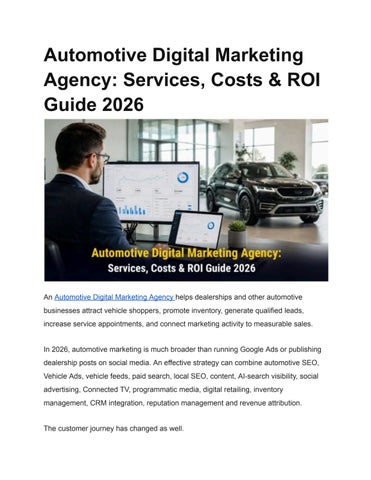
Automotive Digital Marketing Agency: Services, Costs & ROI Guide 2026
An Automotive Digital Marketing Agency helps dealerships and other automotive businesses attract vehicle shoppers, promote inventory, generate qualified leads, increase service appointments, and connect marketing activity to measurable sales. In 2026, automotive marketing is much broader than running Google Ads or publishing dealership posts on social media. An effective strategy can combine automotive SEO, Vehicle Ads, vehicle feeds, paid search, local SEO, content, AI-search visibility, social advertising, Connected TV, programmatic media, digital retailing, inventory management, CRM integration, reputation management and revenue attribution. The customer journey has changed as well.
Cox Automotive’s 2025 Car Buyer Journey Study, published in January 2026, found that 63% of surveyed vehicle buyers said their ideal experience combines online and in-person activities, while only 7% completed their entire purchase online. The research also found that 25% of new-vehicle buyers used AI tools during their shopping process. This means successful automotive marketing should not try to replace the dealership experience. It should connect digital discovery with the showroom, finance department, service lane and long-term customer relationship.
Quick Answer Automotive-focused agencies combine marketing channels with dealership operations, inventory data and sales measurement. The goal is to attract qualified shoppers and connect marketing activity with real business outcomes. An Automotive Digital Marketing Agency helps dealerships and automotive businesses attract online shoppers, generate qualified leads, promote inventory and increase sales. Common services include: ● Automotive and local SEO ● Google Ads and Vehicle Ads ● Vehicle feed management ● Paid social media ● CTV and programmatic advertising ● Content and video marketing ● AI-search optimization ● Reputation management ● Email and SMS marketing ● CRM integration and attribution
Agency costs vary by scope. General digital marketing engagements may range from $5,000 to $50,000 per month, with advertising spend often charged separately. The best agency should be judged by qualified leads, appointments, vehicle sales, gross profit, inventory movement and customer retention rather than clicks or impressions alone.
Key Takeaways The most important points are specialization, accurate inventory data, measurable sales performance and transparent reporting. Dealerships should evaluate marketing by downstream results rather than platform metrics alone. ● An Automotive Digital Marketing Agency combines SEO, paid ads, inventory feeds and sales data. ● Vehicle Ads, technical SEO and AI search are key priorities in 2026. ● Measure success by appointments, sales, gross profit and inventory movement. ● Keep agency fees separate from advertising spend. ● First-party data requires strong privacy and security controls. ● The FTC CARS Rule was withdrawn in 2026, but accurate pricing remains essential.
What Is an Automotive Digital Marketing Agency? This type of agency focuses specifically on the automotive customer journey, from vehicle research to purchase and service retention. Its value comes from understanding dealership systems, inventory behavior and offline sales attribution. An Automotive Digital Marketing Agency provides specialized marketing services for dealerships, dealer groups, OEMs, repair shops and other automotive businesses.
Unlike a general agency, an automotive specialist understands dealership-specific areas such as: ● Vehicle inventory feeds ● VDPs and SRPs ● Automotive CRMs and DMS platforms ● Manufacturer incentives ● Inventory aging ● Fixed operations ● Dealer co-op programs ● Offline sales attribution The real difference appears in measurement. A general PPC agency may report 300 leads at $40 per lead, while an automotive agency should track what happens next: 300 leads → contacts → appointments → test drives → sales This gives dealerships a clearer picture of marketing performance.
Why Automotive Digital Marketing Matters in 2026 Automotive Digital Marketing Agency supporting dealership websites and online vehicle discovery
Car buyers now move between search engines, AI tools, marketplaces, social platforms and physical dealerships. Marketing therefore needs to support an omnichannel journey instead of treating digital and showroom activity as separate experiences. Vehicle buyers move between digital and physical channels, including:
● Google and Google Maps ● AI assistants ● Dealership websites ● Automotive marketplaces ● YouTube and social media ● Reviews ● Financing tools ● Physical dealerships Cox Automotive’s 2026 research found that 63% of surveyed buyers preferred a combination of online and in-store activities. An Automotive Digital Marketing Agency should therefore connect the full customer journey: Discovery → Research → Inventory → VDP → Lead → Appointment → Test Drive → Sale → Service → Repurchase
Core Automotive Digital Marketing Agency Services Automotive marketing usually combines search visibility, paid media, content, conversion optimization and dealership data. The exact mix should reflect inventory, location, competition, margins and the dealership’s growth priorities.
Category
Typical Services
Search
SEO, local SEO, Google Ads, Vehicle Ads
Advertising
Social media, CTV, OTT, display, programmatic
Content
Articles, landing pages, video marketing
Conversion
CRO, digital retailing, BDC optimization
Data
CRM, DMS, analytics, attribution
The right service mix from an Automotive Digital Marketing Agency should depend on the dealership’s inventory, competition, market size, margins and business goals.
Automotive SEO Automotive SEO helps dealership websites appear when shoppers research vehicles, compare models or search for nearby sales and service options. A strong strategy balances high-intent inventory terms with useful informational and local content. Automotive SEO helps dealerships rank for searches such as: ● Toyota dealership near me ● used SUVs near me ● Ford F-150 for sale ● used cars under $20,000 ● vehicle financing near me ● brake repair near me Search intent matters. Someone searching “best three-row SUV” is researching, while “2026 Toyota Highlander for sale near me” shows stronger purchase intent. Automotive SEO may include: ● Keyword research ● Technical SEO ● Local SEO ● Model and service pages ● Internal linking
● Content marketing ● Image optimization ● Search Console analysis ● Indexation management
Technical SEO for VDPs and SRPs Dealership websites can create large numbers of inventory and filter URLs, so technical controls are especially important. Good technical SEO helps search engines discover valuable VDPs and SRPs without wasting crawl activity on duplicate or low-value pages. Technical SEO is especially important for dealership websites because inventory systems can generate thousands of URLs. ● VDP — Vehicle Detail Page: an individual vehicle page. ● SRP — Search Results Page: an inventory listing showing multiple vehicles. Important areas include: ● Crawlable inventory ● Faceted navigation ● Canonical URLs ● JavaScript-rendered content ● Pagination ● Duplicate OEM descriptions ● Internal linking ● Image optimization ● XML sitemaps ● Sold vehicle handling ● Thin inventory pages ● Mobile performance
Crawlable Inventory
Search engines need reliable paths to important vehicle pages. Inventory that exists only behind search boxes, filters or scripts can be harder to discover and index consistently. Important vehicles should be accessible through crawlable links rather than existing only behind filters or internal search tools.
Faceted Navigation Inventory filters improve usability but can generate thousands of URL combinations. Dealerships should decide which filtered pages provide real search value and prevent unnecessary variations from creating crawl waste. Filters for make, model, year, price, mileage or body style can create thousands of URL combinations. An Automotive Digital Marketing Agency should control which pages deserve indexation.
JavaScript and Pagination Modern inventory platforms often rely on JavaScript, infinite scroll or interactive loading. Important vehicles should still be accessible through crawlable URLs and links so search engines can consistently reach the full inventory set. Dealership inventory should remain accessible to search engines even when JavaScript, infinite scroll or “Load More” features are used.
Duplicate Content Manufacturer descriptions are often reused across many dealership websites, which can make pages look very similar. Adding original vehicle details, useful merchandising information and dealership-specific content can make VDPs more valuable.
VDPs should add useful original details rather than relying entirely on manufacturer descriptions. Useful additions include vehicle condition, dealer-installed features, location details and original photography.
Sold Vehicles Sold inventory needs a clear removal or redirection strategy so users and search engines are not sent to irrelevant pages. Redirects should be used only when a genuinely useful replacement or equivalent page exists. Expired VDPs should be removed, redirected only when a genuinely relevant replacement exists, or otherwise handled cleanly rather than redirecting every sold vehicle to the homepage.
Mobile Performance A large share of vehicle research happens on mobile devices, so inventory pages must be fast and easy to use. Shoppers should be able to browse, compare, contact the dealership and schedule actions without unnecessary friction. Mobile shoppers should be able to quickly: ● Search inventory ● Compare vehicles ● Call the dealership ● Submit inquiries ● Check payments ● Schedule appointments Strong VDP and SRP technical SEO helps search engines discover valuable inventory while reducing duplicate and low-value URLs.
Conclusion Automotive marketing works best when advertising, inventory, website experience, CRM data and dealership operations support one another. Agencies should ultimately be evaluated by their contribution to profitable customer and inventory outcomes. Choosing the right Automotive Digital Marketing Agency in 2026 is about more than finding a company that can manage Google Ads or generate website traffic. A strong agency should understand how SEO, Vehicle Ads, inventory feeds, local search, social media, AI-driven discovery, digital retailing, CRM data and dealership operations work together. The real measure of success is not clicks, impressions or cheap leads. Dealerships should focus on qualified leads, appointments, test drives, vehicle sales, cost per sale, gross profit, inventory turnover and customer retention. These metrics provide a much clearer picture of whether marketing is actually contributing to business growth. A reliable Automotive Digital Marketing Agency should also provide transparent reporting, accurate attribution and a clear strategy for improving both sales and service performance. When strong marketing is combined with accurate inventory, responsive lead handling, reliable CRM data and an effective sales process, dealerships can turn digital marketing into a measurable source of long-term revenue and sustainable growth https://www.startupeditor.com/automotive-digital-marketing-agency/