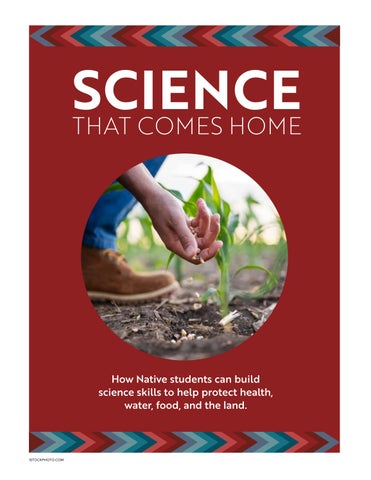
SCIENCE THAT COMES HOME
How Native students can build science skills to help protect health, water, food, and the land.
ISTOCKPHOTO.COM
USING SCIENCE TO PROTECT WHAT MATTERS Science can help protect health, water, food, land, and future generations.
S
cience is not only about discovering new things. It can also be about taking care of people, land, water, and the future. In many Native traditions, today’s choices are made with future generations in mind.
CHEMISTRY helps us study substances in water, soil, food, medicine, and the body. ENVIRONMENTAL SCIENCE helps us understand changes in land, water, air, plants, animals, and ecosystems.
Native Nations and communities have always used knowledge, observation, and problem-solving to care for people, land, water, plants, and animals. Today, science can add new tools to that ongoing work.
HEALTH SCIENCE helps us improve care and prevent disease. BIOTECHNOLOGY brings many of these areas together by using living things — such as cells, bacteria, plants, and DNA — to solve problems and improve lives.
BIOLOGY helps us understand living things.
For Native students, these skills can be a way to strengthen communities, protect what matters, and help carry knowledge forward for generations still to come.
The landscapes of Monument Valley Navajo Tribal Park are part of the Navajo Nation's natural and cultural heritage. Science can help protect them for future generations.
ISTOCKPHOTO.COM
2
Water is essential to life, health, food, culture and the land. Science can help protect it.
SCIENCE IN ACTION
From water and health to food and the land, science — including biotechnology — can help Native communities solve real problems. Protecting Water
Improving Health
Water is essential to life, health, food, culture, and the land. Science can help communities test water, track changes, and spot risks from bacteria, chemicals, drought, pollution, or aging water systems.
Good health is connected to many things, including food, water, housing, environment, access to care, and family history. Science can help communities understand disease, improve testing, support prevention, and strengthen care.
Science skills: Students can learn how to collect samples, use testing equipment, read results, and share information that helps communities make decisions.
Science skills: Students can study health science, biology, nursing, public health, medical lab work, or biotechnology to prepare for work in clinics, hospitals, labs, and tribal health departments.
Where biotechnology comes in: Biotech tools can help identify bacteria, algae, toxins, germs, and other living things that may affect people, animals, and ecosystems.
Where biotechnology comes in: Biotechnology is used in medical tests, vaccines, medicines, disease research, genetics, and new treatments. Native students can help make sure research and care are guided by the real needs of their communities.
ISTOCKPHOTO.COM
3
SCIENCE IN ACTION (CONTINUED) Restoring Food Systems
Caring for Land and Wildlife
Food is connected to health, culture, family, and the land. Many Native communities are working to protect traditional foods, save seeds, grow more local food, improve nutrition, and strengthen food sovereignty.
Land, plants, animals, and people are all connected. Science can help communities monitor pollution, track climate impacts, protect habitats, study wildlife health, and restore damaged areas. Science skills: Students can learn how to collect field data, identify plants and animals, test soil or water, use maps and technology, and study changes in the environment.
Science skills: Students can learn how to study soil, plants, water, pests, food safety, and nutrition. These skills can support gardens, farms, greenhouses, food programs, and community health efforts.
Where biotechnology comes in: Biotech tools can help scientists study DNA, cells, microbes, disease, toxins, and ecosystem health. These tools can help communities better understand what is changing — and how to protect the living world around them.
Where biotechnology comes in: Biotech tools can help scientists study plant health, crop diseases, soil microbes, seed traits, and food safety. These tools can support traditional food systems when they are guided by community values.
Navajo entrepreneur Cherilyn Yazzie founded Coffee Pot Farms to bring fresh, healthy food to her community. Her 36-acre farm grows and sells produce to families across the Navajo Nation and Arizona.
PHOTO BY RAYMOND CHEE, COURTESY NATIVESTARTUP.ORG
4
SCIENCE IN SERVICE OF COMMUNITY Meet a few Native Americans using science to support their communities and protect the places they call home.
T
degree in environmental science and engineering, she returned home to work for the tribe’s natural resources agency. She later focused on climate change and ways to help tribal communities prepare for its effects.
hese Native scientists and students are using biology, chemistry, genetics, and environmental science, and other fields to tackle problems that matter to their communities. Some of them have returned home to work for their tribes. Others conduct research with Native communities, restore important species, protect water, or explore new approaches to food and health.
Jason Baldes
Eastern Shoshone Wildlife and Restoration Jason Baldes studied land resources and environmental science, with a focus on tribal bison restoration. He has helped return buffalo to the Wind River Reservation in Wyoming and restore their role in the land, culture, and community. Today, he also helps educate the next generation about buffalo conservation and stewardship.
Crystal Tulley-Cordova
Diné (Navajo) Water and Hydrology Crystal Tulley-Cordova studied earth and planetary science, water resources, and geology. Today, she is a principal hydrologist for the Navajo Nation Department of Water Resources. Her work helps protect water rights, study groundwater and watersheds, and plan water infrastructure for communities across the Navajo Nation.
Gerald “Jerry” Jondreau Keweenaw Bay Indian Community Forestry Jerry Jondreau studied forestry and built a career helping manage the forests of his own tribal community. As a tribal forester for the Keweenaw Bay Indian Community, he worked to care for forest resources while connecting scientific training with Ojibwe knowledge and stewardship.
Shelby Ross
Oglala Sioux Tribe Climate and Natural Resources Shelby Ross grew up on the Pine Ridge Indian Reservation and studied natural science and conservation biology at Oglala Lakota College. After earning a master’s
PHOTOS COURTESY THE SCIENTISTS
5
COMMUNITY (CONTINUED) Katrina Claw
Diné (Navajo) Genetics and Native Health Katrina Claw studied biology and earned a Ph.D. in genome sciences. Today, she researches how genetics can affect the way people respond to medicines and works with Native communities to make genetic research more useful, understandable, and respectful. One project is helping create Navajo-language resources so more people can understand genetics and make informed decisions about research.
Bree Lameman
Diné (Navajo) Food Systems and Public Health Bree Lameman, who is from Shiprock in the Navajo Nation, studies how food systems connect with health, water, and community well-being. Her research interests include Indigenous food sovereignty, food security, and hydroponics — growing plants without soil. Her path shows how science and public health can help communities explore new ways to improve access to healthy food.
Cale Pete
Washoe Tribe Environmental Science and Restoration Cale Pete grew up on the Washoe reservation in Nevada and earned a degree in environmental science from Haskell Indian Nations University. After college, he returned home to work for his tribe’s environmental department. Today, he helps lead projects to restore meadows, protect water and native plants, and care for lands in the Lake Tahoe Basin that have long been important to the Washoe people.
PHOTOS COURTESY THE SCIENTISTS
6
SO, WHAT INTERESTS YOU?
Y
ou’ve just met Native people who are using science to pro--tect water, restore land and wildlife, improve health, and strengthen food ## What interests you? systems. What problems or possibilities do you notice in your own **Water?** community? Your interests can point Explore hydrology, chemisyou toward classes and programs try, environmental science, that build useful science skills. geology, or engineering. If you care about clean water, riv**Health?** ers, lakes, or safe drinking water… Look into biology, genetics, LOOK FOR: Environmental science, public health, nutrition, or chemistry, biology, geology, hydrollaboratory science. ogy, lab technology **Food?** If you care about health, medicine, Consider agriculture, soil wellness, or disease prevention… science, plant science, nutriLOOK FOR: Health science, biology, tion, or natural resources. genetics, nursing, public health, medical lab technology **Land and wildlife?** Explore biology, ecology, If you care about food, farming, forestry, wildlife science, traditional plants, or nutrition… conservation, or GIS. LOOK FOR: Agriculture, biology, chemistry, food science, plant **Not sure yet?** science, natural resources Start with one interest, one class, or one problem you If you care about animals, plants, care about. Your path can wildlife, or protecting the land… grow from there. LOOK FOR: Agriculture, biology, chemistry, food science, plant science, natural resources Do you like tools, technology, samples, or data? Those skills can help in almost any science path — from labs and clinics to farms, fieldwork, restoration projects, and research.
START CLOSE TO HOME
Tribal colleges can help students build science skills connected to community needs.
A
fter seeing how science can support water, health, food, land, and wildlife, you may wonder: Where could I begin? For many students, the first step does not have to be far away. Tribal colleges and local colleges can offer a place to build science skills while staying connected to family, culture, and community.
Native students at Tribal colleges doing field work and research.
Many tribal colleges and local colleges offer classes in biology, chemistry, environmental science, health science, agriculture, natural resources, lab technology, nursing, and public health. These programs may not have “biotechnology” in the name, but they can still build skills used in health care, environmental testing, food systems, agriculture, research, and biotechnology. Tribal colleges can be powerful places to start because many are built around Native students, Native communities, and the importance of staying connected to home while building new skills. Some students earn a certificate or associate degree and go right to work. Others transfer later to continue toward a four-year degree. There is no single path. What matters is starting with a goal, a question, or a problem you care about.
PHOTOS COURTESY OF THE AMERICAN INDIAN COLLEGE FUND (COLLEGEFUND.ORG), A NON-PROFIT ORGANIZATION WITH THE MISSION OF SUPPORTING NATIVE STUDENTS WITH ACCESS TO A HIGHER EDUCATION. ALL RIGHTS RESERVED.
7
Graduation at Southwestern Indian Polytechnic Institute (SIPI), located in Albuquerque, NM
TAKE YOUR NEXT STEP
You do not have to know the whole path today. Here are a few ways to begin. Try science outside the classroom
• • • • • •
Look for ways to see what science work is really like: • • • • • • •
Water testing projects Community gardens or greenhouse programs Health fairs or tribal health programs Environmental monitoring Summer science programs Internships or job shadowing Research projects or campus STEM clubs
Scholarships Tutoring Transportation Childcare or family support Paid internships or work-study Transfer pathways, if you want to continue later
One step you can take now
Choose one thing you care about — water, health, food, plants, animals, technology, or the land — and ask: What project, program, class, or person could help me learn more?
Ask about support
Your community already has knowledge, strength, and problem-solvers. Science can give you more tools to help protect what matters — now and for generations still to come.
You do not have to figure it out alone. Ask a counselor, teacher, advisor, tribal education office, or college admissions office about:
PHOTO COURTESTY U.S. DEPARTMENT OF THE INTERIOR BUREAU OF INDIAN EDUCATION
This material was made possible with the support of The Bioindustrial Manufacturing and Design Ecosystem (BioMADE); the content expressed herein is that of the authors and does not necessarily reflect the views of BioMADE.
8