December 2026
DALBY 07 4669 7317 TOOWOOMBA 07 4633 5513 WARWICK 07 4661 4126 GOONDIWINDI 07 4519 3801
12808941-CV44-25
More than a shed
Mental health push
PAGE 18
PAGE 17
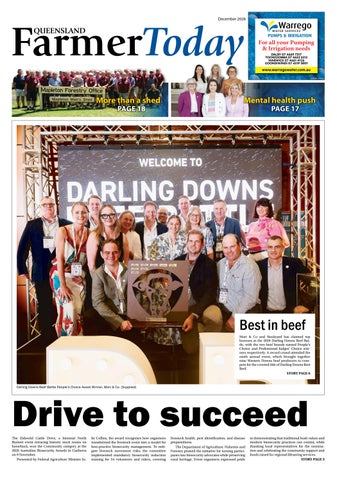
Best in beef Mort & Co and Stockyard has claimed top honours at the 2026 Darling Downs Beef Battle, with the two beef brands named People’s Choice and Professional Judges’ Choice winners respectively. A record crowd attended the ninth annual event, which brought together nine Western Downs beef producers to compete for the coveted title of Darling Downs Best Beef. STORY PAGE 6
Darling Downs Beef Battle People’s Choice Award Winner, Mort & Co. (Supplied)
Drive to succeed The Eidsvold Cattle Drive, a biennial North Burnett event retracing historic stock routes on horseback, won the Community category at the 2026 Australian Biosecurity Awards in Canberra on 9 November. Presented by Federal Agriculture Minister Ju-
lie Collins, the award recognises how organisers transformed the livestock event into a model for best-practice biosecurity management. To mitigate livestock movement risks, the committee implemented mandatory biosecurity induction training for 54 volunteers and riders, covering
livestock health, pest identification, and disease preparedness. The Department of Agriculture, Fisheries and Forestry praised the initiative for turning participants into biosecurity advocates while preserving rural heritage. Event organisers expressed pride
in demonstrating that traditional bush values and modern biosecurity practices can coexist, while thanking local representatives for the nomination and celebrating the community support and funds raised for regional lifesaving services. STORY PAGE 3
INSIDE
NEWS QueenslandFarmerToday.com.au
BEEF AWARDS ..................................... page 6
Barley seed identified as potential carrier
PROPERTY NEWS ................................ page 9 WOMEN IN AGRICULTURE ......... pages 16-17 MEN’S SHEDS ................................... page 18 TSBE UPDATE ..................................... page 24 OPINION ............................................. page 27 MARKET ROUND-UP .......................... page 28 SPORT ..................................pages 26, 29-32
DAM LEVELS Beardmore: .......................................... 101.05% Bjelke-Petersen: ..................................... 97.33% Borumba: ............................................. 100.06% Boondooma: ........................................ 102.94% Cedar Pocket: ....................................... 101.04% Chinchilla Weir: .................................... 117.46% Coolmunda: ......................................... 100.08% Leslie: .................................................... 82.68%
UniSQ researcher Dr Noel Knight is investigating the potential for fungicide-resistant net blotch to spread between crops and seasons through infected barley seed. (Supplied)
Paradise: ............................................. 103.42% Somerset: .............................................. 78.08% Wivenhoe:................................................. 84.5%
CONTACT US
Address: 154-156 Haly Street Kingaroy 4610 Telephone: 07 4182 0450 Website: QueenslandFarmerToday.com.au CONTACT US Editorial: Fiona Gowers Editor E: fiona.gowers@QueenslandFarmerToday.com.au Advertising: Lynda Crombie Sales & Marketing E: lynda.crombie@QueenslandFarmerToday.com.au P: 0407 152 967 David Moon Sales & Marketing E: david.moon@BurnettToday.com.au P: 0408 813 296 Jemma Wilson Sales & Marketing E: jemma.wilson@BurnettToday.com.au P: 07 4182 0458 Gayle Hopes Sales & Marketing E: gayle.hopes@TodayNewsGroup.com.au P: 0421 655 138
Queensland Farmer Today is published monthly and part of the Today News Group. Published by South Burnett Today Pty Ltd ACN 641 796 349. Publisher: Daniel Pelcl P: 0408 956 830 Managing Director: Daniel Pelcl. All material is copyright to South Burnett Today Pty Ltd. All significant errors will be corrected as soon as possible. For our terms and conditions please visit QueenslanFarmerToday.com.au/terms-and-conditions/ 2 TODAY December 2026
Warning on net blotch By Fiona Gowers Barley growers should consider seed source when managing net blotch, after University of Southern Queensland (UniSQ) researchers found fungicide-resistant forms of the disease can be carried on seed and transferred to emerging seedlings. The research provides evidence of a previously unrecognised pathway for fungicide resistance to move between crops and seasons, highlighting the potential for infected seed to introduce disease risk at the beginning of a new growing season. Researchers tested 16 barley seedlots sourced from grower fields across the Darling Downs, detecting net blotch pathogen DNA in 13 of them. The team also investigated whether the seed carried markers associated with decreased sensitivity to fungicides, an emerging concern for Queensland barley growers. To further investigate the risk, researchers planted one of the higher-risk seedlots and monitored the resulting seedlings. The same reduced fungicide-sensitivity types detected on the seed were subsequently identified in net blotch lesions on the seedlings, providing evidence that fungicide-resistant net blotch can move from seed into the next crop. Lead researcher Dr Noel Knight said the findings introduced another consideration for growers managing the disease. “Seed isn’t just planting material,“ he said. “It can be a disease-management decision. “Growers rely on a combination of varietal resistance, inoculum management and fungicides to manage net blotch, but our research suggests seed source should also be considered when managing disease risk.” Net blotch can reduce barley grain yields by 10 to 40 per cent, with losses exceeding 40pc reported during severe outbreaks. The disease poses a significant threat to an industry contributing approximately $190 million annually to the Queensland economy. Dr Knight said fungicide resistance was becoming an increasing concern as reduced sensitivity to important fungicide groups emerged in net blotch populations. “If growers are doing everything recommended to manage disease but unknowingly plant seed carrying both the pathogen and reduced fungicide sensitivity, they could be introducing
Barley leaves showing symptoms of net blotch. additional disease risk at the start of the season,” he said. The findings do not change existing disease management recommendations, which include choosing less-susceptible barley varieties, reducing disease inoculum and rotating or mixing fungicides. However, the researchers suggest seed source could be another factor growers consider when assessing disease risk. Three of the 16 seedlots tested had no detectable net blotch, indicating lower-risk seed may be identifiable. Researchers said seed testing could help growers make more informed disease-management decisions, although testing for net blotch and fungicide resistance on seed is currently unavailable. Dr Knight stressed that further research and testing were needed to establish how widespread the issue is, how frequently it occurs across seasons and how environmental conditions influence seed-to-seedling transmission. “There is more work to do before we might fully understand the significance and impact of seedborne fungicide resistance,” he said. “Rather than sounding the alarm, we’re adding another piece to the puzzle and giving growers another consideration to manage disease risk.” The research was conducted by Dr Noel Knight, Dr Barsha Poudel and Professor Levente Kiss at UniSQ’s Centre for Crop Health through the Broadacre Cropping Initiative, a joint investment by UniSQ and the Queensland Department of Primary Industries.
Barley seed could carry fungicide-resistant disease into next crop, UniSQ researchers have found.
A year of challenges, change and achievement As we prepare to close the book on another year, we reflect on the stories that have shaped Queensland agriculture throughout 2026. Queensland Farmer Today began the year with a timely warning from prominent potato and cattle producer Trevor Hall, who highlighted the growing pressure of shrinking farmgate margins and a lack of supply chain transparency. Weather, as always, played its part. Central Queensland’s cotton industry moved from a season of zero water allocations to renewed optimism following significant rainfall, demonstrating once again the resilience required to farm in an unpredictable climate. Our pages also captured the strength of regional voices, from farmers and the “Knitting Nannas“ campaigning for government commitments to be honoured, to the growing importance of Eromanga in Australia’s fuel security conversation. There were positive developments, too, with a landmark community benefits agreement for the Goombi Wind Farm highlighting the opportunities for regional communities as Queensland’s energy landscape evolves. On the industry front, our producers gave us plenty to celebrate. Queensland competitors dominated the Paddock to Palate weight gain competition and the Ekka’s Prime and Feeder cattle championships, while Santa Gertrudis beef earned national recognition for its eating quality. We also celebrated regional innovation, with Dalby’s Midwest Fabrication earning international recognition and South East Queensland cattle producer Christophe Bur exploring artificial intelligence to reduce farm administration. A big thank you to everyone who has shared their stories with Queensland Farmer Today throughout 2026. We wish our readers, contributors and advertisers a safe and happy Christmas and look forward to reporting more good news stories in 2027.
- Fiona Gowers
QueenslandFarmerToday.com.au
NEWS
Accolade for cattle drive By Julian Lehnert The Australian government recognised a North Burnett event for its “significant contributions to biosecurity“ at an awards ceremony in Canberra. Federal minister for agriculture, fisheries and forestry Julie Collins was one of several Commonwealth representatives to attend the 2026 Australian Biosecurity Awards ceremony at Canberra’s National Arboretum on 9 November, commending the Eidsvold Cattle Drive for its commitment to biosecurity outcomes with a win in the awards’ ’Community’ section. The Eidsvold Cattle Drive, a biennial event where participants retrace historic stock routes in the North Burnett by driving cattle through the region on horseback, was one of 12 winners across the 2026 awards’ nine categories. “The Eidsvold Cattle Drive has become a powerful example of how community-led initiatives can strengthen Australia’s biosecurity system while preserving regional heritage and supporting rural communities,“ the federal government’s Department of Agriculture, Fisheries and Forestry wrote of the award-winning North Burnett event. “Recognising the potential biosecurity risks associated with livestock movements, the organisers developed a comprehensive biosecurity framework that has transformed the event into a practical demonstration of best-practice biosecurity management,“ a Department spokesperson continued. “Through this approach, the organisation has turned participants into active biosecurity advocates while helping strengthen community understanding of biosecurity obligations and responsibilities. “A key strength of the initiative is its focus on education and behavioural change. Biosecurity training is mandatory for participants, with 54 volunteers and riders completing comprehensive induction programs covering personal biosecurity obligations, livestock health, pest identification
and disease preparedness. “By embedding biosecurity requirements into every stage of the event, Eidsvold Cattle Drive has successfully normalised biosecurity practices and demonstrated their importance within everyday livestock operations. “[T]he organisation has created an innovative model that promotes biosecurity awareness and preparedness across regional Queensland,“ the Department wrote of the Eidsvold Cattle Drive. Minister Collins congratulated the North Burnett event’s committee and the other 11 winners for championing biosecurity across Australia. “The achievements of all award winners demonstrate the critical role individuals, communities and organisations play in maintaining Australia’s world-leading biosecurity system and protecting our agriculture, environment and way of life,“ she said. A spokesperson for the Eidsvold Cattle Drive said the event’s organisers were “incredibly proud“ to receive the award, thanking Flynn MP Colin Boyce, Member for Callide Bryson Head, and North Burnett Regional Council councillor Trina Vaughan for nominating the committee for the award. “The award recognises the importance of bringing together our rural community, preserving our rich Australian stock route heritage and demonstrating that traditional bush values and modern biosecurity practices can go hand in hand,“ the committee’s spokesperson said. “We are so proud of what the Eidsvold Cattle Drive represents, from the incredible volunteers, riders, landholders and supporters to the funds raised for our regional communities and lifesaving services.“
Molly Belz from the Eidsvold Cattle Drive went to Canberra to accept a national biosecurity award for the North Burnett event. (Supplied)
12912833-MS48-26
December 2026 TODAY 3
NEWS QueenslandFarmerToday.com.au
Total Australian winter crop production forecast 2026/27. (Rabobank)
Winter crop falls 47.6pc By Fiona Gowers and Rabobank Queensland’s winter crop production is forecast to fall 47.6 per cent this season to 2.03 million tonnes, according to Rabobank’s 2026/27 Australian Winter Crop Forecast. While Australia’s overall winter harvest is expected to be down on last year’s bumper crop, production is forecast to remain at historically high levels, with total volumes estimated at 62.9 million tonnes. This would be 7.9pc below last season’s harvest – the second largest on record – but still 2.6pc above the five-year average, the specialist agribusiness bank said. Report lead author and RaboResearch senior grains and oilseeds analyst Vitor Pistoia said the forecast reflected mixed production results across Australia this year due to “sharply contrasting seasonal conditions”. “Production is more concentrated in southern and western regions of the country this year,” he said. “Below-average rainfall across the northern east coast is expected to reduce output in Queensland and New South Wales. “By contrast though, favourable moisture levels and strong yields are supporting production increases in South Australia and Victoria. “For Western Australia, mixed seasonal conditions have driven year-on-year production declines, although the state’s output still remains above the historical average. “And the WA cropping season has been marked by warmer-than-average conditions and minimal frost damage.” Overall, Mr Pistoia said declines in grain and oilseed production this year on the eastern seaboard – along with the nation’s overall lower wheat volumes – had failed to outweigh strong crops in South Australia and Victoria. Wheat, barley and pulse production are all forecast to be lower than last year, while canola volumes are expected to increase. Rabobank said the 2026/27 crop forecast came amid generally firmer grain prices, primarily due to geopolitical disruptions to global export availability. However, grower margins continued to be 4 TODAY December 2026
“compressed” by high fertiliser, diesel, agrichemical and freight costs. Wheat Australian growers are expected to deliver a total of 31 million tonnes of wheat to bins this harvest, down 13.3pc on last year and 9.7pc below the five-year average. Mr Pistoia said a decline in wheat production in Queensland, New South Wales and Western Australia this year would be partly offset by above-average production in South Australia and Victoria. The price outlook for Australian wheat was being supported globally by Black Sea shipping disruptions and locally by the potential impacts of El Niño, the Rabobank report said. “The global wheat market is moving into 2027 with adequate supply, but reliable export availability is becoming a price driver,” Mr Pistoia said. “Disruption to Black Sea ports and shipping routes has reduced wheat trade and increased maritime trade costs, despite combined Russian and Ukrainian production remaining above the five-year average.” The report said this disruption improved Australia’s freight advantage into Asia, given the country’s much shorter sailing times. This should support local port prices relative to overseas benchmarks, Mr Pistoia said, while the local east-west supply imbalance might also encourage grain movements from Western Australia and South Australia to eastern states livestock markets. “El Niño has already influenced 2026/27 wheat production on the northern east coast and further impacts in 2027 could create the market separation that was seen between 2018 and 2020, when grain moved from WA and SA to eastern Australia to supply the livestock sector,” he said. “This points to a potentially stronger eastern Australian wheat basis in 2027.” Barley Rabobank forecasts Australia’s barley production to reach 16.5 million tonnes this harvest. While this represents a decline of 1.2pc on last year, it would still be 16.8pc above the five-year average, making it the country’s second-largest barley crop on record, Mr Pistoia said.
RaboResearch senior grains and oilseeds analyst Vitor Pistoia. (Supplied) Abundant supply was likely to pressure barley prices at harvest, he noted, before exports supported an expected recovery in the first quarter of next year. “Higher US corn prices, lower European cereal production and global shipping disruptions are improving barley’s competitiveness as a feedgrain globally,” he said. “And if the impacts of El Niño reduce east coast sorghum production in Australia and tighten domestic feed-grain supply, east coast barley prices could rise above international parity, allowing other Australian port zones to supply more of the country’s export program and improving price baseline.” Canola Going against the trend seen in other Australian winter crops this year, canola production is forecast to rise to record levels. Rabobank expects canola volumes to increase 5.3pc to 8.1 million tonnes, which would be
15.5pc above the five-year average. Mr Pistoia said Western Australia was set to account for 59pc of this season’s national canola output, supported by a 41pc increase in the area planted to canola in the state. The outlook for global oilseeds remained supportive of canola prices, he said. “Growth in global consumption of oilseeds is expected to outpace production,” Mr Pistoia said, “while stronger biofuel demand should reduce stocks and support canola prices.” Pulses Australian pulse production is projected to shrink 12.9pc on last year to 5.5 million tonnes. This would still be 25.3pc above the five-year average, Rabobank said. Overall, ample global supply of pulses was capping prices, Mr Pistoia said. However, constraints in chickpea production – including a smaller Australian crop – supported a price premium over other pulses.
QueenslandFarmerToday.com.au
NEWS
Stepping up water security By Fiona Gowers The appointment of Queensland Water Resources to advance the proposed Emu Swamp Dam has been hailed as a “significant step“ towards improving long-term water security for Stanthorpe and the Granite Belt. The Crisafulli Government has appointed the company to progress the proposal, which aims to provide an additional water source for the region, supplementing Storm King Dam – Stanthorpe’s primary water supply – particularly during prolonged drought. The work will build on previous investigations, review key challenges and examine the most practical pathway forward for the project. It will also consider Emu Swamp Dam within the broader Southern Downs water-security system, including how existing and future infrastructure could work together to strengthen supplies for the town and surrounding agricultural industries. Minister for Water Ann Leahy said the Government was committed to progressing the project after funding was withdrawn by the former Labor Government. “The former Labor Government shelved Emu Swamp Dam and withdrew the funding for it,“ she said. “But the Crisafulli Government, we are committed to making sure we have water security for regional communities like Stanthorpe. “The Crisafulli Government, we are backing regional communities with more water security and that’s why we’re progressing Emu Swamp Dam because this will help into the future to make sure that there is water security for agriculture across this region and also to make sure they have water security during drought periods.for the community of Stanthorpe.” Member for Southern Downs James Lister said the region could ill afford to experience another water crisis, following the devastating drought that left Stanthorpe and its horticultural industry without water for an extended period.
Member for Southern Downs James Lister, Minister for Water Ann Leahy and Queensland Water Resources Managing Director Kevin McAlpine celebrate the advancement of the proposed Emu Swamp Dam project. (Supplied) “We know that Stanthorpe and the Granite Belt actually run out of water,“ he said. We must never let that happen again. “And today’s announcement - the opening of this office - is a vital step in securing new water for
the Granite Belt and Stanthorpe for our farmers and for the town. “I’ve been advocating for this for a decade, so I’m very grateful to Minister Ann Leahy and the Crisafulli Government for the announcement of
the appointment of this contractor to do the work in resurrecting the Emu Swamp Dam. “It’s something that the Labor Government cut, they took the funding away and learnt nothing from the previous drought. So I want to thank the Crisafulli Government and Minister Ann Lay for this wonderful announcement.” Mr Lister said securing additional water supplies was vital for both local farmers and the wider community. Queensland Water Resources Managing Director Kevin McAlpine said the company was honoured to be involved in the project and recognised its importance to the region. “We’re honoured to be the proponent of the Emu Swamp Dam,“ he said. “This project has been on the cards for a number of years and it’s absolutely critical for the people of Stanthorpe and the Greater Southern Downs District. “We believe we can take this project forward and deliver this critical piece of infrastructure” The initiative forms part of the Crisafulli Government’s broader investment in drought resilience across the Southern Downs, including upgrades to surrounding water treatment systems and Leslie Dam. The Government’s Watertight Water Security Plan is also intended to strengthen Queensland’s water capacity and provide greater certainty of supply into the future. For the Granite Belt, where horticulture and other agricultural enterprises depend on reliable water supplies, the proposed dam represents a potential additional source of water to help support production, regional growth and resilience during dry periods. Further information about the Emu Swamp Dam proposal is available at www.dlgwv.qld.gov. au/water/consultations-initiatives/drought-resilience-southern-downs.
FARMFORCE Post Driver
Australia’s Toughest & Most Versatile Post Driver
Australian Made, in QLD
Hydraulic Post Drivers from
Specialising in heavy-duty Post Drivers for all purposes, including Exclusion Fencing and Vineyards.
$10,120
Rock Spike & Hydraulic Auger options available. 3 Years Warranty
inc GST
07 5442 1915 0408 883 652
www.farmforce.com.au farmforce@live.com 12884664-JV31-26
December 2026 TODAY 5
NEWS QueenslandFarmerToday.com.au
Brad Tresidder and Andrea Crothers.
Stephen O’Brien and Ian Macfarlane.
Matt Jaggar and Jayde Falvo.
Matt Wainwright and Kelli McDougall.
Top honours to Mort & Co By Fiona Gowers Mort & Co and Stockyard has claimed top honours at the 2026 Darling Downs Beef Battle, with the two beef brands named People’s Choice and Professional Judges’ Choice winners respectively. A record crowd attended the ninth annual event, which brought together nine Western Downs beef producers to compete for the coveted title of Darling Downs Best Beef. Hosted by Toowoomba and Surat Basin Enterprise (TSBE) at Toowoomba Wellcamp Airport, this year’s event showcased the strength of the Darling Downs grain-fed beef industry and the region’s export capabilities. TSBE chief executive officer Jo Sheppard said the event was a great illustration of the region’s exceptional export potential, supported by wellestablished infrastructure. “This year, the Darling Downs Beef Battle united the entire supply chain, from producers to processors and created an opportunity to come together to spotlight and celebrate our region’s leading beef brands,” Ms Sheppard said. “Our region is home to 65 per cent of Australia’s beef feedlot industry, generating $1.4 billion a year for our local economy. “The night was a fabulous showcase of our region’s world-class beef.” Two awards were presented on the night, with Mort & Co winning the People’s Choice Award, voted by the crowd, while Stockyard was named Professional Judges’ Choice winner following assessment by an exclusive panel of judges. The nine participating producers were Bow Creek Food & Agribusiness, NH Foods, Mort & Co, Camm Agricultural Group, Stockyard, John Dee, Stanbroke, JBS and King River. Gallagher was the event’s major sponsor, with TSBE also acknowledging the support of its valued sponsors across a diverse range of industries.
Emily Pullen, Lisa Sharp and Edward Pullen. (Supplied)
Clarissa Crothers-Stumps, Michelle Forbes and Kellie Banditt.
John Wagner, Francesca Wagner, Yolande Woods and Brue Woods. 6 TODAY December 2026
Sheldon Rogers, Denis Wagner and Jo Sheppard.
Representatives from Bow Creek Agricultural Foods.
Sally Scott and Geoff McDonald.
QueenslandFarmerToday.com.au
NEWS
Howlett leads the growers By Liam Hauser The inaugural board for the Australian Peanut Growers Industry Group was established on 16 November, as the group held its annual general meeting at the Department of Primary Industries building in Kingaroy. About 70 people attended, including some via video conference as there was a mix of growers, processors, support organisations and individuals wishing to see a thriving peanut industry in Australia. The inaugural chairperson of the Australian Peanut Industry Group, Peter Howlett, was elected unanimously as president. He also spoke about the issues facing the industry, and his vision to revitalise the peanut sector in this country. Mr Howlett said the Australian Peanut Industry Group could represent the industry to all levels of government, and to organisations like Grains Research and Development Corporation. “Growers, processors, industry, individual supporters and our local government were all represented, and all agreed that revitalising the peanut industry is not only essential for growing areas like Kingaroy, but to the state in general,” Mr Howlett said. “What has happened to the peanut industry over the last 20 years should be a wake-up call to all other ag sectors, and now the Australian Peanut Industry Group has the potential to show other sectors how to reverse that decline and thrive again.” Mr Howlett said the Australian Peanut Industry Group board would meet in early December to start dealing with the process of bringing the industry back from its current levels. “This is not a short-term fix: it’s not a magic bullet that will suddenly fix the industry,” he said. “We have over 20 years of decline to recover from and that will need careful planning and a sound strategy to correct the sector. “That is what the board will be focusing on – as well as the issues currently facing growers.”
Newly elected board members Ben Campbell, Sonie Crumpton, Ben Rackemann, Andrew Seabrook, David Birch, Janelle Reeves, Ros Rackemann, president Peter Howlett and Damian Andersen. (591165)
MAZDA
BT-50 PLATE CLEARANCE BOOK YOUR TEST DRIVE SP model shown. Image for illustration.
XS SINGLE CAB
XT CAB CHASSIS
SP DUAL CAB
4x2 Cab Chassis | Auto
Dual Cab | Auto
4x4 Pickup | Auto
DRIVEAWAY FROM
DRIVEAWAY FROM
DRIVEAWAY FROM
$39,990
*
READY TO GET TO WORK
(07) 5480 5588 gympiemazda.com.au 2 Laurenceson Road, Gympie
$57,490
*
INCLUDES GENUINE ALLOY TRAY
$69,990
*
+ $3,000 CASHBACK^
SCAN TO EXPLORE THE BT-50 RANGE Find your next BT-50 today.
*Driveaway prices apply to the models shown and include registration, CTP, stamp duty and dealer delivery. Premium paint extra on XS and XT; included on SP. ^Cashback applies to selected 2026-plated SP stock while stocks last. It is applied as a reduction in the purchase price at sale, not paid in cash. Private and business buyers only. Excludes fleet, government and rental buyers. Not combinable with other offers unless stated. Offers subject to change. Image is illustrative. Contact Gympie Mazda for stock availability, eligibility and full terms. Prices and offers checked 10 November 2026. 12917460-MS48-26
December 2026 TODAY 7
NEWS QueenslandFarmerToday.com.au
RFDS marks big milestone The Royal Flying Doctor Service (Queensland Section) is celebrating 30 years of delivering mental health care to regional, rural and remote communities, with its service now the largest of any Royal Flying Doctor Service section in Australia. Last financial year, RFDS mental health and wellbeing teams across Far North and Western Queensland - together with the service’s headspace Cairns team - delivered 13,415 consultations. The service has grown from a single clinician when it began in 1996 to a multidisciplinary team of 55 staff, providing specialised mental health support to Queenslanders who often face significant barriers to accessing care. Outreach clinicians fly and drive from bases in Longreach, Charleville, Mount Isa and Cairns to communities including Lockhart River, Cooktown, Weipa, Kowanyama, Normanton, Mornington Island, Camooweal, Winton and Birdsville. Clinicians often spend several days in each community to provide mental health care closer to home. RFDS (Queensland Section) General Manager - Mental Health Dr Tim Driscoll said the 30-year milestone was significant for the organisation and the communities it served. “Over the past 30 years, we’ve had the privilege of supporting thousands of people across regional, rural and remote Queensland through some of the most challenging periods of their lives,” Dr Driscoll said. “It’s important work, because people in regional, rural and remote communities deserve the same opportunity to access quality mental health care as anyone else.” Dr Driscoll said distance continued to present a major barrier to accessing services outside metropolitan centres. “Access to services remains a challenge for many people outside major centres. “Where you live should not determine your access to mental health care. For many people in
RFDS Manager - Central West and Outback Mental Health, Donna Ross delivers mental health and wellbeing services to a rural and remote community member. (Supplied) regional, rural and remote Queensland, distance remains a barrier. “That’s why the Flying Doctor is committed to bringing support closer to home.“ The RFDS mental health service began in 1996 following a Commonwealth-funded feasibility study exploring projects of national significance. After receiving endorsement, the service was initially delivered by clinical psychologist
Robert Williams. Dr Driscoll said the development of the service over three decades had significantly improved the capacity to deliver specialised support in remote communities. “Thirty years ago, the idea of accessing specialised mental health support in some of Queensland’s most remote locations was far less achievable than it is today,” Dr Driscoll said.
“What began in 1996 with a single clinician delivering mental health services has grown into a multidisciplinary team providing thousands of consultations each year.” About one in five rural and remote Australians experience a mental illness each year. While data suggests rates are similar in major cities, access to mental health services differs significantly in rural and remote areas, highlighting the importance of the support provided by the RFDS in Queensland. Dr Driscoll said community attitudes towards mental health had also changed considerably over the past 30 years, with more people recognising the importance of seeking help. “While much has changed over the past three decades, one of the most encouraging shifts has been the way people talk about mental health,“ he said. “More Queenslanders are seeking support early, having open conversations and recognising that looking after their mental health is just as important as looking after their physical health. “This anniversary is an opportunity to celebrate the dedication of our staff and the resilience of the communities we’ve served over the past 30 years. “We are proud to have worked alongside Queenslanders to support their mental health and grateful for the trust they continue to place in us.” Looking ahead, Dr Driscoll said the organisation remained committed to improving access to timely, high-quality and culturally-appropriate mental health care across the state. “As we look to the future, our focus remains on ensuring every Queenslander remains in reach of care. “We are determined to keep improving access to mental health care, working towards a Queensland where everyone, wherever they live, can receive timely, high-quality and culturally appropriate care close to home.“
Entries are now open for the 2027 RNA Paddock to Palate Competition. (Supplied)
RNA Paddock to Palate competition entries open
12917031-CV48-26
Any tarp related questions? Feel free to contact us on: 1300 656 211 (All Hours) info@abctarps.com.au www.abctarps.com.au Queensland Agent: Colin 0419 198 569 8 TODAY December 2026
abctarps
Entries are now open for the 2027 RNA Paddock to Palate Competition, with one of Australia’s leading beef supply chain competitions preparing to celebrate its 30th anniversary. Offering more than $63,000 in prize money across five classes, the competition provides beef producers with an opportunity to benchmark their cattle and assess performance from paddock to plate. First judged in 1998, Paddock to Palate has continued to grow, attracting a record 1300plus head of cattle from across Queensland and New South Wales in 2026. RNA Beef Committee Chair Gary Noller said the competition assessed cattle across the supply chain, from paddock performance and feedlot efficiency through to carcase quality and consumer taste testing. “The competition allows exhibitors to gain access to objective performance data, enabling them to refine genetics, improve herd productivity, and validate breeding strategies,” he said. “It provides exhibitors with a unique platform to benchmark their cattle, elevate their brand, and gain exposure to processors, buyers, and consumers.
“Exhibitors receive detailed feedback that supports breeding, feeding, and marketing decisions.” The competition begins with the best aggregate weight gain phase at the JBS Beef City feedlot, west of Toowoomba, before progressing to carcase assessment and an MSA eating quality competition. Exhibitors achieving the highest combined scores across all three phases will be recognised at the Paddock to Palate Awards and Beef Industry Dinner during the 2027 Ekka Beef Week. The competition has also established a strong reputation with consumers, becoming the only beef competition in Australia to produce a commercial brand, JBS Royal 100. The annual release has become a soughtafter product among restaurants and butchers. Entries for classes 37, 38 and 40 are now open and close on Friday, December 4, 2026. Entries for the 2028 Wagyu Challenge, covering classes 39 and 41, will open in January 2027.
•
•
QueenslandFarmerToday.com.au
NEWS
The Howe family farm encompasses established citrus, avocado, lychee and sugarcane plantings, vertically-integrated coffee production assets and irrigated agriculture development sites. (Supplied)
Landmark titles on market By Fiona Gowers A landmark North Queensland horticultural portfolio spanning 1541 hectares across six farms on the Atherton Tablelands is for sale. It marks a significant milestone for one of the region’s most established agricultural families. Developed over more than seven decades by the Howe family, the portfolio encompasses established citrus, avocado, lychee and sugarcane plantings, vertically-integrated coffee production assets and irrigated agriculture development sites. Located in one of the world’s premier horticultural regions, the properties offer prospective buyers scale, water abundance and security, along with diversification across multiple agricultural commodities. The sale will be held through a flexible expression of interest process, allowing interested parties to bid on individual properties or the portfolio as a whole. It is an approach that provides multiple opportunities for prospective buyers, from family farming operations to institutional investors and businesses seeking strategic expansion. The sale represents an important chapter in the history of Howe Farming Group, established by Tom and Yola Howe in the early 1950s. What began as a small tobacco and vegetable operation near Mareeba has grown into one of the Atherton Tablelands’ most influential agricultural businesses. Under the leadership of second-generation farmer Dennis Howe OAM, the enterprise diversified into avocados, peanuts, bananas, coffee and citrus, becoming one of the region’s largest private employers and a recognised innovator within Australian agriculture. Indeed, few agricultural portfolios in Australia can claim to reflect the development of an entire region over the past 70 years. Following the passing of Dennis Howe in 2025, the family completed a strategic review of its substantial portfolio and elected to sell the selected properties to focus on its core enterprises. Elders Real Estate CEO Tom Russo said the portfolio represented a rare combination of agricultural scale, diversification and family legacy. “Opportunities of this calibre and significance are exceptionally rare,“ he said. “The Howe family has spent generations assembling, developing and improving a portfolio that reflects the evolution of agriculture across the Atherton Tablelands. “This is far more than a collection of farms. It is the culmination of more than 70 years of family stewardship, innovation and investment in one
A horticultural portfolio spanning 1541 hectares across six farms on the Atherton Tablelands in North Queensland is for sale. (Supplied) of Australia’s most productive horticultural districts.“ Mr Russo said the properties offered exposure to multiple high-value horticultural sectors, supported by established water infrastructure, processing capability and experienced local labour markets. “The portfolio provides exposure to multiple high value horticultural sectors while also offering significant operational scale and access to established water infrastructure, processing capability and experienced local labour markets.“ Howe Farming Chairman Ian Wilton said the offering marked an important moment for a business that had helped shape agriculture throughout the region. “The Howe family has been part of the fabric of the Tablelands for generations and these farms tell the story of that journey. “The Mareeba region on the Tablelands is the perfect location to innovate and establish a diverse portfolio of high value crops.“ He said the family had prioritised long-term sustainability and regional development in managing the assets and believed the portfolio offered
incoming investors a strong platform for future growth. “As custodians of these assets, the family has always focused on long-term sustainability and regional development. We believe the portfolio now presents incoming investors with an exceptional platform for future growth.“ Mr Wilton said the properties represented only part of the wider Howe Farming enterprise, with proceeds to be directed towards further development of the remaining portfolio. “This aggregation represents only a portion of the Howe Farming enterprise. Proceeds of the sale will be reinvested into further developing the remaining Howe Farming portfolio.” Among the portfolio’s key opportunities is its exposure to Australia’s developing coffee industry, including an established plantation and associated processing infrastructure. With more than 155,000 coffee trees and dedicated processing facilities, the portfolio includes one of the more significant integrated coffee assets currently available in Australia. Elders General Manager Farmland Agency and Agribusiness Investments Mark Barber said
the Australian coffee sector had reached an important point in its development. “Australia is one of the world’s most sophisticated coffee consuming markets, yet more that 95 per cent of the coffee consumed domestically is imported.“ He said changing consumer preferences were creating opportunities for Australian producers able to supply quality products with clear provenance and traceability. “Consumer preferences continue to shift towards traceability, provenance and premium quality products.“ These trends are creating opportunities for scaled Australian producers who can consistently supply high-quality beans and develop direct relationships with roasters and consumers.“ Mr Barber said the Atherton Tablelands was already recognised as Australia’s premier coffeegrowing region, with the portfolio offering investors an opportunity to enter a sector with significant domestic development potential. “The Atherton Tablelands has already established itself as Australia’s premier coffee growing region. December 2026 TODAY 9
NEWS QueenslandFarmerToday.com.au
Roma tops for RFDS, again Roma Woolworths has been announced as the top earning store for the Royal Flying Doctor Service fundraising campaign across Queensland for fifth year running, raising almost $6000 over the duration of the campaign. The Roma community’s support for the Royal Flying Doctor Service (RFDS) (Queensland Section) was celebrated with a trophy presentation in recognition of taking the top spot in the 2026 Woolworths in-store fundraiser for the fifth year in a row. It’s an initiative where locals are really helping locals. In 2025/26, the RFDS transported 444 patients from hospitals across the Maranoa Regional Council area, including 373 from Roma Hospital alone. RFDS Board Member and Ambassador Hon Bruce Scott AM said the Roma team and the community behind them should be incredibly proud. “Top fundraiser five years running says a lot about Roma. The weekly barbecues, $2 tokens and shopping round-ups, along with daily check-ins to keep everyone involved, show just how much this community cares about the Flying Doctor,” Mr Scott said. “In a region like the Maranoa, people appreciate how vital the RFDS is for the community, and almost everyone has been touched by the service in some way, shape or form.” “Where someone lives should not dictate the care they receive, and Roma is helping to ensure every Queenslander remains within reach of essential health services,” he said. Mr Scott was apart of the team running barbecues at front of the store which raised around 400 dollars each Saturday. He said many of the people he served shared personal experiences about how the RFDS has helped them or a close family member, showing just how much of a difference the service makes locally and around Australia. Mr Scott presented the team with a trophy at Woolworths Roma, joined by RFDS pilot Mat-
The Royal Flying Doctor Service pilot Matthew Joppich and board member Bruce Scott AM, with Woolworths staff. thew Joppich. The partnership between Woolworths and the RFDS (Queensland Section) is now in its 11th year and has raised more than $3.6 million for frontline services across regional, rural and
remote Queensland. This year the campaign raised a total of $150,941. When this year’s campaign launched in July, Woolworths Community Partnership Manager Loretta Arrastia said the company was incred-
ibly proud of its long-standing partnership with the RFDS. “The generosity our customers show during this annual appeal is always inspiring,” Ms Arrastia said.
Weed Spraying Equipment Starting from $590 Australia’s most extensive range of weed spraying equipment to suit any application. Australian-made and built for durability, lasting longer than the industry average.
Fire Fighting Units: Slip On & Skid Mounted Units - Starting From $5500 Built tough for Australian conditions and designed to perform when it matters most. Protect your property during fire season with a reliable, easy-to-use firefighting solution. Be fire-ready at a moment’s notice.
Shoppers were encouraged to purchase two dollar tokens which helped raise funds for the Royal Flying Doctor Service.
BOBCAT Tractors Starting from $30,990 Backed by Bobcat’s 24-Month / 1,500-Hour Warranty and extensive dealer support network.
TYM T1003 - CAB Tractor Starting from $90,000 99.5HP Perkins Diesel Engine delivering proven reliability, fuel efficiency and the power to handle tough farming and commercial workloads. AirConditioned Premium Cabin featuring suspension seat, ergonomic controls and all-day comfort for long hours in the field. Heavy-Duty 3,110kg Lift Capacity with 32x32 Power Shuttle Transmission for effortless operation, maximum productivity and versatility with a wide range of implements.
Call us today to chat with one of our friendly team:
(07) 5356 3000 See our full range on our website triotowing.com.au Locations include Gympie, Hervey Bay and Gladstone. Wherever you are in Australia, we can deliver to you! 12908362-CV44-26
10 TODAY December 2026
Barbecues were held outside Woolworths to raise essential funds for the RFDS.
QueenslandFarmerToday.com.au
NEWS
Rabobank’s new leader Rabobank has appointed agribusiness banking specialist Rupert Backus to lead its Dalby, Goondiwindi and Roma teams, strengthening the bank’s focus on supporting farming clients and regional communities across the Western Downs and South West Queensland. Mr Backus brings 16 years of experience in agribusiness and commercial banking, including leadership roles across Queensland, along with a strong background in agriculture and regional communities. Rabobank Queensland State Manager Polly Saraiva said his leadership experience and practical understanding of the agricultural sector made him well suited to the role. “Rupert is an experienced leader who understands the importance of empowering teams, developing people and maintaining strong connections with the agricultural sector,” Ms Saraiva said. “His leadership capability - combined with his practical industry experience - positions him well to guide our local teams and help deliver meaningful outcomes for clients across the region.” Mr Backus said he was “excited and proud” to lead the three regional teams and looked forward to building relationships with clients and communities. “Rabobank has experienced and highly skilled people based in these communities and I’m looking forward to working alongside them to understand what matters most to local producers,” he said. Mr Backus’s career in agribusiness banking followed earlier work with agricultural chemicals and crop protection company Nufarm, where he worked across New South Wales, Queensland and the Northern Territory. Having grown up around feedlots in New South Wales and Queensland and worked on remote cattle stations, Mr Backus said he had a “genuine connection” to Australian agriculture and the regional communities it supports. “Agriculture has shaped my career and I un-
Agribusiness banking specialist Rabobank has appointed Rupert Backus to lead its Dalby, Goondiwindi and Roma teams. (Supplied) derstand the importance of trusted relationships, local knowledge and practical support,” he said. “Helping farming families and rural communities thrive is incredibly rewarding.” Mr Backus said Rabobank’s long-term commitment to agriculture, along with its support for local events and initiatives across the Western Downs and South West Queensland, were key attractions to joining the bank. “Rabobank specialises in agriculture and takes a long-term view,” he said. “Clients also benefit from research and analysis tailored to their sectors, backed by a deep understanding of agricul-
tural cycles and the opportunities and challenges facing farming businesses.” He said producers across the region were continually looking for ways to strengthen their operations and position their businesses for the future. “There is a real sense of energy and resilience across the region, driven by producers who embrace innovation, adapt to changing conditions and support one another,” he said. “I’m looking forward to listening to producers, understanding their priorities and working with our local teams to help farming businesses build
on their strengths and pursue new opportunities.” Mr Backus succeeds outgoing area manager Troy Frizzel, who is moving into a new position with the bank as a senior Major Agribusiness Client manager for Queensland. Ms Saraiva thanked Mr Frizzel for his dedication, leadership and work over the past two years leading Rabobank’s Roma, Dalby and Goondiwindi teams. “We are excited to see Troy move into a new role with the bank and we thank him for his contribution to clients and colleagues across the region,” she said.
International Nurse Bachelor of Nursing
We all start somewhere. From wherever you are, UNE can take you there. UNE.EDU.AU/STUDY
CRICOS Provider Number 00003G | TEQSA Provider Code PRV12054 Australian University
Lexi Support Worker
12917570-JO48-26
December 2026 TODAY 11
NEWS QueenslandFarmerToday.com.au
Rosie Lloyd-Giblett with her paintings depicting wattle and grevillea, for which she drew inspiration from the Myall Park Botanic Garden near Glenmorgan.
Rosie Lloyd-Giblett in her studio with the Ode to Branch works that will be exhibited at Dogwood Crossing, Miles from 28 November to 30 January 2027.
Miles of art inspiration By Megan Long When she was growing up on a farm near Chinchilla, Rosie Lloyd-Giblett was always outside exploring nature. She has fond memories of the wattle blooming, the golden colour of the harvest and the freedom that a bush kid experiences. Now working as an artist, Ms Lloyd-Giblett reconnected with that feeling while creating her new exhibition, Ode to Branch, which opens at Dogwood Crossing, Miles on 27 November. Returning to the Western Downs to complete the works, she drew inspiration from Myall Park Botanic Garden near Glenmorgan, where she once attended open garden days during the 1970s and 1980s. Back then, she saw the garden as “just a celebration of wildflowers, trees and nature”. Not only did Ode to Branch bring back that sense of childhood wonder, but it allowed Ms Lloyd-Giblett to help foster the same feeling in children who live in the region today. As part of the exhibition, she completed workshops with students from the four small Western Downs state schools of Glenmorgan, Hannaford, Meandarra and The Gums. Their environmental artworks form part of Ode to Branch, which Ms Lloyd-Giblett describes as focusing on the endemic trees of the region. Having been an arts educator for 30 years, she loves sharing knowledge and stories and was excited to work with the children as they discovered more about the birds and plants of the Western Downs. She said she loved having children involved as they often had stories of up-close experiences with nature. “Often in the scheme of education, there’s sometimes not enough time for children to get their hands dirty making art,” Ms Lloyd-Giblett said. “And especially when it’s about what they know. I think it’s really great to lean into that, to their own knowledge of living out in the western region.” Ms Lloyd-Giblett has never lost her own connection to nature. During creation of her works, she spends time walking in bushland, initially with a notebook in hand to make sketches and write down ideas. She also brings exhibition works on location. During her time at the Myall Park garden, she pinned work to trees or her ute as she observed her surroundings when visiting in May and August 2026. “I just sort of move around the landscape, noting seasonal change in the trees and the birdsong,” Ms Lloyd-Giblett said. This created a multi-layered approach, which she describes as “veils of time”, including layers of ink, charcoal and paint, using watercolour on paper and acrylic on canvas in different works. Ms Lloyd-Giblett said she was incredibly interested in birdsong as the animals travelled through the canopy, and she aimed to depict this in her art. She said this aspect of her work had been called “lyrical lines”, while much of the Ode to Branch series included the pinks and yellows of the Western Downs region’s flora. If you look a bit closer, there are finer details to discover, such as a spider’s web or a certain bird. Ms Lloyd-Giblett finished a project on her sister’s Goondiwindi region regenerative farm last 12 TODAY December 2026
Artist Rosie Lloyd-Giblett looks forward to opening Ode to Branch at Dogwood Crossing, Miles, after she grew up in the region on a farm near Chinchilla. (Catherine Anna Photography) year, which focused on the endangered painted honeyeater. That series looked at how the birds followed the mistletoe plant, which has also been captured in Ode to Branch. “I’ve learnt to look with more of an astute eye, so the mistletoe is there within the works too,” Ms Lloyd-Giblett said. Ode to Branch also includes sculptures using both balsa wood and cardboard. Many of the exhibition works capture Ms Lloyd-Giblett’s experiences of the Western Downs landscape as a child – from depictions of Chinchilla gums to tumbleweeds blowing across the paddocks and her favourite tree, the wattle. Ms Lloyd-Giblett said growing up she attended Chinchilla State School, before boarding at The Glennie School in Toowoomba as a teenager.
She always returned home to the family farm for the high school holidays and again when completing university, when she took up fruit-picking positions near Chinchilla. After university she worked as a teacher in Africa, then the Northern Territory and Cape York, before settling on the Sunshine Coast for about 25 years. For the past 15 years, she has used her own dedicated home studio to become more of an established artist, and she recently moved to Burleigh Heads. These days she completes residencies at different locations around Australia, which she said created the chance to explore the country and discover its different trees, ecosystems and birds. She describes her artistic practice as “treading
lightly, listening deeply to the landscape”, and she hopes she has inspired the children who took part in the exhibition and the wider community to do the same. She said Ode to Branch was a year-long project and she looked forward to bringing it to the people of the Western Downs and celebrating the beautiful landscape that surrounded them. “Queensland is such a vast, large state. The west seems a long way for city people but there’s so much beauty out there,” Ms Lloyd-Giblett said. Ode to Branch, showing in the John Mullins Memorial Art Gallery at Dogwood Crossing, Miles, will have an opening night on Friday 27 November, from 6.30pm to 8.30pm. The exhibition will run from 28 November to 30 January 2027.
Ethan Farmer
UNE.EDU.AU/STUDY
CRICOS Provider Number 00003G | TEQSA Provider Code PRV12054 Australian University
Scientist Bachelor of Zoology
12917546-JV48-26
December 2026 TODAY 13
RELIABLE PRODUCTS ... RELIABLE PEOPLE 12652295-AI48-23
Aussies Fert Pumps are a great success.
Aussie builds record number of Fire Chief Pumps. (Supplied)
Aussie best for fire, ferts By Aussie Pumps While Australia faces what is predicted to be the hottest summer ever, uncertain weather events are a great concern to farmers during harvest. “Frankly, the farmers we talk to every day don’t know whether we’re going to have a scorching summer or unexpected deluges, just when we don’t need it”, said Aussie Pumps Chief Engineer John Hales. Aussie Pumps is famous for the time and effort put into the design and production of both fire pumps and fertiliser pumps. “We started with the development of the Aussie Fire Chief, a revolution in firefighter pump design, as you can see clearly from looking at the big bowl on the front compared to the conventional units used in the past. A bigger bowl means a bigger impeller, a bigger impeller means more performance, more performance means safer firefighting!” said Hales. The Aussie fir chief hits the market We found that when we put steel skids and antivibration mounts under the pump, people were surprised that we would go to that much trouble. The flanged bolt on the suction port is 2” not 1.5”. It meant that we were able to provide 25% more flow than those products that were on the market already. We also put metal caps and chains on our three-way outlet so that they weren’t subject to scorching like the plastic ones are on competitors. “These upgraded components cost a little more but enabled us to provide a product that we would like to use if we were in a fire prevention situation”, said Hales. Farmers and volunteer firefighters, not to mention national parks and similar government departments, soon recognised the extra performance of the product and therefore a more effective way of fighting fires. “The Fire Chief is a winner and even we are astonished to find that, there is now up to 250,000 Fire Chief Pumps out there in the market. We never imagined that would happen”, said Hales. Aussie’s simple philosophy Here at Aussie Pumps, we have a very simple target. The aim is to provide Australian farmers with the best products we can possibly build. We started with fire pumps and went from the Fire Chief to the Fire Captain and then to our big Mr T Twin impeller units. We were also developing gusher pumps (high flow pumps) in either petrol or diesel configuration. One major facet of that Mr T is we’re able to change it into a 3” pump with the result that our performance figures went through the roof. Our charts show that with a Honda 13hp petrol engine, we can produce a flow of 200 litres a minute at 80 metres head. That even astonished us. The same thing applies with the Yanmar diesel engine version, where with 150 litres a minute flow, we can reach 80 metres head. Field day success When we started going to Field Days around the country with the products, we were delighted to see the way farmers recognised immediately that the bowl in the fire pump was bigger than anything else on the market. Our 3” transfer pumps were capable of producing 1000 litres a minute, and our 14 TODAY December 2026
JW Farm & Garden Equipment stocked up with Aussies range of fire pumps. big 4” pump, the QP402, was a revolution as farmers thought it was a firefighting pump. They were surprised when they saw how much volume it produced, 1600 litres per minute! “We’re astonished to think that we could get that out of a Honda GX 240 8 hp petrol engine. We learned a lot from those early field days about developing better products that really work”, said Hales. Aussie’s Fert fever Although we started with firefighting pumps and put our development work into that, it wasn’t long before we were able to introduce fertiliser pumps that would handle a wide range of agricultural chemicals. Developed with 2” and 3” configurations, the pumps were built based on the briefs we got from talking to farmers at Field Days. We found that we only needed to have a 2” and 3” pump body but could put a range of different impellers and volumes in to give different levels of performance. For example, our model RSE2BUV is a 2” pump with Viton elastomers, but in high head configuration. Thus, that 2” pump delivering over 600 litres a minute can deliver fertiliser at up to 37 metres head. These Aussie Fert Pumps, what we call our Smart Pump Range, are available in pedestal drive,
petrol or diesel drive and also hydraulic drive. Hydraulic motors are capable, compact and don’t need to be checked for fuel or lube every day. We’re seeing now a trend towards farmers wanting to use the hydraulics system of their headers or to put pumps onto the chaser bins with the 1000 litre water tank and a pump. We’re told that you can put out a fire before it gets really started during the harvest. More flow for Fert pumps The development of that 2” pump into a high head and flow impeller volute combination produced an even better result. Out of a 2” pump, we got 837 lpm flow and a max total head of 37 metres. These pumps will suck liquid from a six-metre vertical lift and do it all day every day! What’s our secret? “It’s no secret at all, it’s that the pump bodies are made from 30% glass filled polyester, a material developed by the NASA space program, and proved to be suitable for space operation, let alone the wilds of Australia”, said Hales. 3” VERSION The development of the 3” version in the same material, but with 3” ports and a significantly bigger pump bowl means a pump that does over 1000 lpm at maximum flow, and in its high head config-
uration (706 impeller), will provide heads of up to 25 metres. The 2” and 3” pumps will both achieve more flow at the sacrifice of some degree of head, and more head, at reduced flow. “Our illustrated charts tell the whole story”, said Hales. Why our dealers are gold “Top notch pump dealers across the country have all signed up with Aussie Pumps to sell the product line that is completely different to everything else on the market. We object to the cheap Chinese knockoffs that enter the market. In our view, they wind up as landfill, and we’re told almost every day by Australian farmers that they’d rather have a pump that works even if it costs a little more. When it comes to price, our prices have stabilised at $800 plus GST, ex-work Sydney, for the last 10 years. Only the best pump dealers in the business can formally be appointed Gold Distributors. By gold we mean that we know that they are loyal, knowledgeable, professional and the backbone of our whole distribution network”, said Hales. Our aim is simple- “Every farmer in the country can afford the best pump in the business”, said Hales. For more info on the pump range contact your local Aussie dealer or Aussie Pump at 02 8865 3500.
HAVE A GREAT
DECEMBER 2026
REWARD YOURSELF WITH AN AUSSIE!
– PRICES MUST RISE…BUY NOW –
– CHOOSE AUSSIE FIRE PUMP…STAY SAFE, STAY PROTECTED, STAY VIGILANT –
AUSSIE ULTRALITES 1” & 1½” 3 year Honda GX engine warranty Flows to 210 lpm Heads to 60m Suits fire protection & high pressure transfer Light weight
3” & 4” BRIGADE BOSS
1”version QP1/GX25 $611
VILLAGE PROTECTION PUMP Big Pressure Big Flow Electric start
1½” version QP154SX/GXH50 $850
NEW AUSSIE IMPOSTER FIRE CHIEF A single impeller pump that think’s it’s a twin. 90 metres head!
$990
50m head 1000 lpm 13hp
FROM
$6689
AUSSIE FIRE CAPTAIN MORE POWER
FROM
$1058
Honda 6.5HP GX200 with 3 year warranty Electric start version… (battery not included) Recoil version QP205SL/GX200FF QP205SL/GX200E JUST $1,988 SALE $1,058
High Pressure. High Head Honda petrol & Yanmar diesel options. FROM $3522
WORLDS BEST PORTABLE FIRE PUMP FROM Honda 5.5HP GX160
Essential reading for those living in high risk areas. QP205SE/GX160
AUSSIE QP TRASH PUMPS... FLOOD SPECIALISTS
2”, 3” & 4” AUSSIE GUSHERS... MOVE WATER FAST
QP402/GX240
NEW 2” 3” Honda 6.5HP Honda 4HP Flows to 1,000lpm Flows to 600 lpm QP303/GX200 QP-2/GX120 JUST $1,692 (electric start option avail) JUST $923
4” Honda 8HP Flows to 1,600lpm QP402/GX240 JUST $2,980
2” 3” & 4” 2.2kW - 15kW Ideal for effluent & wastewater transfer 3 year warranty, self-priming from 6m
2”, 3” & 4” self primers
3” QP301T/ GX240 Flows to 1200 lpm, solids to 1” Honda 8HP … $2,863
(electric start option avail)
6” Honda petrol & Yanmar diesel gushers also available
NEW 316 STAINLESS STEEL
FAST TO SET UP, EASY TO USE
2” QP203T/ GX160 Flows to 630 lpm, solids to 3/4” Honda 5.5HP … $2,379
$3522
$923
$880
FREE BUSHFIRE SURVIVAL GUIDE
$2379
FROM
FROM
Yanmar 4.8HP diesel options from only $4,339
Honda GX series engines, front opening port, handle solids contaminated water. Silicon carbide mech seals. Ideal for dirty water, site dewatering, efficient transfer, dam level management.
QPT305SLT
AUSSIE FIRE CHIEF Out-performs and out-features all others QP205SE/GX160 LIST PRICE $1181
RES CORROISSTS I AN ON ABRASDIO N
QPT205SLT/GX270
QP205SEHF
NEW MR T TWIN... FROM AUSSIE REAL PERFORMANCE WHOPPER $1188 Honda & Yanmar diesel options JUST
FROM
4” QP40T/ GX390E Flows to 1800 lpm, solids to 1.5” High Head High Flow Honda 13HP 2” x 2” electric start (battery not included)
$9,335
Yanmar diesel & electric start options
480LPM / 68 m Head $1188 QP205SEHF
AussiePumps (02) 8865 3500 BLACKWATER CALLIOPE CHARLEVILLE CLERMONT CURRAJONG DALBY EMERALD GATTON GOONDIWINDI
3” MR T TWIN EXCEPTIONAL PERFORMANCE
Country Co Calliope Rural Traders Tas Mini Motors Clermont Hydraulic & Bearing Advanced Irrigation Services Warrego Water CQ Pump & irrigation Services Superior Irrigation Broad Acre Irrigation
(07) 4982 5122 (07) 4975 7475 (07) 4654 1732 (07) 4983 3683 (07) 4779 2677 (07) 4669 7317 (07) 4987 4748 (07) 5462 3510 (07) 4671 6235
Suits high pressure water transfer, irrigation & fire protection Honda 9HP Yanmar 10HP recoil or electric start diesel, electric start FROM $1,980 FROM ONLY $7,838
$1980
AVAILABLE ONLY FROM THE FOLLOWING AUSSIE PUMPS GOLD DISTRIBUTORS PRICES EX SYDNEY WAREHOUSE, GST INCLUDED - SUBJECT TO PRIOR SALE
N.B 5 year warranty covers faulty manufacturing or workmanship on QP & Smart Pump components only.
HILLCREST HUGHENDEN INNISFAIL JIMBOOMBA KINGAROY LONGREACH MAREEBA MARYBOROUGH MONTO
Total Water Services Hughenden Motorcycles NQ Power Equipment P/L Pump Service Industries Kingaroy Plumbing Works Centretune Motorcycles Casali's Kingstons Rural Supplies Monto Irrigation & Plumbing
(07) 3800 3177 (07) 4741 0100 (07) 4061 1941 (07) 5546 0904 (07) 4162 2411 (07) 4658 0800 (07) 4092 3841 (07) 4121 6634 (07) 4166 1363
MORAYFIELD MURGON MT ISA PITTSWORTH ROCKHAMPTON ROLLESTON ST GEORGE TOOWOOMBA WARWICK
Email: info@aussiepumps.com.au Full product specs... aussiepumps.com.au
The Stihl Shop Morayfield (07) 5497 8844 Murgon Outdoor Power Equipment (07) 4168 1685 Mitech Air & Allied Service (07) 4743 3966 Lindenberg & Co (07) 4693 1322 Norosco (07) 4928 7777 Rolleston Rural (07) 4984 3166 Myla Motors (07) 4625 4186 Warrego Water (07) 4633 5513 Warrego Water (07) 4661 4126
12912816-JV48-26
JUST
QP402SL
December 2026 TODAY 15
QUEENSLAND’S ONLY MONTHLY NEWSPAPER FOR WOMEN IN AGRICULTURE 12582497-JW52-22
Cattlewoman wins bursary By Fiona Gowers A young cattle industry professional based in Cloncurry has won the 2027 Liz Alexander Bursary for Leadership in AgTech and Innovation. Amelia Unthank, 26, was awarded the $3000 prize for her emerging leadership and work developing and implementing scalable technology solutions tailored to northern Queensland production systems. “I’m honoured to receive this bursary, especially because of what Liz Alexander stood for,“ she said. “She showed that some of the best agtech thinking in Queensland comes from people who live and work in the regions and that’s exactly where I want to be working.“ Living and working on a cattle station in Cloncurry, Ms Unthank leads the evaluation and implementation of AgTech solutions across a large northern Queensland beef operation. Her work spans analytics, genomics, remote monitoring, carbon accounting and digital farm management systems, with a focus on developing technology that addresses the practical challenges producers face. “I’m an engineer at heart,“ she said. “I like pulling a problem apart, working out what’s actually going on and building something that fixes it. Agriculture is full of those problems.” Growing up in a family involved in livestock agency, Ms Unthank has seen first-hand the commercial pressures facing producers and regional communities, shaping her interest in technology that responds to the needs of the beef industry. She has also contributed to the development of Agscent, a breath-based pregnancy testing tool for livestock, working on its predictive algorithm and sample collection processes. The technology aims to enable earlier, non-invasive pregnancy detection, making the process faster and less stressful for livestock. Ms Unthank is also focused on ensuring AgTech is designed around the people who use it, with her work exploring how producers’ needs and priorities can inform the development of practical solutions. “You don’t have to leave the bush to work at the cutting edge,“ she said. “Some of the most interesting problems in agtech lie in (extra)ordinary agricultural operations.” Ms Unthank holds a bachelor’s degree in science (Bioengineering Systems) and is currently completing a master’s degree in computer science.
She is also co-founder of The Primary Source, an online platform providing news and information for the Australian agriculture industry. The Liz Alexander Bursary for Leadership in AgTech and Innovation celebrates the legacy of Liz Alexander, a visionary leader from Emerald who played a pivotal role in shaping Queensland’s AgTech ecosystem. The $3000 bursary will support Ms Unthank’s attendance at evokeAG. 2027, the Asia Pacific’s premier agrifood innovation event, as part of a Queensland delegation representing the state’s AgTech ecosystem. Deputy Director-General of Agriculture Peter Donaghy said Ms Unthank’s work demonstrated how practical innovation could help Queensland producers respond to emerging challenges and improve on-farm outcomes. “Amelia’s work demonstrates how innovation and technology can deliver practical benefits for Queensland producers, helping improve decision-making and support more productive and sustainable farming operations,” Mr Donaghy said. “Her contribution to the development of Agscent is a great example of how new ideas can be translated into practical solutions for agricultural challenges, bringing together technology, research and industry knowledge to drive progress in the sector. “Now in its second year, the Liz Alexander Bursary is helping build the next generation of AgTech leaders to drive innovation across our primary industries.“ “Supporting leaders like Amelia is critical as we work toward growing Queensland’s primary production output to $30 billion by 2030.” FACTS Amelia Unthank has been awarded the 2027 Liz Alexander Bursary for Leadership in AgTech and Innovation The award recognises leadership, collaboration and innovation in Queensland agriculture The bursary is being awarded for the second year
•
• •
Amelia Unthank has won the 2027 Liz Alexander Bursary for Leadership in AgTech and Innovation. (Supplied)
Rural women deserve healthcare closer to home By Fiona Gowers Rural women should be able to access quality healthcare without travelling hundreds of kilometres, says the Australian College of Rural and Remote Medicine (ACRRM). ACRRM president Dr Rod Martin said last month’s International Day of Rural Women provided an opportunity to recognise the significant contribution rural women made to their communities and highlighted the need for better access to local healthcare. “Rural women contribute enormously to their communities through their work, businesses, families, caring responsibilities and community leadership,” Dr Martin said. “Supporting that contribution means supporting their health. “Living outside a major city shouldn’t automatically mean taking a day off work, organising childcare and travelling hundreds of kilometres to access healthcare.” From cervical screening and contraception to pregnancy care, menopause and preventive health, rural generalists can deliver a broad range of women’s healthcare services within their communities. “Rural generalists are trained to provide comprehensive care across a person’s lifetime and many have additional specialist skills that allow them to provide an even greater range of women’s health services locally,” Dr Martin said. 16 TODAY December 2026
“Being able to see a doctor you know, in your own community, can make it easier to seek care and follow through with treatment. “It also means women can receive ongoing support from someone who understands their health, their circumstances and the community they live in.” Dr Martin said improving access to local services must be central to efforts to achieve better health outcomes for women in rural and remote Australia. “We cannot simply encourage women to prioritise their health without addressing the barriers that make it difficult to get care,” he said. “Travel, cost and time away from work and family can turn a routine appointment into a major undertaking. “Investing in rural generalist training and supporting doctors to work in rural and remote communities helps more women access care locally. “Where specialist care is needed, their rural generalist can help coordinate that care and continue supporting them before and after the appointment. “This International Day of Rural Women, we should recognise women’s contribution with a commitment to services that support their health and wellbeing. “Wherever a woman lives, she should have access to high-quality healthcare as close to home as possible.”
ACRRM President Dr Rod Martin. (Supplied)
QUEENSLAND’S ONLY MONTHLY NEWSPAPER FOR WOMEN IN AGRICULTURE 12582497-JW52-22
Two in three rural mothers report perinatal anxiety or depression and almost half never seek help, Motherland’s first National Report on Rural Motherhood finds.
Gaps in mental health care A national report highlighting significant gaps in mental health support, social connection and healthcare access for rural mothers has called for urgent action to ensure a mother’s postcode does not dictate the support she receives. Released by national charity Motherland, the inaugural Raising Rural report draws on the experiences of 1068 rural and remote mothers across Australia. The findings revealed 68 per cent of respondents had experienced perinatal anxiety or depression, with 47pc of those women never seeking help. Meanwhile, 81pc said postnatal support was inadequate, 42pc reported having no local mothers’ group and 70pc identified isolation as the hardest part of rural motherhood. The report recommends improved access to outreach, home visiting and telehealth services, stronger local healthcare and continuity of care, and more opportunities for mothers to connect. Motherland Founder and CEO Stephanie Trethewey said the findings should be a wake-up call for Australia. “What rural mothers have told us should concern all Australians. They’re doing more, with less, further from help and too many are struggling with their mental health, isolation and access to support. “Rural mums are the backbone of our rural communities. They’re raising the next generation, contributing to communities and local economies, and supporting families, farms and businesses that Australia relies on. “They’re part of what keeps rural Australia moving. “We didn’t ask these women to share some of the most personal parts of their lives just to produce another report. We asked because we want things to change. “A postcode should never determine whether a mother can access support, find connection or get help when she needs it.“ Launched in 2019, Motherland has supported thousands of rural women through its podcast, online mothers’ groups, health platform, scholarship fund, events and advocacy. The report was officially launched at Government House in Canberra alongside Motherland Patron, Governor-General Sam Mostyn. “Rural women give so much of themselves to this country throughout their lives and they should be able to find support when and where they need it and it should not be hard,“ Ms Mostyn said.
Governor-General Sam Mostyn and Motherland Village alumni Alice Woods. (Supplied) This report - for the first time - presents a comprehensive data set on the women who are the backbone of our country. “These are conversations women have had behind closed doors,“ Ms Mostyn said. “Now they need to be heard all over the country and it starts here in Canberra. “Congratulations on bringing this report together and bringing it to Canberra and to the women whose voices fill the pages of this report.“ Facts One in six rural mothers report their nearest hospital no longer offers maternity care, with 36 per cent travelling more than two hours to give birth (rising to 91pc in the Northern Territory). 42pc of rural mothers have no access to a local mothers’ group. A third are simultaneously managing farm work, paid employment and raising children.
•
• •
Governor-General Sam Mostyn Motherland founder and CEO Stephanie Trethewey and Motherland board members.
Kilkivan woman’s MND hope By Arthur Gorrie Kilkivan cattle and feed crop grower Julianne McLean says she knew she had motor neurone disease well in advance of her formal diagnosis. She had all the early symptoms, she said this week. No-one knows what causes MND, a cruel, terminal and at this point incurable illness, one that is surprisingly common all over Australia, including in Gympie region. But suddenly, there is hope. It comes from the work of world-leading Queensland neuroscientist Perry Bartlett, who revolutionised the science of the human brain in the 1990s, with his discovery that, contrary to established dogma, the brain can produce new nerve cells and regenerate. And the same may be true of the nerve degeneration at the heart of MND. Prof Bartlett founded the Queensland Brain Institute at the University of Queensland in 2003 and is noted for his work on dementia. He also chairs the biotech company, NuNerve, which is trialling a promising new treatment for the nerve damage associated with MND.
The hope is that the treatment will not only slow progress of the disease, but stop or even reverse it. Ms McLean says she is hoping to get on the list for the treatment’s Phase Two trial. That trial will involve 75 patients from all over Australia, including Gympie’s Sunshine Coast Hospital and Health Service district. “The Phase One trial involved eight patients and 20 others. “The MND patients had already shown signs of stabilisation of the disease.“ She found immediate common ground and support from near neighbour Ray Currie, whose wife died after a long and difficult battle with MND, on Valentine’s Day, 2014 “There are two MND support organisations, MND Queensland and the Me Foundation,“ Mr Currie said. “They each have a fundraising gala every year and I’ve been to every one. “And I make a donation every year. “At one stage or another I’ve been on the boards of both.“ Ms McLean says some regions seem to have
more of it than others, but no-one knows why. Ray Currie says roughly 10 per cent of MND cases involve a person from a family where someone else has it. “For the rest, there is no idea why they get it. “They used to say that one person is diagnosed with it every 11 hours and every 11 hours someone dies from it. “That hasn’t changed. Not significantly,“ he said. “It’s a terrible disese and we’re no closer to finding a cure or a cause.“ Ms McLean says some people suggest bluegreen algae may be a contributor, but no-one knows. She says she is still able to work on the farm but has trouble with her left foot, forcing her to walk with a limp, lifting her leg so she doen’t trip. At this stage she is “not too bad.“ “You get used to the idea you’ve got a terminal illness pretty quickly. “You know what to expect.“ There is, she said, nothing you can do about it. “You don’t want to get too far ahead of yourself,“ she said.
Julianne McLean on the farm. (591569) December 2026 TODAY 17
Men don’t talk face to face, they talk shoulder to shoulder 12844524-JO08-26
Mapleton men build a community on mateship
The Mapleton Men’s Shed is a treasured hub in the Sunshine Coast hinterland. (Supplied)
This is more than a shed By Fiona Gowers From restoring a forgotten forestry base to supporting families, schools and community groups, the Mapleton Men’s Shed has become a treasured hub where friendships, skills and support are always offered. On the corner of Delicia and Mapleton Forest Roads, in the Sunshine Coast hinterland village of Mapleton, an old building has received a remarkable second life. What was once a deteriorating, disused government facility now houses a thriving men’s shed, where about 80 members meet to tackle woodworking and metalworking projects, help the community and, perhaps most importantly, enjoy each other’s company. For some, it’s the chance to use a decent set of tools. For others, it is the satisfaction of making something useful, helping someone in need or simply having somewhere to go for a chat and a coffee. But, for everyone who walks through the doors, the Mapleton Men’s Shed offers something that cannot be measured in timber, tools or finished projects – a sense of belonging. President Rob Evans, who joined the shed in 2018, said the value of the friendships and connections formed among members was immeasurable. “It’s a very, very good group and we cannot underestimate how much the men get out of it, being able to talk to each other about anything,” he said. That spirit of mateship has been at the heart of the organisation since its beginnings more than 10 years ago. The idea for a Mapleton Men’s Shed was first raised by local resident Eric Jeffries at an annual general meeting of the Blackall Range Land Use and Planning Association. With the disused Mapleton Forestry Office buildings having fallen into significant disrepair, Mr Jeffries saw an opportunity to preserve a piece of local history while creating a place for community engagement. He suggested Peter Hulme, a retired special education professional with an interest in woodworking, as the ideal person to help bring the vision to life. Mr Hulme approached the Mapleton and District Community Association to gauge local interest, with a public meeting held on October 24, 2013. It attracted 18 men. Nambour Men’s Shed member Mark Wall attended to explain how the group operated and the proposal received unanimous support. A seven-member steering committee was established, with meetings throughout November and December 2013 and January 2014 generat18 TODAY December 2026
ing increasing interest among local residents. What followed was an extraordinary community effort. The official opening of the Mapleton Men’s Shed on November 30, 2017, marked the culmination of more than 10,000 hours of enthusiastic volunteer work, from the initial lobbying and negotiations through to building, landscaping, painting, gardening, cleaning and administration. The project involved negotiations with all levels of government, with the disused forestry assets eventually transferred to the Sunshine Coast Regional Council for the shed’s use. Members elected their inaugural office bearers in June 2014, establishing the not-for-profit incorporated association, Mapleton Men’s Shed Inc. After extended negotiations, a 10-year lease agreement with Sunshine Coast Regional Council was signed on June 26, 2015, allowing the organisation to occupy and restore the heritagelisted site. With help from Chris Klar Architects, the committee worked through the requirements involved in restoring the buildings and bringing the facilities back into use. More than $91,000 has since been received through approved grant applications, with about $85,000 spent restoring and renovating the old forestry buildings and infrastructure. The work included restoring structural integrity, roofing and interior and exterior surfaces, rewiring the buildings, replacing water tanks and the septic system and installing an access ramp and toilet in the Barracks Building. Through its own fundraising activities, the shed has also raised more than $18,000 for additional buildings and landscaping improvements. The result is a welcoming, well-equipped facility that has become an important part of the Mapleton community. A place for everyone Gavin Bennink , who also joined in 2018 and now serves as secretary, was initially attracted by the opportunity to use the shed’s extensive range of tools. “It’s got all the tools here that I’m wanting to use,” he said. A keen woodworker, Gavin has spent countless hours making everything from boxes and chairs to tables and cutting boards. Rather than selling much of his work, he generally gives it away. “Over the years, I’ve just done whatever needs doing,” he said. The shed is open six days a week, with members able to drop in according to their interests and availability.
Morning tea sessions are held on Mondays, Wednesdays and Fridays, while the main workshop operates on Tuesdays, Thursdays and Saturdays, giving members access to the tools and equipment. Not everyone comes to make something, however. Some simply enjoy sitting on the deck with a coffee, catching up with friends and having a conversation. Rob said members, who travel from Mapleton, Flaxton, Maleny, Palmwoods, Bli Bli, Rosemount and Forest Glen, attended as often as possible, with some visiting two or three times a week and others only a few times a year. Among the membership are former teachers, electrical engineers, architects, airline pilots, farmers, tradespeople and a range of other professionals, each bringing their own experiences and abilities. Those skills are put to good use, both inside and outside the workshop. Making a difference beyond the workshop The Mapleton Men’s Shed has developed strong relationships with local organisations, including the Mapleton State School and kindergarten, completing a variety of practical projects to support their work. For Rob, that connection is an important part of what makes the organisation worthwhile. “Well, it’s good for the club that we are part of the community,” he said. Rob recalled how members helped a woman whose husband had died by cleaning out his shed. “We fix things and we build things,” he said. The organisation also allows other community groups to use its facilities. A men’s health group regularly uses the building for meetings, while a local band is welcomed to use the facility once a week for an open-air practice session. The shed also offers to pay for members’ first session with a trained professional counsellor if they wish to access that support. The value of friendship While the finished projects and community contributions are easy to see, Rob believes the less visible benefits of the Men’s Shed are as important. For many men, retirement, changing family circumstances, loneliness or the loss of a partner can bring significant changes to daily life. Having somewhere to go, people to talk to and a reason to get out of the house can make an enormous difference. “Just having someone there to listen is very helpful,” Rob said. He noted that a number of members were
also carers for their partners, making the opportunity to spend time with other men particularly valuable. The reasons people join varies, while the support offered often happens quietly in the background. “There’s a combination of things,“ Rob said. “And guys at our age have all got to choose. Some of them have got issues that we can help them with if they come here.” For Gavin, the simple routine of arriving at the shed and having something to do is part of its appeal. “As soon as we walk around in the hall, we’ve got a job to do,” he said. Gavin said the friendships and advice shared between members were among the greatest benefits of belonging to the organisation. “It’s just associating with like-minded men.“ Whether someone needs practical advice, a sympathetic ear or simply a friendly face, the shed provides an informal network of people with a wealth of life experience. It is also a place where members can continue to contribute, rather than feeling their working lives and accumulated skills have come to an end. Looking to the future Despite the considerable work already undertaken to establish and improve the facility, the Mapleton Men’s Shed continues to evolve. Members are currently considering replacing the existing storage building with a larger facility to accommodate the growing collection of timber, tools and equipment. The site also houses a timber museum, which members are keen to bring together as part of their ongoing plans. For an organisation that began with an idea raised at a local community meeting in 2013, its achievements have been considerable. But perhaps the greatest measure of its success is not the restored buildings, the thousands of hours of volunteer labour or the many projects completed for other organisations. It is the friendships formed, the confidence and purpose members gain from being involved and the knowledge that there is always someone willing to lend a hand. More than 10 years after that first meeting, the Mapleton Men’s Shed remains true to the vision that inspired its creation: a welcoming, place where men can meet, share their abilities and support one another through the simple but powerful value of mateship. And, as its members continue to build, repair, create and connect, the shed is ensuring that its contribution to the Mapleton community will be felt for many years to come.
QueenslandFarmerToday.com.au
NEWS
On-farm safety training Queensland cotton and cane growers will have access to free practical training aimed at reducing quad bike and side-by-side vehicle accidents and improving safety across farm operations. A series of workshops are being delivered across the state by Cotton Australia, CANEGROWERS and Real Skills Ag Training’s Troy Smith, with funding provided through the Queensland Government’s Microcredential Program. Mr Smith said the training had been developed to address incidents involving quad bikes and side-by-side vehicles, which remained a significant safety concern for Australian agriculture. “Quad bikes and side-by-sides are essential tools on many farms, yet they remain among the leading causes of fatalities and serious injuries in Australian agriculture,” Mr Smith said. “Too many farm workers, including seasonal staff, are operating these vehicles without adequate induction or training, which research suggests is a key contributing factor to the number of incidents. “This microcredential has been designed to address that by providing growers and their workers with practical skills to operate these vehicles more safely on farm while improving compliance with Work Health and safety (WHS) requirements.” Unlike conventional training options that require participants to travel to regional centres, the workshops will be delivered directly on farms, allowing the training to reflect individual operations and working conditions. Cotton Australia Policy Officer Paul Sloman said the approach had been developed in response to feedback from growers about the cost and time involved in attending off-farm training. “We heard from growers that travelling for training means time away from work and extra costs and the content isn’t always relevant to their own operations,” Mr Sloman said. “By bringing the workshops to the farm, we’re making it easier for people to take part and ensur-
Real Skills Ag Training’s Troy Smith, alongside Cotton Australia and CANEGROWERS, will offer free on-farm vehicle safety training for Queensland cotton and cane growers. (Supplied) ing the learning reflects real conditions. “Real Skills Ag Training is a trusted industry specialist and Troy Smith is well known to many cotton growers having played a key role in helping cotton businesses improve farm safety over the past four years. “I encourage growers, farm managers and their teams to get along to a workshop in their region. A few hours of practical training could prevent a life-changing injury.“ The Safe Operation of Quad Bikes and Sideby-Sides Workshop runs for four hours, combining video-based learning with practical discussions around the vehicles.
Topics include pre-start checks, safety features and vehicle controls, with no riding or driving involved. Participants will gain practical knowledge to help reduce risks, improve safety outcomes and build confidence when operating quad bikes and side-by-side vehicles. The workshops are suitable for cotton growers, farm managers, employees, seasonal workers and anyone responsible for operating or supervising the vehicles. Successful participants will receive a digital microcredential recognising completion of the course.
The workshops will be held at:
• St George on Tuesday 1 December from 8am to 12pm • Talwood on Wednesday 2 December from 8am to 12pm • Goondiwindi on Thursday 3 December from 8am to 12pm • Dalby on Friday 4 December from 8am to 12pm
Participation is free only for cotton and cane growers and their employees, however places are limited and registrations are essential. An additional three workshops will be delivered in cane growing regions in March 2027.
12917311-KF48-26
December 2026 TODAY 19
NEWS QueenslandFarmerToday.com.au
Breeding brings results By Erle Levey Five years of breeding Nguni cattle is paying off for Kin Kin farmers Bryant and Susie Ussher. Bryant and Susie, together with her son Alex Thompson-Welch, run Eastwell Farms off Wahpunga Lane. The decision to breed Nguni was part of an integration of regenative farming processes to their 400-acre property. With it comes grass-fed beef raised in a herd instead of feed lots. It’s an undulating, chemical-free property that has been through a number of incarnations since Kin Kin was first settled in the mid 1800s. Bryant’s parents Arland and Annette moved to Moran Group Rd from Longreach in 1969, changing the property from dairying to beef cattle. Susie, Alex and Bryant all share a passion for preserving the earth and working with nature, not against it. They have created a paddock-to plate business for their beef, but also farm-grown mushrooms. Lamb and chicken have been added and there is talk of including pork in the future. The produce is available on-line, at Yandina Market and at the farm shop by negotiation. Bryant settled on the African breed of cattle for the familiarity with a sub-tropical environment and their resilience to parasites. A colleague at Sarina, near Mackay, had recommended the Nguni to Bryant due to the ease of calving and the quality of meat, even when grazing on lower protein feed. Through migration, natural selection, and human domestication, the resilience of the breed has been built up over thousands of years. Eastwell Farms have been able to increase the numbers of cattle due to the adoption of highdensity grazing. Meanwhile, the breeding program has seen the herd dramatically increase to be predominantly either second cross (F2) or third cross (F3) Nguni. They have also gone from about a quarter of the herd being Nguni to more than seven-eighths. There are even F4 cross and, most recently, an F5 calf. Bryant has been encouraged in the methods by the Haggerty family in Western Australia, as well as holistic farming teachers such as Brian Wehlberg. He has also been influenced by the natural sequence farming methods of Peter Andrews and Stuart Andrews of Tarwyn Park Training. “The high-density grazing is effectively giving us more leafy grass,’’ Bryant said. “Less stalky … and as a result it transitions to a fast recovery. “Cattle create the ability for the grass to respond quicker than mechanical harvesting. “When we do high-density grazing, the manure is a much higher concentration. We can utilise that with the sun’s energy and the moisture to give fast-action improvement of organic matter on the farm.’’ Bryant is trialing Membrane Inlet Mass Spectrometry (MIMS) testing to see what’s in the soil as far as carbon, clay content, iron content and other minerals. In much of Australia the carbon level is very depleted, he said, making it near impossible to regenerate the land. “Regenerative farmers have always been sharers of knowledge. They let everyone know it’s pos20 TODAY December 2026
Bryant Ussher of Eastwell Farms at Kin Kin. 586661 12 sible to try and do things differently. “They are willing to give free advice. Open and honest … an open hand instead of a closed fist.’’ Bryant is taking the thoughts and ideas from the Haggerty family to understand the biology and the animals to bring about change. The family are global pioneers in Natural Intelligence Farming (NIF) and regenerative agriculture by listening to the land to make it well again. They replace synthetic fertilisers, fungicides, and insecticides with biological methods like compost extracts, worm liquids, and livestock microbiome integration to revive degraded soil. So plants are partnered with fungi and fungi is partnered with microbes. Together they build underground communication and nutrient-sharing networks, sophisticated enough to keep life thriving in some of the harshest conditions on Earth. Healthy soil microbiomes can help plants access minerals, exchange nutrients, improve resilience to stress and influence the nutrient density and flavour of food. “When we started we were just doing one day of grazing in each paddock - and we had 37 paddocks,’’ Bryant said. “That worked nicely but it wasn’t giving us a long enough rest period or regrowth period for
our grasses. “Once we moved into the high-density grazing - where I was splitting paddocks again within that - we were effectively grazing for two and a half days in some of those paddocks instead of one day.’’ There are now more than 60 paddocks on the property, created with moveable fences that have a low-voltage solar powered current. There are watering systems and supplement feeders at the hub of paddocks; along with Bos bags in which livestock can self-distribute powders to ward off parasites. “We are taking a lot longer to get around the farm. We’re grazing more but letting the paddocks have a lot longer recovery time - up to three months. “Once we started doing the high density grazing, the recovery across the whole farm was enormous as we’ve got more grass for the cattle to eat. “Accordingly, I had to increase the numbers and so we’ve about 170 breeding females where we had 120 before. “Then of course their progeny comes along, so we’ve got 270 running around on the farm where the most we had before, with calves, was 250. “By the time we go through our calving period, which is right up until after Christmas, it’ll be probably close to 300 in total running around on the farm.’’
With the breeding program, now at the fourth cross, they are almost pure Nguni - it just takes time to do a breed-up program. “We’ve used pure Nguni bulls with the intention of getting as much of the genetics as we can because we can’t afford - or don’t have - enough females in Australia that are pure South African females. They’re just not here. “For this farm here in the hinterland of Noosa, we want animals that are adaptive for this environment - so it doesn’t matter that they started with a Brahman, a Droughtmaster, an Angus or whatever, if it survives and breeds well and keeps growing without chemicals, I don’t have a problem with it. “My intention was just to get more Nguni content in the females - as much as I could - and then we’ll go back to try and get beefier bulls for our meat business. “That way we get a bit more size because the Nguni is a smaller breed of animal with easier calving. But a reason for choosing them was simply about their high tick resistance.’’ It has been shown at Sarina they have proven their ability to survive in very much the same sort of climate as in the Kin Kin area. Sarina has the same sort of rainfall, same sort of grasses, and the grazier was doing it chemical free. Continued page 22
12902648-AF39-26
December 2026 TODAY 21
NEWS QueenslandFarmerToday.com.au
Nguni other and calf at Eastwell Farms. 586661 From page 20 “The really nice thing was he’d already proven that they eat well off grass. “Our intention is to have an animal that does well on coastal country - which is not as good as you know going a bit further west. It’s a lower protein feed. “Even though it might be a slow weight rate gain, it’s still going to eat better then let’s say a bigger boned animal on the same grass, same time. “And that’s really beneficial for us doing paddock to plate.’’ As for ease of calving, Bryant said it was unbelievable that these little calves pop out at 20 to 25kg and are almost up on their legs before the mother gets up, and can walk with her to the next paddock. The herd mentality of grazing and regenerating the soil is certainly proving itself at Eastwell Farms. Holistic farm management mentor Brian Wehlburg mentions what is perceived as the Allan Savory method of a land-management framework that uses high-density livestock to mimic wild herds and regenerate degraded grasslands. “We regularly say it’s not the cow, it’s the how,’’ Bryant said. “It’s not the cow that does the damage. It’s the how. “If the cow is left in one place and she just keeps going back to the nice grass - it gets to the point where it gets as short as a lawn. “They just keep going back to the nice stuff but you can manage the recovery of the plant by managing the animal - where it is and for how long. It’s as simple as that. “The bigger thing comes when we want to fertilise this country ... we might go and buy some 22 TODAY December 2026
Bryant Ussher of Eastwell Farms at Kin Kin. 586661 chook manure or cow manure and spread that on. “When you bring cattle into a smaller area and there’s lots more of them, you’re increasing the amount of manure and urine on that spot. “They’re just going to feed more densely ... and they have spread that manure more naturally than having to come in with tractors. With a lot longer recovery time, Bryant was able to completely spell their hill country last summer. That gave three months of the full summer to recover all of the hill grasses because they were able to take more cattle to the flats, and go back again and again. On the biology side, it’s a little bit different because Bryant wants any inputs into the soil to be beneficial as it’s the plant that makes the change. “The animal helped the plant do it, but the plant is what makes the change. “The plant relies on the amount of nutrient ... how many different plants, how many you’ve got per metre and how deep and strong their roots are. That is what makes change. “We’re trying to encourage the amount of plants, diversity of plants, strength of growing plants, how well they grow and how quickly they can put roots down. “How effectively we can do that, then the better that plant becomes for the animal to eat.’’ Another bonus of high-density grazing is seaquesting carbon into the soil - the higher carbon in the soil, the better the system works through the plants. Bryant uses worm juice and biodiversity sprays such as microbial inoculants, and multispecies liquid extracts to restore soil life, boost plant immunity, and reduce reliance on synthetic
fertilisers and chemicals. “I do foliar sprays for pastures to deliver liquid nutrients, biostimulants, or trace elements directly to the plant leaves rather than through the soil root system. “That plant needs to be stronger, so then it improves the soil. “It’s sort of like a slow burn - if you can help the plant be stronger then it’s going to do more work in the soil. “Those things feed microbes so when you spray it on you’re feeding the microbial world. “That’s an ah-ha moment. You think: ‘Well of course, why wouldn’t it?’’ The Nguni meat suits paddock-to-plate because of the flavour, the nourishment and the size of the cut. “Obviously we look for good beef all the time,’’ Bryant said. “Number one, it’s clean so we don’t have to put any chemical on it or injection as we don’t do vaccinations either. “That means it’s a double whammy on how clean that beef is because the animal has built up a resistance to pests. “I’m looking for an animal adaptive to the conditions, and one that presents a calf every year. “If it’s not able to be productive then that has something to do with the environment or its breeding. “The carbons are the most important thing to measure because that’s where the health of the land comes from. “The more carbon we’ve got in our soils, the more healthy they are. It’s as simple as that. “The more moisture they hold, the more plants can grow - it’s definitely a measure of health.’’
Before settlers started farming in the area the carbon content of the soil could’ve been up as high as 11 percent, Bryant said. “Now we’re down at 1.5 percent. “As soon as you open soil up, you burn carbon into the atmosphere - it’s as simple as that. “It just dissipates and the only way to get it back is through green growing plants. Nothing else, just green growing plants. “Sunlight, water, soil. It’s an amazing process. “Photosynthesis is how each plant transforms sun energy into sugars and stuff that they pump into the soil.’’ In the long term Bryant said their paddock-toplate method of farming and information days on the property have increased knowledge among consumers on healthy and nutritional food. “The response, from whoever is cooking, is they are really responding to the fact that it’s good, wholesome meat and that the kids are understanding where their food comes from. “I have encouraged other producers to do what we’re doing because we want to give them an option to the big supermarkets - we want to give these discerning consumers an option.’’ Speaking with farmers such as Bryant Ussher you are acutely aware of the passion they hold for the land, and in this case, their cattle. Farming is an incredibly demanding lifestyle - something they work hard at most days of the year. All you can hope in return is they get a fair return for their effort, their knowledge and their investment of time so that we can eat good, wholesome food. This is so we can continue to thrive through eating good, wholesome food into the future.
12912820-RV48-26
01/12/2026
December 2026 TODAY 23
NEWS QueenslandFarmerToday.com.au
Andrew Chapman, CEO of the QMCA and Jo Sheppard, CEO of TSBE.
Keld Knudson from AEP, Katie-Anne Mulder from QREC, Matt Tapsall from QRC, Louise McMahon from MFE and Rick Wilkinson from Energy Quest at the Surat Basin Energy Summit.
TSBE Chair Ian Macfarlane, Minister David Janetzki and TSBE CEO Jo Sheppard.
Region crucial to economy By Toowoomba Surat Basin Enterprise The release of the Queensland Major Contractors Association (QMCA) Major Projects Pipeline Report has again reinforced what many in our region already know - our region is at the forefront of Queensland’s economic future. With billions of dollars in infrastructure, energy and industrial investment either underway or planned, our region is well-positioned to benefit from the opportunities these projects create. Jo Sheppard, Chief Executive Officer at Toowoomba and Surat Basin Enterprise (TSBE), said the pipeline sent a strong signal about the region’s importance to Queensland’s economy. “The QMCA Major Projects Pipeline Report confirms what we are seeing. Our region continues to play a critical role in delivering the infrastructure, energy and resources projects that underpin Queensland’s economic growth,” Ms Sheppard said. “These projects create more than construction activity. They support long-term employment, strengthen local supply chains, attract new business investment and provide confidence for existing industries to continue growing.“ The region’s economic outlook remains closely tied to the strength of its traditional industries. Energy, agriculture and resources continue to form the backbone of the local economy and will remain central to future prosperity. The Surat Basin’s energy sector continues to provide significant economic benefits through jobs, exports and investment. As Australia navigates an increasingly complex energy transition, maintaining policy settings that provide certainty for investors will be crucial. “Queensland’s energy industry has delivered enormous value to regional communities and the national economy. As we plan for the future, it is vital that policy settings provide certainty and stability for businesses making long-term investment decisions,“ Ms Sheppard. “We are concerned by proposals such as the Federal Government’s domestic gas reservation policy, which creates a deliberate oversupply and could discourage new gas projects. “This creates uncertainty at a time when Australia needs continued investment in energy production and infrastructure. Investors need confidence that policy settings will remain stable and support the responsible development of our resources. “The Western Downs provides the template for how agriculture and the gas industry can successfully co-exist and at the same time deliver significant benefits to small businesses across the supply chain. “To ensure ongoing vitality across our region, we are calling for policies which attract new in24 TODAY December 2026
Dalby Enterprise Evening panel session with TSBE CEO Jo Sheppard, Joseph O’Brien, Special Advisor – Western Downs Digital Park, Western Downs Mayor Andrew Smith and Minister Ann Leahy. vestment, rather than stall it.“ While established industries remain essential, attracting new investment will also be critical to ensuring the region’s economy continues to diversify and evolve. Emerging opportunities in digital infrastructure, advanced manufacturing, agribusiness, renewable energy and value-added processing are complementing the region’s existing strengths and creating new pathways for economic growth. “The opportunities ahead extend well beyond our traditional industries. We are seeing strong interest from businesses looking to invest in regional Queensland because of our strategic loca-
tion, available land, reliable infrastructure and strong industry base,“ Ms Sheppard said. “New investment is not about replacing existing industries. It is about building on our strengths, creating a more diverse economy and ensuring the next generation of regional jobs and opportunities are created here.“ One example of this growing interest is the increasing attention being given to largescale digital infrastructure projects in regional Queensland. Proposed investments in data and technology infrastructure have the potential to position the region as an attractive destination for future digital services, while creating construc-
tion, operational and supply chain opportunities for local businesses. The region’s ability to attract these types of projects will depend on maintaining a competitive investment environment and continuing to advocate for the infrastructure, workforce development and policy settings needed to support growth. This is an exciting period for the region. The foundations are in place, investment interest remains strong and the major projects pipeline provides a clear indication that our region will continue to play a leading role in Queensland’s economic future.
12917700-EB48-26
December 2026 TODAY 25
SPORT QueenslandFarmerToday.com.au
Mates weather the storm By Andrew Smith From a friendship forged on the football field, to tackling adversity after a freak storm ripped apart the Warwick Turf Club – Eric Standing and John Gillott are the ultimate teammates. The local stalwarts are the latest recipients of Racing Queensland’s Cheer A Volunteer award. Standing, 76, has been the Warwick president since 2023, while Gillott, 72, is also on the committee and a Life Member, having been involved with the Darling Downs-based club for three decades. The duo have been part of the of the club’s fabric for years, attending the racecourse daily to help with maintenance and setting up the venue for race meetings. It was a friendship that stemmed from their days playing together for the Warwick Collegians Dragons that saw the former teammates reunite at the race club. “Eric and I are good mates - we played football together many years ago, and Eric came on to the committee, and I was in charge of maintenance and that sort of thing at that time,” Gillott recalls. “And I said, “Well, you’re coming with me mate.’ “We just work well together - there’s no arguments, no-one’s the boss, we just get in and get things done. “I’m retired, and if I was at home, I’d be a blooming nuisance - I’ve been involved in quite a few clubs around the town, and I just love helping the community.” Standing was used to spending lengthy periods alone while driving a tanker truck for almost 50 years, but testified to the benefits that came with working alongside his old footy mate. “When I retired, I was looking for something to do, and the club said, “why don’t you come over to the turf club and we’ll find something for you?’” Standing said. “So I did a bit of lawn mowing, maintenance, anything that’s going. “John’s the supervisor - we just work together and we know what’s got to be done, and we just go for it. “We talk a lot of rubbish and carry on, but the work is the first thing and away we go. “When 5 o’clock comes, we sit down, have a couple of beers, look at the list, and have a talk about what we’ve achieved for the day…he’s a great bloke to work with.” While they play an invaluable role, it was their efforts in helping get the club back on its feet following the storm on November 26, 2025, that stand above the rest.
John Gillott, Kristen Doyle and Eric Standing at Warwick Turf Club. The Allman Park venue was right in the firing line for around 15-20 seconds of a storm that included wind gusts of 165km/h that evening, leaving a path of destruction through the small town. Standing recalled how he received a call from the club’s Chief Operating Officer Kristen Doyle that rammed home the full impact of the weather event. “Kristen rang me at about half-past eight that night, and she said ‘the clubhouse is gone,’” Standing said. “So over we came, and we could see there was more than the clubhouse gone, the big shed was gone too. “Four hundred metres of running rail went missing - still to this day, we haven’t found it. A lot of it was knocked over, we had to stand it up.” Gillott also described the shock at seeing the devastating impact the storm had had on his beloved club. “We had the roof that went off the main clubhouse, it was gone and there was water damage inside,” Gillott recalls.
ROD LYNCH TYRES
235/85/R16 All Terrain ����������� $148 9�5/17�5 18ply ����������������������������� $198 540�65R-28 Nokia ������������������ $1700 35�65R/35L5 D/coin�������������$8900 26 TODAY December 2026
23.1x34 (5) 14.........................$1760 710.70 R42............................. $3700 480.80 R50...........................$2300 480.80 R 42. .........................$1830 520.85 R42 .............................$2120 520.85 R42 ............................$1950 710.70-R38 ............................$2800 800.65 R32 ...........................$3450 900.60 R 42 .........................$5500 35 SL-32. ................................$5000 420-70-28.................................$965 710.45-26.5............................ $2520 540 65R R28 ........................$1400 18.4 x 28 Tractor (12).........$930 18.4 x 28 Industrial ..........$1045 18.4 x 38 38 (16) ................. $1250 20.8 x 35 (14)........................$1500 13.6 x 38 (12) ............................$725 650-65R 38 ............................$1700
169-24 ply.................................$690 540-65 R34 ........................... $1360 800-70 R38 ...........................$4100 380-85 R30 ..............................$975 620-70 R42...........................$2300 380-85-28 ................................$960 900 x 7R 32. .........................$4600 360-70 R24 ..............................$666 380-70 R24 .............................. $790 480-70 R28..............................$1180 480-80 R46..........................$2280 460-88 R34 ............................$1720 124-28 (12).................................$475 11.2-28 (12)................................$400 750 R16 L/Truck ....................$166 480-70 R28..............................$1180 10-165 10Ply B/Cat. ..............$176 1400-24 16 ply Grader ......$700
Rims - 10 bolt centres - Ferguson 18L-28...........................$470 8 Steel St, Narangaba 0447 066 000 Rod maximtrailer@gmail.com
12912673-RV48-26
16.9-30 (14) ..............................$880 18.4-30 (14) ............................ $1020 18.4-34 (14) ............................$1060 23.1-30 (14) ............................$1450 825-20 (14) .............................. $289 825.16 16 (14p) + cube.....$270 900-20 (16).............................. $320 1000-20 (16)............................$345 825 x R15 (18p) d/deck ...$275 1400 x 20 (20) .......................$800 255.70R-225. .......................... $225 825 R-15 (14).......................... .$320 275.70 R225 ............................$200 11R 225... ..................................... $235 295.80 22.5 .............................$330 30.5-32 (20).........................$2350 245-32 (16) ............................$1980 750-16/RIB (8)........................$150 149.26 (12p) .............................$635
“Various panels of fencing were knocked down on the outside, we had to reinstate those in the tie-up area there, and there were rails down and fences down. “That was besides the machinery shed disappearing, and in the betting ring, it was wrecked. “There was you roofs off the toilet, and it was off some of the tie-ups too…it was devastation.” The club had been due to race two days later on November 28 but were forced to abandon their meeting due to the extensive damage to the facilities. There were also serious doubts about whether the annual Boxing Day race meet would go ahead, with the day normally attracting thousands enjoying the festive season. Rather than let the setback dull their spirits, Standing and Gillott banded together to lead a team of volunteers who got to work on beginning the mammoth clean-up. Students from the local high school were also enlisted to help put the running rail back in place, while a bookmaker even made the trek from the Gold Coast to assist with the repairs. Doyle said the duo were unstoppable in their quest to get the venue ready for racing again. “They were here the next morning, ready to start work to get things back to normal,” Doyle said. “It was a long and tiring process with insurance, but they were here every day, and they both had a ‘get in and get it done’ attitude. “I’ll tell you the truth, I had tears and I know a lot of other people had tears. “It was very traumatic, and we got there in the end, but I couldn’t have done it without them.” With the financial assistance of Racing Queensland, the club pulled off a Christmas miracle and were able to hold their Boxing Day meeting. For Standing and Gillott, it was a feeling of deep satisfaction seeing a 1000-strong crowd enjoying a day at the track after the devastation of just over a month earlier. “The feeling to have it done was excellent, and the feedback we got was excellent too,” Standing said. “The mess that the place was in - how we got it up and running in six weeks, people couldn’t believe it. “I’ve got to give a lot of thanks to the volunteers, a lot of them still work and they have farms and couldn’t get here during the day but would come in after work. Gillott added: “It was tremendous – we operated with obviously less than what we could, we didn’t have anything open in the members. “We operated from up in our old public bar and our pavilion down here, and we looked after every patron that was here. “The feedback that we got from where we come from to where we ended up on that day was tremendous.” In addition to their recovery efforts, Standing
and Gillott also assisted with the setup and delivery of events at the club’s function venue which was unaffected by the storm. It enabled the club to continue generating revenue and supporting the broader community, despite not being able to host a race meeting. It was that feedback and work ethic that prompted Doyle to nominate the duo for the Cheer A Volunteer Award. “They’re both my go-to’s - I regularly call upon them to do little bits and pieces to the massive jobs of installing fencing and repairs,” Doyle said. “Yes we’ve got full-time staff, who are also awesome, but these guys are volunteers who were here from 8.30 to 5 o’clock every day. “I think I have broken their bodies, not me personally, but yes, they get in and get it done, they’re always positive. “I like to think of myself sometimes as a big part of the Warwick Turf Club, and without them, I don’t know how well the place would run. “I rely on them for their knowledge, their leadership, and of course, the other volunteers, and committee are brilliant, but these guys are here every day, and they keep this place running.” A temporary roof is still being used for the clubhouse for the moment, while the club is keen to build bigger facilities to host the growing numbers of jockeys and trainers attending race days. As for Standing and Gillott, they believe the future of the club is in good hands with Doyle, while encouraging more volunteers to sign up and enjoy the camaraderie that comes with it. “I can’t thank Kristen highly enough for what she has done since I’ve been here for the club,” Standing said. “What she does for this club is unbelievable, especially the help she has given me since I took over as president. “You get the friendship that you make while you’re here, the enjoyment and the camaraderie. “I knew nothing about racing until I came here - I still don’t – but I’m learning quick, so come along and join in and as many volunteers we get, the better.” Gillott added: “You get mateship and companionship, and you meet new people, we’ve got a couple of new members onto our committee this year, and they’re going great. “We always set up before the races and after the races we pull everything down, and you don’t have to be on the committee, it’s just volunteering. “Then at the end of it, everyone has a yarn, or we’ll have a beer, or whatever it might be, and especially if you’re retired and got some time on your hands, or if you’re still working, come along.” Clubs are encouraged to nominate their valued volunteers for the award, which is sponsored by Mittys. State-wide, there are more than 8,300 volunteers who make an invaluable contribution to the industry, providing their time and expertise to sustain Queensland’s three codes of racing.
QueenslandFarmerToday.com.au
OPINION
‘Largest theft of labour’ By Rod Sims* The media’s role is fundamental to our society and our democracy. It is more important than ever at this time of social media effectively encouraging polarisation and resentment. This is why I am worried about the Government seemingly wanting to remove the benefits of copyright from media content. Let’s look at what we know. Brent Hecht, Microsoft’s director of applied science, in an internal email, has described AI scraping and training practices in relation to media articles as “the largest theft of labour in human history”. He is correct! Yet the major tech firms argue that Australia’s copyright laws create a hostile environment for technology growth. Jason Kwon, from OpenAI, has warned that copyright issues will determine whether AI companies invest billions in Australia or not. That is, legalise the theft or we will not invest in Australia. The AI companies make two arguments. First, it is said that Australia’s copyright laws are out of line with international norms. Yes, in some minor ways but in these circumstances irrelevant. When it comes to AI taking media work the impact of copyright law appears to be the same in Australia and the US and overseas generally. This is why in the US there are over 150 court cases where AI companies are being sued by rights holders for breach of copyright. AI companies are seeking to weaken or remove copyright protection in Australia in ways they cannot achieve in the USA or elsewhere. Second, it is said that it’s too hard for AI companies to do deals with every rights holder. But there are a finite number of large media companies and collective deals can then be done with smaller players. As an obvious example, Country Press Australia represents 107 different publishers and 237 member newspapers. AI companies seem unwilling to engage with far fewer suppliers than supermarkets Coles or Woolworths do on a regular basis.
Rod Sims addresses the Victorian Country Press Association conference in Melbourne on Friday 13 November. Currently, the AI companies can either do voluntary commercial deals - bilateral and collective to gain access to content, or rights holders can take court action when their content is taken without consent. There are over 200 announcements of licensing deals covering over 8000 media companies around the world. So voluntary commercial deals are happening overseas.
It appears that the Government is aiming to remove copyright protection by the following steps. First, it is said that media companies can opt out of the Government’s scheme and so keep their copyright protections. The AI companies say that if a site uses the Robots.txt standard they have written their content will not be used for training purposes. But this standard is voluntary. We are relying on
the AI companies regulating themselves. Further, even if the AI companies do voluntarily comply this requires millions of automated crawlers, of unknown ownership, to follow the standard. Finally, fewer than 40 per cent of the world’s most visited domains use Robots.txt. How can we expect smaller media companies to have the knowledge and resources to use the Robots.txt standard? Copyright should not be a technical obstacle course. Alternatively put, it is AI developers who must demonstrate lawful access and use, rather than publishers having to prove that they tried to prevent it. Second is the option of voluntary agreements between rights holders and AI companies. But why do such deals, given the third key step? The third step being offered in exchange for losing copyright is to benefit from a fund that the AI companies would pay into for the access to the previously copyrighted material. No control over how your copyrighted material is used, and a completely unclear level of payment over which rights holders have no say. History on this would suggest that the payment will be miserly and the allocation of proceeds opaque and ripe for politicking. Then there is the concern expressed by many international media companies who have written to Australia’s Prime Minister stating that “...the proposals risk establishing Australia as a location to launder infringement worldwide”. They do not want to see Australia as the copyright “tax haven” of the world. I think the Government should urge or, indeed, require that the AI companies negotiate with those whose content they clearly need. If this is too difficult then the Government should follow the maxim “do no harm” and leave AI’s access to content to voluntary commercial negotiation, or the courts, as is happening in the US and other countries. * Rod Sims is Enterprise Professor at the University of Melbourne. He was Australian Competition and Consumer Commission Chair from 2011-22.
Queensland Farmer Today is also available as a FREE printed edition in the following quality regional newspapers: Maranoa Today; South Burnett Today; Central & North Burnett Today; Goondiwindi Argus; Western Downs Today; Warwick & Stanthorpe Today; Fassifern Guardian; Gympie Today; Bundaberg Today; Leader Today; Emerald Today; CQ Today & the Beaudesert Times each month! Hope on-line to view the Digital Edition of Queensland Farmer Today
queenslandfarmertoday.com.au 12916343-GC48-26
December 2026 TODAY 27
12750862-RV08-25
Increase in prime cattle Cattle Report Report Date: 12/11/2026 Saleyard: Blackall Numbers lifted by 2,000 to 3,600 head of cattle at Blackall this week. An increased number of prime cattle were yarded and the return of a southern export order saw an increase in prices for prime grown steers and heifers, and heavy cows held firm on last weeks rates. Grown steers and heifers to feed both saw improved rates mainly to due increased numbers and quality while it was a fairly mixed quality yarding of yearlings. A reduction in overall quality caused local buyers to lower their rates for light weight steers 200 to 280kg, to a top of 674.2c to average 623c/kg. Buyers were preferring steers 280 to 330kg with the top price at 664.2c to average 646c and steers 330 to 400kg returning to the paddock made to 658.2c to average 605c/kg. Some good quality pens of heavy feeder steers sold to 576.2c holding firm at 544c/ kg. Restockers from SWQ were active on light weight restocker heifers 200 to 280kg selling to 546.2c to average 518c, while medium weight PTE heifers to feed sold to 510.2c to average 499c/kg. Extra competition pushed Queensland exporters on prime cattle with heavy grown steers over 600kg selling to 500.2c to average 490c and heavy heifers sold to 470c to average 432c/kg. Medium weight prime cows eased 10c selling to 402.2c to average 377c, heavy 3 score cows over 520kg sold to 408.2c to average 398c and heavy 4 score cows were firm with a top of 422.2c to average 412c/kg. Heavy bulls sold to 456.2c averaging 428c. Market reporter, Sam Hart. Report Date: 18/11/2026 Saleyard: Casino It was a rare occurrence at this weeks sale with cow numbers out numbering young cattle, which was an unusual turn of events at the yards, in a yarding of 2,150 head. There was also a fair penning of grown steers and heifers. The yarding of young cattle consisted mainly of weaners in a mixed line up of cattle. The market continued to be strong with restockers keen to acquire cattle as the season improves in large areas of the State and Southern districts. Restocker weaner steers sold from 520c to 730c with the medium weights averaging 639c/kg. Restocker weaner heifers ranged from 430c to 584c/kg. Background yearling steers sold from 450c to 618c while the heifer portion sold from 468c to 524c/kg. Grown steers held firm toping at 508c to process and feeder steers sold to 562c/kg. There was a good run of grown heifers with the tops selling to 490c to process and feeders to 500c/kg. The large yarding of cows gained 5c although some sales were up to 10c/kg dearer in places. The 2 score medium weights ranged from 356c to 402c. While 3 score medium weights averaged 402c/kg. Heavy cows ranged from 415c to 444c for an average of 428c/ kg. A line of restocker cows reached a top price of 454c/kg. Heavy bulls reached a top price of 432c/ kg. Report compiled by Doug Robson Report Date: 18/11/2026 Saleyard: Dalby Cattle numbers at Dalby increased by 463 head to 5,344. The supply of cows lifted by 224 head to 917 despite price corrections at the previous sale while 382 bulls were also penned. All the regu-
The Roma Store Sale on 10 November. lar export buyers were in attendance however not all were operating in the cow section. Buyer representation was fair to good across all the feeder and restocker categories. Prices generally improved across most classes with light weight yearling steers to restockers averaging over 20c/ kg better and light weight yearling heifers experienced a similar trend. Medium and heavy weight yearling steers and heifers to feed regained some of the previous weeks losses with heavy weight yearling heifers 16c/kg dearer. Bullocks and grown heifers generally sold to good demand. Medium weight plain condition cows returning to the paddock averaged 4c/kg dearer. Heavy weight cows to processors improved by 6c/kg against the reductions experienced the previous sale. Light weight yearling steers returning to the paddock made to 698c with a large sample averaging from 650c to 658c/kg. Medium weight yearling steers to feed averaged 612c and sold to 640c/kg. Heavy weight yearling steers to feed also made to 640c with most at 591c/kg. Light weight yearling heifers to restockers averaged from 535c to 543c with one large consignment reaching 618c/kg. Medium weight yearling heifers to feed made to 576c to average from 530c to 544c/kg. Heavy weight yearling heifers to feed made to 566c with a good sample averaging 533c/kg. Heavy grown steers to export processors made to 523c and bullocks made to 510c to average 501c/kg. Full mouth bullocks made to 480c to average 446c/kg some returning $4,322/head. Heavy grown heifers made to 492c/kg. Medium weight plain condition cows to restockers made to 375c to average 368c/ kg. Heavy weight 3 score cows to processors averaged 377c and the best of the cows made to 435c to average 412c/kg. Heavy weight bulls made to 454c/kg. Market Reporter, Trevor Hess. Report Date: 17/11/2026 Saleyard: Roma Roma Agents yarded 5,881 head a reduction of 2,390 head on the previous sale. A mixed quality yarding penned. All the regular buyers attending and active on the better runs. The market firm to slightly easier quality related. Some of the regular southern operators were not present. Yearling steers under 200kg sold from 580c to 720c/kg to backgrounders. Yearling steers 200 to 280kg made from 350c to 710c/kg for the better lines. Yearling steers 280 to 330kg selling to 700c to average
646c/kg to backgrounders. Yearling steers 330 to 400kg sold from 418c to 660c to backgrounders and 462c to 636c/kg to Lot Feeders. Yearling steers 400 to 480kg made from 472c to 608c/kg to backgrounders. Yearling steers over 480kg sold from 476c to 590c/kg to Lot Feeders. Most of the heifers categories didn’t reach the highs of the previous sale. Yearling heifers under 200kg sold from 350c to 596c/kg to restockers. Yearling heifers 200 to 280kg made to 580c to average 522c/kg to restockers. Yearling heifers 280 to 330kg selling from 360c to 550c/kg to restockers. Yearling heifers 330 to 400kg sold from 360c to 544c to restockers and to 558c/kg to Lot Feeders. Yearling heifers 400 to 480kg topped 456c/kg to processors. Heavy steers also lost ground on the previous sale. Grown steers over 400kg sold to 580c/kg to Lot Feeders. Grown steers 500 to 600kg made to 602c/kg to Lot Feeders. Bullocks over 600kg made to 522c to average 492c/kg to processors. Heavy heifers over 540kg sold from 440c to 526/kg to Lot Feeders. A smaller number of cows penned, which did not reach the highs of the previous sale, however cows trucked and travelled and over 520kg with the score 3 and 4 selling to 428c/ kg to processors. The 2 score cows 400 to 520kg sold from 300c to 365c/kg to processors. Bulls over 600kg made to 462c/kg to processors. Market Reporter. David Friend. Report Date: 17/11/2026 Saleyard: TRLX Tamwoth 2513 cattle were scanned in Tamworth this week. 300 more then last sale. It was a good quality yarding of predominately yearling and feeder type cattle as well as heavy condition cows. Light restocker cattle were limited. All major buyers were present for an overall dearer market. Prime yearling cattle to the trade made from 440c to 540c/ kg. Yearling steers to feed were 5c dearer to make from 534c to 608c and average 580c/kg. Yearling heifers to feed were 7c better to make from 440c to 567c and average 536c/kg. Light steers to the restocker made from 597c to 654c/kg while the light heifers made from 530c to 546c/kg. Prime grown cattle to the processor made from 454c to 504c/kg. 2 and 3 score cows to the processor were 10c better and more in places to make from 370c to 398c/kg. While the 4 score heavy weight cows held firm to make from 400c to 444c/kg. The best of the heavy bulls got to 432c/kg. Hamish Hosegood. Report Date: 17/11/2026 Saleyard: Warwick The widespread rain across the regular supply area reduced the supply of stock at Warwick to 794 head. With the exception of a quality run of heavy feeder steers the balance was very mixed in quality with the better bred lines selling to the strongest competition from the buying panel. Light weight weaner steers to restockers sold from 500c to 654c/ kg. Yearling steers in the 200-280kg range to background sold from 510c to 736c/kg. Yearling steers over 280kg to restockers sold to 646c with those to feed at 600c/kg. Medium weight yearling steers to feed sold from 500c to 594c/kg. Heavy weight yearling steers to feed sold from 500c to 586c/kg. Yearling heifers in the 200-280kg range to background sold from 440c to 590c/kg. Yearling heifers over 280kg to feed sold from 510c to 564c with the medium weights at 566c/kg. A small sample of bullocks to process sold from 480c to 515c/kg. Grown
heifers to processors sold from 442c to 464c/kg. Light weight plain conditioned cows to processors sold from 316c to 387c with those to restockers at 329c to 399c/kg. Good heavy score 3 and 4 cows to processors sold from 380c to 423c/kg. Light weight bulls to restockers sold from 420c to 550c/kg. Heavy bulls to processors sold from 428c to 480c/ kg. Market Reporter Errol Luck. Sheep Report Report Date: 16/11/2026 Saleyard: TRLX Tamworth 2350 lambs were yarded in Tamworth this week 250 less then last sale. It was a mixed quality yarding of lambs with plenty of old season unfinished lambs on offer. There were some new season lambs scattered throughout the yarding. New season store lambs were sought after however the majority of lambs were cheaper with quality the main factor. New season lambs 20kg to 26kg made from $245 to $300/head to average either side of 1100c/kg cwt. 26kg to 30kg new season lambs made from $298 to $322/head to average 1140c/kg cwt. The best pen of heavy sucker lambs made to $360/head. Trade weight old season lambs lacked quality and were $5 cheaper. 20kg to 24kg made from $234 to $250/head. 24kg to 30kg lambs made from $258 to $341/head and the best pen of extra heavy lambs made to $350/head. 1850 sheep were yarded this week 1300 more then a week ago. It was a much improved yarding of mutton with some good lines of heavy mutton on offer with most grades of mutton $10 to $15 dearer mainly on weight and quality. Merino ewes 20kg to 24kg made from $200 to $226/head. Crossbred ewes the same weight made to $224/head. Crossbred ewes 24kg to 30kg made from $258 to $290/head. Merino ewes the same weight made to $258/head. The best pen of extra heavy mutton made to $320/head. Hamish Hosegood. Report Date: 18/11/2026 Saleyard: Warwick Warwick agents penned another small yarding of 626 lambs and 457 grown sheep. All the regular buyers attended however with the small yarding not all operated which resulted in the trade and heavy lambs $3 to $17/head easier. Young lambs to restockers lifted from $12 to $15/head. With hoggets and heavy mutton selling to dearer trends. Young lambs in the 8 to 16kg range to restockers sold from $90 to $165/head. Young lambs in the 16-18kg range to restock and feed sold from $160 to $205/head. Young lambs in the 20-24kg range to the butcher trade sold from $220 to $300/head. Older merino lambs in the 20-24kg range to processors sold from $210 to $212/head. Lambs to suit the wholesale meat trade sold from $221 to $286/ head. Lambs in the 24-30kg range to processors sold from $263 to $320 with the best heavy lambs at $346/head. Hoggets to processors sold from $198 to $270/head. Light weight ewes to restockers sold from $101 to $192/head. Merino ewes to processors sold to $172/head. Heavy dorper and crossbred ewes to processors sold from $160 to $230/head. Wethers to processors sold from $218 to $262/head. Ram lambs to the butcher trade sold from $206 to $247/head. Meat rams sold from $178 to $190/head. Market Reporter Errol Luck.
Do the job right
just add Santa
CONSISTENT QUALITY THAT GIVES YOU CERTAINTY AND CONFIDENCE
santagertrudis.com.au 12749170-RV08-25
28 TODAY December 2026
networkclassifieds.com.au networkclassifieds.com.au
Trades & Services ALARMS
CONCRETE PRODUCTS & SERVICES
We Will Deliver To Site With Our Crane Trucks “The Trusted Name For Concrete Products”
• Round Water Troughs • Long Water Troughs • Feed Troughs • Cattle Grids • Septic Tanks • Reed Beds Add: 4-8 Craig Street, Kyogle, NSW, 2474. Phone: 02 6632 2978 | Email: admin@grahamsprecast.com.au Fax: 02 6632 2917 | Website: www.grahamsprecast.com.au
Specialists in Wireless Alarms For: Driveways & Rural Properties • Commercial Premises • Industrial & Factories • Residential
12876428-EA26-26
Our Precast Range;
Wireless Probe Alarm
Wireless Beam Alarm
Wireless Hose Alarm
Wireless Motion Alarm
Easy Installation | No Electricial No Trenching or Wiring
1300 766 805 *Actual range may vary depending on local terrain
M/L: 000 101 227
12919483-CV48-26
www.alarmaustralia.com.au
PORTABLE HOMES
12918923-AF48-26
December 2026 TODAY 29
Trades & Services
SPORT QueenslandFarmerToday.com.au
FARM SERVICES For Livestock, Equine & Canine Breeders in Australia & New Zealand COWS • SHEEP • PIGS • GOATS • HORSES • DOGS Animal Pregnancy Scanning Equipment - High-End Quality Products Our pregnancy testing range starts with a simple to use ultrasound alarm detector and moves upwards into an EQ 1 Wireless cattle ultrasound probe, AS200 Linear Wireless probe. Dedicated screen scanners made by Draminski that have the capacity to scan both sheep and cattle. We offer ultrasound training on or off farm Dog Ovulation & Pregnancy Detector Mastitis Detectors Hay & Grain Moisture Meters Electric Fence netting. Facebook: Livestock Pregnancy Scanning Ph: 0400 403 883.Philip Schoeffel Email: advancedfarmsystems@gmail.com
NEW WEBSITE RELEASED - FULL RANGE & PRICING - SHOP ONLINE
www.advancedfarmsystems.com.au 12750139-MP08-25
SHEDDING
PBR Australia Grand Finalists at the Townsville Entertainment & Convention Centre. (Elise Derwin/ PBR Australia)
12524291-CG48-21
The locals dominate OFFICE & DISPLAY CENTER – 97A McEVOY ST. WARWICK
Rural
Real Estate
FARM SERVICES
HOUSES & UNITS FOR SALE
AT RDO, JOHN DEERE IS WHAT WE KNOW.
RDOequipment.com.au
General Classifieds FOR SALE
Fish For Farm Dams • Golden Perch • Murray Cod • Silver Perch
Phone: 0400 792 986 12551031-AV21-22
FARM CABINS 2 bedroom with kit and bth/rm. $35,000. IN STOCK
Yes! Can supply Off Grid Solar Power
Phone: Maggie August
0428 304 337 maggie@polygreensolar.com.au
12907306-JO44-26
1/9 Thiedeke Rd, Beaudesert | (07) 5540 0500 21 Computer Rd, Yatala | (07) 3081 3000
12775425-JO25-25
For sales, parts, and service, you’re in good hands with RDO Equipment.
Motoring
WANTED
Call or visit us online! networkclassifieds.com.au 30 TODAY December 2026
12502294-SG27-21
Caravan & Motorhomes
Quick settlement & finance paid out Joe’s Caravan Sales Ipswich • Call Joe - 0418 876 395
From page 32 While the Grand Finals success delivered a significant reward for the Dittmann operation, Mr Dittmann said producing elite bucking bulls required considerable investment, commitment and passion. “We don’t do it because of the money. We do it because of the love. Like, you know, you know what the diesel prices are like, you know, what tyres are like,“ he said. The dry conditions experienced on the property this year had added another layer of difficulty, particularly when it came to maintaining the animals’ nutrition and conditioning. “This is the driest I’ve ever seen in our place. And like, you know, the grain we put in these bulls, you know, like the hay. Like, yeah, they’re athletes. “We jog them every morning. It’s just like the work we put in these bulls is like owning three or four kids. A lot of money. A lot of time.“ Mr Dittmann said the achievement was also a reflection of the people working behind the scenes, paying tribute to the team that supported the operation throughout the season. “Oh, I’ve got the best team I could ever ask for. We go down that road. We jump in that bastard, Eskies packed full of beers. I can tell you what, my team is unbelievable. “If I didn’t have them, I wouldn’t be standing here now.“ The Townsville Grand Finals delivered two capacity nights of professional bull riding and entertainment, with Australian country music star Lane Pittman performing alongside internationally acclaimed American rodeo entertainer Matt Merritt, the 2025 PRCA Clown of the Year. Beyond the arena, the event also provided a significant boost to the regional economy, attracting competitors, families, support crews, event personnel and spectators to Townsville. The event generated an estimated $4.5 million in economic impact, based on the 2025 figure, supporting local accommodation providers, hospitality businesses, transport operators, retailers and tourism experiences. For the Dittmann team, however, the weekend’s biggest reward was seeing their standout grey bull recognised at the highest level. “And like, yeah, to get that, to get that Bull of the Night, it’s another level for us,“ Mr Dittmann said. Honour Roll 2026 Australian Champion: Kurt Shephard – Mareeba, QLD 2026 Australian Championship Runner-Up: Zane Hall – Athol, QLD 2026 Australian Champion Season Earnings: $213,962.41 – Kurt Shephard
• • •
American cowboy Hayes Weight recorded the highest-scoring ride of the entire 2026 Australian season. He rides the formidable Alpha Blokes Warden at the 2026 PBR Australia Grand Finals in Townsville. (Steve Dilks/ PBR Australia)
Mount Isa’s Donnie Rutherfurd on board the legendary Alpha Blokes Warden. (Steve Dilks/ PBR Australia)
• 2026 Grand Finals Champion: Macaulie Leather – Calliope, QLD
• 2026 Grand Finals Runner-Up: Rylee Ward – Central Hawke’s Bay, NZ
• Highest-Scoring Ride of the Grand Finals and 2026 Australian Season: Hayes Weight (Utah, USA) – 90.05 points aboard Alpha Blokes Warden (MJ/Keliher Bucking Bulls)
• 2026 Australian Bucking Bull of the Year: Stetson Nirvana – Dittmann Bucking Bulls
• 2026 Bull of the Grand Finals: Stetson Nirvana – Dittmann Bucking Bulls
QueenslandFarmerToday.com.au
SPORT
Bringing jobsite skills NRL Cowboys House students have gained hands-on jobsite experience and explored career pathways across North Queensland’s rail and export industries during a visit to Bowen Rail Company and Abbot Point Operations. Delivered through the Cowboys Community Foundation’s partnership with Bravus Australia, the excursion took students behind the scenes to learn about workplace safety, freight operations and export logistics, while meeting some of the people who keep these major regional operations moving. For many students, it was an opportunity to see careers they may have known little about brought to life. Bowen Rail Company employees began the visit by sharing their industry knowledge and introducing students to the strong safety culture underpinning the operation. Students then entered the railyard, where they experienced the scale of the worksite firsthand and stepped inside a locomotive. Through these experiences, students were encouraged to consider how different skills, qualifications and career pathways contribute to the business. NRL Cowboys House General Manager Rochelle Jones said opportunities like this played an important role in shaping how young people viewed their futures. “Career exploration becomes much more meaningful when students can step into a workplace, speak with the people who work there and see for themselves what a particular industry has to offer,” Ms Jones said. “For some of our students, this was their first look at railway operations. Entering the rail yard and stepping inside a locomotive helped make those career possibilities feel real and within reach. “At NRL Cowboys House, we want our students to leave school with confidence in their abilities and a strong understanding of the opportunities available to them.”
NRL Cowboys House students visiting Bravus Australia’s rail business, Bowen Rail Company. (Supplied) Managed by the Cowboys Community Foundation, NRL Cowboys House provides wraparound support for Aboriginal and Torres Strait Islander students living away from home and attending secondary school in Townsville. Its award-winning model of care combines education, wellbeing, cultural connection, career transition and Year 13 support with experiences that help students recognise their strengths and prepare for life beyond school. The excursion also reflected a shared commitment between Bravus Australia and the Cowboys Community Foundation to creating meaningful education and employment pathways for young
people from regional communities. A Bravus spokesperson said welcoming students to Bowen Rail Company gave them insight into the industry that can’t be replicated in the classroom. “There is enormous value in giving young people the opportunity to see a workplace up close and hear directly from those who have built careers within it,” the spokesperson said. “Bowen Rail Company offers pathways for people with different strengths and interests. By introducing students to the operation, we hope they can recognise where their own skills might fit and see that rewarding careers are available here
in regional Queensland.“ The experience later continued at Abbot Point Operations, where students learned about the safety, logistics and day-to-day requirements involved in running one of Queensland’s largest export terminals. Through its partnership with Bravus Australia, the Cowboys Community Foundation continues to create opportunities that give NRL Cowboys House students practical knowledge and industry exposure as they consider their pathways beyond school. * For more information on how to support Cowboys Community Foundation initiatives, visit the Cowboys Community Foundation website.
ARE YOU IN THE AGRICULTURAL SECTOR? Do you have a story to tell, new projects to talk about or just simply highlight an achievement.... 40,000 readership per month
Editorial: newsdesk@queenslandfarmertoday.com.au
For all your classified and advertising enquiries, contact our team. Lynda Crombie 0407 152 967 E: lynda.crombie@queenslandfarmertoday.com.au Daniel Pelcl 0408 956 830 E: daniel.pelcl@burnetttoday.com.au
Classified Advertising Sharon Jones P: 07 4182 0451 E: sharon.jones@burnetttoday.com.au
Next Edition out on 31st December 2026
Inserted into the following newspapers: • South Burnett Today • Central & North Burnett Today • Warwick Today • Stanthorpe Today • Leader Today • Jimboomba Today • Beaudesert Times • Emerald Today • CQ Today • Goondiwindi Argus Also available from the follow outlets: • Hartleys Newsexpress Toowoomba • Roma Sale Yards • Warwick Sale Yards • Highfields News & Post • Pittsworth Newsagency • News Extra Central City • Dalby Saleyards • The Barn, Oakey • Crows Nest Newsagency • CQLX Gracemere, • Longreach saleyards • Emerald saleyards • Meringandan Produce • Goombungee Newsagency
12912817-EB48-26
December 2026 TODAY 31
SPORT QueenslandFarmerToday.com.au
Local cowboys dominate By Fiona Gowers Mareeba cowboy Kurt Shephard has made Australian bull riding history, claiming consecutive Australian Championship Gold Buckles and finishing the 2026 season with record earnings of $213,962.41. Mr Shephard secured the title following a thrilling championship battle with fellow Queenslander Zane Hall of Athol at the PBR Australia Grand Finals in Townsville. He is the first rider in PBR Australia history to surpass $210,000 in season earnings. Queensland competitors also dominated the Grand Finals event, with Calliope’s Macaulie Leather returning from the elite American bull riding circuit in outstanding form to claim the event victory. Stetson Nirvana, from Dittmann Bucking Bulls, secured the coveted double of Australian Bucking Bull of the Year and Bull of the Grand Finals. One of the weekend’s standout performances came from American cowboy Hayes Weight, who recorded the highest-scoring ride of the entire 2026 Australian season, conquering the formidable Alpha Blokes Warden for 90.05 points. Brazilian cowboy Keny Roger de Oliveira, from Pereira Barreto in São Paulo, also enjoyed an impressive debut season on the Australian circuit, finishing third in the national championship standings and topping the 2026 Rookie standings to claim a $10,000 bonus. His performances throughout the season established him as one of the sport’s most exciting international talents competing in Australia, adding to a circuit attracting elite riders from around the world. Held across two capacity nights at the Townsville Entertainment & Convention Centre, the PBR Australia Grand Finals delivered world-class bull riding, international competitors, outstanding bucking bulls, entertainment and championship drama for thousands of fans. Shephard makes history It was never going to be easy for 2025 Gold Buckle holder Kurt Shephard and fellow Queenslander Zane Hall made absolutely certain of that. Hall refused to let up in his pursuit of a maiden Australian Gold Buckle, piling the pressure on the reigning champion with an 84.65-point ride aboard Pandemic and an 86.05-point performance on Mr Colourful. The championship drama intensified as Hall advanced to the Championship Round, where he faced the formidable Last Post. Six seconds into the ride, Hall hit the dirt, and his dream of a maiden Australian Championship was over for 2026. For Shephard, it was Gold Buckle glory once again – an achievement the Mareeba cowboy said he could hardly believe. “I can’t believe it, to be honest. I really can’t. I’ll be forever grateful that this has happened to me,” he said. Shephard was quick to congratulate his closest championship rival, praising Hall’s performances throughout the season. “Big congratulations to all the other boys that rode so good, especially Zane. He’s a champion in my eyes and rides so good himself. He’s got plenty of time ahead of him. He’s young. You can tell he’s mentally there. He rides consistently really good. The sky’s the ceiling for Zane Hall, I think.” The back-to-back champion also acknowledged the family, supporters and workplace backing that had helped him achieve the milestone. “Ah, (thank you) to family supporters, a lot of others. They pay me to help me get down the road and do what I love and what I’m trying to do professionally. So, yeah, they’re a big support, and along with that, my workplace, CPH Mining and Civil. “You’ve got to have a lot of support to be able to win these sorts of things. I just appreciate each and every person that has contributed to making this happen. Oh, it’s unreal.” Shephard also credited PBR Australia for continuing to develop professional bull riding opportunities and prize money for competitors. “It’s a big credit to the team, Glenn Young and the team at PBR Australia, for making it happen, making it more and more lucrative for professional bull riders. If it don’t make you get up in the morning and want to be as professional as you can, I don’t know what will. Yeah, it’s just awesome.” He said the Australian circuit offered riders the opportunity to pursue the sport professionally while making the most of what could be a short 32 TODAY December 2026
Kurt Shephard celebrates his 2026 Australian Championship victory in Townsville. (Steve Dilks/ PBR Australia) career. “If you want to ride bulls in Australia professionally, the PBR in Australia is the spot to be. I don’t care what anyone says, it’s where the money is, and it’s a short career, so you want to make the most of it.” The Leather legacy He’s been taking on some of the world’s toughest bucking bulls in the United States, delivering spectacular 90-point rides and making international headlines, but for Calliope’s Macaulie Leather, there’s nothing quite like winning on home soil. The 2023 Australian Champion, who now rides for the Missouri Thunder in the elite PBR Teams league in the United States, returned to Queensland in sensational form, winning the 2026 PBR Australia Grand Finals with a three-fromfour performance, a 263.15-point aggregate and $48,500 in event earnings. “Yeah, it’s good, buddy. I love coming home. There’s nothing like it, no matter where I am. I always look forward to getting back and getting out, mainly getting away from civilisation, to be honest. Getting a bit of peace and quiet,” Mr Leather said. The Central Queensland cowboy said his season in the United States had been a valuable experience, pushing him to continue improving as a professional rider. “Yeah, definitely. It’s been a great season, a real eye opener. You always think you’re at your peak and there’s always a plan and a path that takes you beyond that to further yourself and better yourself. “There’s people in your path that you never expect to be there, just to help you along the way.” Despite competing on some of the biggest stages in America, Mr Leather said Townsville remained one of his favourite places to ride. “Oh, it’s great. I love this event. The atmosphere is insane. The people are insane and it just echoes through the building and just sends shivers down your spine, really. There’s no feeling like riding in Townsville, no matter where you go. “I’ve done some big stages in the States now and Townsville is still very much at the top of my list for places to ride at.” Mr Leather also acknowledged the quality of the bucking bulls at the event, saying they played an important role in his success. “Oh, yeah. I mean, I do my part, but it’s the bulls. The bulls’ side of the equation helps me a lot. I’ve got to have good bulls under me and they always bring really good bulls here, so it always works out well. I mean, shoot, I just try to stay on and do my job.” Describing the Australian Grand Finals title as the best individual event victory available on the domestic circuit, Mr Leather said he was pleased to add another win in Townsville. “I mean, it’s the best event in Australia to win. There’s no bigger or better event in Australia to win individually. There’s titles and that, that mean more, obviously, but as a standalone event goes, the PBR Australian Finals champion is the best you can get. “So, I mean, I’m just happy to get it done and
Nash Jones at the 2026 PBR Australia Grand Finals in Townsville. (Steve Dilks/ PBR Australia) get another win here.” New Zealand’s Rylee Ward, from Central Hawke’s Bay, pushed Mr Leather all the way, finishing second with a 261.70-point aggregate, just 1.45 points behind the Australian and collecting $30,650 in event earnings. Looking ahead, Mr Leather said his immediate plans included catching up with mates and enjoying some time away from the spotlight, while his longer-term ambition was to continue competing in both Australia and the United States. “Oh, not too much celebrating. I mean, a quiet drink with some mates and that and catch up definitely and treat myself to a bit of peace and quiet in the middle of nowhere. “As far as the future goes, I mean, it’s all undecided. I just want to ride bulls no matter where I am. I’m still with Missouri for another couple of years. As far as Unleash the Beast goes, we’ll see where that goes.” He said splitting his year between the Australian circuit and the American PBR Teams season would be his ideal arrangement. “That’s my end goal, really, until I retire, have the best of both worlds, be at home for half a year and with my family and that and then hit the team season. That’s my dream, really. Couldn’t ask for anything more. So that’s where we’ll go in the future.” Stetson Nirvana delivers double delight Queensland stock contractors Dittmann Bucking Bulls have celebrated a remarkable double victory at the 2026 PBR Australia Grand Finals in Townsville, with star bucking bull Stetson Nirvana claiming both Bucking Bull of the Year and Bull of the Grand Finals. The powerful grey bull proved virtually unstop-
pable across the weekend, producing two outstanding performances against some of the sport’s best riders to cement his place among Australia’s elite bucking bulls. Stetson Nirvana first made his mark in the opening round, dispatching eventual Australian Champion Kurt Shephard in just 4.73 seconds and recording an impressive bull score of 44 points. He returned for the Championship Round to face American star Mason Taylor, sending the Texan crashing to the dirt in just 2.2 seconds and earning an even bigger score of 44.45 points. For Dittmann Bucking Bulls principal Jason Dittmann, the double victory was particularly rewarding after what he described as one of the toughest seasons the operation had experienced. “I reckon this year’s been the hardest year that we’ve done. Like, you know, we haven’t had the best year. Like, the last six to seven years, we’ve been, you know, at the top,“ Mr Dittmann said. “This year was probably one of our worst years. But, you know, that little grey bull there, he has just been spectacular. All year.“ He said the competition among Australia’s bucking bull contractors had continued to strengthen, with the quality of animals now making for an increasingly competitive sport. “There’s a lot of good bulls out there now. Like, once before, there was like a bit of a, you know, a bit of a hole in it. “But now, everyone’s on like a level playing field.“ Continued page 30