November 2026
DALBY 07 4669 7317 TOOWOOMBA 07 4633 5513 WARWICK 07 4661 4126 GOONDIWINDI 07 4519 3801
12808941-CV44-25
Doctor’s accolade
Boarding Schools Guide
PAGE 4
INSIDE
FINDING TIME
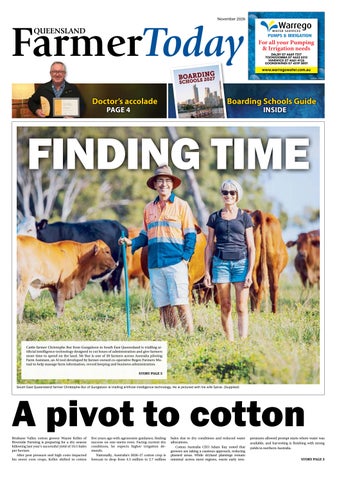
Cattle farmer Christophe Bur from Gungaloon in South East Queensland is trialling artificial intelligence technology designed to cut hours of administration and give farmers more time to spend on the land. Mr Bur is one of 20 farmers across Australia piloting Farm Assistant, an AI tool developed by farmer-owned co-operative Regen Farmers Mutual to help manage farm information, record keeping and business administration. STORY PAGE 3
South East Queensland farmer Christophe Bur of Gungaloon is trialling artificial intelligence technology. He is pictured with his wife Sylvie. (Supplied)
A pivot to cotton Brisbane Valley cotton grower Wayne Keller of Riverside Farming is preparing for a dry season following last year’s successful yield of 10.5 bales per hectare. After pest pressure and high costs impacted his sweet corn crops, Keller shifted to cotton
five years ago with agronomic guidance, finding success on one-metre rows. Facing current dry conditions, he expects higher irrigation demands. Nationally, Australia’s 2026–27 cotton crop is forecast to drop from 4.5 million to 2.7 million
bales due to dry conditions and reduced water allocations. Cotton Australia CEO Adam Kay noted that growers are taking a cautious approach, reducing planted areas. While dryland plantings remain minimal across most regions, warm early tem-
peratures allowed prompt starts where water was available, and harvesting is finishing with strong yields in northern Australia. STORY PAGE 5
INSIDE
NEWS QueenslandFarmerToday.com.au
DOCTOR HONOURED ........................... page 4
Beloved Town Hall coming back to life
MEET NUFFIELD SCH0LARS..... pages 14, 18 WOMEN IN AGRICULTURE ......... pages 16-17 RIDER’S BOLD HORIZONS ........ pages 20, 22 RECIPE ............................................... page 24 MARKET ROUND-UP .......................... page 25
By Fiona Gowers SPORT ........................................ pages 27-28
DAM LEVELS Beardmore: ............................................. 46.75% Bjelke-Petersen: ....................................... 90.46% Borumba: ................................................ 96.08% Boondooma: ............................................ 87.06% Cedar Pocket: .......................................... 86.04% Chinchilla Weir: ........................................ 47.07% Coolmunda: ............................................. 48.41% Leslie: ..................................................... 50.03% Paradise: ................................................. 83.85% Somerset:................................................ 78.09% Wivenhoe: ............................................... 79.08%
CONTACT US
Address: 154-156 Haly Street Kingaroy 4610 Telephone: 07 4182 0450 Website: QueenslandFarmerToday.com.au CONTACT US
Funding to improve Augathella Town Hall’s kitchen facilities will enable more community events at the much-loved western Queensland gathering place. The Augathella Progress Association has been selected as one of 10 recipients of Rabobank’s 2026 Rural Community Hub Program, which will provide $10,000 each to rural community halls across Australia to improve their facilities. The money will help the association upgrade the hall’s fridge, oven and bain-marie, making the building more functional for the many community groups that rely on it. Augathella Progress Association secretary Belinda Tomlinson said the grant was welcome recognition of local volunteers’ efforts to keep their community thriving. “This grant means a lot to this town,” Belinda said. With a population of about 350, Augathella has a strong network of sporting clubs, committees and community organisations, many of which often use the town hall. However, ageing kitchen equipment and limited catering facilities have made it increasingly difficult to host larger functions. “We have a beautiful, big hall,“ Belinda said. “It’s got a great little kitchen but it needs upgrading. “Its facilities are limited. For example, if you wanted to host a ball or large event there, it would be difficult.” The funding will allow the association to address those practical problems and make the most of a venue that already plays an important role in local life. The hall hosts everything from community meetings and school discos to bingo and healthy ageing activities. It is also used for larger gatherings and serves as a wet-weather alternative for the town’s annual Christmas in the Park celebrations. Belinda said the hall was particularly important for Augathella’s ageing population, with many retirees choosing to remain in the community. “The ageing community really benefits from that hall.”
Editorial: Fiona Gowers Editor E: fiona.gowers@QueenslandFarmerToday.com.au Advertising: Lynda Crombie Sales & Marketing E: lynda.crombie@QueenslandFarmerToday.com.au P: 0407 152 967 David Moon Sales & Marketing E: david.moon@BurnettToday.com.au P: 0408 813 296 Jemma Wilson Sales & Marketing E: jemma.wilson@BurnettToday.com.au P: 07 4182 0458 Gayle Hopes Sales & Marketing E: gayle.hopes@TodayNewsGroup.com.au P: 0421 655 138
Queensland Farmer Today is published monthly and part of the Today News Group. Published by South Burnett Today Pty Ltd ACN 641 796 349. Publisher: Daniel Pelcl P: 0408 956 830 Managing Director: Daniel Pelcl. All material is copyright to South Burnett Today Pty Ltd. All significant errors will be corrected as soon as possible. For our terms and conditions please visit QueenslanFarmerToday.com.au/terms-and-conditions/ 2 TODAY November 2026
The beautiful Augathella Town Hall. (Supplied)
She said the association wanted to ensure the building continued to serve residents of all ages, including younger families seeking more opportunities to socialise and hold community events. As it progresses through the upgrades, the association plans to consult with groups frequently using the hall, although Belinda said the need for improved kitchen equipment was clear. The committee recently used the hall for a small music festival and was impressed with the venue, reinforcing its potential to accommodate more activities once the facilities were improved. The association’s work extends beyond the hall, with volunteers advocating for local needs, consulting with council, developing community plans and preparing grant applications to secure funding for projects. Belinda said securing grants could be challenging, particularly as costs continued to rise and volunteers balanced community commitments with running their own businesses and raising families. “Yes, $10,000 these days probably doesn’t seem like much. But it’s a lot if you have to fundraise for that. That’s awesome. We really, really appreciate it.” She said the grant would go a long way towards delivering much-needed town improvements. “The application was pretty rock solid on what we needed and very obvious that it’s just a really simple fix, basically.” Belinda also credited the community’s volunteers for helping maintain momentum and lift spirits, particularly when rural towns were dealing with pressures such as drought and rising fuel costs. “We’re really lucky that we have a proactive community, getting more proactive as well, I think. “When those people keep pushing the town, you lift everyone’s spirits. It’s really great to see.” Having grown up in Texas in southern Queensland, Belinda said community involvement was something she had learnt from her parents, while her husband’s family had also been heavily involved in their community. “These communities do not survive without these volunteers,“ she said. “The work they do is amazing.”
She said it was exciting to see businesses such as Rabobank investing in rural communities and supporting projects that could make a tangible difference to local residents. The 2026 Rural Community Hub Program attracted more than 350 applications during August, with 10 successful halls selected to share $100,000 in funding from the Rabo Community Fund. Now in its second year, the program was developed after Rabobank’s Client Council network identified the vital role community halls play in uniting farming and rural communities, fostering connection, resilience and a sense of belonging. Rabobank community engagement manager Skye Ward said the strong response reflected both the importance of local halls and the commitment of volunteers who maintained them. “Local halls and community hubs are at the heart of rural communities,” she said. “They provide a place for people to come together to connect and support one another. “The breadth of applications received this year highlights the many ways these facilities are used, as well as the practical challenges local communities face in maintaining and improving them.” Ms Ward said successful projects included improvements to accessibility, heating and cooling systems, kitchen and amenities upgrades, and restoration works. “We hope the funding helps communities utilise their hall as the important gathering places they are now and into the future,” she said. For Augathella, the grant represents more than new kitchen equipment. It is an investment in a much-loved local meeting place and the volunteers working to ensure it continues bringing people together for years to come.
Welcome to the November edition of Queensland Farmer Today! This month, we’ve got a little bit of everything, from the challenges of growing cotton in dry conditions to a clever business idea born around the kitchen table and a reminder of just how important our rural community hubs are. We head to the Brisbane Valley, where cotton grower Wayne Keller of Riverside Farming is hoping to match last season’s impressive 10.5 bales per hectare. It’s a fantastic result, but with dry conditions already creating challenges, Wayne knows there’s plenty of hard work ahead. Meanwhile, necessity has sparked a different kind of innovation for North West Queensland beef producer Angie Nisbet. After a day mustering with her sister Shona, the fifth-generation grazier decided there had to be a better option when it came to practical, good-looking work gloves for women on the land. A quick sketch and a wish-list became the now booming business FarmHer Hands. We also visit Augathella, where a $10,000 grant from Rabobank’s Rural Community Hub Program will help upgrade the kitchen at the town hall. A new fridge, oven and bain-marie will make a real difference to the community groups that rely on this much-loved gathering place. So, whether it’s innovative farmers, enterprising rural women or volunteers keeping local halls humming, our communities are full of people finding ways to get things done. I hope you enjoy this month’s stories and thank you, as always, for reading Queensland Farmer Today.
- Fiona Gowers
QueenslandFarmerToday.com.au
NEWS
AI assistant helps cattle farmer spend...
Less time on paperwork By Fiona Gowers Cattle farmer Christophe Bur from Gungaloon in South East Queensland is trialling artificial intelligence technology designed to cut hours of administration and give farmers more time to spend on the land. Mr Bur is one of 20 farmers across Australia piloting Farm Assistant, an AI tool developed by farmer-owned co-operative Regen Farmers Mutual to help manage farm information, record keeping and business administration. Using voice notes, photographs or text from the paddock, tractor or yards, farmers can record activities as they happen, reducing the need to enter the same information into multiple systems later. Mr Bur said the technology had helped him easily track everything from fuel consumption and herd genetics to invoices and expenses, saving him countless hours of bookkeeping. Australian farmers have embraced technologies such as GPS, automated machinery, sensors and remote monitoring for decades, but artificial intelligence remains largely untapped across the sector. Just three per cent of Australian agriculture, forestry and fishing businesses are using AI, the second-lowest rate of any industry and well below the 12 per cent national average. International research shows 17 per cent of farmers surveyed across 10 countries are now using generative AI for farm-related tasks. Regen Farmers Mutual co-director Andrew Ward said one reason for the slower uptake in Australia was that much of the available AI had not been developed around the realities of running a farm. “Low AI uptake shouldn’t be mistaken for farmers being reluctant to embrace technology,“ Mr Ward said. “Australian farmers have been using GPS, automated machinery, sensors and remote monitoring for years. “The problem is that a lot of the conversation around AI has very little to do with the problems farmers need solved. “They don’t need AI to tell them how to farm. They know their land, livestock, crops and seasons. What they do need is a way to cut down the hours spent at night entering information into different systems and doing paperwork.“ Farm Assistant is designed to learn how each property operates, including its paddock names, livestock groups and the terminology used by the people running it. “If you’ve called a paddock ‘The Back Forty’ for 30 years, you shouldn’t have to rename it because you’ve bought some new software,” Mr Ward said. “The technology needs to adapt to the farmer, not the other way around.” The assistant can also work alongside existing sources of farm and business information, including farm-management software, weather information, machinery systems, sensors and commodity data. For example, a farmer treating livestock can tell the assistant what they have done, allowing
South East Queensland farmer Christophe Bur of Gungaloon is trialling artificial intelligence technology. He is pictured with his wife Sylvie. (Supplied) treatment records and inventory to be updated and associated documentation prepared without re-entering the information later. Mr Ward said the technology could help address the repetitive tasks that consume valuable time on farms. “Farming involves an enormous number of repetitive processes, he said. “Spraying, sowing, fertilising, harvesting, moving stock, keeping records, reconciling accounts and meeting compliance requirements happen again and again. “The opportunity isn’t to replace the farmer’s judgement. It’s to stop valuable information disappearing into notebooks, different systems or someone’s memory and reduce the amount of time farmers spend entering the same information more than once.” Mr Bur is based at Zeebra Plains, a 750-hect-
are cattle property about 40km west of Maryborough in Queensland’s Burnett Mary region. He is among the 20 farmers meeting weekly in what Regen Farmers Mutual calls an ‘AI gym’, where participants test Farm Assistant on their properties, share what works and help shape its development. Mr Ward said reducing administration could also give farming families more time together. “For a lot of farming families, paperwork happens after the day’s actual farming is finished. “If AI means someone gets through the gate at the end of the day and has dinner with their family instead of sitting at the computer for another two hours, that’s technology solving a real problem.” More than 40 farms are waiting to join the program.
Regen Farmers Mutual co-director Andrew Ward.
12900501-CV39-26
November 2026 TODAY 3
NEWS QueenslandFarmerToday.com.au
Doc honoured for service
Dr Dan Manahan has received the ACRRM-RDAA Peter Graham “Cohuna” Award for 2026. (Supplied)
Weed Spraying Equipment Starting from $590 Australia’s most extensive range of weed spraying equipment to suit any application. Australian-made and built for durability, lasting longer than the industry average.
Fire Fighting Units: Slip On & Skid Mounted Units - Starting From $5500 Built tough for Australian conditions and designed to perform when it matters most. Protect your property during fire season with a reliable, easy-to-use firefighting solution. Be fire-ready at a moment’s notice.
BOBCAT Tractors Starting from $30,990 Backed by Bobcat’s 24-Month / 1,500-Hour Warranty and extensive dealer support network.
TYM T1003 - CAB Tractor Starting from $90,000 99.5HP Perkins Diesel Engine delivering proven reliability, fuel efficiency and the power to handle tough farming and commercial workloads. AirConditioned Premium Cabin featuring suspension seat, ergonomic controls and all-day comfort for long hours in the field. Heavy-Duty 3,110kg Lift Capacity with 32x32 Power Shuttle Transmission for effortless operation, maximum productivity and versatility with a wide range of implements.
Call us today to chat with one of our friendly team:
(07) 5356 3000 See our full range on our website triotowing.com.au Locations include Gympie, Hervey Bay and Gladstone. Wherever you are in Australia, we can deliver to you! 12908362-CV44-26
4 TODAY November 2026
A Stanthorpe doctor who has spent more than three decades serving rural communities in Queensland and the Pacific has been recognised for his outstanding contribution to rural medicine. Dr Dan Manahan received the 2026 ACRRMRDAA Peter Graham ‘Cohuna’ Award at a special dinner in Brisbane last month, recognising more than 30 years of service spanning clinical practice, medical education and rural health leadership. The Award is the highest given by the Australian College of Rural and Remote Medicine (ACRRM) and Rural Doctors Association of Australia (RDAA). Since arriving in Stanthorpe in 1996 with his wife Jacinta, a registered midwife, Dr Manahan has provided emergency care, obstetrics, anaesthetics, palliative care and community general practice across the Darling Downs region, while holding senior clinical leadership roles within Darling Downs Hospital and Health Service. His work has also extended to Aboriginal Medical Services and outreach clinics in Queensland and nearby NSW communities, including Carbal, Armajun and Goondir, as well as remote locums in areas of need such as Doomadgee, Mornington Island, Cooktown and Weipa. Alongside his clinical work, Dr Manahan has taught and supervised hundreds of medical students and junior doctors, contributed to numerous medical training curricula and supported the work of ACRRM, other medical colleges and university medical schools. He was the Foundational Medical Advisor for Queensland’s Rural Generalist Pathway, launched in 2007, helping establish the training model that has since gained international recognition. Since 2016, he has also volunteered with Rocketship Pacific, a non-profit organisation working to improve health in Pacific Island nations through stronger medical education in primary care. His work has included regular travel to the region to train local doctors and establish future training programs. ACRRM President Dr Rod Martin said Dr Manahan was a “true ‘local hero’” whose contribution reached well beyond his home community. “Dan is a true ‘local hero’ not only in Stanthorpe but across the rural medical sector as a whole, and a shining example of the breadth of skills and dedication that Rural Generalists bring to their communities,“ he said. “He is widely respected by his patients as a doctor who listens and cares, reflecting the warm, holistic, people-centred approach he brings to his work. “He also has a great sense of humour which he brings to his consultations with patients and his training sessions with medical students and junior doctors. “We are incredibly grateful for the significant contribution he has made to ACRRM over many years, from writing the first ACRRM Anaesthetics Core Curriculum through to providing training and clinical supervision for our Rural Generalist trainees for over 20 years. “It is particularly poignant that Dan has received this Award in a year in which Rural Generalist Medicine has become truly recognised as a medical specialty in Australia, given he played such a pinnacle role in establishing the Rural Generalist Pathway in Queensland. “This essentially set the critical foundation for the national recognition of Rural Generalist Medicine we see today. “The Peter Graham ‘Cohuna’ Award is significant recognition of the enormous contribution that Dan has made to Rural Generalist Medicine throughout his career, and it is very richly deserved.” RDAA President Professor Sarah Chalmers said Dr Manahan’s commitment to rural medicine was reflected in his clinical work and his dedication to training future doctors. “Dan’s commitment to Medicine shines brightly not only in Stanthorpe, the Darling Downs and Pacific Islands, but also through the many hours he has devoted to clinical teaching, supervision and curriculum development. “His passion for Rural Medicine, for providing comprehensive care for rural and remote patients, and for teaching and training the next generation of rural doctors, is nothing short of inspiring. “Importantly too, he has been a guiding light in encouraging junior doctors – including those
on his own teams – to achieve work-life balance and spend time with their family, not just their job. “Hearing this coming from a senior doctor makes rural practice much more enticing for our younger colleagues. “He was also an early mentor to some of Australia’s most influential rural doctors, with past presidents of ACRRM, RDAA and the Rural Doctors Association of Queensland (RDAQ) training and/or consolidating their rural clinical skills under Dan’s guidance. “Among numerous awards, he was recognised for the immense contribution he has made to Rural Medicine with RDAQ’s Meritorious Service Award in 2012. “Many a junior doctor has been subjected to memorable ward rounds under Dan’s supervision, linked to days such as Talk Like A Pirate Day, karaoke challenges, and a day where all the doctors wore black tie on their ward rounds – it’s not something you see every day, but it made for an entertaining day… especially for the patients!” Dr Manahan studied Medicine at the University of Queensland with the assistance of a Queensland Health Rural Scholarship. During his training, he worked casual jobs as a wardsman, dogman, Mr Whippy Man, bean picker and for the Red Cross. A fifth-year elective took him to Tonga, where he undertook clinical placements on several islands and developed a lasting connection with the Pacific. After graduating, he worked in Rockhampton, Emerald and Goondiwindi, where he came to appreciate the diversity of rural clinical practice and the communities it serves. He describes rural medicine as “the best job on the planet”. In receiving the Award, Dr Manahan said rural health had provided him with wonderful opportunities throughout his career. “It is a great honour to receive the ACRRMRDAA Peter Graham ‘Cohuna’ Award. Peter’s story and those of the previous recipients have been an inspiration to me and I’m sure many others. I’ve been blessed with wonderful opportunities thanks to rural health. “My early years in Rockhampton, Emerald and Goondiwindi cemented my love of Rural Medicine and rural life. How we ended up in Stanthorpe is a tale in itself (ask the Mrs). The farming and Italian community here have made life rich and rewarding for us. “Ten years in leadership on the Queensland Rural Generalist Pathway was an opportunity to do what we all knew was the right way forward. “The visible career pathway was key and the ducks aligned with the right people in the right places to make it happen. There are too many to name but they run across all domains, from administration to politicians, advocates to zealots, and everything in between. “Rural Generalism’s application in Pacific Island nations is a natural fit and Rocketship Pacific has worked in developing this space with so many amazing people. “Thank you to the team at ACRRM and RDAA for this award. Thanks to my wonderful wife, Jacinta and my family for their love and fun and tolerance. Thanks to my God and yours for walking with me and you daily in all we do. “It was a wonderful presentation dinner this week with Jacinta and my family present, and especially with long-term friends Peta Rutherford (RDAA CEO) and Marita Cowie (ACRRM CEO), two amazing and tireless workers for rural health.” Dr Manahan and Jacinta remain deeply involved in the Stanthorpe community, supporting local sporting clubs, school events, committees and the local Catholic and Christian community. Outside Medicine, he enjoys spending time with Jacinta, their four adult children and their partners; church activities, walking the Camino, camping and four-wheel driving, travel, gardening and a little theatre. “And growing old with dignity, and just a little bit of sauce!” he adds. The ACRRM-RDAA Peter Graham ‘Cohuna’ Award is named in recognition of Dr Peter Graham, a dedicated Rural Generalist who served the Victorian community of Cohuna for nearly 50 years.
QueenslandFarmerToday.com.au
NEWS
Pivot from corn to cotton By Fiona Gowers Brisbane Valley cotton grower Wayne Keller of Riverside Farming is preparing for another dry season after achieving a yield of 10.5 bales per hectare last year. Mr Keller is among a handful of cotton growers in the region, having gradually refined his approach since planting his first 40 hectares five years ago. Riverside Farming traditionally grew vegetable crops, but mounting challenges in its sweet corn crop, which was being “hammered“ by armyworm, and rising production costs prompted Mr Keller to explore cotton as an alternative. The move followed a neighbouring grower asking him to spray cotton, which led to discussions with industry representatives and the decision to plant a small area to assess its potential. The initial planting covered 40 hectares, with subsequent seasons used to experiment with different row spacings and production practices. Mr Keller said the family had worked closely with agronomists to learn how to grow the crop successfully. During the first two seasons, they followed the advice they were given on planting before making adjustments in the third year. That crop showed considerable promise before a hailstorm hit, leaving the family uncertain about its potential yield. Last season, the farm’s fourth cotton crop, Mr Keller planted on one-metre rows, following the approach used more widely across the industry. The result was 10.5 bales per hectare, a yield he hopes to match this season. However, dry conditions are already presenting challenges. “It’s very dry. Very dry,” Mr Keller said. Planting finished recently, and Mr Keller expects irrigation demand to be higher this season, despite having a 100 per cent water allocation. “I think we’re going to have to water more this season,” he said.
Brisbane Valley cotton grower Wayne Keller of Riverside Farming. (Supplied) “I planted dry and have had to water twice to get the crop out of the ground.” Riverside Farming sells its cotton through Louis Dreyfus Company (LDC) at Dalby, with a contractor picking the crop before delivering it to the buyer. Alongside cotton, the farming operation continues to produce grain, carrots and lucerne. Mr Keller runs the business with his brother Noel. Although cotton remains relatively uncommon in the immediate area, other growers operate nearby, including at Forest Hill, near Atkinson’s Dam and around Gatton. The experience highlights how cotton is providing an alternative for some Brisbane Valley growers, with crop selection influenced by production costs, pest pressure and the performance of individual crops. Dry outlook for Australia’s cotton crop Mr Keller’s experience comes as planting progresses for Australia’s 2026-27 cotton season, with
growers across several regions preparing for a drier season forecast by the Bureau of Meteorology. Cotton Australia chief executive Adam Kay said the national crop was expected to be significantly smaller than last season, with reduced water allocations and dry conditions limiting planting opportunities. The current forecast is about 2.7 million bales, down from 4.5 million bales last year, with an estimated value of about $2.1 billion. “This year we are expecting about 265,000 green hectares to be planted which is lower than the last few years,” Mr Kay said. “While cotton prices remain relatively strong, access to water is the biggest driver of planting decisions this season. “Most valleys are down on allocations this year following a dry winter and limited inflows into storages. As a result, growers are generally taking a more cautious approach to planting and many are reducing their cotton area.” The Macintyre Valley is expecting a significantly reduced crop, while growers across the Darling Downs, Gwydir, St George/Dirranbandi/ Mungindi, Macquarie and Southern valleys are also facing lower water allocations than last season. Dryland cotton plantings are expected to be minimal in many regions unless significant rainfall arrives during the planting window. Despite the challenging outlook, planting conditions have generally been favourable where water is available. Planting began in Queensland’s Central Highlands in early August, while growers in St George and the Brisbane Valley started in the weeks leading up to the October long weekend. Some early starters in northern and southern NSW also took advantage of favourable conditions. St George grower Lucas Wuersching finished planting on September 20 and already has cotton emerging.
He said warm temperatures had supported an early start, with the timing also helping growers make use of available irrigation water and potentially reduce harvest delays associated with storms and cold weather. “We’ve been trying to go earlier and earlier if the weather’s right, and this is a hot, dry year and the temperatures were good,” he said. “Our theory for starting earlier is to use our water instead of letting it evaporate away and it puts us in a good window around harvest when there’s less chance of storms and cold weather which could delay defoliation. “It’s been working really well for us the last couple of years.” Mr Wuersching has planted about half the area grown last year, with some growers in the region expected to reduce their area even further because of lower water availability. “It’s looking like it’s going to be a dry season, although some people are saying it might break, so you never know,” he said. “This year we need our crop so we’re not pushing it. We’re going in expecting little to no rainfall and taking a more conservative approach than we might have done in the past. Meanwhile, cotton picking was nearing completion in northern Australia’s Ord region, where yields were promising and fibre quality was good. About 75,000 bales were expected to be processed at the Kununurra gin, with a further 10,000 to 15,000 bales of Ord cotton expected to go through the Katherine gin. The start of planting also coincided with World Cotton Day on October 7, which celebrates cotton’s contribution to livelihoods, innovation, trade and sustainable development. Cotton Australia encouraged growers and the wider community to mark the occasion by celebrating the people behind the fibre and sharing positive stories about the Australian cotton industry.
FARMFORCE Post Driver
Australia’s Toughest & Most Versatile Post Driver
Australian Made, in QLD
Hydraulic Post Drivers from
Specialising in heavy-duty Post Drivers for all purposes, including Exclusion Fencing and Vineyards.
$10,120
Rock Spike & Hydraulic Auger options available. 3 Years Warranty
inc GST
07 5442 1915 0408 883 652
www.farmforce.com.au farmforce@live.com 12884664-JV31-26
November 2026 TODAY 5
NEWS QueenslandFarmerToday.com.au
Showcasing solutions By Fiona Gowers Eleven innovative projects aimed at tackling some of the Australian cotton industry’s biggest future challenges were showcased at the Australian Cotton Conference on the Gold Coast in August. The projects explored potential solutions across three priority areas: Preparing for a lowpesticide future, optimising nitrogen use and improving weed management. Selected in March through the Cotton Research and Development Corporation (CRDC) Innovation Call, the initiatives were developed through feasibility studies completed by Australian startups, ventures, entrepreneurs, agribusinesses and research organisations. CRDC committed almost $550,000 to the projects following a national open call, with up to $50,000 available for each feasibility study. The concepts range from lightning-powered seed technology and artificial intelligence-driven drones to biofertilisers made from farm waste and nature-based pest control, supporting CRDC’s Clever Cotton strategy. CRDC Acting General Manager, Innovation, Susan Maas said the initiative aimed to turn breakthrough concepts into practical solutions for cotton growers. Cotton growers helped prioritise the projects through CRDC and Cotton Australia research panels as part of the competitive selection process. “From AI to nature-based solutions, these ideas show just how bold and innovative the cotton industry has become,” Susan said. “Investing early in feasibility studies like these gives innovators the runway they need to test big ideas with real impact. “We’re excited to see these ideas move from breakthrough to reality and to hear what the innovators have found as they present their findings to the industry.“ All 11 successful applicants presented their completed feasibility studies at Innovation Alley during the conference, giving growers an opportunity to explore the proposed technologies and approaches. The findings will help inform a subsequent funding round, with up to $500,000 available to successful innovators to develop proof-of-concept projects within the Australian cotton farming system. 2025 Innovation Call successful Queensland projects: Turning farm waste into fertiliser Goondiwindi-based Growth Agriculture pitched
Mic and Darryl of Cairns-based Rainstick. (Supplied) a cutting-edge circular-economy fertiliser to the cotton industry. This project will develop and test a circular-economy fertiliser, turning local
ROD LYNCH TYRES
265.65-R17 All Terrain ............. $140 265.68N- R18 All Terrain ......... $145 540.65R-28 Nokia .................. $1700 35.65R/35L5 D/coin.............$8900 6 TODAY November 2026
23.1x34 (5) 14.........................$1760 710.70 R42............................. $3700 480.80 R50...........................$2300 480.80 R 42. .........................$1830 520.85 R42 .............................$2120 520.85 R42 ............................$1950 710.70-R38 ............................$2800 800.65 R32 ...........................$3450 900.60 R 42 .........................$5500 35 SL-32. ................................$5000 420-70-28.................................$965 710.45-26.5............................ $2520 540 65R R28 ........................$1400 18.4 x 28 Tractor (12).........$930 18.4 x 28 Industrial ..........$1045 18.4 x 38 38 (16) ................. $1250 20.8 x 35 (14)........................$1500 13.6 x 38 (12) ............................$725 650-65R 38 ............................$1700
169-24 ply.................................$690 540-65 R34 ........................... $1360 800-70 R38 ...........................$4100 380-85 R30 ..............................$975 620-70 R42...........................$2300 380-85-28 ................................$960 900 x 7R 32. .........................$4600 360-70 R24 ..............................$666 380-70 R24 .............................. $790 480-70 R28..............................$1180 480-80 R46..........................$2280 460-88 R34 ............................$1720 124-28 (12).................................$475 11.2-28 (12)................................$400 750 R16 L/Truck ....................$166 480-70 R28..............................$1180 10-165 10Ply B/Cat. ..............$176 1400-24 16 ply Grader ......$700
Rims - 10 bolt centres - Ferguson 18L-28...........................$470 8 Steel St, Narangaba 0447 066 000 Rod maximtrailer@gmail.com
12904024-CV44-26
16.9-30 (14) ..............................$880 18.4-30 (14) ............................ $1020 18.4-34 (14) ............................$1060 23.1-30 (14). ...........................$1450 825-20 (14) .............................. $289 825.16 16 (14p) + cub........$270 900-20 (16).............................. $320 1000-20 (16)............................$345 825 x R15 (18p) d/deck ...$275 1400 x 20 (20) .......................$800 255.70R-225. .......................... $225 825 R-15 (14).......................... .$320 275.70 R225 ............................ $236 11R 225... ..................................... $235 295.80 22.5 .............................$330 30.5-32 (20).........................$2350 245-32 (16) ............................$1980 750-16/RIB (8)........................$150 149.26 (12p) .............................$635
organic waste like treated sewage (known as biosolids), animal bones and dried blood from meat processing into a safe, high-quality fertiliser for cotton systems. Instead of sending this waste to landfill, the project will recycle it into small fertiliser pellets that slowly release nutrients into the soil. This helps crops use nitrogen more efficiently, reduces fertiliser costs for farmers and lowers harmful emissions. It also locks carbon into the soil, which is better for the environment. The team will test the product in the laboratory and in real farm trials to make sure it’s safe, effective and performs as well as (or better than) common fertilisers like urea. They’ll also design small, portable production units so the fertiliser can be made locally in regional areas and roll out a community education piece through the “Dollars for Dung“ program. Lightning-powered seed technology Cairns-based Rainstick pitched a cutting-edge lightning-inspired seed technology to the cotton industry. This project uses the power of lightning to see if it gives cotton seeds a stronger, faster and more resilient start. This feasibility study will evaluate the potential of Variable Electric Field technology – a non-chemical, bioelectric seed treatment that mimics the effects of lightning – to improve cotton germination, seedling vigour, nitrogen-use efficiency and overall crop resilience. The technology has already demonstrated yield gains of 12 to 16 per cent in other crops and offers a scalable, pre-plant treatment that requires no change to existing on-farm practices. Mapping riparian zones for cotton country Toowoomba-based Southern Queensland Natural Resources Management Ltd (SQ Landscapes) pitched a cutting-edge approach to riverbank restoration to the cotton industry. The Cotton Connection project has worked with growers to show how profit and production can increase through healthy landscapes, thriving waterways and connected wildlife habitats. By mapping woody vegetation across cotton regions, it identifies where nature is working hardest for growers and where targeted investment can deliver on farm results.
CRDC Acting General Manager, Innovation, Susan Maas. Through effective Integrated Pest Management (IPM), reduced pesticide costs and improved chemical performance, the project supports more resilient landscapes and return on investment. Phase two will deliver decision making tools to help growers prioritise riparian restoration for maximum agronomic, environmental and economic benefit. By combining scientific and local knowledge, the project will provide evidence that biodiversity is good for business maintaining market access, reducing costs and risks and opening opportunities in carbon and environmental markets. Developed with growers, agronomists and CottonInfo, it makes investment in biodiversity a win for production, the environment and profit.
QueenslandFarmerToday.com.au
NEWS
Cotton growers eye beans By Fiona Gowers Goondiwindi-based MCA Agronomy is investigating how faba beans and other pulses could improve soil health and reduce reliance on synthetic fertilisers in irrigated cotton rotations. Its project was among just 11 nationally selected to tackle some of the cotton industry’s biggest future challenges. Pulses can capture nitrogen from the atmosphere and add it to the soil, potentially reducing greenhouse gas emissions and fertiliser requirements for the following cotton crop. The project will assess the agronomic, environmental and economic impacts of growing faba beans as a green manure crop, weighing the potential benefits against the additional costs of growing and irrigating the crop. The initial study involves a desktop assessment and a survey of cotton growers to explore their experiences, perceptions and willingness to adopt green manuring. The findings will help shape a potential on-farm validation project. We spoke to MCA Agronomy Director and Consulting Agronomist Tim Richards. 1. What sparked the investigation into using faba beans and other pulses as green manure crops within irrigated cotton rotations? The investigation was driven by discussion between MCA cotton consultants and their growers about whether green manure crops could provide a practical and economical alternative source of nitrogen. Growers could see the potential benefits, particularly with rising fertiliser costs and increasing pressure to improve nitrogen-use efficiency, soil health and sustainability. Over the years we had occasionally tried green manure crops with some great anecdotal results. However, to incorporate into our recommended rotations on a more regular program we wanted locally relevant evidence showing whether the benefits justified the water, establishment and management costs. The project was developed to help answer those questions under commercial irrigated cotton conditions.
2. How can pulse crops such as faba beans improve soil health and what potential benefits could growers see in their following cotton crops? Legumes such as faba beans can fix atmospheric nitrogen and return it to the farming system when the crop is terminated. The amount contributed depends on establishment, biomass production, nodulation, existing soil nitrogen levels and the timing and method of termination. Previous cotton industry studies have reported pulse crops fixing between 100 and 260kg N/ha. With urea prices reaching $1400 per tonne or about $3/kg of nitrogen, a large green manure crop fixing 260kg N/ha has an indicative fertiliser value of approximately $780/ha. However, not all fixed nitrogen will necessarily become available to the following cotton crop, making nitrogen release and fertiliser-replacement value important areas for further research. The additional biomass and root growth may also improve soil biological activity, soil structure, infiltration and nutrient cycling. Over time, retaining more plant material will help improve soil organic matter, although meaningful changes in soil carbon are likely to require repeated use over several seasons. For the following cotton crop, the potential benefits include reduced fertiliser nitrogen requirements, improved soil condition and possibly improved yield and water-use efficiency. Our research aims to measure which of these benefits occur locally and how consistent they are. 3. What factors will your research examine to determine the economic viability of green manuring? If we are successful at obtaining subsequent Innovation funding from CRDC, we want to assess the whole economic picture, because the costs and benefits will vary considerably between farms. The direct costs include seed, planting, water, irrigation, crop management, termination and incorporation. We also need to consider the opportunity cost of using water and land that may otherwise have remained fallow or grown a
harvestable crop. These costs will be compared with measurable benefits, including: The amount of atmospheric nitrogen fixed and ultimately available to the following cotton crop; Any reduction in fertiliser nitrogen requirements and the flow on effect on the total emissions of this system; Changes in cotton yield, quality and water-use efficiency; Improvements in infiltration, soil condition and nutrient cycling; Weed, pest and disease implications; How easily the practice fits within existing farm operations and planting windows. Disease risk is a particularly important consideration for growers. Some green manure species may host or increase soil-borne cotton diseases, while non-host species may help reduce disease inoculum over time. This is especially relevant to Verticillium wilt, one of the cotton industry’s major disease concerns. Initial results from Crown Analytical’s cotton disease surveys suggest that faba beans may help reduce Verticillium levels. While these early findings require further validation, they are encouraging and we are excited to investigate this potential benefit in future trials by including soil DNA test for Verticillium and other cotton diseases. We also want to measure the system’s potential to reduce emissions. To do this, we plan to work with the Queensland Department of Primary Industries’ Low Emissions Intensity Farming Systems initiative to capture the relevant data and accurately assess the impact green manure crops could have on the overall emissions intensity of irrigated cotton production. Growers want local trials that consider these risks and place realistic economic values on as many costs and benefits as possible. 4. How important is grower feedback and on-farm experience in shaping this research, and what are you hoping to learn from the cotton producer survey? Grower, Agronomist feedback and on-farm experience are central to the project. There is little value in developing a practice that may work scientifically but is too costly, risky or difficult
to implement commercially. Our initial surveys helped identify the benefits growers believe green manuring could provide, as well as the main barriers preventing adoption. These included water requirements, establishment and termination costs, uncertainty about nitrogen benefits and concerns about weeds and disease. If the project continues, we want to use local on-farm trials to put realistic values around the potential benefits and directly investigate the barriers identified by growers. Ultimately, the research needs to give growers enough confidence to decide when and where green manuring fits within their farming system. 5. If the research confirms the benefits of faba beans as a green manure crop, what impact could this have on the future sustainability and productivity of irrigated cotton systems? We do not want the research to focus solely on faba beans. Faba beans may suit a winter opportunity, but we also want to investigate legumes that could fit into a summer window. Sunn hemp appears to be a promising candidate because it can rapidly produce biomass and fix nitrogen under warm conditions. If green manure crops can be proven agronomically and economically viable, they could help growers reduce their reliance on manufactured nitrogen fertiliser, improve nitrogen-use efficiency and build more resilient soils. That could improve farm profitability while reducing emissions associated with the manufacture and use of nitrogen fertiliser. Nitrogen fertiliser is one of the largest sources of emissions in irrigated cotton production and a major challenge for growers seeking to reduce their carbon footprint. As pressure increases to meet emissions targets, maintain market access and demonstrate environmental responsibility, research into using green manure crops to reduce reliance on manufactured nitrogen is likely to become increasingly important. The long-term goal is not to prescribe green manure crops for every field, but to provide growers with reliable information about where they can add genuine value within irrigated cotton rotations.
Vertical Feed-mixers 10 to 40 cubic metre models Single or Twin Augers, Front Door or Side Doors with elevator
Model FS1000D Side doors with Elevator
Also available:
RENN GRAIN BAGGERS & BAG UNLOADERS
Quick and effective mixing, complete and rapid emptying . What you put in your mix gets to your herd, consistently. Large carbide-insert knives
ROLLER MILLS For 60 years the heart of the RENN Roller Mill has been its precision-machined 16” diameter rolls, which provide more grain rolling area per revolution compared to other brands of roller mills with smaller diameter rolls. RENN Roller Mills save time and money year after year by rolling more grain per hour with less horsepower.
RG1020 - 10ft tunnel, with 20” direct drive inclined filling auger
Dry and High Moisture Rolling PTO or Electric 12”, 24”, 36” & 48” Models - Folding Auger
Australian Distributors:
EASTERN SPREADERS PTY LTD
9508 Murray Valley Highway, KERANG, Vic 3579 Sales 0409 691 226
or
Ph: 03 5450 3077
0429 480 337 sales@easternspreaders.com.au 12895044-JO39-26
November 2026 TODAY 7
DELIVERING 2032 AND BEYOND In Partnership with the Queensland Government
FROM SIDELINES TO CENTRE STAGE Regional Queensland’s 2032 opportunity FOR generations, Queenslanders in regional towns have watched the Olympic and Paralympic Games from the couch while the action unfolded in faraway cities. In 2032, that changes. From up in Cairns, all the way down to Maryborough, regional Queensland will not simply share in the excitement of the 2032 Olympic and Paralympic Games. It stands to be part of the journey. While the world will see four weeks of competition, the real opportunity for regional Queensland lies in what happens before the opening ceremony and long after the closing ceremony. For communities across the state, the Games are a chance to strengthen transport connections, upgrade community facilities, reveal new tourism opportunities and bring global exposure for some of our iconic destinations. The commitment to spread events across regional Queensland marks a significant shift from many previous Olympic Games, where the benefits were largely concentrated in the host city. The Games provide a fixed delivery horizon, but their success for regional Queensland will ultimately be measured by what communities inherit. Games events slated for regional Queensland include football preliminaries at
Great Barrier Reef Arena, Mackay
Barlow Park Stadium in Cairns and Queensland Country Bank Stadium in Townsville, rowing in Rockhampton, and sailing in Townsville and the Whitsundays.
Legacy lives on in roads and tourism REGIONAL Queensland’s Games opportunity will look different in each community. It includes Games events and venues, but also investment in the connections people rely on, opportunities for tourism and local businesses, infrastructure intended to serve communities for decades, plus support for grassroots sporting facilities. As Queensland prepares to welcome athletes, officials and visitors in 2032, better connectivity will be key. Alongside Games preparation is the broader investment in fixing the Bruce Highway. Described in Games planning documents as the state’s most important road, the Australian and Queensland governments are investing more than $9 billion to upgrade it – linking the regions to Brisbane, each other, and the growing list of Games venues being built outside the capital. The improvements will support Games-time travel, but their long-term value will be measured through safer, more reliable journeys for regional Queenslanders. Tourism is another pillar. A 20-year tourism plan is being implemented to capitalise on Queensland’s time in the global spotlight, with new attractions, including eco-tourism experiences and accommodation, to draw visitors beyond Brisbane. For regional tourism operators, the opportunity is not limited to visitors who arrive in 2032. It is also about building the profile and appeal of Queensland destinations for the decades that follow.
GAMES ON! Boosting regional grassroots sports ACROSS regional Queensland, the 2032 Games are an opportunity to build something larger than the Games themselves. For all regional Queenslanders hosting a slice of the world’s biggest sporting event is set to translate into a lasting, local legacy. The global spotlight will be temporary, but the facilities, connections, business opportunities and community pride created along the way can endure for generations. But it is at the grassroots level that the regional legacy is arguably most visible right now, years out from the opening ceremony. The Queensland Government’s Games On! Grassroots Infrastructure Program is already funding upgrades to local sporting
Rockhampton will also host one of the Games’ Athlete Villages, alongside Brisbane, the Gold Coast and the Sunshine Coast – giving a regional city a central role with additional housing as a legacy. Toowoomba is slated to
host equestrian events, with the Showgrounds to be transformed into a centre of excellence, while archery is planned for the town centre of Maryborough.
facilities across regional Queensland, helping communities ‘get more people active’ and ‘build a lasting community legacy’ well before 2032. In Mackay, the Great Barrier Reef Arena is just one of many venues benefiting. The arena - already a hub for major sporting fixtures where it recently hosted an Australia v Bangladesh cricket Test - is now positioned to host other major events. Arena General Manager Adrian Young said the funding would “help us improve facilities for our community while preparing Mackay for 2032.” He said the venue’s Stage 2 upgrade, and the success of hosting Mackay’s first Men’s Test Match, gave the region “enormous confidence” heading toward 2032. In Bundaberg, the local netball association has also benefited under the program. Bundaberg Netball Association President Matt Leighton said the investment, covering lighting, court surfaces and accessibility, “has been essential” to improving facilities.
RIGHT: Bundaberg Netball Association umpire Anne Howard (L) and Matt Leighton, President of Bundaberg Netball (R).
Artist impression.
Advertisement
BARLOW PARK STADIUM CAIRNS
TOWNSVILLE SAILING
Early works commencing
Planning underway
ROCKHAMPTON ROWING FACILITY
GRASSROOTS SPORTS INFRASTRUCTURE
Planning underway
Works underway
Delivering 2032 Authorised by the Queensland Government, Brisbane. 8 TODAY November 2026
12905134-MS44-26
QueenslandFarmerToday.com.au
NEWS
Fuelling a safety message By Fiona Gowers A fuel stop is usually a quick pitstop, but a road safety campaign is encouraging motorists to take a moment to think about the most important part of the journey ... getting home. Lowes Petroleum introduced its “One message. One decision. One life” campaign for Rural Road Safety Month, replacing promotional messages above its fuel bowsers with reminders about fatigue, distraction and the importance of making it home safely. The campaign was initially planned to run for one month, but conversations with motorists have prompted Lowes Petroleum to keep the safety messages in place. One customer initially dismissed a message while filling her car, only to later tell a Lowes attendant she could not stop thinking about it during her drive home. Another customer said her son told her the message had made him think about how she would feel if he did not make it home. Lowes Petroleum General Manager Health, Safety, Security and Environment Bernie Morris said the reactions proved the messages were having the intended impact. “For our drivers, near misses aren’t statistics,” Mr Morris said. “They’re conversations at the depot after another truck has been overtaken on a blind bend, or another fatigued motorist has narrowly avoided tragedy. “Hearing that customers are actually reading and thinking about these messages while filling up is exactly why we’re extending the campaign.” Truck driver Steve Parr, who has spent decades on the road, said the reminders were particularly important for people spending long hours behind the wheel. “It’s about reminding them that someone is waiting for them to get home,” Mr Parr said. “If a sign above a bowser gets even one more person to stop, swap drivers or grab a coffee before getting back on the road, it’s done its job.” With Christmas approaching and many families preparing for holiday travel, Lowes Petroleum said it would continue monitoring feedback, with the possibility of making the safety messages a permanent feature at its sites. QueenslandFarmerToday.com.au
Fast Facts – Rural Road Safety in Australia More than one in two road deaths occur on regional roads, despite lower traffic volumes About 1300 people are killed on Australian roads each year Regional roads are significantly higher risk due to speed, fatigue and long travel distances between services Fatigue is a major factor in serious crashes, particularly on long rural journeys More than a quarter of drivers (27 per cent) believe rural roads are safer than city streets, despite 69pc of road fatalities occurring in regional and remote areas
• • •
• •
Truck driver Steve Parr, who has spent decades on the road, said the safety reminders were particularly important for people spending long hours behind the wheel. (Supplied)
OPINION
Most Queenslanders would reasonably assume that if a business operates in a regional council area, it is considered a regional business. So it beggars belief that some Queensland horticulture businesses have discovered recently that they don’t qualify for the Queensland Government’s Regional Employer Payroll Tax Discount. These are businesses producing fresh food in regional Queensland, employing people who at the time are living and spending their hardearned money in regional communities yet, under the current rules, they are treated differently because of technical definitions and arbitrary boundaries. It simply doesn’t pass the common-sense test. Queensland Fruit and Vegetable Growers has spent months raising these concerns directly with the Queensland Government. We’ve shared examples from affected businesses. We’ve sought opportunities to engage constructively and asked for one simple thing: a review of the policy settings. Despite those efforts, the Queensland Government has yet to commit to a review. This isn’t about avoiding tax. Growers understand their obligations and support a fair tax system. What they don’t support is a policy designed to encourage regional employment and economic growth that fails to recognise the realities of how a horticultural business operates. At the very same time the Queensland Government is investing more money into compliance and enforcement activities, it has shown little willingness to examine whether the rules themselves are still fit for purpose. Some growers are now facing assessments for up to five years of retrospective payroll tax, along with interest and penalties. Surely that’s getting the priorities the wrong way around. Scott Kompo-Harms, Chief Executive Officer, Queensland Fruit and Vegetable Growers.
12901240-RV44-26
Not considered ‘regional’
November 2026 TODAY 9
NEWS QueenslandFarmerToday.com.au
Fungus shows promise By Julian Lehnert Queensland beekeepers may one day find an unlikely helper in their fight against varroa mite: a fungus. Researchers from Macquarie University took to the 2026 Australian Almond Conference in Adelaide from 13 to 15 October to present their latest project targeting the spread of Varroa destructor, commonly known as varroa mite. The tiny bugs infect honey bees and their colonies, parasitising them and eventually leading to the collapse of the hive. Since it was first discovered in Queensland hives in March 2025, the pest has spread across the state, causing extensive damage to hives and businesses relying on bees. To combat the threat of varroa mites, Macquarie’s team of researchers around Chief investigator Associate Professor Fleur Ponton and Dr Darsh Rathnayake have drawn on the genus of fungi called Metarhizium, which can infect and kill insects. One species of the fungus, M. anisopliae, which can infect over 200 kinds of insects, kills after its spores come into contact with the body of its host. The spores germinate and penetrate the outer layers of the bug, killing it after a few days of growth.
Other species of Metarhizium have previously seen success in the control of mosquitoes and locusts; in the case of the latter, a strain of M. acridum is already commercially available for farmers. The goal of Macquarie’s researchers is to find a species of Metarhizium which can specifically infect varroa mite without damaging or killing the surrounding honey bees. “Our early results show that fungi could provide a promising new way to control Varroa mites, one of the biggest threats facing honeybees,“ said Dr Rathnayake of the project. “In our initial tests, the fungal strains killed high numbers of Varroa mites. “We are now working to identify a concentration that can effectively kill Varroa mites while remaining safe for honey bees,“ he said. Quensland Farmer Today Today contacted Dr Rathnayake to ask about details on the project’s start time, whether it was genetically engineering a species of Metarhizium or simply looking at an already-established species, how the species his team were investigating killed the mites, and when the public could expect to see results. At time of writing, no response to the above questions has been received.
Macquarie’s researchers are looking into a way to combat varroa mite without affecting the beehive itself.
A varroa mite infected by a species of Metarhizium fungi - potentially the newest weapon in the fight against the beehive parasite. (Supplied: Macquarie University)
Producers preparing for high-risk summer weather Queensland primary producers, fishers and aquaculture operators are being urged to prepare for a potentially challenging summer, with active El Niño conditions increasing the likelihood of bushfires and severe storms across the state. Early preparation is one of the most effective ways to minimise the impacts of natural disasters on farms and fishing operations, helping businesses respond quickly and recover faster when disaster strikes. The Queensland Government is encouraging producers to use its available resources to ‘Get Ready’ for summer by reviewing emergency plans, assessing on-farm risks and ensuring essential resources are on hand.
Key preparation measures include: Reviewing emergency plans for bushfires, floods, cyclones and severe storms. Ensuring livestock can be moved quickly and have access to food and water. Securing fodder supplies and protecting critical infrastructure. Maintaining firebreaks and reducing fuel loads around properties. Keeping important records, emergency contacts and asset photographs up to date. Working with local Industry Recovery and Resilience Officers to strengthen preparedness. Department of Primary Industries Deputy Director General Agriculture Peter Donaghy
• • • • • •
said Get Ready Week was an important reminder for producers to act before severe weather events occurred. “Summer is the season for floods, bushfires, cyclones and storms,” Mr Donaghy said. “Taking action now, whether that’s reviewing emergency plans, securing fodder supplies, preparing livestock movement arrangements or protecting critical infrastructure, can make a significant difference when disaster strikes. “Producers are also encouraged to contact their local Industry Recovery and Resilience Officers, who provide tailored support to help producers manage climate risks, strengthen resilience, develop recovery plans and improve business preparedness.”
Industry Recovery and Resilience Officers are jointly funded by the Australian and Queensland governments under the Disaster Recovery Funding Arrangements. The program provides face-to-face assistance across primary industries, along with access to information on recovery grants, concessional loans and wellbeing support. For more information on preparing for disasters, visit the Queensland Government website. Support packages for affected primary producers and commercial fishers remain available. Further information is available on the Queensland Government support website.
Three generations drive Trio Automotive Group’s legacy Trio Automotive Group is a proud third-generation Australian transport and automotive services business, with roots dating back to 1977 on the Gold Coast. Founded by Ted Allan, the business began as a family-driven operation that laid the foundation for what would become a lifelong legacy in the transport industry. After decades of dedication, Ted Allan retired to the Bunya Mountains, where he transitioned into farming more than 1215 hectares. The family’s connection to transport, however, would soon be reignited. In 2003, his son Peter Allan revived and expanded the family’s presence in the industry, establishing operations in the Gympie region. Starting with just one driver, one truck, and one van, Peter secured the local RACQ contract and began building a strong foundation for future growth. The early team also included two staff mem10 TODAY November 2026
bers from the RACQ retail store located within a Ford dealership, marking the beginning of a customer-focused service model that remains central to the business today. As demand grew, Peter expanded the retail operations into Goldfields Shopping Centre, deliberately creating a brand-neutral environment accessible to all customers. From there, the business continued to strengthen its footprint across Queensland, opening additional retail stores and service locations. Over the years, Trio Automotive Group extended its operations into the Cooloola Coast, Fraser Island region, Hervey Bay and Gladstone, growing its network of RACQ-approved repair centres, retail insurance outlets and tractor service divisions. In 2018, the third generation of the Allan family joined the business. Peter’s three sons began working within the company, learning every as-
pect of the industry from the ground up and continuing the family’s hands-on approach to leadership and service. Today, Trio Automotive Group represents a fast, reliable and professional transport and automotive service network. With a team of more than 100 dedicated staff, the company now services a wide stretch of Australia’s east coast, from Rockhampton in Queensland to Nowra in New South Wales. The business also works closely with major industry partners including RACQ, NRMA and other leading organisations to provide local communities with the best possible service, every time. Looking forward, the Trio Boys continue to drive expansion with a clear goal: To be the most trusted 24/7 transport and automotive service provider on the east coast of Australia.
Luke Allan, Lachlan Allan and Peter-Daniel Allan of the Trio Automotive Group. (Supplied)
DESMANTHUS
SUPER SALE
% 33 OFF *
Planning to sow Desmanthus pasture legume this season? *
Save up to 33% off your seed cost when you sow SPELLGRAZER Desmanthus virgatus is identified as one of the most persistent pasture legume species suitable for heavy-soils it the sub-tropical QLD/Northern NSW Brigalow belt1. SPELLGRAZER is a blend of RAY— a new release productive, later flowering re-selection of Desmanthus virgatus; combined with MARC — a highly persistent, early flowering Desmanthus virgatus.
Contact your local Barenbrug reseller to secure stock today. 12910570-RV44-26
1 The Rangeland Journal, Vol 58, Issue 5 October 2026 “Persistence of tropical pasture legumes in the moderate rainfall sub-tropics of eastern Australia” * Seed cost saving estimated on the 2026 wholesale seed cost of the SPELLGRAZER component only. Excludes on-cost of mixing and transport. ® SPELLGRAZER is a registered Trademark of Barenbrug Australia.
November 2026 TODAY 11
RELIABLE PRODUCTS ... RELIABLE PEOPLE 12652295-AI48-23
Aussie fire pumps comes with unique five-year warranty. (Supplied)
Stay safe and fire ready.
Climate crisis... be alert By Aussie Pumps The rain events of the last weeks may prove both a blessing and a curse for farmers. Metre high grass is becoming normal. The rain brought with it a huge increase of fire fuel loads. To make matters worse, the wet weather has prevented the fire brigades and national parks from carrying out essential levels of hazard reduction! That poses serious dangers, not just for farmers but also those living on the ‘urban interface’ sections of towns right throughout Australia. Soggy paddocks can turn to a major fire hazard in just a matter of days. In Australia we are used to bushfires and rely on the brilliant work done by the volunteers under the leadership of state-run National Parks and Firefighting authorities. The reality is nobody has any real appreciation of what hellish conditions we may be in for as we come towards the end of the calendar year. Again, Aussie Pumps has done a lot to help people prepare, issuing their Bushfire Survival Guides that stress not just the first-class equipment they make but also the techniques for property protection. It covers livestock and crop protection. The Aussie Pumps Bushire Survival Guide is an indispensable aid to help get prepared. Whether you’re a broadacre farmer, a pig, dairy, sheep or beef cattle producer, grass fires can be dangerous. AUSSIE DEALERS ARE READY Aussie Pumps is gearing up its retail dealer outlets to be ready for what could be an “all hands-on deck” effort. Aussie Pumps distributors actively promote the idea of buying the right equipment, doing the homework and comparing performances, features and warranties as a first step before making pump acquisition. For practical purposes, fire pumps are used at high pressure. The amount of pressure produced, combined with the volume of water, normally expressed by pump people on a performance curve, can be the difference between saving a shed, crop, livestock or even human lives. It’s not overly dramatic but, this can be a matter of life and death. WHY IS AUSSIE QUALITY NO. 1 The difference in the Aussie approach to corporate pump suppliers is very simple. Because it is a family-owned business, with a small team of only 60 people, their success relates to the ability to empathise with the people who use the product. “Having a rural background helps to think in terms of the challenges facing users of pump products and try to find ways of making their lives easier”, said Aussie Pumps, Chief Engineer John Hales. The company is the leading manufacturer of high-pressure firefighting equipment in the country with advanced designs that are now a success not only in Australia but around the world. It’s that philosophy of taking the user’s position as the highest priority that is the key to Aussie success. 5 YEAR WARRANTY … BETTER PRICE! Aussie’s Fire Chief, claimed to be the best lightweight, portable fire pump, combined with a 12 TODAY November 2026
Aussie test show first rate performance... ‘more water at pressure’. Honda engine, is probably the optimum in terms of performance. Whether it’s Aussie’s single impeller Fire Chief or the mighty performance of their big twin impeller Mr T range pumps produces more water at pressure. The Aussie Fire Chief has a 2” inlet that gets more water into the ‘big belly’ pump body. We recommend using a 1 ½ “delivery hose out of the firefighting tree for any serious work and only using the two 1” outlets, with 1” hose and nozzles for spots or wetting down assets (and livestock). A 3” version of the standard Mr T twin impel-
ler pump will produce 200 lpm at 70 m head, astonishing performance for any pump powered by a 13hp Honda engine. That big 3” twin impeller has been a huge asset to farmers wanting to move more water at high pressure. 3” of water ‘in’ (the suction side) and delivering 3” of water ‘out’ of the outlet elbow means minimum efficiency loss and tremendous performance. These big pumps can also be used for fast tank filling. Aussie also has Australia’s biggest range of transfer pumps to fill tankers or water carts at over 2,500 lpm. Aussie’s reputation for having a first-class
range of firefighting pumps and backing it with a five-year warranty on the pump end is matched by Honda’s three-year warranty on the engine. The combination of Aussie and Honda makes them a bargain compared to other similar pumps selling for up to sixty percent more than Aussie’s retail price! Further information on how Aussie is gearing up with products that will help regional dwellers help contend with the impact of these climate moves is available from aussiepumps.com.au or contact your local Aussie dealer.
AussiePumps
NOVEMBER 2026
GET SET NOW … TRUST AUSSIE! – CHOOSE AUSSIE FIRE PUMP…STAY SAFE, STAY PROTECTED, STAY VIGILANT –
AUSSIE ULTRALITES 1” & 1½” 3 year Honda GX engine warranty Flows to 210 lpm Heads to 60m Suits fire protection & high pressure transfer Light weight
3” & 4” BRIGADE BOSS
1”version QP1/GX25 $611
QP402SL
VILLAGE PROTECTION PUMP Big Pressure Big Flow Electric start
1½” version QP154SX/GXH50 $850
NEW AUSSIE IMPOSTER FIRE CHIEF
$990
A single impeller pump that think’s it’s a twin. 90 metres head!
50m head 1000 lpm 13hp
FROM
$6689
AUSSIE FIRE CAPTAIN MORE POWER
FROM
$1058
High Pressure. High Head Honda petrol & Yanmar diesel options. FROM $3522
Honda 6.5HP GX200 with 3 year warranty Electric start version… (battery not included) Recoil version QP205SL/GX200FF QP205SL/GX200E JUST $1,988 SALE $1,058
WORLDS BEST PORTABLE FIRE PUMP
$880
Essential reading for those living in high risk areas. QP205SE/GX160
AUSSIE QP TRASH PUMPS... FLOOD SPECIALISTS
2”, 3” & 4” AUSSIE GUSHERS... MOVE WATER FAST
QP402/GX240
NEW 2” 3” Honda 6.5HP Honda 4HP Flows to 1,000lpm Flows to 600 lpm QP303/GX200 QP-2/GX120 JUST $1,692 (electric start option avail) JUST $923
4” Honda 8HP Flows to 1,600lpm QP402/GX240 JUST $2,980
2” 3” & 4” 2.2kW - 15kW Ideal for effluent & wastewater transfer 3 year warranty, self-priming from 6m
2”, 3” & 4” self primers
2” QP203T/ GX160 Flows to 630 lpm, solids to 3/4” Honda 5.5HP … $2,379
3” QP301T/ GX240 Flows to 1200 lpm, solids to 1” Honda 8HP … $2,863
NEW MR T TWIN... FROM AUSSIE REAL PERFORMANCE WHOPPER $1188 Honda & Yanmar diesel options $ 1980
4” QP40T/ GX390E Flows to 1800 lpm, solids to 1.5” High Head High Flow Honda 13HP 2” x 2” electric start $9,335
Yanmar diesel & electric start options
480LPM / 68 m Head $1188 QP205SEHF
AussiePumps (02) 8865 3500 Country Co Calliope Rural Traders Tas Mini Motors Clermont Hydraulic & Bearing Advanced Irrigation Services Warrego Water CQ Pump & irrigation Services Superior Irrigation Broad Acre Irrigation
RES CORROISSTS I AN ON ABRASDIO N
QPT205SLT/GX270
QP205SEHF
(battery not included)
(electric start option avail)
6” Honda petrol & Yanmar diesel gushers also available
NEW 316 STAINLESS STEEL
FAST TO SET UP, EASY TO USE
$2379
$3522
$923
FROM
FREE BUSHFIRE SURVIVAL GUIDE
FROM
FROM
FROM
Yanmar 4.8HP diesel options from only $4,339
Honda GX series engines, front opening port, handle solids contaminated water. Silicon carbide mech seals. Ideal for dirty water, site dewatering, efficient transfer, dam level management.
QPT305SLT
AUSSIE FIRE CHIEF Honda 5.5HP GX160 Out-performs and out-features all others QP205SE/GX160 LIST PRICE $1181
BLACKWATER CALLIOPE CHARLEVILLE CLERMONT CURRAJONG DALBY EMERALD GATTON GOONDIWINDI
3” MR T TWIN EXCEPTIONAL PERFORMANCE
(07) 4982 5122 (07) 4975 7475 (07) 4654 1732 (07) 4983 3683 (07) 4779 2677 (07) 4669 7317 (07) 4987 4748 (07) 5462 3510 (07) 4671 6235
JUS
Suits high pressure water transfer, irrigation & fire protection Yanmar 10HP Honda 9HP recoil or electric start diesel, electric start FROM ONLY $7,838 FROM $1,980
T
AVAILABLE ONLY FROM THE FOLLOWING AUSSIE PUMPS GOLD DISTRIBUTORS PRICES EX SYDNEY WAREHOUSE, GST INCLUDED - SUBJECT TO PRIOR SALE
N.B 5 year warranty covers faulty manufacturing or workmanship on QP & Smart Pump components only.
HILLCREST HUGHENDEN INNISFAIL JIMBOOMBA KINGAROY LONGREACH MAREEBA MARYBOROUGH MONTO
Total Water Services Hughenden Motorcycles NQ Power Equipment P/L Pump Service Industries Kingaroy Plumbing Works Centretune Motorcycles Casali's Kingstons Rural Supplies Monto Irrigation & Plumbing
(07) 3800 3177 (07) 4741 0100 (07) 4061 1941 (07) 5546 0904 (07) 4162 2411 (07) 4658 0800 (07) 4092 3841 (07) 4121 6634 (07) 4166 1363
MORAYFIELD MURGON MT ISA PITTSWORTH ROCKHAMPTON ROLLESTON ST GEORGE TOOWOOMBA WARWICK
Email: info@aussiepumps.com.au Full product specs... aussiepumps.com.au
The Stihl Shop Morayfield (07) 5497 8844 Murgon Outdoor Power Equipment (07) 4168 1685 Mitech Air & Allied Service (07) 4743 3966 Lindenberg & Co (07) 4693 1322 Norosco (07) 4928 7777 Rolleston Rural (07) 4984 3166 Myla Motors (07) 4625 4186 Warrego Water (07) 4633 5513 Warrego Water (07) 4661 4126 12903026-KA44-26
November 2026 TODAY 13
NEWS QueenslandFarmerToday.com.au
Meet the Nuffield scholars By Fiona Gowers As part of our coverage of the 2026 Nuffield Australia National Conference in Darwin in September, we have profiled some of the returning 2025 Queensland scholars who shared their research across the full spectrum of Australian agriculture. CAILAN BYRNES From sparky to supply chain: Byrnes targets smarter beef grading Far North Queensland processor Cailan Byrnes is on a mission to bring greater precision and consistency to Australia’s paddock-to-plate beef supply chain, drawing on both hands-on industry experience and global research through his Nuffield Scholarship. Now chief operating officer of Rocky Creek Abattoir, Mr Byrnes returned to the family’s vertically integrated grazing, processing and butchering business four years ago after working as an electrician - a shift he says has shaped his practical, systems-based approach to problem solving. Processing about 150 head of cattle and 100 pigs each week, the business services markets stretch from Torres Strait hotels to Townsville restaurants, giving Mr Byrnes a clear view of how decisions made on the kill floor flow through to producer returns and customer outcomes. Backed by Meat & Livestock Australia, his Nuffield research has focused on whether objective beef grading camera technology can be implemented cost-effectively across Australian abattoirs - particularly smaller regional facilities - to improve feedback, consistency and value across the supply chain. Travelling to the United States, Japan, Canada and Europe, Mr Byrnes examined some of the world’s most advanced grading systems, with the aim of identifying practical solutions that could be adopted locally. Ahead of presenting his findings at the 2026 Nuffield Australia National Conference in Darwin, he spoke with Queensland Farmer Today. 1. You transitioned from a career as an electrician into a leadership role within a vertically integrated beef business - how has that technical background shaped your approach to innovation in processing? Being a sparky gives you a strong fault-finding mindset. You learn to work through problems logically, identify the root cause and develop practical solutions. An abattoir is a complex operation, with refrigeration, boilers, compressed air, hydraulics, electrical equipment and processing machinery all working together. If one part stops, it can affect the entire plant. My trade background helps me understand how these systems interact, communicate effectively with our tradespeople and make informed decisions when something goes wrong. It has also taught me the importance of being organised and structured - staying calm, breaking problems down and testing assumptions rather than jumping to conclusions. That approach applies across the whole business. Whether we are planning maintenance, organising staff, analysing yield or working out how to sell every part of the animal, the process is the same: break the challenge into manageable steps, tackle them one at a time and lean on the knowledge and experience of the team around you. Most importantly, my trade has given me the confidence to know that even the biggest problems can be solved when you approach them logically, remain organised and work together as a team. 2. Your Nuffield research focused on beef grading camera technology - what did you discover overseas that could be realistically applied in Australian abattoirs, particularly smaller regional operations? What I discovered overseas is that every country approaches beef grading differently, but the direction of travel is the same: moving away from subjective assessment and towards objective, technology-based measurement. There are many measurements that can be taken from a beef carcass to determine how it should be graded and segregated into a particular quality class. Capturing that information accurately, consistently and as early as possible in the processing chain can improve efficiency, product quality and decision-making. This is particularly important in an abattoir, where time, labour and physical space are always limited. We are lucky that the industry has already invested years of research and significant money into developing and certifying objective grading technology. However, once a device is proven and 14 TODAY November 2026
Kari Moffat was awarded a Nuffield scholarship in 2025. (Supplied) certified, it could reduce the level of specialised training required and provide more consistent results. That could be particularly valuable for smaller regional processors, helping them remain nimble, compete with larger businesses and potentially establish boutique processing operations in regions with the right cattle or lamb supply. There is no quick or simple solution, and smaller plants still need to commit time and some upfront investment. However, the technology and groundwork are already there. If a processor wants to focus on eating quality and build a brand known for consistency, objective measurement provides a realistic pathway, and I believe we will see significant change in this area over the coming years. 3. From your perspective on the kill floor, where are the biggest inefficiencies or missed opportunities in the current grading and feedback system? From my perspective on the kill floor, the biggest missed opportunity is our limited ability to capture meaningful measurements early enough in the processing chain. Abattoirs are always constrained by time and space, so the sooner accurate information can be collected, the sooner a carcass can be graded, segregated and directed towards its most suitable market especially as chilling technology evolves. Earlier objective measurements could improve processing efficiency, reduce handling and provide better information for production and marketing decisions. The opportunity is there, but the technology still needs to become faster, more reliable and practical enough to operate in a demanding processing environment. I believe industry feedback systems are heading in the right direction. As technology continues to evolve, producers will receive more detailed and timely information about how their cattle perform, helping them make better breeding, feeding and management decisions. The real opportunity is to create a stronger information loop between the producer, processor and customer, so everyone along the supply chain can make better decisions and consistently deliver the product the market wants. 4. How could wider adoption of objective carcass measurement technology improve returns not just for processors, but also for producers further up the supply chain? Wider adoption of objective carcass measurement would give producers more accurate and consistent feedback about how their cattle are performing. They could use that data to make informed
Nuffield scholar Dave Woods. changes to genetics, feeding programs and onfarm management, helping them produce animals that better meet market specifications and potentially achieve stronger returns. For processors, better measurement would improve carcass segregation, yield analysis and the ability to direct each product towards its highestvalue market. It would also support clearer feedback and price signals throughout the supply chain, creating a stronger connection between what the market wants and what producers deliver. Reaching that point will require another significant push in technology development, certification and funding. That investment could be more important than ever if Australia is to remain globally competitive and maintain its reputation as a producer of high-quality beef. We may not be able to compete with every country on volume, but objective measurement can help us compete on quality, consistency and value. 5. Looking ahead, what practical steps does the Australian red meat industry need to take to bridge the gap between available technology and on-the-ground adoption? I believe Australia already has a well-established pathway for developing, testing and adopting new technology. More investment would cer-
tainly help, but funding is only one part of the challenge. I would like to see a tiered accreditation system for objective measurement technology, with pathways suited to both large export establishments and smaller domestic processors. This would not mean different food-safety standards; it would mean creating practical and affordable ways for plants of different sizes to adopt verified technology without the cost of implementation outweighing the benefits. We also need to place greater emphasis on eating-quality measurements alongside yield. Yield will always be important, but the more effectively we can measure and reward both yield and eating quality, the better the information flowing back through the supply chain will become. That will help producers supply cattle that meet market expectations, allow processors to build more consistent brands and strengthen Australia’s ability to retain a premium position. We cannot always compete with high-volume producers such as those in South America on quantity, so our competitive advantage must remain quality, consistency and value. Continued page 18
Charolais & Charbray Stud
7th Summer Bull Sale Saturday 5th December 10am start - 80 bulls 12902857-RV44-26
Kandanga set for bull sale
July 2026 sale in progress. (Supplied) Canadian genetics. The breeding program focuses on producing cattle with ample muscling, growth, structural correctness and early to mid-maturity. Mr Mercer said the aim was to combine these traits with the natural softness developed through the Kandanga Valley breeding program, allowing progeny to finish efficiently. Several of the Charolais bulls also have low birthweight estimated breeding values (EBVs), alongside favourable growth and carcass yield figures. Mr Mercer said the Charolais team was well muscled and structurally correct, with particular attention given to the bulls’ ability to remain sound under working conditions. The 34 Charbray bulls have similarly been selected for soundness, temperament, growth and muscling, with the stud gradually moving towards a predominantly polled herd. Mr Mercer said selecting cattle for structural correctness was particularly important when
Lot 58 calf at Durilgai taken before he was weaned. breeding bulls expected to work in demanding environments. “We pride ourselves on the structural correctness of our cattle, especially focusing on feet, sheaths, testicles and strong masculine heads,” he said. “Charbray bulls are expected to work in some harsh environments, and we always have this in mind when selecting sires and sorting females.” The stud has maintained its breeding objectives through strict selection criteria, including the use of homebred sires from its best females. Mr Mercer said the approach helped retain the desired temperament, growth and muscling while also selecting for good udders and high fertility within the herd. He said the stud’s focus on structural soundness extended to hoof care, with none of the sale bulls having undergone hoof trimming. Buyers will have access to further information before sale day, with all bulls scheduled to
undergo semen motility and morphology testing two weeks before the auction. Muscle and fat scan results will also be available. The bulls have been vaccinated for 7-in-1, three-day sickness, three-germ blood disease and vibrio, and have received a recent three-day sickness booster. All are accustomed to dogs, horses and buggies, while free transport will be available to many centres. Videos of the sale team will be released one week before the auction through the Kandanga Valley website and AuctionsPlus, allowing prospective buyers to inspect the bulls ahead of sale day. Shepherdson & Boyd, Toogoolawah, and Nutrien, Gympie and Rockhampton, are the sale agents. The seventh Kandanga Valley Summer Bull Sale will be held at Warravale on Saturday, December 5, commencing at 10am.
12901473-MS44-26
Kandanga Valley will present 80 beef bulls at its seventh annual Summer Bull Sale at Warravale, in the picturesque Mary Valley, south-west of Gympie, on Saturday, 5 December. The sale will begin at 10am, with stud principal John Mercer and his family offering a strong line-up of Charolais, Charbray and Brahman bulls developed for performance, structural soundness and longevity. The sale team will comprise 45 Charolais bulls, including 31 polled or scurred animals, 34 Charbray bulls, including 22 polled or scurred animals, and one polled Brahman bull. The Charolais offering includes six homozygous polled bulls and 11 red-factor bulls, with some animals combining both characteristics. Mr Mercer said the bulls represented the type of cattle Kandanga Valley had worked to develop over decades of breeding and selection. All bulls will undergo a 90-day sale preparation on a cool ration, with access to quality hay throughout the period. Mr Mercer said the approach was designed to prepare the bulls for sale without overfeeding them for extended periods. “This type of quick preparation means the bulls are not overfed for a long time and are still keen to graze and ready to go straight to work,” he said. After 40 years of breeding and preparing bulls, Mr Mercer said the program had proven successful, with Kandanga Valley bulls working in challenging conditions across Queensland and northern New South Wales. The bulls are reared after weaning at Kandanga in tick-prone, semi-coastal conditions, helping prepare them to perform across a range of environments. The Charolais herd was founded on Full French sires and has since incorporated Australian and
November 2026 TODAY 15
QUEENSLAND’S ONLY MONTHLY NEWSPAPER FOR WOMEN IN AGRICULTURE 12582497-JW52-22
Julie’s passion takes flight By Maddison Richards For a photographer from Goomeri, a love of the land and a lifelong passion for photography have come together in a remarkable new book documenting the first 12 weeks of a wedge-tailed eagle’s life. The book, Before the Eagle Flies, captures the growth, development and learning process of an eagle chick as it prepares for one of the biggest moments of its young life - taking to the sky for the first time. This premium hardcover coffee table book follows one Wedge-tailed Eagle chick from nestling to fledging across four visits, featuring 104 full-colour photographs that capture a remarkable part of its journey. Author and photographer of the book, Julie Trott has called Goomeri home for the last eight years after spending a majority of her working life on cattle properties west of Mundubbera. “Although I have spent a lot of time working in the paddock, be it mustering on a horse, fencing or maintenance, bird photography has taught me to truly see a bird in a much more encompassing fashion,“ Julie said. Through the camera lens, Julie began to notice not only the beauty of the birds, but the important role their surroundings play in their survival. Photographing birds highlighted the importance of food sources, nesting sites and habitat, including the need to leave old grass in paddocks for grass-dwelling birds and old trees for nesting. Spending a majority of her 70 years behind the camera, Julie spent her teenage years learning with a little Instamatic camera. She believes her interest in photography was born from growing up in a house with a trapdoor darkroom. “This was where my father, James Page, developed his own films,“ she said. “I stood beside him and watched the magic happen as he bathed the paper in the row of chemical baths and made the image come to life.“ Of all the birds she’s photographed over the years, the wedge-tailed eagle has always held a special place. “I have always loved the Wedge-tailed Eagle,“ Julie said. “Their size and beauty is extraordinary and for me they symbolise determination and strength, something you need to live on the land in Australia.“ It’s this admiration that led to the opportunity of a lifetime to photograph an eagle chick and document their journey. Informed about a nest containing a new chick in a local cattle paddock by a friend who knew Julie particularly loved eagles, she was invited to photograph the eagle chick if she was interested. Julie took this opportunity and visited the nest as often as possible through the chick’s development, “arriving before the sun was up and sitting in the grass on the next spur over so as not to make the chick feel endangered in any way.“ “That is so very important,“ she said. Over the course of approximately 12 weeks, the camera captured the chick growing and learning as it prepared for the day it would finally leave the nest. Thousands of photographs were taken, documenting a process that many people may never have the opportunity to witness. “So many people aren’t lucky enough to see or appreciate the learning and training process an eagle chick goes through in the nest preparing for the day of fledging,“ Julie said. It’s these thousands of photographs that became the inspiration for ’Before the Eagle Flies.’ One of the hardest parts of the process of turning a collection of photos into a printed book was perhaps picking only one hundred photos from thousands taken. “I tried very hard to find the ones that showed the growing and learning process the best,“ Julie said. “Most of all I wanted my book to make people feel what I felt when I stood there on the side of the hill watching the eagle lift its wings and meet the sky for the very first time.“ Julie was lucky enough to see an eagle fly for the very first time during this journey. “I don’t know of anyone else who has witnessed that,“ she said. “I immediately took a photo of the empty nest, and as I said in my book ’The nest was empty but my heart was full’.“ “The whole process has been one of the most 16 TODAY November 2026
Day of fledging, 12 weeks old.
Julie Trott with her book Before the Eagle Flies. (Supplied)
Five weeks old. learning and emotional experiences of my life.“ While Before the Eagle Flies focuses on one young eagle, Julie hopes it will encourage people to look more closely at the birds living around them and develop a greater appreciation for their place in the environment. While she spends most days continuing to walk the paddocks and photograph birds, Julie is keeping an eye on a pair of wedge-tailed eagles that are currently frequenting the property, leav-
Before the Eagle Flies. ing open the possibility of another special encounter in the future. With one published book now under her belt, Julie has plans for future books, including a collection featuring different local bird species and children’s books. “I think if children can understand a bird they see often, they will relate to it with empathy and kindness because knowledge creates a connection,“ Julie said. “That is my hope for ’Before the
Eagle Flies’.“ Available for order from her website: https://julieetrott.com/products/before-theeagle-flies Physical copies of Before the Eagle Flies are available at: Wimberley & Co – Goomeri, Qld 500 Million Years - Murgon, Qld Arts and Crafts Centre Biggenden, Qld Magicality - Gympie, Qld
• • • •
QUEENSLAND’S ONLY MONTHLY NEWSPAPER FOR WOMEN IN AGRICULTURE 12582497-JW52-22
Two close-to-home skin cancer diagnoses prompted outback Queensland grazier Angie Nisbet to design a range of stylish sun protection gloves for women in agriculture. ALICE MOFFITT reports.
Lending a helping hand There’s no such thing as a quick trip to town for grazier Angie Nisbet. First, there’s the drive. It takes almost five hours from her home on a 13,000-hectare cattle station, near Hughenden in central-western Queensland, to the coastal city of Townsville. Once she’s there, the every-other-month trip means the jobs list is long. There’s farm parts to pick up, a car service due and grocery shopping and kids’ supplies to grab so, unsurprisingly, nonurgent tasks - like hair appointments - tend to get pushed down the to-do list. But, after two young women close to her developed skin cancer, a job that never gets put off is regular skin checks for the whole family. Angie wants her children Hugo, nine, Tilli, seven, and Elka, five, to learn that getting your skin checked is just as important as going to the dentist. Angie, 39, has spent most of her life outside in the harsh Australian sun. She was born and bred in Queensland’s remote Flinders Shire, learning the ropes on her family’s sprawling cattle station, beautiful Mitchell Grass Downs country, along with her two older sisters. “I went away to boarding school but always knew I wanted to get back into agriculture - I just didn’t know what that would look like”, Angie explains. “My husband Sam and I came back into my family’s farming business about six years ago.” After school Angie fulfilled a country kid’s rite of passage and spent years away working as a jillaroo. “During this time my hands caught the brunt of a lot of sun”, she says. “A man shook my hand one day and said something like, ‘you’ve got the roughest hands’. I was mortified! I started wearing gloves after that. I started with these cotton gardening gloves, then I got put onto some fishing gloves but I’d always say to Mum, ‘if you ever see something better in town let me know’.” In 2016, Angie’s sister Shona, who was in her early thirties with three young children, had her first skin check for a few years. A spot on her leg turned out to be a stage two melanoma. “It was such a shock”, Angie says. “She was lucky, they got it all before it spread. She now has six-monthly checks, but it’s constantly in the back of her mind.” Then in 2019 Angie’s world was rocked again when a close friend died from skin cancer. “She was in her mid-twenties when she had a spot on her back removed, but a few years later
Angie Nisbet, who is a fifth-generation beef producer from North West Queensland, has created a range of gloves called FarmHer Hands. (Lindy Hick Photography) it came back”, Angie says. “I miss her every day.” They say necessity is the mother of invention, so in early 2023, after the sisters had been out mustering, Shona lamented the lack of practical, good-looking work gloves for women on the land. Taking inspiration from pairs they’d worn over the years they did a quick kitchen table sketch and made a wish-list for their own range of gloves, FarmHer Hands. “I’d never seen anything else that met our needs”, Angie says. “Obviously, gloves have been around forever but we wanted something that was UPF 50+, really durable and stylish. Our hands get the brunt of our work. They’re the tools of our trade and we need to look after them”. FarmHer Hands now also makes gloves for men and kids. “We love seeing orders come through for kids. If they see mum and dad wearing gloves, they’ll want to wear them too. We’ve also had people from lawnmowing companies buying them, and kayakers and bushwalkers too.”
During research for FarmHer Hands Angie who also hosts a podcast called Married to the Land - was horrified by some of the statistics about skin cancer among rural people. Her learnings naturally evolved into advocacy for the broader issue of sun safety in agriculture. She discovered people in rural areas had a 60pc higher mortality rate from melanoma and other skin cancers than the general population. And, more recently, the Australian Skin Cancer Foundation’s mobile clinic reported one in every four regional Australians who used their service received a skin cancer diagnosis. “It was so frightening and I started to wonder why weren’t we encouraging more skin checks for people in agriculture?”, Angie says. “It was so glaringly obvious that it needed to be addressed.” Angie was recently named the winner of the 2026 Queensland AgriFutures Rural Women’s Award for her roles with FarmHer Hands and The AgriSkin Project, the skin cancer awareness initiative she has developed. With her $15,000 Westpac bursary Angie will
implement the Project’s first stage - a national billboard awareness campaign called Protect the Hands that Feed the Nation. The long-term goal is to pilot virtual skin checks for people in remote areas. “We’re hoping AgriFutures will open up some doors so we can learn more about rural health governance and what virtual checks might look like. And also allow us to give the health sector some feedback about what’s missing in the bush.” Angie hopes that putting on a pair of sun protection gloves before heading out the door will, one day, be as routine for farmers as putting on a wide-brimmed hat, a long-sleeved collared shirt and sun cream. “Significant behavioural change will take time, but we’re really committed to seeing it. Shona and I live and breathe our message every day. We want to show people they can cover their hands and still work as hard as everybody else. If FarmHer Hands can leave agriculture a better place for the next generation, I think we’ll be tracking along pretty well.”
MLA reveals one in three young women low in iron By Fiona Gowers Meat & Livestock Australia is escalating efforts to highlight the nutritional benefits of Australian beef and lamb, with one in three young Australian women having insufficient iron stores. The national campaign, launched during Iron Awareness Week (12 to 18 October), comes as young Australian women consume just half their recommended daily iron intake. Meat & Livestock Australia (MLA) is targeting healthcare professionals, consumers and key international markets to raise awareness of iron requirements and the importance of ironrich foods in a healthy, balanced diet. MLA Group Manager – Food and Nutrition Monique Cashion, said the figures reinforced the need for greater awareness of dietary iron requirements, particularly among women. “Iron is essential for maintaining energy levels, supporting cognitive function and keeping our bodies healthy, yet many young Australian women are not getting enough,” Ms Cashion said. “Lean red meat is one of the richest dietary sources of highly absorbable haem iron, making it an important food for people looking to meet their nutritional needs. “With one in three young women having insufficient iron stores, we want to help Austra-
MLA Group Manager – Food and Nutrition Monique Cashion. (Supplied) lians better understand where their iron comes from and how simple dietary choices can make a difference.” Taking the iron message into GP clinics Recognising the important role healthcare professionals play in addressing iron deficiency, MLA has partnered with healthcare media platform Ausdoc to deliver targeted educational resources to general practitioners across Australia. The initiative has already attracted strong interest, with one in three GPs engaging with MLA’s nutrition resources, which provide practical, evidence-based information to support discussions with patients about iron intake.
MLA has also extended its campaign into medical waiting rooms, with educational videos appearing on 926 GP clinic screens nationally. “GPs regularly see patients presenting with symptoms such as fatigue and low energy, which can be associated with iron deficiency,” Ms Cashion said. “Providing healthcare professionals with credible nutritional information helps ensure patients receive practical advice about the role iron-rich foods, including lean red meat, can play in their diets.” Social media campaign targets consumers MLA is also reaching consumers through Facebook, Instagram and TikTok, recognising the growing influence of digital platforms on everyday dietary choices. Animations, infographics and educational content will explain the differences between haem iron found in animal foods and nonhaem iron found in plant foods, while offering practical advice on incorporating lean red meat into balanced meals. The campaign also reinforces Australian dietary guidance on consuming lean red meat in moderation as part of a varied, healthy diet. Australian red meat nutrition promoted overseas MLA is extending its campaign into key Austra-
lian red meat export markets across Asia and the Middle East, where growing consumer interest in health and wellness is creating opportunities to promote the nutritional benefits of Australian beef and lamb. In South Korea, research has highlighted anaemia concerns among middle-aged and older women, while the Middle East’s expanding wellness sector presents opportunities to connect with increasingly health-conscious consumers. MLA’s international teams are delivering locally tailored nutrition content to strengthen consumer understanding of Australian red meat’s role in a balanced diet. “Australian red meat has a compelling nutrition story to tell, both at home and internationally,” Ms Cashion said. “As consumers become more conscious of the nutritional value of their food, there is a real opportunity to demonstrate how Australian beef and lamb can contribute to a healthy lifestyle. “By taking this message into medical clinics, onto social media and into our international markets, we’re helping consumers make informed food choices while reinforcing the value of Australian red meat.” November 2026 TODAY 17
NEWS QueenslandFarmerToday.com.au From page 14 DAVID WOODS Beyond awareness: Woods digs deeper into rural mental health disconnect Southern Queensland grain grower David Woods is challenging long-held assumptions about rural mental health, using his Nuffield Scholarship to explore why increased investment in programs is not always translating into better outcomes on the ground. Farming with his family at Toobeah, near the Queensland–New South Wales border, Mr Woods has spent years working informally within his community, helping people navigate personal challenges and build resilience. That grassroots experience sparked a deeper question - why do some people engage with support and recover, while others remain resistant despite growing awareness and services? Backed by GrainCorp, his Nuffield research has taken him across the globe, visiting Singapore, Indonesia, Qatar, Dubai, Germany, the United States and Mexico to examine how different cultures approach mental health, particularly in rural and high-pressure environments. What he found points to two critical blind spots: resistance to engagement, and the language used to communicate mental health support. Ahead of presenting his findings at the 2026 Nuffield Australia National Conference in Darwin, Mr Woods spoke with Queensland Farmer Today. 1. You’ve spent years working at a grassroots level in your community - what first made you question whether current mental health approaches are actually working in rural areas? I’d spent years involved in various forms of rural mental health advocacy and I kept seeing how difficult it was to engage rural people (especially men) before they reached crisis. Then I lost some friends to suicide. That made the questions deeply personal: why are we still struggling to reach people before they get to crisis? What are we missing? 2. Your research focuses on resistance to mental health engagement - what did you learn about why some people don’t seek or accept support? I think one of the biggest challenges is that support often requires people to engage on the system’s terms rather than their own. So often there is intense shame attached and shame can block the ability to discuss problems when it’s needed most. Then, as pressure builds, the capacity to think clearly, make decisions and take action can rapidly diminish. Sometimes we’re asking people to take the hardest step at the point where they have the least capacity to take it. I learnt that engagement is a design challenge and there is a lot that we can do to influence it. 3. You also examined the language used around mental health - how could that be part of the problem? The language we use around mental health has a massive influence on engagement. Something I found common in rural areas around the world is that people don’t like talking about mental health and they especially don’t like talking about mental illness. I learnt that we could have many of the same conversations using language that was far more relatable. Mental health became managing pressure. Help became taking action. Support became connection. Instead of talking about illness, we often talked about building the capacity to navigate life’s pressures and challenges. 4. You travelled extensively as part of your Nuffield Scholarship - were there any international approaches that stood out as “ particularly effective? What stood out the most was the consistency of some core principles that spanned across many organisations internationally. There was a clear focus on deeply understanding the people they were trying to reach. They built trust and respect, reduced barriers to engagement and created environments that had a regular cadence for connection. They also kept their core message simple and respected people’s need for autonomy. 5. Looking ahead, what changes do you think are needed to better support mental health outcomes in rural Australia? I think we need to become much more intentional about designing for engagement. My research suggests engagement needs to be designed from the perspective of the people we’re actually trying to reach - their identity, their language, their capacity and what makes that first step easier to take. Strong engagement is a natural result of understanding people deeply, then designing the language, environment and approach around them. KARI MOFFAT Future-proofing the farm: Moffat examines sustainability in an unpredictable climate As climate variability reshapes the operating environment for Australian agriculture, Toowoomba-based sustainability manager Kari Moffat is 18 TODAY November 2026
Returning Queensland Nuffield scholars Cailan Byrnes, Kari Moffat and Dave Woods who shared their research at the 2026 Nuffield Australia National Conference in Darwin in September. (Adam Taylor) asking a critical question ... how can farmers meet growing sustainability expectations without undermining the viability of their businesses? With farm profits already estimated to have declined by an average of 23 per cent over the past two decades due to climate shifts, and further falls projected by 2050, the pressure is mounting on producers to adapt to a system where rainfall, seasons and risk are becoming increasingly difficult to predict. Ms Moffat, who works with AAM Investment Group and sits on the Australian Beef Sustainability Framework Steering Group, is tackling this challenge through her Nuffield Scholarship, supported by the Future Drought Fund. Her research focuses on the sustainability commitments being placed on agriculture by governments, supply chains and financial institutions and whether they are genuinely helping build resilience, or simply adding layers of cost and complexity. Ahead of presenting her findings at the 2026 Nuffield Australia National Conference in Darwin, Ms Moffat spoke with Queensland Farmer Today. 1. Climate variability is already impacting farm profitability - how is this changing the way sustainability is being viewed across the agricultural sector? Agriculture has always operated with variability and uncertainty, whether that comes from climate, markets or input costs. What my research really focused on was resilience, whether farm businesses have the confidence to adapt and invest when conditions change. Sustainability cannot be separated from that commercial reality. If a farming business is not profitable, it has far less capacity to invest in new technology, infrastructure or practice change. Profitability is not in tension with sustainability; it is what enables producers to invest in it. 2. Your research looks at sustainability commitments from governments, supply chains and financiers - where are the biggest pressures currently coming from? Pressure is coming from governments, supply chains and financiers, with growing expectations around emissions, biodiversity, deforestation and climate risk. The challenge is that many commitments are made a long way from the farm gate but rely on producers to deliver them. The key question is whether there is a realistic and durable pathway. If policy, incentives and programs keep shifting, producers cannot invest with confidence. We also need to consider regional context
Nuffield scholar Cailan Byrnes (left). and who ultimately carries the cost and risk. 3. There’s concern that some sustainability requirements add cost without clear return - what have you found in terms of what actually works for producers? What works is when there is a genuine business case and confidence that the settings around that investment will last. Where programs struggle is when producers are expected to carry the cost without a clear or lasting commercial benefit. Agriculture is a long-term investment. Producers need enough certainty to know that if they commit capital today, the rules, incentives or market signals underpinning that decision are not going to disappear tomorrow. 4. Given Australia’s highly variable climate, how important is flexibility when designing sustainability frameworks? Flexibility matters, but the bigger issue is context. Sustainability frameworks need to recognise that agricultural systems differ significantly between
regions and production systems. The risk with overly standardised approaches is that they can impose cost or complexity without necessarily delivering a better outcome. What works in one part of the world will not automatically translate to another. 5. Looking ahead, what needs to change to ensure sustainability efforts genuinely support farmers facing an uncertain climate future? We need to shift the conversation from setting commitments to creating the conditions that allow them to be delivered. Agriculture is a long-term business, but sustainability policy, programs and corporate priorities can change quickly. That inconsistency makes it difficult for producers to invest with confidence. Agriculture will always face uncertainty. Sustainability policy should strengthen resilience, not add another layer of uncertainty. Producers need a clear and consistent direction if they are expected to invest today for outcomes that may take years to deliver.
01.09.2026
12895023-EA39-26
STEEL DEALS
November 2026 TODAY 19
NEWS QueenslandFarmerToday.com.au
Rider’s bold new horizons By Erle Levey Follow your passion ... and it can take you anywhere. For young endurance horse rider Charlotte Williamson that “anywhere“ has been around the world. Charlotte, who had just turned 20 when she came second in Australia’s premier endurance ride in July, has always wanted to ride horses. The Tom Quilty Gold Cup is a 160km ride to be completed in 24 hours. The 2026 event at Stirling’s Crossing Equestrian Centre at Imbil saw a photo finish between three riders - Amy Everett, Charlotte, and Emma Ireland. Right from the age of three, while growing up on the Darling Downs, Charlotte had been inspired by Jay Randle of the Splendacrest Stables. “Jay would literally ride past my house but said I wasn’t allowed to go to lessons until I was four. “Dad promised he would take me on my fourth birthday and that’s where it started. “I think that was the worst financial decision ever. He tried to just pay for lessons but ended up buying a horse for me anyway.’’ Truly Uniquue J-S is now an 11-year-old grey gelding and was ridden in the 2026 Tom Quilty Gold Cup by another young rider from the Splendacrest Stables. Jay Randle established Splendacrest 25 years ago for horse lovers of all ages but has particularly become a mentor for young riders. “Jay gave me a good grounding,’’ Charlotte said. “She gave me everything. She’s really good.’’ After graduating from Saint Joseph’s in Toowoomba in 2023, Charlotte left for New Zealand to ride at the Tylee Farm, thanks to Jay’s connections. “I just wanted to be with horses. I just wanted to ride horses. “That’s what I’m doing.’’ That started an unforgettable journey through eight countries in a year experiencing diverse cultures, adventure and her passion for endurance riding. “It was absolutely incredible. I was able to take a gap for travelling after finishing Year 12. “This allowed me to explore diverse cultures and new experiences while indulging my passion for endurance. “My travels took me through New Zealand in the USA, Canada, Spain, France, Italy, Estonia, and the UAE. “Each offered unique experiences and unforgettable memories.’’ Starting in New Zealand on Mark and Emily Tylee’s farm, Charlotte was riding through beautiful paddocks with the view of Mount Ruapehu. Mark used to do endurance at Stirling’s Crossing - including three Tom Quilty completions but moved back to Taumarunui. Apart from riding and training the horses, Charlotte was working with sheep and cattle which she hadn’t done before. There are two different endurance organisations across the Tasman Sea, Charlotte said - Equestrian Sports New Zealand (ESNZ) which is more like Federation Endurance International (FEI), and the other is Distance Riding New Zealand (DRNZ) which is like Australian Endurance Riders Association (AERA). “I did a lot of DRNZ, including a 120km and couple of other rides around the North Island it’s very hilly and there are a lot of sheep. “It was really pretty though. You would look at a big grassy hill and they looked like a lot of fluffy cows walking around.’’ The US was her second stop, specifically a town in Florida called Williston which became her second home quite quickly. The World Equestrian Center (WEC) at Ocala was nearby: A massive, world-class equestrian and multidiscipline venue. “With so many legendary endurance people all in the one place it truly made this town something special. It was like living at an endurance ride all of the time. “I was able to travel quite a bit visiting 11 states including Texas with Valorie Kanavy, Alex Shampoe - who is presently working at Stirling’s Crossing - and Anna Maria Clark. “The Texas ride was random - and fun. When we went on the last loop it was dark and they said there were a lot of wild dogs, so they asked if I wanted a gun? “I thought ’Oh my god, this is crazy.’ 20 TODAY November 2026
Charlotte Williamson and Brookleigh Danu at Imbil for the 2026 Far-A-Way Easter Endurance Carnival. (545297) “While over there I got this jacket and it has a holster pocket for a gun. Not that I’ve ever, ever had a gun. It’s so you could you just reach in and pull it out.’’ From the US, Charlotte went to Canada. There she spent two short weeks but saw the Niagara Falls and witnessed snow for the first time as well as enjoying some beautiful hikes. Flying first to London, Charlotte then went to Spain and worked at an endurance stable near Barcelona. “The Spanish people have the same same energy as Australia, and it is a similar landscape. “I genuinely owe so much to Jay Randle, she organised a lot of it. “As well as the place in New Zealand she then arranged the American visit. “The lady I rode for in America, she did the 2019 Tom Quilty here at Stirling’s Crossing - Meg Sleeper.’’ Meg finished 23rd in the middleweight division of TQ 2019 on Follydown Gai Emerald. In Spain, Charlotte was with Rebecca Pinder who is based there with her husband Jairo. Rebecca finished 2025 as the highest-ranking Great Britain rider in the FEI Endurance Riders World Ranking, “I have met some amazing people who provided me with invaluable knowledge and a whole new outlook on our sport. “They introduced me to a new approach to training and crewing which was so much fun. “I had the absolute honour of crewing for Rebecca at the 2024 World Endurance Championships in France. “It was amazing to be able to witness the start of that race. It was just breathtaking knowing you were there with the best-of-the-best horses and riders. “I might not have been riding but what an experience.’’ Charlotte was also able to crew at the 2024 FEI Endurance World Championships for Young Horses in Italy. The event was held in Arborea - a town on the island of Sardinia. “We travelled 16 hours by boat with a horse to get there. Something I did not expect I would ever do. “I can also confirm the pizza in Italy really does taste good.’’ Estonia was next on the list and Charlotte rode native horses along a beach at sunrise as part of an endurance event. “Riding bareback on an Estonian horse, that was wild. I don’t know how to describe that moment in any other way than magical. “That concluded with mustering cattle on a beach then galloping with a herd of Estonian horses, which was even more special to me and
something you would see in a movie.’’ “One of the best pastry shops I have ever been to was in the old part of the town. So good.’’ Charlotte finished the trip in United Arab Emirates (UAE) - three months at a stable managed by Jairo from Barcelona. “I just ask. The worst thing they can say is ’no.’ “Desert riding has been a dream of mine ever since I first heard about it. “So Jairo got stuck with me again, at the best stable - Emirates. I did my first qualifier on a feisty mare with about 300 other horses. It was pure chaos but I loved it. “I was in the UAE until the end of the year and then my made my way home to Australia determined to continue to travel and learn more in the future. “These experiences around the world have changed me as a person, rider and horsewoman. “I have created memories. I will always cherish them. “Home sickness came at random times and I missed family. Sometimes I felt lonely not knowing anyone or I would make a mistake, and then think I didn’t deserve to be doing this. “At other times it would be really scary being alone in a country but then realise how much I was gaining - from every new person I met, every country, and every city I visited. “Then I’d remember the valuable lessons I have learned about culture, friendships and all the new horses I have ridden. “Looking back, 2024 was an incredible year and I’m so grateful for the opportunities I’ve been given.’’ What did you learn in Dubai? “A lot of cantering. I would’ve learnt the most in Europe when I was in Spain. “More while participating in the on-course crewing. I didn’t do much racing. “I learnt a lot about strapping - knowing the horse, knowing the different types of food and supplements. And I learnt a lot about icing … having ice ready to cool the horses and how important that is. “The temperature of the water changes so much and so quickly during an event.’’ Razorback Kellys Fire, an Arabian Stock Horse that had won the 2024 Tom Quilty in South Australia at the start of November, and the Shahzada Memorial 400 km in New South Wales earlier in the year, was chosen by Matthew and Nikki Sample for the Stirling’s Crossing stable. Nikki posted an advertisement while Charlotte was in Dubai. “As it turned out, Nikki was there as well, riding. So we were both there and had lunch in Dubai. That’s where I got this job. “We were in different stables - she was at ABH Stables and I was at Emirates.’’
Charlotte Williamson: World at her feet. (571944) Charlotte’s roles at Stirling’s Crossing include rider and daily manager of the horses which includes feeding and riding the young horses. Matt Sample is overall horse manager. Nikki partnered with Razorback Kellys Fire to compete on the global stage at Jullianges, France, for the 2025 FEI Young Horses World Championship. Located two hours north of Toulouse, Charlotte was crewing for Nikki and had flown over with the horse, which in itself was a lot of fun. “Where we were training was right next to a castle,’’ Charlotte said. “Being at Young Horses was interesting. It was a different landscape - they ride through bush and there are a lot of tracks that are up and down. “They have more bitumen. It’s more developed and there is more money in the sport that they can use. “It is the same in Dubai, so they can afford to have a lot of their horses in France. That way they can prepare them for more races.’’ CONTINUED PAGE 22
Thursday, 5 November 2026 Dalby & Northern Downs Jockey Club, Dalby 5.30pm - 8.30pm Join business leaders, industry innovators, government representatives and regional stakeholders at the Dalby Enterprise Evening. This event will bring together key decision-makers and changemakers to connect, collaborate and explore the growing role of data centres in regional economic development. Attendees will hear the latest industry insights, discuss emerging opportunities in the digital infrastructure sector and receive an update from Zerra on its proposed data centre development in the region. Purchase your tickets at tsbe.com.au 12899401-KF39-26
Scan for more information and to purchase tickets.
November 2026 TODAY 21
NEWS QueenslandFarmerToday.com.au
Colours of the day: Charlotte Williamson, Kayleigh Maher and Emily Newman-Tyler in the late afternoon at a Biggenden Endurance Ride. (Sarah Sullivan: 251200)
New horizons FROM PAGE 20 Charlotte’s ability, together with her exposure to international endurance, saw her chosen to ride Stirling’s Thor at the 2026 Tom Quilty ride in Imbil. That exposure saw her finish second in a photo finish at this year’s event, while the 10-yearold chestnut gelding was eventually awarded best conditioned in the middleweight division. “It had been the plan to ride him since January,’’ Charlotte said. “Stirling’s Hutcho was the back-up for Nikki and I, until Alex (Shampoe) came here. “Hutcho wasn’t going to get ridden but Alex did such a good job in the lead-up that Matt said she would ride him. “We worked as a team, sort of thing. Most of our horses had been training together so we knew if we stuck together we would probably get through to the fourth loop. Then see where everyone was for the fifth loop … a shorter distance. “There was no use competing against each other on the first loop, otherwise we would not have completed. “The third leg was the toughest … it gained the most altitude. “Yet the first loop was the hardest - riding at night and contending with the hills as well as the concussive element of the trails.’’ The Stirling’s riders were in the first group of about 50 but after the turn-around point the numbers dropped away. Ute Jordan was riding strongly, along with Emma Ireland. Amy Everett hung in there and it was on loop four that she caught the leaders. That led to the gallop finish with Amy edging Charlotte, and Emma a length away in third place. The connection between the three young girls was evident, with emotional scenes immediately afterwards as tears of joy streamed down their faces. Charlotte is now planning to crew for Nikki at the 2026 FEI World Endurance Championships to be held in UAE. “In the distant future I could start breeding. But horses are expensive and 20-year-olds don’t earn that much money. “I’m really looking at next year’s Young Rider Championships though, in Slovakia, but it’s expensive to get a horse there. “I made the Australian team last year in Ro22 TODAY November 2026
Charlotte Williamson riding Stirling’s Thor, and Nikki Sample on Brookleigh Danu - equal first middleweights at the 2026 Stirling’s Classic. (550945) mania but it ended up at about $100,000 for one horse and there was no way I could do that.’’ Poppy Kettlewell from Southern Tablelands region of NSW, and Eadie McWilliam from Brisbane went and competed well. Did Charlotte ever expect, from watching Jay Randle as a three-year-old, that she would be riding in the desert in Dubai? “I’ve been very lucky. Travel is a great teacher … it’s also very addictive. “I tell my friends from school and at Toowoomba to travel. Just get out and make it cheap - backpack. You don’t need a luxury holiday.’’ Speaking with Charlotte, it’s interesting to watch the young riders come through. There is a certain focus yet also the enjoyment of being out there on a horse - the freedom. The changes in how horses have created career and lifestyle opportunities in recent years has been remarkable. They’re no longer viewed as simply in the racing industry and for mustering sheep and cattle. Horses really have opened up a whole new world for many young riders, just like Charlotte.
Charlotte Williamson riding Stirling’s Thor at the 2026 Stirling’s Classic equal first middleweight. (550945)
Charlotte Williamson strapping Sixbells The Alchemist for Alex Shampoe at Widgee. (560798)
12902648-AF39-26
November 2026 TODAY 23
Pesto, Tuna, Egg & Pasta Salad Prep time: 25 mins Serves: 4 people Ingredients:
· 350g dry pasta of choice · 6 eggs, medium boiled, peeled and halved (see tips) · ⅓ cup (85g) whole egg mayonnaise · ½ cup (120g) basil pesto · 185g can tuna in oil, drained · ½ cup (75g) semi-dried tomatoes in oil, drained and chopped · Salt and pepper to taste Method: 1. Cook pasta according to packet instructions. Drain and refresh in cold water. Transfer to a salad bowl. 2. Mix together mayonnaise and pesto and stir through the pasta. Add tuna and tomatoes and toss gently to mix. 3. Arrange eggs over the top and season with salt and pepper. Tips: To cook medium boiled eggs:
· Add eggs to a saucepan and just cover with tap water. Cook over medium heat. Once the water reaches a simmer, start a timer for 6 minutes. Gently stir the eggs in a clockwise direction, the movement of the water will help centre the yolks. Use a large spoon to remove the eggs from the saucepan.
· Cool the eggs by running them under cold tap water for 3060 seconds or placing them in a bowl of iced water.
Recipe courtesy of Australian Eggs
Peach & Cinnamon Cobbler Prep time: 1hr Serves: 6 Ingredients: 6 large peaches (1.3 kg total) 340 g (11 oz) vegan vanilla cake mix 125 g (4 oz) vegan margarine 1 teaspoon ground cinnamon 2 tablespoons brown sugar Icing (confectioners) sugar, for dusting
· · · · · ·
Method 1. Preheat oven to 220°C/425°F. Line a 25cm (10in) skillet (base measurement) with baking paper. Cut 6 large (1.3kg) peaches in half; remove stones. Cut each half into three wedges. 2. Place three-quarters of the peaches over the base of the pan. 3. Sprinkle evenly with a 340g (11oz) packet vegan vanilla cake mix, top evenly with 125g (4oz) vegan margarine; sprinkle with 1 teaspoon ground cinnamon. Top with remaining peach wedges; sprinkle with 2 tablespoons brown sugar. 4. Cover skillet with foil. Bake on the bottom shelf of the oven for 20 minutes. Remove foil; bake for a further 30 minutes or until cake mixture is browned and the centre is firm. 5. Dust with icing (confectioners) sugar. Note: Many home brand cake mixes are vegan. Check the ingredients listed on the packet to ensure that there are no dairy products. The cake mix is used dry; so you won’t need the ingredients listed on the packet.
·
Recipe: ARE Media Group
24 TODAY November 2026
12750862-RV08-25
Strong clearance rate The CQ Invitational Droughtmaster sale resulted in a strong clearance, with 45 bulls offered, selling 42, with a 93 per cent overall clearance to an average of $11,523. The sale’s top-priced bull was lot 49 Minlacowie Camelot 10022 (PP) (AI) D3, offered by the Spann Family, Minlacowie and Wingfield Droughtmasters, Jambin and Goovigen and purchased by Strathfield Droughtmaster Stud, Clermont for $45,000. The 2nd top price of $36,000 for Lot 1, Yellowwood Weston (PH) D5, purchased by Waringle Partnership. The 3rd top price of $32,000 for Lot 40, Minlacowie Capone 10047 (PH) Herd Bull, purchased by repeat buyer Doug Miles and the 4th top price of $20,000 for Lot 34, 3 Sisters Fargo (P) D5, purchased by Emoh Ruo Grazing. There was a very good buyer gallery of both new and repeat buyers in attendance, and again the sale saw very good support from repeat bulk buyers. Cameron and Jude Hicks, Keilambete – 4 bulls, averaging $10,250 North Tullemore Pastoral Co – 3 bulls, averaging $13,333 Ruby Vale – 4 bulls, averaging $6,500 Mark and Linda Deguara, Mia Mia – 4 bulls, averaging $6,500 LD Grazing – 3 bulls, averaging $6,000 Cattle report Report Date: 08/10/2026 Saleyard: Blackall Numbers fell to 1,400 at Blackall this week with most of the yarding made up of cows. A lot of the yarding were showing the signs of the dry season and a larger percentage of the cows presented in store condition. While numbers of yearling steers and heifers reduced some very good quality pens were on offer with local restockers paying up 536.2c for steers 200 to 280kg to average 507c while those 280 to 330kg made to 525c and feeder steers made to 510c/kg to average 480c/kg. Feeder heifers over 330kg sold to 420c/kg while heavy heifers to the processor were firm selling to 422.2c to average 414c/kg. Fewer numbers of grown steers sold up to 436.2c to average 408c and a larger number of store cows eased this week with processors paying up to 330.2c to average 308c while restocker cows sold to 250.2c to average 239c/kg. Despite the absence of the southern export orders prime cows held firm with medium weight cows selling to 340c to average 330c, heavy 3 score cows sold to 365.2c to average 351c and prime heavy 4 score cows topped at 370c to average 366c/kg. Heavy bulls sold to 408.2c. Market reporter, Sam Hart. Report Date: 21/10/2026 Saleyard: Dalby Light falls of rain across the general supply area along with further rainfall forecast reduced numbers at Dalby by 144 head to 3,280. A total of 544 cows were penned along with 276 bulls. A good panel of buyers were in attendance and operating with strong support from interstate restockers in the young cattle section. Prices generally improved across most classes and any downward movement in price was due to quality. Light
The sale’s top-priced bull was lot 49 Minlacowie Camelot 10022 (PP) (AI) D3, offered by the Spann Family, Minlacowie and Wingfield Droughtmasters, Jambin and Goovigen and purchased by Strathfield Droughtmaster Stud, Clermont for $45,000. weight yearling steers returning to the paddock lifted in price by 40c to 60c/kg. Medium and heavy weight yearling steers to feed averaged 18c to 20c/kg dearer. Light weight yearling heifers to restockers experienced the largest gains to average 70c/kg better. Medium weight yearling heifers to feed lifted in price by 20c/kg and heavy weights experienced some quality related price changes. Heavy grown steers and bullocks sold to strong demand. Plain condition cows to restockers were noticeably dearer while processor lines averaged 3c to 11c/kg better. Light weight yearling steers to restockers made to 682c with a large number averaging from 606c to 607c/kg. Yearling steers to feed for the domestic market made to 580c and averaged from 555c to 558c/kg. Heavy weight yearling steers to feed also made to 580c to average 549c/kg. Light weight yearling heifers returning to the paddock made to 566c with most sales from 496c to 521c/kg. Medium weight yearling heifers to feed made to 560c and averaged from 500c to 512c/kg. Heavy weight yearling heifers to feed made to 532c to average 475c/kg. Grown steers to export processors made to 493c and the bullock portion made to 491c to average 473c and grown heifers made to 468c/kg. Very plain condition cows to restockers made to 356c and averaged 349c/kg. Heavy weight 3 score cows averaged 377c and the best of the cows averaged 399c and sold to 420c/kg to return $3,290/head. Heavy weight bulls made to 459c/kg. Market Reporter, Trevor Hess. Report Date: 20/10/2026 Saleyard: Roma With very much needed and wonderful rain in and around the supply district Roma Agents
yarded 3,428 head. A quality yarding of cattle penned with runs of weaners and feeders and small number bullocks with a large portion of prime cows grain and crop fattened. Most of the regular buyers in attendance and active especially for the light weaner steers making the 700c/kg mark. Yearling steers 200 to 280kg topping 700c to average 650c/kg to backgrounders. Yearling steers 280 to 330kg sold from 374c to 696c/kg for the better pens to backgrounders. Yearling steers 330 to 400kg made from 415c to 572c to backgrounders and 564c/kg to Lot Feeders. Yearling steers 400 to 480kg sold to 564c/kg to Lot Feeders. Yearling steers over 480kg made to 490c/kg to Lot Feeders. Yearling heifers 200 to 280kg sold from 324c to 552c to average 448c/kg to backgrounders. Yearling heifers 280 to 330kg made to 436c to average 421c/kg to backgrounders. Yearling heifers 330 to 400kg sold to 402c to processors and 480c to 530c/kg to Lot Feeders. Yearling heifers 400 to 480kg made 346c to 480c to restockers and 448c/kg to Lot Feeders. Grown steers 400 to 500kg sold from 478c to 552c/kg to Lot Feeders. Grown steers 500 to 600kg sold to 490c/kg to Lot Feeders. Bullocks over 600kg selling from 380c to 480c/kg to processors. Grown heifers over 540kg made to 462c/kg to processors. A magnificent run of prime grain and crop fattened cows offered. The score 3 and 4 cows sold to 400c to average 389c/ kg to processors. The 2 score cows 400 to 520kg selling from 344c to 382c/kg to processors. Bulls over 600kg made to 442c/kg to processors. Market Reporter. David Friend. Report Date: 20/10/2026 Saleyard: Warwick Despite some rain across most parts of the sup-
ply area numbers at Warwick increased by 115 head to 818. Overall quality continues to be very mixed and a few more feeder cattle came forward this week. Buyer attendance across most classes was good and southern New South Wales restockers continued to provide strong support on light weight cattle. The market responded to the rain and the vast majority of the yarding sold to a dearer trend. Light weight yearling steers were noticeably dearer while the medium and heavy weight yearling steers to feed averaged 30c to 50c/kg better. Light weight yearling heifers to restockers were firm to 20c/kg dearer. Medium and heavy weight yearling heifers to feed improved by 35c to 40c/kg. All classes of cows lifted in price by 9c to 17c/kg. Light weight yearling steers returning to the paddock made to a top of 696c with a fair sample averaging 586c/kg. Yearling steers to feed for the domestic market averaged from 550c to 560c with sales to 624c/kg. Heavy weight yearling steers to feed made to 564c to average 544c/kg. Light weight yearling heifers to restockers made to 572c with most sales 464c to 465c/kg. Medium weight yearling heifers to feed made to 520c and averaged from 460c to 484c/kg. Heavy weight yearling heifers to feed made to 540c with most at 511c some to the trade at 533c/kg Bullocks made to 484c to average 481c and grown heifers made to 466c/kg. Medium weight 2 score cows made to 363c and averaged 342c/kg. Heavy weight 3 score cows averaged 372c and the best of the cows averaged 395c with isolated sales to 424c/kg. Heavy weight bulls made to 492c/kg. Market Reporter, Trevor Hess.
Do the job right
just add Santa
CONSISTENT QUALITY THAT GIVES YOU CERTAINTY AND CONFIDENCE
santagertrudis.com.au 12749170-RV08-25
November 2026 TODAY 25
networkclassifieds.com.au networkclassifieds.com.au Trades & Services CONCRETE PRODUCTS & SERVICES
Real Estate
Motoring
HOUSES & UNITS FOR SALE
CARAVANS & TRAILERS
WANTED
We Will Deliver To Site With Our Crane Trucks
Caravan & Motorhomes 12502294-SG27-21
“The Trusted Name For Concrete Products”
Our Precast Range;
Quick settlement & finance paid out Joe’s Caravan Sales Ipswich • Call Joe - 0418 876 395
Buy & Sell in our
FARM CABINS
Add: 4-8 Craig Street, Kyogle, NSW, 2474. Phone: 02 6632 2978 | Email: admin@grahamsprecast.com.au Fax: 02 6632 2917 | Website: www.grahamsprecast.com.au
2 bedroom with kit and bth/rm. $35,000. IN STOCK
Can supply Off Grid Solar Power
Phone: Maggie August
0428 304 337 maggie@polygreensolar.com.au
SHEDDING
Motoring
Yes!
section of Network Classifieds.
12907306-JO44-26
12876428-EA26-26
• Round Water Troughs • Long Water Troughs • Feed Troughs • Cattle Grids • Septic Tanks • Reed Beds
Employment
OFFICE & DISPLAY CENTER – 97A McEVOY ST. WARWICK
General Classifieds
Rural FARM SERVICES
FOR SALE
AT RDO, JOHN DEERE IS WHAT WE KNOW.
• Golden Perch
12775425-JO25-25
• Murray Cod
RDOequipment.com.au
POSITIONS VACANT FULL TIME
Fish For Farm Dams
For sales, parts, and service, you’re in good hands with RDO Equipment. 1/9 Thiedeke Rd, Beaudesert | (07) 5540 0500 21 Computer Rd, Yatala | (07) 3081 3000
12524291-CG48-21
POSITIONS VACANT
HR Truck Driver
• Silver Perch
Phone: 0400 792 986 12551031-AV21-22
Chinchilla, Qld Email your resume to boralcareers@boral.com.au Call or visit us online! 26 TODAY November 2026
networkclassifieds.com.au
12911727-AF44-26
QueenslandFarmerToday.com.au
SPORT
Building on a family legacy From page 28 Mr Moran said the changes would provide another opportunity to showcase the breed’s versatility and quality. “We thought the expanded Challenge program would be a real advantage for potential buyers to see these young horses showcased and presented to the public,” he said. The incentive events are an important part of the wider sale program, with the branch’s committee and volunteers responsible for organising the campdrafts and associated activities. The sale itself is conducted by Ray White Livestock Dalby, which manages year-round preparation and marketing, supported by the wider Ray White Livestock network during sale week. The 2026 event marks 10 years of Ray White Rural and Livestock involvement in the sale’s partnership with the Darling Downs branch. Ray White Livestock Dalby principal David Felsch said the event had continued to grow its reach and attract buyers from across Australia during that period. He credited the vendors and the quality of their horses as the foundation of the sale’s success. The 52nd Dalby Australian Stock Horse Sale will be held at the Dalby Showgrounds from 2 to 6 December and will be livestreamed. More details about the sale and incentive program are available atdalbystockhorsesale.com. au.
Rider/exhibitor Adam Wallen shows McNamara Conbrace in the sale ring at the 2025 Dalby Stock Horse Sale, where she became the highestpriced mare of the sale. (Elite Edge Media)
ARE YOU IN THE AGRICULTURAL SECTOR? Do you have a story to tell, new projects to talk about or just simply highlight an achievement.... 40,000 readership per month
Editorial: newsdesk@queenslandfarmertoday.com.au
For all your classified and advertising enquiries, contact our team. Lynda Crombie 0407 152 967 E: lynda.crombie@queenslandfarmertoday.com.au Daniel Pelcl 0408 956 830 E: daniel.pelcl@burnetttoday.com.au
Classified Advertising Sharon Jones P: 07 4182 0451 E: sharon.jones@burnetttoday.com.au
Next Edition out on 26th November 2026
Inserted into the following newspapers: • South Burnett Today • Central & North Burnett Today • Warwick Today • Stanthorpe Today • Leader Today • Jimboomba Today • Beaudesert Times • Emerald Today • CQ Today • Goondiwindi Argus Also available from the follow outlets: • Hartleys Newsexpress Toowoomba • Roma Sale Yards • Warwick Sale Yards • Highfields News & Post • Pittsworth Newsagency • News Extra Central City • Dalby Saleyards • The Barn, Oakey • Crows Nest Newsagency • CQLX Gracemere, • Longreach saleyards • Emerald saleyards • Meringandan Produce • Goombungee Newsagency
12903013-AF44-26
November 2026 TODAY 27
SPORT QueenslandFarmerToday.com.au
John and Mick Moran with daughter, Cassandra Moran in front.
John and Mick Moran with daughter, Cassandra Moran in front.
Family’s legacy lives on By Fiona Gowers A family connection spanning 50 years will add a special touch to the 52nd Dalby Australian Stock Horse Sale in December, with Darling Downs branch president Phil Moran continuing a legacy his grandfather and father helped to build. For Mr Moran, the Dalby Australian Stock Horse Sale means more than a showcase of quality horses and strong competition, it reflects a family tradition across three generations. The Darling Downs branch president of the Australian Stock Horse Society grew up with the event that his grandfather John Moran helped establish more than 50 years ago. His father Mick Moran, was equally passionate about horses and went on to serve as branch president for many years. Now, Phil is leading the branch his family helped to build, describing the role as a real honour and privilege as preparations gather pace for the 52nd sale at the Dalby Showgrounds from December 2 to 6. The family connection Born on December 3, 1971, Phil has heard the story of how his father Mick briefly visited his mother in the Dalby Hospital Maternity Ward before attending a meeting about the proposed stock horse sale with his grandfather John. John owned a substantial property west of Dalby along the Moonie Highway “The Belahs“ and was passionate about horses and breeding. “He was more or less just a committee member, like one of the guys that kicked it all off,” Mr Moran said. “My father Mick was right into horses as well. They’ve always been in love with them. Mick developed “Belah Stockhorse Stud“ into what it is today and the Triangle 9 P brand is still synonymous with good quality stock horses.“ The Dalby Australian Stock Horse Sale quickly became a fixture of family life, with Phil growing up around the event and becoming heavily involved himself until his 20s. Some of his earliest memories are of the excitement surrounding sale week, including finding a way to earn a little spending money. “I remember little flashbacks of it. And yeah, it was a lot of fun. We used to run around collecting the bottles to get our pocket money,” he said. After stepping away from the event for a period, Mr Moran has returned to become more involved over the past four or five years. With both his grandfather and father now deceased, the sale also provides an opportunity to reflect on the contribution they made to the event. “Dad was the president for a lot of years,” Mr Moran said. “But yeah, I always have a bit of a thought about those guys when the sale is on.” A showcase of Australia’s stock horse industry Now in its 52nd year, the Dalby Australian Stock Horse Sale has established an international reputation as the world’s largest affiliated sale of the breed, attracting buyers from across Australia. For Mr Moran, one of the most rewarding aspects is the growing number of people who attend simply to experience the spectacle, rather than necessarily buy or sell a horse. “Not many places you see 300 to 350 registered 28 TODAY November 2026
Phil Moran’s father Mick was president of the Darling Downs branch of the Australian Stock Horse Society for many years. (Supplied) stock horses and every one of them is a fantastic looking breed,” he said. “They’ve all got wonderful breeding and that’s a real credit to the vendors. “And then you’ve got buyers that are prepared to step up and pay good money for these horses as well, which is really, really great to see.” The quality of the horses and the commitment of breeders have helped establish the sale as a major fixture on the Australian equine calendar. The 2025 event delivered a record-breaking result, exceeding $8 million in gross sales for the first time in its history. A total of 297 horses sold at an average price
of more than $27,000, underlining the strength of demand for quality Australian Stock Horses. McNamara Conbrace set a new all-time sale record at $170,000, while Peelvale Truce sold for $110,000, establishing a new Dalby gelding record and equalling the Australian record. Five horses achieved six-figure prices during the sale. The 2026 event is shaping up strongly, with 340 horses entered and catalogues in production ahead of their release. New opportunities for young horses This year’s event will also feature an expanded Incentive Challenge program, designed to give
buyers a closer look at the ability and potential of young horses purchased through the Dalby sale. The previous five-years-and-under challenge has been divided into three age categories: twoto three-year-olds, four-year-olds and five-yearolds. The program is open to eligible horses previously purchased through the Dalby Australian Stock Horse Sale or entered in the 2026 sale. The expanded competition forms part of the Darling Downs branch’s three-day Incentive Campdraft and Challenge Program, which offers $172,000 in cash, trophies and prizes. Continued page 27