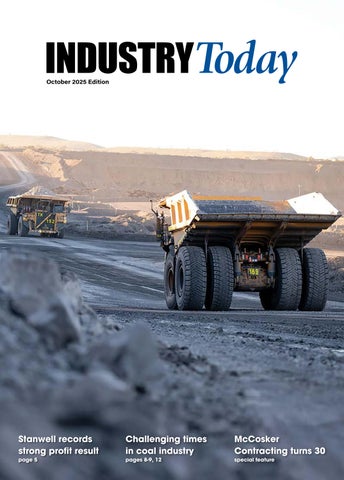
October 2025 Edition
Stanwell records strong profit result
Challenging times in coal industry
McCosker Contracting turns 30
page 5
pages 8-9, 12
special feature
INDUSTRY TODAY
MATES combating suicide By Matthew Pearce A landmark study has revealed that targeted mental health interventions during the Rookwood Weir project have led to measurable improvements in worker wellbeing. Construction on Rookwood Weir, 66km south-west of Rockhampton, was completed in late 2023. The weir is owned and operated by Sunwater. The study, conducted by Griffith University in partnership with MATES in Construction, evaluated psychosocial hazards and mental health outcomes among more than 500 workers over the course of the multi-year project. Using the internationally recognised Job Demands-Resources framework, researchers tracked workforce conditions before and after a suite of initiatives was introduced. MATES Queensland and Northern Territory chief executive officer Nick Thompson said almost 20 years ago, the Building Employers Redundancy Trust found many death claims directed to them were related to suicide. “They commissioned the Australian Institute for Suicide Research and Prevention and found that construction workers were six times more likely to die by suicide than their peers outside of the industry, as well as a lot of other concerning factors, particularly for younger workers who are even more likely to take their life,” he said. “Following this, MATES was established, setting out to create a workplace program where peers are trained in how to identify when someone is struggling, how to have a conversation and link them into support. “What we found from that initial study is that whilst there are lots of agencies in the community that exist to support people when they’re struggling with thoughts of suicide, it can often be really difficult to know how to navigate. “But something construction workers are good at navigating is discussions with their mates, their peers, people they trust, people they get along with, and often when they’re having those conversations, it just means that they
Workers engaged in training with MATES in Construction at Rookwood Weir. (Supplied) can get through things together.” Mr Thompson said Rookwood Weir engaged MATES in Construction in 2020, early in the project. MATES in Construction worked closely with project leaders to roll out training, awareness sessions, and onsite Connector programs that equipped workers and supervisors with the skills to recognise distress, start conversations, and connect people with help. “We started working with the safety committee to talk to key people on that job about how we could support their workers and make sure that they understood what could be done if some of their mates were experiencing thoughts of suicide, or even just general poor mental health,” Mr Thompson said. Local MATES field officer Tawnby Harrington is based in Gladstone but travels throughout Central Queensland. “The leadership at Rookwood grew to really appreciate the local field officer who was based in Central Queensland and prioritised making sure they were engaged in the training pro-
grams,” Mr Thompson said. “A lot of those workers were fly-in, fly-out, so they were away from friends, they were away from family, they were away from normal support networks.” Mr Thompson said because of Rookwood Weir’s long construction time, they were able to use it as a template to inform other projects, particularly those involving FIFO or DIDO workers. “We know that being away from trusted supports like family and friends is already an indicator for poor mental health and potentially suicide,” he said. “This creates a road map for how safety committees and the leadership of those construction projects can engage proper workplace, mental health support.” Mr Thompson said statistics had shown a significant drop in rates of suicide in the construction industry over the past 10 years. “We’re now almost on par with the general male population, but of course one
MATES in Construction Queensland and Northern Territory chief executive officer Nick Thompson. suicide,” he said. “It’s still a tragedy. It still has ripple effects for the community, and everything we can do to try and prevent those ripple effects and those impacts is what MATES’ mission and vision is all about.” Mr Thompson said MATES had identified that apprentices in the industry needed a lot of support. “Young people in general don’t have as much life experience as other people and there are many things – first relationship breakdown, first major job that’s paying significant revenue – that can impact their wellbeing,” he said. “So we’ve identified a program that can really help younger workers and apprentices integrate into the industry and receive the support they might need, because unfortunately, whilst the rates of suicide have gone down, when you look at men under 25 those rates are still quite high. “There’s a lot of work that needs to be done to support young people in the industry.”
Nationals cite report that warns of renewables’ costs Nationals leader David Littleproud has pointed to new analysis by Rainforest Reserves Australia and environmental advocate Steven Nowakowski as evidence of the potential cost and impact of the Albanese Government’s push for a renewable-only energy grid. The report estimates the cost of the shift could exceed $1.33 trillion, without factoring in transmission lines, the Capacity Investment Scheme or rooftop solar subsidies. Mr Littleproud said the true cost could be closer to $1.5 trillion. “This makes a mockery of Prime Minister Anthony Albanese’s scare campaign during the election campaign on nuclear,” Mr Littleproud said. He said the report demonstrated that Aus-
tralians were already experiencing higher energy bills and warned costs would continue to rise. The report also raises concerns about environmental and agricultural impacts, projecting more than 400,000 hectares of land could be affected, with up to 25,000 wind turbines and 250 million solar panels required. Mr Nowakowski described the findings as “an unfolding disaster for regional communities, the electricity system and nature”. Mr Littleproud said the infrastructure needed to support renewables – including 45,000 kilometres of new roads and thousands of kilometres of transmission lines – would have “an enormous impact on regional Australia”. “The report is sobering for not just regional
Australians, but every Australian, who is going to pay a very big price,” he said. The Federal Government last month announced its aim to reduce greenhouse gas emissions by between 62 and 70 per cent compared to 2005 levels, recommended by the Climate Change Authority. The CCA and Treasury projected Australia would need to exceed 90 per cent renewable coverage to achieve that reduction, while also quadrupling wind power and doubling rooftop solar rates. Energy and Climate Change Minister Chris Bowen described those figures as a ‘possibility’, not policy. “What [the CCA] did in their report to me, quite rightly, is ran through some of the possi-
bilities as to what achieving [the emissions target] might look like,” he told the ABC’s Insiders program. “Now of course, there is an opportunity to over-achieve on some things, underachieve on others … That will play out.” While emissions may be falling, Prime Minister Anthony Albanese did not repeat a pledge made prior to the 2022 election that power prices would also go down. Asked whether energy would become cheaper with the rise of renewables, he declined to guarantee a drop in prices. “The modelling is out there, and you can see the modelling,” Mr Albanese said. “I can guarantee that the cheapest form of new energy is renewables.”
Telephone: 07 4863 5050 Address: 5-9 Hempenstall Street, Kawana, QLD 4701 EDITORIAL Gregor Mactaggart Editor E: gregor.mactaggart@CQToday.com.au Matthew Pearce Journalist E: matthew.pearce@CQToday.com.au ADVERTISING Cheryl Altouvas Advertising Sales E: cheryl.altouvas@GladstoneToday.com.au Lou De Jager Advertising Sales Executive E: lou.dejager@CQToday.com.au 2 INDUSTRY TODAY October 2025
Nationals leader David Littleproud has pointed to new analysis by Rainforest Reserves Australia and environmental advocate Steven Nowakowski as evidence of the potential cost and impact of the Albanese Government’s push for a renewable-only energy grid. (File)
INDUSTRY TODAY
Milestone as mine counts down to its first gold pour By Matthew Pearce Heritage Minerals is on track for its first gold pour at the Mount Morgan Mine in 2026, after ticking off another milestone in its Mount Morgan Tailings Processing and Rehabilitation Project. In a statement released last week, Heritage Minerals announced it had “satisfied all conditions to achieve financial close on its debt finance” for the long-awaited project, which will produce “green gold and copper from waste”. “This has followed five-plus years of technical studies, design engineering, environmental planning and monitoring, approvals and permits, early works, plant construction, government and community engagement, as well as $100m in expenditure to date,” the company said. Heritage Minerals plans to establish a gold tailings processing plant at the mine, which
Heritage Minerals is on track for its first gold pour at Mount Morgan Mine in 2026. (File) has been closed since 1990 but was once the largest gold mine in the world. “Achieving this major milestone has been due to the outstanding support from the community of Mount Morgan, as well as the first-class collaboration and support from the three levels of government – Queensland Government, Australian Government and Rockhampton Regional Council,” Heritage
Minerals said. “The task of recommissioning and rehabilitating one of the world’s largest abandoned mines is a complex one, and many hands have lightened the load. “We are now one step closer to producing green metals from waste, reducing environmental degradation at the site, as well as delivering substantial economic impact in the
region and revenues to the Queensland and Australian treasuries.” Two months ago, Heritage Minerals announced it was preparing for stage two of its project – the processing of remnant pyrite at the mine site to produce sulphuric acid, with a target of around 500,000 tonnes of sulphuric acid per annum. “The production of pyrite concentrate removes the remnant pyrite from the Mount Morgan site and thus begins the significant and enduring environmental rehabilitation and reduction of acid mine drainage problems at the site,” the company said. “The project also aims to secure the supply of sulphuric acid for Australia’s critical minerals processing ambitions.” Following the latest milestone, commissioning and the first gold pour at Mount Morgan Mine are expected to occur in less than 12 months.
QAL fined $1m for breach Queensland Alumina Limited has been fined $1 million by the Department of Environment and Science for causing serious environmental harm, following a major chemical release at its alumina refinery in 2022. The breach occurred overnight on 22 March, 2022, when a high-pressure pipe bearing sodium hydroxide ruptured, releasing a toxic spray onsite and into the surrounding neighbourhoods of Barney Point, Toolooa and surrounds. A DETSI spokesperson said the pipe was carrying a dangerous chemical mixture called spent liquor, which turned into a vapour plume that drifted into the residential areas, “While no injuries were reported, the incident posed a potential significant risk to residents’ health, as spent liquor contains sodium hydroxide,” the spokesperson said. “The incident caused more than $800,000 in insurance claims relating to property damage.” It was reported at the time that Toolooa resident Jennifer Dekker was one of many that found cars covered in the corrosive spray, and she expressed concern about negative health impacts from the event. “It was like snow all over our cars,” Ms Dekker said. “If it’s eating my bonnet and making my bonnet bubble, if it eats away at steel, what’s it going to do to our health?” Shortly after the incident, Gladstone MP Glenn Butcher, then the Labor Government’s Minister for Manufacturing, advised that anything containing aluminium that came into contact with the spray could be etched with visible small, fine speckles. On Monday, 22 September, QAL was sen-
Part of the industrial landscape for 58 years, QAL was fined $1 million in a Gladstone court on Monday, 22 September, for environmental breaches relating to the rupture of a high-pressure pipe bearing sodium hydroxide on 22 March, 2022. (Supplied) tenced in Gladstone Magistrates Court and fined $1 million after pleading guilty to three offences against the Environmental Protection Act 1994, including one offence of unlawfully causing serious environmental harm and two offences of contravening a condition of its environmental authority. The company, majority owned by Rio Tinto, was also ordered to pay miscellaneous costs of $78,147 and court costs of $1500. A conviction was also recorded. A DETSI spokesperson said the sentence highlighted the department’s commitment to holding companies accountable for their actions and ensuring the safety of Queenslanders and the environment. In a statement issued on Tuesday 23 September, QAL apologised for not meeting the
Gladstone community’s expectations and its own. “QAL accept the court’s decision, acknowledge the seriousness of the incident,” the statement said. “All properties affected by the release have been assessed and remediation completed. “There were no environmental or human health impacts reported from the event.” QAL said it had taken significant steps to prevent a recurrence. “This includes a $13.2 million upgrade program to replace all carbon steel fittings in our high-pressure circuit with nickel-lined pipes, which have a greater resistance to erosion and a simpler maintenance program to prevent future incidents,” the statement said. “We have also completed our five-year en-
vironmental improvement program, investing over $450 million across more than 70 projects to reduce environmental risks, including a comprehensive update to our Process Safety Management System. “We’ve learned from this incident and remain committed to being a responsible, trusted neighbour and improving our environmental performance. “QAL will continue to work closely with regulators to meet the highest environmental and safety standards, ensuring we build a stronger, more sustainable future for our people, community and environment.” In December, 2020, QAL was fined $500,000, one of the largest penalties for an environmental breach in Queensland, after pleading guilty to one offence of unlawfully causing serious environmental harm and one offence of contravening a condition of an Environmental Authority. It held an EA to carry out various environmental activities, including chemical manufacturing, chemical storage and waste transfer at the Parsons Point refinery. On 8 September, 2018, an issue with an overpressure safety system caused the release of approximately two to three tonnes of alkaline bauxite slurry, including sodium hydroxide, to the atmosphere. The plume travelled around 11km south and caused serious environmental harm, including damage to vehicles and office buildings in the South Trees industrial estate. Among the court orders issues was that $100,000 of the fine be paid as a public benefit order for the purpose of a project aimed at enhancing the environment in the Gladstone region.
THE FUTURE IS HERE >>>
BUILT FOR
OFF GRID
NEW
LIVING Solar buildings that power your site anytime & anywhere
RID OFF-G SOLAR Y FACILIT
8.85kW PV
Cool & Quite: Crimsafe, Tropical Roof & well insulated
15x 590w Solar Panels
MEET RENEWABLE TARGETS REDUCE EMISSIONS IMMEDIATE SITE OPS
Up to
32.80 kWh Lithium Phosphate battery
READY TO GO SOLAR? CONTACT US NOW.
www.multitrade.com.au 12756359-KF20-25
October 2025 INDUSTRY TODAY 3
INDUSTRY TODAY
Profits flowing for GPC By Di Stanley The Gladstone Ports Corporation has recorded a coal export-driven net profit of $148.65 million for the 2024-25 financial year, a 15 per cent increase from the previous year. Total income was $639.43m with the multicommodity port of Gladstone accounting for 117.42 mega tonnes of total throughput with coal exports down 1.67Mt. “This steady performance was driven primarily by sustained demand for coal, LNG, alumina and associated product, demonstrating the strength and resilient of our diversified operations across more than 34 export commodities,” the GPC annual report stated. “Coal remained the dominant commodity in 2024-25, accounting for 54 per cent of total throughput, with 64.29Mt exported. “GPC continued to rank among Australia’s largest LNG ports, recording a total LNG throughput of 23.96Mt. “This underscores our ongoing role in facilitating energy exports to global markets. “GPC handled a wide range of general cargo, this included the movement of containers, wind turbine components, explosives, scrap metal, heavy machinery, industrial equipment, forestry products and a variety of breakbulk items, such as bagged goods. “These cargoes reflect the evolving needs of regional industries and the adaptability of our port infrastructure to accommodate both standard and non-standard freight.” During 2024-25, 1932 vessels docked at the GPC’s three operational ports - Gladstone, Rockhampton and Bundaberg. GPC chair Maree Adshead said the government-owned entity remained committed to the opportunities presented by the transition to clean energy and containerisation in the region. “GPC has long been central to Queensland’s trade and economic growth, and as the industry evolves, we are committed to maintaining operational excellence, while embracing diversification,” Ms Adshead stated in the report. “From the continued strong throughout at RG Tanna Coal Terminal to the expansion of containerisation in Central Queensland, our ability to innovate and adapt positions us well for the future. “With new energy projects on the horizon, GPC stands ready to play a pivotal role in strengthening Australia’s sustainable future.” The annual report’s review of upcoming financial conditions noted global economic
The 2024-25 financial year saw coal exports decrease by 1.67 mega tonnes, but 64.29MT of the commodity, 70 per cent of it steelmaking coal, left for overseas destinations as the Gladstone Ports Corporation powered to a net profit of $148.65 million. (Gladstone Aerial Media) growth continued to remain relatively soft. The US-imposed tariffs were identified as rising trade barriers with uncertainty over where they would settle. “The coal and energy export forecast is expected to pick up modestly as the impact of easing monetary conditions offset the impact of rising trade barriers, however, both metallurgical and thermal coal supply remains constrained across the east coast due to the impacts of bad weather,” the report stated. “GPC continues to support the energy transition to renewables, specifically focused on immediately facilitating the imports of wind and solar equipment, and is focused on assessing the infrastructure that underpins growth. “GPC will constantly monitor for the most diligent sequencing of infrastructure investment to support the demand expected with containerised freight and other emerging trades.” The annual report stated Port Alma, trading as the port of Rockhampton, was of national
New GPC CEO in the role
4 INDUSTRY TODAY October 2025
GPC chair Maree Adshead said the government-owned entity remained committed to the opportunities presented by the transition to clean energy and containerisation in the region. (Supplied) led by the Maersk-McKinney-Mollar Centre for Zero Carbon Shipping t reduce carbon emissions within the shipping industry. The organisation has been working with the federal and state governments and the Marting and Port Authority of Singapore to explore its role in the Singapore-Australian Green Economy Agreement. The draft working plan is focused on consideration of the decarbonisation of shipping corridors and the green and digital shipping corridors between the two countries The Gladstone Marina was recently reaccredited as a fish friendly and clean marina, receiving 100 per cent in its audit. There are only 30 accredited marinas in Australia, New Zealand, Fiji and Southeast Asia.
CHAUVEL INDUSTRIAL SERVICES
• On-site maintenance, shutdown and workshop facilities • Mechanical and Fabrication • Pumps, pulleys, conveyor supply and service • Civil and concreting
Gladstone Ports Corporation’s new chief executive officer Andrew Johnson commenced on Monday, 22 September. (File) recruitment process and are grateful for the trusted advice and support provided by Ms Druce in this period.
12619179-MS29-23
Andrew Johnson has started his tenure as the new chief executive officer at the Gladstone Ports Corporation. Dr Johnson took the helm on Monday, 22 September, following a rigorous and comprehensive search process. As a proud Queenslander with more than 30 years of national and international leadership experience, he has successfully led large-scale, complex, and globally recognised organisations. GPC’s chair Maree Adshead expressed confidence in Dr Johnson’s ability to guide the organisation into its next chapter with his strong reputation for delivering results. “Andrew is the right person to strengthen GPC’s core business, ensure long term stability and we are delighted to offer him a warm welcome to Gladstone,” Ms Adshead said. “GPC remains steadfast as a world-leading multi-commodity port focused on ensuring the future prosperity of our community and the state of Queensland, Andrew’s extensive experience will ensure GPC continues to deliver.” GPC said acting chief executive officer Jenelle Druce has provided safe and stable leadership while the Board undertook the
security significance and a critical link as a hub for hazardous cargo. The facility accounts for the importation of 95 per cent of Australia’s hazardous goods. “The Port of Rockhampton is uniquely positioned to capitalise on future growth opportunities across the country’s mining, construction and defence sectors,” the report stated. “We are committed to building on the existing trade and supporting new trade of hazardous goods and explosives so we can continue to service domestic trends and address global shifts.” In the 2024-25 financial year, there were 815 direct workforce employees across GPC operations, up from 745 in the previous period. The organisation identified high inflation and rising interest rates as placing upward pressure on wages and labour costs. “While GPC provides market competitive renumeration and conditions, it is possible that it may face some employee attraction and retention issues,” the report stated. “GPC will continue to monitor these external actors and any movements in the market wage rates within the Gladstone region in order to maintain its position as an employer of choice.” The CEO’s total renumeration was listed at $760,659, with the chief operating officer’s package at $513,500. The GPC has also delved into the future of ‘green shipping’ and is part of a study being
• Blast and paint
Exceeding Expectations
07 4926 8588 | chauvel.com.au Head Office: 26 Hempenstall St, Nth Rockhampton Emerald: 6 Daniels St, Emerald
INDUSTRY TODAY
Stanwell Power Station general manager Angie Zahra speaking at the Zonta Club of Rockhampton’s International Women’s Day breakfast.
One of the final Megapack units being delivered at the Stanwell Battery site. (Supplied)
Strong Stanwell success By Matthew Pearce Despite choppy waters in the state’s energy sector, Stanwell Corporation recorded a net profit of $429.2 million in the last financial year, attributing “disciplined asset management, strategic investment, and operational excellence” to its success. According to the chair and chief executive officer’s statement in Stanwell’s recently published annual report, the company returned an operating profit of $235.3 million in 2024-25 (compared to $293.5 million in 2023-24). The company’s net profit after tax of $429.2 million in 2024-25 was less than the $594.4 million in 2023-24. Stanwell Corporation operates the Stanwell Power Station, 22km west of Rockhampton, which supplies 15 per cent of the state’s electricity needs as well as two stations at Tarong (Tarong and Tarong North) in the South Burnett region. A Stanwell spokesperson said the company’s strong results and core business fundamentals provided a solid foundation for Stanwell’s critical role in the state’s energy future. “From continued reliability and maintenance of our power stations, major milestones in our battery and wind projects, to strong financial performance and deeper community engagement, the report showcases the collective efforts of our people across all our sites and teams,” they said. It has been a turbulent time for energy providers in Queensland. Queensland’s state-owned energy corporation CS Energy recorded a $324 million loss for the last financial year, largely attributed to ongoing issues at the Callide B coal-fired power station. Meanwhile, on Wednesday, 1 October, Gladstone Power Station’s joint venture partners notified the Australian Energy Market Operator that the plant will be retired in March 2029, six years ahead of schedule.
Stanwell Corporation has recorded a net profit of $429.2 million in the last financial year. (Supplied) The spokesperson called Stanwell’s power stations some of the most reliable in the country, achieving one of the highest reliability performances of any energy provider in the National Electricity Market (NEM), at 98.3 per cent reliability. “We’ve invested $253.6 million in sustaining capital across our existing assets to ensure we continue to provide a reliable supply of energy for Queensland,” they said. “This continued investment and year-round maintenance program ensures Stanwell’s assets continue to deliver affordable, reliable, and sustainable energy for Queensland, our customers, and the NEM.” The Stanwell spokesperson said the com-
pany was making “significant progress” in developing a firmed renewable energy portfolio. “In 2024-25 we invested $546.7 million in new renewable energy and firming projects, including large-scale battery energy storage systems (BESS) and wind farm developments,” they said. One of Queensland’s largest battery projects has hit the construction halfway mark at Stanwell Power Station, with the final Tesla Megapack units delivered and installed onsite late last month. The 324 Megapacks, each weighing 38 tonnes and eight metres in length, have been transported by truck from the Port of Brisbane and installed at the Stanwell site.
Together, the units make up the 300 MW battery with up to four-hour duration (1200 MWh), forming a key part of Stanwell’s broader 2.8 GWh battery firming portfolio. The Stanwell spokesperson said the company returned a dividend of $335.9 million to the state in 2024-25, which goes towards essential services like hospitals, roads, and schools. “Over the past five years, Stanwell has returned more than $1 billion to Queenslanders through these dividends,” they said. The spokesperson said Stanwell’s ongoing strategy is focused on maintaining affordability and reliability while building a portfolio that meets the evolving needs of Queensland’s diversifying energy system.
Environment
CQG is a passionate advocate for local businesses Rockhampton | Gladstone | Brisbane | Mackay | Townsville
Engineering
Planning
www.cqgroup.com.au • +617 4922 9252 12618313-CB29-23
October 2025 INDUSTRY TODAY 5
INDUSTRY TODAY
Gladstone Power Station’s operators say no decision has been made on its closure date despite Wednesday’s announcement on a potential 2029 climax for the plant. (File)
No firm closure date yet, say station’s operators By Di Stanley, Gregor Mactaggart and Peter Bodkin, AAP Gladstone Power Station’s joint-venture partners remain adamant no end date has been confirmed for its closure. An announcement on Wednesday, 1 October referred to CS Energy notifying the Australian Energy Market Operator (AEMO) about the potential retirement of the plant in March 2029, six years ahead of schedule. The news sent shockwaves through not just Central Queensland, but the wider Sunshine State. Resources giant Rio Tinto is the largest shareholder in the joint venture, which also includes Texas-based firm NRG Energy. “No final decision has been made to retire GPS ... and there is potential to extend the life of the power station should market and other factors allow,” a Rio Tinto spokesperson said. “There is no immediate impact of this notification on GPS operations. “Existing power supply contracts, including to Boyne Smelters Ltd, will remain in place until their scheduled expiry in March 2029.” Gladstone Power Station has operated since 1976 and has a capacity of 1680MW, making it the largest of Queensland’s eight coal-fired power stations. “The JV participants recognise the contribution of GPS to the Gladstone community and are committed to work with the operator NRG Gladstone Operating Services to ensure transparent and timely engagement with employees, contractors and suppliers throughout this process,” the spokesperson said. Premier David Crisafulli said he was unaware of the announcement about Gladstone’s future but was “genuinely optimistic about the future of mining and manufacturing in this state”. “(That) is why we need to get an energy plan which is affordable, reliable and sustainable,” he said on Wednesday. Gladstone MP Glenn Butcher challenged Mr Crisafulli and Energy Minister David Janetzki to give surety, one way or the other, to the power station’s 400-odd employees, and Central Queenslanders on their energy future. “It’s an old power station, built in 1976, and is getting a bit long in the tooth, but certainly it 6 INDUSTRY TODAY October 2025
The Gladstone Power Station. was a bit of a shock to hear this,” he said. “Manufacturers are looking for cheaper power and these types of expensive power stations are going to keep costing manufacturers and Rio Tinto’s certainly one of them. “This is now up to David Janetzki - what are the government’s intentions with the power station now? “These people have got to remember they’re in government now and they have to be working extremely closely with Rio Tinto and CS Energy to make sure that whatever happens in this landscape, the GPS is either extended and there is potential to extend its life, but every one of these renewable projects that the LNP and David Janetzki cut, which we’ve seen, and hold back means we’re not getting that cheap energy that big manufacturers need, like
Rio Tinto.” Mr Butcher said he and his twin brother Wayne both did their apprenticeships at the power station. “It’s been a great employer,” he said. “It’s been a staple of the Gladstone and Queensland landscape, and this announcement has been a bit of a shock, but in saying that, I think most people knew that the life of an old power station is certainly going to be challenging moving forward. “The government needs to come out and tell people what they’re going to do. “I think it’s critical they support, moving forward, reliable cheap power as in renewable energy projects or they sit down with Rio Tinto and come up with a plan.”
Gladstone Regional Council Mayor Matt Burnett acknowledged the decision but held out hope that 2029 would not be the end of the road for the station. “Gladstone Power Station has powered Queensland industry and supported thousands of local families for nearly five decades,” Cr Burnett said. “The specific wording in the notice to AEMO is important, and I am looking to working with power station operators and the Queensland and federal governments to ensure the Gladstone Power Station remains operational beyond the potential closure date in 2029.” Flynn MP Colin Boyce said he had been briefed by Rio Tinto on the possible closure of the power station. “Under the AEMO rule book they have to flag possible closure of these coal-fired facilities three to three-and-a-half years out from when they’re doing it,” Mr Boyce said. “This is not necessarily a final decision, but they have flagged the closure as a possible option. “If indeed that happens, it will be devastating to one of the biggest economic generators in Australia and that is Gladstone and Central Queensland. “The alumina sector, the port, the cement industry, engineering and all of the big industries there, they’ve all got a symbiotic relationship and what happens to one will affect the other.” The Queensland Conservation Council hailed the Gladstone decision as further evidence that industry was getting on with the transition to renewable energy. “Rio Tinto is Queensland’s biggest energy user and they’ve made it clear they can’t keep their Gladstone operations and smelter globally competitive relying on expensive coal power,” director Dave Copeman said. “We are calling on the Crisafulli government to stop playing politics and be up-front with the community by planning for the timely closure of the state’s other ageing coal power stations.” The announcement comes just days after it was revealed state-owned energy corporation CS Energy has recorded a $324 million loss for the last financial year, largely attributed to ongoing issues at the Callide B coal-fired power station.
INDUSTRY TODAY
Close Callide B calls grow Queensland’s state-owned energy corporation CS Energy has recorded a $324 million loss for the last financial year, largely attributed to ongoing issues at the Callide B coal-fired power station. In response, the Queensland Conservation Council (QCC) has urged the State Government to stick to the planned 2028 closure of Callide B, rather than spending up to $420 million a year to keep the ageing plant operating. QCC senior renewables campaigner Stephanie Gray said the figures highlighted the financial risks of prolonging the station’s life. “CS Energy’s annual report reveals that the troubled Callide B coal-fired power station is already costing Queensland taxpayers millions,” Ms Gray said. “Callide B’s two units have been offline for an average of three months each year since 2020. Even if taxpayers continue to fork out hundreds of millions, there’s no guarantee the station will provide reliable power.” Energy Minister David Janetzki said Callide B would continue to 2031 as he reiterated Queensland’s support of coal-fired generation. “We’ve got the youngest coal-fired fleet in the country, we will not be turning off coalfired generation arbitrarily in 2035, we’ve made that clear,” he said. “We’re working through technical lifespan. We’re going to invest in the appropriate maintenance of coalfired generators to ensure we have reliable and affordable power into the grid.” Ms Gray said Queensland is on track to build more renewable energy and storage capacity than previously modelled, raising questions about the government’s decision to extend the life of the coal plant. “Callide B was only built to operate for 40 years and the end of its life has always been scheduled for 2028. Queenslanders have ev-
CS Energy, the state-owned company which runs power generation assets including Callide Power Station, posted a $324 million loss in the last financial year. (File) ery right to ask why Premier David Crisafulli appears to be ideologically backing coal rather than what’s in the state’s economic
interest,” she said. According to Nexa Advisory, closing Callide B on schedule would contribute roughly
5 per cent of the progress needed to meet Queensland’s 75 per cent renewables target by 2035.
Our commitments to risk management help protect our people, contractors and the community to enable everyone to get home safely. October 2025 INDUSTRY TODAY 7
gpcl.com.au
1800 243 GPC (472)
INDUSTRY TODAY
The BHP Mitsubishi Alliance axed 750 jobs from its Queensland operations and 72 operational roles at the Saraji South coal mine near Dysart (pictured), which will go into care and maintenance mode from November. (Supplied)
Tough times in Bowen Basin By Di Stanley Queensland Premier David Crisafulli held talks with coal miners after 900 jobs were wiped from the industry last month as Anglo American Australia and BMA, two of the Bowen Basin’s biggest players, wielded their muscle in retaliation to the super-tax coal royalty regime. The meeting took place in the face of mounting pressure from federal LNP parliamentarians, including Capricornia MP Michelle Landry and Senator Matt Canavan, for an urgent review of the scheme. “Behind every job lost is a family struggling with a mortgage, children missing out on afterschool sport and a local economy that will be gutted,” Ms Landry said. “The former state Labor government’s destructive royalties, combined with Federal Labor’s carbon tax by stealth, have created the perfect storm for job losses across the Bowen Basin.” The BHP Mitsubishi Alliance axed 750 jobs from its Queensland operations and 72 operational roles at the Saraji South coal mine near Dysart, which will go into care and maintenance mode from November. Anglo American confirmed 150 voluntary and forced redundancies were in force across its Brisbane office and Bowen Basin mines, with 112 voluntary redundancies for workers at its Grosvenor underground mine affecting the nearby Moranbah community. “Our focus is on supporting safe, core operations and simplifying our business to adapt to ongoing market pressures - including lower coal prices and rising costs,” Anglo American Australia’s people and corporate relations vice president Ben Mansour said. “These changes are essential to secure the future of our steelmaking operations in Central Queensland.” Isaac Regional Council Mayor Kelly Vea Vea said she wouldn’t stand by and watch as the region’s workforce became collateral damage in the royalties stoush. She reiterated her call for the warring parties to come to the Bowen Basin and hammer out a solution at the coalface. “It will be disappointing if these discussions don’t occur in a Bowen Basin mining community,” she said. “Because showing up in the communities at stake is a signal that we matter in these conversations.“ Cr Vea Vea said while the coal mining industry was used to riding the highs and lows and the booms and busts, this was a particularly hard time. She said she believed there had been more than 1000 jobs lost in the last fortnight with another unconfirmed 120 gone from Anglo with a portion involving Moranbah North mine workers. “There are a lot of layers to what’s happen8 INDUSTRY TODAY October 2025
Isaac Regional Council Mayor Kelly Vea Vea said while the coal mining industry was used to riding the highs and lows and the booms and busts, this was a particularly hard time. (File) ing at the moment,” she said. “Since last year, Anglo American has had two mines offline with Grosvenor and Moranbah North this year... we’ve had over 1200 jobs hanging in the balance. “We’ve had terrible weather at the start of the year, low coal prices and now we’ve got a royalties dispute happening. “What we’re asking for is the State Government take control of what they can control as we ride out the wave of this downturn. “What we don’t want to be as communities is collateral damage in a battle between major mining companies and the State Government.” Central Highlands Mayor Janice Moriarty said she stood with Cr Vea Vea in calling for a resolution to the dispute. “The Central Highlands is a two-pillar economy, coal mining and agriculture, and we need both industries to remain strong to sustain community liveability,” she said. “I agree with Cr Vea Vea in saying the royalties’ debate does need to be sorted out, so Bowen Basin communities are not caught in the crossfire. “Even though Saraji and other mines who are currently announcing workforce cuts are not in Central Highlands, the ripple effects have impacts in this region especially for workers and their families who live locally and on mining supply chain businesses.” Central Highlands Regional Resources Use
Planning Cooperative (CHRRUP) chief executive officer Justine McLeod said no-one could afford to have Central Queensland’s economic engine - powered by mining and agriculture derailed. “This is a story about more than just mining jobs in our home of Central Queensland,” she said. “It’s about the economic ripple effect that extends to our agricultural sector, our cities and the entire state budget. “Mining and agriculture are two sides of the same coin. “The resources sector is a multi-billiondollar direct economic contributor, and that money doesn’t stay in the ground. “It flows through our communities, supporting thousands of local businesses - from the butchers and bakers to the mechanics and engineers who keep our farms running. “When one pillar is under threat, so is the other.” Australian Resources and Energy Employer Association chief executive officer Steve Knott said the State Government royalties were a punitive tax disincentivising the industry and the BMA and Anglo mass jobs cull was the result of failed policy. “The (shuttering of South Saraji coal mine) impact this will have on the Dysart community - which caters for coal mining, cattle grazing and other agriculture - will be enormous,” Mr
Knott said. “Anglo American’s announcement of job cuts at the Grosvenor mine show the Queensland Government does not have the luxury of time to make the right call and revise the state’s damaging coal royalty regime. “Coal mining sustains tens of thousands of direct jobs and many more indirect jobs in small businesses across regional Queensland. “It funds schools, hospitals, police, roads and services and every Queenslander benefits from a strong coal sector. “Unless urgent action is taken to reset the royalty system to competitive, sustainable levels, more mines will close, more jobs will go, and the economic foundations of Queensland will be permanently weakened.” At the Bowen Basin Mining Club’s September luncheon, Coronado Global Resources chief executive officer Douglas Thompson emphasised the enormity of the company’s contribution to the state through the $6 billion in royalties paid to the Queensland Government from its Curragh open cut and underground mining complex since listing on the Australia Securities Exchange. “To add perspective, the $6 billion could have built 12 regional hospitals or provided 20 years of the state’s disaster relief budget - or 60 per cent of the venue infrastructure costs for the 2032 Brisbane Olympics,” he said. Queensland Treasurer David Janetzki told State Parliament on Tuesday the coal sector’s 45,000 Queensland employees were supported by the LNP. “BHP’s decision comes on the heels of its 2022 pausing of the open-cut Blackwater South mine, which was due to create 750 construction jobs and 1200 operations jobs,” he said. “It is common knowledge that the coal sector has been hit with rising costs of production and lower coal prices. “Treasury assessment of WoodMac data reveals that average operating costs have increased by $42 a tonne between 2021 and 2025. “By comparison, forecast royalty impacts in 2025-26 total an additional $5.60 a tonne for the tiers introduced by Labor in 2022. “The uncertainty created by these new tiers that were implemented without consultation by the former Labor government has been significant.” Resources Minister Dale Last said BHP’s announcement of the job losses and a review of its FutureFit Academy in Mackay was a “slap in the face” to the people who wanted a future in the mining industry. “BHP’s decision to place the Saraji South mine into care and maintenance is a difficult day for those families, communities and contractors who depend on that operation,” he said. “My thoughts, and the thoughts of this government, are with every worker affected. “They deserved better from BHP.”
INDUSTRY TODAY
Premier David Crisafulli told a packed crowd in Brisbane late last month that Queensland is ‘looking for partners who will remain steadfast in our communities in the challenging times’. (AAP)
BHP Mitsubishi Alliance’s Adam Lancey said his company paid about eight times more in royalties than it made in profit after announcing the layoffs. (File)
Premier takes dig at miners By Laine Clark and Andrew Stafford, AAP It prompted calls for reform but the Premier was adamant his Liberal National Government would not tweak the state’s royalties scheme, which he had promised not to touch during his 2024 election campaign. Mr Crisafulli appeared to take a jab at the alliance, criticising “fairweather friends” in his address to a packed crowd at the Brisbane Convention Centre. “We are looking for companies that want to become part of the fabric of our communities, partners who will share in the good times, and partners who will remain steadfast in our communities in the challenging times,” he said. “We are not interested in fairweather friends who come running for the dollars when things are good, and then abandon Queenslanders in the name of shareholder interests.” In response, the Queensland Resources Council said the sector had been backing the state for some time, supporting 17,000 businesses and more than 1600 charities and sports clubs last year alone. “The resources sector has proudly supported Queenslanders for decades through
both the good times and not so good times in the market cycles,” QRC chief executive officer Janette Hewson said. “Through royalties and taxes paid by our resources industry, all Queenslanders benefit. “This underpins our state’s economic prosperity and enables government to fund the services we all rely on.” The stoush comes after the state government in August finalised a deal with Adani to defer royalty payments in exchange for an expansion of Central Queensland’s Carmichael coal mine. The state’s former Labor government introduced a tiered royalties’ system in 2022, in which higher revenues are generated during boom periods of high coal prices but less is taken when market conditions deteriorate. Miners want the tiers adjusted amid rising production costs and weak coal prices. BHP Mitsubishi Alliance’s Adam Lancey said his company paid about eight times more in royalties than it made in profit after announcing the layoffs. Yet according to one an expert, royalties only play a small part in the financial issues facing the state’s coal mines, pushing back at speculation the scheme would
Queensland Resources Council chief executive officer Janette Hewson said the coal sector had supported the Sunshine State in good times and bad. (File)
put off investors. “It’s not that Queensland is not investable. It’s just that coal mines are not a good investment right now,” Andrew Gorringe of the Institute for Energy Economics and Financial Analysis said. “The major driver of the future viability of coal mines in Queensland is the price for the coal - it’s not sufficiently covering the cost to produce it.” Rising costs have been impacting the indus-
try for some time and squeezed profit margins for miners, he said. Unit costs - the expense of producing a tonne - for metallurgical coal miners in Queensland had risen by up to 50 per cent since 2018. “There are many contributing factors for this, including Queensland’s higher royalty rates - but royalties have risen by a lesser amount than the other cost factors,” Mr Gorringe said.
12758761-EA15-25
October 2025 INDUSTRY TODAY 9
Celebrating 30 years
12807557-KF41-25
Bob McCosker when he received his Order of Australia Medal. (Supplied)
An excavator load at Gove in the Northern Territory.
The original crew at McCosker Contracting.
A look back over 30 years McCosker Contracting was founded in Gladstone in 1995 by local businessman Bob McCosker OAM, who saw the need for a civil contracting company that not only delivered quality projects but also invested in people and community. Bob’s vision was clear from the outset: to create a company built on hard work, integrity, and teamwork, with the capability to take on complex projects while maintaining a strong local identity. In the early days, McCosker Contracting began with modest resources but a determined mindset. Bob drew on his background in surveying, construction, and project management to establish a small but dedicated crew capable of delivering bulk earthworks, civil works, and mining support projects across Central Queensland. The company’s foundation was built on doing things right the first time, taking pride in workmanship, and building lasting relationships with clients, suppliers, and the workforce. Bob’s vision extended beyond the job site. From inception, he wanted McCosker Contracting to be more than just a contractor — it was to be an organisation that empowered its people, supported its community, and created opportunities for future generations. This meant fostering a culture where employees felt part of something bigger, with a focus on training, apprenticeships, and personal growth. It also meant giving back to the community through sponsorships, events, and environmental initiatives. As the company grew, so too did its capabilities. McCosker invested in modern plant and equipment, expanded into new sectors, and earned a reputation for reliability, safety, and innovation. Despite this growth, Bob’s founding vision
The McCosker Contracting team in 2010. has remained the guiding force: valuing people, building trust, and delivering projects that make a positive impact on the region. Today, McCosker Contracting is recognised as one of Queensland’s leading
civil contractors. Yet at its heart, the company still reflects the values set by Bob at inception — a commitment to excellence, a belief in teamwork, and a passion for community.
The legacy of its beginnings continues to shape its future, ensuring McCosker Contracting remains not just a business, but a trusted partner in building stronger industries and stronger communities.
McCOSKER CONTRACTING Celebrating 30 Years Constructing a sustainable future for our people, clients, families and community.
Find out more about us….. (07) 4970 0100 | www.mccoskers.com.au 12800256-EA41-25
10 INDUSTRY TODAY October 2025
12807557-KF41-25
Celebrating 30 years
Safe, efficient, innovative McCosker Contracting is a proudly Queenslandbased civil contracting company with a strong reputation for delivering high-quality, safe, and efficient project outcomes. Established in Gladstone in 1995, McCosker has grown into one of the region’s leading contractors, combining technical expertise with a strong commitment to people, community, and the environment. The company provides a wide range of services across the resources, energy, industrial, and infrastructure sectors. Core capabilities include bulk earthworks, civil construction, structural concrete, road and rail infrastructure, HDPE pipeline construction, drainage and water management, mining support services, and rehabilitation works. McCosker also operates a modern fleet of plant and equipment, ensuring reliability and flexibility across projects of any scale. At the heart of McCosker’s success is a dedication to safety, teamwork, and innovation. The business invests heavily in developing local skills, supporting apprenticeships, and retaining a skilled, experienced workforce. Beyond construction, McCosker is deeply embedded in the Gladstone community. The company supports a wide range of sporting clubs, charities, health initiatives, and environmental projects — including the Quoin Island Turtle Rehabilitation Centre, Bob’s Garage men’s health facility, and the McCosker Gladstone Speedway. With proven experience, strong leadership, and a people-first culture, McCosker continues to deliver projects that shape industries and strengthen communities across Central Queensland and beyond.
Amphibious Scrollers, which are designed and built in-house by the McCosker team. (Supplied)
Bob McCosker at Rookwood Weir with director Danny Hughes, operations manager Andrew Smith, technical superintendent Ross Hagedorn and general superintendent Trent Marshall. (Supplied)
Some members of the McCosker Contracting team after the delivery of the biggest dozer, the Komatsu D11 in 2019.
12800257-JD41-25
Civil Earthworks Industrial Tailing & Residue Piping
Major Affiliates:
Gladstone (07) 4970 0100 Mackay (07) 4952 2900
www.mccoskers.com.au Find us on Facebook
HEAD OFFICE: 19 Morgan Street, (PO Box 1125) GLADSTONE Q 4680 BRISBANE OFFICE: Level 5/67 St Pauls Terrace, SPRING HILL Q 400 October 2025 INDUSTRY TODAY 11
INDUSTRY TODAY
CQ to feel the knock-on effects of job losses Central Queensland mining communities are bracing for the fallout after BHP and Anglo American announced almost 1000 job cuts across their Queensland operations. Mirani MP Glen Kelly said the news was a devastating blow for families and regional towns that rely on the coal sector. “Every one of those job losses represents a family that will now struggle with mortgages, with paying the bills, and keeping food on the table,” Mr Kelly said. “My heart goes out to those workers impacted by BHP’s and Anglo American’s decision. This is an unfortunate commercial decision for both companies — BHP, who (recently) posted a $16 billion profit — but I am focused on the workers and the communities that will be impacted by this decision.” Mr Kelly said the Crisafulli Government remained committed to supporting Queensland’s mining sector through faster planning decisions, streamlined approvals and reduced red tape. “I will continue to stand up for coal jobs, and hope that BHP’s review of the BHP FutureFit Academy in Mackay, located in my electorate, sees this continue to train the next generation of workers,” he said. Mr Kelly also called on BHP to be trans-
parent with workers and the public about the reasons for its decision, rather than blaming the state’s royalty structure. “In 2012, BHP mothballed the Norwich Park Mine, which is now part of the Saraji South Mine, due to financial constraints and increases in operating costs,” he said. “BHP need to be honest with the workers, and the public, and not blame the royalties on this mine continuing. They operated it for three years under the current royalty regime, which was brought in by Labor, and now are making all these workers redundant and blaming the government for what is quite plainly a commercial decision.” He said declining coking coal prices had also contributed to the cuts. “With coking coal prices trending downwards over the past year, there’s more than just royalties impacting these decisions,” he said. Mr Kelly said the ripple effects would be felt across local economies. “These job losses will impact suppliers and local businesses — coal mining is the backbone of many towns in Central Queensland, and when jobs are lost, cafes, shops, mechanics and other service indus- Mirani MP Glen Kelly said the job losses in the coal sector were a devastating blow for families and regional towns that rely on the industry. (File) tries all feel the flow-on effects,” he said.
Boyce supports royalties stand
By Laine Clark and Andrew Stafford, AAP
By Di Stanley Federal Flynn MP Colin Boyce has urged Queensland Premier David Crisafulli not to shut the gate on a rethink of the state’s coal royalties regime. Mr Boyce said the BHP Mitsubishi Alliance’s announcement last month it was cutting 750 jobs from its Queensland operations and mothballing the Saraji South mine in retaliation to the super tax regime was nothing more than a smokescreen to cut a marginal performer in its Bowen Basin portfolio. “BHP, in their wisdom, is using the whole coal royalties issue as an excuse to shut the mine (and) I can 100 per cent guarantee you that if the Premier decided to abandon the coal royalties issue the way it stands now, that would not save Saraji South,” he said. “It is a commercial decision made by BHP and there are things like the safeguard mechanism, which is a cost impost on them. “Yes, there is also a very low price of coal at the moment, also things like rising costs of energy and production costs. “If you look at the history of Saraji South mine, it’s has always been a mine that was teetering on the brink of being viable and unviable. “I do feel for all the people that work there and the 750 people that have now become redundant, but that’s the ebbs and flows of the mining and resource sector.” Mr Boyce said he applauded the Premier and Treasurer David Janetzki for standing their ground in the face of the mining lobby’s sustained campaign for relief from the royalties regime. The Queensland Treasury 2024-25 annual report recorded royalties income of $7.891 billion, down from $12.728b in the previous financial year. “I do believe that David Crisafulli, while he has made a commitment not to adjust any of this mining royalty regimes in this term of government, he has been handed a very difficult economic situation left to him by the previous government and he has got to pay the bills,” Mr Boyce said. “He has got to service the debt. He has got to complete infrastructure projects. He’s got to 12 INDUSTRY TODAY October 2025
Peak body enters the skirmish
Flynn MP Colin Boyce wants Premier David Crisafulli to keep the lines of communication open with the coal sector and work toward an equitable agreement on coal royalties. (Supplied) finance the Olympic Games. “My advice to the Premier, and I’m sure they are well aware of this, is that at some point in time that issue around coal royalties should be readdressed and that needs to be done to give the coal industry, in particular, some confidence investing into the future. “I think David Crisafulli is doing a wonderful job addressing that issue because it’s not the mining royalties that forced the closure of that mine.” Mr Boyce said his advice for Premier Crisafulli, who did meet with representatives from the coal and energy sector last Friday, 26 September, in Brisbane for an hour, was to consider all options moving forward. “All I ask is that everybody keep talking and keep the doors open and come to an equitable agreement at some point in the future,” he said. Gregory MP Sean Dillon publicly aligned himself with lobby group, Coal Australia. “I support broadly any organisation that is advocating for a better deal for coal mines and coal miners,” he said. “They’re a critical component of our economy, not only the ongoing day-to-day parts of the economy in Central Queensland, but some
of the biggest growth areas are still underpinned by future coal mine expansions. “Good advocacy is the good work that people do (and) it’s difficult to not align myself with them, just as I do with AgForce or people who positively promote the merits of agriculture.” Mr Dillon said he was cognisant of the coal industry’s multi-billion-dollar supply chain business network across his electorate and throughout Central Queensland could take a hit from the coal industry’s cost-cutting measures. “The decision is for individual corporates as to the extent of those cost-savings measures is one for them,” he said. “What I will say is coal is a commodity like all other commodities, whose price is cyclical. “The unfortunate reality at a local level is that can translate into job losses or winding back of shift availability for contractors. “We understand that will have ramifications, but for every coal mine that I’m hearing issues around, or that the media are reporting issues with, I’m aware of two or three that are under development or very close to lodging EIS’s for new coal mines.
A call to arms has been issued by a resources sector peak body amid an escalating coal royalties stoush with a state government. Resource Industry Network has urged its members to join the fight against Queensland’s “unsustainable” royalties scheme, highlighting the plight of businesses caught in the coal industry “crisis”. In a newsletter seen by AAP, the network outlines key phases of its campaign against Queensland’s “world-highest coal tax” to its almost 8000-strong members. They have been asked to support a petition, contribute video to a social media campaign, seek out local media for interviews and join a delegation to meet the government in Brisbane. Tips are also provided, with the network saying it can provide “talking points, guidance on engaging with media (and) introductions to media outlets when required”. Calls for royalties reform grew louder when BHP Mitsubishi Alliance, Anglo American and QCoal recently announced a total of 1200 job cuts, with two coal mines either closed or mothballed in Central Queensland. The network represented businesses that were part of the supply chain to the coal mines impacted by the cuts, general manager Dean Kirkwood said. “It is a call to arms for those businesses,” he said of the newsletter. “We feel that all the conversations around mine closures are focusing on the mining companies without mentioning the over 600 businesses in the region that are at least partly reliant on a prosperous resources sector.” Business owners were fast losing confidence in the government and industry amid fears job losses would lead to families leaving and the devastation of communities, he said. The state’s former Labor government introduced a tiered royalties system in 2022, with higher revenues generated during boom periods of high coal prices but less taken when market conditions deteriorate. Miners want the tiers adjusted amid rising production costs and weak coal prices. Premier David Crisafulli has refused to change the scheme, taking a swipe at the mining companies who blamed royalties for the recent job cuts by calling them “fairweather friends”.
INDUSTRY TODAY
New CapRescue partner By Matthew Pearce CapRescue welcomed Whitehaven Coal as its newest BlueSky Partner last month and the relationship is already reaping benefits. Whitehaven’s Blackwater Mine team visited the CapRescue hangar in Canoona Road, Rockhampton, where they donated their entire $5000 Team of the Year Award prize, helping keep the lifesaving aeromedical service in the air. CapRescue chief executive officer Darren Pirie said Whitehaven’s presence goes beyond its workforce, and the company’s commitment to the people of Central Queensland aligns with CapRescue’s mission to provide critical care to the population of more than 300,000 people. As the primary provider of helicopter aeromedical service in the area, CapRescue responds to emergencies and inter-hospital transfers - from inland to the coast and offshore islands - delivering advanced care when it matters most. “Working together with Whitehaven ensures Rescue300 can provide the best chance of recovery, because a big region needs a fast response,” Mr Pirie said. Whitehaven’s Queensland regional general manager Dan Iliffe said Whitehaven is focused on strengthening and giving back to the local areas where it operates. As part of the Central Highlands, they are helping support a region that accounted for almost a third of all CapRescue tasks in 2024 over 170 rescues and nearly $5 million in operational costs.
Gavin Dillon, Sonia Bruce and Crispian Mallise from Whitehaven present a cheque for $5000 to CapRescue chief executive officer Darren Pirie. (Supplied)
CapRescue provides critical care services to a region of more than 300,000 people. (File) “We’re proud to be able to help keep Rescue300 in the air through our ongoing financial support,” he said.
“We know how important the service is for families, workers and communities right across Central Queensland. “Partnering with CapRescue is one way we can give back to our region and help ensure rapid, lifesaving care is available to people in their toughest moments. “This contribution is part of Whitehaven’s ongoing commitment to supporting the communities that support us. “We look forward to a long and meaningful partnership with CapRescue.” Mr Pirie said partnerships like this are vital to keeping the service ready to respond at any
Sonia Bruce, Whitehaven manager HSE at Blackwater Mine, behind the wheel of CapRescue’s Rescue300 helicopter. time. “We’re grateful for Whitehaven’s support and their recognition of the role CapRescue plays in safeguarding the people of Central Queensland,” he said. “Their dedication to the local community makes them a strong partner in ensuring help is always close at hand in an emergency.” The BlueSky Partner program connects CapRescue with organisations committed to sustaining the service for future generations. Whitehaven’s support will contribute directly to the operational costs required to keep Rescue300 mission ready.
Moah Creek paper petition presented to MP Kelly By Matthew Pearce Mirani MP Glen Kelly has received a paper petition with about 1000 signatures calling on the State Government to withdraw all investment from the Moah Creek Wind Farm, saying it proves the people “must have a say”. Central Queensland Power is seeking to develop the Moah Creek Wind Farm within a 10,910ha area consisting of 31 lots, located 30km west of Rockhampton and 10km north of Stanwell. It will consist of 60 wind turbine generators capable of producing up to 372MW of electricity. The wind farm is projected to provide clean energy sufficient to power more than 250,000 homes and create about 300 jobs during construction. CleanCo has an agreement with Central Queensland Power to help develop the project, with a financial option at the end of development, but prior to construction, to purchase the project.
Principal petitioner Nick Holland presents the Moah Creek Wind Farm petition to Mirani MP Glen Kelly. (Supplied) The petition, started by Kalapa local Nick Holland, is advocating for CleanCo not to take up that option and to withdraw from the project. “People feel that the position and the location of it (the wind farm) is not right, there’s
remnant vegetation and there’s too many neighbours close to the project,” he said. “We’re not against it happening, but it has to be the right location and it has to be done respectfully. “You have to pick a location where you don’t have too many neighbours, and this isn’t one of those spots.” Other issues raised include the number of vehicles on the road during the construction phase, as well as concerns over fire planning and water. Mr Holland said there were close to 100 dwellings within a 5km radius, with none of the local residents consulted prior to development. “We were just told this was going to happen at a community meeting,” he said. Under the previous Labor State Government, Mr Kelly said wind farms had been code-assessable and didn’t require full impact assessments or consultation with affected communities as part of the development process.
Earlier this year, the LNP State Government announced that all wind farm approvals would be impact-assessable and require consultation with local councils, communities and other stakeholders for new projects. Mr Holland said residents chose a paper petition so that it reflected the local community, rather than gathering signatures from “across the state”. Mr Kelly, who lives in the Kalapa area, said developers had been allowed to “do whatever they wanted because they worked off the old State Code 23”. “I have said to Central Queensland Power that if this is the right place, let’s get it through under the new legislation where they do actually have to consult with the community,” he said. “There’s 1000 signatures on the petition and that tells a story for me.” Mr Kelly will now present the petition to parliament, where the relevant minister will need to respond within 30 days of it being tabled.
12618405-AP29-23
October 2025 INDUSTRY TODAY 13
INDUSTRY TODAY
Pipeline reaches major milestone as water flows in Water has begun flowing into the Aldoga Reservoirs for the first time, marking a major construction milestone in the $983 million Fitzroy to Gladstone Pipeline (FGP). The two 50 megalitre reservoirs are now far enough advanced to undergo hydrostatic testing, which involves filling each reservoir with water to confirm structural integrity before they are roofed and connected to supporting infrastructure. Gladstone Area Water Board (GAWB) chief executive officer Darren Barlow said the milestone represents a turning point in the project. “Introducing water into the reservoirs for the first time is a major milestone and symbolises how far the project has come,” Mr Barlow said. “This is not just a technical step, it’s a sign we’re getting closer to delivering a second
source of water supply for Gladstone and reducing the region’s reliance on Awoonga Dam. “The hydrostatic testing process is essential to confirm each reservoir is ready for operational use, and it also allows the project to safely progress to the next stage, including roof construction and supporting infrastructure.” The Queensland Government-funded FGP, delivered by GAWB, is designed to secure long-term water supplies for Gladstone while supporting Central Queensland’s industrial and economic growth. When complete in 2026, the 117-kilometre pipeline will integrate into GAWB’s network, which already includes Awoonga Dam, treatment plants and distribution infrastructure. “Each milestone is a step closer to securing safe and reliable water for the industries, communities and future of Central Queensland,” Mr Barlow said.
Water has begun flowing into the Aldoga Reservoirs for the first time, marking a major construction milestone in the $983 million Fitzroy to Gladstone Pipeline. (Supplied)
GAWB records $18m profit By Di Stanley Gladstone Area Water Board generated total revenue of $109.77 million for the 2024-25 financial year to record a net profit of $18.16m. In its annual report, GAWB emphasised the importance of the $983m Fitzroy to Gladstone pipeline for water security for the greater Gladstone region. More than two million work hours have been completed on the project which is expected to be operational in 2026. During construction, the contractor McConnell Dowell BMD Constructions Joint Venture, self-reported two environmental breaches to the Department of Environment, Tourism, Science and Innovation. Two notices were issued relating to the release of turbid water from a construction site into an adjacent waterway. There were five lost time injuries since construction began with Workplace Health and Safety Queensland issuing 27 compliance notices to the contractors. “It is a testament to the vision and determination of those associated with the project over decades, that we are now close to completion of this once-in-a-generation water infrastructure,” GAWB chief executive officer Darren Barlow said. “We are also considering what the future holds for GAWB with an emphasis on considering the potential impact of more extreme weather events, including major floods and droughts on our assets and water security. “This consideration includes scenario testing of Awoonga Dam with a physical hydraulic model, to gauge the impact of more extreme weather on the spillway. “We have also considered possible augmentation of the network, and this information will
The Gladstone Area Water Board recorded a profit of $18.16 million for the 2024-25 financial year. (File) inform our future so we can continue to meet and exceed customer needs.” During the year, the Queensland Competition Authority conducted a price monitoring investigation of GAWB’s bulk water activities for the 2025-30 regulatory period. The QCA report was published on 14 May. “In its final report, the QCA found that the allowable revenue that GAWB could be expected to recover through appropriate prices over the 2025-30 regulatory period is $688.23m, which is $50m, or six per cent lower than that
proposed in GAWB’s regulatory submission,” the annual report stated. “The primary contributors to this reduction in allowable revenue being the difference in GAWB’s rate of return and a minor ($4m) reduction to GAWB’s forecasting operating expenses.” GAWB paid out $13,185m in wages and salaries to its 116.89 full time equivalent employees where the average age was 46.56 years. During the period, an ex-gratia payment of
SUPPORTING THE GLADSTONE REGION FOR OVER 40 YEARS 17 Garfield St Gladstone 4680
07 4976 7999 www.walzgroup.biz
12625262-JC33-23
14 INDUSTRY TODAY October 2025
$13,625 was made to one employee upon termination and a one-off non-contracted bonus of $20,000 was paid to another. 2025 is the final year of GAWB’s five-year Lake Awoonga Recreational Strategy. To date, the organisation has delivered new and upgraded picnic shelters and barbecue areas, more car parks and boat trailer spaces, an additional boat ramp, a walking trail, a boat loading pontoon and two new swimming pontoons to enhance the visitor experience.
INDUSTRY TODAY
Big battery hits milestone One of Queensland’s largest battery projects is approaching the construction halfway mark, with the final Tesla Megapack units delivered and installed onsite at Stanwell Power Station. Stanwell chief executive officer Michael O’Rourke said the 324 megapacks, each weighing 38 tonnes and eight metres in length, have been transported by truck from the Port of Brisbane and installed at the Stanwell site. Together, the units make up the 300 MW, with up to four-hour duration (1200 MWh) battery, and form a key part of Stanwell’s broader 2.8 GWh battery firming portfolio. Mr O’Rourke said big battery projects like the Stanwell Battery were essential for the future of Queensland’s energy system as it continues to diversify. “By investing in large-scale storage projects, we’re creating a more resilient energy system and positioning ourselves to meet the needs of customers and the National Electricity Market for decades to come,” he said. “Batteries provide reliable, dispatchable energy and are needed as our energy system diversifies. They are critical for us to be able to continue to provide affordable, reliable and sustainable energy for Queensland, our customers and the National Electricity Market.” Mr O’Rourke said the batteries work by storing excess energy during periods of high generation and releasing it when demand peaks or generation dips. “Their ability to rapidly respond when needed will help stabilise the grid in real time,” he said. “The Stanwell Battery complements our existing generation assets and is a key step in maximising the value of our sites and leveraging our skilled workforce and strong network connections to deliver future-ready energy solutions.” Stanwell Central Generation general manager Angie Zahra said the arrival and installation of the final megapack at the Stanwell battery site
One of the final Megapack units being delivered at the Stanwell Battery site. (Supplied)
Each of the 324 Megapacks have been transported by truck from the Port of Brisbane and installed at the Stanwell site. was a proud moment for the project team. “Over the past three months, 324 of these megapack units have been transported to site, which is quite the logistical feat,” she said.
“There’s been a hive of activity on site, with the project bringing real benefits to the local community. It was due to create around 80 jobs, but at its peak, up to 115 people have been working on-site, including many from
the region. It’s created jobs and supported local businesses – a great example of how important infrastructure projects can benefit regional communities.” Ms Zahra said the battery’s presence at Stanwell Power Station reinforces Stanwell’s role as a key contributor to Queensland’s energy future. She described the Stanwell Battery project as one of the safest of its kind, with robust fire safety measures, advanced monitoring, and substantial buffer zones. Now that all the megapacks are in place, work is underway to connect them to mediumvoltage transformers, lay high-voltage underground conduits and feeder cables, and prepare for the arrival of the second switch room. Construction of the Stanwell Battery started in 2024, and it is scheduled to start operation in May 2027.
Local governments critical Canadian investor takes for bringing climate answers charge of Edify in $1b deal The Australia Local Government Association is calling for a $400 million a year war chest to combat climate change. In September, ALGA said it welcomed the release of the Federal Government’s first National Climate Risk Assessment and National Adaptation Plan, which underscored the importance of supporting councils in protecting communities from the changing climate The NCRA outlined a sobering but important picture of the ways the changing climate is affecting Australia’s health systems, regional areas, infrastructure and the environment. The NCRA and the NAP also showed communities urgently need local adaptation action and solutions. ALGA’s own research highlighted that Australia’s councils are already delivering more than $400 million per year in projects to prepare their communities for the changing climate needs and will invest about $2 billion in adaptation over the next five years. “We welcome and are encouraged by the Government’s climate risk assessment that recognises local governments can play a key role in making communities and local infrastructure more sustainable and resilient,” ALGA president and Gladstone Regional Council Mayor Matt Burnett said. “Future-proofing communities from the changing climate continues to be a national priority, and Australia’s councils are leading the way by investing heavily in climate resilience solutions. “Innovative councils are showing leadership by planting trees to combat heat, providing community education for bushfires, coastal hazard management systems and upgrading stormwater systems and flood resilience programs.
By Gregor Mactaggart
Australian Local Government Association president and Gladstone Regional Council Mayor Matt Burnett says council need $400 million a year from the Federal Government to cover the costs of fighting climate change. (File) “However, climate-resilient infrastructure is expensive and takes time to build, so we need sustainable funding from the Government to implement long-term planning and adaptation now and into the future. “We are calling for a new $400 million per year climate adaptation fund, to be distributed across all councils to provide local, placebased solutions to Australia’s changing climate. Cr Burnett said many councils are facing significant financial sustainability challenges, and we urgently need the Government to recommence the federal inquiry into local government sustainability. “We are also calling for a return to one per cent of Commonwealth taxation revenue for local government over three years,” he said.
Australian renewable energy and battery storage company Edify Energy will be acquired by global investment group La Caisse in a deal worth about $1.1 billion. The agreement, announced late last month, will fund the acquisition of Edify as well as provide equity to build two integrated solar and battery storage projects totalling 900MW/3600MWh. It will also back Edify’s development pipeline of more than 11GW of hybrid and battery storage projects across the country. Edify Energy’s projects in Central Queensland are the Smoky Creek Solar Power Station about 70km south of Rockhampton and the Callide Solar Power Station, north-east of Biloela. Both are in the development phase. Offtake partners include Rio Tinto and the Commonwealth of Australia. Edify founder and executive chairman John Cole said the deal would accelerate the company’s role in powering Australia’s transition to clean energy. “The agreement with La Caisse is a pivotal moment for Edify, providing balance sheet strength to seriously ramp up Edify’s speed of execution of firm dispatchable green generators,” Mr Cole said. “I am so very proud of the business that Edify has become and the exceptional team that creates and delivers the solutions to meet and exceed the needs of our customers and the grid. In La Caisse, we have found the perfect owner to supercharge the business and take Edify’s enviable market posi-
An artist’s impression of the Smoky Creek Wind Farm, 70km south of Rockhampton. The project is currently in the development phase. (Supplied) tion to the next level.” La Caisse executive vice-president Emmanuel Jaclot said the acquisition underlined its commitment to renewable energy. “Our acquisition of Edify highlights the track record and expertise of its team and a commitment to Australia’s clean energy future,” he said. “With our long-term capital and sustainability expertise, Edify will accelerate the delivery of large-scale renewable and storage projects that strengthen the grid and advance decarbonization.” Founded in 2015, Edify has delivered 11 projects across New South Wales, Queensland and Victoria, totalling more than 1.1GW of capacity. The deal remains subject to regulatory and change-of-control approvals. October 2025 INDUSTRY TODAY 15
INDUSTRY TODAY
Monthly market review WITH TIM O’BRIEN September has seen a mix of challenges and opportunities for businesses, workers, and investors across Central Queensland. From developments in the labour market and major infrastructure projects to regulatory updates and public health pressures, the region continues to experience shifts that impact both the workforce and local economy. Labour market snapshot In August 2025, Central Queensland recorded 129,600 employed persons, reflecting an increase of 2700 jobs, or 2.1 per cent over the past year. The region’s unemployment rate was 4.5 per cent, slightly above the Queensland average of 4.0 per cent, and ranked as the eighth highest among the state’s 19 regions in this statistical area level. Participation in the workforce continues to strengthen, with a rate of 69.9 per cent, up 0.4 per cent over the year. These figures highlight steady employment growth alongside ongoing challenges in the local labour market. Source: ABS, Labour force, Australia, detailed, released 25 September 2025, 11:30 am (AEST) Queensland Alumina fined after chemical release Queensland Alumina was fined $1 million following a caustic chemical release in Gladstone. The incident highlights the importance of rigorous safety and environmental compliance in industrial operations. Local communities and businesses continue to monitor industrial
In August 2025, Central Queensland recorded 129,600 employed persons, reflecting an increase of 2700 jobs, or 2.1 per cent over the past year. (File) safety standards closely in the region. $100 million country roads connect program The State Government announced $100 million for the Country Roads Connect Program to improve road access in rural and remote communities. The initiative is expected to enhance regional connectivity, safety, and economic activity. Local businesses and residents stand to benefit from better transport infrastructure and more reliable supply routes.
Capricornia pumped hydro project advances The $2.9 billion Capricornia pumped hydro project has entered its Early Contractor Involvement phase, marking a significant step forward for renewable energy in the region. The project is expected to create hundreds of construction jobs and generate opportunities for local suppliers. Once completed, it will contribute to energy security and sustainability for Central Queensland.
Rio Tinto Gladstone Power Station early closure Rio Tinto has informed employees of the potential early closure of its Gladstone Power Station, citing operational and economic factors. Queensland’s largest and oldest coal-fired power station, originally scheduled for retirement in 2035, could now close as early as 2029. The decision is expected to affect local energy supply and may have flow-on impacts for industrial customers and the workforce in the Gladstone region. BHP job cuts impact Queensland communities BHP announced it will cut 750 jobs in Central Queensland as it shuts down the Saraji South mine, located three hours inland from Rockhampton, due to high royalties and weak coal prices. This reduction will have significant implications for mining communities across the region. The announcement underscores the volatility in the resources sector and the importance of supporting affected workers and local businesses. Federal overtime and penalty rates legislation passed New federal legislation protecting overtime and penalty rate entitlements was passed in September. Employers in retail, hospitality, and mining supply services are reviewing payroll and rostering practices to ensure compliance. The changes aim to safeguard employee rights while requiring businesses to carefully manage operational costs and workforce scheduling. Monetary policy update The Reserve Bank of Australia held the cash rate steady at 3.60 per cent in September. The board cited ongoing inflation pressures and signalled that future adjustments will depend on evolving economic conditions. For businesses in Central Queensland, stable interest rates provide a degree of certainty for planning and investment decisions.
GLADSTONE PORTS CORPORATION
COMMUNITY
BENEFIT PROGRAM Are you part of a community group in Gladstone, Rockhampton or Bundaberg? Applications are now open for the Community Benefit Program. Online applications are being accepted for funding up to $5,000 for initiatives and activities as part of the funding round for FY25/26. For more information and to apply, head to www.gpcl.com.au gpcl.com.au
12807140-KF41-25
16 INDUSTRY TODAY October 2025
1800 243 GPC (472)
Apply Now!
INDUSTRY TODAY
The Reserve Bank of Australia held the cash rate steady at 3.60 per cent in September. The board cited ongoing inflation pressures and signalled that future adjustments will depend on evolving economic conditions. (AAP/Bianca De Marchi) Queensland small business commissioner transition Dominique Lamb, Queensland Small Business Commissioner, announced she will step down from her role. Her departure marks a transition period for business advocacy and support services across the region. Local small businesses will be watching closely for leadership changes and continued guidance on regulatory and operational matters. Influenza impact on workforce Central Queensland businesses are reporting higher levels of staff absenteeism due to a spike in influenza cases. Many employers are managing operational disruptions while encouraging vaccination and preventive measures. The increase in sick leave highlights the ongoing need for workforce resilience and planning during peak illness periods.
Conclusion September has highlighted both opportunities and challenges for Central Queensland. Infrastructure projects and road investments promise growth and job creation, while workforce pressures, influenza absences, and job cuts in the mining sector emphasize ongoing economic volatility. Businesses and communities will need to remain adaptive as the region navigates these developments in the months ahead. Jobs in Central Queensland are your regional recruitment partners. We help you build the right team in regional locations through a personalised Recruitment Partnership with our experienced specialists, or an advertising campaign on our online job board. For more information about local job opportunities and recruitment support, visit JobsinCentralQueensland.au.
Dominique Lamb has announced her departure as Queensland Small Business Commissioner. (File)
EXTEND YOUR BUSINESS REACH
Yeppoon Longreach
Emerald
Rockhampton Gladstone Biloela
Industry Today provides your business with the chance to extend its footprint beyond local boundaries, attracting a diverse array of new clients. Accessible both in print and online from the coast to the outback.
Advertise today by calling Cheryl 0425 600 098 | cheryl.altouvas@gladstonetoday.com.au 12702173-CB29-24
October 2025 INDUSTRY TODAY 17
INDUSTRY TODAY
Council supports project A Marine Industry Precinct expansion at the Port of Bundaberg, which will boost the local economy and create jobs, has been supported by Bundaberg Regional Council with a 100 per cent infrastructure charges discount. The Pacific Marine Base Bundaberg Pty Ltd development relates to a Material Change of Use for a commercial wharf in stage one, with the second stage incorporating an oversize overmass cargo facility. At a recent ordinary meeting councillors approved a Project of Regional Significance (PORS) infrastructure charges discount for the Break Bulk Shipping Terminal (BBST) project at 141 Buss Street, Burnett Heads. The major shipping facility, which has already been assessed and approved by Gladstone Ports Corporation, will serve a diverse range of markets including mining, agriculture, defence, renewables, as well as domestic and international trade. According to its application, the development will ease congestion at busy Queensland ports like Brisbane and Gladstone and will position Bundaberg as a vital hub for handling oversized and heavy cargo. Pacific Marine Base Bundaberg Pty Ltd (PMBB), the company behind the development, has estimated the project will cost between $35 million and $40 million to deliver and directly employ between 40 to 50 local fulltime staff once operational. Under council’s PORS scheme, projects valued at $15 million or more or those creating at least 50 direct local jobs, are eligible for significant infrastructure charge discounts.
Bundaberg Regional Council has provided a 100 per cent infrastructure charges discount to encourage further development at the Port of Bundaberg. (File) Mayor Helen Blackburn said the shipping facility would be a gamechanger for the region. “This project will open new trade routes,
support key industries and create well-paid jobs in our community,“ she said. “We’re proud to support initiatives that will grow our region.”
Deputy Mayor Steve Cooper said the ongoing benefits to the Bundaberg community would be “unbelievable“. “This will be over and above anything that we could expect,“ he said. According to Pacific Marine Base Bundaberg Pty Ltd, the project will bring many opportunities to Bundaberg, including cargo barging to support the Pacific Islands, a hub for landbased logistics, project support including solar and hydrogen farms, disaster and recovery support and niche shipping line opportunities for smaller ships directly servicing the Pacific with the Stage 1 Wharf. The Stage 2 Break Bulk Shipping Terminal has the opportunity to become a key trading gateway for Queensland and will feature a 200 m long wharf (an extension of the commercial wharf ), berth pocket at -9.5 LAT, biosecurity first point of entry, 45,800 square metres of hard stand with the capacity to extend to 130,000m², accommodate ships up to 190m LOA, office, stevedore and project facilities and extreme loading capacity – substantially higher than most Qld ports. As part of the PORS application approval, council has set a condition that the development must be completed by 30 September 2028. The three-year timeframe has been set to ensure that tangible benefits can be realised in the short term. The project will receive 100 per cent off the applicable infrastructure charges subject to adhering to the conditions which is a reduction in infrastructure charges of $323,712.58.
Moura students dig into trades at camp Coalition It was more trade work and less homework for a group of Moura State High School students who rolled up their sleeves for the recent Oresome Trades Camp. The week-long intensive program, delivered by the Queensland Minerals and Energy Academy (QMEA) with support from Anglo American, gave 12 senior students a hands-on insight into the world of trades. The Vocational Education and Training (VET) students capped off Term 3 with practical learning experiences and a visit to Anglo American’s Dawson Mine, where they were guided by experienced tradespeople. Anglo American Dawson Mine Human Resources manager Ben Leis said the students showed great enthusiasm for a trades career. “There is a continual demand for skilled tradespeople across our sites and the resources industry as a whole,” Mr Leis said. “Camps like this are a great opportunity for the students to consolidate their trade preferences and explore apprenticeship pathways. Our team enjoyed showing the students around Dawson Mine, which is one of Queensland’s longest established coal mines and an integral part of the Moura community.” Moura State High School principal Vanessa Moller said the camp offered a valuable blend of practical experience and career development. “The students worked through a series of trade-based challenges and completed a project building a model light vehicle with safety features suitable for a mine site,” Ms Moller said. “While collaborating with Anglo American and QMEA tradespeople, they also had valuable discussions about trade career options and apprenticeship opportunities in the resources industry. These conversations and experiences are invaluable for our senior trade students.” This year marks QMEA’s 20th anniversary of inspiring students to pursue trades and STEM career pathways within the resources sector.
Some of the instructors involved in the QMEA Ore-some Trades Camp. 18 INDUSTRY TODAY October 2025
renews push
Moura State High School students took part in the camp. (Supplied)
The Coalition has renewed calls to add uranium to Australia’s Critical Minerals List following the release of the latest Resources and Energy Quarterly report, which forecasts rising demand and prices for the mineral in coming years. The report identifies uranium as a key component of global energy supply but also highlights a concerning slowdown in Australia’s exploration sector. The Department of Industry, Science and Resources revealed that exploration expenditure has dropped to its lowest level in almost a decade, with drilling activity falling to a nine-year low due to rising costs and investment uncertainty. Shadow Minister for Resources Senator Susan McDonald said the figures reflected broader struggles under the Albanese Government. “The best gauge of investment appetite in our resources sector is exploration expenditure, and consistently weak spending highlights the risk to Australia’s future investment pipeline,” Sen McDonald said. She said a $35 million fall in onshore gas exploration spending was another red flag for the sector. “This decrease will only lead to tighter gas supplies and higher prices for our besieged manufacturing industry,” she said. Sen McDonald argued that the report also reinforced the potential of Australia’s uranium reserves to strengthen energy security and trade partnerships. “Australia’s Critical Minerals List is meant to include minerals that are in demand from our strategic international partners, are found in Australia, and are vulnerable to supply chain disruption,” she said. “It is clear that uranium fulfils these requirements, and I urge the Labor Government to make a clear-eyed assessment of its strategic importance.”
INDUSTRY TODAY
Ag upturn no bull By Matthew Pearce As Brahman Week hits Central Queensland, the State Government has revealed a year of record growth in the state’s primary industries sector. The 2025 Rockhampton Brahman Week Sale started on Monday, 6 October at the Central Queensland Livestock Exchange (CQLX), and concluded on Wednesday, 8 October. Speaking at CQLX, Primary Industries Minister Tony Perrett said the State Government is delivering on its commitment to boost the value of primary production to $30 billion by 2030 as part of “the Primary Industries Prosper 2050, the largest sector-wide consultation ever undertaken”. New AgTrends figures show Queensland primary industries are forecast to achieve a record GVP (gross value product) worth $26.79 billion for 2024-2025, a rise of 18 per cent for the sector since 2023-2024. “We have seen, in the past 12 months, a significant uplift in the value of primary production across this state,” he said. “Good seasons, supportive policy settings, strong markets and confidence there’s a government at the helm with a thorough understanding of the sector and genuine commitment to see its growth and prosperity have created the right environment for record gains.” Mr Perrett said the farm gate value of cattle had reached a record high of $7.88 billion, up almost 30 per cent on 2023-24, and driven by strong processing and export demand. There has been an increase of 17 per cent for cattle prices and an 11 per cent increase in slaughter numbers. Chickpeas contributed $856 million in GVP, with local producers capitalising on strong export demand.
Central Queensland-based MPs Glen Kelly and Donna Kirkland and Primary Industries Minister Tony Perrett at CQLX for Brahman Week. (Matthew Pearce: 508696) There has also been record farm gate value for poultry at $735 million (a five per cent increase over the year), as well as 13 per cent growth for cotton to $1.15 billion with a 29 per cent increase in bales produced. Mr Perrett said the Brahman Week sale would do its part to boost the sector. “This is something that is critical not only for this region, but the beef industry across Queensland,” he said. “It is the largest multi-vendor sale not only in this nation, but I believe in the southern hemisphere.” Mr Perrett said the Brahman breed had con-
tributed significantly to the value of beef production in Queensland for decades, thanks to breeders’ investment in genetics and breeding technologies. Australian Brahman Breeders Association president Reade Radel said it was the numbers and the quality of the bulls that made the difference at Brahman Week. He said there were “third or fourth generation” breeders attending, as well as buyers from NSW to Western Australia, and all the states in between. “It’s all the best studs and all the best bulls,” he said.
“Strong leadership at QRIDA is vital to deliver timely and effective support for rural and regional Queenslanders. With Ms Irwin at the helm, QRIDA is well placed to deliver strong outcomes for the regions that keep Queensland moving,” Mr Last said. “QRIDA plays a critical role in providing support during hard times and helping to unlock new opportunities for growth, and as someone who has worked in both the banking sector and as QRIDA’s chief lending officer, Ms Irwin has a strong understanding of the unique challenges faced by rural and regional Queensland.” Mr Last also thanked outgoing chief executive officer Cameron MacMillan for his leadership and contribution over the past decade. QRIDA chair Caitlin McConnel said Ms Irwin’s leadership would ensure the Author-
ity continues to deliver practical support and financial resilience programs across the state. “Brooke understands the crucial role that primary producers, businesses and rural communities play in Queensland’s economy, and that building financial resilience to economic or climatic shocks begins with structured, proactive programs and services,” Ms McConnel said. “She has a deep and respected knowledge of QRIDA’s operations, employees and clients that will ensure continuity and stability, while her strategic leadership will help build on QRIDA’s financial assistance capabilities for the benefit of all stakeholders.” Ms McConnel said the Board looked forward to working closely with Ms Irwin to strengthen Queensland’s rural and regional industries.
Chambers named new commissioner The State Government has appointed Rachel Chambers as Queensland’s new Food Farmers’ Commissioner, delivering a three-year term aimed at supporting and empowering the state’s primary producers. Ms Chambers, Queensland Fruit and Vegetable Growers chief executive officer, brings extensive experience advocating for commercial fruit, vegetable and nut growers, as well as a track record of leadership as Mayor of North Burnett Regional Council from 2016 to 2021. Primary Industries Minister Tony Perrett said Ms Chambers’ experience made her the ideal candidate for the role. “Ms Chambers played a prominent role in advocating for growers during the Queensland supermarket inquiry and the national supermarket inquiry conducted by the Australian Competition and Consumer Commission during 2024-25,” Mr Perrett said. “I am confident she will provide strong
Combing through genetics delivers tools to keep bees busy Australian researchers are delving into the secret life of bees in a quest to breed more resilient, productive and happy honey-makers. The nation’s first comprehensive honeybee genetic improvement program, Plan Bee, has delivered genetic tools to secure the future of beekeepers. With pollination supporting more than $12 billion in agricultural production in Australia annually, it’s also a sweet development for over 60 Australian pollination-reliant crops, such as almonds, canola and zucchini. Funded by the Australian Government’s Rural R&D for Profit Program, Plan Bee supports the honeybee and pollination industry, one of AgriFutures Australia’s levied industries.
Australian beef exports at record-breaking levels
Irwin to lead rural and regional support The State Government has named experienced banking professional Brooke Irwin as the new chief executive officer of the Queensland Rural and Industry Development Authority (QRIDA). Ms Irwin steps into the role following three years as QRIDA’s chief lending officer and a recent stint as acting CEO, bringing with her extensive experience in the banking sector. Her appointment comes as Queensland prepares for the summer and wet season, when QRIDA plays a vital role in helping farmers, businesses and non-profits prepare for and recover from natural disasters. Regional and Rural Development Minister Dale Last said Ms Irwin’s experience and understanding of regional Queensland would help strengthen support for communities across the state.
RURAL BRIEFS
leadership, connection, and advocacy across industry, to government and for Queensland primary producers, and it is my view that there is no one better for the job.” The Queensland Food Farmers’ Commissioner role is designed to act as a point of contact for farmers, provide advice on issues affecting the sector, and strengthen relationships with supermarkets. Under the State Government, the role has expanded responsibilities, including working with the Federal Government on the National Food Security Strategy and supporting priority areas in the Primary Producers Prosper 2050 blueprint. Mr Perrett said the appointment provides certainty for the agricultural sector. “I also extend my appreciation to outgoing interim Queensland Food Farmers’ Commissioner, Mr Charles Burke, whose tenure ended earlier this month,” he said.
Rachel Chambers has been appointed as the new Queensland Food Farmers’ Commissioner. (Supplied)
A combination of stronger global beef markets, favourable seasonal conditions in key Australian beef-producing regions and higher local cattle inventory is supporting record-breaking production volumes, according to a new research report by agribusiness banking specialist Rabobank. In its Q3 2025 Global Beef Quarterly, the bank’s RaboResearch division says second quarter Australian cattle slaughter numbers were up 10 per cent year-on-year (YOY) and with heavier carcass weights, this meant production volumes were up 11 per cent YOY for the quarter, setting a new record. June was a new record volume for Australian beef exports at 134,596 tonnes shipped weight (swt), but volumes in July jumped a further 11 per cent to 150,435 tonnes swt – the highest monthly volume ever recorded.
Strong growth in livestock Meat and Livestock Australia (MLA) has released the results of its 2024–25 National Saleyard Survey, revealing a significant increase in livestock transactions across Australian saleyards, with notable growth in both cattle and sheep consignments. The annual survey, conducted by MLA’s National Livestock Reporting Service (NLRS), provides a comprehensive snapshot of saleyard activity for the financial year ending 30 June 2025. It captures data from 73 cattle and 35 sheep facilities across Australia. Key national figures: - Cattle transactions rose to 4.84 million head, up from 4.18 million in 2023-24. - Sheep transactions increased to 16.39 million head, up from 14.09 million in 2023-24.
Natural disasters on the Rise Australia is experiencing an unprecedented rise in the number and severity of natural disasters, with 70 events officially declared by the Australian Government in the 2024–25 financial year. In Queensland alone, all but one Local Government Area (LGA) recorded a declared natural disaster – a sobering statistic highlighting the increasing toll of a changing climate. The economic impact has been immense. In the first half of 2025 alone, the Federal Treasury announced the cost of lost economic activity due to natural disasters to be estimated at $2.2 billion. A significant financial and emotional burden of these disasters falls on farmers and rural communities.
Agricultural exports surge $5 billion Bendigo Bank’s Australian Agricultural Exports Report FY24/25 finds that the value of Australian agricultural exports surged $5 billion to $77.2 billion with growth driven by a boom in the value of red meat exports to all-time highs. The strong result for the agricultural sector comes amidst the backdrop of a rapidly shifting global environment driven by ongoing efforts by the US to reshape trade. Queensland recorded its fourth consecutive year of record export value. Queensland saw growth of $2.2 billion (+16.8 per cent) to maintain its position as the second largest exporter for a consecutive season with export value of $15.5 billion in FY24/25. Growth in exports from Queensland were unsurprisingly boosted by the cattle industry which saw a 20.7 per cent rise and accounted for 59 per cent of the state’s export value. Resurgent cropping exports were also seen across Queensland with the value of crop exports jumping 85.4 per cent following a challenging season in FY23/24. October 2025 INDUSTRY TODAY 19
caprescue.org.au
Whitehaven partners with CapRescue
CapRescue is proud to welcome Whitehaven Coal as the newest Blue Sky Partner, helping to keep Rescue300 in the air for patients across 350,000km2 — at no cost to them. Whitehaven’s presence goes beyond its workforce, and the company’s commitment to the people of Central Queensland aligns with CapRescue’s mission to provide critical care to the population of over 300,000 people. As the primary provider of helicopter aeromedical service in the area, CapRescue responds to emergencies and
inter-hospital transfers — from inland to the coast and offshore islands — delivering advanced care when it matters most.
Partnering with CapRescue is one way we can give back to our region and help ensure rapid, lifesaving care is available to people in their toughest moments.
Working together with Whitehaven ensures Rescue300 can provide the best chance of recovery, because a big region needs a fast response.
“This contribution is part of Whitehaven’s ongoing commitment to supporting the communities that support us. We look forward to a long and meaningful partnership with CapRescue.”
With operations in Blackwater, Whitehaven is focused on strengthening and giving back to the local areas where it operates. As part of the Central Highlands, they are helping support a region that accounted for almost a third of all CapRescue tasks in 2024 — over 170 rescues and nearly $5 million in operational costs. Whitehaven Regional General Manager QLD, Dan Iliffe, said CapRescue provided an essential service for regional communities. “We’re proud to be able to help keep Rescue300 in the air through our ongoing financial support,” Mr Iliffe added. “We know how important the service is for families, workers and communities right across Central Queensland.
CapRescue CEO Darren Pirie said partnerships like this are vital to keeping the service ready to respond at any time. “We’re grateful for Whitehaven’s support and their recognition of the role CapRescue plays in safeguarding the people of Central Queensland. Their dedication to the local community makes them a strong partner in ensuring help is always close at hand in an emergency.” The Blue Sky Partner program connects CapRescue with organisations committed to sustaining the service for future generations. Whitehaven’s support will contribute directly to the operational costs required to keep Rescue300 mission-ready, 24/7, 365 days a year.
Whitehaven Coal’s Blackwater Mine team has donated their $5,000 STRIVE Award prize to CapRescue, helping keep Rescue300 flying to deliver lifesaving care across Central Queensland. “Teamwork and looking out for your mates are fundamental to everything we do on site, and CapRescue embodies that value,” said Sonia Bruce, Manager HSE at Blackwater Mine.
tree-covered mountain while the Rescue Man Winched to Crew Officer was winched down in conditions to safely recover the Safety After Mt Baga overcast patient. The man was transported to Hiking Incident Rockhampton Hospital for further A man in his 70s was winched to safety from Mt Baga on Monday, 22 September, after sustaining injuries while hiking.
CapRescue has reminded the community of the importance of being prepared when exploring Central Queensland’s natural surroundings. While accidents can occur without warning, the service remains ready to respond at a moment’s notice.
12796332-FR41-25
CapRescue was tasked to the scene around 2pm, where the man’s condition prevented him from continuing on foot and the steep terrain ruled out a stretcher evacuation. Rescue300 pilot Brad Hanley held a steady hover on the side of the
treatment.
“Reliability in safety and rescue, wherever you live” - CapRescue. 20 INDUSTRY TODAY October 2025