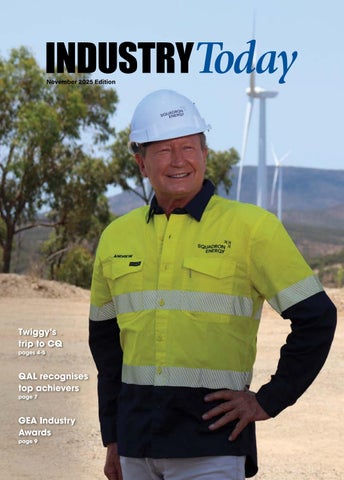
November 2025 Edition
Twiggy’s trip to CQ pages 4-5
QAL recognises top achievers page 7
GEA Industry Awards page 9
November 2025 INDUSTRY TODAY 1
INDUSTRY TODAY
Blow to jobs with closure By Di Stanley Federal Energy and Climate Change Minister Chris Bowen has confirmed 200 jobs could be lost with the possible closure of the Gladstone NRG Power Station in 2029. On Monday, 27 October, Flynn MP Colin Boyce put the question to Mr Bowen on the floor of the House of Representatives. “There are about 200 direct employees at the Gladstone Power Station, there are other employed on a contracting basis and indirectly, and obviously that’s a significant number for the people of Gladstone,” Mr Bowen said. “But also, this is a decision taken by the owners of the Gladstone Power Station... and that is in keeping with the normal protocols. “Those opposite are strongly supporting having coal-fired power stations open for longer and sweating assets to see them last longer. “Now, what that is... Speaker is the biggest structural liability in our energy system today.” Mr Bowen attacked the Callide Power Station’s loss of Unit C4 due to a lightning strike on Sunday, 26 October, and shutdown of Unit C3 as a prime example of ageing coal-fired infrastructure. “Out and not operating, and we have total unplanned outages across our national energy system of 3.4 giga watts of coal-fired power,” he said. “Not planned, not maintenance - coalfired power stations that were working and all of a sudden break down. “That is the biggest threat to the reliabil-
In the House of Representatives on Tuesday, 28 October, Federal Energy and Climate Change Minister Chris Bowen would not guarantee thousands of jobs in the alumina sector in Gladstone would be safe under the government’s renewable-only energy future when questioned by Flynn MP Colin Boyce. (File) ity of our energy system and that in turn is a threat to energy prices because that sees prices spike and that, in turn, is the biggest threat
to industrial jobs in Australia.” On Tuesday, 28 October, Mr Boyce again pursued Mr Bowen on electorate jobs. ques-
tioning if he would guarantee thousands of jobs in the alumina sector in Gladstone would be safe under the government’s renewableonly energy approach. Mr Bowen wouldn’t directly answer the question. “Our energy policy does support renewable energy, backed by gas-peaking, backed by storage and backed by transmission,” he said. “There is a certain irony to the Opposition asking about the future of industry under this government’s energy policy, because it wasn’t that long ago that those opposite went to the Australian people with an alternative energy plan that involved a heavy reliance on nuclear energy. “The Opposition... told the Australian people that their plan was 44 per cent cheaper, and when you looked at their plan it was only 44 per cent cheaper because it assumed 40 per cent less energy use across Australia.” Mr Bowen said that was only achievable with no heavy industry in Australia before he was brought into line and asked to answer Mr Boyce directly. Again, he failed to give assurance to the Gladstone alumina industries and supply chain. “It is clear and it is true that there is an alternative before the Australian people and under this government, I can guarantee that we will ensure that energy policy is designed to ensure the supply of cheap and reliable energy, not only for Australian households... but Australia’s heavy industry.””
Landmark investment in Gladstone chemical plant More than 100 local jobs will be generated by Project Halogen, a groundbreaking chlorakali production facility to begin construction in Gladstone in 2026. The project, announced at the GEA Major Industry, Energy and Manufacturing Conference on Wednesday, 15 October, is a joint venture by Grenof, a leader in chemical technology, and Queensland Investment Corporation through its Critical Minerals and Battery Technology Fund that will invest up to $30 million. “Another great announcement for Gladstone and a key project in the Gladstone Region industrial ecosystem,” Mayor Matt Burnett said. “Proud to work alonside Grenof, Rio Tinto and the Queensland Government to help bring this project to life.” The project is set to reshape the nation’s industrial landscape by securing the domestic supply of essential chemicals. The initiative addresses a long-standing opportunity to enhance Australia’s supply
Mayor Matt Burnett with proponents of Project Halogen at the GEA Major Industry, Energy and Manufacturing Conference on Wednesday, 15 October. (Supplied) chain resilience. By establishing a second, independent source of chlorine and producing caustic soda locally, Project Halogen will create a
more competitive and reliable market, benefiting critical sectors from water treatment to mining, resources and food processing. “This project marks a pivotal moment for Australian industry,” Grenof managing director Scott Barnes said. “It’s an investment in national resilience and our capacity for a more self-reliant economic future. “By producing these vital chemicals on our own shores, we are building a secure supply chain for our most important industries and changing the landscape for the better. “For our partners in Gladstone, this means a secure, localised supply that strengthens the entire region’s industrial ecosystem.” The project is backed by a major investment from the QCMBTF, which joins as a 50 per cent shareholder. Mr Barnes said the fund recognised the unique opportunity to support an initia-
tive that addresses a critical national need, future-proofing the country’s supply chain while seeing significant potential for further developments under the innovative Grenof strategy. “We are incredibly excited to have a partner of QIC’s calibre on board,” Mr Barnes said. “Their investment is a powerful vote of confidence, not only in the strength of Project Halogen but in Grenof’s long-term vision. “This partnership is crucial as we work together to shape a more resilient and selfsufficient industrial future for Australia.” Project Halogen will dramatically lower the reliance on chemical imports into Gladstone, one of Australia’s largest caustic soda user hubs. Mr Barnes said the localised production is a cornerstone of the sustainable industrial ecosystem the Gladstone region has been working to build for years.
Historic moment with last pipe installed Telephone: 07 4863 5050 Address: 5-9 Hempenstall Street, Kawana, QLD 4701 EDITORIAL Gregor Mactaggart Editor E: gregor.mactaggart@CQToday.com.au Matthew Pearce Journalist E: matthew.pearce@CQToday.com.au ADVERTISING Cheryl Altouvas Advertising Sales E: cheryl.altouvas@GladstoneToday.com.au Lou De Jager Advertising Sales Executive E: lou.dejager@CQToday.com.au 2 INDUSTRY TODAY November 2025
The last remaining pipe has been installed, officially connecting the Fitzroy River to Gladstone’s water network through the 117 km Queensland Government-funded Fitzroy to Gladstone Pipeline (FGP). Water is expected to flow through the $983 million pipeline as early as next year. The first pipe was delivered to Gracemere in June 2023, and today marks the completion of the pipeline installation. The pipeline spans 117 km from the Lower Fitzroy River in Rockhampton to Yarwun in Gladstone, providing longterm water security for Gladstone’s industry and supporting the region’s economic development. The pipeline is connected to the Aldoga Reservoirs, which will hold up to 100 megalitres of water and form a vital piece of infrastructure for the FGP.
Located at the southern end of the pipeline corridor, the two reservoirs will gravity-feed water to the Gladstone Area Water Board’s (GAWB) existing water network at Yarwun. The project also includes a water processing facility, reservoirs, and pumping stations at key locations along the alignment, including Laurel Bank, Alton Downs, and Aldoga. Construction and completion of the associated infrastructure are ongoing. Gladstone Area Water Board CEO Darren Barlow said the installation of the final pipe marks a history-making moment for the region. “Over the past 17 years, a range of studies and reports have been undertaken to evaluate potential solutions to increase water supply and reduce the single-source supply risk from
Awoonga Dam,” he said. “Gladstone and Central Queensland have a long history of recurring drought. Long-term water security can only be achieved through the delivery of major infrastructure like the FGP.” “By connecting the Fitzroy River to Gladstone’s water supply network, this project will help future-proof the region, ensuring we can meet the growing demands of population growth and industry expansion for decades to come.” “There has been extensive engagement with local stakeholders and First Nations peoples, industry briefing sessions, and the mobilisation of highly skilled teams for the construction of the Fitzroy to Gladstone Pipeline.”
INDUSTRY TODAY
New survey shows great support for mining sector
Fortescue’s Yarwun green hydrogen facility. (File)
Money owed ‘will be paid’ By Matthew Pearce Billionaire Andrew “Twiggy” Forrest says his company will repay more than $60 million to the State Government following the collapse of Fortescue’s green hydrogen electrolyser project in Gladstone. In May, Fortescue flagged the closure of its Gladstone electrolyser manufacturing facility near Yarwun, announcing 30 workers would be made redundant or offered redeployment elsewhere. The company said it was pivoting its green hydrogen vision towards research and development of new technologies. In August, Deputy Premier Jarrod Bleijie said the former Labor government had approved $92.5 million for Fortescue to build the PEM50 project in Gladstone, with $65.97 million already paid to Fortescue. Flynn MP Colin Boyce said he understood the State Government had issued a notice to comply and was seeking full reimbursement of the $65.67 million towards the now discontinued project. “I believe that taxpayer dollars must be respected and it is fundamental that the over $65 million is returned,” he said. Speaking at the official opening of stage one of Squadron Energy’s Clarke Creek Wind Farm, north of Rockhampton, on Friday, 24 October, Dr Forrest said the funding would be repaid. “We will pay back every cent which we’re due to pay back and we’ve just reached an agreement in principle with the Federal Gov-
ernment,” he said. Dr Forrest said he could still see a future for green hydrogen in Queensland and around the world, saying the fuel would clean up the shipping industry. “Shipping is three per cent of global emissions right now, and if it’s unchecked that will grow to 10 per cent,” he said. “That is just a growth in pollution which organic life cannot afford.” He said the future of shipping was hydrogen in the form of ammonia. “You get more hydrogen molecules in a cubic metre of ammonia than you do in a cubic metre of hydrogen ... so it’s a spectacular fuel to burn clean, zero harm energy made here in Queensland,” he said. Mr Forrest said while the Trump administration had “pushed back hard” on hydrogen for shipping, the “repression of the natural market” wouldn’t last forever. “Gas, oil and diesel ... that stuff is rubbish. You’re not allowed to burn it on land. It’s disgusting,” he said. “So, I think when the foot gets taken off the neck of ocean demand, all these projects will roll here.” Fortescue’s green hydrogen electrolyser plant isn’t the only Gladstone hydrogen project to have hit troubled waters, with Stanwell Corporation lodging documentation with the Commonwealth in July to formally withdraw Gladstone’s $12.5 billion CQ-H2 hydrogen project from the Environmental Protection and Biodiversity Act approvals process.
An overwhelming majority of Queenslanders continue to back the resources sector as vital to the state’s economy and way of life, according to new independent research. The latest Queensland Resources Council (QRC) survey found three in four Queenslanders (75 per cent) believe mining — including coal — is “very important” to maintaining their way of life, rising to 77 per cent among those living in regional areas. More than four in five respondents said the resources sector has an important long-term role to play in Queensland’s future, with the findings marking the highest level of support for the industry since 2022. QRC chief executive officer Janette Hewson said the results underline the sector’s strong social licence and highlight the need for fair policy settings. “Queenslanders want businesses to have a fair go, especially if they believe policy to be impacting their livelihoods or the competitiveness of our state,” Ms Hewson said. The survey of 1500 people was conducted shortly before recent announcements from major mining companies warning of
job and operational risks due to rising costs and the impact of the state’s coal royalty regime. Ms Hewson said Queenslanders were clear in their views on how government and industry should respond. “More than half of Queenslanders think the government needs to sit down with the sector to make a change, and one in four say that consultation is needed,” she said. “Reflecting on this sentiment, and seeing the announcements from industry roll in, it’s time for some tough decisions to be made to live up to Queensland’s expectations about sustaining their quality of life.” The survey also reinforced the economic significance of the resources sector, with seven in 10 people acknowledging its role in supporting jobs — particularly in regional communities — and 76 per cent recognising its importance to the broader state economy. In 2024, resources companies spent nearly half of their $36 billion procurement budget with regional suppliers. Across all commodities, the industry contributed $120 billion to Queensland’s economy and paid $12.8 billion in royalties to fund public services and infrastructure.
Queensland Resources Council chief executive officer Janette Hewson.
THE FUTURE IS HERE >>>
BUILT FOR
OFF GRID
NEW
LIVING Solar buildings that power your site anytime & anywhere
RID OFF-G SOLAR Y FACILIT
8.85kW PV
Cool & Quite: Crimsafe, Tropical Roof & well insulated
15x 590w Solar Panels
MEET RENEWABLE TARGETS REDUCE EMISSIONS IMMEDIATE SITE OPS
Up to
32.80 kWh Lithium Phosphate battery
READY TO GO SOLAR? CONTACT US NOW.
www.multitrade.com.au 12756359-KF20-25
November 2025 INDUSTRY TODAY 3
INDUSTRY TODAY
Young fan meets Twiggy When Clarke Creek 11-year-old Harley Needham needed to profile a notable person for a Year 6 English assignment, he selected Squadron Energy owner Andrew ‘Twiggy’ Forrest. The Rockhampton Grammar School student had to research Dr Forrest’s life and present a speech to the school community, dressed as his chosen subject. Harley’s family is a host family of Squadron Energy’s Clarke Creek Wind Farm. “I chose Andrew Forrest because he has a wind farm on our property and he originates from a farm too,” Harley said. Little did Harley know, but his term three ‘Day of Notables’ assignment would inspire a chance meeting with Dr Forrest when he arrived to mark the wind farm’s opening on Friday, 24 October. Harley’s mum, Kylie Needham, had reached out to Squadron when she heard of Dr Forrest’s planned visit. “I sent through some photos and information as I knew how much it would mean to Harley to know that Dr Forrest was aware of his interest in his life story,” she said. “It was a big achievement for Harley to deliver his first public speech since moving to Rockhampton Grammar from our local Clarke Creek State School of just 23 students.” The email sparked a meet and greet between the Needham family and Dr Forrest at Clarke Creek Wind Farm, ahead of its official opening on Friday, 24 October. Harley and his 13-year-old brother Jensen were gifted vouchers for RM Williams boots by Dr Forrest when they met. The family was then invited to watch the press conference, held underneath a wind turbine. “I like wind turbines on my property because you can still run cattle under them and they’re good for the environment,” Harley said. Stage one of Clarke Creek Wind Farm – the biggest wind farm to open in Australia this year – will generate enough electricity to power the equivalent of 330,000 Queensland homes.
Harley Needham dressed as Andrew Forrest for his ‘Day of Notables’ assignment.
Harley Needham meets his hero, billionare developer Andrew Forrest. (Supplied) Proponents say this will avoid 738,000 tonnes of carbon pollution each year. Clarke Creek Wind Farm includes a
Community Benefit Fund, contributing $200,000 a year for the life of the project. A portion of the fund is dedicated to
The Needham family meets Andrew Forrest at the Clarke Creek Wind Farm. scholarships, to support the costs of attending and undertaking education. Harley and Jensen were both scholarship recipients in 2024.
Queensland’s overhaul of procurement aims high The State Government has launched the biggest overhaul of government procurement in decades, aiming to make it simpler, fairer, and easier for businesses to access work from Queensland’s $35 billion annual spend. Under the new Queensland Procurement Policy 2026, small, family, and regional businesses will be central to how the government buys goods and services, with clear targets, less paperwork, and greater transparency for taxpayers. Key reforms include a 30 per cent small and medium enterprise participation target, support for veteran-owned and femaleled businesses, and at least 3 per cent of
procurement spend allocated to Indigenous businesses. Treasurer David Janetzki said the policy delivers on the government’s commitment to restore respect for Queenslanders’ money. “Removing red tape, permanently scrapping BPIC, and focusing on value for money will improve productivity and drive the delivery of better infrastructure and services,” he said. Housing and Public Works Minister Sam O’Connor said the policy ensures fairness, opportunity, and real value for taxpayers. “More Queensland businesses than ever before will benefit from the new Queensland
Procurement Policy,” he said. “This will simplify the process so local businesses can get on with winning work, not wading through paperwork.” The policy also permanently removes Labor’s Best Practice Industry Conditions (BPICs), which the Queensland Productivity Commission found were costing billions and stifling productivity. Industry leaders have welcomed the changes. Business Chamber Queensland chief executive officer Heidi Cooper said the reforms address long-standing business challenges, while Gallipoli Medical Research chief executive officer Miriam Kent praised
the nation-leading focus on veterans. “Queensland is home to 28 per cent of Australian veterans,” Ms Kent said. “This policy provides a clear and meaningful pathway for veterans to continue serving their communities beyond Defence.” QMCA chief executive officer Andrew Chapman said the removal of BPICs will restore balance to the construction industry, improving collaboration and delivering better value for taxpayers. The Queensland Procurement Policy 2026 takes effect from 1 January 2026, promising a fairer and more transparent framework for businesses across the state.
12809664-JO46-25
4 INDUSTRY TODAY November 2025
INDUSTRY TODAY
Squadron Energy chief executive offier Rob Wheals, Isaac Mayor Kelly Vea Vea and Andrew Forrest at Clarke Creek. (Matthew Pearce: 513339)
Andrew Forrest meets workers at Clarke Creek Wind Farm. (Matthew Pearce: 513339)
Spanning 100 turbines, Clarke Creek Wind Farms is the biggest wind farm opened in Australia this year. (Supplied)
Forrest on top of the world By Matthew Pearce He may be one of Australia’s biggest advocates for renewable energy, but billionaire Andrew ‘Twiggy’ Forrest doesn’t believe in Net Zero. Speaking at the official opening of stage one of Squadron Energy’s Clarke Creek Wind Farm on Friday, 24 October, Dr Forrest said the true goal should be ‘Real Zero’ – the total elimination of fossil fuel. “Net Zero allows a whole heap of fakery, a whole heap of ducking and dodging and spinning yarns just to make a quid or two, but that doesn’t reduce emissions and doesn’t bring down costs,” he said. One of Australia’s richest men, Dr Forrest described renewables as the “lowest cost energy ever”, envisioning the day when renewable power stops being intermittent and operates with “firm consistency, 24-7, every second of every day of the year”. “Even dragging logs up to your cave and lighting a fire as a caveman would have cost more (than wind or solar),” he said. “Anywhere in the world where it’s automation driven, where it’s technology driven and renewables driven, you’re seeing full employment and you’re seeing economic growth. “I just want to say to every political leader out there, don’t burden your people with your own lack of knowledge. “Technology drives investment, drives economic growth and drives full employment, and if you don’t believe that, have a look around the world.” Squadron Energy is owned by Andrew and Nicola Forrest’s Tattarang group. The company’s 100-turbine, 450MW Clarke Creek Wind Farm, located 150km north-west of Rockhampton, produces enough electricity to power the equivalent of around 330,000 Queensland homes and is expected to reduce pollution by 740,000 tonnes each year. While there have been changes to the approvals process for renewable energy projects since the LNP took power, Squadron Energy chief executive officer Rob Wheals said the company had always set a high bar when it
Andrew Forrest is on top of the world - or rather, on top of one of Clarke Creek Wind Farm’s turbines, which stand at 207 metres tall. (Supplied) came to community engagement and was well supported by the State Government through its long-term partnership with Stanwell Corporation. Over the next 15 years, Stanwell will purchase more than 75 per cent of the clean energy generated from the first stage of Clarke Creek Wind Farm to provide to its customers. “What the Queensland Government is looking for is good, solid community engagement, bringing communities along to make sure that they’re seeing the benefits, and we’re fully supportive of that,” he said. He said all households and businesses with-
in 20km of the project are eligible for the Clarke Creek Wind Farm Bill Bonus – a rebate of $1000 on annual electricity bills. While some people in the community, including Capricornia MP Michelle Landry, have criticised wind farm projects such as Clarke Creek for destroying native wildlife habitat and endangering native animals, Mr Wheals said this was “misinformation”. “I can categorically say that there have been no koalas harmed or killed on this project during construction or anywhere else, and that’s really because we set a very high standard on how we manage the environment and manage
flora and fauna,” he said. Mr Wheals said Squadron Energy had also contributed funds to the State Government to upgrade roads. Dr Forrest called for people working in the coal mining sector to make the leap to renewables, describing them as “great workers”. “They are teammates, they know how to operate, and they’re brilliant for the renewable energy sector,” he said. Stage 2 of the Clarke Creek project is currently in advanced development and is expected to go ahead, should it receive approval, within the next 12 to 18 months.
Environment
CQG is a passionate advocate for local businesses Rockhampton | Gladstone | Brisbane | Mackay | Townsville
Engineering
Planning
www.cqgroup.com.au • +617 4922 9252 12618313-CB29-23
November 2025 INDUSTRY TODAY 5
INDUSTRY TODAY
Charging towards solutions By Sophie Mossman The State Government has marked a major milestone in its renewable energy transition, announcing significant progress on a largescale battery storage project at Stanwell Power Station. Following its Energy Roadmap announcement earlier this year, the government confirmed on Tuesday, 4 November, that construction on Stanwell’s 1200 MWh battery system is now halfway complete. The project has also taken a major step forward with Stanwell signing a Memorandum of Understanding with Quinbrook Infrastructure Partners to transform the site into a hub for battery innovation. Under the agreement, Stanwell and Quinbrook will pilot one of the world’s first eighthour duration battery systems - a major leap from the conventional four-hour models currently in use. Known as the EnerQB battery, the technology is designed to provide longer energy storage to firm renewable generation and support Queensland’s growing industrial demand. Stanwell chief executive officer Michael O’Rourke said the project complements the company’s growing energy storage portfolio and will play a key role in strengthening the state’s power supply. “Stanwell Power Station currently supplies around 15 per cent of Queensland’s power,” he said. “Together with our other battery projects - including a 300-megawatt battery at Tarong and a 250-megawatt four-hour battery through Queensland Infrastructure Investments - this brings our total storage capacity to more than 2800 megawatt-hours. “The beauty of all that storage is that it allows us to transfer energy from the middle of the day, when the sun is shining, through to the evening when demand peaks.” The Stanwell Battery Energy Storage System has now reached the halfway point of construction, with all 324 Tesla Megapacks delivered to the site. Each Megapack weighs 38 tonnes and measures eight metres in length, transported from the Port of Brisbane before being assembled on-site. Mirani MP Glen Kelly, who worked at Stanwell Power Station for more than 15 years, said the project reflects the region’s future in
From left: Nigel Hutton, Angie Zahra, David Janetzki, Glen Kelly and Michael O’Rourke.
Mirani MP Glen Kelly worked at Stanwell Power Station for more than 15 years. combining traditional and renewable energy sources. “Yes, it is renewables, but storing energy in these battery projects is so important to ensure power is available when it’s most needed - because coal will be here for decades to come,” Mr Kelly said. “Stanwell has always been recognised for
Some of batteries behind Stanwell Power Station.
providing local, reliable jobs, and it’s the right place for this battery investment given its industrial base.” Energy Minister David Janetzki said the project highlights the government’s balanced approach to keeping energy affordable and reliable. “Stanwell’s leadership is vital as we deliver
our Energy Roadmap, which is focused on affordable, reliable and sustainable power,” Mr Janetzki said. “By keeping coal in the system longer, supporting more gas generation, and unlocking private investment in renewables, projects like this battery are key to strengthening and diversifying Queensland’s energy future.”
Stanwell to take financial reins of Curragh mine By Di Stanley The State Government-owned Stanwell Corporation is set to take over financial control of Blackwater’s Curragh mine complex. The deal, announced by Coronado Global Resources on Tuesday, 28 October, would maintain the mine as a viable operation, the company said in a statement. “This arrangement will also support local jobs, secure over 10 per cent of Queensland’s energy needs, encourage more investment into Australian coal and will provide greater employment certainty for 2500 people and their families in Central Queensland,” Coronado stated. “The transaction, which is currently nonbinding and subject to completion of due diligence, long-form documents and approvals during November, will provide near and longterm liquidity support for Coronado.” The existing New Coal Supply Agreement will remain in place and the end date will be extended from 2037 to 2043 and allow Stanwell a wider, more flexible, nomination range of 1.2 to 2.24 million tonnes per year. Stanwell has been the principal buyer of Curragh’s thermal coal for decades through long-term legacy contracts. Coronado said its current asset-based loan in place with Highland Park XII Pte Ltd would be replaced by Stanwell which will 6 INDUSTRY TODAY November 2025
After navigating financial turbulence over the past 12 months, Coronado Global Resources will enter into an agreement with Stanwell Corporation to ensure the financial viability of its Curragh coal mine complex near Blackwater. (File) provide a $401 million five-year loan facility with an interest rate nine to 12 per cent that provides significant covenant flexibility. “Stanwell will have a first priority security over Coronado’s working capital assets
and a second priority security over all other fixed assets for the asset-based loan, and retain its lower ranking security over all assets for Coronado’s NCSA obligations,” Coronado stated.
“From the beginning of 2026, Stanwell will waive the rebate payments for the remaining term of the Amended Coal Supply Agreement. “Ongoing financial support to Coronado, when required, will consist of Stanwell making prepayments for future NCSA coal to a maximum of the discounts that Stanwell would have received under the ACSA and NCSA nominations. “This will only be provided in months when Coronado’s cash balance is below $378.8 million. “The prepayments will bear a competitive fixed interest rate, the capitalisation of which is capped.” In months when Coronado’s cash balance is above $454.5 million, Coronado will deliver nominated NCSA tonnes that have been prepaid for by Stanwell for free and reduce the prepayment balance. Meanwhile, an investigation is underway after a Curragh mine worker suffered bruising when a component of equipment fell on their leg on Friday, 24 October. Emergency services were notified of the incident. “Coronado’s Emergency Response team was immediately activated and the coal mine worker was taken to Rockhampton Hospital for treatment,” a company spokeswoman said.
INDUSTRY TODAY
Celebrating 2025’s finest Queensland Alumina Limited (QAL) has awarded talented tradespeople, mentors and an operator at the highly-anticipated Apprentice & Trainee of the Year Awards 2025, held recently at its Bob Druitt Training Centre. For the 35th consecutive year running, the QAL Apprentice and Trainee of the Year Awards recognises and honours the exceptional achievements of our top performing Process Trainee and Trade Apprentices who display a commitment to building their skills in an inclusive, diverse and progressive workplace. In an exciting chapter of the awards program, the QAL Learning and Development Team created a new category recognising the foundational role of mentors in shaping determined, resilient and highly-skilled tradespeople. General manager Trent Scherer announced the 2025 award winners: Trainee of the Year: Daniel Siegmann Apprentice of the Year: Royce Parnaby and William Dwan Electrical Mentor of the Year: Trevor Tummon Mechanical Mentor of the Year: Wade Taylor Mr Scherer said the award recipients this year have not only left a lasting impression on the business, but also upon their fellow peers who aspire to display the same values in their own work. “I have had the pleasure of witnessing the culmination of determination, resilience and compassion in our confident and capable graduating apprentices. Equally, I have seen firsthand the quality of tradespeople developed through our apprentice program, which began in 1968,” he said. “It is humbling to see our team members performing at their best and setting a high standard for those at the very beginning of their own rewarding trades career. “This year, we welcomed 15 apprentices and 39 trainees into our process traineeship program, which started more than a decade ago.” Learning and Development Superintendent Kate Hansell said the Mentor of the Year Award is an opportunity for QAL to celebrate outstanding in-field Mechanical and Electrical mentors shaping our future skilled workforce. “The Mentor of the Year award is particularly special because our very own apprentices vote on the recipients, who show not only technical skill, but also the patience, wisdom, and genuine care that defines a true mentor,” she said. Former manager of QAL and founder of the Apprentice of the Year Awards, Bruce Hunt OAM, joined the evening proceedings alongside his wife Robin, to congratulate and present the award recipients with their prizes and certificates. 2025 Apprentice of the Year Royce Parnaby
• • • •
QAL general manager Trent Scherer, QAL Apprentices of the Year William Dwan and Royce Parnaby, former manager of QAL Bruce Hunt. (Supplied) was recognised for his commitment to continuous improvement, safety, and adaptability while performing as a leader. “I absolutely loved the transition from high school, straight into an apprenticeship,” Royce shared. “It’s been a real good achievement and a lot of fun over the last five years. It’s good to finish it off with such a high achievement.” Over the lifespan of operations, the QAL training team have mentored and awarded over 856 apprentices and 264 trainees. QAL’s longstanding apprenticeship program is highly regarded and offers hands-on, on-the-job training, along with nationally-recognised formal qualifications.
QAL general manager Trent Scherer, QAL Trainee of the Year Daniel Siegmann and former manager of QAL Bruce Hunt.
12817775-JV46-25
November 2025 INDUSTRY TODAY 7
INDUSTRY TODAY
Approval of Byellee BESS The Federal Government has approved a new battery energy storage system (BESS) near Gladstone, with the approval taking “just 18 days”. Eku Energy’s 300MW storage project in Byellee, Central Queensland, will power up to 260,000 households for four hours at peak demand and connect to the existing Powerlink infrastructure. The project will support energy grid stability by helping with power fluctuations in the network during peak demand and act as an emergency energy supply in the event of an outage. Eku Energy’s director of policy Rachel Rundle recently told the Today News Group that the company valued building relationships in communities where projects were located and the 300MW Byellee BESS would be no different. “We did a community pop-up session at the IGA to share preliminary information about the proposed project and introduce it to locals and we also did some door knocking of residents in the nearby area,” Ms Rundle aid. “One of the key pieces of information we took back was actually the name of the proposed project (originally Calliope BESS) was a bit misleading. “It is quite a distance from the Calliope township... we actually decided to rename it to Byellee. “We’re close to the Calliope River and the Byellee rail crossing bridge and it is a very vacant area. “It’s over one kilometre from the proposed site and it is out of sight and visibility from those residences.” Environment and Water Minister Murray Watt said the project was a win for the environment, the Australian solar industry, and for Australian jobs.
Eku Energy’s artist impression of the Byellee BESS to be located near the Calliope River. Mr Watt said the approval took “just 18 days” thanks to considered site selection. “The Byellee BESS is one of the fastest renewable energy projects to be approved by the government,” Mr Watt said. “This is a great result for an Australian solar company who have consciously avoided
environmental impacts through good site selection. “The project will create 150 jobs during construction and a further 10 jobs once in operation. “While (Flynn MP) Mr Boyce and his Coalition colleagues continue to debate whether
climate change is real, their own communities are getting on with the transition to cheaper, cleaner energy. “Since 2022, the government has given the green light to more than 100 renewable energy projects – enough to power every home in Australia.”
Report highlights Qld’s resilience and growth The Sunshine State’s exploration sector remains resilient and poised for future growth — but ongoing uncertainty around policy and regulation is holding back new investment, according to the Queensland Exploration Council’s (QEC) latest report. The 2025 Exploration Scorecard, released late last month by the exploration arm of the Queensland Resources Council (QRC), outlines both the opportunities and headwinds facing the industry over the past year. QRC chief executive officer Janette Hewson said the report provides a valuable barometer of industry confidence and the state’s future investment outlook. “Exploration holds the key to the future success of Queensland’s resources sector and its ability to deliver new jobs and contribute to our state’s economic prosperity,” Ms Hewson said. She said there were positive signs of improved sentiment, with many explorers reporting better support from departments, increased land availability, and faster approvals through the Resources Cabinet Committee. “Green shoots in sentiment are appearing but there are still significant issues with complex and overlapping policies for approvals between the State and Commonwealth governments, as well as excessive regulation across the board,” Ms Hewson said. While total exploration expenditure dropped 14.6 per cent last year, nearly half of explorers surveyed (44 per cent) expect to increase spending over the next 12 months. However, greenfield minerals exploration — including coal — fell to its
lowest level since the Scorecard began, at just 21 per cent. “If we need more gas in Queensland’s energy system, an increase in critical minerals for the energy transition, and the global energy security provided by coal production, then new projects must come online sooner,” Ms Hewson said. “The Scorecard is a barometer for explorers but also touches on the appetite for future investment in Queensland. Looking at the temperature of the 2025 results, we must do more to turn around sentiment, and faster.” QEC chair Kim Wainwright said Queensland’s rich endowment of coal, gas, metals and critical minerals continued to provide a strong foundation for sustained exploration and development. “The Geological Survey of Queensland expanded its datasets over the last year with new airborne surveys and high-resolution mapping which help lower the risk for explorers,” Ms Wainwright said. “We have the commodities Australia and the world need, and with the right policies that encourage investment, there is significant potential for Queensland’s exploration sector to thrive and grow. “The 2025 Scorecard provides a path to restore Queensland’s reputation for exploration investment, and industry will continue to work with all stakeholders and governments to achieve that. “The opportunity now lies in turning resource potential into projects, which demands timely approvals, consistent policy, clear pathways to market, and enabling infrastructure.” 12758761-EA15-25
8 INDUSTRY TODAY November 2025
INDUSTRY TODAY
The GEA team with Archer Janson from Aestec Services, the GEA’s principal partner.
GEA chief executive officer Alison Murdoch with Peter Masters from Masters Advisory and Monadelphous Gladstone operations manager Cameron Hausler who collected the Beale Culture Award.
McCosker Contracting took home the Social Performance Award.
GEA awards a success Congratulations to the winners of the prestigious 2025 Gladstone Engineering Alliance Industry Awards. Seven major awards were presented to industry and business leaders who have excelled in their field over the past year, as part of the 2025 GEA Industry Awards & Gala Dinner, which was held on the evening of Wednesday, 15 October, at the Gladstone Entertainment and Convention Centre. The award-winning firms on the night included: CQG Consulting, McCosker Contracting, Walz Group, Xtreme Engineering, and Monadelphous, who were honoured to accept three of the awards. Scott Harrington from Xtreme Engineering was inducted as the 2025 Hall of Fame recipient. Presented by GEA’s principal partner Aestec Services, the annual 2025 GEA Major Industry Awards and Gala Dinner attracted more than 300 attendees to celebrate innovation, excellence, and collaboration within Central Queensland’s industrial supply chain. The Gala Dinner followed the first day of the alliance’s annual Major Industry, Energy and Manufacturing Conference, which placed the spotlight on emerging opportunities and future developments shaping the industrial, energy and manufacturing sector across Central Queensland. GEA chief executive officer Alison Murdoch said the gala evening was a great success, attracting more than 300 attendees to celebrate innovation, excellence, and the spirit of collaboration across Central Queensland’s industrial supply chain. “Congratulations also to all award nominees and finalists, and the GEA members who celebrated their 10 and 20-year memberships at the event,” Mrs Murdoch said. “We extend our sincere thanks to our Principal Partner, Aestec Services, event sponsors, partners and supporters. “Their contributions not only make the conference and industry awards possible every year – they help to elevate Gladstone’s reputation as Queensland’s industrial powerhouse and a global player in the future of industry, energy and manufacturing.” 2025 GEA Industry Awards and Gala Dinner list of award winners: Safety Excellence Award Celebrates an organisation that has a sustained safety performance and culture to encourage physical and mental wellbeing in the workplace. Winner: Monadelphous The Innovator Award Celebrates an organisation that has demonstrated innovation in seeking out new business opportunities, improvements, efficiencies or technological development. Winner: CQG Consulting The Beale Culture Award Celebrates an organisation that has successfully created an equal and inclusive workplace culture that prioritises employee wellbeing and growth. Winner: Monadelphous Forty Calis Memorial Award Celebrates an entrepreneur who demonstrates
GEA 2025 Hall of Fame inductee Scott Harrington from Xtreme Engineering with GEA president Patrice Brown (left) and chief executive officer Alison Murdoch. (GEA)
Forty Calis Memorial Award winner Matthew Campiutti from the Walz Group (second right).
vision, and a commitment to innovation, excellence and industry supply chain leadership, and the ability to inspire and guide others towards long-term success. Winner: Matthew Campiutti – Walz Group The Wayne Peachey Award Celebrates an outstanding employee who demonstrates tenacity, dedication and loyalty, and goes above and beyond in their role.
Nathan Peachey with Wayne Peachy Memorial Award winner Kelly Davidson from Monadelphous, GEA board treasurer Reece Schulte and GEA chief executive officer Alison Murdoch.
Winner: Kellie Davidson – Monadelphous The Social Performance Award Recognises an organisation that exemplifies excellence in ethical, sustainable, and socially impactful practices with employees, customers, contractors and suppliers within the Gladstone region. Winner: McCosker Contracting
Hall Of Fame Award Recognises an individual who has made remarkable, lasting contributions to the Central Queensland industry supply chain business community for over two decades. Having demonstrated exceptional leadership, vision and a sustained commitment to driving positive change and innovation within the region’s supply chain sector. Winner: Scott Harrington – Xtreme Engineering November 2025 INDUSTRY TODAY 9
INDUSTRY TODAY
Proposals sought for fresh terminal Gladstone Ports Corporation (GPC) has launched a major infrastructure investment opportunity, inviting development proposals for a world-class container terminal at Gladstone - Queensland’s largest multi-commodity port and a key component of Australia’s freight network. GPC is calling for Registrations of Interest (ROI) from leading infrastructure developers and operators capable of delivering scalable marine and landside facilities. A 54-hectare site has been identified at Port Central in the Priority Port of Gladstone - a premier location for scalable marine and landside infrastructure. The site benefits from deepwater access, a sheltered harbour, and direct connections to national road and rail freight networks. GPC chief executive officer Andrew Johnson said the terminal development was expected to play a key role in shaping the future of container trade in Queensland, stimulating
regional supply chains, creating jobs, and improving freight access for producers across the state. “This is a transformative opportunity for infrastructure investors,” Dr Johnson said. “Gladstone is the state’s industrial powerhouse and has long been identified as the ideal location for a new container terminal because of its deepwater access, proximity to major producers, and integration with national road and rail freight corridors.” The development will require land reclamation, berth pocket dredging, construction of land-backed wharves and quay structures, terminal yards, operational buildings, equipment, and supporting systems. The Port of Gladstone features seven main trade localities and 20 operational wharves. It is the primary export gateway for Central Queensland’s resource and industrial sectors, handling more than 117 million tonnes
The construction team working on the Gladstone facility which is set to become the world’s largest single-site production facility of ultrahigh purity aluminium materials.
of throughput a year across 30 different commodities, including coal, liquefied natural gas, bauxite, alumina, aluminium, petroleum, cement, and agricultural products. The Port of Gladstone is adjacent to the 27,000-hectare Gladstone State Development Area, which has potential for future integrated logistics and warehousing services. As a Queensland Government-owned corporation, GPC will collaborate with investors to deliver high-capacity container infrastructure that enhances supply chain resilience, unlocks new trade pathways, and drives sustainable economic growth for Central Queensland and beyond. Interested parties can review the Gladstone Container Terminal Opportunity materials and submit responses via the Queensland Government’s procurement platform at www.vendorpanel.com.au/publictenders.aspx, using reference number OS25300373.
Gladstone is leading the way in delivering value-added critical minerals products onshore.
Alpha HPA scores $30M in funding Alpha HPA Limited has received a major vote of confidence in its Central Queensland operations, securing $30 million in funding from the Queensland Government’s Critical Minerals and Battery Technology Fund. The investment, provided through Queensland Investment Corporation, will help advance construction of Alpha HPA’s Stage Two HPA First Project in Gladstone which is set to become the world’s largest single-site production facility of ultra-high purity aluminium materials, critical for semiconductors to power AI demand, lithium-ion batteries for electric vehicles and other advanced future-facing technologies. Under the agreement, QIC has entered into Royalty Deeds with Alpha HPA subsidiaries, providing a source of funding across the entire business. Alpha HPA managing director Rob Williamson said the funding from QIC highlights the confidence from the Government in Australia’s ability to deliver value-added critical minerals products onshore. “Alpha HPA is delighted to have reached this important milestone with QIC and is grateful for its continued support to grow our business and deliver value to the State of Queensland,” Mr Williamson said. QIC senior investment director Jonathan Crombie said the funding reflects strong confidence in Alpha HPA’s leadership and its role in Queensland’s clean energy transition. “QIC is proud to continue supporting Alpha HPA as it advances its innovative HPA First and Sapphire Glass Projects and cements its footprint in Queensland’s critical minerals sector,” Mr Crombie said. 10 INDUSTRY TODAY November 2025
Alpha COO is appointed Alpha HPA appointed Peter Ware as chief operating officer on Friday, 31 October. Mr Ware brings extensive industrial leadership experience to support the safe and successful delivery of the company’s HPA First Project in Gladstone, set to position Queensland at the centre of the global clean energy transition. He will oversee all aspects of project delivery, operations, safety, communications and regulatory compliance as the company builds the world’s largest single-site manufacturing facility of high purity alumina and aluminium materials, powered entirely by renewable electricity. With a background in chemical engineering and more than 20 years of senior leadership experience across mining, chemicals and manufacturing, Mr Ware has led operational turnarounds, major capital projects and emissions reduction programs across Australia and South Africa. Most recently, he was Vice President – Australian Manufacturing at Incitec Pivot Limited, responsible for all operations across the country. The appointment comes as Alpha HPA continues to advance Stage Two of the HPA First Project expansion marking a major milestone in scaling production and downstream engagement with global semiconductor and AI leaders. Backed by $400 million in Federal Government support under the Future Made in Australia initiative, the expanded facility will produce over 10,000 tonnes of high-purity product per year and support around 120 additional local jobs. With customers in the US semiconductor and advanced technology sectors, Alpha HPA is seeing growing demand for materials that enable the age of AI. The recent announcement of a new Australia–US Framework to unlock US$8.5 billion in critical minerals projects further strengthens the pathway for companies like Alpha to deliver downstream, high-purity materials right here in Australia. Alpha HPA managing director Rob Williamson said Mr Ware’s appointment strengthens the company’s leadership team at a pivotal stage. “Peter’s proven ability to lead large teams and deliver safely in complex environments will be invaluable as we scale up operations. His commercial acumen and experience across both manufacturing and resources will help us establish a world-class operation that delivers jobs, skills and investment to Gladstone while supporting the global shift to cleaner technologies,” Mr Williamson said. Mr Ware said he was inspired by the opportunity to help create a new, sustainable industry for Queensland. “I am proud to be joining Alpha HPA at such an important stage,” Mr Ware said. “This project represents not only worldleading innovation but also an opportunity to create lasting value for the Gladstone region, for Queensland, and for industries worldwide that rely on high-purity alumina and aluminium materials. “I look forward to working with the team and the community to deliver this project safely and responsibly.”
the $30 million investment by the Queensland Investment Corporation will advance construction of Alpha HPA’s Stage Two HPA First Project in Gladstone. (Alpha HPA) “This investment reflects our confidence in Alpha HPA’s strategic vision and its potential to deliver long-term value for the State and the broader advanced manufacturing supply chain.” The QIC investment was supported by Alpha HPA’s Australian Government funding partners, Export Finance Australia and the Northern Australia Infrastructure Facility, following contractual close of a $400 million senior debt financing package earlier this year. EFA managing director and chief executive John Hopkins welcomed the QIC investment as another strong endorsement of the project.
“EFA welcomes investment in Australia’s critical minerals sector, and we welcome QIC support for Alpha HPA. We are pleased to continue our work with Alpha HPA, who is receiving support through the Australian Government’s Critical Minerals Facility,” Mr Hopkins said. NAIF chief executive officer Craig Doyle said Alpha HPA’s Gladstone project represents a strong example of national policy in action. “NAIF is proud to support Alpha HPA’s First Project in Gladstone, which represents a strategic investment aligned with our mission to transform northern Australia through infrastructure financing,’’ he said.
Alpha HPA has appointed Peter Ware as chief operating officer. (Supplied)
12817869-MC46-25
Celebrating 2025 Awards
Future leaders honoured Central Queensland’s finest were honoured across three major events celebrating the 2025 Apprentices and Trainees Qld (ATQLD) Awards in Gladstone, Rockhampton and Biloela. The annual awards showcase the outstanding achievements of apprentices, trainees and program participants who have demonstrated excellence in their chosen fields, as well as the mentors and organisations who support them. Across the three locations, the awards recognised talent in a wide range of fields – from engineering, electrical and mechanical trades to business, construction and community services – reflecting the strength of Central Queensland’s training sector and the partnerships that underpin it. In Gladstone, Orica’s Nicholas Hall and Walz’s Trent Powell were among the major winners, while local trainee Liarna Dare from Gladstone Ports Corporation was honoured as the Harbour City’s Trainee of the Year. ATQLD field officer Ashley Webb received the Gladstone Mentor of the Year award for his outstanding leadership and support. Biloela’s ceremony celebrated excellence across mining, meat processing and trade training, with Batchfire Callide Mine, Anglo American and Teys featuring strongly among the winners. Apprentice Anna Morgan (Anglo American) and trainee Rylee Hadwen (Batchfire) took home top honours, while Batchfire tradesman Ben Dansie earned Mentor of the Year recognition. In Rockhampton, the focus was on both apprentices and trainees making their mark across local industries. Jordan Downing from Ashton Engineering was named Apprentice of the Year, while ATQLD’s own Alyssa McCulloch won Trainee of the Year. The Mentor of the Year award went to Missy Arboladura from National JobLink, recognising her significant contribution to workforce development. Each event reflected the strong commitment of local employers, training organisations and community partners to creating real opportunities for young people and career changers. The awards not only recognised skill and achievement but also the resilience and teamwork that define regional Queensland’s workforce. A special thanks to Gladstone Regional Council for sponsoring the Col Brown Memorial Award and Teys, the major sponsor of the Biloela Awards Night. RESULTS GLADSTONE 1st Year Apprentice: Malakai White (Walz), Riley Daley (Walz), Kobe Keevers (KW Electrical Services) – Winner: Kobe Keevers 2nd Year Apprentice: Kye Croft (Walz), Wallace McVey (Walz), Jack Mattson (Walz) – Winner: Wallace McVey 3rd Year Apprentice: Nicholas Hall (Orica), Miguel Rios (Walz), Jayhden Hannant (KNL
Award nights were held in Gladstone, Biloela and Rockhampton.
ATQld general manager Michael Walz and operation manager Angie Wilmot with Gladstone MP Glenn Butcher cut the cake celebrating 40 years of the Group Training Organisation. (Supplied) Engineering) – Winner: Nicholas Hall Year Apprentice: Nicholas Crane (Orica), • 4th Jai Topfer (Walz), Trent Powell (Walz) – Winner: Trent Powell Program Participant of the Year: Hayley Ahern (SQW Business), William Draper (Trade Your Future), Roman Phachi (SQW Construction) – Winner: Hayley Ahern Col Brown Award: Benjamin Knight (Walz), Joe Perchard (My Skills Institute), Roman Phachi (SQW Construction) – Winner: Benjamin Knight Mentor of the Year: Andrew Robertson (Walz - Leading Hand – Workshop), Steve Powell (Walz - Apprentice Leading Hand), Ashley Webb (ATQLD – Field Officer) – Winner: Ashley Webb Trainee of the Year: Liarna Dare (Gladstone Ports Corporation), Adelaide Bishop (NRG), Eden Heath (KNL Engineering) – Winner: Liarna Dare BILOELA 1st Year Apprentice: Jake Ryall (Batchfire –
•
•
•
•
•
• •
•
• • • • •
Callide Mine), Kye Plisch (Teys), Paige Wickham (Anglo American – Dawson Mine) – Winner: Jake Ryall 2nd Year Apprentice: Mitchell Hay (Anglo American – Dawson Mine), Cameron Wedemeyer (Batchfire – Callide Mine), Tarsha Hebbard (Batchfire – Callide Mine) – Winner: Tarsha Hebbard 3rd Year Apprentice: Jayden Cowen (Anglo American – Dawson Mine), Keeli Page (Batchfire – Callide Mine), Noah Saxby (Anglo American – Dawson Mine) – Winner: Jayden Cowen 4th Year Apprentice: Anna Morgan (Anglo American – Dawson Mine), Jemar Aquino (Teys), Sam Moller (Anglo American – Dawson Mine) – Winner: Anna Morgan Trainee of the Year: Rylee Hadwen (Batchfire – Callide Mine), Haylee Kirkham (Batchfire – Callide Mine) – Winner: Rylee Hadwen Mentor of the Year: Ben Dansie (Batchfire – Callide Mine – Tradesman), Steven Vesel (Teys – Tradesman), Ross Jochheim (Batchfire – Callide Mine – Tradesman), Jasmine Sheppard (Batchfire – Callide Mine – Supervisor) –
The ATQld Awards showcase the outstanding achievements of apprentices, trainees and program participants as well as the mentors and organisations who support them. Winner: Ben Dansie ROCKHAMPTON Apprentice of the Year: Jordan Downing (Ashton Engineering), Lockwood Parsons (Ashton Engineering), Danielle Barnes (O’Ryan Signs and Designs) – Winner: Jordan Downing Trainee of the Year: Zac Kemp (FKG Group), Alyssa McCulloch (ATQLD), Leandro Arouca (Ashton Engineering) – Winner: Alyssa McCulloch Mentor of the Year: Denise Mobbs (CQ Capras), Ethan Brouwer (FKG Group), Missy Arboladura (National JobLink) – Winner: Missy Arboladura Program Upskilling Participant of the Year: Beau Plant (CSQ Trade Ready Program – Intake 1), Aiden Hanna (CSQ Trade Ready Program – Intake 2), Myar Booth Shepherd (CSQ Trade Ready Program – Intake 2) – Winner: Aiden Hanna SQW Trainee of the Year: Tegan Saunders (Multicultural Australia), Shekinah Baldoza (National JobLink), Jakoda Jones (CQ Capras) – Winner: Shekinah Baldoza
• • • •
•
WHY HOST WITH ATQLD? BECAUSE RESULTS MATTER! ATQLD 1300 242 425
QLD AVERAGE info@atqld.com.au
12817850-JO46-25
70.37% VS 50.84%
Hosting with ATQLD isn’t just about filling a role. It’s about growing your workforce with success and values built in
November 2025 INDUSTRY TODAY 11
INDUSTRY TODAY
Improving our biosecurity When Melinda Hashimoto became the first in her family to graduate university, she opened the door to a career that is helping to shape the future of farming in Australia. A proud graduate of CQUniversity’s Bachelor of Education (LOTE), Melinda grew up on a cattle property in Central Queensland where she developed a deep appreciation for agriculture and its importance to regional Australia. After completing her degree in Rockhampton and teaching at St. Brendan’s in Yeppoon, Melinda spent five years establishing an elementary program with her husband (also a CQU alumnus) in Japan before returning to Australia to pursue further studies and pivoting her career direction into agri-politics, serving as an adviser to Ministers for Agriculture at both federal and state levels, as well as within the Queensland Department of Trade and Investment. Six years ago, Melinda took on the role of chief executive officer at Egg Farmers of Australia, a position that allowed her to combine her passion for agriculture with her skills in advocacy and policy leadership. Recently, Melinda’s commitment to agricultural advancement was recognised with a prestigious Churchill Fellowship. As part of the fellowship program, Melinda will return to Japan later this year to investigate the country’s response to avian influenza, with a goal of bringing back innovative solutions to elevate and assist Australia’s preparedness for future outbreaks. “While the Australian egg industry has collaborated with North America and Europe, Japan has a wealth of expertise,” she said. “The focus of my research is to enhance the resilience and sustainability of the Australian egg industry and hopefully I can find some
gems to bring back that will mean quicker responses, reduced culling and better protection for Australians,” she said. Australia has faced several H7 avian influenza outbreaks in the past, including one earlier this year, but is the only continent free of the H5 strain which continues to pose a significant biosecurity risk. Japan, however, experienced a spike in H5 strain cases in the last year, and a cluster of outbreaks at the peak of the season resulted in the destruction of more than five million chickens in January alone. “When Japan has an avian influenza outbreak it is treated in the same way a natural disaster is here in Australia in that there is a military support component to the response measures so I’m keen to understand how their various agencies work together,” Melinda said. “Many countries are also talking about potential vaccinations for hens against H5 so I’m keen to understand Japan’s vaccination policy as well.” Melinda continues to be based in Rockhampton and said she holds fond memories of her time as an undergraduate at CQU. “You never forget your roots. I was the first in my family to graduate from university, so it was a big achievement,” she said. “It was a bit daunting going into that experience without having other people close to me who had done it, but I really enjoyed studying. “The research work that I’ll be doing in Japan will allow me to return to ‘study mode’ and I’m looking forward to sharing my findings when I return.” Melinda will embark on her trip to Japan in December.
Melinda Hashimoto. (Supplied)
Nominations are now open for bursary AgTech leaders across Queensland are invited to apply for the Liz Alexander Bursary for Leadership in AgTech and Innovation, a $3,000 opportunity to attend evokeAG 2026, the Asia Pacific’s premier agrifood innovation event. The bursary is designed to empower Queensland AgTech leaders by providing access to cutting-edge ideas, global networks, and industry-leading insights. Created in honour of Liz Alexander, a visionary leader from Emerald who helped shape Queensland’s AgTech ecosystem, the bursary celebrates her legacy of leadership, collaboration and innovation. Department of Primary Industries Agtech Innovation manager Alicia Dunbar said the bursary is a fitting tribute to Liz Alexander’s extraordinary contributions to Queensland’s agricultural and innovation landscape. “Liz was a trailblazer in AgTech, known for her vision, leadership, and dedication to building a world-class AgTech ecosystem across Queensland,” said Ms Dunbar. “This bursary not only honours her legacy but also inspires the next generation of innovators to continue driving change in our primary industries as we work towards the ambitious goal of boosting primary production output to $30 billion by 2030.” Ms Dunbar encouraged nominations from emerging AgTech leaders who embody Liz’s values of innovation, collaboration and community engagement. “Liz believed in the power of bringing people together – producers, innovators, researchers or industry leaders – to help cultivate a culture of innovation across Queensland,” Ms Dunbar said. “Through her work, Liz empowered others to think differently, embrace technology, and build the connected ecosystems that continue to drive agricultural innovation today. “The bursary ensures that Liz’s values of openness, leadership, and community-driven progress inspire future generations.” For more information or to submit a nomination visit the Department of Primary Industries eHub. 12 INDUSTRY TODAY November 2025
Liz Alexander, a visionary leader from Emerald who helped shape Queensland’s AgTech ecosystem. (Supplied)
Qld’s beef produce is showcased Queensland’s world-class beef, dairy, and agricultural products took centre stage in Indonesia last month as part of a high-level trade mission aimed at strengthening international partnerships. The “Taste of Queensland” event brought together leaders from Queensland and Indonesia’s food and agriculture sectors, highlighting the state’s primary industries, from live cattle and beef to horticulture and processed foods. The showcase forms part of the State Government’s strategy to boost Queensland’s primary production output to $30 billion by 2030. Primary Industries Minister Tony Perrett, who led the trade mission, said the event was an opportunity to build long-term partnerships and showcase Queensland’s premium produce. “Queensland’s primary producers are proud of their reputation for delivering safe and sustainable products, and we are honoured to share these with our Indonesian partners,” Mr Perrett said. The trade mission has a particular focus on the beef supply chain, live cattle trade, and sustainable agricultural practices. Indonesia, Australia’s largest beef cattle export market, is Queensland’s sixth-largest export market, with total agricultural exports to the country valued at $718 million last year. The state’s first shipment of dairy heifers is also set to arrive in Indonesia, supporting local dairy development.
RURAL
New leaders are rising up A new wave of young industry leaders will help shape the future of the beef sector, with Bethany Rands appointed as chair of Beef Australia’s Next Gen Committee ahead of Beef 2027. Ms Rands, a Business Analyst (Operations) with the Northern Australian Pastoral Company (NAPCo), recently completed the Marcus Oldham Leadership Program and said she was eager to make her mark in the new role. “My top priority will be to help the team deliver a seamless and impactful Next Gen Program,” Ms Rands said. “I’ve seen the positive impact this initiative has on young people, myself included, and I’m eager to share that same support. I want to build on the legacy of the program and ensure it remains fresh, valuable, and genuinely exciting for the next wave of talent.” Beef Australia chief executive officer Simon Irwin said the Next Gen Program was critical in inspiring the next generation of agricultural
professionals. “At its core, the program aims to expose future participants in the beef industry to the incredible variety of pathways that exist for young people seeking a future in Ag,” he said. “In a time where we’re seeing a continuing skills shortage across the industry, it’s more important than ever for our event to focus on supporting and highlighting pathways to employment among our next gen audience, and also within our schools’ program.” The newly appointed Beef 2027 Next Gen Committee includes: Bethany Rands (chair), Cassandra Bush, Lily Cochrane, Tessa Conaghan, Emily Greer, Toby Kellaway, Xavier McCluskey, Kate McDonald, Lucy McGilvray, Emily McNair, Maddie Morgan and Samantha Plath. Bethany Rands is the new chair of the Beef Australia Next Gen Committee. (Supplied)
JBS mandates vaccine for CQU deepens Pacific Angus cattle at feedlots ties through new research Beef producer JBS Australia has introduced a new requirement for all Angus cattle entering their Queensland feedlots - to be pre-vaccinated with Coopers Bovilis MH+IBR - effective, 1 January, 2026. From 1 January, 2026, all Angus cattle entering any JBS feedlot must be pre-vaccinated with Bovilis MH+IBR before transport. The vaccine is the only combination vaccine approved for use in Australia to help control Bovine Respiratory Disease (BRD). The company said the decision comes from success across JBS’s NSW feedlots, where JBS reports mandatory use of Bovilis MH+IBR has improved cattle performance and health by reducing the incidence of BRD, the leading cause of mortality in Australian feedlots. “We’ve seen first-hand the impact of Bovilis MH+IBR pre-vaccination,” Northern Livestock general manager Edwin Cooke said. “In our NSW feedlots, Bovilis MH+IBR has helped us reduce respiratory issues, maintain consistent performance and reduce antibiotic usage. We’re now mandating pre-vaccination of Angus cattle entering our Queensland feedlots commencing in January 2026 due to the results we’ve seen.” While Brahman cross cattle have traditionally dominated Queensland feedlots, market trends are increasingly favouring Angus and other British-bred cattle due to their feedlot efficiency and stronger market performance. “Feedlot cattle are more susceptible to respiratory disease,” MSD Animal Health veterinarian Felicity Wills said. “Bovilis MH + IBR gives them vital protection during the high-risk induction and early feeding period.” Bovilis MH+IBR is Australia’s only vaccine that provides protection against both Mannheimia haemolytica (MH) and Infectious Bovine Rhinotracheitis (IBR) in one vaccine, two of the most common and costly contributors to BRD. “Respiratory disease doesn’t just impact animal health - It affects average daily gain, feed efficiency and carcass quality,” Ms Wills said. “Vaccination gives producers confidence that their cattle are protected and ready to perform in feedlot settings.” JBS encourages vendors across Queensland, New South Wales, Victoria and South Australia to ensure cattle meet specifications as sourcing expands to meet rising demand. “We’re sourcing cattle from all states and territories, therefore it’s important that we set-
JBS Australia General Manager - Northern Livestock, Edwin Cooke said the company’s decision to mandate a vaccine for angus cattle producers comes from year’s of success in NSW feedlots. (Supplied) up our procurement process to source cattle ready to perform, which includes best management practices such as pre-vaccination,” said Mr Cooke. “The Bovilis MH+IBR pre-vaccination requirement on our JBS Angus programs ensures consistency across all of our feedlots. JBS will continue to support producers with a premium to pre-vaccinate their Angus cattle consigned to a JBS feedlot.” “The change reflects JBS’s ongoing commitment to animal health and welfare, not just a regulatory shift, but as an operational standard. “This isn’t just a new requirement, it’s standard best practice to ensure the welfare of cattle.” JBS Queensland has a feedlot located in Toowoomba and beef production facilities in Rockhampton, Townsville and Brisbane.
CQUniversity has formalised two new Memoranda of Understanding (MoUs), further strengthening its commitment to advancing agricultural collaboration and capacity building across the Indo-Pacific region. The agreements signed at CQUniversity’s Central Queensland Innovation and Research Precinct (CQIRP) in Rockhampton on Friday, 7 November will see the University partner with the Vanuatu Agricultural Research and Technical Centre (VARTC) and Papua New Guinea’s Livestock Development Corporation (LDC) to deliver joint research, technical training and industry placement programs focused on livestock production and sustainable agriculture. CQUniversity’s Professor of Livestock and Animal Science Simon Quigley said the partnerships demonstrate the University’s growing regional leadership in agricultural research and training. “These MoUs formalise relationships that have already been growing for several years through collaborative research and shared goals,” Prof Quigley said. “Agriculture – particularly livestock production – is at the heart of both Vanuatu and Papua New Guinea’s rural economies and communities. By working together, we can strengthen technical skills, support emerging researchers and build resilient agricultural systems that benefit the entire Pacific
region.” CQUniversity has a long-standing relationship with VARTC through multiple Australian Centre for International Agricultural Research (ACIAR) funded projects in cattle and peanut research, led by Professor Quigley and Associate Professor Surya Bhattarai. The University has also collaborated with the LDC through initiatives such as the 2025 Beef Week workshop in Rockhampton which proposed the development of a Pacific Beef Network to support regional collaboration. The new MoUs align closely with the Australian Government’s renewed commitment to Pacific partnerships, which emphasises climate resilience, food security and regional economic development through cooperation and capacity building. “As Australia’s most engaged regional university, CQUniversity is uniquely positioned to work with our Pacific neighbours,” CQUniversity Research vice-president Professor Grant Stanley said. “We share similar environments, agricultural challenges and aspirations for regional development. These agreements not only strengthen our scientific and educational collaborations, but also open new opportunities for Pacific students, researchers and policymakers to work alongside our teams here in Central Queensland.”
CQUniversity Research vice-president Professor Grant Stanley with Vanuatu Agricultural Research and Technical Centre chief executive officer Steglar Tabi Aga. (Supplied) November 2025 INDUSTRY TODAY 13
INDUSTRY TODAY
ConocoPhillips representatives who assisted the students on the day, along with the winning team from Tannum Sands: Isla, Brianna, and Helena. (Supplied)
Students fully immersed in hands-on challenges, showing just how focused and dedicated they are to STEM.
Gladstone STEM champs By Shelby Gurney Gladstone’s brightest young minds gathered on Wednesday, 29 October, for the annual STEM Big Day competition at Chanel College, where innovation, teamwork and problem-solving were put to the test. Hosted by the Queensland Minerals and Energy Academy (QMEA) and APLNG ConocoPhillips, the event brought together Year 9 teams from five local high schools, all vying for the prestigious title of Champion STEM School in Gladstone. From pulley physics to robot races, the competition was fierce, with each school striving to outsmart and outbuild their rivals across a series of hands-on, high-tech challenges. This year, Calliope State High School claimed the Champion STEM School title, while the Tannum Sands team took home the Championship Team title. QMEA STEMengagement educator Sara Hensley reflected on the day’s success, noting how the environment created a unique atmosphere. “The best part about being here is that everyone is genuinely passionate about STEM. It creates a space where students are fully engaged in the activities. It was amazing to see how quiet it was at times because the students were so focused, everyone was really absorbed in their work,” she said. “There was one moment that really stood out for me. “The Tannum Sands team, who ended up winning the Championship Team title, had this incredible focus during the final task. “One of the girls on the team was so determined, she said, ‘all I’m doing is singing Hamilton in my brain because I just want to be hyper-focused on making sure I don’t make any mistakes’ They were building a tower with very specific constraints, and she wanted to make sure they got the maximum points. It was such a beautiful thing to witness their dedication, and they ended up winning.” Calliope State High School was also a
The spirit of teamwork was on full display as students united to solve complex STEM problems.
Collaboration and creativity were key as students from across Gladstone worked together to solve high-tech challenges.
Students left the competition not only with new skills but also with a clearer understanding of the career paths available in STEM fields.
the resource sector, which is exactly what QMEA aims to promote through these events. “The students agreed that it was a great day, and they felt it helped them see possible pathways for their future in STEM,” she said. “Honestly, the feedback was incredible. The students said, ‘Don’t change a thing.’ That kind of response made the whole experience even more rewarding.” This year marked only the second time the event has been held, but it’s already becoming a highlight for the students involved. “The competition is designed for highachieving students who are selected from their
schools, giving them an opportunity to challenge themselves at a high level of academic rigour,” she said. “None of this happens without the incredible teachers supporting these students. Gladstone has amazing educators, and we’re grateful for their support. A big thank you to Chanel College for hosting the event and providing such a fantastic venue. “They were well-behaved, academically driven, and a real pleasure to work with. It’s clear that Gladstone has some exceptional young minds, and I can’t wait to see what they do next.”
highlight of the day, with their team taking home the title of Champion STEM School. “It was fantastic to see how committed the Calliope team was,” she said. “They had 18 students competing, and each one of them was so focused on the challenges. It was impressive to see teenagers so serious about doing well in a STEM competition.” In total, 22 students from Chanel College, 25 from Tannum Sands, and 18 from Calliope participated in the event. Feedback from the students was overwhelmingly positive. Many shared how the competition helped them understand more about careers in
SUPPORTING THE GLADSTONE REGION FOR OVER 40 YEARS 17 Garfield St Gladstone 4680
07 4976 7999 www.walzgroup.biz
12625262-JC33-23
14 INDUSTRY TODAY November 2025
INDUSTRY TODAY
Court’s Bould BESS call By Matthew Pearce ACEnergy’s controversial Central BESS (Battery Energy Storage System) project set to go ahead after a ruling in the Planning and Environment Court. In December last year, Rockhampton Regional Council rejected ACEnergy’s plan for the 500 MW Central Battery Energy Storage System (BESS) on the outskirts of Bouldercombe, saying the project did not comply with certain assessment benchmarks. The council resolution cited that the proposed development would cause fragmentation of good agricultural land, lacked an end-of-life plan, lacked a robust bushfire management plan and places too much reliance on volunteers as first responders. However, developer ACEnergy appealed the decision and the matter was taken to the Planning and Environment Court, which has approved ACEnergy’s amended development application. An ACEnergy spokesperson said this decision marks an important milestone in delivering more affordable and reliable power for Queenslanders. “We acknowledge that this project has gen-
erated significant community interest and we deeply respect the diverse views that have been shared,” the spokesperson said. “This approval comes with strong conditions that reflect community feedback and ensure the highest standards of safety, environmental care, and visual integration.” The spokesperson said ACEnergy will deliver $3.6 million in benefit sharing funds over the Central BESS project lifecycle to neighbours of the project, the local community, and First Nations groups. Multiple conditions have been placed on the project, relating to: - Bushfire safety: A dedicated 576,000-litre firefighting water tank, internal fire breaks, and perimeter fire trails designed for emergency access will be in place before operations begin. - Emergency preparedness: ACEnergy will work closely with the Queensland Fire Department and local fire authorities to develop and implement comprehensive emergency and fire safety plans. - Visual integration: All battery containers will be finished in muted green tones and nonreflective materials to blend with the natural surroundings. - Vegetation buffering: A wider and more
varied vegetation buffer will be planted around the site to improve screening and support local biodiversity. - Site rehabilitation: At the end of its operational life, the site will be fully decommissioned and rehabilitated to approved standards. ACEnergy will also create shared value through a $3.6 million benefit sharing program which will deliver benefit sharing funds over the project lifecycle to neighbours of the project, the local community, and First Nations groups. Rockhampton Regional Council planning and regulation councillor Grant Mathers said council acknowledges the court’s decision and the conditions mutually agreed upon by all parties, including Bouldercombe community members, concerned landholders, council and the developer. “This outcome represents a balanced resolution that takes into account the interests of industry, the community and all relevant stakeholders,” he said. Speaking at Stanwell Power Station, Mirani MP Glen Kelly he believed the people of Bouldercombe would be disappointed with the announcement. “My heart is with Bouldercombe, and I will
make sure that they have are in the right place to have their say moving forward... I’ll certainly stand up for that community,” he said. Mr Kelly said the State Governent’s changes to renewables legislation ensured mandatory public consultation when it came to large-scale projects. Expected to be the largest project of its type in the region, the Central BESS will be located on a 100-hectare site off the Burnett Highway at Bouldercombe. The development comprises 352 battery container units and 176 medium voltage power stations and will connect to the Bouldercombe sub-station via an underground connection, with the capacity to store energy in times of low demand and release it into the grid in times of demand. The amended project received development approval from the Planning and Environment Court in October. The project received 5.3.4A approval of access standards from Australian Energy Market Operator (AEMO) in May 2025 and is currently working with Powerlink to finalise a connection offer. Construction of the project is anticipated to commence in mid-2026.
Tighter conditions on project offers some solace By Matthew Pearce Bouldercombe resident Mikaela Humble says while the Planning and Environment Court decision to approve ACEnergy’s Central BESS project is disappointing, she is still glad the council refused the development last year, as it meant extra conditions were now in place. “There are now a lot more conditions that are required, which there would not have been if it was approved previously,” she said. “It’s really disappointing that council’s planning scheme couldn’t keep up with the times.... There’s no assessment benchmarks currently in the planning scheme for BESS, and council’s planning department would have known about these developments for many years.”
In October, Rockhampton Regional Council voted to submit a Temporary Local Planning Instrument (TLPI) to the State Government to help manage the growing number of battery storage proposals across the region. Ms Humble, who is part of a group of residents fighting multiple large-scale battery projects proposed within the Bouldercombe to Gracemere area, said while the TLPI was too late in this instance, she hoped it would protect other communities. “I hope that the state moves quickly and that it is implemented and that the TLPI protects other families and other communities, because there’s a lot more (projects) coming.” Developer ACEnergy says the Central BESS project will boost the regional econo-
my, driving local procurement and supply chain opportunities, and creating construction and operational jobs that support local livelihoods throughout its 24-year lifecycle. ACEnergy says it will deliver benefit-sharing funds over the project lifecycle to neighbours of the project, the local community, and First Nations groups. These funds will support: Direct payments to neighbours of the project A Community Benefit Fund for initiatives that reflect local priorities A partnership agreement with First Nations groups, developed through respectful engagement “We’re incredibly excited to see how the
• • •
Central BESS Community Benefit Fund will bring local ideas and partnerships to life,” an ACEnergy spokesperson said. “This is about more than just delivering clean energy, it’s about creating opportunities that communities can shape and lead, with benefits that last for generations.” ACEnergy will also establish a Community Reference Group to help shape the Community Fund and ensure it reflects the values, priorities, and aspirations of the local community, and invites interested community members to express their interest in joining the group. Community information sessions will be held in late 2025 to provide further details and opportunities to get involved.
Banana Shire cracks down on approval compliance By Di Stanley Banana Shire councillors have voted to refuse Edify Energy’s request to extend the currency period for the reconfiguration of a lot for subdivision by agreement on its Smoky Creek solar farm after failing to submit seven survey plans since 2020. At the Wednesday, 29 October ordinary meeting, the agenda item contained reference
to COMOO2-18/19 - a negotiated decision notice issued to Edify Energy on 15 September 2020, regarding the solar farm which now has approval to proceed under the Federal Environment Protection Biodiversity Act. The currency period for the reconfiguring of a lot is due to expire on 24 February 2026. The currency period for the material change of use associated with the development is due to expire 24 February 2028.
“On 9 September 2025, council received a request to extend the currency period for both components of the approval,” Development and Regulatory Services manager Tarnya Fitzgibbon said in her report. “The request seeks to extend the material change of us component by two years, to expire on 24 February, 2030. “The request also seeks to extend the reconfiguring a lot component by four years, to
expire on 24 February, 2030.” Ms Fitzgibbon’s report said the decision to refuse the reconfiguring a lot component was based on the fact that the approval has been in place for nearly six years, including the mandatory extensions under Ministerial Declarations during Covid. “This component of the approval requires a survey plan to be created for each lease area to be submitted to council for endorsement,” the report stated.
12618405-AP29-23
November 2025 INDUSTRY TODAY 15
INDUSTRY TODAY
Ken on coal By Di Stanley Former Flynn MP Ken O’Dowd doesn’t want to see the viability of Central Queensland’s coal industry threatened any further without positive steps being taken to reframe the royalties regime. The retired politician said with more than 1000 jobs gone across the Bowen Basin and data showing Queensland coal miners had reduced their local business spend by up to 33 per cent in 2024, the signs were ominous. “I’m concerned about the future, the sovereign risk to our nation,” Mr O’Dowd said. “Korea, India and Japan they want to secure their supplies... and there are other places in the world that supply coal, but we’ve got the best coal and we’ve got to look after them. “In the Central Highlands, we need these jobs and people who work in the coal mines are on a pretty good wicket, but they work hard for it too. “Look at Emerald, how it swings off the coal industry, engineering works, welding works, supermarkets swing off it too, schools, everything depends on what we do and we don’t want to lose that.” BMA has reduced its contracts with 900 businesses in the Central Queensland region in 2024 to 820 this financial year. Its supplier spend declined from $1.6 billion to $1.4b in the same period. Glencore’s gross added value in the Central Highlands was $633 million in 2023, dropping to $423m in 2024 - a 33 per cent decrease. In the Isaac region, the miner’s supplier spend dropped from $624m to $423 in the same period. Yancoal’s local supplier list went from 853 in 2023 to 690 in 2024. Spending with these suppliers decreased from $1.52 billion to $1.31b - a drop of 14 per cent. “It has that rippling effect downwards,” Mr O’Dowd said. “I remember what it was like. Emerald had a population of 5000 people and everyone struggling, Blackwater didn’t exist until coal came on the scene. Mr O’Dowd said a recent one-hour meeting between Premier David Crisafulli and representatives of the coal industry with coal royalties the hot button issue was nowhere near enough to start resolving the issue. “They need to be fair dinkum,” he said. “When Labor first brought the royalties in on the coal mines, we were all up in arms, but we as the LNP haven’t done anything about it and now is the time, sooner rather than later, to sit down with the industry and sort this thing out and get it back on a competitive track.
Former Flynn MP Ken O’Dowd with current member Colin Boyce. Both men have urged the State Government to reset the coal royalties regime. (File) “They do pay a lot of taxes in direct tax from employee wages, superannuation... if they start dropping off we’re in the big trouble. “The coal sector is the backbone of our state economy, the driver of jobs and businesses across the state and the reason many Queenslanders can pay their mortgage, wherever they might live. “We can’t do without them.” Mr O’Dowd said he supported the Regions Before Royalties petition being circulated by the Resource Industry Network representing 8500 small and regional businesses that make up coal’s supply chain. “Many small businesses, mining towns and regional communities are being hit hard by the world’s highest coal royalties,” the organisation said. “It means fewer regional jobs, struggling small businesses and services under pressure. “This is not just another cycle - it’s the future of our towns, our people, and our industries.” Mr O’Dowd said he had an unassailable belief in the future of coal in Central Queensland, in existing operators and the future development to come. “But they’ve got to come up with a formula that encourages future investment and look after the coal miners we’ve already and don’t chase them out of the market,” he said. “There are other places for them to go - other states, other countries where our importers can buy their stocks of coal and gas from. “My advice is to sit down and talk sensibly to the coal mining industry to get it back on a level playing field that is competitive with other supplying nations, or states. “Emerald will survive because of the diverse economy, but towns like Blackwater, Tieri, Dysart and Moranbah are purely mining towns, they did not exist before coal and they won’t exist if we keep chasing our coal miners away,” he said.
Marist College Emerald student Regan Bonne shares her experiences from a school holiday mine camp at Dysart recently. (QMEA)
Marist students happy campers at Saraji MIne By Karen Simmons A group of ore-some students from across Queensland have participated in a different kind of school holiday adventure – a oneweek camp at a Dysart mine exploring the resources sector. Students attended the Central Queensland Oresome Minds camp from schools on the Gold Coast, Brisbane, Ipswich, Emerald, Moranbah and Townsville, giving some their first experience of mining life in regional Queensland. The residential camp included projects designed to solve science, technology, engineering and maths (STEM) challenges based on resource industry issues including productivity, sustainability and safety. The students were mentored by experienced BMA professionals and tradespeople who guided them through the STEM challenges and gave plenty of industry insights throughout the week. Marist College Emerald student Regan Bonne said she signed up for the camp to get a new experience of a mine and meet people in the careers she is interested in. “I want to be an electrician because that involves a lot of problem solving and communication with other people,” Regan said. “I am met a lot of people in electrical engineering and that’s where I want to be in my end game.” Regan said it was great to see where electrical engineers fitted in in the daily activities on site during the maintenance mine tours, as well as gaining practical experi-
Flat response to inflation rise By Jacob Shteyman, AAP
16 INDUSTRY TODAY November 2025
CHAUVEL INDUSTRIAL SERVICES
• On-site maintenance, shutdown and workshop facilities • Mechanical and Fabrication • Pumps, pulleys, conveyor supply and service • Civil and concreting 12619179-MS29-23
In the shock inflation print that scared the Reserve Bank off cutting interest rates at its latest meeting, two items gave governor Michele Bullock particular cause for concern. After the central bank kept the cash rate steady at 3.6 per cent on Tuesday, Ms Bullock did not rule out more rate cuts, if a spike in inflation proves to be temporary and price growth resumes its downward trajectory. But a rise in the cost of new dwellings and the price of services, such as dentists and takeaway meals, suggests inflation could be more entrenched than previously feared. That could rule out further rate cuts. As it stands, Ms Bullock thinks the big jump in September was largely “transitory”, driven by oneoff factors like a rise in council rates and international travel, and won’t be repeated. “Now we’ll be looking at the data, and if that doesn’t look like it’s happening, then we’ll have to re-examine our forecasts and our thinking about how much of it was temporary and how much was not,” she told reporters following the meeting. Commonwealth Bank head of Australian economics Belinda Allen saw the September inflation jump as driven by stronger consumer demand, rather than just temporary factors. “Market services and new dwelling construction costs do generally have more persistence to
them compared to other categories,” she said. In the RBA’s Statement of Monetary Policy released alongside its cash rate decision, bank staff said reduced discounting and increased base prices contributed to the rise in the cost of new homes. Boosted by lower interest rates and rising real wages, buyers have flooded back into the property market. “The unwinding of discounting by home builders could be a one-off,” RBA staff wrote. “Although it could also continue alongside ongoing strength in the housing market.” Strong services inflation could also reflect the economy is heating up in a way that would be more difficult for the RBA to get back under control. Prices for services are more influenced by wages and therefore more reflective of domestic inflationary pressures. “The quarterly inflation rate picked up across a number of components, most notably for meals out and takeaway food - which may partly reflect difficulty finding staff, as well as rising costs for some food inputs,” the Reserve Bank said. Australia’s ailing productivity growth in recent decades has exacerbated rising labour costs. The RBA expects productivity growth to increase, taking pressure off unit labour costs for businesses. But another below-forecast result for productivity could mean it takes longer to get inflation under control than the RBA predicts.
ence throughout their projects. “In my project I found out how to fill tyres with nitrogen - which makes it a lot more safer for the workers.” she said. BMA Saraji Mine’s acting general manager Ryan Ferricks said the residential camp was an immersive experience for students, giving them a real understanding of what it is like to work in the resources sector. “We’re proud to support the QMEA camp, which highlights the diverse STEM roles in our sector and gives students hands-on experience,” said Ryan. “It’s been a rewarding week for the BHP Mitsubishi Alliance team working with the students and helping them to better understand the exciting career pathways available in our industry.” QRC skills, education and diversity policy director Katrina-Lee Jones said the Central Queensland Oresome Minds camp was an incredible opportunity for senior students choosing STEM to underpin future careers. “The students had the opportunity to talk with engineers, maintenance crews, remote dozer operators and geologists giving them a greater idea of the types of roles available to them as a future career in resources.” The camp was delivered by the Queensland Minerals and Energy Academy (QMEA), the education arm of the Queensland Resources Council (QRC) in partnership with BHP Mitsubishi Alliance (BMA) and Civeo who provided the camp accommodation and facilities for the week.
• Blast and paint
Exceeding Expectations
07 4926 8588 | chauvel.com.au Head Office: 26 Hempenstall St, Nth Rockhampton Emerald: 6 Daniels St, Emerald
INDUSTRY TODAY
Ticking boxes for region By GAWB chief executive officer Darren Barlow In Central Queensland, water security is more than an infrastructure challenge – it’s the foundation for jobs, industry, and the future prosperity of our communities. For decades, Gladstone has relied on one source of water – Awoonga Dam, and after multiple failed wet seasons the dam is at 43 per cent capacity this month. Gladstone Area Water Board has an allocation of 78 gigalitres per annum from Awoonga Dam, and every precious drop has been allocated to customers in our region. In 2023, the Queensland Government announced a partial solution to our water supply risk – the Fitzroy to Gladstone Pipeline, a $983 million raw water pipeline connecting water from the Lower Fitzroy River in Rockhampton, to GAWB’s existing network in Gladstone. At 117 kilometres long, the FGP will include an intake at Laurel Bank, a facility at Alton Downs to remove sediment and generate good quality raw water, and reservoirs at Aldoga. When complete, the pipeline will transport 30 gigalitres of raw water each year from the Fitzroy River to Gladstone, delivering significantly improved and much-needed water security to our region and our customers. Our role at GAWB is to deliver safe and reliable bulk water services for our customers, which include major industries and Gladstone Regional Council. Our customers are the engine room of Queensland and quite simply, they need water to operate. There’s been a drive for new customers and increased demand from existing customers for water. The FGP won’t deliver more water for demand – it’s for water security. Yet we have a queue of potential and existing customers wanting more water, which is
Gladstone Area Water Board chief executive officer Darren Barlow believes the Fitzroy to Gladstone Pipeline is an integral part of the water security solution for the Gladstone region. (Supplied) why we have published Queueing Guidelines. These guidelines set out a transparent process for managing customer requests. A large portion of the water we supply goes to energy production, largely in the form of coal and LNG. Collectively, Gladstone’s industries contribute around $6 billion to the Queensland economy and support about 13,000 direct and indirect jobs in our region. Commentary about the FGP being for hydrogen, renewable energy supply, or no longer required is simply incorrect.
We need more water in Central Queensland, and the FGP is part of the water security solution. Construction of the pipeline is almost complete - more than 400 jobs have been created during construction, with opportunities for trainees, and skilled workers across a range of trades and professions. We’re proud to have supported 21 trainees, as part of a focus on building local skills for the future. Importantly, our commitment to investing in the region is not just words – it’s backed by
action. So far, through the FGP construction, we have spent more than $150 million with businesses in Rockhampton and Gladstone. That’s money flowing directly into local suppliers, sub-contractors, and service providers, strengthening the economic fabric of our communities. Furthermore, we have spent $234 million with businesses in Queensland, and another $206 million with Australian businesses located inter-state. In total that’s more than $590 million spent to date with Australian businesses. We could have used overseas suppliers, but we didn’t. It was important to contribute to economic growth by supporting local businesses. The Fitzroy to Gladstone Pipeline is more than steel and concrete – it’s a vital connection for jobs, skills and water security. It’s an investment in the resilience of our region and a project we can all be proud of. GAWB, as a Queensland Government Bulk Water Supply Authority, delivers safe and reliable water services which promote economic development and enhance the lifestyle of regional Queensland. GAWB owns and operates Awoonga Dam, along with a network of pipelines, water treatment plants and other distribution infrastructure. GAWB also owns and operates Aquaculture Gladstone, a fish hatchery and interpretive display at Lookout One at Lake Awoonga. To ensure long-term water security for customers, the 117km Fitzroy to Gladstone Pipeline is under development. When delivered, the FGP will become part of the GAWB network and provide enhanced water security and reliability for the region. For more information about GAWB and the FGP, please visit www.gawb.qld.gov.au
EXTEND YOUR BUSINESS REACH
Yeppoon Longreach
Emerald
Rockhampton Gladstone Biloela
Industry Today provides your business with the chance to extend its footprint beyond local boundaries, attracting a diverse array of new clients. Accessible both in print and online from the coast to the outback.
Advertise today by calling Cheryl 0425 600 098 | cheryl.altouvas@gladstonetoday.com.au 12702173-CB29-24
November 2025 INDUSTRY TODAY 17
INDUSTRY TODAY
October a busy one in CQ WITH TIM O’BRIEN October was an active month across Central Queensland, with key developments in energy, infrastructure and local enterprise. From major investment announcements in Gladstone and Rockhampton to new business and community initiatives across Mackay and the Capricorn Coast, the region continues to strengthen its economic position through innovation and collaboration. Grenof project investment in Gladstone Gladstone’s manufacturing and industrial sector is set to expand with Grenof confirming its investment in a new chemical plant. The project represents a significant step for local advanced manufacturing, aiming to deliver innovative and environmentally responsible water treatment solutions. This investment will create local jobs and strengthen Gladstone’s reputation as a national hub for clean technology and industry innovation. Edify secures funding for CQ renewable projects Renewable energy company Edify Energy has been awarded Commonwealth funding under the Capacity Investment Scheme to deliver up to 900MW / 3.6GWh of clean energy storage and generation across Central Queensland. These projects will not only boost regional energy security but also generate new construction and long-term operational jobs, further supporting the state’s transition toward a lowcarbon economy. Federal $2 billion Green Aluminium Credit Scheme The Federal Government launched a $2 billion Green Aluminium Production Credit Scheme, designed to encourage sustainable smelting practices across Australia. The initiative could directly benefit Boyne Smelters Limited in Gladstone, improving its competitiveness in a global market increasingly focused on decarbonisation. The scheme supports regional manufacturing resilience while positioning Central Queensland as a key player in Australia’s green industrial future.
The Gladstone Engineering Alliance held its annual Industry Awards and Major Industry, Energy and Manufacturing Conference, celebrating excellence and innovation in the region’s industrial sector. (Supplied) New Medicare urgent care clinic for Gladstone Access to healthcare in Gladstone has been strengthened with the introduction of a Medicare Urgent Care Clinic on Goondoon Street, providing bulk-billed treatment for urgent but non-emergency conditions. The clinic will help ease pressure on the Gladstone Hospital emergency department and improve access to timely healthcare for residents - an important step in supporting community wellbeing and workforce stability. Bouldercombe to Larcom Creek transmission line reinforcement Powerlink Queensland continues to progress the Bouldercombe to Larcom Creek Reinforcement Project, designed to enhance electricity transmission capacity between Rockhampton and Gladstone. The project will improve energy reliability for industries and communities, while supporting future renewable energy developments across Central Queensland. This upgrade is a key enabler for the region’s growing clean energy and manufacturing sectors. Rockhampton Council invests $1.69 million in local roads The Rockhampton Regional Council has announced a $1.69 million investment in local roads, commencing with the Park Avenue re-
construction project. The works will improve safety, connectivity and access for residents and businesses. This project reflects the Council’s continued focus on maintaining essential infrastructure to support population growth and regional development. Indigenous Business Month October marked Indigenous Business Month, celebrating the achievements of First Nations businesses across Central Queensland. Events such as the Mackay, Isaac and Whitsunday First Nations Business Expo and Advance Rockhampton’s Indigenous Business Month Celebration showcased the strength, innovation and growing impact of Indigenous enterprises in the region. These initiatives highlight the important role First Nations businesses play in driving inclusive economic growth and community development. GEA 2025 Industry Awards and Major Industry Conference The Gladstone Engineering Alliance (GEA) held its annual Industry Awards and Major Industry, Energy and Manufacturing Conference, celebrating excellence and innovation in the region’s industrial sector. The event brought together industry leaders, government representatives and stakeholders to discuss future opportunities and
challenges in Central Queensland’s evolving energy and resources landscape. Gladstone Women in Enterprise Circle The Gladstone Chamber of Commerce and Industry hosted a Women in Enterprise Circle, providing a platform for local women in business to connect, share experiences and collaborate. Events like this highlight the strength and diversity of the region’s business community and reinforce the importance of supporting leadership development and innovation across industries. Conclusion October has showcased Central Queensland’s growing strength in clean energy, manufacturing and community enterprise. With major infrastructure projects advancing, new investment flowing into local industry and continued recognition of the region’s diverse business talent, Central Queensland remains a vital driver of Queensland’s economic future. Jobs in Central Queensland are your regional recruitment partners. We help you build the right team in regional locations through a personalised Recruitment Partnership with our experienced specialists, or an advertising campaign on our online job board. For more information about local job opportunities and recruitment support, visit JobsinCentralQueensland.au.
November the right time to back local businesses WITH WARREN ACUTT If it is safe, close your eyes? This is what Black Friday Sales are doing to many locally owned businesses. That is how one radio commercial, currently running in Rockhampton, starts. Blackout, a major disruption in November, is now Australia’s biggest retail month! If you were not the owner of a local retail business, you might possibly think that all businesses reap the benefits of the increased activity the Black Friday hype generates. But particularly when spending is tight, as you expect during a cost-of-living crisis, that to pay Paul you end up robbing Peter. Peter, often being the local owned business, and Paul, the new, bright, shiny retailer offering unbelievable savings and cheap, if not free, shipping. Sound familiar? Roy Morgan Research estimates at least 4.7 million Australians spent $3.9 billion with 18 INDUSTRY TODAY November 2025
Forget Black Friday, Back Friday is a local business initiative taking place in Rockhampton this month. (Supplied) the relatively new, bright, shiny overseas web sites, Temu and Shein, in the 12 months up to 30 June 2025. (Temu 4.7m, Shein 2.6m Australian customers). That is $3.9 billion not now recirculating in the Australian economy, let alone in local communities. The effect of this money not passing through Australian hands is that a chain reaction that would have generated between $7.8 billion to $15.6 billion is not going to flow in Australia (the local money multiplier). And that is with just two overseas websites.
Does it matter? The answer possibly depends on what kind of future you want, for you, your children, the volunteer sporting clubs/organisations you are a member of, compete against, and the town you live in. As the businesses you support shape how your town evolves. Close your eyes. Is it black, or do you see bright, shiny lights? Now imagine you are the owner of a small retail business, trying to get your Black Friday sale message heard (after all, if you can’t beat
them, you’d best join them, by cutting your margins too), amongst all the multi-national advertising on all the multi-media options. What is your view, through closed eyes, like now, in what should be one of your busiest months of the year? Back the businesses that back your town. Back local-owned businesses. Local-owned businesses, good for here. That is the call to action the radio commercial ends with!
INDUSTRY TODAY
First step, be interested CONNECTING INDUSTRY WITH KIERAN MORAN
Ever notice how the most magnetic people in the room aren’t the loudest, funniest, or flashiest? They’re not the ones working the room like a game show host. They’re the ones who make you feel interesting. Think about it. You walk away from a conversation not remembering what they said, but how they made you feel. That’s the real art of connection. The truth is - the best way to become interesting isn’t to perfect your one-liners or rehearse stories for the next networking event, it’s to become genuinely interested in others. See - a lot of people mistake relationshipbuilding for performance. They think it’s about impressing others, selling something, or dominating the conversation. But true professionals show up differently. They don’t seek attention; they give it. They don’t collect contacts - they cultivate connections. Authentic relationship builders invest their time and attention in understanding others, not promoting themselves. So, how do you actually do that? First: Expand your knowledge. Curiosity is contagious. Read widely, ask questions, learn beyond your field. The more you know, the more you can connect ideas and people. Knowledge gives you substance; curiosity gives
Connecting Industry Kieran Moran writes authentic relationship builders invest their time and attention in understanding others, not promoting themselves. (Supplied) you warmth. Together, they make you unforgettable. Second: Be selfless and genuinely interested. Put your ego in the back seat. Ask meaningful questions and actually listen not just to reply, but to understand. The most interesting conversations happen when people feel seen and heard. Third: Be authentic. I know, that word gets
thrown around a lot but it matters. The world already has enough “yes-people.” Be the one who tells the truth respectfully. Offer perspective when it counts. People trust those who have the courage to speak honestly, even when it’s uncomfortable. Fourth: Develop a point of view. Have conviction. Share your opinions with confidence but humility. Respectfully challenge assump-
tions and invite others to see things differently. There’s real value in helping someone see their world through a new lens. And finally: Engage fully. In a distracted world, presence is power. Put the phone away. Stop scanning the room for someone “more important.” Focus on the person right in front of you. When you’re genuinely engaged, people feel it and that’s what they remember long after the conversation ends. In my own business, I’ve seen this play out a hundred times. Whether it’s at one of our luncheons or another event, the most memorable people aren’t the ones talking about how great their business is, they’re the ones asking you what you do, where you’re from, what challenges you’re facing, or what opportunities excite you. I’ve seen million-dollar connections start from someone simply asking, “So, what’s happening in your world right now?” - and then actually listening to the answer. One I like to ask is – what’s keeping you up at night? That’s it. No script, no performance. Just genuine curiosity. Because here’s the truth: in business, as in life, very few people want to build relationships with someone who appears uninformed, selfcentred, insincere, or distracted. Relationshipbuilding isn’t about being charming, it’s about being intentional. It takes patience, practice, and sometimes a few awkward missteps. But over time, you’ll discover something powerful...the secret to standing out isn’t about shining the brightest. It’s about helping others shine. And when you do that. When you make others feel seen, heard, and valued, you don’t just become interesting. You become unforgettable.
Gladstone Ports Corporation, an employer of choice. Growth. Prosperity. Community. gpcl.com.au
1800 243 GPC (472) 12815071-KF46-25
November 2025 INDUSTRY TODAY 19
12806180-JV46-25
20 INDUSTRY TODAY November 2025