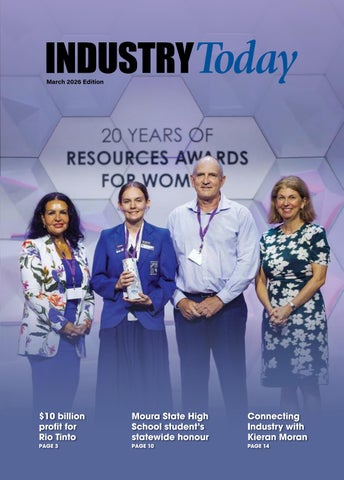
March 2026 Edition
$10 billion profit for Rio Tinto
Moura State High School student’s statewide honour
Connecting Industry with Kieran Moran
PAGE 3
PAGE 10
PAGE 14
INDUSTRY TODAY
Alpha HPA moves forward By Di Stanley Alpha HPA has recorded a loss after tax of some $22.5 million to the half-year ended 31 December 2025 but remains a going concern with its accelerated growth of stages one and two of its Gladstone industrial base of operations. In documents lodged with the Australian Securities Exchange on 26 February, the company had net cash outflows from operating and investing activities of $83.462 million and cash and cash equivalents of $45.07 million. “The group’s main activity is development of the HPA First Project and as such, it does not presently have a material source of operating income, rather it is reliant on funds from equity raising or from other external sources to fund its activities,” the documents stated. Alpha is in continuous production at Gladstone with its HPA First project stage one producing the company’s full range of high purity aluminium materials at an annualised rate of more than 350 metric tonnes per annum with product offerings including high purity aluminas (HPA), high purity alumina hydroxides (ATH), high purity aluminium nitrate precursors (Al-Nitrate) and high purity synthetic sapphire glass. “Stage one of Alpha’s ultra-high purity ATH
Key components for the HPA First Project stage two being barged to a holding pad after arriving in Gladstone in February. (Supplied) and HPA products continue to be fully utilised for customer and end-user qualification orders with demand levels now well above existing ATH and HPA production capacity,” the directors’ report stated. “During the period, the company advanced a number of process optimisation and equip-
ment installation options to increase stage one production capacity in response to oversubscribed product demand in CY2026 and CY2027. “The company is assessing further expansion options for stage one to increase production rates to meet customer demand and facili-
tate ongoing growth in customer qualification and testing.” During the reporting period, Alpha’s marketing efforts were focused on new demand for new technology trends which matched the company’s novel process capability. These included the manufacture of spherical thermal interface materials for parallel processing logical semiconductors for use in artificial intelligence and data centres. Other applications were for use in high bandwidth memory chips, battery coatings and solid state electrolytes, synthetic sapphire wafers for power-semiconductor and LED substrates and a range of pharmaceutical uses. HPA First Project stage two is under construction. In February, the National Reconstruction Fund Corporation (NRFC) approved a $75 million investment in the company, supporting delivery of the HPA First Facility in Gladstone. The NRFC investment was made as a cornerstone commitment in a $225 million funding round, acting as a catalyst to successfully crowd in a further $150 million from institutional investors, which included on-going support from Orica Limited and Australia Super to complete the raise.
Titanic night for charity raises cash for great causes By Liam Emerton Titan IND hosted an incredible ‘Make Your Own Luck’ gala dinner in Rockhampton last month – raising valuable funds for two great causes. The gala dinner – hosted by the local Central Queensland company – put on a wonderful night with some impressive guest speakers. Former NRL talents Andrew McCullough, Ben Hannant, Kerrod Holland and Nate Myles were joined by local singer Jeremy Marou as the big names headlining the dinner at Headricks Lane. The gala aimed to raise funds for both The Shelter Collective – a local Rockhampton charity tackling the homelessness crisis – and Reboot Mindset Academy – a program focused on mental fitness, resilience training and lifestyle choices founded by NRL greats Todd Carney and Mitchell Pearce. All together the night – which saw 150 people attend – raised plenty of funds for those two extremely worthy causes. “A lot went in behind the scenes to pull this all together,” Titan IND’s Troy Sawdy said. “I know all the boys, I’ve met them at other events and that’s how I was able to rope them all in. “Shelter Collective is close to home. I live here in Rockhampton, I walk the river every morning and I see the battle that Dave (chair-
Andrew McCullough, Jeremy Marou, The Shelter Collective’s Dave Grenfell, Titan Ind’s Troy Sawdy and Ben Hannant just before the gala dinner got underway. (Liam Emerton: 535947) man Dave Grenfell) is fighting. “The Reboot Mindset Academy – our workforce spreads across the country because we have a lot of FIFO guys and girls. “They have to live away from their home and it becomes difficult with isolation – Re-
boot Mindset Academy is now working on a program for guys and girls like that in the mining lifestyle.” Former Brisbane dummy-half McCullough was stoked to be up in Central Queensland talking to like-minded people
about life and lessons learned on-and-off the pitch. “I love coming up here, the people are absolutely outstanding and it was for a great cause,” he said. “Troy and Titan got myself and a few of the boys up here. Having a sports background can really resonate with people and their path. “Mindfullness within society is really growing and that’s a really great cause. “People up here are just so welcoming. “I was at Norths [on Thursday night] and the boys just got around it. ‘It was good fun. The boys just love to chat about sport, so I love coming up to these regional areas.” Queensland and Australian representative front rower Hannant was also proud to be asked to speak as such a terrific event. “It’s great to be up here in Rockhampton for a great cause with great company,” he said. “The biggest problem that rugby players do have is that they think rugby league is everything. “They think it makes you who you are; but it doesn’t. “That is only a small part of who you are. It gives you a lot of skills you can use later in life but who you are as a person is how you treat others, build relationships and that’s what tonight is about.”
McKinley is inspiring next-gen tradies Telephone: 07 4863 5050 Address: 5-9 Hempenstall Street, Kawana, QLD 4701 EDITORIAL Gregor Mactaggart Editor E: gregor.mactaggart@CQToday.com.au Matthew Pearce Journalist E: matthew.pearce@CQToday.com.au ADVERTISING Cheryl Altouvas Advertising Sales E: cheryl.altouvas@GladstoneToday.com.au Lou De Jager Advertising Sales Executive E: lou.dejager@CQToday.com.au 2 INDUSTRY TODAY March 2026
A new campaign has been launched to encourage more women into manufacturing as Queensland faces a critical skills shortage in the $28.9 billion sector. Manufacturing Skills Queensland (MSQ) wants women and girls to know they have a critical role to play in building Queensland’s future and there are numerous job opportunities available to them. MSQ has created the Manufacturing Industry Influencer Program which showcases women who are building successful careers in manufacturing by working in jobs ranging from boilermakers and engineers to rocket designers. As part of the program, influencers will visit schools across Queensland and speak at community forums and industry events to inspire young women to consider careers in manufacturing. MSQ acting chief executive officer Kris McCue said it is important for women to see other women working in manufacturing because “if
Gladstone’s McKinley Pope is part of the MSQ Manufacturing Industry Influencer Program and is passionate about supporting the next generation of tradespeople. (Supplied) you see it, you can be it”. “Some workplaces are now seeing increased female participation, and that’s the trend we want to accelerate across the entire manufacturing sector.” Gladstone local McKinley Pope, who works
as a mechanical apprentice and Trades Training Officer, is part of the MSQ Manufacturing Industry Influencer Program and is passionate about supporting the next generation of tradespeople. In her role, Ms Pope supports apprentices through their trade journey by providing hands-on training and guidance. “I love my job because I get to come to work every day and teach people. It makes me happy to see them succeed and give them the help that I was given when I was an apprentice,” Ms Pope said. “I would recommend a career in manufacturing because it’s a great lifestyle and it has given me so many opportunities that I would never have imagined when I first started my career.” Around 170,000 people work in manufacturing across Queensland. MSQ delivers targeted workforce development programs to support manufacturers in building capability and addressing critical skills gaps across the sector.
INDUSTRY TODAY
Coal train drivers threaten strike following lockout By Di Stanley Up to 400 Rail Tram and Bus Union coal train drivers in Rockhampton, Gladstone, Coppabella, Nebo, Sarina and Bowen were locked out by Pacific National for 24 hours from 6pm Tuesday, 3 March, in a move described by branch secretary Peter Allen as “deliberately intimidating”. Mr Allen accused the company of being premeditated in its actions as he warned of further protected industrial action to follow after a breakdown in enterprise bargaining negotiations for a new Queensland agreement with the carrier. Drivers were given just four hours’ notice of the lockout believed to have affected customer haulage on the Blackwater and Goonyella coal corridors. “I have spoken to the drivers, as well as the legal teams, and we are working out further industrial action... we are not going to be intimidated by this sort of thing,” Mr Allen said. “This (lockout) was designed to try and intimate people and I think they’ve really pulled the wrong rein on this. “They thought people would be intimidated and back down and in fact it’s just inflamed the whole situation. “Our people are furious about it and see it as bullying.” Mr Allen said the RTBU took Pacific National to the Fair Work Commission in the early hours of Wednesday morning before a deputy president to challenge the lockout. “They (Pacific National) had to provide cars to people, they had to make sure trains were stowed appropriate and safely and even though there were clear signs they had preplanned this for some time, they still hadn’t worked out the basics of how it was going to work,” he said. “Eventually, the deputy president allowed them to carry on with their lockout after
RTBU member train drivers at the Sarina depot protesting the Pacific National 24-hour lockout imposed on members from 6pm on Tuesday, 3 March. (Supplied) they’d resolve a litany of issues with it.” Mr Allen said the union had little choice but to employ protected industrial action against the company after 80 per cent of its members rejected the latest Pacific National EB offer. “We’ve seen companies that try to bully us and bully their workforce in this industry in times gone by and we know that the only way to deal with them is to step up to them and to increase the pressure,” he said. “Industrial action is the only tool we’ve got to do that. “It could involve strike action, it could involve refusal of overtime, a few different things, but our aim is to step and put pressure on them to come back to the table and get a
sensible agreement. “If we don’t ramp up the intensity with these guys, they will continue to think they can ride roughshod over us.” A Pacific National spokesperson said the lockout notice was issued in response to continued industrial action being taken by the unions against the company, which it claimed impacted its ability to service the coal industry. “Pacific National has been actively bargaining for a new enterprise agreement in Queensland for more than eight months,” the spokesperson said. “Pacific National has been transparent with both the RTBU and AFULE (Australian Federated Union of Locomotive Employees)
about the competitive and challenging operational environment facing the coal business and has presented a generous offer that reflects cost of living pressures, time off and other employee interests. “This offer was rejected and Pacific National issued a lockout notice to bring negotiations to a head and reach a deal that benefits employees and delivers what matters for our people, customers and shareholders. “Pacific National appreciates the work of our train crews who are moving our customers’ product, and we will keep bargaining in good faith. We look forward to getting back to the bargaining table and reaching a practical outcome.”
Rio’s bumper $10b profit By Di Stanley Higher aluminium prices globally have played their part in Rio Tinto recording a $10 billion profit after tax in 2025. Rio’s chief executive officer Simon Trott said the 2025 full year results, released to the market on Thursday, 19 February, showed a four per cent year-on-year increase in alumina production driven by improving plant performance at the Aldoga refinery in Yarwun and stable operations across other sites. “Copper and aluminium prices both rose nine per cent, but average prices don’t tell the whole story,” Mr Trott said. “Copper ended the year 44 per cent higher than 12 months earlier, and aluminium rose 17
per cent higher.” Rio hasn’t backed away from its plans to cut production at Aldoga by 40 per cent from October this year to extend the operation’s life until 2035. It will impact about 180 jobs. Rio recorded an impairment charge of $329 million for the Yarwun facility. “In 2025, the change in closure estimates charge includes $329 million related to the Yarwun alumina refinery, due to an acceleration of its forecast closure date as studies had not identified an economically viable solution for the construction of a second tailings storage facility,” the results report stated. Mr Trott said Boyne Smelters Limited also performed well as the company continued to
adapt to market and supply chain dynamics. “Over the next decade we expect strong growth from aluminium, lithium and copper - with steel demand remaining resilient,” he said. “At the same time, across the board, supply is constrained with sector CAPEX 50 per cent lower than its 2013 peak.” Mr Trott pointed to a positive correlation of the three products with the energy transition. “The demand growth picture is not uniformly strong - traditional areas such as construction remain weak - but the backbone of growth is the energy transition, particularly around power systems and electrification. “The energy transition, combined with sup-
ply constraints and reinforced by investment inflows, is driving market strength. “Lithium ended the year with strong momentum as markets came back into balance earlier than expected. “Battery storage demand is emerging as a fast-growing pillar of the energy transition, with growth now outpacing EVs as renewables scale and grid firming becomes critical. “It continues to surprise many market commentators to the upside.” Mr Trott said the company’s strong operational performance across the board had resulted in an operating cash flow of $16.8 billion, with underlying earnings of $10.9 billion after taxes and government royalties.
SUPPORTING THE GLADSTONE REGION FOR OVER 40 YEARS 17 Garfield St Gladstone 4680
07 4976 7999 www.walzgroup.biz
12659187-JC03-24
March 2026 INDUSTRY TODAY 3
INDUSTRY TODAY
GIRLS’ mentoring magic Several Central Queensland students have been selected for the 2026 Girls in Resources Leadership Skills (GIRLS) mentoring program, which launched in Brisbane with Year 12 participants from across the state. The popular program connects female students with experienced mentors from the mining and energy sector, including geologists, engineers and tradespeople, to help them explore careers in the resources industry. Students from the Fitzroy region selected for this year’s intake include Shayla Hymus from Chanel College in Gladstone, Grace Martin and Regan Bonne from Marist College in Emerald, and Giselle Dickson from Moura State High School. They were among 20 students from 16 schools across Queensland who travelled to Brisbane to meet their mentors and begin the six-month mentoring program. Now in its eighth year, the initiative has connected more than 120 students with the resources sector, with many alumni going on to build successful careers in mining and energy. The program is a joint initiative of the Queensland Minerals and Energy Academy and Women in Mining and Resources Queensland. Queensland Resources Council chief executive officer Janette Hewson said the students would take part in a structured mentoring partnership supported by organisational psychologists. “These young women will get expert guidance and advice from their mentors, who work in the fields they are aspiring to enter,” Ms Hewson said. “This year the students will also walk away with a micro-credential in Artificial Intelligence, digital technology and machine learning through the Australian Institute of Management after sponsorship from the Caterpillar Foundation. “It is an exciting addition to the GIRLS mentoring program recognising the transformative effect of AI on all industries and provides students with a practical qualification for their studies or entry to industry after school.” Women in Mining and Resources Queensland co-chair Catherine Cook said the
Chanel College Gladstone’s Shayla Hymus, Marist College Emerald’s Grace Martin, Kirwin State High School’s Rhianna Daisy-Hart, Marist College Emerald’s Regan Bonne and Giselle Dickson from Moura State High School were chosen to be part of a 20-strong cohort for the 2026 Girls in Resources Leadership Skills mentoring program. (Supplied) program aimed to support young women interested in STEM and trades careers in the resources sector. “By the end of this six-month program the students will be filled with knowledge and confidence about potential careers in mining and
energy,” Ms Cook said. The 2026 mentoring program is delivered in partnership with Metisphere Organisational Psychologists and is supported by industry sponsors including BHP Mitsubishi Alliance, Jellinbah Mining, Whitehaven, Glencore Tech-
nology, Thiess, Coronado Global Resources and Idemitsu Australia. Participants in the program come from regions across Queensland, including Mackay-Isaac, North Queensland and south-east Queensland.
Making up for lost ground in resources exploration The Queensland Resources Council has welcomed the State Government’s decision to release new land for natural gas, coal and mineral exploration across the state. The land release will open 18 new areas for exploration in the Cooper, Surat and Bowen basins, as well as land near Julia Creek in Queensland’s northwest. QRC chief executive Janette Hewson said the move was an important step in rebuilding
exploration opportunities after several years with limited new releases. “Exploration is the lifeblood of the resources sector. Without it, there are no future projects. Exploration is the first step in a long process that can take years, and sometimes decades, to reach production,” Ms Hewson said. She said releasing new land would help support the pipeline of future mining and
CHAUVEL INDUSTRIAL SERVICES
• On-site maintenance, shutdown and workshop facilities • Mechanical and Fabrication • Pumps, pulleys, conveyor supply and service • Civil and concreting 12659322-KG03-24
• Blast and paint
Exceeding Expectations
07 4926 8588 | chauvel.com.au Head Office: 26 Hempenstall St, Nth Rockhampton Emerald: 6 Daniels St, Emerald 4 INDUSTRY TODAY March 2026
energy projects in Queensland, but warned strong policy settings were also needed to attract investment. “Land releases are an important step forward and must be supported with the right policy settings to attract investment and progress projects to production,” she said. Ms Hewson said the State Government had begun reviewing policy settings, with early signs reflected in improved investor
sentiment towards Queensland in the Fraser Institute’s 2025 survey, where the state ranked 13th. However, she said coal investment continued to be impacted by the current royalties regime. “Queensland’s 48th place in the taxation category of the Fraser Institute Report underscores how far we trail other countries, states and territories,” Ms Hewson said.
BHP closes Mackay Academy The BHP FutureFit Academy in Mackay is set to close. The mining giant said the purpose-built mining maintenance and production training centre would cease to operate in its current form following a thorough review process. BHP said a transition was underway to consolidate the FutureFit program in Western Australia. “We have told our current Queenslandbased students that they will absolutely be able to finish what they started at FutureFit, and that their pathways into permanent roles at BHP operations are not impacted when they successfully complete their training,” the company said in a statement. “The FutureFit Academy team in Mackay should take great pride in what’s been achieved since the doors opened in 2020, most notably training nearly 600 graduates and helping kickstart their careers in mining. “This is a difficult but necessary decision in the face of the low returns in Queensland, a
function of the extreme royalty settings introduced in 2022.” Mackay Regional Council Mayor Greg Williamson described the move as ‘a slap in the face’ for the region. “I’m very disappointed that it’s come to this in Queensland,” he said. BHP chairman Ross McEwan said the company had pulled back its investment in the Sunshine State. “When you’re making no money with an operation in an area like Queensland, because the royalties just spoiled your business, you don’t invest,” Mr McEwan told the AFR Business Summit recently. “Our process right now is zero investment in Queensland. “Western Australia are great to deal with, both Western and South Australia. “And where’s the money flow? Into those areas that are actually most willing and keen to work with you. That’s where the money goes.”
INDUSTRY TODAY
$3.5m grants program open
Gladstone MP Glenn Butcher pictured in mid-2025 at the Bensted Road site for Powerlink’s Queensland SuperGrid Training Centre and Transmission Hub in Gladstone. The land will now be sold off. (Supplied)
It’s lights out for Powerlink’s hub By Di Stanley Powerlink has abandoned its proposed stateof-the-art $90 million Queensland SuperGrid Training Centre and Transmission Hub in Gladstone, putting the still undeveloped land on Bensted Road up for sale. Instead, the government-owned corporation has committed to an existing, scaled down operation in Bassett Street, Callemondah. Gladstone MP Glenn Butcher blasted the LNP for reneging on the permanent hub development, designed to train 500 energy workers each year as part of the former Labor Government’s Queensland Energy and Jobs Plan in support of the energy transition to renewables. It had been expected to create 90 jobs over 10 years at the facility. “The whole thing’s gone - they’re going to operate out of a little shed,” a visibly disappointed Mr Butcher said. “That speaks volumes, doesn’t it? “This is just another cut by the LNP. They’re known for their slick slogans, but they’re also known for their cuts and that’s exactly what we’re seeing here. “it’s just another slap in the face for Gladstone.” “I was out there the other day and had a look at it, the bunting’s falling off the fence, it just looks like a hovel.”
A Powerlink spokesperson said the organisation remained committed to a long-term presence in Gladstone. “We have 57 people currently based in the region, which includes 16 apprentices, who continue to play a vital role in delivering reliable electricity to Central Queensland,” the spokesperson told Gladstone Today. “We have been actively evaluating options to ensure our hub matches our future work program, expanding workforce and ongoing commitment to delivering value for Queenslanders. “Our aim is to provide the necessary facilities and equipment for our Gladstone-based workforce in a cost-effective manner that best supports the team, wider industry and the important work being undertaken in the region.” The spokesperson said the decision was made to purchase and upgrade the facilities Powerlink already occupied on Bassett St, including an additional lease on the adjacent site. “This decision meets the needs of our team sooner and in a more cost-effective way,” they said. “The process to sell the property purchased at Bensted Rd is now underway.” In July last year, Mr Butcher, the former Regional Development and Manufacturing Minister, first identified that more than $30 million had been slashed from the hub’s budget and its timeline blown out to 2027.
“This is the downside of a government that doesn’t believe in these training facilities in regional Queensland,” he said. “There’s just so much opportunity... it wasn’t just about training the apprentices and the tradespeople, they would have come from all over Australia to this big hub. “So, our restaurants will be missing out, our motels, and this is just another cut by the LNP. “It’s ridiculous and this just keeps coming - cutting funding to Stanwell (the $12.5 billion Central Queensland hydrogen project) and the consequences of that was the hydrogen manufacturing, a whole industry stopped in its tracks.” Mr Butcher said he firmly believed the LNP Government was “hellbent on breaking Gladstone”. “This is the powerhouse of not only the state, but the nation, and for them not to be here talking about projects and talking up investment - what are they doing?” he posed. “What’s their alternative? “They’ve cut their training facility for Powerlink, they’ve stopped Stanwell, they’ve stopped windfarms - what are they actually doing for Gladstone and Central Queensland that they can put their name on, that’s actually bringing the place forward? “I’d just about say nothing.”
Banana Shire Council has opened a competitive grants program to drive new investment into the Biloela Industrial Precinct. The Biloela Industrial Incentives Initiative offers $3.5 million, funded by the Queensland Government, for shared infrastructure, services and capabilities that benefit multiple businesses in Banana Shire. The Initiative is designed to catalyse economic growth, diversification and job creation by funding shared enabling assets that reduce costs, de-risk investment and unlock private sector activity across the Precinct. Industries with greatest potential for growth include manufacturing, energy (including coal, gas and renewables), resource processing, construction, defence, circular economy and logistics. Businesses operating in or seeking to invest in Banana Shire are encouraged to apply. The program supports shared infrastructure, co-owned or joint-use facilities, and privately owned assets with demonstrable shared benefit, where the project enables access by at least two businesses. Applicants are encouraged to propose innovative solutions that align with the Initiative outcomes, even where projects do not fit neatly into these categories. “Banana Shire is open for business. This Initiative gives local and incoming businesses a real opportunity to invest in the shared infrastructure that will drive the next stage of the region’s industrial growth. We want to see strong, innovative ideas from industry.” Mayor, Nev Ferrier Key facts Program value: $3.5 million (inclusive of GST), funded by the Queensland Government and managed by Banana Shire Council Who can apply: Australian-based businesses and entities proposing projects that benefit at least two businesses in Banana Shire EOI closes: 31 March 2026 How to apply: Submit the EOI Response Form to IndustryIncentive@banana. qld.gov.au Further information: banana.qld.gov. au/biloela-industrial-incentives-initiative Expressions of interest close 31 March 2026. Shortlisted applicants will be invited to submit a detailed proposal under Stage 2 of the program, with successful applicants expected to be confirmed by September 2026. Full program guidelines, the EOI Response Form and further information are available at banana.qld.gov.au/biloelaindustrial-incentives-initiative. Enquiries can be directed to IndustryIncentive@ banana.qld.gov.au by 17 March 2026.
• • • • •
Environment
CQG is a passionate advocate for local businesses Rockhampton | Gladstone | Brisbane | Mackay | Townsville
Engineering
Planning
www.cqgroup.com.au • +617 4922 9252 12660440-MS03-24
March 2026 INDUSTRY TODAY 5
INDUSTRY TODAY
Untapped potential Deadline
for inquiry extended
By Di Stanley In a matter of minutes, more than 50 sticky notes were stuck to a virtual whiteboard, each one filled with a vision, hope and the burning desire to shape the social and economic vibrancy of the Central Highlands by 2056. The first meeting of Regional Futures Round Table was held in Emerald on Tuesday, 24 February, with Central Highlands Rural Resource Use Planning Cooperative chief executive officer Justine McLeod saying a very clear picture emerged of the high degree of opportunity in the region waiting to be developed or valueadded to. The RFRT initiative is working within the orbit of the Central Highlands Development Corporation’s recently launched Frontier CQ project, a roadmap that sets out how the region can work collectively to bring to fruition a range of innovative projects. “Frontier CQ is intended to be the strategy for the region and the roadmap for what regionally needs to be in place to build social and economic development,” Ms McLeod said. “The Regional Future Round Table is part of that Frontier CQ ecosystem and the work that the group takes forward, whether it’s projects that are stalling but need momentum or whether they’re completely new projects but things that require cross-sector representation to be able to solve where it’s at, if something can be done within a silo by an entity, it actually can happen within the ecosystem by itself. “There are huge volumes of projects that have been part of this roadmap for a long time, but aren’t moving forward - the question is why? “It’s just a matter of us working out how we want to prioritise and what makes the most sense to go after.” Ms McLeod cited the example of the Inland Port at Yamala, an industrial estate that has spent years waiting for a water connection to unlock its true potential. “There’s a lot of organisations that want to do industry, but they won’t go there and there’s no other industry that’s suitably working for them in town,” she said. “It’s the fact we’ve tried to get a circular economy intown, but everything still gets shipped away and then comes back because we can’t seem to process here. “Fundamentally, every industry has this massive list of all the problems where we can’t seem to get traction, so it’s really around rather than solving all of them, we need to get clear on how we decide what we go after, and then after
CHRRUP held the inaugural meeting of the Regional Futures Round Table on 24 February as it begins mapping out priorities to attract new industry and give momentum to stalled projects. (Supplied) that, deciding the criteria by which we assess what actually needs the focus the most is really important. “There’ so many opportunities in the region, but there’s lots of things that don’t seem to be getting traction. “There’s differing opinions as to why, but there’s clarity that we do actually have a role to play, and we need to do it.” CHDC chief executive Peter Dowling presented a quarter two update at the Central Highlands council’s 25 February meeting where he said the Frontier CQ innovation roadmap would have a network of business, industry, government and community stakeholders at its core to identify priority works that would make a difference to the regional economy. Councillor Gai Sypher, also a CHDC board member, said the project could be “one of the
most valuable reports that has come out of CHDC for so long”. “This one here, we talk about CHDC just doing reports or glossy magazines or brochures, the next step to this is where CHDC can actually show you tangible results if we can carry it through to the implementation stage,” she said. “If some councillors don’t truly already understand what this project is about, you really need to get over to CHDC and have a really good briefing on it because I think this will drive our region, but we need to take it to the next step to do it. “It’s just so exciting and (there’s) so much potential, but if it’s not taken to the next step, then it’s just another piece of collateral that will gather dust. “I just about jump out of my skin about the future that this can bring for us.”
Highlights of Central Highlands’ big story A new publication captures the full breadth of the Central Highlands’ resources story for the first time. The Central Highlands Mining and Energy Capability Statement details the local coal, gas and renewables sectors, positioning the region as one of strength, capability and growth. Produced by Central Highlands Development Corporation, the 28-page document is an expanded follow-up to CHDC’s coal-focused mining factsheet from 2022. “While this publication reinforces coal’s standing as an economic powerhouse, we’ve also taken the opportunity to shine a light on the lesser-known players in the Central Highlands’ energy sector,” CHDC chief executive officer Peter Dowling said. “What’s come into focus is our region now has a well-established natural gas industry and we’re also claiming our share of the renewables space.” The publication also sets out coal’s futureproofing innovations and post-mining rehabilitation activities. Innovation case studies include Kestrel Coal Resources’ work to convert mine waste gas into electricity – generating power, creating jobs and cutting emissions. “The document does a great job of showing that there’s genuinely exciting and groundbreaking work unfolding right here in the 6 INDUSTRY TODAY March 2026
Australian Bureau of Statistics, various government departments and REMPLAN. Highlights of the Central Highlands’ mining and energy sector: It generates approximately $16 billion in annual output. It produces over 50 million tonnes of coal annually, about a quarter of Queensland’s total output, with 62 per cent for steelmaking and 38 per cent for energy production. It directly employs more than 6,700 people, with a broader workforce exceeding 11,000 when including contractors. Gas – primarily coal seam gas – generates an estimated $155 million in annual output from the region’s mainly-southern gas fields. Renewables include two large-scale solar farms, a battery energy storage system, and several more solar, wind and bioenergy projects in the pipeline. It’s supported by a robust mining equipment, technology and services (METS) ecosystem. It’s home to multiple brownfield extensions and new greenfield projects, signalling continued investment in coal and its long term regional capability. The Capability Statement can be downloaded from chdc.com.au and free hard copies are available at CHDC’s office in Egerton Street, Emerald.
Capricornia MP Michelle Landry is calling on local residents, mining stakeholders, and community groups to take advantage of a deadline extension for the House Standing Committee on Primary Industries’ inquiry into critical minerals. The Standing Committee on Primary Industries has extended the deadline for written submissions to Tuesday 31 March. The Critical minerals: shaping social licence and economic development outcomes inquiry, is investigating how Australia can responsibly develop its mineral wealth while ensuring regional communities see real, long-term benefits. Ms Landry said the inquiry is particularly vital for the electorate of Capricornia, which sits at the heart of Queensland’s resource sector. “Capricornia is a powerhouse of the Australian economy, and our local mining industry is the backbone of our region,” she said. “With the global push for critical minerals, we have a unique opportunity to secure more local jobs and infrastructure. However, it is essential that this development is done right - with genuine community engagement and a strong social licence.” The inquiry is examining several key areas relevant to Central Queensland, including: - The effectiveness of engagement with local communities and Traditional Owners. - Opportunities for regional development, job creation, and skills growth. - The role of various levels of government in supporting sustainable development. “We’ve seen the impact that 100 per cent fly-in fly-out workforces can have on towns like Moranbah and Dysart,” Ms Landry said. “I want to ensure this inquiry hears from the mums, dads, and small business owners who live here. This extension gives our community more time to ensure their voices are heard in Canberra”. Submissions can be lodged directly through the official inquiry website, www.aph.gov.au/Parliamentary_Business/Committees/House/Primary_Industries/CriticalMinerals/Submissions
• •
•
CHDC’s Deb Barns, Cr. Rachael Cruwys, Peter Dowling, Laura Letts, Greg Christensen, Cr. Gai Sypher and Cr. Karen Newman (far right) with Kestrel’s Mick Hoppe and Sam Thomasson at the mine’s waste gas-to-electricity project. (CHDC) Central Highlands, even in what’s seen as a traditional industry like coal,” Mr Dowling said. Complementing the Central Highlands Agricultural Capability Statement, both publications are designed to inform decision makers in government, industry and investment; strengthen funding applications; guide regional planning; and support advocacy efforts. The new publication was developed with input from the industry and data from the
•
•
• •
Capricornia MP Michelle Landry
INDUSTRY TODAY
High hopes, hi-vis for future Fourteen new apprentices and trainees have begun their working life at Gladstone Ports Corporation. Callide MP Bryson Head said the intake highlighted the value of linking training directly to local industry. “This intake shows what happens when government direction meets strong local employers,” Mr Head said. “These are hands-on roles that support major operations right here in our region, from maintaining critical equipment to supporting planning and environmental work. “It means local people can build skilled careers in Central Queensland and contribute to industries that keep the region moving.” GPC chief executive officer Andrew Johnson said the newcomers reflected the organisation’s commitment to building a skilled workforce for the future. “We’re thrilled to welcome so many new faces to GPC,” he said. “Their energy and talent will help drive the future of our operations, and we can’t wait to see the impact they’ll make. “They’ll be learning alongside highly skilled employees with decades of experience, ensuring trade skills and operational knowledge are passed on to the next generation.” Finance, Trade, Employment and Training Minister Ros Bates, said the intake’s focus was on practical training that leads directly to employment in the regions, while supporting Queensland’s trade opportunities. Ms Bates said as one of Central Queensland’s largest employers, GPC was investing in regional skills and hands-on training that supports its day-to-day operations and long-term capability. “These apprentices and trainees are
The Gladstone Ports Corporation’s 2026 intake of 14 apprentices and trainees. (Image: GPC) learning on the job, working with real equipment and real systems that matter to Central Queensland,” she said. “This is a demonstration of how we rebuild Queensland’s skills pipeline after a decade of decline, by employers training locally to create
genuine career pathways. “Government-owned corporations have an important role to play, and Gladstone Ports Corporation is showing how investment in skills delivers real outcomes for regional communities and Queensland’s trade poten-
tial.” Apprentices will work alongside experienced tradespeople maintaining electrical systems, heavy machinery, diesel equipment and refrigeration units that deliver safe and efficient port operations.
Celebrating Women in Ports Gladstone Ports Corporation proudly supports equality across our workplace. At GPC, we’re committed to ensuring everyone feels valued, supported, and empowered to succeed.
#IWD2026
gpcl.com.au 12849037-KF11-26
March 2026 INDUSTRY TODAY 7
INDUSTRY TODAY
Renewables growth sparks private spend By Andrew Brown, AAP Growth in the renewable-energy sector has led to a rise in private spending as the treasurer flags his upcoming budget will be ambitious despite pressure to slow inflation.
Mirani MP Glen Kelly at the existing Genex BESS site in Bouldercombe. (Supplied)
Future of BESS is in Bleijie’s hands By Matthew Pearce The future of Bouldercombe’s proposed Capricorn BESS (Battery Energy Storage System) is now in the hands of the Deputy Premier, with the project officially ‘called in’ for decision. In early January, Deputy Premier Jarrod Bleijie issued a proposed ‘call-in notice’ for Potentia Energy’s Capricorn BESS in Bouldercombe, as well as Trinasolar’s Pleystowe BESS in the Mackay Region, opening up consultation to the community on the two projects, which closed on Thursday, 5 February. In total, 326 submissions were received from members of the community regarding the Capricorn BESS. The final decision on whether the project goes ahead will now sit with Mr Bleijie, with a timeframe of 30 days from the call-in notice being issued. Mr Kelly said the Deputy Premier calling the project in shows the State Government is listening to the community that will be impacted. “Bouldercombe is a community that’s already received a bad deal on BESS projects, after Labor ran roughshod over local governments and communities for years,” he said. Mr Kelly said 95 per cent of submissions op-
posed the project. “To see over 300 submissions against this project shows that despite the town already having a BESS project, there hasn’t been enough consultation with the community to ensure that concerns are heard and mitigated effectively,” he said. “They were given the chance to have their say, given their chance for their voices to be heard, and they took it. The Deputy Premier has listened.” The Capricorn BESS is a proposed 300MW/1200MW battery energy storage system, planned to contain up to 294 battery containers. A Potentia Energy spokesperson said the $500 million project would create significant job opportunities and benefits for the community and First Nations people, with over $3.5 million in community benefits, up to 300 jobs in construction, and 10 high-paying ongoing positions. “We are committed to working constructively with the Deputy Premier, the Rockhampton Regional Council, and the local community throughout this objective assessment process,” they said.
Potentia Energy submitted a development application for the proposed Capricorn BESS project to Rockhampton Regional Council early last year. At Rockhampton Regional Council’s ordinary meeting on Tuesday, 9 December, council laid the matter on the table in the absence of the portfolio and divisional councillor, with the matter to be addressed at the first council meeting for 2026. Following this deferral, Potentia Energy filed a deemed refusal appeal in the Planning and Environment Court. Two days later, new State Government regulations came into effect requiring Battery Energy Storage Systems over 50MW to be impact assessable, require mandatory community consultation, and be assessed by the State Assessment and Referral Agency instead of local councils. Mr Kelly said that due to the court appeal, the Capricorn BESS was not captured by these changes. Both Mr Kelly and Rockhampton Regional Council Deputy Mayor Drew Wickerson submitted letters to the State Government asking for the project to be ‘called in’.
Council fails to adopt BESS benefit scheme By Matthew Pearce Rockhampton Regional Council has failed to adopt a community benefit scheme for BESS (Battery Energy Storage System) projects. At council’s ordinary meeting on Tuesday, 24 February, councillors voted on whether to adopt a Renewable Energy Community Benefit System Policy, which would include a community investment strategy. It was also recommended to update council’s Fees and Charges Schedule for the 2025–2026 financial year to include a fee for assessing the Social Impact Assessment and Community Benefit Agreements for renewable energy projects as prescribed under the Planning Regulation. Cr Edward Oram raised a motion that the matter be laid on the table for another briefing session, as there were “a number of issues with the policy.” “I think the policy needs a lot of reworking before it gets brought back up to the table,” he said. “I also believe the money requested from BESSes is far too low; a BESS can work 24 hours a day, solar panels can only work when the sun’s out, and wind can only work when the wind blows. “We’ve been told by companies that there’s so much solar coming in at the moment that BESSes are able to take energy for a negative price and they’re releasing that for a higher 8 INDUSTRY TODAY March 2026
Rockhampton Regional Council failed to adopt a Renewable Energy Community Benefit System Policy that would apply to BESS projects. (File) profit.” Cr Grant Mathers, who seconded the motion, said he agreed council needed to do a “fair bit more work” on the policy. “I’m also very mindful that we’ve got three proponents (of BESS projects) and we don’t want to be in a situation where we leave them sitting there waiting, wanting to kick off their social impact assessments. “At the end of the day, we’ve only had one full briefing session. There were a number of concerns raised in that meeting, and some of them have been attended to in this revised policy, but I know some haven’t.
“There needs to be a lot more discussion around the table, even regarding how that money is going to be divvied up between the communities.” The motion to lay the matter on the table was lost. Councillors Hilse, Mathers, Oram, and Rutherford voted for the motion, while councillors Williams, Latcham, Wickerson, and Taylor voted against the motion. A motion by Mayor Tony Williams that council not adopt a Renewable Energy Community Benefit System Policy lapsed due to a lack of a seconder. Cr Marika Taylor then moved that councillors return to the original motion of adopting the policy, considering it would be up for review in six months. “I think, considering the advice by our officers, that we probably need to have something in place,” she said. Cr Williams said he was getting mixed messages from the table - “messages that we’re taking money for something that we’re seen to be in support of” - and would be voting against the motion. Councillors Latcham, Wickerson, and Taylor voted for the motion, and councillors Williams, Hilse, Mathers, Oram, and Rutherford voted against the motion. The motion to adopt a Renewable Energy Community Benefit System Policy was lost.
Capital expenditure rose 0.4 per cent in the December quarter and 7.8 per cent on the same period in 2024, according to data released by the Australian Bureau of Statistics last month. The quarterly increase was driven by spending on renewable energy projects and buildings. But the growth was tempered by a decline in equipment and machinery spending after a record-high investment in data centres during the previous quarter. “Business investment in battery-energy storage systems featured strongly this quarter,” the bureau’s head of business statistics Tom Lay said. “Spend on wind and solar developments also remained at an elevated level. “Strength was also seen from data centre construction, despite the fall in equipment and machinery.” Capital expenditure went up 2.3 per cent in the quarter for buildings and structures, while it was up by 3.7 per cent in non-mining industries. The building growth was driven by a large spend on electricity, gas and water projects, as well as in the real estate and media and telecommunications industries. The amount spent on new equipment fell 1.7 per cent. “The drop in new equipment and machinery was driven by an easing in data centre spend this quarter, although equipment investment in the information media and telecommunications industry remains at an elevated level, up 49.6 per cent from last year,” Mr Lay said. It comes as Treasurer Jim Chalmers said the May federal budget would focus heavily on dealing with inflation. Underlying inflation rose to 3.4 per cent in January, giving the Reserve Bank more reason to lift interest rates, data released on Wednesday revealed. While headline inflation remained steady at 3.8 per cent to start the year, the central bank looks more closely at the underlying figure when it sets rates. “The budget will be an ambitious budget and it will recognise the pressures on people,” Dr Chalmers told ABC Radio. “All of this is about responsible economic management. People can expect to see more of that in May, and as part of that, there will be more savings.”
INDUSTRY TODAY
Project is moving ahead Queensland’s resource and supply chain sector gathered in force at last month’s Connecting Industry Luncheon, featuring a project update from QMines Limited and its leadership team. Held in Gladstone, the luncheon brought together contractors, suppliers, consultants, local government representatives and industry stakeholders to hear directly from QMines founder and executive chairman Andrew Sparke, alongside non-executive director Peter Caristo and development manager Richard Wittig, as the company progresses its Mt Chalmers copper and gold project towards development. Presenting to a strong cross-section of Queensland’s resource and construction sector, Mr Sparke detailed how the company has refined its approach to development prioritising capital efficiency, staged production and technical optimisation to strengthen project economics while progressing approvals and engineering studies. Connecting Industry director Kieran Moran said QMines outlined progress across environmental and regulatory pathways, while continuing to assess infrastructure requirements and processing strategies aligned to a practical, staged restart of operations. “This wasn’t a conceptual overview. It was a clear articulation of how Mt Chalmers moves from strategy to development,” Mr Moran said. “Importantly for the region, the presentation reinforced Mt Chalmers’ positioning as a copper-focused development at a time when global demand for copper is increasing due to electrification, renewable energy infrastructure and broader decarbonisation trends.
QMines founder and executive chairman Andrew Sparke sharing details on the Mt Chalmers copper and gold project at the Connecting Industry February lunch. “When a proponent outlines its capital approach, staging methodology and approvals progress, it gives contractors and service providers genuine insight into how and when to position themselves.” He added that projects such as Mt Chalmers represent more than a mining restart.
“Copper is central to the energy transition,” Mr Moran said. “When you have a region like ours with an emerging copper project moving toward development, it presents both an economic opportunity and a supply chain opportunity. “Our role is to ensure those conversations
happen early well before procurement formally begins.” The luncheon attracted strong attendance from across the resource, construction and energy sectors, reinforcing industry appetite for direct engagement with proponents progressing toward development in Queensland.
Reforms to safety framework to help resources workers The State Government has introduced new legislation aimed at strengthening safety oversight in Queensland’s resources sector and restoring confidence in the mining safety regulator. The proposed Resources Safety and Health Queensland and Other Legislation Amendment Bill 2026 would implement the government’s response to a 2025 independent review into Resources Safety and Health Queensland (RSHQ). The review, conducted by Susan Johnston from The University of Queensland, found serious weaknesses in the regulator’s governance structure, confusion around roles, and a lack of clear accountability. If passed, the legislation would establish an independent, skills-based governing board to strengthen oversight and accountability, streamline advisory structures, and remove duplication within the organisation. It would also transfer the statutory functions of the Commissioner for Resources
Safety and Health to the new board, providing clearer lines of responsibility and stronger accountability. In addition, the bill proposes expanding the functions of the Coal Mining Safety and Health Advisory Committee and the Mining Safety and Health Advisory Committee so they can provide independent advice and strengthen safety and health policy across the resources sector. Natural Resources and Mines Minister Dale Last said the reforms were designed to improve safety outcomes for workers while restoring confidence in the regulatory framework. “The findings of the review we commissioned into RSHQ were sobering – every worker deserves to make it home safe to their family,” he said. “The legislation we’ve introduced is making Queensland safer for every mine worker and will restore confidence in the resources safety framework.”
Mr Last said the government also wanted to support continued investment in the resources sector by reducing regulatory costs for industry. “The Crisafulli Government wants to see more investment in Queensland’s resources sector which is why we will repeal legislation that would put the onus on mining companies to fund the Land Access Ombudsman, removing unnecessary red tape and financial burden,” he said. “We are delivering a better lifestyle through a stronger economy by reducing industry costs so mining companies can get on with delivering jobs for Queenslanders.” The bill would also reform the funding model for the Land Access Ombudsman, which would continue to be funded by the state government. Under the changes, the ombudsman’s independent investigation and mediation functions would be managed by Coexistence Queensland.
Natural Resources and Mines Minister Dale Last. (Supplied)
12835945-EA12-26
March 2026 INDUSTRY TODAY 9
INDUSTRY TODAY
Leading women honoured A Thiess mining executive has been crowned the resources sector’s top female leader at the 2026 QRC and WIMARQ Resources Awards for Women in Brisbane. Rae O’Brien was named Exceptional Woman of 2026 at the awards ceremony held at the Brisbane Convention and Exhibition Centre, recognising her decades of leadership in the coal mining industry. Ms O’Brien made history earlier in her career by becoming the first woman in New South Wales to hold both first and second class Mine Manager’s Certificates. Moura State High School student Giselle Dickson was named the Exceptional Female QMEA Student. Hastings Deering’s Georgia Mehmet was also recognised on the night, winning the Exceptional Young Woman Award for her safety and operational leadership in managing endto-end mining equipment projects and improvements. “Career progression and what’s often called ‘work-life balance’ isn’t about juggling – it’s about creating a life that aligns with my values,” Ms Mehmet said. “Leadership is not defined by a title, but by the ability to influence, inspire, build trust, and make a meaningful difference.” About 900 people from across industry and government attended the event, which recognises women and diversity, equity and inclusion champions across Queensland’s resources sector. Now in its 20th year, the awards celebrate leaders across seven categories spanning operational, technological, professional and leadership roles. Queensland Resources Council (QRC) chief executive officer Janette Hewson said the finalists and winners highlighted the depth of talent across the sector. “Queensland’s resources sector is in good hands – judging by the breadth of talent, ambition and drive which was on show today,” Ms Hewson said. “We want the very best people working in our sector and for that to happen, every person needs to feel valued for their contributions. “As we mark International Women’s Day, let’s balance the scales, and support women who are shaping our future.” WIMARQ co-chair Catherine Cook said the winners each had inspiring stories. “So proud to celebrate the women shaping the future of our sector, recognise their achievements and learn from their stories,” Ms Cook said. Winners across the seven categories received scholarships for professional development and leadership courses provided by the Australian Institute of Management. The winners will now represent Queensland in their respective categories at the Women in Resources National Awards in September. The 2026 Resources Awards for Women winners are: Exceptional Woman: Rae O’Brien (Thiess) Exceptional Young Woman: Georgia Mehmet (Hastings Deering) Technological Innovation: Humaira Ehsan (Hastings Deering) DEI Champion: Bec Wright (Hastings Deering) Exceptional Tradeswoman / Operator / Technician: Kymberly Bouchardt (BMA) Excellence in Diversity Programs and Performance: BMA WomenRise program Exceptional Female QMEA Student: Giselle Dickson (Moura State High School) The awards were held during Queensland Women’s Week celebrations, which coincided with International Women’s Day on Sunday, 8 March.
• • • • • • •
10 INDUSTRY TODAY March 2026
About 900 people attended the 2026 QRC and WIMARC Resources Awards for Women in Brisbane recently.
Moura State High School’s Giselle Dickson was named Exceptional Female QMEA Student.
Guest speakers Brian Gillespie, Susie Corlett, Brent Stowers, Kanae Dyas and Nikki Hughes with host Victoria Carthew.
Queensland Resources Council chief executive officer Janette Hewson at the awards. (QRC)
Georgia Mehmet took out the Exceptional Young Woman award.
Kymberly Bouchardt was named the Exceptional Tradeswoman Operator Technician.
BMA’s WomenRise program took out the Excellence in DEI Programs and Performance.
Humaira Ehsan was the winner of the Technological Innovation category.
Bec Wright was the DEI champion.
Rae O’Brien was the winner of the Exceptional Woman category.
INDUSTRY TODAY
Whitehaven Coal regional general manager Dan Iliffe (right) with a QMEA organiser and Blackwater State High School students from the Heavy Hydraulics workshop. (Supplied)
The power of fluid forces The power behind hydraulic cranes was explored and modelled by Blackwater State High School students in a science workshop delivered last month by the Queensland Minerals and Energy Academy and Whitehaven Coal. The Heavy Hydraulics workshop gave students from Years 7 and 8, a deeper understanding of how fluid forces can create a pressure pump, or piston, which is a core component of mechanical engineering. Blackwater State High School principal Rebecca Vitale said the hands-on workshop gave the students the opportunity to problem-solve
and work in teams to find solutions. “The students worked in groups to create a model crane after learning about the physics of hydraulic forces –using the force of water to operate their crane,” Ms Vitale said. “It was a great way to bring their physics lessons to life and show real examples of how machinery using hydraulic forces, like cranes, operate on a work site.” Whitehaven Coal regional general manager Dan Iliffe said they were excited to be delivering the workshop to Blackwater students and giving the mechanical background to machin-
ery essential to mining operations. “The students had two lessons – one on physics and another on careers they could follow in the resources sector,” Mr Iliffe said. “Our experienced maintenance tradespeople joined the students and gave them some real examples of machinery using hydraulics and the types of roles involved in operating and maintaining this equipment including engineers, diesel fitters and electricians. “It was a great opportunity for us to engage with the students and connect their studies to the world around them.”
BSHS students learning about fluid forces at the science workshop.
One of the 39 turbine blades for the Lotus Creek wind farm being unloaded at the Gladstone port in February. (Supplied)
Turbine blade cargo is unloaded in Gladstone The first shipment of turbine components for CS Energy’s 285 MW Lotus Creek Wind Farm arrived at the Port of Gladstone recently. The shipment included 39 massive turbine blades, each measuring 79 metres in length, along with other components such as power trains, nacelles and hubs. The turbine components will be safely stored at the Port of Gladstone in preparation for their transportation to the wind farm site west of St Lawrence mid-year. Construction has been ramping up on site, with the first turbine foundation concrete pour completed in late February.
The Lotus Creek Wind Farm will feature 46 Vestas V162-6.2 MW wind turbines and will generate enough electricity to power 170,000 average Queensland homes every year. Fly ash from CS Energy’s Callide Power Station has been used in the concrete for Yellow Creek Bridge at Lotus Creek Wind Farm – turning a coal-fired energy by-product into a valuable construction material. The 80-metre bridge is engineered to carry turbine components weighing more than 100 tonnes, connecting both sides of the site and improving access for local landowners. 12829632-PS02-25
March 2026 INDUSTRY TODAY 11
INDUSTRY TODAY
Fortescue a ‘stand-out’ By Kaaren Morrissey, AAP One of Australia’s biggest iron-ore players has turned its interim earnings into a dividend machine for investors after hitting a speed bump in its plan to become a global green hydrogen force. But Fortescue still has its eyes on cutting costs by going as green as it can in its Pilbara operations in Western Australia, which allowed it to reduce costs during the first half of 2025/26. The group, which is the world’s fourthlargest iron ore producer, was also coy about the progress of supply talks with China’s statebacked iron ore buyer, saying only the “phased discussions ... are ongoing”. “Customers want low-emission steel and China is looking for partners to make that happen,” Fortescue metals and operations chief executive officer Dino Otranto said in an earnings
briefing. Fortescue posted a 23 per cent rise in bottom-line net profit to $US1.9 billion ($A2.7 billion), on revenue of $US8.4 billion ($A11.9 billion), for the six months ended December 31. The group, chaired by billionaire and green energy fanatic Andrew ‘Twiggy’ Forrest, delivered record shipments of 100.2 million tonnes in the half year ended December. “It’s been a standout first half of the financial year,” Mr Otranto said. Fortescue expects to ship 195-205 million tonnes of iron ore for the full 2025/26 year. Fortescue’s underlying first half earnings - before interest, tax, depreciation and amortisation - rose by 23 per cent to $US4.5 billion ($A6.4 billion), which was better than expected. It declared an increased first-half dividend of 62 cents per share, up from 50 cents, repre-
senting a high payout ratio of 65 per cent of underlying profit. “Look at the divvy,” Mr Otranto said. “It’s a significant cash-generating business in whatever way you look at it, in whatever cycle, with the cheapest iron ore producer on the market - I mean, it’s a no-brainer.” Fortescue is eliminating the use of diesel fuel across its Pilbara fields, which is forecast to trim $2-$4 a tonne from iron ore costs by 2030. “We have the lowest operating cost in the industry and decarbonisation is pushing that even lower,” Mr Oranto said. “The more diesel we eliminate, the less exposure we have to price volatility, and the stronger and more predictable our margins become.” Fortescue has installed thousands of solar panels at its flagship Cloudbreak iron ore mine, and the project is now two-thirds complete.
At the same time, construction is under way on its first wind farm. “We’ve delivered two large battery energystorage systems at our sites and we’re working with leading global manufacturers to roll out electric-mining equipment, battery systems and large-scale renewable infrastructure,” Mr Otranto said. Fortescue’s energy division, which covers its hydrogen ambitions, lost $US201 million ($A283 million) in the half year, although that was 45 per cent less than the previous year. “We are heading in the right direction,” chief financial officer Apple Paget said. Energy chief executive Gus Pichot said Fortescue was still working on technology to drive down the cost of producing the fuel, which was very expensive. Fortescue scrapped a $200 million-plus green hydrogen project in Gladstone in 2025.
Regional junior sports clubs invited to apply for funding Junior sports clubs across select regional areas of Queensland are invited to apply for grants of up to $7,500, with applications now open for Glencore’s Junior Sports Development Program (JSDP). Entering its 14th year, Glencore’s JSDP supports not-for-profit junior sporting organisations in the Collinsville/Scottville, Glenden, Tieri/Capella, Clermont, Rolleston/Springsure, Wandoan/Taroom and Nebo/Pioneer Valley areas to improve facilities, enhance safety and boost participation in local sport. Last year alone, 67 junior sporting clubs across regional New South Wales and Queensland shared in $372,000 in funding, with projects ranging from new equipment and facility upgrades to purpose-built training spaces for young athletes. Glencore’s social performance manager Craig Strudwick said junior sport plays a vital role in building stronger and more resilient regional communities. “Junior sport brings people together. It gives young people purpose, teaches teamwork and builds resilience,” Mr Strudwick said. “These grants help allow clubs to continue offering those opportunities by investing in the facilities, equipment and programs that make sport possible.” Among last year’s successful applicants, the Nebo/St Lawrence Polocrosse Club received funding to organise a series of ‘Come and Try’ Days, designed to encourage and support youth wanting to learn polocrosse.
Glencore has invited clubs across select regional areas of Queensland to apply for its Junior Sports Development Program. The Nebo/St Lawrence Polocrosse Club were among last year’s recipients. (Supplied) Mikayla, a young rider, is the newest junior member of the club. Her father, Richard expressed the value
and confidence the club has given Mikayla, and their family. “Polocrosse has given Mikayla a way to
enjoy horses in a completely new and unimagined way. The teamwork and comradery have supported her and taught some valuable lessons that you don’t get in the classroom,” Richard said. Mikayla’s family do not have a polocrosse background and wouldn’t have experienced the opportunity without the Come and Try Days. “Since her time at the club, Mikayla has had some incredible social and emotional developments through learning and experiencing polocrosse.” Since the program began in 2012, Glencore has provided funding to more than 250 sporting and community organisations across Queensland. “These clubs are where confidence is built, friendships are made and community spirit is passed on,” Mr Strudwick said. “We are proud to play a small part in helping them grow and continue providing those opportunities for the next generation.” Applications for the 2026 Queensland Junior Sports Development Program are open now and close at midnight on Tuesday, 31 March 2026. Not-for-profit junior sports clubs located within the eligible areas are encouraged to apply. For more information or to submit an application, visit glencore.ws/2026QLDJS1
Transitioning Capricornian Bank records strong growth The Capricornian Bank has recorded strong growth since officially transitioning from a credit union to a bank in November last year, including 33.8 per cent growth in new customer numbers. Chief executive officer Dale Grounds said the customer-owned Central Queensland institution had experienced growth across lending, deposits, and new membership. He said this reinforced the community’s confidence in a local bank that continues to put people before profits. “Becoming a bank has allowed us to expand our capability while staying true to who we are: a customer-owned organisation focused on supporting our region,” he said. “We are incredibly proud that more people across Central Queensland are choosing to bank locally. This growth reflects the trust our customers place in us every day.” Highlights since the transition include: Continued growth in new customer numbers across the region, with 33.8 per cent growth. Growth in total lending across home, personal, and business lending.
• •
12 INDUSTRY TODAY March 2026
The Capricornian Bank has recorded strong growth since officially transitioning from a credit union to a bank in November last year, including 33.8 per cent growth in new customer numbers. investment in and growth of • Continued the branch network, with the bank’s ninth branch opening in Mackay in mid-2026.
support of various community part• Ongoing nerships, including Springsure Golf Club, Capella Music Festival, Miriam Vale Rodeo, Rockhampton Basketball, and many more to come in 2026. “Importantly, while the name has evolved,
The Capricornian Bank remains locally owned, with profits reinvested to benefit customers and the broader community,” Mr Grounds said. Chief customer officer Justin Stewart said the move to bank status had resonated strongly with both existing and prospective customers. “For many people, the word ‘bank’ provides clarity about who we are and what we offer, while still delivering the same friendly, famil-
iar experience, however our customers choose to bank with us, whether in branch, over the phone, or via our broker channel,” he said. “Our customers haven’t changed. Our commitment to Central Queensland hasn’t changed. What has changed is our ability to grow and support even more people. This will include the introduction of The Capricornian Bank to the Mackay region in mid-2026. “The Capricornian Bank continues to operate branches across Springsure, Capella, Emerald, Gladstone, Miriam Vale, Stockland Rockhampton, East Street Rockhampton, Yeppoon, and our call centre, giving customers the opportunity to choose their preferred way of connecting with us. “As The Capricornian Bank continues to grow, the focus remains firmly on sustainable growth, community connection, and delivering practical banking solutions for local families and businesses, for now and future generations of Queenslanders choosing The Capricornian Bank.”
INDUSTRY TODAY
Thirty years of CapRescue By Sophie Mossman CapRescue is celebrating a milestone 30 years of serving Central Queenslanders, providing a crucial service that means the difference between life and death. Since 1996, the crew at CapRescue have flown thousands of patients from all corners of Queensland to the health services they need when the worst and unexpected occurs. CapRescue chief executive officer Darren Pirie said he came from a paramedic background and was proud to see the helicopter still flying three decades on. Wednesday, 18 February marked 30 years to the day since CapRescue undertook its first mission. “We live in a great part of the world and we love to support the community and to be honest, we couldn’t do that without 30 years of the community and government getting behind us to achieve that,” Mr Pirie said. “We had a dream 30 years ago that we could access rural remote properties by helicopter (to access) locations that we had trouble reaching by car, by foot; we could winch to them, we could land, we could retrieve critically injured patients and bring them back to hospital quickly.” Oftentimes, CapRescue will fly patients to hospitals and health services in South-East Queensland just to get them to the specialised care that they need. Former paramedic and long-serving board member Mark Tobin said he was in the helicopter for that first mission 30 years ago. “We had an American tourist on the beach at Great Keppel Island break his leg and we were able to go and retrieve him that afternoon - we had a single engine Bell Aircraft that we took off on with two of us, and it was exceptional what we were doing,” Mr Tobin said. “Otherwise, that patient would have bounced back across rough seas on the Coast Guard before being transferred to a road ambulance to hospital.” To keep the helicopters in the air, most of the funds are acquired through community events and fundraisers. Coming up later this year, CapRescue will be hosting their annual Colour Me Capricorn fun run at the end of March as well as their 30th Anniversary Charity Ball in late July. Capricornia MP Michelle Landry said she had backed CapRescue from the beginning and have gone from ‘strength to strength’. “I remember back in the day when we were fighting to get the funding for the hangar (which) was an effort between the Federal Government, the State Government, and also CapRescue with their donors putting the money forward,” Ms Landry said. “(CapRescue) is just a wonderful service that has provided for our communities and makes people feel that they are in safe hands - when we have these great teams with the pilots and the medical staff on board who often
CapRescue chief executive officer Darren Pirie with Mark Tobin, Capricornia MP Michelle Landry and Rockhampton MP Donna Kirkland. (Sophie Mossman)
CapRescue is celebrating 30 years in 2026. (File) go out in very difficult circumstances and put their own lives at risk to save other people’s lives.” As CapRescue enters its fourth decade, the
CapRescue serves a population of 300,000 people across a total area of 350,000 square kilometres. (Supplied) team’s focus remains on serving the community that built and continues to sustain the service — maintaining readiness, strengthening partnerships and ensuring people across the
Capricorn region can access critical aeromedical care at no cost to patients. For more information about their upcoming events, visit: caprescue.org.au/event
THE FUTURE IS HERE >>>
BUILT FOR
OFF GRID
NEW
LIVING Solar buildings that power your site anytime & anywhere
RID OFF-G SOLAR Y FACILIT
8.85kW PV
Cool & Quite: Crimsafe, Tropical Roof & well insulated
15x 590w Solar Panels
MEET RENEWABLE TARGETS REDUCE EMISSIONS IMMEDIATE SITE OPS
Up to
32.80 kWh Lithium Phosphate battery
READY TO GO SOLAR? CONTACT US NOW.
www.multitrade.com.au 12756359-KF20-25
March 2026 INDUSTRY TODAY 13
INDUSTRY TODAY
If one door closes, does your influence close too? CONNECTING INDUSTRY WITH KIERAN MORAN I’ve lost count of how many times I’ve had this conversation. Someone tells me they had a great relationship with a key person inside an organisation. They worked well together. There was trust. There were opportunities. Then that person moved on, new role, new company, retirement, and suddenly everything went quiet. The new contact doesn’t know them. The history doesn’t carry over. The momentum disappears. And they’re back out in the cold. It’s a frustrating experience, and it happens more often than people like to admit. We invest time building rapport with one individual and assume that equals a strong relationship with the organisation. But if that connection only lives in one person’s inbox or mobile phone, it’s fragile. That’s not a relationship. That’s a single thread. And single threads break. Early on, most relationships start with simple touchpoints. The coffee, the phone call, the “how are things?” message. There’s nothing wrong with that. It builds familiarity. But familiar-
Success in business is built on treating relationships like long-term investments. (Supplied) ity alone doesn’t create durability. Durability comes from value. The people who build lasting influence ask better questions. They take the time to understand the broader challenges of the business, not just the immediate task in front of them. They think about how they can contribute beyond the transaction. And over time, those conversations deepen. When you consistently add insight, perspective or practical help, the relationship starts to expand naturally. Your primary contact introduces you to
a colleague facing similar challenges. You’re included in broader discussions. You begin to understand how the whole team operates, not just one role within it. That’s when something shifts. You’re no longer dependent on a single champion. You’re embedded in the ecosystem. So, if someone leaves, the relationship doesn’t collapse. It adjusts. It continues. The strongest operators I know treat relationships like long-term investments. They don’t leave them to chance. They set aside time to nurture them. They think strategically
about who they need to know, who they can support, and how those connections fit together. Eventually, you reach a stage where people start calling you before there’s even a formal opportunity. They bring you into conversations quietly. They value your input. You’re not just a supplier or a service provider; you’re someone they trust to help move things forward. That kind of position isn’t built overnight. It’s earned through consistent, thoughtful effort. So, here’s something worth reflecting on. If your best contact walked out the door tomorrow, would your presence in that organisation walk out with them? Or have you built something strong enough to remain regardless of who sits in the chair? In a business world where roles change constantly, the real asset isn’t a single connection. It’s the network of relationships around them. And that only happens when you stop building threads and start building ecosystems. Kieran Moran is the director of Connecting Industry Pty Ltd, a specialist communications and stakeholder engagement company. Through industry events, communication strategies, and targeted engagement, Connecting Industry helps connect people and businesses to build strategic relationships that create long-term value, drive collaboration, and unlock new opportunities across the resource and construction supply chain and energy sectors.
The city that never came WITH WARREN ACUTT
Dear Inga, What did they see, over 30 years ago, that we still fail to see today? International visits, from and to, a proposal submitted to Council, which they appeared supportive of, indications of spending, what in today’s terms would be around $500 million, all literally in your backyard, 116 kilometres west of Rockhampton, here in Central Queensland. What made a delegation from South Korea, see your small, but charming, place the site for a 1500 strong satellite city? There is little detail I can find about the proposal, that had your then Mayor fly to Korea to discuss. Then, in 2001, a delegation from China, asked to review, as they formulated their plans for much the same land. Imagine the transformation South Korea has undertaken, since its occupation by Japan till 1945, its largely poor agrarian existence into the 1960’s, then, in the 80’s becoming an Asian tiger economy, exporting, amongst other things, vehicles, phones, and screens throughout the world. What kind of satellite city could have developed, a continent away, in Central Queensland, had South Korean backers started building in 1998? Hard to think it would have remained a mere satellite city. Perhaps the economic crash of 1997, the Asian Financial Crisis, was the undoing of the financing for the planned satellite city. It certainly had a huge impact on the South Korea economy, but it rebounded. However, the plans for the satellite city appear to not have rebounded. A Chinese delegation came courting a few years later, and I believe were allowed to review the South Korean proposal, but it appears no 14 INDUSTRY TODAY March 2026
A small town with big possibilities. The story that could have transformed Duaringa.
From South Korea to China: the plans that never materialised. (Facebook) rebound, either. Would you now have an international airport, fast train transport, heading, at least, east to Rockhampton and west to Emerald, industries that add value to our exports of coal and beef, or would you have new, more tech orientated, businesses been created, attracting
international talent; had the plans came to fruition? Perhaps though the satellite city would have had a more powerful mental, rather than material, purpose, focussed on creating national pride, international goodwill, and self-reliance. After all the South Korean delegation was from a religious group called the Canaan Farmers School. A School that was pivotal in South Korea’s transformation from a poor agrarianbased economy to an Asian Tiger. Teaching people how to become self-reliant, community collaborative leaders. Teachings that led to a project where the national government provided 33,267 villages each with a capital investment of 335 sacks of concrete to see what self-help and community collaboration would build, without any government interference. The successful villages received more concrete and iron-bars. How that might have changed, not just the use of your neighbouring land, but the attitudes of generations to come, wide and far? And what would have become of you, dear Inga? Swallowed by the satellite city, would
your story be forgotten? A story that included how, over 150 years ago, people from overseas found their way to you, as they played their parts in developing the region. Family names like Comollatti, Peirano, and Philippi, the descendants of some, who you still call neighbours. A story that in a way has remained largely unchanged since you were born. Something that you acclaim, a way of life that increasingly more are now envying. Small, rural, quiet, but close, and far, enough away from larger cities, their conveniences, and problems. A meeting place on the swamp oaks, that does sound enticing. It is one, the accepted, story of how you got your rather unusual name. Derived from the sound of the aboriginal words ‘D’warra D’nanjie. Or is the story that your name was derived from what was supposedly written on the railway station when it opened in 1876, Dear Inga, acknowledging a well-liked local woman, one we should not consider as being outlandish. Duaringa. The story continues.
INDUSTRY TODAY
CQ workforce on the rise Central Queensland continues to demonstrate steady labour market resilience, supported by infrastructure investment, health sector expansion, and renewed focus on skills development. While unemployment remains slightly above the state average, employment growth, major project announcements, and workforce pipeline initiatives indicate stable underlying economic conditions heading into 2026. Labour market snapshot The number of employed persons in Central Queensland in January 2026 reached 129,900, reflecting an increase of 1,600 persons (1.2 per cent) over the year. The unemployment rate sits at 4.5 per cent, slightly higher than the Queensland average of 4.1 per cent, ranking eighth highest among the state’s 19 regions of this size. The participation rate was 69.7 per cent, down marginally by 0.1 per cent over the year. While unemployment remains moderately elevated compared to the state average, annual employment growth suggests continued workforce absorption across key industries, including construction, health, resources, and public administration. Source: Australian Bureau of Statistics, Labour force, Australia, detailed, released 26 February 2026, 10:30 am (AEST) Regional councils pitch for a defence hub Regional councils across Central Queensland are actively advocating for greater defence investment, positioning the region as a strategic hub for military infrastructure and support services. The proposal highlights CQ’s proximity to training areas, established industrial capability, and transport networks. If realised, a defence hub could stimulate long-term employment growth across construction, engineering, logistics, and professional services, strengthening economic diversification beyond traditional mining activity.
WITH TIM O’BRIEN Stronger trade ties support mining and LNG The State Government is building trade ties with key East Asian partners to attract new investment into the State’s resources and manufacturing sectors, a move expected to directly benefit Central Queensland. With the region’s economy closely linked to coal, gas, critical minerals, and industrial supply chains, stronger export relationships and renewed investor confidence are set to support local jobs, boost demand, and drive long-term economic growth across CQ. Health infrastructure expansion driving workforce demand Healthcare investment remains a significant economic driver across the region. The major expansion of the Rockhampton Hospital Emergency Department will increase service capacity and is expected to generate additional demand for clinical and support staff. Meanwhile, the Gladstone Hospital expansion, adding 51 new beds, represents a major boost to local health infrastructure. Beyond construction employment, the expansion will require ongoing recruitment of nurses, allied health professionals, and operational staff, supporting longterm workforce growth in the health sector. Apprenticeship investment supports regional skills pipeline The Queensland Government is strengthening the State’s workforce pipeline through new in-
Central Queensland continues to demonstrate steady labour market resilience, supported by infrastructure investment, health sector expansion, and renewed focus on skills development. (File) vestment in apprenticeships and traineeships, promoting practical, job-ready training across construction, manufacturing, and trade industries. With strong demand for skilled workers in Central Queensland’s resources, infrastructure, and small business sectors, expanded funding, TAFE training pathways and employer support are expected to help grow the local talent pool, boost workforce participation, and support long-term regional economic growth. $8.6 million upgrade to Rockhampton Courthouse An $8.6 million upgrade to the Rockhampton Courthouse will deliver a new specialist courtroom, dedicated safe rooms, and improved security to better protect victims of domestic and family violence. Beyond improving access to justice, the project will generate local construction and trade jobs during delivery and strengthen community safety and confidence, which are key foundations for workforce par-
ticipation, productivity and broader economic stability across Central Queensland. Women’s leadership scholarship opportunity Partial scholarships through Women and Leadership Australia are creating new opportunities for women across Central Queensland to strengthen their leadership skills and advance their careers, with online programs ranging from short courses to executive-level development. With flexible, part-time delivery and funding support of up to $3,000, the initiative helps reduce barriers to professional growth, supporting greater workforce participation, stronger local leadership capability, and improved diversity across CQ businesses and industries. Conclusion Central Queensland’s economic outlook is supported by a combination of sustained employment growth, strategic infrastructure investment, and targeted workforce development initiatives. From apprenticeships and leadership programs to defence, health, and resource sector opportunities, these developments are not only generating jobs in the short term but also building a more skilled, resilient, and inclusive workforce. Continued focus on these initiatives is expected to underpin long-term economic stability for communities across the region. Jobs in Central Queensland are your regional recruitment partners. We help you build the right team in regional locations through a personalised Recruitment Partnership with our experienced specialists, or an advertising campaign on our online job board. For more information about local job opportunities and recruitment support, visit JobsinCentralQueensland.au.
EXTEND YOUR BUSINESS REACH
Yeppoon Longreach
Emerald
Rockhampton Gladstone Biloela
Industry Today provides your business with the chance to extend its footprint beyond local boundaries, attracting a diverse array of new clients. Accessible both in print and online from the coast to the outback.
Advertise today by calling Cheryl 0425 600 098 | cheryl.altouvas@gladstonetoday.com.au 12702173-CB29-24
March 2026 INDUSTRY TODAY 15
CapRescue Celebrated Across Central Queensland CapRescue has been recognised across Central Queensland as it marks 30 years of lifesaving service, reflecting on three decades of emergency care, innovation and community support. Since its first mission in 1996, the service has grown from a single helicopter retrieval into a vital aeromedical network delivering rapid care across the region. Over that time, thousands of people have felt relief when they have heard Rescue300 overhead. Messages from the community highlighted the lasting impact of the service. Ron Fletcher commented on how far CapRescue has come since its early days, while Bob Farrell thanked the team for their commitment to the region. Former Senior Aircrew Officer Paul Tongue reflected on his time with the organisation.
“Glad to have been part of the achievement as Senior Aircrew Officer 200-2006.” - Paul Tongue Political leaders also acknowledged the milestone. Glen Kelly MP described CapRescue as “a lifeline for 30 years, supporting families, farms and communities when every minute counts.” Michelle Landry MP praised the dedication of first responders, while Donna Kirkland MP noted the service has continued “saving lives and delivering critical healthcare wherever and whenever it’s needed.” For the past decade, CapRescue’s aeromedical partner, Babcock Australasia, has helped continue that legacy - providing aircraft, aviation expertise and operational support to ensure the service remains missionready around the clock. Managing Director Aviation and Critical Services
Share Your Story As CapRescue marks 30 years of service, the milestone is about more than aircraft, missions and response times - it’s about people. Behind every call-out is a patient, a family, a crew and a community connected by a single moment in
Duncan Milne said Babcock is proud to work alongside CapRescue to deliver helicopter emergency medical services to Central Queensland. Major partners also congratulated CapRescue on the milestone and highlighted the ongoing importance of the service. “Powerlink proudly recognises CapRescue’s 30 years of delivering lifesaving care across Central Queensland. As a corporate partner, we are proud to support the vital work you do for communities across the region.” Gerard Reilly, Powerlink LiftOff Partners Hastings Deering, Jemena and Squadron Energy likewise acknowledged the dedication, professionalism and lifesaving impact of CapRescue crews and volunteers, noting time. Over the past three decades, tthousands of lives have been changed by CapRescue in ways both urgent and life-changing. If CapRescue has ever been part of your story - whether as a patient, family member, volunteer, fundraiser or supporter - you are part of this history and their 30-year story.
Saving lives across Central Queensland since 1996
their continued support helps ensure the service remains strong for the region. A series of events will be held throughout the year to mark the 30-year anniversary, including the Gala Ball presented by QMAG. Managing Director Brendon Pambid said the milestone speaks to the dedication, skill and commitment shown over three decades. “QMAG has proudly supported CapRescue for many years and is pleased to continue that partnership through sponsorship of the Ball and annual Degustation events,” he said. “These gatherings celebrate the work CapRescue does and bring the community together to help ensure this essential service remains strong into the future.” Community members are encouraged to share in the celebrations by attending the many events throughout the year. Throughout the year, CapRescue will be sharing selected stories that reflect on the past 30 years: moments of fear and relief, resilience and gratitude and the lasting impact of emergency aeromedical care. They invite you to share your experience by emailing kimw@caprescue.org.au. Thirty years of service. Your story is part of it.
@caprescue | caprescue.org.au 12851073-EA11-26
16 INDUSTRY TODAY March 2026