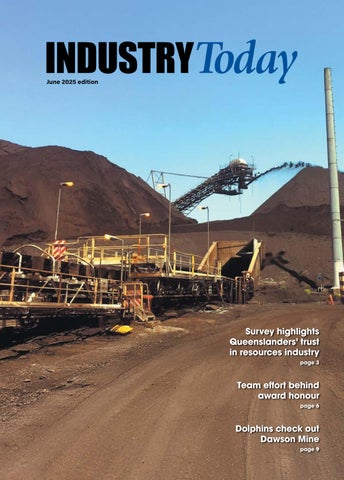
June 2025 edition
Survey highlights Queenslanders’ trust in resources industry page 3
Team effort behind award honour page 6
Dolphins check out Dawson Mine page 9
INDUSTRY TODAY
Mayors issue plea to hit pause button Two regional Queensland mayors are calling on the State Government to pause any further expansion approvals for Glencore until clear, binding and fully funded future strategies are agreed between the government, affected local councils and the company. Isaac Regional Council Mayor Kelly Vea Vea and Mount Isa Mayor Peta MacRae say Glencore is withdrawing from key resource communities including Mount Isa, Glenden and Clermont with unfinished business, while still pursuing new project approvals elsewhere in the state. “Glencore wants the full support of taxpayers to help fund maintenance at the Mount Isa smelter and is expanding at Hail Creek, but it is setting the bar far too low for the communities it is walking away from,” Cr Vea Vea said. “If a company wants to grow its footprint in Queensland, it must first demonstrate it can exit with integrity and work with communities when the end of its long-term business is in sight. That means workforce plans, rehabilitation, legacy projects and clear commitments to the communities that were built to support their operations for decades.” Cr MacRae said Mount Isa deserves a clear, funded transition plan agreed upon by government, community and the company.
“Right now, our community is facing significant economic uncertainty and social disruption because we do not have a clear plan for how processing and mining will continue in our region,” Cr MacRae said. “We want to see serious, detailed and funded plans for Mount Isa. We still see plenty of opportunity and a bright future in the North West Minerals Province, and we are wanting Glencore to display that they can be a good corporate citizen before further approvals are granted elsewhere.” The mayors are urging the State Government to: 1. Pause all current and future expansion approvals for Glencore until funded transition plans are secured. 2. Require Glencore to work with the State and local councils to co-design those plans. 3. Ensure that any plans include long term workforce strategies, rehabilitation, infrastructure handover and regional economic transition. “Our communities are not a line item in a closure report,” Cr Vea Vea said. “We welcome resource development in this state, but it must come with clear responsibilities when the work ends. This is about fairness, transparency and backing the people who have powered this state for generations.”
Isaac Mayor Kelly Vea Vea. (File)
Callide power station unit returns to operation again Unit C3 at the Callide C Power Station is generating electricity after being returned to service in the early hours of Sunday, 1 June. Joint venture partner CS Energy said the unit was brought back online at 2.47am and was being closely monitored before being returned to its full capacity in a staged manner. The unit’s return follows repairs to damage from the major operational safety event on 4 April 2025 and additional pre-emptive maintenance work that was required in the boiler, which was unrelated to the incident. CS Energy acting chief executive Emma Roberts thanked everyone involved in returning this critical energy asset to service. “Approximately 100 people worked on rotating shifts six days a week on the C3 repairs, with approximately 31,000 hours worked,” Ms Roberts said.
“CS Energy, as operator, has introduced additional clinker safety controls based on our findings to date in relation to this incident. “We have worked closely with Workplace Health and Safety Queensland to provide them with reassurance that there are sufficient controls in place to safely bring Unit C3 back online. “The operations team has been rigorous in their approach and this is part of the cultural change the new Board and management is fostering at CS Energy.” Work is continuing on the ICAM (Incident Cause Analysis Method) Investigation into the C3 incident and CS Energy will release its findings and response once complete. In the wake of the latest incident at the trouble-plagued facility, CS Energy has begun a review of its compliance and governance
frameworks to ensure it continues to meet the expectations of its customers and stakeholders. As part of the review, CS Energy has identified potential issues in the way life support registration obligations were managed for a small number of commercial and industrial retail customers and has taken immediate steps to strengthen its processes. “We are making changes to our systems and processes to further enhance our compliance and governance practices and have committed to a process of continuous improvement aimed at achieving best practice in customer service and support,” a spokesperson said. “CS Energy continues to work closely with its stakeholders to ensure its systems and processes support the safe and reliable delivery of electricity to all customers.”
The troubled C3 unit at Callide power station came back online on Sunday, 1 June, at 2.47am. (Supplied)
Fortescue Metals shed 90 jobs in hydrogen Telephone: 07 4863 5050 Address: 5-9 Hempenstall Street, Kawana, QLD 4701 EDITORIAL Gregor Mactaggart Editor E: gregor.mactaggart@CQToday.com.au Matthew Pearce Journalist E: matthew.pearce@CQToday.com.au ADVERTISING Cheryl Altouvas Advertising Sales E: cheryl.altouvas@GladstoneToday.com.au Lacy McDonald-Hearn Advertising Sales Executive E: lacy.mcdonaldhearn@CQToday.com.au Lou De Jager Advertising Sales Executive E: lou.dejager@CQToday.com.au 2 INDUSTRY TODAY June 2025
Billionaire Andrew Forrest’s Fortescue Metals has axed 90 jobs from its green hydrogen division, affecting workers in Gladstone and Western Australia. Fortescue confirmed the job losses last month, including an unspecified number from its Gladstone PEM50 electrolyser project and Gladstone Electrolyser Manufacturing Centre. Gladstone Regional Council acknowledged the job losses with Mayor Matt Burnett saying that while the challenges facing Fortescue’s project were concerning, the Gladstone region’s industrial strengths and strategic location made it an ideal hub for innovation and investment. “The Gladstone Region remains open for business,” Cr Burnett said. “We have a proud industrial heritage that continues to grow and diversify, and we will remain a leader in the transition to clean energy and advanced manufacturing, ensuring we attract new opportunities and create sustainable
Fortescue’s Yarwun green hydrogen facility. (File) jobs for our community. “We will continue to work collaboratively with industry, government, and our community to drive economic prosperity and support our workforce through this transition, as outlined in the 10-year Gladstone Region Economic Transition Roadmap.
“I look forward to working with Fortescue and hopefully we can see their facility reopen sooner rather than later.” Fortescue said it would be refocusing its efforts on research and development instead of manufacturing amid mounting global challenges. The company flagged a review of its green energy investment in April. “To ensure we can produce the large amount of green hydrogen we need to make green iron ore, we are refocusing our efforts into the research and development of new technologies that will deliver green molecules at scale, efficiently and cost-effectively,” a spokesperson said. Fortescue affirmed its stance that green hydrogen remains the “fuel of the future”. The State Government cancelled funding for Stanwell Corporation’s CQ-H2 project earlier this year.
INDUSTRY TODAY
We’re the resources state By Gregor Mactaggart More Queenslanders than ever believe the state’s resources sector is vital to the economy and way of life, a new survey has revealed. Public trust in the mining industry has surged, with 69 per cent of Queenslanders now saying the sector is “extremely” or “very” important to the state—up from 59 per cent at the start of the year. The figures were released by Queensland Resources Council (QRC) chief executive officer Janette Hewson during a Queensland Futures Institute Policy Leaders’ Forum on the future of the state’s resources industry. “We are witnessing a significant and positive shift in how Queenslanders perceive the resources sector,” Ms Hewson said. “Demand for Queensland’s resources — including coal, gas and emerging critical minerals — will remain strong for decades, with the industry playing a key role in the energy transition.” The survey, conducted following last year’s state election, found 75 per cent of regional Queenslanders value the mining industry, while six in 10 respondents across the state believe the sector provides economic security. A further 57 per cent say governments need to consult industry more when making regulatory decisions. Ms Hewson said the results showed growing public recognition of the sector’s role in supporting jobs, regional communities and the broader economy. She also noted the importance of stable government policy and streamlined approvals to help unlock new investment. “Queensland resource companies are making major investments to maintain our international reputation for innovation and sustainability,” she said. “But to continue attracting billions of dollars in new and ongoing projects, we need policies that provide certainty and support. That includes a fair and balanced royalty tax system for coal companies.” Ms Hewson welcomed recent steps by the Miles Government to fast-track approvals but
More Queenslanders than ever believe the state’s resources sector is vital to the economy and way of life, a new survey has revealed. stressed that long-term confidence would depend on cooperation between industry and all levels of government. “There’s a clear message here: Queenslanders understand how important it is to keep the re-
sources sector strong and want government and industry working together to achieve that,” she said. Ms Hewson added that the public also increasingly sees Queensland’s resources as es-
sential to the global energy transition and the push to reduce emissions. “Maintaining our social licence is the single biggest opportunity for the sector over the next five years,” she said.
World-first hydrogen trial for Gladstone now locked in Zinfra has signed an operations and maintenance contract with Summit Hydrogen Gladstone, a wholly owned company of Sumitomo Corporation, Japan, for its pioneering hydrogen production facility in Yarwun. Co-funded by the Australian Renewable Energy Agency and the Regional Hydrogen Hubs Program funded by the Federal Government, the Yarwun facility will support the reduction of carbon emissions at Rio Tinto’s Yarwun refinery by incorporating hydrogen into the calcination process – marking a world-first trial for industrial hydrogen use.
Zinfra managing director Peter Iancov described the project as a strategic milestone for the company. “This is not just about maintaining another facility, it’s about extending our operations and maintenance capability beyond our core customer base and demonstrating our readiness to operate and maintain the energy infrastructure of the future,” Mr Iancov said. “We’ve invested heavily in our people, skilling up for hydrogen and renewables, and this project is a direct result of that commitment.
Our work at Jemena’s Western Sydney green hydrogen hub gave us a strong foundation in this space, and we’re proud to now apply that knowledge to support SHG and Rio Tinto on such a globally significant initiative.” As the operations and maintenance partner, Zinfra will be responsible for ensuring the facility operates safely and efficiently, bringing its expertise in asset management, maintenance, and operations to this groundbreaking initiative. The trial project will run for several years, providing key insights into the viability of hy-
drogen use in industrial applications. Zinfra’s crew – made up of skilled electrical, instrumentation, and process technicians – will begin maintenance and operations of the facility from the third quarter of 2025, using local expertise to support the Gladstone economy. Mr Iancov said Zinfra is proud to work alongside Summit Hydrogen Gladstone and Rio Tinto to make this vision a reality, strengthen the company’s role in Australia’s renewable energy transition, and advance its leadership in hydrogen and gas operations.
12618405-AP29-23
June 2025 INDUSTRY TODAY 3
INDUSTRY TODAY
$230m deal Milestone as first test water flows in pipeline
By Di Stanley Blackwater’s Curragh coal mine complex operators Coronado Global Resources has secured a $230 million liquidity lifeline from Stanwell Corporation and brokered a revised coal contract for supply to the Central Queensland power station. Under the terms of the new deal, Coronado will provide up to 800,000 tonnes per annum over a five-year period from 2027. The cash-strapped company also locked in $230m in ABL refinancing to fund expansion projects at the Mammoth underground mine at Blackwater and its US-based Buchanan coal mine as it looked to save $100m across its operations to buffer it from the current low metallurgical coal price environment. “Under the terms of the 2018 new coal supply agreement between Coronado and Stanwell, Stanwell’s entitlement to thermal coal at deeply discounted, fixed prices will reduce from up to 3.5mtpa to up to 2.2mtpa in 2027,” Coronado said in a statement on Tuesday, 10 June. “Accordingly, under the (agreement) approximately 1.3mtpa of thermal coal becomes available in 2027 for export at market prices. “In addition, the rebate payable by Coronado to Stanwell will also cease and the fixed price paid by Stanwell for the remaining 2.2mtpa will increase.” Coronado said the new agreement would result in significantly lower costs, improved margins and cash generation. “At current prices, this is expected to amount to approximately $230m in incremen-
The Fitzroy to Gladstone Pipeline reached a major construction milestone last month, with the first water pumped into a section of the new pipeline as part of testing before the pipeline is completed in 2026. Gladstone Area Water Board chief executive officer Darren Barlow said the milestone marks significant progress for the $983 million project. “This is the first time water has flowed through a section of the new pipeline, and it’s an exciting sign of what’s to come,” Mr Barlow said. The FGP consists of a 117-kilometre pipeline, almost completely constructed, and a number of reservoirs and a water treatment plant, which are still under construction. As each part of the FGP is constructed, testing takes place to ensure each component will work safely, reliably and as intended when commissioning takes place in 2026. Approximately three kilometres of pipeline have now undergone hydrostatic testing – a key process that involves filling the pipeline with water and pressurising it to check for any leaks or weaknesses. “Hydrostatic testing is a vital step in confirming the safety and reliability of the infrastructure before it is brought into full service,” Mr Barlow said.
Stanwell power station will take a reduced amount of coal from long-standing provider Curragh Mine from 2027. (File) tal annual cash flow, commencing in 2027,” the statement said. Coronado chief executive officer Douglas Thompson said he was confident in production delivery over the term of the agreement. “We believe this arrangement strikes the right balance between funding the company’s near-term requirements while protecting stakeholder interests at a time when our share price doesn’t not reflect the intrinsic value of the company,” he said. “Stanwell is a key business partner to Coronado and we look forward to continuing our mutually beneficial long-term relationship. “We continue to proactively consider all available options to ensure our liquidity position is adequate for a prolonged market downturn and have the appropriate capital structure, including continuing our disciplined approach to capital expenditure and ongoing cost management initiatives.”
The $983 million Fitzroy to Gladstone Pipeline reached a major construction milestone last month. (Supplied) “Reaching this stage is a testament to the skill and commitment of our project team and partners. It brings us one step closer to delivering a secure water future for Gladstone.” Construction of the pipeline remains on track for completion in 2026, weather and conditions permitting. The pipeline will provide a second source of water to Gladstone, addressing long-term supply risks from Awoonga Dam and supporting the region’s growing industries.
McCosker secures contract Gas exploration bid backed Alpha HPA has awarded a $20 million concrete works contract to local firm McCosker Contracting as part of its Stage Two HPA First Project in Gladstone. The deal marks a major milestone in the development of what will become the world’s largest single-site manufacturing facility for high-purity aluminium materials. McCosker will deliver all major concrete works, drawing on its local workforce. The contract is expected to generate significant economic benefits for the region and underlines Alpha HPA’s commitment to supporting local industry. The 10-hectare site will expand on the company’s existing Stage One operations and use a proprietary Australian-developed process to produce ultra-high purity aluminium materials used in sectors such as semiconductors, lithium-ion batteries, and LED lighting. Alpha HPA managing director Rob Williamson said the partnership reinforced the company’s focus on regional engagement. “McCosker is a respected, long-standing family business with deep roots in the Gladstone community,” Mr Williamson said. “It’s fantastic to be working with the trusted folks at McCosker to help bring this worldclass project to life.” McCosker managing director Bob McCosker welcomed the opportunity to be part of
the project. “We’re proud to see a project of this calibre happening right here in our own backyard,” Mr McCosker said. “It’s a vote of confidence in local capability, and we’re looking forward to contributing our team’s skills, experience and local knowledge to help bring Alpha HPA’s vision to life. For us, it’s about more than just delivering concrete – it’s about playing our part in building a stronger future for Gladstone.” Site establishment will begin in early June, with physical works to start later that month. At full capacity, the facility will produce more than 10,000 tonnes of high-purity aluminium products annually, creating 120 ongoing jobs and supporting 300 jobs during construction. “We are proud to leverage homegrown innovation to create a facility that can compete on the world stage,” Mr Williamson said. “This project is a testament to the incredible potential of Australian technology and the substantial economic benefits it can deliver to the Gladstone community.” The project is backed by a $400 million debt facility from the Federal Government and $180 million raised in equity. Alpha HPA’s high-purity alumina products will play a key role in clean energy technologies and global decarbonisation efforts.
The Queensland Resources Council (QRC) has welcomed the State Government’s move to release more land for gas exploration, calling it a critical step toward boosting supply and ensuring long-term energy security along Australia’s Eastern Seaboard. QRC chief executive officer Janette Hewson said the announcement by Natural Resources and Mines Minister Dale Last would give gas producers much-needed certainty. “QRC, through its exploration arm the Queensland Exploration Council, has been advocating to government that more land be released for exploration to unlock more supply of gas into Queensland and the east coast,” Ms Hewson said. “Queensland gas producers have long been doing the heavy lifting to meet demand that has kept industry running and the lights on in homes throughout eastern Australia.” The State Government also committed to a three-month review of the land release process, which the QRC says will give producers greater clarity and reduce overlap with other exploration activities. “QRC also welcomes the announcement of a three-month land release review to provide gas
producers with greater certainty about tenures and reduce the possibility of overlap with other exploration,” Ms Hewson said. She added that both the State and Federal governments recognised the vital role gas would play in the energy transition. “The land release can unlock the vast gas reserves in Queensland’s Cooper Eromanga and Bowen Surat Basins that will contribute to reliable and affordable energy that homeowners and businesses are looking for,” Ms Hewson said. “Boosting supply is the best way to bring down prices and this announcement will help achieve that.” Ms Hewson said the QRC would continue working with the State Government to fast-track project approvals. “QRC looks forward to continuing to work with the government on streamlining the approvals process to remove duplication and excessive regulation so gas projects can move into production sooner and deliver benefits to all Queenslanders.” Queensland’s gas sector contributed more than $17 billion to the state economy and supported 73,000 local jobs in 2024.
CHAUVEL INDUSTRIAL SERVICES
• On-site maintenance, shutdown and workshop facilities • Mechanical and Fabrication • Pumps, pulleys, conveyor supply and service • Civil and concreting 12619179-MS29-23
• Blast and paint
Exceeding Expectations
07 4926 8588 | chauvel.com.au Alpha HPA managing director Rob Williamson. 4 INDUSTRY TODAY June 2025
Head Office: 26 Hempenstall St, Nth Rockhampton Emerald: 6 Daniels St, Emerald
INDUSTRY TODAY
Green iron benefits touted By Di Stanley A prominent thinktank has urged Gladstone to strike while the green iron is hot and be part of a $400 billion export opportunity that could replace fossil fuel revenue and generate thousands of jobs in the region. New research published by the Superpower Institute identified Gladstone as one of the prime location for green iron production alongside three Western Australian sites - the Pilbara, Geraldton and Kwinana - and South Australia’s Eyre Peninsula. Institute chief executive officer Rod Sims said Gladstone was in the box seat to play its part. “Gladstone’s got established infrastructure,” Mr Sims said. “It’s got people, it’s got an industrial culture and it’s got excellent solar and pretty good wind which is mostly in the evening, so they complement each other and that gives you a pretty good renewable energy resource to supply what is essentially a manufacturing facility in a green iron plant. “I don’t think there’s anything missing here.” Mr Sims said the stakes were high for Gladstone and it was incumbent on the Federal Government to support the emerging industry. The Superpower Institute’s recommended policies include: A green iron production tax credit to simulate the effects of a carbon price, with a proposed value of at least $170 per tonne of green iron. Capital grants covering up to 30 per cent of
Superpower Institute chief executive officer Rod Sims said Gladstone would be a suitable site for green iron production with projects ranging from $7-$20 billion. (Supplied) investment costs for early green iron projects. Public investment in essential shared infrastructure, including electricity transmission, hydrogen pipelines, parts and water supplies. Diplomatic engagement to establish inter-
national demand for green iron in Japan, South Korea, Europe, China and Southeast Asia. “The onus is now on the government - there is a substantial prize in play if the right policies, grounded in the national interest framework,
are adopted,” Mr Sims said. “Green iron is the next great chapter in Australia’s export story. “As the world decarbonises, our fossil fuel exports will inevitably decline. “But by using our unparalleled renewable energy resources to make green iron, we can replace those exports with high value, zero carbon products that the world will need. “There is a role for government to overcome the gap between green iron and black iron prices, because the black iron is not paying for the damage it does to the environment, so it’s currently an uneven playing field.” Mr Sims said the withdrawal of Fortescue from its Gladstone hydrogen projects sent a message that hydrogen was not being utilised to its best purpose. “Some people talk about hydrogen as providing a source of energy, which at the end of the day it can, but you need a lot of energy to make hydrogen,” he wsaid. “Hydrogen as an energy source is not a really good thing to do at this stage. “Hydrogen for export, that market will come, but it’s not there yet and it’s very expensive to export it. “In green iron, you’re using the hydrogen for its chemical properties, which are similar to metallurgical coal which is used to separate the iron from the iron ore. “Hydrogen can do the same thing.” Mr Sims said he intended to meet with Gladstone Mayor Matt Burnett and industry representatives.
Exports ensure Rockhampton’s economy continues to rise Rockhampton Regional Council says the region’s economy continues to soar, with new records set for exports and Gross Regional Product (GRP) in the last financial year. Mayor Tony Williams said new data sourced from Economy ID shows exports from the Rockhampton Region hit $5.1 billion during the 2023/24 financial year, up 6.2 per cent in the space of just 12 months. Domestic exports reached $3.6 billion (up $97.4 million), while international exports climbed to $1.4 billion (up $203.2 million). Gross Regional Product (GRP) hit $6.94 billion last financial year, rising by $153 million from FY22/23. GRP is a measure of the total value of goods and services produced and represents economic output generated by businesses, organisations and individuals within the region. Cr Williams said the figures demonstrate clear growth in the local economy. “The figures show businesses in the Rockhampton Region are increasing profits, grow-
Rockhampton Mayor Tony Williams says the region’s economy continues to soar. (Supplied) ing their customer bases and improving productivity in the face of global headwinds,” he said. “Our economy is experiencing growth in the key industries of mining, transport and
logistics, real estate and rental services, retail, education and healthcare. “We’ll proudly proclaim our historic title as the Beef Capital of Australia and a service hub for the resources sector – but clearly Rockhampton has evolved into an essential services hub for Central and Northern Queensland. “As we celebrate this milestone, I’d like to thank our local businesses for their commitment to sustainable growth and local employment, and for being Rockhampton’s biggest advocates on the world stage.” This year marks a decade since the establishment of the council’s economic development unit, Advance Rockhampton. During that time, local exports have soared by 20 per cent, while GRP has climbed 10 per cent. “Advance Rockhampton’s team continues to strive further in its support of local business and regional development through small business education and mentoring programs, investment attraction, business case
developments, industry engagements, and targeted funding opportunities,” Cr Williams said. Advance Rockhampton economic development manager Wade Clark said the region’s strength lies in its diversity. “Beyond the record-breaking headlines, what’s clear from the data is the diversity of the Rockhampton Region’s economy,” he said. “Mining, energy and transport are our largest export industries, yet healthcare, education and retail are some of our most productive. “These figures are worth celebrating. It is a step up in our local economic journey but certainly not an end point. Advance Rockhampton will continue to deliver programs which support local businesses, while advocating for investment in our vast portfolios spanning from agriculture to manufacturing, defence to energy, health to property development, education to mining, and CBD businesses to construction.”
Environment
CQG is a passionate advocate for local businesses Rockhampton | Gladstone | Brisbane | Mackay | Townsville
Engineering
Planning
www.cqgroup.com.au • +617 4922 9252 12618313-CB29-23
June 2025 INDUSTRY TODAY 5
INDUSTRY TODAY
Delight at award win A decade-long environmental initiative led by Gladstone’s LNG operators took out the top honour at the 2025 Australian Energy Producers Excellence Awards. The joint initiative from ConocoPhillips APLNG, Shell QGC, and Santos GLNG received the prestigious Chair’s Award for the Gladstone Long Term Turtle Management Plan – Pioneering Marine Turtle Conservation: A Decade of Industry Collaboration and Environmental Excellence. The project, which exceeded regulatory requirements and achieved transformative outcomes, was recognised for setting a new benchmark in industry-led environmental stewardship. One aspect of the research and monitoring initiative was to understand and manage how artificial light, known as skyglow, affected marine turtle nesting and hatching on Curtis Island. It significantly advanced scientific understanding of marine turtle ecology and showcased exceptional collaboration between energy producers and environmental scientists. Australian Energy Producers’ chief executive officer Samantha McCulloch said the Chair’s Award recognised the best of the best, and the awards judges agreed this year’s winner exemplified long-term leadership, collaboration and innovation. “This initiative not only protected vulnerable marine species but built lasting scientific partnerships that will benefit environmental research for years to come,” Ms McCulloch said. “The winner of this year’s Chair’s Award demonstrated initiative, collaboration and positive outcomes that stood out among such a quality field on finalists.” Over the past 10 years, scientists have monitored night-time light intensity and colour on Curtis Island beaches, using special cameras to measure the night sky at multiple marine turtle nesting locations. They used the data to understand the light emitted from the entire industrialised port, which has numerous nighttime light-producing facilities, including the three LNG plans, coal terminals and cargo operations. “We are operating in a sensitive area that is in the Great Barrier Reef World Heritage Area and we are dedicated to protecting the flora and fauna, such as marine turtles, that call Curtis Island home,” ConocoPhillips Australian president Jan-Arne Johansen said. “We are committed to responsibly managing our environmental footprint, with high standards that align with government regulations, as well as our framework, policies and processes.” Although monitoring results indicate that the LNG facilities on Curtis Island minimally contribute to the regional skyglow phenom-
Gregory MP Sean Dillon has congratulated three Emerald residents named as finalists in the Central Queensland regional final for the Queensland Training Awards to be held in Rockhampton on 26 July.
Highlands trio in hunt for honours Shell Australia senior vice president, Integrated Gas Australia and Country Chair Cecile Wake, Shell QGC representative and lead environmental advisor Ingrid England, ConocoPhillips HSE general manager Becky Peavler, Eco Logical principal environmental consultant Miles Yeates and Santos Operations vice president Tomas Radzevicius, on behalf of Santos GLNG, accepting the Chair’s Award at the Australian Energy Producers Excellence Awards. (Supplied)
Scientists used special, non-intrusive cameras to measure the light intensity and colour at a flatback sea turtle nest on Curtis Island. (Supplied)
The decade-long joint research project by Gladstone LNG proponents created new knowledge on how skyglow affects local flatback turtle populations on Curtis Island. (Supplied)
enon, APLNG has adjusted the direction and color of the lights at its facility to mitigate any potential impact on marine turtles. “This research has created new knowledge on how skyglow affects local flatback turtle populations,” ConocoPhillips General Man-
ager of Health, Safety and Environment Becky Peavler said. “Curtis Island is a near-pristine environment, which forms a part of an industrial port. It’s important that as the region develops further, industry understands and responsibly manages its light emissions.”
The spotlight will be shining on Emerald’s excellent training record during this year’s prestigious Queensland Training Awards, according to Gregory MP Sean Dillon. Mr Dillon said three Emerald residents had been named finalists in the Central Queensland regional final to be held in Rockhampton on 26 July. Mikayla Capil and Jasmine Cook are finalists for the school-based Apprentice or Trainee of the Year, while Andrew Abbas is a finalist for the VET Teacher or Trainer of the Year. “The Queensland Training Awards recognise individuals and organisations that strive for and have achieved success, best practice and innovation in vocational education and training (VET),” he said. “Mikayla is undertaking a Certificate II in Community Pharmacy, while Jasmine is completing a Certificate II in Animal Care. Andrew is a metal fabrication teacher at CQUniversity’s Emerald Campus. “I’m extremely proud to see people in the Gregory electorate recognised for their dedication to training, both as students and teachers. I’m sure the entire electorate will be cheering them on at the awards ceremony. “The awards feature categories for apprentices, trainees, vocational students, teachers and trainers, as well as training providers and employers, highlighting the transformative power of skills.” The regional winners will go on to contest the state final in September.
Unions hail pay boost for millions of low-paid workers By Jacob Shteyman, AAP Workers on minimum award rates will be given one of the highest above-inflation pay increases in history to help redress falling living standards. Nearly three million low-paid workers will take home an extra $32 a week in pay after the industrial umpire decided to make up for falling real wages and living standards in recent years. The Fair Work Commission delivered a 3.5 per cent increase for employees on industry awards and the minimum wage on Tuesday. In handing down a figure substantially above inflation, the commission sided with the federal government’s call for a “sustainable” real pay rise, finding it was unlikely to be detrimental to the economy, despite weak productivity growth. President Adam Hatcher said the decision would help correct a decline in living standards for employees over the past three years. In previous years, the commission was discouraged from awarding a pay increase that would enable low-paid workers to catch up 6 INDUSTRY TODAY June 2025
with rising costs because of concerns it could cause inflation to become more entrenched. Now the inflation spike was over, it was important for the commission to correct a 4.5 per cent fall in the real value of wages since 2021, Justice Hatcher said. “We are concerned that if this opportunity is not taken in this annual wage review, the loss in the real value of wages which has occurred will become permanently embedded in the modern awards system and the national minimum wage,” he said. “And a reduction of living standards for the lowest paid in the community will thereby be entrenched.” The decision is roughly in the middle of the range of suggestions made by unions and business groups. In its submission to the commission’s review, the Australian Council of Trade Unions called for a 4.5 per cent increase. Despite the decision undershooting her demands, council secretary Sally McManus said it was a “great outcome” for low-paid workers. “(An increase of ) 3.5 per cent means they’re starting to catch up again, and that makes an
enormous amount of difference in terms of people’s bills, people’s ability to pay for the basics,” she told reporters in Melbourne. But employer groups warned businesses were struggling to get by on razor-thin margins and a pay rise of this scale would force many to lay off staff or close. “Small businesses are facing a cost crisis across energy, rent, insurance and input costs,” said Council of Small Business Organisations Australia chief executive officer Luke Achterstraat, who argued for a 2 to 2.5 per cent rise. The Australian Bureau of Statistics reported prices rose by 2.4 per cent in the 12 months to March 2025, which would amount to a real increase to award wages of about 1.1 per cent one of the highest granted by the commission. Prime Minister Anthony Albanese said it was a modest increase but a welcome one. The government supported the decision to ensure low-paid workers did not fall behind, he said. The decision will overwhelmingly affect workers in accommodation and food services, health care and social assistance, retail trade and administrative and support services,
which account for over two-thirds of awardreliant employees. About one in five workers are covered by the decision, which follows an increase of 3.75 per cent in 2024. But the impact on inflation will be minor, given awards are disproportionately low-paid and part-time and as a result only contribute about 10.5 per cent of the national wage bill. RBC Capital Markets’ chief economist SuLin Ong estimates the decision will add less than 0.1 per cent to the wage price index. The minimum wage will rise by 85c to $24.95 an hour. The new pay rates will kick in from 1 July. The commission’s next priority will be to review gender-based undervaluation of femaledominated jobs in white-collar fields, including English teachers, architects, paramedics and law graduates. Its last gendered undervaluation review recommended wage rises of up to 30 per cent for workers in childcare, health and other feminised sectors.
INDUSTRY TODAY
New home FITT for purpose By Di Stanley FITT Resources celebrated the opening of its new mechanical engineering workshop at South Trees on Friday, 13 June. Queensland manager John LaFave said the growing volume of work coming through the former workshop in Hilliard Street since establishing a base in Gladstone five years ago necessitated the move to larger premises. “As we built our business and expanded our capabilities, we built our reputation and were getting more and more work and outgrew that workshop,” he said. “We didn’t have the lifting capacity we needed, we didn’t have the room to do the bigger jobs we were getting from clients like Callide power station, Mt Isa Mines, the big water boards. “That was the reason for the move.” FITT Resources specialise in the supply of premium mechanical engineering products, parts and servicing, for rotating and static equipment, across a range of industrial activities. After holidaying in the region for many years, Mr LaFave said Gladstone was identified as a Queensland base after analysis of its central location and existing and emerging industries. “It was cheaper than Mackay, and at that time we’d been through two coal booms and busts, and the gas plants were being built and the price of everything just skyrocketed,” he said. “We could either get a telephone box or a football field - there was nothing to suit us - and that’s why we ended up getting Hilliard Street, because we knew it was going to be temporary. “We knew we were going to outgrow it, but we needed to put a shingle up somewhere.
A worker on site at FITT Resources new workshop at 1 Boys Road, South Trees. The premises officially opened on Friday, 13 June. (Supplied) “We get guys sending us pumps from Mt Isa Mines because they’re more interested in the quality of work getting done as opposed to where it’s located.” Mr LaFave said while Gladstone was growing and attracting new industries to shore up its future, property values were attractive to FITT staff relocating from New South Wales. “They see the price of houses here and go we’re not renting, we’re going to buy,” he said. “They can buy a three-bedroom house here for $450-500,000 whereas in New South Wales,
even in central NSW, it’s $1 million. “Gladstone is a very industrial town but it’s very liveable - you can drive 10 minutes and you’re in the bush or you can jump in your tinny and go up the river and you don’t know you’re anywhere near the city.” FITT Resources major clients include Ernest Henry mine, the CS Energy group - Callide, Kogan Creek, Stanwell, Tarong North and Millmerran power stations, Mt Isa Mines, SunWater and other water boards. “Those larger accounts in water, mining
and power is really where we focus our work in the mechanical repair for our workshops,” he said. “We have other divisions that do civil repair, dewatering and dredging. “We are also the official repair facility for Flight Pumps in Central Queensland and a lot of councils use these pumps for their sewage. “So, it’s been a big expansion wheel for us as a company and we’ve grown, hired local people and are very much involved in the local side of things.”
2026 Apprentice and Traineeship Applications OPEN NOW Visit gpcl.com.au for more information.
gpcl.com.au 12774799-RV25-25
June 2025 INDUSTRY TODAY 7
INDUSTRY TODAY
State Minister for Transport and Main Roads Brent Mickelberg, Rockhampton MP Donna Kirkland and Mirani MP Glen Kelly and Senator Anthony Chisholm inspect the new Lion Creek Bridge. (Supplied)
The new Lion Creek Bridge is open to traffic.
Ring Road hits milestone By Matthew Pearce The Rockhampton Ring Road project has hit a major milestone with the completion of the new Lion Creek Bridge. Spanning more than 61 metres and using locally manufactured concrete decks, this is the first of 18 bridges on the project to be completed. It replaces the old timber bridge, which was built in the late 1800s, with a more flood-resilient structure, improving accessibility for the Pink Lily and Ridgelands communities during wet weather events. Inspecting the new bridge on Lion Creek Road on Thursday, 5 June, Federal Assistant Minister for Regional Development, Senator Anthony Chisholm said the ring road “is happening” and would make a significant difference to this community. “The early works package is due to wrap up soon and then they will move on to the major works package throughout Rockhampton,” he said. “We know that this is an important bit of infrastructure, it’s going to save travel times, it’s going to make the community safer, it’s going to ensure that it’s more flood-proof, and it’s going to improve productivity throughout the whole state as a result of that,” he said. State Minister for Transport and Main Roads Brent Mickelberg said the new Lion Creek Bridge would ensure it was better equipped to deal with the volumes of traffic required. “The cost (of the Ring Road project) is now $1.98 billion. Our focus is on ensuring that we deliver it within that funding envelope, within that budget, and that it’s delivered on time,” he said. “Bridge local company Stresscrete has
The Rockhampton Ring Road project had a hit a major milestone, with the first of 18 bridges completed. provided the bridge decks and that means local jobs for Rockhampton people, and it also means opportunity for the entire Rockhampton economy,” he said. “One of the things the Crisafulli government is focused on is ensuring that local businesses and local employees benefit from these major projects, particularly in regional Queensland. “We know how much of a game-changer projects like the Rocky Ring Road are for communities like Rockhampton and the broader Central Queensland region, and we’re focused on ensuring that there is not just a great piece of infrastructure and road at the end of this project, but more particularly that we build capacity in the local economy and we create jobs
for locals as we roll out our considerable infrastructure spend across the state.” Mayor Tony Williams welcomed the completion of the bridge and the progress being made on the Ring Road. “The Rockhampton Ring Road really will change our region,” he said. “Not only will it connect Gracemere with North Rockhampton, Wandal and the coast and vice versa; but it will also unlock access to new industrial precincts in and around Gracemere and Stanwell and help drive future jobs and opportunity. “The Ring Road is going to set our region up for the future and I’m really pleased to see us reach this milestone.”
The completion of the new bridge coincides with the re-opening of Canoona Road, as work on the West Rockhampton local road connections to the Ring Road is finalised. This improved access to Rockhampton will provide better connectivity to key destinations south of the Fitzroy River, including the airport and hospital, as well as defence, education, and leisure precincts in the city and Wandal. A 204-metre-long bridge over Limestone Creek in Parkhurst will also shortly be completed as part of the early works program. With the early works program set for completion by the middle of this year, the Rockhampton Ring Road will transition to the main works program. Mr Mickelberg said contracts were about to be awarded for the main works. “We’re getting on with the job of delivering the full scope of the Rocky Ring Road,” he said. The $1.98 billion Rockhampton Ring Road project is funded by State and Federal governments, with the Federal Government providing $1.4 billion and the State Government providing $580 million. Main works will include: 17.4 kilometres of new roadway, including about 14.7 kilometres of Ring Road alignment starting from a new southern roundabout on the Capricorn Highway. A new 435-metre long third bridge over the Fitzroy River between Pink Lily and Kawana, including shared active transport facilities. Another 15 (for a total of 18) bridges along the main ring road alignment, including eight road overpasses and seven water crossings. Improved connectivity to key precincts including West Rockhampton, North Rockhampton, and the Capricorn Coast.
•
•
•
•
Federal LNP representatives hail project’s progress By Matthew Pearce Capricornia MP Michelle Landry and Senator Matt Canavan have welcomed the opening of the new Lion Creek crossing as part of the Rockhampton Ring Road project. The Federal LNP representatives said the completed Ring Road would allow heavy freight to bypass 19 sets of traffic lights in Rockhampton, reducing travel times and increasing safety. “This has always been about safety, avoiding those 19 bridges,” Ms Landry said. “We need to get those heavy loads out of the middle of town.” Ms Landry criticised Federal Assistant Minister for Regional Development, Senator Anthony Chisholm, who inspected works on the Lion Creek Bridge earlier this month, calling him a “fly-in, fly-out” senator. “He was not here when we were after more money for the Ring Road to continue after La8 INDUSTRY TODAY June 2025
bor ripped it out of their budget in the 2022 budget,” she said. Senator Canavan said Rockhampton’s 19 traffic lights were “holding up freight across the whole state”. “Once the Rockhampton Ring Road is built, it will mean a much faster and cheaper flow of freight and goods all around our state,” he said. “Importantly for us here in Rockhampton, it’ll make it a lot easier just to get around, to get from the coast, to Gracemere, to the university, to the airport. “All of these things will be connected so much more by this road.” Senator Canavan said the people of Rockhampton had fought for and delivered the Ring Road, not the Labor Party. “When they first came to government, in their first budget they cut funding to the Ring Road and put the project onto the ‘Never
Never’,” he said. “It was only thanks to the hard work of Michelle, of (Flynn MP) Colin Boyce and all the business community, the workers (that it happened). “It was the huge uprising here in Rockhampton that finally delivered this project.” More than 500 locals attended a rally at Parkhurst on Friday, 4 November, 2022 to protest delays to the Rockhampton Ring Road project, which business leaders said would cause a loss of $130 million in direct revenue for the region. Following the rally at the Lily Place Industrial Precinct, industry leaders and Senator Canavan set off in a road convoy to Canberra to plead their case. Senator Canavan said the Rockhampton Ring Road fitted well with the LNP’s plans to hold Olympic rowing and canoeing in Rockhampton for the 2032 Olympics.
MP Michelle Landry and Senator Matt Canavan address the media. (Supplied)
INDUSTRY TODAY
Dolphins visit Dawson Mine By Liam Emerton
The Dolphins posing for a photo in front of the monster dump truck they rode in at Dawson Mine. (Supplied) After moving on to the Dawson Mine, the players got to ride in the dump truck, which particularly impressed Dolphins’ Lewis Symonds. “It was unreal. I don’t think I’ve ever experienced something quite like that before,” he said. “Just being able to see what it really is like to work in the minds and seeing the trucks in action and how much bigger they are. “I saw a road train come past and how much smaller they are compared to these trucks. It’s
just insane.” Dawson Mine HR manager Ben Leis said it was a pleasure to have such terrific people and players on site with them. “When you have a look at the industry that we are in, it’s all about connections, it’s all about trust, mateship, discipline,” he said. “And there’s certainly been some discussions with these athletes and these elite players about the similarities that they have also with
what we do. “The players have taken the time to introduce themselves, they’ve managed to get themselves up into the trucks alongside our operators. “Just talking about what their normal day looks like, what they get to do on a regular basis, just talking about why they do what they do.”
12772580-CV24-25
Dolphins NRL players have immersed themselves in the Central Queensland community when they made a visit to Biloela last month. A contingent of stars, including injury returnee Trai Fuller, travelled west to meet locals and learn more about the mining industry. After a trip to Biloela Junior Rugby League Club, the Dolphins travelled to Dawson Mine before enjoying a meet-and-great with local footy fans in Banana and Moura. Biloela Junior Rugby League president Karl Stevens said it was amazing to have the players come down and help mentor the next generation of stars. “It’s been great. It’s good for the community, good for the club,” he said. “It brings out heaps of different kids, so we may get these kids on board as well for our club. “It’s good to have these guys out in the community helping out, getting the kids out on the Sunday afternoon, enjoying their footy, running around. “It means everything…we don’t get these opportunities much out in the small country town like Biloela, so the kids have been excited. “They’ve been asking me for the past month when they’re coming since it’s been advertised.” One of the major fans was Yeppoon’s Jai Middleton who travelled all the way from the coast to meet some of his favourite players. “(Dolphins are) obviously my favourite team. I came down here to see all the Dolphins and play some footy,” he said. “I got to have photos with them, got them to sign my boots and stuff. It was pretty cool. “It’s been really fun being here with everyone. My first ever like meeting with all the actual famous players.”
12758761-EA15-25
June 2025 INDUSTRY TODAY 9
INDUSTRY TODAY
Riding the cycle together Senior mining executives delivered candid advice on navigating current market pressures at the Bowen Basin Mining Club’s (BBMC) May networking luncheon in Mackay. The panel of senior leaders from Glencore, Whitehaven Coal and Mastermyne focused on building lasting supply chain partnerships through good times and tougher times. With coal prices under pressure and cost escalation, BBMC director Jodie Currie said the panel’s candid insights provided exactly the type of practical guidance the mining community needs during challenging times. “The panel didn’t sugar-coat the issues, but showed there are real opportunities for suppliers who can demonstrate value, innovation, and commitment to long-term partnerships,” Currie said. “The message was clear – this is a cyclical industry, and the suppliers who invest in relationships and bring genuine solutions during the tough times are the ones who will also thrive when conditions improve.” Glencore Coal Assets Australia procurement manager Parry Moore emphasised that successful partnerships require more than simple cost reductions. “Our DNA is that we are an engineering business that safely produces coal, so in procurement we are here to support the business in making the right engineering decisions at the right time,” he said. “Focusing on the efficient use of resources and productivities. Our relationship with suppliers is inter-dependent. We rely on you to provide us with high quality and cost-competitive goods and services, and you rely on us to keep buying. As such, it makes sense for us to seek long-term partnerships where we clearly understand each other’s needs.” Mr Moore highlighted how Glencore works with suppliers to find innovative solutions, citing a recent example where a vendor conducted an operational audit at Hail Creek mine. “They got out there on the shop floor, interacted with their staff and our team, and came up with recommendations on how they could be more efficient. It’s not a straight rate drop, but they’re looking at optimising their service under the current contract,” he said. He also stressed the importance of highquality tender submissions. “We try to make tenders as simple as possible, but I see many vendors waiting for that tender to come out, and then the quality of their submission is poor. I recommend suppliers invest time with estimating, legal, commercial and technical departments because there may not be another tender opportunity for three to five years,” Mr Moore said. Whitehaven Coal Daunia Mine general manager Sean Milfull highlighted the importance of regional suppliers and collaborative relationships during challenging periods. “In these tough times, we’re in it together. There’s a lot of smart people in this room that can help us get through this well,” Mr Milfull said, noting Whitehaven had set a significant cost reduction target for the financial year across their Queensland operations. Mr Milfull emphasised Whitehaven’s com10 INDUSTRY TODAY June 2025
mitment to regional suppliers. “As a general manager, if an engineering project comes across the table and I don’t see a regional supplier as one of the options, I’ll send it back and ask them to re-look for options from our region. It’s that important,” he said. Mr Milfull, who recently transitioned from Queensland to lead Whitehaven’s New South Wales operations, spoke about opportunities to share learnings across the company’s geographic footprint. “We’re going to look at the greater business – the opportunities are enormous because we’re doing some good stuff in Queensland and NSW has decades of experience to share,” he said. Mastermyne chief executive officer and managing director Jeff Whiteman represented
the contractor perspective. He urged suppliers to bring innovative, value-added solutions rather than waiting for mining companies to initiate contact. “From adversity comes opportunity, and it’s really down to companies to respond to current challenges,” he said. “In this market you’ve got to be agile and flexible to meet client’s needs. This is really about building a long-term relationship,” he said. Mr Whiteman highlighted examples of Mastermyne’s recent innovations in underground mining, including remote polymeric emergency sealing solutions and totally paperless training compliance systems. The discussion touched on emerging technologies reshaping the mining supply chain,
with autonomous operations, artificial intelligence, and decarbonisation initiatives creating new supplier opportunities. Mr Moore noted Glencore’s focus on cost accountability and innovation platforms. The panel addressed decarbonisation not as a burden but as an opportunity for innovative suppliers to develop solutions that improve operational efficiency while reducing emissions. “We’ve made commitments as a business to reduce our Scope 1 emissions. The immediate focus for Whitehaven is operational efficiencies – looking at the mine plan, making sure we’re designing for productivity, and maximising the use of our gear,” Mr Milfull said. Mr Moore added that Glencore is “very interested in initiatives that can reduce our overall greenhouse gas emissions footprint.” Despite current market challenges, the panel reinforced the long-term outlook for coal and the importance of maintaining industry pride during difficult periods. “We should also remind ourselves to be proud of our coal industry. Yes, times are tough, and coal continues to face challenges, but our sector still makes a major contribution to Australia, to Queensland, and will continue to do so for many years to come,” Mr Moore said. Mr Milfull reflected on suppliers who have grown with the industry. “I look at contractors I’ve seen grow over 2530 years in the industry. The key ingredients to success have been trust, curiosity, that desire to deliver a superior product or service, and the ability to ride through the tough times. When it’s tough, they come with you and wear the pain, but we all get through it,” he said.
INDUSTRY TODAY
Innovation at heart of day By Shelby Gurney Gladstone’s next generation of innovators lit up the room last month during an action-packed two-day event at CQUniversity’s Marina Campus. The Enterprise Builders Schools Program, held on 28 and 29 May, brought together 50 Year 9 and 10 students each day from local schools, including Clearview Christian College, Tannum Sands State High School, Calliope State High School and Toolooa State High School. Designed to spark interest in business, innovation and sustainability, the challenge invited students to develop real-world solutions for the renewable energy sector. Funded by the Advance Queensland Regional Enablers Program, the initiative blended creative thinking with hands-on learning, and the results were nothing short of impressive. Associate Professor Linda Pfeiffer, Deputy Dean Research, School of Education and the Arts, said the students were very excited and keen to share their innovative ideas. “They were also very competitive in their pitches, with some groups developing QR codes, drawings, and websites to accompany their ideas,” she said. Among the standout projects, EnerGym was awarded Best Overall Product, and in a twist of coincidence, a different group independently earned Best Overall Service for a project also named EnerGym. Other standout innovations included a fidget spinner that doubles as a portable mobile phone charger, which took out Most Innovative Idea, and the Most Engaging Pitch, which proposed repurposing coal-fired power stations into renewable energy generators. Students also attended hands-on workshops led by BOP Industries, known for their
Founder and chief executive officer of BOP Industries Scott Millar, CQU Associate Professor Linda Pfeiffer and Acciona Energia’s Community Stakeholder Engagement Lead Renee Mooney. (Supplied) work in design thinking and innovation-driven entrepreneurship. Industry speakers from European Energy, Calliope Station, and Acciona shared insights on how renewable energy and agriculture can coexist, as well as showcasing a surfboard made from recycled wind turbine blades.
“The industry experts were on the judging panel and were impressed by the innovative ideas, enthusiasm, and creative and design thinking the students displayed,” she said. Looking ahead, students will get another chance to shine, with selected groups invited to pitch their ideas at a networking and pitch
event in September, this time to a broader community audience. With local talent, industry support, and a clear focus on the future, the Enterprise Builders Schools Program proves that the energy transition isn’t just a technical challenge — it’s an opportunity to inspire the leaders of tomorrow.
Pilot’s dreams soar to greater Practical STEM activity heights in recent competition excites Biloela students Creativity, strategy and teamwork were in abundance at the 2025 Physics in Flight and drone competition workshop hosted by Toolooa State High School earlier this month. More than 50 students from five local schools gathered for the workshop which focused on the physics of flight for primary students in the morning and an afternoon drone workshop and competition for secondary students, lead by the impressive Toolooa SHS STEM Squad in the afternoon. The workshop was delivered by the Queensland Minerals and Energy Academy (QMEA), the education arm of the Queensland Resources Council (QRC) in partnership with ConocoPhillips, the downstream operator of Australia Pacific LNG (APLNG). QRC director of skills, education and diversity Katrina-Lee Jones said the workshop had been designed as a competition between the schools to give the students extra incentive to be innovative in the design of their paper planes and programming of their drones. “The primary students will work in school teams to apply their understanding of aerodynamics and create planes to achieve the longest flights possible,” Ms Jones said. “In the afternoon the competition will ramp up for the secondary students as they complete a series of drone flight challenges, developed by the Toolooa SHS STEM squad. “The students will also discover how new drone technology is being used in exploration, safety, sustainability and production processes in the resources sector thanks to industry insights from the ConocoPhillips team.” ConocoPhillips Australia stakeholder relations manager Chantale Lane said Toolooa SHS STEM squad had designed a great sequence of drone challenges for the secondary students, reflecting real-life scenarios where drones might be applied in the industry. “The workshop and competition has given
Students from Calliope State High School took part in the competition. the students a better understanding of how physics and drone technology is being applied in our sector,” Ms Lane said. “Emerging technologies are opening up new career opportunities for students in resources including roles such as automation engineers, data analysts and robotic technicians.” Schools participating in the workshop: Primary: Gladstone West State School; Clinton State School. Secondary: Toolooa State High School; Calliope SHS, Clearview Christian College. After a full day of creativity, concentration and competition the final school winners were: Gladstone West State School (primary) and Clearview Christian College (secondary).
Textbooks were set aside with science students from Biloela State High School and Redeemer Lutheran College putting on the lab coats for hands-on STEM activities in a Queensland Minerals and Energy Academy workshop. The Year 9 students rocked the lab coats for three activities, focusing on different phases of mining operations from exploring to engineering and the final stage of extracting resources from the earth. There was plenty of local knowledge and expertise for the students to refer to with workers from Batchfire Resources joining the STEM Unearthed workshop. Ian Hillier from Batchfire Resources said they were impressed with the students’ enthusiasm for science and interest in resources. “Batchfire is a big part of the Biloela community and today was a great chance for us to share some insights about our operations and the diversity of roles needed to operate a site like Callide mine,” Mr Hillier said. “Over 85 per cent of our workforce lives locally and we hope today’s workshop has inspired some of these students to join us in the future.” The QMEA is the education arm of the Queensland Resources Council and police director - skills, education and diversity Katrina-Lee Jones said the STEM Unearthed workshop complemented the Australian curriculum and engaged students about Queensland’s resources sector. “It is a dynamic industry and there is a high demand for professional roles like engineers, metallurgists and geologists,” Ms Jones said. “In Year 9 the students are starting to consider their study options for senior
Students from Biloela State High School and Redeemer Lutheran College participated in a Queensland Minerals and Energy Academy workshop challenging their STEM skills. (Supplied)
Representatives from Batchfire Resources shared their knowledge with the Year 9 students in attendance at the workshop. school and I hope today (Tuesday 20 May) has excited them about the career options available if they focus on science, technology, engineering and maths subjects.” This year the QMEA is celebrating 20 years of inspiring students to follow a trades or science, technology, engineering and maths study pathway with a focus on the many rewarding career opportunities in the resources sector. June 2025 INDUSTRY TODAY 11
INDUSTRY TODAY
Stand out to build brand CONNECTING INDUSTRY WITH KIERAN MORAN Business professionals with influence or access to power are often surrounded by people competing for their attention. If you want to form meaningful, strategic relationships with high-value connections, you need to stand out from the crowd and the best way to do that is through your personal brand. A strong personal brand is authentic and anchored in clear values, values that have guided your career and shape what you expect from those you choose to connect with. When your brand reflects this clarity, you’re less likely to be disappointed in your professional relationships. Two aspects of your brand matter most when building relationships. First, when people meet you, give them a reason to remember, and be curious about, you. Become an object of interest. Second, adopt the mindset of a relationship investor: be willing to contribute your knowledge, expertise, insights, and networks before asking for anything in return. These contributions are known as Relationship Currency Deposits. If you don’t consistently invest in others, your ability to create “market gravity”, that natural pull of opportunity toward you, diminishes. Without these deposits, you risk being seen as transactional or, worse, a relationship Taker. The simplest way to become more interest-
Kieran Moran is the director of Connecting Industry Pty Ltd. (Supplied) ing is to become genuinely interested in others. This takes more than a few well-rehearsed jokes at a networking event. True relationship builders bring depth, curiosity, and generosity to every interaction. It’s not about grandstanding, manipulation, or ego. It’s about showing up authentically, becoming a unique asset to others, and building long-
term, mutually beneficial connections. Building meaningful relationships isn’t about who you know, it’s about who knows you, and why. When your personal brand is clear, your intentions genuine, and your investments in others consistent, you’ll create a lasting impression, and real opportunity. Kieran Moran is the director of Connect-
ing Industry Pty Ltd, a specialist communications and stakeholder engagement company. Through industry events, communication strategies, and targeted engagement, Connecting Industry helps connect people and businesses to build strategic relationships that create long-term value, drive collaboration, and unlock new opportunities across the resource and construction supply chain and energy sectors.
EXTEND YOUR BUSINESS REACH
Yeppoon Longreach
Emerald
Rockhampton Gladstone Biloela
Industry Today provides your business with the chance to extend its footprint beyond local boundaries, attracting a diverse array of new clients. Accessible both in print and online from the coast to the outback.
Advertise today by calling Cheryl 0425 600 098 | cheryl.altouvas@gladstonetoday.com.au 12702173-CB29-24
12 INDUSTRY TODAY {issue_no}
INDUSTRY TODAY
Supporting local business CAPRICORNIA CHAMBER OF COMMERCE UPDATE PRESIDENT JASON FOSS In celebration of Queensland Small Business Month, the Capricornia Chamber of Commerce hosted two engaging events in Yeppoon and Rockhampton, spotlighting the passion, grit, and growth stories of local entrepreneurs. The interactive sessions brought together a wide range of business owners — from food and hospitality to construction, finance, IT, and consultancy — who openly shared the challenges, lessons, and wins they’ve encountered on their journeys. Whether new to business or seasoned professionals, each speaker brought a unique perspective shaped by lived experience. In Yeppoon, conversation centred around keeping energy high, both personally and within teams. Panellists discussed the role of routines, mindset, and motivation in staying resilient. From building systems that reduce decision fatigue to taking inspiration from tangible project outcomes or maintaining health for the grandkids, it was clear that sustainable success requires more than just hard work. Business processes also took the spotlight, with panellists urging owners to find a balance between structure and flexibility. Tools like Trello, strong onboarding, and clear systems were credited with helping teams stay proactive and accountable. Others shared how rigid processes in their past industries helped shape their current approach. In Rockhampton, the theme of community and perseverance stood out. Speakers reflected on the importance of having the courage to leap between industries, backed by the transferable skills gained over time. The advice to “just give it a go” was a common thread, echoed by many panellists who had navigated major pivots and setbacks. Audience questions also sparked candid insights — on what keeps business owners up at night (from rostering challenges to fear of disappointing others), and what helps them wind down, be it archery, farm time, or coaching junior sport. Both panels also touched on the delicate balance of staffing, succession planning, and avoiding burnout. Many noted the importance of defining roles clearly and fostering team culture through communication and realistic expectations. Above all, what shone through at both events was a deep appreciation for the role
Entrepreneurs from across industries came together in Yeppoon to share honest stories of grit, growth, and lessons learned in business. (Supplied)
Business owners in both Yeppoon and Rockhampton shared practical insights on staffing, succession planning and sustainable growth.
Business owners shared how tools like Trello and clear systems help teams stay on track without stifling creativity.
When asked how they unwind, panellists gave a glimpse into their lives beyond work—revealing hobbies that help keep burnout at bay. small business plays in the fabric of our region — and the personal commitment owners feel to give back.
From mentoring others to supporting local charities, panellists highlighted how small business success can create powerful ripple effects in the community.
Yeppoon panellists discussed the importance of mindset, motivation, and routines in staying resilient through business ups and downs.
From donating to local causes to mentoring others in their field, the ripple effects of small business success are being felt far be-
yond the shopfront. Support your local small business whenever you can.
THE FUTURE IS HERE >>>
BUILT FOR
OFF GRID
NEW
LIVING Solar buildings that power your site anytime & anywhere
RID OFF-G SOLAR Y FACILIT
8.85kW PV
Cool & Quite: Crimsafe, Tropical Roof & well insulated
15x 590w Solar Panels
MEET RENEWABLE TARGETS REDUCE EMISSIONS IMMEDIATE SITE OPS
Up to
32.80 kWh Lithium Phosphate battery
READY TO GO SOLAR? CONTACT US NOW.
www.multitrade.com.au 12756359-KF20-25
June 2025 INDUSTRY TODAY 13
INDUSTRY TODAY
Warren Acutt looks at Rolleston’s history.
Rolleston is home to an outstanding cricket team.
So, who can manage it? Was it a Queensland Government-endorsed communist community? Or a quick, set-and-hopefully-forget funded project to get rid of a problem, out of Brisbane? In October 1893, the Queensland Government passed the Cooperative Land Settlement Act. This enabled the resumption of grazing land to be given to groups of 30 or more unemployed people (mainly men), along with seed money, to move from Brisbane and create equalitarian, self-governing, self-sustaining communities. One of these communities, called Reliance, was located about two miles from Rolleston. In May 2025, a visitor to Blinman might hear: “Welcome to Blinman, where we don’t have a local council and don’t pay any rates. Our Progress Association makes decisions about the town.” This was part of the introduction to a community-managed underground mine tour. Blinman, population around 40, is a former copper mining town in the northern part of the Flinders Ranges in South Australia. 132 years apart — is, to some degree, history repeating itself? And if so, what can Blinman learn from the Rolleston experiment? Migration, productivity and regional development are three major issues that governments at every level claim to be addressing. Would it be more productive for small communities if only two levels tackled these issues, rather than three? One measure introduced by the Queensland Government in response to these concerns was the amalgamation of local councils. The aim: fewer, bigger, ‘more efficient’ councils — implemented in 2008.
WITH WARREN ACUTT Meanwhile, in 2009, the South Australian Government passed the Outback Communities (Administration and Management) Act, establishing the Outback Communities Authority (OCA) to manage about 63 per cent of remote South Australia. The short-term effect? Towns like Blinman have no local council — therefore, no councillors, no rates, no council employees. Local Progress Associations (or equivalents) determine community needs, how projects are funded, and, if built, how they are maintained. The OCA — a hybrid of state and local government — handles a variation of the three Rs: roads, regulation, and red tape. A different model to Queensland’s larger councils. Which resident feels they have more input in their community’s development? A resident of Blinman, or one of the 130-ish people now living in Rolleston, which sits within the Central Highlands Regional Council’s 59,834 km² boundary — with most decisions made 113km away in the Emerald Council Chambers? I think I know who’s happier with their rate bill — or lack thereof. (Then, there’s the matter of state and federal electorates. Rolleston is
a long way from both Brisbane and Canberra.) The Rolleston experiment of 1893 — Reliance — ultimately failed (as did other Queensland equalitarian communities). Reasons include: lack of leadership and resolve, laziness, blind idealism, being ill-prepared, and distance from water. But has history taught communities like Blinman anything? Or has Reliance simply been forgotten — a reaction to turbulent political times? To seriously address the arguably overlapping issues of migration, productivity, and regional development, we need vibrant regional, rural, and remote communities to attract people — especially migrants seeking alternatives to congested capitals. This, in turn, encourages growth, diversity, and ultimately, sustainability. No council rates could be a powerful drawcard. And having real input into one’s community — a say in shaping a shared, perhaps equalitarian, future — can fuel vibrancy (certainly at Progress Association meetings). Just as it did 132 years ago, when people left Brisbane for new beginnings — even overseas. So, could fewer levels of government help solve challenges in regional migration, productivity, and development? Or will even bigger, ‘more efficient’ regional councils provide the answer, despite dwindling rate bases in remote areas? Yes, the Cooperative Land Settlement Act of 1893 is probably viewed as a failure and largely forgotten. But what Reliance and other cooperative communities demonstrated is this: there are people interested in self-governance, willing to
SUPPORTING THE GLADSTONE REGION FOR OVER 40 YEARS 17 Garfield St Gladstone 4680
07 4976 7999 www.walzgroup.biz
12625262-JC33-23
14 INDUSTRY TODAY June 2025
relocate and start anew. (500 Australians even moved to Paraguay in 1893 to found New Australia.) That spirit arguably still exists today. What’s needed is ongoing government support — not just a seed fund and a wave goodbye. Support that helps Progress Associations function effectively without stifling them. Support that sells the vision of regional life to those who can contribute positively. Support that enables infrastructure to attract visitors — and maybe future residents — in collaboration with local communities. But this support doesn’t necessarily need to come from a local council. Especially in small communities like Rolleston, Duaringa, Aramac, Westwood, and Marlborough. Removing that tier of government and giving these communities more say over their destinies could improve national productivity. With the right state and federal backing, it could boost regional migration and development. Small steps — but steps forward, unlike our current national productivity. Living in a small community isn’t everyone’s idea of utopia. But for those with an entrepreneurial spirit, a desire to contribute, and a yearning to escape city congestion, the concept of “no council, no rates” might spark a thought — or action. Equalitarian entrepreneurs in small rural communities, freed from bureaucracy — imagine the innovation they might unleash. And the attraction that might follow. Worth considering!
INDUSTRY TODAY
Wind farm axed, jobs up May was a pivotal month for Central Queensland, marked by shifting labour market trends, a major energy project cancellation, and renewed focus on small business support and regional resilience. The conclusion of the federal election also shaped confidence in the region’s economic outlook. Labour market snapshot According to the latest data, Central Queensland’s labour market continued to reflect cautious strength: Employment: The number of employed persons reached 131,200. An increase of 7,400 people or 5.9 per cent over the year. Participation rate: Rose to 71.7 per cent, up 3.6 per cent from April 2024, indicating more people are either working or actively seeking work. Unemployment rate: Increased to 5.4 per cent, up 0.9 per cent year-on-year, making it the third-highest unemployment rate among Queensland’s 19 regions. Job advertisements: Online job ads declined by 9.1 per cent over the year across both the Fitzroy and Mackay regions. Top occupations in demand: The most advertised roles in the region were General Clerks, Metal Fitters and Machinists, and Registered Nurses. Sources: ABS, Labour Force, Australia, Detailed (released 22 May 2025); Jobs and Skills Australia, Internet Vacancy Index (March 2025) Federal election outcome and economic implications The 2025 Federal Election, held on May 3, resulted in the Australian Labor Party (ALP) being returned to government with a larger-thanexpected majority. Post-election, business confidence appears to be stabilising. According to NAB’s May economic update,
•
•
•
•
•
•
events and webinars to build skills in digital marketing, tendering and leadership. The GCCI launched its 2025 Buy Local Campaign, promoting local procurement and consumer support for Central Queensland businesses. These efforts helped raise the profile of small businesses and encouraged long-term community and industry engagement. GCCI business expo Held in early May as part of Small Business Month, the GCCI Business Expo brought together local entrepreneurs, government representatives and business service providers. With dozens of exhibitors, a visit from the Queensland Small Business Commissioner’s Office, and a program of workshops and panel discussions on resilience and growth, the event provided valuable networking opportunities and reignited conversations around innovation and regional collaboration. Conclusion May reflected a blend of optimism and challenge for Central Queensland. While employment continues to grow and small business support initiatives gained traction, the cancellation of a major renewables project and lingering questions around post-election policy show that uncertainty remains. With a resilient labour force and proactive business community, the region is well-positioned to navigate what comes next. Jobs in Central Queensland are your regional recruitment partners. We help you build the right team in regional locations through a personalised Recruitment Partnership with our experienced specialists, or an advertising campaign on our online job board. For more information about local job opportunities and recruitment support, visit JobsinCentralQueensland.au.
•
WITH TIM O’BRIEN there were moderate gains in business conditions and forward orders. The report also highlighted positive financial market movements, driven in part by optimism around a potential rollback of Liberation Day tariffs. At its May meeting, the Reserve Bank of Australia (RBA)’s monetary policy board decided to decrease the cash rate by 0.25 per cent, to 3.85 per cent, with NAB predicting further reductions through the remainder of 2025 and into early 2026. This could provide relief to households and businesses, supporting consumer demand and investment. Key implications for Central Queensland include: Ongoing infrastructure investment. A renewed focus on regional workforce development. Continued uncertainty around energy transition policies. Businesses are now looking for clarity on funding allocations and policy direction to help guide their medium-term planning. Moonlight Range wind farm project cancelled A major blow to the region’s renewable energy sector came with the cancellation of the $1 billion Moonlight Range Wind Farm, initially planned for Central Queensland. Developers cited delays in approvals and cost pressures. The project was expected to create hundreds of construction jobs and boost local supply
• • •
May was a pivotal month for Central Queensland, marked by shifting labour market trends, a major energy project cancellation, and renewed focus on small business support and regional resilience, writes Industry Today columnist Tim O’Brien. (File) chains. Its cancellation underscores the importance of streamlined planning frameworks and stronger investor confidence in renewables. Queensland Small Business Month May marked Queensland Small Business Month 2025, with a suite of initiatives aimed at celebrating and supporting the backbone of the regional economy: The Queensland Small Business Commissioner’s Roundup highlighted grant programs, cyber security support and mental health initiatives. The State Government hosted dozens of
•
•
Gladstone, take the Local Voices survey now Central Queensland Power representative Kim Stone and Crystal Robson from Strong Communities. (Supplied)
CQ Power sponsors Calliope community hub improvements Central Queensland Power recently sponsored Strong Communities to support improvements to the Calliope Community Hub, also known as the local RSL Memorial Hall. Calliope is the nearest town to the proposed Wooderson Solar Farm. During information sessions hosted by CQP in December, 2024, regarding the proposed Wooderson Solar Farm, community feedback emphasised the importance of sharing benefits with Calliope. In response, CQP took steps to ensure that the local community sees tangible improvements. Strong Communities Ltd is a not-for-
profit social enterprise, operating in Central Queensland. Their mission is to empower children, families and all communities through activities that have a positive impact and prevent social disadvantage. Strong Communities general manager Crystal Robson expressed gratitude for the support. “The funding provided by CQP enabled immediate improvements to the Calliope Community Hub by installing new air conditioners,” she said. “This allowed Strong Communities to deliver programs for families focusing on their well-being.”
Voice your opinion - Share your views on Rio Tinto’s operations in Gladstone. Reward your community - Allocate a token after completing the survey to help local community groups receive a share of $5,000. Quick and simple - Complete the survey on smartphone, desktop or tablet in under 10 minutes.
Learn more and see previous survey insights visit:
Scan the code and take the survey now:
voconiqlocalvoices.com/riotinto/gladstone fb.com/LocalVoicesGladstone
12769312-EA24-25
June 2025 INDUSTRY TODAY 15
INDUSTRY TODAY
Moonlight Range rejected By Matthew Pearce The billion-dollar Moonlight Range Wind Farm will not proceed, following an assessment led by the State Government’s Department of State Development, Infrastructure and Planning. Greenleaf Renewables had proposed to develop the wind farm at Morinish South, about 40km west of Rockhampton and 17km northeast of Ridgelands, with the proposed site on Rosewood Wycarbah Road, south of Glenroy Road. The State Government’s Ministerial Call In Process, which finished on 14 March, allowed community members, local governments and other stakeholders to voice their concerns and opinions on the project. More than 550 submissions were received during the public consultation process, of which 85 per cent (473 submissions) were in support of the minister exercising his powers to call the project in. In his Decision Notice, Deputy Premier and Minister for State Development, Infrastructure and Planning Jarrod Bleijie said that while wind farm development is of importance to the state, it had the potential for adverse impacts on individuals, communities and the natural environment. The assessment by the Department of State Development, Infrastructure and Planning concluded the application was not supported by appropriate strategies to address workforce accommodation and other community and social impacts. The notice said there was no evidence the project had acquired “overriding community acceptance” and that community engagement undertaken by the applicant had been “minimal and insufficient to understand and address any community feedback”. Mr Bleijie said the proposal did not meet the requirements of the government’s new planning laws, which ensure renewable energy projects are assessed by the same rigorous approval processes as other major resource developments. “Queenslanders deserve to have a say on any major development in their local community, which is why our government introduced new nation-leading laws to give them a voice on issues that impact the future of their towns,” he said. “Today’s announcement highlights how these laws are already helping to level the playing field by ensuring councils and communities have a seat at the decision-making table.” Mirani MP Glen Kelly said he was pleased community concerns had been listened to and
Moonlight Range Wind Farm was proposed to include 88 turbines, each with a maximum tip height of 280 metres. (Greenleaf Renewables) considered as part of the approval process. “I’ve stood shoulder to shoulder with these communities from the beginning, raising the alarm about the lack of consultation and the unacceptable location of this project,” he said. “This development was never in the right place. Locals were treated like chumps. “Communities have had enough of being dictated to. The LNP Crisafulli government has made it clear – locals will be heard, and bad projects won’t be forced on them.” Mr Kelly claimed the Moonlight Range Wind Farm proposal would have cleared 741 hectares of remnant or critical habitat vegetation and blasted the tops off ranges to accommodate turbine installation. Moonlight Range’s proposed 20,000-hectare project site would have included 97 turbines with a tip height of 280 metres and an installed capacity of up to 450 megawatts (MW). The proposed project site covered six properties, with the intention that farming operations could continue on properties hosting project infrastructure.
In a statement, Greenleaf Renewables acknowledged the State Government’s decision to refuse the Moonlight Range Wind Farm project development application. “We are extremely disappointed by the outcome, particularly given the Project’s potential to contribute significantly to Queensland’s regional economic development and near-term energy needs,” the company said. “We are also disappointed for the many local landholders, regional businesses and community groups that supported our project, and want to see it progress. “Greenleaf respectfully disagrees with several of the justifications outlined in the decision notice, which are cited as the reasons for decision by the Hon Jarrod Bleijie MP, Deputy Premier and Minister for State Development, Infrastructure and Planning.” The statement continued by saying Greenleaf had conducted thoughtful and transparent community and stakeholder engagement with the local communities and key stakeholders since the inception of the Project in late 2021.
“We want to extend our continued appreciation to these communities for their involvement and engagement to date,” they said. “Our dedication to advancing Australia’s renewable energy sector remains steadfast, in line with all regulatory planning processes. “We will continue to work alongside government, communities, and industry partners to deliver sustainable energy solutions that respect local values, support regional development, and help meet the nation’s clean energy goals.” Greenleaf called the Moonlight Range Wind Farm a $1 billion investment in Queensland’s renewable energy future, comprising up to 88 wind turbines and a battery energy storage system. “The project could generate approximately 450 megawatts of clean electricity, enough to power around 260,000 homes and create up to 300 jobs during peak construction, with additional long-term operational roles. “We are currently reviewing the feedback provided by the Deputy Premier. This information will inform the next steps.”
Landholders delighted after wind farm bid is knocked back By Matthew Pearce For Steve Richards and his fellow landholders, it has been a nervous wait for Deputy Premier Jarrod Bleijie’s determination on the fate of the proposed Moonlight Range Wind Farm. Mr Richards, who chairs the Moonlight Range Preservation Group — a group of Morinish locals impacted by the project — said he was still coming to terms with the ruling that the project would not go ahead. In his submission to Moonlight Range’s Ministerial Call In, Mr Richards cited a range of concerns about the proposed wind farm, including destruction of unexplored wilderness, decimation of endangered plants and animals, untrustworthy data, Indigenous heritage significance, a negative social impact on the adjoining rural community, limited local economic benefit, and the potential to be a permanent environmental disaster. Mr Richards said his family had lived in the Morinish area for 150 years and had managed Lot 16 — located at the centre of the project’s construction area — until its sale in 2016. He still owns and manages properties at Ridgelands and Dalma, which are about 12km and 14km respectively from the project. “It’s difficult to comprehend how indus16 INDUSTRY TODAY June 2025
Moonlight Range as seen from the air - the eastern section of the proposed wind farm site. (Supplied) trial this project is. It would have seen 280m high wind towers, four times taller than the tallest building in Rockhampton up in the mountains behind us,” he said. “Probably one of the biggest issues for us was just to try and understand it (the project). And at the same time, not create a divide in
our community, because that’s what renewables projects do.” Mr Richards said he had seen arguments over renewables projects lead to families who had been friends for generations no longer talking. “We are very grateful that the current State
Government has revised the planning rules, which now allow for communities to have input, but also to challenge some of the data that is put forward by developers, which can be biased,” he said. “A lot of areas where they (developer Greenleaf Renewables) wanted to put the wind turbines are too rough to ride a horse over. “The level of biodiversity in that area is huge and to destroy all that in the name of climate change, there’s little logic.” He said the renewables debate had become a regional–capital city divide, with “very little understanding” in metropolitan areas on all sides of politics about what renewables projects mean to the regions. “I was recently in Brisbane at the time of the election and trying to talk to people down there about our pristine wilderness being destroyed for renewable projects,” he said. “The question I asked was, why aren’t we putting them in the hills around Brisbane where they’re next to the consumers? They didn’t have an answer.” Mr Richards said he hoped lessons learnt from the developer’s perspective included the need to fully consult with the community. “The whole community, not just those who will financially benefit,” he said.
INDUSTRY TODAY
Renewing power to people By Di Stanley A capacity crowd of 150 concerned residents fronted up to have their say on the onslaught of $40 billion in renewable energy projects slated for the Banana Shire at the Queensland Parliament’s State Development, Infrastructure and Works Committee hearing in Biloela on Monday, 2 June. Flynn MP Colin Boyce said he was impressed with the turnout on short notice, given the hearing date was only locked in on Friday, 30 May. “The main takeaway from that meeting was that there is certainly no social licence from the people in that room for these renewable projects, and particularly the Smoky Creek solar farm project in Jambin,” he said. “It’s clearly evident that the whole consultation process is flawed. “These community engagement projects are basically a tick-the-box exercise and nobody listens at all. “I would go as far to say it’s all been deliberately designed like that to expedite these projects. “On the back of the axing of the Moonlight Range wind turbine project just west of Rockhampton, I’ve had so many calls from all over the state, from various communities wanting to know how the hell they can stop the projects that are in their local areas.” For Therese Creed, to be surrounded by community members she never realised were now invested in the outcome of renewables in the region, the meeting was a vindication of the seven years spent fighting Edify Energy’s Smoky Creek development with a group of neighbouring landholders dubbed the ‘tenacious ten’. “It was phenomenal, and I think it was an indication that people are aware of what’s going on now,” Mrs Creed said. “I think Rocky had less than a quarter of the numbers we had of the general public for a much larger town, and from our own experience, we have been following this (renewables) for those seven years and we were the village idiots for the first three years. “Now, we’ve got so many people coming to us for help and the penny has dropped because people have got transmission lines coming through their farms and they’re in the run-off of wind turbines and solar farms and the news from Europe is coming across about meat samples that have microplastics and chemicals and things. “People are working out we don’t want this stuff in our food-producing areas, and even some of the (renewables) hosts that we’ve heard from that can’t say anything because they’ve signed gagging clauses, are regretting
Some 150 people from the Banana and Gladstone regions were at the Biloela Civic Centre for a State Parliament committee hearing about renewable energy projects and their social licence to operate in affected communities. (Supplied) taking these things on.” Mrs Creed said she and her husband Cedric had been overwhelmed by the community sentiment expressed at the hearing. “The word’s got out in Biloela ... we couldn’t believe the show of support because we’ve copped a lot over the years and we just felt unanimous support which was so incredible,” she said. The hearings in Biloela and Rockhampton were to address social impact and community benefit amendments to the Planning and Other Legislation Amendment Bill. The Bill proposes to introduce a community benefit system into the Queensland planning framework by requiring wind farm and large-scale solar farm proponents to undertake a social impact assessment and enter into a community benefit agreement with a local government before lodging a development application. The committee’s report is due to be tabled on 20 June.
The government has three months to respond to the report’s recommendations. Mrs Creed said she was fearful the 1800-hectare Smoky Creek project could not be stopped after Rio Tinto and Edify Energy signed two new solar and battery hybrid services agreements to increase the supply of reliable, competitively priced electricity to Rio Tinto’s Gladstone aluminium operations. Under the agreements, Rio Tinto will purchase 90 per cent of the power and battery storage capacity generated by the Smoky Creek and Guthrie’s Gap solar power stations for 20 years. Edify Energy will build, own, and operate the projects, with construction due to begin in late 2025. “We almost thought we were winning after six years, and now Rio Tinto has come in as the customer to buy their green power, and the Albanese government has given $2 billion toward the green aluminium initiative,” Mrs Creed said. “So, the project which was becoming unvi-
able, is now viable again because they’ve got a customer for the green energy, and whether they make energy or not is irrelevant because they’ve got a battery energy storage system going in as well now where they milk power from the grid and sell it as green energy, whether the panels work or not.” Representatives from the Miriam Vale and Bororen solar farm concerned neighbours and community group were also in attendance at the Biloela hearing. The group is holding its own community forum on Saturday, 7 June, at the Miriam Vale Bowls Club from 10am to galvanise efforts against solar and BESS projects in the region. “I have been asked to speak to the community,” Mr Boyce said. “I’m on the record and have been for a very long time, trying to point out the ramifications and opposing many of these projects. “If you go back to my maiden speech in Federal Parliament, I outlined the impact of all this quite clearly, and everybody thought I was mad at the time, and I am vindicated.”
Farmer: ‘It’s not a fair fight’ By Di Stanley Fighting back tears, Banana Shire farmer Les Marshall was humbled by the spontaneous applause that thundered through the Biloela Civic Centre when he summed up the plight of landholders caught up in the rush to renewable energy. “There are two types of people that are associated with this renewables rush,” he said. “The ones who make money out of it and the ones who have to live beside it, and nobody cares about the latter.” Mr Marshall said he first learned in February 2018 that a 5000-acre solar array was being built on 9000 acres of his neighbour’s land. With his property reliant on surface water, Mr Marshall said the threat of contamination from the development was real. “With the threat of contamination hanging from battery fires, poisons, panel leakage, panel breakage, erosion and no compensation being offered, the stress this has caused has been mentally and physically exhaust-
ing,” he said. “We are resilient people who cope with drought, fire and cyclone, plus market fluctuations and more. “These past seven years have been a battle that was never fair. “We are up against an industry that has no regulation, and the continued stress and pressure has affected the mental health of a young couple trying to start a family and build a future life on the land. They eventually had to sell and move. “It’s very, very sad.” Mr Marshall, who welcomed the opportunity to tell his story, said he feared for his future unless renewable energy developments were subject to stricter government oversight. “No-one has listened to the evidence we have provided, and we have been hung out to dry by local, state and federal governments,” he said. “All we ask is to be listened to and that these companies abide by the same laws and rules as we do, and also complete an environmental impact statement.”
Grazier Les Marshall (second right) speaking at the Biloela hearing on Monday, 2 June, held by the State Parliament committee for the Planning (Social Impact and Community Benefit) and Other Legislation Amendment Bill 2025. (Supplied)
June 2025 INDUSTRY TODAY 17
INDUSTRY TODAY
Farm seals national glory By Matthew Pearce Mel Davies and Cameron Steadman’s four White Dorper sheep have taken top honours at the Dorper Sheep Society of Australia National Show. The pair operate The Ranch, a sheep stud 100km west of Longreach, and have recently returned from the national show in Dubbo, which is held in conjunction with the NSW Sheep Show. The Ranch came home with both Champion Junior awards as well as Grand Champion White Dorper Ram. Mel said she and Cameron established their Dorper and White Dorper stud in 2018 and spent their initial years showcasing their bloodlines in a commercial arena. “We sold the highest Queensland sold Wether lambs through the AuctionsPlus Tuesday Lamb sale for 2023 and decided it was time to take our sheep to the show ring,” she said. “We attended our first national show in 2024 with two white ewe lambs, taking first and second within the same class. “This year, we took four White Dorpers and had great success with all sheep taking a place in competitive classes.” Exhibiting isn’t an easy process, with it taking 17 hours, over two days and a night in the crate, to get to Dubbo. “To take honours in a shed full of highly recognisable studs is a real achievement for Western Queensland-bred sheep,” she said. The Ranch Dorper and White Dorper Stud’s full list of national awards includes: * First WD Ewe 6–9 months and Champion Junior WD Ewe Lamb – The Ranch White
249613 Snow White * Second WD Ewe Two Tooth – The Ranch White Barbie 239491 * Third WD Ewe Two Tooth – The Ranch White Cinderella 239492 * First WD Ram 9+ months Lambs Teeth, Champion Junior WD Ram Lamb and Grand Champion WD Lamb – The Ranch White 249594 Wanda Mel said Wanda, nine months, is structurally correct and has an outstanding soft, sappy coverage. “He has a masculine head and follows through into a deep and well-proportioned ram shape,” she said. “He is an eye-catching and appealing ram that is a great showcase of the breed, sired by a second-generation The Ranch White-bred ram ‘The Ranch White Honda’ out of a Type 5 Kaya ewe,” she said. “The grandmother on the ewe side also produced Kaya 200341 who won Supreme Champion at Dubbo in 2022.” Mel said the Dorper breed is one which continues to shine, named Supreme Shedding Breed Group, Supreme Shedding Breed Ewe and Supreme Shedding Breed Ram at the NSW Sheep Show. “There are many things Dorpers bring to the table in Western Queensland, including fertility, adaptability and hardiness – being the leader in a dryland pasture area,” she said. “Their continual breeding cycles enable a higher lamb production and their ability to produce through tough times has been proven across the world.”
Mel Davies with Wanda, who won Grand Champion White Dorper Ram at the Dorper Sheep Society of Australia National Show. (Supplied)
Historic disaster assistance for producers is welcomed Hundreds of Queensland primary producers previously locked out of disaster assistance will now be eligible for support under long-awaited changes to recovery funding arrangements. Queensland’s peak rural lobby group, AgForce, has welcomed reforms to the Disaster Recovery Funding Arrangements (DRFA), which will expand access to disaster loans and freight subsidies following natural disasters. The changes, announced by the state and federal governments, remove eligibility restrictions for farmers who earn off-farm income to support their operations – a common practice across the agricultural sector. AgForce chief executive officer Michael Guerin described the change as one of the organisation’s most significant advocacy wins. “It’s probably one of our biggest wins because it means a whole lot of genuine primary producers who were previously excluded from support – just because they had off-farm income – will now be eligible,” Mr Guerin said. “Some producers work off farm simply to keep their businesses viable, and in times of disaster they’ve been denied the help they desperately need. That’s no longer the case.” The broadened criteria will also apply ret-
rospectively to those impacted by the 2024–25 disaster season, one of the most damaging on record in Queensland. “There will be hundreds of producers who had no ability to access support, who now will have it,” Mr Guerin said. In addition to traditional farmers, the revised criteria also cover those involved in agricultural support services such as contract mustering and cane harvesting. AgForce has lobbied for the reforms for more than two years, with Mr Guerin saying it reflected the group’s long-term, strategic approach to advocacy. “AgForce isn’t about instant gratification. We don’t solve everything overnight,” he said. “But we’re well-organised and consistent, and our biggest wins – like those on EU trade issues, reef regulations, and the Great Artesian Basin – come from years of hard work and investment from our members.” Mr Guerin urged all farmers, including those previously deemed ineligible for assistance, to contact the Queensland Rural and Industry Development Authority (QRIDA) on 1800 623 946 to find out how the changes may benefit them.
Changes mean that disaster-affected farmers who were ineligible for assistance in Queensland can now apply for support measures including disaster loans and freight subsidies. Flooding in Thargomindah region, March, 2025. (AAP Image/Pool, James Brickwood) 18 INDUSTRY TODAY June 2025
Primary Industries Minister Tony Perrett has unveiled the Primary Industries Prosper 2050 Blueprint.
Blueprint for primary industries prosperity The State Government has finished its tour of Queensland to gather industry insight for the development of a new blueprint for primary industries growth. Primary Industries Prosper 2050 Blueprint will provide a strategic pathway to 2050, aligned with the State Government’s commitment to boost primary industries production output to $30 billion by 2030. More than 2000 Queenslanders have contributed their perspectives to help shape the future of the state’s agriculture, biosecurity, fisheries and timber sectors through face-to-face consultations in Longreach, Gympie, Cairns, Mount Isa, Mackay, Emerald, Charters Towers, Townsville and Rockhampton as well as webinars and online engagement. The next phase involves delivering regionally focused five-year action plans that will set out what needs to be done to achieve the State Government’s goals. Primary Industries Minister Tony Perrett said the turnout has been impressive and continued to call for further submissions. “The level of engagement we’ve seen through this consultation process has been
encouraging, and it reflects how passionate Queenslanders are about the future of our primary industries,” he said. “This is about building on our strengths — premium, safe, sustainable produce — and creating a more profitable, innovative, resilient and future-focused industry. “Most importantly, this blueprint will reflect the lived experience and ambition of those who know the industry best —those on the land and sea, in the labs, in our communities and across our supply chains. “The former Labor government was out of touch with this vital sector and completely ineffective in addressing industry challenges.” There is also an action plan being designed for forestry, the Queensland Timber Futures Plan. Regional action plan teams will be selected via an external EOI process, with regional design sessions scheduled between July–September 2025, followed by a public consultation process on the draft plans. Public consultation on the draft 25-year blueprint closed on 9 June.
INDUSTRY TODAY
Mums share their stories More than 220 rural mums from Clermont and the wider Isaac region came together on Friday, 6 June for a powerful day of connection, conversation, and community at Motherland’s inaugural event in the region. Motherland is a national charity reducing isolation and improving mental health outcomes for women on the land. The Clermont event marked a belated Mother’s Day celebration honouring the incredible women of rural Queensland. Clermont local and Motherland ambassador Rhiannon Finger who has featured on the podcast and has been through the Motherland Village program, hosted the event in partnership with her close friend Sherri Buchanan. She said the event was a celebration of the highs and lows of rural motherhood, from new mothers through to grandmothers. “Living rurally comes with a lot of challenges for mums on the land, and the community and connection that Motherland provides us is so incredibly vital,” Mrs Finger said. Motherland Founder and chief executive officer Stephanie Trethewey hosted a candid conversation with special guest Grace Brennan, founder of Buy From the Bush. They discussed the raw realities of Grace’s life, from moving to the land, growing a national movement to support rural businesses, mental health in the bush, and navigating the ups and downs of motherhood. Ms Brennan said it was a privilege to be invited to the Motherland event in Clermont,
Motherland held its inaugural event in the Isaac region with 220 rural mums meeting in Clermont. (Bianca Merritt) Queensland. “The feeling in the room was very special. Motherland’s ‘village’ is building social capital for isolated mothers and the potential of that for rural Australia is enormous,” she said. “The community that Motherland offers rural mothers is changing lives and weaving a new sort of social fabric for the bush.”
The event was held in partnership with the State Government, enabling Motherland to significantly expand its services and bolster its support services including its Scholarship Fund across Queensland. Women’s Health and Equality Queensland also attended the event, connecting and educating guests on the newly established free phone counselling service, 1800 4 WOMEN,
available for regional and remote mums across Queensland. “The success of our first Clermont event is a testament to the support of the Queensland Government, and the incredible generosity of local businesses, and the community spirit in the region,” Ms Trethewey said. “Mothers across farming communities in Queensland need additional support now more than ever, and Motherland is committed to growing our impact in a state that plays such a critical role in our country’s agricultural story.” The Clermont fundraiser was the last of three events that Motherland has hosted to mark Mother’s Day, with Deniliquin (NSW) and Kingaroy (QLD) both successfully taking place in May. It comes as Queensland was recently named host of Motherland’s second ever national conference, which will see hundreds of women from right across Australia converge on Toowoomba in March 2026. Queensland rural mums doing it tough can access the Motherland Village program for free through a scholarship. Women from across the region are encouraged to apply. The initiative is Australia’s first online rural mother’s group program, connecting rural mothers with children aged 0-18 years to their own personalised support group through Motherland’s six-week program. For more information, or to support Motherland, head to www.motherlandaustralia. com.au
Australia heading towards a record-high winter crop Australia’s farmers are heading towards a record-high winter crop planting this year, Rabobank says in its newly-released 2025/26 Australian Winter Crop Outlook. The annual outlook, by the agribusiness banking specialist’s RaboResearch division, says the nation’s grain growers are expected to plant an estimated 24.5 million hectares of winter crop this year, up 0.8 per cent on last season. The forecast increase is largely driven by good soil moisture levels in northern New South Wales and Queensland, as well as a “positive gross margin outlook” for most crop types. Area planted to crops is expected to be up in all states, except for South Australia – where many regions have been struggling with severe drought conditions. Victoria – which has also been impacted by drought in many western parts of the state – is expected to see cropping area edge up only fractionally. The overall rise in national planted area is expected to benefit most crops, except for wheat, where area is forecast to drop – especially in Western Australia – impacted by rising fertiliser prices and less optimistic market prospects. Despite the projected overall increase in Australia’s winter cropping area, RaboResearch is currently forecasting total production for the 2025/26 harvest to come in below last year, at a “base case” of 53.9 million tonnes, compared with 59.7 million tonnes for last year’s crop. Report author, RaboResearch senior analyst Vitor Pistoia said Australia’s 2025/26 winter cropping area may be “the largest on record” if a “seasonal break comes soon in South Australia and western Victoria”. However, the impact of weather on the season ahead has led the bank to expect there would be a slightly reduced amount of grain heading to the bins at harvest time. “Summer rainfall in Queensland and northern New South Wales was above average, leading to flooding in some cropping regions and this may delay sowing, but is supportive for another season of large sowing areas,” Mr Pistoia said. “Other cropping regions around the coun-
RaboResearch senior analyst Vitor Pistoia. (Supplied) try though, did not get the same summer luck. Soil-moisture levels are generally insufficient, especially in South Australia, western parts of Victoria and southern New South Wales.” “As of mid-May, the weather outlook for the season ahead is for average rainfall for the eastern states and some chance of above average rainfall for Western Australia by spring time, he said. Seeding – ‘Wheat makes room for barley and pulses’ Area planted to wheat is expected to decrease 5.2 per cent on the previous year,
to 12.6 million hectares, the report says. “The most significant drop in wheat planting is anticipated in Western Australia. “Overall, this decline in wheat planting is attributed to rising fertiliser prices and less enthusiasm about the outlook for wheat prices. “Crop rotation is also a factor, as last year’s late seasonal break led to wheat replacing canola and pulses at the eleventh hour and those farmers will now be looking to plant a different crop.” RaboResearch expects cropping area for barley to increase 9.8 per cent year-on-year to 4.5 million hectares, supported by strong demand for livestock feed from the local animal protein sector. “Despite gross margins for barley expected to be within historical averages, it is a promising outlook for regions that can achieve higher yields with barley than wheat, as the price difference between the two commodities is comparatively small,” Mr Pistoia said. Canola planting is projected to remain “virtually stable” – with just minimal forecast area growth of 0.4 per cent on last year to 3.2 million hectares, seeing increases in Western Australia and declines in the eastern states. “There is a supportive outlook for canola, although the price direction varies between genetically-modified (GM) and non-GM canola. “Geopolitical turmoil is pressuring the GM-canola market, while demand from the EU is driving non-GM fundamentals.” Pulse plantings are also expected to be up considerably – by 12.5 per cent on last season – to 3.4 million hectares, with Western Australia and Queensland likely to lead the expansion in pulse area. This is driven by tariff announcements in key pulse markets – including India, a country crucial to Australian pulse exports – that indicate demand will remain steady. “Such positive overseas’ demand signals may lead to higher margin potential compared with cereals,” Mr Pistoia said. States Queensland looks to be the big winner in terms of increased cropping area, with excellent soil moisture setting the stage for a promising season, the RaboRe-
search report says. Area under cropping is forecast to expand 8.4 per cent on last year, to a total of 1.67 million hectares. In terms of market outlook, the report says, “despite the US’s tariff-driven efforts to re-order global trade, Australia’s key grain and oilseeds exports seem largely unscathed for now and may gain global market share”. “Asian countries rely on Australia to source imports of grains and pulses, and the EU imports canola to balance its supply of oilseeds,” Mr Pistoia said. The bank says Australia exported most grains and oilseeds at a good pace in early 2025, although not wheat. “Wheat export volumes from October 2024 to March 2025 reached 9.9 million tonnes, the report said, falling 3.1 million short of the pace needed to avoid an increase in year-onyear carryover stock. “A larger carryover would make local ASX (Australian Stock Exchange) wheat futures prices softer compared with the global CBOT (Chicago Board of Trade) and MATIF prices.“ Globally, with increased wheat supply from the EU and another robust Black Sea crop likely, there are not many reasons to be bullish on wheat prices, the report says. For Australia, RaboResearch forecasts APW port prices to range between AUD 330 and AUD 360 per tonne by the end of 2025, partially supported by currency headwinds. Feed barley prices for the 2025/26 harvest are anticipated to range between AUD 290 and AUD 340 per tonne, the report says, depending on new crop production. On the malting barley front – where there is limited upside beyond Chinese demand, RaboResearch says – prices are projected to be AUD 10 to AUD 20 per tonne higher than feed barley. Canola prices are expected to soften by mid-year as harvests begin in the northern hemisphere. “If EU production falls below 18 million tonnes, Australian non-GM port prices for the 2025/26 season are likely to stay within the AUD 700 to AUD 780 per tonne range, with an eight to 12 per cent discount for GM canola,” Mr Pistoia said. June 2025 INDUSTRY TODAY 19
caprescue.org.au
Ty’s Real Story Without the chopper I would have had a very low chance of getting to help in time.” – Ty Hauwert
When the local ambulance officer arrived, he recognised how critical Ty’s condition was—and called for CapRescue.
Fifteen-year-old Ty Hauwert knew his mum, Andrea, had headed out early to repair a fence on their property at Oakdean, near Ogmore. Wanting to lend a hand, he jumped on his motorbike. Somewhere along the way, he crashed.
“When I saw Ty, I knew straight away how serious it was,” Andrea recalls. “His face and the left side of his body had taken the full impact. The CapRescue crew flew in quickly, moved Ty onto an inflatable mattress, and prepared us for the flight.”
“I don’t remember how or why,” Ty says. “All I remember is waking up and knowing I had to get home and get help.” Battered and seriously injured, Ty walked nearly a kilometre back to the house and told his sister, Sophie, to call their mum.
Ty was flown to Rockhampton Hospital, where doctors made the decision to transfer him immediately to Queensland Children’s Hospital in Brisbane.
His injuries included: - Multiple skull fractures and brain bleed - A lacerated spleen and kidney - A collapsed lung - Open fractures in his left arm - Broken teeth It was a confronting time for the entire family. While Andrea accompanied Ty on the flight, his siblings remained at home with a family friend, and his dad made a frantic dash from Moranbah. After a week and a half in hospital, a second surgery in Brisbane, and months of physiotherapy and occupational therapy, Ty was cleared to get back on the bike just 25 weeks later.
Now, Ty and his family are finding their own way to give back. “We’ve been making a cactus sculpture out of horseshoes,” he says. “We’re hoping to raffle or auction it at the local campdraft this July to raise funds for CapRescue.” This is the Hauwert family’s way of saying thanks—and they hope it inspires others to help too. You can make a real difference by donating to CapRescue’s Annual Appeal today. Visit caprescue.org.au/ donate
Elizabeth had a chest tube inserted in the emergency department and underwent further treatment for suspected internal injuries. Thankfully, she made a full recovery. “All I’ve got now is a small scar. I know it could have been so much worse.” Looking back, she’s deeply grateful for the speed and skill of the aeromedical crew who arrived that day.
Help Needed - Fast “I was thrown from my horse and he stepped on my ribs. I knew I needed help—fast.” For Clarke Creek local Elizabeth Hill, March 20th 2018 is a day she’ll never forget. What started as just another afternoon working on her property turned serious when she was thrown from her horse—and then trampled. “He’d thrown me and stepped right on my ribs. I knew it wasn’t good.”
12757369-RV25-25
The QAS arrived by road from Marlborough, but it soon became clear she’d need more urgent care. Within minutes, the Rescue300 helicopter arrived—bringing a critical care paramedic and doctor straight to her side. “They stabilised me on the property and flew me straight to Rockhampton Hospital where I spent five days in ICU.”
“It’s incredibly reassuring knowing CapRescue is there when something goes wrong. We’re a long way from a hospital out here—so having help at hand like that is just essential.” The ability of Rescue300 to land directly at Clarkwood—Elizabeth’s property, located 150 km northwest of Rockhampton—highlights just how important it is to have that kind of helicopter available for emergencies in remote areas. Elizabeth’s connection to CapRescue didn’t end with her recovery. She’s a dedicated community supporter, volunteering as treasurer of her local campdraft association—which proudly donates to both CapRescue and the Mackay service. “I know first-hand what a difference that helicopter makes. It’s why I keep supporting it, and why I’ll keep encouraging others to do the same.”
“Reliability in safety and rescue, wherever you live” - CapRescue. 20 INDUSTRY TODAY June 2025