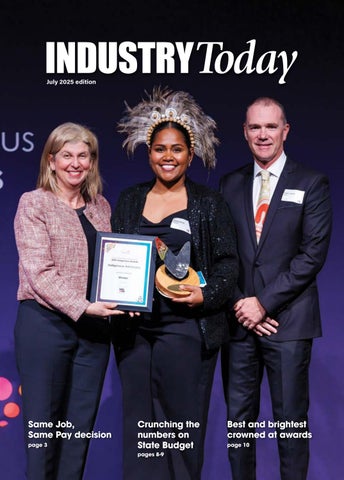
July 2025 edition
Same Job, Same Pay decision page 3
Crunching the numbers on State Budget pages 8-9
Best and brightest crowned at awards page 10
INDUSTRY TODAY
Johnson new Ports CEO Gladstone Ports Corporation (GPC) has announced the appointment of seasoned public sector executive Andrew Johnson as its new chief executive officer following an extensive national and international recruitment process. GPC chair Maree Adshead said Dr Johnson’s appointment comes at a pivotal time for the organisation as it focuses on strengthening core operations and delivering long-term stability. “Andrew is the right person for the job and we are so pleased to welcome him to Gladstone,” Ms Adshead said. “This appointment is fundamental to the Board’s focus on strengthening GPC’s core business, ensuring long-term stability and delivering results. Andrew brings extensive experience leading large, multi-asset, multijurisdictional, complex operations. “Once in the role, Andrew’s priority will be
to work closely with customers, partners, employees and stakeholders to understand their expectations, build alignment and deliver results. “GPC is a world-leading multi-commodity port focused on ensuring the future prosperity of our community and state – Andrew’s significant national and international experience will ensure we continue to deliver value to Queensland.” Dr Johnson will commence in the role on 22 September 2025, after concluding his tenure as chief executive officer of the Bureau of Meteorology. During the past nine years, he led the agency through major organisational and technological transformation while managing the impacts of Covid-19 and successive national weather-related emergencies. His earlier career includes nearly a decade on the executive team at the CSIRO, where
he oversaw marine, land and water research portfolios. This included work supporting the management of the Great Barrier Reef Marine Park and land management across northern Australia. Dr Johnson also has experience delivering large-scale infrastructure, construction, and technology programs both in Australia and abroad — including shipbuilding in Singapore, the development of innovation precincts in Brisbane and Townsville, and one of the Federal Government’s largest civilian IT upgrades. He has served as a non-executive director for a range of organisations across the public, private and not-for-profit sectors. Acting chief executive officer Jenelle Druce will continue to lead GPC until Dr Johnson takes up the position in September.
Dr Andrew Johnson has been appointed as the new chief executive of the Gladstone Ports Corporation. (Supplied)
Man, 27, dies in Clarke Creek Wind Farm incident By Matthew Pearce A 27-year-old man died following an incident at Squadron Energy’s Clarke Creek wind farm involving a piece of heavy machinery. A Squadron Energy spokesperson confirmed “with deep sadness” the incident had occurred on Wednesday, 2 July, at the wind farm site. “All work on site has been suspended, and the family has been notified and is being supported,” they said. “Our thoughts are with the worker’s family, friends and colleagues at this incredibly difficult time.” The spokesperson said safety is the top priority across all of Squadron Energy’s sites. “The wellbeing of everyone on the Clarke Creek Wind Farm site is our immediate focus,” they said. “We would like to acknowledge and thank the colleagues and first responders who responded to this tragedy. “We will fully cooperate with investigating authorities, and we ask that the privacy of the family and all those affected be respected at this time” A spokesperson for turbine manufacturer Goldwind Australia Pty Ltd gave more detail on the incident, saying it occurred late morning on 2 July, involving a male worker and piece of heavy machinery called a telehandler. Despite being treated by emergency services on site, the spokesperson said the worker was unable to be saved. “Our immediate thoughts and condolences are with the worker’s family, and we will
Clarke Creek Wind Farm is located 150km north-west of Rockhampton. (Supplied) provide all necessary support to them during this very difficult time,” they said. “The safety of our project team and contractors is our utmost priority. We will provide assistance to everyone affected by this
tragic event. “Construction work on site has been suspended while we cooperate with investigating authorities. We will also undertake our own investigations.
“We are unable to provide any further details at this stage, pending full investigations.” The Clarke Creek Wind Farm is located 150km north-west of Rockhampton.
Treasurer launches reform roundtable Telephone: 07 4863 5050 Address: 5-9 Hempenstall Street, Kawana, QLD 4701 EDITORIAL Gregor Mactaggart Editor E: gregor.mactaggart@CQToday.com.au Matthew Pearce Journalist E: matthew.pearce@CQToday.com.au ADVERTISING Cheryl Altouvas Advertising Sales E: cheryl.altouvas@GladstoneToday.com.au Lou De Jager Advertising Sales Executive E: lou.dejager@CQToday.com.au 2 INDUSTRY TODAY July 2025
Treasurer Jim Chalmers has announced the first invitations to the Federal Government’s landmark Economic Reform Roundtable, a new initiative aimed at shaping long-term national reform priorities. The roundtable will bring together prominent representatives from business, unions, the community sector, and key economic institutions to generate ideas and build consensus around policies to lift productivity, boost economic resilience and improve budget sustainability. “This is a representative group that we’re asking to provide ideas and build and advance consensus around them,” Dr Chalmers said. “Each participant will play an important role in helping to shape our national reform priorities.” The roundtable will expand over time, with further invitations to be issued in tranches as the agenda develops.
Treasurer Jim Chalmers has announced the first invitations to the Federal Government’s landmark Economic Reform Roundtable, a new initiative aimed at shaping long-term national reform priorities. (Joel Carrett/AAP) Dr Chalmers also confirmed that additional stakeholders, experts and representative groups will be included for specific topics and sessions. “There’s broad interest and engagement in the Roundtable, including from the states and
crossbench, and we will have more to say about their involvement,” he said. In addition to the roundtable, the Federal Government opened a public consultation process, giving individuals and organisations an opportunity to submit reform proposals via the Treasury website - https://consult.treasury. gov.au/economic-reform-roundtable-2025 Submissions must meet three key criteria: Be in the national interest Be budget neutral at a minimum, preferably budget positive Be specific and practical The public consultation period will close on 25 July 2025. Dr Chalmers said the Federal Government welcomed constructive ideas to help Australia navigate global economic uncertainty and build a more robust, future-focused economy.
• • •
INDUSTRY TODAY
Speculation Rio Tinto will carve off power station holding By Di Stanley Mystery surrounds the possible sale of majority shareholder Rio Tinto’s stake in the NRG Gladstone power station. Flynn MP Colin Boyce said he was aware of the divestment rumours and had been denied a meeting with Rio Tinto and told the company ‘did not comment on mergers and acquisition speculation’. Under the current joint venture ownership structure, Rio Tinto holds 42.125 per cent with NRG Energy (37.5 per cent) and Japanese partners including SLMA GPS Pty Ltd (8.50 per cent), Ryowa II GPS Pty Ltd (7.125 per cent), and YKK GPS (Queensland) Pty Ltd (4.75 per cent). “It has been reported in the media and I have spoken with Rio Tinto and asked for a briefing and they have refused,” Mr Boyce said. “I said I represent the wider Gladstone area in Central Queensland and it is in your
Rio Tinto holds a 42.125 per cent in the NRG Gladstone power station, scheduled to close in 2035. (File) best interests to inform me of your intentions, particularly because NRG Gladstone is the largest power station of which 80 per cent of its generating capacity goes directly to the alumina sector.” In May, Rio Tinto announced it would drive development of Australia’s largest solar
power project, after agreeing to buy all electricity from the 1.1GW Upper Calliope Solar Farm over a 25-year period to provide renewable power to its three local production assets in Aldoga, QAL and Boyne Smelter. The Upper Calliope project will be built and operated by European Energy at a site about 50kms south-west of Gladstone. Under the State Government’s clean energy plan, the power station is scheduled to close in 2035. “We know a couple of years ago Rio Tinto wrote off its Australian assets to the tune of $1.4 billion and we also know that the power generation contracts fall due come 2029,” Mr Boyce said. “For me, at least, there needs to be some explanations given by Rio Tinto now in respect of their intentions in general.” Mr Boyce said he would be unsurprised if Rio Tinto was to offload its power station holdings.
“I think that is where they’re headed as a company, obviously they would not put it up for sale if they weren’t prepared to get out of it,” he said. “But I have no knowledge of prospective buyers who may want to buy Rio Tinto’s interest in NRG Gladstone power station, and I would like to understand that further, and I will say we have made that request from Rio Tinto but they have refused to give me a briefing in respect of that.” Mr Boyce said he believed it was in the best interests of NRG Gladstone power station’s customer base and the region’s industry to be reassured over the facility’s future. “One hundred per cent,” he said. “What affects one industry in Gladstone also affects others, so all of those big, heavy industries - the coal, the gas, the alumina, the power generation sector, the cement, the railways, the shipping - they’ve all got a symbiotic relationship and what affects one will affect the others.”
Landmark fair pay ruling The Fair Work Commission has backed Same Job Same Pay at three BHP coal mines in Central Queensland in the biggest win so far under new labour hire laws. The landmark decision on Monday, 7 July, will lift pay for more than 2000 workers and is a nail in the coffin for BHP’s labour hire model, the Mining and Energy Union said. The decision means the Commission will make orders covering labour hire workers employed by WorkPac, Chandler Macleod and BHP’s in-house labour hire subsidiary Operations Services at Saraji, Peak Downs and Goonyella Riverside Mines. MEU Queensland president Mitch Hughes said that once made, the regulated labour hire arrangement orders would deliver annual pay rises in the order of $30,000 for about 2200 workers, while the decision has broader ramifications for the coal industry. “BHP has fought our Same Job Same Pay applications tooth and nail, trying to protect the wage-cutting employment model it pioneered,” Mr Hughes said. “This decision reaffirms that BHP’s approach of using labour hire to undercut bargained wages is no longer lawful and it’s time to pay up. “The community has spoken and the courts have spoken; BHP can no longer use outsourcing and dodgy corporate structure to cut pay.” A BHP spokesman said it was studying the decision and would comply with any orders made. “Clearly this will have implications for our business,” he said.
The Mining Energy Union has won an order for Same Job Same Pay to come into force at BMA’s remaining three coals mines in the Bowen Basin in Saraji, Goonyella and Peak Downs. (Supplied) “Operations Services, as a mining services provider, is delivering compelling job opportunities and career pathways for 3700 people, and productivity-enabling value for BHP.” The decision is the MEU’s sixth successful Same Job Same Pay application in Queensland, and 17th nationally – delivering more than $100 million in annual pay rises.
With 10 MEU Same Job Same Pay applications remaining before the Fair Work Commission, MEU general secretary Grahame Kelly urged employers to cease time-wasting legal interference that is delaying long-awaited pay rises. “This is a great result following a long campaign by MEU members; and I thank everyone involved in delivering this outcome,” he said.
“There are still thousands of workers across the coal industry waiting for Same Job Same Pay decisions that are being held up by employers’ delaying tactics. “This clear decision by the Full Bench of the Fair Work Commission should send a message not just to BHP but to the whole industry that the time for ripping off labour hire workers is over.”
THE FUTURE IS HERE >>>
BUILT FOR
OFF GRID
NEW
LIVING Solar buildings that power your site anytime & anywhere
RID OFF-G SOLAR Y FACILIT
8.85kW PV
Cool & Quite: Crimsafe, Tropical Roof & well insulated
15x 590w Solar Panels
MEET RENEWABLE TARGETS REDUCE EMISSIONS IMMEDIATE SITE OPS
Up to
32.80 kWh Lithium Phosphate battery
READY TO GO SOLAR? CONTACT US NOW.
www.multitrade.com.au 12756359-KF20-25
July 2025 INDUSTRY TODAY 3
INDUSTRY TODAY
Hydrogen project is over By Matthew Pearce, Di Stanley and AAP’s Fraser Barton The largest green hydrogen project planned in Australia — estimated to deliver almost 9000 jobs for Central Queensland — will not go ahead after the State Government pulled funding and an international consortium of backers collapsed. The Central Queensland Hydrogen Project (CQ-H2) was slated to produce up to 200 tonnes of hydrogen by 2028 and 1000 tonnes by 2031, adding $8.9 billion to the Central Queensland economy. The project involved the development of a hydrogen production facility at Aldoga, near Gladstone, the development of a hydrogen gas pipeline to transport hydrogen to Gladstone Port, the development of a hydrogen liquefaction facility and ship loading facilities at Gladstone Port, and the supply of hydrogen to an ammonia production facility at the port. On Sunday, 2 February, Queensland Treasurer and Energy Minister David Janetzki made the decision to pull more than $1 billion in state funding from the $12.5 billion project. Lead developer Stanwell Corporation, which is owned by the State Government, confirmed in a statement late last month that it would be officially pulling out of the project. “Stanwell has discontinued its involvement in the Central Queensland Hydrogen Project (CQ-H2) and other hydrogen development activities,” the company said. “The CQ-H2 project has been a valuable international collaboration that has provided important technical and commercial knowledge to support the future large-scale commercialisation of renewable hydrogen.” The Kansai Electric Power Company pulled out of the consortium in November, while there have been reports another Japanese consortium member Iwatani Corporation, withdrew from the project following the State Government’s decision to pull funding. At a press conference in Brisbane on Monday, 30 June, Mr Janetzki said his government in February had refused to pour any more money into a project he described as speculative. “It was asked for more than a billion dollars at the time and we said we would not be progressing any additional loans or grants,” he said. “A fundamental principle of our budget last week was to respect taxpayer money and I made the decision in February that that project in particular was speculative in nature and I didn’t want to see the precious taxpayer dollar tipped into it.” Federal Energy Minister Chris Bowen said the news comes as no surprise but expressed disappointment. “I think it’s a sad day for Gladstone,” he told reporters in Canberra. “Hundreds of jobs that would have been created now won’t be created because of that decision.”
The CQ-H2 global-scale renewable hydrogen project located near Gladstone has collapsed. (Stanwell.com)
Stanwell has announced it has pulled out of the CQ-H2 project. (Stanwell.com)
Federal Energy Minister Chris Bowen with Gladstone Mayor Matt Burnett, at a hydrogen funding announcement in Gladstone in 2023. (Contributed)
The hydrogen plant and pipeline were expected to cost $12.5 billion in 2019 before blowing out to nearly $15 billion in 2022. Questioning the cost to the ratepayer, Flynn MP Colin Boyce said the project had been a “farce” from the beginning. “It’s just simply economically unviable to produce industrial quantities of both hydrogen and liquid hydrogen,” he said. “The technology is not there yet. We can’t transport it, we can’t store it, then there is no market for it.” Queensland Conservation Council’s regional environmental advocate for Gladstone Emma Smith said the project’s collapse was a
In May, around 30 workers at Fortescue Energy’s Gladstone electrolyser manufacturing facility near Yarwun were made redundant or offered redeployment elsewhere, with the company rerouting its green hydrogen vision to the research and development of new technologies. CQUniversity has a Centre for Hydrogen and Renewable Energy in Gladstone and, last year, signed a Memorandum of Understanding with Stanwell, seeing the two organisations partner on skills development in the renewable energy space through Stanwell’s Future Energy Innovation and Training Hub (FEITH), located at the Stanwell Power Station near Rockhampton.
CHAUVEL INDUSTRIAL SERVICES
• On-site maintenance, shutdown and workshop facilities • Mechanical and Fabrication • Pumps, pulleys, conveyor supply and service • Civil and concreting 12619179-MS29-23
• Blast and paint
Exceeding Expectations
07 4926 8588 | chauvel.com.au Head Office: 26 Hempenstall St, Nth Rockhampton Emerald: 6 Daniels St, Emerald 4 INDUSTRY TODAY July 2025
major blow to the future of Gladstone’s economy. “Gladstone has all the right ingredients to secure a prosperous future in renewable hydrogen production and clean manufacturing, but we’re seeing the State Government’s policy uncertainty squander the opportunity,” she said. “Companies are looking at producing green iron in Gladstone using renewable hydrogen. Those plans can’t feasibly proceed without a local supply of hydrogen.” Gladstone has been banking on hydrogen projects as a new industry for the region in the renewable energy era.
Burnett keeps the faith The State Government’s Stanwell Corporation lodged documentation with the Commonwealth to formally withdraw Gladstone’s $12.5 billion CQ-H2 hydrogen project from the Environmental Protection Biodiversity Act approvals process on Thursday, 3 July. The notification was published on the site the following day. There were three EPBC referrals for the hydrogen transport facility, the surplus industrial water pipeline project and the hydrogen liquefaction facility. Gladstone Region Mayor Matt Burnett has refused to lose faith in the future of hydrogen for the Gladstone economy, stating he would travel to Japan for talks with CQ-H2 proponents Marubeni and Keppel Corp. Cr Burnett said the pair remained the two major investors in the CQ-H2 international
consortium, despite the withdrawal of the Kansai Electric Power company in November, 2024, and more recently, another Japanese consortium member, Iwatani Corporation. He confirmed he was involved in seeking further overseas investors for CQ-H2. “Marubeni and Keppel are the two big players in this ... and they were the ones taking the (CQ-H2) product, so as long as Marubeni is still involved, this project is still alive.,” he said. “I’m planning to be in Japan to meet with them, and others. “Iwatani was a big player too, don’t get me wrong, and it’s important to note that I have not had any correspondence personally from Stanwell to say that they’ve withdrawn any further from the project than they already had.’’
INDUSTRY TODAY
Atmos proposes BESS near Lilyvale By Di Stanley Atmos Renewables has lodged a development application with the Central Highlands council for a battery energy storage system one kilometre from the Lilyvale substation near Tieri. The material change of use application seeks a development permit for the BESS on 10 hectares of land on a flood-free freehold grazing property 51km north-east of Emerald and 12km south-east of Tieri, accessed via the Oaky Creek Mine Access Road. The project site is described as predominantly flat cleared farmland which sits between the Gregory crinum and Oaky Creek coal mines. “The Lilyvale BESS project is one of dozens of BESS projects either in development or under construction in Queensland,” the application stated. “BESS developments are an essential component of the transition from fossil fuel gen-
eration to a renewable energy future. “The Lilyvale BESS will incorporate the latest commercial scale battery technology. “The project provides direct benefit to the Central Highlands community by improving the capacity and security of regional electricity supply, as well as supporting the development of clean renewable energy. “The development footprint has been sited to avoid clearing of remnant vegetation and potential fauna habitat, and loss of Class A agricultural land. “The project is isolated from urban areas and sensitive receptors.” The BESS is expected to have a storage capacity of 1600-2000MWh based on current technology. In its construction phase, it would have a peak full-time workforce of 100-150 employees, with localised workforces to be prioritised. Atmos stated it would employ risk consid-
erations to ensure a fire, such as the one at the Genex Tesla Megapack BESS at Bouldercombe in September, 2023, did not occur. “Battery technology is rapidly evolving, including improvements in more stable chemistry, battery module integrity and protection systems, monitoring software and control systems,” the application stated. “It is a reasonable assumption that the technology eventually employed for the Lilyvale BESS will have improved safety features compared to current technology.” Founded by Igneo Infrastructure Partners in 2020, Atmos owns or holds an interest in 16 operational Australian wind and solar farms and was established to invest in and support the country’s transition to a decarbonised energy market. The development application requires referral to the State Assessment and Referral Agency and Powerlink.
A Battery Energy Storage System proposed to be sited near the Lilyvale substation BESS is expected to have a storage capacity of 16002000MWh based on current technology. (Supplied)
Theodore gets approval A major wind farm in the Banana Shire left in limbo by the State Government in January when its approval process was paused, has finally been given the green light. RWE Renewables Australia’s 1 gigawatt Theodore Wind Farm and battery project, 50kms south-west of Biloela, had its development approval granted by the State Assessment and Referral Agency on Monday, 23 June. Banana Shire Mayor Nev Ferrier said he was relieved at the news as the shire plans for a future with a portfolio of $40 billion in renewable energy projects. “They (RWE) have been a good one all the way through,” he said. “This one is out of the way and there doesn’t seem to be any objections at all, which is good. “They have been working really well with council.” The Theodore Wind Farm is planned to have up to 170 turbines and a BESS. “RWE is thrilled to secure state planning approval for the Theodore Wind Farm, a 1-gigawatt project with strong community benefits, that would support Queensland’s energy supply,” RWE Renewables Australia chief executive Daniel Belton said. “RWE has always understood that a key to successfully delivering projects is putting community first, and in line with this philosophy we have developed strong relationships with the community and other stakeholders at Theodore over the past three years. “We appreciate the Queensland Government’s rigorous approach to DA assessment, and have proactively worked with the government to ensure we delivered best practice community engagement, which has supported the achievement of our DA.
RWE Renewables Australia is waiting on Federal Government approval to start construction of its 1 gigawatt Theordore Wind Farm project in 2026 after the State Government gave thte green light on Monday, 23 June. (Mick Tsikas, AAP) “As we look ahead to commencing construction in 2026, we look forward to continuing to work with Powerlink and the Queensland Government on the infrastructure needed to make this project a success. “We remain committed to collaborating with the community, government, Traditional Owners and other stakeholders to bring this project to life.” The Theodore project is expected to generate $500 million into the local and Queensland economy throughout construction. This is in addition to a Community Benefit Fund of at least $500,000 per year – equating to about $17.5 million across the operational
life of the wind farm – once the project moves into the construction phase. The State Government announced that renewable energy developers in Queensland must enter into binding agreements with local governments, setting out the social impacts and community benefits of projects proposed within their boundaries, before they can apply for development applications with the state. Cr Ferrier said given the sliding scale of CBF payments proposals he had heard proposed by renewable energy developers within the Banana region, he believed payments should be benchmarked against a project’s energy output per year.
“Things are going to change with this government,” he said. “They’ve got to come to a rate for them (developers) to pay community funding I believe. “The New South Wales government has got one and I’ve read though it and thought it was really good, so we’ll just wait and see what the Queensland Government do. “It should be on the energy you’re going to produce - if you’re building it to be 500MW, you pay on that, and if you produce 300MW, well that’s bad luck. “There’s got to be a rate for that converted back to community funding and New South Wales have got it and it seems to be working very well.” Cr Ferrier said the Banana Shire Council continued to act in the best interests of its ratepayers in the face of the renewables onslaught. “Oh my word, it’s a fair impost on the community and we’ve got to get rewarded for it,” he said. “We’ve got to be properly compensated for it.” Construction of the Theodore Wind Farm project would take up to four years and require a workforce of up to 500 people at peak periods. RWE and Stanwell are continuing discussions on offtake for Theodore under their memorandum of understanding, signed in 2023. The Theodore project will now continue through the Federal Government’s EPBC Act process, where it has been placed on the National Renewable Energy Priority List. It is listed as being in the active assessment phase.
Environment
CQG is a passionate advocate for local businesses Rockhampton | Gladstone | Brisbane | Mackay | Townsville
Engineering
Planning
www.cqgroup.com.au • +617 4922 9252 12618313-CB29-23
July 2025 INDUSTRY TODAY 5
INDUSTRY TODAY
Treasurer seeks trade balance in latest US tariff talks By Tess Ikonomou and Andrew Brown/AAP Jim Chalmers has made the case to his US counterpart to remove American-imposed tariffs, while rebuffing calls to increase defence spending in line with NATO allies. The treasurer spoke with US Treasury Secretary Scott Bessent late last month, the third time the pair have talked. Dr Chalmers said he pushed for a deal to remove tariffs on Australian exports into the US imposed by President Donald Trump. “This was a very positive discussion, a very productive discussion,” he said. “I made our case once again when it comes to trade and tariffs and these escalating trade tensions around the world. “The global economic environment is very uncertain, very unpredictable and very volatile.” Australian goods are slugged with a 10 per cent tariff to enter the US, while steel and aluminium products have a 50 per cent
tariff. NATO countries have agreed to increase defence spending to five per cent of GDP, as the US also puts pressure on allies to boost money spent in the area. While the US has called on Australia to lift defence spending to 3.5 per cent, the federal government aims to increase it from two to 2.3 per cent by 2033/34. Dr Chalmers stood by the government’s spend despite the boost from allies. “It’s not unusual for our partners and friends around the world to express or have a preference for us to spend more on defence. We are actually already very substantially increasing our investment in defence,” he said. “Obviously we’ve seen the announcements out of Europe. We’re obviously tracking those developments very closely ... but we are already dramatically increasing our investment in defence. “That’s warranted and that’s why we’re doing it.”
Treasurer Jim Chalmers has made the case to his US counterpart to remove Americanimposed tariffs, while rebuffing calls to increase defence spending in line with NATO allies.
Pipeline of skilled workers The State Government has announced a $2 million expansion of the Queensland Minerals and Energy Academy (QMEA), creating regional hubs to build a pipeline of skilled workers for the state’s booming resources sector. Finance, Trade, Employment and Training Minister Ros Bates and Natural Resources and Mines Minister Dale Last confirmed the funding during a visit to Mackay earlier this month, marking the start of a three-year rollout that will also see new hubs established in Rockhampton (2026) and Townsville (2027). The QMEA currently partners with 100 schools across Queensland and engages up to 6000 students each year through STEM and trade workshops, mentoring programs and camps. The expansion is expected to reach an additional 10,000 students, with plans to ex-
tend the program into primary schools. “The Queensland Government is proud to work closely with the Queensland Resources Council, through the QMEA, to ensure the sector has the right people with the right skills,” Ms Bates said. “The resources sector is critical to Queensland’s economy and as it continues to grow, we need to develop the talent pipeline the industry needs now and into the future.” Mr Last said launching the first hub in Mackay made sense, given the city’s central role in Queensland’s resource economy. “Mining is Queensland’s biggest industry, employing more than 81,000 people, 60 per cent of whom live in regions like Mackay and the Bowen Basin,” he said.
“It’s a great industry to work in with so many rewarding career possibilities from the coal face to geology and everything in between.” Queensland Resources Council (QRC) chief executive officer Janette Hewson welcomed the funding, saying the investment would support the QMEA’s goal of nurturing the next generation of skilled professionals in the resources industry. “In the Mackay region alone, there are nearly 20,000 people employed by the resources sector and it indirectly supports a further 75,000 jobs, so it makes sense to have a regional hub in this resources heartland,” Ms Hewson said. “The resources sector is the backbone of
Queensland, contributing more than $120 billion to the state economy last year.” She said one of the industry’s greatest challenges was attracting and retaining skilled workers in regional communities. “The QMEA is a highly successful industryled partnership, and we know students from QMEA schools are more likely to pursue engineering or mining-related apprenticeships than those from other schools,” Ms Hewson said. “This funding will continue the success of the QMEA across regional Queensland and create the next generation of engineers, electricians, environmental scientists and more to support a sustainable and innovative resources sector.”
Grosvenor Mine prepares for re-entry a year on A year after an underground ignition event suspended operations at the Grosvenor coal mine, Anglo American has announced it is in the final stages of preparation for re-entry. The recovery journey has utilised drones, an underground robodog, laser scanning and advanced location mapping technology. Grosvenor Mine general manager Shane McDowall said the next critical step was to safely re-ventilate the underground environment to allow teams to return underground to carry out visual inspections. Sunday, 29 June marked 12 months since the mine was evacuated due to a methane gas ignition. “We are in the final stages of preparation for re-entry at Grosvenor Mine, marking a significant milestone in our recovery journey and a testament to safety, innovation and teamwork,” Mr McDowall said. “This progress reflects not only technical achievement but also the extraordinary dedication, ingenuity and adaptability of our people. “Our team has worked side by side with the Queensland safety regulator and safety representatives - to ensure every step we take is safe and considered. “I’ve seen our crews step up in amazing ways – solving problems, adapting technology in innovative ways, and rethinking how we do things underground.” “But what’s really stood out for me is our people. They’ve stepped beyond their usual roles, taken on new challenges, and grown in ways that make me incredibly proud.” Peabody is set to acquire all of Anglo-American’s Queensland mines in a deal worth $6 billion. 6 INDUSTRY TODAY July 2025
Boston Dynamics’ robodog was trialled at Anglo’s Moranbah North Mine as a potential tool to visually inspect Grosvenor Mine safely. (Supplied) It would make the multi-national the biggest employer in the Bowen Basin. Mr McDowall said he was proud of the efforts by all involved to get Grosvenor back on track. “That team spirit - people from different backgrounds coming together - has been at the heart of our progress,” he said.
“And because so many of our people live in Moranbah, we know how important it is to get this right for the community too. “We continue to work in collaboration with Resources Safety and Health Queensland and Industry Safety and Health Representatives (ISHRs) to ensure we meet all safety and regulatory requirements for a safe and structured
re-entry as a critical next step. “We’ve come a long way. “Every challenge we’ve faced and every milestone we’ve hit has brought us closer to re-entry. “We’re nearly there—and we’re proud to be doing it the right way: for our people, for Moranbah, and for the future of Grosvenor.”
INDUSTRY TODAY
Hydrogen Park milestone Australia’s first whole-of-city renewable hydrogen project celebrated over six months of successful operations in Gladstone on Wednesday, 2 July. Since November 2024, Hydrogen Park Gladstone, operated by the Australian Gas Infrastructure Group and supported by the Queensland Government, has delivered up to 10 per cent (by volume) blended renewable gas to an entire city network, made up of approximately 700 local Gladstone homes and businesses. This has been achieved by blending the renewable hydrogen produced at the facility with natural gas and distributing to customers via Gladstone’s existing gas distribution network. Since commencing operations, more than one tonne of renewable hydrogen has been produced and distributed to Gladstone customers. For customers on the gas network, this means they can continue enjoying natural gas the same way they have in the past with reduced emissions. In Gladstone, AGIG acting chief executive Cathryn McArthur hosted Assistant Minister for Regional Development, Resources and Critical Minerals Bryson Head, Gladstone MP Glenn Butcher and Gladstone Mayor Matt Burnett at Hydrogen Park Gladstone for a tour of the facility and a community barbecue. “This project is a real-world demonstration of the potential of renewable gas – it’s here, it’s real, it’s viable and it works and can be a key part of Australia’s renewable energy future,” Ms McArthur said. “We’re proud to launch our second operational renewable hydrogen project in Gladstone, marking a major milestone as Australia’s first whole-of-city gas network carrying a renewable hydrogen blend - it’s another important step toward delivering renewable gas at
Australian Gas Infrastructure Group acting chief executive Cathryn McArthur addressing dignitaries gathered at the Hydrogen Park Gladstone to mark its six-month operational milestone on Wednesday, 2 July. (Supplied) scale across the country. “Our approach focuses on using the existing gas distribution network which is largely hydrogen-ready; utlising the demand from current customers; and continuing to scale up the size and ambition of our projects. “Following the success of our flagship project in South Australia, this project represents an important step forward in the transition to renewable gas. “We are excited to be working with the Queensland Government and local council to continue delivering innovative energy solutions that support local industry, jobs and con-
tribute to a sustainable energy future.” Mayor Burnett said he was proud of the key role Gladstone had played in AGIG turning a vision into reality. “There’s no doubt that Gladstone is strategically positioned with a strong industrial foundation, deep-water port, and nationally significant infrastructure – making it a standout destination for investment in futurefocused energy and one that allows projects such as Hydrogen Park Gladstone to grow,” he said. “The region’s diverse and evolving energy mix – including hydrogen, renewables and
gas – provides flexibility and resilience for both new and existing industries navigating lower emissions operations.” Assistant Minister Head said the government’s five-year energy roadmap was encouraging more energy sources toward commerciality. “We need more energy supply, and marketled proposals for future energy sources are key to delivering that supply,” he said. “We are committed to fostering an environment that encourages more private sector investment to help bolster energy security in Queensland.”
Run through GPC’s waterfront Get active and run, jog or walk your way around Gladstone Ports Corporation’s magnificent parklands in the Port to Park 10km Koongo Dash, the 5km Koommonka Sprint or 3km Yallarm Family Run on Sunday 24 August 2025. Port to Park 2025 is an event for the whole family. Registering and getting active will help raise funds for Gladstone schools and our local community beneficiaries Gladstone Women’s Health Centre and PCYC Gladstone. Visit gpcl.com.au or scan the QR code to learn more and register!
12783013-MS28-25
July 2025 INDUSTRY TODAY 7
INDUSTRY TODAY
Butcher bashes ‘bad’ State Budget that neglects CQ By Matthew Pearce Gladstone MP Glenn Butcher has slammed the State Government following the release of the 2025-26 State Budget, calling it a “bad budget” that doesn’t deliver for Central Queensland. Speaking at Rockhampton’s Col Brown Park, Mr Butcher, who is also the ALP’s Shadow Minister for Police and Crime Prevention, Corrective Services and Sport, said while the LNP had made a “heap of commitments” prior to the election, “we didn’t get too much of that last night”. “They’re now calling it a boring budget,” he said. “I’m calling it a bad budget for Central Queensland. “What we’ve seen overnight was, once again, nothing delivered for the cost of living
Gladstone MP Glenn Butcher says the 2025-26 State Budget is bad for Central Queensland. (Matthew Pearce: 486986) for CQ, no relief for (vehicle) registrations in Queensland. “This is a budget that isn’t helping the people of Central Queensland that are doing
it tough.” The Labor MP also accused the State Government of “copying Labor’s homework”. “A lot of initiatives made in the Rockhampton Region are initiatives that the Labor government put in place prior to the election,” he said. While families will be given $100 for every primary school student to help cover the cost of essentials, Mr Butcher said $100 doesn’t go far for most people. “For those people who’ve got multiple cars or even one car, going up $58 a year in the cost of your registration, it’s bad,” he said. Mr Butcher said the LNP had dropped Labor’s $1000 rebate on energy costs, despite people making it clear that cost of living was their number one priority. “To not support a $1000 rebate on your en-
ergy bills is massive for families,” he said. “The LNP have continued to say they’re going to support the people of Queensland with rebates and also with energy cost savings, and they haven’t done it.” Eligible Queensland households will get a total of $150 off their electricity bills from the Australian Government under the Energy Bill Relief Fund extension from 1 July 2025 to the end of 2025. Prior to the budget’s release, Mr Butcher called for answers regarding the status of Stage 2 of CQUniversity’s TAFE Centre of Excellence project. The State Government pledged $61.1 million for the new TAFE precinct at CQUniversity’s North Rockhampton Campus in the budget, which will see the project to completion.
Alarm over debt forecast By Savannah Meacham, Fraser Barton and Laine Clark/AAP Debt is set to reach record levels for a state government planning an Olympics following a milestone budget. Queensland’s Liberal National Government handed down its first budget since 2014, hailing its efforts to reduce debt while delivering key election commitments. “We promised that we would target budget improvements ... we are delivering on that promise,” Treasurer David Janetzki told parliament. However, Queensland has been warned it may receive another credit rating downgrade with debt set to eclipse $200 billion for the first time, leading to higher borrowing costs for Brisbane 2032 projects. Mr Janetzki looked at long-term budget repair after the LNP’s October 2024 election success that ended Labor’s nine-year reign. He opted for a “mature and responsible” approach, more than a decade after the last LNP government sacked 14,000 public servants and cut frontline services under Premier Campbell Newman. Mr Janetzki’s mid-year budget update in January said debt expectations under the former Labor government model would exceed $217 billion by 2027/28 if left unchecked. The treasurer said debt would be lowered to $190 billion by 2027/28 under the LNP. But the state’s debt is expected to reach a record $205 billion by 2028/29, sparking a warning from ratings agency S&P Global. “Queensland’s budget highlights a sharp deterioration in the state’s finances,” it said. “It shows debt is increasing to cover the state’s weak operating position and fund its large infrastructure pipeline.” The state’s AA+ credit rating was downgraded for the first time in 15 years when it went from stable to negative in February. S&P Global warned there was potential for further drops if the budget was not balanced within two years, a move that would ensure higher borrowing costs in the race to complete Brisbane Games projects. Decreased credit ratings mean higher interest rates, making it harder to borrow due to the risk of not being able to pay it back. The LNP’s budget features $1.7 billion to begin construction on the Brisbane 2032 athletes’ village and venues over the next four years. The government outlined an $8.6 billion deficit in 2025/26, expected to improve to $1 billion in 2028/29. S&P Global accused the LNP government of “refreshing” rather than “redesigning” its financial strategy, aiming to stabilise its ratio of debt to revenue. Debt still continues to rise to fund operating deficits and a growing infrastructure budget, the agency said. Mr Janetzki said Queensland had been hit 8 INDUSTRY TODAY July 2025
Queensland Treasurer David Janetzki was quick to blame Labor for the credit rating downgrade after handing down his first State Budget. (Darren England/AAP) hard by a $2.4 billion reduction of GST revenue in 2025/26, calling it a “kick in the pants”, along with coal royalties falling to $6.1 billion compared to $10 billion in 2023/24. The Treasurer had earlier touted an improved bottom line thanks to capital expenditure savings, including scrapping Labor’s pumped-hydro scheme and the “CFMEU” tax. The LNP government still splashed out on its key election commitments - crime, health and housing. “We are front-loading the investments
into jobs and services now in this budget so Queenslanders can reap the benefits sooner,” Mr Janetzki said. After delivering landmark “adult crime, adult time” laws, the state government is investing $5.2 billion in its crackdown on offenders including $347 million to support the controversial legislation. Health services are buoyed by a $33.1 billion investment, including an $18.5 billion plan to deliver 2600 new beds and three more hospitals.
The budget featured “targeted” cost-ofliving support by restoring indexation to the Electricity Rebate Scheme for vulnerable households, expected to reduce the average power bill by $386. Families will also receive $100 vouchers for every primary school student to help with costs. A thousand first home buyers earning up to $150,000 will also benefit with 30 per cent equity in new builds and 25 per cent in existing homes up to $1 million.
INDUSTRY TODAY
‘Missed opportunity’: QRC By Gregor Mactaggart Queensland Resources Council (QRC) said the Crisafulli Government’s first State Budget reinforced the vital role the resources sector plays in supporting Queensland’s economy but has warned a long-term economic plan is urgently needed to secure the industry’s future. QRC chief executive officer Janette Hewson said the budget laid bare the economic challenges facing the state and the importance of encouraging capital investment rather than relying on the sector for short-term revenue fixes. “The resources sector has underpinned Queensland’s economic prosperity and could continue to do so for decades to come,” Ms Hewson said. “Global demand for our resources remains strong, but only if the government can deliver a long-term plan for the state that encourages capital investment rather than simply using the sector to fund its debt short term.” She said mining royalties had allowed the government to fund key initiatives such as 50 cent bus fares and household energy rebates, along with hospitals, roads, police and other essential public services. Royalties from Queensland’s resources sector fell from 12.8 per cent of revenue to 7.9 per cent this year, a drop attributed to lower coal prices and what the QRC describes as the “world’s highest coal royalties”, which it says is putting pressure on investor confidence and project viability. “It’s concerning to see the government extend current royalty rates in the forward estimates to 2028–29,” Ms Hewson said. “This is a continuation of a bad policy that started with the previous Labor Government and is being adopted by the new LNP Government to the detriment of all Queenslanders.” Treasurer David Janetzki projected
Queensland Resources Council (QRC) has warned the State Government a long-term economic plan is urgently needed to secure the industry’s future. (File)
Queensland Resources Council chief executive officer Janette Hewson. Queensland’s debt will remain at record levels and likely eclipse $205 billion by the 2028-29 financial year. Announcing an $8.6 billion deficit for 2025-
26 financial year, Mr Janetzki pinpointed cost blowouts and unfunded programs from the former Labor government, billions in lost GST and lower coal royalty revenue as decisive fac-
tors in the financial woes facing the Sunshine State. “The former government collected more in coal royalties in two years than what will be collected in the next four,” Mr Janetzki told parliament. “The former government absolutely creamed the coal royalties.” Ms Hewson welcomed the government’s comments about making Queensland “open for business” and efforts to streamline approvals but stressed the need for “supporting policies and fairer taxation to regain investor confidence”. The budget also confirmed previous commitments, including funding for the Queensland Minerals and Energy Academy to support a skilled workforce pipeline for the industry. Other initiatives outlined include investment in mineral exploration, the Common User Facility, CopperString, the Electricity Maintenance Guarantee, and the Transforming Queensland Manufacturing Program.
LNP takes the wind out By Savannah Meacham and Fraser Barton/AAP A milestone budget has come under fire for lacking a renewable energy plan as industry leaders raise concerns investors might be turned away. Queensland’s LNP Government has been praised for a “nation-leading” home ownership scheme and record health funding after it handed down its first budget since 2014. But the fiscal roadmap fell well short for environmentalists, who said it lacked an energy plan to secure investor confidence. “One of the things we’re seeing as a result of this lack of plan is that they’re spending some money really unwisely,” Queensland Conservation Council director Dave Copeman said. Budget papers cemented the LNP’s preelection promise to scrap targets set by the former Labor government to reach 50 per cent renewable energy in the power grid by 2030, 70 per cent by 2032 and 80 per cent by 2035. The state will no longer track how much renewable energy is contributing to the grid, calling it a “discontinued measure”. Renewable energy - including wind, solar and hydro - accounted for more than a quarter of the state’s power in 2024/25 while coal contributed nearly 65 per cent, with the remainder supplied from gas. Solar was the biggest contributor among renewable energy sources. Mr Copeman said the energy system measurement metric provided investors with confidence about the state market’s future for renewable projects. He warned the LNP government’s move might push investors away from Queensland because of a lack of clarity over the state’s energy plan and transition time frame.
“Now that treasury and energy no longer have that metric, they don’t have a plan, so they’re really working a bit in the dark that’s not good for Queensland,” he said. Mr Copeman also slammed the government’s $1.6 billion plan to prop up ageing coal-fired power stations as a “waste of money”. The government’s renewable energy stance appeared to be based on LNP stakeholder input, University of Queensland economist John Quiggin said. “Essentially, you’ve got a lot of people who are just hostile to the whole idea for purely cultural reasons,” he said. Treasurer David Janetzki promised to deliver his government’s energy roadmap by the end of 2025. He has backed the incomplete energy plan, celebrating $79 million to progress development of pumped-hydro projects at Mt Rawdon and Cressbrook along with another at Borumba for $355 million. “We promised to fund smaller, more manageable pumped hydro projects and we are delivering on that promise,” Mr Janetzki said. The budget predicted a record $205 billion in debt by 2028/29. 12758761-EA15-25
July 2025 INDUSTRY TODAY 9
INDUSTRY TODAY
Rockhampton Airport’s solar project to take flight A new $2.4 million solar project has officially commenced at Rockhampton Airport under a joint partnership between Rockhampton Regional Council and the Albanese Government. The project, which will install a new 976kW behind-the-meter solar system at the Rockhampton Airport Terminal, is expected to reduce the Airport’s grid energy usage and save up to 1600 tCO2e (tonnes of carbon dioxide equivalent) per year. The project aligns with council’s Reef Action Plan through the Reef Guardian Councils initiative and supports the Australian and Queensland governments’ Reef 2050 Long Term Sustainability Plan objective of “limiting impacts of climate change”. Under the Reef Guardian Council program, Rockhampton Regional Council recognises that local and regional approaches are central to protecting and managing the Reef and the communities it supports, and is committed to working to build the resilience of the Reef through projects like Rockhampton Airport Solar. The project will be delivered by local con-
Mayor Tony Williams, Senator Anthony Chisholm and Cr Elliot Hilse. (Supplied) tractor NRG and is expected to be completed in 2026. Rockhampton Regional Council received $920,000 under the Reef Guardian Councils – Activating Local Councils’ Reef Action Plans Program to deliver the project. Queensland Senator Anthony Chisholm said the Federal Government is committed
to protecting and restoring the Great Barrier Reef and supporting the jobs that depend on it. “Looking after the Great Barrier Reef requires all levels of government and communities to work together, and Reef Guardian Councils play an important role in addressing climate change and improving the health of the Reef,” he said. “We’re proud to support Rockhampton Regional Council to deliver this solar project, which will make a practical difference to the Airport’s emissions, while contributing to improving the health of our precious Great Barrier Reef.” Rockhampton Regional Council Mayor Tony Williams said this is a critical project for council that will help reduce grid energy consumption and save on emissions. “We know that Rockhampton Airport is council’s second-highest energy consumer amongst our many sites and facilities, and so to have this solar project going in to help offset what we are drawing from the grid, while at the same time helping to tackle the impacts of climate change and protect the reef, is a
great thing,” he said. “It’s another example of the Albanese Government working with local councils under the Reef Guardian Councils program to develop local ideas and initiatives and safeguard the long-term future of the Great Barrier Reef.” Rockhampton Regional Council Environmental Sustainability Portfolio Councillor Elliot Hilse said that as part of council’s Sustainability Strategy Towards 2030, they are working with residents, communities, businesses, industries, and other levels of government to lead a variety of strategic actions. “We are proud to take a proactive approach as we move towards net zero emissions, build climate resilience, protect our natural environment, and deliver financially responsible outcomes,” he said. “This project aligns with the Australian and Queensland Governments’ Reef 2050 Long Term Sustainability Plan objective of ‘limiting impacts of climate change’ and will provide renewable energy in a cost-effective way to accelerate council’s transition towards net zero emissions.”
Indigenous talent feted Queensland’s resources sector came together last month for one of its major awards events celebrating the importance of diversity, cultural awareness and social cohesion within our state’s most important industry. The Queensland Resources Council’s (QRC) Indigenous Awards are held every two years to recognise the significant achievements of indigenous people and businesses within the resources sector, and their proud contributions to Queensland. This year’s awards acknowledged the people and projects that are building cultural awareness and inclusion in the sector, as well as businesses that are using traditional and cultural practices to improve the sector’s approach to environmental and social outcomes. These practices are being adopted by the sector even more, and in 2023-24 resources companies increased their spend with indigenous businesses by 45.6 per cent to $207.4 million, which is a 300 per cent increase over the past five years. Women accounted for a record 32 per cent of the resources sector’s Indigenous workforce, which is significantly higher than the industrywide figure of 23 per cent women. A shining example is Jemma Kemp from Thiess who took out the award for Indigenous Advocacy in Queensland Resources for her role as a cultural champion, operator, trainee assessor and crew safety representative. Mentoring forms a large component of Jemma’s role, particularly supporting other indigenous workers new to the resources sector and ensuring their proud heritage is supported. A commitment to mentoring and inspiring other Indigenous workers was reflected in this year’s winner of the Exceptional Indigenous Person in Queensland Resources, Clinton Harding from Thiess. Clinton has shown exceptional leadership within his own organisation and a commitment to safety across the industry. QRC chief executive officer Janette Hewson congratulated all award winners as leading examples of the workforce behind Queensland’s resources sector that contributed $120.2 billion to the state economy last year. “Clinton and Jemma are making outstanding contributions to improving employment opportunities for Indigenous people in the resources sector by setting great examples of what can be achieved,” Ms Hewson said. “A diverse workforce is a stronger workforce and I’m very pleased to see the commitment of QRC member companies to reflect the communities in which we operate through our workforce.” The QRC’s latest figures show that in 202324, Indigenous people represent 5.4 per cent of 10 INDUSTRY TODAY July 2025
Jemma Kemp from Thiess took out the award for Indigenous Advocacy in Queensland Resources. She is pictured with Queensland Resources Council chief executive officer Janette Hewson and BMA’s Adam Lancey.
A host of winners from the night.
Winners at the Queensland Resources Council’s Indigenous Awards in Brisbane last month. the resources sector workforce. It remains above 5.2 per cent Indigenous representation in the Queensland population. The average wage paid to Indigenous employees increased four per cent, reflecting the skill level of Indigenous workers and the number in leadership roles. Machinery operators and drivers were the most popular roles accounting for 44.6 per cent of the Queensland resources sector’s Indigenous workforce, followed by technicians and trades (20.8 per cent) and professional roles (18.7 per cent). “The resources sector is continually looking to increase the participation of Indigenous people, and we hope these awards will inspire more into one of the many rewarding careers
This year’s awards acknowledged the people and projects that build cultural awareness and inclusion in the sector.
available,” Ms Hewson said. “Resources companies across Queensland are actively encouraging Indigenous people into their workforces, particularly in regional and remote areas where they operate. “The QRC’s educational arm, the Queensland Minerals and Energy Academy (QMEA) is also playing an important role in introducing Indigenous school students to the apprenticeships and traineeships available in resources that can set them on the path to a prosperous career.” WINNERS Indigenous Advocacy in Queensland Resources Jemma Kemp - Operator, Trainer, Assessor, Crew Safety Representative, Thiess
•
Exceptional Indigenous Person in Queensland Resources Clinton Harding - Principal Subject Matter Expert for Tyres, Thiess Indigenous Rising Star in Queensland Resources Jameika Maddock - Law Graduate, Origin Energy Exceptional Indigenous QMEA Student Alyssa Ivinson - Glenala State High School Exceptional Indigenous Business in Queensland Resources Ochre Australia - with Whitehaven Best Company Indigenous Initiative in Queensland Resources Stanmore Indigenous Trainee Program Stanmore Resources
•
•
•
•
•
INDUSTRY TODAY
Regional coverage boost New or improved Telstra mobile coverage will be delivered across a host of Central and Western Queensland communities as part of a $12 million local investment. The series of upgrades and new construction projects are being rolled out over the next 12 months, and follows Telstra’s announcement earlier this year that it would increase its national mobile network investment by $800 million over four years to deliver the connectivity needed to support customers in years to come. Telstra regional general manager for Northern Queensland Rachel Cliffe said the multimillion dollar funding would help deliver better coverage and performance in the region, now and into the future. “Data carried across our mobile network has more than tripled over the last five years,” Ms Cliffe said. “This investment will help us further expand our mobile coverage and increase the capacity on our 5G network. “Our investment includes over 35 new projects to upgrade our mobile network in locations like Blackwater, Gladstone and Sarina. We’re also in the process of building a new site in Rockhampton and scoping other opportunities to further expand our coverage.” Telstra has begun upgrading hundreds of mobile sites at its busiest locations around the country with Ericsson’s AIR 3284, the world’s first 5G triple-band radio – a technology that boosts capacity, improves coverage and is central to building a high-performing, programmable network. “Customers near the upgraded sites should see and feel a difference with noticeable improvements to speeds and overall experience from this year especially while using their mobile in busy areas,” Ms Cliffe said. “This includes better streaming, faster uploads, and more reliable connectivity during peak times.” In addition to benefiting from the significant investment on the ground, eligible Telstra
A series of Telstra upgrades and new construction projects are being rolled out across Central and Western Queensland over the next 12 months. (Telstra) customers with a compatible phone can now also access Australia’s first satellite to mobile product – Telstra Satellite Messaging which allows customers to send and receive a text message via Starlink Direct to Cell satellites when they’re outside the reach of Telstra’s mobile coverage area. “This capability will enable basic texting on your phone in some of Australia’s hardest to reach places. It will be helpful to get a message out or to be contactable in remote areas where our mobile network doesn’t reach,” Ms
Cliffe said. “While satellite to mobile messaging is an exciting new technology it’s important to remember the service will initially be limited to messaging only while outside with a clear line of sight to the sky.” Public phones in the region are among 1,000 across the nation to have also been upgraded with free Wi-Fi and extended battery backup to help keep communities connected during times of need. Public phones in over 15 Central and West
Queensland locations are among those to have been upgraded including in Barcaldine, Biloela, Emerald, Gladstone, Longreach, Mackay, Miriam Vale, Moranbah and Rockhampton. “If you’ve had to evacuate, a public phone might allow you to contact family and friends to let them know you are ok,” Ms Cliffe said. The latest investment builds on the $11.8 billion investment Telstra has made in its mobile network nationally, including $4.3 billion in regional areas over the past seven years.
Rio Tinto empowers girls Successful recipients can give back to communities in STEM-tacular Camp Rio Tinto Gladstone has reaffirmed its commitment to fostering future talent in science, technology, engineering, and mathematics (STEM) by supporting the annual STEM-Tacular Girls Camp - an initiative aimed at empowering young women to pursue careers in STEM fields. Held at the Boyne Island Environmental Education Centre, this year’s camp welcomed 46 students from 13 schools across Queensland for five days of hands-on learning, exploration, and collaboration. Now in its 14th year, the STEM-Tacular Girls Camp continues to provide an inspiring platform for students to dive into science,
technology, engineering, and mathematics. Activities ranged from mangrove studies and microscopic analysis to a high ropes course and astronomy sessions, giving participants a broad and exciting taste of STEM in action. Rio Tinto Gladstone commends the students for their curiosity, resilience, and enthusiasm throughout the week. The company also extends its thanks to the dedicated teachers, program leaders, and Queensland Alumina Limited (QAL) team members whose expertise and commitment make this program a success year after year.
Supported by Rio Tinto Gladstone, the STEM-Tacular Girls Camp brought together 46 students from across Queensland for five days of hands-on STEM learning. (Rio Tinto Gladstone Facebook)
Australia’s largest rail freight company Aurizon has announced the latest recipients of its Community Giving Fund, with regional Queensland charities among the beneficiaries of the program that supports health, education and community initiatives. Twenty-three not-for-profit organisations across the company’s national footprint will share in the latest round of grants of up to $20,000. Among the recipients are Royal Far West and Autism Queensland Gladstone, both delivering critical services to communities in Aurizon’s operational areas. Aurizon managing director and chief executive officer Andrew Harding said the fund reflects the company’s commitment to giving back to the regional communities where most of its workforce live. “We are excited to support the regional areas where over 80 per cent of Aurizon’s employees reside and work,” Mr Harding said. “The Community Giving Fund is our way of contributing to local projects, allowing us to give back and positively impact the lives of people in these regions.” Royal Far West, which partners with Country to Coast Queensland (CCQ), received funding to equip a new field team with satellite phones, uniforms and essential supplies. The team will travel across Central and North Queensland delivering developmental screening and assessments to children with health and learning challenges. Recent visits by occupational therapist Annabelle and speech pathologist Bhais to Gladstone, Tannum Sands, Miriam Vale and Agnes Water have already expanded support to educators and early childhood centres.
Recently, Royal Far West speech pathologist, Bhais visited Gladstone, Tannum Sands, Miriam Vale and Agnes Water, ensuring young children and educators receive speech pathology and occupational therapy support. A new partnership with a centre in Agnes Water is helping deliver crucial early intervention services. Autism Queensland Gladstone will use its grant to install motorised blinds at its facility, improving comfort and learning conditions for students with sensory sensitivities while boosting energy efficiency. Since launching in 2011, Aurizon’s Community Giving Fund has supported more than 670 charities and not-for-profit organisations across Australia. Applications for the next funding round will open in September 2025. For more information, visit www.aurizon.com.au/community. July 2025 INDUSTRY TODAY 11
INDUSTRY TODAY
Science turned into fun Do you know how crystals form and why pulleys make it easier to lift heavy loads? Well, Year 7 and 8 students from Blackwater State High School discovered some answers to these questions recently after completing science, technology, engineering and maths (STEM) activities in an educational QMEA workshop. Delivered by the Queensland Minerals and Energy Academy (QMEA) in partnership with Whitehaven Coal, the students were keen to know more about geology and mining. QRC policy director of skills, education and diversity Katrina-Lee Jones said the Blackwater students showed plenty of scientific curiosity. “These students are surrounded by resource operations and many have family who work in the industry, so they are keen to know more about geology and mining,” Ms Jones said. “(Today’s) workshop created a bridge from their science studies into the real world – with activities based on geological exploration and engineering processes. “Having the Whitehaven team at the workshop gave the students some great insights into how STEM is used in different roles on site including those of mining engineers, metallurgists and geologists.” This was the first QMEA workshop sponsored by Whitehaven Coal this year. Whitehaven Coal Queensland regional general manager Dan Iliffe said the organisation was proud to partner with the QMEA to deliver STEM and trade school workshops in the region. “The families of Blackwater play a big role in our operations and we are committed to investing in educational initiatives that excite local students about the resources industry,” Mr Iliffe said. “Ultimately, if we can inspire the next generation to keep studying STEM subjects with the idea of having a career in our sector then that is a win for us, as well as a win for the student and the Blackwater community.” This year the QMEA is celebrating 20 years of inspiring students to follow a trades or science, technology, engineering and maths (STEM) study pathway with a focus on the many rewarding career opportunities in the resources sector.
Having the Whitehaven team at the QMEA Blackwater workshop gave the students some great insights into how STEM is used in different roles on site including those of mining engineers, metallurgists and geologists. (Photos: QRC)
Physics and pulleys.
Discovering the beautiful world of geology! 12 INDUSTRY TODAY July 2025
The workshop created a bridge from their science studies into the real world – with activities based on geological exploration and engineering processes.
INDUSTRY TODAY
Ergon, Energex launch statewide recruitment drive Energy providers Ergon and Energex have launched a statewide recruitment drive for electrical apprentices to start in February, 2026. Between the, Ergon and Energex are looking to take on around 180 apprentices this financial year with roles open across 58 depots and centres across Queensland. Gladstone has one linesperson and two electrotechnology electrician positions available. In Rockhampton, there are four apprentice electrotechnology electrician roles, three linesperson roles and one communications technician role on offer. One linesperson apprenticeship each is available at the companies’ Emerald, Moura and Yeppoon outlets. “We are recruiting for five different trade types,” a spokesperson said.
Some of the 2025 apprentice intake for Ergon in Central Queensland. (File) “Applicants need to be aged 17 or better by February 1, 2026 – there’s no upper age limit. “Our apprentices work a 9-day fortnight,
with excellent pay and conditions, as well as world-class training. “Applicants do not need to have complet-
ed Year 12 “ The Ergon and Energex 2025 intake of 184 apprentices were: -Aged 17-54 years (including 42 per cent under 21yrs, 28 per cent aged over 30, and four per cent aged 40 or better) -60 were male and 40 per cent were female, of which 11 per cent identified as First Nations -Six ex-defence force personnel entered via the pathway partnership with RSL Queensland Ergon and Energex currently have around 600 apprentices at various stages of their training. Aspiring apprentices can apply from now until Sunday 29 June at www.ergon.com.au/ apprenticeships or www.energex.com.au/ apprenticeships
$61.1m for TAFE precinct By Matthew Pearce Queensland Treasurer David Janetzki and Trade, Employment and Training Minister Ros Bates paid a visit to CQUniversity on Thursday, 3 July, to confirm the State Government will fund stage two of the TAFE Centre of Excellence. The newly released State Budget includes funding of $61.1 million over three years for the second and final stage of the Centre of Excellence project, which will consolidate all of CQUniversity’s TAFE offerings at the Northside campus, allowing the Central Rockhampton campus in Alma Street to be turned over to the State Government. The completed precinct will include a trades training centre and a horticultural centre, as well as training facilities for metal fabrication, air-conditioning, refrigeration, hospitality, IT, visual arts, hairdressing, and beauty. CQUniversity’s vice-chancellor and president, Professor Nick Klomp, said stage one of the project, the Centre for Building Excellence, opened earlier this year and is already catering for more than 350 students each year in bricklaying, carpentry, cabinet-making, and plumbing trades. “Boy, do we need every single graduate we can produce in the trades area,” Mr Klomp said. “This is a terrific example of where industry expresses their need for workforce into the future and it can come together with government support and with the training and expertise the university offers.” The completed TAFE Centre of Excellence will add between 500 and 800 more TAFE graduates each year. Mr Janetzki said the $61.1 million investment would do more than put tradies on tools. Moving the TAFE facilities to the Northside
CQUniversity’s Professor Nick Klomp, MP Nigel Hutton, Treasurer David Janetzki, MP Donna Kirkland, Minister Ros Bates and MP Glen Kelly check out one of the mini-homes at the Centre for Building Excellence. (Matthew Pearce: 488260) campus will allow the Canning Street site to be repurposed, enabling an expansion of Rockhampton Hospital. The project will also allow the university to consolidate land at its Northside campus, unlocking 27 hectares of surplus land on Norman Road and Yeppoon Road for up to 200 new homes. “We want to get more homes built sooner for Central Queensland and this is an important part of that investment,” Mr Janetzki said. Ms Bates said on her previous visit the Centre for Building Excellence had been just
a shell, and now it was training the tradies of tomorrow. “We know that we’re going to need all of those tradespeople for the construction into the future, not just the roads and the hospitals and the schools that we need, but also the Olympics, which is coming in 2032,” she said. Ms Bates said the Rockhampton Centre of Excellence would be the first of four across the state. Rockhampton MP Donna Kirkland and Keppel MP Nigel Hutton said Central Queenslanders deserved world-class facilities.
“We know that 70 per cent of people who study in the regions stay in the regions, and we’ve got significant construction projects happening over the next four years right here in Rockhampton, so we will need every single one of those tradespeople,” Ms Kirkland said. “We know and heard at the election that housing and health were huge priorities for our community,” Mr Hutton added. “This project, with its multidisciplinary approach, helps create space for the Central Queensland Hospital and Health Service, allowing the hospital to breathe.
12618405-AP29-23
July 2025 INDUSTRY TODAY 13
INDUSTRY TODAY
CS Energy appoints Gillespie as new chief executive CS Energy has appointed Brian Gillespie as its new chief executive officer. Mr Gillespie, who started in the role on Tuesday, 24 June, brings more than three decades of leadership experience across the mining, transport, logistics, technology, oil and gas, and health sectors. He was most recently group executive and president of Latin America for global mining services company Orica, where he led a significant operational and cultural transformation. CS Energy chair Tony Bellas said Mr Gillespie’s appointment marked a significant step in the company’s evolution. “The appointment of Brian Gillespie marks a pivotal moment in CS Energy’s transformation journey,” Mr Bellas said. “As the Board continues to deliver on its
commitment to a Safer, Better CS Energy, Brian’s leadership will be instrumental in embedding a culture of operational excellence, integrity and transparency.” Mr Bellas said Mr Gillespie’s track record in high-risk industries made him well suited to steer CS Energy through its cultural and operational transformation. “CS Energy has faced significant challenges in recent years, including the Callide C3 and C4 incidents,” he said. “In response, the Board has committed to a comprehensive cultural transformation to strengthen safety, governance, and accountability. Brian’s proven track record in leading high-risk operations with a people-first approach makes him uniquely qualified to drive this change.” Mr Gillespie’s experience in infrastructure and mining will support CS Energy’s strategic
focus on modernising its asset portfolio and strengthening governance frameworks. “Brian’s experience in leading complex infrastructure and mining operations aligns with CS Energy’s focus on modernising its asset portfolio, improving reporting processes, and delivering on the Queensland Government’s Electricity Maintenance Guarantee,” Mr Bellas said. “As CS Energy enters this next chapter, the Board looks forward to working with Brian to build a resilient, innovative, and values-driven organisation that delivers for Queensland’s communities and industries.” Mr Bellas also acknowledged acting chief executive officer Emma Roberts for her leadership during a critical time following the fallout from April’s incident at Callide’s C3 Unit.
Brian Gillespie is the new chief executive officer of CS Energy. (Supplied)
Mine rehab hits milestone Dawson Mine has reached a major rehabilitation milestone showing mined land can be responsibly restored for future agricultural use. An 82-hectare area at Dawson Mine has achieved progressive certification for rehabilitation under the Environmental Protection Act, the first of Anglo American’s five steelmaking coal operations in the Bowen Basin to do so. The land now supports cattle grazing, with up to 135 head on the agisted land near Moura, Banana and Theodore. The certification is issued through Queensland’s environmental regulator – the Department of Environment, Tourism, Science and Innovation. Anglo American environmental manager Jason Fittler said the rehabilitation work at Dawson Mine was an important step for the company and the wider industry. “We’ve been working towards this since 2012 and it’s incredibly rewarding to see the land thriving again – this time as productive grazing country,” he said. “Our goal has always been to return the land to a sustainable use and this certification shows we’re doing just that. “It is a significant step forward in building trust with our communities. Ultimately, the land will return to them, so it’s important we prove we’ve been responsible custodians.” Farmer Michael Kucks, from MNK Kucks Pastoral, said the trial showed great weight gain in the cattle compared to non-mining grazing land. “Some of land is better than it was before mining,” he said. “The cattle are hard to find sometimes, the grass is too long. A paddock full of grass like that - any grazier is happy to see it.” The process to achieve certification involved reshaping the land, returning carefully stockpiled topsoil containing native seed
Property agistee Michael Kucks and Anglo American environmental specialist Larry Hantler on the rehabilitated land at Dawson Mine. (Supplied) banks and beneficial bacteria, and then sowing grass seed as ground cover to prevent erosion and provide food for grazing animals. Reliable water sources also ensure the land remains useful and productive after mining. Mr Fittler said the achievement was a testament to the dedication and expertise of everyone involved – from those who took the first steps a decade ago to the teams conducting grazing trials, ongoing monitoring and weed maintenance.
“The certification process involved rigorous monitoring and maintenance activities, demonstrating the critical role of land stewardship in ensuring successful rehabilitation outcomes,” he said. “It showcases the power of collaboration and long-term commitment to responsible land management. “Cattle grazing trials provided clear evidence of the land’s productivity, reinforcing the viability for future agricultural use to the
SUPPORTING THE GLADSTONE REGION FOR OVER 40 YEARS 17 Garfield St Gladstone 4680
07 4976 7999 www.walzgroup.biz
12625262-JC33-23
14 INDUSTRY TODAY July 2025
regulator. “This Dawson Mine certification is just the beginning. “We’re continuing to seek opportunities to reinforce our commitment to sustainable mining and positive environmental outcomes on the lands where we operate. “We want to demonstrate mining and sustainable land use can go hand in hand – leaving a positive legacy for future generations in our communities.”
INDUSTRY TODAY
CH delivers $261m budget The Central Highlands Regional Council has adopted its 2025–2026 Budget of $261 million, detailing costs for delivering essential services and critical infrastructure to improve liveability for towns and communities across the region. On Wednesday, 18 June, Mayor Janice Moriarty said council took a balanced and responsible approach when shaping and developing this budget on behalf of the community. “Our focus was on balancing the cost-ofliving pressures for our residents with the increasing costs for council to deliver services, while being responsive to community needs and concerns,” Mayor Moriarty said. This is why council has endorsed an average general rate increase of 3.9 per cent, resulting in total general rates revenue increasing by just 2.8 per cent. Mayor Moriarty said getting the balance right for the community and ensuring council services are delivered across all towns and rural areas was a priority. “As part of a comprehensive review of council’s rating system, changes have been made to bring the rate in the dollar back to a more consistent and equitable level throughout the region,” she said. “To make sure no one is unfairly impacted by these changes, in the short-term council will
The Central Highlands Regional Council has delivered a general rates rise of 3.9 per cent in its 2025-26 budget handed down on Wednesday 18 June. (File) continue to use a rates cap to limit increases for ratepayers affected by large property valuations or rating category changes to a maximum of 13.3 per cent, including the general rates rise.” The number of ratepayers affected by the cap will drop significantly from more than 8400 last year to just over 1300 this year. For most ratepayers, the new system is simpler and easier to understand - especially for those not on the minimum general rate, who can now calculate their rate by multiplying their land value by the set rate in the dollar for their category.
More than 1200 property owners will see a reduction in their general rates this year. Some primary producers, particularly those in the rural irrigation category, will benefit from meaningful relief after several years of significant rate increases. “We’ve listened to community concerns and made adjustments that deliver a fairer outcome for all ratepayers,’ Mayor Moriarty said. This year’s budget features: A 4.7 per cent operating surplus An $83 million capital works program, supported by $37.5 million in external grants
$26 million in debt repayments Ahead of a detailed review of changes and fees next year, council has limited increases to utility charges with the average residential household paying $4.46 more per week after discount. Council will continue to offer significant support for eligible residents, including 50 per cent rate remissions for pensioners and up to 100 per cent general rate rebates for approved not-for-profits and sporting groups. As a large regional council covering almost 60,000sq kms, the Central Highlands faces unique cost challenges. Council maintains more than 4500lm of roads and operates critical infrastructure such as water treatment plants, waste facilities and sewerage systems. “Factoring in the longer-term costs of maintaining and renewing vital council assets is critical for the ongoing financial viability of council when developing the annual budget,” Mayor Moriarty said. “For the 2025-2026 budget, council has taken a balanced and responsive approach when considering the cost of delivering services to all towns and communities while responding to community needs to improve liveability within the Central Highlands.”
Less than 1% rate rise for Rockhampton residents By Matthew Pearce Rockhampton Regional Council has delivered its 2025–26 budget, and while residents can expect a rates rise of less than one per cent, they will also feel the impact of land valuations. Delivering the budget on Tuesday, 24 June, Rockhampton Region Mayor Tony Williams said council had forecast a general rate revenue increase of three per cent across the board, with the average ratepayer seeing a rate rise of 0.6 per cent. “However, it is important for people to note that we have seen significant (land) revaluations occur this year, and so that will mean that the exact amount people pay may differ – potentially substantially depending on their specific circumstances,” he said. Cr Williams said council understood the pressures facing the community. “We understand the community needs some breathing space. We’ve had some tough budgets over the last few years, and this is one
where I’d like to commend my fellow councillors for the work that we’ve been able to achieve,” he said. The budget will deliver a forecast surplus of $475,000. While land valuation increases have made it a “challenging budget this year”, Cr Williams said council was working to soften the impact on ratepayers without cutting back on services. “We’ve worked over the last few months, diligently rolling a ruler over every item in our budget to make sure that we could lessen the impact, while still maintaining the infrastructure and the services that our community need for a growing region,” he said. Cr Williams said council had implemented measures to reduce the rate in the dollar between 17 and 24 per cent for residential properties compared to the previous year’s rates. Council has also implemented rate capping for non-residential properties, which have borne the brunt of the largest revalua-
tion increases, to a maximum of 20 per cent. Increases to utility charges have been maintained in line with operating costs, with a four per cent increase to both water and sewerage utility charges, and a 7.8 per cent increase to waste utility. Cr Williams said Rockhampton Regional Council had also reviewed and refined capital expenditure, extending timeframes on projects where infrastructure costs have blown out due to circumstances beyond council’s control — “understanding we need to do these projects, but not trying to do them all at once”. “We have smoothed out that capital program so that we’re not borrowing as much money,” he said. Rockhampton Regional Council has also absorbed the impact of the State Government waste levy in this year’s budget, which affects council for the first time. Cr Williams said he was keen to work with the State Government to look at ways to divert waste before residents feel the impact of
the levy. The 2025–26 budget includes: $39.7 million for road renewals, upgrades, and rehabilitation, offset by $23.2 million in capital income; $21 million for facilities renewals and upgrades, including cemeteries, community and council facilities, libraries, showgrounds, depots, tennis courts, swimming pools, and the Pilbeam Theatre; $10.8 million in airport capital projects; $5.6 million for park renewals and upgrades, including new playgrounds, landscaping, irrigation, pathway renewals, and Rockhampton Zoo enclosure improvements; $2.7 million for continued development of the North Rockhampton Sporting Precinct; $3.4 million for waste management capital works; and $14.1 million for the Fitzroy River Water capital program, offset by $2.8 million in capital income.
•
•
• •
• • •
Isaac Regional Council delivers 4.95% general rates rise Isaac Regional Council has delivered a $153.7 million budget that holds the line on affordability while making significant investment in the future of its 17 communities. Mayor Kelly Vea Vea said the 2025–26 Budget strikes a balance between financial responsibility and the need to strengthen services, infrastructure and opportunity across the region. “This budget is about securing tomorrow, today,” Mayor Vea Vea said. “We are investing in the roads, the water systems, the facilities and the services our communities need now, and laying the groundwork for the Isaac region’s future.” The Budget limits the general residential rates increase to 4.95 per cent and keeps the overall rise in rates and charges to 5.17 per cent. At the same time, it delivers $69.8 million for 110 new and ongoing capital projects. Council has also committed $8.57 million in early payment discounts and remissions to help ease cost-of-living pressures for households across the region. “We know families and businesses are doing it tough, and council is feeling those same cost pressures,” Mayor Vea Vea said. “This year alone, we’ve had to budget more than $6.5 million just to cover utilities
sources Excellence Precinct in Moranbah
community groups and events across Isaac.
million to complete the Phillips Creek • $300,000 to upgrade the selling pens and • $14.6 Bridge replacement on Saraji Road in Dysart bull-ring seating at the Clermont Saleyards. million multi-year investment to finalise Council is also progressing planning for the • $2.8 Stage 1 of the Nebo Showgrounds redevelop-
• • Mayor Kelly Vea Vea (centre) and the Isaac regional councillors have delivered a $153.7 million budget for the 2025-26 financial year. (Supplied) and insurance. “That’s why affordability was front of mind in every decision we made. Most households will see a weekly increase of less than five dollars, which we have worked hard to achieve while still delivering the services and projects our residents deserve.” Multi-year projects being delivered across Isaac in 2025-26 include: $10.2 million for early works on the Isaac Re-
•
• • • • • • •
ment. $2 million multi-year partnership with Queensland Government to establish Country University Centres in Moranbah and Clermont $1.6 million multi-year investment to finalise upgrades of Moranbah Early Learning Centre to increase capacity and take pressure off waitlists. Key programs delivered in the 2025–26 financial year include: $14.8 million for water, waste and wastewater upgrades $3.85 million to resurface 119km of sealed roads $3.46 million to re-sheet 35.6km of unsealed roads $100,000 to Childcare Leadership Alliance to support recruitment of early childhood educators across Isaac. $455,000 in leasing support to Isaac Not-ForProfit Childcare Centres $473,000 in major grants and sponsorships to
Clermont Swimming Centre redevelopment, supported by a $3.2 million Queensland Government election commitment. Mayor Vea Vea said the Budget prioritises delivering what matters most to the community while preparing the region for long-term prosperity. “This Budget is backing the services our people rely on every day, from childcare and education through to safe, affordable housing,” she said. “We are investing in 37 new homes through the Isaac Affordable Housing Trust and continuing our $2 million multi-year support program for childcare across the region. These are the types of investments that make our communities thrive.” “This is a plan to keep momentum going in our towns and to make sure the Isaac region continues to be a place where people want to stay, invest and build their future.” Visit www.isaac.qld.gov.au for more information on Isaac Regional Council’s 2025–26 Budget. July 2025 INDUSTRY TODAY 15
INDUSTRY TODAY
Regional news is proverbial canary in the coal mine This week, I step up as President of Country Press Australia (CPA), ostensibly to represent the best interests of independent regional newspaper publishers. But the responsibility is far greater than that. The future of regional news publishing is inextricably linked to whether regional communities will continue to have a say in shaping the future of regional Australia. In fact, regional newspapers are the metaphorical canary in the coal mine - their health signals the health of the voice of the communities they serve. And both are under threat. The toxic combination of ever-expanding corporations and surging city populations dominating our politics is reducing regional communities to branch office status, with their futures determined by powerful elites in our CBDs. With every small business that’s bought out and “rolled up” into a corporate machine - or shut down to make way for a bigbox competitor - a local business owner is replaced by a corporate manager. The profits are siphoned off in the first electronic transfer back to the city, and a small part of the soul of our communities dies. As our capital cities grow, the weight of our democracy and decision-making drifts further away from the regions - away from where much of our nation’s wealth is generated, by the way. Even local government is losing its voice. Many locally elected councillors now fear speaking out on behalf of their communities,
DAMIAN MORGAN COUNTRY PRESS AUSTRALIA PRESIDENT
worried they’ll be reported by bureaucratic staff to increasingly powerful, city-based governance bodies. When this happens, our democracy is weakened. Regional news publishers are among the last lines of defence against these forces. At our best, we rally and amplify the collective voice of our communities. We stand up to power and fight for a fair go. There’s a saying that the squeaky wheel gets the grease - but in regional Australia, it’s mostly the silent, hardworking wheels that keep the whole country moving. That’s why regional newspapers promote local communities and give those doing the heavy lifting a voice. We unapologetically champion independent regional businesses - the ones who make, grow, and fix things. The ones who only sell what they believe in and are proud of. We’re also here for the bush cops and single-teacher schools, the nurses and doctors who are always on duty, and the junior sports coaches who drive the bus three hours each way so kids can get a game on the weekend. We’re up for the fight. But it’s getting harder. A decade ago, regional newspapers
New Country Press Association president Damian Morgan writes the future of regional news publishing is inextricably linked to whether regional communities will continue to have a say in shaping the future of regional Australia. (File) were thriving. Classifieds, display ads, and community notices funded large local newsrooms filled with trained journalists. But the landscape has changed. When news went online - and we’re online too - global tech giants like Facebook quickly came to dominate the advertising market, us-
ing their monopolistic power to take an overwhelming share of digital ad revenue. Yet these platforms don’t produce news. They don’t employ journalists. And they certainly don’t hire anyone in regional communities where they glean enormous profits from the attention of local people while contributing nothing back to local newsrooms or communities. In fact, they profit from our content, created by local journalists, without paying fairly for it - undermining the very business model that sustains local news. And big box retail corporations making huge profits from our regional communities are now choosing to advertise with these global tech giants, not with local publishers. Like frogs in warming water, too many Australians are unaware of the growing danger of letting corporatism control our communities - and the new media platforms and AI systems that (mis)inform them. My top priority as president of CPA is to fight for the publishers who, in turn, are fighting for their communities. We’ll be wearing out the boot leather lobbying governments to protect our people from exploitation by tech platforms that profit from harmful content and put our children and democracy at risk. We’ll push back against bureaucracy that strips power from local leaders. We’ll shine a light on the creeping reach of corporatism. We’re proud to take on these battles. All we ask in return is that you keep buying your local paper — or subscribe online — and support local businesses that advertise with us.
Minister’s visit welcomed CAPRICORNIA CHAMBER OF COMMERCE UPDATE PRESIDENT JASON FOSS The new financial year always brings a heady mixture of good and bad news for small businesses to sort through. This year, the superannuation guarantee payment rises from 11.5 per cent to the final figure of 12 per cent. Along with this is the 3.5 per cent rise in the minimum wage. Combined, these rises will be a challenge for many if not most small businesses. While the general cut-off for payroll tax remains at $1.3M, some smaller changes were announced in the Budget. For employers liable to payroll tax, the 50 per cent rebate on the wages of apprentices and trainees has been extended to 30 June 2026. A separate program will be established for new small business rebates on apprentice wages, with $19 million allocated over two years. On this basis, employers can claim 50 per cent of first- and second-year apprentice wages, and 25 per cent of third- and fourth-year apprentice wages. In a region with multiple major projects as well as imminent residential and commercial expansion, the opportunity for young locals, including those at school who do not wish to embark on a tertiary education in the shorter term, this will create easier pathways into careers such as construction and other trades. There are already a number of local initiatives doing exactly this. Another welcome bit of news in the recent State Budget was that procurement processes on state projects are to be simplified. The difficulties small businesses face in finding their place and getting work in supply chains is well known. A Business Concierge Service has been established to assist in this regard as well as for other issues facing small businesses. 16 INDUSTRY TODAY July 2025
Small and Family Business Minister Steve Minnikin met with small business owners in Yeppoon earlier this month. The role of the Concierge Service is to assist in accessing State Government offerings, including: small business grants disaster recovery free business mentoring free wellness coaching free financial counselling business events supplying to the Queensland Government. Central Queensland has its own Business Concierge in Cassie Wigginton. Cassie can be contacted on (mob) 0427 690 354 and (email) cassandra.wigginton@desbt. qld.gov.au. The Chamber is in close contact with Cassie
• • • • • • •
and we will work together in supporting small business. Also, funding for the Small Business Financial Counsellors was extended in the Budget, resulting in the welcome news that Sharon Kingston remains in place to provide those services, working in with Cassie. On Thursday, 3 July, the Chamber was delighted to host Minister for Customer Services and Open Data and Minister for Small and Family Business, the Hon Steve Minnikin MP, at The Alley in Yeppoon. Organised by Capricorn Coast subcommittee committee members Ben Crowley and Grant Lynch and introduced by Keppel MP Nigel Hutton, the event attracted more than 50 business owners.
This gave the minister ample opportunity to hear from a wide range of businesses about the daily issues they confront. The Chamber had further opportunity to put some questions to the Minister at a session hosted by Rockhampton MP Donna Kirkland. As always, don’t forget to keep an eye on the Chamber website and our social media – LinkedIn and Facebook – for news about our coffee catchups, sponsored by our growing list of Gold Members. These are an ideal way to meet other businesses in a relaxed atmosphere with minimal formalities. It’s free to attend and you can register and order your coffee on the Chamber’s website capricorniachamber.com.au/events.
INDUSTRY TODAY
Growing your networks CONNECTING INDUSTRY WITH KIERAN MORAN
If you want to build valuable relationships, you need to do more than just be interesting. You need to invest in people in ways that matter to them. Relationships grow when you help others achieve their goals. That’s what I mean by Relationship Currency, it’s what you put into a relationship to make it stronger. And it can be anything that means something to the person receiving it. When you’re building a new relationship, it’s smart to make at least three Relationship Currency Deposits before you ask for anything in return. At the start, shift your thinking to What’s in it for them? and simply ask, How can I help you? A Relationship Currency Deposit could be something you give directly, or something you make happen for someone else. Say the person you’re investing in cares about a charity, you could support that cause by donating yourself, asking your workplace to contribute, or connecting them with people who can help. What counts as valuable will always come down to what matters to the other person. The more you know about them, the easier it is to offer something that really makes a difference. Once a relationship is established, there’s usually a natural rhythm of giving and asking. And as the relationship deepens, the value of
Kieran Moran writes if you want to build valuable relationships, you need to do more than just be interesting. You need to invest in people in ways that matter to them in this month’s edition of Connecting Industry. (File) what’s exchanged tends to grow. But here’s the thing: Relationship Currency doesn’t last forever. Just like inflation eats away at money, time erodes the value of what you did for someone a year or two ago. People forget. That’s why good relationship builders make regular deposits, they keep adding value, so the relationship stays strong and fresh. Think of these deposits like cash: quick, mutual exchanges that mean something right now.
•
•
And finally, remember that people are more than their job titles. Don’t limit what you know about someone to what they do for work. Find out what they care about beyond the office, their causes, their families, their passions. You can invest in a relationship in so many ways: by supporting something they believe in, helping someone close to them, or simply bringing them a little joy. Every time you add genuine value, you
•
make yourself someone worth knowing - and that’s what builds real, lasting connections. *Kieran Moran is the director of Connecting Industry Pty Ltd, a specialist communications and stakeholder engagement company. Through industry events, communication strategies, and targeted engagement, Connecting Industry helps connect people and businesses to build strategic relationships that create long-term value, drive collaboration, and unlock new opportunities across the resource and construction supply chain and energy sectors.
EXTEND YOUR BUSINESS REACH
Yeppoon Longreach
Emerald
Rockhampton Gladstone Biloela
Industry Today provides your business with the chance to extend its footprint beyond local boundaries, attracting a diverse array of new clients. Accessible both in print and online from the coast to the outback.
Advertise today by calling Cheryl 0425 600 098 | cheryl.altouvas@gladstonetoday.com.au 12702173-CB29-24
July 2025 INDUSTRY TODAY 17
INDUSTRY TODAY
Get most bang for your buck By QRIDA Capricornia manager John Metelli Central Queensland beef producers are busy preparing for the bull sale season, with many stud cattle sales getting underway this spring. While global demand for Australian beef is strong, producers will be keeping a keen eye on the weather as well as cattle trends and prices over the next few months to determine how competitive the bidding will be. Whether they are planning to sell their bulls or build their herd, what producers can know for certain is the key steps they can take to best prepare for this upcoming sale season. Continue reading to find out my top three tips for both sellers and buyers. Here’s my top three tips for sellers: Ensure your bulls are healthy, fertile and in good physical condition. This might include, tailored feeding and nutrition, veterinary checks and vaccinations against relevant diseases and grooming such as clipping, trimming and enhancing coat shine. Ensure your property has the necessary onfarm infrastructure to keep your bulls in top condition for the sales. QRIDA’s concessional First Start and Sustainability Loans can
•
•
•
• •
strengths to potential buyers, includes relevant media platforms, and is informed by research and analytics. Here’s my top three tips for buyers: Determine your breeding objectives. Assess the strengths and weaknesses of your current herd and research which additional bull traits would help you achieve your breeding goals for your target markets. Plan your budget and take advantage of any financial assistance for bull purchases. QRIDA’s concessional First Start and Sustainability Loans can help Queensland primary producers build their herds. Ensure your yards and paddocks are ready for new bulls and you have feed, water and adequate space. QRIDA’s First Start and Sustainability Loans can help you improve your property through activities such as investing in water infrastructure, fodder storage, exclusion fencing and property expansions. Get in touch with me on 1800 623 946 to chat more about how QRIDA’s financial assistance could help you prepare for the bull sale season.
QRIDA Capricornia manager John Metelli. (Supplied) help you construct fodder storage facilities, build water infrastructure and implement biosecurity measures.
your marketing. Create and imple• Prepare ment a marketing plan which identifies your target audience, highlights your bulls’
Playing the long game: Why advocacy really matters One of the most common questions I get asked by members and Non-members alike is “What is AgForce doing about…?” And the answer to these questions is `absolutely everything within our power and or influence’ – which should not be underestimated. We don’t always get the result we are looking for, but rest assured our Regional Managers, policy staff and those elected as your representatives have given it a red-hot crack. If the result is not in our favour, it’s not for lack of trying. Some of the things that AgForce has been able to achieve or prevent from coming to fruition over the last few years include retaining the Fuel Rebate Scheme, stopping the implementation of the Carbon Tax, standing firm and stopping the poisoning of the Great Artesian Basin, and just recently - reforming the definition of `primary producer’ to be more inclusive of off-farm income. By lobbying hard to get rid of out-dated definitions such as these - more of our farmers are now eligible for crucial disaster assistance. It’s AgForce’s long-term advocacy focus that ensures these important messages about
AGFORCE QUEENSLAND SHANE MCCARTHY AGFORCE GENERAL PRESIDENT the future of our industry and the vulnerability of food security in our country gets through to the highest levels of government. Such as the recent National Food Security Preparedness Green Paper, which will become the foundation of a National Food Security Strategy. It’s a call to action - that the entire nation should look at food security preparedness with the same importance as Australia’s national defence. It outlined how food security preparedness isn’t a one-time action - but rather a continuous process that must be constantly adapted to meet evolving threats and risks. Other projects AgForce is currently working on include better connectivity, improving pathways for freehold from term leases and
better management of National Parks and stock routes. Security of live trade, improved pathways for young producers and workers and mental health concerns are also right up there. The importance of being `in the room’ for these negotiations cannot be overstated - especially in this next term of federal government. This is what AgForce does best. Whilst we have a state government that by all indications has shown that they understand Ag, the newly returned Federal Labor government may not be as helpful. AgForce is currently under way in recruitment of our next CEO to help take the organisation forward into the future. Our long-standing chief executive officer Michael Guerin steps down from his role soon and as such the search is on for his replacement. His strong contribution in his eight years as CEO has had a substantial impact on this organisation and the Ag industry. He is our longest serving CEO and leaves the organisation in strong shape and with our collective best wishes.
Michael’s leadership has shown us the importance of playing the long advocacy game. If we are not in the room for these hard and difficult conversations, it would lead to a far worse outcome for the Agricultural industry. We as an industry have a great story to tell about how we farm, and we are magnificent at telling that story to our own. But we need to get better at telling it to those people who have never seen a calf being born, or a field full of wheat or cane. Those who have never watched a sheep being shorn and don’t understand all the hard yakka that goes into what we do. The wonderful work we as producers do in looking after the environment we live work and play in is too often overlooked. They don’t see the things that we take for granted, it just turns up on the shelf in the supermarket and always has. But food security is never a given, and we need to get better at explaining that. And why. But if we aren’t in there telling our story then there is no alternative narrative to that provided by other interest groups - while their version goes dangerously unrefuted.
Macadamias are the healthy option Janelle is sharing By Angela Norval As the Finance, Trade, Employment and Training Minister, Ros Bates said Queensland has a powerful story to tell when it comes to premium, sustainable food, with macadamias one of the quiet achievers on the world stage. One local who is sharing the growth of the macadamia industry proudly is Macadamias Australia managing director Janelle Gerry. Since her family planted its first macadamia orchard in 2004, Janelle has been amazed at how the industry has flourished to become the largest growing region in Australia. “It’s so satisfying sharing with our international buyers that Macadamias Australia macadamias are only sourced from the Bundaberg region, a true provenance story,” she said. “It is also with pride that we can share that macadamias are native to the east coast of Australia, grown where nature intended. “The home orchard as we fondly call it where our HQ are based welcomes visitors and locals alike to learn of the family legacy which dates back to 1958, as well as the industry and the unique health benefits that this native nut provides.” In an effort to share her love of all things macadamia, Janelle has also started sharing cooking videos via YouTube with an exceptionally positive response. Janelle said food should nourish us, but also bring us joy. 18 INDUSTRY TODAY July 2025
Macadamias Australia managing director Janelle Gerry filming one of her delicious cooking videos with Andy Knight from Knights Creative behind the lens. (Supplied) “I love being able to show people just how versatile macadamias can be — whether it’s a crunchy crumb, a vibrant salad topper, or a decadent dessert. “Through my videos, I hope to demonstrate the versatility of macadamias as well as easy and creative ways to use the product at home. “I grew up watching my mum in the kitchen, always creating recipes from whatever we were growing on the farm. “I guess that’s where I first fell in love with food and where my passion for cooking with local ingredients really began. “We’ve been so fortunate to work with local
superstar Andy Knight from Knights Creative, who has brought these videos to life so beautifully. “They’re all available to watch on our YouTube channel, so I hope they inspire others to get creative in their own kitchens.” Janelle and the Macadamias Australia team continue to feel so fortunate to be based in Bundaberg, in such a rich and diverse growing region. “At Macadamias Australia, we’re passionate about helping people understand the full journey — from the orchard to the kitchen table. “Our farm tours, visitor centre, and product tastings are designed to connect people to both the health benefits and the incredible flavour of macadamias, while also shining a light on the hardworking local growers and processors who make it all possible. “There’s something so grounding and beautiful about dining among the trees where the macadamias are grown. “People often tell us how peaceful and unique the experience is. “Our guided tours add another layer of meaning — we love sharing the story behind each nut, the care that goes into sustainable growing, and offering a true paddock-to-plate journey. “While our head chef Dion Taylor has also been a fantastic addition to our team as he brings creativity and passion into every dish and you can really taste the thought behind how he
incorporates macadamias, not just as an ingredient but as the hero.” The one biggest dilemma though for all visitors to Macadamias Australia store is sweet or savoury in their choices for take home packs. Janelle said the sweet versus savoury dilemma was very real, but interestingly their sweet chilli macadamias had been a firm favourite lately, striking the perfect balance of both worlds. “But there’s always a place for our milk chocolate clusters and our roasted salted snacks — it really depends on the mood and of course the occasion. “We’ve found that customers often walk away with a bit of both. “We’ve got so many exciting things happening over the school holidays — from interactive family-friendly tours to hands-on macadamia tastings and seasonal dishes at our cafe. “In the coming months we are also going to elevate our high tea experience with some events that I will personally host, using my Mum’s own tea sets, her recipes and some stories which I will share with guests, more on that to come. “It’s the perfect time to visit the orchard, bring the kids, and experience a little slice of Bundaberg joy. “I always say macadamias are one of life’s little joys — and sharing that with others is what makes this work so special.”
INDUSTRY TODAY
Ag-Grow is here to stay By Di Stanley Someone started a rumour that the 2025 AgGrow Field Days at Emerald was the final staging of one of Queensland’s most successful agricultural events. By the time it reached the ears of Ag-Grow managing director Geoff Dein, who has helmed the event since 1989, he was more than a little bemused. “I was pleased to hear that one,” he said, chuckling. “It is over. It is done and dusted. Ag-Grow, as we know it, now rides into the sunset. “I don’t know who started it, but my neighbour came over with a sheepish look on his face and finally broached the subject. “I said I don’t think so mate. “I’m really keenly interested in who started the rumour ... but am I fazed? Not at all. “Am I retired? No, I’m only 71 ... now, I can look forward to the next three days (of AgGrow) in 12 months’ time.” Mr Dein said he was in the process of negotiating with the State Government for a new 25-year lease over the 32-hectare site, plus a further 25 years. “The local member (Gregory MP Sean Dillon) is working on it and as of 30 June we are an expired lease,” he said. “But I don’t see anyone losing any sleep, certainly not me. It’s not going anywhere, it’s just the tardy nature of dealing with government. “They did come back with a 10-year offer... I want longer tenure than that.” With three days of cloudless blue skies and crisp winter temperatures, Mr Dein said attendance at the 2025 Field Days was comparable
Ag-Grow managing director Geoff Dein said rumours of Ag-Grow’s demise were great exaggerated. (File) to 2024, and early reports showed healthy returns for vendors, while sales of large agricultural machinery were up. “Wednesday and Thursday were the same, maybe up a bit from last year, and Friday, it appears, was marginally down,” he said. “We’re not talking much at all, but I’ve still got to put hard numbers on it. “I’ve been dealing with the buyers as they come and pick up their gear and I’m saying, did
the vendor know that you were going to buy? “They’re saying no, they came in cold to buy. “The vendors were not displeased from all reports.” Mr Dein said while the results from the bull and elite horse invitational sales were not finalised, he expected to tally up more than $1 million from each one. “All in all, I would say a good solid event, comparable to pre-Covid years,” he said.
“There was some recovery we had to go through, and we did very well to survive that, compared to other field days. But now that we’re out of the fog of Covid, we’re looking at a good trading footprint and now we consolidate. “I’m pretty happy with everything across the board.” Mr Dein said after 36 years on the Ag-Grow site, he had no intention of relinquishing the reins.
Japan deepens ties with Australian horticulture A high-level delegation from Japan’s Ministry of Agriculture, Forestry and Fisheries (MAFF) visited Australia in June as part of a growing effort to strengthen horticultural trade between the two nations. The week-long tour, held from 15–21 June, was jointly facilitated by Hort Innovation and the Australian Department of Agriculture, Fisheries and Forestry (DAFF), and focused on exploring counter-seasonal export opportunities and future collaboration. The delegation included Katsuhiro Saka, deputy director-general of the Export and International Affairs Bureau; Ryota Kaji, deputy director of the Intellectual Property Division; and Yasuho Iwabuchi from the Bilateral Affairs Division. The visit follows ongoing industry engagement, including the recent Australia–Japan Showcase Dinner in Tokyo in March 2025, aimed at creating new opportunities for fruit, vegetable and nut growers. Hort Innovation chief executive officer Brett Fifield said the visit was a chance to highlight the strengths of Australia’s horticulture sector and further build on a long-standing partnership. “Japan is Australia’s third-largest horticultural trading partner, with exports valued at $175.6 million in 2025,” Mr Fifield said. “Our partnership has been highly complementary and counter-seasonal, allowing us to support each other’s markets effectively, particularly during Japan’s offseason production periods.” During the visit, Japanese delegates met with growers and industry experts and toured horticultural operations to better understand Australia’s quality assurance, food safety and branding capabilities. “Off the back of the visit, one thing is clear: we are deeply invested in each other’s success and building our relationship further,” Mr Fifield said. “We look forward to seeing our growers
A high-level delegation from Japan’s Ministry of Agriculture, Forestry and Fisheries (MAFF) visited Australia in June as part of a growing effort to strengthen horticultural trade between the two nations. (Supplied) benefit from this opportunity.” Leading Australian horticultural exports to Japan include oranges (42 per cent of exports), table grapes (13 per cent) and macadamias (13 per cent), with melons, avocados, almonds, cherries and other citrus also popular. The visit also follows the signing of a Statement of Intent on Agri-Food Value Chains between MAFF and DAFF, which establishes a framework for agricultural cooperation between the two countries. Al Campbell, first assistant secretary for Trade and International at DAFF, said the visit demonstrated a commitment to growing the trade relationship. “Japan is an important trading partner for Australia, and this visit has made the collaboration between our respective horticulture industries even stronger,” Mr Campbell said. “By continuing to engage with our Japanese counterparts, we can support expanded trade opportunities and provide the best outcomes for both Australian exporters and Japanese consumers.” The initiative continues to build relationships between Australian and Japanese horticulture sectors, expanding networks, sharing knowledge, and exploring new commercial and research opportunities.
Australia is experiencing a dip in avocado production with the 2024/25 crop estimated to be down 15 per cent on last year, Rabobank says in a newly-released report. But it adds that the industry will quickly rebound. (File)
Avocado production dips Australia is experiencing a dip in avocado production with the 2024/25 crop estimated to be down 15 per cent on last year, Rabobank says in a newly-released report. But the drop in Australia’s booming ‘avo’ production is expected to be short-lived, resulting from the phenomenon of ‘alternate bearing’ where trees can produce a large crop one year followed by small or no crops the next, according to the report by the agribusiness banking specialist’s RaboResearch division. And Australian production is forecast to rebound to record volumes – of around 170,000 metric tons – in 2025/26. Even with the decline in this year’s production, there will still be plenty of avocados to go around according to RaboResearch analyst Anna Drake, with Australia estimated to produce 128,000 metric tons of the fruit in the 2024/25 season – which equates to close to 20 avocados per person a year. Ms Drake said growth in new “bearing acreage” (avocado trees coming into pro-
duction) in Australia is starting to slow, with the area planted at the peak of new avocado planting in 2019 now in full production. “New avocado planting has continued to drop off sharply,” she said. “Avocado tree planting in 2024 was at its lowest level since 1999 and down over 90 per cent from the highs in 2019, signaling the beginning of a levelling-off in crop size.” Ms Drake said while Australian avocado production is expected to rebound next year, with many alternate-bearing trees set to have an ‘on’ production year, longer term, the production growth rate is likely to slow, reflecting a stabilisation in supply. The report said while Australian avocado export volumes remained flat in 2024, export prices improved for growers, up 13 per cent year-on-year to AUD 5.18/kg. Meanwhile the world’s appetite for avocados continues to grow at a rapid rate, with the global market ‘smashing’ the USD$20 billion (AUD$30 billion) mark for the first time. And global avocado export volumes are expanding rapidly. July 2025 INDUSTRY TODAY 19
caprescue.org.au
On Call: CapRescue’s Mid-Year Snapshot They’ve winched patients from cruise ships and trails near Mount Archer, flown into remote properties and cattle stations, and transferred hundreds of patients to lifesaving care — all by mid-year. With over 260 missions already completed in 2025, Central Queensland’s rescue helicopter service, CapRescue, is showing no signs of slowing down. The service has flown more than 430 hours since January — the equivalent of nearly 18 full days in the air — responding to a diverse mix of emergencies that reflect the unique geography and lifestyle of our region. And with operational costs already exceeding $7 million, every minute in the air comes at a significant price. More than 60% of CapRescue’s missions so far this year — 160 in total — have been interhospital transfers, moving critically ill or injured patients from smaller regional hospitals to major care centres, most commonly in Rockhampton. For many in Central Queensland, the sound of the helicopter overhead is a familiar one — a reminder
that someone nearby is receiving urgent help when they need it most. On top of that, CapRescue crews have responded to 75 primary incidents — a category that includes everything from horse falls and ATV rollovers to snake bites and farm machinery accidents. Motor vehicle accidents also remain a constant, with 10 serious crashes requiring air support so far this year. Then there are the search and rescue missions — 15 in total — including some of the more physically demanding work the crews undertake. These have included coastal searches, inland winches, and even a retrieval from the Pacific Encounter cruise ship. Whether it’s the trails near Mount Archer or the diverse terrain around Camboon, these tasks demand high skill and quick thinking. The numbers are telling, but it’s the people that stand out. CapRescue’s patients this year have ranged from babies under 12 months to a 92-year-old, with the most common age group being those in their 20s — a reminder that CapRescue can be needed by anyone.
Community Rallies Behind CapRescue’s Annual Appeal
it’s like to be rescued by a helicopter in a critical moment.”
CapRescue’s 2025 Annual Appeal has drawn to a close, with the organisation expressing deep gratitude to the Central Queensland community for once again stepping up to support its lifesaving service.
“We’ve seen incredible generosity — not just in donations, but in people’s willingness to share their stories, spread the message, and support our team,” he said. “Every dollar, every post shared, every letter packed — it all helps keep Rescue300 ready to respond.”
Over recent weeks, CapRescue has shared the powerful stories of people who know firsthand just how vital the service is — including Peter Hamilton, Elizabeth Hill and Ty Hauwert. “Each gave a real and personal account of what
The appeal was supported by a wide range of local media outlets, whose coverage helped raise awareness across the region. Volunteers and local businesses also played a crucial role
CapRescue CEO Darren Pirie said community engagement had been overwhelming.
And speaking of anywhere — the crew has landed in locations that many Queenslanders may not even know exist. Among them: Glenroy, Facing Island, Ogmore, Karamea Bank and Couti-Outi. The latter, despite sounding remote, is just southeast of Rockhampton — and according to the crew, gave dispatchers a good tongue-twister on the day. January and April were the service’s busiest months so far, with 55 and 56 missions respectively. But with over 40 tasks completed in June, it seems winter has brought little reprieve. Behind every mission is a highly trained team of pilots, aircrew officers, critical care paramedics and doctors — backed by hours of training, and by a community that helps keep them flying. CapRescue operates 24/7 at no cost to patients — a service made possible by a mix of government funding, corporate partnerships and community donations. The organisation says it is grateful to everyone who supported its recent appeal and continues to stand behind the service in any way they can. — from helping deliver the campaign’s message to homes and workplaces, to spreading the word and offering simple ways to help keep costs down.
For everyone who donated, shared, or simply paused to read the stories — your support has made a real difference.
Raising a remarkable $243,000, CapRescue says it has been uplifted by the number of individuals who contributed — whether it was a large gift or a few spare dollars. “This service exists for the community, and it’s powered by the community,” Mr Pirie said. “We’re incredibly grateful.” Every donation helps cover the real costs of keeping this service in the air — from fuel, training and engineering support, to the dedicated crew who deliver a flying intensive care unit directly to where it’s needed most.
“Reliability in safety and rescue, wherever you live” - CapRescue. 12774426-EA28-25
20 INDUSTRY TODAY July 2025