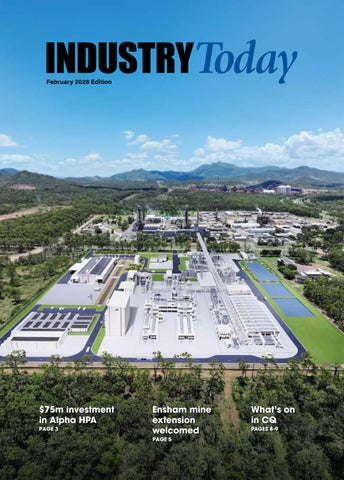
February 2026 Edition
$75m investment in Alpha HPA PAGE 3
Ensham mine extension welcomed PAGE 5
What’s on in CQ PAGES 8-9
INDUSTRY TODAY
CQ women finals-bound Central Queensland women are among the standout finalists recognised in this year’s 2026 Resources Awards for Women, with Blackwater, Rockhampton and Moura represented across key categories. A diesel fitter based in Blackwater, a dragline operator working in the Bowen Basin and a high-achieving student from Moura are among the 18 finalists announced for the prestigious awards, which celebrate women’s achievements across Queensland’s mining and resources sector. Now in its 20th year, the annual awards are run by the Queensland Resources Council (QRC) and Women in Mining and Resources Queensland (WIMARQ), recognising excellence in operational, technical, leadership and emerging talent roles across coal, oil, gas, metals and minerals. Central Queensland finalists include Liberty Cullen, a diesel fitter and field service technician with Hastings Deering, who is based in Blackwater and calls Rockhampton home, and Zoe Burton, a dragline operator and step-up supervisor at Blackwater. Moura is also in the spotlight, with Moura State High School student Giselle Dickson named a finalist in the Exceptional Female QMEA Student category, highlighting the next generation of regional talent coming through the sector. QRC chief executive officer Janette Hewson said the 2026 finalists reflected the depth
of talent across both regional and metropolitan Queensland. “These awards shine a light on the exceptional women, at all levels, shaping the future of Queensland’s resources sector and showing what’s possible,” Ms Hewson said. WIMARQ co-chair Catherine Cook said the finalists’ achievements demonstrated the important role women play in improving safety, productivity and culture across the industry. “From emerging talent to senior leaders, these women are shaping the future of Queensland’s resources sector and their achievements deserve to be celebrated and shared,” Ms Cook said. Hastings Deering managing director and chief executive officer Mark Scott said he was proud of the five nominees from the company this year. “Hastings Deering continues to drive diversity across its business and these awards mean a lot to myself and the team,” Mr Scott said. “We’re lucky to be represented by our exceptional talent in Brisbane and Rockhampton in: Tiffany Kirkwood, Georgia Mehmet, Humaira Ehsan, Liberty Cullen and Bec Wright. “They are outstanding examples of tenacity, resilience and talent for the entire industry.” Award winners will be announced at a ceremony on Friday, 6 March at the Brisbane Convention and Exhibition Centre, coinciding with International Women’s Day and Queensland Women’s Week.
Rockhampton apprentice Liberty Cullen is among the finalists 2026 Resources Awards for Women. (Supplied)
Big fall in spending eases Reserve Bank inflation fears Higher bulk-billing rates and earlier sales have driven a sharp decline in spending, which will take some pressure off the Reserve Bank to raise interest rates again. The RBA hiked the official cash rate for the first time in more than two years earlier in February, citing faster-than-expected growth in private demand pushing the economy out of kilter and causing a resurgence in inflation. But a 0.4 per cent monthly dip in household spending in December, reported by the Australian Bureau of Statistics on 9 February, will help allay fears consumption is gathering steam. The contraction follows rises in spending of one per cent in November and 1.4 per cent in October. ABS head of business statistics Tom Lay said the fall in December indicated households brought forward spending to take advantage of sales events such as Black Friday in the previous two months. “We saw high spending in October and No-
vember, which had major sales and cultural events boost spending,” he said. The falls in expenditure were felt across a range of categories including discretionary items such as electronics, clothing and furniture, as well as essential items like healthcare, Mr Lay said. Clothing and footwear spending was down 2.4 per cent, while health spending declined 1.3 per cent, partly due to higher bulk-billing rates reducing out-of-pocket costs for households, he added. Spending growth fell from six per cent in the year through November to five per cent over the 12 months to December. Despite the monthly decline, Oxford Economics Australia lead economist Ben Udy said spending rises were still running at a solid 0.9 per cent quarter-on-quarter. It would have been even higher, at one per cent, if not for the proliferation of black-market tobacco, which is not included in the official figures.
“Looking ahead, the RBA’s rate hike (in February) will weigh on spending growth in 2026,” Mr Udy said. “However, we expect inflation to cool over the course of the year which, along with solid wage growth, should prevent consumers from turning too sour.” While strong household spending underpinned the surprisingly rapid recovery in private demand, a spike in business investment also contributed. That was largely attributed to a sharp rise in data centre capital expenditure, with a number of large-scale projects coming through the pipeline in the December quarter. However, developers were increasingly running into constraints, most notably around access to reliable electricity, Deloitte Access Economics director Sheraan Underwood said. An extra $28 billion worth of data centre projects were added to Deloitte Access Economics’ investment monitor database in the past year, driving a 57 per cent rise in the value
of projects in the finance, property and business services industries. “The vast majority of these projects remain in the planning stages, meaning the pipeline has yet to translate into a sustained lift in construction activity,” Mr Underwood said. “Progress will depend on continued growth in the use of AI, as well as access to a stable and cost-effective supply of electricity.” It remained too early to tell whether AI would provide the sustained boost to productivity needed to lift Australia’s growth potential and living standards, the report said. But investment in technology infrastructure would enable more data-intensive business models, greater automation and innovation across other industries. Despite the challenges of the energy transition, Australia’s strategic location in the Asia-Pacific and relatively stable regulatory frameworks have made it the second-largest destination for data centre investment after the United States.
Improved regional air services on agenda Telephone: 07 4863 5050 Address: 5-9 Hempenstall Street, Kawana, QLD 4701 EDITORIAL Gregor Mactaggart Editor E: gregor.mactaggart@CQToday.com.au Matthew Pearce Journalist E: matthew.pearce@CQToday.com.au ADVERTISING Cheryl Altouvas Advertising Sales E: cheryl.altouvas@GladstoneToday.com.au Lou De Jager Advertising Sales Executive E: lou.dejager@CQToday.com.au 2 INDUSTRY TODAY February 2026
By McKenzie Neal The future of regional air services is back on the agenda in Outback Queensland, with the State Government launching the next phase of community consultation in the new year. The second round of engagement will see government representatives return to the region over the coming weeks, building on the initial consultation sessions held at the end of 2025. Sixteen sessions are planned statewide, as feedback continues to be gathered on the future of regulated and subsidised regional air routes. The state currently funds seven regulated air services to ensure people living in regional and remote Queensland can access vital medical, educational, social and business services, with the next generation of aviation contracts now under consideration. As part of the latest consultation round, in the coming days locals in Winton and Birdsville are being invited to have their say on how
Gregory MP Sean Dillon. regional aviation services can better meet community needs into the future. In-person sessions will be hosted by the
Department of Transport and Main Roads, alongside continued engagement with councils, industry stakeholders and local Members of Parliament. With existing contracts set to expire in December 2026, the government said the consultation process was a key step in ensuring future services remain reliable, accessible and fit for purpose across Outback Queensland. Gregory MP Sean Dillon said the consultation reflected a commitment to genuinely listening to regional communities. “Air services are a lifeline for regional and remote communities that allow Queenslanders to access essential services, participate in business opportunities, and stay connected with family and culture,” he said. “The feedback already received will directly inform future aviation contracts and we look forward to talking with those on the ground for a second time to help ensure services are delivering for the people who rely on them most.”
INDUSTRY TODAY
$75m boost for Alpha HPA Alpha HPA has announced that the National Reconstruction Fund Corporation has approved a $75 million investment in the company, supporting delivery of the HPA First Project in Gladstone. The NRFC investment was made as a cornerstone commitment in a $225 million funding round, acting as a catalyst to successfully crowd in a further $150 million from institutional investors. This included ongoing support from Orica Limited and AustralianSuper to complete the raise. Alpha HPA managing director Rob Williamson said the investment was a significant milestone for both the company and Australia’s advanced manufacturing sector. “NRFC’s investment is a strong endorsement of Alpha HPA’s strategy, technology and role in building sovereign manufacturing capability in Australia,” Mr Williamson said. “High Purity Alumina is a critical input into semiconductors, lithium-ion batteries and pharmaceutical manufacturing, where ultra-high purity materials are essential for performance, safety and reliability. Our Gladstone HPA First Project positions Australia as a trusted supplier into diversified global supply chains.” Mr Williamson said the project would deliver substantial economic and employment benefits for regional Queensland. “Alpha HPA currently employs around 130 people, and once operational in 2027 the HPA First Project will create approximately 120 additional full-time jobs,” he said. “During construction, the project is expected to generate more than 420 jobs, supporting skills development and long-term industrial capability in Gladstone.” Mr Williamson said the Gladstone location provided a strong industrial foundation for the project. “Gladstone is already home to globally significant industrial operators and offers established infrastructure, a skilled workforce and a deep industrial ecosystem,” he said. The HPA First Project is designed to operate on 100 per cent renewable electricity, using Alpha HPA’s proprietary processing technology. The process delivers near-zero waste, lowemissions production and a purity profile that differentiates Alpha HPA globally. “We are now in the supply chain for semiconductors for AI at small volumes with production from our Stage One facility thanks to the technological advantage our unique process offers over our competitors,” Mr Williamson said. “The unique selling point of our materials is what underpins customer demand and positions Alpha HPA as a long-term supplier of choice into these expanding, critical global markets.” Gladstone Regional Council Mayor Matt Burnett said the news was a fantastic announcement that reinforces the Harbour City’s role as Australia’s centre for advanced manu-
Alpha HPA has announced that the National Reconstruction Fund Corporation has approved a $75 million investment in the company, supporting delivery of the HPA First Project in Gladstone.
Alpha HPA managing director Rob Williamson said Gladstone’s location provided a strong industrial foundation for the project. (Supplied) facturing and industrial development. “This funding supports 420 jobs during construction and 80 ongoing operational positions, diversifying our local economy but importantly reinforcing our global reputation as the region to invest,” Cr Burnett said. “Global demand for critical mineral processing is heating up and Alpha HPA is well positioned to capitalise on this thanks to this investment from the Federal Government.” Gladstone Engineering Alliance vice-president Cameron Hausler said the funding was an acknowledgement of the innovation and diversification in Gladstone’s industrial base. “It also shows confidence in the future of Central Queensland’s advanced manufacturing capability and capacity to service and supply the global critical mineral market,” Mr Hausler said. “This announcement further reinforces Gladstone’s reputation as an industrial powerhouse and helps to attract innovative, highvalue industries and high-tech manufacturing enterprises to set up operations here in Central Queensland.” Mr Hausler said the investment in Alpha HPA would strengthen resilience across the supply chain and reinforce Gladstone’s reputation as an advanced manufacturing hub. “It’s great news for local workers, with more than 100 additional full-time jobs created at the new facility once construction is completed,”
he said. “Effectively, Alpha will almost double its workforce capacity. “It also provides new career pathways in critical mineral processing and advanced, hitech manufacturing. “The investment is strongly complementary to Alpha HPA’s existing long-term funding support from the Northern Australia Infrastructure Facility, Export Finance Australia and Queensland Investment Corporation, and follows NRFC’s comprehensive due diligence process.” NRFC chief executive officer David Gall said the investment reflected the strategic and national importance of Alpha HPA’s project. “This investment backs a truly innovative Australian company while also strengthening Australia’s economic security and supply chain resilience around a critical material that is essential to the future economy,” Mr Gall said. “The National Reconstruction Fund is delighted to support an Australian company commercialising breakthrough intellectual property to produce materials that Australia and the world will increasingly rely on.” Export Finance Australia managing director and chief executive officer John Hopkins reinforced the value of the HPA First Project. “EFA welcomes the next step in Alpha HPA’s investment and financing arrangements,” Mr
HPA First Project aerial view of the eastern boundary, January 2026. Hopkins said. “We look forward to continuing to work with Alpha HPA, which is receiving support through the Australian Government’s critical minerals facility and our own commercial account.” Alpha HPA noted that the capital raising reflects the opportunity to strengthen the balance sheet, accelerate delivery and position the company for future growth. “Demand fundamentals across semiconductors and other advanced manufacturing continue to strengthen,” Mr Williamson said. “As the HPA First Project progresses, Alpha HPA is also assessing opportunities to expand the project through a potential third stage, reflecting customer interest and the scalability of our technology platform.” Settlement of the institutional placement is expected following completion of the capital raising process. Federal Industry and Innovation Minister Tim Ayres said the investment would strengthen Gladstone’s position as a major industrial hub. “This investment will deliver Australia’s first commercial-scale High Purity Alumina facility in Central Queensland, creating hundreds of jobs and strengthening Gladstone’s position as a major industrial hub,” Senator Ayres said.
Environment
CQG is a passionate advocate for local businesses Rockhampton | Gladstone | Brisbane | Mackay | Townsville
Engineering
Planning
www.cqgroup.com.au • +617 4922 9252 12660440-MS03-24
February 2026 INDUSTRY TODAY 3
INDUSTRY TODAY
Eleven fresh faces Momentum Thousands of Central Queensland apprentices have recently returned to CQUniversity’s TAFE workshops in Emerald, Gladstone, Mackay and Rockhampton for their 2026 training. Among the cohort is a new group of 11 apprentices who have just started roles with Gladstone’s largest employer – Queensland Alumina Limited (QAL). The addition of the new apprentices now means QAL has 51 team members currently completing apprenticeships – 21 in Mechanical Fitting, one in Boilermaking, and 29 in the dual trade Electrical and Instrumentation – while being supported by CQU TAFE to complete their trades. The 11 new apprentices were recently introduced to CQU’s Gladstone trade training facilities and all are now keen to hit the ground running. First-year Mechanical Fitting apprentice, Linzi McBean, was very excited to get to work. “I’m most excited about learning new skills for my trade and about working with the machines at CQU, which will help me boost my career at QAL,” she said. “I am also excited about meeting and working with new apprentices and tradespeople in different disciplines.” Fellow first-year Mechanical Fitting apprentice, Mitch Sutherland, said he was looking forward to getting his “hands dirty”. “Gaining skills and experience while undertaking my trade is what I’m anticipating the most,” he said. “Getting my hands dirty and working as a mechanical fitter has been something I have aspired to achieve for a while now.” “Getting that mix of hands-on work, theory and safety is incredibly valuable and it’s what is done at both QAL and CQU. Overall, this experience will set me up for my trade, and an
gathering at Mt Chalmers By Kieran Moran, Director at Connecting Industry
Eleven new apprentices at Queensland Alumina Limited have embarked on the early stages of their careers. (Supplied) amazing future career for me in mechanical fitting.” First-year Electrical and Instrumentation apprentice Tayla Dicton agreed. “I’m really looking forward to diving into my trade because it’s a completely new experience for me, and I can’t wait to meet and work with new people,” she said. “I am also keen to start at CQU because of the hands-on training, the support services provided and the opportunity to collaborate with other apprentices.” QAL Apprentice Trade training officer Lauren Faulke said it was a proud moment seeing the new apprentices begin their training. “Before they start at CQUniversity TAFE, we run a short foundational program at QAL that introduces them to the basic fundamentals of their trades and safe work practices,” Lauren said. “Doing this means when they arrive at TAFE
for their training blocks, they have some context around the tools, terminology and expectations, which really helps their confidence. “Watching their skills grow both at CQU and on site is incredibly rewarding for QAL.” QAL Apprentice and Trade coordinator John Burgess said QAL’s relationship with CQU had been strong for many years. “Our partnership with CQU is proving time and time again that the facilities and trainers in Gladstone are second-to-none,” he said. CQUniversity delivers trades training in several disciplines including building and construction, electrical, engineering and automotive. For more than a decade, CQUniversity has been the public provider of TAFE in Central Queensland and has invested millions in new facilities and equipment to support employers and industry and help future trade professionals to build their skills.
Resource sector’s call before state budget Queensland’s resources sector is sharpening its focus ahead of the next state budget, urging the government to deliver more competitive settings and a fairer approach to coal royalties as the industry faces mounting pressure. Global competition, rising business costs, shifting regulations and ongoing skills shortages have created strong economic headwinds for one of Queensland’s biggest industries. In response, the Queensland Resources Council (QRC) has lodged its pre-budget submission to Treasury, setting out priorities for the 2026–27 state budget aimed at restoring confidence and attracting new investment. The submission calls for economic settings that support the long-term prosperity of Queensland, particularly in regional communities where resources projects underpin jobs and local economies. Key recommendations include revisiting coal royalty rates, publishing an annual regional royalty expenditure state-
ment, expanding funding for workforce skills and decarbonisation, and boosting support for exploration and the next generation of resource projects, including critical minerals needed for energy security and the transition. QRC chief executive officer Janette Hewson said recent government steps to rebuild confidence, including decisions made through the Resources Cabinet Committee, had been welcomed by the sector. “We are seeing improvements and want this to continue with meaningful changes for a sustainable and investment-ready sector,” Ms Hewson said. She said the resources industry remained a cornerstone of the Queensland economy, supporting one in every five jobs, spending $35.8 billion with 17,600 businesses and backing more than 1700 community organisations across the state. “If we want that level of returns to
Queensland to continue long-term, we seek the government’s support to respond to changing market and global conditions,” she said. Ms Hewson said achieving a more balanced coal royalty regime remained critical, along with ensuring regional communities received a fair share of the returns generated in their own backyards. “The regions who generate all the royalties from resources produced in their communities need a fairer share for their own hospitals, roads and public amenities, as well as common user infrastructure like power and rail,” she said. With budget preparations under way, the sector is now looking to the Government to turn those priorities into policy, arguing that the future strength of Queensland’s economy depends on getting the settings right.
SUPPORTING THE GLADSTONE REGION FOR OVER 40 YEARS 17 Garfield St Gladstone 4680
07 4976 7999 www.walzgroup.biz
12659187-JC03-24
4 INDUSTRY TODAY February 2026
QMine Limited has sharpened its development strategy for the Mt Chalmers Copper–Gold Project, setting a clear and disciplined pathway toward construction and first production. The updated plan prioritises a singleasset, expandable 1 Mtpa development model, designed to fast-track the Definitive Feasibility Study (DFS), streamline approvals and reduce execution risk while focusing on early cashflow and capital discipline. Environmental studies and approvals are being progressed in parallel with technical work, positioning the project for construction readiness with an indicative pathway showing environmental assessments, investment decisions and 1 Mtpa construction through 2026– 2029. This refreshed strategy underlines QMines’ intent to move Mt Chalmers from study into delivery and it’s exactly what founder and executive chairman Andrew Sparke will be unpacking at the next Connecting Industry Luncheon on Wednesday, 18 February, where local suppliers and industry can hear first-hand about the development timeline and upcoming opportunities as the project moves closer to construction. Register now at www.connectingindustry.com.au/connecting.../
QMine founder and executive chairman Andrew Sparke (left) will be unpacking at the next Connecting Industry Luncheon on Wednesday, 18 February. Pictured with colleagues at Mt Chalmers Mine. (Supplied)
INDUSTRY TODAY
Nine more years for mine The State Government approval of a $314.9 million extension to Ensham coal mine east of Emerald has secured the future of more than 700 workers. The approval adds another nine years to the underground operation, tapping into a potential further 88 million tonnes of coal and ensuring future supply to both domestic and international markets. The project was approved by the Federal Government in 2023 under the Environment Protection and Biodiversity Conservation Act, and its State approval follows the development of a Greenhouse Gas Emissions Reduction Management Plan. Gregory MP Sean Dillon said the approval would provide certainty for local families and businesses across the Central Highlands. “This is great news for our region, particularly the workers at Ensham, their families, and the many local businesses that support the mine and benefit from it,” Mr Dillon said. “When you secure more than 700 jobs in a regional community, that means school fees are paid, apprentices are taken on, and small businesses are backed in. “Our region has always carried its weight when it comes to powering Queensland’s economy, and this approval shows that under the Crisafulli Government, our contribution is both respected and backed in.” Flynn MP Colin Boyce welcomed the news, saying “coal is king” in Central Queensland. “I’m a great big supporter of the coal industry and all of the people and families that work in the coal industry,” he said. “It’s a very good decision by the Crisafulli government to approve the extension of that mine, a good decision all around.” Central Highlands Regional Council Mayor Janice Moriarty said the expansion was positive news and a strong sign of confidence in the resources sector. “It’s supporting local jobs and delivering flow-on benefits for families, schools, businesses and communities across the Central Highlands,” Mayor Janice Moriarty said. Natural Resources and Mines Minister Dale Last said the approval delivered the type of certainty that industry has been advocating for. “This is what certainty looks like under the Crisafulli Government,” Mr Last said. “More than 700 jobs in Central Queensland have been secured because we worked with Ensham’s proponent Sungela to ensure their mine extension delivers for Queensland. “We’re doing what we said we would - restoring confidence, delivering certainty and getting Queensland open for business again. “Queensland’s world-class coal industry has a strong future, with more than 400 coal-fired power stations under construction around the world and global coal demand nearly doubling since 2000.” South African-based miner Thungela Resources assumed control of 100 per cent of Ensham in February 2025, buying into it two years
Ensham mine’s thermal coal underground operation has been granted approval for an extension that adds another nine years to the site east of Emerald in the Central Highlands. (Supplied)
State Natural Resources and Mines Minister Dale Last said the approval of the Ensham Mine extension delivered the type of certainty that industry has been advocating for. (Supplied) earlier when the controlling stake was offloaded by Japan’s Idemitsu Kosan. In its pre-close statement on 31 December, Thungela noted challenging geology at Ensham for the first half of 2025 impacted quality and resulted in a high stockpile of lower quality
run of mine thermal coal. “Our marketing team in Dubai successfully secured contracts for the lower quality coal which has resulted in improved sales and lower stockpiles. “Accordingly, we expect to report export
saleable production 3.8 million tonnes at Ensham, which is within the guidance range of between 3.7Mt to 4.1Mt.” The company expected to announce capital expenditure of $57.988 million for the 2025 financial year. Lock the Gate and Coral Rowston from Environmental Advocacy in Central Queensland lodged objections to the extension and in March, 2025, the Land Court made a decision to recommend against its approval. The Minister is not required to follow the recommendation of the Land Court and the Minister has decided today to approve the mine. Lock The Gate national coordinator Ellen Roberts said Mr Last’s “unprecedented decision” to approve the Ensham extension would lead to more climate disasters for Queenslanders. “Minister Last conveniently doesn’t mention that the Queensland Land Court recommended against this mine - given that the company had failed to meaningfully reduce the greenhouse gas emissions released during the mining process,” she said. “It is highly unusual, possibly unprecedented, for the Minister not to follow the recommendation from the Land Court. “Coal mines leak huge amounts of methane gas during the mining process and mines are expected to pull their weight and implement measures to prevent gas leaks, and the Land Court found that Ensham mine’s owners have made no effort to do so.”
THE FUTURE IS HERE >>>
BUILT FOR
OFF GRID
NEW
LIVING Solar buildings that power your site anytime & anywhere
RID OFF-G SOLAR Y FACILIT
8.85kW PV
Cool & Quite: Crimsafe, Tropical Roof & well insulated
15x 590w Solar Panels
MEET RENEWABLE TARGETS REDUCE EMISSIONS IMMEDIATE SITE OPS
Up to
32.80 kWh Lithium Phosphate battery
READY TO GO SOLAR? CONTACT US NOW.
www.multitrade.com.au 12756359-KF20-25
February 2026 INDUSTRY TODAY 5
INDUSTRY TODAY
Three new gas exploration areas set to be unlocked Three new gas exploration areas have been unlocked near the Queensland–South Australia border, laying the foundations for the next wave of gas production. The State Government is securing the new gas exploration investment across a landmass almost three times the size of the ACT for Queensland’s future energy needs. Santos QNT Pty Ltd and Drillsearch Energy Pty Ltd have been named preferred tenderers for three gas exploration areas in the CooperEromanga Basin, near the Queensland-South Australia border. The areas form part of a wider package of exploration areas opened for tender last year, aimed at unlocking future gas supply and putting downward pressure on energy prices. Natural Resources and Mines Minister Dale Last said the State Government was delivering more gas supply and more certainty for Queensland. “This exploration investment sends a clear message that Queensland is open for business, and we’re serious about getting more gas into the system to relieve energy pressures,” Mr Last said. “Gas is critical to our state’s energy mix and to the industries that power regional economies. These exploration areas are the next step in delivering the supply needed to support investment, create jobs and ease energy pressures across the board. “By appointing capable explorers, we’re
Santos QNT Pty Ltd and Drillsearch Energy Pty Ltd have been named preferred tenderers for three gas exploration areas in the CooperEromanga Basin, near the Queensland-South Australia border. A Santos gas well. (File) laying the foundations for new production that will keep Queensland’s resources sector strong into the future. “That’s why we’re also preparing further areas for release later this year, to maintain a strong pipeline of new projects that will keep Queensland’s gas supplies flowing and delivering continued investment across our state. “ Santos Australia and PNG Upstream Oil
and Gas chief operating officer Brett Darley said the exploration acreage was unlocking new opportunities. “We welcome the Queensland Government’s leadership in releasing and awarding exploration acreage which will unlock new supply for Australian homes and businesses,” Mr Darley said. The State Government has also pub-
lished the results of industry consultation on Queensland’s land release process to support a faster, more transparent tender process, with clearer prioritisation of exploration areas and earlier engagement with local governments. The Land Release Review summary can be found at www.nrmmrrd.qld.gov.au/miningexploration/initiatives/improving-land-release-in-queensland
No date for re-opening yet By Di Stanley One month after the death of Sunshine Coast miner Jeffrey Palmer, operations at Blackwater’s Mammoth underground mine remain suspended. Mr Palmer, 59, died on 2 January due to a roof collapse above the bolted zone during routine equipment movement. In its quarterly report, Coronado Global Resources said the death of Mr Palmer, 59, and another fatality at its Logan Complex in West Virginia, United States, in mid-December, 2025, were sobering reminders of the dangers of the industry. “Tragic events like this are never acceptable,” Coronado managing director and chief executive Douglas Thompson said. “We are working with the relevant authorities to understand the cause of these incidents and implement remedial actions and changes were required. “The health and safety of our people have always been, and remain, our top priority. “Our leaders have worked steadily through a year of intense activity and difficult moments, staying focused on supporting our people and keeping the business moving forward.
“I’m grateful for their resilience and consistency, which have helped us make real progress and celebrate important milestones, while also working through some very hard times.” The report said Coronado’s resources had been made available to Mammoth Underground Mine Management, the contracted operator for the venture, while they cooperated with union and government investigators. According to a preliminary report into the fatal incident, a multibolter machine was being trammed back from the bolted face to the next work area when the roof collapsed on to a coal mine worker who was handling the bolter cable. The incident has led to an industry-wide review of underground mines’ support designs. A Coronado spokesperson said no date had yet been announced for the reopening of Mammoth Mine. Mr Thompson said the open cut operations at the dual open pit Curragh mine complex had delivered strong results. The on-site coal handling and preparation plant will undergo targeted work to unlock additional capacity and improve performance. “Since reporting a six-year record in ROM
CHAUVEL INDUSTRIAL SERVICES
• On-site maintenance, shutdown and workshop facilities • Mechanical and Fabrication • Pumps, pulleys, conveyor supply and service • Civil and concreting 12659322-KG03-24
• Blast and paint
Exceeding Expectations
07 4926 8588 | chauvel.com.au Head Office: 26 Hempenstall St, Nth Rockhampton Emerald: 6 Daniels St, Emerald 6 INDUSTRY TODAY February 2026
(run of mine) production in June at the Curragh complex, each subsequent quarter has surpassed long-standing production trends,” he said. “Q3 delivered strong growth across all production and sales metrics, including the highest saleable production since Q1, 2021, and another quarter of coal improvement. “Q4 continued this momentum, setting new records across production metrics and marking our fourth consecutive sector of sales growth.” Mr Thompson said Coronado’s liquidity had been strengthened following the $265 million refinancing of its asset-based loan facility with Stanwell Corporation in a deal that extends the company’s new coal supply agreement out to 2043. “The November, 2025, transaction with Stanwell brings forward the long-awaited FY27 reset of our coal supply arrangement by a year, and the expected cash flows from the new arrangement, under certain liquidity conditions, exceed what would have been achieved under the original reset,” he said. “This change will allow us to review the entire Curragh operating model, with a goal of prioritising higher margin product outcomes.”
Jeffrey Palmer, the contractor who died when the roof collapsed at Mammoth Mine, near Blackwater, on 2 January. (File)
State’s brightest sparks to get $2.6m in support Queensland’s innovators and entrepreneurs are set to take their ideas further, with the State Government awarding more than $2.6 million through the latest rounds of the Ignite Ideas Fund and Ignite Spark Program. The funding will support 30 local businesses, including high-growth SMEs and early-stage innovators, helping them develop products, reach new markets, and prepare for customer trials. Since the programs began, more than 520 Queensland businesses have received support. Projects funded this round showcase the state’s cutting-edge innovation, from a worldfirst blood test to predict postnatal depression and female-designed cricket armour, to railsafety detection technology and AI systems aimed at reducing bird-strike risks at airports.
Science and Innovation Minister Andrew Powell said the investment was about backing bold ideas and creating jobs. “Queensland is a global leader in cuttingedge solutions, which is why we’re backing more opportunities for our local start-ups and entrepreneurs,” Mr Powell said. “Innovation can be a tough space for earlystage businesses, and this funding helps bridge the gap by giving them the resources to keep moving forward. By accelerating the journey from prototype to market-ready product, we’re helping local businesses grow, compete and reach new markets. “This support leads to new jobs, stronger industries and more opportunities right across Queensland.”
INDUSTRY TODAY
Thumbs down on merger By Reuters Rio Tinto has walked away from takeover talks with Glencore, ending months of negotiations over a tie-up that would have reshaped the global mining industry. The proposed merger, first announced in January, would have created the world’s largest mining company, with a market value exceeding $US200 billion ($A286 billion). It is the second round of failed discussions in just over a year, following an earlier approach by Glencore in late 2024 and the third in total. Talks late last year were also initiated by Glencore, according to a source familiar with the matter. Glencore’s shares closed 7 per cent lower at 467 pence. Rio Tinto’s London-listed shares were down 2.6 per cent at 6,820 pence. Rio Tinto told shareholders on Thursday that it “is no longer considering a possible merger or other business combination with Glencore”. Attempts ?to combine the companies have repeatedly fallen short. The British-Australian company also rejected a ?merger approach from Glencore in 2014, saying it was not in the best interests of shareholders. However, the latest round of discussions marked a departure from past efforts. The source described it as “the first time there has ever been a really serious, rigorous due diligence process”. Although transition metal copper was an obvious motivation for a deal, Rio Tinto was seeking to acquire Glencore in its entirety, including its coal assets and marketing business. “We concluded that the proposed acquisi-
Rio Tinto has walked away from takeover talks with Glencore, ending months of negotiations over a tie-up that would have reshaped the global mining industry. tion ... does not reflect our view ?on long-term, through the cycle relative value, including not adequately valuing our copper business, and its leading growth pipeline,” Glencore said in a statement. Glencore talked up its copper assets at an investor day in December, when it said it aims to reach 1.6 ?million metric tonnes by 2035 through new and restarted mines and streamlined operations, from 852,000 tonnes last year.
Global copper demand is expected to rise 50 per cent by 2040, benefitting from the energy transition and artificial intelligence demand, and global miners are racing to bulk up. Analysts at HSBC had estimated an average deal premium of 30 per cent, which would have given Glencore’s shareholders 38 per cent of a combined company. The companies did not reveal the terms proposed and rejected.
The abandoned talks echo other ambitious mining deals that have faltered, including BHP’s $US49 billion approach for Anglo American, which unravelled over concerns about the structure of the offer. The only deal still proceeding is a plan for a $US53 billion all-stock, nil-premium merger between London-listed Anglo American and Canada’s Teck Resources that would create the world’s fifth-largest copper producer.
Qantas airport lounge upgrades await in CQ Qantas is continuing with a major refresh of its Regional Lounge network, with upgrades set to commence for seven lounges across Australia over the coming weeks. The Qantas lounge at Gladstone Airport will be temporarily closed during these works from 5 to 18 February, while the Rockhampton lounge will be closed, 5 to 18 February. The upgrades are part of the Flying Kangaroo’s multi-million-dollar regional lounge investment, which will deliver improved comfort, upgraded amenities and a more contemporary design for customers travelling through some of its key regional destinations. Each lounge will receive a refreshed interior featuring a distinct, new colour palette inspired by the region’s natural landscapes. Customers can expect modern furni-
ture and improved seating options, refined finishes such as new flooring and updated surfaces, as well as upgraded technology including more charging points and entertainment displays. QantasLink chief executive officer Mark Dal Pra said the airline was committed to improving the travel experience for customers right across regional Australia. “These investments are part of our commitment to ensuring customers have great experience with us both on the ground and in the air. “We know how much our frequent flyers value our regional lounges, whether it’s to grab a drink and a snack, or as a quiet place to get some work done. “We apologise for the inconvenience while we renovate, but we’re confident the finished product will make it worthwhile.”
The Qantas Club lounge opened at Rockhampton Airport in 2022. Both Rockhampton and Gladstone are receiving upgrades and will be closed for about two weeks throughout February. (Qantas) 12829632-PS02-25
February 2026 INDUSTRY TODAY 7
INDUSTRY TODAY
Trusted training provider My Skills Institute (MSI) is Central Queensland’s trusted and locally focused training provider, dedicated to delivering high-quality, industryrelevant education that strengthens regional workforce capability. As the Registered Training Organisation of Apprentices and Trainees Queensland (ATQLD), MSI provides practical, job-ready training across a wide range of industries including High Risk Work, Construction, safety and customised skills programs tailored to local employer needs. What sets MSI apart is our strong commitment to local trainers delivering training for local industry. Our experienced team is based across Gladstone, Biloela, and Rockhampton, ensuring communities have access to skilled trainers who understand the region’s industries, challenges, and workforce demands. In Gladstone, our trainers work closely with major industrial, construction, and port-related sectors, delivering training that supports operational excellence and safety across one of Queensland’s largest industrial hubs. In Biloela, our trainers support the agricultural, mining, and energy sectors, providing flexible and responsive training that meets the needs of a diverse rural workforce. In Rockhampton, our training team services construction, civil, and commercial industries, helping workers and businesses maintain strong compliance and safety standards while building capability for future growth. MSI’s “locals training locals” approach ensures that training is practical, regionally relevant, and aligned with the real needs of Central Queensland businesses. WELCOMING RTO BUSINESS SERVICES MANAGER - DAVE SMITH We are excited to welcome Dave Smith as MSI’s new RTO Business Services Manager.
Dave Smith has joined My Skills Institute as RTO Business Manager. Many in Central Queensland will recognise Dave from his extensive background as a High Risk Trainer and Assessor, where he has built strong industry relationships and earned a respected reputation for delivering quality training. Dave’s on-the-ground experience, combined with his passion for developing skilled workers, makes him a valuable addition to our leadership team. As MSI continues to grow, Dave will play a key role in strengthening our operations, enhancing service delivery, supporting our trainers and administrative teams, and driving new opportunities across the region. His leadership will support MSI’s continued commitment to delivering high-quality training that benefits our communities.
Dave Smith has joined My Skills Institute as RTO Business Manager. (Supplied)
12842863-KF07-26
8 INDUSTRY TODAY February 2026
12838318-JV08-26
February 2026 INDUSTRY TODAY 9
INDUSTRY TODAY
Reserve Bank boss throws down gauntlet to businesses The Reserve Bank governor has called on businesses to help lift Australia’s sluggish productivity growth as she tries to bring inflation under control. Facing a string of questions about the government’s role in driving up inflation at a parliamentary grilling in Canberra, Michele Bullock looked to the private sector for a helping hand. Lacklustre productivity growth was a contributing factor to the imbalance between demand and supply in the economy, which forced the Reserve Bank to raise interest rates earlier this month, Ms Bullock said. An uptick in business investment towards the end of 2025 provided a ray of hope that it could flow through increased productivity, as more equipment and technology per worker make the economy more efficient. Much of that increase in investment was due to a few large data centre projects, but Ms Bullock hoped it signalled a more sustained pick-up and not just a few big lumps.
Reserve Bank Governor Michele Bullock acknowledged lower public spending would help close the gap between demand and supply in the economy, all else being equal. (Dan Himbrechts/AAP) “If we are to get productivity improvements, we need two things: we need investment so that we can get more labour productivity; but we also need businesses to be thinking about
how they combine labour and capital in more efficient ways,” she said. “Certainly, our analysis of productivity at a higher level is that both of those things have not been occurring, and that’s part of the reason for the slowdown in productivity.” Higher productivity growth would allow for both public and private demand to grow faster without contributing to inflation. Much of the hearing was devoted to whether the federal government was at fault for running the economy too hot by failing to control budget spending. Amid a barrage of questions from Liberal MPs, Ms Bullock was careful not to directly criticise the Albanese government for spending blow-outs. But she acknowledged lower public spending would help close the gap between demand and supply in the economy, all else being equal. “Mathematically, if government spending declines, public demand doesn’t grow as
quickly, if you like, then that will bring down aggregate demand, unless the private sector picks up the slack,” she said. December’s mid-year budget update projected Commonwealth spending to hit 26.9 per cent of GDP this financial year - the highest level since the 1980s, excluding the COVID-19 pandemic Asked if the Reserve Bank’s quick turnaround between its last rate cut in August and its first hike six months later was a sign of an error by the board, Ms Bullock said they always knew it would be tricky when interest rates got to a neutral position. “I think it reflects the fact that we’ve been trying very hard to bring the economy down on a soft landing,” she said. “It would have been very easy to bring the economy to its knees ... just increase interest rates a long way. We tried not to do that. “The labour market is in a good position. Inflation is higher than it should be ... but it’s not a disaster at the moment.”
Gladstone can REIP rewards By Di Stanley Gladstone is being touted as a leading Renewable Energy Industrial Precinct (REIP) candidate, but the race is on to power up the region’s clean energy sector and capitalise on the lion’s share of a $300 billion green export market. Heidi Edmonds from Beyond Zero Emissions, an independent think tank, said Gladstone was one of 16 priority areas identified and “one of the most critical forward-looking cities in Australia”, with heavy industry ripe for 100 per cent decarbonisation. Gladstone, she added, possessed the infrastructure, skills, knowledge and willingness to embrace a clean, green future. “REIPs are historical hubs capable of thriving through the renewable energy transition,” Ms Edmonds told councillors in a Powering Up Gladstone presentation on Tuesday, 3 February. “When they are realised, they twin heavy industry powered by nearby renewable energy generation and storage. “Beyond Zero Emissions research shows that across Australia, the implementation of REIPs has the potential to lead to $300 billionplus in clean exports annually. “This compares with the current scale of fossil fuel exports, which are declining. “We think there is a large opportunity for the Gladstone region with high potential impact, protecting jobs, growing economic benefits and reducing emissions.” Ms Edmonds said in Gladstone, industry was keen to join the energy transition but could be roadblocked by an infrastructure lag. “We applaud ongoing support and progress for the Gladstone Project transmission infrastructure, but we need to accelerate the renewable energy rollout for solar, wind and storage, and ensure hydrogen infrastructure is on the horizon,” she said. “All this will require improvements to government policy. “As the anchor tenant in the Gladstone region ... Rio Tinto has made strong steps to decarbonise their alumina and smelter operations; however, their progress is at risk due to the infrastructure delays that impact their access to reliable and low-priced power to support these plans.” Beyond Zero Emissions senior researcher Matt McKee said upper levels of government were sending mixed messages to potential renewables investors by continuing to greenlight fossil fuel projects. To realise energy-intensive future industries like green iron and green hydrogen for Gladstone, Mr McKee said renewable developers should work with council to identify what capacity was needed and where, while achieving the best community outcome. “When we actually talk about action rather 10 INDUSTRY TODAY February 2026
The potential for Gladstone’s to be powered by 100 per cent renewables and a centre of manufacturing for energy-intensive exports was discussed at a presentation to council by think tank Beyond Zero Emissions representatives on Tuesday, 3 February. (Supplied) than announcements, a lot of it is on the developers, and when this (report) was written, there were so many projects that were stuck in the Federal Government’s EPBC process,” he said. “Some of those are becoming better managed and they’re getting through there. “One of the biggest problems with a lot of these projects is the bankability ... so a lot of these companies are making big promises but then maybe don’t have offtake agreements and therefore struggle to get financing for a couple of billion dollars’ worth of infrastructure.” Cr Glenn Churchill said the Gladstone region had been oversubscribed by renewable proponents wanting to be part of the energy zone, as he queried strategic land use and the advocacy role to be played by councillors. “We want it to happen in the right place, we don’t want it in the wrong place,” he said. “And if the community is telling us it shouldn’t be there, then we need to get this hub right.” Ms Hopkins said everyone was grappling with the need to roll out renewable energy as quickly as possible. “We also need to minimise our impact on nature and we definitely want the impacts on communities to be net positive, and we want the benefits from these projects to be shared,” she said. Deputy Mayor Natalia Muszkat acknowledged the differing opinions towards renewable developments within the local government boundary.
“I think most of us agree that this is happening, whether we like it or not,” she said. “It is just the way we need to move forward.” Cr Chris Cameron said even though renewable projects were now approved by the State Government, he was aware there was a proliferation of battery energy storage systems (BESS) proposed for the Gladstone region as developers scaled down much larger hybrid projects. “The reason why it is happening Australiawide is because batteries are easy to build and they are quick to build,” Mr McKee responded. “Across Australia, the typical battery build timeframe is between 12–18 months, whereas solar farms are a couple of years and wind farms, especially here in Queensland, go to 10 years almost. “So, there is a speed to build.” Mr McKee said another inhibiting factor in the Queensland renewables rollout was the lack of alignment between state and federal policies. He praised the council’s 2022–2032 Economic Transition Roadmap. “Your industry strategy in Gladstone is one of the best we’ve seen, either formally or informally across Australia and, bluntly, across the world,” he said. “It’s really, really good. “You have groups like the Gladstone Engineering Alliance, but getting the disparate facilities talking more closely and thinking how they can best work together to execute the Gladstone industry strategy is, for us, the
Gladstone is being touted as a leading Renewable Energy Industrial Precinct (REIP) candidate, but the race is on to power up the region’s clean energy sector and capitalise on the lion’s share of a $300 billion green export market. (File) biggest opportunity.” Mayor Matt Burnett said he agreed there was misalignment between state and federal policies, but his goal as mayor was to tap into the treasuries of both. “And if one wants to build a hydrogen project, then we’ll have it,” he said. “And if one wants to build another project that’s not hydrogen-related, well, we’ll have that too. “There’s still plenty of investment in Gladstone.” Cr Burnett said he was hopeful that either Sumitomo or Vena Energy would be successful in securing funding under the Federal Government’s Hydrogen Headstart program for a Gladstone base of operations.
INDUSTRY TODAY
CleanCo out of Moah Creek By Matthew Pearce State Government-owned CleanCo Queensland will not exercise its option to acquire the Moah Creek Wind Farm project. Central Queensland Power is seeking to develop the Moah Creek Wind Farm within a 10,910ha area consisting of 31 lots, located 30km west of Rockhampton and 10km north of Stanwell. It will consist of 60 wind turbine generators capable of producing up to 372MW of electricity. CleanCo had an agreement with Central Queensland Power to help develop the project, with a financial option at the end of development, but prior to construction, to purchase the project. A spokesperson for the publicly owned generator said CleanCo had decided not to exercise this option, citing ongoing assessments of its pipeline of development projects. “CleanCo believes onshore wind is a critical part of the energy transition, particularly in Central Queensland,” they said. “This decision is aligned with the Queensland Government’s Energy Roadmap, which encourages the attraction of private sector investment in the energy sector. “Project development is complex and all projects must continue to be tested against market conditions as they evolve.” The spokesperson said CleanCo regularly reviews projects in development to ensure they remain aligned with portfolio needs. “CleanCo continues to actively support new renewable energy projects across Queensland, including through long-term offtake arrangements with private developers,” they said. “This allows CleanCo to bring new wind, solar and storage online while remaining focused on affordability, reliability and sustainability for Queensland’s energy future.” After pulling out of the Moah Creek project, the State Government and CleanCo announced a 10-year agreement with Windlab to secure 75 per cent of Kennedy Energy Park’s wind energy output from 2028. A Central Queensland Power spokesperson said while CleanCo would not proceed with the
Central Queensland Power is seeking to develop a wind farm at Moah Creek, 10km north of Stanwell. option to acquire the Moah Creek Wind Farm project, CQP’s development program would continue, including engagement with landholders and other stakeholders. With the State Government’s Energy Roadmap identifying the need for up to 6.8 GW by 2035, the spokesperson said projects like Moah Creek are essential to delivering a clean, reliable and cost-effective energy future for Queenslanders. Central Queensland Power remains open to exploring a future offtake agreement with CleanCo. Mirani MP Glen Kelly, who lives in the vicinity of the project, said CleanCo had made
the right decision for the people of Kalapa, Wycarbah, the local communities and the people of Queensland. “This project has created a lot of lost sleep in the community around it, with poor community engagement and a lack of genuine interest in the people that will be impacted if this goes ahead,” Mr Kelly said. “This project is not the right place for wind turbines. There’s 150 homes and structures within 1.5km to 5km of a turbine and none of those people knew anything about this project until the plans were all done up. “CleanCo withdrawing their ownership option for this project is a big win for the sur-
rounding community, because it shows that they’ve seen the failure from CQP to work with the community to build that social licence, it shows that the environmental impact is going to be too great, and it shows that it’s a project that just doesn’t stack up. “It’s no surprise to me that we’ve seen this happen, when community consultation sessions were more like community lectures, where questions around concerns are never answered, where the developer lies to the community.” Grazier Nick Holland, whose property neighbours the project site, said while CleanCo’s decision had come as a surprise, it was a decision that he was “quite happy” with. Last year, Mr Holland presented Mr Kelly with a petition with about 1000 signatures calling on the State Government to withdraw all investment into the Moah Creek Wind Farm. “There was a lot of taxpayer dollars that would have gone into that project, for a project that’s not situated in the right location and affects quite a number of people,” he said. Mr Holland said developers had not engaged with the community from the start, despite residents citing visual and noise concerns, as well as the impact on local roads and other issues. “This just isn’t the right location for a project of this scale,” he said. The Central Queensland Power spokesperson said CQP had undertaken extensive community engagement over several years, including multiple public information sessions, an independently chaired Community Consultative Committee, direct engagement with landholders, and ongoing dialogue with Traditional Owners. CQP director Matt Rebbeck said Moah Creek remained well-positioned to be a critical project for Queensland’s affordable, reliable and sustainable energy system. “We are grateful for the constructive engagement from community members, landholders and Traditional Owners as we progress toward key milestones,” he said. CQP remains committed to continuing community engagement openly and constructively as the project progresses.
$2b Wooderson hybrid solar farm is on the move By Di Stanley A major $2 billion solar and battery hybrid project proposed for the Gladstone region has been referred to the Commonwealth Environment Protection Biodiversity Conservation process. The Wooderson Solar Development, with a project area spanning 5618 hectares on land 20 kilometres west of Calliope, is wholly owned by Central Queensland Power Development, a joint venture between RES Australia Pty Ltd and Energy Estate Holdings. It would create 680 local jobs during construction. The referral was open for comment until Monday, 2 February, for feedback for the Department of Climate Change, Energy, the Environment and Water to consider. “A range of technical studies and field surveys have been conducted to optimise the Project siting and design as well as to minimise the potential Project impacts,” the CQP website stated. “CQP has prepared a Matters of National Environmental Significance Assessment and Preliminary Erosion and Sediment Control Plan. “Mitigation measures adopted for the project include iterative design to maintain habitat connectivity and avoid large areas of remnant vegetation containing suitable habitat for species of national environmental significance. “These measures include the implementation of avoidance buffers, and the placement of linear infrastructure within non-
The mammoth Wooderson Solar Development, which plans to install 980,000 solar panels, would be clearly visible from the Dawson Highway in the Mount Alma region west of Calliope. (Supplied) remnant or otherwise disturbed areas. The Project will also avoid waterways and associated riparian vegetation and is committed to implementing fauna-friendly infrastructure design measures. “Opportunities to further avoid and minimise impacts will be developed during the Project’s detailed design phase.” The Wooderson Solar Development proposes a 450 megawatt (MW) solar farm along
with an eight-hour battery sized at up to 3600 megawatt hours (MWh), making the development the biggest of its type to date in Australia, if approved. There would be around 980,000 solar modules, mounted on single axis tracking arms. The construction period, subject to project approvals, is estimated at 37 months. The proponents hope to start in the first
quarter of 2028. The project’s operational life is anticipated to be up to 35 years. “The Central Queensland region has been identified as a critical location for future renewable energy development,” the referral stated. “In this regard, renewable energy projects will be key to the future success of the Central Queensland region as coal-fired power plants are decommissioned in the coming years. “Once operational, the proposed action is expected to produce enough clean, renewable energy to power the equivalent of approximately 235,000 houses and provide electricity to industrial users within the region.” CQP stated it had held two meetings with Gladstone council officers about the Social Impact Assessment scoping and report and Community Benefit Agreement. Representatives have had three deputations to the council on 24 September 2024, 11 February 2025, and 23 September 2025, to provide project briefings and updates. Five meetings with local community organisations in Calliope to introduce the project have been held, along with discussions about the development of a community benefit sharing program. CQP is preparing a material change of use application for the project’s overhead transmission line and switchyard for lodgement with the council for assessment under the Gladstone Planning Scheme. Once operational, the Wooderson Solar Development would support 10 ongoing local jobs. February 2026 INDUSTRY TODAY 11
INDUSTRY TODAY
Pathway for top program
An aerial view of stage two works at the Alpha HPA site in Gladstone this month. (Supplied)
Alpha HPA pleased by increase in demand Alpha HPA continues to make strong progress across both product marketing and project delivery, as global demand accelerates for high purity aluminium materials used in advanced semiconductor, pharmaceutical and industrial applications. The company’s HPA First Project in Gladstone remains a cornerstone of the growth strategy, with stage one in continuous production and stage two advancing through construction toward full commercial scale. “What’s encouraging is that progress is happening on multiple fronts at once,” Alpha HPA managing director Rob Williamson said. “We’re seeing steady delivery and assembly underway on the ground in Gladstone while, in parallel, demand-side engagement and market awareness, along with the AI semiconductor tailwind, are driving continued strong interest. “That alignment between delivery and market traction is critical, and it’s coming together well.” Mr Williamson said building visibility in the international marketplace for Alpha’s suite products was an evolving process where product qualification involved extended, rigorous testing and close collaboration with end users. “That process cannot be rushed, especial-
ly as it often runs in parallel with our customers’ own downstream qualification requirements,” he said. “The feedback we receive is consistently that our product is the best customers have seen for their specific applications, which reflects our unique processing technology. “Customers are laser-focused on performance and quality, which is where Alpha HPA stands out, with the added benefit of enhanced supply security and stronger ESG credentials due to our lower carbon footprint.” Already, Alpha has converted a letter of intent into a binding calendar year 2026 supply contract to one South Korean customer for thermal fillers in HBM chip packaging and is in negotiations for supply contracts to Japanese customers. Mr Williamson said both countries were globally significant markets for advanced materials, particularly in the semiconductor sector. “These markets value performance, quality, reliability and long-term partnerships, which aligns closely with Alpha HPA’s approach,” he said. “Beyond North Asia, we continue to engage with customers across other parts of Asia, Europe and North America as demand
for high purity alumina continues to grow.” Recent milestones during construction of stage two of the HPA First Project, which will become the world’s largest single-site facility for high purity aluminium materials, include the delivery of the first large-scale offsite-fabricated process equipment to site, completion of major civil works across key plant areas, and the mobilisation of the first Structural, Mechanical and Piping installation contractor, Waltz . Engineering, fabrication and procurement activities are progressing with multiple major equipment packages now delivered or in manufacture. “The performance of Gladstone-based contractors has been excellent,” Mr Williamson said. “There’s a deep industrial capability here, and it shows in the quality of work, safety standards and practical problem-solving happening on site.. “These are highly experienced teams who understand large-scale, schedule-driven projects, and importantly, they also recognise the value of building long-term partnerships that extend beyond construction and into operations. “That approach is something we genuinely appreciate.”
Glencore Coal has announced applications are now open for the 2026 First Nations Pathways Program (FNPP). Commencing in May 2026, the FNPP is a 26-week paid education and training initiative developed to empower First Nation Australians with ties to the land near Glencore Coal’s Bowen Basin operations. FNPP coordinator Carrie Bendeich said the program provides a unique opportunity for First Nations Australians to become job-ready for careers in the resources sector. “Across our Australian business, we aim to foster meaningful relationships built on respect and trust with Aboriginal and Torres Strait Islander peoples,” she said. “Now in its eighth year, the FNPP continues to deliver life-changing outcomes, with many graduates securing ongoing employment by the end of the program. That success has also come full circle, with some former participants returning as mentors for new FNPP cohorts. “The program equips participants with practical skills and nationally recognised qualifications, enabling them to step confidently into employment and build sustainable careers. “Every year we look forward to meeting keen applicants who are ready to build a career path, and achieve their goals, to set themselves up for the future.” Successful applicants will participate in the 26-week training and work experience program, which is delivered in two phases across Glencore Coal operations in the Queensland Bowen Basin. At the completion of the program, participants will have fulfilled the requirements to obtain a Certificate II Surface Extraction Operations; Standard 11, as well as gain important employment skills and practical industry experience.
Beyonce was one of Glencore’s 2025 First Nations Pathway Program participants. (Supplied)
Skilled migration a focus Australia’s mining industry is facing a critical skills shortage at a time of growing global demand for minerals essential to daily life, the energy transition, and defence. The Minerals Council of Australia (MCA) believes unlocking the full potential of skilled migration could help fill the gap. In a submission to the Joint Standing Committee on Migration, MCA chief executive officer Tania Constable called for fast-tracked permanent residency for in-demand global talent, streamlined licensing, and reduced processing delays. “Mining is facing a workforce crunch as demand for talent intensifies while nearly half of mining engineers are expected to retire within the next decade, yet hundreds of foreign engineers living in Australia are forced to drive Ubers or accept other work below their level of expertise for a living,” Ms Constable said. She stressed that employing Australians remains the sector’s first priority. The industry provides more than 290,000 direct jobs and a total of 1.25 million roles across supply chains and related industries, 12 INDUSTRY TODAY February 2026
The Minerals Council of Australia (MCA) believes unlocking the full potential of skilled migration could help fill the gap as the Australian mining industry suffers a skills shortage. with projections suggesting up to 35,400 new jobs by 2028. While apprenticeships and domestic training supply job-ready talent, they alone cannot meet demand. Skilled migration fills urgent
workforce gaps, especially in specialised roles such as mining, geotechnical and processing engineers, metallurgists, geologists, electricians, mine surveyors, diesel fitters, and drillers.
“Without skilled migration, mining labour shortages would put project timelines, export earnings, and the broader national economy at risk,” Ms Constable said. Although skilled migrants make up just 1.24 per cent of the minerals workforce, their numbers have more than doubled since 2020, rising from 1700 to 3880 in 2025. With an average salary of $149,600 – the highest of any industry – these roles underscore their economic value. The MCA’s submission calls for a more agile migration system, including flexible regional quotas, accelerated credential recognition, frictionless permanent residency routes, and incentives for industry placements and mentoring. “The lesson for Australia is clear,” Ms Constable said. “A more agile and targeted skilled migration system will secure the skills that drive innovation, lift productivity and reinforce the nation’s position in the global economy, particularly in mining where leadership is critical to longterm prosperity.”
INDUSTRY TODAY
Whitehaven on CQ’s team By Liam Emerton Central Queensland proudly announced a new major sponsor for the next three years on Wednesday. The Capras will partner with Whitehaven Coal in a three-year deal that is aligned with both the club’s and the company’s community values. “It’s a really exciting day today; we’re announcing a three-year partnership with Whitehaven Coal,” Capras chief executive officer Peter White said. “Whitehaven are going to be on the front of our jerseys and attire, and we’re going to have that closer connection to those communities. “It’s a genuine partnership. We really like what Whitehaven are about. “They’re really community-focused and they really care about their people. That really mirrors what we’re about.” White said the sponsorship would allow the Capras to travel further around the region, focusing on Central Queensland and the Central Highlands with training programs and other initiatives. “It’s a community partnership that’s going to enable us to better service our region and get out to those communities that we really want to get into and have a better connection with,” he said. “Through schools, junior clubs in particular, and right across Central Queensland, but with a strong focus on the Central Highlands.” Whitehaven Coal regional general manager for Queensland Dan Iliffe said it was a partnership that made a lot of sense to both parties, with the company proud to back one of the biggest regional clubs in Queensland. “Whitehaven Coal and the coal mines we operate have a long-standing relationship with
Central Queensland Capras and Whitehaven Coal announced a three-year partnership on Wednesday. (Liam Emerton) communities regionally throughout CQ,” he said. “With the CQ Capras, as one of the most followed sporting brands regionally, we’re excited to partner up and bring the Capras regionally through clinics, sporting events and games. “Having lived locally for a very long time, I understand how important this is, especially to the young kids and how excited they get to have these things come out regionally. “We’re super excited about the partnership and what it will bring over the next three years.” The partnership kicks off a major year for
the Capras, who are looking forward to finally being able to host games at Browne Park Stadium again. With the development of the stadium nearing completion, White said that would be one of the most exciting aspects of the season ahead. “We’re going back to the stadium at Browne Park this year,” he said. “I know the players are super excited — I would be if I was running around. “I know our supporters, our community, our corporate partners and our volunteers are
really looking for a positive season. “A big shoutout to the government and Browne Park Trust for all their work, and we’re really looking forward to it. “When people ask me what it’s going to be like, I tell them to imagine the best possible outcome — and it’s going to be better. “It’s a state-of-the-art stadium; it’s great viewing with great facilities, and everyone is going to enjoy it.” Central Queensland will debut their new jerseys in Saturday’s trial with the Dolphins at Marley Brown Oval, Gladstone.
Gladstone Ports Corporation would like to extend a warm welcome to our new Apprentice and Trainee cohort for 2026. gpcl.com.au
1800 243 GPC (472) 12824152-KH07-26
February 2026 INDUSTRY TODAY 13
INDUSTRY TODAY
Students broaden horizons CQUniversity students have gained rare, hands-on experience in human-centred engineering while making a tangible difference in local communities through an immersive learning abroad program in India. In November last year, six engineering students, from Gladstone, Bundaberg, Rockhampton and Emerald, travelled to India for a four-week humanitarian engineering experience at research institution Amrita Vishwa Vidyapeetham, working alongside academics, researchers and local communities to help protect culturally and environmentally significant sacred groves in Kerala. At the heart of the students’ work were sacred groves – places where culture, spirituality and environmental protection intersect. These ecologically significant sites may consist of natural forests, regenerated woodlands, or a blend of both. They are typically protected by local communities, often due to longstanding spiritual beliefs that regard them as abodes of deities, as well as for their ecological functions such as preserving water bodies and maintaining habitat continuity. CQUniversity’s Civil and Humanitarian Engineering program has gained strong recognition, with the Humanitarian Engineering Project embedded as a key component of the curriculum, enabling students to apply engineering theory in real-world, community-led and culturally informed contexts. Supported by the New Colombo Plan Mobility Program, the India experience marked the third time the initiative has been run – and the first time it was extended to a four-week, NCPsupported program. CQUniversity Humanitarian Engineering Discipline Lead Associate Professor in Engineering Shameen Jinadasa said the experience exemplified the University’s commitment to producing socially responsible engineers. “This program gives our students an extraordinary opportunity to engage in human-centred engineering projects that are making a real difference in communities,” Associate Professor Jinadasa said. “They are not just applying technical skills – they are learning to listen, to understand cultural and ecological contexts, and to work respectfully with communities to co-design solutions that are sustainable and meaningful.” Based at the Amrita School for Sustainable Futures in Amritapuri, students worked on a community-led project at the Devakulangara Sacred Grove, a culturally significant ecosystem facing environmental pressures from surrounding development. Second-year Bachelor of Engineering (Honours) student Reid Birbeck said the experience
CQUni engineering students Carl Abit, Gladstone’s Josiah Orr, Reid Birbeck, Bradley Jessop, Daniel Nguyen and Shresht Katyal in India. (CQUni)
The students on tour. fundamentally changed how he understood engineering. “Coming from rural Bundaberg, most of my first-year engineering experience had been classrooms and problem sets – this was completely different,” Mr Birbeck said. “Working directly with the community showed me that engineering solutions only become meaningful when they are culturally aware and community driven.
“We weren’t there to ‘fix’ everything, but to listen, learn and help develop informed recommendations that respect both heritage and ecology.” Students conducted hands-on field and laboratory investigations into water quality, soil characteristics, air conditions and carbon sequestration, while also designing and deploying engineering prototypes to monitor local microclimates.
Assistant Professor Dr Amritesh from the Amrita School for Sustainable Futures said the collaboration demonstrated the power of community-engaged engineering research. “This project is a strong example of how humanitarian engineering, applied research and traditional conservation practices can work together to strengthen climate resilience,” Dr Amritesh said. “The students worked closely with local communities and researchers to establish baseline ecological data, with early results reinforcing the importance of sacred groves as resilient, community-protected ecosystems.” Associate Professor Jinadasa said the program plays a vital role in equipping students with the skills, confidence and global perspective needed to thrive in future engineering careers on the world stage. “Experiences like this help our students understand that engineering is not just about infrastructure or technology – it’s about people, place and long-term impact,” he said. “That mindset is essential for the next generation of engineers working in a rapidly changing world.” Applications will soon open for the next India humanitarian engineering program, planned for November this year, with details to be released once Term 1 commences.
Don’t let chatbots do your thinking, says professor Generative artificial intelligence is reshaping how students learn, write and study – but according to CQUniversity’s Head of Educational Neuroscience, Professor Ken Purnell, the real risk is not the technology itself. It’s how uncritically we use it. In a major new paper on chatbots and learning published this week, Prof Purnell argues that generative AI is neither magic nor the enemy – and that the way forward is not blind enthusiasm or outright bans, but clear education about how AI works, where it fails, and why humans must stay in charge of thinking. “Chatbots don’t think. They don’t understand. And they don’t know what’s true,” Prof Purnell said. “They are powerful tools for generating language, but they should never replace human judgment. When we outsource our thinking to a machine, learning suffers.” Prof Purnell explains that today’s chatbots are trained on vast amounts of text, not realworld experience. While they can sound confident and persuasive, they don’t actually understand what they are saying. “Fluency is not the same as accuracy,” he said. “A chatbot can confidently give you an answer that is completely wrong – and unless you 14 INDUSTRY TODAY February 2026
Professor Ken Purnell of CQUniversity said the risk is not generative artificial intelligence, rather how we use it. (Supplied) already know the topic, you might not realise it.” This problem, known as ‘AI hallucination’, is particularly risky in education. Research shows some AI tools fabricate references, invent sources and present false information as fact, exposing students and institutions to serious academic integrity risks. Beyond accuracy, Prof Purnell said there is a deeper concern: learning itself. Drawing on neuroscience research, his paper highlights evidence that when students rely on AI to generate essays or arguments, their brains engage less deeply.
“Learning happens when students analyse, connect ideas and build arguments themselves,” he said. “When AI does that work for them, those mental pathways don’t activate in the same way. The result is weaker understanding and poorer memory.” In one recent brain-imaging study, students who used ChatGPT to write essays struggled to recall their own work just minutes later. “That should concern every educator,” Prof Purnell said. The paper is not anti-AI. In fact, Prof Purnell explained chatbots can be valuable learning tools when used intentionally and transparently. Used well, AI can help students: Brainstorm ideas and explore different perspectives Clarify difficult concepts or provide alternative explanations Support learners with barriers such as dyslexia Rreceive feedback on drafts, while retaining ownership of their work. “The key principle is simple,” Prof Purnell said. “AI should amplify thinking, not replace it.”
• • • •
He argues the most urgent task for schools and universities is AI literacy – teaching students how to use AI responsibly, critically and ethically. This includes being transparent about AI use, independently checking claims and sources, treating AI output as a first draft, and using AI to support reasoning rather than outsource it. “Students will encounter AI throughout their working lives,” he said. “Our responsibility is to teach them how to use it well – not to pretend it doesn’t exist, and not to let it do their thinking for them.” Prof Purnell also warns against both panic and hype, noting that large-scale AI adoption carries hidden costs, including environmental impact, data privacy concerns and long-term financial risks. “The smartest path forward is measured, evidence-based and human-centred,” he said. “Education must stay focused on what machines cannot do – think critically, make ethical judgments, and learn through real experience. “Don’t outsource your thinking to a machine. Use AI to help you think better, check harder, and decide more wisely. Human judgment is still irreplaceable.”
INDUSTRY TODAY
Apprentices are on the job at Callide Power Station CS Energy’s new cohort of apprentices and trainees has started at Callide Power Station. Business administration trainee Narna Rodgers and electrotechnology electrician, instrumentation and control apprentices Cooper O’Leary and Lincoln Phillips and engineering mechanical trade, fitting and machining apprentices Sean Trevithick and Tyson Charles began their career path with CS Energy at the beginning of February. Their onboarding saw them receive site inductions - including an all-important health and safety overview; meeting their teams, managers, and mentors; a bus tour around the site; familiarisation with computer systems; and, importantly, understanding their career progression opportunities. “They each bring with them enthusiasm, skill, and a commitment to learning that will strengthen our team and our industry for years to come - and we’re just as committed
Joining CS Energy are business administration trainee Narna Rodgers, electrotechnology electrician, instrumentation and control apprentices Cooper O’Leary and Lincoln Phillips, engineering mechanical trade, fitting and machining apprentices Sean Trevithick and Tyson Charles. (Supplied) to developing the next generation of energy professionals as they begin this important journey” a CS Energy spokesperson said.
During National Apprenticeship Week, from 9-15 February, the State Government highlighted the importance of
practical skills and job-ready training in building Queensland’s workforce. Across Queensland, tens of thousands of apprentices and trainees are earning while they learn, supporting essential sectors including construction, manufacturing, automotive and community services. The State Government has delivered $40 million in 2025-26 to train the tradies of tomorrow, bringing total investment to $270 million, $19 million for the Small Business Apprenticeship Pilot Program to support small and family construction businesses with apprentice wage costs and $201 million for four new TAFE Centres of Excellence in priority industries including construction and manufacturing. It also supported the Free Apprenticeships for Under 25s program across 130 priority qualifications, with more than 16,100 places taken up in 2024-2025.
Sights set on medals goal Community leaders have thrown their support behind Rockhampton Regional Council’s proposal to make Olympic and Paralympic medals from Mount Morgan Mine’s gold, silver, and copper, committing to make it a major priority for 2026. The proposal, which would see the expected 5000 medals produced for the 2032 Games made with metals sourced from Heritage Minerals’ Mount Morgan Mine Tailings Project, is one of four key priorities outlined in the region’s Olympic legacy plan released by Mayor Tony Williams in December 2025. Cr Williams said the proposal recognises the unique historical significance Mount Morgan played in the development of Queensland and promotes the town’s history, story, and tourism opportunities on the global stage. Heritage Minerals’ tailings project, expected to start in mid-2026, will reopen the Mount Morgan Mine after a 30-year hiatus, utilising new, innovative technologies to extract leftover minerals from remnant tailings at the site. “Mount Morgan has such a rich history and played a truly significant role in the development of our state and our nation,” Cr Williams said. “I can’t think of a better way to recognise that history, and also the work now underway through Heritage Minerals to rehabilitate the mine, than having Olympic and Paralympic medals made from Mount Morgan. “We know that through that project, Mount Morgan will be producing the necessary quantities of gold, silver, and copper to produce the medals. Having that come from a project that also rehabilitates the mine and improves local environmental outcomes is an added bonus.” Community leaders, including councillors, Mirani MP Glen Kelly, Mount Morgan
Mirani MP Glen Kelly, Cr Cherie Rutherford, Mayor Tony Williams, Heritage Minerals’ Peter Mellor and Mount Morgan Promotions and Development president John Steinberger are calling for 2032 Olympic Games medals to be made from Mount Morgan Mine metals. (Supplied) Promotions and Development president John Steinberger, and Heritage Minerals’ Peter Mellor, will work together to seek further meetings with State and Federal Ministers over the coming weeks and bring local residents, businesses, and community groups into the campaign to promote the opportunity. Mr Steinberger called the medals plan “fantastic”. “What this place did was to create gold and lots of it ... Quay St in Rockhampton is evidence of what Mount Morgan produced,” he said. “The mine had a little bit of a break, but it’s coming back very soon, and we’d love to see that happen. “It’s great for the town, great for everyone.” Mr Kelly, whose electorate includes Mount Morgan, said having the medals made locally would put the Golden Mount on the map again. “There’s so much history here in this mine,
with the gold that came out of here really helping Australia out of the Great Depression. Being able to show off that history to the world would do wonders for Mount Morgan,” he said. “Having the medals all come out of Mount Morgan would help promote the surrounding areas for when the rowing is on, to help spread the benefits of all the additional people coming into Rockhampton for the Rowing. “The tender process is still a way off yet, but I’ve been backing Heritage Minerals on this for almost a year now by facilitating meetings with the relevant ministers so that they can be prepared to make a competitive bid when the process opens.” Mount Morgan Councillor Cherie Rutherford said Olympic medals were a reward for excellence, persistence, hard work, and dedication. “When you consider what it has taken to reopen the Mount Morgan Mine, Heritage
Minerals has demonstrated all of these qualities,” she said. “Wouldn’t it be wonderful if the medals awarded to recognise the excellence of athletes were themselves sourced from a mine that, over many years, has embodied those very same values? “The Mount Morgan Mine is a cornerstone of the establishment of the Australian economy, and this community remembers that legacy and is deeply proud of the role it has played.” Mr Mellor said Mount Morgan Mine was “probably Queensland’s largest abandoned mine” and the biggest gold mine in the world in its day, leading to countless breakthroughs in mining technology. “The residents of Mount Morgan have been so supportive of the project,” he said. “They want to see smoke coming out of that stack again.”
Win More with Your Footy Tips Gladstone Today is giving local business personalities the chance to showcase your tipping skills with a combination of weekly branding, fun & friendly competition. This is a great opportunity to gain valuable exposure for your business
WINNER TAKES HOME A $1,000 CASH CARD Call Cheryl to discuss package options
0425 600 098 cheryl.altouvas@gladstonetoday.com.au 12843396-RV08-26
February 2026 INDUSTRY TODAY 15
INDUSTRY TODAY
Innovative approach shines through after floods strike WITH WARREN ACUTT Jake Roberts is flying over the flooded parts of North West Queensland. His stomach is in knots, not because of the flying, but what he might see. Amongst other things, Jake is an entrepreneur. About a year ago, he came up with an idea, the flood waters were about to literally sink his now tangible idea or prove what he had been telling, selling. Arguably, many budding entrepreneurs get tummy knots. What if, it doesn’t work, sell, someone else gets it to the market first, it is going to cost more money than budgeted, and something better is developed (remember what happened to BlackBerry)? What if, at its first real test, out in the field, a test that only Mother Nature could devise, the product doesn’t pass the vital west Queensland pub test? Amongst the inland sea of water, Jake spots a steel water tank, which is surrounded by flood water, but from what he can see, it looks in good condition. So far so good, but the tummy knots are still there. What does the base of the tank look like? The base he mentally pictured, drew rough designs of, talked to a friend about, with whom he made the moulds, and were
Flooding across north-west Queensland has provided an unplanned stress test for steel water tank foundations developed by Cloncurry installer and entrepreneur Jake Roberts.
Clonagh Station, 80km north of Cloncurry, when it was surrounded by flood water. (Supplied) now selling and installing. As that Meghan Trainor song again annoyingly starts repeating in Jake’s head, it’s all about the base, has it done one of the jobs it was designed to protect against, please, no trouble (treble), base, base, base. Jake, who lives in Cloncurry, is the creator of Pad-Pro. A rather simple, but ingenious, put-together, Meccano-like, base for large steel (and some polyethylene) water tanks. Protecting the tank from vermin, corrosion, and, fingers tightly crossed, erosion.
Problems that have plagued steel water tanks for decades. Under all that water was the answer, now for the waters to subside and the inspections to begin. Amongst the other things Jake does is being a steel water tank installer. It was in this role that Jake pondered the age-old issues of pigs digging around the base of the tank, craving the water they can smell; rust forming at the bottom of the tank from the run-off rain water pooling around it; and erosion of the pad the tank, flatly, sits on, from fast-flowing flood water. Concrete pads, up to 15 square metres, were out of the question. Forming in Jake’s mind was that polyethylene, the polymer that threatened to wipe out steel tank production due to its superior
tank manufacturing qualities, was part of the solution. Then the entrepreneurial journey began, along with the regular tummy knots. A journey that was taking him back to where he flown over. The land had 700-900 millimetres of rain dumped on it over 10 days. And became an inland sea. Did the PadPro pass Mother Nature’s tough test? As the accompanying pictures reveal, the investment (steel water tank) was protected, as their slogan promises. Jake’s tummy knots may have abated, but it is only temporary; the journey is far from over. Getting the story of how the steel tanks that survived the flood into conversations at Western Queensland, Australian and international pubs is now the challenge. As it is a funny thing, or Australian thing, had it failed the flood test, it would already be thoroughly analysed in the outback pubs, but having passed the test, it will hardly get mentioned. Tummy knots, when one remains passionate about what they created, the knots will keep returning. That is the kind of discomfort buyers should be seeking from their suppliers. Suppliers are always seeking continual improvement to remedy what is causing discomfort to their customers. Pad-Pro, a regional Australian idea, is made in regional Australia with plans to export from Australia. That should give us all some tiny tummy knots.
Optimism for strong 2026 WITH TIM O’BRIEN Central Queensland enters 2026 with steady labour market conditions and renewed momentum across key industries. Employment growth has continued through the end of 2025, while major public and private investments are supporting confidence in construction, energy, advanced manufacturing, and skills development. As businesses return from the holiday period and recruitment activity lifts, workforce productivity and training pathways remain central to sustaining economic growth across the region. Labour market snapshot Employment in Central Queensland remained steady, with the number of employed persons reaching 130,200, an increase of 1,800 people (1.4 per cent) over the year. The unemployment rate sat at 4.4 per cent, slightly above the Queensland average of 4.1 per cent, and ranked as the eighth highest among Queensland’s 19 regions of similar size. The participation rate held firm at 69.9 per cent, unchanged over the year. Overall, the figures point to stable labour market conditions, with ongoing demand for workers despite continued pressure from skills shortages in key industries. Source: Australian Bureau of Statistics, Labour force, Australia National Reconstruction Fund invests $75 million in Alpha HPA The National Reconstruction Fund has committed $75 million to Alpha HPA’s high-purity alumina processing facility in Gladstone, reinforcing Central Queensland’s role in Australia’s advanced manufacturing and critical minerals supply chain. The investment supports the production of materials used in semiconduc16 INDUSTRY TODAY February 2026
Gladstone Regional Council has welcomed 15 new apprentices and trainees as part of its 2026 intake, supporting workforce renewal and skills development across local government services. (File) tors, batteries, and clean energy technologies, and is expected to generate new skilled jobs while strengthening long-term industrial capability in the region. Construction sector productivity reforms The Queensland Government has released its response to a major construction productivity review, outlining reforms aimed at improving efficiency, reducing delays, and lifting workforce participation across the sector. For Central Queensland, where construction underpins major infrastructure, housing, and industrial projects, these reforms are expected to improve project delivery timelines and create more stable employment opportunities across trades, engineering, and project management roles. New gas exploration permits granted New gas exploration permits granted by the Queensland Government are set to support future energy supply and investment confidence across regional Queensland. For Central Queensland, the decision has potential flowon benefits for employment in exploration, environmental services, transport, and engi-
neering, while supporting energy security for industrial users across the region. State Government boost $6 million for council jobs A $6 million State Government funding boost will create more than 300 new local government jobs across the state and help retain 100 apprentices, providing employment opportunities in infrastructure maintenance, community services, and environmental management. Regional councils, including those servicing Central Queensland communities, are expected to benefit from the program, supporting local job creation and workforce participation during 2026. Changes to apprenticeship incentives from 1 January 2026 From 1 January 2026, changes to the Australian Apprenticeships Incentive System came into effect, reshaping how financial support is delivered to employers and apprentices. The updated incentives place greater emphasis on priority occupations and completion outcomes, which are particularly relevant for Central Queensland industries experiencing persistent skills shortages, including construction,
engineering, manufacturing, and automotive trades. Gladstone Regional Council welcomes 15 apprentices and trainees Gladstone Regional Council has welcomed 15 new apprentices and trainees as part of its 2026 intake, providing pathways into skilled employment across local government services. The program supports workforce renewal while offering young people and career changers practical experience and long-term employment prospects within the region. TAFE Careers Expo drives skills engagement in CQ The CQU TAFE Careers Expo held in Central Queensland brought together students, job seekers, training providers, and employers to explore education and career pathways. Events like this play a key role in addressing skills shortages by connecting local talent with training and employment opportunities, particularly as post-holiday recruitment activity increases across the region. Conclusion Looking ahead, Central Queensland’s labour market is positioned for continued stability, underpinned by government investment, major industrial projects, and a strong focus on skills and workforce development. While unemployment remains slightly above the state average, ongoing initiatives in apprenticeships, local government employment, and industry-led training are helping to strengthen workforce participation. For employers, the months ahead will require proactive workforce planning to respond to skills shortages, policy changes, and growing competition for talent as regional economic activity accelerates in 2026. Jobs in Central Queensland are your regional recruitment partners. We help you build the right team in regional locations through a personalised Recruitment Partnership with our experienced specialists, or an advertising campaign on our online job board. For more information about local job opportunities and recruitment support, visit JobsinCentralQueensland.au.
INDUSTRY TODAY
Clarity is a key to success Every January, businesses reset. New goals. New plans. New optimism. But if 2026 is going to be any different from the years before it, there’s one question worth asking early - are your relationships actually strong enough to support what you’re trying to do? Most people don’t lack contacts. They lack clarity. They know plenty of people but haven’t thought deeply about who really matters right now, why they matter, and what kind of relationship is actually needed. Too often, relationship-building is treated as something informal, something that just happens if you attend enough events or send enough LinkedIn messages. Hope, however, is not a strategy. The most effective people in business don’t rely on luck or last-minute introductions. They’re intentional. They know who influences their outcomes, their clients, partners, decision-makers, advocates, and they invest time accordingly. They also come prepared. They don’t reach out asking to “pick someone’s brain” with no context. They don’t expect others to think for them. They know who they are, what they’re building, and where they’re heading. They ask good questions. They listen. They follow up.
But if 2026 is going to be any different from the years before it, there’s one question worth asking early - are your relationships actually strong enough to support what you’re trying to do? (Supplied) And they look for ways to add value before asking for anything in return. Another thing successful people understand is that relationships take time. You don’t jump straight to trust. First comes awareness, then familiarity. Trust grows through consistency, not speed. Collaboration only works when that foundation is there. We see this constantly in business and the supply chain. The companies that win work aren’t always the loudest or the biggest.
They’re the ones that keep showing up, have genuine conversations, and build confidence over time. Their success rarely looks sudden. It’s usually years in the making. There’s also a practical reality to consider none of us can maintain deep relationships with everyone. In 2026, the real question isn’t “how many people do you know?” It’s “who are you investing in and why?” Treating every connection the same spreads your energy thin. Focus builds momentum. At its core, relationship-building isn’t about
transactions. It’s about trust. And trust is usually built long before you need it. So, as this year unfolds, the businesses that do well won’t be the ones chasing every opportunity. They’ll be the ones with strong enough relationships to choose the right ones. Because in business, relationships aren’t something you fit in around the work. They decide whether the work works at all. Kieran Moran is the director of Connecting Industry Pty Ltd, a specialist communications and stakeholder engagement company.
EXTEND YOUR BUSINESS REACH
Yeppoon Longreach
Emerald
Rockhampton Gladstone Biloela
Industry Today provides your business with the chance to extend its footprint beyond local boundaries, attracting a diverse array of new clients. Accessible both in print and online from the coast to the outback.
Advertise today by calling Cheryl 0425 600 098 | cheryl.altouvas@gladstonetoday.com.au 12702173-CB29-24
February 2026 INDUSTRY TODAY 17
INDUSTRY TODAY
World issues will impact Geopolitics remains the “dominant risk factor” for Australian agriculture in the year ahead, according to Rabobank in its newly-released annual outlook, with the prospect that fast changing global trade rules and volatile commodity prices are set to continue. However, the global agribusiness banking specialist says in its flagship Australia Agribusiness Outlook 2026, Australia’s agricultural sector remains “well positioned” to navigate these global challenges, with the country’s agricultural exports expected to continue their strong performance in 2026 and major commodity sectors entering the year “from a position of strength”. Report lead author, RaboResearch general manager Stefan Vogel said the recently harvested Australian winter grain crop was the second largest on record, around 10 per cent above last year’s, while Australia’s meat exports – including beef and sheepmeat – remain resilient despite geopolitical tensions and tariffs. “Livestock product prices are forecast to hold up well,” he said. “Although grain prices are likely to stay subdued, given abundant global grain supply and growing inventory.” The report says agri commodity prices are forecast to remain divided in 2026, with prices for grains, oilseeds, pulses, cotton and sugar set to stay subdued, while meat, wool and dairy are expected to perform relatively well (albeit dairy prices are coming under increasing pressure from strong global supply). “That said, there is an anticipation of small price improvements for most crops, while livestock produce prices might marginally weaken from the relatively strong values seen in the second half of 2025,” Mr Vogel said. Overall, the RaboResearch Australia Commodity Price Index – which tracks local prices of all key Australian agricultural commodities – is forecast to sit near its strong five-year average, he said. Geopolitics and shipping remain major areas of concern. “With President Trump not slowing down in the second year of his second term, further geopolitical surprises are likely this year. Commodity markets – from energy to fertilisers to agri goods – may feel the effects,” Mr Vogel said. The report says Australia had benefited from strong US demand for beef in 2025, despite tariffs. And, with most US tariffs on beef now removed, competition from South American beef in the US market may intensify, Mr
RaboResearch general manager Stefan Vogel. Vogel said. “Meanwhile, China’s newly-introduced beef import quotas present additional challenges for both Australian and Brazilian beef importers,” he said. The report noted tariffs continue to be used actively by key trading partners, even as some trade agreements progress, most notably the EU-MERCOSUR bloc (Argentina, Brazil, Paraguay, and Uruguay) deal. “Other trade deals, such as the EU-Australia FTA, remain distant,” Mr Vogel said. “Military actions and threats – including Russia’s ongoing war in Ukraine and new military signals from the US – add further uncertainty.”
Maritime shipping in 2026 also remains clouded by macroeconomic and geopolitical volatility. Climate and weather risks continue to be significant for Australia’s ag sector. Soil moisture remains insufficient across much of the country, except northern Australia, RaboResearch says, making timely rainfall critical for grain planting and pasture growth in drier areas. “The prospects for agriculture will depend heavily on how weather conditions evolve,” Mr Vogel said. “The Bureau of Meteorology’s long-range forecast points to warmer-than average temperatures and near-to-below-normal rainfall
through into May for much of the country except the north. And El Niño – which typically results in drier conditions in Australia – is not off the cards, as several models are seeing chances of an El Niño pattern emerging in the second half of the year.” The Murray-Darling Basin water storage is sitting below levels seen a year ago. Australia’s agricultural sector faces a somewhat subdued global economic outlook for 2026, with GDP growth forecast to slow in the US, China and the Eurozone, compared with last year. Australia may be an exception, with RaboResearch forecasting a modest improvement in GDP growth to 2.3 per cent in 2026 (up from 1.9 per cent in 2025). “However domestic consumer confidence faces renewed pressure, with further interest rate cuts now relatively unlikely. Based on sticky inflation, markets are even pricing in RBA rate hikes,” Mr Vogel said. Rabobank is forecasting the Australian dollar to remain at stronger levels than last year – to sit around USD 0.69 by late 2026 – supporting import purchasing power for Australia’s agricultural sector, but softening export returns in AUD terms. On the topic of currency, the report also notes that the key role of the US dollar in agricultural trade is under challenge, with China increasingly pursuing commodity purchases in Chinese renminbi, while cryptocurrency stablecoins are also gaining traction in international commodity trade. “Exporters may need to prepare for shifts in global practice payments in the coming years,” Mr Vogel said. When it comes to agricultural inputs, the report says, prices for farm fertiliser and crop protection products are expected to remain rangebound, but elevated through 2026. “While still above pre-COVID levels, prices for farm inputs may be contained by slightly reduced demand due to tight global grain production margins,” Mr Vogel said. “However, geopolitical developments continue to pose upside risk to input prices.” Energy markets appear oversupplied, leading to expectations that Brent crude oil prices may trade below USD 60 a barrel in 2026, although geopolitical risk remains a wildcard. Diesel costs, however, due to limited refining capacity, are expected to stay comparatively expensive – both globally and in Australia, which relies heavily on imports.
Federal Government must not trade away our strengths As Australia and the European Union entered the final stages of Free Trade Agreement negotiations in Brussels, the country’s peak farm body welcomed Trade Minister Don Farrell’s insistence that any deal must deliver a better outcome for Australian agriculture. Mr Farrell told Parliament earlier this month the deal “would require a better offer by the EU on agricultural market access”. National Farmers’ Federation president Hamish McIntyre said farmers would hold the Minister to these comments amid growing fears Australian agriculture could be traded away. “The Government has set a clear bar as we enter the final stages of these negotiations – no deal is better than a bad deal for Australian agriculture,” Mr McIntyre said. “This deal is clearly at the pointy end, and the Government should not flinch on the standard they have now set. A one-sided EU agreement would lock in decades of disadvantage for Australian farmers. “At the end of the day, how does the Government explain to Australian farming families that it agreed to a deal that not only harms them against European competitors, but leaves them worse off than other nations doing business with the EU?” The NFF said recent developments in Europe only heightened concerns for Australian 18 INDUSTRY TODAY February 2026
National Farmers’ Federation president Hamish McIntyre. producers. “As negotiations approach a potential conclusion, we are concerned the EU will continue to offer limited access for Australian producers while relying on billion-dollar, production-distorting subsidies. This would
be a double blow for Australian farmers,” Mr McIntyre said. “We saw the EU fast-track nearly $80 billion in farm subsidies to sign an agreement with Mercosur nations. The risk for Australia is being offered limited access while our
European competitors might receive billions more in subsidies – a double blow for Australian farming families.” Mr McIntyre said Australian agriculture could not compete on an uneven playing field. “Australian farmers can compete with anyone in the world, but not against subsidised production unless trade agreements deliver genuine, commercially meaningful access,” he said. He said the timing of the negotiations could not be more critical. “Global trade uncertainty is stacking up as a real threat to farm profitability as we head into 2026. Between China’s beef tariffs, ongoing trade volatility in the United States and rising export costs imposed domestically, now is not the time to accept weak market access,” he said. “Australia can’t control other countries’ trade policy, but we do control the deals we sign. Accepting a bad deal would undermine our commitment to open, liberalised trade and set a damaging precedent for future trade agreements. “We cannot credibly call on others to liberalise trade while settling for an agreement that fails to recognise the economic and sustainability benefits of open agricultural markets.”
INDUSTRY TODAY
Calling for next gen of beef leaders
Beef Australia’s 2027 AMPC National Beef Carcase Competition nominations are now open. (Supplied)
Prized competition nominations open Nominations are now open for Beef Australia’s 2027 AMPC National Beef Carcase Competition. The competition is one of Australia’s largest National Carcase competitions with processors in every Australian state participating. The AMPC National Carcase Competition offers producers a unique opportunity to benchmark in a national competition. AMPC chief executive officer Edwina Toohey says the competition highlights the importance of accurate carcase measurement in delivering value across the beef supply chain. “The AMPC National Beef Carcase Competition gives producers a clear, nationally consistent way to assess how their cattle perform against market expectations, while supporting processors with valuable insights that ultimately contribute to eating quality, yield and profitability,” Edwina said. “AMPC is proud to support initiatives that strengthen collaboration between producers and processors, and that ensure Australian beef continues to meet the highest standards for domestic and export markets.” Beef Australia chief executive officer Simon Irwin said entrants will have the chance to be awarded Beef Australia’s 2027 AMPC National Beef Carcase Competition Champion Carcase,
with cash prizes awarded to the first, second and third pens and ribbons to sixth place, across eight classes. The AMPC National Beef Carcase Competition is developed from the Australian Beef Carcase Appraisal System (ABCAS) by the National Beef Carcase Competition Committee of Beef Australia 2027 and is supported by MLA Meat Standards Australia. Nominations entered into the AMPC National Carcase Competition are evaluated against the MSA Index utilising the latest technology available to Australia’s beef industry. This includes the return use of the Master Beef camera to allow oversight of grading data. Beef Australia’s 2027 National Beef Carcase Competition Committee chair David Hill said the appraisal system is specifically designed to meet both export and domestic market requirements, including lean meat yield and predicted eating quality using the MSA Index. “Entrants have the opportunity to be recognised as producing some of the finest quality beef in the world, in a competition where the difference between first and minor placings can be less than a single point across three carcasses,” Mr Hill said. To align with peak turn off periods, entrants have an opportunity to have their cattle entries
delivered over a twelve-month competition phase, to their nominated meat processor for carcase judging. Winners will be announced at the AMPC National Beef Carcase Competition Awards Dinner at Beef 2027. Nominations can now be made online for Beef Australia’s 2027 AMPC National Carcase Competition by visiting www.beefaustralia. com.au/carcasecompetition Cash prizes and ribbons will be awarded to the top pens across each class, and MLA will award a trophy to the winning pen of three carcases with the highest combined MSA Index scores. Champion Pen and Reserve Champion Pen will also be awarded to the Highest Scoring Pen of three across all classes, as well as Champion and Reserve Champion Carcase. Nominations will close one month prior to the intended slaughter date of the entrant’s cattle, with the last slaughter date offered on 31 January 2027. For more information on the 2027 competition, including competition conditions and judging criteria, read the 2027 AMPC National Beef Carcase Competition Schedule available at www.beefaustralia.com.au/carcasecompetition.
Applications open to be a part of program The National Farmers’ Federation (NFF) and Woolworths have opened applications for the second round of the AgriEmpower Scholarship Program, aimed at fostering the next generation of Australian agriculture leaders. The $20,000 scholarships are open to people aged 25-40 with a proven commitment to advancing the agriculture industry. Recipients will use the funding to develop their ideas, build networks, and gain new skills through courses, conferences, professional development, and overseas travel over an 18-month period. Bridgitte Brooks, one of seven recipients from the first round, is using her scholarship to promote Australian wool in the fashion industry. “Being part of the AgriEmpower program
has opened up so many networks and opportunities for me since September,” she said. “It’s helping me shine a light on wool in the Australian fashion space, and I’m excited about what I’ll be able to achieve, both professionally and personally through this experience. I’d encourage everyone with a dream for our industry to apply.” NFF president Hamish McIntyre said the scholarship is open to people across the agricultural supply chain. “The AgriEmpower Scholarship is an amazing opportunity to make a real difference, on both a personal and an industry level,” he said. “The partnership between NFF and Woolworths is providing a huge advantage for passionate ag advocates to further develop their
ideas.” Woolworths retail managing director Annette Karantoni said the initiative highlighted the talent and innovation in Australian agriculture. “We’ve seen the first group of scholarship winners already achieve great things, and I’m really excited to see this next group make a difference in promoting the industry’s growth and success,” she said. Participants will also take part in events and workshops run by Woolworths and the NFF. Applications are now open for those ready to make an impact on Australia’s agriculture future. For more information, visit nff.org.au/ agriempower-scholarships
Beef Australia has opened applications for the 2026-2027 Graeme Acton Beef Connections Program and is calling for emerging leaders to participate as mentees in the next program intake. The 14-month program provides future leaders with a structured mentoring experience designed to deepen their leadership capability, enhance their practical industry skills, and support the delivery of a project that delivers value to the Australian beef sector. The program is open to individuals aged up to 35 who are working in or connected to any part of the beef supply chain, including production, processing, corporate affairs, or agribusiness. Beef Australia chief executive officer Simon Irwin said the organisation will recruit up to ten mentees for the next cohort, with applications now open via the Beef Australia website. “This will be the fifth intake of the program, which has already produced a national network of more than 35 emerging leaders who are contributing to positive change across the beef industry,” Mr Irwin said. “Beef Connections continues to play a critical role in developing the next generation of leaders by combining knowledge building, practical experience and the invaluable guidance of dedicated mentors.” Program graduates have progressed to director roles, contributed to industryshaping committees, earned leadership scholarships, and even returned as mentors. Graeme Acton Beef Connections Program Alumna Isobel Heffernan, a 2024 Mentee, said the program gave her exposure to all facets of the Australian beef industry, broadening her understanding of the complexity and opportunities present. “The peers, mentors and networks created through the program are the greatest benefit and I actively lean upon these relationships today,” Ms Heffernan said. “I believe the program was pivotal in challenging my way of thinking, encouraging me to continually grow and ultimately built my confidence, which spurred my decision to apply for a Nuffield Scholarship.” The program will again pair each mentee with a senior industry mentor and will introduce new group mentoring sessions to strengthen collaboration and shared learning across the cohort. The application process involves completing an online form, providing an individual project pitch, and submitting a one-to-two-minute video via the Beef Australia website. Applications will close on COB Friday, 13 March 2026. For more information, visit https:// beefaustralia.com.au/get-involved/ graeme-acton-beef-connections-program/
Beef Australia chief executive officer Simon Irwin is encouraging emerging leaders to be part of the 2026-2027 Graeme Acton Beef Connections Program. (File) February 2026 INDUSTRY TODAY 19
Stronger Together: Keeping Central Queensland Safe Every day across Central Queensland, CapRescue crews answer the call on what is often the worst day of someone’s life - whether it’s a crash on a remote highway, a medical episode at a mine site, or an offshore emergency. In 2025, those calls came from every corner of the region, reflecting the way people live, work, and move across this vast landscape. Out in the Central Highlands, life revolves around mining and energy. Rescue300’s ability to reach people quickly is made possible thanks to support from Glencore, Jellinbah Group, Thiess, Squadron Energy, and Yarrabee. It’s not just the work that shapes the region - it’s the families and friendships that make it home. When something goes
wrong, the CapRescue team can bridge the distance between life-threatening emergencies and timely medical care. In Banana Shire, Anglo American understands the challenges of long commutes and isolated sites. When a serious crash, a farming accident, or an urgent health issue occurs, it’s often a race against the clock - and every second counts. With partners like these supporting Rescue300, crews can bring safety and reassurance to residents across the Shire. The Gladstone region hums with industry, from APLNG operated by ConocoPhillips and Santos GLNG to Orica and Jemena. For the people who live and work here, Rescue300 is more
Win Big This Easter CapRescue has launched its muchanticipated Easter Raffle, and this year there’s an exciting twist to the top prize. While seafood lovers will still be well catered for, the first prize now also includes a family holiday getaway. Tickets are on sale now for just $2 each, with the major prize featuring a two-night stay at Great Keppel Island
than an emergency service - it’s a lifeline. Whether transferring a patient to hospital, responding to emergencies on the water, or attending to a snake bite on site, the crew relies on the support of regional partners to cover distances and reach those in need. Closer to the coast, Rockhampton and Livingstone serve as a home base for many regional workers during their time off. Motor vehicle accidents and boating emergencies keep CapRescue busy - and if a weekend getaway on an island goes wrong, a flight to hospital can be vital. Local partners including Rockhampton Regional Council, Hastings Deering and MM Electrical Mining & Industrial Suppliers help ensure the team can keep people safe across the region every day. Hideaway for two adults and two children, including transfers, valued at $700, plus a $300 seafood voucher. Great Keppel Island Hideaway Director and long-time CapRescue supporter Kelly Harris said the partnership was a natural fit. “We know just how important CapRescue is, especially here on the island,” he said. “Over the years we’ve seen the incredible work they do, and supporting them through the Easter raffle is our way of giving a little back and keeping our community strong.”
Saving lives across Central Queensland since 1996
Behind every call is a person, a family, a town. And behind every mission is the support of those who believe that when you live and work across Central Queensland, emergency care should be just as mobile. From the mines of the Central Highlands to the waters off Gladstone and homes in Moura, Rescue300’s ability to respond across the region is made possible through those who call this place home. Here in Central Queensland, where we live and work is rarely just one place and thanks to the people and partners who stand with them, help is never far away.
There are plenty of chances to win beyond first prize, with a $600 seafood voucher for second place, and a $400 seafood voucher up for grabs for the top ticket seller. Not a seafood fan? Winners can donate their vouchers to CapRescue’s grateful crews, or host an Easter feast and share the love with family and friends - all while supporting the service that keeps Central Queensland safe, every day of the year. Drawn Thursday 26th March and announced on CapRescue Facebook.
@caprescue | caprescue.org.au 12838335-JO07-26
20 INDUSTRY TODAY February 2026