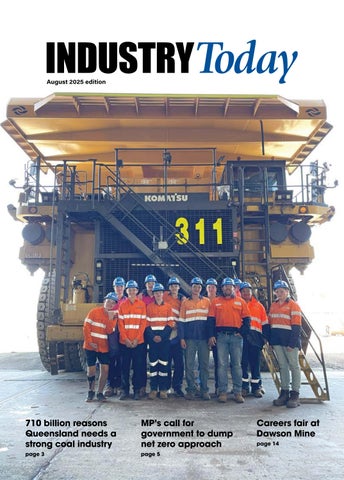
August 2025 edition
710 billion reasons Queensland needs a strong coal industry
MP’s call for government to dump net zero approach
page 3
page 5
Careers fair at Dawson Mine page 14
INDUSTRY TODAY
Professor Longbin Huang collects samples from matured pioneer plants at QAL’s field trial site. (Rio Tinto)
Globally, around four billion tonnes of red mud sits in dams.
This is a muddy good idea Gladstone’s Queensland Alumina Limited (QAL) is at the centre of a groundbreaking project to turn industrial waste into soil, following a $1 million Australian Research Council (ARC) Linkage grant to University of Queensland researchers. The funding will help the Sustainable Minerals Institute (SMI) test the long-term viability of technosol — a soil-like material made from “red mud,” a byproduct of alumina refining. More than four billion tonnes of red mud are currently stored in dams worldwide. QAL is hosting the largest and longestrunning technosol field trials to date, building on earlier laboratory research in Brisbane and
small-scale trials in Gove, Northern Territory. QAL general manager Trent Scherer said the project could revolutionise tailings rehabilitation in Gladstone and globally. “If technosol can be shown to have a longterm benefit, this could lead to an industrywide shift towards tailings rehabilitation in Gladstone and around the world,” Mr Scherer said. QAL is one of the largest alumina producers in the world, operating for almost 60 years in Gladstone. Professor Longbin Huang, group leader of Ecological Engineering at SMI’s Centre for
Mined Land Rehabilitation, said the project addresses a major challenge in Australia’s mining industry — the shortage of topsoil for site rehabilitation. “Our previous work established that red mud can be turned into technosol and that plants can grow in it, but it must be resilient and sustainable to support long-term plant growth and development because the external supply of nitrogen fertilisers is not an option for this purpose,” Professor Huang said. The research will identify which plants can naturally supply nitrogen in high-salt, high-alkaline soils, and whether technosol can retain those nutrients over time.
The $1 million grant is part of $6.4 million awarded to UQ across projects in health, agriculture, environment, Indigenous experiences and data science. “This ARC grant will aim to prove this longterm viability by establishing which plants could provide this nitrogen supply to the soil and if the technosols can hold onto it,” Professor Huang said. If successful, the QAL trials could pave the way for large-scale adoption of technosol, offering a sustainable and cost-effective solution to mine rehabilitation while reusing millions of tonnes of industrial waste.
EOI process welcomed for Qld resources exploration
Queensland Resources Council chief executive officer Janette Hewson said the organisation welcomed the targeted Expression of Interest process. (File)
The Queensland Resources Council (QRC) has welcomed the State Government’s launch of an Expression of Interest (EOI) process, describing it as a positive step towards attracting new investment in the state’s resources sector. QRC chief executive officer Janette Hewson said the move follows recommendations from both the QRC and its exploration arm, the Queensland Exploration Council (QEC), on improving land access. “QRC welcomes the targeted EOI process as a positive step toward unlocking new exploration opportunities and restoring confidence in Queensland’s resources sector,” Ms Hewson said. “The move will encourage existing producers and explorers to apply for nearby ground and aligns with QRC’s recommendation to re-
duce the regulatory burden on the resources industry to support project expansion. “Opening up land next to existing coal and gas tenures will help provide opportunities for continued investment, extend the life of projects, and make use of existing infrastructure already in place. Queensland needs a strong pipeline of projects to capitalise on global demand for traditional and emerging commodities and to meet our domestic gas needs.” QEC chair Kim Wainwright said it was encouraging to see the process opened to companies developing known reserves across the state, including the North West Mineral Province. “This decision opens up releases in underexplored regions and basins, which is essential if Queensland is to uncover our vast re-
serves of minerals needed for the technology of the future, including renewable energy,” Ms Wainwright said. “Queensland has some of the richest vanadium deposits in the world, a vital material for making batteries that can store large amounts of energy for extended periods.” QRC will lodge a submission to the State Government’s review of the land release process and is calling for an annual land release schedule for coal and petroleum to provide greater certainty for the sector. According to QRC’s latest Economic Contribution Report, Queensland’s resources sector contributed more than $120 billion to the state’s economy in 2024, supporting 550,000 local jobs.
Encouraged QMines eyes production boost Telephone: 07 4863 5050 Address: 5-9 Hempenstall Street, Kawana, QLD 4701 EDITORIAL Gregor Mactaggart Editor E: gregor.mactaggart@CQToday.com.au Matthew Pearce Journalist E: matthew.pearce@CQToday.com.au ADVERTISING Cheryl Altouvas Advertising Sales E: cheryl.altouvas@GladstoneToday.com.au Lou De Jager Advertising Sales Executive E: lou.dejager@CQToday.com.au 2 INDUSTRY TODAY August 2025
QMines Limited is poised to ramp up its copper and gold strategy in Central Queensland following positive open-pit optimisation results at its recently acquired Mount Mackenzie Gold-Silver Project. The high-sulphidation epithermal deposit, which joined QMines’ portfolio in July 2025, has been confirmed as a potentially low-cost, high-margin operation that could deliver significant gold and silver ounces into the company’s production profile. QMines executive chairman Andrew Sparke said the results were a major step forward. “We are delighted with this optimisation result at Mount Mackenzie, which confirms our newest asset to be a high-quality, high-margin open pit operation in the making,” he said. “For our shareholders, this means Mount Mackenzie could deliver significant low-cost ounces into our production profile.” The project is set to be integrated into the
updated pre-feasibility study for the Mt Chalmers copper-gold project, expected in the first half of 2026. It will underpin a planned 2.0 million tonnes per annum regional processing hub, with ore from three advanced deposits across QMines’ 100 per cent-owned portfolio, totalling around 19 million tonnes in mineral resources. QMines is also capitalising on buoyant precious metals markets, with gold prices near record highs due to central bank demand and global economic uncertainty, and silver rising on industrial demand linked to solar, electronics and green technologies. “These results bolster our hub-and-spoke strategy,” Mr Sparke said. “We now have three advanced deposits ... shaping up to be one of Australia’s next longlife, multi-asset copper and gold operations with scale.”
QMines Limited is poised to ramp up its copper and gold strategy in Central Queensland following positive open-pit optimisation results at its recently acquired Mount Mackenzie Gold-Silver Project. (Supplied)
INDUSTRY TODAY
Cost pressures hitting coal By Gregor Mactaggart Queensland’s coal industry has generated more than $710 billion for the state economy over the past 15 years, but a new report warns falling investment and confidence could threaten jobs, regional communities, and government revenue. The independent analysis, commissioned by the Queensland Resources Council (QRC), found the sector contributed $85.3 billion to the economy in 2023-24 alone, including $10.6 billion in royalties. It spent $25.6 billion with more than 7570 local businesses, supported nearly 800 community organisations, and provided direct and indirect employment for 387,285 people. QRC chief executive officer Janette Hewson said the findings underscored the need for policies that encourage investment, including a “fair and balanced” royalty system. “This report shows the coal industry’s contribution to Queensland goes well beyond the royalties and export revenue that help fund roads, hospitals, schools and the services all Queenslanders rely on,” Ms Hewson said. “Queensland produces some of the world’s best quality coal, vital for both steelmaking and thermal power. Our steelmaking coal is a crucial ingredient for the infrastructure that will support the energy transition, and our thermal coal is ensuring energy security here and among our trading partners.” She said the government’s recent budget signalled a shift towards “bad policy” on royalties, jeopardising thousands of jobs across Queensland. Those pressures were laid bare last month when ASX-listed Bowen Coking Coal entered voluntary administration after the Queensland
Queensland’s coal industry has generated more than $710 billion for the state economy over the past 15 years, but a new report warns falling investment and confidence could threaten jobs, regional communities, and government revenue. Revenue Office rejected its bid to defer royalty payments. The metallurgical coal producer, which operates the Burton Mine Complex north of Moranbah, failed to reach new arrangements with its largest contractor, BUMA Australia, and its senior secured lender. “The decision to appoint administrators reflects the current challenging environment for the coal industry in Queensland from higher costs, lower global coal prices and higher royalty rates introduced by the Queensland government in 2022,” the company’s board said. Operations are continuing while administrators pursue a sale or recapitalisation. Ms Hewson said operating conditions in the coal industry have become ‘extremely challenging’.
“Energy and production costs have risen significantly for coal producers while coal prices are stubbornly low and Queensland producers are paying the world’s highest coal royalty tax rates,” Ms Hewson said. “QRC is aware of other mining companies operating in Queensland experiencing difficulties attributable to the same factors. “The resources sector, particularly coal, is crucial to Queensland’s economic prosperity and industry continues to work with the government on policies that make our state competitive and more productive, to attract and retain investment across all commodities. “We need a fair and balanced coal royalty regime that delivers for both Queensland and coal producers. “QRC is aware of other mining companies
operating in Queensland experiencing difficulties attributable to the same factors.” Greater Whitsunday Alliance chief executive Kylie Porter said coal remained the most important industry in her region, despite efforts to diversify the economy. “The resources sector is a major local employer in our region directly and indirectly supporting nearly 76,000 jobs, which is nearly three-quarters of total employment,” Ms Porter said. “Our local METS sector is not just a supplier of innovative technology to Queensland’s mining industry but is also a significant export industry in its own right.” Last month, industry and government leaders met at a Queensland Exploration Council forum to find ways to boost explorer confidence and meet demand for gas, critical minerals, coal and metals. Ms Hewson said the International Energy Agency estimates 300 new critical minerals mines will be needed globally by 2030 to meet demand — not counting the steelmaking coal and gas required for infrastructure and the energy transition. Natural Resources and Mines Minister Dale Last said the State Government was committed to attracting new investment. “Maintaining a strong pipeline of exploration protects the future of Queensland’s resources sector, which returns billions of dollars to Queenslanders,” Mr Last said. “We’re asking industry to tell us where they are interested in exploring, which will inform our decisions over future land exploration releases. “Industry told us it needed certainty and confidence to keep investing in Queensland to create local jobs, and we’re delivering just that.”
Rio Tinto profits slip as prices weigh on performance By Adrian Black, AAP Lumbering iron ore prices and multiple cyclones have weighed on Rio Tinto’s profits, but the miner’s increasing diversification across other commodities has helped balance the result. Rio posted a $US4.5 billion ($A6.9 billion) net profit in the six months to 30 June, a 22 per cent slip on the same period in 2024, after its Pilbara operations were affected by four cyclones. Iron ore is the group’s biggest earner, and ore prices have grinded roughly 15 per cent lower from $US107 a tonne to as low as $US93 in 2025. Chief executive officer Jakob Stausholm, who will make way for incoming boss Simon Trott on 25 August, said he had often seen higher prices at other times while at the company’s helm. “But this set of results are the stron-
gest, demonstrating real momentum in improving operational performance, real value from a more diversified portfolio, and excellence in unlocking growth projects,” Mr Stausholm told investors at an results presentation in London. Positive earnings and cash flow results were buoyed by strong prices and production in aluminium and copper, which helped offset the weaker iron ore performance, chief financial officer Peter Cunningham said. “It’s also important to note that going forward, over the next 10 years, we expect that 40 per cent of (iron ore) production from the majors needs to be replaced,” he told investors. “And while China’s steel consumption has plateaued, there is demand growth elsewhere in global steel markets often supplied by Chinese exports.”
The company will pay an interim ordinary dividend of $US1.48 ($A2.27) a share, worth $US2.4 billion, delivering its promised 50 per cent payout ratio but a step down from last year’s $US1.77 per share. Rio Tinto’s production guidance remained largely unchanged, but Pilbara shipments were tipped to fall to the lower end of the expected range because of cyclones in the first quarter. Bauxite and copper production was forecast to come in at the higher end of expectations thanks to better-than-expected mine performances and a successful ramp up at an underground mine in Mongolia. Rio’s takeover of Arcadium Lithium came to $US7.6 billion. Along with property and equipment purchases, $US3.8 billion in dividends and other outgoings, this took its net debt to $US14.6 billion, swelling from $US5.5 billion at the end of 2024.
Mr Cunningham was confident about Rio’s books. “We feel that the balance sheet is in really good shape, and we have flexibility going forward with these sorts of levels,” he told investors. “This is a cyclical industry, cash flow goes up and down what we’ve got to do is use the balance sheet to really make sure we can deliver against the strategy, and also deliver shareholder returns. RBC Capital Markets analysts Kaan Peker and Ben Davis said sentiment on the result would be positive. “Rio Tinto produced a good set of operational results across key divisions that was a six per cent beat at the product group level,” the analysts wrote. “But this was dragged down by other items including restructuring costs at Arcadium.”
THE FUTURE IS HERE >>>
BUILT FOR
OFF GRID
NEW
LIVING Solar buildings that power your site anytime & anywhere
RID OFF-G SOLAR Y FACILIT
8.85kW PV
Cool & Quite: Crimsafe, Tropical Roof & well insulated
15x 590w Solar Panels
MEET RENEWABLE TARGETS REDUCE EMISSIONS IMMEDIATE SITE OPS
Up to
32.80 kWh Lithium Phosphate battery
READY TO GO SOLAR? CONTACT US NOW.
www.multitrade.com.au 12756359-KF20-25
August 2025 INDUSTRY TODAY 3
INDUSTRY TODAY
Carborough Downs crew takes out QMRS State Cup Hosted on Thursday, 7 August at Oaky North Mine, the Queensland Mines Rescue Service State Cup brought together Queensland’s toptier mines rescue teams for a full day of challenges, teamwork and pressure testing in simulated emergency conditions. All participants were commended for their effort, skill and commitment to safety under pressure. “Your performance reflects the strength and capability of Queensland’s underground coal industry,” a QMRS spokesperson said. Place – Carborough Downs • First Mine, sponsored by Dräger • Representative: Jenna Duffield Place – Moranbah North • Second Mine (MNM), sponsored by FRSA • Representative: Brett Spence Place – Kestrel Coal, spon• Third sored by 3M • Representative: Sarah Ryan • Fourth Place – Grosvenor Mine A special mention to Jason Sea• born (MNM), who was recog-
• •
nised with: Chief Inspector’s Trophy – awarded for outstanding individual performance Matt Best Trophy – recognising excellence in theory.
The winning team from Carborough Downs Mine. (Supplied)
Rates relief for borrowers By Jacob Shteyman, AAP Borrowers received welcome relief from the Reserve Bank of Australia (RBA) which delivered a widely expected interest rate cut earlier this month. The central bank opted not to shock markets on Tuesday. 12 August. In its accompanying statement, the RBA board said a further easing in monetary policy, following cuts in February and May, was appropriate because underlying inflation and the labour market had continued to ease. “The board nevertheless remains cautious about the outlook, particularly given the heightened level of uncertainty about both aggregate demand and potential supply,” it said. “It noted that monetary policy is well placed to respond decisively to international developments if they were to have material implications for activity and inflation in Australia.” All nine board members voted in favour of a cut. The RBA’s decision to cut the cash rate by 25 basis points to 3.6 per cent will save borrowers with a $600,000 mortgage almost $90 a
The Reserve Bank of Australia decided to cut interest rates by 25 basis points on Tuesday, 12 August. (Dean Lewins/AAP Photos) month in repayments and a cumulative $272 per month since cuts began in February. The move brings the cash rate to its lowest level since May 2023, with the average variable mortgage rate expected to fall to 5.5 per cent. But for many borrowers, the financial boost is behind schedule. Most economists had expected the RBA to deliver further rate relief in its July meeting. In a shock 6-3 decision, the board kept rates on hold, citing a need to wait for more inflation
CHAUVEL INDUSTRIAL SERVICES
• On-site maintenance, shutdown and workshop facilities • Mechanical and Fabrication • Pumps, pulleys, conveyor supply and service • Civil and concreting 12619179-MS29-23
• Blast and paint
Exceeding Expectations
07 4926 8588 | chauvel.com.au Head Office: 26 Hempenstall St, Nth Rockhampton Emerald: 6 Daniels St, Emerald 4 INDUSTRY TODAY August 2025
data to ensure price growth was coming down sustainably to target. A benign consumer price index in late July and weaker jobs figures gave the bank the green light to deliver the cut that most saw as a matter of when, not if. With money markets predicting more cuts coming down the pike, rising buyer confidence and borrowing capacity was set to support housing demand and price growth, REA senior economist Eleanor Creagh said.
Vanguard senior economist Grant Feng predicted one more cut by the end of the year. “With growth showing signs of recovery and the unemployment rate stabilising, the magnitude for additional rate cuts appears modest,” he said. Treasurer Jim Chalmers said the decision was “very welcome relief for millions of Australians”. “The three interest rate cuts we’ve seen this year would not have been possible without our collective efforts to get inflation down,” he said. The RBA has just cut interest rates for the third time in six months. The RBA board in its statement noted uncertainty in the global economy was still high. But markets had settled down in recent months with a little bit more clarity to the scale of Donald Trump’s tariffs and a relative low amount of retaliation from other countries. “Trade policy developments are nevertheless still expected to have an adverse effect on global economic activity, and there remains a risk that households and firms delay expenditure pending still greater clarity on the outlook,” the RBA board said.
INDUSTRY LEADERS JOIN BODY TO DRIVE GROWTH Eleven of Queensland’s top manufacturing figures have been appointed to a new dvisory body tasked with boosting investment, creating jobs and strengthening regional economies. The Queensland Manufacturing Advisory Council (QMAC), which met for the first time last month, will provide strategic advice to the State Government on how to grow and diversify one of the state’s largest industries. Manufacturing employs more than 180,000 Queenslanders, with a quarter of those jobs in regional and rural areas. Manufacturing Minister Dale Last said QMAC would help position Queensland as the most attractive state for manufacturing investment. Members of the Queensland Manufacturing Advisory Council are: Angela Bailey, Dewatering Operations manager, Weir Minerals Australia Xanny Christophersen, chief executive officer, Priestley’s Gourmet Delights Sharon Dawson, director and chief executive officer, Dawsons Group of Companies Louise McMahon, general manager, MFE Pty Ltd Mick Murray, director, Mick Murray Welding Richard Parker, general manager, TEi Services Pty Ltd Emily Pullen, director and chief executive officer, Mighty Good Food Group Aaron Thompson, managing director, Ferra Engineering Thomas Northcott, managing director, Vecco Group Rebecca Andrews, chief executive officer, Manufacturing Skills Queensland Shay Chalmers, chief executive officer, GLT Trailers
• • • • • • • • • • •
INDUSTRY TODAY
MP slams net zero ‘madness’ By Di Stanley Coal and gas exports from Gladstone worth $160 billion to the Australian economy would be lost if the Labor Government continued barrelling down the path to net zero emissions by 2050, Flynn MP Colin Boyce warned. Mr Boyce, who said net zero was “economic madness”, seconded the Repeal Net Zero Bill presented by Coalition colleague Barn aby Joyce when it was introduced into Federal Parliament on Monday, 28 July. “Net zero will ultimately destroy our economic base here in Australia,” Mr Boyce said. “In Gladstone, we have got the CSG industry and the fourth-largest coal-exporting terminal in the world. “By net zero, what we are doing is overseeing the demise of both of these industries. “If we do that, how do we fill the economic shortfall? “The aluminium smelter and the refineries in Gladstone and Australia are asking for billions in government handouts just to stay competitive. “What happens to the thousands of jobs if we continue down this road?” Mr Boyce urged people to understand the ramifications of net zero in Central Queensland with the government steadfast on its targets of 82 per cent renewable energy and a 43 per cent carbon reduction by 2030. The Flynn electorate currently has more than 90 renewable energy projects on agricultural land and across the state’s geological spine, the Great Dividing Range. Federal Energy and Climate Minister Chris Bowen revealed a 25 per cent boost to the size of the Capacity Investment Scheme, which the government uses to underwrite new wind, solar and storage projects. “Thousands of turbines and millions of solar panels - this is dividing communities,” Mr Boyce said. “It is all subsidised, and makes absolutely no sense because this power generation, the renewable energy sector, is unreliable. “We have three coal-fired power stations in the electorate of Flynn - Callide, Gladstone and Stanwell. “What becomes of that baseload power when it gets put in a position where it cannot compete in the marketplace to sell energy because of the mandates and the RET subsidies that the renewable energy sector gets?” Mr Boyce said net zero’s effect was already in evidence across Flynn and affecting lives. “We’ve got people living in cars and people living in tents because they cannot afford their electricity bills, and it’s time this stopped,” he said. “And here we are, spending million and billions in the green hydrogen sector, in the renewable energy sector to provide an unreliable power source that is putting jeopardy our coal and gas industries, and our manufacturing industries in particular in Queensland. “Let’s dump this net zero. It is economic madness.”
Colin Boyce (left) watches as Nationals member for New England Barnaby Joyce presents his Repeal Net Zero Bill 2025 in the House of Representatives at Parliament House in Canberra, Monday, 28 July. (Mick Tsikas/AAP) Mr Joyce’s private member Bill has the backing of key Nationals and conservative Liberals, while Nationals leader David Littleproud said he was waiting on the outcome of the party’s own review, under outspoken net zero opponent Senator Matt Canavan “Of course, we’re not winning any friends doing that among colleagues,” Mr Boyce said. “Let’s draw a line in the sand and fix bayonets, as far as I’m concerned. Mr Joyce’s told Parliament Australians were getting ‘done over’ by net zero. The veteran politician said the nation’s pursuit of zero emissions would have no effect on the climate globally while large-scale emitters like China, the United States, India were not involved in meaningful engagement. He said net zero was the villain in driving down the standard of living for many Australians.
“If you go into shops, they talk about 30 to 40 per cent of their costs being energy,” Mr Joyce said. “Whether it’s pie shops or hairdressers, it doesn’t matter. “It’s dividing our communities - not down the middle - into the 90 per cent who are either furious or just angry, and the 10 per cent who feel intimidated. “It is driving out, from our nation, manufacturing. “We are losing manufacturing - our plastics, our fertiliser and our glass - and other industries such as aluminium are just holding on by their fingernails, only with government subsidies.” Mr Joyce said if there was virtue in net zero, the government should underwrite the decommissioning and rehabilitation of land at the time of obsolescence of wind towers and solar
panels. “Andrew Dyer, who was the ombudsman appointed by Labor two years ago, said the cost of decommissioning one tower, if it’s structurally sound, would be $600,000,” he said. “If it’s not structurally sound, it would be over $1.5 million. “The farmers won’t have that money. “Who benefits? It’s not our nation, if it’s not manufacturing, if it’s not the cost of living, if it’s not the pensioners, if it’s not rural Australia and if it doesn’t change the weather, who benefits? “Billionaires, both domestic and international, benefit. “The thought they would have a scheme underwritten by you, the taxpayers, with borrowed money from overseas, in secret agreements called capacity investment schemes, so that you can’t see the details.”
Environment
CQG is a passionate advocate for local businesses Rockhampton | Gladstone | Brisbane | Mackay | Townsville
Engineering
Planning
www.cqgroup.com.au • +617 4922 9252 12618313-CB29-23
August 2025 INDUSTRY TODAY 5
INDUSTRY TODAY
CQ’s finest honoured at Regional Training Awards The region’s finest in vocational education and training were recognised at the 2025 Central Queensland Regional Training Awards last month. The event, which took place at the Rockhampton Leagues Club on Saturday, 26 July, presented winners in 11 different categories. CQUniversity TAFE staff and students secured four major titles, including Emeraldbased Metal Fabrication teacher Andrew Abbas, who received the coveted VET Teacher or Trainer of the Year Award. “I am very privileged to have been the recipient of such an award, and I am very grateful to our clients and stakeholders who have recognised my capability and value to VET Training,” Andrew said. Certificate III in Business graduate Chloe Hutchinson received the Bob Marshman Trainee of the Year award. Chloe completed her CQU TAFE studies through a traineeship with Gladstone Regional Council. Livingstone Regional Council employee and proud Bailai woman Kylie Johnston won the the Vocational Student of the Year category for her efforts while studying a Certificate III in Horticulture at CQU. CQU Certificate III in Electrotechnology Electrician/Certificate III in Instrumentation and Control student Maddison Petrie took out the Aboriginal and Torres Strait Islander Student of the Year category. Maddison balances full-time work, study and parenting while completing qualifications in by Shell QGC. VET Operations deputy vice-president Pe-
ter Heilbuth congratulated the winners and finalists. “Andy, Chloe, Kylie and Maddison are exceptional examples of what makes CQU TAFE’s training the most sought-after training in the region,” he said. “We’re very proud of their achievements and these exceptional students, and our colleague Andy, should feel proud of everything they’ve accomplished.” Glencore Coal’s Queensland Apprenticeship Program was named Large Employer of the Year, recognising its contribution to skills development and workforce growth across the region. Judges commended Glencore for its innovative approach to training and its futurefocused curriculum. In their remarks, they noted the program exemplifies best practices in apprenticeship education. Glencore Coal’s Queensland Engineering coordinator Jarryd Townson described the win as a powerful acknowledgment of the people behind the program. “This achievement reflects the hard work we put in every day to deliver quality training and support to develop future tradespeople,” he said. “From Site Coordinators, HR specialists, Engineering Managers, Site Tradespeople, Mentors and TAFE teachers, there are a myriad of people that play an integral role to support our apprentices to succeed and grow within the industry.” Glencore Coal’s Queensland Apprenticeship Program named Large Employer of the
The winners at last month’s Central Queensland Training Awards in Rockhampton. (Supplied) Year and Glencore’s program supports 118 apprentices across the state, offering dual trades, emerging technology training, and strong mentorship. Judges praised its “future-focused curriculum” and innovation. Queensland Engineering Coordinator (Training and Development) Jarryd Townson said the award reflected “the myriad of people” who support apprentices daily. “This achievement reflects the hard work we put in every day to deliver quality training and support to develop future tradespeople,” he said. “From site coordinators to TAFE teachers — this is for everyone involved.” Other major award winners included: Harry Hauenschild Apprentice of the Year – Adam Dittman, Certificate III in Engineer-
•
ing – Fixed and Mobile Plant Mechanic, Lee Crane Hire. School-based Apprentice or Trainee of the Year – Jasmine Cook, Certificate II in Animal Care, Maraboon Veterinary Surgery/ Emerald SHS. Equity Student of the Year – Sharee Ann Pryce, Certificate III in Supply Chain Operations, MACS Engineering. Community Training Initiative of the Year – Community Solutions for its Community Careers program. Medium Employer of the Year – VAJ Byrne & Co Lawyers. Small Employer of the Year – Intuition The Art of Hair. Regional winners will now compete at the Queensland Training Awards State Finals in Brisbane on 13 September.
•
•
•
• •
Push to inspire students The Queensland Resources Council (QRC) has launched a new campaign showcasing young Queenslanders building careers in the state’s $120 billion resources sector. Shape Our Future went live earlier this month, aiming to inspire Year 12 students and their families by profiling early-career professionals working in innovation, sustainability, and problem-solving roles across the industry. QRC chief executive officer Janette Hewson said the campaign’s strength lay in its authenticity. “The best advocates for recruiting the next generation into our sector are young people already working in it,” Ms Hewson said. “It was important to us the Shape Our Future campaign reflected real career journeys – with young Queenslanders sharing their enthusiasm for working in an industry that contributes so much to local communities and the Australian economy.” Featured roles include an earth science intern, critical minerals researcher, land access manager, maintenance supervisor and environmental officer. Mackenzie, an earth science intern at Pembroke Resources, said she was excited to share her passion for the industry. “It is awesome taking everything I’ve learned in the classroom at university and putting it into practice on site – I definitely feel like I am part of a bigger picture,” she said. The campaign builds on QRC’s previous Shape Your Future initiative, shifting the focus from individual career rewards to the benefits of working in a collaborative industry at the forefront of new technologies and sustainable innovation. Running for three months across social media and online platforms, the campaign coincides with the opening of university course preference submissions for Year 12 students. Ms Hewson said the goal was to “excite school leavers about the potential of a resources career” and help them match study options with career goals. 6 INDUSTRY TODAY August 2025
Mackenzie is part of the Shaping Our Future campaign.
OIive Downs mine employee Tom. The initiative is supported by QRC’s education arm, the Queensland Minerals and Energy Academy, along with university partner James
Brock and Jake Arrow feature in the QRC’s campaign. Cook University and industry members Pembroke Resources, Arrow Energy, Critical Minerals Group and Thiess. The campaign features
a hero video and shorter profile videos, with more information available on the campaign’s website - shapeourfuture.com.au
INDUSTRY TODAY
Katter’s praise for Sir Leo By Arthur Gorrie Queenslanders and especially the city of Gladstone and the whole of the north will benefit for generations from one of the state’s “true giants,” Sir Leo Hielscher, Katter’s Australian Party leader Robbie Katter said. “His passing marks the end of an era, but his legacy will endure in steel, concrete, and in the lives of millions of Queenslanders who continue to benefit from his foresight and conviction,” Mr Katter said. “I thought I knew a fair bit about Sir Leo, but the more I look into him, his accomplishments, and his ability to ‘get it done’ the more I discover and admire him more. “Sir Leo was not a man who sought the spotlight. Yet his fingerprints are all over the great economic pillars of modern Queensland. He embodied the “can do” public servant. Someone who never asked ‘if’ something could be done, only ‘how quickly we could get it going’.” Sir Leo, who died on 4 August, joined the Queensland Public Service in 1942 and played a decisive role in the successful delivery of Expo 88 and Commonwealth Games in Brisbane. He held a number of key roles including 14 years as the Queensland Under Treasurer, Queensland Treasury Corporation Board chairman and Austsafe chairman. But it was his business nous that shone through according to Mr Katter. “He saw bauxite in the ground at Weipa and saw not merely a resource to export, but the beginning of an entire domestic industry - mined here, refined here, smelted here,” Mr Katter said. “He helped create the ecosystem that allowed us not only to extract bauxite but to turn it into aluminium, fueling jobs, towns,
Sir Leo Hielscher, regarded as Queensland’s greatest titan, has died at the age of 98. (AAP) and state coffers for generations. “He didn’t just sign off on policy. He fought for outcomes. When the state needed a new power station or rail link to make a project viable, Sir Leo found a way to get it done. He believed that governments should be builders, not bystanders. “One story I’ve often repeated says everything about his approach to economic development. “When Queensland couldn’t get support from the Federal Government for a vital rail
project to open a mine, Sir Leo, then in Treasury, simply went to the World Bank and arranged a development loan. “The Commonwealth was at risk of being embarrassed on the world stage, and it worked. Suddenly the money flowed. It wasn’t just about finance; it was about Queensland refusing to be told to wait while opportunity passed us by. “That was Sir Leo: smart, fearless, and entirely focused on delivering results for the state.
“His work shaped towns like Gladstone into hubs of heavy industry. His stewardship of the Queensland Treasury through booms and busts established a reputation as one of the state’s most effective financial leaders. “Another example is Sir Leo’s foresight to build a State Bank to support agriculture and development. The very bank that a future government sold off to Suncorp for $1.5 billion! “Sir Leo understood that economic development isn’t just about balance sheets. It’s about building a future where Queenslanders, particularly those in the regions, have access to jobs, infrastructure, and opportunity. “In a time defined by caution, red tape, and delay, Sir Leo represented the opposite. He was bold. He was practical. He got things done. “Queensland is richer, stronger, and more self-reliant because of Sir Leo Hielscher. “May he rest in peace, and may we honour him not just with words, but by carrying forward the nation-building spirit he lived by.” Premier David Crisafulli said Queensland had lost a state builder. “Sir Leo shaped Queensland’s economy, mapped the foundations for Queensland Treasury Corporation, and helped deliver the successful Expo 88 and 1982 Commonwealth Games,” he said. “Sir Leo dedicated more than half a century in the service of Queensland, followed by many more years graciously offering counsel to Treasurers across the political divide and contributing his vast experience to both the public and private sector. “His lifetime of service helped build the modern Queensland we know today, and his legacy will live on in the state he leaves behind.”
12790527-KF33-25
August 2025 INDUSTRY TODAY 7
INDUSTRY TODAY
Hydrogen is not yet viable says Janetski By Di Stanley The State Government has put hydrogen projects on the back burner in favour of gas peaking generation to drive energy policy and investment. At a 29 July governance, energy and finance committee estimates session, treasurer David Janetzki said state-backing for energy projects was incumbent on financial and operational performance, and hydrogen projects had failed to pass muster. The collapse of Stanwell’s $12.5 billion CQH2 project in early July left a gaping hole in the Gladstone Regional Council’s Industrial Ecosystem Industry Map Economic Transition Roadmap 2022-2032. “We welcome commercially viable hydrogen projects and investments from the private sector and Federal Government,” Mr Janetzki said. “But with regard to hydrogen, there have been some clear indicators that the market is in agreement with the sentiment behind our decision not to proceed with funding the Central Queensland hydrogen project. “Last year, Fortescue Metals Group scrapped a 2030 target for producing so-called green hydrogen, and Forescue (in mid-July) ended its Gladstone hydrogen project. “In March, Origin Energy backed away from a joint venture with chemicals giant Orica in the New South Wales Hunter Valley. “In February, Woodside Energy said it would delay a hydrogen venture in the US and last year ditched early-stage hydrogen plans in Tasmania and New Zealand. “We welcome commercially viable hydrogen projects and investment from the private sector and Federal Government, but our energy policy is grounded in economics, not ideol-
ogy, and projects must always stack up. Mr Janetzki said former Premier Anna Palaszczuk had been in agreeance that the hydrogen investment was premature. “She even said that our decision to not invest in CQ-H2 was understandable,” he said, “She is not the only one to have lost her enthusiasm. “The Leader of the Opposition has not mentioned hydrogen once since the election.” Mr Janetzki said the government’s targeted strategy of gas peaking generation to provide firming capacity in the grid included $479m in 2025-26 for CS Energy to develop the Brigalow gas peaker project at Kogan Creek. “This is a critical investment that will deliver dispatchable firm energy when it is most needed to support grid reliability and put downward pressure on wholesale prices,” he said. He said CleanCo was investigating a new open-cycle gas turbine at Swanbank, while Stanwell was continuing to work with Quinbrook to progress the Lockyer Energy Project another gas-peaking facility to strength capacity in southern Queensland. “Gas generation is not the enemy of renewables - it is their enabler,” Mr Janetzki said. “It provides the firming power needed to make renewables viable at scale. It ensures when weather-dependent sources diminish, we can keep the lights on, industry moving and costs down.” The State Government is soon to release its Energy Roadmap for a coordinated plan for the grid to 2030 and beyond. “Out approaches includes investment in smaller, manageable pumped hydro projects, expansion of battery storage and ongoing support for coal-fired generation and maintenanced, but gas will play a key role in generation and firming capacity,” Mr Janetzki said.
Queensland treasurer David Janetzki said state-backing for energy projects was incumbent on financial and operational performance, and hydrogen projects had failed to pass muster. (Darren England/AAP)
The Queensland Conservation Council’s green metals forum attracted around 50 participants on Wednesday, 6 August. (Supplied)
Green metals, Gladstone ‘a good fit’, forum reveals Around 50 people turned out to the green metals for Gladstone: a community conversation event to hear about the potential of the Central Queensland region to produce green metals, like green iron and aluminium, using firmed renewable energy. On Wednesday, 6 August, the community members heard from Associate Professor of Engineering Fiona Beck, who told the room that decarbonising heavy industrial processes offered Australia a real economic opportunity, despite recent setbacks in green hydrogen projects. The event was held by the Queensland Conservation Council, Queensland Community Alliance and Greenhouse, and followed the Gladstone Green Metals and Industry Workshop hosted by Greenhouse, which was held earlier in the day. “At these events we heard loud and clear from experts and industry that Gladstone has a huge potential to become a hub for green metals production, even though the hype around hydrogen is calming down,” QCC Gladstone Environmental Advocate Emma Smith said. “Decarbonising our industry is really important for the future of our region because international players, like Rio Tinto, have made it clear that they have to repower with firmed renewable energy to stay globally competitive. “New green metal industries are an exciting opportunity to power a future-proof regional economy, and if development is done well, create lasting community and nature benefits.” Assoc Prof Beck said Australia had the opportunity to play an outsized role in de-
carbonising the regions. “When Australia’s metal ore is processed overseas, the processes create over three times our domestic emissions,” she said. “If we started processing Australia’s ore onshore using renewable energy, we could significantly cut global emissions while value-adding here. “There has been a feeling that the netzero transition has stalled, and it is true that global economic trends have slowed progress, particularly for green hydrogen. “However, this hasn’t stopped the push to decarbonise global industry, and it is important that Australia moves to keep up so we can grasp the large economic opportunity that this represents for us, particularly in our regions.” Greenhouse chief operating officer Ed Schmidt said there was ample opportunity for Gladstone’s industries base to capitalise on green metals. “Greenhouse was excited to bring industry leaders and the Gladstone community together to explore the region’s role in a low-emissions future,” he said, “It was fantastic to partner with the Queensland Conservation Council to support these important conversations. “There is a clear opportunity for Gladstone to lead in green metals and futureproof its economy through clean industrial development. “We’re proud to support the economic and climate opportunity green metals represent for Gladstone and Australia’s decarbonisation journey.”
Battery packs arrive for Stanwell project The first delivery for the Stanwell Battery project has arrived in Central Queensland, marking a mega milestone for the project. The first consignment of Tesla Megapack 2XL units safely arrived at the project site adjacent to Stanwell Power Station last month. In total, 324 Megapack units will arrive on site over the next few months and together will make up Stanwell’s 300 MW Battery Energy Storage System with four-hour duration. Each lithium-ion unit weighs 38 tonnes and is 8.8 metres long – the length of a city bus. They are being transported daily on dropdeck semi-trailers from Brisbane to Stanwell 8 INDUSTRY TODAY August 2025
via the Bruce Highway, Capricorn Highway and Power Station Road. By September, all Megapacks will be sitting in place, stored in a safe shipping mode until commissioning commences in November 2025. Stanwell Central Generation general manager Angie Zahra said this delivery was a significant milestone for Stanwell’s portfolio diversification efforts. “The Stanwell Battery is part of the diversification of our portfolio, to include cleaner and more flexible energy solutions,” Ms Zahra said.
“It is just one part of the 800 MW of battery energy storage capacity we have in our pipeline. “Capable of discharging 300 MW of energy for up to four hours (1200 MWh), our mega battery will be one of the largest in Queensland.” The Megapacks are being installed by Yurika, a Queensland government-owned company. Several local contractors are involved, and around 80 jobs are being created during the project’s construction. The Stanwell Battery is scheduled to supply electricity to the grid starting in May 2027.
The first consignment of Tesla Megapack 2XL units arrived at the project site adjacent to Stanwell Power Station last month. (Supplied)
INDUSTRY TODAY
Senate inquiry bid denied By Di Stanley The Coalition failed in its bid to force a Senate inquiry into the metals manufacturing industry in which Flynn MP Colin Boyce said Gladstone would have been ground zero. Mr Boyce said he was bitterly disappointed the Labor Federal Government voted with the Greens to block the inquiry on Monday, 28 July. “It just goes to show you they don’t want to recognise the rising cost of energy is crippling our manufacturing sector right now,” he said. “We’ve got the metals manufacturing industry here that’s under enormous pressure to stay viable and to stay operational and competitive, and the problem they’ve got is rising energy costs. “We’ve already seen the nickel industry close, the plastics industry close, the glass and copper industry close. “They’ve all got their hands out for billions of dollars of government subsidies to remain operational and competitive.” Mr Boyce said his focus was on the Flynn electorate and the reputation Gladstone enjoyed as an industrial powerhouse which he did not want to see further eroded. “Some are most definitely (in trouble),” he said. “Rio Tinto has got their stake in the NRG Gladstone power station there for sale, they’ve written off the value of their assets to the tune of $1.4 billion two years ago and they have to renegotiate their power contracts come 2029. “They’ve got the tariffs to deal with, and the point is that everything is becoming more and more expensive for them to remain operational. “Their Tomago (smelter) in New South Wales, they’ve got their hands out for billions of dollars in subsidies and it’s only a matter of time before the same thing happens
Flynn MP Colin Boyce and his Coalition colleagues at Parliament House in Canberra last month calling for an inquiry into the metals manufacturing industry that failed to win support from the Federal Government and the Greens. (Supplied) in Gladstone.” In part, the Coalition inquiry sought to uncover why at least 10 smelters and refineries that employ more than 6000 workers across Australia were asking the Federal Government for support, when to date, the Labor Government had promised more than $10 billion. It also aimed to focus on reasons behind why major assets nationwide were being put in jeopardy where, under a Labor Government, electricity prices had increased by 10.6 per cent and gas prices by 45.3 per cent. The Queensland Conservation Council’s Gladstone regional environmental advocate Emma Smith said the QCC firmly believed in a green future for the Gladstone region despite the collapse of the $12.5 billion CQ-H2 project and Fortescue confirming its PEM50 electrolyser manufacturing plant project was not proceedings. “We still need hydrogen to decarbonise those high heat industrial programs,”
Ms Smith said. “There are some other processes out there that still would be hoping to use hydrogen of some sort... so it is possible hydrogen might still happen in Gladstone. “It’s just going to look completely different to what we thought. “I think everybody didn’t quite understand the barriers that were there to getting hydrogen to work in Gladstone.” Ms Smith said in light of the setback, she suspected the green dream promise had affected supply chain industries who were contemplating their future in the space. “I know there’s a group that is looking to produce green iron in Gladstone,” she said. “They’re still hopeful that they can make their project work, so while this is definitely a big blow, it’s really hard to get information about what it actually means for Gladstone. “If you couple hat with not being really at
the moment about what the State Government’s energy plan is right now, those two things together create a fair bit of uncertainty. “It means it’s hard to diversify Gladstone’s economy, and regional economies in general, which leaves us a little bit exposed. “There’s definitely a lot of work to do to make sure that Gladstone is a desirable place for businesses to come and set up.” Ms Smith said she believed it would take all three levels of government working together with industry stakeholders, environmental and community groups, to ensure Gladstone’s future was vibrant. Mr Boyce said the Harbour City’s and Central Queensland’s future hinged on its ability to pivot and exploit new opportunities as they navigated the winds of adversity in the wake of the CQ-H2 project collapse. “There is a question to be asked as to how viable the whole (manufacturing) industry is with the rising costs of power, and how long they can continue to operate with rising power costs,” he said. “It’s an issue that needs to be dealt with because if we’re going to keep our sovereign capability and our national security and our manufacturing base, we need reliable and affordable energy. “Australia has all of these God-given energy resources in coal, gas and particularly uranium, and we’re not allowed to use it. “I sit on my verandah at my apartment in Gladstone and watch the coal boats and the gas boats go out every day on their way to China and the hypocrisy behind it is staggering. “We’re quite prepared to let China use in their coal-fired power stations and their boilers and their smelters and so forth to create heat and energy, but we don’t use it ourselves. “Honestly, you couldn’t make it up.”
Former MP is appointed The Queensland Government has appointed Lachlan Millar as a director to the board of Gladstone Area Water Board. Mr Millar replaces Tina Zawila, who has completed her term as director. GAWB chair Adrienne Ward thanked Tina for her service to the board. “On behalf of the board, we thank Tina for her service to GAWB, our customers and community,” Ms Ward said. “She has been a valued director since her appointment in December 2021. “Tina’s background in finance, business and the local community has been instrumental as we have transitioned through pre-approval to almost completion of the FGP, and as GAWB has grown in maturity as a business. “We also welcome Mr Millar, who brings a wealth of experience as our new
board director.” Mr Millar spent 10 years as a rural journalist for the ABC, and a decade as the Member for Gregory before announcing his retirement prior to the 2024 state election. Originally from a farming/irrigation family in Emerald, Mr Millar understands the challenges faced by a regionally based organisation. He has previously held roles as a Ministerial Advisor and Executive of Fitzroy Basin Food and Fibre and currently works part-time for the Royal Flying Doctor Service (RFDS) in commercial and corporate affairs. In accordance with the Water Act 2003 (QLD), Directors are appointed for a term of three years. The continuing members of the GAWB Board are Ms Suzanne Burow and Mr Mitchell Petrie.
Former Gregory MP Lachlan Millar has been appointed to a three-year term on the Gladstone Area Water Board’s board of directors. (File) 12758761-EA15-25
August 2025 INDUSTRY TODAY 9
INDUSTRY TODAY
The path to a ‘better BMA’ Guests at the BBMC’s July luncheon were treated to a ‘seat by the fireside’ as BMA asset president Adam Lancey spoke frankly about his insights on navigating current pressures and positioning for future growth. Since taking the helm two years ago, Mr Lancey explained how a strong focus on stabilisation and simplicity, coined ‘Better BMA” has changed the game, both internally and externally. “We’ve made some really good progress over the last few months. There’s been quite a different feeling within the company internally,” he said. For example, one impressive result is BMA’s 39.94 per cent female participation across their workforce – nearly reaching their ambitious 40 per cent target. Mr Lancey highlighted how this diversity has brought fresh perspectives at all levels, as well as on-the ground innovation, from new tooling designs to procedural improvements for both safety and productivity. Differing site requirements are an issue that suppliers and contractors struggle with. BMA is working to standardise requirements across operations, making it simpler for contractors to work across multiple sites. “There is still more opportunity to harness the competitive advantage we have with our sites in close proximity,” Mr Lancey said. However, sometimes changing requirements are safety-related, and BMA’s stance on safety is non-negotiable. Their ‘Safety starts with me’ program focuses on BMA and their partners returning to basics, helping workers understand personal risk at every moment of the day. Drawing from recent visits to leading tech companies including Tesla, Google, and Honeywell, Mr Lancey painted an optimistic picture of mining’s technological future, perhaps even moving to “double autonomy” – smart, autonomous operations that could totally revolutionise mining practices. “There are people in those tech companies who just pick and choose what they want to get excited about. The solutions they invent could apply to problems they don’t even know exist in mining,” he said. “The announcement on the day of the luncheon that Bowen Coking Coal has entered administration was a stark warning of the tough economic conditions the mining industry in Central Queensland faces.” It was an important reminder to the audience that without the right policy settings in place to make Queensland a competitive place to invest, the flow-on impact of mining companies shutting mines or curtailing production will be felt right along the supply chain. Despite these headwinds, Mr Lancey remains steadfastly optimistic about coal exports in Queensland’s future. Looking ahead, he predicts that technology will crack the next big breakthrough in mining operations. “I think we’ll get that big leap forward, though I’m not quite sure of the timeframe,” he said. “The ways we optimise ore recovery and refining processes, such as coal washing techniques, are still relatively unchanged. There are real opportunities to improve as our ore bodies get bigger, deeper, and more challenging.”
10 INDUSTRY TODAY August 2025
Guest speaker BMA’s Adam Lancey and Bowen Basin Mining Club director Jodie Currie at the July lunch. (Supplied)
Attendees at the Bowen Basin Mining Club’s July lunch.
INDUSTRY TODAY
BMA’s Adam Lancey with Mackay MP Nigel Dalton. (Supplied)
Attendees at the Bowen Basin Mining Club’s July lunch.
August 2025 INDUSTRY TODAY 11
INDUSTRY TODAY
The Calliope RSL Memorial Hall will be repurposed into a central and accessible community space including five consulting rooms, two multi-purpose rooms, a meeting room and connection lounge.
First legacy investment from Aldoga Solar Farm The historic Calliope RSL Memorial Hall will be transformed into a vibrant community hub with the support of $80,000 from ACCIONA Energía’s Aldoga Solar Farm Legacy Investment Program. The Legacy Investment Program, which launched this year, is designed to contribute to long-term sustainable development in the region and to support projects that will leave a lasting impact. The Calliope Community Hub project is the program’s first grant recipient and was awarded $80,000 to support a major renovation that will create a new community centre to host health social services and events. Local organisation Strong Communities is leading the project and will repurpose the Hall into a central and accessible community space including five consulting rooms, two multi-purpose rooms, a meeting room and connection lounge. “The Calliope Hub will be a vibrant, inclusive space where individuals of all ages and backgrounds can connect, find support, and access essential services,’’ Strong Communities co-founder and general manager Crystal Robson said. “This project will preserve this historic building while adapting it to provide specialised services and activities that empower children, youth, families, seniors, and veterans. “We have been consulting with the community about the future of the hall for five years and now, thanks to the support of the Aldoga Legacy Investment Program, we can start construction on this exciting new space.”
ACCIONA Energía’s Aldoga Solar Farm Community Engagement Committee endorsed the selection of the Calliope Community Hub project as the first recipient of funds under the Legacy Investment Program. The program is designed to support projects in the local Gladstone area that will have a lasting impact with individual grants of up to $40,000 or $40,000 a year for multiple years. ACCIONA Energía’s Queensland community and stakeholder lead Renee Mooney said the Calliope Community Hub would provide long-lasting benefits for the region. “The Aldoga Solar Farm is proud to support this transformative community project, and we know it will make a real difference to so many people in the Gladstone community,’’ she said. “The Calliope Community Hub is exactly the kind of local legacy project we want to support, and we look forward to seeing construction commence soon on this longawaited initiative.’’ ACCIONA Energía has also awarded funding to local community groups under the Aldoga Solar Farm’s annual Small Grants Program. The grants program supports local notfor-profit organisations as part of ACCIONA Energía’s commitment to the long-term future of communities around its renewable energy projects. In 2025, $32,000 in grants have been awarded to the following organisations: Mount Larcom RSL Sub Branch - grant to
Local organisation Strong Communities is leading the project. assist with hosting the annual Veteran’s and War Animal Memorial Dinner. Mount Larcom Support Group SES - grant to purchase laptops to support training and disaster coordination at the Emergency Operations Centre Mt Larcom & District Progress Association - grant to support the Association’s annual family Christmas Fair Westowe Rural Fire Brigade - grant to assist with drainage works to prevent water from entering the station Yarwun Primary P&C Association - grant to purchase computers for the school to support student learning outcomes and equity in access to technology Gladstone Animal Rescue Group Inc grant to purchase a generator, lights and equipment to provide back-up power supply in the event of a natural disaster or electrical outage. These grants were provided as part of the Aldoga Solar Farm’s $120,000-per year community benefits program. Successful applications for funding under
the Small Grants and Legacy Investment Programs must align with ACCIONA Social Action Plan, and must meet one or more of the following criteria: Enhance education, healthcare or cultural development Promote sustainability, the environment and conservation Promote, provide or support the provision of basic energy and water services Actively contribute to driving and improving the socio-economic system of the communities where ACCIONA Energia operates Applicants must also satisfy the following: Operate as a not for profit or community organisation Have a direct link with the communities in which ACCIONA Energía operates a wind farm or solar farm. More information about the Aldoga Legacy Investment Program is available on community.acciona.com.au/aldoga/investmentlegacy-program
• • • •
• • •
Summit aims to ‘get it right’ with renewables The Renewable Energy Alliance hosted the country’s inaugural Regional Leaders Summit on the shift to renewables with Banana Shire Mayor Nev Ferrier taking away valuable learnings to deal with the $40 billion pipeline of wind, solar and pumped hydro projects in the pipeline. Held across two days in Newcastle on 5-6 August, more than 90 rural and regional leaders from across local governments, regional development, First Nations and community groups, came to learn from each other about leading their communities through significant large-scale renewable energy planning and development. “Newcastle provided the opportunity to discuss with other councils, community groups, state and federal government representatives the shared experiences and challenges that the transition to renewable energy is bringing to a wide range of communities in Australia,” Cr Ferrier said. “The conference provided an opportunity to identify key challenges such as unclear processes for the negotiation and determination 12 INDUSTRY TODAY August 2025
of Social Impact Assessments and Community Benefit Agreements. “It also offered an opportunity to share examples of where communities have been genuinely involved through well-structured processes, helping them carefully consider the risks and opportunities of the transition and define their priorities for lasting legacy benefits in the region.” Cr Ferrier said the conference also talked through the Queensland Government’s changes to the Queensland Planning Act made this year and the value this presented to the council as part of the negotiation of new energy projects in Queensland “The conference also reviewed a number of models for the establishment and management of community benefit funds, allowing council to finalise arrangements for the establishment and operation of the Banana Shire Community Benefit Fund,” he said. “The conference also provided an opportunity to promote the Banana Shire Major Projects Housing Policy as an important tool for communities to achieve lasting legacy benefits
from the energy transition and this was wellreceived by conference attendees. “It is important that council learns from both the challenges and the successes of other communities so we can help our community make the most of what’s coming.” Delegates represented communities from Western Australia, Tasmania, Queensland, Victoria, South Australia and across New South Wales and brought perspectives from Australia’s most advanced Renewable Energy Zones through to regions at the beginning of their journey. Regional leaders shared how they have tried to coordinate risks and opportunities in the shift to renewable energy and expressed significant gaps in capacity across local government and community organisations to prepare for the challenges ahead. RE-Alliance national director Andrew Bray said the summit was created by regional leaders, for regional leaders. “There are so many conferences where industry and governments come together to further Australia’s shift to renewables, but re-
gional voices are rarely at the centre,” he said. “From different models of community benefit sharing and First Nations ownership and engagement, to housing and workforce solutions, to nature and decommissioning - we’ve gone deep on a range of complex issues that regional leaders are grappling with across the country. “The unifying theme is a sense of energy to harness the swirl of uncertainty in regions where large-scale renewable energy projects are being planned for or developed and using it to positively realise the best outcomes for our communities.” RE-Alliance is an independent not-for-profit that has been working for more than a decade with regional communities at the centre of the shift to renewables. Many of these challenges and opportunities are outlined in the publication of a new report Striking a New Deal for Renewables in Regions authored by FRRR and Projects JSA as part of the Striking a New Deal collaboration between RE-Alliance, The Next Economy, FRRR and Projects JSA.
INDUSTRY TODAY
These students aren’t just flying drones, they’re launching careers.
The High School students coded drones to complete real-world industry tasks.
Student interest takes off By Shelby Gurney Gladstone was buzzing with excitement earlier last month as nearly 100 students from local primary and secondary schools took to the skies – virtually, at least – in a thrilling drone challenge aimed at sparking a passion for STEM. The two-day event, hosted by the Queensland Minerals and Energy Academy (QMEA) in partnership with ConocoPhillips (the downstream operator of Australia Pacific LNG), saw students from seven schools battle it out in a series of tech-driven tasks at the Yaralla Sports Club. Primary students from Gladstone West State School, Clinton State School and Star of the Sea competed on Tuesday, 22 July, while students from Calliope State High School, Toolooa State High School, Gladstone State High School and Chanel College stepped up for the secondary school challenge on Wednesday, 23 July. This year the QMEA is celebrating 20 years of inspiring students to follow a trades or science, technology, engineering and maths (STEM) study pathway, with a focus on the many rewarding career opportunities in the resources sector. QMEA STEM engagement educator Sara Hensley said the event gave students a hands-on opportunity to explore real-world applications of drone technology. “The manual driving means the students can control the drones themselves,” Ms Hensley said. “You can imagine them using their iPads like remote controls, with little virtual joysticks that help them go up, down, and navigate around obstacles.” For primary students, the challenge was a little less technical, but no less engaging. “They still have to manually drive the drones and do some basic block coding,” she said. “Even though it was more simplistic, they had to manoeuvre the drones through obstacle courses and then model a rescue mission, like putting out a fire. “The idea was to get them thinking: what are drones, and how are they actually used in everyday life and across industries?” High school students were introduced to more advanced concepts.
Students explored how drones support safety, science, and sustainability. (Supplied)
From biomass-powered drones to radiation leak detectors, students imagined amazing futures.
Students navigated obstacles and coding their way through challenge day.
The primary school competition took place first followed by a secondary school competition the next day at the Yaralla Sports Club in Gladstone.
“The high school program had a stronger emphasis on the coding side. We were still using block coding, but students had to take measurements and pre-program how they wanted the drone to move,” Ms Hensley said. “It was about modelling how drones are used in the resources sector, for example, tracking a pipeline or detecting safety issues. Just like in industry, the students programmed a specific route and then received video feedback from the drone. They were exploring those more techni-
cal dimensions of drone flight.” The challenge also looked to the future of drone technology, with students invited to enter a poster competition imagining innovative uses for drones in the years to come. “If we’re already using drones for safety, gas detection, and mapping, the students were asked: what’s next? What’s the next level of drone innovation?” she said. “We had some fantastic ideas, including
drones powered by biomass, and drones designed to detect radiation leaks. It was fascinating to see what they came up with.” While the competition presented its fair share of challenges, the focus was just as much on teamwork and resilience as it was on technology. “Everyone left with smiling faces. Even if it was difficult or they didn’t feel completely successful, they still had a great day, because it was fun,” Ms Hensley said.
12618405-AP29-23
August 2025 INDUSTRY TODAY 13
INDUSTRY TODAY
Forty-one students attended the Dawson Mine careers fair.
The role of drones in open pit coal mining was one that interested many of the students at the careers fair.
Coal can still offer a lucrative employment path as these three students discovered at the careers fair.
A taste of life at coalface Anglo’s Dawson Mine at Moura hosted 41 students from Theodore State School and Moura State High School to showcase the breadth of careers available in the resources sector last month. Swapping the classroom for the mine site, the event on Tuesday, 22 July, included a workshop tour, hands-on demonstrations, behindthe-scenes insights and giving students a real-world look at the roles that keep a mine running. Dawson Mine general manager Matt Stevens said modern mining was as much about innovation, strategy and people as it was about machines and resources. “We’re proud to open our gates to show students the careers available in the resources sector,” he said. “We want students to see a mine site isn’t just trucks and diggers; it’s a complex operation that needs people with all kinds of skills, from data analytics to health and safety, strategic planning and environmental science. “Whether you love solving problems, working with people or using technology to make things more efficient, there’s a place for all passions in mining. “And it’s vital young people in towns like Moura, Theodore and Banana can see a future career for themselves right here in their own backyard. “Showing the diversity of roles on-site can help demystify mining and broadens students’ aspirations beyond traditional operator roles.” Mr Stevens said he began his career as an apprentice diesel fitter in the army. Twenty-six years later, he’s a mine manager. “Just because you choose a path at school, that never means you are locked in,” Mr Stevens said. “There is a massive industry out here which means you can pivot your skills wherever you find your passion. “Here at Dawson, we mine steelmaking coal which is a critical ingredient in creating the steel that underpins much of modern life – from infrastructure like bridges and buildings to the wind turbines and solar farms that will power our low carbon future. “Regional jobs not only support the local economies where we operate, they shape our communities. We believe introducing young
MSHS students Reegan Saxby, Jace Van Der Plas and Billie Davison at the Dawson Mine careers fair. (Supplied)
Students from Theodore State School and Moura State High School got a glimpse of some big equipment and even bigger employment opportunities at the Dawson Mine careers fair. (Supplied)
Students learning about all the personal safety equipment available for working in a mining environment.
MSHS students Penny Colyer, Ryan Stratford, Luke Edwards with Anglo American surveyor Wade Reynold.
people to these opportunities builds thriving communities long-term.” Dawson Mine environmental school-based trainee and MSHS Year 12 student Lucy Donohoe has been in the environment department for two years, working toward her Certificate 2 in Environment Conservation. “So far I’ve really enjoyed this because I get a hands-on experience as well as getting to meet people and having connections and being able to get my foot in the door for any future career possibilities,” she said. MSHS principal Vanessa Moller said the careers fair offered an opportunity for students to go the mine and experience the vast array of
positions and work on offer. “It’s not just about driving a truck; there’s a whole range of different experiences out there, different work, different transition through the workplace,” she said. “I think it’s really important also to make those connections between the mine and the community. “We know I know the mine does so much stuff for our school and our local community. “So building those connections and keeping those connections strong is also really important and, honestly, fabulous day for our kids.” Theodore State School principal Dan Williamson said students were buzzing ahead of
the visit to the mine site. “Having the kids out here was pretty exciting,” he said. “Although we’re only Prep to 10, it has really opened our kids’ eyes up about career paths and going into Year 11 and 12. “A lot of our kids go to boarding school, but for the kids that are at Theodore State School, they’re uncertain on where they’re going to go, whether they’re going to finish high school. “So, I’ve heard a lot of conversations about ‘maybe we are going to go to Moura, look at the career path there’, really put their hat in the ring for an opportunity for employment to set themselves up.”
SUPPORTING THE GLADSTONE REGION FOR OVER 40 YEARS 17 Garfield St Gladstone 4680
07 4976 7999 www.walzgroup.biz
12625262-JC33-23
14 INDUSTRY TODAY August 2025
INDUSTRY TODAY
Gladstone’s eyes on future By Shelby Gurney Gladstone Regional Council has unveiled its bold new vision for the year ahead, releasing the 2025/26 Strategic Priorities during the general meeting on Tuesday, 5 August. The Strategic Priorities document is an advocacy blueprint shaped with the community, for the community. Throughout the year, there are several opportunities for Council to advocate formally and informally to all levels of government, as well as stakeholders, industry, and prospective investors. The publication presented for endorsement evolved from being a list of projects to a publication focused on regional advocacy. In March 2025, Council reviewed the priorities, considering both internal and external factors to ensure a focused and effective advocacy agenda for 2025/26. Once endorsed, the priorities will be published on Council’s website and supported by a targeted communication plan. Digital copies will be shared with key stakeholders, including State and Federal Government ministers (sitting and shadow), departmental leaders, and other advocacy partners. Strategy and Performance manager Kim Marxsen said each year Council identifies key priorities that matter most to the community and publishes the annual strategic advocacy agenda. “These priorities are not just a list of projects, they represent our region’s aspirations for liveability, sustainability and economic strength,” she said. “This advocacy agenda was shaped through collaboration with councillors, community and staff and positions us to engage proactively with all levels of government and key stakeholders. “From housing and health care to wastewater and defence investment, each priority targets real challenges our residents face and/or unlocks opportunities for long-term regional benefit. “Projects like the Harvey Road Sports Precinct and the Boyne Tannum Aquatic Centre reflect our commitment to wellbeing, liveability and inclusion, while others like Inland Rail and the Transport Corridor demonstrate our commitment to the growth of our region. “We’re strongly advocating for fairer funding and better policy settings so we can continue delivering the essential services our community relies on without overburdening our ratepayers. “Endorsing these priorities enables us to advocate with purpose, helping to secure the infrastructure, services and investment that our community deserves.” Mayor Matt Burnett congratulated Ms Marxsen and the team behind the document. Councillor Simon McClintock said he knows Council had a lot of discussion around the document and that it had been put together in a great way. “Delineating that advocacy piece out of the strategic directions we’re taking as a council, versus where we’re advocating for the things that are not necessarily our responsibility, I
Concept design drone view of the Harvey Road Sports and Events Precinct. (Gladstone Regional Council)
away, whereas we know the reality is much different.” The messaging in the publication will be updated to reflect this suggestion. Councillor Glenn Churchill spoke in relation to the Transport Corridor, expressing strong support, as all councillors do, for the advocacy document. “We have come a long way since we first implemented it,” he said. “The intent of the advocacy document was a quick referral for anybody and everyone who was in a position to make a decision that might benefit. “But I think there is also the other side of it when we talk about the Transport Corridor, and I will preface this by noting that other local
governments are now doing the same thing. “They’re learning from the models we implemented. “But we also need to make sure those bureaucrats that work in other state government authorities are also aware of what our position is. “Because when we talk about the Transport Corridor, a dedicated heavy vehicle corridor to the Port of Gladstone, which has always been the Port Access Road, I just want to highlight the position this Council has made in relation to Hanson Road. “Our position hasn’t changed as we continue to advocate for this. “People need to be well aware, including those in bureaucratic areas, that we are opposed to Hanson Road being the major multi-heavy vehicle corridor. “Because of all the different reasons, and the Hanson Road traders have made that quite explicit to us. “So, while we collect all this information for an advocacy document, this also comes from the people within our region as well. “So, it is not just us, we’re the driver of it, but the people in our community are the ones who have had a significant contribution to these key priority projects. “I just wanted to emphasise that our position has not changed, because it’s a resolution of this Council, unless, of course, it finds itself back here at some stage.” The motion was moved by Councillor Cameron, seconded by Councillor McClintock and carried unanimously.
Boyne Tannum Aquatic Centre – A new aquatic centre will give more than 10,000 residents fair access to vital recreational and health facilities, improving wellbeing and reducing travel burdens. Harbour Arbour – Replacing critical endof-life infrastructure in Goondoon Street and revitalising the streetscape to create a safe, shaded link between the harbour and CBD — boosting local business, tourism, and community amenity. Health Services – Calling for better access to GPs, specialists, and mental health services — because no one in the region should have to travel hours for basic healthcare. Housing – Affordable housing is essential for the region’s growth. Coordinated action is
needed to ensure workers, families, and vulnerable residents have a place to call home. Fair Funding – Local governments are doing more with less. Fair funding is needed to continue delivering the services the community relies on — without compromising quality or sustainability. Inland Rail to Gladstone – Extending Inland Rail to the port is a nation-building opportunity that will unlock jobs, boost exports, and strengthen regional Queensland’s role in the national economy. While these priorities have been identified as significant long-term challenges and opportunities for our region, council is able to change them at any time during the year in response to changing community or economic conditions.
An artist’s impression of the Boyne Tannum Aquatic and Recreation Centre. (File) think that is really well done,” he said. “The only section I was curious about was in the Boyne Tannum Aquatic Centre. “In the situation blurb, it talks about it being a 25-minute drive to Gladstone, which perhaps in the grand scheme of things, when we’re talking to people in Brisbane, that’s only about three blocks and does not seem as significant. “Perhaps the kilometres that it is away from there would be more appropriate, as it’s not a walkable distance. “Just wondering if there might be a better advocacy piece there on the kilometres it is away, rather than the timeframe. “It’s not a big issue, but just as I was reading through, I thought I wouldn’t be as keen to support ‘only 25 minutes’, that doesn’t seem that far
GLADSTONE’S STRATEGIC ADVOCACY PRIORITIES The proposed list of Strategic Advocacy Priorities are (in no particular order): Wastewater Infrastructure – Advocating for $80M to upgrade ageing wastewater systems to protect the environment and ensure essential services keep pace with growth, without overburdening local ratepayers. Waste Management – Scalable, regionally appropriate waste solutions and funding certainty to reduce costs for households and meet sustainability targets are needed, because the community deserves a cleaner, more affordable future. Defence Investment – Gladstone is strategically positioned to support Australia’s defence future. By attracting defence investment, council can diversify the local economy and create high-skill jobs in the region.
Transport Corridor – A dedicated heavy vehicle corridor to the Port of Gladstone will protect local roads, improve safety, and support major industry — keeping the community liveable and economy competitive. Low-Carbon Economy – Gladstone is ready to lead Australia’s energy transition — supporting new industries while helping existing ones decarbonise. With clear policy, infrastructure investment, and funding, council can secure jobs, attract investment, and ensure the region thrives in a cleaner, more competitive economy. Harvey Road Sports and Events Precinct – This precinct will bring national events to the region, boost tourism, and provide a world-class venue for local sport — enhancing community pride and economic opportunity.
August 2025 INDUSTRY TODAY 15
INDUSTRY TODAY
July labour market report WITH TIM O’BRIEN July marked a significant month of change and opportunity across Central Queensland. Labour market shifts, major project announcements and new commitments to workforce skills and First Nations business engagement all contributed to an evolving regional economic outlook. NAIDOC Week 2025 NAIDOC Week 2025 was celebrated across the region in early July, with this year’s theme honouring the strength and voice of First Nations communities. Events across Central Queensland highlighted the achievements of Aboriginal and Torres Strait Islander people, with a strong focus on promoting Indigenous-owned businesses and entrepreneurs. Markets, panels and networking events provided opportunities to showcase First Nations products, services and leadership. Hydrogen project cancelled in Gladstone In a major energy sector development, the $12.5 billion Central Queensland Hydrogen Project (CQ-H2) was officially cancelled after the consortium withdrew. This represents a setback to Queensland’s renewable hydrogen ambitions and raises questions about the future pace of energy transition projects in the region. Theodore wind farm approved Balancing the CQ-H2 cancellation, planning approval was granted for the 1GW Theodore
NAIDOC Week 2025 was celebrated across the region in early July, with this year’s theme honouring the strength and voice of First Nations communities. (Matthew Pearce)
Balancing the CQ-H2 cancellation, planning approval was granted for the 1GW Theodore Wind Farm near Biloela. (James Ashby)
Wind Farm near Biloela. Once operational, it will become one of the largest onshore wind projects in the state. The farm is expected to provide enough power for hundreds of thousands of homes and support local employment during construction. Commission of inquiry into CFMEU Queensland The Queensland Government launched a Commission of Inquiry into the Queensland branch of the CFMEU to investigate alleged unlawful or improper conduct within the building and construction industry. The inquiry, led by retired judge Justice John Byrne AO RFD, will report by December 2025. This signals a renewed government focus on industry integrity, workplace culture and regulatory compliance within major infrastructure sectors.
Conclusion July’s developments reflect a dynamic Central Queensland. Facing energy sector shifts, advancing clean energy solutions and recommitting to inclusive workforce development. As the region continues to grow, businesses and workers alike will need to stay informed and adaptable to capitalise on both challenges and opportunities ahead. Jobs in Central Queensland is your regional recruitment partners. We help you build the right team in regional locations through a personalised Recruitment Partnership with our experienced specialists, or an advertising campaign on our online job board. For more information about local job opportunities and recruitment support, visit JobsinCentralQueensland.au.
Queensland Minerals and Energy Academy expansion The Queensland Government announced a $2 million expansion of the Queensland Minerals and Energy Academy (QMEA). The funding will enable 10 new schools to join the program, providing high school students with direct pathways into mining, energy and engineering careers. GCCI Best in Business Awards nominations The Gladstone Chamber of Commerce & Industry (GCCI) opened nominations for its annual Best in Business Awards 2025, recognising excellence across local businesses and industries. The awards play a key role in celebrating the innovation, resilience and growth of CQ’s business community. The Best in Business Awards night will be held on 1 November 2025.
Well done! Congratulations to our skilled apprentices who recently competed at the 2025 WorldSkills competition in Brisbane! GPC was proudly represented by a team of three apprentices who demonstrated true team spirit. They showcased their trade skills and dedication to excellence, with one apprentice walking away with a Medallion of Excellence. Well done to all apprentices who competed in Brisbane and a huge thank you to GPC’s incredible trainers and mentors who prepare our apprentices for success every year. gpcl.com.au
1800 243 GPC (472)
12791006-EB33-25
16 INDUSTRY TODAY August 2025
INDUSTRY TODAY
Getting networking right CONNECTING INDUSTRY WITH KIERAN MORAN When people say “networking doesn’t work”, they often point to examples where they invested time in others but saw no return. But when I ask, “how did you equip those people with the context they needed to help you?” the response is usually a blank stare. Take a recent message I received on LinkedIn: “Hi Kieran, this is Steve, a friend of John. I was wondering if you could click on my calendar link and schedule an hour to let me pick your brain.” I’m still not sure what goes through someone’s mind when they send a message like that. What about that approach would compel me, or anyone, to take action? Still, I often try to take the high road. So, I scheduled the meeting and did some research on who Steve was. But when I asked about his background, he shared little. Instead, he told me he wanted to build connections in the region. I followed up with questions - industry targets? Company sizes? Types of projects? Each time, I had to draw the information out like pulling teeth. It wasn’t just uncomfortable, it was revealing. The meeting dragged. He never asked a single question about my work or future goals. There was no curiosity, no reciprocal interest, no attempt to build rapport.
Kieran Moran is the director of Connecting Industry, hosting monthly luncheons to promote supply chain and procurement opportunities for Gladstone businesses and industry. (Supplied) He wanted access to the benefits of a strong relationship, but without putting in any of the work. Here’s the truth: real, valuable relationships require real investment. People understand this concept when choosing a life partner, buying a home, or planning for retirement. Yet somehow, when it comes to professional connections, they expect results without due diligence, strategy, or effort. So, if you’re reaching out, don’t make others guess how they can help you. Respect their time.
Come prepared with a clear game plan: Who you are What you’re aiming to achieve How they might be able to support you What steps you’re hoping to take next If you want to build something meaningful, you must bring something to the table. Otherwise, you’re just asking people to invest in a vague idea with no reason to believe it’s worth their time. In the end, relationships aren’t transactions, they’re trust built over time.
• • • •
The question isn’t whether networking works. The question is: Are you doing the work that makes it worth it? Kieran Moran is the director of Connecting Industry Pty Ltd, a specialist communications and stakeholder engagement company. Through industry events, communication strategies, and targeted engagement, Connecting Industry helps connect people and businesses to build strategic relationships that create long-term value, drive collaboration, and unlock new opportunities across the resource and construction supply chain and energy sectors.
EXTEND YOUR BUSINESS REACH
Yeppoon Longreach
Emerald
Rockhampton Gladstone Biloela
Industry Today provides your business with the chance to extend its footprint beyond local boundaries, attracting a diverse array of new clients. Accessible both in print and online from the coast to the outback.
Advertise today by calling Cheryl 0425 600 098 | cheryl.altouvas@gladstonetoday.com.au 12702173-CB29-24
August 2025 INDUSTRY TODAY 17
INDUSTRY TODAY
Why we need local business WITH WARREN ACUTT Many of us possibly know of the biblical characters David and Goliath. David, the little guy, a shepherd, accepted the one-on-one challenge that no other would. With just his sling and faith, he was able to whirl and hurl a stone at Goliath (as the name suggests, the big, huge, scary military trained guy from the other team), hitting him on the forehead, knocking him to the ground. Did you know what happened next, though? Well, in today’s business world, the big guy would just get up and squeeze the life out of the little guy, with the government on the side lines, its back slightly turned away. Big guys may lose a battle, but they always win the war. “I will always encourage people to support the battlers and small businesses because they are what our country was built on and will die without,” said Milko (a fifth generation dairy producer) on his Facebook post, dated 24 November, 2023. In writing this column, I was reminded of this quote, made when Milko announced the closure of the independent milk processor, Central Queensland Dairy Fresh. Primarily due to the big, multi-national corporate processor deciding not to buy his milk, even though their trucks drive past his gate. Depriving Milko of an income to subsidise his competing (albeit very small) milk processing business. Exclusionary conduct, one might argue, if one had equal access to the law that a multinational corporation can muster. Now, look at what is happening at Kingaroy and Tolga. Having bought the peanut processing plants, the big guy is now going to close them down, squeezing life out of Kingaroy and Tolga. And this is an Australian corporation, not Italian, as was the case with Milko. Local owned businesses (LOB’s), more correctly the people (battlers having a go) who
The tale of David and Goliath resonates in the world of business. (Supplied) conceived them, are from what our towns started. And, to a large degree, what makes each town unique. In many cases, amongst the very first businesses in every regional Australian town were hotels, providing refreshments and accommodation to travellers and Bullockies. In Rockhampton, it was the Bush Inn, where the Criterion now stands, with its Bush Inn restaurant. Food, general merchant shops, houses, infrastructure, and red tape followed. So, when Milko says small businesses are what our country was built on, he is spot on. “… will die without,” with that additional comment, maybe not as spot on. Australia will continue, just change. But, Australia, as we know it, will die without locally owned small businesses; that is, arguably, spot on! And if you live in a regional/rural/remote town, it could very well be the whole town that dies. Not change, just dies. Large Australian cities will, however, further evolve into corporate clones, with golden arches, sterile big box retailers and American-
named motels lining their entrances. And the government will welcome this ‘progress.’ So, what did David do after knocking Goliath to the ground? He took Goliath’s sword and cut off his head. Maybe not such a good Bible story to read to the kids. Is it time the Goliath corporations had their head chopped off? Divestiture, that sounds a better word than decapitation, is what the Nationals (headed by a David!) and Greens wanted done to Woolworths and Coles, (not sure if the Liberal Party was wholeheartedly for it, despite being Coalition policy). Forcing Woolworths and Coles to sell off a portion of their businesses to a third party. Most likely another large corporate, possibly having the same major overseas shareholders as Woolworths and Coles. To, hopefully, create a more competitive market with lower grocery bills for customers, is the outcome. The insurance goliaths are another proposed divestiture target. However, it appears, after the election re-
sult, they are not going to lose their heads over it, either. If regional, rural, remote Australia really means something to you, please consider who you do business with. There is a lot more at stake than just the difference between price stickers. Think of a regional/rural/remote town as a carousel on the first day of the Show. It is brightly polished, playing ‘happy’ music, as it goes round. Local owned businesses, mount the seesaw horses, experiencing the rides’ ups and downs. In time, some get off, maybe someone has bought their unlimited ride ticket for them, or they can no longer afford to keep it. What is vital for the carousel (town), there is at least another locally owned business, a ticket holder to get on, as one gets off. Even better, more of the seesaw seats are being filled with other locally owned businesses. As they do, more people stop to watch. Some of whom gain inspiration from seeing and hearing the stories of those on the ride. Inspiration to support these local businesses (dreams) or dare to live their own entrepreneurial dreams. However, if the seesaw seats are not taken, the carousel is less exciting, becomes unviable, the crowd watching decreases, and the polish and music begin to fade. Local owned businesses offer diversity, character, sponsorships, clout, employment opportunities, extra money circulating within and reinvestment; life to the towns they operate in. Something arguably even more important, they provide inspiration to the next generation of doers (entrepreneurs if you prefer), those willing to take a leap of faith, like David did, to make decisions and invest in their dream of hopefully having a successful business, sometimes from scratch. Take locally owned businesses out of a town, and you are altering its DNA, or more Old Testament, ripping its heart out. “I will always encourage people to support the battlers and small businesses because they are what our country was built on and will die without.” – Milko. With whom are you spending your money, the profit-siphoning corporates, or a David (LOB), who has taken a leap of faith, in themselves, and in the town they live in?
Changes to casual employment you may have missed If your business hires casual employees, there’s a good chance the rules have changed since you last looked. These changes occurred in August 2024, which means by now they’re not just on the horizon. They’re active, enforceable and being checked. If you haven’t updated how you onboard, classify or manage your casual team, it might be time to hit pause and review your setup. What Changed with Casual Employment? On 26 August 2024, the Fair Work Act got a major update through the Closing Loopholes reforms. These changes reshaped how casual employment works in Australia and introduced: A new definition of a casual employee. A new employee-driven pathway to move from casual to permanent. New rules around the Casual Employment Information Statement (CEIS), which employers must give out at specific times. These changes apply across all states and territories, including WA, as long as your business is part of the national workplace relations system. That’s most private businesses, including Pty Ltd companies. What is the CEIS (and why does it matter)? The Casual Employment Information Statement is a Fair Work document that explains:
• •
18 INDUSTRY TODAY August 2025
BUSINESS JESSE WILLIAMSON
• Who counts as a casual employee. and when a casual can request to go • How permanent. What reasons an employer can give for say• ing no. • Where to go if there’s a dispute.
When Do You Need to Give it Out? The CEIS isn’t a one-time thing. Here’s the current schedule: Business Type When CEIS Must be Issued. All Employers At the Start of Casual Employment. Small Business (15 staff ) After 12 Months Only. Non-Small Business (15+ Staff ) After 6 months, 12 months and every 12 months after that. Who’s Actually Considered a Casual Now? Under the updated definition, someone is only a casual employee if: There’s no firm advance commitment to on-
• • • •
going work. They receive a casual loading or specific casual rate under an award or agreement. That means contracts alone won’t protect you anymore. Fair Work looks at how the role actually operates in practice. Think about things like: Does the employee have a regular, predictable roster? Are they expected to take every shift offered? Are they doing the same work as your permanent team? If the answer’s yes, you might be sitting in a grey area, and it’s worth a second look. What is the New Casual-to-Permanent Process? The old rule meant you, the employer, had to offer permanent roles to casuals after 12 months. As of 26 February 2025, that’s flipped. Now, employees have the choice. Here’s how it works: The “Employee Choice Pathway” A casual employee can request to move to permanent if: They’ve worked six months (or 12 months in a small business). They believe they no longer meet the casual definition.
• • • • •
• •
If they submit a written request, you’ve got 21 days to: Respond in writing. Consult with them about the decision. Either accept (and confirm start date, hours, etc.). Refuse with valid, documented reasons. Reasons for refusal must be fair and lawful. For example, it would seriously impact your operations, or the employee still clearly fits the casual criteria. If you don’t respond, or the employee disagrees, they can take it to the Fair Work Commission. What Happens if You Get it Wrong? Non-compliance can be expensive. Here’s a quick snapshot of what’s at stake: Mistake Potential Penalty. Not Giving the CEIS on time Up to $93,900 per breach. Misclassifying casual employment Up to $469,500 per breach. Ignoring a Conversion Request Escalation to Fair Work. Multiply that across a casual team and it’s easy to see how this could snowball quickly, especially if you don’t have systems in place.
• • • •
• • • •
INDUSTRY TODAY
Rabobank info session Primary producers in Central Queensland have the opportunity to develop skills to assist with family farm succession and business transition at a complimentary information session. Hosted by the Southern Queensland Rabo Client Council, the practical Business Transition and Succession Planning information session will be held in Rockhampton in mid September. The initiative has been led and funded by food and agribusiness banking specialist Rabobank’s Rabo Client Councils, a group of innovative, forward-thinking clients who are passionate about making a difference in their communities and support a range of activities designed to make a meaningful impact on the vibrancy and resilience of rural Australia. The interactive session – which is free of charge – offers practical information, such as why family and business communication can be difficult and how to improve it, what makes a meeting work and how to take account of differing family goals. The information session – which will be limited to 30 participants and is not restricted
to the bank’s clients – will be presented by content and facilitator partner, Transition Partners director Jim Benson. Rabo Client Council member and Coalstoun Lakes-based grain, beef and hay producer Sue Marshall said the session encourages proactive planning among farming families as they prepare for generational transitions within their agricultural enterprises. Mrs Marshall said the Rabobank session will be “thought provoking and equip attendees with skills to facilitate ongoing communication to help support farming families through the intricacies of business change and succession”. “By providing access to information and fostering open communication, families can establish plans and strategies that uphold the essential values of the family farm and promote long-term business sustainability,” Mrs Marshall said. “A successful transition of a farm business encompasses more than just the legal and financial considerations.” The session content includes how to start
the conversation about business succession, Mrs Marshall said. “During the session, participants will delve into key aspects of organising their initial meeting to discuss next steps in management, business, property and wealth transition. Additionally, practical tools will be offered to aid in the planning process, assist in settling family and business conflicts, and address family-related issues,” she said. The information session provides couples and families with a collaborative environment for shared learning. Additionally, it allows producers to briefly step away from their day-to-day farming activities and participate in a group educational experience. Mrs Marshall said starting “pre-emptive” planning is important for ensuring an effective business transition. “Beginning succession planning early can help avoid potential conflicts resulting from differing individual expectations if the process and discussions are postponed,” she said.
Mrs Marshall, who has experience working through succession planning in her own family farming business, said it is important families also revisit their plans regularly. “It’s important to instigate conversations where you discuss any changes that may have occurred in the last 12 months and talk about plans for the future – business expansion, retirement for example,” she said. Since launching the Business Transition and Succession Planning information session program in 2024, the Rabo Client Councils have delivered 22 sessions across the country – to date providing family farm succession and business transition skills and tools to almost 600 participants. Information session details: Thursday, 18 September 2025 – 8.30am – 2pm (Rockhampton) To register to participate, visit the Rabobank website or visit https://rabobankaunz.eventsair.com/succession-sessions/register/Site/ Register Morning tea and lunch will be provided.
Plan to supercharge the state’s primary industries Queensland’s agriculture sector has been handed a long-term blueprint for growth, with the State Government unveiling Primary Industries Prosper 2050 — a 25-year plan shaped by one of the largest industry consultations in the state’s history. The strategy sets a bold target to lift primary production output to $30 billion by 2030, backed by priorities identified through more than 3200 contributions from farmers, fishers, foresters, processors, researchers and regional communities. Premier David Crisafulli said the plan was “a fresh start” for the industry. “It’s one of the backbones of Queensland and will play a massive role in driving the state’s future,” he said. “This blueprint has been shaped by thousands of people who live and breathe this industry every day. We are backing primary producers with a clear plan to grow our agriculture sector with more jobs and more opportunity for regional Queensland.” Key priorities in the plan include: market growth and value-adding; innovation and adoption; a skilled workforce; shared infrastructure; community support; and streamlined regulation.
The consultation, launched in February, included 16 in-person sessions across the state, five webinars, drop-in hubs at major ag shows, and hundreds of written submissions. The plan will be rolled out through fiveyear regional and industry action plans, with Regional Industry Government Working Groups established for Far North Queensland, North and Western Queensland, Central Queensland, Mackay Isaac Whitsunday, Darling Downs and South West, Wide Bay Burnett, and South East Queensland. Two sector-specific action plans will also be delivered — a Queensland Future Timber Plan now open for feedback and a fisheries plan in development. Primary Industries Minister Tony Perrett said Prosper 2050 was built to be practical as well as ambitious. “It’s more than a strategy – it’s a shared vision we’ve built with producers and industry,” he said. “The action plans will define what gets delivered on the ground — in regions, across sectors, and for the future workforce.”
Queensland’s agriculture sector has been handed a long-term blueprint for growth, with the State Government unveiling Primary Industries Prosper 2050 — a 25-year plan shaped by one of the largest industry consultations in the state’s history.
Queenslanders invited to have say on timber planning The State Government has released its draft Future Timber Plan for public consultation, outlining a 25-year strategy to secure a sustainable timber supply capable of meeting the Queensland’s growing housing and infrastructure needs. The plan aims to ensure the Sunshine State can source enough renewable timber to help build one million homes by 2044, while supporting regional jobs, encouraging innovation, and
protecting forestry resources for the long term. It includes a detailed five-year action plan to guide the initial rollout and forms a key part of the government’s broader Primary Industries Prosper 2050 blueprint, which targets $30 billion in primary production output by 2030. Primary Industries Minister Tony Perrett said the strategy was designed to address rising demand for construction materials and strengthen the state’s forestry sector.
“This plan is about securing a reliable and sustainable timber supply to meet Queensland’s growing housing, construction, and infrastructure needs, all while protecting jobs and building regional economies,” he said. “This is a once-in-a-generation opportunity to shape the future of Queensland’s forestry and timber industries.” The draft plan has been shaped through two industry roundtables and input from key stake-
holders. The government is now calling for feedback from timber producers, manufacturers, small and family businesses, environmental groups, and regional communities. Public consultation will remain open as the government works with industry to finalise the strategy, with the goal of balancing supply security, sustainability, and economic growth across the sector.
Beef Australia appoints new livestock event manager Central Queensland cattle breeder Bonni Geddes has been appointed livestock event manager at Beef Australia. Beef Australia chief executive officer Simon Irwin said it was great to announce Bonni joining the team in the lead up to the 2027 event. “Bonni has been involved with the Beef Australia Stud Cattle Committee as coordinator in 2018, and later as a committee member
in both 2021 and 2024 and has a strong understanding of the operational and organisational needs of the role, as well as a genuine appreciation for the work and culture of Beef Australia,” he said. “Bonni has also held a variety of volunteer roles at local agricultural shows, including secretary of the Central Queensland Carcase Classic; and has been an active competitor in both stud and carcase competitions.”
Mr Irwin said this was the first time Beef Australia has appointed a person to specifically oversee all aspects of the cattle events, and the position had attracted many wellqualified applicants. “The Livestock manager is an integral member of the management team having oversight of the Stud, Commercial and Carcase championships, and will ensure the cattle competitions remain at the heart of the
Beef event,” Mr Irwin said. “Bonni will work with our cattle committees and the team at Beef Australia to make sure that our competitions are a great experience for exhibitors and the public.” Bonni has started in her new role, and and some of her first tasks will be calling for applications from people seeking to join the three cattle committees, with a call for expressions of interest already going out. August 2025 INDUSTRY TODAY 19
caprescue.org.au
Community Rallies Behind CapRescue From the Gemfields to the Capricorn Coast, CapRescue’s helicopter was a familiar sight in July - with the rescue service tasked to 49 incidents across Central Queensland. Clocking up almost 97 hours in the air, the Rockhampton-based crew responded to everything from medical emergencies in remote communities to serious motor vehicle accidents. More than three-quarters of the month’s missions were inter-hospital transfers - helping move critically ill or injured patients between regional and major hospitals for specialised care. The estimated operational cost for July alone topped $1.5 million - a figure CapRescue covers thanks to government funding and the strong backing of the Central Queensland community. And it’s that local support that shone just as brightly in July.
supported by Ray White Gladstone and local businesses. Earlier in the month, Gladstone’s Mieplace Niteclub held a themed party raising over $4,000 for the service. The event was organised by former patient Aodhan McCann, who knows firsthand the importance of fast emergency response. Businesses and community groups also stepped up, with the Rockhampton Lions Club donating $5,000 and Richglen Maintenance Services contributing $9,000 through a matched-giving initiative led by their team. Two major community events - the CQ Carcase Classic Dinner and the Marlborough Campdraft - raised a combined total of more than $25,000, with past patient Ty Hauwert playing a key role in the Marlborough auction effort.
More than $11,000 was raised during the inaugural Charity Golf Day, hosted at the Gladstone Golf Club and
In-kind support also helped lighten the load. Gladrock Transport assisted with WorkReady logistics, and Plumtree Store in Stanage continued to support CapRescue’s remote fuel coordination
Profit-for-Purpose Workplace Testing
All profits from the program go directly toward funding CapRescue’s life-saving emergency helicopter operations across Central Queensland.
WorkReady - a profit-for-purpose program delivered by CapRescue - is expanding into Rockhampton, with increased mobile services also available in Gladstone. This initiative supports local businesses in meeting their safety and compliance needs through:
CapRescue Operations Manager Kirsty Wooler said the expansion reflects increasing demand from businesses that want their service providers to deliver more than just a transactional outcome.
- Accredited drug and alcohol screening (urine, oral swab, and breathalyser) - Fit testing for respirators and hearing protection - Cotral QEOS II custom earplug impressions
“Our communities have told us they want more ways to support CapRescue, and WorkReady is a practical, meaningful option, Ms Wooler said. You stay on top of your safety obligations - and you’re supporting a service that protects all of us.” CapRescue CEO Darren Pirie said the initiative demonstrates CapRescue’s
- a crucial part of operating across 350,000km². CapRescue was also named among the recipients of the latest Gambling Community Benefit Fund grants, which will help upgrade vital crew training equipment. Member for Rockhampton Donna Kirkland MP shared the news with CapRescue earlier in the month. Meanwhile, the team was proud to be chosen as the charity partner for the upcoming Queensland Mining Industry Health and Safety Conference — a nod to the shared focus on safety that underpins both the event and CapRescue’s operations. As always, the service remains free to patients - something made possible by the community’s ongoing generosity. Whether it’s through donations, events, or practical help, Central Queenslanders continue to rally behind the chopper that stands ready for them, day and night.
broader commitment to community wellbeing. “CapRescue is known for responding when things go wrong - but with WorkReady, we’re also helping to prevent accidents from happening in the first place, Mr Pirie said. This is another way we can serve our region. We can keep Central Queenslanders safe - at home, at work, on the road, and wherever life takes them.”
For more information or to book a consultation W: caprescue.org.au/support/workready E: workready@caprescue.org.au.
WorkReady services are delivered by trained, accredited professionals and are available from CapRescue’s Rockhampton hangar, their Gladstone office, or through mobile testing teams that travel to worksites across the region.
“Reliability in safety and rescue, wherever you live” - CapRescue. 12781737-EB33-25
20 INDUSTRY TODAY August 2025