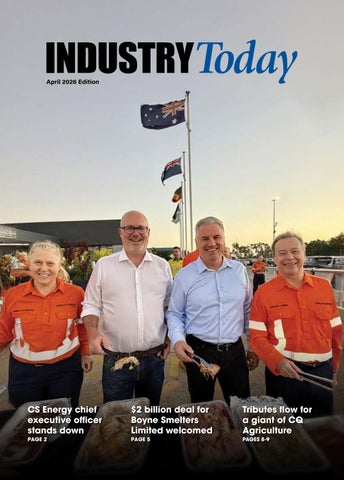
April 2026 Edition
CS Energy chief executive officer stands down
$2 billion deal for Boyne Smelters Limited welcomed
Tributes flow for a giant of CQ Agriculture
PAGE 2
PAGE 5
PAGES 8-9
INDUSTRY TODAY
Early exploration for oil By Sophie Mossman After the Queensland Government gave the green light for oil exploration in the Taroom Trough, there are already signs of promise that there could be some home-grown ‘liquid gold’. Spanning 750 square kilometres, about 3.4 kilometres beneath the surface, the Taroom Trough has been a known energy reserve for some time for its gas, but more recently, it has been brought into the spotlight again because of its oil potential. Callide MP Bryson Head said it is a great step forward and ‘with what is known there is the potential’. “We were already progressing this deposit well before there was an oil crisis because we’re backing local oil and gas,” Mr Head said. “Now, given global affairs, it certainly means
that we need to be making sure we move as quickly as we can with the industry to get this potential reserve online as quickly as possible.” It is only the early days of exploration, but there is an air of excitement with the prospect of oil being produced in Queensland. If viable, Australia could see crude oil coming out of regional Queensland as soon as 2028, and one of the biggest onshore oil opportunities since the 1970s. Queensland Minister for Natural Resources and Mines, Dale Last said this could have ‘massive economic benefits’ and plans to fast-track the project ‘if results are confirmed’. The Taroom Trough is one of 12 petroleum and gas areas within the Bowen/Surat and Cooper/Eramanga Basins. “We’ve been focused on getting the settings
right for exploration and resource development… and if we need to build a new refinery to process that oil, we will look at that,” Mr Last said. “By applying domestic market supply conditions to key gas areas and unlocking new highly prospective ground, we’re strengthening energy security and supporting regional jobs.” However, there is another factor that needs to be considered moving forward. At the end of 2025, the Australian Government, in collaboration with the Greens, passed amendments to the Environmental Protection and Biodiversity Conservation (EPBC) Act, under which farmers are no longer allowed to clear regrowth that is 15 years or older. Additionally, within the changes to the legislation, the Greens ensured that new coal,
gas and oil projects were no longer considered within the national interest. Flynn MP Colin Boyce said that ‘the current government had snookered themselves in respect to environmental reform by putting ideology over practicality’ and everyone needs to exercise some caution. “This disallows the minister of the day from approving projects within the National interest, so now that puts some boundaries around what might happen,” Mr Boyce said “Obviously, we didn’t have this oil crisis in the Middle East back when that bill was passed late last year, so it will be interesting to see how the government handles that one. “The reality is that you cannot do without diesel or petrol (because) the whole economy is geared around it.”
CS Energy chief resigns By Gregor Mactaggart CS Energy’s chief executive officer Brian Gillespie has tendered his resignation after nine months in the role. Mr Gillespie was appointed to the role in June 2025 following a diverse career spanning the mining, transport, logistics, technology, oil and gas, and health sectors. His appointment came following a period of upheaval for CS Energy, including the C3 explosion at Callide Power Station in April 2025. CS Energy chair Tony Bellas thanked Mr Gillespie for his service to the organisation and his contribution during a period of ongoing transformation for the business. “Brian has worked closely with the CS Energy Board to provide leadership, rebuild the executive team, and position the company for the next phase of Queensland’s energy transition in a dynamic and rapidly changing energy market,” Mr Bellas said. “On behalf of the Board, I thank Brian for his commitment to CS Energy and wish him well in his future endeavours.” Mr Bellas said the Board had commenced a search to appoint CS Energy’s next chief executive officer. Mr Bellas will serve as executive chair on a temporary basis until a new appointment is made. “CS Energy’s strategy, operations and commitments to safety, reliability and delivering affordable and sustainable energy for Queenslanders continue as planned,” he said. CS Energy is a State Government-owned electricity generation company that operates Callide and Kogan Creek power stations.
Telephone: 07 4863 5050
QMAG has announced changes to its organisational structure.
Address: 5-9 Hempenstall Street, Kawana, QLD 4701 EDITORIAL Gregor Mactaggart Editor E: gregor.mactaggart@CQToday.com.au Matthew Pearce Journalist E: matthew.pearce@CQToday.com.au ADVERTISING Cheryl Altouvas Advertising Sales E: cheryl.altouvas@GladstoneToday.com.au Lou De Jager Advertising Sales Executive E: lou.dejager@CQToday.com.au 2 INDUSTRY TODAY April 2026
QMAG redundancies as costs bite hard QMAG says changes to its organisational structure will allow the company to navigate increasing cost pressures and continue operating efficiently and responsibly. It is understood 13 redundancies were announced last month across the Parkhurst production facility and the Kunwarara mine site. “QMAG wishes to advise that, following a recent review of our operating requirements, we are taking proactive steps to ensure the long-term strength and sustainability of our business,” the company said in a statement.
“Like many organisations across Australia, we are managing increasing cost pressures, including higher gas and energy prices, fuel and supply chain costs, and broader freight challenges. “To continue operating efficiently and responsibly, we are proposing a number of adjustments to our organisational structure to better align with the current global market climate.” The statement said these steps form part of a broader plan to position QMAG for stability and future growth.
“While change is never easy, these measures reflect our commitment to managing the business responsibly and maintaining continuity for our people, customers, contractors, suppliers and broader stakeholders,” it said. “Our priority throughout this period remains the wellbeing of our people and the ongoing reliability of our operations.” Based in Central Queensland, QMAG (Queensland Magnesium) is a leading Australian producer of magnesia products, involved in both mining and processing.
INDUSTRY TODAY
Company found guilty Resources company Mastermyne has been found guilty by a jury of industrial manslaughter over the 2021 death of a worker at a Central Queensland mine site. Experienced underground miner Graham Dawson, 62, was killed after the roof of the Crinum Underground Mine, near Emerald, collapsed and crushed him in September 2021. It took four days for Graham’s body to be recovered. The MEU made the recommendation to prosecute after investigations by the Union’s Industry Safety and Health Representatives indicated that Mastermyne’s strata control systems were inadequate. At the time of the event, Mastermyne employed and managed the whole production workforce at Crinum. The jury handed down a majority verdict 11 out of 12 - of guilty of one count of industrial manslaughter. The MEU welcomed the verdict, the first successful application of industrial manslaughter charges since the laws were introduced in Queensland and 2020. The MEU said the historic decision reaf-
firms the fundamental belief that that workers are entitled to safe and healthy workplaces, and that employers who fail in this duty deserve to be held to account. Mining and Energy Union general vicepresident Stephen Smyth is relieved that the laws have proven to be effective. “The Queensland mining community has followed this case with great interest and concern, and we are pleased that justice has been delivered,” Mr Smyth said. “While nothing can make up for Graham’s loss, it is heartening to know that that those responsible for his death have been held to account. “Throughout the protracted investigation and hearing, our thoughts have been with Graham’s loved ones. We hope that today’s decision has brought them some comfort.” MEU Queensland District president Mitch Hughes said that the decision should send a strong message to mine managers and operators about the consequences of cutting corners on safety. “If you seriously injure or kill a worker, you will be held to account,” he said.
CAPS ON GAS, COAL COSTS ON THE CARDS IF PRICES SOAR Australia will consider imposing a cap on gas and coal prices if they skyrocket due to the Iran war, Energy Minister Chris Bowen says. Mr Bowen said unlike the energy situation following Russia’s full-scale invasion of Ukraine in 2022, gas and coal prices were yet to be impacted by the Iran war in the same way. “The government will act if we see any increases in gas and coal prices further in Australia,” he told reporters in Sydney on Good Friday. “We have planned for a number of eventualities.”
RIO’S $19.7B SPEND WITH SUPPLIERS
Graham Dawson was an experienced underground miner who was killed after the roof of the Crinum Mine, near Emerald, collapsed and crushed him in September 2021. (Supplied)
Greenfield coal mine ticks off milestone Baralaba South has completed its Environmental Impact Statement process to progress the development of a new open-cut metallurgical coal mine in the Banana Shire. The miner received the EIS assessment report from the Department of the Environment, Tourism, Science and Innovation on 2 March. The project, on 1211 hectares, involves the construction, operation, decommissioning and rehabilitation of a greenfield mine around eight kilometres south of Baralaba in the lower Bowen Basin. Production is expected to achieve up to 2.5 million tonnes per annum of run of mine coal over an operational life of 23 years slated to begin as production from the Baralaba North mine reduces as it nears the end of its mine life. Product coal would be transported through to the Port of Gladstone for export. “The successful completion of the EIS assessment process is a significant regulatory milestone for the Baralaba South project and a prerequisite for the granting of a mining lease approval,” the company stated. “The project provides for a continuation of jobs and economic benefit to the local community and Queensland. “Extensive community and stakeholder engagement has occurred over the last 10 years which was incorporated into the final EIS and resulted in the size of the mine being effectively halved minimising community
IN BRIEF
Rio Tinto spent a record A$19.7 billion with more than 6000 Australian suppliers in 2025. This represents a A$2 billion increase on the previous year, supporting jobs and businesses across Australia. About A$1.5 billion was spent with local suppliers in the regions where the company operates, supporting local jobs and local communities. A record A$1.1 billion was spent with Indigenous businesses, including A$820 million with Traditional Owner businesses. In addition, Rio Tinto paid A$9.5 billion in taxes and royalties in 2025 in Australia.
KEELY’S TOP GONG James Cook University (JCU) geology student Keely O’Mara has been named this year’s recipient of the Christopher Wallin Prize for Excellence in Geology. The award, presented by the QCoal Foundation, recognises the strongest-performing second-year geology student at JCU and includes a $2000 prize along with a paid vacation work placement with the QCoal Group’s geology team in Brisbane. Now in its third year, the scholarship is aimed at supporting the next generation of geologists. O’Mara, who is studying at JCU’s Townsville campus, said she has enjoyed the practical focus of the degree, including field trips and hands-on work with rock samples.
FUEL RELIEF MEASURES WELCOMED
The Baralaba South project will see the development of a new coal mine in the Banana Shire. (Supplied) and environmental impacts. “Baralaba South looks forward to working constructively with the local community and government stakeholders to progress the remaining approvals.” The assessment report has been sent
to the Australian Department of Climate Change, Energy, the Environment and Water to complete the assessment of the project as a controlled action under the Environmental Protection and Biodiversity Conservation Act.
The Australian Livestock and Rural Transporters Association (ALRTA) acknowledges the Federal Government’s latest fuel relief measures, including the additional 5.7 cents per litre reduction in fuel excise, as a constructive step in response to rising fuel costs. However, it is important to recognise that for heavy vehicle operators, this latest reduction delivers no real net benefit. The previous announcement to remove the Heavy Vehicle Road User Charge to zero effectively returned this equivalent value through Fuel Tax Credits. “We acknowledge the Government is acting and we welcome that, but for truck operators, this latest change doesn’t materially shift the dial, it just stops things getting worse.” ALRTA president Gerard Johnson said.
THE FUTURE IS HERE >>>
BUILT FOR
OFF GRID
NEW
LIVING Solar buildings that power your site anytime & anywhere
RID OFF-G SOLAR Y FACILIT
8.85kW PV
Cool & Quite: Crimsafe, Tropical Roof & well insulated
15x 590w Solar Panels
MEET RENEWABLE TARGETS REDUCE EMISSIONS IMMEDIATE SITE OPS
Up to
32.80 kWh Lithium Phosphate battery
READY TO GO SOLAR? CONTACT US NOW.
www.multitrade.com.au 12756359-KF20-25
April 2026 INDUSTRY TODAY 3
INDUSTRY TODAY
Water torture looms large By Di Stanley Gladstone ratepayers and the industrial base, including the city’s biggest employer Rio Tinto, face the unpalatable prospect of being slugged with astronomical water price hikes if the Gladstone Area Water Board’s (GAWB) water security assets price monitoring for 1 July 2026 to 30 June 2030 is allowed to proceed. Rio Tinto, Gladstone Regional Council and the Wiggins Island Coal Export Terminal lodged submissions with the Queensland Competition Authority (QCA) in response to a draft report investigating GAWB’s bulk water supply activities relating to water security assets, including the $950 million Fitzroy to Gladstone pipeline, for the set period. Gladstone MP Glenn Butcher claimed that when he was Water Minister in the former Labor Government, he advised GAWB to write off the pipeline over an average asset life of 30 years, rather than the compressed time scale he said was suggested in the proposed bulk water pricing model. “My instructions to the GAWB were to stretch the price out over the lifetime of the pipeline and they haven’t done that,” Mr Butcher said. “They have chosen to listen to the CEO and whack in a heap of prices for industry and for residents without any real consultation to allow the community and large business to have a say on the pricing path that they’ve chosen. “I think it’s absolutely disgraceful that they’ve lumped all this on to those businesses and to the council — and it’s still not too late for the government and the Minister to fix it. “I’m hopeful Matt Burnett and the council
will fight hard for this, because the ratepayers shouldn’t be slugged with the cost of this pipeline. “It was a pipeline for water security, for industry, for Gladstone, and for some of the new players coming to town, as in hydrogen.” A GAWB spokesperson said Mr Butcher’s claims were incorrect. “The assertion that the former Minister for Water instructed GAWB to write off the Fitzroy to Gladstone Pipeline is false,” they said. “In line with our previous statements about water pricing, GAWB is fully participating in an independent process from the Queensland Competition Authority to consider pricing arrangements for our water security assets, including the Fitzroy to Gladstone Pipeline.” In the 2023–24 financial year, Rio Tinto revealed its three Gladstone-based operations paid a total of $27 million for water and associated GAWB services. “Under the proposed increase, our annual costs are expected to rise to $35 million for 202526 and greater than $65 million for 2026-27,” Rio Tinto Aluminium - Pacific Operations managing director Amanda Torres stated in the corporate submission. “This dramatic escalation in costs will have a significant impact on the financial sustainability and competitiveness of already challenged assets in the region.” GAWB has proposed introducing a new water security price for FY27 of $1,406.888 per megalitre for industry users and the council. Rio Tinto is not dependent on the Fitzroy to Gladstone Pipeline for its bulk water, with Ms
Torres saying GAWB should look to recover the pipeline cost through parties who would benefit from the infrastructure into the future under user-pays principles. “Repeated major price rises in Rio Tinto’s operating costs at Gladstone have impacted, and will continue to significantly undermine, the viability of Rio Tinto’s Gladstone facilities,” she stated. “Rio Tinto considers that the QCA should specifically note the likely negative impact that GAWB’s price increases will have on investment incentives by major businesses operating in the area, including the flow-on impacts to regional growth and employment.” Gladstone Regional Council chief executive officer Leisa Dowling said households and small businesses should not have to fund the delivery of infrastructure like the pipeline through higher water charges. “To do so would create an inefficient, unnecessary and unfair wealth transfer from local households and businesses to industrial users,” she stated. “No engagement with council was undertaken by GAWB regarding willingness to pay and affordability to inform its submission and pricing proposal. “It is important to understand that GAWB’s water charges already make the water bills extremely high for households and businesses in the region.” Ms Dowling said a comparison of 2025–26 water charges against 11 other Queensland councils at 200kL and 250kL consumption levels showed Gladstone charges were “consider-
ably higher” than Rockhampton, Fraser Coast, Whitsunday, Livingstone and Mackay, among others in the dataset. “Council has serious concerns about the affordability of water charges for households and businesses in the region, particularly given GAWB prices exclude implications of the Awoonga Dam Improvement Project,” she added. “It is clearly apparent that the significant industrial demands met by GAWB are placing upward pressure on water supply costs in the region, significantly impacting the cost of living for households and the commercial viability of businesses.” WICET lodged its submission to the QCA on 27 February, stating it was “deeply concerned” about the “disproportionate” cost burden being imposed on existing industry participants by the GAWB increases, and calling for the pipeline to be treated as a stranded asset. Mr Butcher said the State Government needed to answer why it backed GAWB to recover the pipeline costs in the pricing model. “If you talk about Rio Tinto, that money that they’ve now got to put into this could have been spent on the workers or the EBA to support workers or to support the projects they’re doing to make the lives of the people working at these refineries a lot better,” he said. “Now, they’ve got to pay GAWB millions and millions of dollars, which means they’re going to have to cut and save somewhere else.” The QCA’s final report will be delivered to the State Government by 24 April and published in May.
Call to expand Gladstone oil refinery amid fuel crisis By Di Stanley With the fuel crisis gripping the nation, LNP statesman Michael McCormack has called on Climate Change and Energy Minister Chris Bowen to act on plans to expand the northern oil refinery at Yarwun. It is the only facility in Queensland capable of recycling waste lube oil back into base lube oil and is the most advanced re-refining plant of its kind in the world. Mr McCormack told the House of Representatives on Monday, 30 March, that the northern refinery produces 50 million litres of oil annually and its sister venture, the southern oil refinery at Wagga Wagga in New South Wales, produces 20 million litres a year. “Now, in the scheme of things on the national fuel front, they are small numbers, but that can be upscaled,” he said. “He (proprietor Tim Rose) has had a plan on the desk of the Minister for Climate Change and Energy for at least two years, if not a lot longer, to see what can be done to upscale the southern and northern oil refineries.
The northern oil refinery at Yarwun can re-refine up to 100 million litres of waste lube oil a year, meaning 100 per cent of Queensland’s annual waste lube oil production could be processed through Gladstone. (Supplied) “We could call them re-refineries because what they’re doing is converting sump oil into usable oil. “More than that, his plant at Gladstone has the potential, with a bit of engineering
and some political will, to convert old tyres into usable oil and prickly pear acacia into oil.” Mr McCormack urged consideration of the refineries’ expansion under the federal oil
SUPPORTING THE GLADSTONE REGION FOR OVER 40 YEARS 17 Garfield St Gladstone 4680
07 4976 7999 www.walzgroup.biz
12659187-JC03-24
4 INDUSTRY TODAY April 2026
stewardship program. “We have to get some sovereignty into our fuel reserves, in our oil stocks. “If we can invest in this and have the political will and the pluck to do the right thing — to make sure of the oil stewardship program, the funding, the capacity at those two plants — then we can create jobs and, more importantly, create oil. “That particular proposal that Mr Rose has had on the table, in the inbox of the minister, must be retrieved, dusted off and examined thoroughly.” The northern oil refinery works with waste collector JJ Richards and Sons to provide an environmentally sustainable waste oil recycling option for truck fleets, heavy vehicle operators, mines and local governments. According to its fact sheet, the re-refining process is a “cradle-to-cradle” treatment of oil and the highest form of recycling — keeping lube oil in productive use, lowering carbon emissions and delivering improved oil security through avoided imports, while enhancing the environmental credentials of its partners.
INDUSTRY TODAY
Smelter’s future locked in By Gregor Mactaggart A landmark $2 billion deal between the Federal Government, State Government and Rio Tinto has secured the long-term future of Boyne Smelters Limited (BSL). The agreement, announced on Wednesday, 25 March is designed to ensure Australia’s second-largest aluminium smelter remains internationally competitive beyond its current power contract in 2029, with production now underpinned through to at least 2040. The investment is forecast to unlock almost $7.5 billion in new energy generation and transmission projects, with Rio Tinto underwriting major renewable energy developments as part of a broader industrial transition. Under the arrangement, the Commonwealth and Queensland Governments will each invest $1 billion over 10 years, supporting the future of the Boyne facility and safeguarding thousands of direct and indirect jobs across Central Queensland, including Gladstone and Weipa. BSL — majority owned by Rio Tinto — employs around 1000 people directly, with a further 2000 indirect jobs supported in the Gladstone region. Rio Tinto will also deliver significant investment in solar, wind and transmission infrastructure across Central Queensland, strengthening the long-term energy supply for aluminium production while accelerating the state’s shift toward renewables. Federal Industry Minister Tim Ayres said
the deal represented a major win for regional jobs and national industry. “Today’s announcement is exactly what Future Made in Australia is all about — governments stepping up to partner with industry and unlock the enormous industrial potential of our regions,” he said. “With a considerable public investment, we are catalysing a fivefold private investment that will build out the renewable energy grid and keep thousands of good regional jobs in Central Queensland. “The arrangement here, from the Commonwealth’s perspective, is our $1 billion dollar commitment will be dispersed over the course of the 10 years of the agreement through until 2040 they will be production link credits for renewable energy generated aluminum. “That will support the investment that Rio Tinto makes in underwriting power purchasing agreements right through Queensland. “So, it’s an investment from the Commonwealth, an investment from Queensland production link credits, payment on delivery so related to the production results here, and it will underwrite a $7.5 billion commitment from Rio Tinto that will deliver new generation. “So, lower power costs more electricity, good for Queensland and good for Australia.” State Natural Resources and Mines Minister Dale Last said the agreement would strengthen the state’s economic future and industrial base. “Our partnership with the Australian Government and Rio Tinto will secure the long-
term future of the Boyne Smelter and the thousands of jobs it supports across Queensland,” he said. “At a time when supply chain disruptions are being felt across the globe, this investment is needed now more than ever to safeguard Queensland’s sovereign manufacturing capabilities, and to build national resilience and international competitiveness. “Only in Queensland can we mine, refine and smelt to produce one of the world’s most versatile and ubiquitous metals, being aluminium, and we must protect that capability.” Aluminium produced at BSL is used across transport, construction, packaging, electronics and energy infrastructure, making it a critical input for both the domestic and global economy. Rio Tinto’s Pacific Operations managing director Armando Torres said the agreement would provide long-term surety for BSL. “Today, we are very excited to tell everyone here that Boyne Smelter has a strong long-term future, at least until 2040,” he said. “Our landmark partnership will support thousands of jobs in the region and across Queensland and preserve the Queensland onshore manufacturing through a fully integrated aluminum supply chain. “Bauxite in Cape York, from the alumina here in Gladstone, and of course, for this asset producing aluminum. So, it’s a great outcome. “This smelter is important for the supply chain and finding an energy solution that
moves us to a transition for renewables is not simple. “So, for us to find that solution that we’re announcing here today was a tremendous work from Queensland, from Federal [Government], from our teams, really to find a solution that that’s going to be quite a transformational solution for the smelter to be using renewable energy. “So, with that really, under this complex and difficult solution – of course, we have a strong commitment for several projects that will be in development, and our contracts will be with at least 20 to 25 years. “So, there’s a solution, strong commitment from Rio Tinto, strong commitment from the state of Queensland, strong commitment from Commonwealth.” Rio Tinto Aluminium and Lithium chief executive officer Jerome Pecresse said the partnership would ensure the smelter remains competitive while accelerating decarbonisation. “This transformative partnership with the Queensland and Australian governments will ensure Boyne Smelter remains internationally competitive, strengthens the Australian aluminium sector for the future and supports the transformation and decarbonisation of the Queensland energy system,” he said. He said the investment, combined with existing renewable energy agreements, would position Boyne among the world’s first aluminium smelters driven by solar and wind power.
‘Strong vote of confidence’: Legacy-making lifeline By Di Stanley Rio Tinto’s $2 billion deal with the Federal and State Government to shore-up the longterm future of Boyne Smelters and safeguard thousands of jobs in the Gladstone and Weipa regions has been met with future-focused optimism. Gladstone Region Mayor Matt Burnett said the announcement reinforced Gladstone’s position as a critical hub for Australian industry. “This is a significant investment in the future of our region and a strong vote of confidence in Gladstone’s industrial base,” Cr Burnett said. “I’m the happiest mayor in the country at the moment as this announcement provides certainty for local workers, families and businesses who rely on Rio Tinto’s operations. “This is a fantastic collaboration between governments and industry to deliver long-term outcomes for the region. “We know how important it is to back our existing industries while also preparing for future opportunities and this investment helps achieve both.”
Connecting Industry director Kieran Moran said the $2 billion investment to transform Gladstone’s energy grid was one of the more consequential developments seen for Central Queensland, not just for the scale of the investment, but for what it’s aiming to address. “For years, the key question has been how energy-intensive industry, particularly the Boyne smelter, remains viable in a decarbonising market,” Mr Moran said. “This begins to provide a pathway, aligning government support with long-term private investment in generation and transmission, and recognising the importance of firm, reliable power to underpin industrial activity. “There is also a broader pipeline forming around this. “Rio Tinto has been progressing renewable supply through agreements with projects such as Smoky Creek and Guthrie’s Gap, Bungaban, Lower Wonga and Upper Calliope. “At this scale, it is unlikely to stop there with additional generation, storage and transmission infrastructure required over time.” Mr Moran said delivering firm, reliable power at this scale from renewables was com-
plex. “It will require careful planning, significant capital and a coordinated approach to how projects are developed and integrated,” he said. “Framing this purely as a ‘bail-out’ risks missing the broader point, this is about solving a system-level challenge facing industrial regions globally. “If it works, it won’t just be significant for Gladstone, it could become a model for how heavy industry transitions while remaining competitive. “From a supply chain perspective, this is where the opportunity becomes real, with work across design, construction and ongoing operations. It is still early, but the direction is clear.” Australian Aluminium Council chief executive officer Marghanita Johnson said Rio’s smelter deal was welcome news for Gladstone workers and the Central Queensland region, recognising the smelter’s important economic role and its contribution to the evolution of the Queensland grid. “Competitive energy is essential for Australian industry to compete globally — for alu-
minium smelters, it is critical to survival,” Ms Johnson said. “Australia’s historic reliance on marketbased settings has left producers exposed, as they increasingly compete not just with companies, but with governments backing their own industries. “Strong, coordinated policy is needed to restore competitiveness, protect value-added industry, and secure Australia’s place in global supply chains, which is critical to delivering long-term economic and geostrategic benefits. “This highlights how large industrial users can support energy investment, including renewables, and enable broader industrial growth. Rio Tinto announced it had spent a record $19.7 billion with more than 6000 Australian suppliers in 2025. The spend represented a $2 billion increase on the previous year, supporting jobs and businesses across Australia. About $1.5 billion was spent with local suppliers in the regions like Gladstone where the company operates, supporting local jobs and local communities.
Environment
CQG is a passionate advocate for local businesses Rockhampton | Gladstone | Brisbane | Mackay | Townsville
Engineering
Planning
www.cqgroup.com.au • +617 4922 9252 12660440-MS03-24
April 2026 INDUSTRY TODAY 5
INDUSTRY TODAY
Nuclear energy deputation By Shelby Gurney Gladstone Regional Council heard a deputation from Nuclear for Climate Australia on Tuesday, 17 March which discussed the environmental aspects of wind and solar energy, the economics of transitioning to ultra-lowcarbon, low-cost energy, and the role of nuclear, wind, hydro and solar in that transition. In his early 30s, Nuclear for Climate Australia founder Robert Parker and his wife settled in Blackwater, where they lived for three years. His wife was a GP and he was a civil engineer working in infrastructure on subdivision water supply and assisting mining companies. Following that, they moved to Rockhampton, where, with a contractor, he was involved in the construction of a concrete reservoir for Gladstone City Council. He then went on to complete earthworks at Stanthorpe power station. Over a period of five years, Mr Parker had a strong connection with the region. “It was sometime thereafter when I was working on a small weir at Eidsvold that I became recognised for all the work I was also doing overseas at the same time, and I became quite concerned about the issue of man-made climate change. And I wanted to do something about it,” he said. “I formed a relationship with a gentleman called the grandfather of climate change science, Professor James Hansen at Columbia University. “He’s also the director of NASA’s Goddard Institute, and James convinced me and many others that if we’re to get on top of emissions, but also do it at a low cost, nuclear would be an essential part of the mix.” Mr Parker went on to found the organisation Nuclear for Climate Australia. He presented an image to Gladstone Regional Council that showcased a “Control Room – Power Grid Operations”. “On the left-hand side, we see the problem we have when we have wind and solar, with their variability requiring significant amounts of gas backup and batteries and storage to deliver electricity safely into a modern industri-
Gladstone Regional Council heard a deputation from Nuclear for Climate Australia on Tuesday, 17 March which discussed the environmental aspects of wind and solar energy, the economics of transitioning to ultra-low-carbon, low-cost energy, and the role of nuclear, wind, hydro and solar in that transition. (Shuttershock) alised economy,” Mr Parker said. “‘Industrialised’ is the key term here because Gladstone, particularly with the wonderful industries you’ve got here, requires very reliable energy. “Some people say, ‘We can have demand response to fluctuate our demand with respect to variability’, but that really doesn’t work economically very well. “On the right-hand side, we have what we could get to, which is pretty much what they’re doing in France right now, where they have extremely low emissions and medium-cost electricity in Europe. It’s not the highest, certainly not the lowest. “They’re running on about 70 per cent nuclear, with a range of wind, solar, batteries and gas as well. That type of reliability is the sort of thing I’d like to discuss.” Mr Parker displayed images of Clarke Creek Wind Farm and said some people would welcome it, while others would see it as a “bird grinder”.
Japan invests in biofuel
6 INDUSTRY TODAY April 2026
Finance, Trade, Employment and Training Minister Ros Bates helped plant the first of an initial batch of 16,000 pongamia trees near Emerald for a biofuel venture involving Japan’s Nippon Steel Trading and Queensland’s Energreen. (Supplied) sults for Queenslanders. “We are securing global investment which creates regional jobs and builds a stronger Queensland economy,” she said. “Queensland is open for business and our international partners once again have confidence in our economic direction.” Mr Perrett said the project created new opportunities for regional producers. “We are backing farmers to diversify their income and tap into growing global demand,” Mr Perrett said. “This project gives landholders another way to strengthen their businesses while keeping food production strong.” “It’s just one of the ways we are unlocking new avenues for primary industries to help us reach our ambitious goal to increase the value of primary production to $30 billion by 2030.”
people are trying to do, and the statistics we saw publicly going into the last election, 12 months out from the last election, Australia was running at around 55 per cent in favour of nuclear,” he said. “As we drew closer to that election, it fell into the 40s. “The Australian public has difficulty with nuclear, and it needs a lot of discussion so it can go further into the community. I have a website and I engage with social media to hold discussions. “I think the takeaway from today (Tuesday, 17 March) is that when we visited your aluminium smelters here, I have experienced this community as the industrial hub of this state, and it has to be secured for the long term. “The aluminium smelters have got to be secured, the LNG plants have got to be secured. “You have got to have low-cost, ultra-lowcarbon energy to secure that industry. “The community of Gladstone should be able to put their hand up through their elected representatives sitting here and make the case clearly to the Queensland Government that this needs to be on the table and considered alongside wind and solar. “It’s not a black and white, either-or; it’s a shared approach. “That’s the case I believe needs to be made. The industrial rebirth of Australia around a nuclear fleet would be massive. “We see it in Canada, where they’ve got 20 reactors in Ontario, and we’re seeing it in the United States. Australia needs to participate in that.” Councillor Glenn Churchill said he was happy to move that the presentation be received. The motion was seconded by Cr Wagner and carried.
CHAUVEL INDUSTRIAL SERVICES
• On-site maintenance, shutdown and workshop facilities • Mechanical and Fabrication • Pumps, pulleys, conveyor supply and service • Civil and concreting 12659322-KG03-24
Japan’s Nippon Steel Trading has entered into a joint venture with Queensland’s Energreen to create a cutting-edge biofuel industry in the Central Highlands. A large-scale 16,000 pongamia tree plantation will be established north of Emerald, with planting beginning earlier this month. The deal was secured after trade talks during a recent delegation to Japan involving the Finance, Trade, Employment and Training Minister Ros Bates and the Primary Industries Minister Tony Perrett. Gregory MP Sean Dillon said the venture showed the Central Highlands was leading the way. “We are attracting significant global interest and investment to our region, while creating new opportunities for local families,” Mr Dillon said. “This investment shows regional Queensland is central and integral to the state’s economic future.” Pongamia is a hardy, non-edible crop whose seeds are rich in oil suitable for biofuel production. The trees can grow on marginal land not suited to traditional crops, giving farmers an extra income stream from disused land without sacrificing space for food production. Creating a commercial nursery in the Highlands would give local landholders the ability to grow pongamia on their own properties under supply agreements with the joint venture. Ms Bates helped plant the first of an initial batch of pongamia trees and said the State Government was delivering real re-
“I happen to fall into the latter category. It has a profound impact on flora and fauna of the region. During the development of those, there’s a massive amount of road clearing for the construction of these, and it has a tremendous impact on the local environment. When we try to industrialise our environment in this way, we see bird and bat deaths occurring all the time,” he said. “If it were giving us some profound benefit, one might come up with a value judgment that you’ve got to break eggs to bake a cake. However, what we are actually seeing is it is delivering neither low-cost energy nor ultra-low emissions. The whole hope for solar was that we would end up with some form of sustainable future. Here, unfortunately, it’s not happening. “Large nuclear power plants are the leastcost source of ultra-low-carbon energy on a system-wide basis. Nuclear energy has the lowest environmental impact of all generating sources. We must learn from and collaborate with success stories, especially Canada and South Korea, both of which I’ve visited. And we can build these in Australia. “From the first few, we would be able to do 80 per cent of the input here in Australia, and that could be scaled up. We need, with urgency, to get rid of anti-nuclear legislation so we can stop procrastinating.” Councillor Michelle Wagner asked what his interest in the topic was. “My interest is to ensure that the industrial wealth of Australia is maintained as we go forward, and to ensure we do that in a way that protects our environment,” Mr Parker said. Cr Wagner asked if this had gained momentum for him and where he felt he was positioned at this stage. Mr Parker said it fluctuated. “If one looks at the work that I and other
• Blast and paint
Exceeding Expectations
07 4926 8588 | chauvel.com.au Head Office: 26 Hempenstall St, Nth Rockhampton Emerald: 6 Daniels St, Emerald
INDUSTRY TODAY
Works are already underway on site for BMD Bielby RRR Joint Venture LTD’s precast yard. (Matthew Pearce: 543513)
The site has two road frontages, including Werribee Street along the Northern boundary and Anniki St along the Southern boundary.
Pre-cast yard plan firms up By Matthew Pearce Rockhampton Regional Council has approved a plan for a facility at Kawana to manufacture and provide pre-cast concrete bridge components for the Rockhampton Ring Road project. At the council’s ordinary meeting on Tuesday, 24 March, councillors heard details of the proposal by BMD Bielby RRR Joint Venture LTD (BBJV). The yard, located at Lot 46 Waurn Street, Kawana, will operate for two and a half years, including an eight-month construction period. The development will include a 118-metre x 31-metre x 19-metre open industrial shed
with an awning, a storage area for large precast bridge segments along the northern boundary, general storage areas, internal site roads, and temporary site office (demountable) facilities. Sixty-four staff car parking bays are proposed to accommodate 50 to 80 personnel. The site is described as an irregularly shaped lot with a total area of 6.9348 hectares. The unimproved vacant land has two road frontages: Werribee Street along the northern boundary and Anniki Street along the southern boundary. No concrete batching will be undertaken on-site; cement will be delivered by an external
supplier. The report presented to council found that the proposed development is not anticipated to compromise the Strategic Framework of the Rockhampton Region Planning Scheme 2015 and generally complies with the provisions of the applicable codes. The development was open to public notification for 15 business days, with one submission received and addressed. Cr Marika Taylor asked whether the development would include any upgrades for the Werribee Street area and was advised that Werribee Street and nearby streets would be up-
graded, including the intersection of Alexandra and Werribee streets. Cr Taylor also questioned the capacity of a bridge on nearby Johnson Street and was told it would be assessed to ensure it can withstand traffic from the “oversized, overmass vehicles” transporting the precast units to the Rockhampton Ring Road corridor. The motion to approve an application for a Development Permit for a Material Change of Use for High Impact Industry (temporary pre-cast concrete yard) was moved by Cr Grant Mathers, seconded by Cr Taylor, and carried unanimously.
TRAINING GLADSTONE’S FUTURE WORKFORCE Since 2016, Santos GLNG has taken on 47 local apprentices and trainees across the fields of Process Plant Operations, Mechanical Fitting & Turning, Electrical & Instrumentation and Indigenous Pathways. We’re proud to support the development of Gladstone Region talent by providing training opportunities at our world-class liquefied natural gas (LNG) facility on Curtis Island. Please join us in welcoming our 2026 cohort to site.
We are proud to have been a part of the Gladstone Region community since 2009.
GLNG.COM 12856779-JV14-26
April 2026 INDUSTRY TODAY 7
INDUSTRY TODAY
Agricultural sector reeling By Matthew Pearce and Di Stanley The agricultural sector is reeling from a double tragedy following the deaths of AgForce Central Queensland councillor Ian Burnett and his grandson Noah at Wyuna. At around 2.10pm on Sunday, 29 March, police and emergency services were called to Wyuna Road in the Central Highlands following reports an agricultural vehicle had rolled into a dam. Police said a 70-year-old man and sevenyear-old boy were declared deceased at the scene. Mr Burnett was a third-generation farmer and one of the first students at the Emerald Agricultural College. He was one of four successful balloters drawn when the Weemah channel in the Emerald Irrigation Area opened, moving to the farm in 1982. He was a member of the Queensland Grain Growers Association and Cattlemen’s Union, president of the local Grain Growers Association, president of the Cotton Growers and Irrigators Association and president of the Upper Mackenzie Water Group. He dedicated many years to AgForce in various roles, including Central Queensland regional president, vice-president and general president. AgForce Central Queensland president John Baker said he had a long history with Mr Burnett, going back to their school days. Later, they worked together closely during their time with AgForce. Mr Baker described the deaths of Mr Burnett and his grandson as “heartbreaking”. “I’ve got the utmost respect for Ian. He was the nicest person you could possibly hope to meet, just a true gentleman,” he said. “He put a lot of thought into everything that he said and did and was very reasonable and rational in his thinking.” In addition to AgForce circles, Mr Baker said Mr Burnett would be greatly missed in the Central Highlands community, where he served as chair of the Rotary Club of Emerald. He was the driving force behind the RFDS
The community is mourning the passing of Central Highlands pastoralist Ian Burnett, pictured with his long-term partner Julie Lancaster. (Supplied) (Qld Section) aeromedical patient transfer facility, currently under construction at Emerald Airport. The club has raised more than $1.25 million in the Central Highlands community towards the facility, which is due to open in August or September. “He was a great bloke, a great advocate for agriculture and the community and the region,” Mr Baker said. “This is just a huge loss for everyone.” RFDS (Qld Section) chair Georgie Somerset said Ian’s passing would leave a huge hole not only for his family, but the community. “We, at the RFDS, are just so deeply appreciative of all that he’s done for that project and for the community,” she said. Ms Somerset said she had spoken with Mr Burnett just a few weeks ago about the
aeromedical patient transfer facility and what it would mean for Emerald. “I’ve known Ian for a couple of decades and I think, for me, one of the marks of Ian was he was always wanting to leave things better than how he found them, and that’s certainly what he was doing through Rotary,” she said. Mayor Janice Moriarty extended her heartfelt thoughts and deepest sympathies on behalf of the Central Highlands Regional Council and the broader community. “This is an unimaginable loss for the Burnett family, and our hearts are with them, their loved ones, and friends during this incredibly difficult time. ,” she said. Flynn MP Colin Boyce said the deaths were heartbreaking news for the Central Highlands. “The loss of these lives will be felt right across the region. My thoughts are with the
family, friends and local community at this difficult time,” he said. Gregory MP Sean Dillon said his thoughts and deepest sympathies were with Mr Burnett’s partner Julie, as well as the Burnett and Williamson families, as they navigate this unimaginable loss. “Ian’s leadership extended far beyond his own farm gate… His advocacy for the future of Queensland agriculture earned deep respect across the state,” he said. “My thoughts are also with Noah’s school community as they learn about the loss of their classmate and friend.” Mr Dillon said this was a double tragedy for a family that had given so much to the Central Highlands community and the agricultural industry.
Industry tributes for Ian The entire Australian cotton family is heartbroken by the tragic loss of Ian Burnett and his much-loved grandson. Cotton Australia chief executive Adam Kay said Ian was more than a respected cotton grower – he was a leader, a mentor and a quiet powerhouse of Australian agriculture. “To lose him so suddenly, alongside his young grandson, is a tragedy that has shaken the agricultural community in Queensland, particularly all those who know the family,” he said. A third-generation farmer, Ian dedicated his life to the land. He had been growing cotton since moving to Emerald from Clermont in 1983 and since then has played a pivotal role in establishing and strengthening cotton production in Central Queensland. “Ian’s influence reached far beyond the farm gate,” Mr Kay said. “Over more than four decades, he gave tirelessly to industry organisations including Central Highlands Cotton Growers Association, AgForce Queensland, National Farmers Federation and numerous local and regional boards. “He was passionate about his local community and was a member of Rotary, the Rural Fire Brigade and had been actively involved in fundraising for the Royal Flying Doctor Service (RFDS) in Emerald. “His efforts were instrumental in securing funding for the construction of a new patient transfer facility at Emerald Airport.” MrKay said Ian was never one to seek recognition, yet his leadership was widely felt and 8 INDUSTRY TODAY April 2026
deeply respected. “At the heart of everything Ian did was family,” he said. “He was immensely proud that his sons, including Cotton Australia’s immediate past Chair Nigel Burnett and current CRDC Director Ross Burnett, were continuing the farming legacy he worked so hard to build. “On behalf of Cotton Australia, I extend our deepest sympathy to Ian’s family, friends, colleagues and the wider Emerald and cottongrowing communities. Ian leaves behind a legacy of leadership, service and integrity and he will be deeply missed.” National Farmers Federation president Hamish McIntyre said the double tragedy had reverberated far and wide. “The NFF family is devastated by the news of Ian and his grandson’s death,” Mr McIntyre said. “Our thoughts are with their family during this incredibly difficult time. Ian made a valuable contribution to the NFF both during his time on the NFF Board and as a member, and for a period president of AgForce. “However, his contribution to agricultural advocacy reached far deeper, serving many decades in various roles championing Queensland producers. Ian was a great believer in unity in advocacy and encouraging others to get involved. “He was an innovative, hardworking and generous farmer, both in the paddock and in the board room, but above all, he was a family man at heart. He will be remembered with deep respect and gratitude across the agricultural community.”
A titan of the ag industry Australia-wide, the untimely loss of Central Highlands cotton grower Ian Burnett has led to a flood of tributes. (Supplied)
INDUSTRY TODAY
Double tragedy takes toll By Di Stanley To his fellow Emerald Rotarians, president Ian Burnett was simply known as “I.B.” - dependable, generous and always there when it mattered most. Tragically, Ian, 70, and his adored grandson Noah Williamson, aged seven, died in an onfarm accident at his Wyuna property on Sunday, 29 March. On Thursday, 2 April, club members gathered at the Rotary Park clubhouse for a night of shared fellowship to honour his memory. “This devastating loss has shaken not only our club, but the entire Central Queensland community and the broader Australian agricultural sector,” club member Ross Drayton said. “Ian was not simply a member of Rotary, he was the cornerstone of it. “Over the past two years, he led our club with quiet strength, integrity and unwavering commitment. “Under his guidance, our club flourished. “New members joined, many drawn by Ian’s character, his belief in people and his ability to bring others together with purpose. “Our club is grieving. “We are not operating as an organisation, but as a family coming to terms with an unimaginable loss.” RFDS ambassador board member Russell Postle had worked closely with Ian on the aeromedical patient transfer facility at Emerald Airport, seeing him as recently as Wednesday, 11 March, for the launch of five micro stories told on video for the project. “It was great that Ian was able to be there and from a project point of view, the fact that he’s been interviewed, he’s on the story, he’s there, he will be remembered,” Mr Postle said. “One of the great things to reflect on is the fact he took on the presidency of Rotary from Michael and he got the pass, he grabbed the ball and he ran with it. “He understood the patient transfer facility and he could really see the vision and what it can do for the town and just put 110 per cent effort into it. “Ian was very proud of the fact that the project had a positive impact on the club and its membership in terms of bringing them together, encouraging others to join them on the pathway.” Mr Postle said the patient transfer facility, due for completion in August-September, would be the enduring legacy of its Emerald partners in Rotary and the Central Highlands council. “It is certainly a thought that it would be nice to do something to remember Ian as part of that process,” he said. Rotarian Max Ragigia described Ian as a leader, a mentor and the true embodiment of the Rotary spirit. “His dedication to service above self was evident in everything he did,” Mr Ragigia said. “He led with kindness, humility and a genuine passion for helping others. “Through his leadership, he strengthened our club and inspired each of us to give more, care more, and do more for our community. “His legacy is not only in the projects he led, but in the lives he touched and the friendships he built. “We also remember his grandson, a young life full of promise and potential, taken far too soon. “While we may not have known him as deeply, we feel the weight of this loss alongside Ian’s family.” Former Gregory MP and cotton farmer Lachlan Millar said he was “heartbroken” by the news of Ian’s death. “We were basically next-door neighbours as a young boy,” Mr Millar said. “I’ve known Ian and the Burnett family for most of my life... I’m just heartbroken. “He and my dad, they drew their blocks (on Foleys Road) the same year.” Mr Millar said Ian’s loss would be felt on many levels. “It’s absolutely devastating, not only for the
Rotary Club of Emerald members turned out in force at the Emerald Airport on Wednesday, 11 March, to support president Ian Burnett (centre back) and the proponents of the RFDS aeromedical patient transfer facility. (Di Stanley: 544880) agricultural community but the community in the Central Highlands in general,” he said. “Ian was such a leading figure in agriculture, but also with his work with Rotary and in the community - it was significant. “Like all other people from there, our hearts are just broken, for the family and for everybody who loved and knew him.” Immediate past president Michael McCosker lost a good mate, a neighbour and lifelong family friend. “He was very involved in the rural industry with us, he’s our neighbour and he’s a great mate at Rotary,” Mr McCosker said. “Ian used to get a lift with dad (Neil Mc Cosker) from Clermont to go to the (Emerald) ag college. “From way back when, he kept a close relationship with dad. “He’s been a big part of our family for all that time and we’ve been close in terms of industry organisations over the time, always involved in that sort of thing together and cotton research.” Mr McCosker said the ag college was a particular shared passion for he and Ian. Both were past chairmen, as was Mr McCosker’s father. “We saw the need for having a formal educational facility that provided students with rural knowledge and skills for generations to come,” Mr McCosker said. “Ian was instrumental in organising the 50th year reunion of the ag college so past students and staff could reconnect. “He was always very supportive of programs like LeadAg and if anyone called on him from that respect, he was more than willing to give them his time and any assistance he could to help that particular project.” Current Gregory MP Sean Dillon described Ian as a third-generation farmer, former Emerald Agricultural College student and member of AgForce, Central Highlands Cotton Growers and Irrigators Association and Rotary. “The terrible accident that has claimed the life of Ian Burnett and his grandson Noah Williamson is a double tragedy for a family that has given so much to the Central Highlands community and the agricultural industry,” he said. “His advocacy for the future of Queensland agriculture and his community service earned deep respect across the state. “My thoughts and deepest sympathies are with Julie, the Burnett and Williamson families as they navigate this unimaginable loss. “My thoughts are also with Noah’s school community, as they learn about the loss of their classmate and friend.”
Ian was one of the country’s leading experts on cotton cropping. (Supplied)
Ian Burnett with his sons Nigel and Ross and long-term partner Julie Lancaster. (Supplied) Mr Drayton said Ian’s service to the community was never more evident than in helping the club raise $1.3 million toward the RFDS aeromedical patient transfer facility through his “extraordinary network, generosity of spirit and relentless drive”. “Ian was a man who never sought recognition, yet it found him in everything he did,” he said. “He was a leader, a mentor, a trusted friend
and a champion for those he believed were not being treated fairly. “Above all, he was a devoted family man, deeply proud of his children and absolutely devoted to his grandchildren.” Ian leaves behind his sons Nigel, Ross and Craig, daughter Louise, grandchildren and long-term partner and fellow Rotarianne Julie Lancaster. April 2026 INDUSTRY TODAY 9
INDUSTRY TODAY
Arrivals Plaza build begins Construction is now underway on the Great Keppel Island (Woppa) Arrivals Plaza, marking a key milestone in the transformation of one of Central Queensland’s most popular island destinations and delivering a major boost to its long-term tourism future. The new arrivals precinct at Fishermen’s Beach will create a welcoming gateway for visitors, featuring public amenities, shaded seating, accessible pathways, landscaping and wayfinding designed to reflect the island’s unique cultural and natural character. The project is expected to significantly improve the visitor experience while supporting smoother movement through one of Livingstone Shire’s most iconic destinations. Livingstone Shire Mayor Adam Belot said the start of construction represents a longawaited milestone for both the island and the wider community. “Great Keppel Island is one of Livingstone Shire’s most iconic natural assets, and it’s incredibly rewarding to finally see work underway on infrastructure that will transform the arrival experience and do justice to such a special place,” Cr Belot said. He said the project had been carefully planned to ensure minimal disruption during construction. “Council officers have engaged with Paynters and local businesses to plan construction staging that minimises impacts on the island community,” Cr Belot said. “Importantly, Great Keppel Island remains open to visitors throughout the duration of construction, and people can continue to enjoy everything this beautiful island has to offer while works are underway.” Tourism Minister Andrew Powell said the project signalled real progress for the island’s
future, with the Arrivals Plaza forming a key part of the $25 million Great Keppel Island Rejuvenation Fund. “Great Keppel Island holds a special place in the hearts of Queenslanders and today marks the start of an exciting new chapter,” he said. “The Arrivals Plaza is a cornerstone of our $25 million Great Keppel Island Rejuvenation Fund and shows our commitment to building a stronger, more sustainable tourism future for the region.” Mr Powell said the development aligned with long-term planning for the region’s tourism growth. “Breaking ground is a major step forward in revitalising the island and delivering the world-class visitor experience Great Keppel Island deserves, in line with the long-term goals set out in Destination 2045,” he said. The project’s construction contractor, Paynters, said it was proud to be working alongside Livingstone Shire Council and the Queensland Government to deliver the infrastructure upgrade. A spokesperson said the company aims to deliver an outcome that enhances the visitor experience and encourages greater visitation to the island. Construction activity will be visible around Fishermen’s Beach throughout the build period, with clear signage in place to ensure pedestrian safety. Ferry services, accommodation providers and island businesses will continue to operate as normal, with minimal disruption expected for visitors. The Arrivals Plaza is due for completion by August 2026.
Matt Tamassy, Max Parker, Jacob Weir, Livingstone Shire Mayor Adam Belot, Keppel MP Nigel Hutton, Arvind Singh and Luke Massingham celebrate the start of work on the Arrivals Plaza at Great Keppel Island. (Supplied)
The new arrivals plaza will feature public amenities, shaded seating, accessible pathways and landscaping reflecting the island’s natural beauty.
Construction is underway on the Great Keppel Island (Woppa) Arrivals Plaza, set to transform the visitor experience at Fishermen’s Beach.
Funding boost for groups Yarrabee Coal Mine is investing $180,000 into community organisations in Blackwater and the surrounding areas, aiming to make a positive difference to the community. The Yarrabee Coal 2026 Community Support Program is funding a diverse range of local programs and initiatives including: new gardening equipment for Bluff Rugby League Football Club; a canteen upgrade at Blackwater Bandits Football Club; Indigenous, sensory and cultural resources for Blackwater Community Kindergarten; a music program at Blackdown Seniors; the Science and Engineering Challenge at Marist College Emerald; installation of an outdoor learning shelter at Blackwater State High School; coaching clinics and new gear for Blackwater Junior Golf; sponsorship of the Blackwater International Coal Centre, PCYC Queensland, Martuwarra Wanderers, Blackwater Clay Target Club; and helping ensure local events run such as Blackwater Rodeo, the Blackwater State High School Awards Evening, Emerald Polocrosse, Blackwater Golf tournament and Blackwater Arts event. Yarrabee Coal Operations Manager Mike Priestly congratulated the 2026 successful recipients. “We are dedicated to making a positive impact on the Blackwater community and its people and a keyway of doing this is funding groups and initiatives year on year through our community support program,” Mr Priestly said. “This year we are pleased to see that our funding will go towards local senior and youth education and training programs, running events, new equipment, building upgrades and arts initiatives.
• • • • • • • • •
Yarrabee Coal sponsored the annual awards evening at Blackwater State High School where student, Hunter Scott received an award from Yancoal’s Andy Barrow. (Supplied) “Over the past five years, Yarrabee has distributed over $600,000 in community grants and sponsorships and we are confident that our financial assistance will help continue to strengthen these vital community projects and services throughout the region. “We look forward to seeing the positive impact the 2026 projects make on our community.” The Yarrabee Coal Community Support Program runs annually, aiming to make a positive difference in the local community, and to the lives of the people who work and live in the local area. “We appreciate Yarrabee Coal’s ongoing generous sponsorship, attendance and donation towards our annual awards evening,” Tamara Jackson from Blackwater State High School said. “The support plays a pivotal role in making the event a success for our students. It is wonderful to have partners like Yarrabee Coal that recognise the importance of investing in education and the growth of our students. “We look forward to continued collaboration and shared success in the future.” 12829632-PS02-25
10 INDUSTRY TODAY April 2026
INDUSTRY TODAY
Cr Andrea Friend, Mayor Adam Belot, Cr Glenda Mather and Cr Lance Warcon on site. (Supplied)
The Gateway Stage 4 works underway.
Industrial park’s progress Construction has begun on Stage 4 of the Gateway Business and Industry Park, marking another step in Livingstone Shire Council’s push to expand industrial capacity and support long-term economic growth across the Capricorn Coast. The latest stage of the Yeppoon-based precinct will deliver 11 new low-impact industry lots, with council saying demand for industrial land continues to remain strong. Livingstone Shire Mayor Adam Belot said the project reflected ongoing confidence in the local economy and the need for additional space for business expansion. “Gateway Stage 4 will deliver 11 new low impact industry lots, responding directly to strong market demand and providing opportunities
for new and expanding businesses to establish themselves on the Capricorn Coast,” Cr Belot said. Yeppoon-based contractor JRT Group has been awarded the construction tender, with works now underway on site. “It’s fantastic to see a local company like JRT Group delivering this important project,” Cr Belot said. “Using local contractors means local jobs, local knowledge and investment flowing straight back into our community.” The Gateway Business and Industry Park has already delivered more than 30 lots across previous stages, with a range of businesses now operating from the precinct. Cr Belot said the development was playing a
key role in supporting economic diversification and strengthening regional resilience. “The Gateway Business and Industry Park provides businesses with a strategic footprint to service the broader region, while also creating local employment and attracting private sector investment,” he said. Stage 4 is expected to be completed by mid2026, with lots to be released to the market following completion. The works will also deliver additional road network improvements for Yeppoon, including future integration with the planned East West Connector Road, which is expected to provide an alternative link to the Rockhampton-Yeppoon Road and ease pressure on Jordy Drive. Planning is already underway for Stage 5 of
the development, which will provide a further nine industrial lots. The Gateway Business and Industry Park forms part of Blueprint Livingstone, council’s long-term strategy aimed at delivering major infrastructure projects to support investment, jobs and sustainable growth across the region. Cr Belot said the program was focused on building future opportunity for the region. “Blueprint Livingstone is about thinking beyond business as usual and creating opportunities that deliver lasting prosperity for our community,” he said. “Gateway is a prime example of how council is proactively investing in infrastructure that supports jobs, businesses, and the future of Livingstone Shire.”
Your gateway to new opportunities. gpcl.com.au
1800 243 GPC (472)
12852959-JV16-26
Growth. Prosperity. Community.
April 2026 INDUSTRY TODAY 11
INDUSTRY TODAY
An artist impression of the interior.
A drone shot of the site.
Green light for new centre By Shelby Gurney Gladstone Regional Council has approved Paynters Pty Ltd to build the long-awaited Boyne Tannum Aquatic Centre. Construction is anticipated to commence in May 2026, with expected completion around mid-2027, weather and site conditions permitting. With $15 million in Federal funding secured in January 2024, the new facility promises to enhance the region’s recreational offerings by 2027. The works will include the construction of a new aquatic centre, incorporating site clearance, associated infrastructure, civil works, roadworks, a 50m pool with plant room, change rooms, a kiosk, a children’s play area, landscaping, and associated environmental works. The project will also include new road and footpath connections. Located at Lot 5 Arthur Street, Boyne Island, the BTAC has been a long-term priority for Council and a highly anticipated project for the region, with nearly 95 per cent (94.61 per cent) of respondents in favour of the development, according to initial community engagement. Acting general manager of finance, governance and risk Tanya Whalley said the recommendation followed a rigorous, transparent and fully compliant procurement process supported by an independent probity advisor. “Today, the officers’ recommendation is that council awards the contract for construction of the Boyne Tannum Aquatic Centre to Paynters Pty Ltd, with an expenditure of $29,717,030 excluding GST,” she said. General manager of assets and environment Mark Francis said, should council support this recommendation, it would also serve as council’s final investment decision to move from design into delivery. “This project has, over the last eight years, matured from a notice of motion through to community consultation, site selection, new site selection, development approvals, and concept through to detailed design, while being revised to ensure an asset that contributes to the community’s wellbeing and the region’s liveability in the most cost-effective way,” he said. “The project itself has been a real crossbusiness collaboration, and I would like to commend the sponsorship of general manager of people and strategy Carly Quinn and Strategic Project Specialist Erickson Noakes in particular for leading most of the project through the height of the uncertainty of early concepts and site selection, navigating planning and regulatory approvals, as well as keeping key com12 INDUSTRY TODAY April 2026
An artist impression of the Boyne Tannum Aquatic Centre. (Supplied) munity stakeholders updated.” Mayor Matt Burnett moved the motion from the chair. Councillor Glen Churchill said he was happy to second the motion. “This is just another visionary project for the future, and it’s not only for Boyne Tannum but our entire region,” Cr Churchill said. “It has been a long time coming. I acknowledge the efforts of the officers who have been doing a lot of work behind the scenes. “As I’ve indicated previously, none of us will live forever, but this project can live on forever as a legacy. “I would like to acknowledge not only this council today but previous councils who were endeavouring to ensure that this communitybased project was not only on our agenda but our community’s agenda.
“The report clearly states the people have spoken — 95 per cent are in favour. “There’s a huge amount of benefits that will come from this, not only in terms of recreation, training and competition. I also sit on the Gladstone Sports District Foundation Trust, and I hope my colleagues will support the officers’ recommendation, which could lead to additional funding for this project. “I would also like to acknowledge Mayor Burnett’s efforts in the past, but also at the same time acknowledge the Australian Government’s $15 million contribution to the project.” The motion was moved by Cr Burnett and seconded by Cr Churchill. Cr Burnett called a division. The recorded vote was unanimous.
Before moving to the next item on the agenda, Cr Burnett said he wanted to take a moment to thank two people. “Firstly, (former councillor) Kahn Goodluck for tabling the notice of motion in the first instance and bringing it back onto the agenda, and Catherine King, who is the reason we have $15 million, which is just over half of the cost of the project,” he said. “Federal Minister for Infrastructure, Transport, Regional Development and Local Government Catherine King was in Tannum and made the announcement there in about 2021. It was fantastic to welcome Catherine to our region and secure that $15 million commitment, which is just over half the cost of the tendered price.”
INDUSTRY TODAY
Not an open and shut case CONNECTING INDUSTRY WITH KIERAN MORAN I went looking for a stock called “Disconnected” the other day. Thought it might be a good buy given we’re being told to stay home, travel less, keep your distance, pick a side, argue it loudly, and don’t trust the other side. However, I couldn’t find it. Strange, really. Because if you listen to the noise about oil prices, global tensions, the constant churn of social media, it feels like disconnection is being positioned as the safest, smartest move. The Offspring’s “Keep ’em Separated” might as well be today’s unofficial business strategy. But here’s the thing, it’s wrong. Or more accurately, it’s incomplete. Because while the world might be nudging people toward isolation, the businesses and individuals who move forward i.e. the ones who grow, win work, and build something meaningful, are doing the opposite. They’re doubling down on connection. This isn’t about ignoring reality. Costs are up. Travel takes more effort. Time is tighter. But that just makes relationships more valuable, not less. When things are uncertain, people don’t retreat from trust, they rely on it more. I saw this clearly a few years ago during the Covid pandemic when everything felt like it was shutting down. Instead of pulling back, I
Businesses that make it through the toughest periods are the ones that keep investing. In their people, systems and relationships. (Supplied) sat down and wrote out a list of my top 50 business relationships. People I respected. People who trusted me. People who would pick up the phone or reply to an email within 24 hours. Not prospects. Not “contacts“. Relationships. That list became one of the most valuable assets I’ve ever built. Not because I needed something from them, but because it reminded me of something simple - business is still, at its core, people. And people don’t operate well in isolation. We talk a lot about knowledge workers, data, insights, strategy, which are all important. But if you strip it back, most outcomes don’t come from what you know. They come from who you can call, who will
back you, who will open a door, who will tell you the truth and who will go into bat for you when it matters. That doesn’t happen overnight. And it definitely doesn’t happen when you’re sitting back waiting for things to settle down. If anything, the businesses that came through the toughest periods strongest weren’t the ones who paused, they were the ones who kept investing. In their people. In their systems. And most importantly, in their relationships. They stayed visible and they kept turning up. They continued conversations when it would’ve been easier to go quiet and it showed. Some of them didn’t just survive, they accelerated. Because when others pulled back, they leaned in. They strengthened their networks while
others let theirs drift. That’s the opportunity right now. Not to disconnect. Not to wait. Not to convince yourself that “things are too uncertain” to get out there and engage. But to be intentional. Call people. Meet them. Show up. Put yourself in the room even when it’s inconvenient. Especially when it’s inconvenient. Because relationships aren’t built when it’s easy. They’re built when it takes effort. That list became one of the most valuable assets I’ve built. Because when you strip it back, business is still about people. Outcomes don’t come from what you know, they come from who you can call, who will back you, who will open a door, and who will go into bat for you when it matters. And that doesn’t happen by chance. It happens by being intentional. Staying visible. Showing up. Continuing conversations when it would be easier to go quiet. So, if you’re thinking about pulling back or waiting for things to settle, I’d challenge that. This isn’t the time to go quiet. It’s the time to invest. Because while “Disconnected” might feel like the trend, it’s not where the value is being created. That’s happening, quietly, consistently, in conversations, in rooms, and in relationships. Kieran Moran is the Director of Connecting Industry Pty Ltd, a specialist communications and stakeholder engagement company. Through industry events, communication strategies, and targeted engagement, Connecting Industry helps connect people and businesses to build strategic relationships that create long-term value, drive collaboration, and unlock new opportunities across the resource and construction supply chain and energy sectors.
EXTEND YOUR BUSINESS REACH
Yeppoon Longreach
Emerald
Rockhampton Gladstone Biloela
Industry Today provides your business with the chance to extend its footprint beyond local boundaries, attracting a diverse array of new clients. Accessible both in print and online from the coast to the outback.
Advertise today by calling Cheryl 0425 600 098 | cheryl.altouvas@gladstonetoday.com.au 12702173-CB29-24
April 2026 INDUSTRY TODAY 13
INDUSTRY TODAY
Students gain key insights From virtual haul trucks to hands-on mechanical challenges, Blackwater students have been given a taste of life in the mining trades through an immersive workshop designed to showcase career pathways in the resources sector. Eighteen Year 10 students from Blackwater State High School recently took part in the “Tradies for a Day” program, delivered by the Queensland Minerals and Energy Academy (QMEA) in partnership with Coronado Global Resources. The workshop aimed to highlight the range of trade-based careers available in mining and the apprenticeship pathways students can pursue after school. This year’s program also incorporated virtual reality technology, with students stepping into simulated mine-site environments to try welding, operate haul trucks and complete vehicle maintenance checks. Students also rotated through a series of hands-on challenges covering mechanics, electronics, pneumatics and automotive skills, working alongside experienced tradespeople from Coronado. Coronado Global Resources Organisational Capability manager Peter Murphy said early engagement was key to building the future workforce. “Workshops like this are about sparking interest and showing students what jobs are possible in resource operations close to their home,” Mr Murphy said. “There is continual demand for tradespeople in our industry, and by connecting with students early, we hope to help them see exactly
The workshop was designed to give students a realistic insight into the vital role that trades play in the resources sector and the apprenticeship pathways available to them beyond school.
A group of eighteen Year 10 students from Blackwater State High School put their trade skills to the test during the workshop delivered by the Queensland Minerals and Energy Academy (QMEA) in partnership with Coronado Global Resources. how vocational studies at school can lead to real-world careers in our industry.” Blackwater State High School principal Rebecca Vitale said the experience gave students valuable exposure to trade pathways. “Spending an entire day focused on trade skills allows students to build confidence, try
new things and find out more about trade apprenticeships,” Ms Vitale said. “Hearing directly from tradespeople about their career journeys helps students make informed decisions about their future and the subjects they need to study in their final years at school.”
This year’s program also featured cutting-edge technology, with students using virtual reality (VR) to experience welding, haul truck driving and complete a vehicle maintenance check in a simulated mine-site environment.
Work on third bridge for Rockhampton set to start By Matthew Pearce A temporary exclusion zone has been established on part of the Fitzroy River, with early works about to begin on Rockhampton’s long-anticipated third river crossing. The crossing is part of the $1.98 billion Rockhampton Ring Road project. A Transport and Main Roads spokesperson said the 435-metre bridge over the Fitzroy River will connect Pink Lily and Parkhurst, improving safety, travel efficiency and regional connectivity, while supporting local jobs and economic growth. The four-lane river crossing will include shared bike riding and walking facilities in both directions, with early works on the bridge expected to start in mid-April, weather permitting. A temporary upstream work bridge will be built to support construction. In a public notice in Central Queensland Today, Maritime Safety Queensland advised that a 250m section of the Fitzroy River would be temporarily designated as an exclusion zone to facilitate construction of a third river crossing as part of the Rockhampton Ring Road project. An exclusion zone refers to an area where vessels are prohibited from anchoring, berth-
Work on the Rockhampton Ring Road is underway at Alexandra St, Parkhurst near the planned new Fitzroy River crossing. (Matthew Pearce: 545341) ing, mooring, operating or conducting any activity that may endanger marine safety. This section, located between Pink Lily and Parkhurst, is about 4.5km upstream of the Fitzroy River Barrage. “The exclusion zone will be clearly marked with yellow buoys and flashing lights, with river users requested to follow all signage and markers during this period,” the notice reads. Stage 1, from 7 April to 12 July, will be a partial exclusion zone. A 50m navigation channel will remain open on the Parkhurst side of the river for continued public access.
Stage 2, from 13 July 2026 to 30 June 2028, will be a full river-width exclusion zone. Expected to be completed in 2031, the Rockhampton Ring Road project is funded by the state and federal governments, with the Federal Government providing $1.4 billion and the State Government providing $580 million. In addition to the Fitzroy River bridge, the Ring Road will include a total of 18 bridges along the main alignment, including eight road overpasses and seven water crossings. In September last year, construction was
completed on the Limestone Creek Bridge, which signified the transition from early works to main construction on the ring road. The 204-metre Limestone Creek Bridge, at the northern access to the ring road at Parkhurst, was constructed using 66 pre-cast concrete Super-T girders from Humes Concrete Products, with each girder weighing 82 tonnes and measuring around 34 metres in length. The Rockhampton Ring Road project will involve the construction of 17.4 kilometres of new roadway, including a 14.7km western link of the Bruce Highway extending from the Capricorn Highway (at Nelson Street) in the south to the Bruce Highway and Rockhampton–Yeppoon Road intersection in the north. The current highway through Rockhampton is a bottleneck, with 19 sets of traffic signals and significant traffic volumes, including an average of 3,020 heavy vehicles daily. The State and Federal Government say these upgrades will improve connectivity to key locations, such as the Rockhampton Airport, the Rockhampton Hospital, defence, education and leisure precincts in Wandal and Rockhampton City, and industrial precincts in North Rockhampton.
Streamlining approvals process to get projects moving The State Government has moved to streamline approvals for major resource projects, launching a new cross-agency model aimed at cutting delays, reducing red tape and fasttracking investment across Queensland’s mining and resources sector. The new Cross-Agency Assessment Team will bring together specialist officers from key state government agencies to work through environmental and regulatory requirements earlier in the approvals process, with the aim of giving project proponents greater certainty and faster decisions. Led by the Coordinator-General, the team will coordinate assessments across departments and engage local councils from the out14 INDUSTRY TODAY April 2026
set to ensure regional issues are identified and addressed sooner. The government said the approach is designed to remove bottlenecks that can slow down major developments, with the first projects to come under the new system including the Eva Copper Mine, the Centurion North Development and Graphinex’s Esmeralda Graphite Project. Deputy Premier and State Development, Infrastructure and Planning Minister Jarrod Bleijie said the new model would help unlock investment and job creation. “The Cross-Agency Assessment Team will allow us to address challenges early and provide certainty for proponents, support invest-
ment certainty, drive job creation and reinforce Queensland’s position as a competitive, globally focused resource state,” Mr Bleijie said. He said the resources sector had previously been held back by uncertainty and slow approvals. Natural Resources and Mines Minister Dale Last said the initiative sent a clear message that Queensland was “open for business” and ready to capitalise on global demand for coal and critical minerals. “Queensland is well placed to tap into the strong global demand for our resources, but to meet that demand, we need a regulatory framework that supports investment,” Mr Last said.
Coordinator-General Gerard Coggan said the team would improve coordination across government and help balance economic, environmental and social considerations. “Resource projects are significant undertakings that require precise coordination across multiple agencies and engagement with stakeholders at all levels,” Mr Coggan said. “The Cross-Agency Assessment Team will enable a more unified approach to addressing issues early, ensuring projects meet requirements while reducing delays in decision-making.”
INDUSTRY TODAY
Global knowledge Gladstone’s ecosystems are not just beautiful, they’re essential to the region’s economy. CQUniversity Principal Research Fellow Associate Professor Carolyn Lundquist is working with local industry to deliver nature-based solutions that protect the environment while supporting sustainable business operations. Through projects led by CQUniversity’s Coastal Marine Ecosystem Research Centre (CMERC) in partnership with the Great Barrier Reef Foundation and working with Traditional Owners, researchers are scaling up seagrass restoration and creating mangrove and oyster reefs. Local port managers at Gladstone Ports Corporation (GPC) are also working with researchers to trial a range of nature-based initiatives such as living seawalls. These projects aim to improve water quality, strengthen coastal resilience and support fisheries, while helping maintain sustainable port operations. Early results point to successful habitat establishment and strong potential to expand seagrass meadows, mangrove forests and oyster reef systems. A/Prof Lundquist said the local partnerships demonstrated how working with nature delivered practical and economic benefits. In Gladstone, we’re seeing how naturepositive practices, including living seawalls, expanded seagrass restoration and mangrove and oyster reef creation, help support sustainable port operations while maintaining healthy ecosystems within a working multi-commodity port,” A/Prof Lundquist said. “These projects make economic sense be-
Associate Professor Carolyn Lundquist. cause they help safeguard the natural assets that port communities and industries depend on.” This regional work is highly informed by A/ Prof Lundquist’s global expertise, who recently attended the 12th Plenary of the Intergovernmental Science-Policy Platform on Biodiversity and Ecosystem Services (IPBES) in Manchester. The IPBES 12th Plenary brought together more than 1000 delegates from around 150 governments, reflecting a strong global focus on the links between business and nature. A/Prof Lundquist serves on IPBES’ Multidisciplinary Expert Panel (MEP) - a global panel that oversees the scientific quality of IPBES assessments. For the first time, women (including Dr Lundquist who was re-elected for a second three-year term) now make up most of this panel.
During the Plenary in Manchester, governments approved the first-ever business and biodiversity methodological assessment. This report confirms that all businesses depend on and impact nature, and that biodiversity loss now poses growing risks to economies worldwide. “Lessons from Gladstone and Central Queensland are contributing to global solutions, and the international perspectives I bring back help guide our local projects,” A/ Prof Lundquist said. The IPBES assessment also highlighted an imbalance in global finance. “Trillions of dollars continue to flow into activities that harm nature, while far less is invested in conservation,” A/Prof Lundquist said. “Many subsidies are designed to support industry growth, infrastructure and productivity, but some can have unintended impacts such as increased pollution or pressures on ecosystems. “More than half of global Gross Domestic Product is moderately or highly dependent on biodiversity, showing that ecosystem degradation is not just an environmental issue, it’s an economic one.” Locally, CMERC and GPC’s long running partnership includes co-funded scholarships, research projects and field trials that integrate environmental science directly into port management. Their work supports broader biodiversity programs, including restoring mangroves, seagrasses and coral, ecosystems vital to Gladstone Harbour, fisheries and local industry.
Banana looks to drought-proof its future By Di Stanley An Urban Water Security Assessment for Biloela and surrounding Dawson Valley communities has recommended the Banana Shire Council retain its contracts with the Gladstone Area Water Board for supply from Awoonga Dam. The assessment by Minister Ann Leahy’s Department of Local Government, Water and Volunteers staff used surface and groundwater models to explore the capability of the water supplies to meet current and future water demands. Key findings for Biloela highlighted security risks such as drought reliance on the Awoonga Dam via third-party infrastructure, PFAS in groundwater and climate impacts on inflows that should be addressed by the council to support growth and development opportunities, as well as provide reliable, safe and secure water. The assessment found climate change and its increases in temperature, evaporation and decreased rainfall would reduce the reliability of the Biloela communities water supply. “The Biloela communities current water demand can be met in most years by its supply from Callide Dam and the Callide Vallery aquifer,” the assessment stated. “However, water supply security through drought periods, such as the Millenium Drought, depends on the availability of a reliable continency supply, currently from Awoonga Dam. “As the Biloela communities water demand grows, they will rely more on contingency supplies. “Council’s existing water supplies, including Awoonga Dam, provide sufficient water security to meet project demands to at least 2050. “While council’s current water allocations could potentially support new development projects, the implications for water security need to be carefully considered. “Council’s access to the supply from Awoonga Dam is dependent on future contractual arrangements and significant infrastructure that is owned, operated and managed by other entities.” It was recommended the council coordinate with CS Energy and Sunwater to enable and quick and effective response to drought conditions and continue to conduct monitor-
A Department of Local Government and Water assessment of the Banana Shire’s water security has recommended maintaining existing Awoonga Dam supply contracts with the Gladstone Area Water Board. (Supplied) ing of PFAS levels in groundwater to inform water supply decisions. The Dawson Valley assessment found more detailed drought response planning was needed to identify a contingency water supply, with carting being a viable option. “The security of the Dawson Valley communities water supply from the Dawson Valley water supply scheme could be improved through changes to the operational, water sharing and management arrangements of the Dawson Val-
ley WSS,” the assessment noted. The council has engaged consultants Arap to prepare a comprehensive drought management plan, including water contingency for all town water supply schemes, as well as undertake a high-level options assessment to source additional bulk water for Biloela’s future industrial and development planning. The work is targeted for completion midyear.
Sharing the BESS benefits By Matthew Pearce Councillor Edward Oram will serve as chairperson of a reference group intended to deliver benefits from the Central BESS to the Bouldercombe community. At Rockhampton Regional Council’s ordinary meeting on Tuesday, 24 March, strategic planning coordinator Cameron Wyatt said council had been approached by ACEnergy Pty Ltd, seeking to nominate a councillor representative to act as chairperson of the Central BESS Benefit Sharing Program Community Reference Group (CRG). Expected to be the largest project of its type in the region, ACEnergy’s proposed Central BESS will be located on a 100-hectare site off the Burnett Highway at Bouldercombe. The development comprises 352 battery container units and 176 mediumvoltage power stations and will connect to the Bouldercombe substation via an underground link, with the capacity to store energy in times of low demand and release it into the grid during periods of high demand. ACEnergy says its $3.6 million benefit-sharing program will deliver benefits over the project’s lifecycle to neighbours, the wider community and First Nations groups. The CRG will ensure the Community Benefit Fund supports “targeted and meaningful initiatives” and provides a local perspective to inform the development of the fund. While the development sits outside the formal provisions of the Planning (Social Impact and Community Benefit) and Other Legislation Amendments Act 2025, it was recommended that a councillor be nominated to the CRG as chair to ensure maximum community benefit in line with council’s strategic objectives. At the council’s previous monthly ordinary meeting on Tuesday, 24 February, councillors voted on whether to adopt council’s own Renewable Energy Community Benefit System Policy, but the motion failed. Cr Grant Mathers asked whether, if council established its own policy, it could approach ACEnergy to come under it. Mr Wyatt said ACEnergy had already been asked but wished to develop its own community benefit fund. Cr Mathers nominated Cr Oram, as the area’s divisional councillor, for the role. Mayor Tony Williams said he would have preferred the role go to the portfolio councillor rather than the divisional councillor, but it was up to the chamber. Cr Cherie Rutherford asked whether accepting the role would create a conflict of interest, but was advised this was considered highly unlikely. The motion to nominate Cr Oram was moved by Cr Mathers and seconded by Cr Rutherford, with Cr Williams asking for his vote to be recorded against the motion. In December 2024, Rockhampton Regional Council rejected ACEnergy’s BESS plan, saying the project did not comply with certain assessment benchmarks. However, ACEnergy appealed the decision, and the matter was taken to the Planning and Environment Court, which approved the amended development application in October last year. April 2026 INDUSTRY TODAY 15
Crews Complete Six Rescues In Four Days Across CQ CapRescue crews completed six rescues across CQ in just four days in midMarch, spending over 15 hours in the air. Initially, Rescue300, was tasked to a property near Clermont after an eightyear-old boy fell from a motorbike, sustaining a leg injury. The aircraft landed on scene before airlifting the young patient to Rockhampton for treatment, accompanied by his father. The following morning, crews flew to Mt Larcom, where a 17-year-old girl required urgent assistance after a
suspected snake bite while hiking. With winds reaching up to 35 knots, the crew conducted a technical winch rescue before safely transporting the her to the Gladstone Hospital.
“The crew handled the mission with a high level of professionalism and worked together to ensure the patient received the critical care she needed.”
In the early hours of the fourth day, crews completed another inter-facility transfer, flying a woman in her 50s from Woorabinda to Rockhampton after she was stabilised by the medical team.
CapRescue Base Manager and pilot Lucas Holt, said the conditions added an extra layer of complexity.
Later that evening, following the Mt Larcom winch, the crew conducted an inter-facility transfer, transporting a man in his 50s from Thangool to Rockhampton Hospital for treatment.
Later that morning, Rescue300 was again tasked to Thangool, this time transporting a child with respiratory issues to Gladstone for further care.
The following afternoon, the helicopter responded to Glendower Point for a man in his 70s experiencing a medical condition. He was transported to Mackay.
From Clermont to Mt Larcom, Thangool, Woorabinda and Mackay, CapRescue continues to respond when it matters most - ensuring help is on its way.
Check and Training Air Crewman Cam Fewtrell said the intensive training funded by High Altitude partner Glencore in the lead-up to this task played a crucial role in Alysa’s ability to safely perform the rescue. “The preparation provided by our training partners ensures our crew are ready to respond in high-pressure situations. Alysa’s performance yesterday is a great example of how corporate support directly contributes to patient safety and successful outcomes,” Cam said.
“Ongoing training and operational preparedness are central to ensuring CapRescue can respond safely, no matter the location or circumstances.” Once safely lifted to Rescue300, the medical crew stabilised the patient and provided ongoing care before airlifting her to Rockhampton Hospital for further treatment.
“The weather across the weekend was a little unpredictable, and the winds during the Mt Larcom task made it a challenging operation,” Mr Holt said.
Ready To Respond On Monday 11th March, CapRescue was tasked to assist a woman in her 70s after she suffered a critical medical condition while aboard a Princess Cruises ship off the Central Queensland coast. With the helicopter unable to land on the vessel, the Rescue Crew Officer and Paramedic were winched down to the Crown Princess. They quickly assessed the patient and prepared her for retrieval via stretcher. This operation marked the first of its kind performed by Rescue Crew Officer Alysa Atkinson.
Glencore Coal Social Performance Manager, Craig Strudwick, said the company was proud to support Alysa’s intensive training.
Saving lives across Central Queensland since 1996
CapRescue thanks Glencore for their ongoing support of critical training initiatives, which ensure Rescue300 remain ready to respond to those in our region who need us on their worst days, and the crew wishes the patient all the best in her recovery.
@caprescue | caprescue.org.au 12853835-KH15-26
16 INDUSTRY TODAY April 2026