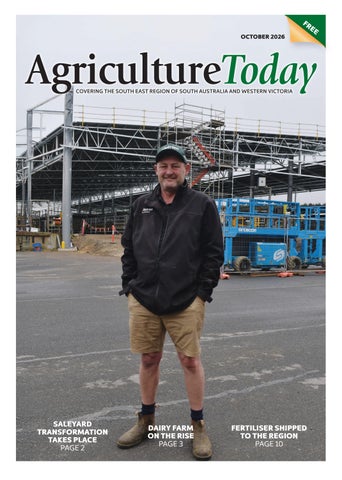
OCTOBER 2026 6
SALEYARD TRANSFORMATION TAKES PLACE PAGE 2
DAIRY FARM ON THE RISE PAGE 3
FR EE
FERTILISER SHIPPED TO THE REGION PAGE 10 OCTOBER 2026 | AG TODAY 1
AGRICULTURE TODAY
Saleyard upgrade ahead BY CHARLOTTE VARCOE
WHILE the Mount Gambier and Districts Saleyard Transformation Project is well underway, cattle and sheep sales look a little different. Mount Gambier Combined Agents chairperson Sam O’Connor said while the project was well underway, sales had needed to be divided into fortnightly slots. “We made the decisions as a combined agent group because we have lost about 70 pens over there for this first stage of the Saleyards Transformation Project and that will happen for the next two stages as well,” Mr O’Connor said. “Our capacity here for store sales has been reduced to about 2500 head and going through the next 18-month period, traditionally we are yarding 4500 head per month.” He said the combined agents made the decisions on how to facilitate the sales after loosing a large number of pens due to construction. “That will continue through to the completion of the transformation,” Mr O’Connor said. “If the numbers drop off in March, April or May we will revisit it then and we might combine a bit earlier but we are just trying to work with what we have got at the moment.” He said while there had only been a small number of sales so far both were successful despite initial concerns. “A few people in the community have questioned how it has been done, when it has been done and why, I think the results have shown for themselves,” he said. “We have been able to yard the cattle and the buyer support is definitely there so there is always going to be a few people who question why you make the you make but we believe we have made the decision which is in the best interest of the producers of the region, the users of the sale-
Mount Gambier Combined Agents chairperson Sam O’Connor welcomes the new Mount Gambier Saleyards Transformation project. (Charlotte Varcoe)
yards and we have got the support of the buyers behind us and we think this is the best way to go forward and manage the situation.” Labelling the transformation project as “absolutely marvelous” Mr O’Connor said it was incredible and when the works originally be-
gan with ground work, many agents would “sit out the front and wonder” how it would come together. “It did not look like much was happening, then all of a sudden the poles went up and there was a roof there,” he said.
“You look at it now and you can see it is actually happening and we get so many comments from people just driving past because they can suddenly see this giant structure going up.” Mr O’Connor said the investment would secure the future of the saleyards with an “overwhelmingly positive” response. “For the people who actually use the saleyards and come here to see it, it has been nothing but positive and really good,” he said. “Once it comes out of the ground, people can actually see it and the prep work, all the hard stuff they do before it, you do not see it, all you see is distraction and disruption because you do not see anything really happening.” Despite a slight disruption, Mr O’Connor said price wise, things were good for a while for both cattle and sheep. “We have just seen it cheapen off a little bit in the last couple of weeks which you expect once a few numbers start to come into the system,” he said. “Generally speaking prices are still very buoyant and with the hopes of a little bit more rain I can see the prices staying pretty buoyant for a while yet.” He said both cattle and sheep were selling really well. “We have not really started selling new season lambs here just yet but they have started to hit the market in other areas and in earlier areas and they are making good money,” he said. “Lambs, mutton, all making expected values and really good values and cattles as well and they have remained for quite sometime now and although we do expect cheapening to happen, the market indicators all remain pretty positive.” With prices remaining buoyant for at least 12 months, Mr O’Connor said all that was needed was continuous rain to keep it going.
The Border Watch Address: Level 1 / 1 Commercial Street East, Mt Gambier SA 5290 Telephone: 08 8741 8170 Website: www.borderwatch.com.au Hamilton Spectator Address: 84 Gray Street, Hamilton, Vic 3300 Telephone: 03 5572 1011 Website: www.hamiltonspectator.com.au Portland Observer Address: 92 Percy Street, Portland, VIC 3305 Telephone: 03 5522 3000 Website: www.portlandobserver.com.au CONTACT US Editorial: Email: editorial@agtoday.com.au EDITORS: Elisabeth Champion E: elisabethchampion@tbwtoday.com.au Marlene Punton E: marlene.punton@portlandobserver.com.au Advertising: Email: advertising@agtoday.com.au ADVERTISING CONSULTANTS Leesa Cook E: leesa.cook@portlandobserver.com.au Sierra Laird E: sierra.laird@portlandobserver.com.au Shannon Benge E: shannon.benge@hamiltonspectator.com.au Christine Cock E: christine.cock@tbwtoday.com.au Christine Black E: christine.black@tbwtoday.com.au Josh Phelan E: josh.phelan@tbwtoday.com.au Published by SA Today Pty Ltd. ACN 644 311 937
All material is copyright to SA Today Pty Ltd. All significant errors will be corrected as soon as possible. Distribution numbers, areas and coverage are estimates only. For our terms and conditions, please visit https://borderwatch.com.au/terms-and-conditions/ 2 AG TODAY | OCTOBER 2026
Dairy is a big export earner for Australia.
Growing demand for dairy VICTORIA is Australia’s leading dairy exporter, and now the State Government is entering a new partnership to continue growth. The partnering with Dairy Australia aims to help more dairy businesses access new trades and markets. The State’s Minister for Agriculture Michaela Settle announced $250,000 in funding for the Growing Demand for Victorian Dairy Exports Program. This funding through Global Victoria was matched by Dairy Australia, which will enable the delivery of: • The Dairy Australia Scholarships Program including the Victorian based visit program and ongoing alumni engagement; • International seminars, showcasing the best of Australian dairy production and innovation on a global stage; • Trade policy and market access work.
This program will help dairy businesses strengthen their trade relationships across Greater China, Japan and Southeast Asia – markets that are crucial to Victoria’s dairy export success and future growth. For more than 25 years, the Dairy Australia Scholarship Program has built strong commercial and industry connections between Victoria and international markets. Each year, participants from China, Japan and Southeast Asia take part in the Dairy Australia Scholarship Program to gain firsthand insight into Australian dairy farming practices, manufacturing and food safety systems. More than 950 alumni now hold influential roles throughout Asia, providing valuable insights into consumer demand, market trends and future trade opportunities. The program forms part of the Government’s $10 million Food and Fibre Exports
Program Regional Package and will support the continued growth of one of Victoria’s most important agricultural industries. Ms Settle said Victoria accounts for around 74 per cent of the nation’s dairy exports by value. In 2024-25, Victorian dairy exports were valued at $2.79 billion. “Victoria’s dairy farmers produce the best dairy, and we’re proud to back them so they can connect with customers around the world,” she said. Dairy Australia CEO Dr Matthew Shaffer said: “The Victorian Government and Dairy Australia have enjoyed a strong, longstanding partnership, which has supported the Victorian dairy industry to take advantage of commercial opportunities globally that drive demand and value for our dairy products.”
AGRICULTURE TODAY
Genetics put herd on the rise STATISTICS show that 2021 was a pivotal year in the journey of Chloe and Rodney Brown’s Jersey herd at Kirkstall in south-west Victoria. Before that year, their herd’s Balanced Performance Index (BPI) was consistently below breed average but since that time it has consistently bettered the national average. The BPI is a measure of genetic merit for the key traits that affect dairy farm profitability. Two major changes in 2021 have been instrumental in turning around their herd’s genetics - moving from a Jersey-Holstein mix to concentrate solely on Jerseys and starting genomic testing. Their herd now ranks 63 in Australia for BPI with an average of 45. It consistently tracks above national average for genetic progress for longevity and has made significant improvements in genetic merit for fertility and mastitis. Ms Brown that concentrating on one breed and genomic testing all calves have been significant contributors to their success, with data playing a big role in their decision making. “We’ve got history going back multi-generations and then genomics builds the story for what we do,” she said. “It gives us really good data to be able to make good decisions.” Chloe and Rodney have been leasing his parents’ farm since 2016. They started with a five-year plan to go straight Jerseys, but it took a clearance sale to push them into action. “In 2021, Jamie Drury’s herd of cows was up for dispersal at Tamworth,” she said. “It was a great herd so we bought 50 and sold about 80 Holsteins and also bought some local Jerseys. “We had the five-year plan but hadn’t done anything about it, then with great dispersals, we could do it.” Rodney had the Jersey portion of his fam-
Chloe and Rodney Brown run Jersey cows at their farm in Kirkstall. (Supplied)
ily’s herd and continues to prefer the breed for its smaller stature, good feed conversion and high components. “Our farm has a heavy clay base and can pug easily so the Holsteins did way more damage,” he said. “We also thought it would be easier to manage one herd, especially when it came to feeding. Concentrating on one breed has definitely improved the quality of the herd.” They now milk about 200 cows on a compact 133 hectares, which also has to maintain young stock. As part of their changes, Chloe and Rodney moved away from “just joining cows”. “We have a clear vision of the type of cow we want,” she said. “She needs to be strong in stature, milk really well, especially in terms of components, convert really well and do better on less, and she must get in calf. We focus on fertility, com-
ponents and strength.” They use selective mating, with genomics data becoming a more important cornerstone of their plans. At least 80 per cent of the herd has been genomically tested. “We probably didn’t use the data as well as we should have at the start but now you realise you can’t do anything without data,” he said. “Now we look at the genomic data and every cow is visually assessed in the paddock and we have so much breeding and classification history to look back on. It becomes part of the jigsaw puzzle to figure out what we want.” With their breeding consultant, Chloe and Rodney go through DataGene’s Good Bulls Guide to look at their best options. “We look at who is at the top, what can we use, and what suits our herd. A bull might be number one in the country, but we ask ourselves will he actually suit our cows and can we
achieve what we want to achieve with that bull.” Nearly 80 per cent of their cows are bred from bulls that meet DataGene’s Good Bulls criteria. The bulls they have chosen over the past 10 years have improved their cows for BPI, HWI overall type, protein, fat, fertility, mastitis resistance and longevity. While the vast majority of these improvements fit their goals and breeding choices, Chloe describes the improved longevity as a “happy accident”…not that she’s complaining. “It’s not a main focus but we always love having cows productive for as long as possible.” They use a mix of sexed semen on cows along with conventional semen and a small percentage of beef semen. While Jerseys are now their focus with cross-breeds exiting the herd, eldest daughter Charlotte, 11, decided to start her own herd this year, so a sprinkle of Holstein Reds have been added to the mix. The herd calves in March-April and all heifer calves are genomically tested. “We rear all the heifers to avoid the bobby calf market,” Chloe said. “That means we rear more heifers than we need, genomically test them, and then export the tail end. This year I reared 50, all genomically tested, but we only need to bring 35 in so we keep the best. The first line of defence is the genomics. Exports are a good source of extra income for the business.” “Jerseys are never going to get as much as Holsteins but there is still a good market for them,” Rodney said. “We take out from the bottom and they’re ready to go. “We’ve got history going back multi-generations for everything and then genomics builds the story for what we do.”
12901302-AF41-26
OCTOBER 2026 | AG TODAY 3
AGRICULTURE TODAY
Parenting after separation ADVERTORIAL GOING through a separation can be a complex and emotionally taxing time. While financial matters often attract significant attention, parenting arrangements can be equally challenging and require careful consideration, particularly where young or vulnerable children are involved. Whether parents are able to reach an agreement themselves or require the assistance of the Court, every parenting decision in Australia is guided by one overriding principle: what is in the best interests of the child. Many parents understandably assume that the law focuses on what is fair for each parent, or that children should automatically spend equal time with both parents after separation. However, this is not how parenting arrangements are determined. The child’s interests are always the paramount consideration, and what a parent believes is best for their child may not ultimately align with what the Court considers to be in that child’s best interests. When assessing parenting arrangements, the Court considers a range of factors including the child’s safety, wellbeing and developmental needs. This includes protecting children, and those caring for them, from family violence, abuse, neglect or other harm. The Court may also consider a child’s views, although the weight given to those views will depend on the child’s age, maturity and particular circumstances. The law also requires consideration of the child’s emotional, psychological, educational, and cultural needs, along with each parent’s capacity to meet those needs. Maintaining
12906760-MC41-26
4 AG TODAY | OCTOBER 2026
meaningful relationships with parents and other important people in a child’s life is also an important consideration. One of the most common misconceptions is that parents are entitled to a 50/50 care arrangement. This is simply not the case. While equal time may be appropriate for some families, it will not suit every child or family dynamic. Parenting arrangements must be tailored to the individual needs of the child and the circumstances of the family. Where parents can focus on their children’s needs and work together to reach an agreement, they are often able to achieve more flexible, cost-effective and positive outcomes than through lengthy court proceedings. Once reached, these arrangements can be formalised through Consent Orders, providing certainty and enforceability for all parties. If you are navigating parenting arrangements following separation, obtaining legal advice can help you understand your rights and obligations while ensuring your children’s best interests remain the focus. To discuss your circumstances, contact Mellor Olsson on (08) 8414 3400 or email lawyers@molawyers.com.au.
Mellow Law speaks on separation. (Supplied)
AGRICULTURE TODAY
Honours for Lucindale School LUCINDALE Area School students have returned from the Royal Adelaide Show with an impressive haul of awards across cattle, sheep and goat competitions, capped by the Premier School Award and Most Professional School honours. The school’s 2026 show campaign produced results across its Led Steer, Merino Wether, White Suffolk Stud and Goat teams, with students competing successfully both in school competitions and alongside established livestock breeders. The Led Steer Competition provided what the school described as a “fairytale ending” to its 2026 campaign, with Team Lucindale named Premier School and Most Professional School. In the carcase results, Warrawindi Wowza placed first in the Schools Heavy Domestic class, while Warrawindi Western Star finished fifth in Purebred Heavy Domestic. Lucindale also featured prominently in the combined hoof and hook results, with Warrawindi Wowza finishing second and Warrawindi Western Star third. The school’s success continued in the Merino Wether competition, where Lucindale successfully defended its Best Pen of Three Wethers title. Remarkably, its second pen also finished third, giving the school two places in the top three. Lucindale finished sixth for Most Valued Fleeces from a field of 85 schools and placed second in the 70–80kg category of the meat competition.
The Lucindale students have been breeding champion White Suffolk.
Its fleeces also finished first and second in the school’s zone. Students Georgia and Sammy progressed to the top 14 of the Merino handlers competition from a field of more than 270 students.
Both were subsequently given the opportunity to handle Merinos for industry breeders, with Georgia going on to place fourth. The school acknowledged Merino breeders David and Brody Lock, of Lock-Haven Stud, for
their continuing support and for providing the school with its Merino wethers. Lucindale’s school-based White Suffolk Stud also held its own against established breeders. Its rams finished fourth and fifth in the Under 1½ Years – August Drop class, while its ewes placed second and third in the corresponding ewe class. A pair of Lucindale ewes then added another third placing in the Pair of Ewes Under 1½ Years class. The Goat Team completed the school’s broad showing across livestock sections. Jacinta, leading Knight, and Ruby, leading Jackie Chan, each collected second placings in their respective weight classes. Taylor and Binnie finished fifth, while Hannah and Wally placed sixth. Two Lucindale students also reached the goat Handlers Final. The school said one of the team’s most pleasing moments came during the Grand Parade, when the students received positive feedback on the calmness and handling of their goats in the busy show environment. Across the four programs, the school emphasised that the results reflected months of work by students feeding, weighing, handling and training animals, preparing fleeces and maintaining pens and displays. The Led Steer Team thanked its cattle breeders, sponsors and supporters, including Granite Ridge Angus for support towards a new show steer banner and curtain, while the school also acknowledged the Royal Adelaide Show Beef Cattle Committee.
12905778-AF41-26
ROB HARVEY
OCTOBER 2026 | AG TODAY 5
AGRICULTURE TODAY
New markets are growing for table wine.
RaboResearch senior analyst Michael Harvey.
Grapes show export resilience AUSTRALIA’S export-focused table grape industry is adapting to a rapidly-evolving global market, with stronger export values helping offset a smaller, weather-affected 2025/26 crop, Rabobank says in newlypublished research. The specialist agribusiness bank says
Australian table grape growers faced adverse weather conditions during the 2025/26 season – particularly in the key Sunraysia production region – leading to lower production volumes and some quality challenges. In the report, Table grape update 2026, the bank’s RaboResearch division says despite
Ee N LI sal Ny O nl o
quality • integrity • vision • performance
Online via
| Tuesday 13th October from 11am
OPEN DAY Tuesday 6th October - On Farm
200 RAMS FOR SALE 100 Maternal Rams · 100 Terminal Rams Pre-Sale inspections available by appointment Contact: Craig Brewin 0428 648 117 Maddy Webster 0435 422 940 Ross Milne Jordy Anthony
0408 057 558 0407 649 925
Antony Baillieu Dale Bruns
0417 519 599 0458 899 918
yarrampark.com.au 12901783-RV41-26
6 AG TODAY | OCTOBER 2026
these headwinds, the Australian table grape sector achieved stronger export returns as it continued to diversify market opportunities. RaboResearch senior analyst Michael Harvey said Australia remained heavily reliant on export markets, with domestic production continuing to significantly exceed local consumption requirements. “The Australian table grape industry remains one of the nation’s most exportfocused fresh produce sectors, with export markets critical to industry profitability and long-term growth,” he said. “In the previous season, Australia produced close to 229,000 metric tonnes of table grapes and exported almost 150,000 metric tonnes, highlighting the importance of international demand for the sector.” Mr Harvey said the 2025/26 season presented a different set of challenges, with weather conditions affecting fruit development and reducing export availability. “Unfavourable weather conditions close to harvest in the Sunraysia region, which accounts for around 70 per cent of Australia’s table grape production, affected fruit development and led to lower volumes and some quality issues,” he said. “However, what we saw this season was that lower export availability and changing market dynamics supported stronger export values, helping offset some of the production challenges experienced by growers.” The report found Australian shipments to China and Hong Kong fell to their lowest level in 12 seasons during 2025/26, reflecting both reduced export availability and the industry’s efforts to diversify export destinations. According to Mr Harvey, this diversification strategy continues to be an important part of the Australian sector’s long-term outlook. “The declining share of exports to China and Hong Kong highlights the industry’s ongoing efforts to broaden its export portfolio and reduce dependence on any single market,” he said. “This market diversification is becoming increasingly important as global trade patterns evolve, and competition intensifies across key destination markets.” The report notes that the shift in export destinations contributed to stronger pricing outcomes, with Australia’s export value returning to average post-pandemic levels of USD 2.92 FOB per kilogram. Global trade Looking more broadly at the international market, the RaboResearch report highlights
another year of expansion in global table grape trade, driven by growing exports from emerging suppliers and changing consumption patterns across major markets. Report lead-author RaboResearch fresh produce senior analyst Gonzalo Salinas said global table grape exports are expected to reach a record 4.95 million metric tonnes in 2025/26, continuing a pattern of steady long-term growth. “The global table grape sector continues to grow despite production challenges in several traditional exporting regions,” Mr Salinas said. “We are seeing increasing volumes from countries such as Peru, South Africa and India reshape global supply patterns, while China has consolidated its position as the world’s largest exporter.” China emerged as the world’s largest table grape exporter in 2025/26, shipping approximately 770,000 metric tonnes, although the report notes this rapid expansion has been accompanied by declining export unit values. Mr Salinas said China’s growing production capacity and ability to supply grapes year-round were reshaping trade flows throughout Asia. “We are now seeing the broader implications of China’s transition from a net importer to a net exporter,” he said. “China’s growing export presence is supporting consumption growth in emerging Asian markets while also changing competitive dynamics for exporters around the world.” On the demand side, global consumption of table grapes remains resilient across major destination markets. The report notes per-capita grape availability has remained relatively stable in mature markets such as the United States and European Union, while emerging markets in Asia continue to record gradual gains. “While mature markets continue to provide a stable foundation for demand,” Mr Salinas said, “emerging markets with large populations are creating additional opportunities for exporters and helping support continued trade growth.” The report also highlights strong growth in ASEAN (Brunei, Cambodia, Indonesia, Laos, Malaysia, Myanmar, the Philippines, Singapore, Thailand, Vietnam, and Timor-Leste) markets, where imports have increased significantly in recent years. Since 2021, table grape imports into ASEAN countries have risen by 31 per cent, making the region one of the most attractive long-term growth opportunities for exporters.
AGRICULTURE TODAY
Help promote food and fibre FOOD and Fibre Great South Coast Inc. (FFGSC) is seeking expressions of interest from passionate individuals wishing to join our volunteer Board. Board members oversee the strategic direction of our organisation’s activities, finance and sustainability. FFGSC holds five to six Board meetings per annum. All Board meetings held in person with the option of attending online if required. Board members are to act in the best interests of the organisation and typically contribute around four hours per quarter in addition to Board and committee participation. Applicants will be assessed on the following selection criteria: 1. Credibility within the food and fibre industry. 2. Understanding of governance principles, Board members duties, strategic planning and priority setting. 3. Understanding of the challenges and opportunities facing the food and fibre sector in our region. 4. Knowledge of the economic drivers of food and fibre and an understanding of the value of agriculture to regional economic development. People with experience, networks and knowledge within the following areas will be highly regarded: • Financial oversight and funding processes (fund raising, agreements and reporting) • Red meat, sheep meat and wool sector • Dairy sector • Aquaculture sector • Horticulture sector • Indigenous background or networks and cultural awareness
The Food and Fibre Great South Coast Board is proud to reflect our sector’s diversity. Board members represent a range of ages, gender, commodity and career stage. We aim to maintain this type of inclusive composition moving forward. Food and Fibre Great South Coast is a representative body for Victoria’s agricultural powerhouse that spans south-west Victoria contributing over $4.6bn in agricultural output annually. We drive strategic change where it is
needed most: water management, sustainable practices, workforce issues and championing a positive industry image. Expressions of interest in joining our organisation as a member and our Board, listing relevant experience and addressing the selection criteria, should be sent to chair@foodfibregsc. com.au. For more, visit https://foodfibregsc. com.au/ About Food and Fibre Great South Coast: Food and Fibre Great South Coast (FFGSC) is
a representative body for South West Victoria’s $4.6bn agriculture sector, which is responsible for 60 per cent of our region’s gross regional product and 21.6 per cent of all regional jobs. South West Victoria is Australia’s largest agricultural production region by value, dominated by dairy, beef and sheep industries and supplying 14 per cent of Victoria’s fresh seafood. FFGSC is an incorporated organisation administered by a volunteer Board and an a Chief Executive Officer.
SafeWork SA is upgrading your business toolbox
Your SafeWork SA customer portal has been updated, making it easier for South Australian businesses and workers to stay on top of licences, assessments, and selected notifications together in one place. safework.sa.gov.au/customer-portal 12905922-MS41-26
OCTOBER 2026 | AG TODAY 7
AGRICULTURE TODAY
Melrose leads merino field ADVERTORIAL IN an era where livestock breeding is increasingly driven by data and objective measurement, Melrose Merinos has established a reputation for successfully blending modern genetic tools with the traditional skills of stockmanship. The result is a flock that not only performs in the paddock but also continues to attract attention in the show ring. Over many decades, Melrose sheep have earned recognition for their combination of productive performance, visual appeal and fleece quality. That reputation was further reinforced at the 2026 Bendigo Sheep and Wool Show, where the stud enjoyed a successful showing, claiming Champion Superfine Wool March Shorn poll Ram. Success has not been confined to the show ring. Commercial demand for Melrose genetics remained strong at the stud’s 2025 on-property ram sale, where all 48 rams offered were sold. The sale averaged $1,837, with the top-priced ram, Poll Ram 24RP8474, selling for $4,000 to Ashley, Katrina and Emily McErvale. The complete clearance reflected continued confidence from clients seeking genetics that can deliver both productivity and predictability. At the heart of the Melrose breeding program is a philosophy centred on continual improvement through informed decision-making. The stud employs a considered breeding strategy that combines visual assessment, practical experience and independent expert advice with the use of objective measurement tools. Renowned sheep classer Chris Bowman plays an
important role in the evaluation process, providing independent insight when classing ewes and selecting sires. The stud also places significant emphasis on the use of Merinoselect Australian Sheep Breeding Values (ASBVs) and selection indexes. Rather than relying on appearance alone, breeding decisions are supported by performance data that provides a clearer picture of an animal’s genetic potential and likely impact on future generations. This commitment to transparency extends to Melrose sale rams, which are offered with both Merinoselect ASBVs and comprehensive raw performance data. By providing clients with objective information alongside visual assessment, buyers are able to make more informed decisions about the genetics they introduce into their own flocks. For Melrose, however, technology is only one part of the equation. The stud’s breeding philosophy is firmly grounded in the belief that objective data must complement, rather than replace, experienced stockmanship. By balancing proven breeding principles with modern genetic evaluation, Melrose aims to achieve steady and measurable genetic gain while maintaining sheep that are functional, profitable and true to type. Wednesday, 14 October, will see Melrose again offer 48 rams, 16 horn and 32 poll. These animals meet the demands of modern woolgrowers while remaining true to the qualities that have underpinned the stud’s success for generations.
Melrose Fine Wool Merinos
FLOCK No. 1704 P1238 112 Russells Road, Nurrabiel, Vic 3401
On Property Auction
14th October 2026
Champion superfine horn ram at the 2025 Australian Sheep & Wool Show, with Warren Russell.
Stud Park South heads to field day ADVERTORIAL STUD Park South Merino and Poll Merino Stud (SPS) is again participating in the Southern Victorian Merino Field Day to be held on Friday,16 October. On display will be the SPS ram sale team and a selection of top end sheep which highlight the Stud’s breeding direction. SPS young rams are well grown pushing out a white crimpy wool on a productive skin. A balanced breeding objective maintaining correct constitution and white wools with staple length are becoming a feature of our sheep. Structure and doing ability are two main traits visually selected. Bred on some of the best bloodlines from Wallaloo Park, Kamballie (WA), Charinga, Banavie and Glenlea Park, we feel we have a type that is unique to the industry. Sons and grandsons continue to drive Stud Park South forward. We purchased a significant run of ewes from Barton Hill Poll Merino Stud in South Australia (dispersal), which has given us a huge injection of pure Poll blood into our stud. The Stud Park South commercial sheep on Edgarley at Willaura reflect our breeding objectives with wool cuts generally averaging around 6.5kgs and preg scanning rates pushing 170 percent in our mixed age ewes. Enjoying one of the best seasons we have
Pat and Annabelle Millear at the 2025 Stud Park South Field Day.
seen for a while, paddocks have been set up to accommodate our 10,000 strong commercial ewe flock which are generally all in lamb. Surplus stock and extra wool cut is a profit driver in any commercial flock. The current strong demand for meat and wool is a positive sign for sheep producers, offering opportunities for growth and profitability in the future. We look forward to welcoming visitors to our on-property Field Day on Friday, 16 October. Quality Poll and Horn rams will be offered at our annual on-property Ram Sale on Tuesday, 20 October at Edgarley woolshed, 724 Delacombe Way, Willaura Vic 3379.
Stud Park South Merinos and Poll Merinos On-Property Ram Sale
60 poll and horn rams
Tuesday, 20 October 2026 @ Edgarley Woolshed, 724 Delacombe Way, Willaura, Vic.
March shorn
Inspections from 10am. Sale at 1pm.
16 mths old • OJD Vaccinated • Brucellosis Accredited Free 4% rebate outside agents
60 RAMS | 2025 Drop | April Shorn
Visit us during the Southern Victorian Merino Field Days 9am-5pm | Friday, 16 October 2026
Warren Russell: 0427 881 204 John Russell: 0427 340 844 8 AG TODAY | OCTOBER 2026
12896194-EB41-26
Semen available from stud sires. Private sales throughout year. Inspections always welcome.
Principal - Pat Millear 0428 541 462 Stud Classer - Rob Russell 0427 506 291 Stud Consultant - Chris Guthrie 0437 005 805 Email: millearaps@bigpond.com OJD Vaccinated - Brucellosis Accredited Horn Flock No.5051 Poll Flock No.1462 Pic no. 3ARTR032
12895600-EB41-26
AGRICULTURE TODAY
Final ticks for huge wind farm A FINAL decision regarding the Kentbruck wind farm proposal is set to be made under national environmental law seven years after its plans were made public. The proposed site would be adjacent to several public reserves and Nature Glenelg Trust’s (NGT) wetland restoration project, which the organisation said could interrupt the flight path of many migratory and threatened species of birds and bats. If approved, the current proposal would see turbines situated as close as 300 metres from the Ramsar site and Protected Area boundary, just 500 metres from the water’s edge The proposed development consists of 105 turbines, each 270 metres tall in a remote corner of south-west Victoria. Based on local and international research, many of those species are at high risk of collision with the blades of wind turbines. NGT managing director Mark Bachmann said the organisation was seeking a commonsense decision by the Australian government at this “pivotal moment” for local wildlife. He said one location in particular, the Discovery Bay wetlands, served multiple purposes for the conservation of bird species. “The government’s own recently released risk assessment for bird flu, alongside the ecological risk assessment they commissioned last year for onshore wind farm impacts on threatened species, illustrates just how precarious the situation could be,” Mr Bachmann said.
Nature Glenelg Trust managing director Mark Bachmann is urging the federal government to consider the impact the Kentbruck wind farm would have on wildlife conservation in the surrounding area. (Supplied)
“The wetlands of Discovery Bay have become a regional drought refuge and hotspot for wildlife thanks to concerted efforts by the local community, who have worked with NGT to restore the hydrology of this wetland system for more than a decade. “At one key location, an artificial outlet deliberately cut to the ocean in the 1930s has been blocked since 2015 and the natural sand dune restored since 2019. “The wetland responded magnificently, attracting the return of wildlife and increasing
its resilience – even holding water through the extreme drought period of the past couple of years.” Mr Bachmann said it would be “inconceivable” to approve the wind farm at this time and at this location. “Against this backdrop, it would seem inconceivable that a major wind farm could be approved in this location, at this moment in time, directly undermining the resilience of this vital, restored wetland habitat that is relied upon by so many threatened species,” he said.
“This decision is shaping up to be a litmus test of the current rhetoric surrounding environmental resilience as our key collective response to bird flu. “NGT agree that we need to give our wildlife a chance to survive, persist and slowly bounce back by keeping our most significant wetland sites in good health.” A decision is expected to be reach by November 10 this year.
Forestry industry ready for bushfire season AUSTRALIA’S forestry industry has expressed a readiness for the upcoming bushfire season and is set to play a critical role in preventing, managing and responding to bushfires. With the 2026-27 bushfire season starting on October 1, the Australian Forestry Products Association (AFPA) joined forestry members near Bunbury in Western Australia to highlight the industry’s commitment to reducing bushfire risks in regional communities, as the warmer months approach. AFPA senior policy manager and bushfire spokesperson Dominic Lane said the wellresourced industry has a long and effective tradition of helping keep forests, assets and communities safe. “Our sector is fully committed and ready
AFPA senior policy manager and bushfire spokesperson Dominic Lane with Brad Barr. (Supplied)
to reduce and manage bushfire risks, and invests significant resources every year on preparedness and prevention,” Mr Lane said.
“We work closely with local, state and national emergency management authorities and volunteers to protect forests, farms, reserves, wildlife and communities.” A recent AFPA survey found the sector invests more than $100 million each year in bushfire prevention, mitigation and response across Australia. “This includes around $8 million on fire towers, detection cameras and other monitoring systems, almost $65 million on firebreaks, roads, prescribed burning and fuel management, and almost $30 million on more than 1,200 firefighting appliances and 1,500 personnel,” Mr Lane said. “Forestry companies also contribute around $15 million through insurance and
other levies that support bushfire preparedness and response.” Mr Lane said the industry works hand-inglove with local fire authorities, and regularly undertakes hazard reduction burning and embraces new techniques to reduce fuel loads. “For example, Wespine in WA is using cattle in plantation forests to reduce fuel loads, as part of an innovative new trial,” he said. Known as pyrograzing, this biological method offers a highly customisable, lowemission approach to fire management. “Overall, we sincerely our thank and applaud the forestry sector for their strong contribution and work in this critical emergency management area,” Mr Lane said.
Grains group welcomes new board directors THE Grains Research and Development Corporation (GRDC) has welcomed the appointment of three new directors to its Board, alongside the reappointment of four existing directors. Federal Minister for Agriculture, Fisheries and Forestry Julie Collins announced the appointments this week. The directors’ three-year terms began on October 1. The new directors include Victorian grain and livestock producer John Bennett, who operates a diversified family farming operation in the west Wimmera; New South Wales-based Robert Hulme, a fifth-generation farmer who has spent 30 years working in global agribusiness and Western Australian grain grower Brian McAlpine from Latham in the northeastern grain belt. GRDC Board Chair Sharon Starick welcomed the new directors and congratulated Shaun Coffey from the Northern Territory, Andrew Earle from New South Wales, Natalie Sommerville from South Australia and Belinda (Bindi) Turner from New South Wales on their reappointment. “John, Robert and Brian will bring valuable perspectives from across Australia’s grain-
GRDC Board Chair Sharon Starick welcomed the announcement of the three new GRDC Board directors earlier this month. (Supplied)
growing regions as well as global agribusiness and I look forward to the contribution they will make to GRDC and to the industry,” Ms Starick
said. “Serving as a GRDC director requires a significant commitment and a genuine interest in the grains sector. “Our directors help shape strategic investment in research, development and extension that delivers enduring benefits for Australian grain growers. “The combination of new perspectives and continuing experience, together with a broad range of skills, will support strong governance and informed decision-making as GRDC works on behalf of growers across the country.” Ms Starick thanked outgoing directors Richard Heath, Kellie Benda and Bob Nixon for their service to GRDC and the grains industry. Richard Heath served on the GRDC Board for nine years, including as Chair of the Remuneration, People and Performance Committee, after previously serving six years on a GRDC regional panel. Kellie Benda served three years as a director and contributed to strengthening GRDC’s governance standards as a member of the Audit and Risk Committee. Bob Nixon stepped down from the Board in July after almost six years with GRDC, during
which he was deputy Chair and shared practical and innovative farming insights. “Richard, Kellie and Bob have served with professionalism, dedication and integrity,” Ms Starick said. “Each has made a significant and lasting contribution to GRDC and the broader grains industry. On behalf of the Board, I thank them for their leadership, sound judgement and commitment to Australian grain growers.” Mrs Starick said she looked forward to working with the Board to guide GRDC’s investments and ensure its work continues to respond to grower priorities and deliver impact across the Australian grains industry. GRDC Managing Director Nigel Hart said he welcomed the opportunity to collaborate with the new Board to grow GRDC’s investment program and deliver against its strategy. “I look forward to working with our new and returning directors to build on GRDC’s strong foundations, grow our research portfolio and create even greater value for Australian grain growers,” Mr Hart said. “The Board’s collective experience and perspectives will help us expand the impact of our RD&E investments and keep grower priorities at the centre of our decisions.” OCTOBER 2026 | AG TODAY 9
AGRICULTURE TODAY
The storage tanks at Incitec Pivot Fertilisers’ Portland Primary Distribution Centre. (Denis Belden 579737)
Andrew Evans and Matthew Evans have been among a crew of 12 workers from Portland’s Precision Engineering who have spent the past two months reinstating the pipelines from the KS Anderson wharf to the tanks at Incitec Pivot Fertilisers. (Denis Belden 579737)
Fertiliser shipped into region DENIS BELDEN
FARMERS across the Green Triangle region are expected to benefit from a new move to ship fertiliser directly into the region. A $5 million investment by Incitec Pivot Fertilisers (IPF) across its facilities in Portland and Adelaide has just hit a major milestone. After months of preparation work, the company received its first shipment of liquid nitrogen fertliser from the USA on Thursday 17 September, with 5000 tonnes of urea ammonium nitrate (UAN) piped from the Chem Stellar vessel to storage tanks at IPF’s Primary Distribution Centre at the Port of Portland. The Chem Stellar made its voyage from Louisiana with the shipment, delivering to IPF’s facilities at Portland, Adelaide and Geelong. “It is a significant milestone for us,” IPF’s liquids product manager, Ben Anderson, said. “It is the first time we have shipped in a liquid fertiliser to Portland, and it will complement the granular products that we already offer.” IPF sells UAN under the brand name EASY N. The liquid nitrogen fertiliser will be stored in repurposed tanks at the distribution centre before being sold to farmers. The tanks had previously been used to store sulfuric acid, which was used in the manufacturing process for making granular single superphosphate, but have sat idle since the Portland manufacturing plant was closed in 2019. Mr Anderson said the investment in the facilities at Portland and Adelaide would strengthen the company’s capacity to deliver products to farmers. “UAN is a product that IPF has had for a number of years now, but this investment is making it more accessible to farmers and our customers, and to really guarantee supply around peak periods. “It is a complementary product, offering a diversified nitrogen choice for growers. “The advantage of a liquid is that it can be applied more precisely, and there is less manual handling involved. “The big benefit for the farmers is that it can be stored on farms for longer, so they have it there ready to use. It gives them flexibility in their operations.” The investment has increased UAN storage capacity in southern Australia by 64 per cent. “For us it is about making the product more accessible. “Portland is already a major distribution point, and this is bringing in a complementary product. “It means we are not so reliant on the Middle East where we have seen a lot of challenges 10 AG TODAY | OCTOBER 2026
Incitec Pivot Fertilisers’ Portland site manager Therese Walton, regional general manager Victoria Jason Minkhorst and liquids product manager Ben Anderson were on hand to witness the first delivery of urea ammonium nitrate into Portland last week. (Denis Belden 579737)
with shipping in the last 12 months. “Urea became pretty hard to get because of the Middle East crisis, so what this product does is it diversifies our supply chain of nitrogen. “This ship today has come from the USA, but the next shipment will likely be from China. “We expect to get to the point where we will bring in four or five ships on an annual basis. “We are really striving to get to the point where we can bring in larger shipments, make more frequent shipments, and make UAN a more relevant product.”
The storage tanks at IPF’s Portland facility hold about 5700 tonnes, or about 4.3 million litres, and are fed via a sealed pipeline from where vessels dock at the K.S. Anderson wharf. “That is the same system that was being used for the sulfuric acid, so there has been quite a bit of work going into that line and the tanks to make sure they are fit for purpose.” That work has been carried out by Portland firm Precision Engineering with 12 employees devoting about two months to the project. “Today is the exciting part where we are getting our first shipment of the product off the
ship and into the tank. “We still have some work to do over the coming months to get the dispatch area finished, so we aren’t delivering to farmers yet. “Once that is up and running we will deliver product to farms, where they will have their own storage tanks. “The beauty of this product is that it can be stored for a long period of time. It means farmers can take that delivery early, prior to peak seasons, and have that storage on farms ready to use when they need it.”
AGRICULTURE TODAY
Crush capacity key to upscaling
EXPANDING domestic crushing capabilities will be key to scaling up Australian canola production in the future, Rabobank says in new industry research. The specialist global agribusiness bank says Australia has the capacity to lift its average annual production of canola – the country’s primary oilseed crop – to around seven million tonnes a year over the next 10 years, up from recent annual averages of 6.5 million tonnes. This is made possible by “structural gains” in cropping area, genetics and agronomy practices, it says. However, the report – Harvesting the future: How far can Australia scale canola crushing?, by the bank’s RaboResearch division – cautions that without a material expansion in domestic crushing capacity, canola’s production growth will likely “remain incremental and variable”. Report author, RaboResearch senior grains and oilseeds analyst Vitor Pistoia says growing global demand for biofuel has seen Australia’s canola sector respond with significant supply growth in recent years, however this has primarily been in the form of increased canola seed exports to be crushed off shore. “Australia’s export-led system has responded to global demand growth largely through higher canola seed exports rather than by expanding domestic crushing capacity (to enable oil exports),” he said. “And this has limited the extent to which that demand growth is translated into local value-adding, job creation and more stable domestic price formation.” The report says expanding local canola crushing capacity could result in improved price stability and boost grower confidence. “Regions in Australia with higher canolacrushing density already exhibit more stable pricing dynamics than export-dependent zones such as Western Australia,” Mr Pistoia said. “Expanding crushing capacity in Australia would absorb surplus supply, stabilise basis and reduce volatility, creating a positive feedback loop that supports grower confidence, sustained area and long-term supply growth.” Canada comparison Mr Pistoia said a comparison of Australia with other major canola-producing regions in the world, such as Canada, highlighted the importance of domestic processing in supporting area expansion. Today, canola accounts for roughly 14 per cent of Australia’s winter cropping area compared with approximately 28 per cent in Canada, where a large crushing industry underpins stable demand.
RaboResearch senior grains and oilseeds analyst Vitor Pistoia.
“In Canada, a large share of canola production is absorbed by domestic crushers, creating a stable demand base that supports persistent cropping intensity alongside exports,” Mr Pistoia said. He said expanded domestic crushing in Australia would support a lift in total winter canola cropping area and more persistent canola plantings over time. Local production The report says Australian canola area has increased at an average rate of around 3.5 per cent per year since the early 2000s and is projected to reach 4.1 million hectares, or around 16 per cent of Australia’s winter cropping area by 2030. “Over the past two decades, production and planted area have expanded steadily, supported by varietal improvements, advances in agronomy and buoyant export demand, particularly from Europe and Asia,” Mr Pistoia said. Assuming continued area growth, national canola output is expected to reach about seven million tonnes a year. In renewable diesel terms, this equates to around 2.4 billion litres a year, Mr Pistoia said. Over the past five seasons – 2021/22 to
2025/26 – canola area has averaged around 3.4 million hectares within a total winter cropping area of approximately 24.1 million, he said, indicating recent growth has been “incremental rather than transformational, with the share of the cropping mix still relatively low, despite price increases”. Grown primarily in Victoria, New South Wales and Western Australia, these states account for approximately 92 per cent of canolacropped area in Australia. Mr Pistoia said canola was generally “viewed as a high-value break (rotational) crop” within cereal-based farming systems, although now for some regions it is a core element of the cropping program. “Canola delivers rotational benefits, but remains sensitive to seasonal conditions, with moisture availability during establishment continuing to impact year-to-year outcomes,” he said. Where? Western Australia offers the clearest, most scalable supply expansion opportunity for Australian canola, the report said. “If domestic crushing expands, Western Australia is poised to anchor supply growth, supported by rising area, improving yields and
a large, export-oriented surplus,” Mr Pistoia said. “Kwinana, Albany and Esperance stand out as the most reliable supply hubs, collectively exporting around 2.6 million tonnes in recent seasons, close to 45 per cent of national exports.” By contrast, parts of New South Wales and Victoria have more limited growth potential “due to competition from other winter season land uses”, he said. “Australia’s exportable canola surplus is overwhelmingly concentrated in WA, while New South Wales and Victoria already divert a significant share or production into domestic crushing.” * The Harvesting the future: How far can Australia scale canola crushing? report is part two in a three part-series exploring opportunities and challenges for Australia and New Zealand’s farming sectors in leveraging regional biofuel production from canola. Part one examines how rising biofuel demand could underpin canola prices and support the development of canola value chains. Part three, yet to be released, will look at canola meal, considering the sectors that could potentially absorb the increase in this coproduct as canola production expands.
Locust surveillance urged as hatching begins LANDHOLDERS and managers are being asked to ramp up their surveillance efforts as the first locust egg hatching has begun in parts of the northern Mallee. Agriculture Victoria’s incident management team incident controller Alex Perera said now that young locusts have been detected, it was important for landholders and managers to conduct surveillance of their properties to understand their specific situation. “Where land managers see hatching has occurred, they should begin preparing to treat using registered chemicals that suit their specific needs,” Ms Perera said. “Spraying will be most effective around two weeks after hatching, when young locusts are on the ground and banding together but not yet flying. “Ground spraying with an approved insecticide is the most effective way to manage locusts and protect crops and pastures.” Ms Perera said the hatching of locust eggs in the north of the Mallee was not unexpected.
Priority areas were determined through surveys in May to establish areas with a heightened risk. She said surveillance was focused on seven priority local government areas, based on forecasts showing a moderate to high chance of high locust numbers in the Mallee and a low to moderate chance of high locust numbers in the Wimmera. Agriculture Victoria will support private landholders, councils and public land managers throughout September and October by conducting surveillance, collecting public reports and identifying when and where locust management activities, such as ground spraying, should be implemented. “Early reporting helps support accurate advice to landholders and managers and leads to a reduced risk of widespread impacts,” she said. “Different insecticides are approved for use on or in different crops or situations. the product label and make sure the product is approved for use on Australian Plague Locusts.” Locust reporting options are available online or by calling 136 186.
Agriculture Victoria is calling for help with locusts. (File) OCTOBER 2026 | AG TODAY 11
AGRICULTURE TODAY
Haystack fires emerging WITH haymaking under way across the region, firefighting authorities are reminding landowners to be vigilant when it comes to baling. Haystack fires are often caused by spontaneous combustion when hay is baled with excess moisture. High moisture levels, combined with the compact nature of hay bales, can create internal heat, leading to ignition. The warning follows an incident in Donald last month, where about 400 bales were lost in a haystack fire. Five CFA units, including a bulk water carrier, were called to the fire at 5.35pm on September 3, crews worked swiftly to bring the incident under control in just over half an hour. Donald Captain and Incident Controller Brod Harrison said the fire was initially largely contained within the bales. “When we first arrived, there wasn’t a lot of fire. It was mostly smouldering inside the bales, but once we pulled them apart, they started to flare up,” Brod said. “About half a dozen nearby farmers brought machinery to help separate the burning bales from the ones that could be saved.” The incident was followed by a second significant haystack fire in Lockington on 12 September, which affected around 120 bales. CFA District 18 Acting Assistant Chief Fire Officer Shane Bailey said there were a number of factors that could contribute to haystack fires. “Hay that is baled with too much moisture can generate heat as it sits in a stack, and under the wrong conditions that heat can build to the point where a fire starts. “It’s important that people storing hay un-
The haystack fire in Donald.
derstand the risks and regularly monitor their stacks, particularly in the weeks after baling.” “Haystacks should be kept well-ventilated and, where possible, separated into smaller stacks rather than having a large amount of hay stored together,” Shane said. “Keeping sheds, gutters and downpipes well maintained can also help prevent water
from getting into stored hay.” He said checking the temperature of stored hay was an important precaution. “There are a range of ways people can monitor the temperature of hay, from traditional temperature probes through to newer technology that can provide remote readings and alerts.
“If a haystack is getting unusually hot, that can be a warning sign that something is happening inside the stack and it needs to be taken seriously.” For more information, visit CFA’s website or contact your local CFA brigade for advice on haystack safety.
Agriculture Today is a monthly farming publication dedicated to delivering trusted agricultural news, industry insights, and market information. Reaching more than 36,000 readers across South East South Australia and Western Districts Victoria, it connects producers, agribusinesses and rural communities throughout one of Australia’s most productive farming regions. Bookings for the next edition close Friday 30 October, 2026. To find out more please contact our team today: Leesa Cook Sierra Laird Shannon Benge Lia Slattery Christine Black Christine Cock Josh Phelan
leesa.cook@portlandobserver.com.au sierra.laird@portlandobserver.com.au shannon.benge@hamiltonspectator.com.au lia.slattery@hamiltonspectator.com.au christine.black@tbwtoday.com.au christine.cock@tbwtoday.com.au josh.phelan@tbwtoday.com.au
0427 718 172 0438 593 449 0427 747 119 03 5572 1011 08 8724 8172 0419 811 381 08 8741 8173
12881871-LD41-26
12 AG TODAY | OCTOBER 2026
Cattle yard upgrades, improve efficiency and reduce injuries.
Safety, it does more than keep you safe.
Scan for farm safety support.
12897634-KF41-26
Upgrading your cattle yards can reduce animal stress and make your job safer and more efficient. To learn more about upgrades you can make on your property, including cattle gates and ramps, visit worksafe.vic.gov.au/safer-cattle-handling
OCTOBER 2026 | AG TODAY 9