6 minute read
Scaling a Website and Marketing Is Easy (If You Use the Right Stack)

Previously, scaling up meant hiring fifty more people, buying physical servers, and burning through your venture capital just to keep the lights on. It was a linear game: to get 10x the results, you needed 10x the budget.
That era is officially over.
Today, scaling is no longer a resource problem – it is a workflow problem. If you can’t scale, stop blaming your team and start looking at your tools.
The reality is that with automation, AI, and specialized management systems, you can triple your website traffic and scale your marketing strategy while keeping your team the same size.
Before you spend another dollar on a new hire, we have identified the core areas where you need to make a revision to your current stack.
Scaling Your Website: Infrastructure and Localization
To scale a website, you have to stop thinking of it as a collection of static pages and start seeing it as a dynamic data stream. If your team is still manually copy-pasting text into a website editor, that does not support your scaling.
1. Tech Foundation Should be Headless and Cloud
The first step to easy scaling is separating your content from your design. In traditional setups, your content is trapped inside your website’s design. If you want to change a price or a headline, you have to go into the back-end of every single page.
Instead, move to a Cloud-based Headless CMS (such as Contentful or Sanity) to separate content from the visual layer of the website. This allows you to serve your content anywhere (your website, a mobile app, or a partner portal) from one single source.
Automation is the glue. Instead of manual uploads, use APIs to trigger updates. When you update a product description in your database, it should automatically sync across every digital channel you own. That is how you scale infrastructure without scaling your workload.
2. What If You Try to Scale Internationally?
If you want to grow your traffic fast, the answer is not just to produce more content. It is time to explore new markets.
The fastest way to scale a website is to duplicate its success in a new language. However, this is where most companies get lost. They try to manage translations using spreadsheets and email threads. But this is a killing sentence for growth. Manual translation kills scaling because it is slow, prone to error, and difficult to track.
You Need a Translation Management System (TMS)
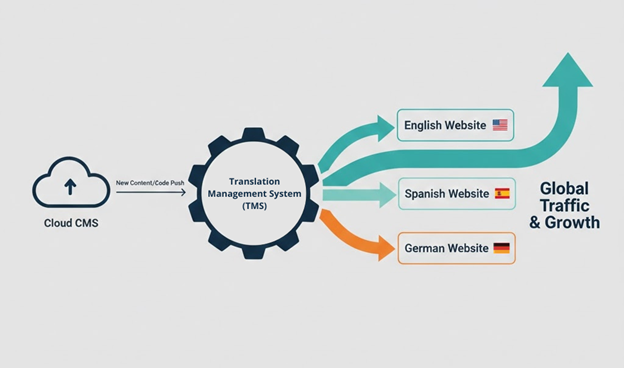
To make global scaling easy, you need a translation management system. TMS automates the lifecycle of multilingual content, and acts as a central hub where your code, AI translations, and human proofreaders work in sync.
Here is how your new stack will handle a new market:
Push: Your developers push new code or content to a repository (like GitHub).
Extraction: TMS automatically grabs the new text strings.
Transformation: AI or professional linguists translate the strings inside the platform.
Pull: TMS automatically pushes translated content back to your website.
With this setup, launching 10 languages is literally as easy as launching one. You do not need ten different web teams. You just need one automated pipeline. Set it once, and it will work for you forever.
Scaling Your Marketing: Channels and Content
Marketing usually feels like a treadmill. The more channels you add (LinkedIn, X, Telegram, blogs, emails), the faster you have to run. But if you have the right tools, you can increase your content velocity without burning out your creative team.
1. Content Velocity through AI
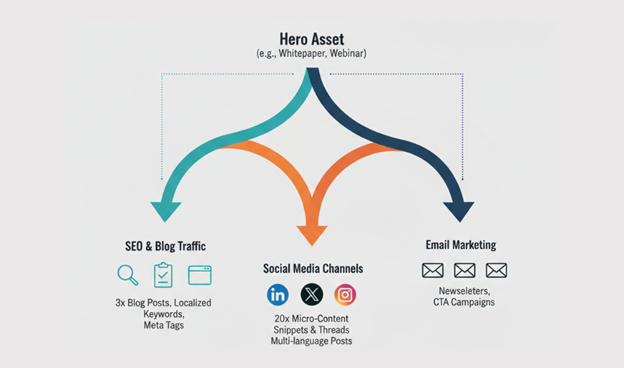
Stop trying to write every blog post from scratch. To scale, you need to master the hero asset strategy.
Take one high-value piece of content (such as a 20-page whitepaper or a recorded webinar) and use Generative AI to break it down. A single main asset can be broken down into:
5 SEO-optimized blog posts.
20 social media snippets.
An email drip campaign.
A video script for YouTube Shorts.
AI handles the busywork of formatting and sharing, so your team can focus on the big ideas.
Please note that you should review and edit the AI output for mistakes, and too robotic sentences. Anyway, that will be quicker than starting from scratch.
2. Global SEO Practices to Scale Your Traffic
You cannot scale marketing if you only exist in the English-speaking world. There is a large audience of non-English speakers searching for exactly what you sell.
However, simply translating your blog is not enough. To get that traffic, you need seo localization. This means moving beyond word-for-word translation and actually localizing your strategy. You need to research what keywords people really use in France or Germany. You need to optimize your meta tags and headers for those specific regional search engines. URL structure, alts, schema markup, and many more aspects need your attention too.
When you combine a TMS with a localized SEO strategy, you can dominate search results in multiple countries simultaneously, bringing in organic traffic without increasing ad spend.
3. Distribution Automation
Finally, you need to automate the distribution. Tools like HubSpot, Zapier, and Buffer let you schedule and distribute your content across all channels at once.
The magic happens when you connect your distribution tools back to your TMS. Imagine this: you finish a campaign in English. Your TMS automatically handles the Spanish and German versions, and your distribution tool schedules all three versions to go live at the optimal time in their time zones.
That is what easy looks like. It is a fully automated system that runs independently once it’s set up.
Conclusion
The myth that scaling requires "more" is dead. Nowadays, scaling is about the efficiency of movement.
If you feel like your growth has stalled, it is time to audit your stack:
Are you still using spreadsheets for content?
Are you manually uploading blog posts?
Are you ignoring non-English markets because they seem too hard to manage?
If the answer is yes, you are working too hard. Just use the right stack, and scaling becomes the easiest part of your business.
Yes, you will spend some time setting up these new workflows. Configuring a Headless CMS, mapping your TMS API, and prompt engineering your AI requires effort. However, this is an investment. Once these systems are integrated, they will work for you indefinitely, allowing you to grow without adding more work.