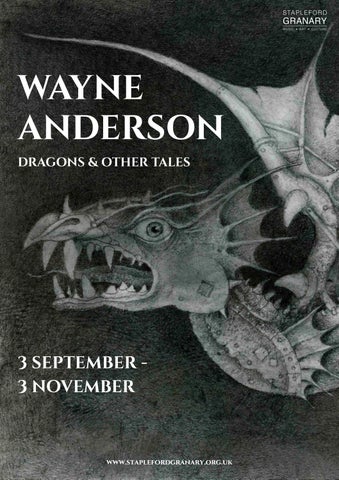
WAYNE ANDERSON DRAGONS & OTHER TALES
3 SEPTEMBER 3 NOVEMBER
www.staplefordgranary.org.uk
Front cover image: Prototype, 2007 Inside cover image: Juggling Full Moon, 1998
Contents Introduction Advertising & iconography Dragons & other tales Materials & methods Fairy tale or fantasy? List of works
INTRODUCTION Wayne Anderson has spent more than sixty years creating extraordinary worlds inhabited by dragons, monsters, witches and fantastical machines. His illustrations combine fairy tale, folklore, fantasy and the macabre into images that are at once beautiful, humorous and unsettling. Anderson was born in Leicester in 1946. At the age of fifteen, he left school to attend Leicester College of Art as a student on the new graphic design vocational course – a progressive experimental model of tuition. This was followed by a one year postgraduate course, also at Leicester, which he used to build up his portfolio before moving to London in search of work in advertising or design. ‘I was lucky to be a student at a time when lecturers were all working artists and designers’ Anderson recalls. ‘These were people who earned their living in the creative arts and were employed to teach on a part time basis. They brought all this into the colleges — knowledge, experience, skills and imagination’. Although the course was largely focussed on typography, layout and photography, it included life drawing and still life, and gave Anderson ‘a good eye for balance’. Because of the strong drawing element in his work, colleagues suggested that he might re-think his portfolio with a view to becoming a freelance illustrator.
ADVERTISING & ICONOGRAPHY In the 1960s, Anderson’s most regular work was a fortnightly picture for Clement Freud’s Cookery Column in the Weekend Telegraph Magazine. His reputation flourished, and he has created campaigns for companies in the hospitality, travel, finance, energy, life science and insurance sectors, bridging the gap between fine art and brand promotions. A covetable set of Little Demons playing cards for Pearl Assurance (1987) show a range of everyday mishaps, ingeniously combining real-life insurable examples with the risk and probability inherent in a card game. His British Airways campaign (1988) was devised as a developing month by month story, portraying BA as a global, punctual, reliable giant of the skies. His design for Hirondell wine (1978) is a scene of floating castles, romantic and exquisitely detailed. It won the D & AD Silver Award for the most outstanding illustration for an advertising campaign.
Artwork for Hirondell wine (1978)
Artwork for BA campaign (1988)
Artwork for BA campaign (1988)
Anderson’s work in advertising sat side by side with his advancement as a book illustrator. He approached advertising with the theatricality of his illustration, treating commercial commissions as another canvas for his powerful imagination. He understood instinctively the need to create brand worlds, playing on storytelling and a sense of belonging in distinctive visual ecosystems of text, image and emotion. Whether he was designing for mass production or making individual artworks, his themes did not change; trees with human faces, monsters, witches, fish, dragons, clowns, castles, butterflies and birds appear throughout his body of work. Such was the growing iconography of his style that the commissioners of a 1983 Budweiser promotion gave him free reign to depict all his favourite characters enjoying a bottle of the famous American pale lager. Artwork (right) for 1983 Budweiser promotion
DRAGONS & OTHER TALES Anderson’s first children’s book — for which he provided both the concept and illustrations — was Ratsmagic, published in 1976. This dark, eerie picture book with a text by poet Christopher Logue, is based on a story about a hero rat who rescues a bluebird from an evil witch. It was an immediate success, and was awarded the Gold Medal for Best Illustrated Children’s Book from The Society of Illustrators, New York. The second book from the same creative duo, The Magic Circus (1979) shares the surreal aesthetic, but the tone is lighter and more playful, and the gothic quality has been replaced by absurdity, driven by the theatrical, whimsical plot line. ‘Local children used to call me the dragon man’ says Anderson. He kept a bottled baby dragon (actually a pickled chameleon) and his dragon-themed picture books have been loved by children for decades. His first dragon publication, however, was not a children’s book. The Flight of Dragons by Peter Dickinson was published in 1979 — the same year as The Magic Circus. In this celebrated fantasy book, Dickinson draws on folk tales, anecdotes and Anderson’s illustrations as evidence for a tonguein-cheek, pseudo-science thesis on the existence of dragons, explaining, for example, flight via hydrogen filled internal sacs and fire breathing through chemical reactions. Anderson was invited to expand his vision and assist in translating his style into a 1982 animated film made by Rankin/Bass Productions.
Artwork from The Flight of Dragons (book), 1979
For Dragon (1992) Anderson created both the illustrations and story; a quest for a baby dragon to find its mother. The book shows a departure from Anderson’s previous style; the images are softer and more brightly coloured. In 1993, he illustrated 11 short dragon tales (Dragons: Truth, Myth and Legend) spanning multiple centuries and global traditions, including Babylonian, Greek, Norse, and English folklore. These dragons are magnificent, voracious and powerful; they are treasure guardians, village terrorisers and man-eaters, slain by kings, gods, knights and soldiers. In The Dragon Machine (2003), Anderson seamlessly blends organic elements with mechanical shapes, questioning the lines between man-made technology and the natural world, and exploring the relationship between humans and animals, the real world and the imagination.
Dragon, 1992
Fly Me To The Moon, 2022
MATERIALS & METHODS Anderson produces his work with colour crayon pencils, pushing the boundaries of the medium far beyond normal expectations. His distinctive style combines precision and detail with a smooth colour blend of rich, luminous hues, layering the colours to produce an effect rather like an oil painting. Very occasionally, he uses other media in a picture, such as paint or ink, for details or special circumstances. Drawing with colour crayons is a time-consuming technique, and blacking in a background can take up to three days. He enjoys the simplicity of the materials. A piece of art board and a tray of pencils can be carried anywhere, there is no drying time and they take up little space.
Gotya, 1978
Help (1978, later renamed Gotya) was Anderson’s first picture on wood — an experiment prompted by a piece of sanded floorboard. The picture can be seen in The Flight of Dragons and prompted later experimentation with wood as a surface, mostly in the form of breadboards with their appealing circular shape. Anderson begins by creating ‘developement drawings’, sketching ideas on a layout pad which are brisk, crude ‘childish even’. He enjoys improvising as he works, and the sketches are rarely identical to the final picture. He says that his best results ‘have often come from starting with no more than a vague idea and letting it develop from start to finish at its own pace’. Some of his pictures have a fragmented history. The Balance of Power (1983-9) began as a poster for Budweiser. Anderson conceived of a flock of pigeons with flying caps and goggles carrying packs of beer in their beaks. Wings and tail were complete, then the project was dropped. Two years later he added an acrobat. A further two years later, he added the bird’s head. The annual Benson & Hedges Art Award (New Zealand) proposed the theme of ‘power’ and the picture was completed and named The Balance of Power for entry to the competition. Though it didn’t win, Anderson retains a lot of affection for the picture. He later re-named it again: it appears in our exhibition as The Balance of Nature (1992).
The Balance Of Nature, 1992
FAIRY TALE OR FANTASY? Wayne Anderson's work sits at the meeting point of fairy tale and fantasy. His dragons, witches and castles draw on centuries of folklore, yet his illustrations belong unmistakably to the modern world. Although fairy tales and fantasy are undoubtedly related, there are ways of distinguishing between the two. Fairy tales have their roots in archaic times and archaic thought. In this sense, they can be seen as successors to myths, which were often told to explain the universe or natural phenomena. But fantasy literature is a product of modern times. Its origins lie in the core ideals of Romanticism; a deep fascination with folklore, a rejection of logic and reason in favour of imagination and emotion, and an idealised view of the innocence and purity of childhood. Fairy tales generally aim to keep the story as close to its original version as possible, whilst reflecting the personality, time and society of the teller. Fantasy, on the other hand, is a conscious creation and an eclectic genre, freely borrowing traits from gothic novels, mysteries, romance and science fiction, often blending these seemingly incompatible elements in the same story. Fantasy started to appear in British literature in the second half of the nineteenth century with Lewis Carroll and Charles Kingsley. Both authors enjoyed huge popularity. The didactic tone of Kingsley’s Water Babies fitted comfortably into the Victorian tradition of instructional and moralising literature. Carroll’s Alice in Wonderland broke the rules, offering fun, imagination, and freedom, and adult readers recognised it as a masterpiece and a work for all ages. But the real change came at the turn of the twentieth century, with Edith Nesbit’s Psammead trilogy (Five Children and It, The Phoenix and the Carpet, and The Story of the Amulet). Gone were the remote dreamworlds and sermons, and in place were children bickering in their backyard, playing in sand pits and gravel pits, making mistakes and discovering magic right on their own Edwardian doorsteps. This clash between the wondrous and the ordinary had become a key feature of fantasy. The Golden Age of fantasy arrived in the 1950s and '60s with C. S. Lewis, Philippa Pearce, Lucy M. Boston, Mary Norton, and Alan Garner. From Narnia to Green Knowe, from tiny hidden worlds beneath floorboards to secrets buried in the landscape,
children’s fantasy was elevated to sophisticated psychological literature. The gritty realism and domestic settings of post-war British life were fused with time-slippage, myth and high emotional stakes, proving that fantasy could address modern anxieties and the complexities of human grief. Anderson’s books are fantasy novels drawing on qualities of fairy tales. Fantasy has inherited many of the more superficial elements of fairy tales (wizards, witches, dragons, talking animals, swords etc). But under Anderson’s hand and eye, these elements are modernized and transformed; his fairytale characters drink lager, and ride on the backs of mechanical birds, ducks and fish. His characters are often anchored in the real world (the small boy in The Dragon Machine, the old man in The Tin Forest) demonstrating the confrontation of the ordinary and the fabulous. Anderson’s fantasy protagonists are not the heroes of fairytales; they are an unlikely rat, a scared dragon. They lack ‘heroic’ qualities, they are fallible, they can be scared and reluctant to perform their tasks, and they sometimes fail. In this sense, they are just like us. This element of relatability in a fantastical realm is critical to the fantasy genre. As Tolkien noted, it creates a temporary sense of belief in the reader, causing us — just fleetingly — to accept alternative worlds, and the existence of magic.
Faery Juggler
Artwork from The Tin Forest
Flying Fish, 1979
Starry Starry Night, 2015 35 x 42.5cm Mixed media on canvas £600
Juggling Full Moon, 1998 40 x 47cm Mixed media £1,000
On the Road to Nowhere, 2005 105 x 80cm Mixed media £1,200
Ashes to Ashes, Dust to Dust, 2016 45.5 x 47cm Mixed media £800
Scratch, Meeow and Claw, 2004 49 x 39.5cm Mixed media £650
Bubble, 2020 44 x 44cm Mixed media £750
King Twig and Queen Crinkle, 1979 63.5 x 37.5cm Mixed media £2,600
The Balance of Nature, 1992 70 x 86.5cm Mixed media £2,800
Gotya, 1979 13.5 x 22.5cm Mixed media on wood £500
Flying Fish, 1979 35 x 36cm Mixed media on wood £500
And the Creature Could Fly, 1979 36.5 x 38cm Mixed media on wood £500
This Way, That Way, 1979 33.5 x 35cm Mixed media on wood £400
Faery with the Dragon Tattoo, 2015 40cm diameter Mixed media on canvas £1,200
The Funambulist, 1979 25.5 x 25.5cm Pencil on Art Board £450
The Wedding, 1995 46 x 39cm Pencil on tracing paper, dry mounted on acid free board £750
Three Aliens, 1996 29cm x 29cm Graphite £450
Up, Up and Away, 1979 25.5 x 25.5cm Pencil on art board £350
Alien, A, 1996 29 x 29cm Graphite £300
Alien, B, 1996 27.5 x 27cm Graphite £300
Doctor Growser, 1979 21.5 x 23cm Pencil on Art Board £450
Party in the Dump, 1996 59.5 x 70cm Pencil on tracing paper, dry mounted on acid free board £750
Buzzzz, 2013 65 x 70cm Mixed media £1,500
Magic Mushrooms, 2010 65 x 70cm Mixed media £1,500
Moondance, 2013 65 x 70cm Mixed media £1,500
Tip Toe through the Tulips, 2011 65 x 70cm Mixed media £1,500
The Last Waltz, 2010 65 x 70cm Mixed media £1,700
Heartbeat, 2014 65 x 70cm Mixed media £1,500
Blue Moon, 2010 65 x 70cm Mixed media £1,500
Fly Me To The Moon, 2022 91 x 73.5cm Coloured pencil and graphite £1,650
Out of the Flames, 2000 44 x 45.5cm Coloured pencils and graphite £600
Little Lost Dragon, 1992 58 x 43cm Coloured Pencils and graphite £1,100
Chinese New Year, 2000 52 x 51cm Coloured pencil £650
Dragon in a Bottle, 1991 24 x 33cm Coloured pencil and graphite £600
Dragon Prince of Wutang, 2000 53.4 x 49cm Coloured pencil £800
Wildwood, 1976 45 x 45cm Mixed media £800
Blue Shoes, 1988 36 x 36cm Mixed media on wooden breadboard £1,000
Creatures of the Night, 2007 67 x 94cm Mixed media £1,750
Bedtime Stories, 1993 62.5 x 48.5cm Coloured pencil and graphite £1,100
Prototype, 2007 70.5 x 50.5cm Graphite £800
Sleeping in Flame, 1989 49 x 42cm Graphite, coloured pencil, watercolour & acrylic ink £650
Creatures Appeared Out of the Darkness, 2010 37 x 25cm Poster £250
The Dragon in the Dungeon, 2011 39.5cm x 49.5cm Print £400
Flight of Dragons, 1979 78 x 90cm Poster £800
Tattooed Faery Juggler, 2005 20cm x 30.5cm Print on canvas £350
The Higher He Climbed, the Brighter He Became, 1990 23.5 x 23.5cm Print on film £600
Zodiac Sky, 1983 23.5 x 30cm Poster £225
Angry Neptune, 1999 51.5 x 41cm Print on Canvas £450
Buzzzz, 2013
Zodiac Sky, 1983
This in-house publication has been created to accompany Wayne Anderson: Dragons & Other Tales, exhibited at Stapleford Granary, 3 September - 3 November 2026. Artworks in this booklet have been supplied by Wayne Anderson and used for non-commercial educational purposes. Booklet author, Kate Romano Booklet design, Jess Henry © The Association for Cultural Exchange www.staplefordgranary.org.uk
Stapleford Granary is owned and operated by The Association for Cultural Exchange | registered charity 279567