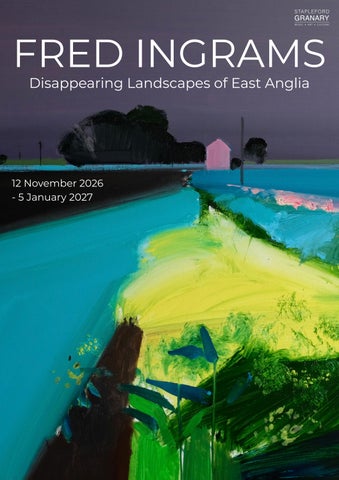
FRED INGRAMS Disappearing Landscapes of East Anglia
12 November 2026 - 5 January 2027
Dark Hedge, 2026
Contents Introduction Kate Romano in conversation with Fred Ingrams List of works Artwork used for front cover: Ten Mile Bank, 2026
Introduction British landscape painter Fred Ingrams is renowned for his captivating depictions of the Fenlands – the flat coastal plains in the East of England. His work highlights the subtle beauty and vastness of the scenery, often emphasising the everchanging interplay of light, weather, and season. Ingrams paints directly within the landscape, returning repeatedly to the same locations throughout the changing seasons. His paintings distil the experience of place through expressive brushwork, bold colour and simplified form. Born in 1964, Ingrams studied at Camberwell College of Arts before spending a decade painting from a studio above Soho's Coach & Horses pub. He later moved to Norfolk, where he continues to work between the Fens and Scotland's Flow Country. Alongside his painting practice, he worked as a graphic designer and art director for publications including The Sunday Times, Tatler, Vogue and House & Garden. This exhibition presents a new selection of paintings that celebrate Ingrams' continuous engagement with the East Anglian landscape.
‘Behind every pretty painting, there’s a visual disaster waiting to happen’ Since 2012, Fred Ingrams has painted the Fens, a million acres of low-lying marshland at the edge of eastern England. To him, this is a landscape of immense skies, black earth, vivid sunsets and startling colour; a place of solitude and spiritual intensity. Yet the very qualities that make it distinctive are increasingly under threat. The Fens are a landscape shaped by water. The historic network of canals, dykes, cuts, sluices and locks, slipways and quays, reedbeds and saltwater creeks, shapes the experience of the landscape, perhaps more than anywhere else in England. It is an area of striking contrasts: light and darkness, straight lines and tough, springy vegetation. It is brooding and faintly menacing. ‘It’s beautiful,’ says Ingrams. ‘The Fens are one of the few landscapes where one can be totally alone. When I am out painting, the only sounds are distant tractors, the call of lapwings, warblers and the cry of marsh harriers. I like to find places that are so quiet I can hear God. Space and solitude is a physical and spiritual need for me. For all these reasons, I feel so at home painting in this landscape, which has the sense of being at the edge of everything.’
Orange Ditch, 2026
For centuries, life in the Fens revolved around water. Seasonal floods sustained a thriving wetland economy: cattle grazed the marshes, reeds thatched roofs, willow supplied basket-makers, peat provided fuel, and fish and wildfowl fed families and trade. It was a carefully adapted way of life, shaped by an unpredictable landscape. But to outsiders, however, the Fens were a forbidding place of stagnant water, thick fogs and deadly ‘marsh fever’ (malaria). Fen dwellers relied heavily on selfmedication using crude opium, often prepared as poppyhead tea or laced into beer. Everything changed in the seventeenth century, when drainage schemes led by the Earl of Bedford and engineer Cornelius Vermuyden set out to turn wetlands into profitable farmland. New channels controlled the water, while enclosure stripped communities of traditional rights to fish, hunt and graze. Resistance was fierce: those defending their way of life became known as the Fen Tigers. Yet drainage brought new problems. As peat dried, it shrank and the land sank, leaving some fields below river level. Flooding remained a constant threat, making pumps essential. Over subsequent centuries, drainage and enclosure reshaped the Fens into the intensively cultivated landscape we recognise today: some of the most fertile agricultural land in Europe, but one whose existence depends on continual intervention and control. Fred Ingrams was drawn to the Fens after seeing Richard Diebenkorn's work at the Whitechapel Gallery in London in 1991. Struck by Diebenkorn’s geometrical compositions and colours, inspired by the light and geography of California, he began looking for a similar landscape to paint closer to home. On a map, he spotted ‘a strange long shape in the landscape near King’s Lynn’ and set off to find it. He ended up at Welney on the banks of the River Ouse, looking out at the flooded washes, the wildlife and birds, and had found what he wanted to paint. ‘It is a very empty landscape and one that you can be alone in. I choose what to see and what to record. I turn the volume up on the colours. I see them, and feel them, and the Fens become colourful and bright. I’m exaggerating what is there. It's an industrial landscape with a cold nagging wind, and it is a totally unnatural, manufactured façade. It feels fragile and brittle. The Fens are perhaps the least loved landscape in Britain. The flatness of this huge area does not capture the heart, and to most people they are featureless and grim’.
Magdalen, 2026
Yet this flat, featureless and grim landscape has not failed to capture the English cultural imagination. Charles Kinglsey’s nineteenth-century essays and fiction, most notably, his 1866 novel Hereward the Wake, contain vivid, painterly descriptions of the marshes before drainage. Dorothy L. Sayers The Nine Taylors is an atmospheric tale of stolen jewels, faceless corpses and bellringing set in the Fens. Graham Swift’s wonderful and discomfiting Waterland describes the Fens as ‘a landscape which, of all landscapes, most approximates to Nothing’. The poet John Clare, who moved from Helpston to Northborough in 1832, wrote about the Fenland world he knew and loved with lyricism and the eye of a working peasant and naturalist. In his early poems, everything he sees flares into life. He records minute details of local flora, bird nests, insects, and wildlife, as thoughts tumble from his astonished mind with poetic precision. What wonders strike my idle gaze As near the pond I stand! What life its stagnant depth displays As varied as the land All forms & sizes swimming there Some sheath’d in silvery den Oft siling up as if for air Then nimbling down again Clare's relationship with the Fens became increasingly grief-stricken. He passionately opposed the parliamentary Enclosure Acts, which carved up the countryside, and the relentless draining of the Fens, which fenced off open land where local people had once foraged and celebrated the seasons. In To a Fallen Elm, the felling of a majestic tree became a symbol of a wider assault on the rural commons. In The Mores, he furiously mourned the destruction of open, communal landscapes; ‘Inclosure came and trampled on the grave Of labour's rights and left the poor a slave ... And birds and trees and flowers without a name All sighed when lawless law's enclosure came’ In Clare's eyes, enclosure was not merely an economic transformation but a theft of dignity, identity and belonging.
Where Clare mourned the enclosures of the commons, Ingrams fears a different kind of dispossession; the loss of the distinctive landscape itself. ‘This exhibition might be my swan song,’ muses Ingrams. ‘All of the places I have painted are disappearing — they are falling into the sea, or about to be covered in wind turbines, solar panels, houses, data centres or flooded for reservoirs to supply water for development. This landscape is undergoing a massive change and, in some cases, its unique beauty will be destroyed. I feel that nearly everywhere I paint is under threat and the quiet, still places are harder to find. The Fens are not picture-postcard pretty, and they are underpopulated, so there is less opposition to these huge plans.’ In his painting of Burnt Fen, near Shippea Hill, cultivated farmland meets a narrow country path bordered by wild vegetation. Long, sweeping bands of brown, black and muted purple lend the ploughed field a brooding intensity. Against them, the track glows pale pink and lilac beneath a violet-grey sky. A startling strip of vivid lime green separates the foreground from the distant trees.
Burnt Fen, October 2026
‘A Swedish company has applied to build 32 wind turbines at Shippea Hill,’ Ingrams says. ‘Each one will be 721 feet tall. That’s three times the height of Ely Cathedral. Wind energy is great, but I worry about the scale of what is proposed. When turbines of this size arrive, they will affect local communities and fundamentally alter the visual character of the landscape. Every landscape in this exhibition faces the prospect of a reservoir, a wind farm or a solar farm. Behind every pretty picture, there is a visual disaster waiting to happen’. The paintings in this exhibition all feature water and its edges, in specific locations in Norfolk and the Fens. Coastal landscapes around Happisburgh, Trimingham, Overstrand and Sea Palling sit alongside ditches, banks and hedgerows beneath low horizons. Shocks of pink, orange, acid green, turquoise and brilliant yellow contrast with more subdued tones in pictures such as Grey Morning and Blue Storm. Landscapes are built from broad shapes, blocks of colour and contrasts of light and dark. Visual drama emerges from the edge of the sea and the geometry of the flat agricultural land. ‘Force yourself to see more flatly’ instructs essayist Georges Perec in Species of Spaces. Ingrams helps us to do just that: to notice the overlooked, the common and the ordinary. To ‘see flatly’ is to give the mundane — a ditch, a canal, a creek — the same attention we might give to a spectacle. Through the repetition of scenes, vanishing points, lines and shapes, Ingrams transforms what might seem a passive backdrop into a rich, living world, capturing the beauty, discomfort and fragility of this distinctive English landscape.
Revetments and Rocks, April 2026
Looking down the beach towards Overstrand, April 2026 91 x 91cm acrylic on canvas £5,500
Burnt Fen, October 2026 90 x 90cm acrylic on canvas £5,500
Block Fen II, 2026 90 x 90cm acrylic on canvas £5,500
Sea Palling to Happisburgh, April 2024 91 x 91cm acrylic on canvas £5,500
Ten Mile Bank, 2026 90 x 90cm acrylic on canvas £5,500
Ditch with a Twist, 2026 90 x 90cm acrylic on canvas £5,500
Orange Ditch, 2026 90 x 90cm acrylic on canvas £5,500
Dark Sky in May, 2026 60 x 60cm acrylic on board £2,500
Revetments and Rocks, April 2026 60 x 60cm acrylic on canvas £2,500
Strong Light, Anchor Drove, April 2026 60 x 60cm acrylic on canvas £2,500
Cliff Shadows, May 2026 60 x 60cm acrylic on board £2,500
Blue Storm, March 2026 60 x 60cm acrylic on canvas £2,500
Wet evening in the Black Fens, August 2025 60 x 60cm acrylic on canvas £2,500
Dark Hedge, 2026 60 x 60cm acrylic on canvas £2,500
Headland, 2026 60 x 60cm acrylic on board £2,500
Trimingham Beach in the Rain, March 2026 122 x 122cm acrylic on canvas £7,500
Block Fen I, 2026 50 x 50cm acrylic on board £1,800
Hot Fen, May 2026 40 x 40cm acrylic on board £1,600
Magdalen, 2026 40 x 40cm acrylic on canvas £1,800
Station Road, 2026 40 x 40cm acrylic on board £1,600
Hazy Happisburgh, July 2026 40 x 40cm acrylic on board £1,600
Trimingham, July 2026 40 x 40cm acrylic on board £1,600
Happisburgh, 2026 40 x 40cm acrylic on board £1,600
Grey Morning, Trimingham, March 2026 30 x 30cm acrylic on board £950
Autumn Storm, October 2025 30 x 30cm acrylic on board £950
Sandy Cliffs, March 2026 30 x 30cm acrylic on board £950
This in-house publication has been created to accompany Fred Ingrams: Disappearing Landscapes of East Anglia, exhibited at Stapleford Granary, 12 November 2026 - 5 January 2027. Artworks in this booklet have been supplied by Fred Ingrams and used for non-commercial educational purposes. Booklet author, Kate Romano Booklet design, Jess Henry Artwork used for back cover: Hazy Happisburgh, July 2026 © The Association for Cultural Exchange www.staplefordgranary.org.uk Stapleford Granary is owned and operated by The Association for Cultural Exchange | registered charity 279567