Stanlay | Clamp Meter DC AMPS Blog Guide
www.stanlay.in
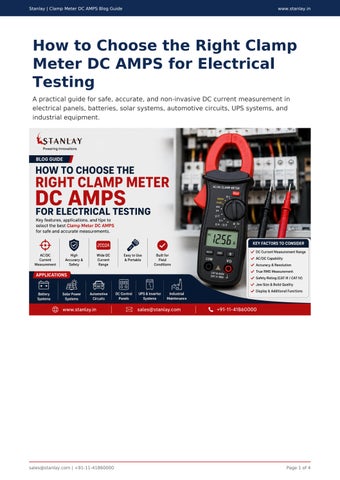
How to Choose the Right Clamp Meter DC AMPS for Electrical Testing A practical guide for safe, accurate, and non-invasive DC current measurement in electrical panels, batteries, solar systems, automotive circuits, UPS systems, and industrial equipment.
sales@stanlay.com | +91-11-41860000
Page 1 of 4
Stanlay | Clamp Meter DC AMPS Blog Guide
www.stanlay.in
How to Choose the Right Clamp Meter DC AMPS for Electrical Testing When working with electrical systems, accurate current measurements are essential for troubleshooting, maintenance, and safety. A clamp meter that measures DC amps allows you to check current without disconnecting wires or interrupting a circuit. However, choosing the right model requires more than selecting the highest amperage rating.
What Is a Clamp Meter for DC Amps? A DC amp clamp meter measures direct current flowing through a conductor. Unlike a standard multimeter, it uses a clamp that surrounds the wire and detects the magnetic field produced by the current. This makes it especially useful for testing batteries, automotive systems, solar installations, control panels, and industrial equipment. Many clamp meters measure both AC and DC current, but not every model offers the same accuracy, range, or features. Selecting the right tool depends on the type of electrical work you perform.
Key Features to Consider DC Current Range Start by determining the maximum current you expect to measure. A meter rated for 400 amps may be suitable for automotive and residential applications, while industrial or renewable-energy systems may require a rating of 600, 1,000, or more amps. Choose a meter with enough capacity for your work, but also consider its low-current accuracy. A high-range meter may not provide precise readings when measuring very small currents.
Measurement Accuracy Accuracy is important when diagnosing charging problems, battery drain, or equipment performance. Check the manufacturer accuracy specifications and resolution. A meter with a higher resolution can detect smaller changes in current, which is useful for identifying parasitic loads and intermittent faults.
Jaw Size The clamp opening must be large enough to fit around the conductors you need to test. A compact jaw is convenient for crowded electrical panels, while a larger jaw is better for heavy cables and busbars. Avoid forcing a conductor into the clamp. Doing so can damage the meter or produce unreliable readings.
True RMS Capability True RMS technology provides more accurate readings on non-linear loads, such as variable-frequency drives, switching power supplies, LED lighting, and modern electronic equipment. For mixed AC and DC applications, a clamp meter that measures both AC and DC current can help professionals measure current across different electrical systems.
sales@stanlay.com | +91-11-41860000
Page 2 of 4
Stanlay | Clamp Meter DC AMPS Blog Guide
www.stanlay.in
Zero Function DC clamp meters can be affected by residual magnetism and environmental conditions. A zero or relative function allows you to remove the meter baseline reading before measuring current. This feature is particularly helpful when taking low-current measurements.
Safety Rating Always check the meter CAT safety rating before using it. CAT III and CAT IV meters are designed for increasingly demanding electrical environments. Select a rating appropriate for the system you are testing, and verify that the meter meets recognized safety standards. Safety features such as insulated jaws, overload protection, and clear display warnings can provide additional protection during testing.
Common Applications A DC clamp meter can be used for many tasks, including:
• • • • • • •
Testing automotive charging systems Measuring battery charging and discharging current Checking solar panel and inverter output Troubleshooting motor and control circuits Finding parasitic battery drains Verifying power supply performance Measuring current in industrial equipment
Because the circuit does not need to be opened, clamp meters can reduce testing time and minimize the risk of creating loose connections.
How to Use a DC Clamp Meter Before taking a measurement, inspect the meter and test area for damage or unsafe conditions. Set the meter to the DC current function, zero the display if necessary, and open the jaws. Place the clamp around one conductor only. If the clamp surrounds both the positive and negative conductors of a DC circuit, their magnetic fields may cancel each other and produce an incorrect or near-zero reading. Close the jaws completely and keep the conductor centered when possible. Read the display and compare the result with the expected operating current. If the reading is unstable, check the meter position, battery condition, and surrounding magnetic fields.
Choosing the Right Meter for Your Needs For basic automotive work, a compact clamp meter with a moderate DC current range and a small jaw may be sufficient. For solar, battery, or industrial applications, look for a higher current rating, True RMS measurement, a zero function, and a durable CAT safety rating. If you frequently work in dark or crowded areas, features such as a backlit display, work light, data hold, and min/max recording can make testing easier. Bluetooth connectivity and data logging may also be useful for documenting measurements over time.
sales@stanlay.com | +91-11-41860000
Page 3 of 4
Stanlay | Clamp Meter DC AMPS Blog Guide
www.stanlay.in
Final Thoughts The best clamp meter for DC amps combines the right current range, accuracy, jaw size, safety rating, and practical features for your work. Consider the systems you test most often and choose a meter that provides reliable readings without exceeding its limits. For professional fieldwork, choosing reliable electrical test and measurement equipment helps improve current measurement, troubleshooting, and electrical safety. Using the correct clamp meter can make electrical testing faster, safer, and more efficient while helping you identify problems before they lead to equipment damage or system failure.
sales@stanlay.com | +91-11-41860000
Page 4 of 4